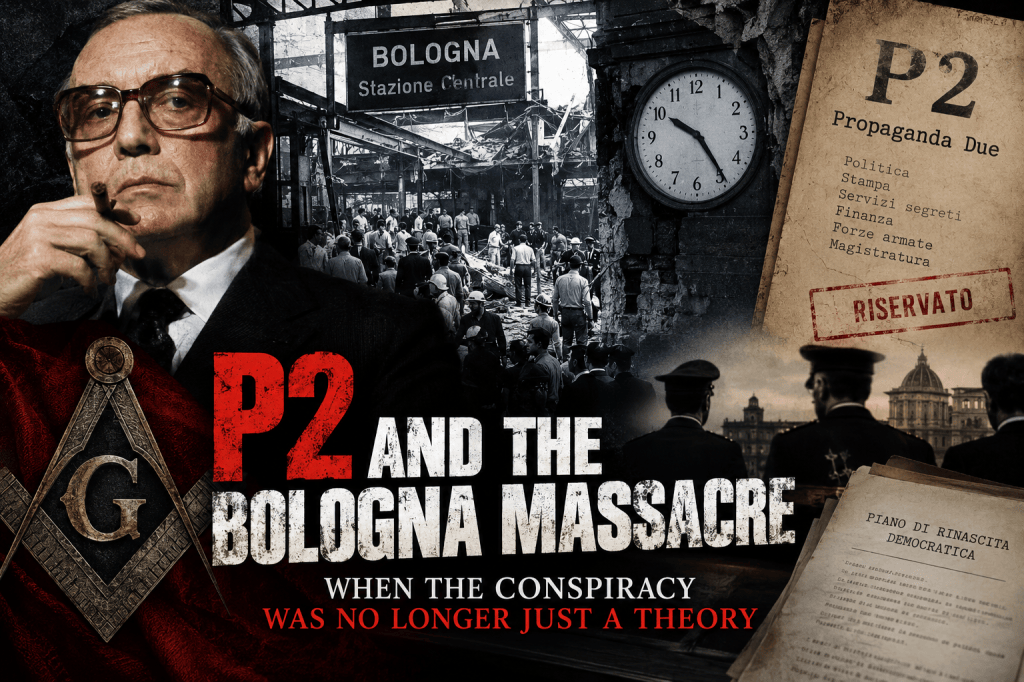
A secret lodge, intelligence officers, hidden membership lists, deliberate disinformation and one of the deadliest terrorist attacks in postwar Europe — the disturbing story of Propaganda Due is a reminder that occasionally the most frightening conspiracy is not the imaginary one, but the one that leaves documents behind.
On the morning of August 2, 1980, Bologna Centrale was overflowing with travelers escaping the summer heat, families carrying suitcases toward holiday destinations, students crossing the station, railway employees moving through another apparently ordinary Saturday and passengers waiting for trains that would never leave as planned. At precisely 10:25 a.m., an explosive device detonated inside the second-class waiting room, tearing through the building with such violence that part of the station collapsed, debris was thrown across the platforms and rescuers were forced to transform taxis, private vehicles and even the city’s number 37 bus into improvised ambulances.
Eighty-five people died and around two hundred were wounded, making Bologna the deadliest attack of Italy’s long and sinister period of political violence known as the Years of Lead. The station clock would become one of the enduring symbols of the massacre, its hands associated forever with 10:25, the moment when an ordinary summer morning became part of Italian history.
For decades, however, the explosion itself was only the beginning of the mystery, because behind the convicted neo-fascist terrorists investigators encountered something even more disturbing: false trails, compromised intelligence officers, secret networks, mysterious financial movements and a clandestine organization whose members reached extraordinarily high levels of the Italian state.
Its name was Propaganda Due — P2.
And this is where history begins to resemble the kind of conspiracy story that most people would normally refuse to believe.
THE LODGE THAT WAS NOT SUPPOSED TO EXIST
Propaganda Due did not begin as the sinister organization it would eventually become. Its ancestry lay within Italian Freemasonry, particularly the Grande Oriente d’Italia, where a special lodge known as Propaganda had historically provided a discreet form of membership for prominent individuals whose public positions made ordinary lodge participation inconvenient.
Under Licio Gelli, however, something changed.
Even the official historical account published by the Grande Oriente d’Italia acknowledges that the organization gradually escaped normal control, becoming an unusual network populated by military officers, generals, politicians, senior civil servants, bankers, businessmen, journalists and other influential figures. The same source describes Gelli’s organization as eventually operating independently and acknowledges that its abnormal development caused immense damage to Italian Freemasonry as a whole.
(Grande Oriente d’Italia – Sito Ufficiale +1)
That distinction matters enormously, because P2 should not be confused with Freemasonry in general. Italian Masonic institutions themselves eventually expelled Gelli and have consistently argued that his network represented a degeneration of Masonic organization rather than ordinary Masonic activity.
(Grande Oriente d’Italia – Sito Ufficiale +1)
Yet whatever P2 had originally been, by the end of the 1970s it was becoming something very different.
Something hidden even from many other Freemasons.
MARCH 17, 1981: THE RAID THAT CHANGED EVERYTHING
Sometimes history turns on the discovery of a document.
On March 17, 1981, magistrates investigating financier Michele Sindona ordered searches connected to Licio Gelli. At Gelli’s property in Castiglion Fibocchi, near Arezzo, investigators found documents that would trigger one of the greatest political scandals in modern Italian history.
Among them was a list containing 962 names associated with P2.
The Parliamentary Commission later chaired by Tina Anselmi examined the material in extraordinary detail and concluded that the Castiglion Fibocchi lists were authentic documents representing the P2 organization, although the Commission also questioned whether they represented its complete membership. Its investigation found corroborating correspondence and even evidence from the ribbon of a seized typewriter supporting the circumstances in which the lists had been prepared.
What made the discovery explosive was not simply the number of names.
It was where those people worked.
The list contained senior military figures, intelligence officials, politicians, businessmen, public administrators, journalists and other influential individuals, while subsequent investigations examined the extent to which the network penetrated institutions responsible for protecting the very Republic in which it operated.
The Parliamentary Commission eventually concluded that Gelli had obtained effective control over P2 and that the organization could no longer reasonably be described merely as a discreet or confidential lodge, because its secrecy extended not only toward wider society but even toward the Masonic organization from which it had emerged.
For anyone familiar with conspiracy literature, the resemblance is uncomfortable.
A hidden membership network.
Senior military officers.
Intelligence officials.
Bankers.
Politicians.
Media figures.
And a leader maintaining relationships across these apparently separate worlds.
The difference is that this time investigators had the files.
THE PLAN FOR A “DEMOCRATIC REBIRTH”
The discoveries surrounding P2 became even stranger when investigators examined documents associated with the so-called Piano di Rinascita Democratica — Plan for Democratic Rebirth.
The title sounds almost reassuring.
Its contents were considerably more unsettling.
The parliamentary investigation examined proposals involving changes to political institutions, the press, trade unions and the machinery of government, within a broader philosophy that placed extraordinary importance on obtaining influence over key centers of power. The Commission’s final report devoted an entire section to the plan and to what it called the principle of control, while its conclusions emphasized how P2 had interfered across numerous areas of national life with influence that could be substantial and sometimes decisive.
The document has sometimes been exaggerated by later conspiracy writers into a perfect blueprint explaining everything that subsequently happened in Italy, and that interpretation goes beyond what can responsibly be demonstrated. There was also substantial disagreement over its practical significance, while later criminal proceedings did not validate every sweeping accusation originally made against P2.
That uncertainty, however, does not make the document imaginary.
It existed.
And so did the network surrounding the man associated with it.
In January 1982, Italy enacted Law No. 17, explicitly dealing with secret associations and the dissolution of the organization called Loggia P2. The law defined prohibited secret associations partly in terms of organizations concealing their existence, purposes or membership while interfering with constitutional bodies, public administrations or essential public services.
A supposed secret society had therefore reached the extraordinary point at which the Italian Republic passed legislation explicitly naming it.
But the darkest part of the story had already occurred eighteen months earlier.
THE BOMB AT BOLOGNA
The Bologna massacre initially generated numerous competing theories, international leads and claims about who might have been responsible. After decades of investigation and trials, definitive convictions established responsibility among members of the neo-fascist terrorist milieu, including Valerio Fioravanti, Francesca Mambro and Luigi Ciavardini, while later proceedings added Gilberto Cavallini and Paolo Bellini to the judicial reconstruction of those responsible for the attack.
Yet the most disturbing question was never merely who physically participated.
It was whether other people had helped create, protect or conceal the operation.
Because investigators discovered something almost unbelievable.
Someone had been planting false evidence.
WHEN THE CONSPIRACY BECAME A PROVEN COVER-UP
In January 1981, several months after the Bologna bombing, a suitcase was placed aboard the Taranto–Milan train and made to appear as though it supported an international terrorist explanation for the massacre.
Inside were weapons, explosives and airline tickets connected with foreign destinations.
It looked like evidence.
It was actually manufactured evidence.
Court proceedings eventually established a deliberate operation intended to divert investigators toward false international leads. Among those convicted in connection with the Bologna investigation’s misdirection were Licio Gelli, intelligence-linked Francesco Pazienza and former SISMI officers Pietro Musumeci and Giuseppe Belmonte. The definitive 1995 Cassation judgment described attempts to redirect investigators away from Italian extremist organizations by fabricating indications pointing toward foreign terrorism.
This is one of the most extraordinary aspects of the entire case, because it moves us beyond speculation about powerful individuals secretly protecting one another.
A judicially established disinformation operation actually existed.
The same judgment discussed P2’s penetration of the security apparatus and noted that senior officials in both SISMI and SISDE were affiliated with P2, together with other important intelligence personnel.
Imagine hearing that claim before the investigations had exposed it.
Imagine somebody saying that members of a secret network had reached the leadership of intelligence services and that people connected with those services were manipulating evidence after a mass-casualty terrorist attack.
It would sound almost too perfect for a conspiracy novel.
Yet significant elements of precisely that story became part of the judicial record.
THE CASE THAT CHANGED AGAIN FOUR DECADES LATER
For many years, the Bologna story remained incomplete, particularly regarding what Italian investigators often called the “second level” — the possible organizers, financiers and figures operating beyond those who physically carried out the attack.
Then came the later prosecution of Paolo Bellini, a former member of the far-right Avanguardia Nazionale.
In July 2025, Italy’s Court of Cassation made Bellini’s life sentence definitive. The reasoning subsequently published by the Court stated that the evidence established his voluntary contribution to the massacre and his awareness that his actions formed part of a broader criminal project.
The implications went considerably further.
In discussing the reconstruction adopted by the lower court, the Cassation judgment published in 2026 records the conclusion that Licio Gelli was considered the instigator-financier of the Bologna attack, while the operational terrorists were described as acting within a broader structure involving elements of diverted intelligence or other compromised state apparatuses.
Contemporary reporting on the now-concluded trials similarly explains that the Bellini proceedings expanded the judicial picture toward the alleged organizers and financiers, identifying Gelli, Umberto Ortolani, Federico Umberto D’Amato and Mario Tedeschi within that reconstruction. Because those men were already dead, however, they could not themselves stand trial on those allegations.
And that qualification is crucial.
Saying that recent judicial findings identify Gelli as a financier or instigator within the reconstruction of the massacre is not the same thing as saying that Gelli was personally convicted of ordering the Bologna bombing. He was not tried and convicted for that role, because the later proceedings examining it took place after his death.
The distinction makes the story slightly less sensational.
It also makes it considerably more credible.
WHAT HAS ACTUALLY BEEN PROVEN?
After decades in which Bologna accumulated myths, counter-myths, propaganda and political accusations, several essential elements can now be separated from speculation.
The massacre itself was the work of the neo-fascist terrorist environment identified by repeated criminal proceedings; Paolo Bellini’s conviction became definitive in 2025, while the Italian courts had already convicted other participants over preceding decades.
P2 was a real clandestine network whose membership reached deeply into sectors of government, the military, intelligence, finance and media, while its structure and activities were investigated by a dedicated parliamentary commission.
Licio Gelli and others were definitively convicted for activities connected with the deliberate misdirection of the Bologna investigation, including the construction of false leads.
The later Bellini proceedings produced a judicial reconstruction in which Gelli and other deceased figures were identified as belonging to the level of organizers, financiers or instigators behind the massacre, although they could not themselves be tried on those accusations.
(Supreme Court of Cassation +1)
Those facts are already extraordinary enough.
There is no need to add imaginary ones.
WHAT HAS NOT BEEN PROVEN?
This is where the story becomes equally important for anyone interested in conspiracy theories.
The P2 scandal does not prove that Freemasonry as a worldwide institution secretly controls governments, that every person whose name appeared on a P2 list understood every activity of the network, or that every unexplained event in Italy during the Years of Lead can be traced back to Licio Gelli.
Indeed, the Grande Oriente d’Italia has long argued that P2 became an abnormal organization divorced from legitimate Masonic practice, and its historical account emphasizes that later criminal proceedings did not sustain some of the broadest allegations originally made about a political conspiracy against the constitutional powers of the state.
(Grande Oriente d’Italia – Sito Ufficiale)
There is therefore a danger in moving from the statement “a secret network penetrated important institutions”, for which there is substantial documentation, to the much greater statement “one hidden organization controlled everything”, for which there is not.
Reality is usually more complicated.
And perhaps more disturbing.
Because genuine covert power does not require omnipotence.
It requires only enough influence in enough places at the right moment
.
THE MOST DISTURBING LESSON OF P2
Conspiracy theories often imagine secret organizations as perfectly organized machines whose members know the complete plan and obey a central command, but real covert networks rarely operate so neatly. They consist instead of overlapping loyalties, private favors, compromised officials, political interests, financial relationships, ideological alliances and individuals who may know only a fraction of what others are doing.
P2 is frightening precisely because it resembles that messier model.
The story contains no supernatural ritual capable of changing history, no mysterious ancient bloodline and no omniscient brotherhood meeting beneath the earth.
What it contains is arguably more unsettling: people with access.
Access to intelligence.
Access to politicians.
Access to money.
Access to newspapers.
Access to military institutions.
And, according to definitive judicial findings, access sufficient for individuals connected with this world to participate in an operation that deliberately attempted to mislead investigators after eighty-five people had been killed.
The greatest mystery surrounding P2 may therefore not be whether some mythical secret society controls the world.
It may be how much power a relatively small hidden network can acquire before ordinary democratic institutions realize that it exists.
WHEN “CONSPIRACY THEORY” BECOMES THE WRONG QUESTION
There is a habit in modern culture of dividing difficult stories into two categories: either something is an officially accepted fact or it is dismissed as a conspiracy theory.
P2 demonstrates why that division can sometimes fail.
In 1980, a traveler standing beneath the clock at Bologna station could not possibly have known that decades of trials would eventually expose convicted terrorists, compromised intelligence figures, deliberate false evidence, a clandestine Masonic-derived network and judicial findings concerning a higher level of organizers and financiers.
The evidence emerged slowly.
Some documents remained hidden.
Some witnesses died.
Some investigations went in the wrong direction.
Some were deliberately pushed there.
And some questions may never receive a complete answer.
Yet by August 2026, after forty-six years of proceedings, the principal Bologna trials had reached their conclusion, while even the judge who presided over Bellini’s first-instance trial cautioned that although enormous progress had been made, the complete truth had still not necessarily been recovered.
Perhaps that is the most unsettling conclusion of all.
The P2 story does not teach us to believe every conspiracy theory.
It teaches us something far more valuable.
Sometimes we should examine the documents before deciding that a conspiracy is impossible.
Sources
– Italian Parliamentary Commission of Inquiry into the P2 Masonic Lodge — Final Report, chaired by Tina Anselmi, Italian Parliament, 1984. The investigation examined P2’s structure, membership, political influence, financial connections and penetration of Italian institutions.- Italian Republic — Law No. 17 of 25 January 1982 — Legislation concerning secret associations and the official dissolution of the organization known as Loggia P2.- Supreme Court of Cassation of Italy — Judicial findings concerning Paolo Bellini and the Bologna railway station massacre, including the reconstruction of the higher-level network surrounding the attack.- ANSA — The Bologna Massacre: The Judicial Truth After Decades of Investigations — Coverage of the definitive judicial findings concerning the neo-fascist perpetrators, P2, Licio Gelli, the financing of the massacre and decades of investigative obstruction.- Historical Archives of the Italian Senate — Records and proceedings of the Parliamentary Commission investigating Propaganda Due, including testimony, seized documents and material concerning intelligence officials and institutional connections.- Judicial records concerning the Bologna investigation and subsequent trials — Court proceedings documenting false leads, investigative obstruction and the roles of individuals connected with P2 and elements of the Italian intelligence apparatus.Further ReadingTina Anselmi Parliamentary Commission — Relazione conclusiva sulla Loggia massonica P2Italian Supreme Court of Cassation — Bologna Massacre / Paolo Bellini proceedingsItalian Parliament — Documents of the Commissione parlamentare d’inchiesta sulla Loggia massonica P2Law No. 17/1982 — Scioglimento della associazione denominata Loggia P2
This is only the beginning.
In the next episode, we uncover another case where secrecy, power, money, and hidden networks crossed paths — and where the truth proved stranger than the conspiracy.