Blog

  • When Learned Men Were Completely Wrong: The Scientific Beliefs That Survived for Centuries

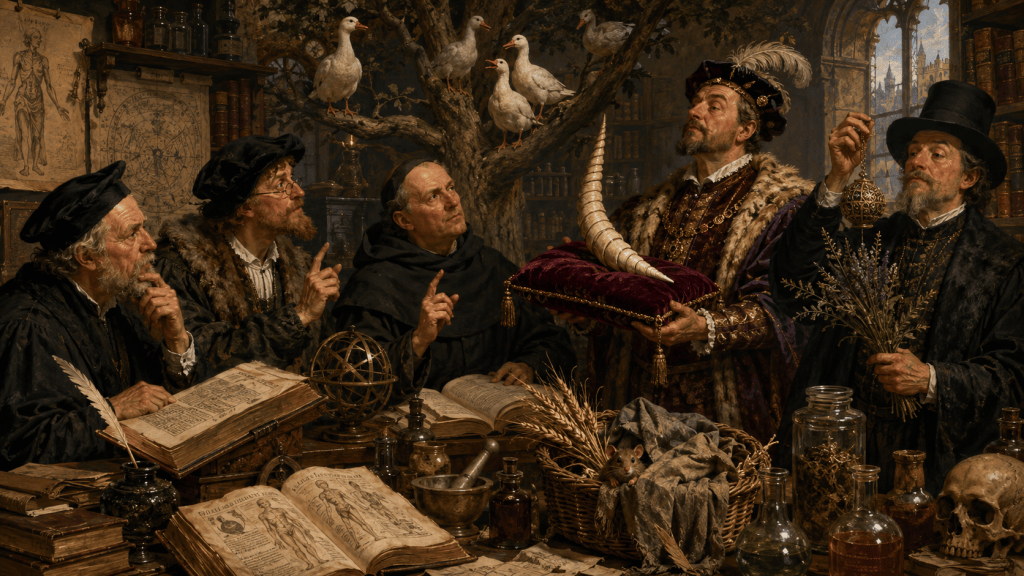
    There is something deeply comforting about looking back at history and laughing at our ancestors, because from the safety of the twenty-first century it is remarkably easy to wonder how intelligent people could possibly have believed that mice could be manufactured from dirty laundry, that certain birds grew on trees, that the smell of a rose might stand between a person and the plague, or that the horn of an animal no one had ever reliably seen could detect poison at the dinner table. Yet there is also something slightly dangerous about laughing too loudly, because many of these ideas were not whispered in taverns by the ignorant or preserved only in village superstition; they appeared in serious books, were discussed by physicians, natural philosophers and scholars, circulated through universities and royal courts, and sometimes survived for centuries precisely because respectable people had already decided that they were true.
    The history of science is therefore not merely a triumphant procession from darkness toward knowledge, with one brilliant discovery politely replacing another. It is also a museum of magnificent mistakes, some amusing, some deadly, and some so wonderfully strange that, had they appeared in a fantasy novel, an editor might have asked the author to make them a little more believable.
    And perhaps the most uncomfortable lesson is this: the people who believed them were not necessarily less intelligent than we are.


    WHEN MICE COULD BE MADE FROM WHEAT AND A DIRTY SHIRT
    For centuries, one of the most persistent ideas in natural philosophy was spontaneous generation, the belief that living creatures could arise directly from non-living or decaying matter. Maggots seemed to appear from rotting meat, insects appeared in mud, and small animals could seemingly materialize wherever food and filth had been left undisturbed, so the conclusion did not initially appear as absurd as it does today.
    The seventeenth-century physician and chemist Jan Baptista van Helmont, an important figure in early chemistry, provided one of the most memorable recipes associated with the theory. According to his writings, if wheat was placed in a vessel together with a dirty shirt, after approximately twenty-one days the combination could produce mice.
    Not attract mice.
    Produce them.
    The sweat from the shirt was supposed to act upon the wheat and somehow transform the material into living animals. One can only imagine the satisfaction of a seventeenth-century experimenter discovering mice in his grain after three weeks and triumphantly announcing that nature had obeyed him, while the mice themselves, having discovered an unattended container full of wheat, were probably equally pleased with the experiment.
    Van Helmont also described a supposed method of generating scorpions involving basil and bricks, which suggests that seventeenth-century kitchens could theoretically have doubled as zoological laboratories if one possessed sufficient patience and a reckless attitude toward household pests.
    The idea was not destroyed simply because someone laughed at it. It had to be challenged experimentally. In 1668, the Italian physician Francesco Redi placed meat in different containers, leaving some open and covering others so that flies could not reach the meat. Maggots appeared where flies had access, while the protected meat did not spontaneously manufacture them. Redi demonstrated that the seemingly miraculous appearance of worms had a considerably less mystical explanation: flies laid eggs.
    Even then, spontaneous generation did not disappear overnight. Versions of the idea survived until the nineteenth century, when experiments by scientists including Louis Pasteur helped demonstrate that microorganisms appearing in supposedly lifeless material came from contamination rather than material suddenly deciding to become alive.
    For a theory that seems ridiculous today, spontaneous generation had an extraordinarily long career.


    WHEN BIRDS GREW ON TREES
    If mice could emerge from wheat, perhaps birds growing from trees did not seem quite so unreasonable.
    Medieval and early modern Europeans faced a peculiar mystery involving the barnacle goose, a bird that appeared seasonally in parts of Britain and Ireland but whose nesting grounds were far to the north, beyond the everyday experience of European observers. People saw the birds arrive, but they did not see them breed locally, build nests or hatch from eggs.
    Nature seemed to have misplaced an important part of the story.
    Meanwhile, sailors and coastal inhabitants encountered strange stalked barnacles attached to floating wood. Their shapes, particularly when interpreted through imagination rather than modern zoology, could be made to resemble developing birds. From this coincidence developed one of history’s most delightful pieces of natural history: the belief that barnacle geese did not hatch from eggs at all.
    Some accounts described them developing from barnacles hanging from wood; others imagined strange trees producing structures from which the young birds eventually emerged. Medieval illustrations even depicted trees carrying what looked like embryonic geese, waiting for gravity and destiny to complete the process. Gerald of Wales wrote about the phenomenon in the Middle Ages, and the story remained culturally recognizable centuries later.
    It is tempting to imagine an English traveler standing beneath an ordinary oak tree, staring upward with great concentration and wondering why the local geese crop was disappointing that year.
    Yet the story reveals something more interesting than simple gullibility. The observers possessed incomplete information and tried to construct an explanation from what they could actually see. The birds arrived mysteriously; barnacles appeared mysteriously; the two objects looked vaguely connected; therefore, a theory was born.
    It was wrong, but it had something many successful false theories possess: it explained the missing evidence.


    WHEN A BAD SMELL COULD KILL YOU
    Few historical theories demonstrate the strange mixture of error and accidental usefulness better than the miasma theory of disease.
    For centuries, disease was frequently associated with foul air arising from rotting organic matter, sewage, corpses and filthy streets. Epidemics seemed to flourish in places where the smell was terrible, so physicians and authorities concluded that the smell itself, or some poisonous corruption carried within the air, was responsible.
    In other words, if a street smelled as though something had died there, medical wisdom suggested that the smell might soon arrange for something else to die there as well.
    During outbreaks of plague, people attempted to protect themselves with strong aromas, vinegar, herbs, spices and smoke. During the Great Plague of London in 1665, advice included carrying aromatic substances and using smoke to defend against dangerous air. The underlying theory was wrong: unpleasant odor itself was not the infectious agent. Yet filthy conditions often did accompany environments where disease spread, meaning that people had noticed a genuine association while misunderstanding its cause.
    This distinction matters, because history rarely divides itself neatly into sensible people and fools. Sometimes people observed the right pattern and reached the wrong explanation.
    Miasma theory could even encourage sanitation reforms, because removing sewage, rubbish and rotting waste improved public health even though the reformers did not yet understand microorganisms in the modern sense. A mistaken theory could therefore lead occasionally to useful behavior, which is perhaps one reason mistaken theories can be so difficult to kill.
    If an incorrect idea appears to work, it acquires friends very quickly.


    WHEN KINGS BOUGHT HORNS FROM AN ANIMAL THAT DID NOT EXIST
    Medieval and Renaissance Europe possessed another remarkable item of prestigious scientific and medical technology: the unicorn horn.
    These objects were not cheap ornaments sold to gullible tourists. Supposed unicorn horns could be extraordinarily valuable, belonged to royal collections and were credited with extraordinary medicinal abilities, particularly the power to detect or neutralize poison.
    For a ruler living in a world where poisoning was feared, the attraction is obvious. Imagine sitting down to dinner knowing that political rivals might prefer you dead, while a trusted courtier assures you that the mysterious spiral horn beside your plate will reveal whether someone has interfered with the soup. One might reasonably decide that the horn was worth a considerable amount of money.
    Unfortunately for European monarchs and fortunately for Arctic marine biology, many celebrated “unicorn horns” were actually narwhal tusks.
    The narwhal’s extraordinary spiral tusk entered European trade from northern regions and was interpreted within a culture that already accepted descriptions of unicorns. According to the Smithsonian, narwhal tusks were sold as unicorn horn and credited with medical properties ranging from treating diseases to detecting poison, and the most prized examples could command astonishing prices.
    The deception worked partly because almost nobody buying a unicorn horn was in a position to compare it with an actual unicorn.
    This is an excellent commercial advantage when selling imaginary animals.
    What makes the story especially fascinating is that the objects themselves were entirely real. A magnificent spiral tusk could be placed on a table, measured, touched and displayed to ambassadors. The mistake concerned not the evidence but its interpretation.
    The horn existed.
    The unicorn was the problem.


    WHEN THE CURE FOR DROWNING INVOLVED TOBACCO SMOKE AND A VERY UNEXPECTED ROUTE
    Historical medicine becomes particularly dangerous when one assumes that every strange treatment is an exaggeration invented later for amusement.
    Consider the tobacco-smoke enema.
    After tobacco reached Europe, it acquired a reputation as a medicinal substance and was recommended for various conditions. By the Georgian period in Britain, physicians and rescuers sometimes attempted to revive drowning victims by introducing warm tobacco smoke into the rectum, believing that the warmth and stimulating properties of tobacco might restore the apparently lifeless person.
    This was sufficiently respectable that equipment for administering tobacco-smoke enemas was provided along the River Thames in connection with efforts to resuscitate drowning victims.
    There are historical medical procedures that invite careful scholarly interpretation.
    This one also invites the observation that waking after nearly drowning and discovering several earnest gentlemen standing behind you with bellows must have produced an unusually strong desire to return immediately to full consciousness.
    The practice nevertheless followed a recognizable medical logic of its period. Tobacco was considered stimulating, drowning victims were cold and unresponsive, and warm smoke appeared capable of providing both heat and stimulation. Without modern knowledge of respiratory physiology, the reasoning was not random, merely spectacularly misdirected.
    Eventually, more effective methods of resuscitation replaced it, and the bellows were allowed to return to occupations less alarming to patients.


    WHEN POISON WAS MEDICINE
    Medicine provides some of the most disturbing examples of intelligent people operating with imperfect knowledge, because a physician cannot simply wait several centuries for microbiology to improve while a patient is suffering in front of him.
    For hundreds of years, mercury compounds were among the treatments used against syphilis. Mercury could be administered in different forms, despite its toxicity, because physicians had few effective alternatives and sometimes interpreted the body’s violent reactions to treatment as evidence that the medicine was doing something useful.
    And technically, it certainly was doing something.
    Unfortunately, some of what it was doing was poisoning the patient.
    The Science History Institute notes that historical syphilis treatments involving toxic mercury compounds could produce symptoms severe enough to rival those of the illness itself. Later, the arsenic-derived drug Salvarsan, introduced in the early twentieth century, became an important treatment before penicillin transformed syphilis therapy.
    Here the story becomes more sobering than amusing, because it reminds us that past physicians were often forced to choose between dangerous treatment and an even more dangerous disease. Their mistakes were sometimes produced not by stupidity but by desperation, limited evidence and the absence of better options.
    That distinction is important when judging the past.
    It is also slightly terrifying.


    THE MOST DANGEROUS PHRASE IN SCIENCE MAY BE “EVERYONE KNOWS”
    What connects mice created from dirty shirts, geese growing from trees, poisonous air, medicinal unicorn horns and tobacco smoke administered through improbable anatomy is not simply ignorance.
    It is authority.
    Once an idea entered respected books, once distinguished scholars repeated it, once physicians taught it to students and students eventually became the next generation of physicians, the theory gained something stronger than evidence: familiarity.
    People stopped asking whether it was true and began asking how it worked.
    That is a remarkably important transition.
    If everyone agrees that barnacle geese grow from unusual marine structures, the scholarly question becomes the precise stage at which feathers develop. If unicorn horn neutralizes poison, researchers debate how best to prepare the powder. If bad air produces disease, officials argue over which smells are most dangerous.
    A false premise can therefore generate an enormous amount of perfectly logical reasoning.
    The reasoning may be excellent.
    The premise is still false.
    History repeatedly demonstrates that intelligence is not an automatic vaccine against error. In fact, an intelligent person can sometimes defend a bad idea more effectively than an unintelligent person, because intelligence supplies a much larger collection of arguments with which to protect it.


    WHY DID THEY NOT SIMPLY CHECK?
    This is perhaps the question modern readers ask most frequently, and it deserves an answer.
    Sometimes they did check.
    Redi checked the maggots. Pasteur checked microorganisms. Anatomists dissected bodies. Naturalists traveled. Physicians compared cases. Sailors brought specimens home. Each challenge slowly weakened beliefs that had previously seemed obvious.
    But checking reality was historically more difficult than it sounds. A medieval scholar in England could not book an inexpensive flight to Greenland to inspect a barnacle goose nesting site. A physician could not examine bacteria without instruments that had yet to be invented. A European naturalist confronted with a narwhal tusk might never see a living narwhal during his entire lifetime.
    Books therefore carried enormous authority, particularly when an ancient and respected author had made the original claim.
    Knowledge was inherited much as property was inherited, and people were understandably reluctant to throw away an intellectual estate merely because one room looked suspicious.
    Eventually, however, observation began winning more arguments.
    Not always quickly.
    Not always peacefully.
    But increasingly, the question changed from “Who said this?” to “How can we test it?”
    That change may be one of the most important events in the history of human thought.


    AND NOW FOR THE UNCOMFORTABLE QUESTION
    It would be pleasant to finish here, congratulate ourselves and conclude that humanity has finally escaped the age of ridiculous ideas.
    Unfortunately, history does not offer us that luxury.
    The medieval scholar who believed that birds grew from trees did not wake each morning thinking, Today I shall believe something absurd. He believed he possessed a reasonable explanation supported by respected authorities and apparently consistent with the evidence available to him.
    The physician carrying aromatic herbs against epidemic disease did not consider himself superstitious. The courtier guarding a king’s supposed unicorn horn did not necessarily imagine himself participating in mythology. Van Helmont did not think that his theories would one day become material for jokes about dirty shirts and entrepreneurial mice.
    They lived inside the accepted knowledge of their own time.
    So do we.
    Science today possesses tools, methods and safeguards unimaginable to earlier generations, from controlled trials and statistical analysis to genetics, electron microscopy and global scientific collaboration. That does not mean every current theory is wrong, nor does it mean modern science is merely another collection of medieval beliefs. Quite the opposite: the strength of science lies precisely in its ability to test, challenge and eventually abandon ideas when evidence contradicts them.
    But it does mean that some things we currently regard as obvious will almost certainly be revised, qualified or discarded.
    Perhaps a person living in the year 2400 will open a history book, encounter one of our most confident assumptions and stare at the page with exactly the expression we wear when reading instructions for manufacturing mice from wheat and underwear.
    They may laugh.
    We should probably forgive them.
    After all, somewhere in seventeenth-century Europe, a very serious man once looked into a container containing wheat, discovered several mice and believed he had witnessed the creation of life.
    The mice, meanwhile, had probably reached a simpler and much more accurate scientific conclusion:
    free dinner.

    Sources & Further Reading
    Bob Fenster, Duh! The Stupid History of the Human Race
    Additional historical and scientific sources were consulted to verify the events and beliefs discussed in this article.

  • Can Music Manipulate the Human Mind? The Science, the Experiments, and the Conspiracy Theories Behind Sound

    There is something profoundly strange about music that we rarely stop to consider, perhaps because it has accompanied humanity for so long that its presence feels natural. A sequence of vibrations moves through the air, enters the ear, is converted into electrical activity inside the nervous system, and within seconds a person may feel fear, longing, excitement, melancholy, desire, serenity or an almost unbearable sense of nostalgia, even though nothing tangible has happened around them.
    No one has touched them. No argument has been presented. No drug has entered the bloodstream. No image may even be present.
    And yet the body has changed.
    The heart may accelerate, breathing may alter, memories may suddenly return, muscles may prepare to move, skin may produce goosebumps and an apparently meaningless sequence of acoustic frequencies may acquire enough emotional force to make someone cry.
    This extraordinary ability has naturally produced a darker question.
    If music can change what we feel, can it also change what we think?
    And if it can change what we think, could someone deliberately use it to influence us without our realizing what is happening?
    Behind those questions lies a world in which neuroscience, psychology, military history, advertising, ritual, politics and some of the internet’s most persistent conspiracy theories unexpectedly meet.
    The answer is far more complicated than either extreme suggests. Music is not a magical remote control for the human mind, yet neither is it merely harmless decoration playing in the background of our lives.
    Science has discovered that sound reaches remarkably deep into the machinery of the human brain.
    And governments, armies, religions, political movements, filmmakers, advertisers and musicians have understood that power, in one form or another, for centuries.
    THE INVISIBLE FORCE WE CALL SOUND
    Sound begins as mechanical energy.
    An object vibrates, creating changes in air pressure that travel outward as waves. When those waves reach the ear, the mechanical movement is eventually transformed by the auditory system into neural signals that the brain interprets as pitch, rhythm, timbre, location and meaning.
    Music, however, is not simply one frequency entering the brain.
    This distinction becomes extremely important when discussing theories surrounding frequencies such as 432 Hz and 440 Hz.
    A violin concerto supposedly “at 440 Hz” is not producing a continuous 440 Hz tone. It contains thousands of changing frequencies, harmonics and overtones. The figure 440 Hz refers primarily to a reference pitch: the frequency assigned to the musical note A above middle C when instruments are tuned according to the modern A440 system. ISO 16 specifies A = 440 Hz as the international standard tuning reference.
    Changing that reference to A = 432 Hz shifts the tuning of the entire musical system slightly downward, but it does not somehow transform every sound in a composition into a 432 Hz vibration.
    That seemingly technical distinction dismantles many simplistic claims about frequency manipulation, but it does not make the larger mystery disappear, because the human nervous system genuinely does respond to acoustic structure in remarkable ways.
    MUSIC DOES NOT SIMPLY ENTER THE EAR — THE BRAIN PREDICTS IT
    One of the great discoveries of modern music neuroscience is that listening is not passive.
    The brain is constantly attempting to predict what will happen next.
    A melody establishes patterns. A rhythm establishes timing. Harmony creates expectations. The listener’s brain begins unconsciously constructing a model of what should follow, and composers can satisfy that expectation, postpone it, violate it or surprise the listener completely.
    Researchers studying musical reward have shown that unexpected musical events can engage the nucleus accumbens, an important component of the brain’s reward circuitry. Experiments have found that musical prediction errors — moments when what happens differs intriguingly from what the listener expects — can engage reward mechanisms also involved in learning from other rewarding experiences.
    This may partly explain one of music’s strangest paradoxes.
    We enjoy being manipulated by it.
    A composer builds tension because the brain expects resolution. The resolution is withheld. The listener remains suspended. Then, perhaps several seconds later, the expected chord finally arrives and produces a pleasure that would never have existed without the preceding uncertainty.
    Nothing supernatural has happened.
    Yet the emotional response is real.
    And the mechanism is operating partly below conscious awareness.
    MUSIC AND THE CHEMISTRY OF PLEASURE
    Perhaps the most famous evidence for music’s biological power came from experiments investigating dopamine, the neurotransmitter heavily involved in motivation and reward.
    In a landmark study published in Nature Neuroscience in 2011, researchers led by Valorie Salimpoor used PET imaging together with functional MRI while participants listened to music capable of producing intense emotional pleasure. They found evidence of dopamine release in the striatum, with different regions involved during the anticipation of a musical climax and during the experience of the emotional peak itself.
    Later experiments went further. A 2019 pharmacological study manipulated dopamine transmission and found evidence supporting a causal role for dopamine in musical pleasure: altering dopaminergic activity changed both how pleasurable music felt and how much participants were willing to invest in obtaining it.
    Consider what this means.
    A pattern of organized sound, containing no food, no physical reward and no direct survival benefit, can nevertheless interact with neural circuitry deeply associated with reward.
    The ancient intuition that music somehow “enters the soul” was not neuroscience, but it captured something humans had recognized long before brain scanners existed: music can reach emotional systems that rational argument often struggles to reach.
    WHEN THE BODY BEGINS TO FOLLOW THE MUSIC
    The effects do not stop at emotion.
    Researchers have measured changes in cardiovascular and respiratory activity during music listening, and experiments have shown that tempo, rhythmic structure and musical crescendos can be accompanied by changes in breathing, heart rate and other autonomic responses. In work led by Luciano Bernardi, physiological variables were found to track musical phrases and rhythmic changes, demonstrating that the body can become partially synchronized with the temporal structure of music.
    Even movement can become linked to external rhythm with astonishing ease.
    Humans can synchronize their movements to auditory beats, and neurophysiological experiments have shown coupling between auditory and motor processes when people move in time with rhythmic sound. EEG studies have detected beat-related neural activity and interactions between sensory and motor systems during synchronization.
    This is why a foot begins tapping before its owner consciously decides to move it, why thousands of people can clap together during a concert, and why marching songs have accompanied armies for millennia.
    Rhythm provides an external clock.
    And the nervous system is extraordinarily willing to follow it.
    MUSIC CAN OPEN DOORS TO MEMORIES WE THOUGHT WERE LOST
    There is another property of music that makes its influence unusually powerful: its connection with autobiographical memory.
    A few notes from a song heard decades earlier can recreate an entire scene with astonishing precision — a room, a face, a summer evening, a lost relationship, even an emotional state that seemed to have disappeared permanently.
    Neuroscientist Petr Janata demonstrated through functional neuroimaging that familiar music capable of evoking autobiographical memories engages brain regions involved in memory, self-referential processing and emotion. Other experimental work has continued to show that personally meaningful music can interact strongly with the networks involved in autobiographical recollection.
    This makes music psychologically different from an ordinary sound.
    A melody can become attached to identity.
    And once that association exists, hearing the melody again may reactivate far more than the auditory memory itself.
    It can reactivate part of the person who first heard it.
    SO WHERE DOES INFLUENCE BECOME MANIPULATION?
    This is where the subject becomes uncomfortable.
    If music alters emotion, reward, physiological arousal, movement and memory, it is reasonable to ask whether those effects can be deliberately exploited.
    They can.
    But the word manipulation needs to be used carefully.
    Music cannot normally insert a specific belief into an unwilling brain as though programming a computer. There is no established scientific evidence that a hidden frequency in an ordinary song can force a mentally competent listener to vote for a particular politician, purchase a specific object or commit an action against their will.
    What music can do is something subtler.
    It can alter the emotional environment in which decisions are made.
    That difference matters enormously.
    A frightening soundtrack does not need to tell us that a character is dangerous; it can make us feel danger before the character does anything. A triumphant anthem does not need to logically demonstrate the greatness of a nation; it can create the emotional sensation of greatness. A religious chant need not present a theological argument; repetition, collective singing, acoustic architecture and ritual can help produce a psychological state in which participants experience unity and transcendence.
    The message does not always arrive as a proposition.
    Sometimes the emotional state comes first.
    The interpretation follows.
    THE POWER OF SYNCHRONY
    Music becomes even more interesting when experienced collectively.
    Experimental psychology has found that synchronized movement can affect social behavior. In controlled experiments, people moving rhythmically in synchrony have sometimes demonstrated increased cooperation or social bonding compared with people moving asynchronously.
    This gives an entirely natural explanation for something that political leaders, military commanders and religious traditions appear to have understood intuitively for centuries.
    Humans who sing together, march together, dance together or chant together do not merely hear the same thing.
    They begin doing the same thing at the same time.
    Individual bodies become temporarily coordinated by an external rhythm.
    That does not create mind control.
    But it can help create group identity.
    And once people experience themselves as part of a group, psychological dynamics can emerge that would not exist in isolation.
    Perhaps the most effective collective music therefore does not tell a crowd what to think.
    It first makes the crowd feel that it is one thing.
    WHEN MUSIC BECAME AN INSTRUMENT OF COERCION
    There are historical cases in which sound moved far beyond persuasion or entertainment.
    Documents from U.S. government investigations into detention and interrogation practices after September 11 provide examples of detainees being exposed to loud music during interrogation. A Senate hearing reviewing Department of Defense detention operations recorded that one detainee at Guantánamo was repeatedly yelled at or subjected to loud music during interrogations between November 2002 and January 2003, conduct observed on occasions by FBI personnel.
    The broader CIA detention and interrogation program was later examined in the U.S. Senate Select Committee on Intelligence’s extensive 2014 report.
    Here the objective was not some mystical manipulation through a special musical frequency.
    The mechanism was far more brutal and comprehensible: sensory stress, disruption, exhaustion, loss of environmental control and psychological pressure.
    This is an important distinction because it reveals how easily two very different subjects become confused online.
    Sound can be used coercively.
    That is documented.
    Therefore secret frequencies can remotely control thoughts.
    That does not follow.
    The first statement does not prove the second.
    THE 440 HZ MYSTERY
    Few subjects in modern alternative culture illustrate this confusion better than A = 440 Hz.
    Search long enough online and an extraordinary story begins to appear.
    According to various versions, humanity once tuned music to the supposedly natural or harmonious frequency of 432 Hz, until powerful organizations deliberately replaced it with 440 Hz. Some versions attribute the change to governments, others to financial interests, others to secret societies, and particularly dramatic versions connect 440 Hz to Nazi propaganda minister Joseph Goebbels, suggesting that the frequency was selected because it produced aggression, anxiety or psychological disconnection.
    It is a compelling story.
    There is just one major problem.
    The documented historical record does not support the dramatic version.
    The National Institute of Standards and Technology records that its U.S. radio station WWV began broadcasting a 440 Hz reference tone in 1936, at the request of music organizations, while international discussions about standardizing concert pitch culminated in an international conference in London in 1939. NIST states that A440 became the international standard for musical pitch from that period, and ISO eventually formalized the reference in ISO 16.
    A contemporary report in Nature from 1939 also records the international conference on concert-pitch standardization, held under the auspices of the International Standards Association at BBC Broadcasting House.
    Those records describe technical standardization.
    They do not reveal a secret neurological experiment.
    And there is another problem with the conspiracy story: musical pitch had never been perfectly universal before 440 Hz.
    Different places, eras, orchestras and instrument makers used different reference pitches, which was precisely why standardization became desirable.
    The historical story is therefore not that humanity lived peacefully at 432 Hz until somebody suddenly poisoned music with 440 Hz.
    Reality was considerably messier.
    BUT DOES 432 HZ ACTUALLY FEEL DIFFERENT?
    Here the story takes another turn, because dismissing the conspiracy surrounding 440 Hz does not automatically prove that 432 Hz has no measurable effects.
    Several small scientific studies have compared music tuned around these different reference pitches.
    A 2019 study comparing the same music tuned to 440 Hz and 432 Hz reported differences in several physiological measurements and found a greater reduction in heart rate during the 432 Hz condition, while the researchers themselves emphasized that larger randomized trials were necessary.
    Other experimental work has reported reductions in anxiety-related measures under certain 432 Hz conditions. For example, a study involving dental patients found that both 432 Hz and 440 Hz music were associated with lower clinical anxiety than a control condition, while salivary cortisol differed between the tuning conditions.
    More recently, a randomized crossover trial published in 2025 compared sound interventions tuned to 432 Hz and 443 Hz in 43 cancer patients. Both conditions improved subjective psychological measures, while some cardiovascular parameters changed more under the 432 Hz condition. Importantly, the researchers cautioned that their study could not determine whether any difference resulted from something unique about exactly 432 Hz or simply from the slightly lower tuning being perceived differently.
    That final point is crucial.
    Suppose listeners consistently find a slightly lower tuning more relaxing.
    That would be scientifically interesting.
    But it would still not prove that 432 Hz is a cosmic healing frequency, that 440 Hz damages consciousness or that an international organization deliberately altered musical tuning to control humanity.
    There is an enormous logical distance between “a measurable difference may exist” and “the frequency was selected as a weapon.”
    Good investigation must resist the temptation to fill that distance with imagination.
    THE STRANGE NUMEROLOGY OF 432
    Part of the fascination with 432 does not come from neuroscience at all, but from mathematics, symbolism and the human tendency to search for hidden correspondences.
    The number appears repeatedly in alternative literature alongside astronomical cycles, ancient monuments, sacred geometry, planetary measurements and numerological relationships, creating the impression that the universe itself may somehow be encoded around 432.
    Some of these relationships are mathematically correct because numbers can genuinely share interesting ratios.
    The difficult question is whether the relationship has physical significance.
    A number appearing in two unrelated systems does not automatically mean those systems share a hidden causal connection, particularly when units, rounding conventions or measurement choices can be changed.
    This is where numerology and experimental science separate.
    Science does not merely ask whether two numbers resemble one another.
    It asks what mechanism connects them, whether the relationship predicts something measurable, whether the result can be reproduced, and whether competing explanations have been eliminated.
    For 432 Hz, that level of evidence has not established the extraordinary claims often attached to it.
    Yet the smaller question — whether slightly different tuning systems can influence perception or physiology — remains scientifically legitimate.
    And that is arguably more interesting than simply declaring one frequency “good” and another “evil.”
    BINAURAL BEATS: A FREQUENCY THAT DOES NOT EXIST OUTSIDE YOUR HEAD
    Binaural beats provide an even stranger example.
    Imagine a listener wearing headphones. One ear receives one pure tone, while the other receives a slightly different tone. The auditory system can produce the perception of an additional rhythmic beating corresponding approximately to the difference between them.
    The perceived beat is not simply a conventional external tone being played identically through both speakers.
    It emerges from how the auditory system processes the two inputs.
    This phenomenon has led to claims that binaural beats can synchronize brainwaves, induce meditation, improve memory, reduce anxiety, increase intelligence, produce altered states of consciousness and, in the most extravagant versions, act almost like digital psychoactive substances.
    Again, reality refuses to fit neatly into either extreme.
    Some experiments have reported genuine psychological effects.
    A randomized controlled study published in 2005 involving patients awaiting surgery found a larger reduction in preoperative anxiety among participants exposed to audio containing binaural beats than among comparison groups.
    However, evidence that binaural beats reliably “force the brain” into a particular global brainwave state is considerably less straightforward.
    A 2025 randomized controlled trial involving surgical patients found that anxiety declined more in the binaural-beat group than in controls, but EEG results provided only limited evidence of differences in alpha-band activity, with no group effect on alpha power and only selected measures of connectivity differing. The researchers concluded that further investigation is needed to understand whether the effects exceed those of music and ordinary relaxation.
    That is very different from the dramatic advertisements promising instant control of consciousness.
    Something may be happening.
    But exactly what is happening remains much less certain.
    CAN SOUND “ENTRAIN” THE BRAIN?
    The word entrainment deserves special attention because it appears constantly in discussions about frequency manipulation.
    In its broad scientific sense, entrainment describes synchronization between oscillating systems.
    It is unquestionably real in many biological contexts.
    Humans synchronize movement to rhythm. Neural activity can show responses related to periodic auditory stimulation. Breathing and movement can become coupled to external timing.
    But internet discussions often transform this limited concept into something much larger.
    If neural activity can synchronize with an auditory rhythm, the argument goes, then a carefully selected sound could theoretically place the entire brain into whatever psychological state its creator desires.
    That does not follow.
    The brain is not one oscillator.
    It contains enormous numbers of interacting neural populations operating across different spatial and temporal scales, while attention, expectation, memory, personality, hearing ability and context all influence auditory responses.
    Neural entrainment is fascinating.
    It is not evidence that consciousness possesses a hidden frequency dial that can simply be turned from the outside.
    THE MYTH OF “LOW-FREQUENCY MUSIC” CREATING LOW CONSCIOUSNESS
    The post that inspired this investigation makes another claim frequently encountered online: that particular genres, especially rap or hip-hop, supposedly keep listeners trapped in “lower states of consciousness” associated with fear, greed or aggression.
    There is no accepted neuroscientific scale on which musical genres can be arranged from “low consciousness” to “high consciousness,” and no established evidence showing that rap, hip-hop or another genre inherently lowers human consciousness through its acoustic frequencies.
    Lyrics can certainly convey ideas.
    Extremely loud sound can produce physiological effects.
    Tempo can affect arousal.
    Personal associations matter.
    Cultural meaning matters.
    Repeated exposure may influence familiarity and preference.
    But a musical genre is an enormous and heterogeneous cultural category, not a single neurological frequency.
    To claim that one genre mechanically lowers consciousness therefore disguises a philosophical or cultural judgment as neuroscience.
    That does not mean music is psychologically neutral.
    It means the mechanism cannot be reduced to a label.
    MUSIC AS PROPAGANDA WITHOUT A SECRET FREQUENCY
    Perhaps the most revealing conclusion is that anyone attempting to manipulate people with music would not actually need a secret frequency.
    Ordinary music already possesses more powerful psychological tools.
    Repetition creates familiarity.
    Rhythm encourages synchronization.
    Harmony creates and releases tension.
    Lyrics attach language to emotion.
    Melodies become associated with people, places and ideas.
    Group singing reinforces shared identity.
    A familiar song can reactivate memories formed decades earlier.
    Reward systems respond to anticipation and musical pleasure.
    Those mechanisms are sufficient to explain why music has accompanied ceremonies, revolutions, armies, religions, advertising, cinema, political movements and collective celebrations throughout human history.
    The great irony may therefore be that the search for an exotic hidden frequency distracts us from something much more obvious.
    Music does influence us.
    It simply does so through mechanisms far richer and more psychologically sophisticated than a single mysterious number.
    THE MOST EFFECTIVE SOUNDTRACK IS THE ONE YOU DO NOT NOTICE
    Consider cinema.
    Remove the soundtrack from a horror scene and the monster may suddenly seem ridiculous. Change the music beneath the same facial expression and the audience may interpret the character as romantic, dangerous, heroic or tragic.
    Nothing in the image changed.
    The emotional frame changed.
    The same principle operates in everyday life more subtly.
    Music accompanies shopping, exercise, restaurants, political events, religious services, funerals, weddings, advertisements, sporting events and social-media videos. Most of the time we concentrate on the apparent message while barely noticing the emotional architecture beneath it.
    That may be the closest ordinary music comes to influencing us “without conscious consent.”
    Not because it secretly bypasses free will.
    But because humans do not consciously analyze every influence acting upon them.
    We rarely ask why a particular chord made a scene feel tragic.
    We simply experience the tragedy.
    CAN MUSIC CONTROL YOU?
    At this point the distinction becomes clearer.
    Music can influence emotion.
    Yes.
    Music can affect physiological arousal.
    Yes.
    Music can activate reward-related neural systems.
    Yes.
    Music can trigger autobiographical memories.
    Yes.
    Rhythm can synchronize movement and interact with neural timing.
    Yes.
    Sound and loud music have been deliberately employed in coercive interrogation environments.
    Yes.
    Some experiments suggest different tuning systems or auditory-beat techniques may produce modest physiological or psychological differences.
    Yes.
    But:
    Can an ordinary musical frequency secretly take control of a healthy person’s mind and remove free will?
    There is no convincing evidence that it can.
    Has 440 Hz been demonstrated to be a frequency deliberately imposed upon humanity to produce aggression or spiritual disconnection?
    No.
    Has 432 Hz been scientifically established as the natural frequency of the universe or a universal healing frequency?
    No.
    And yet these answers do not make music less mysterious.
    They make it more mysterious.
    THE REAL MYSTERY MAY BE GREATER THAN THE CONSPIRACY
    Perhaps we have been asking the wrong question.
    The extraordinary thing is not whether someone discovered a secret frequency capable of manipulating consciousness.
    The extraordinary thing is that consciousness is so responsive to organized vibration in the first place.
    Why should an arrangement of pressure waves create sadness?
    Why should anticipation of a chord release chemicals involved in reward?
    Why can a melody heard at sixteen resurrect memories at sixty?
    Why do human beings spontaneously synchronize their bodies to rhythmic sound?
    Why can thousands of strangers sing the same melody and temporarily experience themselves as one group?
    Physics can describe the wave.
    Neuroscience can map some of the circuits.
    Psychology can measure behavior.
    But the subjective transformation — the moment when vibration becomes meaning — remains one of the most remarkable features of the human mind.
    And perhaps this is why every civilization we know has surrounded music with ideas of magic, divinity, healing, danger and power.
    Long before anyone knew what a hertz was, humanity already knew that sound could change us.
    The ancients did not need brain scanners to discover that a drum could prepare people for battle, that a lament could deepen grief, that a chant could alter the atmosphere of a temple or that a melody could carry memory across generations.
    Modern science has not destroyed that mystery.
    It has merely shown us some of the machinery hidden behind it.
    THE LINE BETWEEN SCIENCE AND CONSPIRACY
    The most dangerous mistake when exploring subjects like this is believing that we must choose between two absolute positions: either every unusual claim is true, or anything associated with conspiracy culture must automatically be false.
    History repeatedly teaches us that reality is less convenient.
    Governments have conducted secret experiments.
    Psychological manipulation exists.
    Propaganda exists.
    Sound has been deliberately used in coercive environments.
    Music genuinely influences the brain and body.
    At the same time, those facts cannot be used as blank checks to validate every theory about frequencies, subliminal control or hidden musical agendas.
    Evidence must be examined one claim at a time.
    The existence of MKUltra would not prove that 440 Hz controls the brain.
    The use of loud music during interrogations does not prove that popular songs contain secret consciousness-altering frequencies.
    A small experiment finding a difference between 432 Hz and another tuning does not prove that ancient civilizations possessed a lost universal frequency.
    The mystery deserves something better than automatic belief.
    It also deserves something better than automatic ridicule.
    It deserves investigation.
    PERHAPS THAT IS WHY MUSIC HAS ALWAYS FRIGHTENED POWER
    Music occupies a peculiar territory between thought and sensation.
    Words usually ask to be understood.
    Music does not always need permission.
    It can enter a room before we decide whether we want to interpret it, establish an emotional atmosphere before a conversation begins, resurrect a memory we had no intention of remembering and make the body move before the rational mind has formulated a reason.
    That power is not supernatural.
    But neither is it trivial.
    Perhaps there is no single forbidden frequency hidden inside our music.
    Perhaps there never was.
    Perhaps the deeper secret has been playing openly around us for thousands of years:
    human consciousness is profoundly responsive to sound, and anyone who understands emotion, rhythm, memory and expectation already possesses a remarkable instrument of influence.
    The mystery is not that music can control the mind.
    The mystery is how much of the mind has always been listening.
    SOURCES AND FURTHER READING
    International Organization for Standardization — ISO 16:1975, Standard Tuning Frequency. ISO specifies A above middle C at 440 Hz; the standard remains current after later review.
    National Institute of Standards and Technology — History of Radio Station WWV. NIST documents the broadcast of the 440 Hz musical reference beginning in 1936 and the history of international musical-pitch standardization.
    Salimpoor et al., Nature Neuroscience, 2011 — “Anatomically Distinct Dopamine Release During Anticipation and Experience of Peak Emotion to Music.” PET and fMRI evidence linking intense musical pleasure with dopamine release.
    Ferreri et al., 2019 — “Dopamine Modulates the Reward Experiences Elicited by Music.” Pharmacological evidence supporting a causal relationship between dopamine and musical reward.
    Bernardi et al., 2006 and 2009. Experimental research on cardiovascular, respiratory and autonomic responses to musical tempo and structure.
    Janata, 2009 — “The Neural Architecture of Music-Evoked Autobiographical Memories.” Functional neuroimaging research into music and autobiographical memory.
    Nozaradan et al., Cerebral Cortex — Sensorimotor Synchronization to the Beat. EEG evidence concerning neural entrainment and auditory-motor coupling.
    U.S. Senate — Review of Department of Defense Detention Operations. Congressional evidence documenting exposure of detainees to loud music during interrogation.
    U.S. Senate Select Committee on Intelligence, 2014 — Study of the CIA Detention and Interrogation Program. Official Senate investigation of CIA detention practices.
    Calamassi & Pomponi, 2019 — Music Tuned to 440 Hz Versus 432 Hz and Health Effects. Small experimental study reporting physiological differences and explicitly calling for larger trials.
    Hohneck et al., 2025 — Randomized Crossover Trial of 432 Hz versus 443 Hz. Both interventions produced effects, with some cardiovascular measures favoring the lower tuning while the researchers stressed that a unique effect of precisely 432 Hz could not be established.
    Padmanabhan, Hildreth & Laws, 2005 — Binaural Beats and Preoperative Anxiety. Randomized controlled research reporting reduced preoperative anxiety during binaural-beat audio exposure.
    Ostertag et al., 2025 — Binaural Beat Stimulation and Preoperative Anxiety. Randomized controlled study showing modest anxiety effects while finding limited evidence for broad EEG alpha entrainment.

  • The Devil’s Footprints: What Walked Across Devon on the Night of February 8, 1855?

    The Devil’s Footprints: What Walked Across Devon on the Night of February 8, 1855?

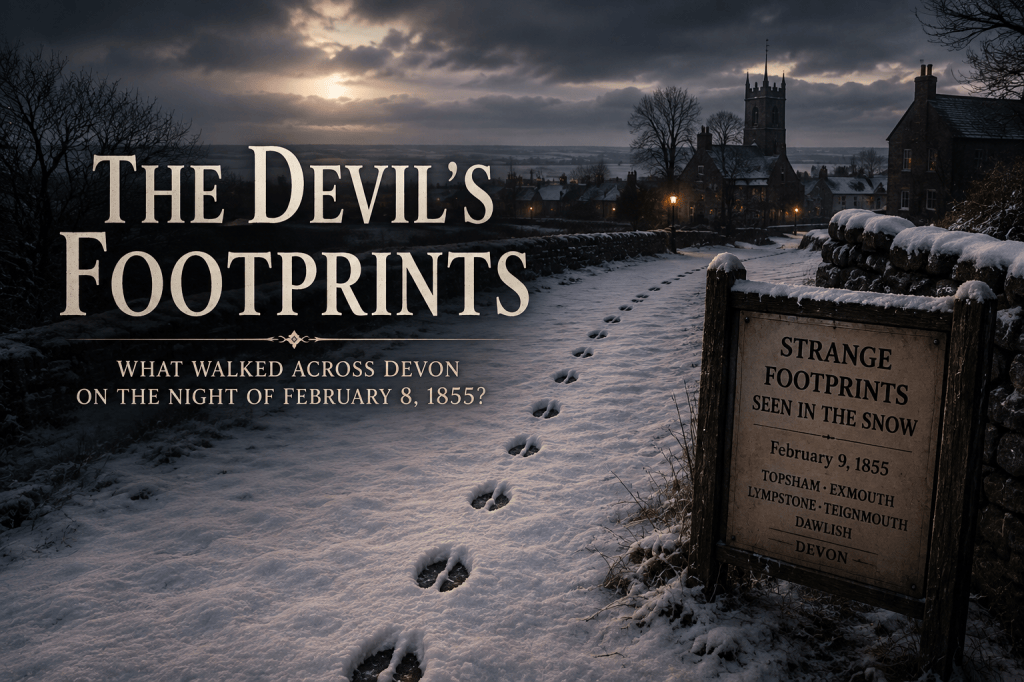
    On the morning of February 9, 1855, residents of several towns and villages in Devon awoke to a landscape transformed by snow and to a mystery that would outlive almost everyone who saw it. Across gardens, roads, fields and enclosed courtyards appeared lines of unusual impressions that many witnesses compared to the marks of a small hoof, although the creature that might have produced them was nowhere to be found.The tracks were reported around communities including Topsham, Lympstone, Exmouth, Teignmouth and Dawlish, and before long newspapers were describing them in places that seemed increasingly difficult to explain. They appeared in open countryside but were also said to continue into walled gardens, across narrow walls and, according to contemporary reports, even over the snow-covered tops of houses.What particularly disturbed observers was not simply the shape of the marks but the strange manner in which many of them seemed to proceed. Rather than displaying the alternating pattern expected from an ordinary four-legged animal, some trails appeared to consist of impressions following one another in an almost single line, separated by surprisingly regular intervals.Within days, naturalists, clergymen, journalists and ordinary residents were debating what could possibly have crossed the snowy Devon countryside.Some proposed badgers, birds, rodents, toads or an escaped kangaroo, while others suspected that several completely ordinary animals had produced different tracks that frightened observers subsequently combined into a single extraordinary mystery.Among the more superstitious inhabitants, however, another possibility began to circulate.Perhaps the tracks belonged to no ordinary animal at all.Perhaps, during that cold February night, the Devil himself had walked through Devon.

    A Snowfall That Left Something Behind

    The mystery began after snow fell across parts of southern Devon during the night of February 8–9, 1855. When residents emerged the following morning, they discovered unusual trails impressed into the fresh covering.The story spread remarkably quickly.

    On February 16, The Times reported that considerable excitement had been caused in Topsham, Lympstone, Exmouth, Teignmouth and Dawlish by the discovery of strange foot-tracks. The newspaper noted that the marks had been observed not only in ordinary fields and roads but in locations that appeared much more difficult for an animal to reach, including gardens and courtyards enclosed by walls and fences.

    The newspaper also recorded the supernatural interpretation already circulating among local people, reporting that some believed the marks might have belonged to Satan and that the mystery had generated enough interest to be discussed from the pulpit.The event was therefore not a legend invented generations afterward. Newspapers were discussing the strange tracks while the snow, the witnesses and the excitement surrounding them were still contemporary realities.Yet those same reports also reveal something important that later retellings sometimes obscure: people did not agree about exactly what they had seen.

    What Did the Footprints Actually Look Like?

    Modern illustrations often depict the Devil’s Footprints as a perfectly uniform trail of tiny cloven hooves stretching uninterrupted across Devon, but the surviving nineteenth-century descriptions are considerably messier and therefore considerably more interesting.Some witnesses compared the impressions to a donkey’s hoof or horseshoe, while others described them as divided or cloven. Measurements also varied from place to place, and drawings reproduced by the Illustrated London News showed different forms rather than one perfectly consistent mysterious footprint.One report described impressions roughly four inches long and less than three inches wide, separated by intervals of approximately eight inches, while accounts from other locations recorded different dimensions and shapes.This inconsistency is crucial.If every observer across Devon had recorded an identical footprint with precisely the same dimensions and stride, the case for a single mysterious source would be considerably stronger. Instead, the historical record suggests that several types of unusual marks may have been grouped together under one rapidly spreading story.The mystery may therefore have begun not with one impossible trail, but with many puzzling trails discovered after the same unusual weather.Once newspapers began connecting them, Devon suddenly seemed to have been crossed by a single invisible visitor.

    The Tracks That Seemed to Ignore Walls

    The most famous part of the story concerns the apparent ability of the tracks to continue through or across obstacles that should have interrupted the path of an ordinary animal.Contemporary reports described impressions on walls, rooftops and inside enclosed gardens. Residents sometimes claimed that the trail approached an obstacle and appeared again on the opposite side, creating the impression that whatever had made the marks had crossed barriers without changing its direction.This transformed a curious zoological puzzle into something far more unsettling.A fox could cross a field, a bird could land in a garden and a badger could leave unusual impressions in melting snow, but what kind of animal could apparently maintain the same mysterious trail over walls, roofs and fences?The newspapers themselves struggled with the question.Reports described local people gathering in groups to inspect the tracks, comparing theories and following trails through the landscape, while speculation grew with every new location in which unusual marks were discovered.Some residents treated the affair humorously, but others were genuinely frightened.The supernatural explanation had found ideal conditions in which to grow.

    When Devon Began Talking About the Devil

    Victorian England was living through enormous scientific and technological change, but traditional beliefs, folklore and religious interpretations remained deeply embedded in everyday culture. A strange trail appearing overnight after snowfall could therefore exist simultaneously as a natural-history puzzle, a newspaper curiosity and a supernatural warning.The nickname “Devil’s Footprints” captured the imagination because some of the impressions were interpreted as resembling a cloven hoof, a form long associated in European Christian imagery with demonic figures.Newspaper coverage demonstrates that the Satanic interpretation was already circulating in February 1855, although it would be misleading to imagine that everyone in Devon accepted it.Indeed, some journalists openly mocked the panic. Trewman’s Exeter Flying Post, reporting later that month, described the excitement in terms suggesting that it belonged more appropriately to the “dark ages,” while still acknowledging that the mysterious tracks had genuinely been observed across numerous locations.The disagreement itself tells us something important.Devon was not simply terrified by a supernatural event.Devon was arguing about one.

    The Kangaroo That Probably Never Escaped

    Among the most memorable explanations was the suggestion that a kangaroo had escaped from a private menagerie.To Victorian readers, the idea was not quite as ridiculous as it sounds today. Exotic animals were kept in private collections, and a kangaroo moving through snow could potentially produce unfamiliar tracks that local residents failed to recognize.The theory became associated with the Reverend G. M. Musgrave of Withycombe Raleigh, who discussed the possibility of an escaped kangaroo.There was, however, a problem.Musgrave later indicated that he had encouraged the kangaroo story largely because he wanted to divert frightened parishioners away from the belief that the Devil was roaming through Devon.In other words, one of the most famous explanations may itself have been deliberately promoted as a reassuring alternative to supernatural panic rather than as the result of evidence that an actual kangaroo had escaped.Even if a kangaroo had been loose, another difficulty remained: tracks were being reported across a broad area and on both sides of the Exe estuary.The hypothetical animal would have needed to undertake a remarkable winter journey.

    Richard Owen Suspected a Badger

    A considerably more serious zoological explanation came from Richard Owen, one of nineteenth-century Britain’s most prominent anatomists and the scientist who had coined the term “Dinosauria.”Writing to the Illustrated London News, Owen suggested that a badger could have produced at least some of the mysterious impressions.The theory had several advantages. Badgers were native to Britain, could travel considerable distances while searching for food and possessed feet capable of leaving marks that might appear unexpectedly hoof-like after snow had partially melted or distorted their original form.Owen also questioned the assumption that a single animal had produced every trail. If numerous badgers and other animals had been active across Devon during the same snowy conditions, witnesses in different communities might have discovered similar-looking but unrelated tracks.This possibility becomes especially important when we remember how quickly the newspaper story expanded.Once people knew that mysterious footprints were being reported elsewhere, almost any unusual trail in the snow could become part of the phenomenon.

    Could Mice Have Created the Devil’s Hooves?

    One of the most intriguing explanations involves an animal considerably smaller than a badger.A hopping mouse can bring its feet together during a leap, producing a combined impression that looks surprisingly different from the ordinary footprint people expect from a rodent. Under certain snow conditions, repeated jumps can create a neat series of marks resembling tiny hoof-like impressions.The possibility was already being discussed in 1855, when correspondence published by the Illustrated London News compared the mysterious Devon tracks with marks made by rodents and other small animals.Later researchers revisiting the case have considered mice particularly useful for explaining trails found in places such as rooftops, narrow walls and enclosed spaces, because rodents could reach locations that would seem extraordinary if observers imagined a much larger hoofed creature.Melting snow could then perform the final transformation.A small animal’s detailed footprint might lose the impressions of toes and claws as temperatures changed, leaving behind a larger, smoother depression whose original shape was no longer obvious.By the time a person discovered it, the mouse could be gone and its ordinary tracks could have become something that looked remarkably unfamiliar.

    Birds, Toads and Other Suspects

    The list of proposed culprits did not stop with badgers and mice.Contemporary correspondents suggested birds, particularly waders, whose footprints could change dramatically depending upon the depth and consistency of snow. Others considered otters, foxes and various small mammals.In March 1855, Trewman’s Exeter Flying Post even published an account from a man near Torquay who had followed strange tracks in his garden until he discovered a large toad beneath the stump of a tree. He believed that the animal’s impressions closely resembled illustrations of the mysterious Devon tracks.A toad obviously cannot explain every report scattered across southern Devon, but that is precisely the point.Perhaps nothing explains all of them because there was never a single phenomenon requiring one explanation.Badgers could have produced one trail, rodents another, birds another and melting snow could have altered all of them.A newspaper narrative could then do what newspapers, folklore and human memory frequently do extremely well: transform many separate incidents into one unforgettable story.

    Did One Creature Really Travel One Hundred Miles?

    One of the most repeated claims about the Devil’s Footprints is that a single trail extended for approximately one hundred miles during a single night.It is also one of the details that deserves the greatest caution.The surviving reports certainly describe unusual tracks across a broad region, but they do not establish an uninterrupted hundred-mile trail made by one creature. Locations, measurements and descriptions differ, and the idea of a single continuous journey appears stronger in later retellings than in the fragmented evidence left by witnesses and newspapers.The distinction fundamentally changes the mystery.A single animal leaving identical tracks for one hundred miles while crossing estuaries, roofs and walls would present an extraordinary physical problem.Numerous animals leaving superficially similar tracks across a snowy county would present a very different one.The second scenario may be less supernatural, but it reveals something equally fascinating about the way mysteries are created.People did not need to invent the footprints.They only needed to connect them.

    The Reverend Who Preserved the Evidence

    Much of what researchers know about the episode owes something to material associated with Henry Thomas Ellacombe, the vicar of Clyst St George.Documents connected with Ellacombe included correspondence about the tracks and drawings or tracings showing what witnesses believed they had seen. These materials became particularly important to later researchers because they demonstrated that the footprints were not described uniformly.Some were rounded, some appeared hoof-like, some suggested claws or toes, and their measurements varied.This surviving evidence creates an uncomfortable problem for the most spectacular version of the legend.The closer we move toward the original reports, the less the Devil’s Footprints resemble one perfectly consistent supernatural trail.Yet this does not make the story uninteresting.It makes it better.Instead of asking what impossible creature crossed Devon, we can ask how an entire region came to believe that many mysterious marks might belong to the same visitor.

    Weather May Have Been the Invisible Accomplice

    Snow is an unreliable recorder.A footprint impressed into fresh snow does not necessarily preserve the shape of the foot that created it. Temperature, wind, sunlight, freezing and thawing can enlarge or distort the original impression, sometimes removing fine details while preserving only the deepest part of the track.This process can produce a phenomenon sometimes described as enlargement through thawing, in which a small print gradually becomes larger and more rounded.A bird track can lose recognizable toes.A rodent’s clustered impressions can merge.A paw can begin to resemble something more like a hoof.If different animals crossed Devon during the night and their tracks subsequently underwent similar weathering, observers could have encountered impressions that looked more alike than the original footprints actually were.The snow, in other words, may not merely have preserved the mystery.It may have helped create it.

    Why the Mystery Survived

    The Devil’s Footprints endured because no explanation managed to account convincingly for every reported detail, particularly when those details were treated as parts of a single event.A badger explains some features but not every rooftop.Rodents can explain small single-file tracks and access to narrow surfaces but seem inadequate when applied indiscriminately to every witness account.Birds and toads can reproduce particular shapes but not the entire geographical legend.Weather explains distortion but still requires animals to have produced the original impressions.The mistake may be assuming that one solution is necessary.The historical evidence permits a much more complicated possibility in which several ordinary causes occurred simultaneously and were joined together by extraordinary circumstances: unusual snowfall, unfamiliar animal tracks, changing weather, frightened communities, religious imagery and newspapers eager to report a mystery that became more remarkable each time another town was added to the story.None of this requires the witnesses to have lied.They may genuinely have seen tracks they could not identify.What changed was the interpretation.

    So What Walked Across Devon?

    More than 170 years later, there is no surviving footprint that can be subjected to modern forensic examination, no photograph capable of settling the matter and no animal waiting to be identified from biological evidence.What remains are newspaper reports, letters, drawings, later recollections and a story that became larger than the snow in which it began.It is entirely possible that no single creature ever crossed Devon that night.Mice may have jumped across rooftops, badgers may have searched fields for food, birds may have crossed gardens and other animals may have left tracks that changed shape as the snow thawed. Residents who had already heard rumors about mysterious hoofprints would naturally examine every unusual mark more carefully, while newspapers connected reports separated by miles into one enormous trail.Yet there remains something wonderfully unsettling about returning to Devon on that February morning in imagination.The inhabitants did not possess our later theories. They opened their doors and discovered strange impressions where there had been fresh snow the night before, followed them toward walls and gardens, heard that identical marks had supposedly appeared in neighboring towns and discovered that nobody could tell them with certainty what had made them.By the time darkness returned, some residents were reportedly reluctant to venture outside.Whatever walked through Devon in February 1855 may therefore have been several animals, altered snow and a rapidly expanding rumor rather than a single impossible visitor.But for one winter morning, before explanations had time to catch up with imagination, something seemed to have crossed the sleeping countryside without respecting walls, roofs, rivers or locked gates.The snow eventually melted.The footprints disappeared with it.The mystery did not.—Sources & Further ReadingThe Times, February 16, 1855 — one of the important contemporary newspaper reports describing the unusual tracks around Topsham, Lympstone, Exmouth, Teignmouth and Dawlish, as well as the excitement and supernatural speculation they generated.The Illustrated London News, February–March 1855 — published drawings, correspondence and proposed explanations for the Devon tracks, including contributions discussing badgers, rodents and other animals.Trewman’s Exeter Flying Post, February–March 1855 — valuable local reporting that demonstrates both the extent of contemporary interest and the skepticism with which some observers treated the mystery.Henry Thomas Ellacombe papers — correspondence and tracings associated with the vicar of Clyst St George became important evidence for later researchers because they preserve differing descriptions of the tracks.Mike Dash, “The Devil’s Hoofmarks: Source Material on the Great Devon Mystery of 1855,” Fortean Studies — a detailed modern collection and analysis of primary and secondary material concerning the event.G. A. Household, The Devil’s Footprints: The Great Devon Mystery of 1855 — a collection of historical material concerning the newspaper reports and proposed explanations surrounding the case.

    Sources & Further Reading
    The Times, February 16, 1855 — one of the important contemporary newspaper reports describing the unusual tracks around Topsham, Lympstone, Exmouth, Teignmouth and Dawlish, as well as the excitement and supernatural speculation they generated.
    The Illustrated London News, February–March 1855 — published drawings, correspondence and proposed explanations for the Devon tracks, including contributions discussing badgers, rodents and other animals.
    Trewman’s Exeter Flying Post, February–March 1855 — valuable local reporting that demonstrates both the extent of contemporary interest and the skepticism with which some observers treated the mystery.
    Henry Thomas Ellacombe papers — correspondence and tracings associated with the vicar of Clyst St George became important evidence for later researchers because they preserve differing descriptions of the tracks.
    Mike Dash, “The Devil’s Hoofmarks: Source Material on the Great Devon Mystery of 1855,” Fortean Studies — a detailed modern collection and analysis of primary and secondary material concerning the event.
    G. A. Household, The Devil’s Footprints: The Great Devon Mystery of 1855 — a collection of historical material concerning the newspaper reports and proposed explanations surrounding the case.

    Fediverse reactions
  • Nikos Kazantzakis: The Restless Mind Who Refused to Stop Searching

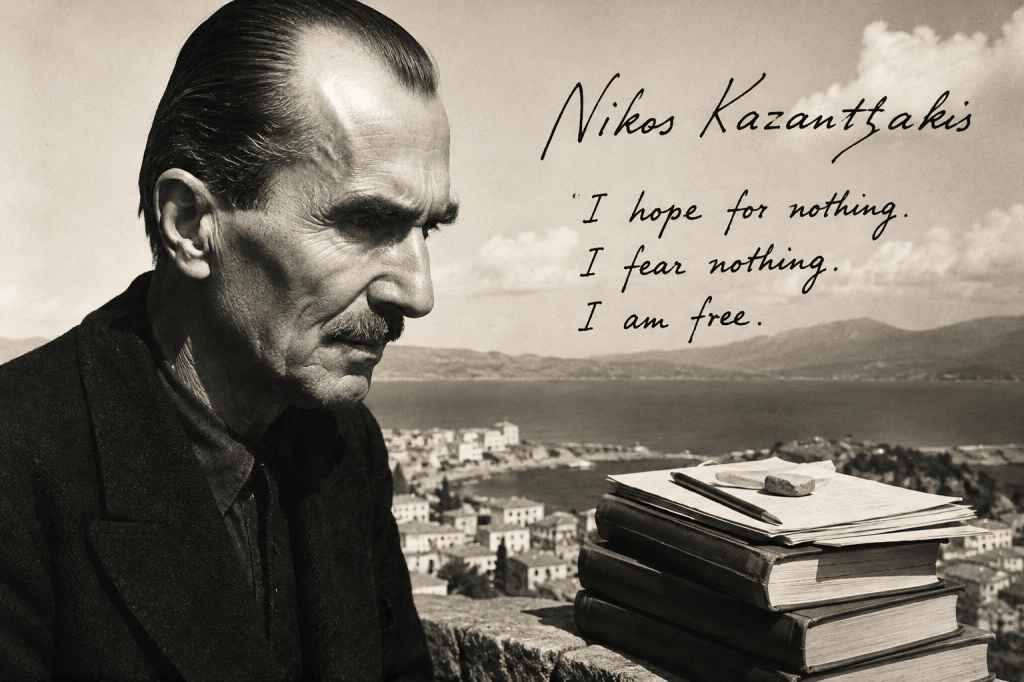
    Few modern Greek writers have crossed the borders between literature, philosophy, religion and existential questioning as fearlessly as Nikos Kazantzakis. To many readers around the world, his name is inseparable from Zorba the Greek, the exuberant story that became internationally famous through cinema, yet reducing Kazantzakis to Zorba means overlooking the much more complicated writer behind the novel: a man fascinated by Christ and Nietzsche, by Buddhism and ancient Greece, by revolution and solitude, by the struggle between the body and the spirit, and above all by the question of what a human being should do when certainty disappears.
    Born in Crete in 1883 and dying in 1957, Kazantzakis lived during a period of extraordinary political and intellectual upheaval, experiencing wars, revolutions, ideological conflicts and profound transformations in Greek society. His novels emerged from this turbulent world, but they also reached beyond it, repeatedly returning to questions that have no simple historical boundary: whether freedom is worth suffering for, whether faith can survive doubt, whether human beings need God, and whether the search for meaning matters even when no final answer can ever be found.
    The result was a body of work that made him one of Greece’s most internationally recognized literary figures while simultaneously making him controversial in his own country.
    From Crete to a Much Larger World
    Kazantzakis was born in Heraklion, Crete, at a time when the island was still under Ottoman rule, and the atmosphere of resistance, political instability and the struggle for independence left a deep impression on his imagination. Crete would later become far more than a geographical background in his writing; it represented a particular idea of freedom, pride, suffering and defiance that would repeatedly reappear in his fictional characters.
    He studied law in Athens before continuing his intellectual formation in Paris, where he encountered the philosophy of Henri Bergson. During his life he traveled extensively, moving through Europe and visiting regions of Asia and the Middle East, while absorbing influences that ranged far beyond the conventional boundaries of Greek literature.
    His intellectual world became extraordinarily wide. Christianity fascinated him, although his relationship with institutional religion was complicated and frequently contentious. Nietzsche influenced his understanding of struggle and self-overcoming, while Buddhist thought introduced another vision of liberation from attachment. Ancient Greek philosophy, modern European thought, political revolution and mystical traditions all entered the restless conversation taking place within his work.
    Kazantzakis did not seem interested in choosing one comfortable system and remaining inside it. He was interested in what happened when contradictory ideas collided.
    Zorba Was Only One Side of Kazantzakis
    For millions of readers, the doorway into Kazantzakis remains Zorba the Greek, originally published in Greek in 1946 under a title referring to the life and adventures of Alexis Zorbas.
    The novel contrasts two radically different approaches to existence. Its intellectual narrator observes, thinks and questions, while Zorba seems determined to experience life directly, through work, music, desire, food, grief and his famous dance. Their friendship becomes something larger than the story of two men attempting a business venture in Crete; it becomes a confrontation between thought and experience.
    This is one reason Zorba has remained such an enduring literary figure. He represents something many people feel they have lost: the ability to inhabit life rather than continually analyze it.
    The internationally celebrated film adaptation directed by Michael Cacoyannis, starring Anthony Quinn as Zorba, transformed the character into a cultural icon and helped carry Kazantzakis’s name to audiences far beyond Greece. The Nikos Kazantzakis Museum still uses the novel and Cacoyannis’s adaptation in its educational work devoted to the writer’s characters and ideas.
    Kazantzakis Museum Educational Actions
    Yet Zorba’s exuberance represents only one current within Kazantzakis. Elsewhere, the writer entered much darker and more dangerous intellectual territory.
    The Last Temptation of Christ and the Scandal of a Human Jesus
    Few of Kazantzakis’s books generated more controversy than The Last Temptation of Christ.
    His Jesus is not presented simply as a distant figure untouched by ordinary human conflict. Kazantzakis imagines Christ confronting fear, desire, doubt, responsibility and the possibility of another life, thereby making the spiritual victory meaningful precisely because temptation exists.
    For Kazantzakis, this tension between flesh and spirit was central to the human condition. The greatness of Christ, within the imaginative world of the novel, does not depend upon the absence of struggle but upon passing through struggle.
    That interpretation inevitably provoked religious opposition.
    The controversy surrounding the novel eventually became almost as famous as the book itself, and decades later Martin Scorsese’s 1988 film adaptation reignited international disputes over Kazantzakis’s portrayal of Jesus.
    Yet describing the novel simply as an attack on Christianity misses much of what makes it interesting. Kazantzakis was deeply preoccupied with spiritual questions throughout his life. His conflict was not necessarily between belief and disbelief, but between the human desire for absolute truth and the impossibility of reaching it without doubt.
    His Christ struggles because Kazantzakis’s human beings struggle.
    Christ Recrucified: What Happens When Faith Becomes Real?
    Another of his major novels, Christ Recrucified, approaches Christianity from a different direction.
    In a Greek village, inhabitants preparing to stage a Passion play are assigned the roles of Christ and other biblical figures. What begins as religious representation gradually becomes disturbingly real when refugees arrive seeking assistance and the moral questions of the Gospel cease to be abstract.
    The villagers must decide what Christian compassion actually requires when helping others threatens comfort, property and social order.
    This is where Kazantzakis becomes particularly uncomfortable for readers who prefer religion to remain safely symbolic. His characters are forced to confront the difference between venerating an ideal and living according to it.
    The question underlying the novel is deceptively simple: what would happen if people who claimed to follow Christ were suddenly required to behave like him?
    Kazantzakis rarely provides comfortable answers.
    Captain Michalis and the Cretan Obsession With Freedom
    In Captain Michalis, often published in English as Freedom or Death, Kazantzakis returned intensely to Crete and its struggle against Ottoman rule.
    The novel draws upon the historical and emotional landscape of the writer’s childhood, transforming Cretan resistance into a broader exploration of freedom, honor, violence and sacrifice. Kazantzakis’s characters frequently behave as though freedom possesses a value greater than survival itself, an idea deeply connected with the mythology and historical memory of Crete.
    This helps explain why his work can feel simultaneously modern and ancient. His protagonists wrestle with twentieth-century philosophical problems, yet they often possess the uncompromising intensity of figures from Greek tragedy.
    They are rarely moderate people.
    They love excessively, believe excessively, rebel excessively and sometimes destroy themselves because compromise feels more unbearable than suffering.
    The Odyssey That Contained 33,333 Verses
    Kazantzakis’s ambition extended far beyond the novels for which he is now most famous.
    One of his most extraordinary achievements was his enormous poetic work The Odyssey: A Modern Sequel, in which he imagined the adventures of Odysseus continuing after the conclusion of Homer’s epic.
    Kazantzakis worked on the poem repeatedly, producing multiple drafts before reaching the final version of 33,333 verses. His Odysseus cannot simply return home and remain there, because the desire to continue searching is stronger than the desire for security.
    That idea could almost serve as a metaphor for Kazantzakis himself.
    Arrival never seems sufficient.
    Every answer produces another question, every belief contains the possibility of rebellion, and every destination eventually becomes another point of departure.
    The Writer Who Came Close to the Nobel Prize
    Kazantzakis’s international literary reputation was substantial during his lifetime, and his connection with the Nobel Prize is more extensive than popular retellings sometimes suggest.
    The official Nobel Prize nomination archive records 14 nominations involving Nikos Kazantzakis between 1947 and 1957. Among his nominators were academics, literary organizations and the Society of Men of Letters of Greece.
    Nobel Prize
    In 1957, the final year of his life, he was nominated by both Samuel Baud-Bovy of the University of Geneva and the Society of Men of Letters of Greece. The Nobel Prize in Literature that year ultimately went to Albert Camus.
    Nobel Prize +1
    Kazantzakis never received the prize.
    Yet literary history has a strange way of rendering prizes less important with time. The question eventually becomes not who received a particular award in a particular year, but whose books people continue opening generations later.
    Kazantzakis survived that test.
    God, Freedom and the Endless Struggle
    Perhaps the deepest thread connecting Kazantzakis’s apparently different works is the concept of struggle.
    His characters struggle against political oppression, social convention, bodily desire, religious certainty, death and themselves. Even when victory appears impossible, the struggle itself can acquire meaning.
    This reaches one of its most concentrated forms in The Saviors of God: Spiritual Exercises, a philosophical and spiritual text that attempts to express Kazantzakis’s vision of existence beyond the conventions of the traditional novel.
    The world that emerges from his writing is rarely peaceful. Human beings stand between matter and spirit, instinct and aspiration, mortality and the desire to transcend mortality. There is no guarantee that the universe will provide them with an answer.
    Kazantzakis nevertheless refuses resignation.
    His philosophy repeatedly suggests that dignity may lie not in receiving certainty, but in continuing the ascent despite uncertainty.
    A Writer Too Religious for Some and Too Dangerous for Others
    One of the fascinating contradictions surrounding Kazantzakis is that he has been interpreted both as profoundly spiritual and as dangerously irreverent.
    The contradiction makes sense because he did not treat religion as something fragile that had to be protected from questioning. He entered directly into its most difficult territory, placing sacred figures inside psychological and philosophical conflict and asking what faith means when doubt is taken seriously.
    For some readers, this approach appeared offensive.
    For others, it made religious questions more meaningful precisely because they were no longer protected from uncertainty.
    Kazantzakis’s relationship with Christianity therefore cannot be adequately summarized by simply labeling him believer or unbeliever. His writing reveals something considerably more complicated: a lifelong confrontation with God, transcendence and the limits of human understanding.
    He did not walk away from these questions.
    He wrestled with them.
    Death and the Return to Crete
    Kazantzakis died in Freiburg, Germany, on 26 October 1957, following illness after returning from a journey to Asia.
    His body was eventually returned to Crete, the island that had shaped so much of his imagination. He was buried on the Martinengo Bastion overlooking Heraklion rather than in an ordinary cemetery.
    His tomb became associated with one of the most famous phrases connected with him:
    “I hope for nothing. I fear nothing. I am free.”
    The words seem almost designed as the final sentence of his intellectual life, bringing together the themes that had pursued him through decades of writing: fear, hope, attachment and freedom.
    Today the Nikos Kazantzakis Museum stands in Myrtia, approximately 15 kilometers south of Heraklion, in the ancestral village associated with his family, preserving manuscripts, personal material and the memory of his life and work.
    Kazantzakis Museum Educational Actions +1
    Why Kazantzakis Still Matters
    Kazantzakis belongs to the unusual category of writers whose books can be read as stories while simultaneously opening doors into philosophy.
    A reader can encounter Zorba simply as an unforgettable character, but behind him waits a question about whether thinking too much prevents us from living. A reader can approach The Last Temptation of Christ as historical fiction, only to encounter questions about desire, sacrifice and the nature of spiritual victory. Christ Recrucified can be read as a village drama until its characters force us to consider whether moral principles retain their meaning when following them becomes costly.
    That is why Kazantzakis has not disappeared into literary history.
    His questions remain inconveniently alive.
    How much freedom can a person actually bear? Can faith exist without doubt? Is intellectual knowledge enough to make a life meaningful? What should we do when the body wants one thing and the spirit another? And if death ultimately defeats every individual human being, can the struggle to transcend ourselves still possess meaning?
    Kazantzakis spent his life moving between countries, philosophies, religions and literary forms without finding — or perhaps without wanting — a comfortable final answer.
    In the end, that may be the most important thing to understand about him.
    Nikos Kazantzakis was not a writer who wanted to tell his readers what to think.
    He wanted to make it impossible for them to stop thinking.

    Sources & Further Reading

    The Nobel Prize Nomination Archive documents Kazantzakis’s fourteen recorded Nobel nominations between 1947 and 1957 and provides the nominators and years involved.
    Nobel Prize +1
    The Nikos Kazantzakis Museum in Myrtia, Crete preserves material relating to the writer’s life and work and provides historical and educational resources concerning his novels, travels and intellectual world.

    Fediverse reactions
  • The Green Children of Woolpit: The Medieval Mystery That Has Never Been Fully Explained

    The Green Children of Woolpit: The Medieval Mystery That Has Never Been Fully Explained

    Sometime during the twelfth century, while workers were gathering the harvest near the small English village of Woolpit in Suffolk, two children appeared in the countryside under circumstances so unusual that their story would survive for more than eight hundred years.

    They were a boy and a girl, apparently brother and sister, and according to the medieval chroniclers who recorded the event, there was immediately something extraordinary about them. Their clothes were made from material the local people did not recognize, the language they spoke could not be understood by anyone around them, and, most remarkably of all, their skin appeared to have a distinctly green coloration.

    The children seemed frightened and disoriented, and they were unable to explain where they had come from because nobody could understand their speech. They were eventually taken into the household of a local landowner, where another strange detail soon emerged: although food was placed before them, they refused almost everything they were offered.

    Then they saw beans.

    According to the medieval accounts, the children immediately became excited and searched desperately for the beans inside their stalks, apparently unfamiliar with the way the plants were presented to them. Once the beans themselves were produced, they ate eagerly.

    For some time, beans were reportedly almost the only food they would accept.

    Eventually their diet changed, their green coloration gradually disappeared, and the surviving child learned enough English to tell the people around her where she believed she had come from.

    Her explanation transformed an already unusual story into one of medieval England’s most enduring mysteries.

    She said that she and her brother had come from a place known as St Martin’s Land, a country where the sun did not shine as it did in England and where the world remained beneath a strange twilight.

    According to her account, everyone there was green.

    The Village Where the Children Appeared

    Woolpit is a real village in Suffolk, situated not far from Bury St Edmunds, and its unusual name has traditionally been connected with pits used for trapping wolves. The medieval form of the name is generally understood as deriving from something resembling “wolf pit,” which provided later storytellers with an appropriately mysterious landscape for the children’s appearance.

    One version of the story describes the children emerging near one of these pits during harvest time, where workers discovered them wandering in confusion.

    The event would probably have disappeared completely into local folklore had it not attracted the attention of two medieval chroniclers.

    The first was William of Newburgh, an Augustinian canon born around 1136 who wrote his Historia rerum Anglicarum, or History of English Affairs, toward the end of the twelfth century.

    William was not merely collecting fairy tales. His work was intended as a history of England beginning with the Norman Conquest, although, like many medieval historians, he also included accounts of wonders, supernatural events and phenomena that he considered sufficiently remarkable to record.

    When introducing the strange children, William himself acknowledged how difficult the story was to believe, yet indicated that the number and quality of the witnesses convinced him that something unusual had occurred.

    The second account comes from Ralph of Coggeshall, a monk and later abbot of Coggeshall Abbey in Essex, whose Chronicon Anglicanum also contains the story.

    Ralph’s account is particularly interesting because he claimed to have obtained information from Richard de Calne, the man whose household had reportedly taken in the children. If that statement is accurate, Ralph’s version brings us considerably closer to people associated with the original event than many legends of medieval Europe allow.

    The two chronicles differ in some details, but their central elements are remarkably similar: two strangely dressed children appeared near Woolpit, their skin had a green coloration, their language was unfamiliar, and initially they would eat little except beans.

    The Children Who Would Eat Only Beans

    Once the children had been brought into local care, attempts were made to feed them, but the food offered to them appeared unfamiliar or unacceptable.

    Then green beans were brought into their presence.

    The children reportedly reacted with intense interest, although one version of the story contains an intriguing detail: they initially searched the stalks rather than opening the pods, as though they recognized the food but did not understand where the beans were located on the plant before them.

    After someone showed them the pods, they ate eagerly.

    For a period afterward, beans remained their preferred food, although they gradually began eating other foods as they adapted to their new surroundings.

    At the same time, another transformation supposedly occurred.

    Their green skin began to fade.

    The boy, however, did not recover as successfully as his sister. Medieval accounts describe him as becoming increasingly weak or depressed, and he eventually died.

    The girl survived.

    She was baptized, remained in England and gradually learned the local language.

    Only then could anyone ask the question that must have occupied the villagers from the moment the children appeared.

    Where had they come from?

    The Land Where the Sun Never Fully Rose

    The girl’s answer was extraordinary.

    She reportedly said that she and her brother came from a place called St Martin’s Land, where the inhabitants were Christian and where churches existed, but the quality of daylight was completely different from that of England.

    The sun, she explained, did not shine brightly over their homeland.

    Instead, the country existed beneath something resembling perpetual twilight.

    In one version of the account, she described another luminous land visible beyond a considerable river, suggesting that her own country was separated from a brighter region by water.

    When asked how she and her brother had reached Woolpit, her explanation became even stranger.

    According to the story preserved by the chroniclers, the children had been tending their father’s animals when they entered or followed them into some kind of underground passage or cavern. Inside the darkness they heard the sound of bells, and after wandering through the passage for what seemed like a long time, they suddenly emerged into brilliant daylight.

    The intensity of the sunlight supposedly overwhelmed them because they had never experienced anything like it.

    Before they could find their way back, the harvest workers discovered them.

    The children had apparently crossed from one world into another without understanding how they had done it.

    At least, that was how medieval listeners could interpret the story.

    Was St Martin’s Land Somewhere on Earth?

    The obvious question is whether the girl’s mysterious homeland might have been a perfectly ordinary location whose description became distorted through language, fear and retelling.

    One modern hypothesis proposes that the children may have belonged to a Flemish community living in eastern England.

    Flemish settlers and textile workers were present in medieval England, and political conflict during the twelfth century created periods of hostility and violence involving Flemish communities and mercenaries.

    In 1173, during the rebellion against Henry II, fighting occurred at Fornham, not far from Bury St Edmunds. A later theory proposed by Paul Harris suggested that the children might have been displaced Flemish youngsters associated with Fornham St Martin, providing a possible explanation for the girl’s reference to “St Martin’s Land.”

    If the children spoke a Flemish dialect, their language could easily have sounded completely incomprehensible to rural English villagers.

    Their unfamiliar clothing might similarly have reflected cultural differences rather than anything supernatural.

    The theory is attractive because it potentially explains several pieces of the puzzle at once, but it remains a reconstruction rather than a demonstrated solution. Geographic and chronological difficulties remain, and historians do not possess independent evidence identifying the children as Flemish refugees.

    Why Were Their Faces Green?

    The most famous element of the story may also have one of the least supernatural explanations.

    Historical writers have suggested that the children’s appearance could have resulted from severe malnutrition or anemia. A condition historically called chlorosis was associated with a pale or greenish complexion, although applying a later medical diagnosis to two children known only through medieval chronicles is necessarily speculative.

    If the children had spent a prolonged period lost, displaced or surviving on an inadequate diet, their unusual complexion might have appeared even more striking to people encountering them for the first time.

    The fact that the girl’s green coloration reportedly disappeared after she began eating a more varied diet is one reason this explanation has remained attractive. Woolpit’s own historical account mentions severe nutritional deficiency as one possible explanation for the reported appearance.

    Yet this explanation creates another interesting question.

    If malnutrition explains the green color, what explains the strange language, unfamiliar clothing and story of the twilight homeland?

    Each mystery can perhaps be explained individually, but combining all of them into one convincing reconstruction becomes considerably more difficult.

    Or Was This a Medieval Story About Another World?

    There is another possibility that does not require the children to have existed exactly as described.

    Medieval chronicles were not written according to modern standards of historical reporting, and their authors frequently recorded miracles, omens, monsters, visions and other extraordinary events alongside political history.

    The boundary between history, theology, oral tradition and folklore was considerably more fluid than it is for modern historians.

    The Green Children may therefore belong partly to the enormous European tradition of stories about encounters with an Otherworld, a hidden realm existing alongside the ordinary human world.

    Several elements fit surprisingly well.

    The children emerge from an underground passage.

    Their homeland exists beneath unusual light.

    Their appearance is different from ordinary humans.

    They eat unusual food.

    They cannot initially communicate with the people who discover them.

    One of them eventually remains permanently in the human world.

    Green itself acquired powerful associations with nature, fairies, spirits and otherworldly beings in later European folklore, although we must be careful not to project later traditions automatically onto a twelfth-century account.

    The story could therefore represent a real event that accumulated folkloric details, an older folktale attached to a real village, or some combination of both.

    That uncertainty is precisely what makes Woolpit so fascinating.

    What Happened to the Surviving Girl?

    After learning English and adapting to local life, the girl reportedly remained in England.

    William of Newburgh wrote that she eventually lost the green coloration of her skin and lived for many years, while Ralph of Coggeshall associated her with the household of Richard de Calne.

    Later tradition sometimes gives the girl the name Agnes and claims that she married a man connected with King’s Lynn, but these details are considerably less secure than the central medieval accounts and should not be presented as established fact.

    What matters is that, according to the chroniclers, the surviving child did not disappear mysteriously back into St Martin’s Land.

    She stayed.

    This small detail makes the story unusually tantalizing because, if there really was a surviving girl who grew into adulthood in medieval England, she potentially represented a living connection to whatever event originally inspired the legend.

    Yet no surviving document has conclusively identified her.

    Her trail disappears into history.

    Two Chroniclers, One Extraordinary Story

    The existence of two medieval accounts is often presented online as though it proves that the Green Children must have existed exactly as described.

    It does not.

    The chroniclers were not eyewitnesses to the children’s appearance, and both recorded the story after the supposed event. Medieval information traveled through oral networks, monasteries, travelers and shared stories, which means that two written accounts do not necessarily represent two completely independent eyewitness traditions.

    Nevertheless, their existence matters.

    The Green Children were not invented by a nineteenth-century spiritualist, a twentieth-century UFO writer or a modern internet storyteller.

    Something resembling this extraordinary narrative was already circulating in medieval England strongly enough for two serious chroniclers to preserve it.

    That leaves us with several possibilities, none of which can now be proven.

    Perhaps two displaced foreign children really did wander into Woolpit, malnourished, frightened and unable to communicate, while bewildered villagers gradually transformed their tragedy into a supernatural story.

    Perhaps the narrative began as folklore and acquired real names and locations as it circulated.

    Perhaps an unusual historical incident and an older tradition of the Otherworld merged until separating fact from legend became impossible.

    Or perhaps something happened near Woolpit that does not fit comfortably into any explanation that has survived.

    More than eight centuries later, the village remains where it always was, the medieval chroniclers remain available to be read, and the children themselves have disappeared completely.

    We know what William of Newburgh and Ralph of Coggeshall wrote.

    We know what later generations believed.

    What we do not know is what two frightened children actually saw before they stepped into the sunlight near Woolpit.

    And somewhere between those three things — chronicle, legend and lost experience — the Green Children are still waiting.


    Sources & Further Reading

    William of Newburgh — Historia rerum Anglicarum (History of English Affairs)
    One of the two principal medieval accounts of the Green Children.

    Ralph of Coggeshall — Chronicon Anglicanum
    The second major medieval source; Ralph claimed information connected with Richard de Calne, whose household was associated with the children.

    Woolpit Village — Local History
    The village’s historical account preserves the local tradition and discusses possible explanations for the children’s appearance.

    Brian Haughton — “The Green Children of Woolpit”
    A useful overview comparing the medieval sources with later historical, medical and folkloric explanations.

    Fediverse reactions
  • The Pope Who Was Put on Trial After His Death: The Terrifying Cadaver Synod of 897

    The Pope Who Was Put on Trial After His Death: The Terrifying Cadaver Synod of 897

    In the winter of 897, Rome witnessed a spectacle so disturbing that, more than eleven centuries later, it remains one of the most infamous episodes in the history of the papacy. Inside the Lateran Basilica, where ecclesiastical disputes were normally decided among living men, bishops and clergy gathered for a trial whose defendant had already been dead and buried for approximately nine months.

    The man being judged was Pope Formosus, but he was not represented merely by documents, witnesses or memories of his pontificate. His body had been removed from its tomb, dressed once again in papal vestments and brought into the basilica, where it was reportedly placed upon a seat before the assembled clergy. According to later accounts of the proceedings, a deacon was assigned the extraordinary task of answering on behalf of the dead pope while Pope Stephen VI presided over the accusations against his predecessor.

    The episode would become known as the Cadaver Synod, and later tradition would remember it under the chilling Latin designation Synodus Horrenda, the Horrible Synod. Although its most sensational details sound as though they belong to a Gothic novel rather than to ecclesiastical history, the trial itself was very real, and its purpose becomes considerably more understandable once the violent political struggles surrounding the papacy at the end of the ninth century are brought into view.

    The corpse on the throne was horrifying, but the real struggle concerned the living.

    Before the Corpse, There Was a Powerful Churchman

    Long before his body was brought into a courtroom, Formosus had been one of the most prominent and controversial churchmen of his generation. Born around the beginning of the ninth century, he eventually became bishop of Porto, an important episcopal see near Rome, and acquired a reputation as an able missionary and diplomat whose ecclesiastical career brought him into contact with some of the most significant political conflicts of his age.

    His abilities did not protect him from enemies. During the pontificate of Pope John VIII, Formosus became involved in a serious dispute with papal authorities and was accused of abandoning his diocese, conspiring against the pope and aspiring improperly to the Roman see. He was excommunicated and compelled to swear that he would never return to Rome or resume his episcopal functions, although changing political circumstances eventually allowed him to be restored to communion and to return to his position.

    When Formosus was elected pope in October 891, therefore, he arrived at the papal throne carrying both considerable experience and a history that his enemies would later use against him. One particularly important canonical problem concerned his position as bishop of Porto, because church law strongly discouraged the transfer of a bishop from one episcopal see to another, and his eventual election as Bishop of Rome provided his opponents with an argument that could later be transformed into an accusation of illegitimacy.

    Had this been merely a technical ecclesiastical dispute, Formosus might never have become the defendant in history’s most famous posthumous trial. What transformed the controversy into something far more dangerous was the struggle for political control of Italy and the imperial crown.

    A Pope Caught Between Rival Rulers

    The political landscape of late ninth-century Italy was extraordinarily unstable. The Carolingian order that had once provided a measure of imperial unity was disintegrating, powerful aristocratic families competed for territory and influence, and the papacy frequently found itself caught between rulers whose military strength could determine who controlled Rome itself.

    Among the most powerful forces in Italy was the house of Spoleto. Formosus initially recognized its position and crowned Lambert of Spoleto as co-emperor, but relations deteriorated, and the pope eventually sought assistance from Arnulf of Carinthia, the East Frankish king whose intervention offered the possibility of breaking Spoletan dominance.

    Arnulf crossed into Italy and entered Rome in 896, after which Formosus crowned him emperor. The decision was politically explosive because it represented a rejection of the interests of Lambert and his powerful mother, Ageltrude, while simultaneously tying the papacy to Arnulf’s military fortunes.

    Those fortunes changed almost immediately. Arnulf became seriously ill during his Italian campaign and was forced to withdraw, leaving the political situation unresolved, while Formosus himself died on 4 April 896. The pope was buried according to the customs of his office, and under ordinary circumstances his participation in the struggle might have ended there.

    Instead, the political balance shifted again, the Spoletan faction recovered its influence, and Formosus’s enemies discovered that death did not necessarily prevent them from attacking the legitimacy of everything he had done.

    Nine Months After Burial, the Grave Was Opened

    Following Formosus came the extremely brief pontificate of Boniface VI, whose reign lasted only a matter of days, and then Stephen VI became pope. During Stephen’s pontificate, probably in January 897, an extraordinary decision was made: Formosus would be prosecuted formally despite the inconvenient fact that he had been dead for months.

    His grave was opened and the corpse was removed.

    Historical accounts describe the body being dressed again in papal vestments and brought into the Lateran Basilica, where an ecclesiastical assembly had been convened. The dead pope was positioned before the court as though his physical presence were necessary for the proceedings, while Stephen VI assumed the role of his accuser and judge.

    Later narrative sources describe a deacon standing beside Formosus and answering questions on his behalf, creating an almost surreal scene in which the forms of a conventional ecclesiastical hearing were maintained even though the defendant was incapable of hearing the charges, understanding the proceedings or defending himself.

    It would be easy to dismiss the entire spectacle as nothing more than an eruption of medieval superstition or personal madness, yet doing so would obscure the political calculation behind it. Stephen and the enemies of Formosus were not interested merely in humiliating a corpse; they wanted to destroy the legal and ecclesiastical consequences of Formosus’s pontificate.

    To accomplish that, they first had to establish that he should never have been pope at all.

    What Could a Dead Pope Be Accused Of?

    The accusations revived controversies that had followed Formosus during his lifetime, particularly those involving his earlier position as bishop of Porto and the canonical restrictions concerning the transfer of bishops between sees. His opponents argued, in effect, that he had occupied the Roman see illegitimately and had therefore exercised papal authority that he should never have possessed.

    Other accusations concerned the oaths and obligations arising from his earlier conflict with John VIII, but the significance of the proceedings extended far beyond Formosus’s personal reputation. If his election to the papacy could be declared invalid, then the decisions he had made while occupying the office could also be challenged, including his ecclesiastical appointments and the ordinations he had performed.

    This was where the trial became politically useful, because Formosus had created networks of authority through the bishops and clergy he had ordained. Invalidating those acts could weaken men whose positions depended upon him while strengthening their rivals, which meant that the prosecution of a dead pope could have very real consequences for powerful living churchmen.

    The corpse could not defend itself, and the verdict was hardly in doubt.

    Formosus was condemned.

    Punishing a Man Who Could No Longer Feel Punishment

    Once the court had declared Formosus guilty, the proceedings entered their most macabre phase. His papal vestments were stripped from the corpse, and the acts associated with his pontificate were declared invalid. According to the traditional accounts, three fingers of his right hand, associated with the gesture of papal blessing, were cut away, an act whose symbolism was far more important than any physical punishment that could obviously no longer be inflicted upon the dead man.

    Everything about the treatment of the body communicated the same message: the authority Formosus had exercised as pope was being erased symbolically from his remains.

    His body was subsequently buried in a common grave rather than being allowed to retain the honor associated with papal burial. Later accounts state that it was then removed once more and thrown into the River Tiber, transforming a former pope, bishop and imperial kingmaker into a mutilated corpse discarded in the water flowing through Rome.

    Some of the vivid details of the trial survive through chroniclers writing after the event, which means that historians must distinguish carefully between the firmly established outline of the Cadaver Synod and dramatic elements preserved by later narrative tradition. There is no serious doubt, however, that Formosus was exhumed and subjected to a posthumous ecclesiastical trial under Stephen VI, nor that subsequent popes considered the proceedings sufficiently serious to overturn their consequences.

    Whatever Stephen hoped to achieve, the spectacle did not bring stability to Rome.

    It helped produce the opposite.

    The Living Judge Soon Followed the Dead Defendant

    The reaction against Stephen VI was rapid and severe. His political position collapsed during the months following the Cadaver Synod, and he was eventually deposed, imprisoned and strangled in the summer of 897.

    The reversal is one of the most striking features of the entire episode. At the beginning of the year, Stephen had possessed enough authority to order the exhumation and condemnation of a former pope; only months later, he himself was a prisoner whose pontificate had ended violently.

    Formosus, meanwhile, began an extraordinary posthumous rehabilitation.

    Tradition records that his body was recovered after being thrown into the Tiber, and later in 897 Pope Theodore II convened a synod that annulled the judgment against him and recognized the validity of his ordinations. His remains were restored to an honorable papal burial, reversing the humiliation imposed during Stephen’s pontificate.

    Theodore II occupied the papal throne for only a short period, but his actions were followed by those of John IX, who continued the rehabilitation of Formosus and convened synods that rejected the Cadaver Synod and attempted to prevent similar proceedings from occurring again. At Ravenna in 898, the measures against Formosus were overturned, while records associated with the grotesque trial were ordered destroyed.

    The dead pope, in effect, had received an appeal and won.

    Why the Ordinations of a Dead Pope Could Threaten the Living

    The controversy did not disappear simply because Formosus was returned to his tomb, because the question of his legitimacy created a theological and legal problem with potentially enormous consequences.

    A pope ordained bishops, and those bishops could subsequently ordain priests, consecrate other bishops and perform sacramental acts whose legitimacy depended upon their own ecclesiastical authority. If the ordinations performed by Formosus were invalid because he had supposedly occupied the papal office illegitimately, then doubts could spread through an expanding chain of clergy whose authority ultimately traced back to him.

    The problem therefore resembled a crack moving through the foundations of a building. What began as an attack on one dead pope could destabilize the status of numerous living churchmen and create uncertainty about sacraments and appointments that had already taken place.

    Writers defending Formosus consequently argued vigorously for the validity of his ordinations, while the controversy continued to influence papal politics after the principal participants were dead. Pope Sergius III, who became pope in 904, was associated with renewed hostility toward the Formosan position, demonstrating how difficult it was to bury a dispute that had already survived the man at its center.

    The Cadaver Synod was therefore never simply an absurd trial of a corpse. It represented an attempt to use canon law, ritual and physical humiliation to rewrite the legal consequences of an earlier pontificate.

    Was Stephen VI Insane?

    Modern retellings sometimes explain the episode by portraying Stephen VI as a deranged pope whose hatred of Formosus drove him to an act of grotesque irrationality. The temptation is understandable, because exhuming a decomposing predecessor and placing him before an ecclesiastical tribunal certainly appears incomprehensible when viewed outside its historical setting.

    There is, however, no reliable basis for diagnosing Stephen’s mental state more than eleven centuries after his death, and the political context provides motives that do not require such speculation. Formosus had supported Arnulf of Carinthia against the interests of the Spoletan faction, while his ecclesiastical acts had created positions and loyalties that remained important after his death. Declaring his pontificate illegitimate could therefore serve political interests by weakening the authority of his supporters and strengthening those who wanted his legacy destroyed.

    Seen in this context, the trial becomes more disturbing rather than less, because it suggests that the grotesque treatment of the corpse was not necessarily meaningless madness. It could function as calculated political theater in which the body of a dead pope became an instrument for changing the balance of power among living men.

    The courtroom was merely the stage.

    The real struggle was taking place throughout Rome and Italy.

    The Painting That Gave the Trial a Face

    Almost a thousand years after the Cadaver Synod, French painter Jean-Paul Laurens created one of the most memorable visual interpretations of the episode. His 1870 painting Le Pape Formose et Étienne VI depicts the dead Formosus seated rigidly before Stephen, surrounded by clergy inside a dark architectural space whose theatrical lighting intensifies the horror of the confrontation.

    The painting should not be mistaken for a reconstruction based on eyewitness evidence, because Laurens was creating a nineteenth-century historical drama rather than documenting the precise appearance of the Lateran in 897. Nevertheless, his composition captures something fundamental about the episode: the dead figure appears strangely passive and almost dignified while the living men surrounding him generate the violence and menace of the scene.

    Perhaps this is why the image remains so effective. The corpse is not really the frightening part.

    The frightening part is what the living are willing to do with it.

    A Trial That Was Never Really About the Dead

    The Cadaver Synod continues to fascinate because it violated an expectation that seems almost universal: whatever conflicts surround a person during life, death eventually removes that person from the immediate struggle for power.

    Formosus was denied even that final separation.

    His enemies could no longer force him to surrender authority, retract his decisions or answer accusations, so they attacked the surviving structures of his pontificate instead. By removing his body from the grave and placing it physically before a tribunal, they transformed a legal dispute into an extraordinary ritual in which the dead were temporarily dragged back into the political world of the living.

    For a brief moment in Rome in 897, the boundaries between courtroom and tomb, punishment and memory, law and political revenge became almost impossible to distinguish. A dead pope was dressed in the clothing of the office he had once occupied, a living pope demanded answers that the defendant could never provide, and an ecclesiastical assembly pronounced judgment upon a man whose earthly punishment had already been completed by death.

    Yet the final irony belongs to Formosus.

    The judgment against him was overturned, his ordinations were defended, his remains were restored to honorable burial and the spectacle intended to destroy his legacy instead ensured that his name would be remembered for more than a thousand years.

    Stephen VI, who had attempted to place a dead predecessor permanently among the condemned, was himself deposed, imprisoned and strangled only months after the trial.

    Formosus returned to his tomb.

    The Cadaver Synod entered history.

    And perhaps that is the most unsettling part of the entire story, because beneath the decomposing body, the papal robes and the macabre courtroom lies something far more recognizable than medieval superstition: the ancient human desire to rewrite the past when controlling the present is no longer enough.

    Sources & Further Reading

    Liudprand of Cremona, Antapodosis — an important later narrative source for the episode, although it was written decades afterward and its dramatic details must therefore be approached critically.

    Horace K. Mann, The Lives of the Popes in the Early Middle Ages — provides historical context for Formosus, Stephen VI and the political struggles surrounding the late ninth-century papacy.

    Catholic Encyclopedia, “Pope Formosus” — useful for the ecclesiastical career of Formosus, the Cadaver Synod and his subsequent rehabilitation.

    Bilal, M. and Tubbs, R. S., “Popes Convict Dead Pope Twice! The Unbelievable Cadaver Synod,” Clinical Anatomy (2017) — a modern scholarly discussion of the treatment of Formosus’s corpse and the extraordinary posthumous proceedings.

    Encyclopaedia Britannica, entries concerning Formosus and the ninth-century papacy — useful for the broader political and ecclesiastical context.

    Fediverse reactions
  • The Prisoner Who Took God to Court: Romania’s Strangest Case Against Heaven

    A convicted murderer, a baptism treated as a contract, a defendant whose address was listed as Heaven — and a legal complaint that eventually reached newspapers around the world.


    Somewhere behind the walls of Timișoara Penitentiary, in western Romania, a prisoner arrived at an extraordinary conclusion.
    The justice system had already decided who was responsible for the murder that had brought him there.
    He disagreed.
    Or, at least, he believed there was another party who should also be held accountable.
    That party was God.
    In October 2005, Pavel Mircea, a Romanian prisoner serving a 20-year sentence for murder, submitted a criminal complaint naming God as the accused. Contemporary Romanian reports described him as a man from Reșița imprisoned in Timișoara. The complaint was not a metaphor, a theological essay or merely an angry letter.
    It entered Romania’s legal machinery.
    And Mircea had an argument.
    He believed he had a contract.


    A Contract Signed at Baptism
    The foundation of Mircea’s case reached all the way back to his baptism.
    According to contemporary Romanian reporting, he argued that through his baptism in the Orthodox Church he had effectively entered into an agreement with God. Under his interpretation of that agreement, God had undertaken to keep the Devil away from him and protect him from misfortune and evil.
    But Mircea was now sitting in prison for murder.
    Therefore, he reasoned, something had gone terribly wrong with the agreement.
    He maintained that God had failed to protect him from Satan and that the Devil had consequently been able to influence him toward the crime for which he had been convicted. Romanian newspaper Adevărul later summarized his argument in striking terms: the divine party to the baptismal “contract” had failed to keep its word.
    The logic was bizarre from a legal perspective.
    Yet internally, it followed an almost unsettling sequence:
    There was a promise.
    The promise involved protection from evil.
    Evil prevailed.
    Therefore the promise had been broken.
    And Mircea wanted someone held responsible.


    The Defendant’s Address: Heaven
    Even the wording of the complaint seemed designed for a story that no novelist would dare make too obvious.
    Mircea sought criminal proceedings against:
    God, domiciled in Heaven.
    He identified the Romanian Orthodox Church as God’s representative in Romania and, locally, the Orthodox metropolitan authority in Timișoara.
    Once the supernatural defendant had been identified, Mircea proceeded as though he were accusing an ordinary earthly suspect.
    Contemporary reporting listed allegations corresponding to offences such as fraud, concealment, abuse of office, receiving undue benefits and influence peddling.
    And there was money involved.
    One 2005 Romanian report said Mircea demanded €2 million in damages.
    Later reporting stated that he also wanted back money he had spent on candles and religious services that, in his view, had failed to produce the promised protection.
    Suddenly the argument became stranger still.
    Prayer had become consideration.
    Baptism had become contract.
    Religious offerings had become payments.
    And divine protection had become a service which, according to the prisoner, had not been delivered.


    The Prosecutors Had a Problem
    It would have been easy simply to throw the papers away.
    But a criminal complaint submitted to authorities could not necessarily be treated as though it had never existed.
    In October 2005, Florin Munteanu, then chief prosecutor attached to the Timișoara District Court, told Romanian media that the complaint would be registered and ultimately closed. He said prosecutors still had to provide the prisoner with an answer. Police representatives likewise described the complaint as impossible for state institutions to resolve.
    For almost two years, the story remained an extraordinary curiosity of the Romanian justice system.
    Then, in July 2007, it returned to the news.
    The file had finally been closed.
    According to Adevărul, prosecutors attached to the Timișoara District Court decided not to begin a criminal prosecution, giving a reason that would propel the case into headlines far beyond Romania:
    God was not a real person in the legal sense and had no domicile.
    The problem was brutally mundane.
    To prosecute someone, the legal system needs a legally recognizable defendant.
    And Heaven was not an address at which Romanian authorities could serve papers.


    When the Story Escaped Romania.
    This was the moment the case became international.
    News agencies picked it up, and soon one of Romania’s strangest criminal complaints appeared on websites thousands of kilometres away.
    ABC News in Australia published the story under the headline “God escapes day in court.” Its AFP report described a Romanian murderer who had accused God of fraud and betrayal of trust after his prayers apparently failed to protect him from evil.
    South Africa’s Mail & Guardian carried essentially the same international agency report, describing the defendant as God, resident in Heaven and represented in Romania by the Orthodox Church.
    There was, however, an important difference between some international accounts and the Romanian reporting.
    The foreign stories often said that a court had dismissed a lawsuit against God. Romanian contemporary sources describe the procedure more precisely as a criminal complaint handled by prosecutors, ending with a decision not to begin criminal prosecution.
    That distinction hardly made the headline less remarkable.
    A Romanian prosecutor’s office had still been placed in the surreal position of having to determine what to do with a criminal accusation against the Creator of the universe.


    But Pavel Mircea Was Not the First
    What happened in Timișoara feels unique until one begins searching through legal history.
    Then something unexpected appears.
    Human beings have tried, more than once, to drag supernatural beings into earthly courts.
    And each case reveals something peculiar about what happens when metaphysical claims collide with procedural law.


    United States v. Satan — 1971
    More than three decades before the Romanian complaint, another prisoner had selected an even less accessible defendant.
    Satan.
    In 1971, Gerald Mayo brought a case in the United States District Court for the Western District of Pennsylvania under the unforgettable title:
    United States ex rel. Gerald Mayo v. Satan and His Staff
    This case is not an urban legend. The federal court decision survives.
    Mayo alleged that Satan had caused him misery and threats, deliberately placed obstacles in his path and caused his downfall. He argued that these actions had deprived him of constitutional rights.
    Judge Gerald J. Weber found several problems.
    There were questions about whether the court had personal jurisdiction over Satan. Mayo had not alleged that Satan resided within the Western District of Pennsylvania.
    There were also problems with Mayo’s attempt to make the proceeding a class action.
    And then there was the question that would echo eerily through later supernatural lawsuits:
    How exactly was Satan supposed to be served with legal papers?
    The court noted that Mayo had failed to provide the U.S. Marshal with instructions for service of process. His request to proceed without paying court costs was denied.
    The judicial opinion even contained a piece of remarkable legal humor. Judge Weber referred to an “unofficial” account in which the same defendant had once appeared as a plaintiff in New Hampshire — an unmistakable allusion to the fictional tale The Devil and Daniel Webster.
    The law had met the Devil.
    And paperwork won.


    Then a Senator Sued God
    Two years after Pavel Mircea’s complaint became international news, another case involving God attracted enormous attention in the United States.
    The plaintiff this time was not a prisoner.
    He was Nebraska state senator Ernie Chambers.
    On September 14, 2007, Chambers filed a petition in the District Court of Douglas County, Nebraska, asking for a permanent injunction against God. The surviving complaint literally identifies the parties as:
    State Senator Ernie Chambers, Plaintiff
    v.
    God, Defendant.
    Center for Agricultural Law and Taxation
    Chambers accused the defendant of causing catastrophic events and sought an order stopping harmful activities and terroristic threats. His filing attempted to solve the jurisdiction problem with wonderfully circular theological logic: because God was omnipresent, God was necessarily present in Douglas County, Nebraska — therefore the court had jurisdiction.
    The suit was not primarily an expression of religious grievance like Mircea’s. Chambers used the case to make a point about access to the courts and the ability of citizens to file lawsuits. Contemporary accounts characterized the filing as a demonstration of how broadly the courthouse doors were supposed to remain open.
    But once again, theology encountered procedure.
    The fundamental difficulty remained familiar:
    How do you legally notify God that God has been sued?


    The Strange Pattern Behind These Cases
    Look at the three cases side by side and something fascinating emerges.
    Gerald Mayo blamed Satan for his downfall.
    Pavel Mircea blamed God for failing to prevent his.
    Ernie Chambers sued God partly to test a principle of human law.
    Different decades. Different countries. Different motives.
    Yet all three eventually collided with roughly the same wall:
    A court may entertain almost any allegation on paper, but a legal system operates through jurisdiction, legal personality, evidence and service of process.
    The supernatural is remarkably difficult to summon with a subpoena.


    And that is where these stories stop being merely funny.


    Who Is Responsible for Evil?
    Strip away the absurdity of Mircea’s complaint and underneath it sits one of humanity’s oldest philosophical problems.
    If an all-powerful and benevolent God exists, why is evil permitted?
    Philosophers and theologians have debated variations of that question for centuries.
    Pavel Mircea did something different.
    He tried to turn the question into a criminal file.
    Rather than asking:
    “Why did God allow evil?”
    his complaint effectively asked:
    “If God promised to protect me from evil and failed, can God be held responsible?”
    The transformation is extraordinary because it attempts to force a theological dilemma into the language of earthly accountability.
    Contract.
    Obligation.
    Failure.
    Damage.
    Compensation.
    But there is an uncomfortable element to the story as well.
    Mircea had been convicted of murder. His theory transferred responsibility for his actions away from himself and toward supernatural forces: God had failed him; Satan had influenced him.
    The criminal law could not accept that chain of reasoning merely because the prisoner believed it.
    Human courts judge human conduct.
    And so the cosmic question returned to Earth.


    The One Defendant Who Could Not Be Summoned
    There was no courtroom confrontation in Timișoara.
    No lawyer stood up for Heaven.
    No representative of the Romanian Orthodox Church was required to defend the Creator against accusations of fraud.
    No witness was asked whether prayers constitute payment.
    No judge had to determine whether baptism creates an enforceable contract.
    The case ended before any such spectacle could occur. Romanian prosecutors closed the matter rather than beginning a criminal prosecution.
    Yet the complaint survived.
    It survived because it was strange enough to be reported in Romania in 2005.
    It survived because the decision resurfaced in 2007.
    It survived because international news agencies carried it across continents.
    And nearly two decades later, it remains one of those rare stories in which bureaucracy, religion, crime and philosophy briefly occupy the same page.
    Perhaps the most remarkable part is not that a prisoner tried to put God on trial.
    Humans have been putting God on trial in poetry, philosophy and private despair for thousands of years.
    Pavel Mircea simply attempted to obtain a case number for it.
    And somewhere inside the Romanian justice system, for a brief and astonishing moment, someone had to decide what to write in the file when the accused had only one known address:
    Heaven.

    Sources & Further Reading
    ABC News Australia / AFP — “God escapes day in court”, July 12, 2007. Relates the international version of Pavel Mircea’s complaint against God and the decision to dismiss the case.
    ABC News
    Mail & Guardian / AFP — “Case against God dismissed in Romanian court”, July 11, 2007. Reports that Mircea was serving a 20-year sentence for murder and had named God, “who lives in the heavens,” as defendant.
    Mail & Guardian
    University of Georgia School of Law — United States ex rel. Gerald Mayo v. Satan and His Staff, 54 F.R.D. 282 (W.D. Pa. 1971). Original federal court decision concerning Gerald Mayo’s lawsuit against Satan.
    University of Georgia School of Law
    Texas Bar — Discussion of Mayo v. Satan and His Staff and the unusual procedural issues raised by attempting to sue a supernatural defendant.
    Texas Bar
    Ernie Chambers v. God, District Court of Douglas County, Nebraska, 2007 — court filing in which Nebraska State Senator Ernie Chambers named God as defendant and argued that an omnipresent deity was necessarily within the court’s jurisdiction.

  • The Unicorn Horns Worth a Fortune: What Medieval Kings Were Really Buying

    Imagine sitting at a royal banquet somewhere in Renaissance Europe while a servant carefully places an extraordinary object beside the king: a long, ivory-white horn twisted into an almost perfect spiral. It has cost a fortune, perhaps more than many people could earn in several lifetimes, yet its value does not come merely from its beauty. The people gathered around the table believe that it came from one of the rarest creatures on Earth and that, under the right circumstances, it might even save the king’s life from poison.
    To modern eyes, the object would be immediately recognizable as something very different. It was not taken from a magical white horse wandering through an enchanted forest, because the magnificent spiral was actually the elongated tooth of a narwhal, an Arctic whale that most Europeans of the Middle Ages had never seen.
    For centuries, however, these remarkable tusks crossed enormous distances before appearing in churches, royal treasuries, princely collections and apothecaries, where they were accepted as tangible evidence that unicorns were not merely creatures of legend.
    The deception, if we can even call it that, became one of the most fascinating intersections of mythology, medicine, exploration and commerce in European history.


    When the Unicorn Was Not Considered a Fantasy
    It is easy to imagine that medieval Europeans understood the unicorn in much the same way that we do today, as a beautiful but obviously mythical animal. The reality was considerably more complicated.
    Medieval descriptions of the natural world contained creatures that Europeans rarely, if ever, encountered themselves. Elephants, lions, crocodiles and exotic animals from distant territories could seem almost as extraordinary as creatures that we would now classify as mythical. In a world where reliable zoological information traveled slowly and distant lands remained mysterious, the existence of a horse-like animal with a single horn was not necessarily an absurd proposition.
    The unicorn also possessed a long literary history. Ancient writers had described mysterious one-horned animals, and during the Middle Ages the creature acquired powerful religious and symbolic meanings. In Christian interpretations, the unicorn could represent purity and even Christ, while stories concerning its capture frequently involved a virgin maiden capable of taming an animal that hunters could not otherwise approach.
    The famous Unicorn Tapestries, created around the turn of the sixteenth century and now preserved at The Met Cloisters, demonstrate just how deeply the creature had entered European aristocratic culture. Medieval tradition attributed extraordinary therapeutic powers to its horn, and by the twelfth century narwhal tusks were being regarded as genuine unicorn horns.
    Then there was something even more persuasive than stories.
    There were actual “horns”.


    The Mysterious Objects Arriving from the North
    Narwhals inhabit Arctic waters around Greenland, Canada, Scandinavia and Russia. The characteristic tusk, found primarily in males, is actually an elongated tooth that grows in a distinctive spiral and can reach extraordinary lengths.
    To people familiar with narwhals, there was nothing supernatural about it. Arctic peoples had known and hunted these animals for generations, using different parts of the whale for food, tools, clothing and other necessities of life.
    Farther south, however, the situation was completely different.
    Most medieval Europeans had never seen a living narwhal, and they possessed little reliable knowledge about the animal from which these spectacular ivory spirals originated. When the tusks entered European trade networks, their appearance fitted remarkably well with descriptions and artistic representations of the legendary unicorn.
    A beautiful spiral horn existed.
    People already believed that an animal possessing such a horn existed somewhere beyond the familiar world.
    The two ideas fitted together almost perfectly.
    The Metropolitan Museum of Art notes that narwhal tusks believed to be unicorn horns were treasured in churches from London to Kraków. Saint-Denis near Paris possessed one traditionally said to have been presented to Charlemagne by the Abbasid caliph Harun al-Rashid, while San Marco in Venice acquired another from Sultan Süleyman the Magnificent.
    These were not obscure curiosities hidden in private cabinets. They belonged to some of Europe’s most prestigious institutions and powerful rulers.


    A Horn Worth a King’s Fortune
    The supposed unicorn horn eventually became an object of astonishing financial value.
    Kings, princes and wealthy collectors wanted them not simply because they were rare, but because rarity was combined with the belief that the object possessed extraordinary power.
    Charles VI of France owned one. Jean, Duke of Berry, possessed one. Philip the Good, Duke of Burgundy, listed unicorn horns among his treasures.
    Perhaps the most remarkable example concerns Lorenzo de’ Medici.
    When Lorenzo died in 1492, the “unicorn horn” contained in his collection was valued at 6,000 florins, according to The Metropolitan Museum of Art.

    The figure gives us some idea of how seriously these objects were regarded. This was not the medieval equivalent of purchasing an amusing fantasy souvenir. A genuine unicorn horn was treated as an elite treasure whose rarity, prestige and supposed medicinal power could make it enormously valuable.
    Some historical estimates even placed unicorn material above gold by weight. A Metropolitan Museum publication discussing Renaissance beliefs records a sixteenth-century comparison in which a pound of gold was valued at 148 écus while a pound of “unicorn” was valued at 1,536 écus.
    Why would anyone pay such extraordinary sums?
    Because people believed the horn could do something gold could not.
    It might keep them alive.


    The Royal Fear of Poison
    For rulers surrounded by political rivals, ambitious relatives and competing factions, poisoning represented a particularly frightening possibility.
    Whether the actual frequency of royal poisoning matched the enormous fear surrounding it is another question, but suspicion itself was powerful. Courts developed elaborate precautions surrounding food and drink, while unusual substances were credited with the ability to reveal or neutralize toxins.
    The unicorn horn became one of the most prestigious of these supposed protections.
    According to medieval and Renaissance belief, the horn could purify poisoned water and neutralize dangerous substances. The idea appears beautifully in The Unicorn Purifies Water, one of the famous Unicorn Tapestries, where the animal kneels beside a fountain as other animals wait nearby. Plants traditionally associated with antidotes to poison appear around the stream, reinforcing the scene’s medicinal symbolism.
    At princely tables, pieces of supposed unicorn horn could be brought near food as protection against poisoning. Other materials, including certain stones and fossilized shark teeth, were credited with similar abilities.
    The logic was compelling within the medical beliefs of the period. If the unicorn possessed a supernatural ability to purify poisoned water, then perhaps its horn retained that power after the animal’s death.
    Owning such an object therefore meant possessing something far more important than a symbol of wealth.
    It meant possessing a supposed defense against assassination.


    Drinking from a Unicorn
    The belief eventually influenced the creation of extraordinary luxury objects.
    Narwhal ivory could be incorporated into drinking vessels, staffs, ceremonial objects and other possessions associated with rulers and wealthy elites. The material’s supposed protective qualities made it particularly attractive for objects connected with eating, drinking and medicine.
    The Metropolitan Museum describes seventeenth-century princely apothecary cabinets that contained some of the most prestigious remedies available at the time, including pulverized “unicorn horn,” meaning narwhal material, alongside bezoar stones and medicinal herbs.
    This detail is particularly revealing because it shows that the unicorn horn did not belong solely to the world of fairy tales and decorative symbolism. It occupied a place within elite medical culture.
    Small amounts could be shaved or powdered and added to preparations intended to treat illness or protect against poison. The Met notes that wealthy European rulers continued purchasing supposed unicorn horns into the early modern period and that pieces could be shaved into drinks for medicinal purposes.
    A creature of mythology had effectively entered the pharmacy.


    The Churches That Guarded Unicorn Horns
    Royal courts were not the only places where these objects appeared.
    Church treasuries also preserved supposed unicorn horns among precious and extraordinary possessions.
    This made sense within medieval symbolism because the unicorn had acquired a strong Christian identity. Its purity and its association with the virgin maiden allowed theologians and artists to connect the creature with Christ and the Virgin Mary.
    A long, mysterious spiral horn arriving from distant lands could therefore possess both material and spiritual significance.
    Historical collections provide remarkable examples. Saint-Denis in France, San Marco in Venice and Westminster Abbey in England were all associated with prized “unicorn horns.” A Metropolitan Museum study even recounts that a highly coveted horn belonging to the royal treasury at Westminster Abbey was stolen during the famous treasury robbery of 1303 and later discovered hidden beneath the bed of a member of the religious community.
    Someone, apparently, considered a unicorn horn worth stealing.
    Given its value, that is hardly surprising.


    The People Who Knew the Truth
    There is an important part of this story that is easily overlooked when it is told purely from a European perspective.
    The narwhal was not a mysterious mythical creature to the people who actually lived in its Arctic environment.
    Indigenous Arctic communities had extensive knowledge of narwhals and used their meat, skin, blubber, sinews and tusks. Smithsonian accounts emphasize that Inuit communities traditionally made practical use of the animal rather than regarding its tusk simply as an exotic luxury.
    The transformation happened through distance and trade.
    Somewhere between the Arctic waters where the animal was known and the European palaces where its tooth was displayed as a magical treasure, knowledge about the tusk’s true origin was lost, ignored or transformed.
    The farther the object traveled from the creature that produced it, the easier it became for mythology to replace zoology.
    And mythology was considerably more profitable.


    When Science Began to Spoil the Magic
    The unicorn trade could not remain untouched forever.
    European exploration expanded, natural-history collections grew, specimens circulated more widely and scholars became increasingly interested in identifying the true origins of supposedly mysterious objects.
    One of the figures associated with dismantling the European unicorn belief was the Danish physician and naturalist Ole Worm, also known as Olaus Wormius.
    By the seventeenth century, scholars were increasingly demonstrating that the famous spiral horns came from narwhals rather than magical terrestrial animals. Smithsonian describes Worm’s work in the 1630s as an important step in refuting the unicorn interpretation, while later evidence gradually made the connection increasingly difficult to deny.
    Yet beliefs that had existed for centuries did not disappear instantly.
    A scientific explanation could identify the animal that produced the tusk, but it also had to overcome generations of medical tradition, religious symbolism, commercial interests and stories repeated by respected authorities.
    The unicorn was losing its horn to science, but the legend was not ready to die.


    A Whale Stranger Than the Myth
    There is a wonderful irony hidden at the center of this story.
    Europeans searched for a magical animal and were eventually disappointed to discover that their treasured unicorn horns came from a whale.
    Yet the real animal is hardly ordinary.
    The narwhal’s extraordinary tusk is a tooth extending through the upper lip, usually in males, and its spiral structure can reach several meters in length. Modern research has revealed that the tusk contains an enormous number of nerve endings and appears capable of sensing aspects of the surrounding marine environment.
    The medieval explanation was wrong, but the object itself remained remarkable.
    Perhaps that is one reason the story of the unicorn horn is so fascinating. The truth did not replace something extraordinary with something ordinary. Instead, one mystery was replaced by another, more scientific one.
    There was no white horse hiding somewhere beyond the edge of medieval maps.
    There was an Arctic whale swimming beneath ice-covered seas with an enormous spiral tooth projecting from its head.
    Reality had created something almost as strange as mythology.
    What Were Medieval Kings Really Buying?
    When a king purchased a unicorn horn, he was buying several things at once.
    He was purchasing rarity because the object had traveled from distant and poorly understood regions. He was purchasing prestige because only extraordinarily wealthy people and institutions could afford such treasures. He was purchasing medicine because physicians and apothecaries attributed therapeutic properties to the material. He was purchasing security because the horn supposedly offered protection against poison.
    Most importantly, however, he was purchasing certainty.
    The object seemed to prove that the stories were true.
    A unicorn could be painted in a manuscript or described by an ancient writer, but a magnificent spiral horn standing in a royal treasury was something that could be touched, measured and displayed to visitors.
    For generations, physical evidence appeared to support the legend.
    Only later did Europeans realize that they had been asking the wrong question. Instead of wondering where unicorns lived, they needed to ask where the mysterious horns actually came from.
    The answer was waiting thousands of kilometers away in the Arctic Ocean.
    Today, narwhal tusks survive in museums alongside the tapestries, manuscripts and precious objects that once helped sustain belief in unicorns. What medieval kings considered evidence of a magical animal has become evidence of something else entirely: how trade, incomplete knowledge, medicine, religion and imagination can combine to make a legend appear completely real.
    The unicorn may never have existed, but for centuries its horn was real enough to be guarded by churches, prescribed as medicine, coveted by princes and valued like a royal treasure.
    And somewhere far to the north, completely unaware of the fortunes being spent in its name, the narwhal simply continued swimming beneath the Arctic ice.


    Sources & Further Reading
    The Metropolitan Museum of Art provides particularly strong documentation of surviving narwhal tusks and their medieval identification as unicorn horns, including records of examples owned by European rulers and churches and the 6,000-florin valuation of Lorenzo de’ Medici’s specimen.
    The Metropolitan Museum of Art
    The Met’s documentation of the Unicorn Tapestries provides historical context for medieval beliefs concerning the horn’s therapeutic and poison-purifying properties.
    The Metropolitan Museum of Art
    The museum’s documentation of princely apothecary cabinets also confirms that pulverized narwhal material sold as “unicorn horn” was included among prestigious early-modern remedies.
    The Metropolitan Museum of Art
    Smithsonian’s research on narwhals provides additional context concerning the historic European trade in tusks, the gradual identification of their true origin and traditional Inuit knowledge and uses of the animal.
    Smithsonian Magazine

  • Did Jesus Survive the Crucifixion? The Templar Legend That Refuses to Die

    Part II – The Tomb in Kashmir, the Templar Secret and the Search for Evidence

    Did Jesus Survive the Crucifixion? The Templar Legend That Refuses to Die

    Part II – The Tomb in Kashmir, the Templar Secret and the Search for Evidence

    The first part of this investigation examined the historical evidence for the crucifixion of Jesus, the medical improbability of surviving a Roman execution, and the controversial nineteenth-century claims that Jesus may have traveled eastward during the undocumented years of his early life. Those theories become considerably more complicated, however, when the story moves beyond Tibet and into Kashmir, where an old tomb in the city of Srinagar has become the center of one of the most persistent alternative narratives in modern religious history.

    The building is known as Roza Bal, a modest shrine located in the Khanyar district of Srinagar. For generations it was associated locally with a figure known as Yuz Asaf, traditionally remembered as a holy man. During the late nineteenth and twentieth centuries, however, writers began advancing a far more extraordinary interpretation: Yuz Asaf, they claimed, was actually Jesus of Nazareth, who had survived the crucifixion, traveled east and eventually died in Kashmir at an advanced age.

    It is a remarkable proposition. It is also one for which mainstream historians find no convincing contemporary evidence.

    Understanding why the theory became so influential requires separating several layers of history that have gradually been combined into a single narrative.

    Roza Bal: The Tomb at the Center of the Mystery

    Roza Bal existed long before it became internationally associated with Jesus. The shrine contains a tomb traditionally connected with Yuz Asaf and another Muslim holy figure. Local traditions surrounding the site developed over centuries, but establishing precisely when individual elements of those traditions originated is difficult.

    The identification of Yuz Asaf with Jesus became particularly influential through the writings of Mirza Ghulam Ahmad, founder of the Ahmadiyya movement, toward the end of the nineteenth century. Ahmad argued that Jesus had survived crucifixion, traveled east in search of the Lost Tribes of Israel and eventually settled in Kashmir.

    In this interpretation, the crucifixion did occur, but it did not end Jesus’ earthly life.

    Instead, it marked the beginning of another journey.

    The theory later attracted independent authors, travelers and researchers who attempted to connect various Asian legends with the life of Jesus.

    Yet the historical problem is substantial: there is an enormous chronological gap between the first century, when Jesus lived, and the much later sources used to establish the connection between Jesus and Yuz Asaf.

    No securely dated first-century inscription at Roza Bal identifies the person buried there as Jesus of Nazareth.

    No contemporary Roman, Jewish or Indian document records Jesus arriving in Kashmir after the crucifixion.

    That absence does not logically prove that such a journey could never have occurred, but it prevents historians from treating it as established history.

    Who Was Yuz Asaf?

    The identity of Yuz Asaf is itself complicated.

    Various versions of the name appear in later Persian, Arabic and South Asian traditions. Some writers describe him as a prophet or holy man who came from the West. Others connect the tradition to stories that circulated across Asia through centuries of religious and cultural exchange.

    This has created a tempting historical puzzle.

    If Yuz Asaf was a foreign religious teacher, could his story preserve a distant memory of Jesus?

    The difficulty is that names and legends change dramatically as they move between languages and cultures. Stories can merge with other stories, historical figures can acquire characteristics belonging to entirely different people, and religious narratives can survive for centuries while changing their original meaning.

    Historians therefore require more than similarities between legends.

    They require evidence capable of connecting a specific person, place and period.

    That connection has never been conclusively established at Roza Bal.

    The Mysterious Footprints

    One of the most frequently cited pieces of evidence involves carved impressions traditionally interpreted as footprints associated with the tomb.

    Some proponents of the Jesus-in-Kashmir theory have claimed that markings on these impressions correspond to wounds caused by crucifixion nails.

    If genuine and demonstrably connected with the individual buried at Roza Bal, such evidence would certainly be intriguing.

    But several problems immediately appear.

    The age and original purpose of the footprints have not established the identity of the person buried there. Even if the markings were intended to represent wounds, symbolic representations of injured or sacred feet occur in multiple religious traditions.

    An image is not a biological identification.

    Without independently authenticated first-century material connecting those footprints specifically to Jesus, they cannot function as proof of survival from the crucifixion.

    They remain part of the tradition surrounding the shrine rather than forensic evidence.

    What About the Lost Tribes of Israel?

    Another important element of the theory attempts to explain why Jesus would have traveled to Kashmir at all.

    Supporters argue that populations descended from the Lost Tribes of Israel migrated eastward following ancient Assyrian deportations. Jesus, according to this hypothesis, traveled through Afghanistan and northern India in search of these dispersed communities.

    Certain similarities between Kashmiri and Jewish customs have occasionally been cited in support of the idea.

    Yet cultural resemblance alone is notoriously unreliable evidence for common ancestry. Trade, migration, conquest and religious exchange can produce similarities between societies without demonstrating direct descent.

    Modern historical and genetic research has not established the extraordinary chain of events required to demonstrate that Jesus traveled to Kashmir specifically to find Israelite descendants.

    Once again, an interesting possibility becomes something very different when subjected to the standards required for historical proof.

    Enter the Knights Templar

    The story becomes even more dramatic when the Knights Templar enter the narrative.

    The Templars were founded in the early twelfth century, initially to protect Christian pilgrims traveling through the Holy Land. Over the following two centuries, the order became wealthy, politically influential and surrounded by secrecy.

    Their headquarters were established on Jerusalem’s Temple Mount, an association that later generated enormous speculation.

    What did the Templars discover beneath Jerusalem?

    Did they find ancient manuscripts?

    Documents relating to Jesus?

    The Ark of the Covenant?

    The Holy Grail?

    Evidence capable of undermining the authority of medieval Christianity?

    These possibilities have become central to modern Templar mythology.

    The historical record, however, is far less dramatic.

    There is no authenticated Templar document stating that Jesus survived the crucifixion. Nor is there reliable medieval evidence demonstrating that the order possessed secret records tracing Jesus to India or Kashmir.

    The association largely belongs to much later esoteric literature and modern alternative-history theories.

    The Templars undoubtedly possessed secrets in the ordinary sense: financial information, military plans, internal ceremonies and political agreements. Secretive institutions naturally attract speculation, particularly when their destruction is as dramatic as that of the Templars.

    But secrecy itself is not evidence of a hidden gospel.

    Why Were the Templars Destroyed?

    This question is crucial because it is often used to support the theory.

    On Friday, 13 October 1307, King Philip IV of France ordered the arrest of Templars throughout his kingdom. They were accused of heresy, idolatry, obscene initiation rituals and numerous other offenses.

    Some confessed under interrogation and torture.

    The spectacular accusations eventually helped create the image of an organization guarding forbidden knowledge.

    The political and financial context provides a less mysterious explanation.

    Philip IV was heavily indebted to the Templars and had strong reasons to eliminate an organization whose wealth and independence had become politically inconvenient. Pope Clement V eventually dissolved the order in 1312.

    Nothing in the surviving evidence demonstrates that the Templars were destroyed because they possessed proof that Jesus survived the crucifixion.

    That interpretation appeared much later.

    From History to Alternative History

    The Jesus-survival theory demonstrates how powerful alternative histories are created.

    Several genuine historical mysteries exist at its foundation.

    We know remarkably little about Jesus’ life between childhood and approximately age thirty.

    Ancient trade routes genuinely connected the Mediterranean with India.

    The Templars genuinely operated from Jerusalem and developed extraordinary wealth and influence.

    Roza Bal genuinely exists.

    Yuz Asaf genuinely belongs to traditions associated with the shrine.

    These are historical elements.

    The controversial step occurs when separate facts are connected by assumptions for which evidence is missing.

    A gap in the historical record becomes a journey.

    A mysterious holy man becomes Jesus.

    A medieval military order becomes the guardian of the secret.

    Once those elements are assembled, they create a compelling story.

    But a compelling story and a demonstrated historical sequence are not the same thing.

    Could Jesus Have Survived Crucifixion?

    Returning to the original question requires confronting the strongest evidence available.

    Roman crucifixion was designed to kill.

    The canonical Gospels explicitly state that Jesus died.

    Early Christian writings are built around his death and resurrection.

    Tacitus independently confirms that Christus was executed under Pontius Pilate.

    There is no surviving first-century source stating that Jesus survived and traveled to India.

    From the standpoint of mainstream historical scholarship, therefore, the conclusion is clear: Jesus was crucified and died as a consequence of the execution.

    The survival hypothesis requires several extraordinary assumptions for which contemporary evidence is absent.

    That does not make studying the legend meaningless.

    Quite the opposite.

    Why the Legend Refuses to Die

    The continuing fascination with the theory reveals something important about the way people approach history.

    Unanswered questions are uncomfortable.

    When the historical record becomes silent, imagination naturally enters the empty space.

    The missing years of Jesus invite speculation because we want to know what happened.

    The mysterious traditions of Kashmir attract attention because they appear to offer an answer.

    The Templars fascinate us because their dramatic destruction suggests that something important disappeared with them.

    Put these mysteries together and an irresistible narrative emerges.

    Yet responsible historical investigation requires resisting the temptation to turn possibility into evidence.

    At present, there is no reliable historical proof that Jesus survived the crucifixion, traveled to Kashmir, died at Roza Bal or entrusted knowledge of his survival to the Knights Templar.

    There are traditions.

    There are disputed interpretations.

    There are remarkable coincidences.

    And there are unanswered questions.

    Those things deserve investigation, but they should not be confused with conclusions.

    Perhaps that distinction is what makes this story genuinely fascinating. The mystery is not simply whether Jesus traveled to India. The deeper mystery is how fragments of history, religion and legend separated by thousands of kilometers and many centuries became woven together into a story powerful enough to survive into the modern world.

    The tomb at Roza Bal still stands.

    The Templars are gone.

    The ancient sources remain incomplete.

    And nearly two thousand years after the crucifixion, the question continues to be asked—not because history has provided convincing evidence for an alternative ending, but because humanity has never stopped searching for what might exist beyond the parts of the story we already know.

    Fediverse reactions
  • When Animals Were Put on Trial: Medieval Europe’s Strangest Court Cases

    When Animals Were Put on Trial: The Strange Medieval Courts That Judged Pigs, Rats, and Insects

    When Animals Were Put on Trial: The Strange Medieval Courts That Judged Pigs, Rats, and Insects

    Imagine entering a medieval courtroom expecting to witness the trial of a thief, a murderer, or perhaps someone accused of heresy, only to discover that the defendant waiting for judgment is a pig. In another town, the accused might be a colony of rats suspected of destroying crops, while elsewhere caterpillars, beetles, locusts, or other creatures could find themselves at the center of surprisingly elaborate legal proceedings. Stranger still, some of these animals were represented by lawyers who attempted to defend their interests before the court.

    Although the idea sounds like something invented for a dark comedy, animal trials were a genuine phenomenon in parts of medieval and early modern Europe. Surviving records and later historical studies describe proceedings involving pigs, cattle, dogs, rats, insects, and other creatures, sometimes ending with punishment and execution and sometimes developing into complicated arguments about responsibility, territory, legal procedure, and even whether animals had been given sufficient opportunity to obey the court.

    To modern eyes these trials appear absurd, but to the communities that organized them they could serve a serious purpose. Medieval Europeans inhabited a world in which religion, law, morality, nature, and the supernatural were not separated as clearly as they are today. When an animal killed a human being or an infestation threatened an entire harvest, people sometimes attempted to restore order using two of the most powerful institutions available to them: the law and the Church.

    Two Very Different Kinds of Animal Trials

    Not every animal was treated in the same way. Historians generally distinguish between proceedings against individual domestic animals and those directed against groups of agricultural pests.

    Domestic animals such as pigs, cattle, horses, and occasionally dogs could become the subjects of secular criminal proceedings after injuring or killing a person. Because these animals lived close to humans and often moved relatively freely through towns and villages, dangerous encounters were not uncommon, particularly in communities where livestock shared streets and public spaces with adults and children.

    Proceedings against rats, mice, caterpillars, beetles, locusts, and similar creatures were different because there was obviously no practical way to arrest thousands of animals and bring them physically before a judge. Such cases were more commonly associated with ecclesiastical authorities and could involve formal summonses, religious condemnations, anathemas, or orders demanding that the creatures leave a particular territory.

    Behind both types of proceedings was the same fundamental desire: when nature seemed to violate the order of human society, people wanted that order restored.

    The Pig of Falaise

    Among the best-known stories in the history of animal trials is the case of a pig prosecuted in Falaise, Normandy, in 1386 after reportedly attacking and killing a child.

    According to historical accounts of the case, the pig was formally tried, convicted, and condemned to death. The punishment was especially disturbing because the animal was reportedly mutilated before its execution in a manner intended to correspond to the injuries suffered by the child, after which it was publicly executed.

    The spectacle may appear grotesque today, but public punishment played an important role in medieval justice because an execution was not merely intended to remove a dangerous individual. It was also a ceremony through which authorities demonstrated that an offense against the community had been answered and that social order had been restored.

    What makes the Falaise story particularly fascinating is that the pig was apparently treated as something more than dangerous property. Instead of simply being slaughtered after the attack, it became the subject of a judicial process whose structure resembled criminal proceedings used against human offenders.

    Why Were Pigs So Often Accused?

    Pigs appear with surprising frequency in accounts of medieval animal prosecutions, but there was a practical reason for their unfortunate prominence in legal history. Medieval pigs were frequently allowed to wander through streets, courtyards, and public spaces in search of food, meaning that encounters between large animals and small children could sometimes end tragically.

    When such an attack occurred, communities living without modern concepts of animal behavior, liability, veterinary science, or public safety sometimes interpreted the incident through the legal framework they already understood. Rather than viewing the event purely as an accident caused by an uncontrolled animal, they could treat the animal itself as the perpetrator of an offense.

    The result was one of the strangest spectacles in European legal history: a creature incapable of understanding human law becoming the symbolic defendant in a human courtroom.

    The Rats That Supposedly Had a Lawyer

    One of the most celebrated stories concerning animal trials is connected with the French jurist Bartholomew Chasseneuz, also known as Chassenée, who lived during the late fifteenth and early sixteenth centuries and became associated with legal discussions concerning proceedings against animals.

    According to the traditional account, rats accused of devastating crops were summoned before an ecclesiastical court, but unsurprisingly they failed to appear. Their defense supposedly argued that the summons had not been sufficiently communicated because the accused rats were scattered across a large territory and therefore could not all have received proper notice.

    When the rats continued to ignore the court, an even more ingenious argument became associated with the story. Their journey to the hearing, the defense supposedly maintained, would expose them to mortal danger because cats were waiting along the roads. Since defendants could hardly be expected to risk their lives simply to reach the courtroom, their absence could therefore be considered reasonable.

    Historians have debated how literally every colorful detail of this famous story should be accepted, particularly because animal-trial anecdotes were frequently embellished as they were repeated. Nevertheless, Chasseneuz genuinely became associated with legal discussions surrounding proceedings against animals, and the story illustrates the extraordinary procedural questions that arose once human courts attempted to place non-human creatures inside a legal framework.

    If an animal could be summoned, did it need proper notice? If it failed to appear, could there be a legitimate reason for its absence? If a court demanded that an entire population of animals leave an area, did those creatures have somewhere else they were permitted to live? What began as an attempt to control pests could therefore develop into an unexpectedly sophisticated legal puzzle.

    When Entire Populations of Insects Faced Judgment

    Animal justice became even stranger when the defendants were not individual creatures but enormous populations of insects or agricultural pests.

    For communities whose survival depended heavily on a successful harvest, an infestation of caterpillars, beetles, locusts, or other destructive organisms could represent a genuine catastrophe. A ruined crop was not simply an economic inconvenience; it could mean hunger, poverty, displacement, or even death during the following winter.

    Without modern entomology, pesticides, ecological science, or an understanding of population cycles, communities sometimes turned toward religious and legal authorities when conventional attempts to remove the pests had failed. Ecclesiastical proceedings could then be initiated in which the creatures were formally ordered to abandon fields, vineyards, or other agricultural territory.

    The insects themselves obviously could not understand what was happening, yet the proceedings provided frightened communities with a structured response to something that otherwise seemed uncontrollable.

    The Extraordinary Case of the Moles

    One particularly curious proceeding discussed in histories of animal trials took place in the Alpine region in 1519 and concerned moles accused of damaging agricultural land.

    A legal representative was appointed to defend the animals, and the resulting arguments reveal how strange these proceedings could become once the machinery of law had been activated. According to accounts of the case, the animals were eventually required to leave the affected territory, but an extraordinary concession was reportedly made for those considered unable to comply immediately.

    Pregnant animals and their young were said to have been granted additional time before they were expected to depart.

    From a modern perspective, the idea of granting a legal extension to pregnant moles sounds almost impossible to believe, yet it illustrates the peculiar internal logic of these proceedings. Once the animals had been transformed into defendants, the court could find itself considering questions that resembled fairness, incapacity, and reasonable accommodation.

    Caterpillars Summoned Before a Court

    Another remarkable proceeding occurred in Chiavenna in 1659, when caterpillars accused of damaging vegetation became the subject of formal action. Historical discussions of the case describe the appointment of a representative for the creatures and attempts to notify them that proceedings were taking place.

    The image is extraordinary: human officials formally communicating a legal decision to insects scattered across fields and vegetation. Beneath the apparent absurdity, however, was a problem that was extremely serious for the people involved. When insects destroyed agricultural land, entire communities could face food shortages, and people naturally searched for ways to explain why such disasters occurred and how they might be stopped.

    For societies that understood the universe through a combination of Christian theology, customary law, natural philosophy, and inherited tradition, asking religious or judicial authorities to intervene was not necessarily as irrational as it appears from a twenty-first-century perspective.

    Did Animals Really Have Lawyers?

    Perhaps the most surprising aspect of these proceedings is that legal representatives could indeed be appointed in certain cases involving animals or pests. This did not necessarily mean that medieval judges believed a rat possessed human consciousness or understood its legal rights, but once authorities decided to conduct a formal proceeding, the rules and traditions of that legal system could create procedural obligations.

    A representative could question whether the accused had been properly summoned, whether a particular court possessed jurisdiction, whether an order was reasonable, or whether the creatures could realistically comply with the judgment imposed upon them.

    The resulting arguments occasionally resemble modern legal reasoning in surprisingly recognizable ways, even though the defendants themselves had no awareness that a case existed. Animal trials therefore tell us as much about human law as they do about medieval beliefs concerning animals.

    Were Animals Really Excommunicated?

    Modern retellings frequently claim that medieval courts simply “excommunicated” rats, insects, or other troublesome creatures, but the historical reality is more complicated.

    Excommunication properly refers to a religious sanction directed against a member of the Christian community, which obviously creates theological difficulties when applied literally to an animal. Nevertheless, historical sources describe religious condemnations, curses, anathemas, and ecclesiastical proceedings directed against creatures believed to be harming human communities.

    Over time, these different practices have often been grouped together under the dramatic expression “animal excommunication,” even though the terminology does not always accurately describe what occurred in each individual case.

    This distinction matters because the real history is fascinating enough without exaggeration. Medieval and early modern communities genuinely used formal religious and legal procedures against animals and pests, even if some of the most sensational details found in popular accounts developed through later retellings.

    Why Would Intelligent People Do This?

    It is tempting to laugh at people who summoned rats or caterpillars before a court, but doing so risks misunderstanding the world in which these proceedings occurred.

    Medieval Europeans were not simply incapable of recognizing that animals lacked knowledge of human law. Their societies operated within intellectual systems very different from our own, and disasters involving animals could carry religious, moral, social, and symbolic meanings in addition to their practical consequences.

    When a pig killed a child, the community had experienced something violent and deeply disturbing. When insects destroyed a harvest, the survival of families could be threatened, while rats consuming stored grain could contribute to hunger and economic hardship.

    Modern societies respond to these problems using veterinary medicine, public-health regulations, pest management, agricultural science, insurance, and scientific explanations of animal behavior. Medieval communities possessed none of these systems in their modern forms, so they sometimes turned to institutions that already carried enormous authority: the Church and the courts.

    A trial transformed chaos into a recognizable sequence of events in which there could be an accusation, a hearing, arguments, a judgment, and finally an attempt to restore the order that had been disturbed.

    What These Strange Trials Tell Us About the Medieval Mind

    Perhaps the greatest mistake would be to view animal trials merely as amusing examples of medieval superstition, because they reveal something much deeper about humanity’s relationship with nature.

    People have always attempted to impose understandable patterns upon events that frighten them. When explanations are unavailable, societies often use the intellectual systems they trust most to make sense of uncertainty.

    For medieval Europeans, law and religion provided powerful frameworks through which the unpredictable natural world could be interpreted. A destructive animal was therefore not always perceived merely as an organism behaving according to instinct; in certain circumstances, it could become part of a much larger drama involving justice, morality, divine order, and the survival of the community.

    This is what makes the history of animal trials so compelling. Behind the strange image of a pig facing execution or a lawyer defending rats lies a profoundly human desire to believe that even chaos can be brought under control.

    Somewhere centuries ago, a judge may have sat beneath the authority of a court while lawyers presented arguments concerning creatures that would never understand a single word being spoken about them. Outside, rats continued to move through fields, caterpillars continued to consume leaves, and pigs continued to behave according to instinct, completely unaware that human beings had transformed their actions into questions of law and justice.

    The animals could never understand the courts that judged them, yet the trials were never really about what the animals understood. They were about human beings attempting to make an unpredictable world obey rules, and perhaps that is why these extraordinary cases remain so fascinating centuries later.

    Sources and Further Reading

    E. P. Evans, The Criminal Prosecution and Capital Punishment of Animals (1906).

    Historical legal writings associated with Bartholomew Chasseneuz (Barthélemy de Chasseneuz) and proceedings involving animals.

    Historical and modern legal scholarship concerning animal prosecutions and ecclesiastical proceedings against agricultural pests in medieval and early modern Europe.