Category: Witchcraft, Occult & Paranormal

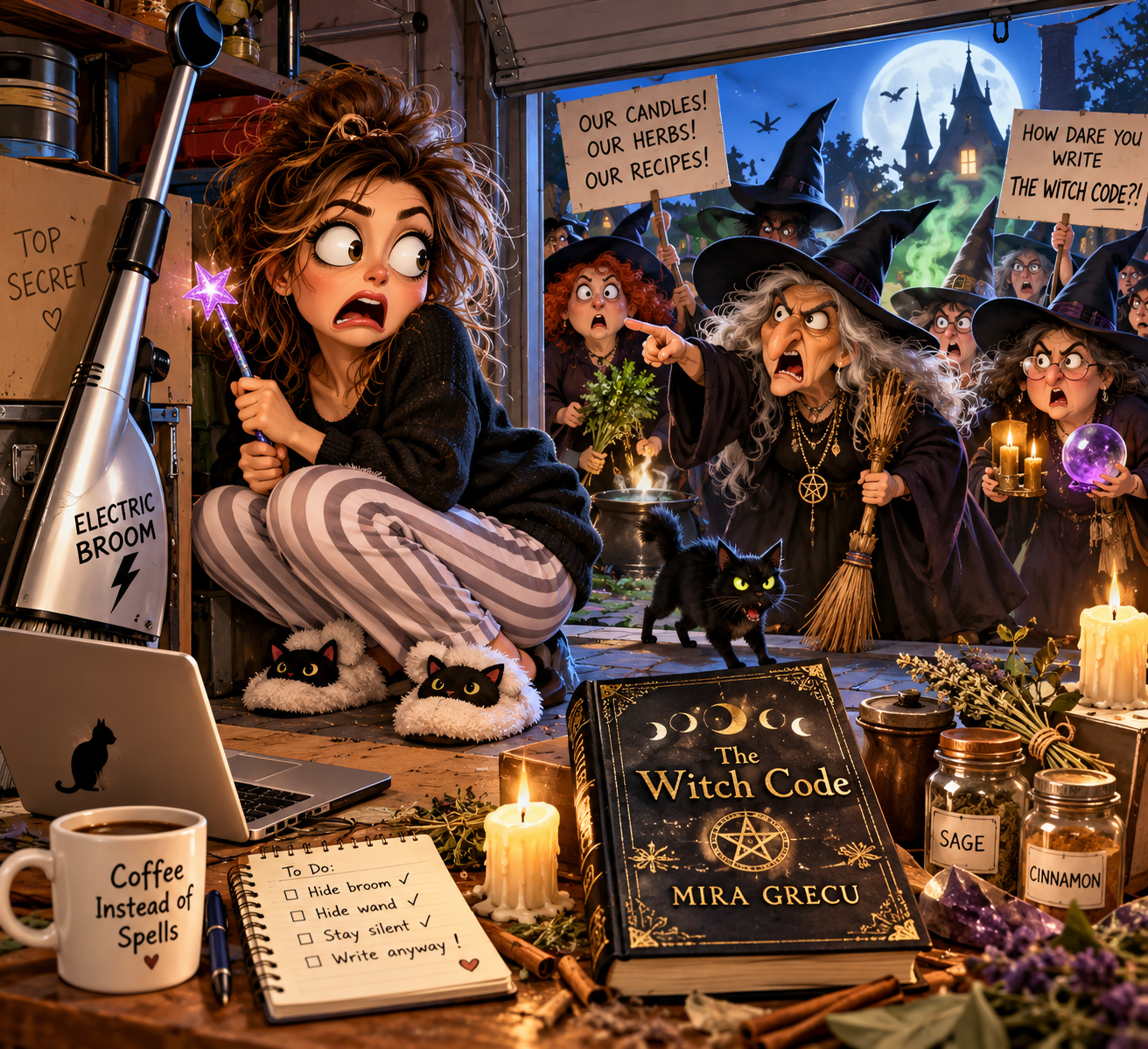
  • THE WITCHES ATTACKED ME! I HID MY ELECTRIC BROOM AND DECLARED A STATE OF EMERGENCY

    THE WITCHES ATTACKED ME! I HID MY ELECTRIC BROOM AND DECLARED A STATE OF EMERGENCY

    A tragicomic tale of magic, furious witches, money that refuses to fall from the sky, and a book that dared to take away their candles.

    The witches attacked me!

    No, they didn’t come down the chimney, they didn’t send toads into my bedroom, and they didn’t turn my neighbors into bats, although, now that I think about a few of them, the transformation might have taken place long before I noticed. They attacked me on one of the social media platforms, where modern witchcraft has evolved spectacularly, where curses no longer need to be written on parchment but can simply be delivered in the comments section, and where an angry finger pounding on a keyboard can easily replace three hours of incantations in the forest.

    I admit I was absolutely terrified, so I immediately hid my electric broom in the garage, shoved my magic wand into a place so intimate that not even an experienced demon would dare go looking for it, and decided to remain silent, because there are certain things in life you simply shouldn’t mess with: the tax authorities, a woman who knows where you keep your savings, and, above all, a witch with unlimited internet access.

    The trouble apparently began the moment I committed the unforgivable mistake of writing a book called The Witch Code, in which I had the audacity to strip witches of their candles, herbs, crystals, jars of cinnamon, and little midnight rhymes, leaving them face to face with a question so uncomfortable that I can almost hear their cauldrons bubbling with indignation: if magic is a real power, why should it depend on an inventory of kitchen supplies and an operating schedule determined by the phases of the Moon?

    I fully understand the seriousness of my offense. I have endangered an entire industry, threatened the economic stability of scented candle manufacturers, and probably triggered an existential crisis among sage distributors, who until yesterday believed they were merely supplying aromatic plants, without suspecting that the financial prosperity of humanity depended on their harvests.

    How I Missed My Chance to Become the Richest Woman in the World

    Over the years, I have encountered so many recipes for attracting money that, if even half of them had worked as promised, I would have bought several banks by now, lent money to the International Monetary Fund, and accumulated enough wealth to enjoy the luxury of never checking the price of olive oil again.

    I learned that money comes if you light a green candle on a particular day, sprinkle cinnamon at your doorstep, write an amount on a piece of paper and hide it under your pillow, repeat a formula nine times, or stare into a mirror at midnight while concentrating on universal abundance.

    There are rituals for fast money, unexpected money, money that returns, money that multiplies, and money arriving from unknown sources, although nobody seems to have invented the ritual that makes the electricity bill disappear from the mailbox all by itself.

    I seriously considered standing on one leg at midnight, singing in front of the mirror, and asking the Universe to send me prosperity, but when the electricity bill arrives in the morning, I discover that the power company does not accept positive vibrations instead of euros.

    Therefore, if the ritual fails, I will find myself without money and without electricity, which automatically transforms me into an authentic witch, forced to live by candlelight.

    And that, apparently, is how destiny sometimes pushes you toward spirituality without asking your permission.

    Considering how many bundles of sage, mint, and lavender I would have to burn to attract even fifty cents, I am convinced that the tea industry would plunge into an international crisis, while pharmaceutical companies would begin looking at me with profound jealousy, because according to the logic of certain miraculous recipes, I could attract health, youth, love, and prosperity with a single trip to the spice aisle.

    And yet, amid this extraordinary abundance of advice on becoming rich, I noticed one detail that continues to intrigue me: many of the people promising urgent money through rituals seem remarkably concerned with selling as many of those rituals as possible.

    I do not know these people’s financial circumstances, nor do I claim that all of them are poor, but the commercial contradiction is far too delicious to ignore. If you have discovered the secret formula through which the Universe delivers money within twenty-four hours, why do you need to sell that same formula at a weekend discount?

    If you have direct access to unlimited prosperity, why do you need subscriptions, donations, courses, and private sessions?

    And if the ritual works so wonderfully, why not use it to obtain the money you need before asking me for fifty euros to explain how it’s done?

    I fear that the only demonstrable magic in this business is the extraordinary ability to transform the customer’s money into the income of the person promising miracles.

    I Took the Witch Off Her Broom and Put Her Face to Face with History

    When I began writing The Witch Code, I did not set out to insult women who practice rituals, ridicule traditional beliefs, or deny the importance of symbols. Quite the opposite: the more I investigated the history of witchcraft, the more I discovered that the reality behind the legends is infinitely more interesting than the familiar image of a woman wearing a pointed hat, standing over a cauldron with a black cat beside her.

    In the first chapter of the book, I began precisely with this familiar image, constructed over centuries from fear, religion, prejudice, folklore, trials, and, later, literature and cinema. Behind it, however, I found very different people: folk healers, fortune-tellers, midwives, people knowledgeable about medicinal plants, practitioners of charms, and individuals who had acquired the mysterious reputation of knowing things that others did not.

    What particularly intrigued me was how easily that reputation could become dangerous. A woman whom the village believed capable of curing an illness could, under certain circumstances, also be suspected of causing it, while a single unfortunate coincidence could transform a respected neighbor into someone feared by the entire community.

    Sometimes a witch did not have to do absolutely anything to become a witch. It was enough for other people to believe she was one.

    That was when I began to understand that the history of magic is not merely the history of rituals, but also the history of the power people grant to those they believe possess inaccessible knowledge.

    And, much to my disappointment, I found no universal registry of witches, no official broom-driving examination, and no government department issuing permits for curses.

    The Mystery of the Ritual That Must Be Performed Exactly Right, Even Though Nobody Knows Which Version Is Correct

    Another thing that fascinated me during my research was the extraordinary diversity of rituals. In the Greco-Roman world, there were curse tablets known as defixiones. Other traditions developed amulets, prayers, charms, and symbolic objects, while European folk practices passed formulas and gestures from generation to generation, gradually changing along the way.

    I noticed that two people could pursue exactly the same goal using completely different rituals, without either necessarily considering the other’s tradition powerless.

    I found this detail extraordinary, especially when I compared it with the impressive certainty of internet witches who now explain that if you fail to light your candle at the exact hour, or place your cinnamon on the wrong side of the room, the Universe will reject your prosperity request like an incorrectly completed application form.

    I wonder how witches in Antiquity managed without digital clocks, phone notifications, and video tutorials. Presumably, many missed their opportunity to become millionaires simply because they didn’t know whether the ritual had to begin at 11:59 p.m. or 12:01 a.m.

    In the book, I explored how rituals change, how certain elements disappear while others are added, and how some practices eventually come to be presented as ancient secrets, even though their current forms may be the result of much more recent modifications.

    This observation led me toward a question that runs throughout the entire work: if rituals differ so dramatically, is it possible that their true significance lies not in the objects being used, but in the meaning the human mind assigns to them?

    The Curse That Works Without Actually Working

    Of all the subjects I investigated, one struck me as particularly disturbing, because it demonstrates how a curse can produce real consequences even when there is no evidence that any supernatural force has intervened.

    Imagine someone telling you, in a grave voice and with an expression capable of making even a statue tremble, that a powerful curse has been placed upon you and that, over the coming days, problems will begin appearing in your life.

    At first, you laugh, but the next day you lose your keys, two days later you argue with someone, then you have a terrible night’s sleep, and eventually you begin interpreting every unpleasant incident as confirmation that the curse is working.

    From that moment onward, fear can change the way you sleep, think, make decisions, and interpret events. You become more attentive to misfortunes than to things that go well, while what previously seemed like an ordinary coincidence takes on the significance of an invisible threat.

    In The Witch Code, I examine precisely these mechanisms of suggestion, autosuggestion, and expectation, including the ways in which a prophecy can contribute to its own fulfillment through the behavior of the person who believes in it.

    Here lies, in my opinion, one of the most uncomfortable questions in the entire history of witchcraft: if someone begins to suffer because they are convinced they have been cursed, what produced that suffering—the supposed supernatural force, or the belief that changed their life?

    Not every effect of belief is imaginary, just as not every real effect proves the existence of magic. Fear can produce genuine psychological and physical reactions, and this reality is important enough to deserve investigation without automatically invoking demons, spirits, or mysterious energies.

    The Witch Who Discovers Your Curse and Then Charges You to Remove It

    And so we arrive at one of the most profitable miracles of the modern world: discovering a curse you never knew existed, followed by the generous offer to remove it for a fee.

    The scenario is almost perfect.

    You visit someone who claims to identify evil influences, and they inform you that your energy is extremely heavy, that someone close to you is jealous, and that an ancient curse hangs over your family.

    Naturally, they cannot immediately tell you who cast it, because such information requires an in-depth spiritual investigation which, for reasons the Universe refuses to explain, is never free.

    You pay for the first ritual.

    Nothing happens.

    You are informed that the curse is stronger than originally anticipated and that you need a second ritual involving special ingredients, which costs more.

    You pay again.

    Your problems continue, so you discover that you have a hereditary curse, three energetic blockages, two attached entities, and probably an ancestor who offended a witch sometime in the seventeenth century.

    By the time you finish your spiritual treatment, you can no longer afford to pay your bills, but at least you know exactly why you are poor: you spent everything trying to escape a curse that nobody ever demonstrated existed.

    In the manuscript, I analyzed this form of fear-based exploitation, in which the person claiming to discover the danger is the very same person selling the solution. It is a particularly effective mechanism of manipulation because every failure can be presented as evidence that the threat is even more serious than previously believed.

    I do not, however, confuse such scams with all spiritual practices, nor with people who preserve their traditions without exploiting the vulnerability of others. The difference between a personal belief and a fraudulent commercial promise is essential.

    But I must admit that if I possessed the talent to invent curses that only I could remove, my electricity bill would probably no longer be a problem.

    It would be a business opportunity.

    Where Is the Witch’s Power Actually Hidden?

    The further I progressed in my research, the less interested I became in the inventory of magical objects and the more fascinated I became by the human being using them. Why do certain symbols provoke fear, others inspire confidence, and some rituals manage to change a person’s behavior even when there is no evidence that they alter the external world through supernatural means?

    In The Witch Code, I explored this relationship between mind, will, belief, and ritual, as well as the stories of spirits, demons, entities, and extraordinary experiences that have nourished magical traditions throughout history.

    I wanted to understand what practitioners claimed, what historical sources recorded, and which explanations could actually be supported, without turning every legend into a demonstrated fact or every unusual experience into a joke.

    You do not have to believe that a green candle can change the balance of a bank account to recognize that symbols, expectations, and convictions can profoundly influence human behavior. Nor do you have to reject every spiritual tradition to notice that some of the commercial promises of modern magic cannot withstand even the most elementary scrutiny.

    It was precisely this boundary between belief and evidence, between experience and interpretation, between psychological power and supposed supernatural intervention, that led me to write the book.

    I did not want to offer readers yet another recipe for becoming rich by Thursday, because if I had discovered such a recipe, I would probably be writing from a castle by now, surrounded by accountants rather than candles.

    I wanted to ask more uncomfortable questions, examine what history has preserved, and show how easily the power of the mind can be confused with the power attributed to objects.

    The Witch Code is not a cookbook of lucky teas, a manual for getting rich through cinnamon, or a collection of incantations for attracting love. It is an investigation into witchcraft, history, the mind, belief, will, fear, and the mechanisms through which human beings have attempted to understand and control the unknown.

    And if some of my conclusions are disturbing, I can only assume that I have touched a sensitive nerve.

    My Dear Witches, I Am Not Asking You to Give Up Your Brooms

    I am simply asking you not to expect me to believe that placing three bay leaves in my wallet will cause the director of a Swiss bank to call me tomorrow morning and ask where the Universe would like my millions transferred.

    I have nothing against candles, I love lavender, I use mint, and I respect traditions that have survived for centuries, but I reserve the right to ask why a ritual only seems to work when the person selling it receives payment in advance.

    After all, if magic exists in a form we do not yet understand, it should be interesting enough to withstand questions, investigations, and verification without collapsing at the first request for evidence.

    And if it cannot withstand even a single question, then the problem is not my skepticism, but the fragility of the promise.

    So, my dear internet witches, you may keep your candles, crystals, herbs, and recipes for prosperity, while I will keep my questions, my books, and my irritating habit of investigating things before believing them.

    If you wish to curse me, I would only ask that you refrain from doing so between 10 p.m. and 8 a.m., because I need my sleep, and if you genuinely possess the power to attract money from the Universe, I would be most grateful if you could begin with my electricity bill.

    Until then, my electric broom will remain hidden in the garage, my magic wand will remain in a place where no customs inspection should ever attempt to look for it, and I will continue writing about what fascinates me most: the mysteries that human beings have transformed into beliefs, and the beliefs that others have transformed into businesses.

    And if tomorrow morning I wake up transformed into a frog, please don’t send a prince to kiss me.

    Send me a good editor and a publishing contract.

    At least we might make some money out of the story, since cinnamon clearly hasn’t worked.


    THE WITCH CODE — MIRA GRECU

    Beyond candles, incantations, and miraculous promises lies a far darker and more fascinating history: that of the human mind, fear, belief, and the power that people have attributed to magic for centuries.

    The Witch Code invites you to discover who the witches behind the legends really were, how rituals originated, why certain curses seem to work, how fear of the unknown can be exploited, and where the boundary lies between authentic experience, suggestion, manipulation, and the supernatural.

    It does not promise you miracles. It challenges you to investigate who is promising them, why, and with what evidence.

    Mira GRECU — The Witch Code

  • THE WITCH CODE: If You Take Away the Ritual, Does the Magic Disappear?

    THE WITCH CODE: If You Take Away the Ritual, Does the Magic Disappear?

    THE WITCH CODE: If You Take Away the Ritual, Does the Magic Disappear?

    An exclusive glimpse inside The Witch Code — Volume I, by Mira Grecu

    For centuries, witches have been associated with burning candles, mysterious herbs, ancient symbols, whispered incantations, and objects believed to possess extraordinary powers. These images have become so deeply embedded in our imagination that we rarely stop to question them.

    But what happens when we remove every one of those objects?

    Does the magic disappear with them, or have we been looking for its source in the wrong place all along?

    While writing The Witch Code, I wanted to explore a question that reaches beyond the familiar images of witchcraft: Is ritual the source of power, or merely an instrument through which the human mind expresses intention?

    The following passage comes from Chapter 19, Ritual — The Instrument or the Source of Power?

    An Excerpt from THE WITCH CODE

    The objects do not physically change when they enter a ritual, but their meaning is transformed, and with that transformation the behavior of the people using them changes as well.

    This is precisely why the central question of this chapter is not whether rituals exist or whether people can have powerful experiences during them, because both are evident.

    The question is whether ritual is merely an instrument through which the mind organizes intention or whether, as numerous occult traditions maintain, the ritual act produces something that extends beyond the psychology of its participants.

    — The Witch Code, Volume I, Chapter 19, by Mira Grecu

    What If the Most Important Ingredient Was Never in the Ritual?

    A candle can illuminate a room, but it can also become a symbol of protection, remembrance, or purification. A simple thread can hold two pieces of fabric together, yet in a ritual it may represent a bond that someone hopes to create or destroy.

    The objects remain physically unchanged. What changes is the meaning we give them, the attention we devote to them, and sometimes even our expectations about what will happen next.

    Does that make ritual meaningless? Not necessarily. Human beings have used rituals for thousands of years to confront uncertainty, express grief, mark important transitions, and organize experiences that ordinary language cannot always capture.

    But the more disturbing question remains unanswered: if a ritual can profoundly influence the person performing it, where does psychological influence end, and where do claims of supernatural power begin?

    That boundary is one of the mysteries explored throughout The Witch Code.

    What Else Is Hidden Inside Volume I?

    The journey extends far beyond candles and incantations, into chapters exploring questions such as:

    • Are witches born, or are they made?
    • Can a thought reach another mind?
    • Where does psychology end and magic begin?
    • Can fear and belief make a curse feel real?
    • Who answers when you call upon a spirit?
    • Can the dead be summoned?

    These are not promises of supernatural revelations, but invitations to investigate the extraordinary relationship between history, belief, fear, ritual, and the human mind.

    THE WITCH CODE — VOLUME I

    Over 700 pages of mysteries, history, psychology, and questions that challenge what we think we know about witchcraft.

    They burned the witches. But did they ever understand their power?

    Discover THE WITCH CODE — Volume I on Amazon

    Book cover for 'The Witch Code' by Mira Grecu, featuring a cloaked figure with long hair, mystical symbols, a skull, candles, and a raven, set against a dark background with an illuminated moon.
  • THE WITCH CODE: What If the Most Terrifying Part of Witchcraft Was Never the Witch?

    THE WITCH CODE: What If the Most Terrifying Part of Witchcraft Was Never the Witch?

    For centuries, humanity has feared witches, curses, forbidden rituals, and invisible forces. But what if we have been looking in the wrong direction all along?

    Imagine waking up one morning with the unmistakable feeling that something is wrong, although nothing around you has visibly changed. Your house is the same, the people you love are still there, and your life appears to be following its familiar course, yet an inexplicable uneasiness has begun to settle somewhere deep inside you.

    A few days later, someone tells you that you have been cursed.

    Perhaps they are a stranger claiming to possess unusual knowledge, perhaps an elderly woman whose family has practiced folk healing for generations, or perhaps someone close to you who believes that certain misfortunes cannot possibly happen by accident.

    At first, you laugh at the suggestion because you consider yourself a rational person, someone who does not believe in witches, evil eyes, invisible entities, or words capable of changing another human being’s destiny.

    But then something happens.

    You become ill. A relationship begins to collapse. You lose money unexpectedly. Your nights fill with strange dreams, and every coincidence seems to arrive carrying a message that only you can understand.

    Eventually, a question begins to form in your mind, one that you would once have considered ridiculous.

    What if someone really has done something to me?

    And that is where the story becomes genuinely disturbing, because the moment you begin to believe that an invisible power is controlling your life, something very real may already have started to change.

    Not necessarily in the supernatural world.

    Inside you.

    The Woman They Needed by Day and Feared After Sunset

    Long before witchcraft became entertainment, before black-robed figures appeared on cinema screens and occult symbols became fashionable decorations, the accusation of being a witch could destroy an entire life.

    Imagine a small European village centuries ago, where disease, hunger, failed harvests, and sudden death were familiar realities, while the knowledge needed to explain them was painfully limited.

    Somewhere in that village lives a woman who understands plants, knows how to assist during childbirth, remembers remedies inherited from her mother, and possesses an unusual ability to calm people when fear threatens to overwhelm them.

    When a child becomes ill, the villagers come to her door. When an animal refuses to eat, they ask for her advice. When someone suffers a nightmare or believes that an evil influence has entered their home, they turn to the same woman, hoping that she knows something they do not.

    Yet if a child dies despite her efforts, if a harvest fails, or if an unexplained misfortune strikes a household, the very knowledge that once made her valuable may suddenly become evidence against her.

    The woman who was sought for help in daylight becomes the woman whose name is whispered with suspicion after sunset.

    Historical witchcraft accusations were far more complicated than the romantic image of persecuted healers alone, involving religious anxieties, social conflicts, local rivalries, and many different kinds of accused people. Nevertheless, the contradiction remains deeply unsettling.

    Human beings have often feared the very people they believed might possess the power to save them.

    And perhaps we have never completely escaped that contradiction.

    Can a Curse Destroy Someone Who Does Not Believe in Curses?

    There is a particularly uncomfortable question at the heart of every story about a curse.

    If someone tells you that terrible things are going to happen, and you believe them completely, how much of your future behavior might begin to change because of that belief?

    Modern psychology and medicine recognize a phenomenon known as the nocebo effect, in which negative expectations can contribute to genuine symptoms or intensify experiences such as pain, discomfort, and anxiety.

    This does not mean that every illness is psychological, nor does it establish that curses possess supernatural power. It means that the relationship between expectation and physical experience is considerably more complicated than most people imagine.

    Now consider what happens when fear is reinforced by an entire community.

    Your relatives believe you have been cursed. Your neighbors remember similar stories. Someone recommends a ritual to remove the supposed influence, while another person warns you that the situation may become dangerous unless you seek immediate spiritual assistance.

    You are no longer dealing with one frightening suggestion, but with an entire world of explanations that seem to confirm one another.

    Every accident becomes suspicious. Every unfamiliar sound becomes a warning. Every ordinary illness becomes evidence of something hidden.

    And the most terrifying possibility is that the curse may not need to exist as a supernatural force in order for the fear surrounding it to cause genuine suffering.

    But if belief can intensify suffering, could belief also help someone escape it?

    That question opens another door, leading toward the extraordinary history of healing rituals, suggestion, protective symbols, and the mysterious ways human beings have attempted to regain control over their lives.

    Why Do Rituals Survive When Empires Disappear?

    Civilizations rise and collapse, religions transform, languages vanish, and entire systems of knowledge are forgotten, yet certain ritual elements continue to appear across widely separated cultures.

    Candles are lit. Words are repeated. Symbols are drawn. Water is blessed. Objects are carried for protection. Specific gestures are performed in a particular order, sometimes in silence and sometimes accompanied by prayers, invocations, or ancient formulas.

    Why?

    The easy answer is that our ancestors were superstitious, but that explanation becomes less satisfying when we consider how deeply ritual behavior is woven into human life, including practices that have nothing to do with witchcraft.

    People perform rituals before important events, repeat familiar actions during moments of uncertainty, and find reassurance in objects or gestures that connect them to memories, communities, or beliefs.

    A ritual can provide structure when life feels chaotic, create a sense of belonging, or help a person confront fear through an action that feels meaningful.

    None of this proves that a ritual can summon an entity, reverse a supernatural curse, or alter the physical world through magic.

    Yet it does raise a more subtle question.

    What happens when the human mind gives an ordinary action extraordinary meaning?

    And why have some people throughout history believed that certain individuals could perform these actions with greater power than others?

    Perhaps the answer lies partly in tradition, partly in authority, partly in the psychology of expectation, and partly in those experiences that people continue to interpret through the language of mystery.

    The Invisible Presence: Spirit, Entity, or Something Within the Mind?

    Few subjects have inspired more fear than the belief that an unseen intelligence can enter a room, communicate through strange sounds, influence a person’s thoughts, or attach itself to a particular place.

    Throughout history, people have interpreted unusual experiences as encounters with spirits, ancestors, demons, divine messengers, or other invisible beings.

    A sudden knocking in an empty house might be understood as an ordinary structural sound by one person, a spiritual message by another, and evidence of a haunting by someone who has already been told that the building possesses a troubled history.

    The experience may feel equally real to all three.

    What changes is the interpretation.

    This distinction becomes especially important when examining stories of witchcraft, mediumship, spirit communication, and alleged supernatural attacks, because the sincerity of an experience does not automatically establish the explanation given for it.

    People can genuinely experience something they cannot explain, and still be mistaken about its cause.

    But does that mean every mysterious experience has already been understood?

    Certainly not.

    There are limits to what we know about human perception, memory, consciousness, and the complex interaction between expectation and experience.

    The mistake is to assume that uncertainty proves the supernatural, just as it would be a mistake to assume that every unanswered question is meaningless.

    And somewhere between those two extremes lies the territory that has fascinated humanity for thousands of years.

    What If the Most Dangerous Witchcraft Begins With a Whisper?

    There is something deeply disturbing about the idea that another person’s words can change the way we experience our own existence.

    Not because language is a magical weapon capable of rewriting reality at will, but because words can create fear, inspire confidence, destroy reputations, influence decisions, and alter relationships.

    A whispered accusation can turn a respected neighbor into an outcast.

    A frightening prediction can make an anxious person watch constantly for disaster.

    A promise of protection can become the foundation of trust, while a threat of supernatural punishment can become a powerful instrument of manipulation.

    The history of witchcraft is therefore not merely the history of alleged supernatural practices. It is also a history of authority, vulnerability, social control, human imagination, and the struggle to understand events that seem to have no explanation.

    And there is another uncomfortable truth.

    Sometimes the person who claims to remove your fear is also the person who has taught you what to fear.

    Consider the individual who announces that you are under a terrible curse, insists that only they can remove it, and then demands increasingly large payments for rituals that must never be questioned.

    The danger in such a situation does not require a supernatural explanation.

    It is already present in the manipulation itself.

    Perhaps the most frightening question is not who has the power to curse you, but who benefits when you believe that you have been cursed.

    The Secret No Two Witches Could Share

    There is one idea that challenges the familiar image of witchcraft more profoundly than almost anything else.

    What if there has never been a single universal ritual capable of defining what a witch is?

    Across centuries and cultures, the practices associated with witchcraft have differed enormously. Some traditions emphasized herbs and healing, others divination, spoken charms, protective objects, relationships with spirits, or ceremonies shaped by local beliefs.

    Even within the same community, two practitioners might have understood their work in very different ways.

    This suggests that witchcraft cannot be reduced to a collection of instructions copied from an ancient manuscript.

    For those who practice within spiritual traditions, personal meaning, experience, discipline, and belief may matter more than the mechanical repetition of another person’s gestures.

    And for those examining the subject historically or psychologically, these differences reveal how deeply ritual practices are shaped by culture, identity, and individual interpretation.

    No two witches are identical. Perhaps no authentic personal ritual can ever be perfectly copied.

    That thought leads us toward a mystery far more interesting than the familiar image of a witch standing over a boiling cauldron.

    If the ritual is not universal, if its meaning changes from person to person, and if belief plays such a powerful role in the experience, then where exactly does the supposed power reside?

    In the words?

    In the symbols?

    In the person performing the ritual?

    Or in the mind that gives all these things their meaning?

    THE WITCH CODE — The Book That Asks the Questions We Are Afraid to Ask

    These are some of the unsettling questions explored in The Witch Code: The Hidden Truth About the Power of the Mind and the Unseen Mechanisms of Magic, by Mira Grecu.

    This is not a conventional collection of spells, nor a promise that mysterious powers can be acquired by memorizing ancient formulas.

    It is a journey through the history of witchcraft, the fear of curses, the psychology of belief, the significance of ritual, the enduring fascination with spirits, and the uncomfortable possibility that some of the most powerful forces in human experience are those we barely understand within ourselves.

    The book does not ask readers to abandon reason in order to enter the mysterious world of witchcraft. It asks them to bring their curiosity, their skepticism, and their willingness to question explanations that have survived for centuries.

    Because sometimes a legend is only a legend.

    Sometimes a terrifying experience has an ordinary explanation.

    Sometimes a ritual changes the way someone confronts suffering.

    And sometimes the most disturbing discovery is not that an invisible enemy has been controlling your life, but that fear has been shaping your decisions without your knowledge.

    Perhaps that is why the figure of the witch has never truly disappeared from human imagination.

    She represents something we have always struggled to understand: the possibility that knowledge and power may exist beyond the boundaries of what our communities consider acceptable, and the fear that someone else might possess answers we do not.

    But there is one final question worth considering.

    If you discovered that the greatest mystery of witchcraft was not hidden in an ancient grimoire, a forbidden spell, or an invisible entity, but somewhere inside the human mind, would you still dare to open the book?

    The Witch Code is available in its complete English digital edition, bringing together both volumes in one extensive work.

    Discover THE WITCH CODE by Mira Grecu.

    Some doors remain closed because there is nothing behind them. Others remain closed because we are terrified of what we might discover about ourselves when we finally open them.

  • The Witches Who Still Speak With the Dead: Inside a Real Witchcraft Retreat in Ireland

    The Witches Who Still Speak With the Dead: Inside a Real Witchcraft Retreat in Ireland

    April 2026The Witches Who Still Speak With the Dead: Inside a Real Witchcraft Retreat in Ireland

    There is something strangely unsettling about witchcraft in the twenty-first century, not because it has survived in forgotten villages or in the private rituals of people who refuse to abandon old beliefs, but because it has returned openly, confidently, and without any apparent need to hide.

    The modern witch does not necessarily live at the edge of a forest, surrounded by herbs and candles in a house avoided by the neighbours. She may have an Instagram account, a normal profession, a smartphone beside her tarot cards, and a plane ticket to Ireland in her bag.

    And yet, beneath these thoroughly modern details, some of the oldest questions have not changed.

    Can the dead hear us?

    Can something that no longer has a physical body still answer?

    Can an object held between our fingers move because another consciousness is attempting to communicate with us?

    Or are we listening to something much closer, and perhaps equally mysterious: the hidden part of our own minds?

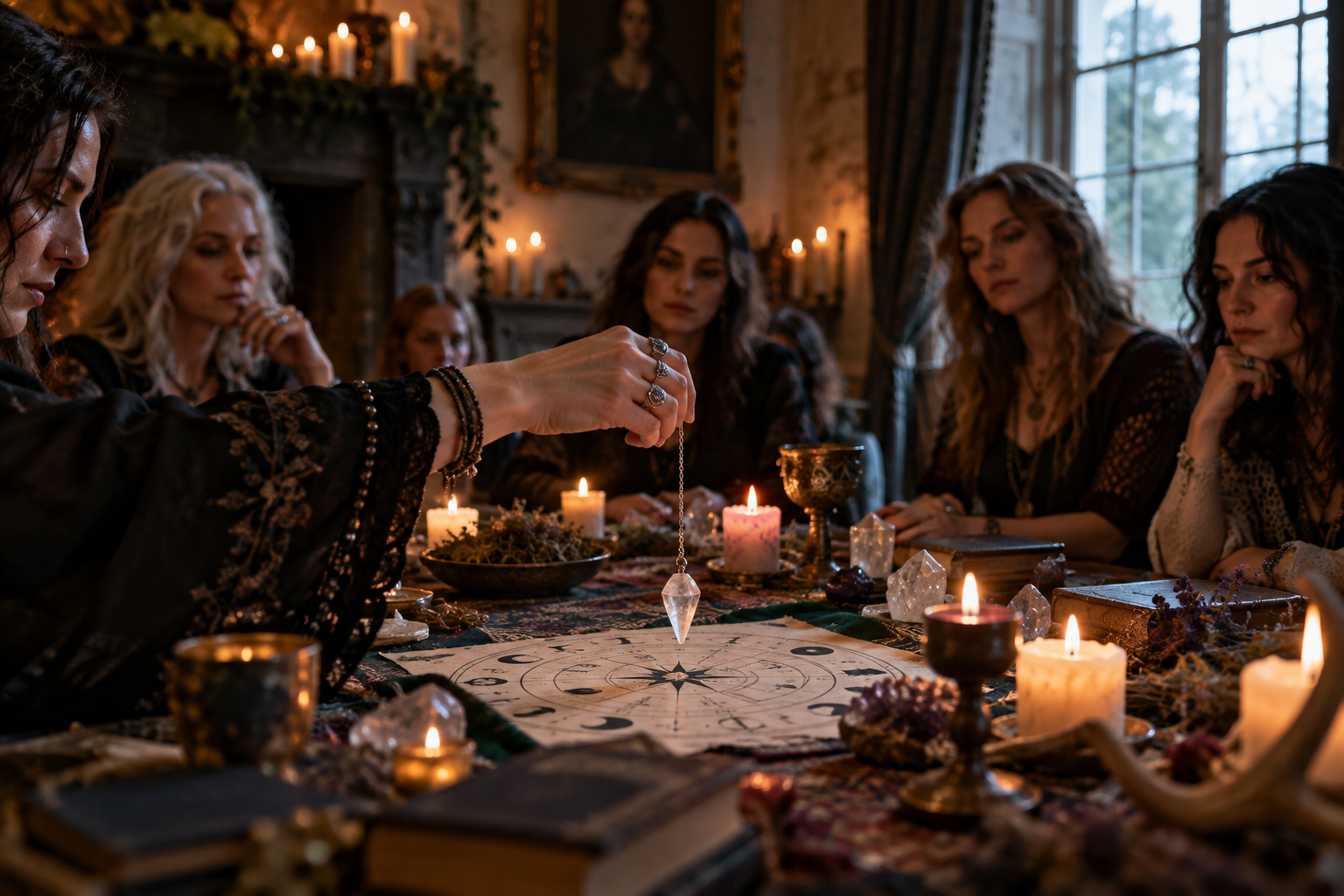
    In April 2026, fifteen women gathered inside an old Irish estate for a witchcraft retreat known as Green Veil. They had travelled there for rituals, divination, healing practices and something that human beings have attempted for thousands of years: communication with the invisible.

    The gathering was not reconstructed from rumours or from a story circulating through occult forums. Journalist Lauren Abunassar attended the retreat and later described it for The Guardian, documenting the women, their practices and what happened inside that house.

    What she witnessed was neither a medieval witches’ sabbath nor the theatrical version of witchcraft created by cinema.

    It was, in many ways, far stranger precisely because it was so ordinary.

    An old house, fifteen women and a room full of questions

    The retreat took place at Lisnavagh House in County Carlow, an old Irish estate surrounded by countryside and woodland. Retreat organisers continue to use the property for witchcraft gatherings, and future events advertised by the venue combine folklore, ritual, somatic practices and seasonal traditions.

    Inside the house during the April gathering were fifteen women who identified with various forms of witchcraft or alternative spirituality. More than half had travelled from the United States.

    They did not all look like the witches of popular imagination. Some wore clothing that might have belonged in an occult photograph, while others arrived dressed much like anyone spending a weekend in the countryside. That contrast is important because it removes the comfortable distance between the observer and the subject.

    These were not fictional characters.

    They were women with ordinary histories, families, jobs, grief, religious backgrounds and personal losses, sitting together because they believed — or at least hoped — that reality contained something more than what could be measured.

    Their guide was Isabella Ferrari, better known within her community as Penny the Witch.

    Ferrari describes herself as a modern witch, author, spiritual mentor and practitioner whose work combines witchcraft with Buddhist philosophy and somatic healing. According to her own biography, she lived and studied for several years in a Buddhist monastery before eventually incorporating paganism and witchcraft into her spiritual practice. She later created an online community that now reaches well over a hundred thousand followers.

    This mixture tells us something important about modern witchcraft.

    It is rarely a simple continuation of one ancient religion. Instead, it often brings together folklore, pagan traditions, meditation, psychology, ritual, herbalism, divination and ideas drawn from several spiritual systems. For its practitioners, however, this does not necessarily make the experience less serious.

    For some of the women in Ireland, it had become a new spiritual language after older religious structures had ceased to make sense to them.

    And on that particular day, the language they chose involved a pendulum.

    The pendulum begins to move

    The women sat together and created what were described as divination maps. On the paper were possible responses, including simple answers such as yes and no.

    A crystal pendulum was suspended above the map.

    The principle was ancient in spirit even if the materials were modern: ask a question, hold the pendulum as steadily as possible, and watch.

    For believers in divination, the resulting movement may reveal an answer from intuition, spiritual forces, ancestors or other forms of consciousness. For a psychologist, the same motion may have a very different explanation.

    But before reaching the science, something happened inside that room.

    One participant, Tara Monte, watched her pendulum begin to rotate with such intensity that she called out to Ferrari, uncertain whether she should stop.

    To Monte, the movement did not feel random.

    She later interpreted what happened as contact involving the Archangel Michael and a message connected with her deceased parents. What she believed she had received was reassurance: that they were proud of her and still loved her.

    It is easy to dismiss an incident like this when reading about it from a distance.

    A hand moves. A crystal swings. A grieving person interprets the result.

    Nothing supernatural has been demonstrated.

    But inside that room, surrounded by other people engaged in the same ritual and carrying their own memories of the dead, the experience was evidently powerful enough to be remembered as something far more significant than the movement of an object.

    That difference between what an observer sees and what a participant experiences lies at the heart of nearly every serious discussion about the paranormal.

    A camera can record the pendulum.

    It cannot record what the woman holding it believes she is encountering.

    Who are modern witches actually trying to contact?

    Not everyone at the retreat was necessarily looking for the stereotypical ghost of a dead human being.

    The women spoke of ancestors, deceased loved ones, spiritual beings, figures from folklore and the witches who had lived before them. This makes contemporary witchcraft difficult to define through the familiar categories of traditional religion.

    The invisible world described by its practitioners can include the dead, nature spirits, deities, archetypal beings, angels, faeries and sometimes something considerably less defined — a presence, an intuition or the sense that an answer has arrived from somewhere outside ordinary thought.

    Ferrari’s retreats themselves demonstrate how broad that world has become. Her programmes advertise forest rituals, folklore, candle work, ceremonies, somatic healing and practices connected with the seasons. An Ireland retreat scheduled for December 2026, for example, specifically includes Yule traditions and Irish faerie lore concerning the Aos Sí, hawthorn trees and ancient burial mounds.

    The old supernatural landscape has therefore not disappeared.

    It has simply entered the modern wellness age.

    There are booking pages now.

    There are payment plans.

    There are WhatsApp groups and online communities.

    A person may spend the afternoon discussing spirits and the evening checking notifications on a phone.

    That apparent contradiction is perhaps one of the most interesting aspects of the entire phenomenon. Technology has not eliminated magical thinking. In some ways, it appears to have helped communities built around it find one another.

    But why does the pendulum really move?

    Here the story becomes more complicated, because science does have an explanation for an apparently self-moving pendulum.

    It is called the ideomotor effect.

    The principle has been studied for more than a century and refers to movements generated without the person experiencing a clear conscious intention to make them. Tiny muscular actions can pass from the fingers into the pendulum and gradually become amplified, creating a visible swinging motion even though the person holding it may sincerely feel that she is keeping her hand still.

    Research published in Neuroscience of Consciousness describes exactly this phenomenon. Thoughts and expectations concerning movement can generate extremely small muscular actions, which are then magnified by the pendulum. The person does not necessarily experience those actions as deliberate.

    The same mechanism has long been invoked to explain dowsing rods and Ouija boards. A medical review of the history of ideomotor signalling likewise notes that subtle movements can occur without conscious awareness and become amplified by the device being held.

    At first glance, that seems to solve the mystery.

    The spirit did not move the pendulum.

    The hand did.

    But the answer is not quite as simple as it sounds.

    Saying that a muscle moved does not necessarily tell us why the brain produced that particular movement at that particular moment, nor does it fully explain the extraordinary subjective sensation of watching one’s own body apparently act independently of conscious intention.

    Researchers have even experimented with Ouija-type responses to study unconscious knowledge. One study found that participants sometimes performed differently when answering through ideomotor movements than when consciously guessing, suggesting that such methods may reveal aspects of information processing occurring outside immediate conscious awareness. Later pendulum experiments have produced more cautious results, so the idea remains scientifically interesting without providing evidence for communication with spirits.

    And this is where the story becomes genuinely fascinating.

    Perhaps the pendulum is not a telephone to the dead.

    But it may sometimes behave like a doorway into processes inside the living mind that the conscious self does not fully perceive.

    For someone sitting in an old Irish house and asking a dead parent a question, the distinction may not feel as large as it sounds.

    The ancient desire behind a very modern retreat

    Human beings have been trying to communicate with the dead for far longer than the word “witchcraft” has carried its modern meaning.

    The methods have changed repeatedly.

    Ancient cultures consulted oracles and practiced forms of necromancy. Later European traditions developed elaborate systems involving spirits, dreams, signs and divination. In the nineteenth century, Spiritualism brought séances and table-turning into respectable drawing rooms, where educated men and women sat in darkness waiting for the furniture to move.

    The Ouija board eventually turned spirit communication into something that could be bought in a box.

    Now there are witchcraft retreats.

    Seen from that perspective, the women gathered in Ireland were participating in something much older than contemporary social media spirituality. They were repeating an ancient human act: asking those who have disappeared whether disappearance is truly the end.

    Modern science can explain many of the physical events associated with these rituals, but it has never removed the emotional reason people perform them.

    Grief does not disappear because a mechanism has been identified.

    Neither does curiosity.

    And perhaps most importantly, neither does the uncomfortable awareness that consciousness itself remains one of the great unresolved problems of human knowledge.

    We understand enormously more about the brain than our ancestors did, yet we still cannot completely explain why electrical and biochemical activity produces the intimate experience of being a person — of remembering a mother, missing a father, fearing death or feeling that someone who is gone is somehow close.

    Into that unanswered territory, spiritual traditions inevitably enter.

    Witchcraft without hiding

    There is another reason the Irish retreat deserves attention.

    For centuries, being publicly identified as a witch could destroy a person’s life.

    In parts of Europe, accusations of witchcraft resulted in imprisonment, torture and execution. The historical record is filled with women and men who did not choose the label placed upon them.

    The modern practitioners at Green Veil do something radically different.

    They claim it voluntarily.

    Ferrari does not conceal the word witch. She places it at the centre of her identity and her work. Her retreats are openly advertised, priced and booked, and demand has been strong enough for additional events to be organised. Her official retreat pages list programmes in Ireland, Italy and Scotland, with accommodation and structured ritual activities presented much as any other specialist retreat would be.

    Whatever one thinks of the supernatural claims sometimes associated with witchcraft, the transformation of the word itself is remarkable.

    The figure once whispered about in courtrooms is now running workshops.

    The secret coven has become an international retreat.

    The forbidden ritual has a booking form.

    Yet the central mystery has survived untouched.

    When the room becomes quiet, when a question is asked and a pendulum begins to move, everyone still has to decide what they believe caused it.

    So what happened in that room in Ireland?

    We know that fifteen women gathered there.

    We know that they performed divination rituals.

    We know that pendulums moved.

    We know that Tara Monte experienced one of those movements as meaningful and interpreted it as communication associated with the Archangel Michael and her deceased parents.

    Those are the parts of the story that can be documented.

    What cannot be documented is a spirit standing beside her.

    There is no scientific evidence from the retreat demonstrating that a deceased person, an angel or another supernatural intelligence moved the pendulum.

    There is, however, strong scientific evidence that pendulums can move through unconscious muscular activity without the holder feeling that she deliberately caused the motion.

    For a sceptic, that may be the end of the story.

    For a practitioner of witchcraft, it may only explain the mechanism through which something else communicates.

    And for someone who remains somewhere between those two positions, perhaps the most interesting possibility is that the pendulum reveals neither ghosts nor fraud, but something hidden inside the architecture of the human mind.

    That possibility is less spectacular than a spirit entering the room, but it is not necessarily less mysterious.

    We like to imagine that we know when we are moving our own hands, why a thought enters our minds, where an intuition comes from and how much of ourselves is under conscious control.

    Experiments in psychology repeatedly suggest that the boundary is far less certain.

    So perhaps the most disturbing question raised by the witches of Ireland is not whether the dead can speak.

    It is whether something can speak through us without our conscious mind knowing where the message began.

    The fifteen women eventually left the old estate and returned to ordinary life. The candles were extinguished, the pendulums packed away, the rooms emptied.

    Nothing captured there proves that another world opened its doors.

    But somewhere inside that house, for a few moments, a small crystal hanging from a woman’s fingers began to turn while she insisted that she was not consciously making it move.

    Science has a name for that movement.

    The woman had another.

    And between those two explanations lies the narrow, uncomfortable territory where the most enduring mysteries have always lived.

    Sources
    The Guardian — report on the 2026 witchcraft retreat in Ireland, including Isabella Ferrari and the women attending the Green Veil gathering.
    Lisnavagh House — official information about the witchcraft retreats held at the Irish estate.
    Neuroscience of Consciousness — research on the ideomotor effect and unconscious pendulum movement.
    PubMed — research on ideomotor signaling, including pendulums, dowsing, and Ouija-style responses.

  • Hoia-Baciu: The Romanian Forest Where Reality Seems to Misbehave

    Hoia-Baciu: The Romanian Forest Where Reality Seems to Misbehave

    Hoia-Baciu: The Romanian Forest Where Reality Seems to Misbehave

    UFO photographs, twisted trees, a strangely persistent clearing and decades of disturbing testimony have turned a forest outside Cluj-Napoca into one of Europe’s most enduring paranormal mysteries. Yet the deeper one looks into Hoia-Baciu, the more difficult it becomes to tell where documented history ends and legend begins.

    There are forests that become frightening because of what happened inside them, and there are others that seem unsettling long before anyone tells you a story.Hoia-Baciu belongs to the second kind.

    On the western edge of Cluj-Napoca, in Transylvania, the forest is close enough to the city that it should hardly feel isolated. Roads, houses and the ordinary rhythms of modern life are never impossibly far away.

    Parts of the surrounding area have genuine geological and botanical significance; the nearby Baciu Gorge, for example, is a protected natural area formed in Eocene limestone.

    Yet over the second half of the twentieth century, this otherwise accessible woodland acquired another identity entirely. It became a place associated with strange lights, photographs that seemed to contain things invisible to the photographer, unusual sensations, distorted trees and, most famously, one of Romania’s best-known UFO encounters.

    Today, Hoia-Baciu is repeatedly described as one of the world’s most haunted forests.

    That description is excellent tourism, but it also creates a problem: once a place becomes famous for the paranormal, every shadow begins to acquire a story.

    The real mystery of Hoia-Baciu is therefore not simply whether something unexplained happens there.It is whether we can still separate the original mystery from everything that was added afterward.

    Before the Ghost Stories Came the Photographs

    The modern history of the Hoia-Baciu mystery is closely connected with Alexandru Sift, a Cluj biologist whose work remains surprisingly important to the story.

    Long before paranormal tourism arrived, Sift was reportedly spending years observing unusual manifestations in the area around the forest. Adrian Pătruț’s later account states that by the time Sift entered public attention in 1974, he had already been systematically investigating unusual phenomena near Cluj for more than two decades.

    Sift was not simply a wandering occult enthusiast; records reproduced in Pătruț’s work describe him as having worked at a biological research centre, including research involving plant mutations produced by radiation.

    That background makes his story more interesting, although it does not automatically validate his conclusions.

    Sift reportedly photographed lights and unusual formations that sometimes appeared only after photographs were developed. His observations remained almost unknown outside a small circle until the Romanian magazine Flacăra published an article about him in May 1974.

    The article brought his investigations into public view and helped establish the idea that something unusual had been occurring around Hoia-Baciu long before the forest acquired its modern international reputation. But something even more dramatic had already happened six years earlier.

    18 August 1968On Sunday,

    18 August 1968, Emil Barnea was spending the day in the forest with three companions.According to the account later investigated and circulated by Romanian UFO researchers, the group noticed a bright, flattened object moving above the trees.

    Barnea had a camera with him and managed to take several photographs before the object disappeared.

    Three of the images became particularly famous and would eventually circulate far beyond Romania.

    The photographs show what appears to be a dark, disc-like object against the sky.And this is where Hoia-Baciu begins to become difficult.

    Within UFO literature, the photographs were treated with extraordinary seriousness and were subjected to analyses by researchers abroad. Romanian UFO organisations continue to regard them as an important historical case. Yet none of this establishes that the object was an extraterrestrial vehicle.

    The photographs document an object whose interpretation remains disputed; they do not tell us what the object actually was.

    This distinction is important because the legend has gradually simplified the incident.In many modern retellings, Barnea “photographed an alien spacecraft.”Historically, what we can say with confidence is narrower and more interesting: he photographed something in the sky that he and his companions considered unusual, and those photographs became one of the defining UFO cases of communist-era Romania.

    That alone was enough to change the forest forever.

    The Clearing at the Centre of the StoryAlmost every modern account of Hoia-Baciu eventually arrives at Poiana Rotundă, the Round Clearing.Seen from above, it creates precisely the type of image from which legends are born: woodland seems to open unexpectedly around an approximately circular patch of ground.

    Over time, the clearing has been described as a place where nothing grows, where trees refuse to take root, where electronic equipment behaves unpredictably and where strange physical sensations become more intense.But here the mythology has outrun the visible reality.

    The clearing is not literally sterile.

    Grass and other low vegetation can grow there. What is conspicuous is the absence of mature trees across the open area, not the complete absence of plant life.

    Describing Poiana Rotundă as an entirely barren circle is therefore misleading.

    That correction does not make the place visually ordinary.

    A rounded opening surrounded by woodland naturally produces a peculiar psychological effect, especially when viewed through photographs that flatten perspective and make the boundary appear more precise than it necessarily is on the ground.Humans are remarkably sensitive to geometry in nature.

    A nearly circular clearing invites intention. It seems designed even when no designer exists.

    And once a place has been presented as the centre of paranormal activity, expectation does something else: it changes the way we experience it.

    A sudden silence becomes significant.

    A headache becomes evidence.

    A camera error becomes an anomaly.

    A feeling of being watched stops being merely a feeling.

    This does not mean that witnesses are lying. In many cases they may be describing exactly what they experienced. The difficult question is what caused the experience.

    The Trees That Look as Though They Tried to Escape

    Then there are the trees.

    Some photographs from Hoia-Baciu show trunks bending close to the ground before curving upward again, creating shapes that seem almost sculpted.

    Other trees grow at strange angles or form dramatic twists.These forms are real enough that even official tourism material mentions the unusual shapes of trees surrounding the Baciu area.

    They are also among the most visually persuasive elements of the legend because they require no belief in ghosts or UFOs. You can photograph them. You can stand beside them. You can touch the bark.

    The mistake comes when unusual biology is automatically transformed into evidence for an unknown force.Trees can become deformed for many reasons, including repeated physical damage during early growth, weather, competition for light, soil conditions or earlier human interference.

    Without careful dendrological analysis of individual specimens, their shape alone cannot demonstrate electromagnetic fields, radiation or paranormal influence.Yet there is something genuinely unsettling about seeing an entire photograph filled with trees that appear to have changed direction halfway through their lives.

    Even when nature has an explanation, nature does not always look natural.

    The Lost Archive of Alexandru Sift

    Perhaps one of the most intriguing parts of the Hoia-Baciu story has nothing supernatural about it at all.It concerns documentation.Alexandru Sift died in 1993.

    Accounts preserved by the Cluj County Library state that much of the documentary archive connected with his decades of observations was subsequently destroyed or lost under circumstances that have themselves become part of Hoia-Baciu folklore.

    This absence matters because Sift’s archive might have allowed later researchers to examine his photographs, dates, experimental procedures and observations systematically.Instead, we are left largely with selections, reconstructions and later testimony.

    Lost evidence is dangerous territory.It encourages two opposite mistakes.

    Believers may assume that whatever disappeared must have contained extraordinary proof, while sceptics may assume that nothing important could have been there.

    Neither conclusion follows from the loss itself.What disappeared is simply unavailable.And an unavailable archive cannot prove anything.Adrian Pătruț and Forty Years of Strange ObservationsIn 1995, Adrian Pătruț published Fenomenele de la Pădurea Hoia-Baciu, a monograph devoted to the forest and the observations associated with it. Bibliographic records confirm the volume was published in Cluj in 1995, while contemporary reporting described it as bringing together decades of photographs, testimony and investigations by several contributors.

    Pătruț approached the subject from the perspective of parapsychological investigation and regarded at least some of the phenomena as genuinely anomalous.Yet one detail attributed to him is particularly revealing.

    A Cluj County Library account of his work states that he believed only a small percentage of reports deserved serious investigation, with most being explainable as optical illusions or observations influenced by the desire to see something unusual. That observation deserves more attention than it usually receives.Because this is precisely how a legendary place evolves.

    Once thousands of people arrive hoping to encounter a phenomenon, the number of reported phenomena inevitably rises.Not necessarily because the forest has changed.Because the observer has.

    The Shepherd, the Missing Girl and the Problem With Perfect Legends

    The older folklore attached to Hoia-Baciu is considerably harder to document.One frequently repeated story claims that the name Baciu comes from a shepherd who entered the forest with approximately 200 sheep and vanished together with the entire flock.

    Another famous tale describes a young girl who disappeared in the forest and returned years later without having aged and without remembering what happened to her.Versions of these stories are repeated by paranormal-tourism sources and modern articles, but reliable contemporary documentation establishing that these events actually occurred is extremely difficult to find.

    Even the Hoia-Baciu Project presents the shepherd story explicitly as a legend. That does not make the stories worthless.Folklore tells us something different from police records.It tells us what a community feared, repeated and remembered.But there is an important difference between saying that a shepherd vanished with 200 sheep and saying that a legend developed in which a shepherd vanished with 200 sheep.For Whisper Mysteries, that distinction matters.Mystery becomes more powerful, not less powerful, when we know exactly where certainty stops.

    Missing Time, Voices and the Feeling of Being Watched

    Modern visitors have reported headaches, anxiety, nausea, sudden feelings of fear, unexplained lights, strange sounds, electronic malfunctions and an intense impression that someone or something is watching from between the trees.Some accounts go further and describe missing time.The difficulty is that these experiences are almost impossible to evaluate after the event.

    A person can genuinely experience fear without there being an external threatening presence. A battery can fail without an electromagnetic anomaly. A photograph can contain a lens reflection the photographer never noticed. An unfamiliar forest can distort our sense of distance and time more easily than we realise.

    Expectation can also influence perception enormously.If someone walks through an ordinary forest expecting an evening hike, the cracking of a branch means very little.If that same person enters a place described as one of the most haunted forests on Earth, the identical sound arrives carrying an entirely different meaning.None of this proves that every report from Hoia-Baciu has a mundane explanation.It means only that subjective experience cannot, by itself, tell us which explanation is correct.

    The Most Important Question Is Not Whether the Forest Is Haunted

    The temptation with Hoia-Baciu is to demand a verdict.

    Haunted or not haunted.UFO or hoax.Portal or clearing.

    Paranormal phenomenon or imagination.But perhaps that binary question has prevented us from seeing what makes the place genuinely fascinating.Hoia-Baciu contains several layers of reality occupying the same landscape.There is the physical forest with its trees, paths, clearings and geology.

    There is the historical forest of Emil Barnea, Alexandru Sift and decades of investigation.

    There is the folkloric forest filled with vanished shepherds and people returning from nowhere.There is the psychological forest carried inside every visitor who already knows the stories.And finally there is the digital forest, the one constructed from thousands of photographs, videos, television programmes and articles calling Hoia-Baciu the Romanian Bermuda Triangle.

    All of them now overlap.Perhaps this explains why entering Hoia-Baciu today can never reproduce what it might have felt like to enter the same woodland in 1950.The forest has acquired a memory.

    Not necessarily a supernatural memory, but something almost as powerful: a human one.Every person who walks beneath those trees carries fragments of all the previous stories with them.

    So What Really Happened at Hoia-Baciu?

    Something certainly happened.Emil Barnea really did take the photographs that became famous in 1968. Alexandru Sift really investigated unusual manifestations around the area. A 1974 article really brought those investigations before a wider Romanian audience. Adrian Pătruț really compiled a substantial volume devoted to decades of observations. The unusual-looking trees exist, and so does Poiana Rotundă.

    What has not been demonstrated is the extraordinary conclusion.There is no established scientific evidence that Hoia-Baciu is a portal, that extraterrestrial craft regularly visit it, that ghosts inhabit the forest or that known physical laws cease to operate there.But that does not make Hoia-Baciu uninteresting.

    Quite the opposite.The most disturbing mysteries are rarely those in which everything can be proved. They are the cases in which a small core of documented reality survives beneath decades of exaggeration, leaving just enough uncertainty that the story cannot be completely closed.Somewhere beneath the ghost tours, television documentaries and internet mythology there remains a real forest outside Cluj.

    A biologist spent years watching it.

    A man pointed a camera toward its sky in August 1968.

    Several photographs survived.Thousands of stories followed.And more than half a century later, people are still entering the trees hoping that, for a few seconds, Hoia-Baciu will show them something that should not be there.Perhaps the strangest thing about the forest is not that so many people claim to have seen the impossible.

    Perhaps it is that after all these years, we are still looking.

  • The Numbers of Abundance: Why 369, 555, 777 and 888 Keep Appearing in the Hidden Language of Money

    The Numbers of Abundance: Why 369, 555, 777 and 888 Keep Appearing in the Hidden Language of Money

    There is something strangely intimate about a number that refuses to leave you alone.

    You glance at your phone and it is 8:08. Later, a receipt ends in 8.88. An invoice contains three eights, a hotel room carries the same digits, and then, just when you have almost forgotten about it, 888 appears again somewhere completely ordinary. For someone who has never attached meaning to numbers, this is little more than coincidence. For someone familiar with numerology, however, 888 carries a very different reputation: it is supposed to be the number of abundance, material flow, success and money.

    Nearby in this strange numerical landscape are 555, usually associated with sudden change; 777, with fortune and spiritual alignment; 111 or 1111, with beginnings and manifestation; and the almost legendary combination 3–6–9, surrounded today by stories about Nikola Tesla, hidden mathematical laws and a supposed numerical architecture underlying reality itself.

    Then another layer is added. Search online for these numbers and soon they cease to be merely numbers. They become frequencies. There are recordings labelled 888 Hz Money Frequency, 777 Hz Abundance Frequency, 555 Hz Transformation Frequency, often accompanied by promises of prosperity, energetic clearing or a dramatic shift in one’s financial life.

    At this point an obvious question becomes difficult to avoid.

    Where did all of this actually come from?

    And perhaps the more unsettling question is not whether a number can magically deposit money into a bank account, but why human beings have been assigning power to numbers for thousands of years, long before YouTube manifestation videos, TikTok numerology and modern “angel numbers” ever existed.

    Long Before 888 Meant Money, Numbers Were Already Mysterious

    The belief that numbers possess qualities beyond simple counting is far older than the modern manifestation movement.

    Among the Pythagoreans of ancient Greece, number was not merely a convenient human invention used to measure livestock, land or coins. Numerical relationships appeared to reveal something fundamental about reality itself. Early accounts of Pythagorean thought describe a worldview in which mathematical relationships were intimately connected with harmony, music, geometry and the structure of the cosmos, eventually giving rise to the famous idea commonly summarized as “all things are number.” Ancient Pythagorean speculation also attached symbolic qualities to particular numbers, although these associations should not be confused with today’s internet numerology.

    This distinction matters because modern numerology often borrows the atmosphere of antiquity while adding meanings that are actually much more recent.

    Pythagoras did not leave behind an ancient handbook announcing that seeing 888 on a supermarket receipt meant a financial breakthrough was approaching, nor did his followers teach that playing an 888-Hz tone would attract money into one’s life. What they did help establish was something more fundamental and, in a sense, more interesting: the idea that numbers might express qualities and relationships hidden beneath visible reality.

    Once that door had been opened, later generations never completely closed it.

    Numbers became entangled with theology, astrology, magic, architecture, music, calendars and divination. Seven became sacred in numerous traditions, three repeatedly appeared in religious structures, twelve organized heavens and calendars, and particular numerical combinations acquired meanings that changed according to culture and period.

    The modern fascination with 111, 555, 777 and 888 belongs to this much larger human habit of turning quantity into meaning.

    But the specific system most people encounter today is considerably younger than it appears.

    888: How Eight Became the Number of Abundance

    Within contemporary numerology, 8 has acquired an unusually material character. It is commonly associated with authority, ambition, achievement, organization, business, material power and the movement of resources; repeated three times, that symbolism becomes 888, now widely interpreted as abundance, prosperity or financial success.

    The modern category known as “angel numbers”, however, should not be mistaken for an intact doctrine transmitted from antiquity. Repeating sequences such as 111, 222, 555 and 888 became especially prominent through modern New Age publishing and were popularized in their present form during the early twenty-first century, particularly through the work of author Doreen Virtue. Contemporary interpretations commonly describe 555 as major change and 888 as manifestation, success and prosperity.

    That makes the story considerably stranger than the simplified version often encountered online.

    The symbolism of numbers is ancient, but the tidy modern dictionary in which 111 means one thing, 555 another and 888 automatically means money is largely contemporary.

    Yet 888 does contain an elegant numerical curiosity that helps explain why people drawn to numerology find it so appealing.

    Add its digits:

    8 + 8 + 8 = 24

    Then reduce again:

    2 + 4 = 6

    So the numerological root of 888 is 6, traditionally interpreted in many modern systems as harmony, responsibility, balance, care and restoration.

    Now perform exactly the same operation with 555:

    5 + 5 + 5 = 15

    1 + 5 = 6

    The supposed number of dramatic change and the supposed number of abundance both return to 6.

    This proves no supernatural mechanism whatsoever, because digital reduction is simply arithmetic. Yet symbolically it creates an irresistible narrative: movement and disruption represented by 555 eventually return to balance, while the material power represented by 888 must also return to balance.

    Whether one calls that cosmic wisdom or a beautiful human interpretation depends entirely on where one stands.

    555: The Number That Appears Before Everything Changes

    If 888 is imagined as the vault, 555 is the door being forced open.

    In contemporary angel-number traditions, 555 represents disruption, transition, movement and the collapse of an old pattern before another one can take its place. Financially, therefore, it is sometimes interpreted not as money itself but as the change that precedes a new source of income, a different career, an unexpected opportunity or the uncomfortable realization that an existing way of living is no longer sustainable.

    There is something psychologically clever in this interpretation, because prosperity rarely arrives in real life without some degree of transformation. A person changes work, learns a skill, takes a risk, starts a business, abandons an unsuccessful project or notices an opportunity that had previously been ignored.

    The number itself does not need to possess supernatural power for the symbolism to become personally powerful.

    A person who begins using 555 as a reminder to ask What must change? may actually behave differently.

    And that brings us dangerously close to the border where ritual, psychology and magic begin to resemble one another.

    777: Luck, Mystery and the Number We Already Wanted to Believe In

    Seven entered the symbolic imagination long before modern numerology discovered it.

    It appears repeatedly in religious traditions, mythology, calendars and cultural symbolism, which gave it an aura that later systems could easily inherit. Modern angel-number interpretations typically connect 777 with spiritual insight, inner wisdom, good fortune or being somehow “in alignment.”

    Its modern association with luck was strengthened further by popular culture and gambling imagery, particularly the familiar three sevens of slot machines, where 777 became visually synonymous with the jackpot.

    This is worth remembering because symbolism rarely has a single origin. Meanings accumulate.

    A number may begin with a religious association, acquire an occult meaning centuries later, be reinforced by popular entertainment and eventually return to social media disguised as an ancient universal code.

    By the time we encounter it, the layers have become almost impossible to see.

    Then There Is 369

    Of all the numerical mysteries circulating online, 3–6–9 is probably the most seductive because its legend contains a real historical figure: Nikola Tesla.

    A statement endlessly attributed to him claims that if humanity understood the magnificence of 3, 6 and 9, it would possess a key to the universe.

    The problem is that a reliable primary source establishing that Tesla actually made this famous statement has never been convincingly produced.

    What is documented is Tesla’s peculiar fixation on the number three and numbers divisible by three. Biographical accounts describe his preference for hotel rooms whose numbers were divisible by three, rituals involving counting, and his use of eighteen napkins at meals. Smithsonian’s account of Tesla’s later life also notes his fixation on three, while Tesla biographer Margaret Cheney, when asked by PBS about his “magic” number three, described it as apparently a superstition rather than a hidden scientific theory.

    This does not make the 369 story less fascinating; in some ways, it makes it more so.

    There really was a Tesla fascinated by numerical repetition.

    There really are striking mathematical patterns involving digital roots and multiples of nine.

    What appeared later was a mythology built around these facts.

    For example, multiples of nine repeatedly return to nine when their digits are summed:

    18 becomes 1 + 8 = 9.

    27 becomes 2 + 7 = 9.

    36 becomes 3 + 6 = 9.

    108 becomes 1 + 0 + 8 = 9.

    There is nothing paranormal about this property; it follows from arithmetic in base ten and modular mathematics. Yet visually and mentally, it is hypnotic, particularly when combined with other digital-root patterns that make 3, 6 and 9 appear to occupy distinctive positions.

    From such patterns came later systems including what is popularly called “vortex mathematics,” along with manifestation practices instructing people to write an intention three times in the morning, six times during the day and nine times at night.

    Tesla himself did not leave us such a manifestation ritual.

    The internet did.

    When a Number Suddenly Becomes a Frequency

    There is another confusion hidden inside this subject, and it is responsible for much of the mythology surrounding “money frequencies.”

    888 and 888 Hz are not the same thing.

    The first is a number.

    The second is a physical frequency representing 888 oscillations per second.

    A sound wave at 888 Hz is perfectly real and measurable, just as 440 Hz or 528 Hz is measurable. What science does not establish is that the symbolic numerological meaning assigned to the digits 888 somehow transfers automatically to a sound wave oscillating 888 times per second.

    That leap is philosophical or spiritual rather than physical.

    Nevertheless, once modern spiritual culture began associating certain frequencies with meditation and transformation, it was almost inevitable that numerological sequences would enter the same world. Today one can easily find 888 Hz labelled as an abundance or money frequency, 777 Hz associated with luck or spiritual awakening and 555 Hz with transformation.

    Their popularity can create the impression that these correspondences belong to an ancient system of sacred acoustics.

    They do not.

    The distinction becomes particularly important when these recordings are compared with the so-called Solfeggio frequencies, another modern spiritual system that is frequently presented online as if its exact Hertz values were inherited unchanged from medieval monks.

    Historical solfeggio was indeed real, but it referred to a method of teaching musical intervals through syllables such as Ut, Re, Mi, Fa, Sol, La. The modern lists of supposedly healing frequencies are a different development.

    That does not mean sound has no effect on us.

    Quite the contrary.

    It simply means that the effect must not be confused with the claims attached to the number printed in the video title.

    What Sound Really Can Do

    Music can influence human physiology and emotion in measurable ways.

    A large meta-analysis of 104 randomized controlled trials involving 9,617 participants found significant overall effects of music interventions on both physiological and psychological stress-related outcomes. Other research has similarly explored effects on anxiety, heart rate, blood pressure, cortisol and emotional state.

    There is even emerging research examining specific tunings. A randomized controlled study published in 2026 compared instrumental music at 528 Hz and 432 Hz with a no-music condition in 162 university students experiencing exam-related stress. Researchers reported differences in several salivary biomarkers after exposure, although cognitive performance on the Stroop test did not significantly differ between the groups. Interesting as those findings are, they do not demonstrate that a particular frequency possesses a universal healing power, much less that a frequency can attract money.

    Science therefore leaves us in a more nuanced place than either believers or absolute skeptics sometimes prefer.

    Sound can affect the human organism.

    Music can influence stress and emotion.

    Ritual can alter attention.

    But there is currently no credible scientific evidence showing that listening to 888 Hz causes financial abundance, that 777 Hz changes luck, or that repeating 555 alters external events through an undiscovered energetic law.

    And yet people continue reporting that these numbers seem to follow them.

    Why?

    The Moment You Learn 888, You Begin Seeing It Everywhere

    There is a well-known psychological phenomenon called the frequency illusion, sometimes referred to as the Baader-Meinhof phenomenon.

    Once something becomes personally significant, attention begins detecting it more readily. The object has not necessarily become more common; rather, the mind has begun selecting it from the enormous amount of information that was already present. Selective attention and confirmation bias can then reinforce the impression that the pattern is appearing with extraordinary frequency.

    Imagine how many numbers pass through a person’s visual field during an ordinary week.

    Clocks, prices, passwords, receipts, telephone numbers, addresses, vehicle registrations, social-media metrics, bank statements, page numbers, dates and notifications surround us constantly.

    Most disappear without leaving any trace in memory.

    But tell someone that 888 means money, and 888 is no longer ordinary information.

    It has become a signal.

    The next time it appears, the brain notices.

    The appearance after that feels like confirmation.

    After several repetitions, coincidence begins to resemble communication.

    Research into repetition provides another intriguing piece of the puzzle. Experiments on the “illusory truth effect” have shown that repeated information can feel more truthful simply because it becomes more familiar and easier for the mind to process. In experiments where statements were presented multiple times, repeated claims were subsequently judged as more truthful than unfamiliar ones.

    None of this proves that every experience of synchronicity can be reduced neatly to a cognitive bias.

    It does, however, demonstrate that the human mind is extraordinarily capable of transforming repetition into significance.

    Perhaps that ability is precisely why numerical mysticism has survived for so long.

    But What If the Number Still Changes Something?

    Here the story becomes more complicated, because dismissing the entire subject with the word “coincidence” misses something important.

    Suppose a person chooses 888 as a private symbol of financial stability and writes it at the top of a notebook each morning. Beneath it, she records her income, expenses, unfinished projects and one action that could improve her financial position.

    After several months she has earned more money.

    Did 888 attract it?

    There is no need to invoke an invisible monetary vibration to explain what happened. The ritual repeatedly directed attention toward financial decisions, opportunities and unfinished tasks. A symbol altered focus; focus influenced behaviour; behaviour altered outcomes.

    From the outside, this looks psychological.

    From the inside, it may feel like manifestation.

    And somewhere between those two descriptions lies one of the oldest ambiguities in magic.

    Rituals often work by changing the person performing them long before they change anything else.

    The candle, symbol, prayer, sigil or repeated number may not command the universe, yet it can organize intention in a mind that was previously scattered. Once intention becomes consistent, behaviour can follow. Once behaviour changes, reality sometimes changes with it.

    This does not validate every supernatural claim attached to manifestation, but neither does it make symbolic practices meaningless.

    Symbols have always possessed power of a particular kind because human beings respond to them.

    Money itself proves the point rather beautifully.

    A banknote is paper.

    A number displayed inside an online banking application is a pattern of pixels.

    Yet entire lives can change because societies collectively agree that those symbols represent value.

    Human civilization is already filled with numbers that possess enormous power, although the source of that power is not necessarily hidden cosmic vibration.

    It is belief, agreement, attention and action.

    So Is 888 Really the Frequency of Money?

    If by “frequency” we mean a measurable physical phenomenon capable of attracting wealth, there is no good evidence that it is.

    If we mean an ancient universal numerical law proving that 888 automatically produces abundance, history does not support that claim either.

    But if we ask why 888 has become such a powerful symbol of abundance, the answer becomes considerably richer.

    It stands at the meeting point of ancient numerical mysticism, modern numerology, New Age angel-number culture, digital repetition, the psychology of attention and a very old human desire to believe that chaos contains patterns.

    555 tells us that something must change.

    777 whispers that fortune may be nearby.

    888 promises abundance.

    369 suggests that somewhere beneath ordinary reality a mathematical mechanism might still be waiting to be discovered.

    Perhaps none of these numbers opens a supernatural vault.

    Yet perhaps that was never their most interesting power.

    A number can make someone stop.

    Notice.

    Remember.

    Change direction.

    Take an opportunity seriously.

    Ask a question that had been avoided.

    And every now and then, after enough of those small changes, a person’s external life really does begin to look different.

    The rational explanation would say that the mind changed first.

    The occult explanation would say that the vibration changed first.

    Between those two interpretations remains the narrow territory where Whisper Mysteries prefers to linger, because the strangest mysteries are not always those that can be proved or disproved cleanly.

    Sometimes the mystery is why a simple sequence of digits can enter the human mind and refuse to leave.

    And if you happen to see 888 shortly after reading this, remember one thing before deciding that the universe has sent you a message:

    You now know exactly what to look for.

    Whether that makes the next appearance coincidence, psychology or synchronicity is a question the number itself will never answer.

    Sources
    Stanford Encyclopedia of Philosophy — Pythagoras: pentru tradiția pitagoreică, semnificația numerelor și relația dintre număr, armonie și cosmos.
    Pythagoras – Stanford Encyclopedia of Philosophy


    Smithsonian Magazine — Nikola Tesla and the Tower That Became His “Million Dollar Folly”: confirmă documentarea istorică privind fascinația lui Tesla pentru cifra 3 și numerele divizibile cu trei.

    PBS – Tesla: Master of Lightning: biografa Margaret Cheney spune că „numărul magic 3” al lui Tesla pare să fi fost o superstiție personală, nu o teorie științifică secretă.


    Vogue — How to Decode Angel Numbers: utilă pentru istoria modernă a „angel numbers” și interpretările contemporane ale 111, 555, 777 și 888; articolul notează și popularizarea termenului de către Doreen Virtue.

    Psychology Today — Frequency Illusion: explică de ce, după ce aflăm semnificația unui număr precum 888, putem începe să-l observăm aparent peste tot.

    PubMed — Effects of Music Interventions on Stress-Related Outcomes: meta-analiză a 104 studii randomizate, cu 9.617 participanți, despre efectele muzicii asupra stresului fiziologic și psihologic.
    PubMed – Music and Stress Meta-analysis

    PubMed — Acute Music-Frequency Exposure, 2026: studiul randomizat cu 162 de participanți care a comparat muzica la 528 Hz, 432 Hz și lipsa muzicii.
    PubMed – 528 Hz and 432 Hz Study

  • The Rosenheim Poltergeist: The Office Where Something Seemed to Bend the Rules of Reality

    The Rosenheim Poltergeist: The Office Where Something Seemed to Bend the Rules of Reality

    There are haunted houses whose stories begin with footsteps in an empty corridor, a pale figure at the foot of a bed, or the whisper of a dead relative heard in the middle of the night. Rosenheim was different. There was no ruined castle, no forgotten cemetery beneath the floorboards and no ancient family curse waiting conveniently in the background. The disturbances began inside an ordinary German law office, among ringing telephones, filing cabinets, fluorescent lights, invoices and typewriters, which may be one reason the case still feels so uncomfortable more than half a century later.

    Because whatever happened there did not behave like the traditional ghost of folklore.

    It behaved, at least according to those who investigated it, almost as though something invisible had learned how to interfere with electricity, machinery and matter itself.

    In the autumn of 1967, strange disturbances began to be reported in the law office of attorney Sigmund Adam in Rosenheim, a Bavarian town southeast of Munich. Automatic fuses reportedly tripped without an obvious electrical cause, light bulbs burst, hanging lamps began swinging, loud cracks were heard in the rooms and the telephone system behaved in ways the staff could not explain. Calls appeared to have been registered that nobody remembered making, including repeated connections to the German telephone time service, then reached through the number 0119.

    At first, nobody needed a ghost.

    They needed an electrician.

    And that distinction matters, because the people involved did not immediately interpret the disturbances as paranormal. The obvious possibility was that something was wrong with the building’s electrical installation, so technicians from the Rosenheim municipal utility began examining the office. According to the contemporary technical account published the following year, investigations had already been underway for more than three weeks by the time physicists Friedbert Karger and Gerhard Zicha arrived. The electricity company installed recording instruments designed to monitor voltage and current, replaced or isolated parts of the electrical system and eventually supplied parts of the office through separate wiring and an emergency generator.

    Yet the reported disturbances continued.

    That is where the story begins to become difficult.

    The Machines Began Recording Something

    Voltage and current recorders installed in the office sometimes produced dramatic deflections. The investigators were interested in these events precisely because, unlike a frightened witness saying that a lamp had moved, an instrument left a physical trace.

    Karger and Zicha later published a technical investigation of the case in the Zeitschrift für Parapsychologie und Grenzgebiete der Psychologie. Their report described telephone disturbances, unexplained recorder deflections, loud noises, automatic circuit breakers switching off, exploding bulbs and lamps swinging with unusual force. They also noted that efforts by the local electricity utility — including separate lamps, wiring and an emergency power source — had not simply made the phenomenon disappear.

    This did not prove anything supernatural. An unexplained measurement is not the same thing as evidence for a spirit, and it is worth remembering that unusual electrical behaviour can arise from causes that are extremely difficult to locate.

    Nevertheless, Rosenheim had moved beyond the familiar territory of ghost stories told around a kitchen table. Technicians were now watching instruments, police were aware of the investigation, witnesses were being questioned and physicists were trying to understand why equipment appeared to be registering disturbances for which they could not find a satisfactory physical explanation.

    Then the pictures on the walls began to move.

    Hans Bender, one of Germany’s best-known researchers of alleged paranormal phenomena and at the time director of the Institute for Frontier Areas of Psychology and Mental Health in Freiburg, became involved. Bender’s own account described pictures rotating on their suspension points, sometimes falling from the walls, along with drawers and furniture apparently moving without an obvious hand pushing them. His team attempted to document events with an AMPEX video recorder, managing to record swinging lamps and noises, while some of the more dramatic events remained frustratingly unpredictable.

    One particular observation preserved in Bender’s report is difficult to forget.

    Paul Brunner, involved in the electrical investigation, reported standing near a floral picture when it suddenly rotated approximately 320 degrees, twisting its hanging wire around the hook. Another witness present at the time confirmed that he had seen the picture move from its resting position. Other technicians subsequently reported seeing pictures swing or turn.

    Whether those observations had a paranormal cause is another question entirely.

    But the witnesses themselves were real.

    The reports were real.

    And the investigation existed.

    Then They Noticed Annemarie

    Among the employees in the office was a nineteen-year-old apprentice, usually identified in accounts of the case as Annemarie Schaberl.

    As the investigation progressed, Bender’s group became convinced that the frequency of the disturbances was somehow associated with her presence. Their published summary claimed that the number of incidents appeared to decrease with increasing distance from the young woman and that the phenomena eventually stopped after she left the workplace.

    This detail transformed Rosenheim from an electrical mystery into something much stranger.

    Bender did not believe that Annemarie was possessed by a dead person. Nor did he necessarily imagine an invisible ghost wandering around the law office unscrewing bulbs and pushing pictures.

    He proposed something arguably even more disturbing.

    Spontaneous psychokinesis.

    Within parapsychology, this idea suggested that intense unconscious psychological states might somehow produce physical effects outside the body, particularly around certain individuals during periods of emotional strain. There is no accepted mechanism in modern physics demonstrating that human emotion can cause objects to move at a distance, and psychokinesis has never been established as a reproducible phenomenon under the standards required by mainstream experimental science.

    But Bender believed that poltergeist cases might not primarily concern the dead at all.

    They might concern the living.

    Instead of imagining a spirit entering a room, this interpretation asks us to imagine something hidden inside the human mind somehow escaping the ordinary boundaries of the nervous system and acting upon the surrounding world.

    It is a deeply unsettling idea because it changes the location of the haunting.

    The haunted place would not be the building.

    The haunted place would be the person.

    Bender used the concept of an emotional or “affective field” when discussing spontaneous phenomena, and the Rosenheim report linked the concentration of the disturbances with the apparent proximity of the young employee. His interpretation belonged to parapsychology rather than established physics, but it would become central to the legend of Rosenheim.

    There is something psychologically fascinating here even if one rejects the paranormal explanation completely. Human beings have always imagined hauntings as intrusions from outside ourselves — the dead returning, demons entering, invisible beings crossing some forbidden threshold — while the poltergeist tradition frequently reverses that image and places the source inside an emotionally disturbed living person.

    If that model were ever shown to be real, the implications would be extraordinary.

    There is presently no scientific basis for saying that it has been.

    And Rosenheim certainly did not settle the question.

    The Case Was Not as Clean as the Legend Suggests

    This is the part that many paranormal retellings quietly omit.

    Rosenheim became famous, and fame is rarely kind to an investigation.

    By 1969, illusionist Albin Neumann, known professionally as Allan, together with Herbert Schiff and Gert Günther Kramer, had published Falsche Geister – Echte Schwindler — roughly, False Ghosts, Real Swindlers. Their account challenged the paranormal interpretation and argued that at least some of the spectacular physical phenomena could have been produced through ordinary deception.

    The controversy became serious enough that the German newspaper Die Zeit revisited the case in April 1970 under the wonderfully appropriate title “Geister oder Nylon?” — “Ghosts or Nylon?” The article discussed allegations that fine nylon threads could have been used to move fixtures and objects inside the office.

    This cannot simply be brushed aside because it damages a good ghost story.

    If evidence of trickery existed, it matters enormously.

    Later sceptical critics also attacked the methodology of the investigation, arguing that the controls were not strong enough to exclude fraud reliably and questioning whether Bender’s publications presented every problematic detail of the case. Physicist John Taylor would later argue that some of the recorder traces might themselves have been produced mechanically and regarded expectation, misinterpretation and trickery as more plausible explanations than psychokinesis.

    At this point it would be tempting to close the file.

    Nylon thread was alleged, therefore there was no mystery.

    But that conclusion is also more convenient than the surviving evidence allows.

    Showing that a lamp could have been moved with a hidden thread does not automatically reconstruct every event reported over the preceding months, nor does it by itself account for every electrical disturbance, telephone irregularity or instrument reading described during the technical investigation. Conversely, the fact that technicians failed to explain something at the time cannot transform an unexplained event into evidence for psychokinesis.

    Rosenheim therefore occupies an uncomfortable space between two stories, neither of which can simply swallow the other.

    The paranormal version sometimes claims too much.

    The sceptical version can also become more certain than the evidence permits.

    And somewhere between them is what actually happened inside that Bavarian office.

    What Makes Rosenheim Different

    Most famous hauntings are built almost entirely from testimony. Someone saw a woman standing on the stairs. Someone heard footsteps in a locked room. Someone woke with scratches across their body.

    Rosenheim is stranger because technical people became involved before the story had finished unfolding.

    The municipal utility investigated. Electrical monitoring equipment was installed. Physicists wrote a technical paper. Witness statements were collected. Attempts were made to record the phenomena. Bender’s preliminary account and the Karger-Zicha physical investigation appeared in a 1968 journal issue devoted substantially to the case, and those documents remain accessible today through the University Library of Freiburg.

    That does not mean that scientists proved the paranormal.

    They did not.

    It means something subtler and, perhaps, more interesting: scientifically trained observers encountered a confusing collection of events, some of which they believed they could not explain using the physical causes they had examined.

    History contains many unexplained observations that later received ordinary explanations. Instruments fail. Witnesses make mistakes. People deceive investigators. Investigators become attached to their theories. Rare combinations of circumstances produce events that look impossible until somebody notices the missing variable.

    All of those possibilities belong inside Rosenheim.

    But there is another uncomfortable fact.

    Not every anomaly documented in a controversial case automatically vanishes because fraud has been demonstrated somewhere within that case.

    Human reality is often messier than that.

    A person can fake one incident after genuinely witnessing another that frightened them. A witness can misunderstand an event while accurately reporting something else. Investigators can correctly eliminate several explanations while overlooking the one explanation that matters. A case can contain deception, coincidence, faulty interpretation and genuinely unresolved events simultaneously.

    Perhaps that is exactly what happened in Rosenheim.

    Or perhaps something stranger occurred.

    Was Annemarie the Poltergeist?

    The strangest element remains the apparent relationship between the disturbances and the nineteen-year-old apprentice.

    Bender’s published summary stated that the phenomena diminished with distance from her and ceased when she changed workplaces.

    If this association was genuine, it still does not tell us why it existed.

    Perhaps Annemarie herself produced some of the disturbances deliberately.

    Perhaps other people did.

    Perhaps her presence created heightened expectations and witnesses began interpreting ordinary events differently.

    Perhaps the correlation was exaggerated afterward.

    Or perhaps Bender had encountered something for which our ordinary psychological vocabulary was inadequate.

    The difficulty is that Rosenheim took place in 1967, not inside a modern laboratory surrounded by synchronized high-resolution cameras, independent observers, tamper-proof sensors and continuous digital recording. The evidence that survives is substantial enough to make the story interesting but incomplete enough to prevent certainty.

    And certainty is precisely what both believers and sceptics often want most.

    The believer wants the final sentence to say that Rosenheim proves the mind can move matter.

    The sceptic wants it to say that nylon thread solved everything.

    The documents stubbornly refuse to give either side such an elegant ending.

    Perhaps the Most Disturbing Possibility Is Not a Ghost

    More than fifty years later, nothing in the Rosenheim material allows us responsibly to say that a supernatural entity haunted Sigmund Adam’s office.

    There is no verified ghost.

    There is no established physical mechanism for spontaneous psychokinesis.

    There are serious allegations of deception, methodological weaknesses and competing interpretations that prevent the case from being treated as scientific proof of the paranormal.

    And yet, after all of those qualifications have been made, Rosenheim does not become boring.

    Quite the opposite.

    Because beneath decades of sensational retelling remains an office in Bavaria where electricians installed equipment because something was repeatedly going wrong, where recording instruments produced unusual traces, where technicians and other witnesses described objects moving, where researchers arrived expecting to study an electrical anomaly and eventually began discussing psychokinesis, and where the disturbances appeared, according to the investigators, to orbit around one young woman.

    Then she left.

    And the office became quiet.

    Perhaps the explanation was entirely human.

    Perhaps some crucial technical defect was never discovered.

    Perhaps a mixture of tricks, anxiety, coincidence and expectation created one of the most famous poltergeist cases of the twentieth century.

    Or perhaps, hidden somewhere inside those old recorder traces and contradictory witness statements, there was a phenomenon for which the investigators simply did not possess the right language.

    That is why Rosenheim still matters.

    Not because it proves that ghosts exist, but because it leaves behind a question considerably more disturbing than a ghost story:

    If the source of a poltergeist is sometimes not a dead person at all, but something unconscious within the living human mind, what exactly are the limits of the mind we believe we understand?

    More than half a century later, Rosenheim has still not given us a reliable answer.

    And perhaps that unanswered space is where the real haunting begins.

    Sources and Further Reading

    Hans Bender, Der Rosenheimer Spuk – ein Fall spontaner Psychokinese, Zeitschrift für Parapsychologie und Grenzgebiete der Psychologie, Vol. 11, 1968.

    F. Karger & G. Zicha, Physikalische Untersuchung des Spukfalles in Rosenheim 1967, Zeitschrift für Parapsychologie und Grenzgebiete der Psychologie, Vol. 11, 1968.

    Institute for Frontier Areas of Psychology and Mental Health, historical information on Hans Bender and the institute.

    Alexander Adrion, Rosenheimer Spuk wieder vor Gericht: Geister oder Nylon?, Die Zeit, April 10, 1970.

    Allan [Albin Neumann], Herbert Schiff & Gert Günther Kramer, Falsche Geister – Echte Schwindler, Zsolnay, Vienna, 1969. Contemporary critical discussion of the book and the Rosenheim controversy appeared in Die Zeit.

  • LA VOISIN — THE WOMAN WHO SOLD BLACK MAGIC TO THE COURT OF THE SUN KING

    LA VOISIN — THE WOMAN WHO SOLD BLACK MAGIC TO THE COURT OF THE SUN KING

    Behind the splendour of Louis XIV’s France existed another Paris, one of fortune-tellers, clandestine poisons, forbidden rituals and people willing to pay almost anything to alter love, inheritance and fate.

    There is something almost indecent about the contrast. While Louis XIV was constructing the image of an absolute monarchy bathed in gold, ceremony and divine authority, while Versailles was becoming the theatre from which the Sun King intended to astonish Europe, another world was flourishing only a carriage ride away in Paris. It existed behind ordinary doors, in rented rooms and suburban houses, among astrologers, midwives, apothecaries, disgraced priests, fortune-tellers and women whom respectable society visited discreetly after nightfall. They were consulted about husbands who would not die, lovers who had lost interest, inheritances that seemed too distant, rivals who needed removing and futures that people were too impatient to leave in the hands of God.
    At the centre of that world appeared a woman whose name eventually became inseparable from one of the darkest scandals of Louis XIV’s reign: Catherine Deshayes Monvoisin, remembered simply as La Voisin.
    It would be convenient to describe her as a witch and leave it there, because that is how later generations transformed her into legend, but the surviving record is far stranger. La Voisin occupied an uncomfortable territory where several worlds overlapped. She practised divination and chiromancy, dealt in remedies and supposed love preparations, moved among people accused of supplying poisons, and became associated through testimony with rituals that contemporaries regarded as sorcery and sacrilege. Some accusations were supported by overlapping testimony; others emerged under interrogation and torture, and some were so extravagant that even modern historians must approach them cautiously. The French Ministry of Justice itself, in its account of the Affair of the Poisons, warns that the investigation became filled with exaggerations, inaccuracies and fabrications alongside genuine criminal activity.

    That uncertainty does not make the story less disturbing. It makes it more so, because behind the fantastic language of demons and spells there was a very real underground economy built around desperation.
    The Paris beneath Paris
    The scandal did not begin with La Voisin.
    Years before her arrest, France had already been shaken by the case of the Marquise de Brinvilliers, whose crimes helped create an atmosphere in which every unexpected death among the wealthy might conceal poison. In 1672, Jean-Baptiste Godin de Sainte-Croix died unexpectedly. Among his possessions were found bottles containing dangerous substances and letters linking him to the Marquise de Brinvilliers. She was eventually accused of poisoning members of her own family, fled France, was captured and brought back to Paris, where she was tried and executed in 1676. The case lodged itself in the imagination of the capital and gave a sinister expression to the age: poudre de succession, “inheritance powder,” poison purchased when waiting for an inheritance had become inconvenient.
    (Ministère de la justice)
    Soon the authorities began to suspect that Brinvilliers had not belonged to an isolated world of murderers. In September 1677, an anonymous warning concerning a supposed plot against Louis XIV and the use of a mysterious “white powder” drew further attention from the police. Nicolas de La Reynie, Louis XIV’s powerful lieutenant-general of police, began following the threads.
    Those threads led into a Paris that respectable society officially despised and privately used.
    Fortune-tellers were not necessarily marginal figures serving only the ignorant poor. Their clients could include people with money, influence and access to court. Astrology remained culturally powerful, charms and divination existed alongside orthodox Catholic belief, and medicines, cosmetics, aphrodisiacs, abortifacients and poisons could circulate through overlapping networks whose boundaries were not nearly as clear as a modern distinction between healer, magician and criminal might suggest. A scholarly history of the Affair describes precisely such a loose underworld of diviners, sorcerers, renegade clergy and sellers of magical remedies and poisons serving customers across Parisian society.
    (Encyclopedia.com )
    One of the women caught in the investigation was Marie Bosse, a fortune-teller who allegedly boasted that wealthy women came to her seeking ways to rid themselves of inconvenient husbands. The police arranged a trap, she was arrested, and under interrogation she began naming others.
    Among the names was Catherine Deshayes Monvoisin.
    La Voisin was arrested on 12 March 1679. What initially looked like another investigation into fortune-telling and poisoning soon expanded so violently that the monarchy created a special tribunal to contain it. On 7 April, Louis XIV established the commission that became famous as the Chambre Ardente, the Burning Chamber, which met at the Arsenal in a room described as draped in black and illuminated by torches. Between 1679 and 1682, hundreds of people would be questioned or implicated. The French Ministry of Justice records 442 people heard by the tribunal, 367 arrest orders, 218 detentions and ultimately dozens of severe sentences, including executions.
    (Ministère de la justice ⚖️)
    For a scandal supposedly born among obscure fortune-tellers, it was moving dangerously close to the throne.
    What exactly did people buy from La Voisin?
    This is where Catherine Monvoisin becomes more interesting than the caricature of a seventeenth-century witch.
    People did not necessarily approach her saying, “I want black magic.” They came with problems.
    A woman feared that her lover was abandoning her. Someone wanted to know whether a marriage would occur. Another wanted a wealthy relative gone. Someone wanted a pregnancy ended. Someone else needed a rival to lose favour. The client might begin by asking for a prediction, but if the prediction was unwelcome, the conversation could apparently move toward changing the predicted future.
    The line between telling fate and trying to manipulate it was extremely profitable.
    Accounts of the affair associate La Voisin with palmistry, physiognomy and fortune-telling, but also with love preparations, drugs and access to people capable of providing stronger substances. Contemporary investigators believed that a network existed in which magical services and poison trafficking could overlap. Whether every death attributed to these people was truly a poisoning is impossible to establish, because seventeenth-century toxicology was primitive and many accusations rested on testimony rather than forensic evidence. What is certain is that poisons were genuinely being traded and that the authorities recovered substances capable of killing.


    La Voisin also became associated with abortion, an activity that placed her clientele in another clandestine world where secrecy was essential. Modern accounts repeatedly identify her as having practised or facilitated abortions, although some of the later stories about what happened to infants became intertwined with allegations of ritual murder and must be treated far more cautiously.


    Then the investigation entered territory that would turn a criminal scandal into an occult legend.
    Priests began appearing in the testimony.
    So did forbidden masses.
    And eventually, demons.
    The Masses nobody was supposed to celebrate
    The most famous accusations surrounding La Voisin involve what later writers called black masses, ceremonies in which the Catholic Mass was supposedly inverted, corrupted or employed for magical purposes. Several priests accused during the Affair were alleged to have conducted sacrilegious rituals for clients seeking love, power or revenge.
    Among the names that emerged was Étienne Guibourg, an elderly priest whose testimony would later become central to the most sensational version of events.
    Here we have to move carefully, because this is precisely where historical documentation and legend begin feeding upon one another.
    There is documentary evidence that witnesses and defendants described ritualised masses involving women, priests and magical intentions. A recent Cambridge University Press history of Satanism notes testimony concerning a Mass reportedly performed in La Voisin’s home over a woman’s abdomen and observes that the episode may represent one of the earliest recorded descriptions of the motif later recognised as the Satanic or black mass using a woman as an altar. Yet the same scholarship stresses the wider context: the Affair of the Poisons was also a panic saturated with rumours about Satanism, and some confessions emerged from a judicial system that used coercion and torture.
    (Cambridge Assets)
    The later stories became considerably darker.
    According to testimony produced in the investigation, some ceremonies allegedly called upon demonic names, while other statements accused Guibourg and associates of using infant blood or performing sacrifices. These are among the most repeated details in popular accounts of La Voisin, yet they should never be written as though a modern investigator had walked into the room and witnessed them. The French Ministry of Justice explicitly describes allegations involving murdered infants, black masses and demons while also observing that the proceedings accumulated exaggerations, imprecisions and fabrications and that tangible evidence was often lacking.

    That distinction matters.
    The documents prove that such accusations were made. They do not prove that every ritual described in those accusations happened exactly as reported.
    Yet even after removing the embellishment, something uncomfortable remains. There really were people in Louis XIV’s Paris prepared to pay for ceremonies they believed might influence another human being, and there really were clergy accused of lending religious ritual to this underground commerce. The magical act did not have to work for the trade in magic to be real.
    Its power existed first in belief.
    And belief was enough to make people pay.
    Then a name appeared that could destroy everything
    After La Voisin was executed, the investigation should have begun to die with her.
    Instead, it became more dangerous.
    Her daughter, Marie-Marguerite Monvoisin, began providing information to investigators, and among the names appearing in subsequent testimony was one that could transform an embarrassing criminal affair into a catastrophe for the monarchy: Françoise-Athénaïs de Rochechouart de Mortemart, Marquise de Montespan, one of the most powerful women at Louis XIV’s court and the mother of several of his children.
    Montespan was not an obscure aristocrat with a passing connection to Versailles. She had become Louis XIV’s official mistress and occupied apartments adjoining his. Versailles itself describes her circle as having become an epicentre of court life, pleasure, fortune, ambition and fear. She patronised artists including Molière and La Fontaine and stood for years extraordinarily close to the centre of royal power.
    -(Château de Versailles | Site officiel)
    Now witnesses were suggesting that she had consulted La Voisin.
    The less sensational part is entirely plausible and is acknowledged even in the French Ministry of Justice’s account: Montespan appears to have consulted La Voisin concerning horoscopes, love preparations or magical remedies. Such practices, however improper, were not in themselves evidence that she had ordered murder.

    The accusations went much further.
    Marie-Marguerite and other prisoners claimed that Montespan had employed magical rituals to preserve the king’s affection. More lurid testimony connected her to black masses supposedly intended to retain Louis XIV’s love or harm rivals. Still darker allegations suggested attempts at poisoning.
    Historians have argued over these accusations ever since.
    The important fact is not that every allegation can be believed; it cannot. What matters is what happened when the allegations approached the king’s bedroom.
    Louis XIV intervened.
    According to the French Ministry of Justice, once Montespan’s name became dangerous, the king ordered that certain interrogations no longer be entered in the normal registers but recorded on separate sheets. Material concerning her was placed in a sealed container under royal control, and the Chambre Ardente was eventually prevented from pursuing cases in which her name appeared. In 1709, long after the scandal had disappeared from public life, Louis XIV personally ordered the incriminating papers held in that collection destroyed.

    It is one of those moments in history that almost seems designed for conspiracy.
    Documents existed.
    The king intervened.
    Some documents were later destroyed.
    But that does not mean that the most horrifying accusations were therefore true.
    A king might suppress an accusation because it was true, but he might just as readily suppress a false accusation because allowing the king’s former mistress and mother of his children to be publicly examined for sorcery, poison and sacrilege would be politically devastating regardless of the verdict.
    The destruction of evidence leaves us not with proof, but with absence.
    And absence is where legends thrive.
    La Voisin herself remained remarkably difficult to break
    One detail of Catherine Monvoisin’s final days deserves more attention than it usually receives because it complicates the popular image of the theatrical witch gleefully confessing every imaginable atrocity.
    She did not provide investigators with the complete occult horror story later attached to her name.
    Some of the most extreme revelations emerged only after her death.
    La Voisin was interrogated repeatedly and subjected to brutal judicial pressure, yet important claims involving the alleged black masses and Montespan became clearer through other witnesses and particularly through her daughter. Even accounts sympathetic to the prosecution acknowledge the problem posed by contradictory statements, self-serving denunciations and testimony obtained under torture.


    On 22 February 1680, Catherine Deshayes Monvoisin was taken to the Place de Grève in Paris and burned alive.
    Public execution in seventeenth-century France was deliberately theatrical. Punishment had to be seen. Authority had to appear stronger than crime, heresy and disorder. The woman who had spent years promising clients that the future might be read or perhaps altered now reached a future she could no longer negotiate.
    Yet her death solved almost nothing.
    The Chambre Ardente continued its work until 1682. The investigation eventually became so politically poisonous that Louis XIV suspended it. Some defendants who might have revealed compromising information about the court were imprisoned without ordinary public trials and remained confined for years. The official French account records 34 executions, five sentences to the galleys and 23 banishments arising from the tribunal’s work.


    The scandal had begun with powders and suspicious deaths.
    It ended with the monarchy trying to control what could safely be known.
    Was La Voisin really a witch?
    Perhaps this is the wrong question.
    If by witch we mean a woman possessing supernatural powers, history cannot establish that Catherine Monvoisin ever caused a death by magic, summoned a demon or altered Louis XIV’s affections through a ritual. No surviving document can demonstrate supernatural causation, and serious treatment of the case should never pretend otherwise.
    If, however, we ask whether she participated in a culture in which magic was sold, purchased and believed to be capable of manipulating reality, the answer becomes much more interesting.
    Her world contained divination, astrology, charms, ritual magic, suspected poisons, illicit medicine and a clientele willing to cross boundaries when ordinary solutions failed. The people approaching figures such as La Voisin did not necessarily perceive the neat categories we impose today between superstition, religion, medicine, crime and magic. A prayer could become a spell depending on intention. A remedy could become poison depending on dosage. A Mass could become magical if someone believed that the sacred words themselves possessed a power that could be redirected.
    That is perhaps the darkest aspect of the Affair of the Poisons.
    Not demons.
    Not the extravagant stories of midnight ceremonies.
    The clients.
    Because behind almost every practitioner stood someone respectable enough to fear scandal and wealthy enough to purchase secrecy. The occult underground of Paris was not separated from elite society by an impenetrable wall; according to the investigation, members of that society entered it whenever love, jealousy, money or ambition became sufficiently desperate.
    The splendour of Versailles and the darkness surrounding La Voisin were therefore not opposite worlds at all.
    They belonged to the same century.
    Perhaps even to the same people.
    Louis XIV built his monarchy around light. He chose the Sun as his emblem, constructed halls filled with mirrors and surrounded himself with an elaborate ritual intended to make royal power appear almost cosmic in its order. Yet during the same reign, investigators discovered a Paris where another kind of power was being bought quietly in rooms far from the palace, power whispered over cards and palms, mixed into powders, requested through forbidden prayers and attributed to forces that respectable society publicly insisted it feared.
    Whether those forces existed is a question history cannot answer.
    But La Voisin existed.
    Her clients existed.
    The poisons existed.
    The court that investigated them existed.
    And somewhere among the surviving testimonies, the coerced confessions, the political manoeuvring and the papers that Louis XIV eventually ordered destroyed lies the part of the story that can no longer be recovered.
    That missing part may be exactly why, more than three centuries later, La Voisin still refuses to remain merely a criminal and continues to haunt history as a witch.

    Sources used for the historical reconstruction

    The strongest source for the judicial chronology, arrests, Chambre Ardente, executions, Montespan allegations and destruction of the secret papers is the French Ministry of Justice’s historical dossier on the Affair of the Poisons. The Château de Versailles provides the court context and Montespan’s documented position beside Louis XIV. For the broader scholarly treatment of magical commerce and the development of the black-mass allegations, I also checked academic/encyclopedic histories of the Affair and a recent Cambridge University Press discussion of the episode.

  • Yaldabaoth and the Soul Trap: What the Ancient Gnostics Really Said — and What the Modern Matrix Theory Added

    Yaldabaoth and the Soul Trap: What the Ancient Gnostics Really Said — and What the Modern Matrix Theory Added

    What if the most disturbing version of the Matrix was imagined almost two thousand years before computers existed?

    Long before simulation theory, artificial intelligence, virtual reality or the language of digital prisons entered human culture, several ancient religious movements were already telling a remarkably unsettling story: the visible universe was not necessarily the work of the highest God, human beings carried within themselves something that did not truly belong to this world, and powerful cosmic rulers stood between the imprisoned divine spark and the realm from which it had originally descended.

    Those rulers were called the Archons, and presiding over their imperfect cosmos was an extraordinary figure known as Yaldabaoth, also called Saklas and Samael, a creator who believed himself to be supreme precisely because he was ignorant of everything existing above him.

    Almost seventeen centuries later, an entirely new mythology has begun to grow around those ancient ideas, combining Gnostic cosmology with near-death experiences, reincarnation, the Van Allen radiation belts, Saturn, the Moon, electromagnetic frequencies and the mysterious concept known as Loosh. According to this modern theory, Earth is not merely a difficult world but part of an enormous reincarnation mechanism in which consciousness is repeatedly returned to physical existence after death.

    The resemblance between these two systems is fascinating.

    The problem is that they are not the same system.

    To understand where ancient Gnosticism ends and the modern “soul trap” begins, we have to go back to texts buried for centuries beneath the Egyptian desert and ask a much more disturbing question: what did the Gnostics actually believe was waiting above the visible world?

    The God Who Did Not Know There Was a God Above Him

    Among the manuscripts discovered near Nag Hammadi in Upper Egypt in 1945 was a collection of texts containing radically different interpretations of creation, salvation and the nature of humanity. One of the most important is the Apocryphon of John, sometimes called the Secret Book of John, a work that presents creation almost as a cosmic catastrophe.

    At the highest level of reality exists the divine fullness, usually described in Gnostic language as the Pleroma, a realm beyond ordinary matter and limitation. From this transcendent divine reality emerge spiritual powers known as Aeons, among them Sophia, whose name means Wisdom.

    Then something goes wrong.

    Sophia produces a being outside the proper harmony of the divine realm, and that being becomes Yaldabaoth. Unaware of the higher world from which his power ultimately derives, Yaldabaoth begins creating his own realm and generating subordinate rulers.

    The Apocryphon of John describes him as establishing seven kings over seven heavens, while other authorities rule additional regions beneath them. The text gives Yaldabaoth three names — Yaldabaoth, Saklas and Samael — and depicts him declaring himself to be the only God because he does not know the true source of his own power.

    This is one of the most radical theological reversals surviving from antiquity.

    The creator of the material cosmos is not necessarily evil in the simple sense of a demonic villain plotting in darkness; what makes him dangerous is his ignorance, combined with enormous power. He mistakes a lower realm for total reality and mistakes himself for the supreme principle of existence.

    Another Nag Hammadi text, The Hypostasis of the Archons, or The Reality of the Rulers, develops a similar image, calling the chief ruler blind and associating him with Samael, traditionally interpreted as the “god of the blind.”

    From a modern perspective, the idea sounds almost unnervingly familiar: imagine an intelligence capable of constructing an entire world while remaining incapable of perceiving the reality above its own system.

    Whether interpreted religiously, symbolically or philosophically, Yaldabaoth resembles the ultimate administrator of a closed reality who has forgotten that he, too, belongs to something larger.

    The Divine Spark Hidden Inside the Human Being

    Gnostic mythology becomes even stranger when humanity enters the story, because human beings are not presented merely as creatures belonging completely to the world constructed by the Archons.

    Within humanity exists something higher.

    Different Gnostic schools described this inner element in different ways, but the central image is that a fragment, spark or element of the divine realm has somehow become embedded within material existence. The human problem therefore becomes more profound than sin in the ordinary moral sense; the problem is forgetfulness, because the spiritual element within the human being no longer remembers where it came from.

    Salvation, consequently, requires more than obedience.

    It requires Gnosis.

    Gnosis does not simply mean accumulating secret facts, but awakening to the true nature of oneself, of the cosmos and of the powers claiming authority over it. From this perspective, ignorance is the prison, while knowledge becomes the beginning of escape.

    This explains why many Gnostic narratives contain strange images of awakening, recognition and remembering one’s origin. The human being who discovers that the material order is not ultimate also discovers that the rulers of that order may not possess ultimate authority.

    It is here that modern Matrix comparisons become difficult to resist.

    A prisoner who does not know that he is imprisoned does not search for an exit, while a consciousness that believes the visible world is the whole of reality will never ask what might exist beyond it.

    The Seven Heavens and the Cosmic Gatekeepers

    One of the strongest connections between genuine Gnosticism and the modern soul-trap theory is the ancient idea that the cosmos consisted of successive heavenly regions associated with ruling powers.

    The Apocryphon of John explicitly speaks of seven rulers assigned to seven heavenly spheres.

    This idea did not emerge in a vacuum, because ancient Mediterranean cosmology commonly imagined a layered universe associated with the visible celestial bodies, and religious traditions frequently transformed these astronomical layers into spiritual territories.

    For certain Gnostic groups, however, these were not merely beautiful heavens through which a blessed soul floated effortlessly upward. They could represent domains of authority through which the ascending soul had to pass.

    Later Gnostic works, including traditions preserved in the Pistis Sophia and related texts, describe elaborate cosmic hierarchies filled with rulers, emanations, mysteries and regions of light. The Pistis Sophia, preserved separately from the Nag Hammadi collection in the Askew Codex, repeatedly describes the ascent through cosmic regions and the mysteries connected with higher realms.

    Some late Gnostic and related initiatory traditions went even further, associating spiritual ascent with names, seals, formulas and precise knowledge that permitted passage through hostile or restricted regions.

    For a modern reader, these texts can sound surprisingly like descriptions of checkpoints.

    That resemblance has helped generate one of the most persistent contemporary interpretations: the idea that ancient descriptions of celestial gates were actually coded references to a mechanism designed to recycle souls.

    Yet the ancient texts never mention satellites, radiation belts, electromagnetic grids or planetary technology.

    Those elements arrived much later.

    From Seven Gnostic Spheres to the Van Allen Belts

    The modern soul-trap theory makes a dramatic leap by identifying ancient celestial barriers with the Van Allen radiation belts, two major regions of energetic charged particles surrounding Earth.

    The comparison is visually powerful. The belts form enormous toroidal regions around the planet, and if someone approaches ancient cosmological diagrams already believing Earth is enclosed within an energetic prison, the resemblance can appear almost irresistible.

    However, the historical chronology creates an immediate problem.

    The Van Allen belts were discovered in 1958, roughly seventeen centuries after the principal Gnostic texts were composed. NASA describes them as regions of high-energy charged particles trapped by Earth’s magnetic environment, with an inner and outer radiation belt surrounding the planet.

    They are therefore real.

    What is not established is the claim that they interact with souls.

    There is currently no scientific evidence that consciousness after death possesses electrical charge, measurable electromagnetic mass or any known physical property that would allow it to become trapped by Earth’s magnetic field. Equally important, the belts are not an impenetrable wall surrounding the planet; spacecraft travel through them, and NASA notes that Apollo 8 became the first crewed spacecraft to travel beyond the Van Allen belts in 1968.

    This does not make the symbolic comparison meaningless.

    It simply changes what the comparison represents.

    Ancient Gnostic spheres were metaphysical structures within a religious cosmology, while the Van Allen belts are measurable regions of plasma physics. Connecting the two may create an intriguing modern mythology, but it should not be mistaken for an ancient teaching secretly anticipating twentieth-century space science.

    The White Light: Gateway to the Beyond or Entrance to the Loop?

    Perhaps no part of the modern theory is more disturbing than the reinterpretation of the light reported during near-death experiences.

    Accounts from people who have come close to death sometimes include sensations of leaving the body, entering darkness or a tunnel, encountering intense light, meeting deceased relatives or apparently spiritual beings, experiencing unusual peace and reviewing episodes from one’s life. These features appear repeatedly in the scientific literature examining near-death experiences, although not every person reports the same sequence and no single element appears universally.

    The modern Archon theory reverses the usual interpretation.

    Instead of seeing the light as a destination of peace, divine presence or neurological phenomenon, some soul-trap believers describe it as a lure, an artificial mechanism supposedly designed to attract consciousness immediately after death.

    In this interpretation, deceased relatives, religious figures or benevolent guides might themselves be projections intended to persuade the disoriented individual to consent to another incarnation. The frequently reported life review is then transformed from a moment of understanding into a psychological interrogation during which guilt, regret and attachment supposedly convince the soul that it must return to Earth in order to correct previous mistakes.

    It is an extraordinarily powerful narrative because it takes familiar spiritual symbols and reverses their meaning.

    Love becomes bait.

    Judgment becomes manipulation.

    Reincarnation becomes imprisonment.

    Yet this interpretation does not come from the Nag Hammadi manuscripts, nor has science demonstrated that NDE lights are external machines or that post-mortem consciousness is being redirected toward reincarnation.

    Research confirms that people report such experiences; it does not establish the modern explanation attached to them.

    Did the Gnostics Really Possess Passwords for the Afterlife?

    One of the most fascinating claims surrounding the soul-trap theory concerns secret names and formulas supposedly used to bypass Archonic guardians.

    Here the modern story contains a genuine ancient echo.

    Late antique religious traditions did sometimes assign enormous importance to sacred names, seals, symbols and mysteries, and certain Gnostic texts contain elaborate maps of spiritual hierarchy that would be nearly incomprehensible without initiation into the system behind them.

    The Pistis Sophia repeatedly speaks of mysteries, regions and powers connected with ascent toward higher light, while related Gnostic literature develops intricate systems through which initiates symbolically demonstrate their spiritual identity and knowledge.

    What should not be done, however, is to take every modern phrase circulating online and label it a quotation from Nag Hammadi.

    Statements such as “I come from the Pre-Existent One and return to the place from which I came” may resemble Gnostic theology, because they express the fundamental motif of remembering one’s divine origin, but modern versions often circulate without a precise ancient manuscript, tractate, chapter or translation attached to them.

    The deeper Gnostic principle is actually more interesting than a magical password.

    The soul escapes because it knows what it is.

    If the Archons rule through ignorance, then the moment of liberation occurs when their authority is recognized as limited.

    The ultimate password would therefore not be a sequence of syllables.

    It would be awakening.

    Saturn, the Moon and the Alleged Cosmic Broadcast

    Modern versions of the theory often expand the Matrix far beyond Earth, presenting Saturn as a gigantic generator and the Moon as a relay station that supposedly broadcasts frequencies maintaining human consciousness within a narrow perceptual spectrum.

    Saturn is particularly attractive to occult interpretation because its mythological counterpart, Cronus or Kronos, has long been associated symbolically with time, limitation, age and restriction, while the enormous ring system gives the planet an appearance unlike anything else visible in the Solar System.

    From symbolism, however, the modern theory moves into technology.

    Saturn’s rings are sometimes described online as artificial transmitters, while the Moon is described as an amplification station projecting the signal toward Earth.

    There is no observational evidence supporting this mechanism.

    Cassini spent more than a decade studying Saturn and its rings at close range, measuring their structure, composition and interactions with Saturn’s moons. NASA describes the main rings as overwhelmingly composed of enormous numbers of pieces of water ice ranging from tiny particles to extremely large fragments, while some ring material is continually supplied or redistributed through interactions with moons such as Enceladus.

    The idea that the Moon is hollow encounters an equally substantial problem.

    Apollo seismic experiments recorded moonquakes, impacts and the propagation of seismic waves through the lunar body, allowing researchers to investigate its internal structure, while subsequent analyses support a differentiated Moon containing crust, mantle and a small core rather than an empty artificial shell.

    The symbolic Saturn–Moon theory may therefore belong to modern occult cosmology, but it should not be confused with planetary science.

    Loosh: The Word That Sounds Ancient but Is Not

    One word appears constantly in contemporary discussions of Archons: Loosh.

    According to the modern theory, suffering, fear, grief, conflict and intense emotional states generate an energetic substance that non-human entities can consume, providing a reason why humanity might be kept inside a cycle of repeated incarnation.

    The concept has become so deeply intertwined with contemporary discussions of Archons that many people assume it originated with the Gnostics.

    It did not.

    The term is associated with American author Robert A. Monroe, who described unusual out-of-body experiences and nonphysical realities in his books. His Far Journeys, published by Doubleday in 1985, contains the famous Loosh narrative in which life generates a valuable form of energy.

    Monroe was not translating an ancient Gnostic manuscript.

    He was describing his own parapsychological experiences and interpretations.

    Only later did elements from Monroe’s cosmology become combined online with Yaldabaoth, Archons, reincarnation and the prison-planet theory, producing the hybrid mythology now frequently presented as if it were one uninterrupted ancient doctrine.

    It is a perfect example of how modern myths are born, because fragments from separate systems gradually lock together until the seams disappear.

    Cremation, the Astral Body and the Alleged Breaking of the Connection

    Another modern idea claims that cremation may help sever an energetic bond between consciousness and the physical body more rapidly than burial, while some versions of the theory suggest traditional funeral rites could allow parasitic entities to feed upon residual emotional or etheric energy.

    There is no scientific evidence demonstrating such a mechanism, and the major Gnostic texts do not teach that cremation itself guarantees escape from the Archons.

    This distinction matters because the central Gnostic problem was not the physical corpse.

    It was ignorance.

    If liberation depends upon Gnosis, then changing the method by which the physical body is disposed of cannot substitute for the transformation of consciousness that Gnostic writers considered essential.

    In that sense, even ancient Gnosticism would undermine some of the more mechanical modern interpretations of escape.

    A person could burn the body and remain ignorant.

    Another could bury it and possess Gnosis.

    The decisive battlefield was consciousness itself.

    The Most Dangerous Archon May Not Be a Creature

    There is another way of reading these texts that requires neither spaceships nor invisible electromagnetic machines.

    Suppose the Archons were understood psychologically.

    Fear can rule a human being.

    Desire can rule a human being.

    Status, tribal identity, ideology, addiction, resentment, money, social conformity and the need for approval can all become invisible authorities whose power depends partly upon our failure to recognize them.

    Under this interpretation, Yaldabaoth becomes something more than an ancient monster.

    He becomes the symbol of consciousness that mistakes its own limited reality for the whole universe.

    An institution can become Yaldabaoth when it believes nothing exists beyond its rules.

    An ideology can become Yaldabaoth when it interprets every contradiction as proof of itself.

    Even the human ego can become a miniature Demiurge when it constructs a mental world and then forgets that the world it sees is partly its own construction.

    This may explain why Gnostic mythology continues to return in modern culture.

    The language changes, but the fear remains remarkably similar: what if the forces controlling our perception are strongest precisely when we do not know they exist?

    So Is Earth Really a Soul Prison?

    There is no reliable scientific evidence demonstrating that the Earth is an artificial reincarnation prison, that the Van Allen belts capture souls, that Saturn broadcasts a Matrix frequency, that the Moon is a hollow relay station or that the light reported in near-death experiences is a technological trap.

    Those claims belong to modern speculative and esoteric cosmology.

    Yet dismissing the entire story as merely an internet invention would be equally inaccurate, because beneath the modern additions lies an authentic and genuinely astonishing ancient tradition.

    The Gnostics really did describe an inferior cosmic ruler.

    They really did call him Yaldabaoth, Saklas and Samael.

    They really did speak about Archons.

    They really did imagine multiple cosmic regions governed by powers.

    They really did teach that humanity contained an element originating beyond the visible world.

    And they really did believe that liberation required a form of awakening capable of revealing the true nature of reality.

    What the twentieth and twenty-first centuries added were radiation belts, electromagnetic grids, Saturnian transmissions, lunar technology, Loosh farming and the reinterpretation of near-death experiences as components of a reincarnation machine.

    Perhaps the most fascinating mystery is therefore not whether ancient Egyptians secretly knew about the Van Allen belts.

    It is how an ancient religious fear survived for nearly two thousand years and then adapted itself perfectly to the technological anxieties of the modern age.

    The ancient Gnostic looked upward and saw planetary rulers standing between the soul and the Pleroma.

    The modern conspiracy theorist looks upward and sees satellites, radiation belts and invisible frequencies.

    The imagery changed.

    The question did not.

    Who controls the reality we mistake for the whole of existence?

    And if the Gnostics were right about one thing — that ignorance is the strongest prison — then perhaps the most important escape has never required a spacecraft, a password or a hidden opening in the sky.

    Perhaps it begins the moment we learn to distinguish what we know from what we merely believe.


    Sources and Further Reading

    Primary and historical Gnostic texts: The Apocryphon of John, Nag Hammadi Codex II; The Hypostasis of the Archons (The Reality of the Rulers), Nag Hammadi Codex II; Pistis Sophia, preserved in the Askew Codex; translations and archival material available through the Gnostic Society Library.

    Space science: NASA material on the Van Allen radiation belts, Cassini observations of Saturn’s rings, Apollo lunar seismology and studies of the Moon’s internal structure.

    Near-death experiences: peer-reviewed reviews describing commonly reported NDE features, including light, tunnel experiences, apparent separation from the body and life review, while noting important methodological and explanatory uncertainties.

    Modern Loosh concept: Robert A. Monroe, Far Journeys, Doubleday, 1985.

  • Why Do Hebrew Letters Appear in Occult Symbols?

    Why Do Hebrew Letters Appear in Occult Symbols?

    The Strange Journey from Kabbalah to Western Magic


    From Sacred Alphabet to Grimoires: How Jewish Mysticism Entered the Hidden Language of European Magic
    Open an old European grimoire and, sooner or later, something unexpected appears among the planetary seals, concentric circles, mysterious names, pentacles and diagrams intended to represent forces that cannot be seen. There, written from right to left, are Hebrew letters. Sometimes they form names of God; sometimes they identify angels; sometimes they are placed around geometric figures whose meaning is far removed from anything a modern reader would immediately associate with Judaism. To someone encountering such pages without historical context, the conclusion can seem almost inevitable: perhaps Hebrew itself was once a secret magical language, perhaps these symbols belonged to forbidden rituals, perhaps the alphabet concealed something that ordinary religion never wished to reveal.
    The truth is more complicated, and considerably more fascinating.
    Hebrew letters did not enter Western occultism because Judaism was secretly a religion of black magic, nor because the alphabet was designed for conjuring spirits. They entered the occult imagination through a centuries-long transformation in which Jewish mystical speculation about language, creation and divine names passed into Renaissance Christian thought, was reinterpreted by theologians and magicians, absorbed into ceremonial magic, combined with astrology and alchemy, and eventually inherited by nineteenth-century occult societies whose symbols still dominate popular ideas about magic today.
    What looks like a single ancient tradition is actually the result of many layers placed one over another, and when those layers are separated, a remarkable journey emerges: from sacred language to cosmic mathematics, from biblical exegesis to Renaissance magic, from the hidden names of God to the pentacles of grimoires, and finally from Jewish Kabbalah to what the modern West came to call Hermetic Qabalah.


    The First Mystery: What If Letters Were More Than Letters?
    To understand why Hebrew eventually appeared inside magical diagrams, we have to begin long before the famous occultists of Renaissance Europe, because within Jewish mystical speculation the alphabet could represent far more than a practical method of writing.
    One of the most enigmatic texts in this history is Sefer Yetzirah, usually translated as The Book of Formation or Book of Creation. Its precise date remains debated, although scholars generally place its development somewhere in late antiquity, centuries before the mature medieval Kabbalah of the Zohar. What makes the work extraordinary is its vision of creation: the universe is described through thirty-two mysterious paths of wisdom, consisting of ten sefirot and the twenty-two letters of the Hebrew alphabet. The letters are not merely labels attached to objects after those objects have come into existence; within the symbolic cosmology of the text, they participate in the architecture through which existence itself is ordered.
    The concept is difficult for the modern mind because we ordinarily separate language from reality. A tree exists independently of the word tree, while changing the word does nothing to the physical object. Sefer Yetzirah, however, emerges from an intellectual world in which the relationship between divine speech and creation could be understood far more literally and mystically. Genesis begins with God speaking creation into existence, and from that premise an extraordinary possibility follows: if God creates through speech, then the elements of sacred speech—the letters themselves—may belong to the machinery of creation.
    The text describes the twenty-two letters as being engraved, combined, weighed and permuted, producing a cosmos in which language, number and existence become intertwined. Later mystical interpretation would develop these ideas far beyond the brief and cryptic original text, but the seed was already present: perhaps letters were not merely signs representing reality; perhaps they were echoes of the structure beneath reality.
    That is the first doorway through which Hebrew enters the world that later Western occultists would find irresistible.
    When Every Letter Also Became a Number
    Hebrew possesses another characteristic that made it especially attractive to mystical interpreters: its letters can also carry numerical values. Aleph corresponds to one, Bet to two, Gimel to three, and the system continues through higher values.
    From this emerged gematria, one among several methods by which correspondences could be sought between words whose letters possessed equivalent numerical totals. Within mystical interpretation, an unexpected numerical relationship could suggest an underlying symbolic relationship between two biblical words or ideas.
    The important point is not whether such correspondences reveal objective structures in the universe, something historical scholarship cannot establish, but that generations of mystics believed sacred scripture contained layers beneath its literal surface, and therefore examined not only words but letters, numbers, permutations and even shapes for concealed meaning.
    Stanford’s Encyclopedia of Philosophy, discussing the Kabbalistic material encountered by Giovanni Pico della Mirandola, notes that Kabbalists could treat the Hebrew biblical text as divine speech possessing effectively inexhaustible meaning, extending interpretation down to individual letters, their numerical values and their forms.
    Imagine how astonishing this appeared to a fifteenth-century Christian intellectual encountering it for the first time.
    The Bible was no longer merely a text to be read.
    It could be approached as a cosmic cipher.


    The Name That Could Not Be Spoken
    Among all combinations of Hebrew letters, none carried greater theological weight than the four-letter divine name:
    יהוה — YHWH
    Known as the Tetragrammaton, from the Greek expression meaning “four letters,” it occupied a unique position within Jewish religious tradition. The divine name was treated with profound reverence and was not ordinarily pronounced as written; traditional reading substituted Adonai.
    For Kabbalists, divine names became central to speculation about the relationship between the hidden God and the manifest universe. Other sacred names—including Ehyeh, El, Elohim and Shaddai—could be associated in later systems with different divine attributes or sefirot.
    Here we reach an essential distinction that has been almost completely erased by modern conspiracy culture.
    When a Renaissance manuscript places YHWH inside a pentacle, its author is not necessarily invoking a demon.
    Quite often, the opposite is happening.
    The magician is invoking divine authority.
    This is one reason apparently “dark” grimoires contain names of God, biblical verses and angelic names beside instructions concerning spirits. Medieval and early-modern ceremonial magic did not always divide the supernatural universe into the modern categories of “religion over here” and “occultism over there.” Practitioners could imagine that spirits were constrained precisely through superior sacred authority, so the names of God became protective, commanding or consecrating elements within ritual diagrams.
    A modern viewer sees strange Hebrew surrounding a pentagram and assumes “satanic.”
    A sixteenth- or seventeenth-century practitioner might have understood the same Hebrew as something closer to a seal of divine jurisdiction.
    That reversal changes almost everything.
    The Renaissance Opens the Door
    The decisive transformation occurred in Renaissance Italy.
    During the late fifteenth century, Giovanni Pico della Mirandola became one of the first major Christian intellectuals to study Kabbalistic materials seriously and attempt to incorporate them into Christian theology. Pico depended extensively upon Jewish scholars and converts who knew Hebrew and Aramaic, particularly Flavius Mithridates, who translated large quantities of Kabbalistic literature into Latin for him.
    Pico’s project was radical. He believed Kabbalah might contain an ancient wisdom capable of confirming Christian doctrines, and his famous 900 Conclusions contained a substantial body of explicitly Kabbalistic propositions. He did not merely study Jewish mysticism as an outside historian would; he Christianized it, searching within Hebrew names, letters and sefirot for evidence of Christ, the Trinity and a primordial theological revelation.
    Something momentous had happened.
    Knowledge that had previously circulated predominantly inside Jewish intellectual and mystical environments was crossing into Latin Christian Europe.
    But it did not cross unchanged.
    Pico’s Dangerous Experiment
    For Pico, Kabbalah was part of a much larger dream: the possibility that beneath apparently different religions, philosophies and ancient wisdom traditions there existed fragments of one primordial truth.
    This idea resonated with the Renaissance concept later described as prisca theologia—an ancient theology supposedly preserved imperfectly through various traditions. Philosophers searched Plato, Pythagoras, Neoplatonism, ancient theology and other traditions for remnants of this lost wisdom, while Pico gave Jewish Kabbalah an exceptionally high position within the search.
    To the modern reader, this intellectual experiment may seem romantic: scholars attempting to reconstruct a forgotten universal wisdom.
    Yet there was also an uncomfortable dimension. Christian Kabbalists were frequently not preserving Jewish Kabbalah on its own terms; they were appropriating and transforming it, sometimes interpreting Jewish texts as secret proofs that Judaism itself had failed to understand Christianity.
    Modern scholarship therefore carefully distinguishes Jewish Kabbalah from the Christian Cabala that developed in Renaissance Europe. Oxford’s Joseph Dan describes the late fifteenth century as a turning point in which Kabbalah moved beyond an exclusively Jewish context and became intertwined with European Christianity, philosophy, science and magic.
    One tradition had begun producing another.
    Johannes Reuchlin and the Miracle-Making Word
    The next major figure was the German humanist Johannes Reuchlin, one of Renaissance Europe’s most important Christian Hebraists.
    Reuchlin studied Hebrew deeply enough to publish a Hebrew grammar and dictionary in 1506, while his works De Verbo Mirifico of 1494 and De Arte Cabalistica of 1517 became landmarks in the development of Christian Kabbalah. Oxford historian David Price describes Reuchlin as a foundational figure both in Christian Hebrew scholarship and in the controversial discipline of Christian Kabbalah.
    The title De Verbo Mirifico can be rendered approximately as On the Wonder-Working Word.
    The title alone reveals something fundamental about the evolving Western imagination.
    Language was becoming power.
    Not ordinary language, however, but the supposedly primordial, sacred language closest to divine revelation. Hebrew appeared increasingly attractive precisely because many Christian scholars considered it more ancient and spiritually authoritative than Latin, while some went much further and imagined it as a surviving fragment of humanity’s original language.
    Within such a worldview, knowing a divine name correctly was not equivalent to memorizing a label.
    It meant approaching the hidden architecture behind creation.
    Agrippa Builds the Occult Machine
    If Pico opened the door and Reuchlin walked through it, Heinrich Cornelius Agrippa helped build the vast intellectual machine on the other side.
    Agrippa’s Three Books of Occult Philosophy, written initially around 1509–1510 and published in expanded form between 1531 and 1533, became one of Renaissance Europe’s most influential syntheses of magical thought. Rather than presenting one isolated tradition, Agrippa gathered astrology, Neoplatonism, Hermetic ideas, natural magic, angelology, number symbolism and Kabbalistic speculation into an enormous interconnected system.
    A modern Cambridge scholarly overview describes Agrippa’s work as combining ideas about planetary influence and cosmic correspondences with explicitly Kabbalistic speculation concerning words, letters, numbers, signs and the names of intermediary spiritual beings.
    This is the point at which the answer to our original question becomes much clearer.
    Why do Hebrew letters appear in Western occult symbols?
    Because Renaissance magic developed around the idea of correspondence.
    Planet corresponded to metal.
    Metal corresponded to color.
    Color corresponded to number.
    Number corresponded to angel.
    Angel corresponded to divine name.
    Divine name was written in Hebrew.
    A magical diagram could therefore become a miniature map of the universe, with every symbol supposedly connected to another level of reality.
    Hebrew was incorporated into that map because Kabbalistic traditions had already invested Hebrew letters and divine names with sacred cosmological significance.
    The Grimoires of Solomon
    The phenomenon becomes unmistakable when we turn to one of the most famous families of magical texts in Western history: the works attributed to King Solomon.
    Solomon’s biblical reputation for extraordinary wisdom gradually generated a vast legendary afterlife in which texts on spirits, talismans and magical knowledge were attributed to him, even though the surviving grimoires are products of much later historical periods.
    Among the best known is the Clavicula Salomonis, or Key of Solomon.
    The Wellcome Collection preserves a digitized copy of S. L. MacGregor Mathers’s 1889 edition, compiled from manuscripts then held in the British Museum, as well as a facsimile published in 1914 of a Hebrew Sepher Maphteah Shelomo, “Book of the Key of Solomon.
    Turn through the pentacles reproduced in these traditions and Hebrew appears everywhere.
    One pentacle reproduced in Mathers’s edition contains names such as Adonai and Eheieh, surrounded by Hebrew biblical material.
    To the uninitiated eye, these inscriptions look sinister precisely because the alphabet is unfamiliar.
    Historically, however, many such inscriptions represent names of God and scripture, not demonic names.
    And herein lies one of the great ironies of Western occult imagery: some of the symbols modern viewers interpret as evidence of satanism actually contain attempts to invoke the God of the Hebrew Bible.
    Angels, Demons and the Bureaucracy of the Invisible
    The same process occurred with angelic names.
    Michael, Gabriel, Raphael and other figures already crossed the boundaries between Jewish and Christian religious traditions, while medieval and Renaissance magical texts vastly expanded the invisible hierarchy into complex systems of planetary intelligences, angelic rulers and spiritual intermediaries.
    Agrippa’s Renaissance synthesis included precisely this combination of astrology, Cabala and angelic magic.
    This produces another source of modern misunderstanding because grimoires frequently place angels and dangerous spirits within the same manuscript.
    To us, that appears contradictory.
    To practitioners of ceremonial magic, it need not have been.
    The ritual universe was hierarchical. A magician might call upon a divine name in order to invoke an angel, or appeal to an angelic authority in an attempt to constrain a lesser spirit. Sacred and dangerous forces therefore appear together because the ritual itself depended upon hierarchy.
    The presence of Hebrew does not tell us which side of that hierarchy a symbol represents.
    Context does.


    The Nineteenth Century Changes Everything Again
    Several centuries later, Western occultism underwent another transformation.
    The French occultist Éliphas Lévi became one of the great architects of the nineteenth-century occult revival, and with him Kabbalistic imagery became even more deeply woven into Tarot, ceremonial magic and esoteric symbolism.
    One of Lévi’s most influential ideas was the systematic correspondence between the twenty-two letters of the Hebrew alphabet and the twenty-two Major Arcana of the Tarot. The relationship was not an ancient Jewish tradition concealed inside the Tarot from antiquity; it was part of a comparatively modern occult synthesis. Members of the later Hermetic Order of the Golden Dawn adopted and elaborated these correspondences, profoundly influencing twentieth-century Western magic.
    This distinction matters enormously.
    When modern occult diagrams connect Aleph with a Tarot trump, a path on the Tree of Life, an astrological principle and a ritual concept, we are often looking not at “ancient Kabbalah” in a pure form but at Hermetic Qabalah, a Western esoteric system assembled gradually from Jewish Kabbalah, Christian Cabala, astrology, Tarot, alchemy, ceremonial magic and other sources.
    The spelling itself sometimes signals the distinction:
    Kabbalah — usually Jewish mystical tradition.
    Cabala — often Renaissance Christian adaptations.
    Qabalah — commonly used for later Hermetic and occult systems.
    The boundaries are not perfectly consistent, but historically they represent genuinely different worlds.


    The Tree of Life Leaves Its Original Garden
    Perhaps no image demonstrates this transformation better than the Tree of Life.
    The ten sefirot became central to medieval Kabbalah as symbols for divine manifestations or emanations, providing a language through which mystics contemplated the relationship between the unknowable divine and the created universe.
    In later Western esotericism, however, the Tree acquired layers upon layers of additional correspondences.
    Planets were placed upon it.
    Tarot cards were assigned to its paths.
    Hebrew letters were attached to those paths.
    Colors, elements, angels, divine names and states of consciousness were arranged across its structure.
    The result was an extraordinary symbolic machine, but it was no longer identical to medieval Jewish Kabbalah.
    It had become something new.
    And this explains why a symbol encountered today on an occult website may contain unquestionably Jewish elements while belonging to a system created largely by Christian and post-Christian European occultists.


    Why Hebrew Now Looks “Dark” to Many People
    There is a curious historical loop behind modern conspiracy theories about Hebrew symbols.
    First, Jewish mystical traditions invested Hebrew letters and divine names with profound sacred significance.
    Then Renaissance Christian thinkers appropriated parts of those traditions.
    Then European magicians incorporated those ideas into ceremonial magic.
    Then nineteenth-century occultists combined ceremonial magic with Tarot, astrology and other esoteric systems.
    Then twentieth-century occult movements inherited those symbols.
    Finally, popular horror films, conspiracy videos and satanic imagery borrowed portions of the already hybrid occult vocabulary.
    After centuries of transmission, someone sees a Hebrew word inside an ominous pentagram and concludes:
    “Hebrew must have been demonic from the beginning.”
    Historically, the chain frequently runs in precisely the opposite direction.
    The Hebrew was there because earlier occultists believed it was sacred.
    And What About Baphomet?
    The famous goat-headed image of Baphomet provides an instructive example of how quickly historical layers can collapse into one another.
    The iconic androgynous Baphomet familiar today was created by Éliphas Lévi in the nineteenth century, not recovered from some intact secret cult of biblical antiquity. Modern scholarship treats Lévi’s Baphomet as a product of nineteenth-century Western esotericism, while Cambridge’s edition of Lévi’s Transcendental Magic identifies his famous “Sabbatic Goat” as a symbolic magical representation constructed within own system.
    Yet internet imagery routinely combines Baphomet, Hebrew letters, pentagrams, Kabbalistic diagrams, demons and medieval art as though they all emerged from one ancient hidden religion.
    They did not.
    They belong to different centuries, cultures and theological systems that later occultism blended together.
    The mystery is real.
    The simplified conspiracy is not.


    The Secret Was Not “Evil”—It Was Language
    Behind this entire history lies a much deeper philosophical idea.
    Human beings have repeatedly wondered whether language merely describes the universe or somehow participates in it.
    We still ask versions of the same question today. Mathematics describes nature with uncanny precision; genetic information is written in sequences that we casually call a “code”; physics seeks equations capable of expressing fundamental structures beneath visible reality. None of this proves ancient mystical ideas about letters, of course, but it helps us understand why the concept was so psychologically powerful.
    The Kabbalist looking at the letter Aleph did not necessarily see what we see when looking at the letter A.
    He could see number, sound, form, biblical association, divine symbolism and perhaps an echo of creation itself.
    The Renaissance magician inherited that fascination and asked another question:
    If creation was spoken into existence, could the right word reconnect the human mind with the forces behind creation?
    From that question came divine names, permutations, talismans, sacred alphabets and elaborate rituals designed around words that were believed to possess more than ordinary semantic meaning.
    Whether one believes such practices possessed supernatural power is a question of faith.
    That generations of intelligent people believed language concealed profound metaphysical power is an historical fact.


    The Most Important Distinction
    There is therefore one distinction that should remain with us whenever we encounter Hebrew inside an occult diagram:
    Presence does not equal origin.
    Finding Hebrew on a magical pentacle does not prove that Judaism produced the magical system surrounding it.
    Finding Kabbalistic terminology in an occult society does not mean that occult society accurately represents Jewish Kabbalah.
    Finding a biblical divine name beside a demon does not make the divine name demonic.
    And finding twenty-two Hebrew letters assigned to twenty-two Tarot cards does not prove that ancient Jewish mystics secretly invented Tarot.
    Much of what we call Western occultism was created through syncretism—the continual borrowing, translation, reinterpretation and recombination of material from different traditions.
    That process is historically far more interesting than the conspiracy theory because it reveals something fundamental about esoteric history: secrets rarely remain where they began.
    They travel.
    They change language.
    They acquire new meanings.
    Sometimes they become almost unrecognizable.


    The Final Mystery: Who Owns a Sacred Symbol?
    Perhaps the strangest part of this story is that the Hebrew letters never changed.
    Aleph remained Aleph. Yod remained Yod. He remained He.
    What changed was the world surrounding them.
    In one manuscript, a letter could belong to scriptural commentary.
    In another, to meditation.
    In another, to Christian theology.
    In another, to an alchemical diagram.
    In another, to a planetary talisman.
    In another, centuries later, to a Tarot correspondence drawn by an occult initiate who might never have practiced Judaism at all.
    The same marks traveled through completely different cosmologies.
    And somewhere during that journey, the West began forgetting where they had come from.
    Perhaps that is why old occult manuscripts still exert such fascination. They are not merely collections of strange symbols. They are archaeological sites of the imagination, places where religions, philosophies and mystical traditions collided, borrowed from one another and produced new systems that their original creators could never have anticipated.
    So when Hebrew letters appear inside a pentagram or ancient-looking magical circle, the most interesting question is not:
    “Is this satanic?”
    It is:
    “Who placed those letters there, in what century, what did they believe the letters meant, and from whom did they learn to use them?”
    Follow those questions far enough and the trail leads not to a single hidden cult, but through late-antique Jewish cosmology, medieval Kabbalah, Renaissance Florence, Christian Hebraists, Agrippa’s occult philosophy, Solomonic grimoires, Éliphas Lévi, the Golden Dawn and the birth of modern ceremonial magic.
    And that journey is stranger than the conspiracy.
    Because much of it actually happened.

    Note:

    This article distinguishes between Jewish Kabbalah, Renaissance Christian Cabala, and later Hermetic Qabalah. Their historical connections are real, but they are not identical traditions, and the presence of Hebrew letters in Western occult manuscripts should not be interpreted as evidence that Hebrew or Judaism is inherently connected with demonology.

    Sources & Further Reading
    Stanford Encyclopedia of Philosophy — “Giovanni Pico della Mirandola”
    David H. Price — Johannes Reuchlin and the Campaign to Destroy Jewish Books, Oxford University Press
    Cambridge University Press — Defining Magic: A Reader
    Wellcome Collection — The Key of Solomon the King (Clavicula Salomonis), edited by S. L. MacGregor Mathers
    My Jewish Learning — “Sefer Yetzirah: The Book of Creation”
    Oxford Academic — The Rise of Modern Western Magic
    The Metropolitan Museum of Art — Studies on Hebrew and Kabbalistic Inscriptions in Renaissance Esoteric Objects