Category: Witchcraft, Occult & Paranormal

  • THE SECRET MEANING OF BIRTHMARKS: ANCIENT BELIEFS, REINCARNATION CASES AND THE OCCULT MAP OF THE SKIN

    THE SECRET MEANING OF BIRTHMARKS: ANCIENT BELIEFS, REINCARNATION CASES AND THE OCCULT MAP OF THE SKIN

    Are Birthmarks Merely Biological Accidents — or Could the Body Remember Something the Mind Has Forgotten?

    Most of us enter the world carrying no visible evidence of where we have come from, yet some arrive already marked, bearing upon the skin an oval patch, a red stain, an irregular constellation of pigment, a shape resembling a leaf, a flame, a wing, a flower or, in the strangest cases, something disturbingly similar to an old wound.

    Modern medicine has names for these marks, and those names matter, because birthmarks are real biological structures rather than supernatural objects floating outside the laws of the body. Dermatology generally distinguishes between vascular birthmarks, involving blood vessels, and pigmented birthmarks, involving pigment-producing cells, while congenital melanocytic nevi, port-wine stains, hemangiomas and dermal melanocytosis all have their own biological characteristics, appearances and clinical significance. For many birthmarks, medicine can describe remarkably well what the tissue is doing, even though the precise cause of every type is not always known.

    Yet throughout history another question has persisted beside the medical one, quieter and considerably more unsettling.

    Why there?

    Why that particular shape?

    Why does one person arrive bearing a mark over the heart, another along the spine, another upon the hand, the throat, the thigh or the face, while most human beings emerge without anything comparable at all?

    Science can examine the mechanism by which pigment cells or blood vessels form a mark, but the occult imagination asks a different kind of question, not necessarily because science has failed, but because human beings have always searched for meaning in patterns that biology merely describes. From ancient Greek divination to Renaissance medicine, from folk traditions surrounding maternal impressions to twentieth-century investigations of alleged past-life memories, the birthmark has repeatedly occupied a strange borderland where flesh, symbolism, destiny and memory seem to touch.

    Perhaps that is why the skin has never been merely skin in the esoteric imagination.

    It is the frontier where the hidden becomes visible.

    And if the old occultists were right about even a fraction of what they suspected, some birthmarks may be more than imperfections in the parchment.

    They may be writing.


    THE SKIN AS THE FIRST SACRED TEXT

    Long before human beings carved prayers into stone, painted symbols upon temple walls or bound sacred words between covers, the body itself was interpreted as a text, because the face, hands, eyes, scars, moles and peculiarities of the flesh appeared to ancient observers as signs through which the invisible order of existence might occasionally reveal itself.

    This idea does not belong to one culture alone, nor does it require us to assume that every bodily feature possesses a supernatural meaning, because its real historical importance lies in something deeper: human beings repeatedly imagined the body as a microcosm, a miniature world in which celestial, moral and spiritual realities could somehow leave traces.

    The Hermetic principle traditionally summarized as “as above, so below” encouraged precisely this kind of correspondence, because if the human being reflected the larger cosmos, then the body could theoretically become a map upon which greater forces expressed themselves. Medieval and Renaissance physiognomy extended such reasoning into elaborate systems, while astrology associated portions of the body with planets and zodiacal influences, alchemy turned bodily transformation into a metaphor for spiritual transmutation, and magical traditions regarded certain unusual physical features as signs of destiny, protection, danger or inherited power.

    The concept of birthmarks as an occult alphabet therefore did not emerge from nowhere, although the elaborate interpretations found in modern esoteric literature should not automatically be projected backwards and called ancient Hermetic doctrine.

    What history actually gives us is more interesting.

    It gives us fragments.

    And fragments are often where mysteries begin.


    AN ANCIENT GREEK MAP OF THE MARKED BODY

    Among the surviving works associated with the legendary Greek seer Melampus is a brief text known as Peri Elaion tou Somatos, usually translated as On the Moles of the Body or interpreted more broadly as a treatise concerning bodily marks. The work survives within an ancient tradition of divination in which the location of a mark could be read as an omen, and a sixteenth-century English edition preserved the text as “a little treatise” concerning the significance of moles attributed to the Greek Melampus. Modern cataloguing by the Folger Shakespeare Library confirms that this tradition circulated in early modern Europe alongside works on physiognomy.

    The surviving material is strange because it treats the human body almost as though geography itself possessed meaning, connecting particular locations with particular outcomes and sometimes distinguishing between the left and right sides of the body. Historians do not regard this as scientific anatomy, of course, but its existence tells us something important: the idea that a bodily mark might carry meaning according to its exact position is not a recent invention created by social media mysticism.

    People were asking this question more than two thousand years ago.

    The Greek text does not give us the elaborate chakra-like map sometimes presented online today, nor should we pretend that it does, but it reveals an enduring occult instinct: position matters, because a mark on the mouth seems symbolically different from a mark upon the foot, just as a scar across the heart carries a different psychological meaning from one upon the hand.

    Whether the universe actually intended such distinctions remains impossible to establish.

    The fact that human beings have perceived them for centuries is indisputable.


    PARACELSUS AND THE MYSTERIOUS “IMPRESSIONS”

    The story becomes considerably stranger when we reach Paracelsus, the sixteenth-century physician, alchemist and medical revolutionary whose writings exist in the uncomfortable territory between observation, medicine, theology, astrology and occult philosophy.

    Paracelsus lived in a world in which imagination was not regarded merely as private fantasy. Within his cosmology, imagination could function almost like a force, capable of influencing matter under particular conditions, and when discussing pregnancy he described unusual marks upon the unborn child as “impressions,” comparing the process to a seal being pressed into something capable of receiving its form.

    In an English translation of his writings, he describes influences becoming impressed upon the fetus “as though one should impress a seal or stamp a piece of money,” after which the resulting birthmarks were called “impressions.” Elsewhere in the same body of writings, he discusses what were once called maternal or uterine marks and connects outward bodily signs with an “art of signature,” according to which visible forms were thought capable of revealing invisible qualities.

    His biological explanation does not survive modern scientific scrutiny, and there is no good evidence that an unsatisfied craving or a powerful maternal image literally stamps a corresponding symbol onto the fetus, yet the metaphor he chose remains remarkable.

    A seal.

    An impression.

    Something invisible pressing itself into visible matter.

    If we temporarily remove Paracelsus’s obsolete embryology and retain only the symbolic architecture of his thought, we arrive at one of the most evocative occult ideas surrounding congenital marks: perhaps the body does not simply grow, but receives impressions while it grows.

    The question then becomes infinitely more dangerous.

    Impressions from what?


    THE ASTRAL BODY AND THE MOMENT OF DESCENT

    In a modern esoteric synthesis drawing upon Hermeticism, Neoplatonism, alchemy, astrology and later occult traditions, we can imagine the formation of a human being as something more complicated than a soul suddenly dropped into a finished biological machine.

    Instead, consciousness would gradually descend through levels of increasing density until it became attached to physical existence, passing symbolically from the invisible toward the visible, from possibility toward form, from what the alchemists might have called subtle substance into the heavy kingdom of matter.

    We might call the hypothetical pattern carried through that descent the Morphe Astralis, not as an authenticated ancient Hermetic term, but as a useful modern name for the occult idea that consciousness possesses a subtle architecture before its physical expression becomes complete.

    Within this symbolic system, a birthmark could be imagined as Stigmata Hermetica, a “Hermetic impression” where something belonging to the subtle history of the person has coincided with the construction of the physical body.

    Such a model cannot presently be demonstrated scientifically, and it should not be confused with embryology, but occult philosophy has never restricted itself to asking only how matter behaves. It also asks whether meaning can precede matter, whether consciousness can leave physical traces, whether memory can exist outside ordinary neurological recall and whether the body may occasionally preserve information that the waking mind cannot access.

    These questions move us directly toward one of the most controversial researchers of the twentieth century.


    IAN STEVENSON AND THE CHILDREN WHO WERE BORN WITH WOUNDS

    Ian Stevenson was not an occultist writing by candlelight in a forgotten monastery, but a psychiatrist associated with the University of Virginia who spent decades investigating young children who spontaneously reported what appeared to be memories of previous lives.

    The University of Virginia’s Division of Perceptual Studies reports that its researchers have collected more than 2,500 cases of the “reincarnation type,” and approximately 30 percent of those cases involve a birthmark and/or birth defect.

    That figure is often distorted online into the claim that Stevenson “proved reincarnation through thousands of birthmarks,” which he did not, and the actual material is considerably more interesting when presented accurately.

    In a published summary concerning 895 children said to remember previous lives, Stevenson reported that 309 cases, approximately 35 percent, included a birthmark or birth defect attributed by the families to the previous personality. He subsequently investigated hundreds of such cases more closely, attempting, when circumstances permitted, to compare the child’s physical anomaly with information about injuries suffered by the deceased person.

    For some cases his research involved autopsy reports, medical records, police documentation or eyewitness accounts, rather than relying exclusively upon family stories, and his later two-volume work Reincarnation and Biology assembled an enormous collection of these reports.

    Among the cases described in the literature were children born with abnormalities allegedly corresponding to amputations, surgical wounds or fatal injuries associated with the deceased individuals whose lives they claimed to remember, although every individual case presents methodological difficulties and alternative explanations must remain part of any serious evaluation.

    This is precisely where the mystery should be allowed to remain a mystery.

    Stevenson’s cases do not establish that a bullet wound suffered by one person magically reappears as a birthmark upon another body, and mainstream biology has no accepted mechanism through which such a transfer could occur.

    But if even a small number of carefully documented correspondences resist ordinary explanations, an uncomfortable possibility appears at the edge of the discussion.

    What if memory is not always confined to the brain?

    And what, exactly, would a body remember if consciousness had existed before it?


    THE OCCULT GEOMETRY OF BIRTHMARKS

    Once we enter the symbolic territory rather than the medical one, the shape of a birthmark becomes as significant as its location, although we should immediately resist the temptation to create an absolute dictionary in which every circle means one thing and every triangular mark inevitably predicts another.

    Occult symbolism is strongest when understood as a language of correspondences rather than a mechanical code, because the same symbol may transform its meaning according to location, colour, orientation, personal history and even the associations spontaneously produced in the person who carries it.

    An oval or egg-shaped mark, for example, naturally evokes one of humanity’s oldest symbols of latent creation, because the egg contains an entire living form that has not yet revealed itself. In an alchemical reading, such a mark may therefore symbolize concentrated potential, an ability, memory or unfinished transformation that has remained enclosed rather than manifested, especially when the person repeatedly experiences the sensation that some important capacity exists within them without ever having been fully expressed.

    A circle traditionally evokes wholeness, enclosure, eternity and recurrence, because it possesses neither obvious beginning nor end, while alchemical imagery frequently uses circular forms to represent cycles of dissolution and regeneration. A circular birthmark could consequently be contemplated as the image of a cycle that has closed, or perhaps one that continues to repeat until its internal pattern is understood.

    A mark resembling a star, radiant point or small explosion belongs naturally to the symbolism of fire and illumination, particularly if its shape suggests energy moving outward from a centre. Within an occult reading, this could represent initiation, revelation, knowledge struggling toward expression or an old experience of visibility so powerful that the person in this life simultaneously seeks and fears being seen.

    A crescent, tear or drop-shaped mark invites lunar and aquatic associations, connecting it symbolically with memory, receptivity, intuition, mourning and the hidden movements of emotional life, while an organic mark resembling a flower or unopened bud might represent spiritual development that is incomplete rather than absent, something that has already begun beneath the surface but has not yet opened completely into the world.

    A leaf, branch or tree-like formation naturally belongs to the symbolism of ancestry, continuity and the Earth, because trees join what lies beneath the ground with what reaches toward the sky, making them among the oldest possible symbols of mediation between worlds.

    A mark resembling a bird, feather or wing, meanwhile, lends itself to the symbolism of separation, transcendence and freedom, perhaps becoming especially meaningful for someone whose life repeatedly revolves around departure, exile, escape, confinement or an almost irrational refusal to remain where others expect them to stay.

    None of these interpretations can tell you objectively what a birthmark “means.”

    What they can do is provide a symbolic mirror.

    Sometimes mirrors reveal things that dictionaries cannot.


    THE OCCULT MAP OF THE BODY

    If shape tells us something about the quality of the symbol, location tells us where its story may be unfolding, and this is the principle underlying almost every historical system that interprets bodily signs.

    THE HEAD, FACE AND THROAT — IDENTITY, PERCEPTION AND THE WORD

    A mark upon the forehead, particularly near the space between the eyes, has naturally acquired associations with perception, judgment and hidden sight because this region occupies the symbolic frontier between ordinary vision and what later mystical traditions described as interior vision.

    An occult interpretation would not mean that someone with such a birthmark automatically possesses clairvoyance, because that would reduce symbolism to superstition, but it might suggest a life organized around seeing what others overlook, questioning appearances or becoming painfully conscious of contradictions other people find easier to ignore.

    A mark around the mouth or lips belongs to another powerful territory because the mouth receives food, gives kisses, utters promises, tells lies, reveals secrets and transforms thought into sound. Such a mark could symbolically be explored through questions concerning speech, forbidden expression, broken vows, persuasion, desire or words that were never spoken when they should have been.

    The throat intensifies this symbolism because it is both a passageway and a vulnerable constriction between head and body, making it an obvious occult location for themes involving suppressed truth, testimony, command, silence or the terrifying consequences that can follow from saying the wrong thing at the wrong moment.

    THE SHOULDERS, ARMS AND HANDS — WILL MADE VISIBLE

    The arms are where intention becomes action, because thought may conceive a thing but the hands must eventually build it, touch it, write it, destroy it, heal it or release it.

    A mark upon the shoulder or upper arm may therefore be contemplated in relation to burden, responsibility and strength, particularly in people who repeatedly find themselves carrying obligations that technically belong to others.

    The forearm occupies an especially intriguing symbolic position because it is the bridge between the body’s central strength and the precision of the hand, making it suitable for what we might call the Seal of Craft, an association with learned skill, healing, writing, construction, artistic work or any ability through which invisible intention becomes physical result.

    A mark upon the wrist or palm naturally evokes older traditions surrounding the magical hand, because hands bless, swear oaths, exchange money, perform ritual gestures, feel the sick, wield weapons and leave fingerprints, which are themselves unique biological signatures.

    The occultist might therefore ask not “Does this mark prove that I was a healer or magician?” but rather, “What do my hands repeatedly attempt to do in this life, and why does this particular part of my body feel symbolically charged?”

    That question is considerably more useful.

    And considerably harder to answer.


    THE CHEST AND HEART — LOVE, SACRIFICE AND THE UNFINISHED VOW

    Few locations invite stronger interpretation than a congenital mark close to the heart, because the chest is simultaneously anatomical protection and emotional symbol, shielding the organs that keep us alive while becoming, across cultures, the imagined home of courage, grief, love, loyalty and betrayal.

    An occult reading of a birthmark here might therefore concern an unresolved bond, a sacrifice, a devotion that outlived its circumstances or a recurring pattern in which love becomes inseparable from suffering.

    In the darker language of esoteric symbolism, it might be called the Seal of the Vow, not because every mark on the chest records some literal oath from a former incarnation, but because the person carrying it may discover that promises, loyalty and emotional debts dominate their life with unusual intensity.

    If reincarnation were ever demonstrated to involve the transfer of more than personality, the heart would be exactly the kind of place in which human imagination expects an old story to survive.

    Whether nature shares our symbolism is another matter entirely.


    THE ABDOMEN AND SOLAR PLEXUS — INSTINCT, FEAR AND THE BODY THAT KNOWS FIRST

    Human beings often say that they “feel something in the gut” long before they can explain what is wrong, an expression that has physiological dimensions as well as symbolic ones because the nervous system, stress response and gastrointestinal system are deeply interconnected.

    Occult traditions transformed this visceral territory into something even larger, interpreting the abdomen as a region of instinctive power, appetite, fear, courage and emotional digestion.

    A birthmark upon the abdomen can therefore be contemplated as a symbol of experiences that must be digested rather than merely understood intellectually, particularly when the person repeatedly encounters circumstances that produce strong instinctive reactions before conscious reasoning catches up.

    In symbolic terms, this is the territory where life is swallowed.

    And where life sometimes refuses to be digested.


    THE BACK AND SPINE — WHAT WE CARRY WITHOUT SEEING

    The back is perhaps the most psychologically suggestive territory of all because it exists largely outside our ordinary field of vision, allowing us to carry wounds, scars and marks that other people may observe more easily than we can.

    A congenital mark between the shoulder blades can therefore be read as an emblem of inherited burdens, obligations or stories that seem to have been placed upon a person without their conscious choice, making this area particularly suited to reflection upon family patterns and transgenerational identity.

    The lower back and sacral region belong to another symbolic world involving support, survival, sexuality, ancestry and the physical capacity to remain upright beneath pressure.

    Later esoteric systems influenced by Indian traditions might associate this region with kundalini and foundational life energy, although it would be historically inaccurate to describe kundalini doctrine itself as ancient Hermetic teaching.

    The more interesting possibility is that multiple spiritual traditions independently recognized the lower trunk and spine as profound symbols of incarnation because this is literally where the human body balances itself against gravity.

    A mark there may therefore invite the question: What keeps me rooted in this world, and what repeatedly threatens to uproot me?


    THE THIGHS, KNEES, LEGS AND FEET — THE MEMORY OF THE ROAD

    If the hands represent what we do, the legs represent where we go, which is why marks upon the lower body naturally lend themselves to interpretations involving endurance, movement, exile, pilgrimage and the direction of one’s life.

    The thighs, massive engines of movement and support, suggest resilience and stored power, particularly when life repeatedly requires a person to rise after experiences that should have left them unable to continue.

    The knees introduce a different symbolism because bending the knee can signify humility, defeat, reverence or strategic flexibility, making a congenital mark there suitable for contemplation of pride, submission and the ability to yield without surrendering one’s identity.

    The calves and lower legs belong to forward motion and persistence, while marks upon the ankles or feet inevitably evoke paths, journeys and contact with the Earth itself.

    In an occult reading, a marked foot might be called the Seal of the Road, particularly for someone whose existence has been shaped by migration, repeated relocation, an inability to remain in one place or the persistent intuition that there is somewhere they are still supposed to go.

    Perhaps some people inherit houses.

    Perhaps others inherit journeys.


    RIGHT AND LEFT — THE ANCIENT MYSTERY OF POLARITY

    The distinction between the right and left sides of the body appears in numerous historical symbolic systems, including traditions of divination, and the old Greek material associated with bodily marks sometimes distinguishes between sides rather than treating the body as perfectly symmetrical in meaning.

    A modern occult synthesis can develop this further through the language of polarity, provided we understand that we are constructing symbolism rather than recovering a single ancient doctrine.

    The right side can be treated as the solar, active or outward-facing current, connected with action, projection, decision, creation and the forces we impose upon the world, while the left side can be treated as lunar, receptive and inward-facing, connected with memory, intuition, inheritance and the forces the world impresses upon us.

    Thus, a mark upon the right hand might invite reflection on what a person is meant to accomplish, while a similar mark upon the left could invite questions concerning what they have received, inherited or carried.

    The symbolism becomes even more interesting when the person’s actual temperament seems reversed, because a strongly passive individual bearing an unusual mark on the traditionally active side might contemplate whether the mark symbolizes precisely the quality that remains undeveloped.

    An occult symbol does not always describe what you are.

    Sometimes it describes what you have not yet become.


    THE WOUND THAT DID NOT DISAPPEAR

    Alchemy rarely treats wounds as meaningless because the entire Great Work depends upon transformation, and transformation begins with something imperfect, divided, impure or incomplete.

    The alchemist does not begin with gold.

    He begins with matter that must pass through darkness, separation, dissolution and recombination before another state becomes possible.

    For that reason, the most profound occult interpretation of a birthmark is not that it proves a violent death in another lifetime, nor that it condemns the person to repeat an ancient tragedy, but that it may be used symbolically as the location where an unfinished story has become visible.

    This is where the old alchemical metaphor of lead becoming gold becomes useful.

    The “lead” is not the mark itself.

    It is whatever fear, attachment, inherited pattern, unexpressed ability or repeated conflict the mark comes to represent within the person’s interior life.

    The “gold” appears when the symbol ceases to be a sentence pronounced upon the individual and becomes instead an instrument of self-knowledge.

    A mark over the heart does not mean you are destined to suffer for love.

    A mark upon the throat does not mean someone once killed you for speaking.

    A mark upon the hand does not prove that you possessed magical abilities.

    Those are stories, and stories become dangerous when possibility hardens into certainty.

    But if a particular symbol repeatedly opens the same psychological door, if contemplating it produces memories, dreams, fears or associations that are strangely consistent across years, then the occultist does not necessarily dismiss the experience.

    The occultist watches.


    HOW TO READ YOUR OWN BIRTHMARK WITHOUT INVENTING A DESTINY

    The worst way to interpret a birthmark is to search for a rigid online dictionary that tells you that a mark three centimetres above the left knee means you were a priestess in Atlantis or murdered by a jealous lover in 1742.

    The deeper method begins without an answer.

    Study the shape without deciding what it resembles, because human perception is exceptionally skilled at finding familiar forms in ambiguous patterns, a phenomenon that can transform an irregular patch of pigment into a bird, a sword, a continent, a face or almost anything else once expectation has taken control.

    Then ask what you saw before anyone else suggested an interpretation.

    Consider its location and your relationship with that part of the body, while paying attention to recurring dreams, inexplicable emotional reactions, lifelong fears, unusual abilities and patterns that seem to gather around the same symbolic territory.

    You may place a hand gently over the mark, close your eyes and ask three questions, not as an attempt to summon an objective supernatural answer, but as a contemplative exercise capable of revealing associations hidden beneath ordinary thought:

    What force does this part of my body represent in my life?

    Does the shape seem to speak of containment, expansion, movement, protection, injury, growth or transformation?

    If this mark were not a defect but a message written in a symbolic language, what part of myself would I suspect I had forgotten?

    Then resist answering too quickly.

    The first answer often comes from expectation.

    The more interesting one sometimes arrives later.


    THE MOST DANGEROUS POSSIBILITY

    It would be easy to end this investigation by declaring either that birthmarks are purely biological accidents and therefore meaningless, or that they are indisputable seals from former incarnations and therefore proof that the soul survives death.

    Neither conclusion is justified by the evidence we possess.

    Medicine demonstrates that birthmarks have physical structures and developmental mechanisms, and unusual or changing marks should always be evaluated medically when appropriate, because symbolic interpretation must never replace dermatological care. MedlinePlus notes that most birthmarks are harmless while some types require observation, particularly if they change, bleed, itch or develop other concerning features.

    History, however, demonstrates something equally undeniable: people have contemplated bodily marks as meaningful signs for centuries, from Greek mole divination to Renaissance theories of signatures and Paracelsian “impressions.”

    And the investigations associated with Ian Stevenson leave us with a third category, neither accepted proof nor easily disposable mythology, consisting of cases in which children reportedly displayed both unusual physical marks and detailed claims concerning deceased individuals, sometimes allowing comparisons against records that existed independently of the child’s body.

    Perhaps all such cases will eventually receive conventional explanations.

    Perhaps memory is stranger than we currently understand.

    Perhaps the human impulse to interpret birthmarks is simply an extraordinary example of our species’ refusal to accept randomness.

    Or perhaps the mistake lies in assuming that biology and meaning must cancel one another out.

    A page is made of paper, ink and chemical compounds, yet none of those facts tells you what the words written upon it mean.

    Could the same principle ever apply to the body?

    We do not know.

    That uncertainty is the real mystery.

    Because before you were old enough to write your name, before you learned your family’s stories, before anyone taught you what a soul was supposed to be, your body had already written something upon itself.

    Maybe it was nothing more than biology following an ancient molecular choreography.

    Maybe it was an accident of pigment and blood vessels.

    Maybe it was an echo carried through some mechanism we have not discovered.

    Or perhaps, as the occultists might whisper, the body is not merely the vessel into which consciousness arrives.

    Perhaps it is the final page of a book that began somewhere else.

    And perhaps a birthmark is one sentence that was never completely erased.

    Your skin may be the first sacred manuscript you were ever given, and the marks with which you entered this world may be letters from an alphabet that the body knew before the mind learned how to read.


    SOURCES AND FURTHER READING

    Ian Stevenson, Reincarnation and Biology: A Contribution to the Etiology of Birthmarks and Birth Defects, Praeger, 1997.

    University of Virginia, Division of Perceptual Studies, research archive on children who report memories of previous lives. The division reports more than 2,500 investigated cases and notes that roughly 30 percent contain a birthmark and/or birth defect.

    Ian Stevenson, “Birthmarks and Birth Defects Corresponding to Wounds on Deceased Persons,” Journal of Scientific Exploration, 1993.

    Paracelsus, The Hermetic and Alchemical Writings of Paracelsus, translated and edited by Arthur Edward Waite, including passages concerning congenital “impressions,” maternal marks and the art of signature.

    Pseudo-Melampus, Peri Elaion tou Somatos (On the Moles/Marks of the Body), preserved within the ancient and later European tradition of bodily divination; the work is catalogued in the Folger Shakespeare Library within Thomas Hill’s 1571 The Contemplation of Mankinde.

    MedlinePlus, U.S. National Library of Medicine, medical information concerning vascular and pigmented birthmarks, congenital nevi and related conditions.

    Thank you for subscribing!

    Please check your email to confirming your subscription.

  • The Devil’s Footprints: What Walked Across Devon on the Night of February 8, 1855?

    The Devil’s Footprints: What Walked Across Devon on the Night of February 8, 1855?

    The Devil’s Footprints: What Walked Across Devon on the Night of February 8, 1855?

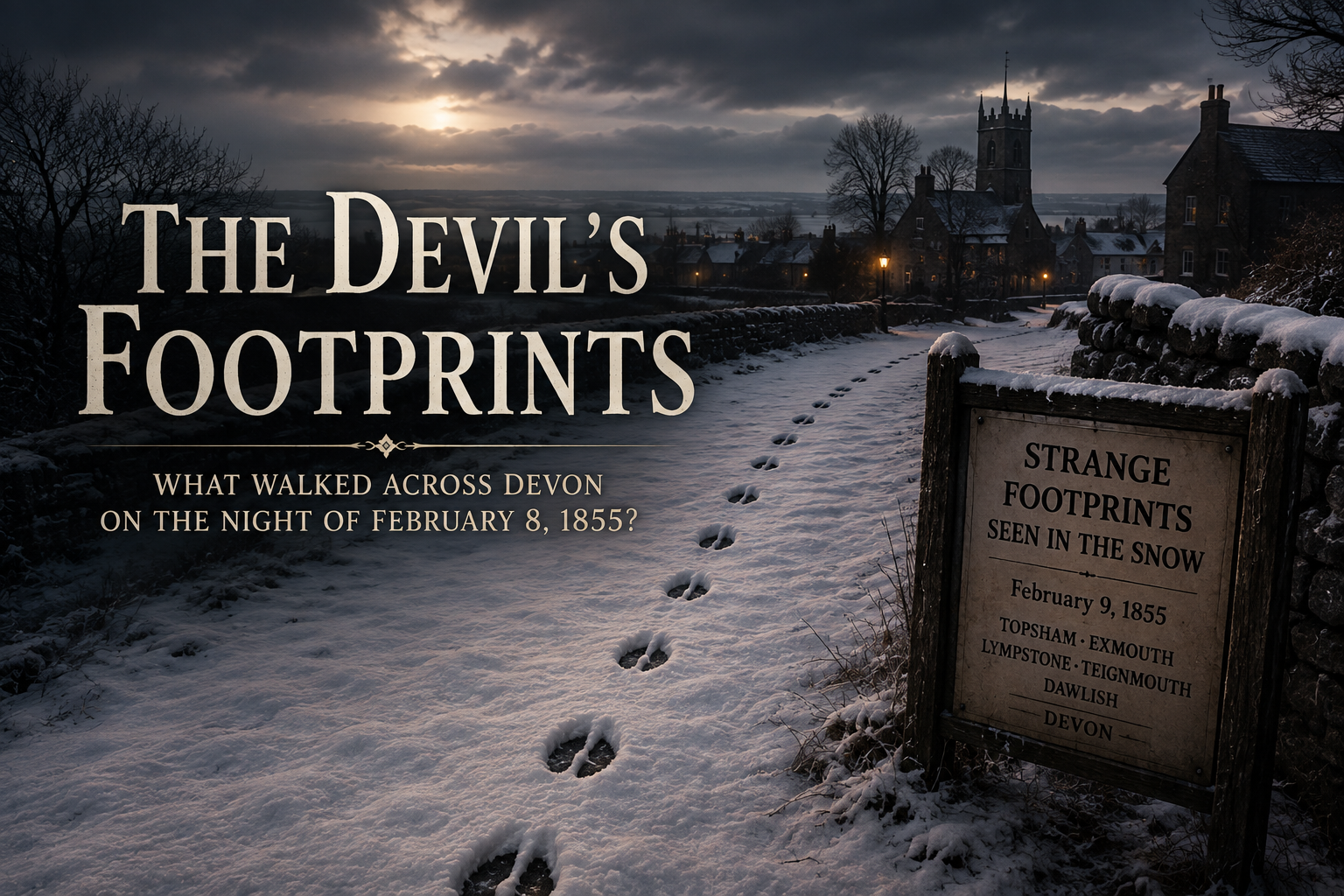
    On the morning of February 9, 1855, residents of several towns and villages in Devon awoke to a landscape transformed by snow and to a mystery that would outlive almost everyone who saw it. Across gardens, roads, fields and enclosed courtyards appeared lines of unusual impressions that many witnesses compared to the marks of a small hoof, although the creature that might have produced them was nowhere to be found.The tracks were reported around communities including Topsham, Lympstone, Exmouth, Teignmouth and Dawlish, and before long newspapers were describing them in places that seemed increasingly difficult to explain. They appeared in open countryside but were also said to continue into walled gardens, across narrow walls and, according to contemporary reports, even over the snow-covered tops of houses.What particularly disturbed observers was not simply the shape of the marks but the strange manner in which many of them seemed to proceed. Rather than displaying the alternating pattern expected from an ordinary four-legged animal, some trails appeared to consist of impressions following one another in an almost single line, separated by surprisingly regular intervals.Within days, naturalists, clergymen, journalists and ordinary residents were debating what could possibly have crossed the snowy Devon countryside.Some proposed badgers, birds, rodents, toads or an escaped kangaroo, while others suspected that several completely ordinary animals had produced different tracks that frightened observers subsequently combined into a single extraordinary mystery.Among the more superstitious inhabitants, however, another possibility began to circulate.Perhaps the tracks belonged to no ordinary animal at all.Perhaps, during that cold February night, the Devil himself had walked through Devon.

    A Snowfall That Left Something Behind

    The mystery began after snow fell across parts of southern Devon during the night of February 8–9, 1855. When residents emerged the following morning, they discovered unusual trails impressed into the fresh covering.The story spread remarkably quickly.

    On February 16, The Times reported that considerable excitement had been caused in Topsham, Lympstone, Exmouth, Teignmouth and Dawlish by the discovery of strange foot-tracks. The newspaper noted that the marks had been observed not only in ordinary fields and roads but in locations that appeared much more difficult for an animal to reach, including gardens and courtyards enclosed by walls and fences.

    The newspaper also recorded the supernatural interpretation already circulating among local people, reporting that some believed the marks might have belonged to Satan and that the mystery had generated enough interest to be discussed from the pulpit.The event was therefore not a legend invented generations afterward. Newspapers were discussing the strange tracks while the snow, the witnesses and the excitement surrounding them were still contemporary realities.Yet those same reports also reveal something important that later retellings sometimes obscure: people did not agree about exactly what they had seen.

    What Did the Footprints Actually Look Like?

    Modern illustrations often depict the Devil’s Footprints as a perfectly uniform trail of tiny cloven hooves stretching uninterrupted across Devon, but the surviving nineteenth-century descriptions are considerably messier and therefore considerably more interesting.Some witnesses compared the impressions to a donkey’s hoof or horseshoe, while others described them as divided or cloven. Measurements also varied from place to place, and drawings reproduced by the Illustrated London News showed different forms rather than one perfectly consistent mysterious footprint.One report described impressions roughly four inches long and less than three inches wide, separated by intervals of approximately eight inches, while accounts from other locations recorded different dimensions and shapes.This inconsistency is crucial.If every observer across Devon had recorded an identical footprint with precisely the same dimensions and stride, the case for a single mysterious source would be considerably stronger. Instead, the historical record suggests that several types of unusual marks may have been grouped together under one rapidly spreading story.The mystery may therefore have begun not with one impossible trail, but with many puzzling trails discovered after the same unusual weather.Once newspapers began connecting them, Devon suddenly seemed to have been crossed by a single invisible visitor.

    The Tracks That Seemed to Ignore Walls

    The most famous part of the story concerns the apparent ability of the tracks to continue through or across obstacles that should have interrupted the path of an ordinary animal.Contemporary reports described impressions on walls, rooftops and inside enclosed gardens. Residents sometimes claimed that the trail approached an obstacle and appeared again on the opposite side, creating the impression that whatever had made the marks had crossed barriers without changing its direction.This transformed a curious zoological puzzle into something far more unsettling.A fox could cross a field, a bird could land in a garden and a badger could leave unusual impressions in melting snow, but what kind of animal could apparently maintain the same mysterious trail over walls, roofs and fences?The newspapers themselves struggled with the question.Reports described local people gathering in groups to inspect the tracks, comparing theories and following trails through the landscape, while speculation grew with every new location in which unusual marks were discovered.Some residents treated the affair humorously, but others were genuinely frightened.The supernatural explanation had found ideal conditions in which to grow.

    When Devon Began Talking About the Devil

    Victorian England was living through enormous scientific and technological change, but traditional beliefs, folklore and religious interpretations remained deeply embedded in everyday culture. A strange trail appearing overnight after snowfall could therefore exist simultaneously as a natural-history puzzle, a newspaper curiosity and a supernatural warning.The nickname “Devil’s Footprints” captured the imagination because some of the impressions were interpreted as resembling a cloven hoof, a form long associated in European Christian imagery with demonic figures.Newspaper coverage demonstrates that the Satanic interpretation was already circulating in February 1855, although it would be misleading to imagine that everyone in Devon accepted it.Indeed, some journalists openly mocked the panic. Trewman’s Exeter Flying Post, reporting later that month, described the excitement in terms suggesting that it belonged more appropriately to the “dark ages,” while still acknowledging that the mysterious tracks had genuinely been observed across numerous locations.The disagreement itself tells us something important.Devon was not simply terrified by a supernatural event.Devon was arguing about one.

    The Kangaroo That Probably Never Escaped

    Among the most memorable explanations was the suggestion that a kangaroo had escaped from a private menagerie.To Victorian readers, the idea was not quite as ridiculous as it sounds today. Exotic animals were kept in private collections, and a kangaroo moving through snow could potentially produce unfamiliar tracks that local residents failed to recognize.The theory became associated with the Reverend G. M. Musgrave of Withycombe Raleigh, who discussed the possibility of an escaped kangaroo.There was, however, a problem.Musgrave later indicated that he had encouraged the kangaroo story largely because he wanted to divert frightened parishioners away from the belief that the Devil was roaming through Devon.In other words, one of the most famous explanations may itself have been deliberately promoted as a reassuring alternative to supernatural panic rather than as the result of evidence that an actual kangaroo had escaped.Even if a kangaroo had been loose, another difficulty remained: tracks were being reported across a broad area and on both sides of the Exe estuary.The hypothetical animal would have needed to undertake a remarkable winter journey.

    Richard Owen Suspected a Badger

    A considerably more serious zoological explanation came from Richard Owen, one of nineteenth-century Britain’s most prominent anatomists and the scientist who had coined the term “Dinosauria.”Writing to the Illustrated London News, Owen suggested that a badger could have produced at least some of the mysterious impressions.The theory had several advantages. Badgers were native to Britain, could travel considerable distances while searching for food and possessed feet capable of leaving marks that might appear unexpectedly hoof-like after snow had partially melted or distorted their original form.Owen also questioned the assumption that a single animal had produced every trail. If numerous badgers and other animals had been active across Devon during the same snowy conditions, witnesses in different communities might have discovered similar-looking but unrelated tracks.This possibility becomes especially important when we remember how quickly the newspaper story expanded.Once people knew that mysterious footprints were being reported elsewhere, almost any unusual trail in the snow could become part of the phenomenon.

    Could Mice Have Created the Devil’s Hooves?

    One of the most intriguing explanations involves an animal considerably smaller than a badger.A hopping mouse can bring its feet together during a leap, producing a combined impression that looks surprisingly different from the ordinary footprint people expect from a rodent. Under certain snow conditions, repeated jumps can create a neat series of marks resembling tiny hoof-like impressions.The possibility was already being discussed in 1855, when correspondence published by the Illustrated London News compared the mysterious Devon tracks with marks made by rodents and other small animals.Later researchers revisiting the case have considered mice particularly useful for explaining trails found in places such as rooftops, narrow walls and enclosed spaces, because rodents could reach locations that would seem extraordinary if observers imagined a much larger hoofed creature.Melting snow could then perform the final transformation.A small animal’s detailed footprint might lose the impressions of toes and claws as temperatures changed, leaving behind a larger, smoother depression whose original shape was no longer obvious.By the time a person discovered it, the mouse could be gone and its ordinary tracks could have become something that looked remarkably unfamiliar.

    Birds, Toads and Other Suspects

    The list of proposed culprits did not stop with badgers and mice.Contemporary correspondents suggested birds, particularly waders, whose footprints could change dramatically depending upon the depth and consistency of snow. Others considered otters, foxes and various small mammals.In March 1855, Trewman’s Exeter Flying Post even published an account from a man near Torquay who had followed strange tracks in his garden until he discovered a large toad beneath the stump of a tree. He believed that the animal’s impressions closely resembled illustrations of the mysterious Devon tracks.A toad obviously cannot explain every report scattered across southern Devon, but that is precisely the point.Perhaps nothing explains all of them because there was never a single phenomenon requiring one explanation.Badgers could have produced one trail, rodents another, birds another and melting snow could have altered all of them.A newspaper narrative could then do what newspapers, folklore and human memory frequently do extremely well: transform many separate incidents into one unforgettable story.

    Did One Creature Really Travel One Hundred Miles?

    One of the most repeated claims about the Devil’s Footprints is that a single trail extended for approximately one hundred miles during a single night.It is also one of the details that deserves the greatest caution.The surviving reports certainly describe unusual tracks across a broad region, but they do not establish an uninterrupted hundred-mile trail made by one creature. Locations, measurements and descriptions differ, and the idea of a single continuous journey appears stronger in later retellings than in the fragmented evidence left by witnesses and newspapers.The distinction fundamentally changes the mystery.A single animal leaving identical tracks for one hundred miles while crossing estuaries, roofs and walls would present an extraordinary physical problem.Numerous animals leaving superficially similar tracks across a snowy county would present a very different one.The second scenario may be less supernatural, but it reveals something equally fascinating about the way mysteries are created.People did not need to invent the footprints.They only needed to connect them.

    The Reverend Who Preserved the Evidence

    Much of what researchers know about the episode owes something to material associated with Henry Thomas Ellacombe, the vicar of Clyst St George.Documents connected with Ellacombe included correspondence about the tracks and drawings or tracings showing what witnesses believed they had seen. These materials became particularly important to later researchers because they demonstrated that the footprints were not described uniformly.Some were rounded, some appeared hoof-like, some suggested claws or toes, and their measurements varied.This surviving evidence creates an uncomfortable problem for the most spectacular version of the legend.The closer we move toward the original reports, the less the Devil’s Footprints resemble one perfectly consistent supernatural trail.Yet this does not make the story uninteresting.It makes it better.Instead of asking what impossible creature crossed Devon, we can ask how an entire region came to believe that many mysterious marks might belong to the same visitor.

    Weather May Have Been the Invisible Accomplice

    Snow is an unreliable recorder.A footprint impressed into fresh snow does not necessarily preserve the shape of the foot that created it. Temperature, wind, sunlight, freezing and thawing can enlarge or distort the original impression, sometimes removing fine details while preserving only the deepest part of the track.This process can produce a phenomenon sometimes described as enlargement through thawing, in which a small print gradually becomes larger and more rounded.A bird track can lose recognizable toes.A rodent’s clustered impressions can merge.A paw can begin to resemble something more like a hoof.If different animals crossed Devon during the night and their tracks subsequently underwent similar weathering, observers could have encountered impressions that looked more alike than the original footprints actually were.The snow, in other words, may not merely have preserved the mystery.It may have helped create it.

    Why the Mystery Survived

    The Devil’s Footprints endured because no explanation managed to account convincingly for every reported detail, particularly when those details were treated as parts of a single event.A badger explains some features but not every rooftop.Rodents can explain small single-file tracks and access to narrow surfaces but seem inadequate when applied indiscriminately to every witness account.Birds and toads can reproduce particular shapes but not the entire geographical legend.Weather explains distortion but still requires animals to have produced the original impressions.The mistake may be assuming that one solution is necessary.The historical evidence permits a much more complicated possibility in which several ordinary causes occurred simultaneously and were joined together by extraordinary circumstances: unusual snowfall, unfamiliar animal tracks, changing weather, frightened communities, religious imagery and newspapers eager to report a mystery that became more remarkable each time another town was added to the story.None of this requires the witnesses to have lied.They may genuinely have seen tracks they could not identify.What changed was the interpretation.

    So What Walked Across Devon?

    More than 170 years later, there is no surviving footprint that can be subjected to modern forensic examination, no photograph capable of settling the matter and no animal waiting to be identified from biological evidence.What remains are newspaper reports, letters, drawings, later recollections and a story that became larger than the snow in which it began.It is entirely possible that no single creature ever crossed Devon that night.Mice may have jumped across rooftops, badgers may have searched fields for food, birds may have crossed gardens and other animals may have left tracks that changed shape as the snow thawed. Residents who had already heard rumors about mysterious hoofprints would naturally examine every unusual mark more carefully, while newspapers connected reports separated by miles into one enormous trail.Yet there remains something wonderfully unsettling about returning to Devon on that February morning in imagination.The inhabitants did not possess our later theories. They opened their doors and discovered strange impressions where there had been fresh snow the night before, followed them toward walls and gardens, heard that identical marks had supposedly appeared in neighboring towns and discovered that nobody could tell them with certainty what had made them.By the time darkness returned, some residents were reportedly reluctant to venture outside.Whatever walked through Devon in February 1855 may therefore have been several animals, altered snow and a rapidly expanding rumor rather than a single impossible visitor.But for one winter morning, before explanations had time to catch up with imagination, something seemed to have crossed the sleeping countryside without respecting walls, roofs, rivers or locked gates.The snow eventually melted.The footprints disappeared with it.The mystery did not.—Sources & Further ReadingThe Times, February 16, 1855 — one of the important contemporary newspaper reports describing the unusual tracks around Topsham, Lympstone, Exmouth, Teignmouth and Dawlish, as well as the excitement and supernatural speculation they generated.The Illustrated London News, February–March 1855 — published drawings, correspondence and proposed explanations for the Devon tracks, including contributions discussing badgers, rodents and other animals.Trewman’s Exeter Flying Post, February–March 1855 — valuable local reporting that demonstrates both the extent of contemporary interest and the skepticism with which some observers treated the mystery.Henry Thomas Ellacombe papers — correspondence and tracings associated with the vicar of Clyst St George became important evidence for later researchers because they preserve differing descriptions of the tracks.Mike Dash, “The Devil’s Hoofmarks: Source Material on the Great Devon Mystery of 1855,” Fortean Studies — a detailed modern collection and analysis of primary and secondary material concerning the event.G. A. Household, The Devil’s Footprints: The Great Devon Mystery of 1855 — a collection of historical material concerning the newspaper reports and proposed explanations surrounding the case.

    Sources & Further Reading
    The Times, February 16, 1855 — one of the important contemporary newspaper reports describing the unusual tracks around Topsham, Lympstone, Exmouth, Teignmouth and Dawlish, as well as the excitement and supernatural speculation they generated.
    The Illustrated London News, February–March 1855 — published drawings, correspondence and proposed explanations for the Devon tracks, including contributions discussing badgers, rodents and other animals.
    Trewman’s Exeter Flying Post, February–March 1855 — valuable local reporting that demonstrates both the extent of contemporary interest and the skepticism with which some observers treated the mystery.
    Henry Thomas Ellacombe papers — correspondence and tracings associated with the vicar of Clyst St George became important evidence for later researchers because they preserve differing descriptions of the tracks.
    Mike Dash, “The Devil’s Hoofmarks: Source Material on the Great Devon Mystery of 1855,” Fortean Studies — a detailed modern collection and analysis of primary and secondary material concerning the event.
    G. A. Household, The Devil’s Footprints: The Great Devon Mystery of 1855 — a collection of historical material concerning the newspaper reports and proposed explanations surrounding the case.

  • The Green Children of Woolpit: The Medieval Mystery That Has Never Been Fully Explained

    The Green Children of Woolpit: The Medieval Mystery That Has Never Been Fully Explained

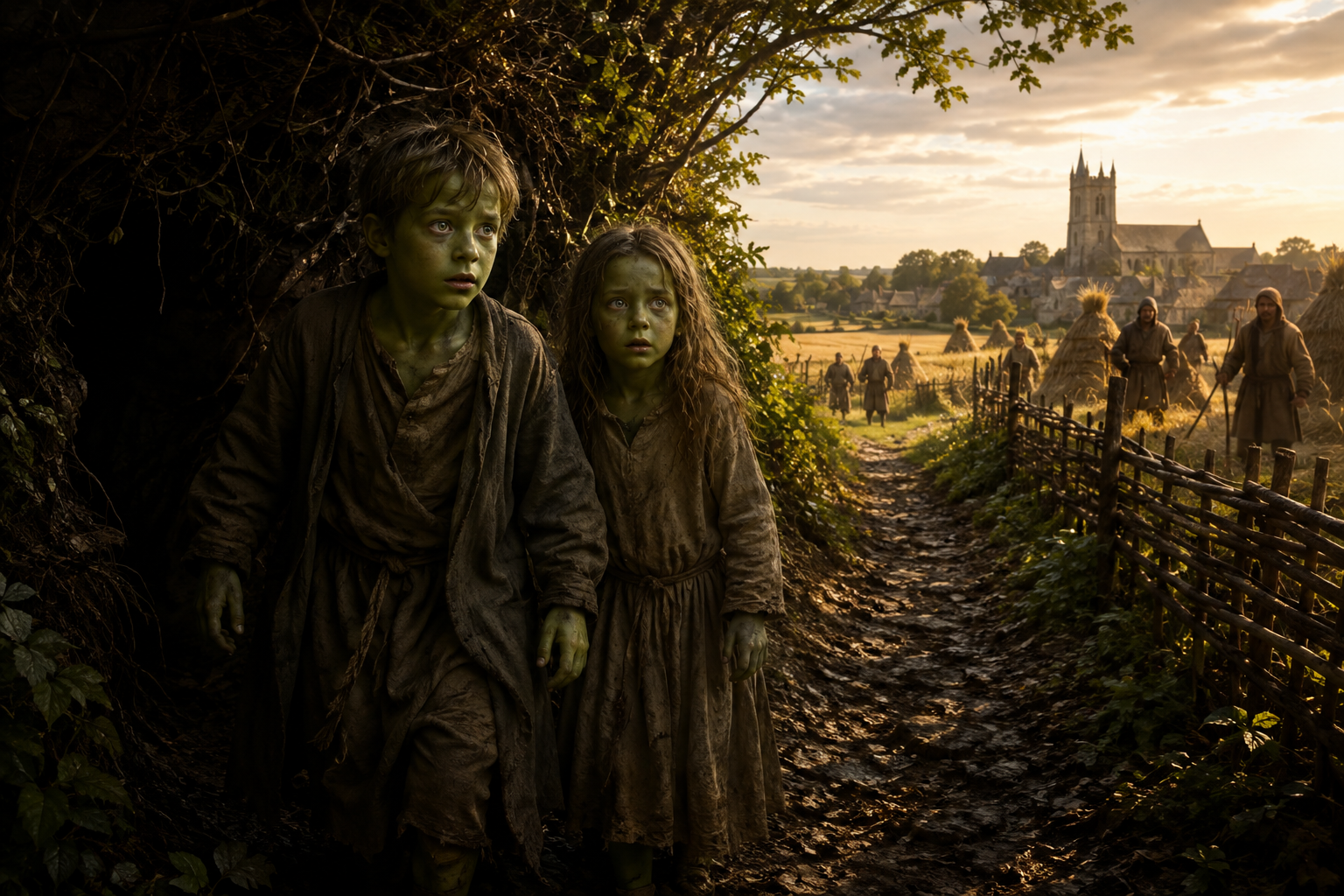
    Sometime during the twelfth century, while workers were gathering the harvest near the small English village of Woolpit in Suffolk, two children appeared in the countryside under circumstances so unusual that their story would survive for more than eight hundred years.

    They were a boy and a girl, apparently brother and sister, and according to the medieval chroniclers who recorded the event, there was immediately something extraordinary about them. Their clothes were made from material the local people did not recognize, the language they spoke could not be understood by anyone around them, and, most remarkably of all, their skin appeared to have a distinctly green coloration.

    The children seemed frightened and disoriented, and they were unable to explain where they had come from because nobody could understand their speech. They were eventually taken into the household of a local landowner, where another strange detail soon emerged: although food was placed before them, they refused almost everything they were offered.

    Then they saw beans.

    According to the medieval accounts, the children immediately became excited and searched desperately for the beans inside their stalks, apparently unfamiliar with the way the plants were presented to them. Once the beans themselves were produced, they ate eagerly.

    For some time, beans were reportedly almost the only food they would accept.

    Eventually their diet changed, their green coloration gradually disappeared, and the surviving child learned enough English to tell the people around her where she believed she had come from.

    Her explanation transformed an already unusual story into one of medieval England’s most enduring mysteries.

    She said that she and her brother had come from a place known as St Martin’s Land, a country where the sun did not shine as it did in England and where the world remained beneath a strange twilight.

    According to her account, everyone there was green.

    The Village Where the Children Appeared

    Woolpit is a real village in Suffolk, situated not far from Bury St Edmunds, and its unusual name has traditionally been connected with pits used for trapping wolves. The medieval form of the name is generally understood as deriving from something resembling “wolf pit,” which provided later storytellers with an appropriately mysterious landscape for the children’s appearance.

    One version of the story describes the children emerging near one of these pits during harvest time, where workers discovered them wandering in confusion.

    The event would probably have disappeared completely into local folklore had it not attracted the attention of two medieval chroniclers.

    The first was William of Newburgh, an Augustinian canon born around 1136 who wrote his Historia rerum Anglicarum, or History of English Affairs, toward the end of the twelfth century.

    William was not merely collecting fairy tales. His work was intended as a history of England beginning with the Norman Conquest, although, like many medieval historians, he also included accounts of wonders, supernatural events and phenomena that he considered sufficiently remarkable to record.

    When introducing the strange children, William himself acknowledged how difficult the story was to believe, yet indicated that the number and quality of the witnesses convinced him that something unusual had occurred.

    The second account comes from Ralph of Coggeshall, a monk and later abbot of Coggeshall Abbey in Essex, whose Chronicon Anglicanum also contains the story.

    Ralph’s account is particularly interesting because he claimed to have obtained information from Richard de Calne, the man whose household had reportedly taken in the children. If that statement is accurate, Ralph’s version brings us considerably closer to people associated with the original event than many legends of medieval Europe allow.

    The two chronicles differ in some details, but their central elements are remarkably similar: two strangely dressed children appeared near Woolpit, their skin had a green coloration, their language was unfamiliar, and initially they would eat little except beans.

    The Children Who Would Eat Only Beans

    Once the children had been brought into local care, attempts were made to feed them, but the food offered to them appeared unfamiliar or unacceptable.

    Then green beans were brought into their presence.

    The children reportedly reacted with intense interest, although one version of the story contains an intriguing detail: they initially searched the stalks rather than opening the pods, as though they recognized the food but did not understand where the beans were located on the plant before them.

    After someone showed them the pods, they ate eagerly.

    For a period afterward, beans remained their preferred food, although they gradually began eating other foods as they adapted to their new surroundings.

    At the same time, another transformation supposedly occurred.

    Their green skin began to fade.

    The boy, however, did not recover as successfully as his sister. Medieval accounts describe him as becoming increasingly weak or depressed, and he eventually died.

    The girl survived.

    She was baptized, remained in England and gradually learned the local language.

    Only then could anyone ask the question that must have occupied the villagers from the moment the children appeared.

    Where had they come from?

    The Land Where the Sun Never Fully Rose

    The girl’s answer was extraordinary.

    She reportedly said that she and her brother came from a place called St Martin’s Land, where the inhabitants were Christian and where churches existed, but the quality of daylight was completely different from that of England.

    The sun, she explained, did not shine brightly over their homeland.

    Instead, the country existed beneath something resembling perpetual twilight.

    In one version of the account, she described another luminous land visible beyond a considerable river, suggesting that her own country was separated from a brighter region by water.

    When asked how she and her brother had reached Woolpit, her explanation became even stranger.

    According to the story preserved by the chroniclers, the children had been tending their father’s animals when they entered or followed them into some kind of underground passage or cavern. Inside the darkness they heard the sound of bells, and after wandering through the passage for what seemed like a long time, they suddenly emerged into brilliant daylight.

    The intensity of the sunlight supposedly overwhelmed them because they had never experienced anything like it.

    Before they could find their way back, the harvest workers discovered them.

    The children had apparently crossed from one world into another without understanding how they had done it.

    At least, that was how medieval listeners could interpret the story.

    Was St Martin’s Land Somewhere on Earth?

    The obvious question is whether the girl’s mysterious homeland might have been a perfectly ordinary location whose description became distorted through language, fear and retelling.

    One modern hypothesis proposes that the children may have belonged to a Flemish community living in eastern England.

    Flemish settlers and textile workers were present in medieval England, and political conflict during the twelfth century created periods of hostility and violence involving Flemish communities and mercenaries.

    In 1173, during the rebellion against Henry II, fighting occurred at Fornham, not far from Bury St Edmunds. A later theory proposed by Paul Harris suggested that the children might have been displaced Flemish youngsters associated with Fornham St Martin, providing a possible explanation for the girl’s reference to “St Martin’s Land.”

    If the children spoke a Flemish dialect, their language could easily have sounded completely incomprehensible to rural English villagers.

    Their unfamiliar clothing might similarly have reflected cultural differences rather than anything supernatural.

    The theory is attractive because it potentially explains several pieces of the puzzle at once, but it remains a reconstruction rather than a demonstrated solution. Geographic and chronological difficulties remain, and historians do not possess independent evidence identifying the children as Flemish refugees.

    Why Were Their Faces Green?

    The most famous element of the story may also have one of the least supernatural explanations.

    Historical writers have suggested that the children’s appearance could have resulted from severe malnutrition or anemia. A condition historically called chlorosis was associated with a pale or greenish complexion, although applying a later medical diagnosis to two children known only through medieval chronicles is necessarily speculative.

    If the children had spent a prolonged period lost, displaced or surviving on an inadequate diet, their unusual complexion might have appeared even more striking to people encountering them for the first time.

    The fact that the girl’s green coloration reportedly disappeared after she began eating a more varied diet is one reason this explanation has remained attractive. Woolpit’s own historical account mentions severe nutritional deficiency as one possible explanation for the reported appearance.

    Yet this explanation creates another interesting question.

    If malnutrition explains the green color, what explains the strange language, unfamiliar clothing and story of the twilight homeland?

    Each mystery can perhaps be explained individually, but combining all of them into one convincing reconstruction becomes considerably more difficult.

    Or Was This a Medieval Story About Another World?

    There is another possibility that does not require the children to have existed exactly as described.

    Medieval chronicles were not written according to modern standards of historical reporting, and their authors frequently recorded miracles, omens, monsters, visions and other extraordinary events alongside political history.

    The boundary between history, theology, oral tradition and folklore was considerably more fluid than it is for modern historians.

    The Green Children may therefore belong partly to the enormous European tradition of stories about encounters with an Otherworld, a hidden realm existing alongside the ordinary human world.

    Several elements fit surprisingly well.

    The children emerge from an underground passage.

    Their homeland exists beneath unusual light.

    Their appearance is different from ordinary humans.

    They eat unusual food.

    They cannot initially communicate with the people who discover them.

    One of them eventually remains permanently in the human world.

    Green itself acquired powerful associations with nature, fairies, spirits and otherworldly beings in later European folklore, although we must be careful not to project later traditions automatically onto a twelfth-century account.

    The story could therefore represent a real event that accumulated folkloric details, an older folktale attached to a real village, or some combination of both.

    That uncertainty is precisely what makes Woolpit so fascinating.

    What Happened to the Surviving Girl?

    After learning English and adapting to local life, the girl reportedly remained in England.

    William of Newburgh wrote that she eventually lost the green coloration of her skin and lived for many years, while Ralph of Coggeshall associated her with the household of Richard de Calne.

    Later tradition sometimes gives the girl the name Agnes and claims that she married a man connected with King’s Lynn, but these details are considerably less secure than the central medieval accounts and should not be presented as established fact.

    What matters is that, according to the chroniclers, the surviving child did not disappear mysteriously back into St Martin’s Land.

    She stayed.

    This small detail makes the story unusually tantalizing because, if there really was a surviving girl who grew into adulthood in medieval England, she potentially represented a living connection to whatever event originally inspired the legend.

    Yet no surviving document has conclusively identified her.

    Her trail disappears into history.

    Two Chroniclers, One Extraordinary Story

    The existence of two medieval accounts is often presented online as though it proves that the Green Children must have existed exactly as described.

    It does not.

    The chroniclers were not eyewitnesses to the children’s appearance, and both recorded the story after the supposed event. Medieval information traveled through oral networks, monasteries, travelers and shared stories, which means that two written accounts do not necessarily represent two completely independent eyewitness traditions.

    Nevertheless, their existence matters.

    The Green Children were not invented by a nineteenth-century spiritualist, a twentieth-century UFO writer or a modern internet storyteller.

    Something resembling this extraordinary narrative was already circulating in medieval England strongly enough for two serious chroniclers to preserve it.

    That leaves us with several possibilities, none of which can now be proven.

    Perhaps two displaced foreign children really did wander into Woolpit, malnourished, frightened and unable to communicate, while bewildered villagers gradually transformed their tragedy into a supernatural story.

    Perhaps the narrative began as folklore and acquired real names and locations as it circulated.

    Perhaps an unusual historical incident and an older tradition of the Otherworld merged until separating fact from legend became impossible.

    Or perhaps something happened near Woolpit that does not fit comfortably into any explanation that has survived.

    More than eight centuries later, the village remains where it always was, the medieval chroniclers remain available to be read, and the children themselves have disappeared completely.

    We know what William of Newburgh and Ralph of Coggeshall wrote.

    We know what later generations believed.

    What we do not know is what two frightened children actually saw before they stepped into the sunlight near Woolpit.

    And somewhere between those three things — chronicle, legend and lost experience — the Green Children are still waiting.


    Sources & Further Reading

    William of Newburgh — Historia rerum Anglicarum (History of English Affairs)
    One of the two principal medieval accounts of the Green Children.

    Ralph of Coggeshall — Chronicon Anglicanum
    The second major medieval source; Ralph claimed information connected with Richard de Calne, whose household was associated with the children.

    Woolpit Village — Local History
    The village’s historical account preserves the local tradition and discusses possible explanations for the children’s appearance.

    Brian Haughton — “The Green Children of Woolpit”
    A useful overview comparing the medieval sources with later historical, medical and folkloric explanations.

  • The Last Words of Erin Valenti: “We’re in the Matrix”

    The Last Words of Erin Valenti: “We’re in the Matrix”

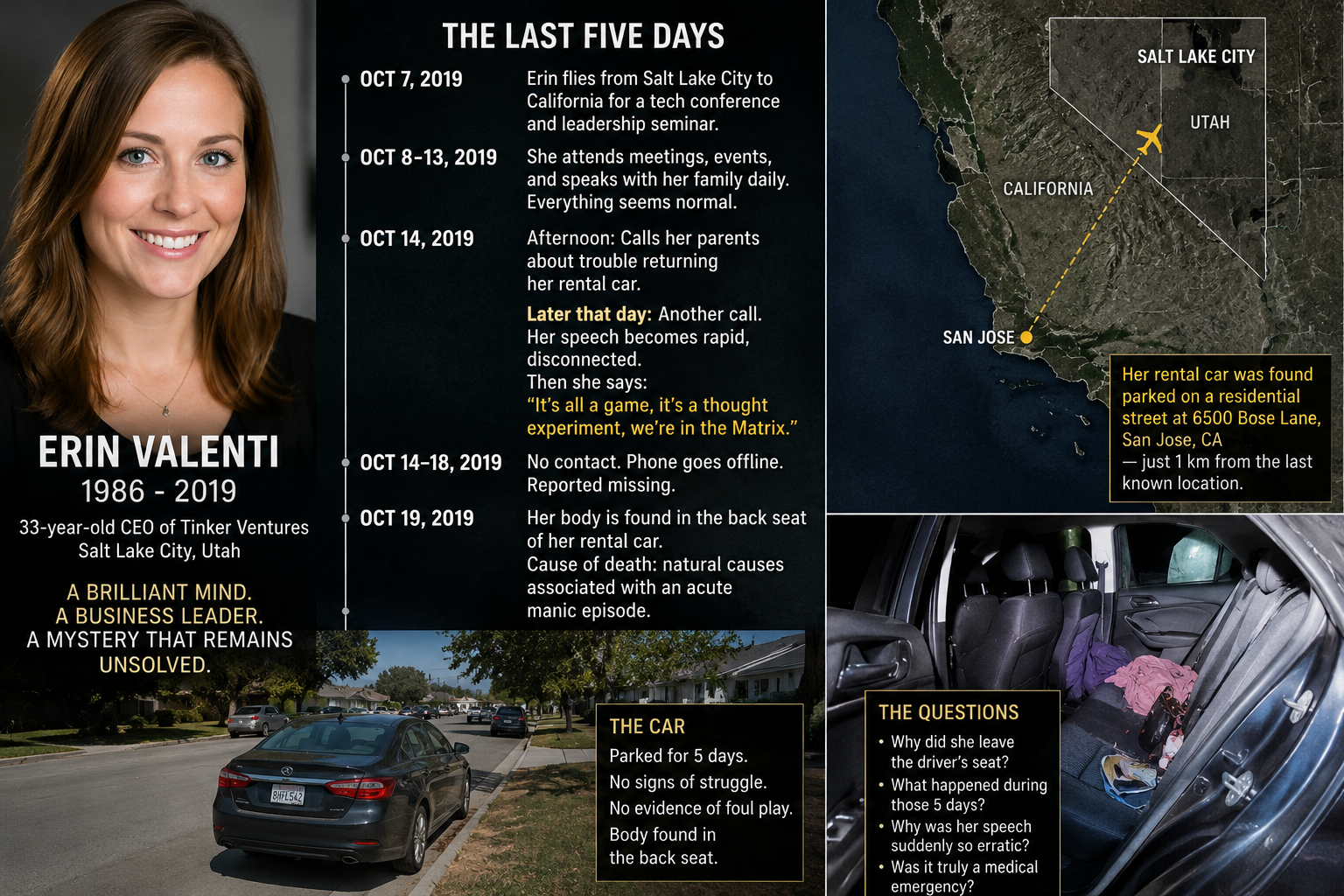
    On 7 October 2019, Erin Valenti, a 33-year-old technology executive from Utah, boarded a flight to California.

    The trip appeared routine. She was scheduled to attend a founders’ conference and a leadership seminar before returning home to her husband and her growing business.Five days later, she was found dead in the back seat of her rental car.

    Officially, the case was ruled a death from natural causes associated with an acute manic episode.

    Yet nearly six years later, the circumstances surrounding her final days continue to generate questions that have never been fully answered.

    Who Was Erin Valenti?

    Erin Valenti was the CEO of Tinker Ventures, a technology company focused on helping startups develop innovative software solutions. Colleagues described her as intelligent, energetic and ambitious. She frequently attended conferences, worked long hours and was well known within Utah’s entrepreneurial community.

    According to her family and husband, she had no documented history of bipolar disorder, psychosis, psychiatric hospitalization or substance abuse.That fact would later become central to the controversy surrounding her death.

    A Normal Business Trip

    During the first days of her California visit, nothing appeared unusual.She attended meetings.She met former colleagues.She participated in leadership events.She spoke regularly with her parents, as she often did while traveling.Family members later recalled that she sounded optimistic and excited about returning home. One conversation with a former employer reportedly focused on new business ideas and solutions to challenges she had recently faced.Nothing suggested that within twenty-four hours she would completely disappear.

    The Phone Calls

    Everything changed on Monday afternoon.Erin called her parents after experiencing difficulties returning her rental vehicle. At first, the conversation appeared ordinary.Moments later she called again.This time, according to her mother, something was profoundly wrong.

    Her speech became rapid and fragmented.Her thoughts appeared disconnected.

    Then she made a statement that would later become the defining phrase of the entire case.”It’s all a game. It’s a thought experiment. We’re in the Matrix.”

    Family members immediately realized that something was terribly wrong.Her father later described the conversation as completely unlike anything they had ever experienced.

    The woman speaking no longer sounded like Erin.

    The Disappearance

    After those phone calls, contact stopped.Her cellphone eventually became inactive.Friends and relatives were unable to reach her.Police began searching after she was officially reported missing.Meanwhile, her rental car remained parked on a quiet residential street in San Jose.For five days.No one appears to have noticed anything unusual.

    The Discovery

    On 12 October 2019, a volunteer assisting in the search located the rental vehicle near 6500 Bose Lane.Erin’s body was found inside.One detail immediately attracted attention.

    She was lying in the back seat, not behind the steering wheel.Investigators found no obvious evidence of violence.No indication of robbery.No signs of a struggle.The vehicle itself showed no evidence of a collision or forced entry.

    The Official Conclusion

    The Santa Clara County Medical Examiner ultimately concluded that Erin Valenti died from natural causes during an acute manic episode.According to medical experts, severe mania can produce profound sleep deprivation, dehydration, extreme psychological stress and dangerous physiological changes. In rare situations, these complications may contribute to sudden death.

    The conclusion surprised many observers.Although first episodes of mania can occur in adulthood, they often leave relatives struggling to understand how dramatic behavioral changes could emerge so suddenly.

    The Family’s Questions

    Erin’s husband, Harrison Weinstein, who is trained as a psychologist, publicly questioned whether the official explanation fully accounted for the circumstances.He emphasized that Erin had never been diagnosed with a psychiatric illness.Her parents expressed similar concerns.They were not necessarily rejecting the medical findings.Instead, they questioned whether investigators had successfully reconstructed everything that happened during the missing five days.

    Several questions remain unanswered.

    Why did she drive aimlessly for hours before disappearing?Why was the vehicle left where it was?Why was her body found in the rear seat?What happened during the period between her final phone call and her death?Publicly available records provide only partial answers.

    The “Matrix” Statement

    Perhaps no element of the case has generated more speculation than Erin’s final recorded words.Within hours of news reports becoming public, online forums connected her comments to simulation theory, artificial intelligence, secret technology projects and countless conspiracy theories.There is, however, no evidence supporting these claims.Mental health specialists note that individuals experiencing acute mania or psychosis sometimes express grand philosophical ideas, unusual beliefs or references to concepts drawn from popular culture.

    The word “Matrix” may therefore represent symbolism rather than hidden knowledge.Equally, no investigator has produced evidence that it meant anything beyond the state of mind Erin was experiencing during those final hours.

    What Can Be Established?

    Several facts are not disputed.

    Erin Valenti traveled to California for business.She suddenly began speaking in a confused and highly unusual manner.She disappeared shortly afterward.Five days later she was found deceased inside her rental vehicle.The official medical conclusion identified an acute manic episode as the underlying cause of the events leading to her death.Beyond those facts, certainty becomes increasingly difficult.

    An Unfinished Story

    The death of Erin Valenti illustrates how modern mysteries are often shaped not by hidden evidence but by missing information.Every unexplained gap invites speculation.Every unanswered question creates another theory.Yet responsible investigation requires distinguishing between what is known, what is probable and what remains entirely unknown.Today, Erin Valenti’s case occupies an unusual place between medical science, criminal investigation and internet mythology.It reminds us that not every mystery conceals a conspiracy.

    Sometimes the greatest challenge is accepting that even after years of investigation, some questions simply remain unanswered.

  • The Black Mirror of John Dee: A Window to Another World?

    The Black Mirror of John Dee: A Window to Another World?

    Few objects in the history of the occult have inspired as much fascination as the black mirror of John Dee. Unlike the ornate crystal balls and elaborate magical instruments often portrayed in popular culture, Dee’s mirror was astonishingly simple. It was a polished disk of deep black obsidian, smooth enough to reflect a face, yet dark enough to conceal far more than it revealed. To some, it was merely a carefully crafted artifact from ancient Mexico. To others, it was a doorway through which one of the greatest minds of the Renaissance believed he could communicate with beings beyond the visible world.

    John Dee was no ordinary mystic. He served as mathematician, astronomer, navigator, philosopher, and trusted advisor to Queen Elizabeth I. His knowledge of astronomy helped shape England’s ambitions at sea, while his immense personal library became one of the greatest collections of scientific and philosophical works in Europe. Yet despite his remarkable achievements, Dee believed that human knowledge had reached a limit. Beyond mathematics, beyond philosophy, and beyond theology, he became convinced that another source of wisdom existed—one that could only be reached through direct contact with higher intelligences.

    It was during this relentless search that the black mirror became central to his work. Unlike many occult practitioners of his age, Dee insisted that he did not seek power, wealth, or domination over hidden forces. He believed that before humanity’s fall from grace, divine knowledge had once been freely accessible. The ancient patriarchs, he argued, had understood truths that later generations had forgotten. His goal was not to invent new magic, but to recover a sacred language that had been lost with time.

    The mirror itself had a remarkable history long before it reached Dee’s hands. Modern scholars believe it was fashioned from volcanic obsidian by Aztec craftsmen centuries before the Spanish conquest of the Americas. In Aztec tradition, polished obsidian mirrors were associated with the powerful deity Tezcatlipoca, whose name is often translated as “Smoking Mirror.” Priests are believed to have used such mirrors in rituals of divination, believing they could glimpse hidden realities or receive messages from the divine. Whether by coincidence or fate, an object once revered in one civilization eventually found its way into the study of an English scholar searching for heavenly knowledge.

    Dee rarely worked alone. His most famous collaborator was Edward Kelley, a controversial figure who claimed to possess an extraordinary ability known as “scrying”—the practice of perceiving visions within reflective surfaces. While Dee prayed, recorded observations, and carefully documented every detail, Kelley would gaze into the black mirror, describing luminous cities, strange symbols, radiant beings, and voices that claimed to be angels. These sessions were recorded with remarkable precision, filling thousands of pages with conversations written in a mysterious language that Dee believed was the original tongue spoken by Adam before the Fall.

    This language, now known as Enochian, remains one of the greatest mysteries in Western esotericism. Some linguists argue that it was an elaborate invention created by Kelley. Others maintain that its unusual grammatical structure and internal consistency make it difficult to dismiss as simple fabrication. Whatever its true origin, the language continues to be studied and used within certain esoteric traditions more than four centuries after Dee first encountered it.

    Not everyone who visited Dee’s house viewed these experiments with admiration. Rumors spread quickly through London that the scholar who advised the Queen was secretly practicing forbidden arts. Some believed he conversed with angels; others whispered that no angel would speak through a black mirror once used in pagan ceremonies. The line between divine revelation and dangerous sorcery was perilously thin during the sixteenth century, and Dee increasingly found himself viewed with suspicion. Although he spent much of his life pursuing knowledge, history often remembered him more as a magician than as one of England’s greatest intellectuals.

    Centuries later, the black mirror survives. It is no longer hidden inside a private chamber lit by candlelight but preserved behind glass in the collections of the British Museum. Visitors stand before it expecting something extraordinary, only to find a polished disk of black volcanic stone. Yet many describe an unsettling sensation as they look into its surface. Unlike an ordinary mirror, obsidian absorbs light instead of reflecting it brightly. Faces seem to emerge from darkness rather than from light, giving the illusion that the glass possesses an unusual depth.

    Psychologists explain this phenomenon as a natural consequence of prolonged observation in dim light. The human brain begins to reinterpret subtle reflections, occasionally producing vivid visual distortions. Historians see the mirror as a priceless cultural artifact connecting Renaissance Europe with pre-Columbian America. Occultists, however, continue to believe that certain objects preserve more than their physical form. They argue that centuries of ritual use may leave behind an intangible presence, impossible to measure yet impossible to ignore.

    Whether one accepts these ideas or rejects them entirely, the black mirror of John Dee remains an extraordinary symbol of humanity’s endless search for hidden knowledge. It stands at the crossroads of science, religion, philosophy, and the occult, reminding us that some of history’s greatest thinkers were never satisfied with the answers available in their own age. They continued searching beyond the horizon of accepted knowledge, convinced that the greatest mysteries were not those buried beneath the earth, but those waiting silently beyond the limits of human perception.

    Even today, no one can say with certainty what Edward Kelley truly saw reflected in that dark obsidian surface. Perhaps it revealed nothing more than the imagination of a gifted visionary. Perhaps it became a canvas upon which the human mind projected its deepest hopes and fears. Or perhaps, on certain forgotten nights, when the candles burned low and silence filled the room, the mirror reflected something that no ordinary eye was ever meant to see.Dacă vrei, putem transforma acest articol într-o serie intitulată “Forbidden Objects of the Occult”, continuând cu The Book of Soyga, The Hand of Glory, The Emerald Tablet, The Bell Witch Cave, The Skull of Yorick?, The Baphomet Idol și alte relicve misterioase. Acest tip de serie poate deveni o semnătură a blogului tău.

  • The Day Fish Fell from the Sky: Alabama’s Most Bizarre Rain

    The Day Fish Fell from the Sky: Alabama’s Most Bizarre Rain

    There are storms that bring thunder.

    There are storms that bring hail.And then there are storms that leave behind questions no one has ever been able to answer.

    On a warm spring afternoon in May 1956, on a quiet farm near Uniontown, Alabama, the ordinary suddenly became impossible.The morning had been peaceful. The sky was mostly clear, the air heavy with the scent of fresh earth, and nothing suggested that history—or perhaps mystery—was about to unfold.Then the wind changed.It wasn’t a violent storm. There was no deafening thunder, no towering black clouds stretching across the horizon. Witnesses later described only a brief gust of wind, almost as if nature had taken a single deep breath.And then they saw it. A single dark cloud.It seemed strangely isolated, hanging above a small patch of land as though it had appeared from nowhere. Within moments, a light drizzle began to fall. But it wasn’t the rain that caught everyone’s attention. Something else was falling.

    A Rain Unlike Any Other

    At first, the farmers thought birds were dropping from the sky. As the objects struck the ground, they realized the impossible truth.They were fish.Hundreds of them. Small fish, twisting and flapping as they landed on the wet grass. Some bounced across the muddy ground.

    Others landed in puddles and continued swimming, very much alive. Children screamed with excitement. Adults stood frozen in disbelief.

    For nearly fifteen minutes, fish continued to fall from the mysterious cloud. And then…

    Just as suddenly as it had appeared, the cloud disappeared.The sky cleared.The strange rain had ended. Only the fish remained.

    The Silent Witnesses

    Those who witnessed the event insisted that the fish had fallen over an area no larger than a few hundred square meters. Not across the county. Not across the entire town. Only there.

    Some residents gathered buckets full of fish.

    Others simply stared at the sky, waiting for another impossible shower. None came.

    There were no birds carrying them. No aircraft overhead. No exploding fishing boats. Only silence.

    The kind of silence that follows an event too strange to explain.A Miracle… or Something Else?

    News of the bizarre incident spread quickly. Newspapers reported the extraordinary rain.Scientists offered cautious explanations.Local people shared their own stories.Some believed it was a miracle.Others whispered that strange signs had appeared in the sky before the rain began. A few elderly residents claimed that nature had occasionally behaved this way long before modern science arrived.

    Perhaps, they said, the world still held secrets no one understood.

    The Waterspout Theory

    Meteorologists have long proposed a logical explanation.

    According to their theory, a powerful waterspout—a tornado forming over water—can lift fish, frogs, and other small aquatic creatures high into the atmosphere.The animals may travel for several kilometers before falling back to Earth when the rotating column of air weakens.

    It is an elegant explanation.It is also supported by similar events documented around the world.Yet some details remain difficult to reconcile.No nearby witnesses reported seeing a waterspout.The weather had been relatively calm.The fish appeared within a remarkably small area.And many of them were still alive.

    Enough to make even skeptics pause.

    A Global Mystery

    The Alabama incident is far from unique.For centuries, people from every continent have reported astonishing “animal rains.”

    Fish have fallen in Honduras.Frogs have reportedly rained over parts of Europe. Small crabs have appeared after storms in Australia. Even tiny jellyfish have allegedly fallen with heavy rain in coastal regions.

    Each event is separated by oceans, languages, and cultures.Yet the stories share an eerie similarity.A sudden storm.A strange cloud.Then life falling from the sky.

    Coincidence?Or evidence of a natural process we still do not fully understand?

    Ancient Beliefs

    Long before meteorology existed, ancient civilizations interpreted these events very differently.The Greeks sometimes viewed unusual rains as messages from the gods.Roman writers recorded extraordinary weather as omens before major political events.Across Asia, unexpected showers of animals were sometimes believed to signal a shift in the balance between heaven and earth.To ancient observers, such events were not accidents.They were warnings.Or perhaps invitations to pay attention.

    What Did the Witnesses Really See?

    Imagine standing in an open field.The air is still.A single dark cloud hangs overhead while the rest of the sky remains bright.Without warning, living fish begin falling around you.There is no obvious source.No explanation.No time to prepare your mind for what your eyes are seeing.Would you believe it happened?Or would you spend the rest of your life trying to convince yourself that it hadn’t?

    Perhaps this is why such stories endure.Not because they prove the impossible…But because they remind us that nature is still capable of surprising us in ways we scarcely expect.

    The Mystery Above Us

    Science has explained many things that once seemed supernatural. Lightning. Eclipses. Comets.

    Even earthquakes.

    Yet every so often, an event slips through the cracks between certainty and mystery.

    The fish rain of Alabama remains one of those rare moments.

    Perhaps it was nothing more than an unusual atmospheric phenomenon.

    Perhaps the explanation is waiting in some branch of meteorology not yet fully understood.

    Or perhaps the sky occasionally reminds us that the world is far stranger than we imagine.

    And somewhere, on an ordinary afternoon beneath an ordinary sky…The next impossible rain may already be waiting to fall.