Category: UFO & Space Mysteries

  • The Planetary Guardians: Could Mysterious UAP Spheres Be Watching Over Earth?

    For decades, reports of unidentified flying objects were relegated to the margins of public discourse. Pilots who described strange encounters risked ridicule. Military personnel often chose silence over publicity, while scientists generally avoided the subject altogether, fearing that even asking the question could damage their careers. That landscape has changed dramatically.

    Governments now openly acknowledge that unidentified aerial phenomena—commonly referred to as UAPs—exist.

    Military videos have been officially released.

    Congressional hearings have been held in the United States. Intelligence agencies have established dedicated offices to investigate reports that remain unexplained after conventional analysis. Yet despite this growing transparency, one question remains unanswered. What are these objects?

    Among the scientists willing to confront that question is Dr. Garry Nolan, professor of pathology at Stanford University, inventor, entrepreneur, and one of the world’s leading researchers in immunology and biomedical technology. Unlike many public figures associated with the UFO debate, Nolan’s reputation was established long before he ever discussed unidentified phenomena. His work has been recognized internationally, and he has spent decades developing advanced medical technologies while collaborating with government agencies on highly specialized research. For this reason, when Nolan speaks about UAPs, many people pay attention—not because he claims to possess extraordinary proof, but because he approaches extraordinary questions with scientific discipline.

    A Scientist’s Perspective Nolan has repeatedly stated that he believes the phenomenon deserves serious scientific investigation rather than immediate dismissal. In interviews and public conferences, he has argued that the available evidence suggests humanity is observing something genuinely unusual. Perhaps his most widely discussed statement was his personal opinion that there is a very high probability that an advanced non-human intelligence has visited—or may still be visiting—Earth. Importantly, Nolan has consistently distinguished between evidence and interpretation. He does not claim to possess definitive proof of extraterrestrial visitors. Instead, he argues that enough credible observations exist to justify rigorous scientific study. That distinction is often lost in sensational headlines.

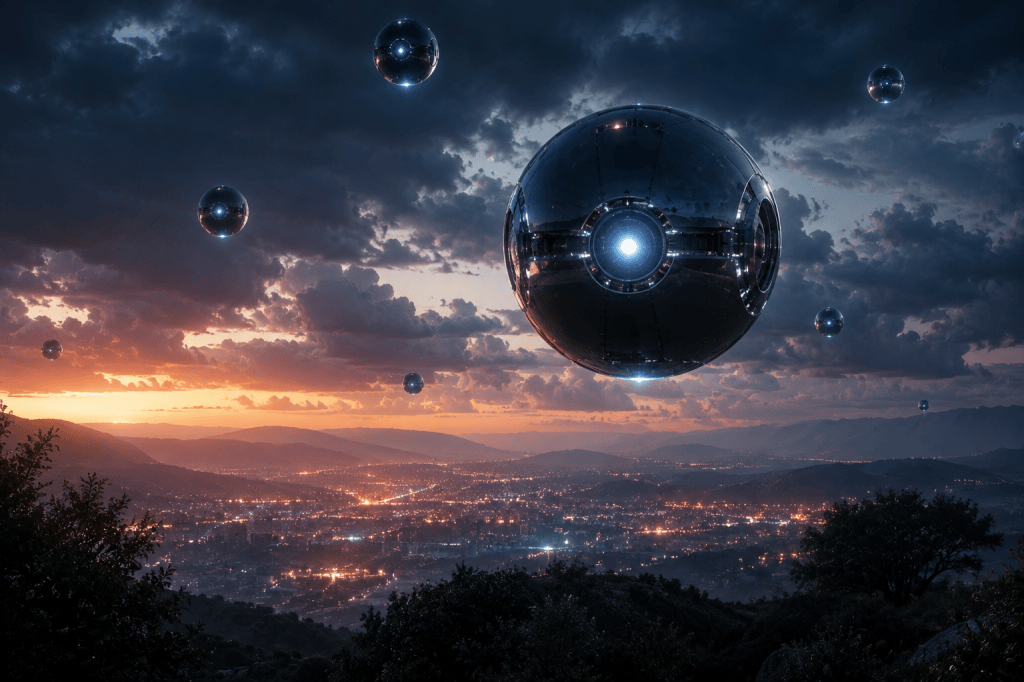
    The Theory of Planetary Guardians One of the most intriguing hypotheses associated with recent UAP discussions comes not from government agencies but from independent British researcher Patrick Jackson. After examining thousands of reports describing small luminous spheres, Jackson proposed a remarkable possibility.

    What if these mysterious objects are not random visitors at all?

    What if they are components of a vast planetary surveillance network? According to his hypothesis, these spheres may operate as an interconnected system, monitoring Earth’s environment while responding to unusual activity.

    Jackson suggests that the apparent consistency of spherical objects reported across decades—and sometimes centuries—may indicate an organized technological network rather than isolated encounters.

    The theory becomes even more provocative when it proposes that whoever created such a network may still maintain it. In this interpretation, the spheres would function less like spacecraft and more like autonomous guardians quietly observing events across the planet. It is a fascinating idea. It is also one for which no direct evidence currently exists. Why Spheres?

    Curiously, spherical objects appear again and again in modern UAP reports. Military pilots have described metallic spheres moving without visible propulsion. Commercial airline crews have reported glowing orbs maintaining impossible trajectories. Radar systems have occasionally tracked small, highly maneuverable objects that appear inconsistent with known aircraft. Even historical accounts sometimes describe luminous globes crossing the sky centuries before modern aviation existed. Spheres possess certain practical advantages if they are technological devices.

    They have no obvious aerodynamic orientation. They distribute structural stress evenly. They can rotate freely in any direction.

    Whether these similarities are meaningful or coincidental remains unknown.

    Harvard’s Hidden Intelligence Hypothesis Adding another layer to the discussion, several researchers affiliated with Harvard University published a speculative paper exploring an idea once considered almost unthinkable. Rather than asking whether intelligent non-human life exists elsewhere in the universe, they asked a different question. Could an advanced non-human intelligence already exist on Earth, remaining largely undetected? The paper explored several hypothetical possibilities, including hidden civilizations, technologically advanced unknown species, or intelligences operating beyond ordinary human perception.

    The authors emphasized that these ideas were speculative thought experiments—not conclusions supported by evidence. Nevertheless, the publication demonstrated something remarkable.

    Questions that were once dismissed outright are now entering serious academic discussion.

    The Official Position Despite growing public interest, official investigations remain cautious.

    The United States Department of Defense, through the All-domain Anomaly Resolution Office (AARO), has investigated hundreds of UAP reports. Some cases remain unresolved because of insufficient data. Others involve sensor limitations or observations that cannot presently be explained. However, official reviews have repeatedly stated that no verified evidence currently demonstrates extraterrestrial technology or confirms the existence of non-human spacecraft operating on Earth. For many observers, this conclusion is unsatisfying.

    An unexplained event is not necessarily an extraordinary one. Yet an unexplained event is also not automatically explained. Science advances precisely by examining such questions rather than ignoring them.

    Between Skepticism and Curiosity

    Perhaps the greatest contribution of researchers like Garry Nolan is not that they provide answers. It is that they encourage better questions. Scientific history is filled with discoveries that were initially dismissed because they challenged accepted understanding. Meteorites were once considered impossible. Continental drift was ridiculed. Ball lightning remained controversial for centuries before careful documentation forced scientists to reconsider. None of these examples prove that UAPs represent non-human technology. They simply remind us that skepticism and curiosity are not opposites. They are partners. Healthy skepticism prevents us from believing every extraordinary claim. Curiosity prevents us from rejecting every extraordinary observation.

    Watching the Sky

    If Patrick Jackson’s planetary defense theory is correct, then humanity may already be living beneath a silent network of watchers whose purpose we have yet to understand. If the theory is incorrect, then the mysterious spheres may eventually prove to be natural phenomena, classified human technology, sensor artifacts, or explanations not yet imagined. At present, no evidence allows us to choose confidently between those possibilities.

    Yet history teaches that the greatest scientific revolutions often begin with observations that refuse to fit comfortably within existing knowledge.

    Perhaps the luminous spheres reported by pilots and military personnel are nothing more than misunderstood objects. Perhaps they represent technologies that will one day be fully explained. Or perhaps they are the first faint indication that humanity has never been as alone as it believed.

    For now, the sky offers no definitive answers. Only questions.

    And sometimes, history begins with a question that seems impossible to ask.

    Fediverse Reactions
  • The Horned Beings of Brazil: Did the Military Capture Something Beyond Human Understanding?

    Some mysteries begin with a whisper.

    Others begin with a scream.

    In January 1996, the quiet Brazilian city of Varginha became the center of one of the most controversial incidents in modern UFO history. Within days, stories spread through the streets of frightened witnesses, mysterious military convoys, strange creatures, and an operation so secretive that many believed the truth had been hidden forever.

    Nearly two decades later, the mystery took an even darker turn.

    In 2014, filmmaker David Vose released a documentary claiming that the creatures reported in Brazil were not extraterrestrials at all. According to the film, they were something far older, far more disturbing, and perhaps deeply connected to humanity’s oldest religious traditions.

    Could the beings described by witnesses have been what ancient civilizations once called demons?

    Or had imagination transformed an already extraordinary story into modern mythology?

    The Day Everything Changed

    On an ordinary afternoon in January 1996, several young women walking through a vacant lot in Varginha claimed they encountered a strange creature unlike anything they had ever seen.

    According to their descriptions, it was approximately five feet tall, with oily brown skin, disproportionately large eyes, and an oversized head. Some witnesses also reported small horn-like protrusions on its head, giving it an appearance that frightened them so deeply that they ran home in panic.

    Within hours, rumors spread across the city.

    Residents reported unusual military activity.

    Army trucks were allegedly seen moving through the streets.

    Some claimed that soldiers had captured an unknown being alive.

    Others insisted that more than one creature had been recovered.

    No official confirmation ever followed.

    Yet the story refused to disappear.

    The Documentary That Changed the Narrative

    Years later, David Vose proposed a far more controversial interpretation.

    His documentary argued that the creatures described in Brazil shared remarkable similarities with ancient descriptions of demonic beings rather than visitors from another planet.

    The alleged creatures were described as possessing:

    • dark, rough skin;
    • glowing red eyes;
    • horn-like structures;
    • an overwhelming sulfur-like odor;
    • unusual physical abilities.

    To supporters of the theory, these details seemed strangely familiar.

    Throughout history, many cultures have described supernatural beings with horns, glowing eyes, and terrifying appearances.

    Was this merely coincidence?

    Or had humanity been describing the same entities for thousands of years under different names?

    Demons… or Visitors?

    One of the documentary’s central arguments is both fascinating and controversial.

    It suggests that ancient people interpreted mysterious encounters according to the language of their own time.

    A medieval monk might have described an unknown entity as a demon.

    A Roman could have called it a spirit.

    An ancient Greek might have believed it was a divine messenger or a creature from the Underworld.

    Today, many people would simply call it an alien.

    Perhaps, the documentary suggests, the phenomenon has remained the same while human interpretations have changed.

    It is an intriguing idea.

    But it remains only a theory.

    The Government Conspiracy

    As with many famous UFO cases, allegations of a military cover-up quickly emerged.

    Witnesses claimed they saw military vehicles transporting unusual containers.

    Others alleged that hospitals suddenly became restricted areas.

    One persistent story even claimed that a soldier involved in handling one of the creatures later died from a mysterious infection.

    These accounts have fueled decades of speculation.

    However, despite countless investigations by journalists, researchers, and UFO enthusiasts, no verifiable evidence has ever confirmed that non-human beings were captured.

    The official explanations ranged from misunderstandings and rumors to misidentified individuals and ordinary military activity.

    For believers, those explanations seem insufficient.

    For skeptics, they remain the most likely answer.

    Why Horns?

    Perhaps the most striking feature of the story is the repeated mention of horn-like structures.

    Across human history, horns have symbolized power, divinity, fertility, fear, and the supernatural.

    Ancient gods wore them.

    Kings placed horned crowns upon their heads.

    Later religious traditions often associated horns with demons.

    Yet biology offers another possibility.

    If such a creature existed, small bony protrusions might simply be part of its anatomy rather than symbols of evil.

    The human mind naturally interprets unfamiliar forms through familiar ideas.

    Sometimes, symbolism speaks louder than reality.

    Between Myth and Memory

    The Varginha incident has become one of the world’s most enduring modern mysteries.

    For some, it represents compelling evidence that governments conceal encounters with non-human intelligences.

    For others, it is a fascinating example of how rumors, fear, media attention, and sincere eyewitness testimony can combine to create a legend.

    The truth may lie somewhere between those extremes.

    History is filled with stories that were dismissed for centuries before new evidence emerged.

    It is equally filled with legends that grew larger every time they were retold.

    The Mystery Remains

    No authenticated photographs of a captured creature have ever surfaced.

    No physical remains have been independently examined.

    No official documents confirm that the Brazilian military recovered a non-human being.

    And yet…

    More than thirty years after the incident, people still travel to Varginha searching for answers.

    The story refuses to disappear because it speaks to something deeper than a simple UFO report.

    It asks an ancient question that humanity has never stopped asking.

    If something truly unknown stood before us…

    Would we recognize it for what it is?

    Or would we simply give it the oldest name we know?

    Perhaps an alien.

    Perhaps a demon.

    Or perhaps something for which human language has never possessed the right words.

    Fediverse Reactions
  • The Lights That Followed the ISS: What Did Astronaut Leroy Chiao Really See?

    There are countless stories of unidentified flying objects reported by ordinary people. Most are dismissed almost as quickly as they appear. Witnesses are questioned, memories are challenged, and explanations—whether convincing or not—are quickly offered.

    But every so often, a story emerges that is far more difficult to ignore.Not because it proves the existence of extraterrestrial life.But because the witness is someone whose profession depends upon observation, discipline, and scientific precision.

    One such witness was Leroy Chiao, a NASA astronaut, engineer, and former commander of the International Space Station.For years, Chiao remained largely silent about one peculiar moment he experienced while orbiting the Earth. When he finally chose to speak publicly, he did so with remarkable restraint. He never claimed to have seen an alien spacecraft. He never described little green men or impossible technology.He simply admitted that he had seen something he could not explain.

    A Routine Mission

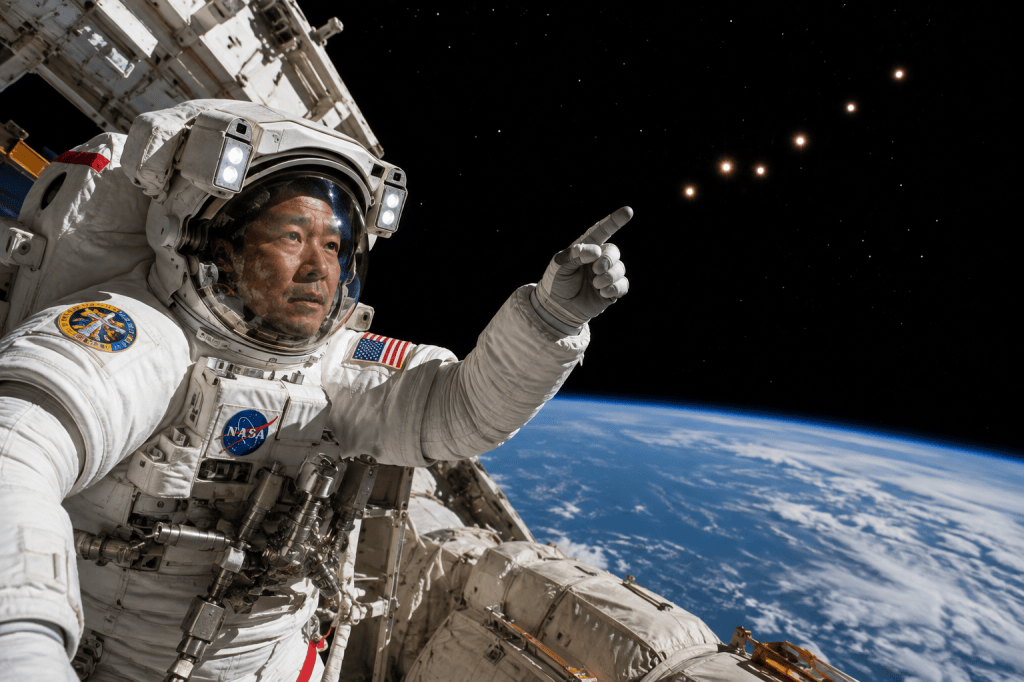
    In 2005, Leroy Chiao was serving as commander of the International Space Station during Expedition 10. Together with Russian cosmonaut Salizhan Sharipov, he was performing a routine spacewalk nearly 370 kilometers above Earth.Outside the station, there is no up or down.Only endless darkness interrupted by the brilliant curve of the Earth below.The station circles the planet at nearly 27,000 kilometers per hour, making every movement deliberate and every observation important.The astronauts were installing navigation antennas when something unusual caught Chiao’s attention.At first, it seemed insignificant.Then he looked again.

    Lights in Formation

    Moving across his field of view were several bright lights.They appeared arranged in an unusual formation, resembling an inverted check mark.Unlike ordinary stars, these lights seemed to move together.For a brief moment, they appeared to travel alongside the station before disappearing into the darkness.The entire event lasted only seconds.Sharipov never saw them.He happened to be looking in another direction.That single detail would later become one of the strongest arguments against the sighting.Without a second witness, the mystery belonged entirely to Chiao.

    The Astronaut’s Response

    Many people expected sensational claims.Instead, Chiao reacted with remarkable caution.He openly admitted that he had no immediate explanation for what he had seen.At the same time, he refused to describe the lights as an alien spacecraft.Unlike many stories surrounding unidentified aerial phenomena, Chiao consistently emphasized that not understanding something does not automatically make it extraterrestrial.His honesty made the account even more intriguing.He wasn’t trying to convince anyone.He was simply describing an experience.

    A Possible Explanation

    Years later, Chiao discussed what he believed was the most likely answer.The lights may have belonged to a fleet of fishing boats hundreds of kilometers below the International Space Station.At first, the idea sounds almost absurd.How could fishing boats be visible from space?The answer lies in the extraordinary conditions of orbit.Powerful fishing vessels often use extremely bright lamps to attract marine life during nighttime operations.

    Under certain angles, especially when viewed against the darkness of space, these lights can appear surprisingly bright.Combined with the immense speed of the station and the unusual perspective outside Earth’s atmosphere, several separate lights might easily create the illusion of a single moving formation.It is a perfectly reasonable explanation.But it also relies on assumptions.No one can prove that those particular lights belonged to fishing boats.

    No photographs exist.No video recorded the event.

    Only Chiao’s memory remains.

    Space Is Stranger Than We Imagine

    Contrary to popular belief, astronauts occasionally report seeing unusual visual phenomena.Most are eventually explained.Tiny particles drifting near spacecraft.Ice crystals reflecting sunlight.Space debris.Optical illusions created by changing angles of light.Even so, space is an environment unlike anything humans experience on Earth.Without atmosphere, familiar visual cues disappear.Distances become almost impossible to judge.Objects can appear enormous or tiny depending on lighting conditions.What seems impossible may turn out to have a perfectly ordinary explanation.Or perhaps not.

    Between Curiosity and Certainty

    Leroy Chiao has repeatedly stated that he remains skeptical of extraordinary claims.He believes intelligent life almost certainly exists somewhere in the vast universe.Yet he sees no convincing evidence that Earth is regularly visited by extraterrestrial spacecraft.His own experience did not change that position.Instead, it reminded him—and perhaps all of us—that mystery should never be confused with proof.There is a profound difference between saying, “I don’t know what I saw,” and declaring, “I know it was alien.”Too often, that distinction is forgotten.

    The Darkness Beyond Earth

    Every night, the International Space Station circles our planet sixteen times.Its astronauts witness sunsets every ninety minutes.They observe lightning storms stretching across continents, glowing auroras dancing over the poles, and cities sparkling like constellations beneath them.Occasionally, something appears that refuses to fit neatly into any category.Perhaps it is an optical illusion.Perhaps it is a natural phenomenon not yet fully understood.Perhaps it is simply a reminder that even in an age of satellites and space stations, the universe still has the power to surprise us.

    As for the lights Leroy Chiao saw on that quiet spacewalk in 2005, they remain suspended somewhere between explanation and mystery.Not because they prove that we are not alone…

    But because they remind us that even the most experienced observers can sometimes look into the darkness and find themselves asking the oldest question of all:

    What did I just see?

    Fediverse Reactions