There are countless stories of unidentified flying objects reported by ordinary people. Most are dismissed almost as quickly as they appear. Witnesses are questioned, memories are challenged, and explanations—whether convincing or not—are quickly offered.
But every so often, a story emerges that is far more difficult to ignore.Not because it proves the existence of extraterrestrial life.But because the witness is someone whose profession depends upon observation, discipline, and scientific precision.
One such witness was Leroy Chiao, a NASA astronaut, engineer, and former commander of the International Space Station.For years, Chiao remained largely silent about one peculiar moment he experienced while orbiting the Earth. When he finally chose to speak publicly, he did so with remarkable restraint. He never claimed to have seen an alien spacecraft. He never described little green men or impossible technology.He simply admitted that he had seen something he could not explain.
A Routine Mission
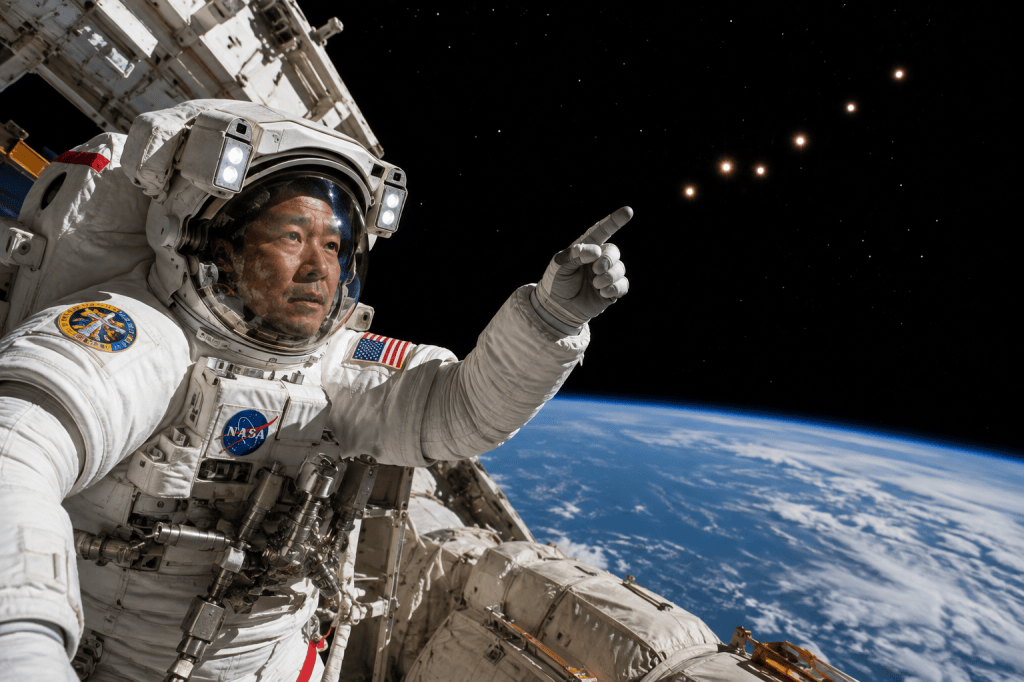
In 2005, Leroy Chiao was serving as commander of the International Space Station during Expedition 10. Together with Russian cosmonaut Salizhan Sharipov, he was performing a routine spacewalk nearly 370 kilometers above Earth.Outside the station, there is no up or down.Only endless darkness interrupted by the brilliant curve of the Earth below.The station circles the planet at nearly 27,000 kilometers per hour, making every movement deliberate and every observation important.The astronauts were installing navigation antennas when something unusual caught Chiao’s attention.At first, it seemed insignificant.Then he looked again.
Lights in Formation
Moving across his field of view were several bright lights.They appeared arranged in an unusual formation, resembling an inverted check mark.Unlike ordinary stars, these lights seemed to move together.For a brief moment, they appeared to travel alongside the station before disappearing into the darkness.The entire event lasted only seconds.Sharipov never saw them.He happened to be looking in another direction.That single detail would later become one of the strongest arguments against the sighting.Without a second witness, the mystery belonged entirely to Chiao.
The Astronaut’s Response
Many people expected sensational claims.Instead, Chiao reacted with remarkable caution.He openly admitted that he had no immediate explanation for what he had seen.At the same time, he refused to describe the lights as an alien spacecraft.Unlike many stories surrounding unidentified aerial phenomena, Chiao consistently emphasized that not understanding something does not automatically make it extraterrestrial.His honesty made the account even more intriguing.He wasn’t trying to convince anyone.He was simply describing an experience.
A Possible Explanation
Years later, Chiao discussed what he believed was the most likely answer.The lights may have belonged to a fleet of fishing boats hundreds of kilometers below the International Space Station.At first, the idea sounds almost absurd.How could fishing boats be visible from space?The answer lies in the extraordinary conditions of orbit.Powerful fishing vessels often use extremely bright lamps to attract marine life during nighttime operations.
Under certain angles, especially when viewed against the darkness of space, these lights can appear surprisingly bright.Combined with the immense speed of the station and the unusual perspective outside Earth’s atmosphere, several separate lights might easily create the illusion of a single moving formation.It is a perfectly reasonable explanation.But it also relies on assumptions.No one can prove that those particular lights belonged to fishing boats.
No photographs exist.No video recorded the event.
Only Chiao’s memory remains.
Space Is Stranger Than We Imagine
Contrary to popular belief, astronauts occasionally report seeing unusual visual phenomena.Most are eventually explained.Tiny particles drifting near spacecraft.Ice crystals reflecting sunlight.Space debris.Optical illusions created by changing angles of light.Even so, space is an environment unlike anything humans experience on Earth.Without atmosphere, familiar visual cues disappear.Distances become almost impossible to judge.Objects can appear enormous or tiny depending on lighting conditions.What seems impossible may turn out to have a perfectly ordinary explanation.Or perhaps not.
Between Curiosity and Certainty
Leroy Chiao has repeatedly stated that he remains skeptical of extraordinary claims.He believes intelligent life almost certainly exists somewhere in the vast universe.Yet he sees no convincing evidence that Earth is regularly visited by extraterrestrial spacecraft.His own experience did not change that position.Instead, it reminded him—and perhaps all of us—that mystery should never be confused with proof.There is a profound difference between saying, “I don’t know what I saw,” and declaring, “I know it was alien.”Too often, that distinction is forgotten.
The Darkness Beyond Earth
Every night, the International Space Station circles our planet sixteen times.Its astronauts witness sunsets every ninety minutes.They observe lightning storms stretching across continents, glowing auroras dancing over the poles, and cities sparkling like constellations beneath them.Occasionally, something appears that refuses to fit neatly into any category.Perhaps it is an optical illusion.Perhaps it is a natural phenomenon not yet fully understood.Perhaps it is simply a reminder that even in an age of satellites and space stations, the universe still has the power to surprise us.
As for the lights Leroy Chiao saw on that quiet spacewalk in 2005, they remain suspended somewhere between explanation and mystery.Not because they prove that we are not alone…
But because they remind us that even the most experienced observers can sometimes look into the darkness and find themselves asking the oldest question of all:
What did I just see?


Leave a comment