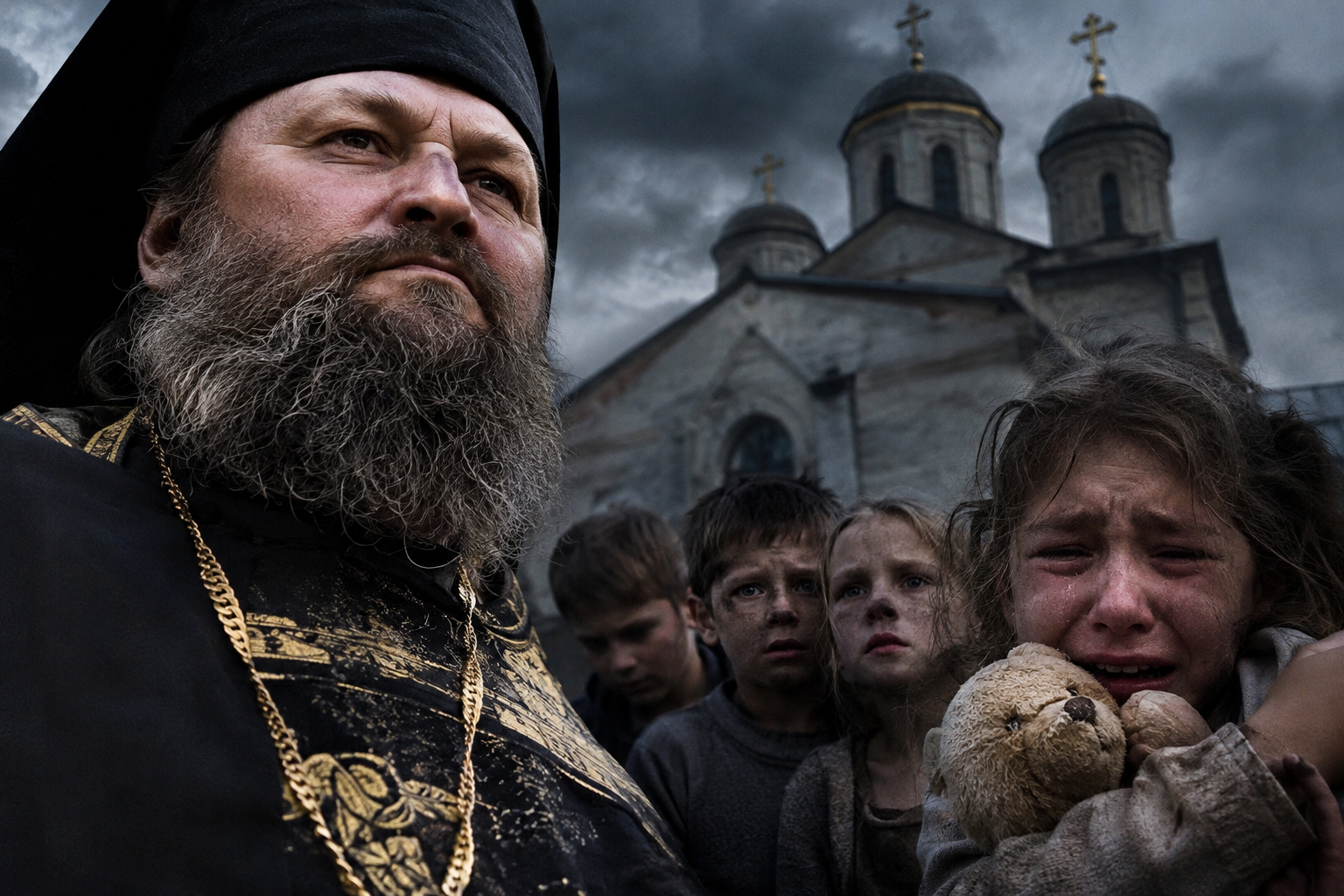
In a remote Russian town, an Orthodox priest became a national symbol of compassion, earning prestigious honors for raising abandoned children. Behind that celebrated image, however, a criminal investigation uncovered a disturbing history of abuse. The story of Nikolai Stremsky raises a question far more unsettling than the crimes themselves: how does a society learn to trust someone so completely that it almost forgets to question him?
There are certain stories that disturb me not simply because of the cruelty they reveal, but because of the extraordinary care with which that cruelty can remain concealed beneath an appearance of goodness. I have always found the relationship between power and public admiration fascinating, particularly when an individual becomes so closely associated with morality that questioning his behavior begins to feel almost like questioning morality itself.
The story of Nikolai Stremsky, a Russian Orthodox priest who became famous for raising dozens of abandoned children, belongs to this troubling category of human history.
For years, his name was associated with charity, religious devotion, and one of the largest families in Russia. Newspapers celebrated his extraordinary household, religious authorities recognized his work, and the Russian state awarded him the Order of Parental Glory, a prestigious distinction intended to honor exceptional contributions to family life.
Yet on December 24, 2021, the Saraktash District Court in Russia’s Orenburg region sentenced this same man to 21 years in a strict-regime penal colony for serious offenses against children, including rape and other forms of sexual violence.
When I began looking more closely at the reports surrounding this case, I found myself returning to a question that reaches far beyond Saraktash. How many times throughout history have people mistaken an impressive public reputation for evidence of private virtue?
What makes this case especially disturbing is that Stremsky did not build his reputation through secrecy. His family was publicly celebrated, his religious institution was known to the community, and his work with children had attracted attention for decades.
The danger was not hidden in some forgotten underground organization. It existed within an institution that many people believed represented safety, compassion, and moral authority.
A Russian Town, a Religious Revival, and the Making of a National Hero
Saraktash is a settlement in Russia’s Orenburg region, not far from the border with Kazakhstan. Its geographical position places it within a historically fascinating frontier, where Russian settlement, steppe traditions, Orthodox Christianity, and the cultures of Central Asia have intersected for generations.
The broader Orenburg region developed as an important frontier territory of the Russian Empire during the eighteenth century, serving military, commercial, and administrative purposes along routes connecting European Russia with the Kazakh steppe and Central Asia.
This historical background matters because Saraktash was not an isolated religious world detached from Russian society. Its institutions were shaped by the same political and social transformations that affected the rest of the country.
When the Soviet Union collapsed in 1991, Russia entered a period of profound economic instability. Families struggled with poverty, unemployment, alcoholism, and the breakdown of familiar social structures. The difficulties facing children without adequate parental care became one of the most painful aspects of this transition.
At the same time, the Russian Orthodox Church was experiencing a remarkable public revival after decades of restrictions under Soviet rule. Religious buildings were restored, monasteries reopened, and priests began recovering a social influence that had been severely limited during much of the twentieth century.
It was within this atmosphere that Nikolai Stremsky and his wife, Galina, began taking children into their family during the early 1990s.
Their work became associated with the Holy Trinity Simeon Monastery of Mercy in Saraktash, an Orthodox charitable complex that also developed educational and community activities.
To the outside world, the story seemed extraordinary. A priest and his wife were providing a home for children who had experienced abandonment, institutional care, or difficult family circumstances.
The number of children associated with their household eventually became central to Stremsky’s public identity. Reports frequently described him as the father of approximately 70 adopted or foster children, although the precise distinction between formal adoptions, guardianship arrangements, and children raised within the wider institution was not always made clear.
That distinction is more important than it might initially appear. A large charitable household is not necessarily the same thing as a family in the legal sense, and the responsibilities of adults caring for vulnerable children depend on the arrangements under which those children have been placed.
What interested me most was how quickly the number itself became a symbol. Seventy children represented generosity on a scale that seemed almost impossible to imagine, and the public narrative increasingly centered on the remarkable adult who had taken them in.
But the greater the admiration directed toward the father, the easier it became for the individual experiences of the children to disappear behind his reputation.
The Medal That Made a Reputation Almost Untouchable
One of the less-discussed aspects of this story is the importance of public recognition in establishing Stremsky’s authority.
In 2006, Nikolai Stremsky and his wife were photographed receiving a Golden Heart award in recognition of their work raising children. Later, Stremsky received Russia’s Order of Parental Glory, a state decoration associated with the upbringing of large families.
The Order of Parental Glory is not simply a symbolic religious honor. It belongs to the Russian state awards system and is intended to recognize parents whose family life is presented as an example of responsible upbringing and commitment to children.
In other words, Stremsky’s reputation was reinforced by two powerful sources of legitimacy: religion and the state.
I find this combination particularly significant because both institutions carry forms of authority that can influence how ordinary people interpret evidence.
A respected priest may be trusted because he represents spiritual guidance. A decorated citizen may be trusted because the state has publicly recognized his achievements. When the same individual possesses both forms of prestige, the psychological barrier to questioning him can become unusually strong.
This does not mean that religious authority or state honors automatically create abuse. It means that public recognition can sometimes discourage the scrutiny that every institution responsible for vulnerable people requires.
A medal may celebrate a person’s achievements, but it cannot reveal everything that happens behind closed doors.
That is the contradiction at the heart of Saraktash. The very qualities that made Stremsky appear trustworthy also helped create an image that was extraordinarily difficult to challenge.
September 2019: When the Public Story Began to Collapse
In September 2019, Russian authorities arrested Nikolai Stremsky following allegations of serious crimes against children in his care.
The investigation eventually examined offenses allegedly committed over a period extending from 1999 to 2019, a span of approximately twenty years.
According to reporting based on statements from Russia’s Investigative Committee, the accusations included rape, sexual assault, indecent acts involving minors, cruel treatment, and failures to fulfill responsibilities toward children. Investigators also accused Stremsky of involving minors in alcohol consumption and of offenses involving specialized equipment intended for covert information gathering.
The investigation referred to eleven minors in connection with alleged sexual offenses, while subsequent reporting identified seven children as formally recognized victims in the criminal proceedings.
These numbers should not be confused. The number of children mentioned in an investigation, the number formally recognized as victims, and the number of specific criminal acts are different legal categories.
I consider this distinction essential, especially in cases involving children, because exaggerating or combining figures may make a story sound more dramatic while actually weakening its credibility.
At the time of Stremsky’s arrest, authorities removed nine children from his household, according to Russian reporting. Eight were under guardianship arrangements and one had been adopted. He subsequently lost his guardianship rights.
For a man whose public identity had been built around caring for children, the significance of that intervention was enormous.
The institution that had once symbolized protection had become the subject of a criminal investigation into the treatment of the very people it was supposed to protect.
Stremsky denied the allegations, describing them as slander. His denial became part of the public controversy surrounding the case, but the subsequent judicial proceedings resulted in his conviction.
There is something deeply unsettling about the chronology. The alleged offenses investigated by authorities stretched across two decades, during which his reputation as a devoted father continued to grow.
It is tempting to explain this contradiction through a simple theory of institutional protection or deliberate complicity. Yet the publicly accessible reporting does not establish that every official, religious figure, or supporter knew about the abuse.
What it does establish is that the existence of a celebrated public image did not prevent serious crimes from being committed against children.
That fact alone deserves serious reflection.
The Other Adults: A Detail That Changes the Story
One of the most revealing aspects of the Saraktash case concerns the involvement of other adults connected to Stremsky’s household.
Reports from BBC News and Radio Free Europe/Radio Liberty describe how one of his adult adopted daughters and her husband received suspended sentences for unlawfully restricting children’s freedom.
This detail is significant because it shows that the criminal proceedings extended beyond accusations against a single priest.
The case also raised questions about the treatment of children within the broader household and the extent to which adults responsible for their welfare respected their freedom and dignity.
However, I believe it is important to resist turning every reported allegation into a cinematic scene. Some accounts circulating online describe underground prisons, elaborate surveillance networks, and carefully organized rituals of psychological torture.
The verified reporting establishes serious crimes and accusations involving unlawful confinement, but it does not independently substantiate every sensational detail attached to the story.
The distinction matters because real victims do not need invented horrors to make their experiences worthy of attention.
The crimes established by the court are disturbing enough without embellishment.
The Psychology of Obedience: Why Authority Can Silence Doubt
What makes the Saraktash case relevant beyond Russia is the psychological question it raises about authority.
In 1963, psychologist Stanley Milgram published his famous research on obedience, demonstrating how the presence of an apparently legitimate authority figure could influence people to perform actions that conflicted with their personal judgment.
Milgram’s experiments have been debated extensively, both ethically and scientifically, and they cannot explain the behavior of every person involved in a modern criminal case. Nevertheless, they helped establish an important question within social psychology: how does perceived legitimacy affect our willingness to challenge authority?
Later research on institutional abuse, coercive control, and the psychology of betrayal has explored how dependence on powerful individuals or organizations can complicate the recognition and disclosure of harmful experiences.
Psychologist Jennifer Freyd’s work on betrayal trauma is especially relevant here. Her research examines how abuse involving a trusted or depended-upon person can create profound conflicts for victims, particularly when acknowledging the betrayal threatens an important relationship or source of security.
I cannot claim to know the private psychological experiences of the children involved in Saraktash. Those experiences belong to them, and public reporting provides only a limited understanding of their lives.
But the wider research offers a useful framework for understanding why abuse within trusted institutions can be difficult to expose.
A child dependent on an adult for food, shelter, affection, education, and social belonging is not negotiating from a position of equality. When that adult also possesses religious or institutional authority, the imbalance becomes even more pronounced.
The question is therefore not simply why a child might remain silent, but whether the surrounding environment provides a genuinely safe opportunity to speak and be believed.
This is where I think the public fascination with supposedly saintly figures can become dangerous. The more completely a community identifies goodness with one individual, the more difficult it may become to recognize evidence that contradicts that belief.
December 2021: The Judgment That Destroyed a Public Myth
On December 24, 2021, the Saraktash District Court sentenced Nikolai Stremsky to 21 years in a strict-regime penal colony.
The prosecution had reportedly requested a sentence of 24 years.
The court also imposed restrictions on his freedom following imprisonment, prohibited him from working with children for twenty years, and stripped him of the Order of Parental Glory.
The proceedings were held behind closed doors, a significant consideration in a case involving sexual crimes against minors. Public access to the complete evidentiary record was therefore limited, and detailed claims about particular testimony or forensic findings should not be presented as established unless supported by reliable documentation.
By the time of his conviction, Stremsky had also been removed from the priesthood.
In July 2022, the Orenburg Regional Court considered his appeal and upheld the prison sentence.
There is a powerful historical irony in the removal of his state decoration. The same public system that had once recognized him as an exemplary parent eventually withdrew that recognition following a criminal conviction for crimes against children.
Yet the symbolic reversal cannot undo the experiences of those harmed.
A medal can be removed from an official record, and a sentence can establish legal responsibility, but neither action automatically restores the trust, security, or childhood that victims may have lost.
The Most Disturbing Question Is Not About Religion
Whenever a case like this becomes public, discussions often turn toward religion itself. Some interpret the crimes as proof of the dangers of religious institutions, while others insist that the actions of an individual should never be confused with the beliefs of an entire community.
I think both reactions can distract from the more precise question raised by the evidence.
The central issue is not whether faith is inherently good or bad, but what happens when moral authority becomes so concentrated in one person that ordinary safeguards begin to seem unnecessary.
Religious institutions are not alone in facing this danger. Schools, charitable organizations, residential care facilities, political movements, and even families can develop cultures in which reputation is protected more aggressively than vulnerable individuals.
History offers repeated examples of admired figures whose public image concealed serious wrongdoing. The lesson is not that every respected person should be regarded with suspicion, but that admiration must never replace accountability.
The philosopher Hannah Arendt explored the relationship between authority, responsibility, and the human tendency to surrender independent judgment within powerful systems. Her work does not provide a direct explanation of Saraktash, but it offers a useful reminder that moral responsibility cannot simply be transferred to institutions or prestigious individuals.
For me, this is one of the most important questions raised by the case. At what point does respect for an authority figure become an unwillingness to examine his actions?
And how can institutions create conditions in which children are heard even when their testimony threatens the reputation of someone powerful?
What Saraktash Reveals About the Stories We Want to Believe
The longer I reflect on this case, the more I realize that its deepest mystery is not the existence of cruelty. Human history has never lacked examples of individuals capable of harming others while presenting themselves as respectable members of society.
The more difficult mystery is our willingness to construct reassuring stories around people we admire.
Stremsky’s public image offered a comforting narrative: an Orthodox priest rescuing abandoned children, rebuilding family life, and embodying charity during a period of social upheaval.
It was a story people wanted to believe, partly because it seemed to demonstrate that goodness could survive even in difficult circumstances.
And that desire was understandable.
What troubles me is how easily a beautiful story can become a substitute for independent scrutiny. When admiration grows strong enough, uncomfortable questions may begin to look like acts of hostility rather than necessary precautions.
The case also reminds me that the number of children in someone’s care should never become more important than the conditions in which those children live.
Seventy children may make an impressive headline, but the true measure of an institution’s success lies in whether each child is safe, respected, listened to, and able to seek help without fear.
The criminal proceedings in Saraktash established that the celebrated reputation of its most prominent religious figure concealed a reality profoundly different from the image presented to the public.
That contradiction is the reason this story deserves to be remembered.
Not because it proves that every charitable institution hides something sinister, and certainly not because the suffering of children should become entertainment, but because it reveals the consequences of confusing moral prestige with moral accountability.
When I think about Saraktash, I do not see only the downfall of a famous priest. I see a warning about the human need to believe in heroes, the fragility of trust, and the responsibility we have to question even the most reassuring appearances.
Perhaps the most frightening deception is not the lie that nobody believes, but the one that becomes so comforting that nobody wants to investigate it.
And sometimes, the most important question we can ask is not whether a person appears to be good, but whether those who depend on that person are genuinely safe.
Sources and Further Reading
The following sources document the criminal proceedings, the history of Stremsky’s household, and the psychological concepts discussed in this article.
BBC News — December 24, 2021
Russian priest who adopted 70 children jailed for abuse
https://www.bbc.com/news/world-europe-59779376
Radio Free Europe/Radio Liberty — December 24, 2021
Священник Стремский приговорён к 21 году колонии за насилие над детьми
https://www.svoboda.org/a/svyaschennik-stremskiy-prigovoryon-k-21-godu-kolonii-za-nasilie-nad-detjmi/31624053.html
RBC Russia — December 24, 2021
Обвиненному в педофилии оренбургскому священнику дали 21 год колонии
https://www.rbc.ru/society/24/12/2021/61c563d39a79473b315d622a
1743.ru — September 9, 2020
СК: Николай Стремский совершал преступления против половой неприкосновенности в течение 20 лет
https://poleznygorod.1743.ru/news/40055
Orenday — July 18, 2022
21 год тюрьмы: приговор священнику Николаю Стремскому вступил в законную силу
https://orenday.ru/news/180722094713
Stanley Milgram — 1963
Behavioral Study of Obedience. Journal of Abnormal and Social Psychology, 67(4), 371–378.
DOI: 10.1037/h0040525
Jennifer J. Freyd — 1996
Betrayal Trauma: The Logic of Forgetting Childhood Abuse. Harvard University Press.
Hannah Arendt — 1963
Eichmann in Jerusalem: A Report on the Banality of Evil. Viking Press.
Editorial note: This article distinguishes between documented court findings, allegations reported during the investigation, and the author’s interpretation of the wider social and psychological issues. Graphic details circulating online that could not be independently corroborated have been excluded.
Whisper Mysteries — Exploring the truths hidden behind familiar stories.