Category: Occult Relics

  • Yaldabaoth and the Soul Trap: What the Ancient Gnostics Really Said — and What the Modern Matrix Theory Added

    What if the most disturbing version of the Matrix was imagined almost two thousand years before computers existed?

    Long before simulation theory, artificial intelligence, virtual reality or the language of digital prisons entered human culture, several ancient religious movements were already telling a remarkably unsettling story: the visible universe was not necessarily the work of the highest God, human beings carried within themselves something that did not truly belong to this world, and powerful cosmic rulers stood between the imprisoned divine spark and the realm from which it had originally descended.

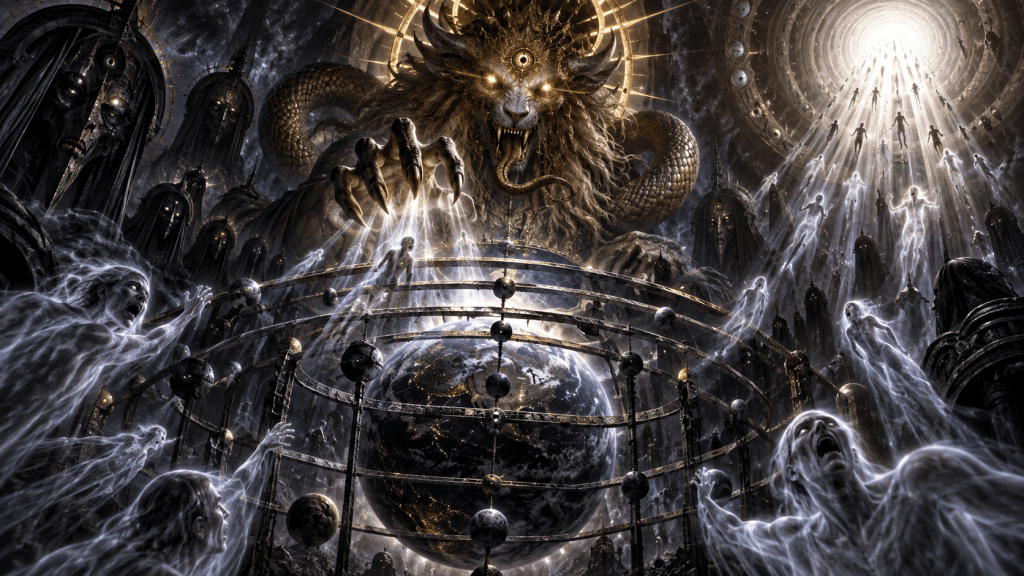
    Those rulers were called the Archons, and presiding over their imperfect cosmos was an extraordinary figure known as Yaldabaoth, also called Saklas and Samael, a creator who believed himself to be supreme precisely because he was ignorant of everything existing above him.

    Almost seventeen centuries later, an entirely new mythology has begun to grow around those ancient ideas, combining Gnostic cosmology with near-death experiences, reincarnation, the Van Allen radiation belts, Saturn, the Moon, electromagnetic frequencies and the mysterious concept known as Loosh. According to this modern theory, Earth is not merely a difficult world but part of an enormous reincarnation mechanism in which consciousness is repeatedly returned to physical existence after death.

    The resemblance between these two systems is fascinating.

    The problem is that they are not the same system.

    To understand where ancient Gnosticism ends and the modern “soul trap” begins, we have to go back to texts buried for centuries beneath the Egyptian desert and ask a much more disturbing question: what did the Gnostics actually believe was waiting above the visible world?

    The God Who Did Not Know There Was a God Above Him

    Among the manuscripts discovered near Nag Hammadi in Upper Egypt in 1945 was a collection of texts containing radically different interpretations of creation, salvation and the nature of humanity. One of the most important is the Apocryphon of John, sometimes called the Secret Book of John, a work that presents creation almost as a cosmic catastrophe.

    At the highest level of reality exists the divine fullness, usually described in Gnostic language as the Pleroma, a realm beyond ordinary matter and limitation. From this transcendent divine reality emerge spiritual powers known as Aeons, among them Sophia, whose name means Wisdom.

    Then something goes wrong.

    Sophia produces a being outside the proper harmony of the divine realm, and that being becomes Yaldabaoth. Unaware of the higher world from which his power ultimately derives, Yaldabaoth begins creating his own realm and generating subordinate rulers.

    The Apocryphon of John describes him as establishing seven kings over seven heavens, while other authorities rule additional regions beneath them. The text gives Yaldabaoth three names — Yaldabaoth, Saklas and Samael — and depicts him declaring himself to be the only God because he does not know the true source of his own power.

    This is one of the most radical theological reversals surviving from antiquity.

    The creator of the material cosmos is not necessarily evil in the simple sense of a demonic villain plotting in darkness; what makes him dangerous is his ignorance, combined with enormous power. He mistakes a lower realm for total reality and mistakes himself for the supreme principle of existence.

    Another Nag Hammadi text, The Hypostasis of the Archons, or The Reality of the Rulers, develops a similar image, calling the chief ruler blind and associating him with Samael, traditionally interpreted as the “god of the blind.”

    From a modern perspective, the idea sounds almost unnervingly familiar: imagine an intelligence capable of constructing an entire world while remaining incapable of perceiving the reality above its own system.

    Whether interpreted religiously, symbolically or philosophically, Yaldabaoth resembles the ultimate administrator of a closed reality who has forgotten that he, too, belongs to something larger.

    The Divine Spark Hidden Inside the Human Being

    Gnostic mythology becomes even stranger when humanity enters the story, because human beings are not presented merely as creatures belonging completely to the world constructed by the Archons.

    Within humanity exists something higher.

    Different Gnostic schools described this inner element in different ways, but the central image is that a fragment, spark or element of the divine realm has somehow become embedded within material existence. The human problem therefore becomes more profound than sin in the ordinary moral sense; the problem is forgetfulness, because the spiritual element within the human being no longer remembers where it came from.

    Salvation, consequently, requires more than obedience.

    It requires Gnosis.

    Gnosis does not simply mean accumulating secret facts, but awakening to the true nature of oneself, of the cosmos and of the powers claiming authority over it. From this perspective, ignorance is the prison, while knowledge becomes the beginning of escape.

    This explains why many Gnostic narratives contain strange images of awakening, recognition and remembering one’s origin. The human being who discovers that the material order is not ultimate also discovers that the rulers of that order may not possess ultimate authority.

    It is here that modern Matrix comparisons become difficult to resist.

    A prisoner who does not know that he is imprisoned does not search for an exit, while a consciousness that believes the visible world is the whole of reality will never ask what might exist beyond it.

    The Seven Heavens and the Cosmic Gatekeepers

    One of the strongest connections between genuine Gnosticism and the modern soul-trap theory is the ancient idea that the cosmos consisted of successive heavenly regions associated with ruling powers.

    The Apocryphon of John explicitly speaks of seven rulers assigned to seven heavenly spheres.

    This idea did not emerge in a vacuum, because ancient Mediterranean cosmology commonly imagined a layered universe associated with the visible celestial bodies, and religious traditions frequently transformed these astronomical layers into spiritual territories.

    For certain Gnostic groups, however, these were not merely beautiful heavens through which a blessed soul floated effortlessly upward. They could represent domains of authority through which the ascending soul had to pass.

    Later Gnostic works, including traditions preserved in the Pistis Sophia and related texts, describe elaborate cosmic hierarchies filled with rulers, emanations, mysteries and regions of light. The Pistis Sophia, preserved separately from the Nag Hammadi collection in the Askew Codex, repeatedly describes the ascent through cosmic regions and the mysteries connected with higher realms.

    Some late Gnostic and related initiatory traditions went even further, associating spiritual ascent with names, seals, formulas and precise knowledge that permitted passage through hostile or restricted regions.

    For a modern reader, these texts can sound surprisingly like descriptions of checkpoints.

    That resemblance has helped generate one of the most persistent contemporary interpretations: the idea that ancient descriptions of celestial gates were actually coded references to a mechanism designed to recycle souls.

    Yet the ancient texts never mention satellites, radiation belts, electromagnetic grids or planetary technology.

    Those elements arrived much later.

    From Seven Gnostic Spheres to the Van Allen Belts

    The modern soul-trap theory makes a dramatic leap by identifying ancient celestial barriers with the Van Allen radiation belts, two major regions of energetic charged particles surrounding Earth.

    The comparison is visually powerful. The belts form enormous toroidal regions around the planet, and if someone approaches ancient cosmological diagrams already believing Earth is enclosed within an energetic prison, the resemblance can appear almost irresistible.

    However, the historical chronology creates an immediate problem.

    The Van Allen belts were discovered in 1958, roughly seventeen centuries after the principal Gnostic texts were composed. NASA describes them as regions of high-energy charged particles trapped by Earth’s magnetic environment, with an inner and outer radiation belt surrounding the planet.

    They are therefore real.

    What is not established is the claim that they interact with souls.

    There is currently no scientific evidence that consciousness after death possesses electrical charge, measurable electromagnetic mass or any known physical property that would allow it to become trapped by Earth’s magnetic field. Equally important, the belts are not an impenetrable wall surrounding the planet; spacecraft travel through them, and NASA notes that Apollo 8 became the first crewed spacecraft to travel beyond the Van Allen belts in 1968.

    This does not make the symbolic comparison meaningless.

    It simply changes what the comparison represents.

    Ancient Gnostic spheres were metaphysical structures within a religious cosmology, while the Van Allen belts are measurable regions of plasma physics. Connecting the two may create an intriguing modern mythology, but it should not be mistaken for an ancient teaching secretly anticipating twentieth-century space science.

    The White Light: Gateway to the Beyond or Entrance to the Loop?

    Perhaps no part of the modern theory is more disturbing than the reinterpretation of the light reported during near-death experiences.

    Accounts from people who have come close to death sometimes include sensations of leaving the body, entering darkness or a tunnel, encountering intense light, meeting deceased relatives or apparently spiritual beings, experiencing unusual peace and reviewing episodes from one’s life. These features appear repeatedly in the scientific literature examining near-death experiences, although not every person reports the same sequence and no single element appears universally.

    The modern Archon theory reverses the usual interpretation.

    Instead of seeing the light as a destination of peace, divine presence or neurological phenomenon, some soul-trap believers describe it as a lure, an artificial mechanism supposedly designed to attract consciousness immediately after death.

    In this interpretation, deceased relatives, religious figures or benevolent guides might themselves be projections intended to persuade the disoriented individual to consent to another incarnation. The frequently reported life review is then transformed from a moment of understanding into a psychological interrogation during which guilt, regret and attachment supposedly convince the soul that it must return to Earth in order to correct previous mistakes.

    It is an extraordinarily powerful narrative because it takes familiar spiritual symbols and reverses their meaning.

    Love becomes bait.

    Judgment becomes manipulation.

    Reincarnation becomes imprisonment.

    Yet this interpretation does not come from the Nag Hammadi manuscripts, nor has science demonstrated that NDE lights are external machines or that post-mortem consciousness is being redirected toward reincarnation.

    Research confirms that people report such experiences; it does not establish the modern explanation attached to them.

    Did the Gnostics Really Possess Passwords for the Afterlife?

    One of the most fascinating claims surrounding the soul-trap theory concerns secret names and formulas supposedly used to bypass Archonic guardians.

    Here the modern story contains a genuine ancient echo.

    Late antique religious traditions did sometimes assign enormous importance to sacred names, seals, symbols and mysteries, and certain Gnostic texts contain elaborate maps of spiritual hierarchy that would be nearly incomprehensible without initiation into the system behind them.

    The Pistis Sophia repeatedly speaks of mysteries, regions and powers connected with ascent toward higher light, while related Gnostic literature develops intricate systems through which initiates symbolically demonstrate their spiritual identity and knowledge.

    What should not be done, however, is to take every modern phrase circulating online and label it a quotation from Nag Hammadi.

    Statements such as “I come from the Pre-Existent One and return to the place from which I came” may resemble Gnostic theology, because they express the fundamental motif of remembering one’s divine origin, but modern versions often circulate without a precise ancient manuscript, tractate, chapter or translation attached to them.

    The deeper Gnostic principle is actually more interesting than a magical password.

    The soul escapes because it knows what it is.

    If the Archons rule through ignorance, then the moment of liberation occurs when their authority is recognized as limited.

    The ultimate password would therefore not be a sequence of syllables.

    It would be awakening.

    Saturn, the Moon and the Alleged Cosmic Broadcast

    Modern versions of the theory often expand the Matrix far beyond Earth, presenting Saturn as a gigantic generator and the Moon as a relay station that supposedly broadcasts frequencies maintaining human consciousness within a narrow perceptual spectrum.

    Saturn is particularly attractive to occult interpretation because its mythological counterpart, Cronus or Kronos, has long been associated symbolically with time, limitation, age and restriction, while the enormous ring system gives the planet an appearance unlike anything else visible in the Solar System.

    From symbolism, however, the modern theory moves into technology.

    Saturn’s rings are sometimes described online as artificial transmitters, while the Moon is described as an amplification station projecting the signal toward Earth.

    There is no observational evidence supporting this mechanism.

    Cassini spent more than a decade studying Saturn and its rings at close range, measuring their structure, composition and interactions with Saturn’s moons. NASA describes the main rings as overwhelmingly composed of enormous numbers of pieces of water ice ranging from tiny particles to extremely large fragments, while some ring material is continually supplied or redistributed through interactions with moons such as Enceladus.

    The idea that the Moon is hollow encounters an equally substantial problem.

    Apollo seismic experiments recorded moonquakes, impacts and the propagation of seismic waves through the lunar body, allowing researchers to investigate its internal structure, while subsequent analyses support a differentiated Moon containing crust, mantle and a small core rather than an empty artificial shell.

    The symbolic Saturn–Moon theory may therefore belong to modern occult cosmology, but it should not be confused with planetary science.

    Loosh: The Word That Sounds Ancient but Is Not

    One word appears constantly in contemporary discussions of Archons: Loosh.

    According to the modern theory, suffering, fear, grief, conflict and intense emotional states generate an energetic substance that non-human entities can consume, providing a reason why humanity might be kept inside a cycle of repeated incarnation.

    The concept has become so deeply intertwined with contemporary discussions of Archons that many people assume it originated with the Gnostics.

    It did not.

    The term is associated with American author Robert A. Monroe, who described unusual out-of-body experiences and nonphysical realities in his books. His Far Journeys, published by Doubleday in 1985, contains the famous Loosh narrative in which life generates a valuable form of energy.

    Monroe was not translating an ancient Gnostic manuscript.

    He was describing his own parapsychological experiences and interpretations.

    Only later did elements from Monroe’s cosmology become combined online with Yaldabaoth, Archons, reincarnation and the prison-planet theory, producing the hybrid mythology now frequently presented as if it were one uninterrupted ancient doctrine.

    It is a perfect example of how modern myths are born, because fragments from separate systems gradually lock together until the seams disappear.

    Cremation, the Astral Body and the Alleged Breaking of the Connection

    Another modern idea claims that cremation may help sever an energetic bond between consciousness and the physical body more rapidly than burial, while some versions of the theory suggest traditional funeral rites could allow parasitic entities to feed upon residual emotional or etheric energy.

    There is no scientific evidence demonstrating such a mechanism, and the major Gnostic texts do not teach that cremation itself guarantees escape from the Archons.

    This distinction matters because the central Gnostic problem was not the physical corpse.

    It was ignorance.

    If liberation depends upon Gnosis, then changing the method by which the physical body is disposed of cannot substitute for the transformation of consciousness that Gnostic writers considered essential.

    In that sense, even ancient Gnosticism would undermine some of the more mechanical modern interpretations of escape.

    A person could burn the body and remain ignorant.

    Another could bury it and possess Gnosis.

    The decisive battlefield was consciousness itself.

    The Most Dangerous Archon May Not Be a Creature

    There is another way of reading these texts that requires neither spaceships nor invisible electromagnetic machines.

    Suppose the Archons were understood psychologically.

    Fear can rule a human being.

    Desire can rule a human being.

    Status, tribal identity, ideology, addiction, resentment, money, social conformity and the need for approval can all become invisible authorities whose power depends partly upon our failure to recognize them.

    Under this interpretation, Yaldabaoth becomes something more than an ancient monster.

    He becomes the symbol of consciousness that mistakes its own limited reality for the whole universe.

    An institution can become Yaldabaoth when it believes nothing exists beyond its rules.

    An ideology can become Yaldabaoth when it interprets every contradiction as proof of itself.

    Even the human ego can become a miniature Demiurge when it constructs a mental world and then forgets that the world it sees is partly its own construction.

    This may explain why Gnostic mythology continues to return in modern culture.

    The language changes, but the fear remains remarkably similar: what if the forces controlling our perception are strongest precisely when we do not know they exist?

    So Is Earth Really a Soul Prison?

    There is no reliable scientific evidence demonstrating that the Earth is an artificial reincarnation prison, that the Van Allen belts capture souls, that Saturn broadcasts a Matrix frequency, that the Moon is a hollow relay station or that the light reported in near-death experiences is a technological trap.

    Those claims belong to modern speculative and esoteric cosmology.

    Yet dismissing the entire story as merely an internet invention would be equally inaccurate, because beneath the modern additions lies an authentic and genuinely astonishing ancient tradition.

    The Gnostics really did describe an inferior cosmic ruler.

    They really did call him Yaldabaoth, Saklas and Samael.

    They really did speak about Archons.

    They really did imagine multiple cosmic regions governed by powers.

    They really did teach that humanity contained an element originating beyond the visible world.

    And they really did believe that liberation required a form of awakening capable of revealing the true nature of reality.

    What the twentieth and twenty-first centuries added were radiation belts, electromagnetic grids, Saturnian transmissions, lunar technology, Loosh farming and the reinterpretation of near-death experiences as components of a reincarnation machine.

    Perhaps the most fascinating mystery is therefore not whether ancient Egyptians secretly knew about the Van Allen belts.

    It is how an ancient religious fear survived for nearly two thousand years and then adapted itself perfectly to the technological anxieties of the modern age.

    The ancient Gnostic looked upward and saw planetary rulers standing between the soul and the Pleroma.

    The modern conspiracy theorist looks upward and sees satellites, radiation belts and invisible frequencies.

    The imagery changed.

    The question did not.

    Who controls the reality we mistake for the whole of existence?

    And if the Gnostics were right about one thing — that ignorance is the strongest prison — then perhaps the most important escape has never required a spacecraft, a password or a hidden opening in the sky.

    Perhaps it begins the moment we learn to distinguish what we know from what we merely believe.


    Sources and Further Reading

    Primary and historical Gnostic texts: The Apocryphon of John, Nag Hammadi Codex II; The Hypostasis of the Archons (The Reality of the Rulers), Nag Hammadi Codex II; Pistis Sophia, preserved in the Askew Codex; translations and archival material available through the Gnostic Society Library.

    Space science: NASA material on the Van Allen radiation belts, Cassini observations of Saturn’s rings, Apollo lunar seismology and studies of the Moon’s internal structure.

    Near-death experiences: peer-reviewed reviews describing commonly reported NDE features, including light, tunnel experiences, apparent separation from the body and life review, while noting important methodological and explanatory uncertainties.

    Modern Loosh concept: Robert A. Monroe, Far Journeys, Doubleday, 1985.
  • Why Do Hebrew Letters Appear in Occult Symbols?

    The Strange Journey from Kabbalah to Western Magic


    From Sacred Alphabet to Grimoires: How Jewish Mysticism Entered the Hidden Language of European Magic
    Open an old European grimoire and, sooner or later, something unexpected appears among the planetary seals, concentric circles, mysterious names, pentacles and diagrams intended to represent forces that cannot be seen. There, written from right to left, are Hebrew letters. Sometimes they form names of God; sometimes they identify angels; sometimes they are placed around geometric figures whose meaning is far removed from anything a modern reader would immediately associate with Judaism. To someone encountering such pages without historical context, the conclusion can seem almost inevitable: perhaps Hebrew itself was once a secret magical language, perhaps these symbols belonged to forbidden rituals, perhaps the alphabet concealed something that ordinary religion never wished to reveal.
    The truth is more complicated, and considerably more fascinating.
    Hebrew letters did not enter Western occultism because Judaism was secretly a religion of black magic, nor because the alphabet was designed for conjuring spirits. They entered the occult imagination through a centuries-long transformation in which Jewish mystical speculation about language, creation and divine names passed into Renaissance Christian thought, was reinterpreted by theologians and magicians, absorbed into ceremonial magic, combined with astrology and alchemy, and eventually inherited by nineteenth-century occult societies whose symbols still dominate popular ideas about magic today.
    What looks like a single ancient tradition is actually the result of many layers placed one over another, and when those layers are separated, a remarkable journey emerges: from sacred language to cosmic mathematics, from biblical exegesis to Renaissance magic, from the hidden names of God to the pentacles of grimoires, and finally from Jewish Kabbalah to what the modern West came to call Hermetic Qabalah.


    The First Mystery: What If Letters Were More Than Letters?
    To understand why Hebrew eventually appeared inside magical diagrams, we have to begin long before the famous occultists of Renaissance Europe, because within Jewish mystical speculation the alphabet could represent far more than a practical method of writing.
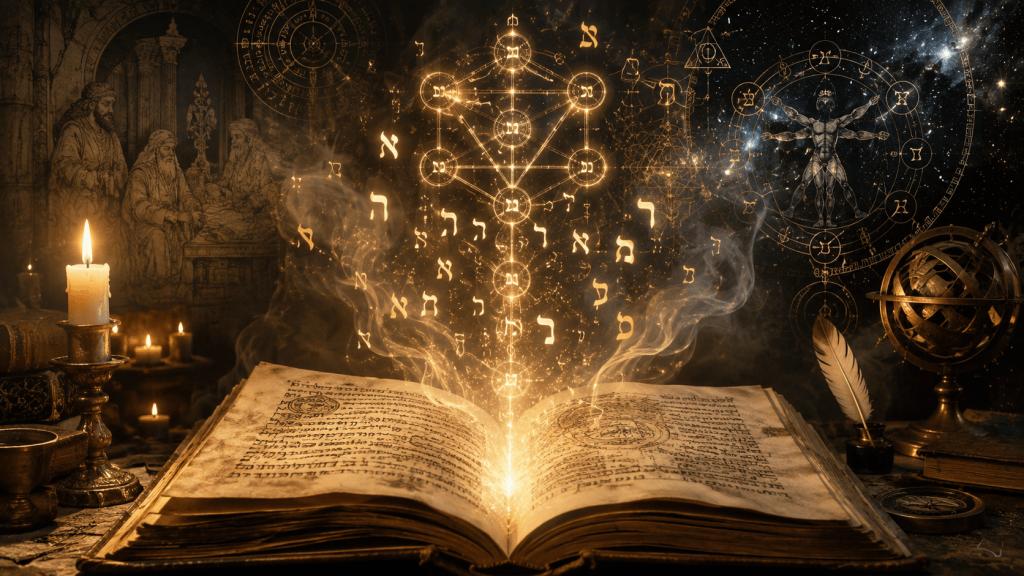
    One of the most enigmatic texts in this history is Sefer Yetzirah, usually translated as The Book of Formation or Book of Creation. Its precise date remains debated, although scholars generally place its development somewhere in late antiquity, centuries before the mature medieval Kabbalah of the Zohar. What makes the work extraordinary is its vision of creation: the universe is described through thirty-two mysterious paths of wisdom, consisting of ten sefirot and the twenty-two letters of the Hebrew alphabet. The letters are not merely labels attached to objects after those objects have come into existence; within the symbolic cosmology of the text, they participate in the architecture through which existence itself is ordered.
    The concept is difficult for the modern mind because we ordinarily separate language from reality. A tree exists independently of the word tree, while changing the word does nothing to the physical object. Sefer Yetzirah, however, emerges from an intellectual world in which the relationship between divine speech and creation could be understood far more literally and mystically. Genesis begins with God speaking creation into existence, and from that premise an extraordinary possibility follows: if God creates through speech, then the elements of sacred speech—the letters themselves—may belong to the machinery of creation.
    The text describes the twenty-two letters as being engraved, combined, weighed and permuted, producing a cosmos in which language, number and existence become intertwined. Later mystical interpretation would develop these ideas far beyond the brief and cryptic original text, but the seed was already present: perhaps letters were not merely signs representing reality; perhaps they were echoes of the structure beneath reality.
    That is the first doorway through which Hebrew enters the world that later Western occultists would find irresistible.
    When Every Letter Also Became a Number
    Hebrew possesses another characteristic that made it especially attractive to mystical interpreters: its letters can also carry numerical values. Aleph corresponds to one, Bet to two, Gimel to three, and the system continues through higher values.
    From this emerged gematria, one among several methods by which correspondences could be sought between words whose letters possessed equivalent numerical totals. Within mystical interpretation, an unexpected numerical relationship could suggest an underlying symbolic relationship between two biblical words or ideas.
    The important point is not whether such correspondences reveal objective structures in the universe, something historical scholarship cannot establish, but that generations of mystics believed sacred scripture contained layers beneath its literal surface, and therefore examined not only words but letters, numbers, permutations and even shapes for concealed meaning.
    Stanford’s Encyclopedia of Philosophy, discussing the Kabbalistic material encountered by Giovanni Pico della Mirandola, notes that Kabbalists could treat the Hebrew biblical text as divine speech possessing effectively inexhaustible meaning, extending interpretation down to individual letters, their numerical values and their forms.
    Imagine how astonishing this appeared to a fifteenth-century Christian intellectual encountering it for the first time.
    The Bible was no longer merely a text to be read.
    It could be approached as a cosmic cipher.


    The Name That Could Not Be Spoken
    Among all combinations of Hebrew letters, none carried greater theological weight than the four-letter divine name:
    יהוה — YHWH
    Known as the Tetragrammaton, from the Greek expression meaning “four letters,” it occupied a unique position within Jewish religious tradition. The divine name was treated with profound reverence and was not ordinarily pronounced as written; traditional reading substituted Adonai.
    For Kabbalists, divine names became central to speculation about the relationship between the hidden God and the manifest universe. Other sacred names—including Ehyeh, El, Elohim and Shaddai—could be associated in later systems with different divine attributes or sefirot.
    Here we reach an essential distinction that has been almost completely erased by modern conspiracy culture.
    When a Renaissance manuscript places YHWH inside a pentacle, its author is not necessarily invoking a demon.
    Quite often, the opposite is happening.
    The magician is invoking divine authority.
    This is one reason apparently “dark” grimoires contain names of God, biblical verses and angelic names beside instructions concerning spirits. Medieval and early-modern ceremonial magic did not always divide the supernatural universe into the modern categories of “religion over here” and “occultism over there.” Practitioners could imagine that spirits were constrained precisely through superior sacred authority, so the names of God became protective, commanding or consecrating elements within ritual diagrams.
    A modern viewer sees strange Hebrew surrounding a pentagram and assumes “satanic.”
    A sixteenth- or seventeenth-century practitioner might have understood the same Hebrew as something closer to a seal of divine jurisdiction.
    That reversal changes almost everything.
    The Renaissance Opens the Door
    The decisive transformation occurred in Renaissance Italy.
    During the late fifteenth century, Giovanni Pico della Mirandola became one of the first major Christian intellectuals to study Kabbalistic materials seriously and attempt to incorporate them into Christian theology. Pico depended extensively upon Jewish scholars and converts who knew Hebrew and Aramaic, particularly Flavius Mithridates, who translated large quantities of Kabbalistic literature into Latin for him.
    Pico’s project was radical. He believed Kabbalah might contain an ancient wisdom capable of confirming Christian doctrines, and his famous 900 Conclusions contained a substantial body of explicitly Kabbalistic propositions. He did not merely study Jewish mysticism as an outside historian would; he Christianized it, searching within Hebrew names, letters and sefirot for evidence of Christ, the Trinity and a primordial theological revelation.
    Something momentous had happened.
    Knowledge that had previously circulated predominantly inside Jewish intellectual and mystical environments was crossing into Latin Christian Europe.
    But it did not cross unchanged.
    Pico’s Dangerous Experiment
    For Pico, Kabbalah was part of a much larger dream: the possibility that beneath apparently different religions, philosophies and ancient wisdom traditions there existed fragments of one primordial truth.
    This idea resonated with the Renaissance concept later described as prisca theologia—an ancient theology supposedly preserved imperfectly through various traditions. Philosophers searched Plato, Pythagoras, Neoplatonism, ancient theology and other traditions for remnants of this lost wisdom, while Pico gave Jewish Kabbalah an exceptionally high position within the search.
    To the modern reader, this intellectual experiment may seem romantic: scholars attempting to reconstruct a forgotten universal wisdom.
    Yet there was also an uncomfortable dimension. Christian Kabbalists were frequently not preserving Jewish Kabbalah on its own terms; they were appropriating and transforming it, sometimes interpreting Jewish texts as secret proofs that Judaism itself had failed to understand Christianity.
    Modern scholarship therefore carefully distinguishes Jewish Kabbalah from the Christian Cabala that developed in Renaissance Europe. Oxford’s Joseph Dan describes the late fifteenth century as a turning point in which Kabbalah moved beyond an exclusively Jewish context and became intertwined with European Christianity, philosophy, science and magic.
    One tradition had begun producing another.
    Johannes Reuchlin and the Miracle-Making Word
    The next major figure was the German humanist Johannes Reuchlin, one of Renaissance Europe’s most important Christian Hebraists.
    Reuchlin studied Hebrew deeply enough to publish a Hebrew grammar and dictionary in 1506, while his works De Verbo Mirifico of 1494 and De Arte Cabalistica of 1517 became landmarks in the development of Christian Kabbalah. Oxford historian David Price describes Reuchlin as a foundational figure both in Christian Hebrew scholarship and in the controversial discipline of Christian Kabbalah.
    The title De Verbo Mirifico can be rendered approximately as On the Wonder-Working Word.
    The title alone reveals something fundamental about the evolving Western imagination.
    Language was becoming power.
    Not ordinary language, however, but the supposedly primordial, sacred language closest to divine revelation. Hebrew appeared increasingly attractive precisely because many Christian scholars considered it more ancient and spiritually authoritative than Latin, while some went much further and imagined it as a surviving fragment of humanity’s original language.
    Within such a worldview, knowing a divine name correctly was not equivalent to memorizing a label.
    It meant approaching the hidden architecture behind creation.
    Agrippa Builds the Occult Machine
    If Pico opened the door and Reuchlin walked through it, Heinrich Cornelius Agrippa helped build the vast intellectual machine on the other side.
    Agrippa’s Three Books of Occult Philosophy, written initially around 1509–1510 and published in expanded form between 1531 and 1533, became one of Renaissance Europe’s most influential syntheses of magical thought. Rather than presenting one isolated tradition, Agrippa gathered astrology, Neoplatonism, Hermetic ideas, natural magic, angelology, number symbolism and Kabbalistic speculation into an enormous interconnected system.
    A modern Cambridge scholarly overview describes Agrippa’s work as combining ideas about planetary influence and cosmic correspondences with explicitly Kabbalistic speculation concerning words, letters, numbers, signs and the names of intermediary spiritual beings.
    This is the point at which the answer to our original question becomes much clearer.
    Why do Hebrew letters appear in Western occult symbols?
    Because Renaissance magic developed around the idea of correspondence.
    Planet corresponded to metal.
    Metal corresponded to color.
    Color corresponded to number.
    Number corresponded to angel.
    Angel corresponded to divine name.
    Divine name was written in Hebrew.
    A magical diagram could therefore become a miniature map of the universe, with every symbol supposedly connected to another level of reality.
    Hebrew was incorporated into that map because Kabbalistic traditions had already invested Hebrew letters and divine names with sacred cosmological significance.
    The Grimoires of Solomon
    The phenomenon becomes unmistakable when we turn to one of the most famous families of magical texts in Western history: the works attributed to King Solomon.
    Solomon’s biblical reputation for extraordinary wisdom gradually generated a vast legendary afterlife in which texts on spirits, talismans and magical knowledge were attributed to him, even though the surviving grimoires are products of much later historical periods.
    Among the best known is the Clavicula Salomonis, or Key of Solomon.
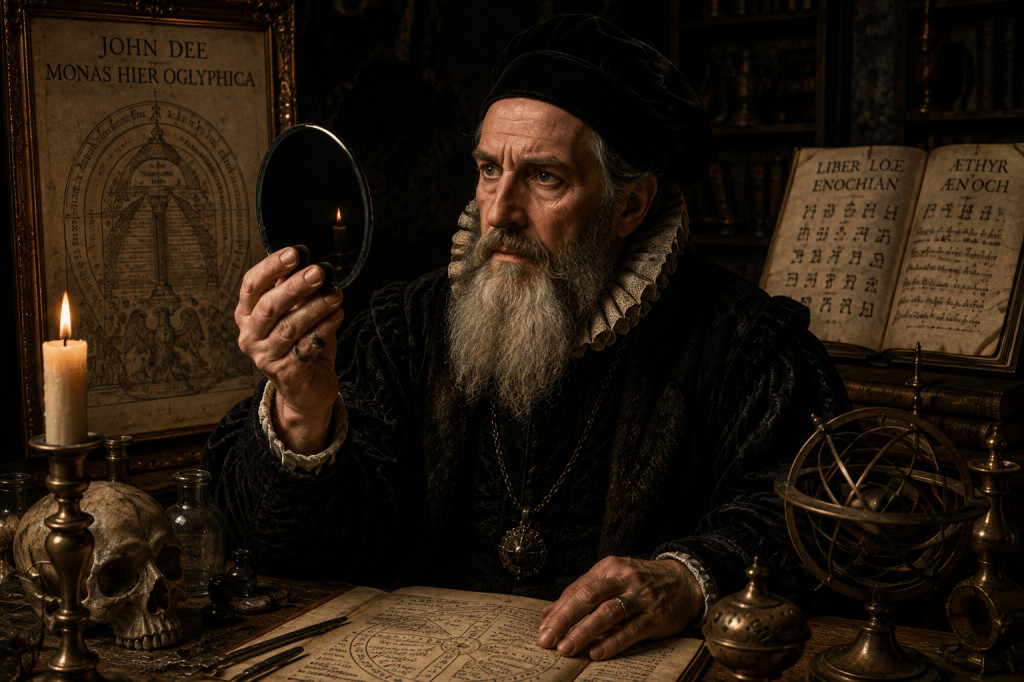
    The Wellcome Collection preserves a digitized copy of S. L. MacGregor Mathers’s 1889 edition, compiled from manuscripts then held in the British Museum, as well as a facsimile published in 1914 of a Hebrew Sepher Maphteah Shelomo, “Book of the Key of Solomon.
    Turn through the pentacles reproduced in these traditions and Hebrew appears everywhere.
    One pentacle reproduced in Mathers’s edition contains names such as Adonai and Eheieh, surrounded by Hebrew biblical material.
    To the uninitiated eye, these inscriptions look sinister precisely because the alphabet is unfamiliar.
    Historically, however, many such inscriptions represent names of God and scripture, not demonic names.
    And herein lies one of the great ironies of Western occult imagery: some of the symbols modern viewers interpret as evidence of satanism actually contain attempts to invoke the God of the Hebrew Bible.
    Angels, Demons and the Bureaucracy of the Invisible
    The same process occurred with angelic names.
    Michael, Gabriel, Raphael and other figures already crossed the boundaries between Jewish and Christian religious traditions, while medieval and Renaissance magical texts vastly expanded the invisible hierarchy into complex systems of planetary intelligences, angelic rulers and spiritual intermediaries.
    Agrippa’s Renaissance synthesis included precisely this combination of astrology, Cabala and angelic magic.
    This produces another source of modern misunderstanding because grimoires frequently place angels and dangerous spirits within the same manuscript.
    To us, that appears contradictory.
    To practitioners of ceremonial magic, it need not have been.
    The ritual universe was hierarchical. A magician might call upon a divine name in order to invoke an angel, or appeal to an angelic authority in an attempt to constrain a lesser spirit. Sacred and dangerous forces therefore appear together because the ritual itself depended upon hierarchy.
    The presence of Hebrew does not tell us which side of that hierarchy a symbol represents.
    Context does.


    The Nineteenth Century Changes Everything Again
    Several centuries later, Western occultism underwent another transformation.
    The French occultist Éliphas Lévi became one of the great architects of the nineteenth-century occult revival, and with him Kabbalistic imagery became even more deeply woven into Tarot, ceremonial magic and esoteric symbolism.
    One of Lévi’s most influential ideas was the systematic correspondence between the twenty-two letters of the Hebrew alphabet and the twenty-two Major Arcana of the Tarot. The relationship was not an ancient Jewish tradition concealed inside the Tarot from antiquity; it was part of a comparatively modern occult synthesis. Members of the later Hermetic Order of the Golden Dawn adopted and elaborated these correspondences, profoundly influencing twentieth-century Western magic.
    This distinction matters enormously.
    When modern occult diagrams connect Aleph with a Tarot trump, a path on the Tree of Life, an astrological principle and a ritual concept, we are often looking not at “ancient Kabbalah” in a pure form but at Hermetic Qabalah, a Western esoteric system assembled gradually from Jewish Kabbalah, Christian Cabala, astrology, Tarot, alchemy, ceremonial magic and other sources.
    The spelling itself sometimes signals the distinction:
    Kabbalah — usually Jewish mystical tradition.
    Cabala — often Renaissance Christian adaptations.
    Qabalah — commonly used for later Hermetic and occult systems.
    The boundaries are not perfectly consistent, but historically they represent genuinely different worlds.


    The Tree of Life Leaves Its Original Garden
    Perhaps no image demonstrates this transformation better than the Tree of Life.
    The ten sefirot became central to medieval Kabbalah as symbols for divine manifestations or emanations, providing a language through which mystics contemplated the relationship between the unknowable divine and the created universe.
    In later Western esotericism, however, the Tree acquired layers upon layers of additional correspondences.
    Planets were placed upon it.
    Tarot cards were assigned to its paths.
    Hebrew letters were attached to those paths.
    Colors, elements, angels, divine names and states of consciousness were arranged across its structure.
    The result was an extraordinary symbolic machine, but it was no longer identical to medieval Jewish Kabbalah.
    It had become something new.
    And this explains why a symbol encountered today on an occult website may contain unquestionably Jewish elements while belonging to a system created largely by Christian and post-Christian European occultists.


    Why Hebrew Now Looks “Dark” to Many People
    There is a curious historical loop behind modern conspiracy theories about Hebrew symbols.
    First, Jewish mystical traditions invested Hebrew letters and divine names with profound sacred significance.
    Then Renaissance Christian thinkers appropriated parts of those traditions.
    Then European magicians incorporated those ideas into ceremonial magic.
    Then nineteenth-century occultists combined ceremonial magic with Tarot, astrology and other esoteric systems.
    Then twentieth-century occult movements inherited those symbols.
    Finally, popular horror films, conspiracy videos and satanic imagery borrowed portions of the already hybrid occult vocabulary.
    After centuries of transmission, someone sees a Hebrew word inside an ominous pentagram and concludes:
    “Hebrew must have been demonic from the beginning.”
    Historically, the chain frequently runs in precisely the opposite direction.
    The Hebrew was there because earlier occultists believed it was sacred.
    And What About Baphomet?
    The famous goat-headed image of Baphomet provides an instructive example of how quickly historical layers can collapse into one another.
    The iconic androgynous Baphomet familiar today was created by Éliphas Lévi in the nineteenth century, not recovered from some intact secret cult of biblical antiquity. Modern scholarship treats Lévi’s Baphomet as a product of nineteenth-century Western esotericism, while Cambridge’s edition of Lévi’s Transcendental Magic identifies his famous “Sabbatic Goat” as a symbolic magical representation constructed within own system.
    Yet internet imagery routinely combines Baphomet, Hebrew letters, pentagrams, Kabbalistic diagrams, demons and medieval art as though they all emerged from one ancient hidden religion.
    They did not.
    They belong to different centuries, cultures and theological systems that later occultism blended together.
    The mystery is real.
    The simplified conspiracy is not.


    The Secret Was Not “Evil”—It Was Language
    Behind this entire history lies a much deeper philosophical idea.
    Human beings have repeatedly wondered whether language merely describes the universe or somehow participates in it.
    We still ask versions of the same question today. Mathematics describes nature with uncanny precision; genetic information is written in sequences that we casually call a “code”; physics seeks equations capable of expressing fundamental structures beneath visible reality. None of this proves ancient mystical ideas about letters, of course, but it helps us understand why the concept was so psychologically powerful.
    The Kabbalist looking at the letter Aleph did not necessarily see what we see when looking at the letter A.
    He could see number, sound, form, biblical association, divine symbolism and perhaps an echo of creation itself.
    The Renaissance magician inherited that fascination and asked another question:
    If creation was spoken into existence, could the right word reconnect the human mind with the forces behind creation?
    From that question came divine names, permutations, talismans, sacred alphabets and elaborate rituals designed around words that were believed to possess more than ordinary semantic meaning.
    Whether one believes such practices possessed supernatural power is a question of faith.
    That generations of intelligent people believed language concealed profound metaphysical power is an historical fact.


    The Most Important Distinction
    There is therefore one distinction that should remain with us whenever we encounter Hebrew inside an occult diagram:
    Presence does not equal origin.
    Finding Hebrew on a magical pentacle does not prove that Judaism produced the magical system surrounding it.
    Finding Kabbalistic terminology in an occult society does not mean that occult society accurately represents Jewish Kabbalah.
    Finding a biblical divine name beside a demon does not make the divine name demonic.
    And finding twenty-two Hebrew letters assigned to twenty-two Tarot cards does not prove that ancient Jewish mystics secretly invented Tarot.
    Much of what we call Western occultism was created through syncretism—the continual borrowing, translation, reinterpretation and recombination of material from different traditions.
    That process is historically far more interesting than the conspiracy theory because it reveals something fundamental about esoteric history: secrets rarely remain where they began.
    They travel.
    They change language.
    They acquire new meanings.
    Sometimes they become almost unrecognizable.


    The Final Mystery: Who Owns a Sacred Symbol?
    Perhaps the strangest part of this story is that the Hebrew letters never changed.
    Aleph remained Aleph. Yod remained Yod. He remained He.
    What changed was the world surrounding them.
    In one manuscript, a letter could belong to scriptural commentary.
    In another, to meditation.
    In another, to Christian theology.
    In another, to an alchemical diagram.
    In another, to a planetary talisman.
    In another, centuries later, to a Tarot correspondence drawn by an occult initiate who might never have practiced Judaism at all.
    The same marks traveled through completely different cosmologies.
    And somewhere during that journey, the West began forgetting where they had come from.
    Perhaps that is why old occult manuscripts still exert such fascination. They are not merely collections of strange symbols. They are archaeological sites of the imagination, places where religions, philosophies and mystical traditions collided, borrowed from one another and produced new systems that their original creators could never have anticipated.
    So when Hebrew letters appear inside a pentagram or ancient-looking magical circle, the most interesting question is not:
    “Is this satanic?”
    It is:
    “Who placed those letters there, in what century, what did they believe the letters meant, and from whom did they learn to use them?”
    Follow those questions far enough and the trail leads not to a single hidden cult, but through late-antique Jewish cosmology, medieval Kabbalah, Renaissance Florence, Christian Hebraists, Agrippa’s occult philosophy, Solomonic grimoires, Éliphas Lévi, the Golden Dawn and the birth of modern ceremonial magic.
    And that journey is stranger than the conspiracy.
    Because much of it actually happened.

    Note:

    This article distinguishes between Jewish Kabbalah, Renaissance Christian Cabala, and later Hermetic Qabalah. Their historical connections are real, but they are not identical traditions, and the presence of Hebrew letters in Western occult manuscripts should not be interpreted as evidence that Hebrew or Judaism is inherently connected with demonology.

    Sources & Further Reading
    Stanford Encyclopedia of Philosophy — “Giovanni Pico della Mirandola”
    David H. Price — Johannes Reuchlin and the Campaign to Destroy Jewish Books, Oxford University Press
    Cambridge University Press — Defining Magic: A Reader
    Wellcome Collection — The Key of Solomon the King (Clavicula Salomonis), edited by S. L. MacGregor Mathers
    My Jewish Learning — “Sefer Yetzirah: The Book of Creation”
    Oxford Academic — The Rise of Modern Western Magic
    The Metropolitan Museum of Art — Studies on Hebrew and Kabbalistic Inscriptions in Renaissance Esoteric Objects

  • THE SECRET MEANING OF BIRTHMARKS: ANCIENT BELIEFS, REINCARNATION CASES AND THE OCCULT MAP OF THE SKIN

    Are Birthmarks Merely Biological Accidents — or Could the Body Remember Something the Mind Has Forgotten?

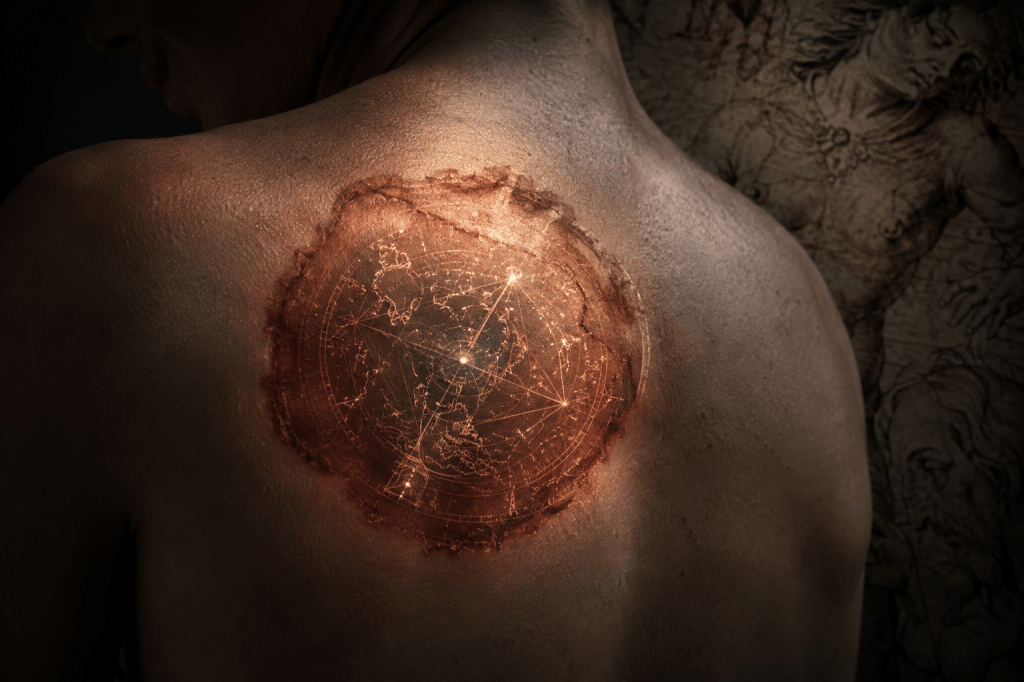
    Most of us enter the world carrying no visible evidence of where we have come from, yet some arrive already marked, bearing upon the skin an oval patch, a red stain, an irregular constellation of pigment, a shape resembling a leaf, a flame, a wing, a flower or, in the strangest cases, something disturbingly similar to an old wound.

    Modern medicine has names for these marks, and those names matter, because birthmarks are real biological structures rather than supernatural objects floating outside the laws of the body. Dermatology generally distinguishes between vascular birthmarks, involving blood vessels, and pigmented birthmarks, involving pigment-producing cells, while congenital melanocytic nevi, port-wine stains, hemangiomas and dermal melanocytosis all have their own biological characteristics, appearances and clinical significance. For many birthmarks, medicine can describe remarkably well what the tissue is doing, even though the precise cause of every type is not always known.

    Yet throughout history another question has persisted beside the medical one, quieter and considerably more unsettling.

    Why there?

    Why that particular shape?

    Why does one person arrive bearing a mark over the heart, another along the spine, another upon the hand, the throat, the thigh or the face, while most human beings emerge without anything comparable at all?

    Science can examine the mechanism by which pigment cells or blood vessels form a mark, but the occult imagination asks a different kind of question, not necessarily because science has failed, but because human beings have always searched for meaning in patterns that biology merely describes. From ancient Greek divination to Renaissance medicine, from folk traditions surrounding maternal impressions to twentieth-century investigations of alleged past-life memories, the birthmark has repeatedly occupied a strange borderland where flesh, symbolism, destiny and memory seem to touch.

    Perhaps that is why the skin has never been merely skin in the esoteric imagination.

    It is the frontier where the hidden becomes visible.

    And if the old occultists were right about even a fraction of what they suspected, some birthmarks may be more than imperfections in the parchment.

    They may be writing.


    THE SKIN AS THE FIRST SACRED TEXT

    Long before human beings carved prayers into stone, painted symbols upon temple walls or bound sacred words between covers, the body itself was interpreted as a text, because the face, hands, eyes, scars, moles and peculiarities of the flesh appeared to ancient observers as signs through which the invisible order of existence might occasionally reveal itself.

    This idea does not belong to one culture alone, nor does it require us to assume that every bodily feature possesses a supernatural meaning, because its real historical importance lies in something deeper: human beings repeatedly imagined the body as a microcosm, a miniature world in which celestial, moral and spiritual realities could somehow leave traces.

    The Hermetic principle traditionally summarized as “as above, so below” encouraged precisely this kind of correspondence, because if the human being reflected the larger cosmos, then the body could theoretically become a map upon which greater forces expressed themselves. Medieval and Renaissance physiognomy extended such reasoning into elaborate systems, while astrology associated portions of the body with planets and zodiacal influences, alchemy turned bodily transformation into a metaphor for spiritual transmutation, and magical traditions regarded certain unusual physical features as signs of destiny, protection, danger or inherited power.

    The concept of birthmarks as an occult alphabet therefore did not emerge from nowhere, although the elaborate interpretations found in modern esoteric literature should not automatically be projected backwards and called ancient Hermetic doctrine.

    What history actually gives us is more interesting.

    It gives us fragments.

    And fragments are often where mysteries begin.


    AN ANCIENT GREEK MAP OF THE MARKED BODY

    Among the surviving works associated with the legendary Greek seer Melampus is a brief text known as Peri Elaion tou Somatos, usually translated as On the Moles of the Body or interpreted more broadly as a treatise concerning bodily marks. The work survives within an ancient tradition of divination in which the location of a mark could be read as an omen, and a sixteenth-century English edition preserved the text as “a little treatise” concerning the significance of moles attributed to the Greek Melampus. Modern cataloguing by the Folger Shakespeare Library confirms that this tradition circulated in early modern Europe alongside works on physiognomy.

    The surviving material is strange because it treats the human body almost as though geography itself possessed meaning, connecting particular locations with particular outcomes and sometimes distinguishing between the left and right sides of the body. Historians do not regard this as scientific anatomy, of course, but its existence tells us something important: the idea that a bodily mark might carry meaning according to its exact position is not a recent invention created by social media mysticism.

    People were asking this question more than two thousand years ago.

    The Greek text does not give us the elaborate chakra-like map sometimes presented online today, nor should we pretend that it does, but it reveals an enduring occult instinct: position matters, because a mark on the mouth seems symbolically different from a mark upon the foot, just as a scar across the heart carries a different psychological meaning from one upon the hand.

    Whether the universe actually intended such distinctions remains impossible to establish.

    The fact that human beings have perceived them for centuries is indisputable.


    PARACELSUS AND THE MYSTERIOUS “IMPRESSIONS”

    The story becomes considerably stranger when we reach Paracelsus, the sixteenth-century physician, alchemist and medical revolutionary whose writings exist in the uncomfortable territory between observation, medicine, theology, astrology and occult philosophy.

    Paracelsus lived in a world in which imagination was not regarded merely as private fantasy. Within his cosmology, imagination could function almost like a force, capable of influencing matter under particular conditions, and when discussing pregnancy he described unusual marks upon the unborn child as “impressions,” comparing the process to a seal being pressed into something capable of receiving its form.

    In an English translation of his writings, he describes influences becoming impressed upon the fetus “as though one should impress a seal or stamp a piece of money,” after which the resulting birthmarks were called “impressions.” Elsewhere in the same body of writings, he discusses what were once called maternal or uterine marks and connects outward bodily signs with an “art of signature,” according to which visible forms were thought capable of revealing invisible qualities.

    His biological explanation does not survive modern scientific scrutiny, and there is no good evidence that an unsatisfied craving or a powerful maternal image literally stamps a corresponding symbol onto the fetus, yet the metaphor he chose remains remarkable.

    A seal.

    An impression.

    Something invisible pressing itself into visible matter.

    If we temporarily remove Paracelsus’s obsolete embryology and retain only the symbolic architecture of his thought, we arrive at one of the most evocative occult ideas surrounding congenital marks: perhaps the body does not simply grow, but receives impressions while it grows.

    The question then becomes infinitely more dangerous.

    Impressions from what?


    THE ASTRAL BODY AND THE MOMENT OF DESCENT

    In a modern esoteric synthesis drawing upon Hermeticism, Neoplatonism, alchemy, astrology and later occult traditions, we can imagine the formation of a human being as something more complicated than a soul suddenly dropped into a finished biological machine.

    Instead, consciousness would gradually descend through levels of increasing density until it became attached to physical existence, passing symbolically from the invisible toward the visible, from possibility toward form, from what the alchemists might have called subtle substance into the heavy kingdom of matter.

    We might call the hypothetical pattern carried through that descent the Morphe Astralis, not as an authenticated ancient Hermetic term, but as a useful modern name for the occult idea that consciousness possesses a subtle architecture before its physical expression becomes complete.

    Within this symbolic system, a birthmark could be imagined as Stigmata Hermetica, a “Hermetic impression” where something belonging to the subtle history of the person has coincided with the construction of the physical body.

    Such a model cannot presently be demonstrated scientifically, and it should not be confused with embryology, but occult philosophy has never restricted itself to asking only how matter behaves. It also asks whether meaning can precede matter, whether consciousness can leave physical traces, whether memory can exist outside ordinary neurological recall and whether the body may occasionally preserve information that the waking mind cannot access.

    These questions move us directly toward one of the most controversial researchers of the twentieth century.


    IAN STEVENSON AND THE CHILDREN WHO WERE BORN WITH WOUNDS

    Ian Stevenson was not an occultist writing by candlelight in a forgotten monastery, but a psychiatrist associated with the University of Virginia who spent decades investigating young children who spontaneously reported what appeared to be memories of previous lives.

    The University of Virginia’s Division of Perceptual Studies reports that its researchers have collected more than 2,500 cases of the “reincarnation type,” and approximately 30 percent of those cases involve a birthmark and/or birth defect.

    That figure is often distorted online into the claim that Stevenson “proved reincarnation through thousands of birthmarks,” which he did not, and the actual material is considerably more interesting when presented accurately.

    In a published summary concerning 895 children said to remember previous lives, Stevenson reported that 309 cases, approximately 35 percent, included a birthmark or birth defect attributed by the families to the previous personality. He subsequently investigated hundreds of such cases more closely, attempting, when circumstances permitted, to compare the child’s physical anomaly with information about injuries suffered by the deceased person.

    For some cases his research involved autopsy reports, medical records, police documentation or eyewitness accounts, rather than relying exclusively upon family stories, and his later two-volume work Reincarnation and Biology assembled an enormous collection of these reports.

    Among the cases described in the literature were children born with abnormalities allegedly corresponding to amputations, surgical wounds or fatal injuries associated with the deceased individuals whose lives they claimed to remember, although every individual case presents methodological difficulties and alternative explanations must remain part of any serious evaluation.

    This is precisely where the mystery should be allowed to remain a mystery.

    Stevenson’s cases do not establish that a bullet wound suffered by one person magically reappears as a birthmark upon another body, and mainstream biology has no accepted mechanism through which such a transfer could occur.

    But if even a small number of carefully documented correspondences resist ordinary explanations, an uncomfortable possibility appears at the edge of the discussion.

    What if memory is not always confined to the brain?

    And what, exactly, would a body remember if consciousness had existed before it?


    THE OCCULT GEOMETRY OF BIRTHMARKS

    Once we enter the symbolic territory rather than the medical one, the shape of a birthmark becomes as significant as its location, although we should immediately resist the temptation to create an absolute dictionary in which every circle means one thing and every triangular mark inevitably predicts another.

    Occult symbolism is strongest when understood as a language of correspondences rather than a mechanical code, because the same symbol may transform its meaning according to location, colour, orientation, personal history and even the associations spontaneously produced in the person who carries it.

    An oval or egg-shaped mark, for example, naturally evokes one of humanity’s oldest symbols of latent creation, because the egg contains an entire living form that has not yet revealed itself. In an alchemical reading, such a mark may therefore symbolize concentrated potential, an ability, memory or unfinished transformation that has remained enclosed rather than manifested, especially when the person repeatedly experiences the sensation that some important capacity exists within them without ever having been fully expressed.

    A circle traditionally evokes wholeness, enclosure, eternity and recurrence, because it possesses neither obvious beginning nor end, while alchemical imagery frequently uses circular forms to represent cycles of dissolution and regeneration. A circular birthmark could consequently be contemplated as the image of a cycle that has closed, or perhaps one that continues to repeat until its internal pattern is understood.

    A mark resembling a star, radiant point or small explosion belongs naturally to the symbolism of fire and illumination, particularly if its shape suggests energy moving outward from a centre. Within an occult reading, this could represent initiation, revelation, knowledge struggling toward expression or an old experience of visibility so powerful that the person in this life simultaneously seeks and fears being seen.

    A crescent, tear or drop-shaped mark invites lunar and aquatic associations, connecting it symbolically with memory, receptivity, intuition, mourning and the hidden movements of emotional life, while an organic mark resembling a flower or unopened bud might represent spiritual development that is incomplete rather than absent, something that has already begun beneath the surface but has not yet opened completely into the world.

    A leaf, branch or tree-like formation naturally belongs to the symbolism of ancestry, continuity and the Earth, because trees join what lies beneath the ground with what reaches toward the sky, making them among the oldest possible symbols of mediation between worlds.

    A mark resembling a bird, feather or wing, meanwhile, lends itself to the symbolism of separation, transcendence and freedom, perhaps becoming especially meaningful for someone whose life repeatedly revolves around departure, exile, escape, confinement or an almost irrational refusal to remain where others expect them to stay.

    None of these interpretations can tell you objectively what a birthmark “means.”

    What they can do is provide a symbolic mirror.

    Sometimes mirrors reveal things that dictionaries cannot.


    THE OCCULT MAP OF THE BODY

    If shape tells us something about the quality of the symbol, location tells us where its story may be unfolding, and this is the principle underlying almost every historical system that interprets bodily signs.

    THE HEAD, FACE AND THROAT — IDENTITY, PERCEPTION AND THE WORD

    A mark upon the forehead, particularly near the space between the eyes, has naturally acquired associations with perception, judgment and hidden sight because this region occupies the symbolic frontier between ordinary vision and what later mystical traditions described as interior vision.

    An occult interpretation would not mean that someone with such a birthmark automatically possesses clairvoyance, because that would reduce symbolism to superstition, but it might suggest a life organized around seeing what others overlook, questioning appearances or becoming painfully conscious of contradictions other people find easier to ignore.

    A mark around the mouth or lips belongs to another powerful territory because the mouth receives food, gives kisses, utters promises, tells lies, reveals secrets and transforms thought into sound. Such a mark could symbolically be explored through questions concerning speech, forbidden expression, broken vows, persuasion, desire or words that were never spoken when they should have been.

    The throat intensifies this symbolism because it is both a passageway and a vulnerable constriction between head and body, making it an obvious occult location for themes involving suppressed truth, testimony, command, silence or the terrifying consequences that can follow from saying the wrong thing at the wrong moment.

    THE SHOULDERS, ARMS AND HANDS — WILL MADE VISIBLE

    The arms are where intention becomes action, because thought may conceive a thing but the hands must eventually build it, touch it, write it, destroy it, heal it or release it.

    A mark upon the shoulder or upper arm may therefore be contemplated in relation to burden, responsibility and strength, particularly in people who repeatedly find themselves carrying obligations that technically belong to others.

    The forearm occupies an especially intriguing symbolic position because it is the bridge between the body’s central strength and the precision of the hand, making it suitable for what we might call the Seal of Craft, an association with learned skill, healing, writing, construction, artistic work or any ability through which invisible intention becomes physical result.

    A mark upon the wrist or palm naturally evokes older traditions surrounding the magical hand, because hands bless, swear oaths, exchange money, perform ritual gestures, feel the sick, wield weapons and leave fingerprints, which are themselves unique biological signatures.

    The occultist might therefore ask not “Does this mark prove that I was a healer or magician?” but rather, “What do my hands repeatedly attempt to do in this life, and why does this particular part of my body feel symbolically charged?”

    That question is considerably more useful.

    And considerably harder to answer.


    THE CHEST AND HEART — LOVE, SACRIFICE AND THE UNFINISHED VOW

    Few locations invite stronger interpretation than a congenital mark close to the heart, because the chest is simultaneously anatomical protection and emotional symbol, shielding the organs that keep us alive while becoming, across cultures, the imagined home of courage, grief, love, loyalty and betrayal.

    An occult reading of a birthmark here might therefore concern an unresolved bond, a sacrifice, a devotion that outlived its circumstances or a recurring pattern in which love becomes inseparable from suffering.

    In the darker language of esoteric symbolism, it might be called the Seal of the Vow, not because every mark on the chest records some literal oath from a former incarnation, but because the person carrying it may discover that promises, loyalty and emotional debts dominate their life with unusual intensity.

    If reincarnation were ever demonstrated to involve the transfer of more than personality, the heart would be exactly the kind of place in which human imagination expects an old story to survive.

    Whether nature shares our symbolism is another matter entirely.


    THE ABDOMEN AND SOLAR PLEXUS — INSTINCT, FEAR AND THE BODY THAT KNOWS FIRST

    Human beings often say that they “feel something in the gut” long before they can explain what is wrong, an expression that has physiological dimensions as well as symbolic ones because the nervous system, stress response and gastrointestinal system are deeply interconnected.

    Occult traditions transformed this visceral territory into something even larger, interpreting the abdomen as a region of instinctive power, appetite, fear, courage and emotional digestion.

    A birthmark upon the abdomen can therefore be contemplated as a symbol of experiences that must be digested rather than merely understood intellectually, particularly when the person repeatedly encounters circumstances that produce strong instinctive reactions before conscious reasoning catches up.

    In symbolic terms, this is the territory where life is swallowed.

    And where life sometimes refuses to be digested.


    THE BACK AND SPINE — WHAT WE CARRY WITHOUT SEEING

    The back is perhaps the most psychologically suggestive territory of all because it exists largely outside our ordinary field of vision, allowing us to carry wounds, scars and marks that other people may observe more easily than we can.

    A congenital mark between the shoulder blades can therefore be read as an emblem of inherited burdens, obligations or stories that seem to have been placed upon a person without their conscious choice, making this area particularly suited to reflection upon family patterns and transgenerational identity.

    The lower back and sacral region belong to another symbolic world involving support, survival, sexuality, ancestry and the physical capacity to remain upright beneath pressure.

    Later esoteric systems influenced by Indian traditions might associate this region with kundalini and foundational life energy, although it would be historically inaccurate to describe kundalini doctrine itself as ancient Hermetic teaching.

    The more interesting possibility is that multiple spiritual traditions independently recognized the lower trunk and spine as profound symbols of incarnation because this is literally where the human body balances itself against gravity.

    A mark there may therefore invite the question: What keeps me rooted in this world, and what repeatedly threatens to uproot me?


    THE THIGHS, KNEES, LEGS AND FEET — THE MEMORY OF THE ROAD

    If the hands represent what we do, the legs represent where we go, which is why marks upon the lower body naturally lend themselves to interpretations involving endurance, movement, exile, pilgrimage and the direction of one’s life.

    The thighs, massive engines of movement and support, suggest resilience and stored power, particularly when life repeatedly requires a person to rise after experiences that should have left them unable to continue.

    The knees introduce a different symbolism because bending the knee can signify humility, defeat, reverence or strategic flexibility, making a congenital mark there suitable for contemplation of pride, submission and the ability to yield without surrendering one’s identity.

    The calves and lower legs belong to forward motion and persistence, while marks upon the ankles or feet inevitably evoke paths, journeys and contact with the Earth itself.

    In an occult reading, a marked foot might be called the Seal of the Road, particularly for someone whose existence has been shaped by migration, repeated relocation, an inability to remain in one place or the persistent intuition that there is somewhere they are still supposed to go.

    Perhaps some people inherit houses.

    Perhaps others inherit journeys.


    RIGHT AND LEFT — THE ANCIENT MYSTERY OF POLARITY

    The distinction between the right and left sides of the body appears in numerous historical symbolic systems, including traditions of divination, and the old Greek material associated with bodily marks sometimes distinguishes between sides rather than treating the body as perfectly symmetrical in meaning.

    A modern occult synthesis can develop this further through the language of polarity, provided we understand that we are constructing symbolism rather than recovering a single ancient doctrine.

    The right side can be treated as the solar, active or outward-facing current, connected with action, projection, decision, creation and the forces we impose upon the world, while the left side can be treated as lunar, receptive and inward-facing, connected with memory, intuition, inheritance and the forces the world impresses upon us.

    Thus, a mark upon the right hand might invite reflection on what a person is meant to accomplish, while a similar mark upon the left could invite questions concerning what they have received, inherited or carried.

    The symbolism becomes even more interesting when the person’s actual temperament seems reversed, because a strongly passive individual bearing an unusual mark on the traditionally active side might contemplate whether the mark symbolizes precisely the quality that remains undeveloped.

    An occult symbol does not always describe what you are.

    Sometimes it describes what you have not yet become.


    THE WOUND THAT DID NOT DISAPPEAR

    Alchemy rarely treats wounds as meaningless because the entire Great Work depends upon transformation, and transformation begins with something imperfect, divided, impure or incomplete.

    The alchemist does not begin with gold.

    He begins with matter that must pass through darkness, separation, dissolution and recombination before another state becomes possible.

    For that reason, the most profound occult interpretation of a birthmark is not that it proves a violent death in another lifetime, nor that it condemns the person to repeat an ancient tragedy, but that it may be used symbolically as the location where an unfinished story has become visible.

    This is where the old alchemical metaphor of lead becoming gold becomes useful.

    The “lead” is not the mark itself.

    It is whatever fear, attachment, inherited pattern, unexpressed ability or repeated conflict the mark comes to represent within the person’s interior life.

    The “gold” appears when the symbol ceases to be a sentence pronounced upon the individual and becomes instead an instrument of self-knowledge.

    A mark over the heart does not mean you are destined to suffer for love.

    A mark upon the throat does not mean someone once killed you for speaking.

    A mark upon the hand does not prove that you possessed magical abilities.

    Those are stories, and stories become dangerous when possibility hardens into certainty.

    But if a particular symbol repeatedly opens the same psychological door, if contemplating it produces memories, dreams, fears or associations that are strangely consistent across years, then the occultist does not necessarily dismiss the experience.

    The occultist watches.


    HOW TO READ YOUR OWN BIRTHMARK WITHOUT INVENTING A DESTINY

    The worst way to interpret a birthmark is to search for a rigid online dictionary that tells you that a mark three centimetres above the left knee means you were a priestess in Atlantis or murdered by a jealous lover in 1742.

    The deeper method begins without an answer.

    Study the shape without deciding what it resembles, because human perception is exceptionally skilled at finding familiar forms in ambiguous patterns, a phenomenon that can transform an irregular patch of pigment into a bird, a sword, a continent, a face or almost anything else once expectation has taken control.

    Then ask what you saw before anyone else suggested an interpretation.

    Consider its location and your relationship with that part of the body, while paying attention to recurring dreams, inexplicable emotional reactions, lifelong fears, unusual abilities and patterns that seem to gather around the same symbolic territory.

    You may place a hand gently over the mark, close your eyes and ask three questions, not as an attempt to summon an objective supernatural answer, but as a contemplative exercise capable of revealing associations hidden beneath ordinary thought:

    What force does this part of my body represent in my life?

    Does the shape seem to speak of containment, expansion, movement, protection, injury, growth or transformation?

    If this mark were not a defect but a message written in a symbolic language, what part of myself would I suspect I had forgotten?

    Then resist answering too quickly.

    The first answer often comes from expectation.

    The more interesting one sometimes arrives later.


    THE MOST DANGEROUS POSSIBILITY

    It would be easy to end this investigation by declaring either that birthmarks are purely biological accidents and therefore meaningless, or that they are indisputable seals from former incarnations and therefore proof that the soul survives death.

    Neither conclusion is justified by the evidence we possess.

    Medicine demonstrates that birthmarks have physical structures and developmental mechanisms, and unusual or changing marks should always be evaluated medically when appropriate, because symbolic interpretation must never replace dermatological care. MedlinePlus notes that most birthmarks are harmless while some types require observation, particularly if they change, bleed, itch or develop other concerning features.

    History, however, demonstrates something equally undeniable: people have contemplated bodily marks as meaningful signs for centuries, from Greek mole divination to Renaissance theories of signatures and Paracelsian “impressions.”

    And the investigations associated with Ian Stevenson leave us with a third category, neither accepted proof nor easily disposable mythology, consisting of cases in which children reportedly displayed both unusual physical marks and detailed claims concerning deceased individuals, sometimes allowing comparisons against records that existed independently of the child’s body.

    Perhaps all such cases will eventually receive conventional explanations.

    Perhaps memory is stranger than we currently understand.

    Perhaps the human impulse to interpret birthmarks is simply an extraordinary example of our species’ refusal to accept randomness.

    Or perhaps the mistake lies in assuming that biology and meaning must cancel one another out.

    A page is made of paper, ink and chemical compounds, yet none of those facts tells you what the words written upon it mean.

    Could the same principle ever apply to the body?

    We do not know.

    That uncertainty is the real mystery.

    Because before you were old enough to write your name, before you learned your family’s stories, before anyone taught you what a soul was supposed to be, your body had already written something upon itself.

    Maybe it was nothing more than biology following an ancient molecular choreography.

    Maybe it was an accident of pigment and blood vessels.

    Maybe it was an echo carried through some mechanism we have not discovered.

    Or perhaps, as the occultists might whisper, the body is not merely the vessel into which consciousness arrives.

    Perhaps it is the final page of a book that began somewhere else.

    And perhaps a birthmark is one sentence that was never completely erased.

    Your skin may be the first sacred manuscript you were ever given, and the marks with which you entered this world may be letters from an alphabet that the body knew before the mind learned how to read.


    SOURCES AND FURTHER READING

    Ian Stevenson, Reincarnation and Biology: A Contribution to the Etiology of Birthmarks and Birth Defects, Praeger, 1997.

    University of Virginia, Division of Perceptual Studies, research archive on children who report memories of previous lives. The division reports more than 2,500 investigated cases and notes that roughly 30 percent contain a birthmark and/or birth defect.

    Ian Stevenson, “Birthmarks and Birth Defects Corresponding to Wounds on Deceased Persons,” Journal of Scientific Exploration, 1993.

    Paracelsus, The Hermetic and Alchemical Writings of Paracelsus, translated and edited by Arthur Edward Waite, including passages concerning congenital “impressions,” maternal marks and the art of signature.

    Pseudo-Melampus, Peri Elaion tou Somatos (On the Moles/Marks of the Body), preserved within the ancient and later European tradition of bodily divination; the work is catalogued in the Folger Shakespeare Library within Thomas Hill’s 1571 The Contemplation of Mankinde.

    MedlinePlus, U.S. National Library of Medicine, medical information concerning vascular and pigmented birthmarks, congenital nevi and related conditions.

    Thank you for subscribing!

    Please check your email to confirming your subscription.

    Fediverse Reactions
  • The Black Mirror of John Dee: A Window to Another World?

    Few objects in the history of the occult have inspired as much fascination as the black mirror of John Dee. Unlike the ornate crystal balls and elaborate magical instruments often portrayed in popular culture, Dee’s mirror was astonishingly simple. It was a polished disk of deep black obsidian, smooth enough to reflect a face, yet dark enough to conceal far more than it revealed. To some, it was merely a carefully crafted artifact from ancient Mexico. To others, it was a doorway through which one of the greatest minds of the Renaissance believed he could communicate with beings beyond the visible world.

    John Dee was no ordinary mystic. He served as mathematician, astronomer, navigator, philosopher, and trusted advisor to Queen Elizabeth I. His knowledge of astronomy helped shape England’s ambitions at sea, while his immense personal library became one of the greatest collections of scientific and philosophical works in Europe. Yet despite his remarkable achievements, Dee believed that human knowledge had reached a limit. Beyond mathematics, beyond philosophy, and beyond theology, he became convinced that another source of wisdom existed—one that could only be reached through direct contact with higher intelligences.

    It was during this relentless search that the black mirror became central to his work. Unlike many occult practitioners of his age, Dee insisted that he did not seek power, wealth, or domination over hidden forces. He believed that before humanity’s fall from grace, divine knowledge had once been freely accessible. The ancient patriarchs, he argued, had understood truths that later generations had forgotten. His goal was not to invent new magic, but to recover a sacred language that had been lost with time.

    The mirror itself had a remarkable history long before it reached Dee’s hands. Modern scholars believe it was fashioned from volcanic obsidian by Aztec craftsmen centuries before the Spanish conquest of the Americas. In Aztec tradition, polished obsidian mirrors were associated with the powerful deity Tezcatlipoca, whose name is often translated as “Smoking Mirror.” Priests are believed to have used such mirrors in rituals of divination, believing they could glimpse hidden realities or receive messages from the divine. Whether by coincidence or fate, an object once revered in one civilization eventually found its way into the study of an English scholar searching for heavenly knowledge.

    Dee rarely worked alone. His most famous collaborator was Edward Kelley, a controversial figure who claimed to possess an extraordinary ability known as “scrying”—the practice of perceiving visions within reflective surfaces. While Dee prayed, recorded observations, and carefully documented every detail, Kelley would gaze into the black mirror, describing luminous cities, strange symbols, radiant beings, and voices that claimed to be angels. These sessions were recorded with remarkable precision, filling thousands of pages with conversations written in a mysterious language that Dee believed was the original tongue spoken by Adam before the Fall.

    This language, now known as Enochian, remains one of the greatest mysteries in Western esotericism. Some linguists argue that it was an elaborate invention created by Kelley. Others maintain that its unusual grammatical structure and internal consistency make it difficult to dismiss as simple fabrication. Whatever its true origin, the language continues to be studied and used within certain esoteric traditions more than four centuries after Dee first encountered it.

    Not everyone who visited Dee’s house viewed these experiments with admiration. Rumors spread quickly through London that the scholar who advised the Queen was secretly practicing forbidden arts. Some believed he conversed with angels; others whispered that no angel would speak through a black mirror once used in pagan ceremonies. The line between divine revelation and dangerous sorcery was perilously thin during the sixteenth century, and Dee increasingly found himself viewed with suspicion. Although he spent much of his life pursuing knowledge, history often remembered him more as a magician than as one of England’s greatest intellectuals.

    Centuries later, the black mirror survives. It is no longer hidden inside a private chamber lit by candlelight but preserved behind glass in the collections of the British Museum. Visitors stand before it expecting something extraordinary, only to find a polished disk of black volcanic stone. Yet many describe an unsettling sensation as they look into its surface. Unlike an ordinary mirror, obsidian absorbs light instead of reflecting it brightly. Faces seem to emerge from darkness rather than from light, giving the illusion that the glass possesses an unusual depth.

    Psychologists explain this phenomenon as a natural consequence of prolonged observation in dim light. The human brain begins to reinterpret subtle reflections, occasionally producing vivid visual distortions. Historians see the mirror as a priceless cultural artifact connecting Renaissance Europe with pre-Columbian America. Occultists, however, continue to believe that certain objects preserve more than their physical form. They argue that centuries of ritual use may leave behind an intangible presence, impossible to measure yet impossible to ignore.

    Whether one accepts these ideas or rejects them entirely, the black mirror of John Dee remains an extraordinary symbol of humanity’s endless search for hidden knowledge. It stands at the crossroads of science, religion, philosophy, and the occult, reminding us that some of history’s greatest thinkers were never satisfied with the answers available in their own age. They continued searching beyond the horizon of accepted knowledge, convinced that the greatest mysteries were not those buried beneath the earth, but those waiting silently beyond the limits of human perception.

    Even today, no one can say with certainty what Edward Kelley truly saw reflected in that dark obsidian surface. Perhaps it revealed nothing more than the imagination of a gifted visionary. Perhaps it became a canvas upon which the human mind projected its deepest hopes and fears. Or perhaps, on certain forgotten nights, when the candles burned low and silence filled the room, the mirror reflected something that no ordinary eye was ever meant to see.Dacă vrei, putem transforma acest articol într-o serie intitulată “Forbidden Objects of the Occult”, continuând cu The Book of Soyga, The Hand of Glory, The Emerald Tablet, The Bell Witch Cave, The Skull of Yorick?, The Baphomet Idol și alte relicve misterioase. Acest tip de serie poate deveni o semnătură a blogului tău.

    Fediverse Reactions