Category: Forbidden Knowledge & Conspiracies

  • THE ARCHONS: What If the World Was Created by a God Who Didn’t Know the Truth?

    THE ARCHONS: What If the World Was Created by a God Who Didn’t Know the Truth?

    THE ARCHONS: What If the World Was Created by a God Who Didn’t Know the Truth?

    The disturbing secrets of the Nag Hammadi manuscripts, the mysterious rulers of the material world, and the ancient belief that humanity has forgotten its true origins.

    There is something deeply unsettling about the possibility that the world we know might not be exactly what we believe it to be, especially when that possibility appears in ancient writings composed long before modern theories about simulated realities, invisible dimensions, or hidden systems of control. I have spent considerable time exploring religious history and the different ways human beings have tried to explain existence, but few accounts have intrigued me as much as the extraordinary story preserved in the manuscripts discovered near Nag Hammadi, Egypt, in 1945.

    What makes these writings so fascinating is not simply their age or the unusual circumstances of their discovery, but the disturbing picture they present of creation itself. According to certain traditions preserved in these texts, the material universe was not created directly by the highest divine intelligence, but by an inferior being who possessed extraordinary powers while remaining ignorant of the greater reality from which he had emerged. This creator believed himself to be the only God, surrounded himself with subordinate rulers, and established an order in which humanity would remain unaware of its spiritual origins.

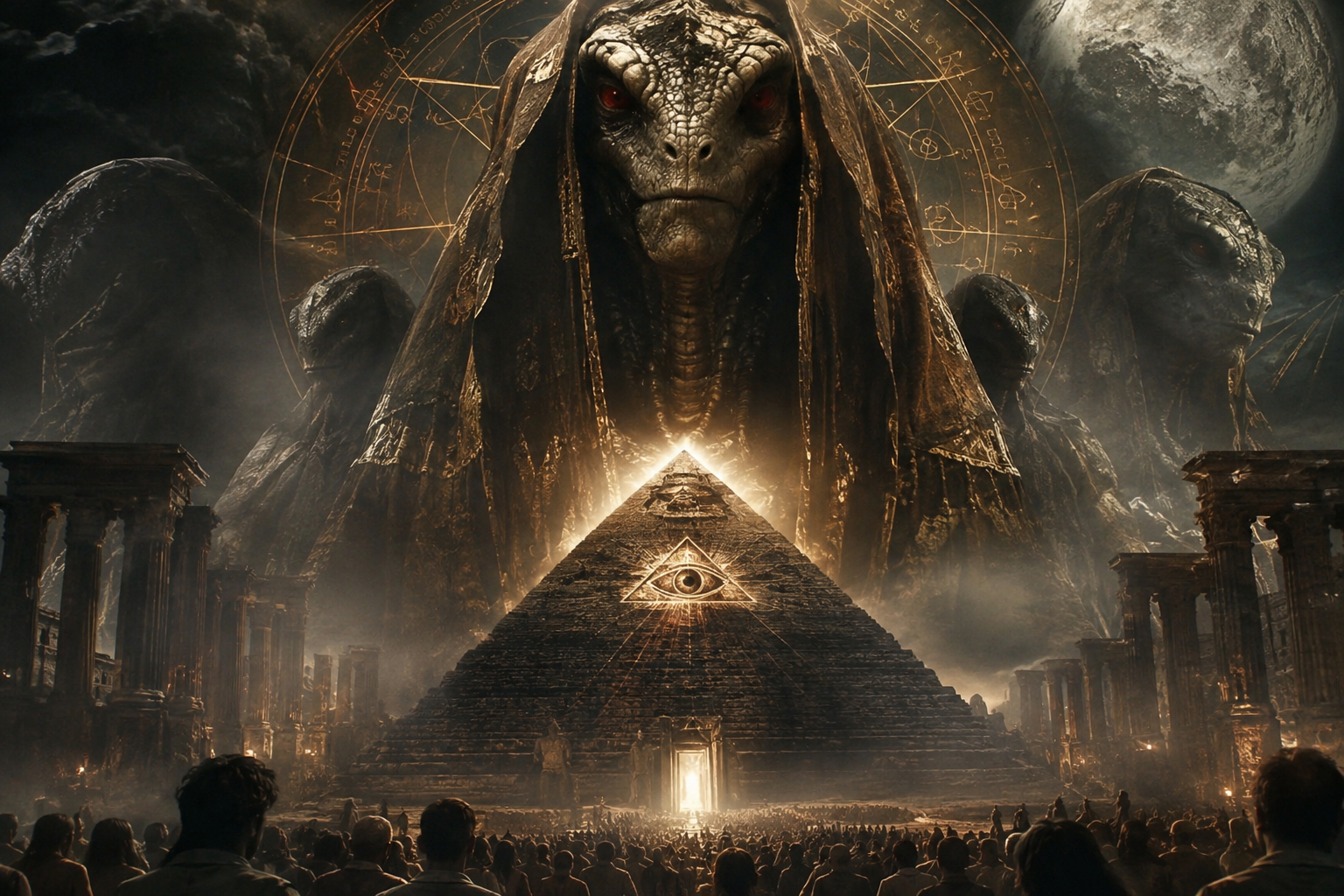
    These rulers were called the Archons, and although modern theories have transformed them into everything from reptilian extraterrestrials to invisible entities feeding on human fear, their original appearance in ancient religious literature reveals a far more complex and interesting story. I wanted to understand what the manuscripts actually say, particularly because the difference between an ancient belief and a modern interpretation can easily disappear when a mysterious subject becomes popular on the internet.

    The three writings that deserve our attention are The Apocryphon of John, The Hypostasis of the Archons, and On the Origin of the World. Together, they describe a universe shaped by ignorance, contested authority, and a struggle for knowledge, although each approaches the story from a different perspective. Their existence is historically established, while the supernatural beings they describe belong to religious cosmology rather than scientifically demonstrated reality.

    The Discovery at Nag Hammadi and the Beliefs That Almost Disappeared

    The story begins in Upper Egypt, where a collection of ancient papyrus books came to light in 1945, near the town of Nag Hammadi. The best-known account describes a local farmer, Muhammad Ali al-Samman, discovering manuscripts inside a large earthenware jar, although historians have questioned certain details of the discovery because the surviving accounts do not agree on every circumstance.

    The manuscripts themselves are genuine and date mainly to the fourth century, while many of the works they contain were probably composed during the preceding two centuries. Written in Coptic and frequently translated from earlier Greek compositions, these books preserve a remarkable variety of religious and philosophical traditions that existed during the formative centuries of Christianity.

    What makes the discovery particularly important is that several of these teachings had previously been known primarily through the writings of theologians who opposed them. Early Christian authors such as Irenaeus of Lyon described and criticized movements whose beliefs differed from those that eventually became orthodox, but the Nag Hammadi collection allowed modern researchers to study many related traditions through their own surviving literature.

    I find the uncertainty surrounding the manuscripts’ final owners almost as interesting as their contents, because we still cannot establish with confidence who assembled the collection, why these particular books were kept together, or why they ended up buried. The popular theory that they were hidden to escape religious persecution is possible, but it should not be mistaken for a proven historical explanation.

    Among the texts, however, one particular idea repeatedly emerges: the visible world is not necessarily the highest expression of divine reality, and the powers governing it may be fundamentally mistaken about their own nature.

    Yaldabaoth: The Creator Who Mistook His Power for Divine Perfection

    In The Apocryphon of John, also known as The Secret Book of John, the story begins not with the familiar biblical creation of heaven and earth, but with an ineffable divine source existing beyond the material universe. This ultimate reality transcends ordinary human categories, and from it emerge divine manifestations, including Barbelo, associated with divine forethought, and Sophia, whose name means Wisdom.

    Sophia occupies a central position in the unfolding drama because, according to the narrative, she brings forth a being without the proper participation of her divine counterpart. The result is Yaldabaoth, an imperfect entity who possesses considerable creative power but lacks awareness of the higher divine realm. The manuscript describes him through the extraordinary image of a lion-faced serpent, a representation that modern writers sometimes interpret literally, although such hybrid imagery was familiar within ancient religious symbolism.

    What interested me most was not his appearance, but the contradiction between his power and his ignorance. Yaldabaoth believes that he is the supreme divine authority because he cannot perceive the reality above him, and his conviction becomes so absolute that he proclaims himself the only God in existence. Within the logic of the story, his claim reveals the very ignorance he does not recognize, since a truly all-knowing being would not be unaware of its own origin.

    This is where the ancient narrative becomes philosophically provocative, because it presents a creator whose authority is not supported by complete understanding. Yaldabaoth then produces subordinate cosmic powers, the Archons, who participate in organizing and governing the lower universe, creating a hierarchy in which authority flows from a being who has misunderstood his own position.

    I find it difficult to read this account without thinking about the difference between possessing power and possessing wisdom, a distinction that has troubled philosophers throughout history. Human societies have repeatedly placed enormous authority in the hands of individuals and institutions whose confidence exceeded their understanding, and although the ancient text was not written as a modern political commentary, its central paradox remains recognizable.

    The most disturbing implication of the narrative is that an entire world could be organized around the certainty of a ruler who does not know what he does not know.

    The Creation of Humanity and the Secret the Archons Could Not Control

    The story becomes even more unusual when The Apocryphon of John describes the creation of Adam, because the Archons do not simply create humanity as an expression of their own perfection. Instead, they perceive an image associated with the higher divine realm and attempt to reproduce it, constructing a human form that initially lacks the living spiritual power necessary to animate it.

    Through an intervention originating from the higher divine reality, Yaldabaoth is induced to transfer power into the human being, and Adam becomes alive. The result is deeply ironic: the rulers have helped create something that possesses a spiritual capacity they themselves cannot fully comprehend, because humanity carries a connection to the divine realm beyond their authority.

    Within this mythology, the human condition is therefore more complicated than ordinary obedience to a creator. The rulers attempt to limit human awareness precisely because knowledge of humanity’s higher origin threatens the assumptions upon which their authority rests.

    This interpretation transforms the familiar story of Genesis into a conflict over spiritual knowledge, where the central problem is not simply disobedience but ignorance of one’s true nature. The human being is presented as possessing a potential that cannot be explained entirely through the material order, while the rulers struggle to maintain control over a creation whose deeper identity exceeds their understanding.

    Some contemporary writers have connected these passages to genetic manipulation, extraterrestrial experimentation, and the possibility that humanity was deliberately engineered by nonhuman beings. However, the manuscript does not provide scientific evidence for these claims, and its elaborate descriptions of the human body belong to ancient religious cosmology rather than modern biology.

    Even without accepting the account literally, I find its underlying question fascinating, because it asks what happens when a being created within a particular system develops the ability to recognize the limitations of that system. The question applies naturally to philosophy, education, and the history of human knowledge, where progress has often depended upon challenging explanations once considered beyond dispute.

    The Hypostasis of the Archons: A Woman Who Challenged the Rulers

    The second manuscript, The Hypostasis of the Archons, sometimes translated as The Reality of the Rulers, develops the relationship between humanity and the cosmic authorities through a striking reinterpretation of the biblical creation story. Although it shares important themes with The Apocryphon of John, it places particular emphasis on the rulers’ attempts to dominate human beings and on the spiritual forces that resist them.

    One of the most intriguing aspects of this text is its treatment of feminine spiritual figures, especially the spiritual Eve and Norea. Rather than presenting feminine knowledge simply as the cause of humanity’s downfall, the narrative associates the spiritual feminine with insight, resistance, and a form of existence that the rulers cannot fully possess.

    In one disturbing episode, the Archons attempt to violate the woman, but the spiritual feminine principle escapes their grasp, leaving them unable to exercise the control they imagined they possessed. The episode is expressed through mythological imagery, yet its treatment of domination and spiritual autonomy is unmistakable.

    Later, Norea confronts the rulers when they attempt to assert authority over her, and she receives assistance from a heavenly revealer named Eleleth, who explains the origins and limitations of the powers threatening her. Through this revelation, the narrative presents knowledge as a means of resisting illegitimate authority, while the rulers’ inability to understand the higher divine reality becomes the foundation of their weakness.

    I was particularly interested in how differently this story treats the relationship between feminine identity and spiritual knowledge compared with more familiar interpretations of Genesis. Instead of reducing the woman to a symbol of temptation, the manuscript presents figures who challenge domination and expose the ignorance of those claiming absolute power.

    This does not mean that the text should be treated as a modern statement about political or social equality, because its authors operated within a very different religious and cultural environment. Nevertheless, its portrayal of resistance raises a question that remains relevant: whether authority deserves obedience simply because it possesses the ability to impose its will.

    On the Origin of the World: The Archon Who Turned Against His Creator

    The third text, On the Origin of the World, offers a more elaborate explanation of the formation of the lower cosmos, developing themes of darkness, deficiency, divine wisdom, and the emergence of the rulers. Its narrative shares important elements with the other two manuscripts, but the details are not identical, which is worth remembering whenever modern interpretations combine all Gnostic writings into one supposedly unified secret doctrine.

    Yaldabaoth again appears as a ruler whose arrogance is inseparable from his ignorance, but the story introduces an unexpected development involving Sabaoth, one of the powers associated with the lower cosmic order. Rather than remaining permanently loyal to his father’s claims, Sabaoth turns away from Yaldabaoth’s arrogance and receives a different position within the divine hierarchy.

    This detail complicates the popular portrayal of the Archons as a single, unchanging species of malicious beings, because the ancient narrative allows for recognition, transformation, and a change in allegiance. The conflict is therefore not simply between humanity and an alien race, but between ignorance and knowledge within a much larger religious drama.

    Reading the three manuscripts together, I was struck by how much disappears when their stories are reduced to claims about reptilian creatures secretly controlling the planet. Their authors were exploring questions about the origins of evil, the limitations of material existence, the nature of divine wisdom, and the possibility of spiritual liberation, using an elaborate mythological language that cannot be translated directly into contemporary scientific categories.

    Reptilian Archons, the Matrix, and the Modern Fear of Invisible Control

    Anyone who searches for the Archons today will encounter interpretations that connect them to reptilian extraterrestrials, interdimensional parasites, emotional energy harvesting, and hidden forces supposedly manipulating human civilization. These theories often draw upon Yaldabaoth’s serpent-like appearance, the hierarchical organization of the cosmic rulers, and the ancient idea that humanity has been prevented from recognizing its true spiritual origins.

    The problem is that the surviving manuscripts do not establish the existence of a reptilian extraterrestrial species, nor do they demonstrate that invisible entities consume human fear or control contemporary institutions. Those claims belong to modern speculative interpretations, many of which combine ancient Gnostic mythology with ideas drawn from science fiction, conspiracy literature, and contemporary spirituality.

    Nevertheless, I understand why these interpretations have become popular, because the image of humanity living under an unseen system of control reflects anxieties that are deeply familiar in modern society. We inhabit a world shaped by complicated economic structures, political institutions, digital platforms, and technologies that influence what information reaches us, how our attention is directed, and sometimes even how we understand ourselves.

    These mechanisms can be studied through psychology, sociology, economics, and political history without assuming the existence of supernatural rulers. Yet the resemblance between the ancient mythology and the modern experience of living within systems we do not fully understand is difficult to ignore.

    The comparison becomes even more interesting when we consider the simulation hypothesis and Plato’s allegory of the cave, both of which raise questions about the relationship between perceived reality and a deeper level of existence. The Gnostic writers were not describing computer simulations or artificial intelligence, but they did imagine a world in which ordinary perception fails to reveal the highest truth.

    For them, liberation depended upon gnosis, a transformative knowledge of divine reality and humanity’s spiritual origin, rather than merely accumulating secret information about the rulers. This distinction matters because the ancient concept of awakening was not equivalent to discovering a hidden conspiracy; it involved a fundamental change in how the individual understood existence.

    Were the Nag Hammadi Teachings Deliberately Suppressed?

    One of the most persistent claims surrounding the Nag Hammadi discovery is that the manuscripts contain the original teachings of Jesus, deliberately concealed by religious authorities because they challenged the foundations of established Christianity. The historical reality is more complicated, although there is no doubt that the early Christian world contained a much greater diversity of theological interpretations than many people realize.

    During the first centuries of Christianity, different communities debated the nature of God, the identity of Jesus, the meaning of salvation, and the relationship between the material and spiritual worlds. Authors such as Irenaeus strongly opposed doctrines they considered incompatible with their understanding of Christianity, and many writings associated with alternative traditions eventually ceased to circulate widely.

    However, historians cannot establish that the entire Nag Hammadi collection was deliberately buried to preserve a single forbidden revelation, nor that its contents represent one original form of Christianity subsequently replaced by an invented doctrine.

    What these manuscripts genuinely demonstrate is that ancient religious thought was extraordinarily diverse, and that some communities developed interpretations of creation and salvation that differed radically from those that became dominant. Their survival allows us to examine ideas that might otherwise have been known only through the criticisms of their opponents, which makes the discovery historically significant without requiring an elaborate conspiracy to explain it.

    The Most Unsettling Question the Archons Leave Behind

    After examining these three writings, I found myself thinking less about the physical appearance of the Archons and more about the extraordinary relationship between ignorance, authority, and human freedom that their stories describe. The image of a lion-faced creator surrounded by subordinate cosmic rulers is certainly memorable, but the deeper philosophical problem lies in the possibility that an entire system could be governed by beings who mistake their limited understanding for absolute truth.

    In The Apocryphon of John, Yaldabaoth cannot recognize the reality above him, yet claims supreme authority over everything beneath him. In The Hypostasis of the Archons, the rulers attempt to dominate human beings whose spiritual nature they cannot fully comprehend, while On the Origin of the World introduces the possibility that even a being associated with the lower cosmic order can recognize the arrogance of its creator and turn away from it.

    Although these accounts differ in their details, they share a concern with the consequences of ignorance and the transformative possibilities of knowledge. Their authors imagined spiritual liberation as an awakening to a reality beyond the visible world, but the questions raised by their mythology remain meaningful even when approached without supernatural assumptions.

    I began reading about the Archons because I wanted to understand why ancient writers had imagined such an unusual hierarchy of cosmic powers, and why modern audiences continue to connect those figures to hidden rulers, extraterrestrial beings, and the possibility that our reality is not what it appears to be. What stayed with me, however, was the realization that the most disturbing form of control does not necessarily involve invisible creatures or supernatural intervention, because human beings can also become prisoners of inherited beliefs, unquestioned authority, and explanations they have never seriously examined.

    The Nag Hammadi manuscripts cannot prove that humanity is trapped inside a cosmic prison, but they preserve an extraordinary ancient attempt to explain why the world appears imperfect and why knowledge might offer a path toward freedom. Their authors lived in a very different intellectual universe from our own, yet their questions about power, ignorance, and the limits of perception have lost little of their ability to disturb us.

    And this is the thought I would leave with anyone willing to explore these manuscripts: if a person had spent an entire lifetime accepting a particular version of reality, surrounded by institutions that reinforced it and authorities that insisted there was nothing beyond it, how could that person ever recognize the limits of what they had been taught?

    The answer may have nothing to do with supernatural Archons, but it has everything to do with the courage to question what we believe we know.


    Sources and Further Reading

    • The Apocryphon of John — Nag Hammadi Codices II,1; III,1; IV,1; Berlin Codex 8502,2.
    • The Hypostasis of the Archons — Nag Hammadi Codex II,4.
    • On the Origin of the World — Nag Hammadi Codex II,5, with additional fragmentary evidence from Codex XIII.
    • James M. Robinson (ed.), The Nag Hammadi Library in English, revised edition, 1990.
    • Bentley Layton, The Gnostic Scriptures, 1987.
    • Karen L. King, What Is Gnosticism?, 2003.
    • Michael A. Williams, Rethinking “Gnosticism”, 1996.
    • Hugo Lundhaug and Lance Jenott, The Monastic Origins of the Nag Hammadi Codices, 2015.

    This article examines ancient religious writings and their contemporary interpretations. The manuscripts are authentic historical documents, but claims about literal extraterrestrial Archons or supernatural control of humanity have not been scientifically established.

    Whisper Mysteries — Discover the Inexplicable.
  • Karl Marx: The Secrets Behind the Revolutionary — A Hidden Son, a Silent Woman, and the Tragic Fate of His Daughters

    Karl Marx: The Secrets Behind the Revolutionary — A Hidden Son, a Silent Woman, and the Tragic Fate of His Daughters

    Karl Marx: The Secrets Behind the Revolutionary — A Hidden Son, a Silent Woman, and the Tragic Fate of His Daughters

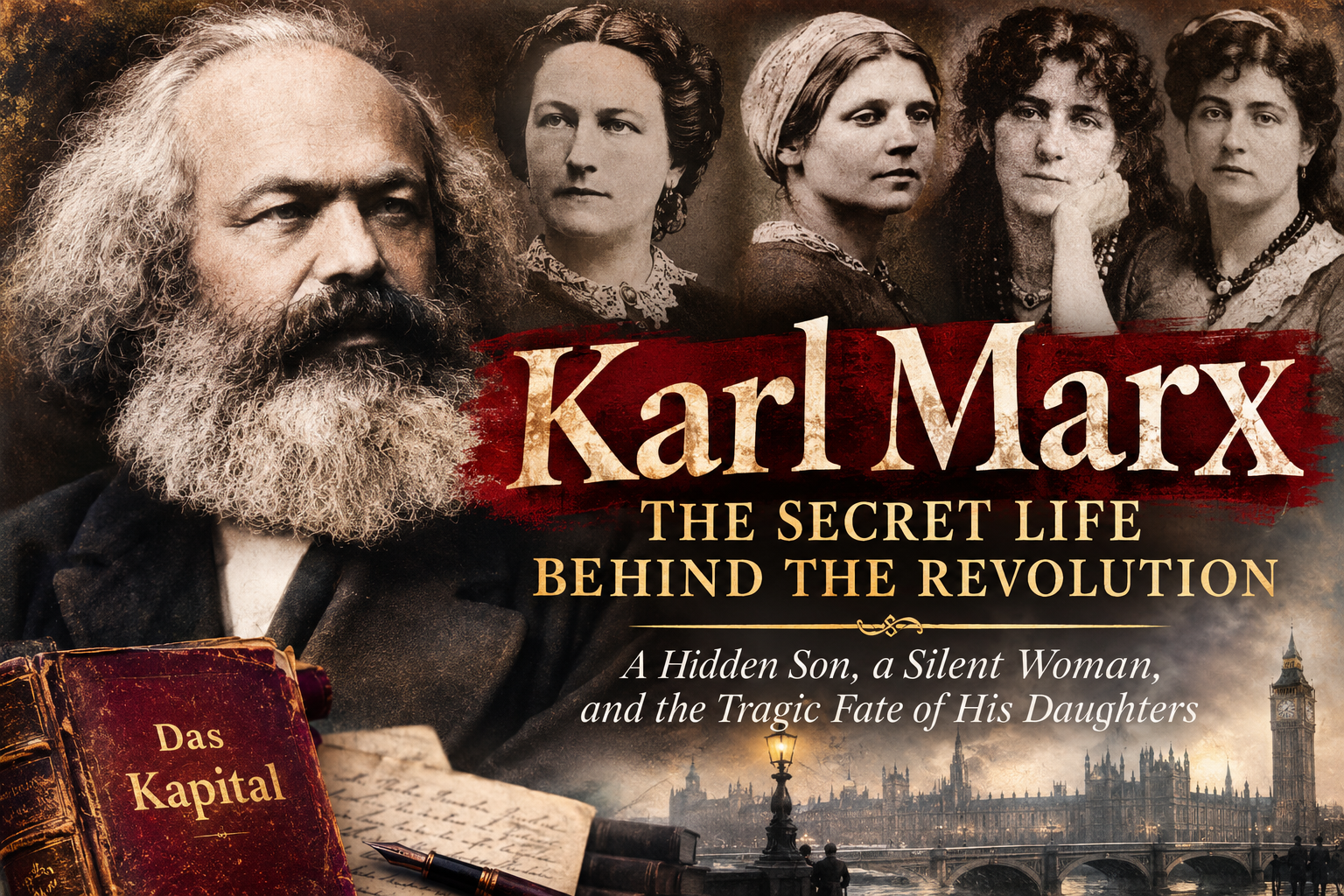
    Behind the man who promised to liberate humanity from exploitation lies a disturbing family history of poverty, financial dependence, concealed relationships, and two daughters whose lives ended in tragedy. But how much of this story is true, and how much has been rewritten to serve political agendas?

    There is something about the private lives of famous historical figures that has always fascinated me. We know their books, their speeches, their theories, and the ideas that changed the world, yet we rarely ask what happened when they returned home, closed the door, and became ordinary human beings, surrounded by people who had to live with their ambitions, weaknesses, and contradictions.

    Karl Marx is one of those figures whose public identity has almost completely swallowed the man himself. His name has been praised, condemned, worshipped, and blamed for some of the most dramatic political transformations in modern history. Generations have argued over his ideas about capitalism, class struggle, and revolution, but far fewer have examined the complicated relationships and painful secrets hidden within his own family.

    My curiosity began with an unusual statement circulating online, supposedly written by Marx himself. In it, he appeared to confess that he had fathered a child with his housekeeper, lived on his wife’s money, depended on a wealthy friend, and had two daughters who committed suicide.

    The accusations were extraordinary, but one detail immediately raised a question that changed the direction of my investigation. Marx died in 1883, while the two daughters mentioned in the statement died in 1898 and 1911. Whatever the origins of that supposed confession, it could not have been written by him in the form being circulated.

    I could have dismissed the entire story as another piece of political propaganda, but the historical details behind it were too intriguing to ignore. Some were documented, others remained disputed, and a few led me toward a side of Marx’s life that was far more revealing than the fabricated confession itself.

    I began following the story backward, through nineteenth-century London, family letters, biographies, and the lives of women who spent decades in the shadow of a man determined to change the world.

    And somewhere along the way, the revolutionary philosopher began to look very different from the familiar portrait hanging in history books.

    The Man Who Studied Poverty While His Own Family Was Drowning in It

    London, 1849.

    The city was becoming the industrial heart of the British Empire, a place where extraordinary wealth existed within walking distance of overcrowded rooms, polluted streets, and families struggling to survive. Factories produced fortunes for their owners, while thousands of workers endured exhausting labour and living conditions that would later become central to Marx’s criticism of capitalism.

    Marx arrived in this city as a political exile, accompanied by his wife, Jenny von Westphalen, and their children. The revolutionary movements of 1848 had failed to achieve the transformations he had hoped for, and his political activities had made it increasingly difficult for him to remain on the European continent.

    Jenny had not been born into poverty. Her family belonged to respectable Prussian society and had aristocratic connections, which makes the contrast between her upbringing and her married life especially striking. She had chosen a brilliant, controversial young intellectual whose political convictions offered little prospect of financial security.

    Their life in London became a long struggle against debt, illness, and uncertainty.

    At 28 Dean Street, in Soho, the family occupied cramped rooms that have since become part of the mythology surrounding Marx. Household possessions were repeatedly pawned, creditors demanded payment, and the lack of money affected almost every aspect of their existence.

    One of the details that stayed with me came from Jenny’s own recollections of the death of their daughter Franziska in 1852. The little girl was barely a year old, and the family was so impoverished that Jenny had to seek help to obtain a coffin.

    It is difficult to read such an account without imagining the despair inside that household. While Marx was developing arguments about the economic structures responsible for human suffering, his own wife was confronting a tragedy made even more painful by their inability to pay for the simplest funeral arrangements.

    Karl and Jenny had seven children, but only three daughters survived to adulthood: Jenny Caroline, Laura, and Eleanor.

    The deaths of their other children cannot simply be blamed on Marx’s financial decisions. Childhood mortality was tragically common in nineteenth-century Europe, and infectious diseases claimed lives across social classes. Nevertheless, the family’s precarious living conditions added another layer of vulnerability to an already dangerous world.

    The correspondence from those years reveals a man capable of intense intellectual concentration but frequently overwhelmed by practical difficulties. Marx worked as a journalist, received payments for articles, and occasionally benefited from inheritances, yet his income was inconsistent and his spending often exceeded what the household could afford.

    Jenny copied manuscripts, managed family affairs, dealt with correspondence, and helped preserve her husband’s work through periods when their circumstances might have destroyed it entirely.

    The more I read about her, the more I wondered how differently the history of Marxism might have unfolded without the unpaid and largely invisible labour of the woman who shared his life.

    But Jenny was not the only woman whose work sustained the Marx household.

    There was another, and her story leads directly to one of the most controversial mysteries in the philosopher’s biography.

    Helene Demuth: The Woman Who Knew Too Much

    Her name was Helene Demuth, although everyone in the family called her Lenchen.

    She had entered Jenny von Westphalen’s household before Jenny married Marx and remained connected to the family for decades. Through political exile, poverty, illness, and personal upheaval, Helene became an indispensable presence in their domestic life.

    She cooked, cleaned, cared for the children, and helped maintain the household while Marx spent long hours studying and writing.

    I find her position particularly interesting because she lived at the intersection of two very different worlds. Inside the same home where one of the nineteenth century’s most influential critics of class inequality was developing his theories, Helene performed the domestic labour that made his intellectual life possible.

    The relationship between Helene and the Marx family was not simply that of an employer and an employee. She was deeply involved in their daily existence and remained close to them throughout her life, although that closeness did not erase the differences in status and power between them.

    Then, in June 1851, something happened that would become the subject of speculation for generations.

    Helene gave birth to a boy.

    His name was Henry Frederick Demuth, usually known as Freddy.

    The father’s name was not recorded on his birth certificate.

    Freddy was raised outside the Marx household, and the identity of his biological father remained a question that would eventually divide historians.

    According to the account accepted by many Marx biographers, Karl Marx was the child’s father, while Friedrich Engels, Marx’s closest friend and collaborator, helped conceal the relationship to protect Jenny and prevent a scandal.

    But the story is not as straightforward as it is often presented.

    A crucial piece of evidence is a letter written in September 1898 by Louise Freyberger to the German socialist leader August Bebel. Freyberger reported that Engels had acknowledged, shortly before his death, that Marx was Freddy’s father.

    The letter is historically significant, but it is not the same as a direct confession by Marx, and it does not establish biological paternity beyond all doubt.

    Historians have debated the reliability of the testimony, the circumstances in which the information was transmitted, and whether the traditional interpretation rests too heavily on a limited documentary record.

    What makes this case especially revealing is the silence surrounding Helene herself. Her own detailed account of the circumstances has not survived, leaving historians dependent largely on the words and recollections of other people.

    I kept returning to that absence while reading about the controversy. The men involved became world-famous intellectual figures, their letters were collected, and their political disagreements were studied for generations, while the woman at the centre of this intimate mystery left comparatively little testimony through which we can hear her own voice.

    Freddy Demuth eventually worked as a skilled tradesman and lived a life far removed from the intellectual and political circles associated with Marx. He died in 1929.

    Whether Marx was his biological father remains disputed, but the existence of Freddy, his mother’s position in the household, and the later attempts to establish his paternity are part of the historical record.

    And the man whose name appears repeatedly in this controversy, Friedrich Engels, played another extraordinary role in Marx’s life.

    He helped keep him financially afloat for decades.

    Friedrich Engels: The Capitalist Who Financed the Critic of Capitalism

    If there is one contradiction in Marx’s biography that deserves careful examination, it is his relationship with Friedrich Engels.

    Engels was not merely a political companion or a fellow philosopher. He came from a prosperous industrial family whose business interests included textile manufacturing, particularly in Manchester, one of the great centres of British industrial capitalism.

    His family’s wealth was connected to the very economic system that Marx and Engels would spend much of their lives analysing and criticising.

    Engels knew the industrial world from within. He had observed the conditions endured by workers in Manchester and published The Condition of the Working Class in England in 1845, several years before Marx began publishing the major volumes of his economic work.

    The friendship between the two men developed into one of the most influential intellectual partnerships in modern history, but it also involved something much more practical.

    Money.

    Engels repeatedly sent financial assistance to Marx, helping him cover living expenses and continue his research during periods when the family had little reliable income.

    Their correspondence contains numerous references to financial difficulties, requests for help, payments, and arrangements intended to provide Marx with greater stability.

    In 1869, Engels retired from his commercial position in Manchester, and the financial arrangements between the two friends became more regular.

    What intrigued me was not simply the irony of a revolutionary thinker receiving money generated through capitalist industry. It was the extraordinary extent to which Marx’s intellectual independence depended on the material support of another person.

    Without Engels, Marx might still have developed his ideas, but the conditions under which he worked would have been considerably more difficult.

    Of course, receiving financial support from an industrialist does not automatically invalidate a critique of capitalism. Engels himself believed that understanding the system from within strengthened his arguments against its inequalities.

    Nevertheless, the relationship exposes a truth that ideological portraits often conceal: even the most radical intellectual projects depend on ordinary material realities.

    Someone has to pay the rent, purchase the books, provide food, and make it possible for a writer to spend years developing ideas that may never generate enough income to sustain a family.

    Marx understood economic dependence as a central feature of social life, yet his own dependence on Engels was unusually personal.

    There is something almost literary about that relationship, a wealthy industrialist financing the man who would become capitalism’s most famous critic, while the two worked together to imagine a world fundamentally different from the one that made their collaboration possible.

    But money was only one part of the story.

    Behind the intellectual partnership stood a family in which love, loyalty, illness, ambition, and sacrifice were becoming increasingly difficult to separate.

    Jenny Marx: The Woman Who Helped Build a Revolution and Paid a Personal Price

    When I began looking more closely at Jenny von Westphalen, I realised that her life deserved an investigation of its own.

    She was not simply the patient wife of a difficult genius, nor was she a passive figure standing quietly beside her husband’s intellectual achievements. Jenny was educated, politically aware, and deeply involved in the work that would eventually make Marx famous.

    She copied manuscripts, discussed political developments, maintained correspondence, and helped him navigate the complicated relationships surrounding the socialist movement.

    But she was also a mother who buried four children, a woman who lived for years under financial pressure, and a wife whose private life may have contained a betrayal that was never openly acknowledged.

    The possibility that Marx fathered Helene Demuth’s child raises uncomfortable questions about what Jenny knew and how the family handled the situation. The surviving evidence does not allow us to reconstruct her thoughts with certainty, and I would rather leave that silence intact than invent a confrontation or a confession for which no reliable document exists.

    What we do know is that Jenny remained with Marx until her death in December 1881, after a long marriage marked by political upheaval, financial insecurity, and repeated illness.

    One of the lesser-known aspects of their relationship is that Jenny came from a social background very different from the revolutionary circles in which her husband would eventually become famous. Their marriage crossed expectations of class and political respectability, and her commitment to Marx was established long before anyone could have predicted his historical influence.

    I found that detail particularly moving because it reminds us that Jenny did not marry a monument or a celebrated philosopher. She married a young man whose future was uncertain, whose ideas were controversial, and whose political activities would repeatedly disrupt their lives.

    History tends to preserve the achievements of exceptional men while reducing the women around them to supporting roles. Yet without Jenny’s labour, patience, intelligence, and practical involvement, the story of Karl Marx would have been profoundly different.

    And after Jenny’s death, the family began to unravel in ways that neither Marx nor Engels would live to witness completely.

    The Three Daughters Who Survived Childhood

    There were three daughters who reached adulthood in the Marx family, and their lives reveal something rarely discussed in the simplified portraits of their father.

    Jenny Caroline, Laura, and Eleanor were raised in an intellectually intense household, surrounded by political debates, books, foreign languages, visiting revolutionaries, and conversations about the future of European society.

    Marx was affectionate with his children, who called him Moor, a family nickname associated with his dark appearance. His letters and the recollections of those who knew him reveal a playful side of his personality, particularly in his relationships with children and grandchildren.

    This is an important part of the story because the historical record does not support portraying Marx as a man incapable of affection or indifferent to his family.

    He could be loving, humorous, demanding, irritable, intellectually generous, and personally difficult, sometimes within the same relationship.

    His daughters inherited more than his name. They grew up in a world where political commitment was treated as a serious moral responsibility, and both Laura and Eleanor became active participants in socialist movements.

    The eldest daughter, Jenny Caroline, married the French socialist Charles Longuet and became involved in political journalism and activism. Her life was cut short by illness in January 1883, only weeks before her father’s death.

    By then, Marx had already lost his wife and several children, and his own health was deteriorating.

    Karl Marx died in London on 14 March 1883, aged sixty-four.

    His death is essential to understanding the false quotation that originally led me into this investigation, because the tragedies most frequently used to condemn his private life had not yet occurred.

    Eleanor would die fifteen years later.

    Laura would die twenty-eight years later.

    Neither event could have appeared in a genuine confession written by their father.

    Yet the circumstances of those deaths are among the most haunting episodes in the history of the Marx family.

    Eleanor Marx: The Woman Who Fought for Freedom but Could Not Escape Her Own Tragedy

    Eleanor Marx was born in London in January 1855 and became known within her family as Tussy.

    Of all Marx’s daughters, she is perhaps the one whose life most clearly demonstrates the tension between public convictions and private suffering.

    She was intelligent, energetic, politically committed, and deeply interested in literature and theatre. She translated important works, including Gustave Flaubert’s Madame Bovary, and became involved in the British labour movement at a time when women were still struggling to gain recognition as independent political actors.

    Eleanor helped organise workers, supported trade union activity, and became associated with the emerging socialist movement in Britain.

    She was not merely repeating her father’s ideas. She developed her own political identity and became an important advocate for women’s emancipation.

    What drew me into her story was the contrast between the independence she defended publicly and the painful complications of her relationship with Edward Aveling.

    Aveling was a socialist lecturer, writer, and activist who moved in the same intellectual circles as Eleanor. He was charismatic, educated, and politically active, but his personal and financial conduct attracted criticism even among his associates.

    The two began living together in the 1880s, although their relationship was never formalised through marriage.

    For years, Eleanor supported their shared political activities while also dealing with Aveling’s financial difficulties and the tensions surrounding his behaviour.

    Their relationship became increasingly troubled, and in 1897 Aveling secretly married another woman, an actress named Eva Frye, despite his continuing relationship with Eleanor.

    This deception would become central to the accounts written after Eleanor’s death.

    On 31 March 1898, Eleanor died at her home in Sydenham, London, after taking poison. She was forty-three years old.

    The circumstances surrounding her death generated suspicion and controversy almost immediately.

    Aveling’s behaviour was questioned, particularly because of his secret marriage and the circumstances in which Eleanor obtained the poison. Some contemporaries believed he bore a grave moral responsibility for what happened, although the available evidence does not establish that he murdered her.

    One of the most valuable contemporary accounts came from Eduard Bernstein, who had known Eleanor and published an examination of her death in July 1898.

    Bernstein’s account is important because it demonstrates that concerns about Aveling were not simply inventions created by later political opponents of Marx.

    But even this testimony cannot tell us everything that passed through Eleanor’s mind during her final days.

    I kept thinking about the woman who had spent years speaking about freedom, equality, and the dignity of working people, yet whose own intimate relationship had become a source of profound distress.

    It would be tempting to turn her death into a symbolic judgement on her father’s philosophy, but doing so would erase the independent life she had built and reduce a complex personal tragedy to a political argument.

    Eleanor was not simply Karl Marx’s unfortunate daughter.

    She was a remarkable woman whose achievements deserve recognition independently of the circumstances of her death.

    Her story also raises a question that remains painfully relevant today: how can someone understand injustice so clearly in public life and still become trapped in a destructive relationship in private?

    There is no simple answer, and perhaps that is precisely why her story continues to disturb me.

    Laura Marx: The Final Tragedy and a Decision That Shocked Europe

    The second daughter whose death is mentioned in the circulating accusation was Laura Marx, born in Brussels in 1845.

    Laura married Paul Lafargue, a French socialist of Cuban background who became one of the best-known figures in the French socialist movement.

    Lafargue is remembered for his provocative essay The Right to Be Lazy, first published in 1880, in which he criticised the glorification of endless labour and challenged the idea that human existence should revolve entirely around work.

    Laura and Paul shared political commitments, intellectual interests, and decades of activism. They also experienced personal tragedy, including the deaths of their children.

    Unlike Eleanor, Laura did not die following a documented romantic betrayal.

    Her death occurred under entirely different circumstances.

    On 26 November 1911, Laura and Paul Lafargue died by suicide at their home in Draveil, near Paris. Laura was sixty-six, while Paul was sixty-nine.

    Paul left a written explanation describing his determination not to endure the physical and intellectual decline he associated with old age. His final statement also expressed confidence in the future of socialism.

    The decision shocked many contemporaries, including members of the socialist movement who admired the couple.

    Vladimir Lenin attended their funeral and spoke in their memory.

    I find the contrast between the two sisters especially important. Eleanor’s death followed years of personal turmoil and deception, while Laura and Paul had made a deliberate joint decision shaped by their own beliefs about ageing, independence, and the end of life.

    Both deaths were tragic, but they cannot responsibly be explained as consequences of a single family ideology.

    There is also a historical irony that deserves attention.

    Karl Marx, whose writings were devoted to understanding the forces shaping human lives, never knew how the stories of his two surviving daughters would end.

    He had been dead for fifteen years when Eleanor died and for twenty-eight years when Laura died.

    The famous revolutionary who had imagined a transformed future never lived to see these final chapters of his family’s history.

    The Forgotten Lives Behind the Famous Name

    By this point in my investigation, something had begun to trouble me more than the original accusation.

    Almost every popular account of the Marx family revolves around Karl himself, even when the most extraordinary events concern the women around him.

    Jenny is remembered primarily as his wife.

    Helene is remembered through the controversy surrounding the paternity of her son.

    Eleanor is frequently reduced to the tragedy of her relationship with Edward Aveling.

    Laura is often mentioned only because of the circumstances of her death.

    Yet each of these women had a life far more complicated than the role assigned to her in the biography of a famous man.

    Jenny helped preserve and support a body of work that would influence generations.

    Helene remained an essential figure in the household and later helped care for Engels after Marx’s death. She died in 1890 and was buried in the Marx family grave at Highgate Cemetery, a detail that speaks to the unusual closeness of her relationship with the family.

    Eleanor became a political activist, translator, and organiser in her own right.

    Laura worked alongside her husband in the international socialist movement and helped sustain the intellectual and political legacy of her father.

    Their stories deserve to be told without reducing them to evidence for or against Marxism.

    Another detail caught my attention while examining the family history: after Marx died, Engels devoted considerable effort to organising and publishing the manuscripts his friend had left unfinished.

    The second and third volumes of Capital were published after Marx’s death, edited by Engels in 1885 and 1894.

    That means the intellectual legacy we associate with Marx was also shaped by the editorial decisions and years of work of another man.

    Even the most famous achievements attributed to solitary historical figures often depend on networks of people whose contributions are less visible.

    The Marx household was not simply the residence of a philosopher.

    It was a place where political ideas, domestic labour, financial support, friendship, personal loyalty, and unresolved tensions existed together.

    And perhaps the most revealing aspect of this history is that none of those elements can be completely separated from the others.

    The Confession Karl Marx Could Never Have Written

    I eventually returned to the statement that had started this investigation.

    Its message was designed to be devastating: the man who criticised exploitation supposedly admitted that he had depended on other people’s money, betrayed his wife, and watched his daughters die by suicide.

    Several elements were drawn from real historical controversies, but the supposed confession contained an impossible chronology.

    Marx died in 1883.

    Eleanor died in 1898.

    Laura died in 1911.

    A man cannot confess to having witnessed events that occurred after his death.

    I have found no reliable primary source establishing that Marx wrote or spoke the statement circulating online, and its reference to the later deaths of his daughters is sufficient to demonstrate that it cannot be an authentic quotation in that form.

    This is how historical misinformation often becomes persuasive.

    It does not always begin with a completely invented story. Sometimes it takes genuine events, removes their context, rearranges their chronology, and places them inside a dramatic quotation attributed to a famous person.

    The result feels convincing precisely because some of its ingredients are true.

    Marx did depend heavily on financial support from Engels.

    The paternity of Helene Demuth’s son has been attributed to Marx by numerous biographers, although the matter remains historically disputed.

    Two of Marx’s daughters did die by suicide.

    But combining these facts into a supposed personal confession transforms history into something else entirely.

    It creates the illusion that Marx himself acknowledged a moral failure involving events he never lived to witness.

    The distinction matters because historical truth should not depend on whether we admire or despise the person being investigated.

    If we want to criticise Marx, there is no shortage of authentic material to examine. His writings, political positions, personal correspondence, conflicts with other socialists, and the later interpretations of his ideas provide enormous room for serious debate.

    Inventing a confession only weakens that debate.

    Can a Man Who Wanted to Liberate Humanity Be Judged by His Own Life?

    This was the question I carried with me after finishing my research.

    Marx spent much of his life investigating the relationship between economic power and human freedom, yet his own household depended on financial assistance, domestic labour, and the sacrifices of people who rarely received public recognition.

    He criticised systems of inequality while living within the social structures of nineteenth-century Europe, structures that shaped his own relationships as surely as they shaped those of the people he studied.

    If he fathered Helene Demuth’s child, as many historians believe, the circumstances raise serious questions about personal responsibility and the vulnerability of a woman employed in his household.

    But it would be equally misleading to ignore the evidence of affection within his family, his grief over the deaths of his children, or the political and intellectual achievements of his daughters.

    Human beings rarely fit the moral categories that later generations create for them.

    The same person can produce extraordinary intellectual work and make deeply questionable personal decisions. Someone can understand the suffering of strangers while failing to recognise the harm caused within their closest relationships.

    That contradiction is not unique to Marx.

    It appears repeatedly throughout history, in the lives of philosophers, religious leaders, reformers, artists, and revolutionaries who offered humanity visions of a better world while struggling with their own limitations.

    I have never believed that we understand historical figures by turning them into saints or monsters.

    Both approaches are convenient because they remove the need to examine complexity.

    The saint can do no wrong, while the monster can do nothing right.

    The real person disappears somewhere between those two inventions.

    Karl Marx’s private life does not, by itself, prove or disprove his economic theories. Those theories must be examined through their arguments, historical evidence, and consequences.

    But his private life does reveal something about the distance that can exist between intellectual ideals and everyday human behaviour.

    And that distance is worth investigating, particularly when a historical figure becomes the symbol of a movement that claims to understand how society should be organised.

    The Silence That Remains

    When I think about this story now, the image that stays with me is not the familiar photograph of Karl Marx, seated with his heavy beard and penetrating expression.

    It is the image of a London household in which several lives unfolded around the ambitions of one extraordinary man.

    I imagine Jenny working through another difficult evening, surrounded by papers, unpaid bills, and the constant demands of family life.

    I think of Helene Demuth, whose presence was essential to that household but whose own voice remains largely absent from the controversy that followed her son.

    I think of Eleanor, the passionate advocate for women’s freedom whose final years were overshadowed by a relationship that brought her enormous suffering.

    And I think of Laura, who lived long enough to witness the expansion of the socialist movement across Europe but whose life ended in circumstances that shocked even those closest to her political world.

    These women were not merely witnesses to Karl Marx’s greatness or evidence of his shortcomings.

    They were individuals whose experiences reveal the human cost, complexity, and contradictions of a family that lived at the centre of nineteenth-century revolutionary politics.

    What began for me as an attempt to verify a suspicious quotation became something far more interesting: an investigation into the private world behind a public legend.

    The fabricated confession was easy to expose once the dates were examined.

    The genuine history was much harder to understand.

    And that is often the difference between propaganda and historical investigation. Propaganda offers a conclusion before asking questions, while serious investigation forces us to live with details that do not always fit together comfortably.

    Karl Marx wanted to understand the forces that shaped human society, and his ideas would influence generations long after his death.

    Yet behind those ideas were people whose lives cannot be reduced to economic theories, political slogans, or the convenient judgements of posterity.

    Perhaps the most unsettling truth is not that the man who wanted to change the world had contradictions.

    It is that we continue to search for flawless people behind powerful ideas, even though history repeatedly shows us how rarely such people exist.

    The real mystery of Karl Marx is not whether he lived according to every principle he defended, but how much of the human story behind his intellectual legacy we have chosen to forget.


    Historical Sources and Further Reading

    1. Karl Marx and Friedrich Engels — Collected Works and Correspondence. Their letters provide essential evidence about the family’s financial circumstances, political activities, personal relationships, and Engels’s long-term financial support.

    Marxists Internet Archive: https://www.marxists.org/archive/marx/

    2. Mary Gabriel — Love and Capital: Karl and Jenny Marx and the Birth of a Revolution (2011). A detailed narrative biography examining the Marx family, Jenny’s role, the children’s lives, and the personal circumstances surrounding the development of Marx’s ideas.

    3. Jonathan Sperber — Karl Marx: A Nineteenth-Century Life (2013). A historical biography that places Marx within the intellectual, political, and social realities of nineteenth-century Europe.

    4. Gareth Stedman Jones — Karl Marx: Greatness and Illusion (2016). A critical examination of Marx’s life and thought, separating the historical individual from the political mythology constructed around him.

    5. Yvonne Kapp — Eleanor Marx: Family Life (1855–1883) and Eleanor Marx: The Crowded Years (1884–1898). Two major biographical studies of Eleanor’s intellectual achievements, political activities, relationship with Edward Aveling, and final years.

    6. Eduard Bernstein — What Drove Eleanor Marx to Suicide? (1898). A contemporary account discussing the circumstances surrounding Eleanor’s death and the conduct of Edward Aveling.

    7. Peter Madill — Historical research on Frederick Demuth and the disputed paternity evidence. Research revisiting the documentary record surrounding the alleged relationship between Marx and Helene Demuth.

    8. Paul Lafargue — The Right to Be Lazy (1880). A work offering insight into the intellectual and political convictions of Laura Marx’s husband.

    9. Jenny Marx — Autobiographical recollections and family correspondence. Important firsthand material concerning the family’s years of poverty, the deaths of the children, and the difficulties of political exile.


    Whisper Mysteries — Hidden History, Forgotten Lives, and the Stories Behind the Official Narrative.

  • MH370: The Plane That Vanished — And the Truth Still Buried Beneath the Ocean

    MH370: The Plane That Vanished — And the Truth Still Buried Beneath the Ocean

    MH370: The Plane That Vanished — And the Truth Still Buried Beneath the Ocean

    239 people disappeared into the darkness of the Indian Ocean. Twelve years later, the aircraft remains missing, its final hours are still unexplained, and one of aviation’s greatest mysteries continues to challenge everything we believe about modern technology.

    There is something deeply unsettling about the disappearance of Malaysia Airlines Flight MH370, something that goes beyond the tragedy itself and raises uncomfortable questions about the technological world we inhabit. We live in an age in which satellites observe the Earth, aircraft communicate across continents, and sophisticated surveillance systems monitor movements that would once have remained invisible. Yet, on March 8, 2014, a Boeing 777 carrying 239 people vanished during what should have been an ordinary flight from Kuala Lumpur to Beijing.

    I have returned to this story several times over the years, not because I believe every mysterious disappearance conceals a conspiracy, but because certain details refuse to fit comfortably into a simple explanation. The more I examined the official reports, satellite communications, recovered debris, and extraordinary scale of the underwater searches, the more I understood why MH370 has become something larger than an aviation investigation.

    What intrigues me most is not simply that the aircraft disappeared, but that investigators were able to reconstruct fragments of its journey without ever establishing what happened inside the cockpit, why the aircraft changed course, or precisely where its final descent ended.

    Now, twelve years later, advanced underwater robots have brought renewed attention to the southern Indian Ocean, reminding us of an uncomfortable reality: finding something in the deepest parts of our own planet can still be extraordinarily difficult.

    And somewhere beneath those immense stretches of dark water, the evidence that could resolve this mystery may still be waiting.

    The Last Ordinary Conversation

    The final routine radio exchange between MH370 and Malaysian air traffic control occurred at approximately 1:19 a.m., Malaysian time, as the aircraft approached the boundary between Malaysian and Vietnamese-controlled airspace.

    The message, commonly reproduced as Good night Malaysian Three Seven Zero, sounded entirely ordinary. There was no distress call, no warning of an emergency, and nothing in the recorded exchange that suggested the aircraft was about to become the centre of an international mystery.

    Approximately two minutes later, its transponder stopped providing the identifying information used by civilian air traffic control. The aircraft disappeared from conventional tracking displays, but it had not disappeared from the sky.

    Military radar data later indicated that MH370 had turned away from its intended route, crossed back over the Malay Peninsula, and continued northwest towards the Strait of Malacca before leaving radar coverage.

    I find this sequence particularly disturbing because it changes the nature of the mystery. We are not dealing simply with an aircraft that lost contact and immediately crashed into the sea. The available evidence indicates that it continued flying for hours after disappearing from civilian radar.

    The question that has troubled investigators ever since is whether those changes resulted from deliberate human intervention, an extraordinary technical emergency, or a combination of circumstances that has never been reconstructed.

    The Malaysian safety investigation published in 2018 acknowledged that the changes in flight path were difficult to attribute to ordinary system failures alone, yet it could not establish who, or what, was responsible.

    Evidence suggesting deliberate control of an aircraft is not the same as proof of a particular person’s intentions, and that distinction remains essential when examining MH370.

    The Satellite That Continued Listening

    One of the least understood aspects of MH370 is that the aircraft did not vanish completely from the technological world when its transponder stopped transmitting.

    A satellite communications system operated through Inmarsat continued to exchange automated signals with equipment aboard the aircraft. These exchanges, often described as electronic handshakes, were not ordinary messages from the pilots and did not reveal the aircraft’s exact position.

    Instead, they provided technical measurements from which investigators could estimate the aircraft’s distance from the satellite and examine its movement.

    Two types of information became especially important: Burst Timing Offset, which helped establish possible distance arcs, and Burst Frequency Offset, which provided clues about relative motion through changes in signal frequency.

    The resulting analysis pointed towards the southern Indian Ocean, far from the original flight route to Beijing.

    What struck me while studying this evidence was how much information could be extracted from signals that were never intended to function as a complete tracking system. Investigators were effectively reconstructing the movements of a missing aircraft from the timing and frequency characteristics of brief satellite communications.

    But there was a fundamental limitation. A distance measurement does not identify a single location, and even a sophisticated reconstruction remains dependent on assumptions about speed, altitude, direction, and aircraft behaviour.

    The famous seventh arc, associated with the aircraft’s final satellite communication at approximately 8:19 a.m., was therefore not a precise crash location. It was a geographical constraint within which investigators had to search for a possible endpoint.

    Another intriguing detail concerns the satellite communication system itself. After an interruption, it logged back onto the network at approximately 2:25 a.m., an event investigators examined as a possible indication of an interruption and restoration of electrical power to the satellite data unit.

    A further log-on occurred near the end of the flight, at approximately 8:19 a.m. Investigators considered whether this event could have followed a power interruption associated with fuel exhaustion and subsequent electrical changes, although the available evidence could not establish the complete sequence.

    These are not insignificant technical details. They offer rare glimpses into the condition of an aircraft whose cockpit conversations, final decisions, and last moments remain unknown.

    The Ocean That Concealed an Aircraft

    When I first looked at the maps of the MH370 search areas, I underestimated the scale of the problem. On a computer screen, the southern Indian Ocean appears as an immense blue expanse interrupted by lines, coordinates, and carefully drawn search boundaries. In reality, those lines cross one of the most remote and difficult maritime environments on Earth.

    The search crews faced powerful winds, enormous waves, unpredictable weather, and depths reaching several kilometres. Beneath the surface lay underwater mountains, steep slopes, deep valleys, and geological formations that complicated the interpretation of sonar images.

    Before investigators could systematically search certain areas for an aircraft, they needed to map portions of the seabed itself.

    The Australian-led underwater operation eventually examined more than 120,000 square kilometres before being suspended in January 2017. It was one of the most extensive searches ever conducted for a missing aircraft, yet it failed to locate the main wreckage.

    What fascinated me was the paradox: the search produced an extraordinary body of new geographical information about the ocean floor, while the object responsible for the investigation remained undiscovered.

    The seabed had become better known, but the fate of the aircraft had not.

    The First Piece of the Puzzle Was Found on a Beach

    In July 2015, a large piece of aircraft wreckage washed ashore on Réunion, a French island in the western Indian Ocean.

    The object was a flaperon, a movable surface from an aircraft wing, and investigators subsequently confirmed that it belonged to MH370.

    This discovery fundamentally changed the investigation because it provided physical evidence connecting the missing aircraft to the Indian Ocean.

    Additional debris was subsequently recovered along the shores of East Africa and nearby islands, including fragments whose identification and connection to MH370 varied in certainty.

    The ocean currents had apparently carried pieces of the aircraft thousands of kilometres from their original location.

    I became particularly interested in the scientific effort to reverse that journey. Researchers examined currents, winds, drifting objects, and marine growth on recovered fragments in an attempt to determine where the debris might have entered the water.

    Even the small marine organisms attached to wreckage became potential witnesses.

    Barnacles, for example, can provide information about environmental conditions experienced during their growth. Researchers have explored whether the chemical composition of their shells could help reconstruct the temperature history of drifting debris and, indirectly, its possible journey across the ocean.

    It is an extraordinary idea that something as small as a marine organism might preserve clues about an aircraft that the world’s most advanced search systems could not locate.

    But ocean drift modelling is not an exact reversal of time. Floating debris can be influenced by wind exposure, waves, currents, and the shape of individual fragments. Different assumptions can produce different possible origins.

    The recovered pieces support the conclusion that MH370 ended its flight in the Indian Ocean, but they have not established the precise impact location or explained why the aircraft travelled there.

    The Pilot, the Flight Simulator, and a Theory That Refuses to Disappear

    Among the most controversial elements of the MH370 investigation is the discovery of deleted flight simulation data on a computer belonging to the aircraft’s captain, Zaharie Ahmad Shah.

    Investigators recovered information relating to simulated flight paths, including coordinates associated with a route towards the southern Indian Ocean. The discovery attracted considerable attention because of its apparent geographical resemblance to the region where MH370 is believed to have ended its journey.

    I wanted to understand whether this represented compelling evidence or whether the connection had become stronger in public imagination than it was in the actual investigation.

    The distinction is important. The recovered simulator data did not constitute a complete, verified rehearsal of the final MH370 flight, and the official investigation did not establish that the captain deliberately caused the aircraft’s disappearance.

    Nevertheless, the possibility of intentional human intervention has remained part of the debate, particularly because of the aircraft’s unexplained course changes and the absence of a conventional distress message.

    Other proposed explanations include a serious onboard emergency, loss of cabin pressure, incapacitation of those aboard, and an aircraft continuing under automatic flight control until its fuel was exhausted.

    Each explanation encounters difficulties when compared with the available evidence.

    An emergency might account for an initial deviation from the planned route, but explaining the subsequent flight requires additional assumptions. Deliberate intervention could explain some of the course changes, but the available evidence does not identify a perpetrator or establish a motive.

    What I find most revealing is how easily uncertainty becomes certainty when a theory is repeated often enough. A suspicious detail can become an accusation, and an unverified interpretation can eventually acquire the appearance of historical fact.

    In the case of MH370, that would be especially irresponsible, because the people aboard cannot defend themselves and their families have already endured years of speculation.

    The Radio Signals That Might Reveal Another Route

    One of the more unusual approaches to locating MH370 involves a global network of amateur radio transmissions known as WSPR, or Weak Signal Propagation Reporter.

    The system was developed to study radio propagation rather than track aircraft. However, British engineer Richard Godfrey and other independent researchers have explored whether disturbances in historical radio signal data might reveal the passage of MH370 through particular regions.

    The idea is intriguing because it proposes extracting information from an entirely different technological system, one that was operating independently of the aircraft’s conventional navigation and communication equipment.

    According to Godfrey’s proposed reconstruction, the aircraft may have followed a route towards a specific region of the southern Indian Ocean that deserves further investigation.

    I was fascinated by the possibility that signals exchanged by amateur radio operators, scattered across different continents, might contain traces of an aircraft whose disappearance became a global mystery.

    Yet this hypothesis must be treated carefully. The use of WSPR data to reconstruct the precise historical path of an individual aircraft is disputed, and the proposed locations have not been independently validated by the discovery of wreckage.

    It remains a research hypothesis rather than an established solution.

    Still, the existence of such alternative approaches illustrates something important about MH370: the investigation has attracted people from aviation, oceanography, mathematics, radio engineering, satellite communications, and several other scientific disciplines.

    The aircraft may have disappeared from radar, but it never disappeared from the questions researchers continued to ask.

    The Robots Searching the Darkness

    The latest chapter of this investigation belongs to underwater robotics.

    Ocean Infinity, a marine exploration company specialising in autonomous systems, conducted an unsuccessful search in 2018 before returning to the southern Indian Ocean with newer technology.

    Unlike conventional searches that rely heavily on ships towing equipment over the seabed, autonomous underwater vehicles can travel through the ocean while collecting high-resolution sonar information and other measurements.

    These machines operate in an environment where sunlight cannot penetrate, GPS signals cannot be received underwater, and conventional radio communication becomes impractical.

    They navigate using combinations of inertial navigation, acoustic positioning, and other sensors, while collecting data that can later be examined for unusual objects or structures.

    Their sonar systems produce detailed representations of the seabed, allowing investigators to distinguish geological features from objects that might be fragments of a large aircraft.

    But the technology is not infallible. Underwater mountains can create shadows in sonar imagery, steep slopes complicate scanning, and an object may be difficult to identify if it lies in an unexpected position or is partly obscured.

    The results of Ocean Infinity’s latest campaign illustrate both the progress and the limitations of modern exploration.

    According to Malaysia’s Ministry of Transport, the search conducted between March 2025 and January 2026 involved 28 operational days under the new agreement and examined approximately 7,571 square kilometres of seabed. The aircraft was not found.

    In March 2026, Ocean Infinity reported that, across its MH370 operations since 2018, it had spent 151 days at sea and mapped more than 140,000 square kilometres of ocean floor.

    Its chief executive, Oliver Plunkett, emphasised that unsuccessful searches still provide valuable information by eliminating areas and allowing future investigators to refine their calculations.

    I find this aspect particularly interesting because failure in an investigation does not always mean the absence of progress. Every carefully examined region changes the geographical problem, although the confidence with which an area can be excluded depends on the quality and completeness of the search.

    On June 29, 2026, Malaysia announced that Ocean Infinity’s agreement would be extended until June 30, 2027, allowing the company to complete work on approximately 7,428 square kilometres still awaiting examination.

    The arrangement follows a no find, no fee principle, with a payment of $70 million contingent upon locating the wreckage.

    The mystery remains unresolved, but the search has not been abandoned.

    What the Black Boxes Could Tell Us — and What They Might Never Reveal

    There is a widespread assumption that finding MH370’s flight recorders would immediately explain everything.

    The reality is more complicated.

    The flight data recorder could contain crucial information about the aircraft’s altitude, speed, flight controls, engine parameters, and system behaviour, depending on the condition and recoverability of the stored data.

    The cockpit voice recorder could also provide important evidence, but its recording capacity was limited. On a flight that continued for hours after communications were lost, the earliest and potentially most revealing cockpit conversations might have been overwritten before the aircraft reached the ocean.

    After more than twelve years underwater, the physical condition of both recorders would also be uncertain, although such devices are designed to survive extremely severe conditions.

    Locating the main wreckage could nevertheless provide information that no satellite calculation can supply.

    The distribution of debris, the condition of the fuselage, the position of major components, and the damage to flight control surfaces could help investigators reconstruct the aircraft’s final impact.

    I keep returning to the possibility that the greatest discovery might not be a dramatic recording or an unexpected revelation, but a series of technical details that finally allows investigators to eliminate competing explanations.

    Sometimes the truth does not arrive as a confession. It emerges slowly, from measurements, fragments, and evidence that only acquires meaning when everything is examined together.

    The Most Uncomfortable Question

    After examining the history of MH370, I find myself returning to one question that seems almost impossible to ignore.

    How could a modern passenger aircraft continue flying for hours beyond its expected route without anyone being able to determine its precise location in time to intervene?

    The answer involves limitations that were not widely understood by the public in 2014.

    Aircraft tracking depended on several different systems, and continuous global position reporting was not as comprehensive as many passengers assumed. Radar coverage was limited by geography and distance, particularly over remote oceans, while satellite communications were not necessarily designed to transmit a continuous record of an aircraft’s exact coordinates.

    The disappearance exposed vulnerabilities that prompted changes in international aviation tracking requirements.

    What troubles me is the distance between the technological world we imagine and the technological world that actually exists.

    We have become accustomed to believing that everything is recorded, monitored, stored, and recoverable. Yet MH370 demonstrated that a highly sophisticated aircraft could leave behind a trail of indirect electronic evidence without leaving investigators a definitive explanation of its fate.

    That does not prove the existence of a cover-up, and the absence of a complete answer should never be treated as evidence that authorities are concealing one.

    But it does reveal how fragile our confidence in technological certainty can become when confronted with an event that falls outside ordinary expectations.

    The People Behind the Mystery

    There is one aspect of MH370 that I believe deserves more attention than the endless arguments about pilots, satellites, and hidden flight paths.

    There were 239 human beings aboard that aircraft: 227 passengers and 12 crew members.

    They had families, personal histories, responsibilities, unfinished conversations, and plans that extended far beyond the morning of March 8, 2014.

    For their relatives, the disappearance did not end when the initial search operations were suspended or when the international media gradually turned its attention elsewhere.

    The absence of the main wreckage has meant living without a complete explanation of the circumstances in which their loved ones died.

    I think this is why the continued search matters, even when another unsuccessful expedition produces little public excitement.

    Finding MH370 would not reverse the tragedy, but it could provide answers that the families have waited more than a decade to receive.

    It could also reveal lessons capable of preventing another disappearance under similar circumstances.

    And that possibility gives the investigation a significance far beyond curiosity about an unsolved mystery.

    Somewhere Beneath the Seventh Arc

    I began examining MH370 because I was intrigued by the apparent contradiction between modern surveillance technology and the disappearance of an enormous commercial aircraft. What I discovered was a far more complex story involving incomplete information, extraordinary scientific efforts, competing interpretations, and an ocean whose immense depths still resist our attempts to understand them.

    The recovered debris tells us that the aircraft reached the Indian Ocean. The satellite communications provide important constraints on its final journey. The radar information reveals that its route changed in ways investigators have never fully explained.

    But none of these pieces, individually or together, has yet established the complete sequence of events.

    I do not believe we need to invent an extraordinary explanation to recognise how extraordinary this case already is.

    An aircraft carrying 239 people departed on a scheduled international flight, changed course, continued into one of the most isolated regions of the planet, and disappeared into waters so vast that even years of coordinated searches have failed to locate its main wreckage.

    Somewhere beneath the southern Indian Ocean, the remains of MH370 may still contain evidence capable of answering questions that have haunted investigators and families since 2014.

    The most haunting part of this story is that the truth may not be inaccessible because someone deliberately concealed it. It may simply be lying several kilometres beneath the surface, surrounded by darkness, waiting for technology and human persistence to reach the right place.

    And until that happens, MH370 will remain more than a missing aircraft. It will remain a reminder that, despite everything humanity has learned about the world, there are still places on our own planet where the answers to our most urgent questions can disappear from sight.

    Whisper Mysteries — Discover the Inexplicable.


    Sources and Further Reading

    • Malaysian Ministry of Transport — Safety Investigation Report MH370, 2018.
    • Australian Transport Safety Bureau — The Operational Search for MH370, 2017.
    • Ocean Infinity — MH370 search updates, March 2026.
    • Malaysian Ministry of Transport — MH370 search extension announcement, June 2026.
    • Inmarsat satellite communications analysis associated with the MH370 investigation.

    Editorial note: The theories discussed in this article remain unproven unless explicitly supported by official findings. As of November 5, 2026, the main wreckage of MH370 has not been located and the cause of its disappearance remains undetermined.

  • The Price of a Child’s Hope: Inside Greece’s €5.8 Million Charity Scandal

    The Price of a Child’s Hope: Inside Greece’s €5.8 Million Charity Scandal

    An investigation into the Greek nonprofit organization “Παιδική Χαρά,” the millions collected in the name of vulnerable children, and the disturbing questions surrounding the people entrusted with their hope.

    For the past few days, I have found myself sitting in front of the television, watching the news from Greece with a growing sense of horror. I have followed stories of corruption, financial scandals, political deception, and human greed for years, yet there is something particularly disturbing about an investigation involving money donated for sick children. It is not simply the amount of money that troubles me, although the reported figure of €5.8 million is staggering. It is the possibility that one of the most compassionate human instincts, our willingness to help a suffering child, may have been turned into an extraordinarily profitable instrument of deception.

    The organization at the center of the controversy bears an almost painfully innocent name: Παιδική Χαρά, meaning “Children’s Joy.”

    As I listened to the reports, I kept returning to that name, wondering how something associated with childhood happiness could become the subject of such serious criminal allegations. Behind the television headlines, I wanted to understand something more important than the financial figures: how an organization could gain people’s confidence, how donations could allegedly be diverted from their intended purpose, and what warning signs might have been overlooked along the way.

    What began as another news story gradually became, for me, an investigation into the fragile relationship between generosity, trust, and the people who claim to act on behalf of those who cannot defend themselves.

    The Millions Behind the Promise

    According to Greek media reports published in early November 2026, investigators have been examining approximately €5.8 million in financial movements associated with the nonprofit organization and individuals connected to it over a period extending from 2018 to 2026.

    What particularly caught my attention was the reported complexity of the financial trail, involving numerous transactions and accounts that investigators have been attempting to reconstruct. Reports have suggested that only a portion of the money collected reached children and families requiring assistance, while substantial amounts are suspected of having been diverted toward other purposes.

    An important distinction must be made here: the €5.8 million figure refers to financial activity under investigation, not to a judicially established amount of stolen donations.

    I found myself wondering what it must feel like for a parent desperately trying to finance a child’s treatment to discover that an organization offering help is now being investigated for the possible misuse of charitable contributions. When a family is confronted with a serious illness, time becomes an enemy, medical expenses become overwhelming, and an offer of financial assistance can appear almost miraculous.

    The emotional circumstances surrounding such donations are precisely what make this case so unsettling. Donors are not purchasing a product or expecting a financial return. They are placing their confidence in strangers because they believe that somewhere, a child might have a better chance of surviving.

    A Name, a Public Image, and a Life of Luxury

    The man identified in Greek reporting as the organization’s founder is Konstantinos Firinidis. His public appearances, charitable appeals, and social-media presence have attracted renewed attention since the investigation became public.

    Greek media have described an apparent contrast between the charitable image associated with the organization and reports of expensive travel, luxury accommodation, designer purchases, and substantial personal expenditure now being examined by investigators.

    I have always found the construction of public trust fascinating, particularly when reputation becomes almost as valuable as money. A person who appears repeatedly in charitable campaigns can gradually acquire an image of generosity, and that image may discourage uncomfortable questions.

    Yet a photograph from an expensive holiday does not, by itself, prove that charitable funds paid for it. The essential question is whether investigators can demonstrate a direct financial connection between donations intended for children and the personal expenses under scrutiny.

    For me, this is where the real investigation begins, not with the appearance of wealth, but with its documented source.

    The Detail That Disturbed Me Most

    Among the most troubling allegations emerging from Greece are those concerning the way seriously ill children may have been presented in fundraising campaigns.

    Greek reporting has described accusations that children in extremely serious medical conditions were used in emotionally powerful appeals intended to encourage donations. Other allegations concern financial assistance that families were reportedly promised but did not receive in full.

    These claims remain subject to investigation and judicial examination.

    I read these details several times because they reveal something profoundly disturbing about the potential exploitation of human suffering.

    There is an enormous moral difference between showing the reality of a child’s illness to obtain necessary treatment and using that suffering primarily to generate money. The first can be an act of solidarity, provided that the child’s dignity and the family’s wishes are respected. The second, if established, transforms vulnerability into a commercial instrument.

    What disturbed me was the possibility that the more visibly a child suffered, the more useful that suffering could become to someone collecting donations.

    I cannot imagine a more painful betrayal of the trust that charitable work requires.

    The Strange Connection to Football Betting

    Just when I thought the case could not become more complicated, another aspect of the investigation emerged, one that seemed almost disconnected from the original purpose of the organization.

    Football betting.

    According to Greek media reports, investigators are examining substantial transfers involving betting accounts, including allegations that gambling transactions may have been used to disguise the origin of money associated with charitable collections.

    Reports have also described possible financial connections with amateur football clubs and allegations concerning sporting activities that authorities are investigating.

    This was the moment when I began to understand why the affair was being treated as something considerably more complex than a straightforward allegation of charity fraud.

    The investigation appears to involve several interconnected financial activities, from charitable collections and personal accounts to betting transactions and possible sporting corruption.

    I am particularly interested in whether the judicial proceedings will establish a coordinated mechanism or reveal separate activities that became connected through the same individuals.

    At present, that remains a question for the courts.

    Two Emails That Changed Everything

    One of the lesser-known details of this story concerns the way the investigation reportedly began to unravel.

    According to Greek reporting, two complaints sent to the authorities in July 2024 and January 2025 helped direct attention toward the organization’s financial management. The resulting investigation eventually expanded into an examination of banking records, transfers, personal expenditure, and alleged connections to sporting activities.

    I find this detail particularly revealing because it suggests that the case did not begin with the spectacular images now circulating on television, but with concerns raised long before the public became aware of the scale of the investigation.

    It also raises questions that deserve attention. Who first noticed something suspicious? What information prompted the complaints? Were donors or families already questioning how the organization handled the money entrusted to it?

    These questions are not accusations against anyone beyond those already under investigation. They are questions about accountability and the mechanisms that should protect charitable donations.

    When Compassion Becomes a Vulnerability

    The more I examine this case, the more I realize that its most disturbing dimension extends beyond the organization itself.

    Charitable fraud, when it occurs, exploits something deeply human: our reluctance to question a person who claims to be helping someone in desperate need.

    We ask difficult questions when purchasing property, investing money, or entering a business agreement, yet we often hesitate to demand the same transparency when donating to a charitable cause. We fear appearing insensitive, suspicious, or indifferent to suffering.

    That hesitation can create opportunities for exploitation.

    A photograph of a sick child, a heartbreaking family story, a recognizable public representative, and an urgent request for money can form a remarkably persuasive appeal. None of these elements proves wrongdoing, and countless legitimate organizations depend on such campaigns to provide essential assistance. The danger begins when emotional persuasion replaces financial transparency.

    A genuine charitable organization should be able to explain how donations are collected, where they are deposited, who controls the accounts, what administrative expenses are incurred, and how much assistance actually reaches the intended beneficiaries.

    Compassion and accountability should never be treated as opposing values.

    The Question That Remains

    As of November 3, 2026, the Greek investigation and judicial proceedings are ongoing. The individuals accused are entitled to the presumption of innocence, and the allegations described in the media must be distinguished from facts established by a court.

    I do not know what the final judicial outcome will be, and I have no intention of replacing evidence with speculation. What I do know is that the allegations have exposed an uncomfortable question about the relationship between generosity and trust.

    If investigators establish that donations intended for vulnerable children were deliberately diverted for personal benefit, the consequences will extend far beyond financial losses. Every scandal of this nature risks making ordinary people more suspicious of legitimate charitable organizations, including those that work tirelessly and transparently to save lives.

    That possibility troubles me almost as much as the allegations themselves.

    Because somewhere in Greece, and elsewhere in the world, there are parents who genuinely need assistance, children whose treatment depends on public generosity, and honest volunteers who devote their lives to helping them.

    They should not have to pay the price for the actions of anyone who abuses that trust.

    And as I continue watching the developments on Greek television, one thought remains with me: the greatest damage caused by an alleged charity fraud cannot always be measured in euros. Sometimes it is measured in the trust that disappears, the donations that are never made, and the children who may consequently lose an opportunity to receive help.

    A child’s suffering should never become someone’s business model.


    Sources and Further Reading

    Editorial note: This article discusses allegations reported during an ongoing criminal investigation. Financial figures and descriptions of suspected misconduct are based on media reporting and should not be interpreted as findings of guilt. All accused persons retain the presumption of innocence.

  • THE BANKER WHO KNEW TOO MUCH? Michele Sindona, P2, the Vatican, the Mafia — and the Cyanide Coffee(3)

    THE BANKER WHO KNEW TOO MUCH? Michele Sindona, P2, the Vatican, the Mafia — and the Cyanide Coffee(3)

    He had advised Vatican finances, controlled banks on both sides of the Atlantic, moved through the secret world surrounding P2, staged his own kidnapping with the help of men connected to organized crime, and was eventually sentenced to life for ordering the murder of the lawyer who had begun to unravel his empire. Two days after that sentence, Michele Sindona drank a cup of coffee inside a maximum-security Italian prison. The coffee contained cyanide.
    On the morning of March 20, 1986, inside the high-security prison at Voghera in northern Italy, Michele Sindona was given breakfast under circumstances that should have made almost any outside interference difficult. He was watched around the clock, his meals were controlled, and only two days earlier a Milan court had sentenced him to life imprisonment for ordering the murder of lawyer Giorgio Ambrosoli, the man appointed to examine and liquidate the ruins of Sindona’s banking empire.
    Then Sindona drank his coffee.
    Shortly afterward he collapsed.
    Tests revealed cyanide poisoning, and on March 22, after lying in an irreversible coma, the sixty-five-year-old financier died. Contemporary reports recorded the immediate question that spread through Italy: how had a prisoner under such close surveillance obtained poison, and had he taken it voluntarily or had somebody finally decided that Michele Sindona knew too much? At the time, the public prosecutor in Voghera openly stated that investigators could not yet determine whether they were dealing with suicide or murder.


    It would have been an extraordinary ending to almost anyone’s life. In Sindona’s case, however, it was merely the final scene in a story that had already passed through the Vatican, Wall Street, Italian politics, Cosa Nostra, the clandestine P2 network, a murdered lawyer, a fictitious kidnapping, a false passport and a trail of financial relationships so complicated that Italian parliamentarians eventually created an entire commission of inquiry to understand what had happened.
    The strange thing about Michele Sindona is that, the deeper one goes into his story, the less necessary the mythology becomes.
    The documents are disturbing enough.
    BEFORE CALVI, THERE WAS SINDONA
    Readers of the previous episode will recognize several names that appear again here: Licio Gelli, P2, the IOR, Roberto Calvi and the shadowy borderland where banking, politics and private influence met. This is not an accidental repetition.
    Parliamentary investigations later noted a remarkable continuity between the financial world of Sindona in the first half of the 1970s and that of Roberto Calvi and Banco Ambrosiano later in the decade. One parliamentary report described the connection not merely in terms of personalities, but through the continuing relationships of both financial groups with the Institute for the Works of Religion, the IOR, and Vatican circles.

    Sindona had risen dramatically after the Second World War, becoming an international financier whose interests eventually reached from Milan to the United States. By the late 1960s he was also operating close to Vatican financial affairs; contemporary accounts describe him as advising Vatican interests from around 1969, while parliamentary material documents the deeper financial relationships that subsequently connected Sindona, the IOR and, eventually, Calvi.

    For a time, Sindona seemed almost untouchable.
    He understood currencies, tax structures, holding companies and international finance at a moment when money was becoming increasingly capable of moving across borders faster than regulators could follow it. His world was one in which ownership could disappear behind another company, which was controlled by another company, which had accounts in another country, while the men who ultimately benefited might remain several legal layers removed from the transaction.
    It was sophisticated finance.
    It was also an extraordinary environment in which to hide things.
    And by 1974, it was beginning to collapse.
    TWO BANKING EMPIRES FALL APART
    Sindona had acquired control of Franklin National Bank in the United States, at the time one of America’s major banks. In 1974 Franklin failed spectacularly following huge financial problems, including disastrous foreign-exchange operations, and the collapse became, at that point, the largest failure of a federally insured American bank.
    The disaster did not remain confined to America.
    In Italy, Sindona’s Banca Privata Italiana was also collapsing beneath enormous losses and irregular operations. His reputation as an international financial genius was being replaced by something much less glamorous: investigations, creditors, regulators and prosecutors asking where the money had gone.
    An American court eventually sentenced him in 1980 to 25 years in prison for fraud connected with the Franklin National collapse, while Italian proceedings later produced another conviction relating to the fraudulent collapse of Banca Privata Italiana.

    But financial crimes were no longer Sindona’s greatest problem.
    A quiet Milanese lawyer had started reading the accounts.
    His name was Giorgio Ambrosoli.
    THE MAN WHO READ THE PAPERS
    Ambrosoli was not a spy, politician or professional anti-Mafia investigator. He was a lawyer appointed as liquidator of Sindona’s failed Italian banking operation, which sounds almost painfully ordinary until one understands what the job required.
    He had to reconstruct an empire built through companies, international transactions and financial arrangements that had accumulated over years.
    In other words, Ambrosoli was being paid to follow the paper trail.
    As he worked, he came increasingly into conflict with Sindona and the interests surrounding him. The liquidation threatened not merely a financier’s remaining wealth but the possibility that transactions, relationships and beneficiaries which had remained obscure might eventually become visible.
    On the night of July 11, 1979, Ambrosoli returned to his home in Milan.
    An assassin was waiting.
    He was shot dead.
    Nearly seven years later, on March 18, 1986, an Italian court concluded that Michele Sindona had ordered the murder, finding him guilty of arranging payment to the American hitman responsible for the killing. Sindona received a life sentence.

    That conviction changes the way the rest of his story has to be read.
    We are no longer dealing merely with a reckless banker who made terrible financial decisions.
    A court had concluded that when the man dismantling his financial empire became dangerous to him, Sindona arranged to have that man killed.
    And yet, only weeks after Ambrosoli’s assassination in 1979, something even stranger happened.
    Michele Sindona disappeared.
    THE KIDNAPPING THAT NEVER HAPPENED
    On August 2, 1979, Sindona vanished from New York.
    Messages began to suggest that he had been kidnapped. The story was dramatic enough to fit perfectly into the violent atmosphere of Italy in the late 1970s, when political kidnappings, terrorism and organized crime had made extraordinary events almost believable by default.
    Except Sindona had not been kidnapped.
    He had gone underground deliberately.
    A later Italian parliamentary reconstruction traced an extraordinary journey. Using a false passport in the name of Joseph Bonamico, Sindona flew from Kennedy Airport to Vienna, continued through Salzburg and Athens, entered Italy through Brindisi, traveled to Caltanissetta and then reached Palermo, where he remained secretly from August 17 until October 8.
    When the performance was nearly finished, Sindona returned through Vienna and Frankfurt to New York. He remained hidden for several more days before reappearing in Manhattan, looking sufficiently battered to support the story that he had survived a kidnapping.
    There was one especially theatrical detail.
    While in Sicily, he had arranged to be shot in the leg so that his injuries would make the fictional abduction more convincing.

    Had this appeared in a novel, an editor might have considered it excessive.
    The Italian parliamentary record goes further still.
    The reconstruction describes the operation as having been carried out with extensive assistance from individuals connected to Sicilian and Italian-American organized crime, and identifies several men involved in sheltering, transporting or assisting Sindona during his clandestine stay. Among the most important was physician Giuseppe Miceli Crimi, whose role would unexpectedly help expose an entirely different secret structure.


    Because while Sindona was supposedly being held by kidnappers, he was actually meeting people.
    And some of those meetings led back toward Licio Gelli.
    THE ROAD FROM SINDONA TO P2
    This is where Episode Three folds back into Episode One.
    Investigators examining Sindona’s false kidnapping began following the people who had assisted him, including Miceli Crimi. Under questioning, Miceli Crimi eventually revealed contacts he had maintained with Licio Gelli on Sindona’s behalf during the clandestine Sicilian operation.
    Those disclosures helped direct Milan magistrates toward Gelli.
    On March 17, 1981, investigators searched Gelli’s offices at the Giole factory in Castiglion Fibocchi.
    What they found transformed Italian politics.
    The membership lists of Propaganda Due — P2.
    The discovery exposed the network containing military officers, intelligence officials, businessmen, journalists, public figures and others, producing the scandal explored in the first episode of this series. Parliamentary documentation explicitly places the Sindona investigation in the chain of events that led investigators toward Gelli and ultimately to the discovery of the P2 material.

    This connection is worth lingering over because it is easily lost when the cases are treated separately.
    The P2 scandal was not discovered because somebody decided one morning to investigate a mysterious Masonic lodge.
    Investigators were following Michele Sindona.
    A bankrupt banker pretending to have been kidnapped helped open the door to one of the largest secret-network scandals in modern Italian history.
    And P2, in turn, had already been trying to help him.
    GELLI’S EFFORTS TO SAVE SINDONA
    Parliamentary investigations later described Licio Gelli’s persistent activity in support of Sindona after the 1974 banking collapse, noting that Gelli, Roberto Calvi and Umberto Ortolani were particularly active during efforts to find a solution for Sindona and Banca Privata Italiana.
    The relationship therefore did not begin with the fake kidnapping.
    By then, a network of assistance had already existed for years.

    This is an important point because it reveals what makes P2 historically more interesting than the cartoon version of a secret society.
    Its power did not depend upon occult ceremonies or supernatural secrets.
    It depended upon relationships.
    Someone knew a banker.
    Someone knew a politician.
    Someone knew an intelligence officer.
    Someone could arrange a meeting.
    Someone could make a telephone call.
    Someone might know which institution could be persuaded to help rescue a failing financial structure.
    Real networks of influence rarely look dramatic from the inside. Often they consist of favors, introductions, private agreements and loyalties whose importance becomes visible only after someone begins reconstructing them backward.
    Sindona’s collapse did precisely that.
    It forced people to follow the relationships.
    THE VATICAN CONNECTION — AND WHAT IT DOES NOT PROVE
    No serious account of Sindona can avoid the Vatican, but this is also the part of the story where sensationalism most easily overwhelms evidence.
    Sindona had substantial financial relationships with Vatican interests and was widely described as a financial adviser to the Vatican during the period in which his influence was at its height. Parliamentary investigations into the later P2 and banking scandals repeatedly examined the continuity among Sindona, the IOR, Calvi and Banco Ambrosiano, because the same financial world appears again when Sindona falls and Calvi rises.

    What this proves is that the financial relationship was real and important.
    It does not prove that the Vatican ordered Ambrosoli’s murder, organized Sindona’s false kidnapping or arranged Sindona’s death.
    There is no responsible way to collapse all those events into a single Vatican conspiracy.
    What makes the historical situation fascinating is something subtler: Sindona occupied a position where financial institutions, powerful private figures, religious financial interests, political contacts and clandestine networks intersected, which meant that when his empire began collapsing, many different people had reasons to care about what he might reveal.
    That is not the same as saying they all belonged to one conspiracy.
    It may actually be more unsettling.
    THE MAFIA WAS NOT JUST A RUMOR
    For years, descriptions of Sindona as a banker connected to organized crime could sound like another layer added to an already overloaded conspiracy story.
    Parliamentary material makes the relationship harder to dismiss.
    Later investigations into the false kidnapping documented Sindona’s presence in Sicily among people identified as belonging to important organized-crime circles, while parliamentary reconstructions explicitly described Mafia participation in protecting and assisting him during his secret stay. Another parliamentary document recounting the period states that Sindona, a P2 member, disappeared from New York and traveled clandestinely to Sicily while presenting himself publicly as a kidnapping victim.

    This does not mean every financial transaction Sindona ever conducted was a Mafia operation, nor does it establish that organized crime controlled every institution around him.
    Again, the reality is more complicated.
    It tells us instead that when Sindona desperately needed to disappear, travel secretly, obtain protection and stage an elaborate deception, he had access to people capable of helping him do exactly that.
    The distinction matters.
    So does the fact.
    ANDREOTTI, POLITICAL PROTECTION AND THE DANGEROUS EDGE OF THE STORY
    The Sindona affair also reached deeply into Italian politics, particularly through the controversy surrounding Giulio Andreotti, one of the dominant figures of postwar Italian political life.
    The subject produced fierce disagreement inside Parliament itself. Later parliamentary documentation records that Milan prosecutor Guido Viola argued that political protection afforded to Sindona between 1974 and 1979 had contributed to the environment surrounding the Ambrosoli tragedy, while political opponents of Andreotti made even stronger accusations.
    Those claims, however, should not be converted into a statement that Andreotti ordered Ambrosoli’s murder. The parliamentary record itself reflects substantial political dispute over precisely how far responsibility could be extended.

    This is one of the places where a mysterious story becomes more credible when we resist the temptation to make it simpler than it was.
    There were people who protected Sindona.
    There were attempts to rescue his financial position.
    There were political relationships around him.
    But political protection, moral responsibility and criminal responsibility are not interchangeable concepts.
    History becomes distorted when we pretend they are.


    THE AMERICAN CONVICTION
    By 1980, Sindona’s ability to move freely through this world had largely disappeared.
    A New York court sentenced him to 25 years in prison for fraud arising from the collapse of Franklin National Bank, and after subsequent extradition proceedings he was returned to Italy, where the consequences of his Italian banking operations and the Ambrosoli murder awaited him.


    In March 1985 he received a fifteen-year sentence in Italy over the fraudulent collapse of Banca Privata Italiana.
    Then came the Ambrosoli trial.
    On March 18, 1986, the court handed down the life sentence for ordering the lawyer’s assassination.


    For a man who had once moved among financiers, church officials, political figures and international bankers, the transformation was complete.
    There would be no restored empire.
    No rescue of the banks.
    No triumphant return to finance.
    Only prison.
    And perhaps testimony.
    Because a man in Sindona’s position carried something that could remain valuable long after his money disappeared.
    Memory.
    TWO DAYS LATER, THE COFFEE ARRIVED
    On Thursday morning, March 20, breakfast reached Sindona’s cell in Voghera.
    According to investigators, the prison coffee was prepared in an area also serving guards and other personnel and was delivered to his cell by prison officers. His security arrangements immediately made the poisoning deeply suspicious because Sindona was not simply another inmate; he was a high-profile prisoner whose movements, food and contacts were carefully controlled.
    He drank.
    Soon afterward he collapsed.
    The substance was identified as cyanide.
    At first there was no official certainty whether Sindona had poisoned himself or had been poisoned by somebody else, and politicians immediately speculated that the financier might have been silenced before he could identify people involved in his illegal dealings.


    The timing seemed almost designed to produce suspicion.
    Life sentence: March 18.
    Cyanide: March 20.
    Death: March 22.
    After everything that had happened around Sindona, few Italians were inclined to regard those dates without asking questions.
    “THEY HAVE POISONED ME”
    One detail gave the story an almost unbearable ambiguity.
    After drinking the coffee, Sindona reportedly claimed that he had been poisoned.
    If someone wanted to silence him, those words sound like the final declaration of a man who understood immediately what had happened.
    But investigators eventually reached another conclusion.
    In November 1986, investigating magistrate Antonio De Donno closed the criminal inquiry into Sindona’s death, ruling that the financier had committed suicide. According to the magistrate, approximately a gram of cyanide had been placed in the coffee, an enormous quantity whose smell and taste would have been difficult not to notice, and Sindona’s subsequent declaration that somebody had poisoned him was interpreted as part of a prearranged attempt to make his death appear to be murder.


    That is the official conclusion.
    It deserves to be stated clearly.
    The Italian investigation concluded that Michele Sindona killed himself.
    Yet the conclusion did not erase the mystery from public memory, partly because the circumstances surrounding his life had already made straightforward explanations difficult to accept.
    The question was no longer merely how cyanide entered a prison.
    It was why Sindona would stage one final deception.
    ONE LAST FALSE FLAG?
    There is a strange symmetry here that is almost impossible to ignore.
    In 1979, Sindona had staged a kidnapping.
    He had disappeared, traveled secretly across Europe, hidden in Sicily, sent messages supporting the fiction and even arranged to receive a gunshot wound so that the invented story would look real.
    Seven years later, according to the magistrate who investigated his death, Sindona may have attempted another deception — this time making his own suicide look like murder.
    If that conclusion is correct, the final performance was perfectly consistent with the man investigators had already encountered.
    He understood the power of appearances.
    He understood that people believed a story more easily when physical evidence seemed to support it.
    A bullet in the leg made a kidnapping believable.
    Perhaps a cup of poisoned coffee inside a guarded prison could make murder believable.
    The problem, of course, is that by 1986 Sindona had also accumulated enough genuine enemies and enough genuine secrets that murder did not sound impossible.
    That is why the question survives.
    DID MICHELE SINDONA KNOW TOO MUCH?
    This phrase appears constantly in stories about mysterious deaths, often without justification, but in Sindona’s case we can at least identify what he might have known.
    He knew the internal mechanics of his own banks.
    He knew the people who had tried to help rescue his empire after 1974.
    He knew his contacts within P2.
    He knew Licio Gelli.
    He knew the history of his financial dealings with Vatican interests.
    He knew the people who had helped him disappear in Sicily.
    He knew enough about international finance to understand how money could be moved, concealed and reconstructed through foreign institutions.
    And he had already demonstrated, during his years of crisis, that he was willing to use information and relationships as instruments of survival.
    The question therefore is not whether Sindona possessed some mythical secret capable of destroying governments.
    There is no evidence for that.
    The more reasonable question is whether he possessed embarrassing, incriminating or politically dangerous knowledge about particular people and transactions.
    Given his career, it would be surprising if he did not.
    Whether any of that knowledge caused his death is another matter entirely.
    The official investigation says it did not.
    THE MAN WHO ACCIDENTALLY OPENED THE DOOR TO P2
    There is another irony in this story that deserves more attention.
    Michele Sindona spent years trying to survive scandal through connections, influence, secrecy and deception.
    Yet one of his most elaborate deceptions helped expose something much larger than himself.
    His false kidnapping led investigators toward Miceli Crimi.
    Miceli Crimi led investigators toward Gelli.
    Gelli led investigators to Castiglion Fibocchi.
    And Castiglion Fibocchi yielded the P2 list.
    In trying to hide his own world, Sindona helped investigators discover another one.
    There is something almost literary about that sequence, except that it actually happened.
    Without the investigation into the banker who pretended to disappear, one of the most consequential secret membership lists in modern European political history might have remained hidden considerably longer.
    SINDONA AND CALVI: TWO BANKERS, TWO DEATHS
    After reading the previous episode, the parallels are difficult to miss.
    Michele Sindona had financial relationships involving the Vatican, connections to P2 and an empire that collapsed amid investigations.
    Roberto Calvi had financial relationships involving the Vatican, connections to P2 and an empire that collapsed amid investigations.
    Sindona died from cyanide inside an Italian prison.
    Calvi was found hanging beneath Blackfriars Bridge in London.
    Neither story proves the existence of one omnipotent organization controlling finance, religion, organized crime and politics.
    What they demonstrate instead is the existence of overlapping networks whose members and interests repeatedly crossed the same territory.
    Italian parliamentary investigators themselves noticed the continuity, describing Sindona and Calvi as occupying successive roles in financial structures connected through relationships with the IOR and Vatican environments.
    (Senato Italiano)
    That is far more interesting than the simplistic claim that everyone involved belonged to the same conspiracy.
    They did not need to.
    Power can overlap without being centralized.
    THE DOCUMENTS ARE STRANGER THAN THE LEGEND
    Whenever the Sindona case is discussed today, it is tempting to add layers to it.
    Secret Vatican accounts.
    Masonic rituals.
    Assassination squads.
    International intelligence agencies.
    A master plan hidden behind everything.
    Some of those stories may contain fragments worth investigating, while others collapse immediately when one asks for evidence.
    But removing them does not make Sindona’s story ordinary.
    What remains after the mythology is stripped away?
    A powerful international banker whose financial empire collapsed.
    A documented relationship with Vatican financial circles.
    Connections with P2.
    A fabricated kidnapping.
    A secret journey to Sicily.
    Assistance from men linked to organized crime.
    A lawyer investigating his financial empire who was assassinated.
    A court finding that Sindona ordered the killing.
    A twenty-five-year American prison sentence.
    A later Italian life sentence.
    A cup of cyanide coffee delivered inside a closely guarded prison.
    And a parliamentary investigation large enough that the Italian Senate still preserves entire collections of documents devoted simply to understanding the “Sindona case.”


    Nothing supernatural is required.
    Nothing needs to be invented.
    WHAT WE KNOW — AND WHAT WE STILL DON’T
    It is established that Sindona was convicted of serious financial crimes in both the United States and Italy, and that an Italian court sentenced him to life for ordering Giorgio Ambrosoli’s murder.


    It is documented that his supposed 1979 kidnapping was staged and that he secretly traveled to Sicily using a false identity, where people associated with organized crime assisted him.
    (Senato Italiano)
    His connections with P2 and Licio Gelli were investigated extensively by the Italian Parliament, and the Sindona investigation became one of the paths that led authorities toward the discovery of the P2 membership lists.

    His financial relationship with Vatican interests and the continuity between his financial network and the later Calvi-Ambrosiano world are likewise documented in parliamentary material.
    And the official investigation into his death concluded that he committed suicide by cyanide poisoning.


    What the evidence does not establish is that the Vatican killed him, P2 killed him, the Mafia killed him or some unified secret alliance decided to silence him.
    Those ideas remain speculation.
    Yet perhaps the Sindona case does not need one final conspiracy to make it disturbing.
    Perhaps its real lesson lies elsewhere.
    THE BANKER WHO COULD NO LONGER BE SAVED
    For years, Michele Sindona survived by moving between worlds that ordinary people rarely see from the inside: international finance, political influence, private banking, Vatican financial circles, clandestine associations and organized-crime contacts.
    When one avenue closed, another seemed to appear.
    When his banks began collapsing, powerful people tried to find solutions.
    When legal pressure increased, he disappeared.
    When he needed to look like a kidnapping victim, he created one.
    When Ambrosoli’s investigation threatened him, a court later found that he answered with murder.
    But eventually the network could no longer rescue him.
    By March 1986, the banker who had once been able to cross borders beneath a false name was sitting inside a maximum-security prison with a life sentence ahead of him.
    Then came the coffee.
    Perhaps Sindona simply chose his own ending and attempted, as investigators concluded, to make his final act resemble yet another conspiracy.
    Perhaps this explains everything.
    And perhaps the reason people still hesitate is that too many of the conspiracies surrounding Michele Sindona turned out not to be imaginary at all.
    His kidnapping really was fabricated.
    His P2 connections really existed.
    His Mafia-linked protection during the Sicilian disappearance was investigated and documented.
    Ambrosoli really was murdered.
    Sindona really was convicted of ordering it.
    P2 really was discovered partly through the investigation surrounding his network.
    By the time investigators told the public that the cyanide was suicide, history had already taught them an uncomfortable lesson:
    sometimes the unbelievable explanation had been the correct one before.
    And that is why, forty years after Michele Sindona drank his last coffee, the official answer can be clear while the story still feels unfinished.
    SOURCES
    Italian Parliament — Parliamentary Commission of Inquiry into the Sindona Case. The commission was formally established in 1980 to investigate the Sindona affair and possible political and administrative responsibilities connected with it; its reports and transcripts remain preserved by the Italian Senate.


    Italian Parliament — P2 Commission documents. Parliamentary material reconstructs the relationship between Sindona, Gelli and P2, the false kidnapping and the investigative trail that helped lead to the March 1981 search in which the P2 lists were discovered.


    Italian parliamentary documentation on Sindona, Calvi and the IOR. Later reports examined the continuity between Sindona’s financial world and that of Roberto Calvi and Banco Ambrosiano, including their respective relationships with the IOR and Vatican circles.


    Contemporary judicial reporting, March 1986. Sindona was sentenced to life imprisonment for ordering the murder of Giorgio Ambrosoli and died days later from cyanide poisoning.


    Investigation into Sindona’s death, November 1986. The investigating magistrate concluded that Sindona’s cyanide poisoning was suicide and closed the criminal inquiry into his death.

  • GOD’S BANKER: ROBERTO CALVI, P2, THE VATICAN AND THE DEATH BENEATH BLACKFRIARS BRIDGE (2)

    GOD’S BANKER: ROBERTO CALVI, P2, THE VATICAN AND THE DEATH BENEATH BLACKFRIARS BRIDGE (2)

    He controlled one of Italy’s most important private banks, belonged to the secret P2 network, maintained extraordinary financial relationships with the Vatican Bank and fled Italy while a financial empire was collapsing around him. Days later, Roberto Calvi was found hanging beneath a London bridge, his pockets containing bricks and large amounts of foreign currency, and more than four decades later the central question still has no judicially established answer: who wanted “God’s Banker” dead?
    On the morning of June 18, 1982, a postal worker crossing London noticed something beneath Blackfriars Bridge that seemed, at first, almost impossible to understand. Suspended from scaffolding above the River Thames was the body of a well-dressed man, a length of orange rope around his neck, while bricks had been placed inside his clothing and substantial sums of money in several currencies remained in his pockets.
    The dead man was Roberto Calvi, sixty-two years old, chairman of Banco Ambrosiano and one of the most controversial financiers in Europe, whose intimate relationship with the Vatican’s Institute for the Works of Religion had earned him the nickname “God’s Banker.”
    Within months, Banco Ambrosiano would become synonymous with one of Europe’s largest postwar banking scandals, while Calvi’s death would develop into something considerably stranger than a financial crime story, because following the money meant entering a labyrinth in which an Italian bank, offshore companies, the Vatican Bank, members of the clandestine P2 lodge, businessmen, intelligence connections and organized crime repeatedly appeared in the same historical landscape. Italian archival material describing Calvi’s career explicitly records his P2 affiliation and the opaque network of relationships linking Banco Ambrosiano, the IOR, international financial institutions, elements of the Italian political world and organized crime.
    What happened beneath Blackfriars Bridge remains unresolved.
    What happened before Calvi reached London, however, is documented sufficiently well to make the mystery disturbing without embellishment.
    THE BANKER WHO ENTERED THE SHADOW WORLD OF P2
    Banco Ambrosiano had been founded in Milan at the end of the nineteenth century as a Catholic-oriented financial institution, but under Calvi its operations expanded aggressively beyond Italy, developing a complicated international network involving subsidiaries, holding companies and offshore structures.
    Calvi became president of the bank in 1975, and during approximately the same period another relationship increasingly shaped his world: his association with Propaganda Due, or P2, the clandestine organization controlled by Licio Gelli.
    The Italian national archival description of Calvi’s career is unusually direct about this period, stating that the years from 1975 until his death were marked by his affiliation with P2 and his relationship with its leaders, Licio Gelli and Umberto Ortolani. It also notes that Banco Ambrosiano became involved in increasingly risky operations and eventually participated in the acquisition of Rizzoli, the publishing group that controlled one of Italy’s most influential newspapers, Corriere della Sera.
    This is where the story begins to resemble the previous P2 article.
    A secret network was not merely operating beside the worlds of finance and media.
    Its members were moving inside them.
    When investigators discovered the P2 membership lists in 1981, Calvi’s name became part of a national scandal that was already engulfing politicians, military officers, intelligence officials and businessmen.
    The banker who handled enormous international transactions was therefore not simply an isolated financier who happened to know influential people; he belonged to the same clandestine organization whose discovery had shaken the Italian state.
    Yet P2 was only one side of Calvi’s network.
    The other led behind the walls of Vatican City.
    THE VATICAN CONNECTION
    The institution commonly described as the Vatican Bank is formally known as the Institute for the Works of Religion — IOR, and during Calvi’s rise it was headed by the American archbishop Paul Marcinkus.
    The relationship between Banco Ambrosiano and the IOR became intensely controversial because of a network of offshore companies and enormous loans originating through Ambrosiano’s foreign subsidiaries. Investigators found that large sums had traveled toward companies located in jurisdictions such as Panama and Liechtenstein, creating a financial architecture so opaque that even today accounts of the scandal can become difficult to follow.
    At the center of the controversy were documents known as letters of patronage, issued in connection with companies involved in the network.
    Contemporary investigations reported that the letters indicated connections between these companies and the IOR, creating the appearance that the Vatican institution stood behind them, although the Vatican consistently disputed that the documents amounted to legally enforceable guarantees. One contemporary reconstruction also described a separate “liberating letter” that relieved the IOR of responsibility, while the banks extending the loans apparently did not initially receive the same information.
    This distinction is essential because later mythology frequently transformed a complex financial relationship into the much simpler claim that “the Vatican stole the Banco Ambrosiano money,” which is not what the surviving evidence establishes.
    The relationship was nevertheless sufficiently serious that, after years of negotiations, the Vatican agreed in 1984 to make a payment of approximately $241 million to foreign creditors of the failed Ambrosiano group, describing the payment as a voluntary contribution while continuing to deny legal liability for the debts.
    That is not proof of a Vatican conspiracy to kill Calvi.
    It is proof that the financial relationship was substantial enough to survive the banker’s death and require an enormous international settlement.
    A BILLION-DOLLAR HOLE
    By the beginning of the 1980s, the structure Calvi had constructed was becoming increasingly difficult to sustain. Italian monetary authorities were examining Ambrosiano’s foreign operations, questions were being raised about the destination and recoverability of massive loans, and the bank’s international network was beginning to expose liabilities that could no longer be concealed behind layers of companies and financial transactions.
    Historical banking archives describe a deficit reaching approximately 1,200 billion Italian lire, while contemporary international reporting frequently placed the missing or problematic exposure at more than a billion US dollars.
    Calvi had already been convicted in 1981 for currency violations, although he remained free pending appeal, and his political and financial position deteriorated dramatically as the P2 scandal exploded around him.
    The very people and institutions that had once represented access and protection were increasingly becoming liabilities.
    Gelli was exposed.
    P2 had been uncovered.
    The Bank of Italy was investigating.
    Banco Ambrosiano’s directors were losing confidence.
    The Vatican relationship was deteriorating.
    The offshore structure was becoming impossible to explain.
    By June 1982, Calvi was running out of places to hide.
    THE LETTER TO THE POPE
    Among the most chilling details associated with Calvi’s final days is a letter he wrote to Pope John Paul II shortly before his death.
    Reporting on the correspondence later noted that Calvi warned that the collapse of Banco Ambrosiano could cause catastrophic consequences for the Church, while his increasingly desperate communications suggested that he believed the financial network contained secrets whose exposure could damage powerful institutions far beyond his own bank.
    One does not need to assume that every threat or implication in Calvi’s letters was accurate. A man whose financial empire was collapsing had obvious reasons to exaggerate his importance and the consequences of abandoning him.
    Nevertheless, the letter introduces one of the questions that has haunted the case ever since.
    What exactly did Roberto Calvi know?
    Not merely about Banco Ambrosiano, because the bank’s financial condition was already becoming visible, but about the relationships that had allowed the system to operate for so long.
    If Calvi possessed documents showing where certain money had gone, who had authorized particular arrangements and which powerful figures had benefited from his network, his value as a banker was disappearing at precisely the moment when his value as a witness might have been increasing.
    THE ESCAPE
    In June 1982, Calvi left Italy using a false passport and traveled through Austria before reaching London, where he hid in an apartment in Chelsea.
    The scene surrounding his final days is extraordinary because almost every structure supporting his life appeared to be collapsing simultaneously.
    On June 17, Banco Ambrosiano’s board stripped him of his authority, while Italian banking authorities intervened in the institution.
    That same day, another death occurred in Milan.
    Calvi’s longtime secretary, Graziella Corrocher, fell from a fourth-floor window at Banco Ambrosiano’s headquarters and died, leaving behind what was reported as a note blaming Calvi for the disaster affecting the bank and its employees.
    Within hours, Calvi himself would be dead in London.
    Two deaths.
    One collapsing bank.
    A secret lodge.
    Hundreds of millions moving through offshore structures.
    A Vatican financial institution drawn into the controversy.
    And a banker hiding under a false identity in another country.
    It is not difficult to understand why the case produced conspiracy theories.
    The remarkable part is how much of the surrounding story was real.
    BENEATH BLACKFRIARS BRIDGE
    When Calvi’s body was discovered, the circumstances immediately seemed theatrical.
    There was the orange rope.
    There were the bricks.
    There was the foreign currency.
    There was the location itself: Blackfriars Bridge.
    Because Calvi had belonged to P2, writers eventually began suggesting that the bridge represented some kind of Masonic message, noting the literal translation of Black Friars as Frati Neri — “Black Friars” or “black brothers” — and constructing elaborate theories around the symbolic choice of location.
    It is an irresistible detail.
    It is also not proven.
    Even investigators who came to believe that Calvi had been murdered expressed skepticism about whether the bridge had been selected because of a Masonic message, and there is no definitive judicial finding establishing that the location represented a P2 ritual or warning.
    The bricks have similarly inspired decades of speculation about Masonic symbolism because masonry naturally evokes bricks, stones and builders.
    Again, the symbolism is intriguing.
    Again, it remains speculation.
    The physical evidence surrounding Calvi’s death is more important.
    SUICIDE — OR A PERFECTLY STAGED MURDER?
    The original British investigation leaned rapidly toward suicide, and the first inquest returned that verdict.
    Calvi’s family refused to accept it.
    A second inquest in 1983 produced an open verdict, meaning that the circumstances of death could not be determined with sufficient certainty.
    Years later, the case changed dramatically.
    Private investigators hired by Calvi’s family reconstructed the scaffolding beneath Blackfriars Bridge and examined what Calvi would have needed to do in darkness to reach the location where his body was found. Later forensic examinations also focused on the absence of marks investigators expected to find if he had climbed across the scaffolding himself.
    In 2002, new forensic work carried out during the reopened Italian investigation concluded that the circumstances were compatible with Calvi having been immobilized or strangled before being suspended beneath the bridge, strengthening the hypothesis that his apparent suicide had actually been staged.
    British investigators who later assisted the Italian inquiry similarly treated murder as the more credible explanation.
    Yet here we encounter a crucial distinction.
    Evidence suggesting murder is not the same as identifying the murderer.
    And in Roberto Calvi’s case, that second step has never been completed successfully.
    THE MAFIA THEORY
    As investigators reconstructed Calvi’s financial world, suspicion increasingly focused on people connected with organized crime, particularly the idea that Banco Ambrosiano or its associated structures may have handled money belonging to criminal organizations.
    Italian prosecutors eventually advanced a theory according to which Calvi was killed because he had mishandled money, possessed dangerous financial knowledge and represented a threat to powerful interests.
    Several people were eventually placed on trial, including Giuseppe “Pippo” Calò, a major Sicilian Mafia figure, along with Flavio Carboni, Ernesto Diotallevi, Silvano Vittor and Manuela Kleinszig.
    The prosecution’s reconstruction was spectacular, involving the possibility that Calvi had been brought toward the Thames, killed and then suspended beneath Blackfriars Bridge to create the appearance of suicide.
    But in 2007, all five defendants were acquitted because the court found insufficient evidence to establish that they had committed the murder.
    The acquittals of Carboni, Calò and Diotallevi were subsequently confirmed on appeal in 2010.
    Therefore, anyone claiming that “the Mafia was proven to have murdered Calvi” goes further than the judicial record permits.
    The murder hypothesis became considerably stronger.
    The identity of the killers did not.
    P2, THE VATICAN AND THE MAFIA: WHAT CAN ACTUALLY BE CONNECTED?
    This is precisely where the Calvi case becomes a perfect example of how genuine conspiracies and speculative conspiracies become entangled.
    Calvi’s membership in P2 is documented.
    His close financial relationship with the Vatican Bank is documented, as are the controversial letters of patronage and the subsequent financial settlement.
    Banco Ambrosiano’s enormous network of offshore lending and its catastrophic collapse are documented.
    The later forensic evidence that led investigators to treat Calvi’s death as probable murder is documented.
    Investigations and prosecutions examining possible organized-crime involvement are documented.
    What has not been proven is a single unified conspiracy in which P2, the Vatican and the Mafia collectively ordered Calvi’s death.
    There is an enormous difference between those two statements.
    The first describes a documented network of relationships surrounding one extraordinarily compromised banker.
    The second proposes a final explanation for his murder that no court has established.
    That gap between what can be demonstrated and what remains hidden is where the real mystery survives.
    THE MONEY THAT DISAPPEARED
    One of the enduring questions is not simply who killed Calvi, but where all the money went.
    Banco Ambrosiano’s offshore system contained layers of companies whose ownership, control and ultimate beneficiaries were difficult to reconstruct, while billions in liabilities and loans passed through entities that sometimes appeared to have little independent commercial purpose.
    Contemporary reporting described Panamanian shell companies financed by Ambrosiano subsidiaries, while Vatican connections became important because letters from the IOR appeared to establish relationships with some of those companies.
    This created a situation in which every missing document mattered.
    Every nominee shareholder mattered.
    Every offshore company mattered.
    Every letter mattered.
    And Calvi was one of the few individuals positioned near the center of the system who may have understood how the pieces connected.
    That fact provides a perfectly rational reason why so many different theories of motive emerged after his death.
    A banker controlling secrets involving ordinary clients is useful.
    A banker controlling secrets involving powerful institutions is dangerous.
    A bankrupt banker controlling those secrets while threatening to talk may be something else entirely.
    THE STRANGEST PART OF THE STORY
    Perhaps the most unsettling aspect of the Calvi affair is that the supposedly fantastic parts gradually became less fantastic as investigators uncovered the surrounding world.
    A clandestine lodge operating among powerful Italians?
    P2 existed.
    A prominent banker belonging to it?
    Calvi belonged to P2.
    Secret offshore companies moving enormous sums of money?
    They existed.
    A deep financial connection with the Vatican Bank?
    It existed.
    A financial collapse exceeding a billion dollars?
    It happened.
    A dead banker hanging beneath a London bridge under circumstances later considered incompatible with a simple suicide by many investigators?
    That happened too.
    The only part of the story that remains beyond reach is the one people most want answered.
    Who put Roberto Calvi beneath Blackfriars Bridge?
    THE MEN WHO WERE NEVER IDENTIFIED
    More than forty years after the death, no court has conclusively identified the person or people who physically killed Calvi, nor has a judicial judgment established who ordered his death.
    That fact makes irresponsible certainty tempting because a mystery creates a vacuum, and a vacuum attracts explanations.
    The Mafia did it.
    P2 did it.
    The Vatican did it.
    Political interests did it.
    Secret services did it.
    Calvi killed himself.
    Every version has had supporters.
    Yet the evidence does not permit us to close the case so neatly.
    What we can say is far more interesting: Calvi existed at the intersection of several structures that genuinely possessed enormous power, enormous amounts of money and enormous reasons to fear exposure, while investigators later developed substantial reasons to question the original suicide explanation.
    The banker died.
    The bank collapsed.
    The Vatican paid hundreds of millions to help settle the international creditors’ dispute without accepting legal liability.
    P2 became one of the greatest political scandals in postwar Italy.
    And the person who could perhaps have explained how those worlds intersected never returned from London.
    WHEN THE CONSPIRACY IS NOT ONE CONSPIRACY
    There is a deeper lesson hidden inside the Calvi story.
    People frequently imagine conspiracies as perfectly organized secret plans controlled by a single group, when historical reality often consists of several overlapping networks whose interests temporarily coincide.
    A banker may work with a religious financial institution without that institution knowing every transaction he performs.
    A criminal organization may use a financial system without controlling the entire bank.
    Members of a clandestine lodge may help one another without every member understanding what others are doing.
    Politicians may accept favors without belonging to the same conspiracy.
    Financiers may hide losses for completely different reasons.
    When those networks overlap, however, an outsider can look at the final picture and see one enormous organization controlling everything.
    Perhaps that is the wrong model.
    Roberto Calvi’s world may have been more dangerous precisely because there was no single center.
    Instead, there were intersecting circles of money, loyalty, influence, secrecy and fear, each containing people who knew something about the others but perhaps nobody who knew everything.
    Except possibly the banker standing in the middle.
    THE MAN UNDER THE BRIDGE
    Today, the image of Roberto Calvi hanging beneath Blackfriars Bridge has almost separated itself from the man who actually existed.
    He has become the “Banker of God,” the mysterious financier, the P2 Mason, the keeper of Vatican secrets, the possible custodian of Mafia money and the victim in one of Europe’s most famous unsolved deaths.
    Some of those descriptions are established.
    Others remain allegations.
    That distinction matters because the factual story is already astonishing enough.
    Calvi did not need to possess an occult secret.
    He possessed financial secrets.
    He did not need to know the hidden rulers of the world.
    He knew bankers, financiers, P2 figures and people connected with extremely powerful institutions.
    And he did not need to leave behind a coded message beneath an ancient bridge to create one of the greatest mysteries of the twentieth century.
    All he had to do was die before he could explain where the money had gone.
    More than four decades later, Roberto Calvi’s bank has disappeared, P2 has been exposed, many of the principal figures are dead and mountains of documents have entered archives, yet the final minutes of his life remain hidden somewhere between history and the Thames.
    Perhaps that is why Blackfriars Bridge continues to fascinate us.
    Not because we know what its symbolism meant.
    But because we still do not know who chose it.

    Source

    Italian National Archival System — historical profile of Roberto Calvi and Banco Ambrosiano.Italian Senate Historical Archive — P2 and Banco Ambrosiano archival collections.Contemporary documentation concerning the IOR letters of patronage and Banco Ambrosiano’s offshore structure.Records concerning the Vatican’s 1984 voluntary payment to Banco Ambrosiano’s foreign creditors.Later forensic investigation into the circumstances of Roberto Calvi’s death.Reports concerning the 2007 murder trial and subsequent acquittals.

    In the next episode, we uncover another case where secrecy, power, money, and hidden networks crossed paths — and where the truth proved stranger than the conspiracy.Continue the investigation.

    Missed the beginning of the story?
    Return to the first episode and discover how the P2 network, the Bologna massacre, secret intelligence connections, and deliberate disinformation first revealed the darker side of this hidden world.
    Read Episode One: P2 and the Bologna Massacre

  • P2 AND THE BOLOGNA MASSACRE: WHEN THE CONSPIRACY WAS NO LONGER JUST A THEORY (1)

    P2 AND THE BOLOGNA MASSACRE: WHEN THE CONSPIRACY WAS NO LONGER JUST A THEORY (1)

    A secret lodge, intelligence officers, hidden membership lists, deliberate disinformation and one of the deadliest terrorist attacks in postwar Europe — the disturbing story of Propaganda Due is a reminder that occasionally the most frightening conspiracy is not the imaginary one, but the one that leaves documents behind.

    On the morning of August 2, 1980, Bologna Centrale was overflowing with travelers escaping the summer heat, families carrying suitcases toward holiday destinations, students crossing the station, railway employees moving through another apparently ordinary Saturday and passengers waiting for trains that would never leave as planned. At precisely 10:25 a.m., an explosive device detonated inside the second-class waiting room, tearing through the building with such violence that part of the station collapsed, debris was thrown across the platforms and rescuers were forced to transform taxis, private vehicles and even the city’s number 37 bus into improvised ambulances.
    Eighty-five people died and around two hundred were wounded, making Bologna the deadliest attack of Italy’s long and sinister period of political violence known as the Years of Lead. The station clock would become one of the enduring symbols of the massacre, its hands associated forever with 10:25, the moment when an ordinary summer morning became part of Italian history.
    For decades, however, the explosion itself was only the beginning of the mystery, because behind the convicted neo-fascist terrorists investigators encountered something even more disturbing: false trails, compromised intelligence officers, secret networks, mysterious financial movements and a clandestine organization whose members reached extraordinarily high levels of the Italian state.
    Its name was Propaganda Due — P2.
    And this is where history begins to resemble the kind of conspiracy story that most people would normally refuse to believe.


    THE LODGE THAT WAS NOT SUPPOSED TO EXIST
    Propaganda Due did not begin as the sinister organization it would eventually become. Its ancestry lay within Italian Freemasonry, particularly the Grande Oriente d’Italia, where a special lodge known as Propaganda had historically provided a discreet form of membership for prominent individuals whose public positions made ordinary lodge participation inconvenient.
    Under Licio Gelli, however, something changed.
    Even the official historical account published by the Grande Oriente d’Italia acknowledges that the organization gradually escaped normal control, becoming an unusual network populated by military officers, generals, politicians, senior civil servants, bankers, businessmen, journalists and other influential figures. The same source describes Gelli’s organization as eventually operating independently and acknowledges that its abnormal development caused immense damage to Italian Freemasonry as a whole.
    (Grande Oriente d’Italia – Sito Ufficiale +1)
    That distinction matters enormously, because P2 should not be confused with Freemasonry in general. Italian Masonic institutions themselves eventually expelled Gelli and have consistently argued that his network represented a degeneration of Masonic organization rather than ordinary Masonic activity.
    (Grande Oriente d’Italia – Sito Ufficiale +1)
    Yet whatever P2 had originally been, by the end of the 1970s it was becoming something very different.
    Something hidden even from many other Freemasons.


    MARCH 17, 1981: THE RAID THAT CHANGED EVERYTHING
    Sometimes history turns on the discovery of a document.
    On March 17, 1981, magistrates investigating financier Michele Sindona ordered searches connected to Licio Gelli. At Gelli’s property in Castiglion Fibocchi, near Arezzo, investigators found documents that would trigger one of the greatest political scandals in modern Italian history.
    Among them was a list containing 962 names associated with P2.
    The Parliamentary Commission later chaired by Tina Anselmi examined the material in extraordinary detail and concluded that the Castiglion Fibocchi lists were authentic documents representing the P2 organization, although the Commission also questioned whether they represented its complete membership. Its investigation found corroborating correspondence and even evidence from the ribbon of a seized typewriter supporting the circumstances in which the lists had been prepared.
    What made the discovery explosive was not simply the number of names.
    It was where those people worked.
    The list contained senior military figures, intelligence officials, politicians, businessmen, public administrators, journalists and other influential individuals, while subsequent investigations examined the extent to which the network penetrated institutions responsible for protecting the very Republic in which it operated.
    The Parliamentary Commission eventually concluded that Gelli had obtained effective control over P2 and that the organization could no longer reasonably be described merely as a discreet or confidential lodge, because its secrecy extended not only toward wider society but even toward the Masonic organization from which it had emerged.
    For anyone familiar with conspiracy literature, the resemblance is uncomfortable.
    A hidden membership network.
    Senior military officers.
    Intelligence officials.
    Bankers.
    Politicians.
    Media figures.
    And a leader maintaining relationships across these apparently separate worlds.
    The difference is that this time investigators had the files.


    THE PLAN FOR A “DEMOCRATIC REBIRTH”
    The discoveries surrounding P2 became even stranger when investigators examined documents associated with the so-called Piano di Rinascita Democratica — Plan for Democratic Rebirth.
    The title sounds almost reassuring.
    Its contents were considerably more unsettling.
    The parliamentary investigation examined proposals involving changes to political institutions, the press, trade unions and the machinery of government, within a broader philosophy that placed extraordinary importance on obtaining influence over key centers of power. The Commission’s final report devoted an entire section to the plan and to what it called the principle of control, while its conclusions emphasized how P2 had interfered across numerous areas of national life with influence that could be substantial and sometimes decisive.
    The document has sometimes been exaggerated by later conspiracy writers into a perfect blueprint explaining everything that subsequently happened in Italy, and that interpretation goes beyond what can responsibly be demonstrated. There was also substantial disagreement over its practical significance, while later criminal proceedings did not validate every sweeping accusation originally made against P2.
    That uncertainty, however, does not make the document imaginary.
    It existed.
    And so did the network surrounding the man associated with it.
    In January 1982, Italy enacted Law No. 17, explicitly dealing with secret associations and the dissolution of the organization called Loggia P2. The law defined prohibited secret associations partly in terms of organizations concealing their existence, purposes or membership while interfering with constitutional bodies, public administrations or essential public services.
    A supposed secret society had therefore reached the extraordinary point at which the Italian Republic passed legislation explicitly naming it.
    But the darkest part of the story had already occurred eighteen months earlier.


    THE BOMB AT BOLOGNA
    The Bologna massacre initially generated numerous competing theories, international leads and claims about who might have been responsible. After decades of investigation and trials, definitive convictions established responsibility among members of the neo-fascist terrorist milieu, including Valerio Fioravanti, Francesca Mambro and Luigi Ciavardini, while later proceedings added Gilberto Cavallini and Paolo Bellini to the judicial reconstruction of those responsible for the attack.
    Yet the most disturbing question was never merely who physically participated.
    It was whether other people had helped create, protect or conceal the operation.
    Because investigators discovered something almost unbelievable.
    Someone had been planting false evidence.


    WHEN THE CONSPIRACY BECAME A PROVEN COVER-UP
    In January 1981, several months after the Bologna bombing, a suitcase was placed aboard the Taranto–Milan train and made to appear as though it supported an international terrorist explanation for the massacre.
    Inside were weapons, explosives and airline tickets connected with foreign destinations.
    It looked like evidence.
    It was actually manufactured evidence.
    Court proceedings eventually established a deliberate operation intended to divert investigators toward false international leads. Among those convicted in connection with the Bologna investigation’s misdirection were Licio Gelli, intelligence-linked Francesco Pazienza and former SISMI officers Pietro Musumeci and Giuseppe Belmonte. The definitive 1995 Cassation judgment described attempts to redirect investigators away from Italian extremist organizations by fabricating indications pointing toward foreign terrorism.
    This is one of the most extraordinary aspects of the entire case, because it moves us beyond speculation about powerful individuals secretly protecting one another.
    A judicially established disinformation operation actually existed.
    The same judgment discussed P2’s penetration of the security apparatus and noted that senior officials in both SISMI and SISDE were affiliated with P2, together with other important intelligence personnel.
    Imagine hearing that claim before the investigations had exposed it.
    Imagine somebody saying that members of a secret network had reached the leadership of intelligence services and that people connected with those services were manipulating evidence after a mass-casualty terrorist attack.
    It would sound almost too perfect for a conspiracy novel.
    Yet significant elements of precisely that story became part of the judicial record.


    THE CASE THAT CHANGED AGAIN FOUR DECADES LATER
    For many years, the Bologna story remained incomplete, particularly regarding what Italian investigators often called the “second level” — the possible organizers, financiers and figures operating beyond those who physically carried out the attack.
    Then came the later prosecution of Paolo Bellini, a former member of the far-right Avanguardia Nazionale.
    In July 2025, Italy’s Court of Cassation made Bellini’s life sentence definitive. The reasoning subsequently published by the Court stated that the evidence established his voluntary contribution to the massacre and his awareness that his actions formed part of a broader criminal project.
    The implications went considerably further.
    In discussing the reconstruction adopted by the lower court, the Cassation judgment published in 2026 records the conclusion that Licio Gelli was considered the instigator-financier of the Bologna attack, while the operational terrorists were described as acting within a broader structure involving elements of diverted intelligence or other compromised state apparatuses.
    Contemporary reporting on the now-concluded trials similarly explains that the Bellini proceedings expanded the judicial picture toward the alleged organizers and financiers, identifying Gelli, Umberto Ortolani, Federico Umberto D’Amato and Mario Tedeschi within that reconstruction. Because those men were already dead, however, they could not themselves stand trial on those allegations.
    And that qualification is crucial.
    Saying that recent judicial findings identify Gelli as a financier or instigator within the reconstruction of the massacre is not the same thing as saying that Gelli was personally convicted of ordering the Bologna bombing. He was not tried and convicted for that role, because the later proceedings examining it took place after his death.
    The distinction makes the story slightly less sensational.
    It also makes it considerably more credible.


    WHAT HAS ACTUALLY BEEN PROVEN?
    After decades in which Bologna accumulated myths, counter-myths, propaganda and political accusations, several essential elements can now be separated from speculation.
    The massacre itself was the work of the neo-fascist terrorist environment identified by repeated criminal proceedings; Paolo Bellini’s conviction became definitive in 2025, while the Italian courts had already convicted other participants over preceding decades.
    P2 was a real clandestine network whose membership reached deeply into sectors of government, the military, intelligence, finance and media, while its structure and activities were investigated by a dedicated parliamentary commission.
    Licio Gelli and others were definitively convicted for activities connected with the deliberate misdirection of the Bologna investigation, including the construction of false leads.
    The later Bellini proceedings produced a judicial reconstruction in which Gelli and other deceased figures were identified as belonging to the level of organizers, financiers or instigators behind the massacre, although they could not themselves be tried on those accusations.
    (Supreme Court of Cassation +1)
    Those facts are already extraordinary enough.
    There is no need to add imaginary ones.


    WHAT HAS NOT BEEN PROVEN?
    This is where the story becomes equally important for anyone interested in conspiracy theories.
    The P2 scandal does not prove that Freemasonry as a worldwide institution secretly controls governments, that every person whose name appeared on a P2 list understood every activity of the network, or that every unexplained event in Italy during the Years of Lead can be traced back to Licio Gelli.
    Indeed, the Grande Oriente d’Italia has long argued that P2 became an abnormal organization divorced from legitimate Masonic practice, and its historical account emphasizes that later criminal proceedings did not sustain some of the broadest allegations originally made about a political conspiracy against the constitutional powers of the state.
    (Grande Oriente d’Italia – Sito Ufficiale)
    There is therefore a danger in moving from the statement “a secret network penetrated important institutions”, for which there is substantial documentation, to the much greater statement “one hidden organization controlled everything”, for which there is not.
    Reality is usually more complicated.
    And perhaps more disturbing.
    Because genuine covert power does not require omnipotence.
    It requires only enough influence in enough places at the right moment

    .
    THE MOST DISTURBING LESSON OF P2
    Conspiracy theories often imagine secret organizations as perfectly organized machines whose members know the complete plan and obey a central command, but real covert networks rarely operate so neatly. They consist instead of overlapping loyalties, private favors, compromised officials, political interests, financial relationships, ideological alliances and individuals who may know only a fraction of what others are doing.
    P2 is frightening precisely because it resembles that messier model.
    The story contains no supernatural ritual capable of changing history, no mysterious ancient bloodline and no omniscient brotherhood meeting beneath the earth.
    What it contains is arguably more unsettling: people with access.
    Access to intelligence.
    Access to politicians.
    Access to money.
    Access to newspapers.
    Access to military institutions.
    And, according to definitive judicial findings, access sufficient for individuals connected with this world to participate in an operation that deliberately attempted to mislead investigators after eighty-five people had been killed.
    The greatest mystery surrounding P2 may therefore not be whether some mythical secret society controls the world.
    It may be how much power a relatively small hidden network can acquire before ordinary democratic institutions realize that it exists.


    WHEN “CONSPIRACY THEORY” BECOMES THE WRONG QUESTION
    There is a habit in modern culture of dividing difficult stories into two categories: either something is an officially accepted fact or it is dismissed as a conspiracy theory.
    P2 demonstrates why that division can sometimes fail.
    In 1980, a traveler standing beneath the clock at Bologna station could not possibly have known that decades of trials would eventually expose convicted terrorists, compromised intelligence figures, deliberate false evidence, a clandestine Masonic-derived network and judicial findings concerning a higher level of organizers and financiers.
    The evidence emerged slowly.
    Some documents remained hidden.
    Some witnesses died.
    Some investigations went in the wrong direction.
    Some were deliberately pushed there.
    And some questions may never receive a complete answer.
    Yet by August 2026, after forty-six years of proceedings, the principal Bologna trials had reached their conclusion, while even the judge who presided over Bellini’s first-instance trial cautioned that although enormous progress had been made, the complete truth had still not necessarily been recovered.


    Perhaps that is the most unsettling conclusion of all.
    The P2 story does not teach us to believe every conspiracy theory.
    It teaches us something far more valuable.
    Sometimes we should examine the documents before deciding that a conspiracy is impossible.

    Sources

    – Italian Parliamentary Commission of Inquiry into the P2 Masonic Lodge — Final Report, chaired by Tina Anselmi, Italian Parliament, 1984. The investigation examined P2’s structure, membership, political influence, financial connections and penetration of Italian institutions.- Italian Republic — Law No. 17 of 25 January 1982 — Legislation concerning secret associations and the official dissolution of the organization known as Loggia P2.- Supreme Court of Cassation of Italy — Judicial findings concerning Paolo Bellini and the Bologna railway station massacre, including the reconstruction of the higher-level network surrounding the attack.- ANSA — The Bologna Massacre: The Judicial Truth After Decades of Investigations — Coverage of the definitive judicial findings concerning the neo-fascist perpetrators, P2, Licio Gelli, the financing of the massacre and decades of investigative obstruction.- Historical Archives of the Italian Senate — Records and proceedings of the Parliamentary Commission investigating Propaganda Due, including testimony, seized documents and material concerning intelligence officials and institutional connections.- Judicial records concerning the Bologna investigation and subsequent trials — Court proceedings documenting false leads, investigative obstruction and the roles of individuals connected with P2 and elements of the Italian intelligence apparatus.Further ReadingTina Anselmi Parliamentary Commission — Relazione conclusiva sulla Loggia massonica P2Italian Supreme Court of Cassation — Bologna Massacre / Paolo Bellini proceedingsItalian Parliament — Documents of the Commissione parlamentare d’inchiesta sulla Loggia massonica P2Law No. 17/1982 — Scioglimento della associazione denominata Loggia P2

    This is only the beginning.
    In the next episode, we uncover another case where secrecy, power, money, and hidden networks crossed paths — and where the truth proved stranger than the conspiracy.


    Continue the investigation here!

  • Picatrix: The Secret Almost No One Notices

    Picatrix: The Secret Almost No One Notices

    Liber Juratus Honorii (The Sworn Book of Honorius) is one of the best-known medieval grimoires. The manuscript Royal MS 17 A XLII, preserved at the British Library, dates from the 15th century.

    Most articles about the Picatrix describe it as a medieval grimoire filled with talismans, astrology, and mysterious rituals. But the true mystery of this legendary book is not hidden in its rituals.

    It is hidden between the lines.

    Few people know that the author claims to have studied more than 200 books before compiling the work. In other words, the Picatrix is not an isolated creation but a remarkable collection of knowledge drawn from Greek, Egyptian, Persian, and Arabic traditions, carefully woven into a single manuscript.

    But there is an even more intriguing detail.

    When historians compare the text with its sources, they find that many of its ideas do not come from other grimoires at all. Instead, they trace back to an unexpected work known as The Nabataean Agriculture—a book about farming, seasonal cycles, plants, and the rhythms of nature. In the Picatrix, these observations are transformed into a broader vision in which the heavens, time, and the natural world are seen as parts of one interconnected system.

    This may be the greatest secret of the Picatrix.

    The book is not simply about magic. It presents a philosophy of the universe in which human beings, the stars, the earth, and the changing seasons all belong to the same cosmic order. During the Middle Ages, this was understood as a way of explaining how the universe itself functioned.

    Perhaps this is why the Picatrix had such a profound influence during the Renaissance. Philosophers and scholars were fascinated not only by its mysterious reputation but also by its ambitious attempt to unite astronomy, philosophy, symbolism, and the natural world into a single vision of reality.

    Today, many readers search the Picatrix  hoping to discover forgotten rituals or hidden formulas. Yet its greatest lesson may be something far more enduring: the belief that nature is not a collection of separate objects but a web of relationships, patterns, and correspondences.

    Whether we see this as medieval philosophy, intellectual history, or a fascinating cultural artifact, one thing remains certain.

    Nearly a thousand years after it was written, the Picatrix still invites us to ask the same timeless question:

    How much of the universe do we truly understand?

  • LIBER JURATUS HONORII

    LIBER JURATUS HONORII

    Liber Juratus Honorii (The Sworn Book of Honorius) is one of the best-known medieval grimoires. The manuscript Royal MS 17 A XLII, preserved at the British Library, dates from the 15th century.

    The Forbidden Book That Was Never Meant for Everyone

    Among the many medieval grimoires that have survived the centuries, few are surrounded by as much mystery as the Liber Juratus, also known as The Sworn Book of Honorius.

    Unlike many famous grimoires, its greatest secret is not hidden in unusual symbols or elaborate diagrams.

    It is hidden in its intended audience.

    The title itself offers the first clue. The word Juratus means “sworn.” According to the introduction preserved in medieval manuscripts, the book was intended only for individuals who had taken a solemn oath to protect its contents. Whether this account reflects historical events or serves as a literary device is uncertain, but it reveals how exceptional and restricted the text was meant to appear.

    This immediately sets the Liber Juratus apart from many other medieval works.

    Rather than presenting knowledge as something anyone could possess, it portrays wisdom as something that required discipline, discretion, and moral responsibility.

    Another fascinating aspect is that the manuscript focuses less on material gain than many later grimoires. Modern readers often expect medieval occult books to revolve around treasure, power, or supernatural control. The Liber Juratus is different.

    Much of its content reflects a search for divine wisdom, contemplation, and a deeper understanding of creation. Historians generally view it as a product of medieval religious and intellectual traditions, where prayer, symbolism, and philosophy were often intertwined.

    One detail that is rarely mentioned is the extraordinary effort required to produce a manuscript like this.

    Every copy was written entirely by hand. Before the invention of the printing press, creating a single manuscript demanded months—sometimes years—of careful work by trained scribes. As a result, no two surviving copies are exactly alike. Differences in wording, additions, omissions, and annotations reveal that the text evolved as it was copied across generations.

    In many ways, each manuscript became a historical document in its own right.

    This is one reason why scholars continue to study the Liber Juratus today. They are not only interested in what the book says but also in how it changed over time, what those changes reveal about medieval Europe, and how ideas traveled across different regions and cultures.

    Perhaps the greatest lesson of the Liber Juratus is not that it contains hidden secrets.

    Its real value lies in showing us how knowledge was regarded nearly eight centuries ago—not as entertainment or instant information, but as something precious, demanding patience, study, and personal responsibility.

    That may be why this remarkable manuscript continues to fascinate historians, collectors, and curious readers today.

    Sometimes, the greatest mystery is not the book itself.

    It is the world that believed such a book was worth protecting with an oath.

  • Voinich Manuscript

    Voinich Manuscript

    The Voynich Manuscript: The Book That Refuses to Be Read


    Some books preserve knowledge.Others preserve stories.
    But one book appears to preserve a secret.
    Hidden today inside Yale University’s Beinecke Library lies a manuscript that has defied scholars, cryptographers, linguists, historians, artificial intelligence, and even some of the greatest codebreakers of the twentieth century.
    For more than six centuries, no one has convincingly read a single sentence from it. Despite countless attempts, the Voynich Manuscript remains silent.Yet perhaps the greatest mystery is not what it says……but whether it was ever meant to be understood.

    A Book Without a Voice

    Radiocarbon dating places the parchment between 1404 and 1438, making the manuscript undeniably medieval. Its pages are filled with elegant illustrations of impossible plants, strange constellations, mysterious circular diagrams, alchemical-looking vessels, and groups of women immersed in interconnected pools of green liquid.

    None of these images fully resemble anything found in known medieval books.The text itself is even stranger.
    Nearly 40,000 words flow across its pages in a beautiful script that resembles a real language. It follows statistical patterns found in genuine human languages, yet no known alphabet matches it. Every proposed translation has eventually collapsed under careful examination.Imagine opening a book that clearly wants to communicate……while refusing every attempt to understand it.


    The Secret Hidden in the Plants


    At first glance, the manuscript appears to be a herbal encyclopedia.Look closer.Most of the plants do not exist.Some resemble familiar herbs, while others seem to combine leaves, roots, and flowers from entirely different species.
    Was the artist inventing imaginary plants?
    Or were these illustrations intentionally altered to conceal real medicinal knowledge?Several historians have suggested that changing botanical details would have been an effective way to hide valuable medical information from outsiders. The reader would need the “key” before recognizing the true plant.Perhaps the illustrations are not mistakes.Perhaps they are camouflage.


    The Women in the Green Water


    One section has fascinated researchers more than any other.Dozens of unclothed women appear connected by intricate tubes and pools, as though flowing through an enormous hidden mechanism. Some scholars believe these represent medieval bathing therapies or women’s medicine. Others argue they symbolize alchemical transformation rather than anatomy.But there is another possibility rarely discussed.What if these women are not human at all?Throughout medieval Europe, sacred springs were believed to be inhabited by spirits capable of healing, revealing visions, or granting forbidden knowledge. Could these strange figures represent beings from forgotten folklore rather than ordinary people?No one knows.

    A Language That Doesn’t Want to Be Broken


    The Voynich Manuscript has attracted some of history’s greatest minds.Professional cryptographers.Military codebreakers.Linguists.Computer scientists.Artificial intelligence.None has produced a translation accepted by the academic world. Even today, the manuscript officially remains unread.That failure has inspired an uncomfortable question.What if we are trying to solve the wrong puzzle?Perhaps the symbols are not letters.Perhaps the illustrations themselves form the true language.Or perhaps the manuscript requires a tradition that disappeared centuries ago—a missing way of reading that vanished with its last keeper.

    The Forgotten Theory


    Among the many theories, one remains strangely overlooked.Suppose the manuscript was never intended for ordinary readers.Imagine a secret circle where every initiate already knew the spoken teachings. The book would then serve only as a memory device—its symbols acting as reminders rather than complete explanations.Without belonging to that tradition, every modern reader would be attempting to read half of a conversation.The other half would already be lost.

    A Door Still Closed


    Every generation believes it will finally solve the Voynich Manuscript.

    Every generation leaves with more questions than answers.
    Perhaps one day a forgotten archive will reveal the missing key.
    Perhaps a hidden diary will identify its creator.
    Or perhaps the manuscript was designed to ensure that only those who already possessed the knowledge could ever understand it.

    Until that day arrives, the Voynich Manuscript remains what it has always been:Not simply an unread book……but one of history’s greatest invitations to wonder.

    The secrets of the Voynich Manuscript may never be fully revealed… but your own journey into ancient wisdom can begin today.