Category: Ancient Mysteries

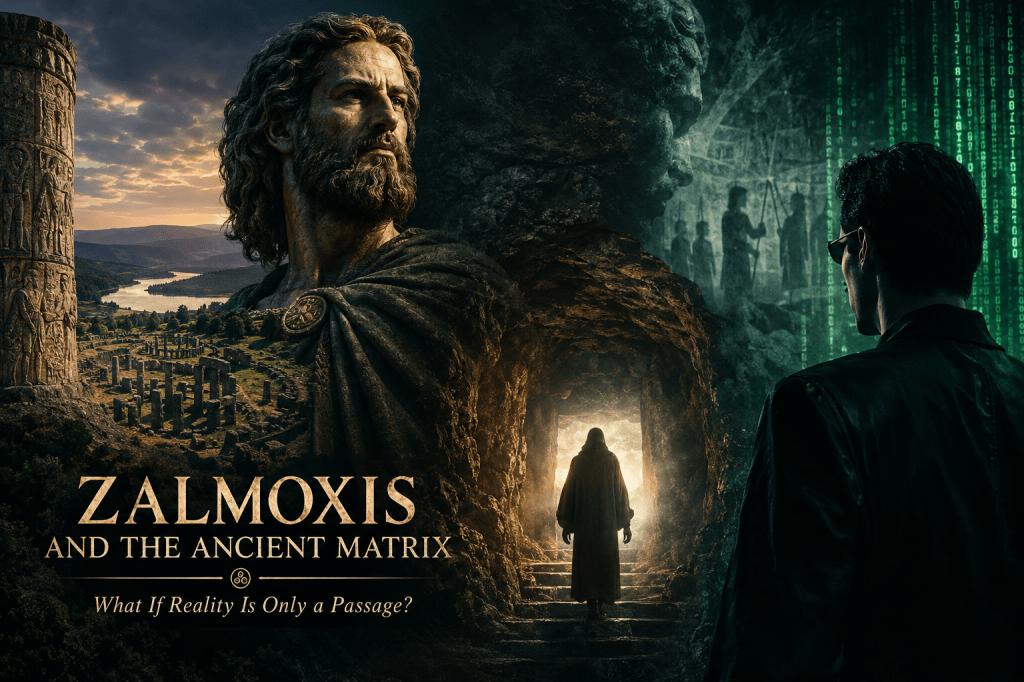
  • Zalmoxis and the Ancient Matrix: What If Reality Is Only a Passage?

    Zalmoxis and the Ancient Matrix: What If Reality Is Only a Passage?

    There is something unsettling about Zalmoxis even before we begin trying to understand who—or what—he was.

    He appears at the edge of recorded European history almost as if he had stepped out of a story that had already been told for centuries before anyone thought to write it down. A god to some, a man to others, perhaps a priest, perhaps a reformer, perhaps the distant memory of a real person whose identity dissolved into religion, he belonged to the world of the Getae north of the lower Danube, yet nearly everything we know about him was preserved by outsiders.

    That alone should make us cautious.

    It should also make us curious.

    The Getae left us no surviving sacred book explaining Zalmoxis in their own words. There is no Zalmoxian gospel hidden in a monastery, no authentic collection of his teachings waiting to be deciphered and no ancient manuscript that allows us to hear his voice directly. Instead, we find fragments scattered through Greek and Roman literature, each writer looking at the same strange tradition from a different angle.

    And yet, when those fragments are placed together, a remarkably persistent idea emerges.

    Human beings may be mistaken about what reality actually is.They may be mistaken even about death.That is where the story becomes far more interesting than a simple chapter of ancient religion, because behind Zalmoxis lies a question that humanity has never stopped asking.

    What if what we see is only the surface?

    The people who believed death was not an ending

    Our earliest substantial account comes from Herodotus, writing in the fifth century BC.

    While describing the Persian expansion into the lands around the Danube, Herodotus pauses to speak about the Getae. He calls them particularly courageous among the Thracian peoples, but it is their religious belief that captures his attention.

    According to him, the Getae believed that they did not truly die. A person who perished went instead to Zalmoxis—or, in the wording of the ancient account, to a divine figure Herodotus associates with Zalmoxis and also mentions under the name Gebeleizis.

    It is easy to read that sentence too quickly.

    Ancient cultures believed in afterlives everywhere, after all. Egyptians imagined the world beyond death, Greeks told stories about Hades, and later religions would place entire theological systems around the fate of the soul.

    But Herodotus describes something more concrete among the Getae.

    Once every five years, he says, they selected a messenger by lot. That man was entrusted with requests that he was supposed to carry to Zalmoxis. Then came the part that must have sounded shocking even to ancient readers: men held spears upright while the chosen messenger was thrown onto their points.

    If he died, the sacrifice was considered accepted. If he survived, the failure was blamed on the messenger and another could be selected.

    The ritual is brutal, and there is no reason to romanticize it. At the same time, its logic tells us something extraordinary about the world in which the ritual made sense.

    The messenger was not simply being killed.

    He was being sent.

    For the people performing the ritual, death was apparently a border that could be crossed, and on the other side of that border there was someone—or something—capable of receiving a message.Seen from that perspective, the sacrificed man was not merely a victim.

    He was a traveller into a reality inaccessible to the living.

    Whatever the Getae actually believed in all its complexity, Herodotus understood their religion as containing a radical conviction: the visible disappearance of a human being did not mean that the human being had ceased to exist.

    Then Herodotus tells another story, and this is where Zalmoxis becomes truly difficult to separate from mystery.

    The man who vanished underground

    Herodotus says that Greeks living around the Hellespont and the Black Sea told a different version of Zalmoxis’ origin.

    According to them, Zalmoxis had once been a mortal man associated with Pythagoras. In their story he had lived on Samos, learned from Greek thought, accumulated wealth and eventually returned to his homeland.

    There he gathered important men around him, entertained them and began teaching something astonishing: neither they, nor their descendants, nor Zalmoxis himself would truly die. Instead, they would go to another place where existence continued and where good things awaited them.

    Then he did something that sounds almost theatrical.

    He built an underground chamber.When it was ready, Zalmoxis disappeared into it.For three years, according to the story, nobody saw him. His people mourned him as dead.

    Then, in the fourth year, he emerged again.

    The man they believed had died had returned.

    And according to the Greek version preserved by Herodotus, that apparent return from death helped convince the Getae that his teaching had been true.It is precisely at this point that responsible history has to resist temptation.We cannot say that this event actually happened. We cannot even be certain that Zalmoxis was originally a historical person.

    Herodotus himself is surprisingly careful: he says that he neither completely believes nor completely rejects the tale of the underground chamber, and he doubts the chronology connecting Zalmoxis directly with Pythagoras. He even leaves open the basic question of whether Zalmoxis had been a man or a native Getic deity.

    That uncertainty does not weaken the story.In some ways it makes it more fascinating.Because whatever happened historically, somebody considered this story important enough to preserve: a teacher disappears beneath the earth, is mourned as dead, and then returns among the living.If this was an initiation drama rather than biography, what did it mean?

    If it was a myth, what truth was the myth trying to communicate?

    And if Zalmoxis was already a god before Greeks attempted to turn him into a former student of Pythagoras, why did the underground disappearance become such an important part of the story?

    We do not know.

    But we can see the structure.A man enters darkness.The world assumes he is gone.

    He returns possessing—or representing—knowledge about death that ordinary people do not possess.

    That structure has survived in religious myths, mystery traditions and philosophical stories across cultures because it touches a very old fear: perhaps human beings understand only the side of reality they happen to inhabit.

    Zalmoxis did not disappear from ancient literature

    Centuries later, Strabo tells another version.The Zalmoxis we meet in his Geography is less like a magician staging his own return from death and more like a sacred political figure, a man who acquires knowledge, becomes close to a ruler and eventually acts as an intermediary between divine authority and earthly power.

    Strabo says that Zalmoxis became a priest of the god most honoured among his people and was eventually himself treated as divine. He lived, according to the account, in an inaccessible cavernous place and met few people apart from the king and attendants. The mountain associated with this sacred retreat was called Cogaeonum in Strabo’s text.

    Again, we encounter withdrawal.

    Again, a sacred man is separated from ordinary society.Again, access to him is restricted.It is worth noticing how different this is from the modern image of a religious teacher speaking openly to crowds.

    Zalmoxis, as Strabo presents him, gains authority partly through distance. He occupies a space ordinary people cannot easily enter, and from that hidden space comes knowledge that affects the visible world outside it.Strabo even says that something of this religious-political institution continued later among the Getae. During the reign of Burebista, a comparable role was held by Decaeneus, the famous Deceneu of later Romanian historical tradition.This does not prove an unbroken secret order stretching across centuries, as modern esoteric stories sometimes suggest.

    The evidence simply does not allow that conclusion.

    Still, the repeated pattern is difficult to ignore.The ruler governs the visible world.The sacred figure interprets something beyond it.One possesses political power; the other possesses access to hidden knowledge.In a culture in which religion and political authority were deeply entangled, that distinction could have been enormously powerful.

    And then Plato enters the story.

    The strange physicians of Zalmoxis

    There is a passage in Plato’s Charmides that deserves far more attention than it usually receives when Zalmoxis is discussed.

    Socrates speaks of having learned from one of the Thracian physicians associated with Zalmoxis. The teaching attributed to them says, in essence, that you cannot properly treat the eyes without treating the head, nor the head without treating the body, and that you should not attempt to heal the body without considering the soul.

    The part cannot be healed while the whole is ignored.

    Plato presents Zalmoxis as both king and god within this story, and the medicine associated with him is explicitly holistic: body, soul and human character belong to the same reality and should not be artificially separated.

    Whether Plato is preserving an authentic Getic doctrine, reshaping an exotic tradition for philosophical purposes, or combining both is impossible to establish from the text alone.But something important has happened by this point.

    Zalmoxis is no longer merely the mysterious deity to whom the Getae send the dead.He has become associated with knowledge unavailable to ordinary perception.Death may not be what it seems.

    The body cannot be understood without the soul.The visible part cannot be fully understood without the invisible whole.That is an extraordinary collection of ideas to find around a figure standing in the mist between history and mythology.And this is where we can approach the Matrix—not by pretending that ancient Getae believed in computers, simulated universes or machines controlling humanity, but by recognising something much older beneath the modern language.

    The suspicion that reality has layers.

    Long before the red pill

    When people hear the word Matrix today, they often think immediately of a computer simulation.But the deeper philosophical idea behind the Matrix is much older than computers.

    The real shock is not discovering that machines exist.

    The real shock is discovering that your definition of reality was wrong.Neo begins inside a world that appears completely normal. Streets exist. Buildings exist. People go to work. Conversations happen. Food has taste. The world follows rules.Nothing initially appears artificial because Neo has never known anything against which to compare it.His prison works because it feels ordinary.

    That idea has an obvious philosophical ancestor in Plato’s Allegory of the Cave.

    Plato asks us to imagine human beings imprisoned underground from childhood, able to see only shadows projected before them. Since shadows constitute everything they have ever experienced, the prisoners naturally treat those shadows as reality.

    Only the person who turns around, leaves the cave and encounters another level of existence discovers how incomplete the former world was.

    Plato explicitly uses the image to distinguish the world apprehended through ordinary sight from a higher intelligible understanding.And here something curious happens.Plato gives us prisoners inside a cave, mistaking appearances for reality.The tradition about Zalmoxis gives us a sacred teacher who enters an underground chamber, disappears from ordinary human sight and returns carrying the authority of someone who supposedly knows what lies beyond death.The stories are not the same and should never be presented as though one copied the other.

    But place them beside one another and the resemblance of the questions becomes difficult to ignore.What can human senses actually tell us?How much of existence remains outside their range?If everybody around us agrees that something is real, does that agreement make it true?

    And what happens to the person who crosses the boundary between the accepted world and another understanding of it?These are not exclusively Greek, Getic or modern questions.They are human questions.

    Perhaps the real prison is certainty

    There is an uncomfortable reason why stories like these survive.Human beings need stable reality.We need to believe that the floor beneath us exists, that tomorrow will resemble today, that cause precedes effect and that the people around us inhabit roughly the same world we do.Without that agreement, ordinary life becomes almost impossible.Yet philosophy has always been dangerous to certainty.It asks whether seeing something is enough to know it.It asks whether consensus proves truth.It asks whether the limits of human perception have quietly become the limits of what we are willing to call real.Zalmoxis becomes fascinating in this context because the surviving traditions surrounding him attack the most absolute certainty of all.

    Death.

    A body falls.

    It stops breathing.It grows cold.It disappears into the earth.Every visible sign tells the observer that the person’s existence is over.And yet the Getic belief described by Herodotus says: you are interpreting what you see incorrectly.The person has gone somewhere.One does not have to accept that belief literally to understand its philosophical power.The senses provide evidence, but the doctrine tells the believer that the evidence is incomplete.That tension between appearance and hidden reality is precisely what gives both ancient initiation traditions and modern Matrix imagery their force.Not because they provide the same answer.Because they begin with the same doubt.

    What was inside the chamber?

    We will probably never know what Zalmoxis’ underground chamber looked like—if such a chamber existed at all.That missing information leaves a strange empty space at the centre of the story.

    Was it simply a hidden room in which a man lived for several years?Was it a ritual space connected with initiation?Did the story preserve a much older myth of a deity descending beneath the earth and returning?Was it a Greek attempt to rationalise a foreign god by turning him into a clever human teacher?

    Each possibility has been discussed in different forms, but the surviving evidence cannot settle the question.Modern scholarship also treats the Pythagorean connection cautiously.

    The story making Zalmoxis a former slave or follower of Pythagoras comes through Greek tradition, while Herodotus himself already doubted its chronology. Later analysis has continued to examine how legends linking Pythagoras with northern religious figures developed in Greek literature.This matters because Zalmoxis has accumulated an extraordinary amount of modern mythology.He has been called a prophet, a supreme god, a monotheistic reformer, a shaman, an initiate, a philosopher and the guardian of supposedly lost Dacian wisdom.

    Some of those interpretations may contain useful comparative ideas, while others go far beyond anything ancient sources actually tell us.The honest version is less comfortable and, I think, far more intriguing.

    We do not know exactly who he was.

    Herodotus did not know.

    Strabo inherited traditions centuries later.

    Plato knew the name and associated it with remarkable Thracian wisdom, yet he was using that tradition inside a philosophical dialogue rather than writing an ethnographic report.

    Zalmoxis stands precisely where evidence begins to thin and myth begins to breathe.

    And perhaps that is why he has never disappeared.

    The ancient Matrix was not a machine

    If we use the word Matrix here, we should use it carefully.There is no evidence that Zalmoxis taught that physical reality was false, that the world was artificially generated or that humanity was imprisoned inside anything resembling a technological simulation.The interesting parallel lies elsewhere.

    A Matrix can also be understood as a framework of reality that becomes invisible because we have lived inside it for too long.A culture tells us what life is.It tells us what death means.It teaches us which things are possible and which questions are absurd.

    Eventually we stop recognising those assumptions as assumptions. They become the walls of the world.The prisoner in Plato’s cave does not initially see a prison.Neo does not initially see a simulation.And the ordinary observer sees death and assumes that what has vanished from sight has vanished from existence.

    Zalmoxis enters this conversation not as proof that the ancients knew the secret structure of the universe, but as evidence of something more modest and perhaps more profound: thousands of years ago, human beings were already deeply uncomfortable with the possibility that visible reality might not be complete reality.That thought lies at the heart of our book Matrix as well.

    The question is not simply whether we live inside a computer program. That is only one modern version of a much older problem.The deeper question is what creates the reality in which we live.Our senses?Our society?Our language?Our memories?Our fears?Our education?The people who hold authority?Or something beyond all of them?Once that question is allowed into the mind, the Matrix changes shape.It no longer requires cables, machines or a digital sky.

    Sometimes the Matrix is simply everything we have been taught never to question.

    And perhaps this is why Zalmoxis still feels strangely modern

    More than two millennia separate us from the people Herodotus described.Their world has vanished. Their language has largely disappeared with them. Their sacred places survive mostly as archaeology, geography and conjecture, while their beliefs reach us through the imperfect filter of outsiders who were themselves trying to understand something foreign.

    Yet Zalmoxis remains.

    Not clearly enough for us to possess him, but not vaguely enough for us to forget him.A god who may have been a man.A man who may have become a god.A teacher associated with immortality who vanished beneath the earth.A sacred figure hidden in an inaccessible place.A tradition in which the soul mattered more than the body alone could explain.A people described as believing that death did not mean what everyone else assumed it meant.

    Perhaps there is no secret doctrine waiting to be recovered from these fragments.Perhaps there was never one.

    But imagine, just for a moment, the person standing outside the underground chamber after Zalmoxis had disappeared.Three years pass.Nothing.The man is dead. Everyone knows it.Then one day he walks out.What would collapse first?Belief in death?Belief in the evidence of your own eyes?Or the comforting certainty that the world works exactly as you have always been told?

    That is where Zalmoxis becomes more than an ancient mystery.

    Because every Matrix begins at exactly that point.

    Not when someone gives you the answer.But when, for the first time, you suspect that the reality you accepted without question may not be the whole story.
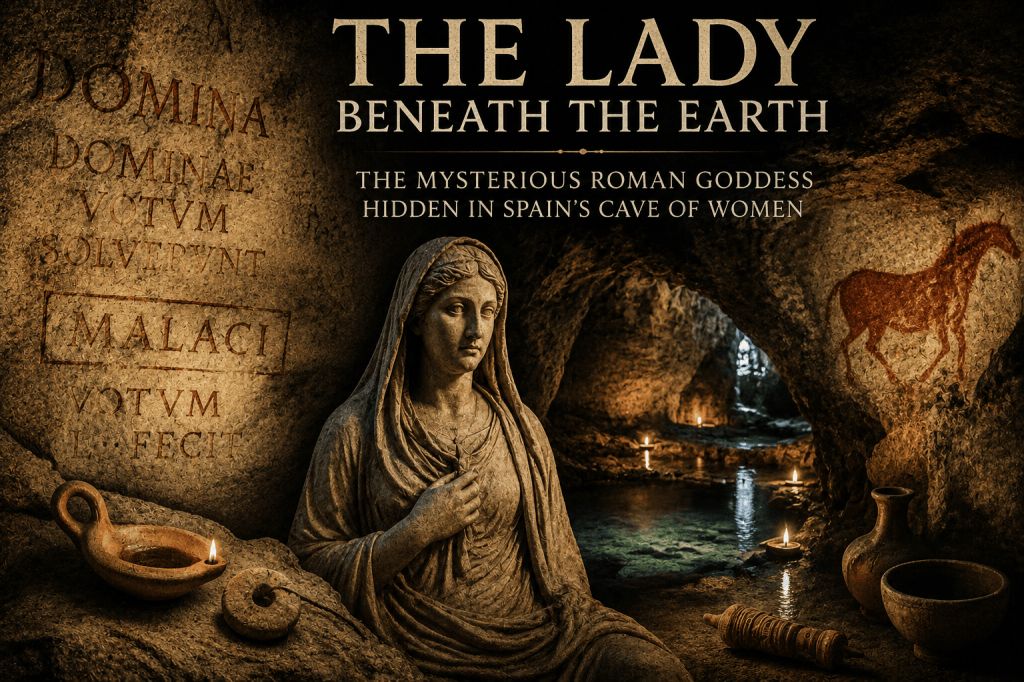

  • THE LADY BENEATH THE EARTH: THE MYSTERIOUS ROMAN GODDESS HIDDEN IN SPAIN’S CAVE OF WOMEN

    Deep in the mountainous interior of Valencia, far from the monumental temples, marble statues and crowded forums that usually dominate our image of Roman religion, there is a cave whose walls appear to preserve the memory of a deity whose real name may have disappeared almost completely from history, leaving behind only a reverential title, a handful of enigmatic dedications and a strange word that archaeologists are still struggling to understand.
    The place is known as Cova Dones, or Cova de les Dones, the “Cave of the Women,” near the small municipality of Millares in eastern Spain, and during archaeological work carried out in May and June 2026 researchers documented at least 120 Latin inscriptions, most provisionally dated to the first and second centuries CE, inside a chamber situated more than 200 metres from the cave entrance. Five of those texts appear to be votive dedications to the same female divinity, addressed reverentially as Domina, meaning “the Lady” or “the Mistress,” while three contain the mysterious expression MALACI, an otherwise unknown divine designation whose precise meaning has not yet been established.
    At first glance this might appear to be simply another Roman sanctuary discovered at the edge of an empire littered with forgotten shrines, yet almost every detail of Cova Dones makes that explanation increasingly inadequate, because the Roman worshippers were entering a subterranean landscape that had already attracted human beings for thousands upon thousands of years, a place where prehistoric people painted animals in red clay, altered stalagmites, moved through chambers illuminated only by fire and left behind signs whose original meaning vanished long before Rome existed.
    The deeper archaeologists move into Cova Dones, the stranger its history becomes, because this is not merely the story of an unknown Roman goddess but the story of a cave that repeatedly became sacred to people separated from one another by extraordinary stretches of time.


    A GODDESS WHO LEFT HER TITLE BUT NOT HER NAME
    The most tantalizing discovery of the 2026 archaeological campaign is contained in five inscriptions whose importance is easy to underestimate, because the Latin word Domina should not automatically be understood as the personal name of the goddess.
    In Roman usage, domina could mean “lady” or “mistress,” and in a religious context it could function as a respectful title, which means that the worshippers entering Cova Dones may have known perfectly well whom they were addressing while leaving modern archaeologists only with the equivalent of calling her “The Lady.” The distinction is crucial, because the inscriptions confirm that a female deity was worshipped but do not yet reveal her conventional divine identity, leaving open the possibility that she represented a highly local cult whose traditions never entered the literary record preserved by Roman authors.
    Even more intriguing is the word MALACI, which appears in three of the votive inscriptions and has been described by the archaeological team as an unprecedented designation or epithet associated with the deity, although its definitive reading and interpretation remain under investigation. Silvia Alfayé, the ancient historian responsible for part of the epigraphic analysis, has suggested that the epithet might eventually prove to have some relationship with water, an especially provocative possibility because the sanctuary chamber contains small natural pools formed by groundwater moving through the cave.
    For the moment, however, MALACI remains precisely the kind of archaeological clue that makes a mystery more interesting rather than less interesting, because it is not an invented occult word or a modern reconstruction but a genuine ancient expression written by people who apparently understood its meaning perfectly well approximately two thousand years ago.
    We do not.


    THE WORSHIPPERS HAD TO LEAVE DAYLIGHT BEHIND
    The spatial arrangement of the sanctuary makes the cult even more unusual, because these inscriptions were not casually scratched near the cave entrance by passing visitors who briefly stopped to invoke a god before continuing their journey.
    They are concentrated within a particular underground chamber more than 200 metres from the entrance, on its walls and ceilings, and the repeated dedications to the same female deity within this carefully bounded area have led researchers to argue that Cova Dones was the site of an organized cult, rather than a cave that happened to receive occasional religious visitors.
    To reach the sanctuary, Roman worshippers would therefore have had to deliberately penetrate the subterranean landscape while leaving daylight progressively farther behind them, entering an environment in which sound, temperature, darkness and flowing water would have created a sensory experience completely different from an ordinary open-air temple.
    This matters because caves occupied a peculiar position within ancient religious imagination, functioning naturally as thresholds between familiar human space and an underground world associated in different traditions with springs, nymphs, fertility, prophecy, the dead and divine powers believed to inhabit the landscape itself.
    Nothing yet proves that the mysterious Lady of Cova Dones belonged to any one of those familiar categories, and assigning her prematurely to Diana, a nymph, an underworld goddess or another known Roman deity would go beyond the evidence, yet the architecture of the ritual space suggests that the cave itself may have been inseparable from the cult, because the worshippers did not simply erect a shrine somewhere convenient; they travelled deep underground to reach her.


    THE WATER BENEATH THE LADY
    One of the less publicized details of the discovery may eventually prove to be one of the most important, because the floor of the Roman sanctuary contains natural formations known as gours, small pools in which underground water collects, and archaeological materials appear to have been deposited in association with these watery features.
    The 2026 campaign identified objects including two rings, a bracelet, chalice-shaped vessels, spindle whorls, pottery fragments and animal remains, which joined the Roman coin discovered during the previous investigation of the sanctuary, creating an unusually rich association between inscriptions, objects and the physical cave environment.
    If the tentative relationship between MALACI and water is eventually confirmed, those pools could become enormously significant, because the cult would then appear to have revolved not simply around an abstract goddess but perhaps around a particular manifestation of divine power associated with water emerging from inside the earth.
    Ancient Mediterranean religion frequently attached sacred meaning to springs, caves and unusual geological features, yet the researchers at Cova Dones have wisely avoided assigning the Lady a familiar identity before the inscriptions are fully understood, because local religions throughout the Roman Empire were considerably more complicated than the simplified pantheon of Jupiter, Mars, Venus and Diana familiar from modern textbooks.
    Romanization did not erase every local deity; in many places, older gods survived beneath Latin names, Roman titles or hybrid religious forms, meaning that an indigenous Iberian cult could theoretically have continued or been reinterpreted during Roman rule without leaving behind a literary biography recognizable to us today.
    That possibility is particularly intriguing at Cova Dones because Rome was not the first culture to regard the cave as significant.


    THE ROMANS WERE NOT THE FIRST PEOPLE TO ENTER THIS DARKNESS
    Long before anyone recognized the Latin inscriptions, archaeological material discovered in and around Cova Dones had already suggested activity during the Iron Age, and research during the twentieth century contributed to its interpretation as an Iberian cave sanctuary.
    The Roman phase may therefore represent a continuation, transformation or appropriation of an older sacred landscape rather than the sudden creation of an entirely new sanctuary, although the archaeological evidence does not yet allow researchers to reconstruct an uninterrupted chain of worship from the Iberian period into Roman times.
    This distinction is extremely important, because it would be tempting to imagine an ancient goddess surviving secretly beneath successive civilizations, worshipped first by prehistoric people, then Iberians and finally Romans, but archaeology does not presently demonstrate such continuity.
    What it does demonstrate is perhaps even more interesting: completely different human societies repeatedly found reasons to enter the same subterranean environment and leave meaningful traces behind.
    The cave itself may have possessed qualities capable of repeatedly attracting symbolic behavior, whether because of its water, its unusual geological formations, its landscape setting or the psychological effect created by penetrating deep underground, possibilities that the archaeological team itself has identified while trying to understand why Cova Dones remained important for so long.


    A SANCTUARY THAT BEGAN MORE THAN 24,000 YEARS BEFORE ROME
    The modern archaeological story of Cova Dones changed dramatically in 2021, when an exploratory visit revealed paintings that nobody had previously recognized as belonging to one of the most important Paleolithic art assemblages in eastern Iberia.
    Subsequent investigation identified more than one hundred graphic units, including horses, female red deer, aurochs, a stag, geometric signs, finger-traced markings and other motifs, with the principal decorated area lying approximately 400 metres from the entrance of a cave system extending roughly 500 metres.
    What makes the Paleolithic art particularly extraordinary is not simply its quantity but its technique, because many of the paintings were created using red clay collected from the cave itself, rather than the diluted ochre or manganese pigments more commonly associated with prehistoric cave painting.
    Researchers reported that the entire painted corpus known at the time, more than eighty graphic units, had been made using this unusual clay technique, while other figures were produced by engraving or by scraping pale mineral deposits from the walls to create contrasts in the rock surface.
    The people who made these images were therefore not merely drawing animals on convenient surfaces; they were using the material of the cave itself to create them, turning clay from the floor into horses, deer and symbols that remained attached to the underground walls for tens of thousands of years.
    Even their age contains a detail that sounds almost impossible to invent.


    THE BEAR THAT ACCIDENTALLY DATED HUMAN ART
    Dating prehistoric cave markings can be extremely difficult, particularly when the pigment cannot easily be radiocarbon dated, yet one panel at Cova Dones preserves an extraordinary sequence in which human finger markings were later crossed by the claw marks of a cave bear.
    Because cave bears disappeared from Europe roughly 24,000 years ago, the fact that the bear scratched across markings already present on the wall provides a chronological boundary indicating that at least some of the human traces must be older than the animal’s final disappearance from the continent. Researchers have combined this clue with stylistic evidence, mineral deposits and comparisons with other Paleolithic art to argue that parts of the Cova Dones ensemble exceed 24,000 years in age.
    The image is difficult to forget: an unknown Ice Age person ran fingers or tools across a soft cave surface, perhaps never imagining that the marks would survive, and at some later moment a cave bear passed the same wall and dragged its claws across the human trace, accidentally creating a chronological signature that archaeologists would recognize more than twenty millennia later.
    By the time Roman women descended toward the sanctuary of the Lady, those Paleolithic images were already older to them than the pyramids are to us.


    THE CAVE WAS PHYSICALLY ALTERED BY PREHISTORIC PEOPLE
    Another remarkable discovery appeared in 2025, when researchers identified more than one hundred speleofacts within Cova Dones, meaning stalagmites and other natural cave formations that had been deliberately broken, displaced or rearranged by prehistoric visitors.
    Some formations appear to have been organized into ring-like structures, while others were cut or moved in ways that may have made passage easier, and the discovery placed Cova Dones among the most important known sites in the world for the study of deliberate prehistoric modification of underground environments, behind only Saint-Marcel Cave in France according to the research team.
    Their precise dates and functions remain subjects of continuing investigation, and researchers have not claimed that every modified formation was necessarily religious, because practical, symbolic and ritual explanations may overlap, yet the finding adds another layer to the cave’s extraordinary biography.
    People were not simply visiting this underground world.
    At some point in prehistory, they were changing it.


    THE CAVE OF WOMEN HAD THAT NAME BEFORE ARCHAEOLOGISTS KNEW ABOUT THE GODDESS
    Perhaps the most haunting coincidence surrounding the discovery concerns the cave’s name itself.
    Long before modern archaeologists discovered inscriptions containing female names, spindle-related objects and dedications to a goddess called the Lady, the place was already known as Cova de les Dones — the Cave of the Women.
    According to researchers discussing the history of the site, the name appears in an eighteenth-century account associated with Valencian naturalist Antonio José Cavanilles, meaning that the designation existed long before anyone understood the Roman sanctuary hidden inside the cave.
    Virginia Barciela, one of the project’s directors, has suggested that the name deserves renewed consideration because it might preserve a distant cultural memory connected with women or female entities associated with the cave, although this remains a hypothesis rather than archaeological proof.


    That distinction should be preserved, because place names can arise for countless reasons and may change meaning through folklore, language and local tradition, yet the coincidence is difficult to ignore.
    A cave called the Cave of the Women eventually reveals inscriptions bearing female names and a sanctuary dedicated to the Lady.
    Whether the name preserves an extraordinary fragment of cultural memory or merely represents one of archaeology’s most evocative coincidences remains unknown.


    THE SPINDLES MAY TELL US WHO CAME TO WORSHIP
    The inscriptions contain several female personal names, while the objects recovered from the sanctuary include numerous spindle whorls, small weighted pieces associated with spindles used in textile production, a sphere of work strongly associated with women in many ancient Mediterranean societies.
    Researchers have therefore suggested that some of these objects may represent ritual offerings of textile tools and that, when combined with the female names appearing in the inscriptions, they support the conclusion that women participated actively in the sanctuary’s religious life. -University of Alicante
    This should not yet be transformed into the stronger claim that Cova Dones housed an exclusively female cult or that women necessarily served as priestesses, because the available evidence does not establish such a precise organization.
    What it does show is that women were not merely invisible background participants in this underground religion, because their names, possible offerings and association with the divine recipient appear directly within the archaeological evidence.
    The Lady seems to have attracted women into the darkness, although what they asked from her remains one of the cave’s unanswered questions.
    Were these requests connected with fertility, childbirth, healing, marriage, water, household protection or something completely different?
    The surviving inscriptions have not yet provided enough information to say.


    A COIN FROM THE AGE OF CLAUDIUS
    The first Roman phase of the mystery emerged during the 2024 campaign, when researchers initially recognized approximately fifteen Latin inscriptions inside the sanctuary chamber and recovered a Roman coin dating to the reign of Emperor Claudius, who ruled from 41 to 54 CE.
    The coin was interpreted as an offering, providing an important chronological anchor for Roman ritual activity in the cave and establishing that the sanctuary was already being used during the early imperial period.
    Only two years later, however, the number of documented inscriptions had exploded from roughly fifteen to at least 120, illustrating how incomplete our understanding of Cova Dones still is.
    The archaeological team has emphasized that many sections remain to be studied carefully and that a number of inscriptions are still being deciphered, meaning that what currently appears to be the largest concentration of Latin texts known from a Roman cave sanctuary may still have more material waiting to be recognized.
    -University of Alicante
    The identity of the Lady may therefore be hidden not because the answer was never written, but because archaeologists may not yet have read everything the cave contains.


    WAS THE LADY ROMAN AT ALL?
    The presence of Latin inscriptions naturally places the documented cult within Roman-period Hispania, yet calling the deity simply a “Roman goddess” may eventually prove too simplistic.
    Across the Roman provinces, local populations frequently continued venerating indigenous divinities while adopting Latin language, Roman naming conventions or Roman styles of dedication, producing religious identities in which native and imperial traditions became intertwined.
    Cova Dones had already possessed significance during the Iberian Iron Age, and therefore it remains possible that the mysterious Lady represented a local deity whose worship survived or changed after Roman control of the region, although no surviving evidence currently allows scholars to identify such a predecessor with certainty.
    This is where the mysterious word MALACI becomes particularly important, because if researchers eventually determine that it represents a local epithet, hydrological reference or surviving indigenous divine name, the inscriptions could open a small window into a religious tradition almost completely absent from Roman literary sources.
    History is written disproportionately by people whose words survived in books, monuments and administrative records, while countless local gods worshipped by ordinary communities disappeared because nobody copied their stories into manuscripts.
    The Lady of Cova Dones may belong to that enormous lost pantheon.


    THE TEMPTATION TO CONNECT HER WITH THE PALEOLITHIC MUST BE RESISTED
    There is an irresistible narrative hiding inside Cova Dones, because the cave contains Paleolithic animal paintings older than 24,000 years, prehistoric modifications to its geology, Iron Age activity and finally a Roman sanctuary associated with a female deity, which makes it extraordinarily tempting to imagine that some sacred tradition survived continuously across the entire sequence.
    Such a story would be magnificent.
    It would also, at present, be unsupported.
    Twenty thousand years is an almost incomprehensible cultural distance, and there is no evidence demonstrating that Roman worshippers knew the meaning of the Paleolithic images, understood who created them or regarded their own Lady as the descendant of an Ice Age deity.
    What archaeology allows us to say is both more cautious and, in its own way, more mysterious: different human communities repeatedly treated the same cave as something more than an ordinary geological space.
    Why they did so may have changed completely from age to age.
    Perhaps the water mattered.
    Perhaps the acoustic qualities mattered.
    Perhaps the unusual formations mattered.
    Perhaps local stories attached themselves to the cave repeatedly until the landscape accumulated sacred meaning.
    Whatever the explanation, Cova Dones appears to demonstrate that certain places can outlive the religions created around them.


    WHAT HAPPENS NEXT MAY CHANGE THE STORY AGAIN
    The DONARQ team, led by researchers from the Universities of Alicante and Zaragoza and supported by an interdisciplinary group of specialists, is continuing to document the cave while epigraphers attempt to complete the reading of the inscriptions and archaeologists study the objects recovered from the sanctuary.
    Future work also includes conservation measures and the creation of a digital twin of the cave, which should allow researchers and eventually the public to examine portions of the site virtually without exposing its fragile surfaces to unnecessary physical traffic.
    The most important unanswered question, however, remains astonishingly simple.
    Who was the Lady?
    Perhaps another inscription will eventually reveal a recognizable divine name and turn the mystery into a chapter of conventional Roman religion, while another possibility is that MALACI will prove to belong to a local cult that survived nowhere else in the written record, leaving Cova Dones as the only place where the forgotten goddess still speaks.
    For now, all that remains are fragments: women writing their names on stone, small objects deposited near underground water, Latin letters carved onto ceilings and walls, a coin left during the reign of Claudius and five dedications addressed respectfully to a being whose true identity has slipped beyond historical memory.
    Yet there is something profoundly fitting about the fact that we do not know her name, because the worshippers who entered Cova Dones nearly two thousand years ago travelled away from sunlight and into a landscape that had already been touched by human hands for tens of thousands of years, passing through a cave where Ice Age artists had painted animals with red earth and prehistoric visitors had reshaped stone formations before eventually reaching a chamber where water collected silently beneath the rock.
    There, somewhere in the darkness, they believed that the Lady was listening.
    Twenty centuries later, the offerings remain, the water still gathers inside the cave, the inscriptions are slowly returning to human language, and the goddess herself remains hidden behind a single title.
    Domina.
    Not her name, perhaps, but merely what those who knew her once called her when they entered the dark.

    PRINCIPAL SOURCES
    The strongest current source is the University of Alicante’s July 2026 report, which documents at least 120 inscriptions, the five votive dedications to Domina, the three occurrences of MALACI, the female names, spindle whorls, water pools and associated archaeological objects.
    University of Alicante
    The Paleolithic material is documented in the peer-reviewed journal Antiquity, including the red-clay painting technique, animal representations and the cave-bear claw mark used as evidence that some human markings are more than 24,000 years old.
    Cambridge University Press
    The 2025 discovery of more than one hundred deliberately modified stalagmite formations is documented by the Universities of Zaragoza, Alicante and Southampton.
    This is exactly the version I would publish on Whisper Mysteries: it has the recent discovery at its center, but the rarer details — the eighteenth-century name Cave of the Women, the bear claw over Paleolithic finger marks, the red-clay paintings, the modified stalagmites, the water pools and the unresolved MALACI — make it much more distinctive than the short news reports currently circulating online.

    Fediverse Reactions
  • When Learned Men Were Completely Wrong: The Scientific Beliefs That Survived for Centuries

    There is something deeply comforting about looking back at history and laughing at our ancestors, because from the safety of the twenty-first century it is remarkably easy to wonder how intelligent people could possibly have believed that mice could be manufactured from dirty laundry, that certain birds grew on trees, that the smell of a rose might stand between a person and the plague, or that the horn of an animal no one had ever reliably seen could detect poison at the dinner table. Yet there is also something slightly dangerous about laughing too loudly, because many of these ideas were not whispered in taverns by the ignorant or preserved only in village superstition; they appeared in serious books, were discussed by physicians, natural philosophers and scholars, circulated through universities and royal courts, and sometimes survived for centuries precisely because respectable people had already decided that they were true.
    The history of science is therefore not merely a triumphant procession from darkness toward knowledge, with one brilliant discovery politely replacing another. It is also a museum of magnificent mistakes, some amusing, some deadly, and some so wonderfully strange that, had they appeared in a fantasy novel, an editor might have asked the author to make them a little more believable.
    And perhaps the most uncomfortable lesson is this: the people who believed them were not necessarily less intelligent than we are.


    WHEN MICE COULD BE MADE FROM WHEAT AND A DIRTY SHIRT
    For centuries, one of the most persistent ideas in natural philosophy was spontaneous generation, the belief that living creatures could arise directly from non-living or decaying matter. Maggots seemed to appear from rotting meat, insects appeared in mud, and small animals could seemingly materialize wherever food and filth had been left undisturbed, so the conclusion did not initially appear as absurd as it does today.
    The seventeenth-century physician and chemist Jan Baptista van Helmont, an important figure in early chemistry, provided one of the most memorable recipes associated with the theory. According to his writings, if wheat was placed in a vessel together with a dirty shirt, after approximately twenty-one days the combination could produce mice.
    Not attract mice.
    Produce them.
    The sweat from the shirt was supposed to act upon the wheat and somehow transform the material into living animals. One can only imagine the satisfaction of a seventeenth-century experimenter discovering mice in his grain after three weeks and triumphantly announcing that nature had obeyed him, while the mice themselves, having discovered an unattended container full of wheat, were probably equally pleased with the experiment.
    Van Helmont also described a supposed method of generating scorpions involving basil and bricks, which suggests that seventeenth-century kitchens could theoretically have doubled as zoological laboratories if one possessed sufficient patience and a reckless attitude toward household pests.
    The idea was not destroyed simply because someone laughed at it. It had to be challenged experimentally. In 1668, the Italian physician Francesco Redi placed meat in different containers, leaving some open and covering others so that flies could not reach the meat. Maggots appeared where flies had access, while the protected meat did not spontaneously manufacture them. Redi demonstrated that the seemingly miraculous appearance of worms had a considerably less mystical explanation: flies laid eggs.
    Even then, spontaneous generation did not disappear overnight. Versions of the idea survived until the nineteenth century, when experiments by scientists including Louis Pasteur helped demonstrate that microorganisms appearing in supposedly lifeless material came from contamination rather than material suddenly deciding to become alive.
    For a theory that seems ridiculous today, spontaneous generation had an extraordinarily long career.


    WHEN BIRDS GREW ON TREES
    If mice could emerge from wheat, perhaps birds growing from trees did not seem quite so unreasonable.
    Medieval and early modern Europeans faced a peculiar mystery involving the barnacle goose, a bird that appeared seasonally in parts of Britain and Ireland but whose nesting grounds were far to the north, beyond the everyday experience of European observers. People saw the birds arrive, but they did not see them breed locally, build nests or hatch from eggs.
    Nature seemed to have misplaced an important part of the story.
    Meanwhile, sailors and coastal inhabitants encountered strange stalked barnacles attached to floating wood. Their shapes, particularly when interpreted through imagination rather than modern zoology, could be made to resemble developing birds. From this coincidence developed one of history’s most delightful pieces of natural history: the belief that barnacle geese did not hatch from eggs at all.
    Some accounts described them developing from barnacles hanging from wood; others imagined strange trees producing structures from which the young birds eventually emerged. Medieval illustrations even depicted trees carrying what looked like embryonic geese, waiting for gravity and destiny to complete the process. Gerald of Wales wrote about the phenomenon in the Middle Ages, and the story remained culturally recognizable centuries later.
    It is tempting to imagine an English traveler standing beneath an ordinary oak tree, staring upward with great concentration and wondering why the local geese crop was disappointing that year.
    Yet the story reveals something more interesting than simple gullibility. The observers possessed incomplete information and tried to construct an explanation from what they could actually see. The birds arrived mysteriously; barnacles appeared mysteriously; the two objects looked vaguely connected; therefore, a theory was born.
    It was wrong, but it had something many successful false theories possess: it explained the missing evidence.


    WHEN A BAD SMELL COULD KILL YOU
    Few historical theories demonstrate the strange mixture of error and accidental usefulness better than the miasma theory of disease.
    For centuries, disease was frequently associated with foul air arising from rotting organic matter, sewage, corpses and filthy streets. Epidemics seemed to flourish in places where the smell was terrible, so physicians and authorities concluded that the smell itself, or some poisonous corruption carried within the air, was responsible.
    In other words, if a street smelled as though something had died there, medical wisdom suggested that the smell might soon arrange for something else to die there as well.
    During outbreaks of plague, people attempted to protect themselves with strong aromas, vinegar, herbs, spices and smoke. During the Great Plague of London in 1665, advice included carrying aromatic substances and using smoke to defend against dangerous air. The underlying theory was wrong: unpleasant odor itself was not the infectious agent. Yet filthy conditions often did accompany environments where disease spread, meaning that people had noticed a genuine association while misunderstanding its cause.
    This distinction matters, because history rarely divides itself neatly into sensible people and fools. Sometimes people observed the right pattern and reached the wrong explanation.
    Miasma theory could even encourage sanitation reforms, because removing sewage, rubbish and rotting waste improved public health even though the reformers did not yet understand microorganisms in the modern sense. A mistaken theory could therefore lead occasionally to useful behavior, which is perhaps one reason mistaken theories can be so difficult to kill.
    If an incorrect idea appears to work, it acquires friends very quickly.


    WHEN KINGS BOUGHT HORNS FROM AN ANIMAL THAT DID NOT EXIST
    Medieval and Renaissance Europe possessed another remarkable item of prestigious scientific and medical technology: the unicorn horn.
    These objects were not cheap ornaments sold to gullible tourists. Supposed unicorn horns could be extraordinarily valuable, belonged to royal collections and were credited with extraordinary medicinal abilities, particularly the power to detect or neutralize poison.
    For a ruler living in a world where poisoning was feared, the attraction is obvious. Imagine sitting down to dinner knowing that political rivals might prefer you dead, while a trusted courtier assures you that the mysterious spiral horn beside your plate will reveal whether someone has interfered with the soup. One might reasonably decide that the horn was worth a considerable amount of money.
    Unfortunately for European monarchs and fortunately for Arctic marine biology, many celebrated “unicorn horns” were actually narwhal tusks.
    The narwhal’s extraordinary spiral tusk entered European trade from northern regions and was interpreted within a culture that already accepted descriptions of unicorns. According to the Smithsonian, narwhal tusks were sold as unicorn horn and credited with medical properties ranging from treating diseases to detecting poison, and the most prized examples could command astonishing prices.
    The deception worked partly because almost nobody buying a unicorn horn was in a position to compare it with an actual unicorn.
    This is an excellent commercial advantage when selling imaginary animals.
    What makes the story especially fascinating is that the objects themselves were entirely real. A magnificent spiral tusk could be placed on a table, measured, touched and displayed to ambassadors. The mistake concerned not the evidence but its interpretation.
    The horn existed.
    The unicorn was the problem.


    WHEN THE CURE FOR DROWNING INVOLVED TOBACCO SMOKE AND A VERY UNEXPECTED ROUTE
    Historical medicine becomes particularly dangerous when one assumes that every strange treatment is an exaggeration invented later for amusement.
    Consider the tobacco-smoke enema.
    After tobacco reached Europe, it acquired a reputation as a medicinal substance and was recommended for various conditions. By the Georgian period in Britain, physicians and rescuers sometimes attempted to revive drowning victims by introducing warm tobacco smoke into the rectum, believing that the warmth and stimulating properties of tobacco might restore the apparently lifeless person.
    This was sufficiently respectable that equipment for administering tobacco-smoke enemas was provided along the River Thames in connection with efforts to resuscitate drowning victims.
    There are historical medical procedures that invite careful scholarly interpretation.
    This one also invites the observation that waking after nearly drowning and discovering several earnest gentlemen standing behind you with bellows must have produced an unusually strong desire to return immediately to full consciousness.
    The practice nevertheless followed a recognizable medical logic of its period. Tobacco was considered stimulating, drowning victims were cold and unresponsive, and warm smoke appeared capable of providing both heat and stimulation. Without modern knowledge of respiratory physiology, the reasoning was not random, merely spectacularly misdirected.
    Eventually, more effective methods of resuscitation replaced it, and the bellows were allowed to return to occupations less alarming to patients.


    WHEN POISON WAS MEDICINE
    Medicine provides some of the most disturbing examples of intelligent people operating with imperfect knowledge, because a physician cannot simply wait several centuries for microbiology to improve while a patient is suffering in front of him.
    For hundreds of years, mercury compounds were among the treatments used against syphilis. Mercury could be administered in different forms, despite its toxicity, because physicians had few effective alternatives and sometimes interpreted the body’s violent reactions to treatment as evidence that the medicine was doing something useful.
    And technically, it certainly was doing something.
    Unfortunately, some of what it was doing was poisoning the patient.
    The Science History Institute notes that historical syphilis treatments involving toxic mercury compounds could produce symptoms severe enough to rival those of the illness itself. Later, the arsenic-derived drug Salvarsan, introduced in the early twentieth century, became an important treatment before penicillin transformed syphilis therapy.
    Here the story becomes more sobering than amusing, because it reminds us that past physicians were often forced to choose between dangerous treatment and an even more dangerous disease. Their mistakes were sometimes produced not by stupidity but by desperation, limited evidence and the absence of better options.
    That distinction is important when judging the past.
    It is also slightly terrifying.


    THE MOST DANGEROUS PHRASE IN SCIENCE MAY BE “EVERYONE KNOWS”
    What connects mice created from dirty shirts, geese growing from trees, poisonous air, medicinal unicorn horns and tobacco smoke administered through improbable anatomy is not simply ignorance.
    It is authority.
    Once an idea entered respected books, once distinguished scholars repeated it, once physicians taught it to students and students eventually became the next generation of physicians, the theory gained something stronger than evidence: familiarity.
    People stopped asking whether it was true and began asking how it worked.
    That is a remarkably important transition.
    If everyone agrees that barnacle geese grow from unusual marine structures, the scholarly question becomes the precise stage at which feathers develop. If unicorn horn neutralizes poison, researchers debate how best to prepare the powder. If bad air produces disease, officials argue over which smells are most dangerous.
    A false premise can therefore generate an enormous amount of perfectly logical reasoning.
    The reasoning may be excellent.
    The premise is still false.
    History repeatedly demonstrates that intelligence is not an automatic vaccine against error. In fact, an intelligent person can sometimes defend a bad idea more effectively than an unintelligent person, because intelligence supplies a much larger collection of arguments with which to protect it.


    WHY DID THEY NOT SIMPLY CHECK?
    This is perhaps the question modern readers ask most frequently, and it deserves an answer.
    Sometimes they did check.
    Redi checked the maggots. Pasteur checked microorganisms. Anatomists dissected bodies. Naturalists traveled. Physicians compared cases. Sailors brought specimens home. Each challenge slowly weakened beliefs that had previously seemed obvious.
    But checking reality was historically more difficult than it sounds. A medieval scholar in England could not book an inexpensive flight to Greenland to inspect a barnacle goose nesting site. A physician could not examine bacteria without instruments that had yet to be invented. A European naturalist confronted with a narwhal tusk might never see a living narwhal during his entire lifetime.
    Books therefore carried enormous authority, particularly when an ancient and respected author had made the original claim.
    Knowledge was inherited much as property was inherited, and people were understandably reluctant to throw away an intellectual estate merely because one room looked suspicious.
    Eventually, however, observation began winning more arguments.
    Not always quickly.
    Not always peacefully.
    But increasingly, the question changed from “Who said this?” to “How can we test it?”
    That change may be one of the most important events in the history of human thought.


    AND NOW FOR THE UNCOMFORTABLE QUESTION
    It would be pleasant to finish here, congratulate ourselves and conclude that humanity has finally escaped the age of ridiculous ideas.
    Unfortunately, history does not offer us that luxury.
    The medieval scholar who believed that birds grew from trees did not wake each morning thinking, Today I shall believe something absurd. He believed he possessed a reasonable explanation supported by respected authorities and apparently consistent with the evidence available to him.
    The physician carrying aromatic herbs against epidemic disease did not consider himself superstitious. The courtier guarding a king’s supposed unicorn horn did not necessarily imagine himself participating in mythology. Van Helmont did not think that his theories would one day become material for jokes about dirty shirts and entrepreneurial mice.
    They lived inside the accepted knowledge of their own time.
    So do we.
    Science today possesses tools, methods and safeguards unimaginable to earlier generations, from controlled trials and statistical analysis to genetics, electron microscopy and global scientific collaboration. That does not mean every current theory is wrong, nor does it mean modern science is merely another collection of medieval beliefs. Quite the opposite: the strength of science lies precisely in its ability to test, challenge and eventually abandon ideas when evidence contradicts them.
    But it does mean that some things we currently regard as obvious will almost certainly be revised, qualified or discarded.
    Perhaps a person living in the year 2400 will open a history book, encounter one of our most confident assumptions and stare at the page with exactly the expression we wear when reading instructions for manufacturing mice from wheat and underwear.
    They may laugh.
    We should probably forgive them.
    After all, somewhere in seventeenth-century Europe, a very serious man once looked into a container containing wheat, discovered several mice and believed he had witnessed the creation of life.
    The mice, meanwhile, had probably reached a simpler and much more accurate scientific conclusion:
    free dinner.

    Sources & Further Reading
    Bob Fenster, Duh! The Stupid History of the Human Race
    Additional historical and scientific sources were consulted to verify the events and beliefs discussed in this article.

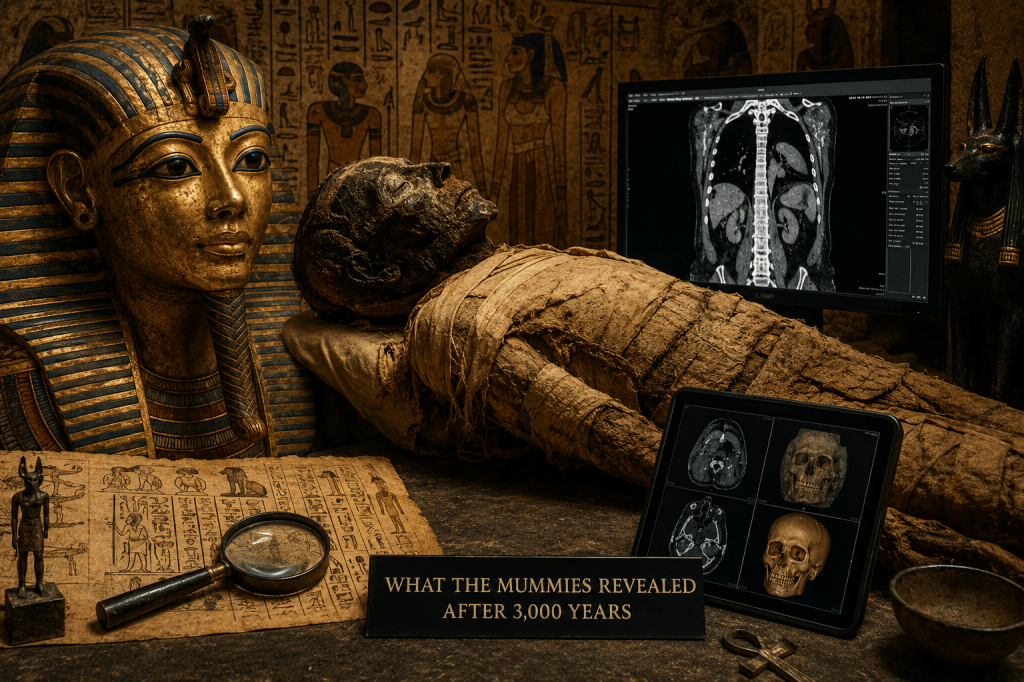
  • The Hidden Diseases of Egypt’s Pharaohs: What the Mummies Revealed After 3,000 Years

    Part I – When Modern Medicine Entered the Tombs


    For more than three thousand years, the pharaohs of ancient Egypt were believed to have carried their secrets into eternity. Their carefully preserved bodies rested inside magnificent tombs, surrounded by gold, precious stones, sacred texts, and objects intended to accompany them into the afterlife. To the ancient Egyptians, mummification was not merely a funerary custom; it was a sacred science designed to preserve both identity and dignity beyond death.
    For centuries, historians viewed these royal mummies primarily as archaeological treasures. They were admired for their elaborate coffins, exquisite funerary masks, and the astonishing skill of the embalmers who had preserved them. Little attention was paid to what their bodies might reveal about their lives. That changed dramatically during the twentieth and twenty-first centuries, when advances in medicine transformed ancient mummies into some of history’s most extraordinary medical patients.
    Using CT scans, DNA analysis, digital reconstruction, endoscopy, and forensic pathology, researchers began examining Egyptian royalty without disturbing the delicate remains. These technologies allowed scientists to look beneath layers of linen that had remained untouched for millennia. What they discovered was remarkable. The bodies of Egypt’s most powerful rulers told stories of disease, chronic pain, genetic disorders, traumatic injuries, and medical conditions that no ancient scribe had ever recorded.
    The image of the pharaoh as an almost divine being began to fade. Behind the gold masks and monumental temples were men and women who suffered from many of the same illnesses that affect humanity today.


    The Silent Testimony of the Mummies


    Ancient Egyptian inscriptions often portrayed pharaohs as physically perfect. They were depicted defeating enemies in battle, hunting dangerous animals, and standing proudly before the gods with youthful strength regardless of their actual age. Royal propaganda left little room for weakness or illness.
    The mummies told a different story.
    Modern imaging techniques revealed worn joints, damaged teeth, spinal degeneration, healed fractures, cardiovascular disease, and congenital abnormalities. Some rulers endured years of chronic pain while continuing to govern one of history’s greatest civilizations.
    Perhaps the most striking realization was that the body itself had become a historical document. Bones, arteries, and even preserved soft tissue recorded details that no ancient inscription could hide.


    Tutankhamun: The Boy King Reconsidered


    No Egyptian ruler has attracted more fascination than Tutankhamun. Since Howard Carter uncovered his nearly intact tomb in 1922, generations have wondered about the young king whose golden mask became the symbol of ancient Egypt itself.
    For decades, his death remained one of archaeology’s greatest mysteries.
    Early theories suggested assassination. Some believed he had been struck on the head during a palace conspiracy. Others proposed a fatal accident involving a chariot.
    Modern forensic studies have painted a far more complex picture.
    High-resolution CT scans demonstrated that the apparent fracture at the back of his skull was most likely caused after death during the mummification process or by the excavation itself. The long-standing murder theory gradually lost support.
    DNA studies produced another important discovery.
    Researchers identified evidence that Tutankhamun suffered from malaria, a disease that still claims hundreds of thousands of lives each year. The analysis also suggested that he inherited several genetic conditions associated with repeated marriages between close relatives within the royal family.
    His left foot showed significant deformities, including evidence of clubfoot and bone disorders that would have made walking painful. More than one hundred walking sticks discovered inside his tomb, once thought to be ceremonial objects, suddenly acquired a new meaning. They may have been practical necessities rather than symbols of authority.
    The image of a powerful warrior racing into battle became increasingly difficult to support.
    Instead, modern science revealed a young ruler struggling with physical limitations while carrying the immense responsibilities of kingship.


    Royal Blood and Hidden Genetic Risks


    The Egyptian royal family believed that preserving divine bloodlines required marriages within the dynasty. Brothers married sisters. Half-siblings became husbands and wives. The practice strengthened claims to the throne but also increased the likelihood of inherited genetic disorders.
    DNA analyses have begun reconstructing these complex family relationships with unprecedented precision.
    While not every physical characteristic can be attributed directly to inbreeding, researchers generally agree that repeated marriages among close relatives increased the probability of congenital abnormalities appearing within the royal family.
    This realization has transformed the study of Egyptian history.
    Political decisions once interpreted purely through religion or tradition now carry biological consequences visible thousands of years later inside the royal mummies themselves.


    Ramesses II: The Warrior Who Lived with Pain


    If Tutankhamun represents youth, Ramesses II represents longevity.
    Known to history as Ramesses the Great, he ruled Egypt for approximately sixty-six years, commanded military campaigns, and oversaw one of the most ambitious building programs in the ancient world. His colossal statues continue to dominate the Egyptian landscape more than three millennia after his death.
    Yet the body of this legendary ruler reveals that his later years were anything but comfortable.
    CT imaging and physical examinations indicate that Ramesses suffered from severe arthritis, particularly affecting his spine and hips. The degeneration was so advanced that walking would almost certainly have become increasingly difficult during old age.
    His dental health was equally poor.
    Researchers found extensive tooth wear, abscesses, and advanced infections. Some experts believe that chronic dental disease may have caused persistent pain for many years. In an era before antibiotics or modern dentistry, even a seemingly ordinary tooth infection could become a serious medical condition.
    Despite these ailments, Ramesses continued to govern one of the ancient world’s greatest empires well into his nineties—an extraordinary lifespan by ancient standards.
    His mummy reminds us that greatness and suffering often coexist.
    The monumental temples celebrate the victorious king.
    The preserved body reveals the aging man behind the crown.


    Ancient Medicine: Remarkably Advanced, Yet Limited


    The discoveries inside Egypt’s royal mummies have also transformed our understanding of Egyptian medicine.
    Ancient physicians possessed surprisingly sophisticated knowledge. Medical papyri describe surgical procedures, wound treatment, fracture management, herbal remedies, and careful clinical observation. Egyptian doctors recognized numerous diseases and developed specialized branches of medicine centuries before similar practices emerged elsewhere.
    Yet they remained powerless against many of the conditions revealed by modern science.
    They could relieve pain.
    They could clean wounds.
    They could set broken bones.
    But malaria, inherited genetic disorders, severe arthritis, and cardiovascular disease lay far beyond the reach of ancient medicine.
    The pharaohs, despite being regarded as living gods, remained subject to the same biological realities as every other human being.
    Death, illness, and aging recognized no royal authority.

    Fediverse Reactions
  • The Sea Peoples: The Mystery That Destroyed an Age

    History remembers the rise of great civilizations.

    But it rarely remembers the strangers who brought them to an end.Around 1200 BC, the ancient world was thriving.

    The mighty Hittite Empire dominated Anatolia. Mycenaean kingdoms flourished across Greece. Rich cities traded from Cyprus to the Levant, while Egypt stood as one of the greatest powers on Earth.

    Then, within only a few decades…Everything changed. Cities that had stood for centuries were reduced to ashes. Palaces burned. Trade routes disappeared. Entire kingdoms vanished from history.Ancient records blamed a mysterious enemy known only as the Sea Peoples.

    But who were they?

    The Enemy from the Sea

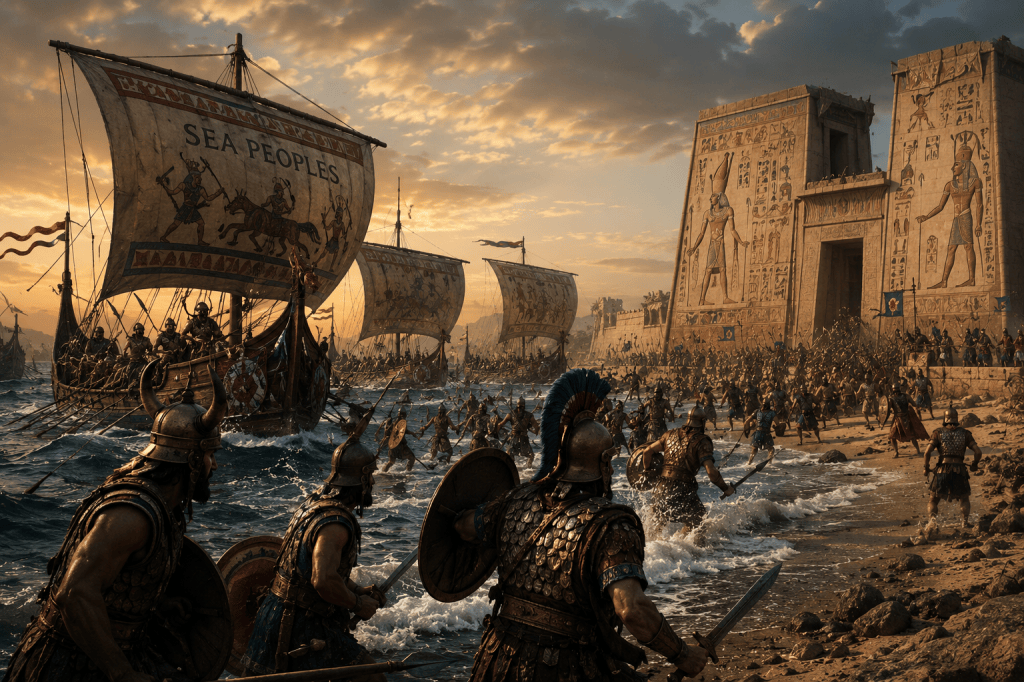
    The most detailed account comes from the reign of Pharaoh Ramesses III.

    His temple at Medinet Habu depicts enormous naval battles unlike anything seen before. Ships crashed together as archers filled the sky with arrows. Warriors wearing unusual feathered helmets stepped onto Egyptian soil with families, wagons, and possessions.

    These were not ordinary pirates.They appeared to be entire populations on the move. Ramesses claimed victory, but even his triumph carried a warning:”The foreign countries made a conspiracy in their islands… No land could stand before their arms.

    “Whether those words were meant as history or royal propaganda, one fact remains undeniable.The ancient world was collapsing.

    A Civilization Falls Silent

    One of the greatest victims was the Hittite Empire.

    For centuries it had rivaled Egypt itself, ruling vast territories and commanding powerful armies.Then it simply disappeared.Its capital, Hattusa, was abandoned.Its archives fell silent. Its kings vanished from history.No single explanation has ever satisfied historians.

    Was it invasion?Civil war?Famine?Climate change?

    Or did the arrival of the Sea Peoples push an already fragile world beyond its breaking point?

    Who Were They?

    This is where history becomes mystery.

    No ancient text clearly identifies their homeland.

    Over the centuries, scholars have proposed dozens of possibilities. Some believe they came from the Aegean islands. Others point toward western Anatolia. Some connect them to Sardinia or Sicily.

    A few even suggest they were survivors of kingdoms destroyed elsewhere, forced to migrate in search of new lands.

    Perhaps they were not one nation at all.

    Perhaps they were an alliance born from desperation. A moving civilization rather than a single people.

    The End of the Bronze Age

    The arrival of the Sea Peoples coincided with one of history’s greatest turning points—the collapse of the Bronze Age.

    International trade disappeared.

    Writing systems were forgotten.Entire cities remained abandoned for generations.Knowledge itself seemed to vanish.When the darkness finally lifted, the ancient world had become something entirely different.

    The age of mighty Bronze Age kingdoms was over.

    A new world would slowly emerge from the ruins. A Mystery Still UnsolvedModern archaeology has uncovered burnt cities, abandoned fortresses, and shattered kingdoms.

    It has reconstructed trade networks stretching across the Mediterranean.It has analyzed climate records and ancient DNA. Yet one question continues to resist every answer. Who were the Sea Peoples?Were they conquerors…Refugees…Mercenaries…Or the survivors of a forgotten catastrophe whose own homeland has long since disappeared beneath history?

    Perhaps the answer still lies buried beneath the sands of Egypt, the ruins of Anatolia, or the depths of the Mediterranean Sea.

    Until that day comes, the Sea Peoples remain one of history’s greatest mysteries—not because they conquered an empire……but because they helped erase an entire age.

    Fediverse Reactions