Category: History’s Absurdities

  • “God Is Forbidden to Perform Miracles Here”: The Strange Mystery of Saint-Médard

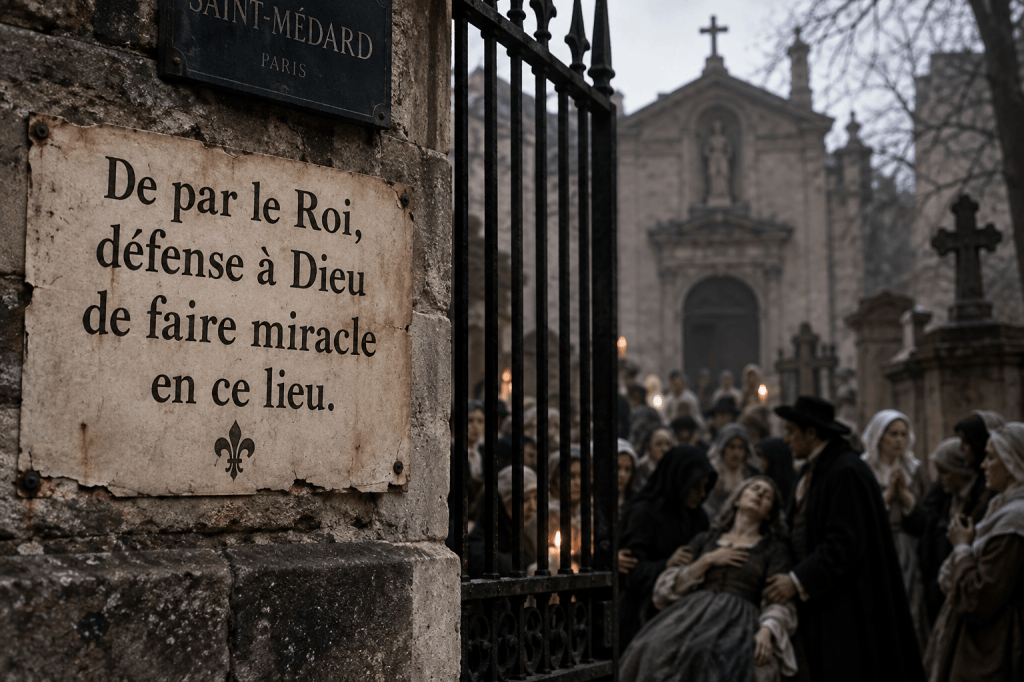
    There are historical sentences that survive because they explain an event, and there are others that survive because they make the event almost impossible to forget. Somewhere in Paris, during the winter of 1732, an anonymous hand is said to have placed one of the latter on the barrier surrounding a cemetery that the authorities had just ordered closed:

    “De par le Roi, défense à Dieu de faire miracle en ce lieu.”

    By order of the King, God is forbidden to perform miracles in this place.

    It sounds so absurd that it has often been repeated as though Louis XV himself had issued a royal decree commanding God to cease supernatural activity, but that is not what happened. The real story is stranger, because the sentence was a piece of anonymous satire aimed at a government that had found itself confronting something it could neither comfortably accept nor easily suppress: crowds gathering around the grave of an obscure religious man, reports of miraculous cures, bodies twisting in violent convulsions, respectable Parisians insisting that heaven had taken sides in a theological dispute, and a movement that became more extreme after the cemetery gates were finally locked.

    The royal ordinance of 27 January 1732 did not forbid God to perform miracles. It closed the small cemetery of Saint-Médard because the Crown believed the gatherings there were exploiting popular credulity and disturbing public order. The famous couplet appeared afterward and rapidly became one of the most memorable pieces of underground satire produced in eighteenth-century France. Historians still quote it because, in two lines, an anonymous Parisian managed to expose the almost comic problem confronting royal power: if the events were frauds, why did the state seem so afraid of them, and if they were miracles, what exactly did a locked gate accomplish?

    Behind that joke lies one of the strangest religious episodes of the French Enlightenment.

    The Dead Deacon Who Refused to Disappear

    François de Pâris was not a flamboyant prophet, an occult magician or a wandering miracle worker, which is partly why what happened after his death became so difficult for contemporaries to dismiss as ordinary religious theatre. Born in 1690, he became a Catholic deacon associated with Jansenism, a controversial current within French Catholicism that emphasized original sin, divine grace, moral austerity and a demanding vision of salvation.

    By the time Pâris died in 1727, Jansenism had become far more than a theological argument. It had acquired political meaning because many of its supporters resisted both papal authority and the increasingly centralized religious policies of the French monarchy. Pope Clement XI’s bull Unigenitus, issued in 1713 at the request of Louis XIV, condemned propositions associated with the Jansenist theologian Pasquier Quesnel, while the French Crown eventually treated the bull as a matter of state law in 1730. What looked from a distance like an argument about grace and doctrine had therefore become entangled with questions of royal power, ecclesiastical authority and the right of conscience.

    Pâris belonged to the opposition.

    He lived with unusual austerity, devoted himself to prayer and charity, and became respected among those who saw Jansenist persecution as evidence that the institutional Church had turned against sincere religious life. After his death on 1 May 1727, he was buried in the small cemetery attached to the church of Saint-Médard, in what was then a relatively poor district of Paris.

    Almost immediately, stories began circulating around his grave.

    People prayed there. Sick men and women visited. Reports appeared of pain disappearing, paralysis improving, blindness being relieved and illnesses inexplicably changing course, while devotees began treating the grave almost as though it had become a point of contact between ordinary Paris and another order of reality.

    Whether these were genuine miracles, spontaneous remissions, psychosomatic phenomena, exaggerations or carefully cultivated religious propaganda remains impossible to resolve three centuries later. What can be established is that reports of cures multiplied sufficiently to attract enormous public attention, and by 1731 the cemetery had become the center of a movement that authorities could no longer regard as merely private devotion.

    Then the bodies began to convulse.

    When the Miracles Changed Form

    Visitors to Saint-Médard began entering states that contemporaries struggled to classify. Some trembled violently, others fell to the ground, experienced spasms, cried out, spoke ecstatically or appeared to enter altered states of consciousness, and the people exhibiting these phenomena became known as the Convulsionnaires de Saint-Médard.

    To believers, the convulsions could be interpreted as signs of divine action, physical evidence that grace was moving through the body and confirming the righteousness of a persecuted religious cause. To opponents, they looked like hysteria, deception, fanaticism or mass contagion. Royal physicians and clerical critics rejected the supernatural interpretation, while supporters collected testimonies with almost obsessive determination.

    The argument was therefore not simply over whether unusual things happened at Saint-Médard, because nobody seriously disputed that unusual behavior was occurring. The battle concerned what those bodies meant.

    A woman collapsing beside the tomb could be interpreted as a saintly recipient of grace, a medically disturbed patient, an actress, a victim of suggestion or a political symbol, depending entirely upon who was watching her.

    This is where Saint-Médard becomes more fascinating than a collection of old miracle stories, because eighteenth-century France found itself confronting a problem that continues to trouble modern societies: the same physical event can become evidence for completely different realities once religion, medicine and politics compete to explain it.

    What one witness called possession by divine grace, another called illness.

    What one called healing, another called coincidence.

    What one called revelation, the police called disorder.

    The Authorities Had a Problem

    By late 1731, Saint-Médard was attracting crowds large enough to make the affair impossible to ignore, and the political context made the situation even more dangerous. Jansenists regarded the supposed miracles as evidence that God himself had vindicated a community condemned by ecclesiastical authorities, which meant every claimed cure carried an implication far beyond the health of the person involved.

    If Pâris really was performing miracles from beyond the grave, then heaven appeared to be validating people whom Church and Crown had tried to silence.

    A miracle had become an argument against authority.

    The archbishop of Paris, Charles-Gaspard de Vintimille, opposed the cult, while royal authorities increasingly viewed the cemetery gatherings as both religiously suspect and politically destabilizing. After investigations, condemnations and growing public controversy, the decision was finally made to close the cemetery.

    On 27 January 1732, access was prohibited by royal ordinance. Historical accounts record that the order accused those involved of exploiting the credulity of the public, while guards and physical barriers prevented worshippers from reaching the famous grave.

    Not long afterward, Paris acquired its immortal joke:

    De par le Roi, défense à Dieu
    De faire miracle en ce lieu.

    Larousse still records the epigram in its dictionary, while academic work on Saint-Médard describes it as perhaps the most enduring commentary produced by the affair. Its author remains unknown.

    There is something almost modern about it.

    The writer did not need a theological treatise, because two lines were enough to make royal authority appear ridiculous.

    The king could close a cemetery.

    Apparently, someone wondered whether he could close heaven as well.

    The Gates Closed, but the Convulsions Did Not

    Had the movement disappeared after the cemetery was sealed, Saint-Médard might have remained merely another curious episode in the history of popular religion. Instead, the opposite occurred, because the Convulsionnaires moved indoors.

    Meetings continued in private houses, including homes connected with clergy, members of the Parlement and sympathetic elites. The phenomenon became less public but, in some circles, considerably more extreme. Historical sources describe practices known as secours, or “assistance,” in which people undergoing convulsions asked others to apply heavy physical pressure or blows in the apparent belief that intense bodily intervention relieved the internal agony accompanying their ecstatic states.

    Over time, certain groups developed ritual forms of mortification that could include crushing pressure, blows from heavy objects, piercing, burning and even performances modeled upon crucifixion. The sources must be approached carefully because hostile observers had every reason to emphasize the most grotesque episodes, yet surviving Jansenist manuscripts themselves record extraordinary acts associated with the movement, while the Bibliothèque nationale de France preserves eighteenth-century collections of testimony concerning “prodigious events” attributed to the convulsions.

    This is the point at which Saint-Médard crosses an uncomfortable border between religion and something much harder to name.

    Were these acts expressions of mystical identification with Christ’s suffering, collective psychological states, demonstrations of bodily endurance, subconscious performance, or rituals that gradually developed their own symbolic language once official worship had been driven underground?

    The answer probably varied from person to person, and perhaps that ambiguity explains why the movement became so difficult for both the Church and later historians to classify.

    It was Catholic but condemned by important Catholic authorities.

    It was political without being a conventional political party.

    It was physical yet interpreted spiritually.

    It was public devotion transformed by repression into something resembling a secret initiatory culture, complete with private gatherings, unusual bodily trials and an increasingly elaborate understanding of suffering as spiritual evidence.

    To call it simply “occult” would be historically misleading, because its participants considered themselves Christians rather than practitioners of hidden magic, yet the atmosphere surrounding the later Convulsionnaires unmistakably enters territory familiar from the history of esoteric religion: hidden meetings, altered states, privileged revelation, sacred suffering and the conviction that ordinary appearances concealed another order of truth.

    The Skeptic Who Became a Believer

    Among the people drawn into the affair was a man whose involvement gave the movement a degree of seriousness its enemies would have preferred to deny.

    Louis-Basile Carré de Montgeron, a magistrate of the Parlement of Paris, approached the Saint-Médard phenomena as a skeptic before becoming convinced that at least some of the reported cures were genuine. He began gathering evidence with the mentality of a legal official rather than that of a wandering visionary, interviewing witnesses, assembling medical statements and attempting to reconstruct individual cases in detail.

    The result was the monumental La Vérité des miracles opérés à l’intercession de M. de Pâris, first published clandestinely in 1737, a work designed explicitly to demonstrate that genuine miracles had occurred through the intercession of François de Pâris. The Bibliothèque nationale de France preserves the work and identifies its purpose precisely as a demonstration of the reality of miracles associated with the dead deacon.

    Montgeron’s next decision was either courageous, naïve or spectacularly reckless.

    On 29 July 1737, he personally presented a copy of his book to Louis XV.

    It was an extraordinary gesture because the book was not merely devotional literature; it was evidence, in Montgeron’s view, that the king’s government and Church authorities had been resisting manifestations of divine approval.

    He was arrested shortly afterward and imprisoned.

    The BnF preserves an engraving commemorating the episode, showing Montgeron presenting his demonstration of the miracles to the king before his confinement, an image that almost perfectly captures the tension of the entire Saint-Médard affair: a magistrate kneeling before earthly sovereignty while offering what he believed to be evidence of a higher sovereignty that no royal decree could overrule.

    Montgeron spent much of the rest of his life imprisoned and died in 1754.

    His book survived him.

    Were There Really Miracles?

    This is the question that inevitably remains, and it deserves a better answer than either credulous acceptance or dismissive laughter.

    Carré de Montgeron attempted to present the cures in something resembling documentary form, including witness statements and medical observations, while supporters stressed that some cases involved illnesses known to physicians before the alleged recovery. Modern readers sometimes treat this as though eighteenth-century documentation were equivalent to contemporary controlled medical evidence, which it was not.

    Diagnostic medicine was different, standards of verification were different, spontaneous remission was poorly understood, and retrospective testimony carried enormous evidentiary problems.

    Yet simply calling everything fraud does not explain the entire phenomenon either.

    Religious expectation can powerfully influence behavior and subjective symptoms, social contagion can produce genuine physical manifestations without conscious deception, altered states can spread through groups, and psychosomatic processes can create symptoms that are absolutely real despite lacking the kind of structural pathology people normally imagine when hearing the word disease.

    None of this requires supernatural intervention.

    It also does not prove that every reported cure was imaginary.

    The intellectually responsible position is less satisfying and more interesting: the surviving evidence allows us to reconstruct what people claimed, what they witnessed and how passionately they fought over those events, but it does not allow us to travel backward three centuries and establish the medical cause of every recovery.

    In some ways, the uncertainty is what kept Saint-Médard alive.

    A miracle conclusively disproved becomes a mistake.

    A miracle conclusively proven would cease to be a historical mystery.

    Saint-Médard remained suspended between them.

    A Cemetery Where Religion Became Political Evidence

    The deepest layer of the story may have little to do with supernatural healing.

    The cult of François de Pâris emerged at precisely the moment when the French monarchy and the Catholic hierarchy were attempting to settle a theological conflict through authority. The supposed miracles therefore became dangerous because they appeared to reverse the direction of judgment.

    Rome had condemned the Jansenist cause.

    The Crown supported that condemnation.

    Yet ordinary men and women gathered around a dead Jansenist and claimed that God disagreed.

    For an absolute monarchy, that was no small problem.

    A government can imprison theologians, prohibit publications and close cemeteries, but religious experience cannot be regulated so easily because its ultimate authority is claimed to originate somewhere beyond the reach of government. Once a crowd becomes convinced that heaven has authenticated its cause, political suppression can even strengthen the belief by providing exactly the persecution narrative that the movement expects.

    This may explain why closing Saint-Médard failed so spectacularly as an attempt to end the phenomenon.

    Before 1732, the movement had a grave.

    After 1732, it had a legend.

    The Occult Shadow of Saint-Médard

    What happened inside the private gatherings after the cemetery closure is perhaps the most unsettling part of the story because repression changed the movement’s spiritual vocabulary.

    Public pilgrimage had been relatively simple: visit the grave, pray, touch the tomb, hope for healing.

    Underground Convulsionnaire spirituality became more elaborate, physical and symbolic, with suffering increasingly interpreted as a vehicle for revelation. The body ceased to be merely something waiting to be healed and became an instrument through which hidden meaning might be expressed.

    Similar ideas appear in many mystical traditions, although their theological explanations differ dramatically. Christian ascetics practiced fasting and mortification; medieval visionaries understood bodily suffering as participation in Christ’s Passion; ecstatic religious movements repeatedly blurred the boundary between pain, transcendence and altered consciousness.

    Saint-Médard belonged to that wider human territory in which extreme bodily experience can acquire sacred interpretation.

    There is no need to invent demons, secret magical orders or supernatural conspiracies to make this strange.

    The documented reality is strange enough.

    Educated magistrates defended the movement.

    Authorities feared it.

    Crowds sought miracles at a grave.

    Bodies convulsed around the dead.

    Private groups transformed suffering into ritual.

    An anonymous Parisian mocked the king for apparently trying to regulate God.

    And all of it occurred not in some forgotten medieval village but in eighteenth-century Paris, at the very moment Europe liked to imagine itself entering an age of reason.

    Voltaire Was Watching Too

    The irony was not lost on Voltaire, who later mocked the Convulsionnaires and used their excesses as ammunition against religious fanaticism. His Dictionnaire philosophique preserved the famous couplet about forbidding God to perform miracles, while treating the movement with characteristic sarcasm.

    Yet Voltaire’s ridicule creates another interesting paradox.

    The Enlightenment is often narrated as though reason simply arrived and superstition retreated, but Saint-Médard shows how inadequate that picture is. Skepticism, popular religion, early medical reasoning, political propaganda, mystical experience and satirical journalism existed simultaneously, competing within the same city and sometimes within the same individuals.

    Paris could produce Voltaire and the Convulsionnaires at the same time.

    Perhaps it had to.

    Periods that advertise themselves as rational often generate intense fascination with whatever reason appears unable to explain.

    The Sentence That Outlived the King

    Louis XV died in 1774.

    François de Pâris had already been dead for nearly half a century.

    The Convulsionnaire movement slowly fragmented, although traces of it persisted for decades, while Jansenism itself continued influencing French religious and political culture long after the spectacular scenes at Saint-Médard had disappeared. Larousse records that secret Convulsionnaire activity continued well into the later eighteenth century.

    The anonymous couplet survived them all.

    Perhaps this happened because it captures something larger than the event that inspired it.

    Every system of authority eventually encounters a boundary beyond which commands become strangely powerless. A king can decree where people may gather, a bishop can condemn a doctrine, guards can prevent worshippers from reaching a tomb, and printers can be forbidden to circulate certain books, yet none of these measures can directly regulate what people believe they have experienced.

    That does not mean the belief is true.

    It means belief occupies a territory that coercion cannot completely control.

    The cemetery of Saint-Médard was closed because authorities wanted the phenomenon to end, but the closure gave the affair the one thing capable of preserving it indefinitely: a perfect story.

    A dead deacon.

    A forbidden grave.

    Supposed miracles.

    Bodies seized by inexplicable convulsions.

    Secret ceremonies continuing behind closed doors.

    A magistrate imprisoned after presenting evidence to the king.

    And finally an unknown hand leaving two lines on a barrier in Paris, quietly suggesting that earthly authority had become so confident in itself that it had attempted to issue instructions to heaven.

    The king never actually forbade God to perform miracles at Saint-Médard.

    Someone merely accused him of trying.

    Almost three hundred years later, that is the part everyone still remembers.

    Sources and Further Reading

    The historical reconstruction is based on the Bibliothèque nationale de France collections concerning François de Pâris, the Convulsionnaires and Louis-Basile Carré de Montgeron; academic research collected in Miracles, Convulsions, and Ecclesiastical Politics in Early Eighteenth-Century Paris; eighteenth-century manuscript testimony preserved in the French national collections; the historical archives of Larousse; research on the Unigenitus controversy and French Jansenism; and Montgeron’s 1737 La Vérité des miracles opérés à l’intercession de M. de Pâris.

    Some mysteries were never meant to remain inside churches, archives, or forbidden books. If you want to go deeper into ritual, symbolism and the hidden path of the witch, enter the Grimoire.

  • The Pope Who Was Put on Trial After His Death: The Terrifying Cadaver Synod of 897

    The Pope Who Was Put on Trial After His Death: The Terrifying Cadaver Synod of 897

    In the winter of 897, Rome witnessed a spectacle so disturbing that, more than eleven centuries later, it remains one of the most infamous episodes in the history of the papacy. Inside the Lateran Basilica, where ecclesiastical disputes were normally decided among living men, bishops and clergy gathered for a trial whose defendant had already been dead and buried for approximately nine months.

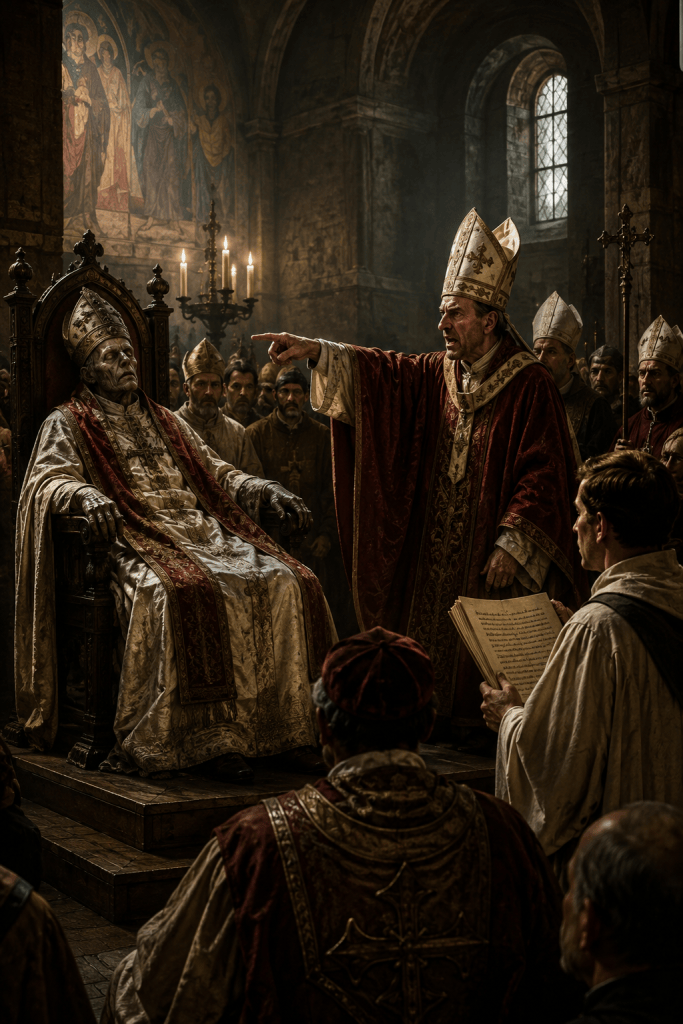
    The man being judged was Pope Formosus, but he was not represented merely by documents, witnesses or memories of his pontificate. His body had been removed from its tomb, dressed once again in papal vestments and brought into the basilica, where it was reportedly placed upon a seat before the assembled clergy. According to later accounts of the proceedings, a deacon was assigned the extraordinary task of answering on behalf of the dead pope while Pope Stephen VI presided over the accusations against his predecessor.

    The episode would become known as the Cadaver Synod, and later tradition would remember it under the chilling Latin designation Synodus Horrenda, the Horrible Synod. Although its most sensational details sound as though they belong to a Gothic novel rather than to ecclesiastical history, the trial itself was very real, and its purpose becomes considerably more understandable once the violent political struggles surrounding the papacy at the end of the ninth century are brought into view.

    The corpse on the throne was horrifying, but the real struggle concerned the living.

    Before the Corpse, There Was a Powerful Churchman

    Long before his body was brought into a courtroom, Formosus had been one of the most prominent and controversial churchmen of his generation. Born around the beginning of the ninth century, he eventually became bishop of Porto, an important episcopal see near Rome, and acquired a reputation as an able missionary and diplomat whose ecclesiastical career brought him into contact with some of the most significant political conflicts of his age.

    His abilities did not protect him from enemies. During the pontificate of Pope John VIII, Formosus became involved in a serious dispute with papal authorities and was accused of abandoning his diocese, conspiring against the pope and aspiring improperly to the Roman see. He was excommunicated and compelled to swear that he would never return to Rome or resume his episcopal functions, although changing political circumstances eventually allowed him to be restored to communion and to return to his position.

    When Formosus was elected pope in October 891, therefore, he arrived at the papal throne carrying both considerable experience and a history that his enemies would later use against him. One particularly important canonical problem concerned his position as bishop of Porto, because church law strongly discouraged the transfer of a bishop from one episcopal see to another, and his eventual election as Bishop of Rome provided his opponents with an argument that could later be transformed into an accusation of illegitimacy.

    Had this been merely a technical ecclesiastical dispute, Formosus might never have become the defendant in history’s most famous posthumous trial. What transformed the controversy into something far more dangerous was the struggle for political control of Italy and the imperial crown.

    A Pope Caught Between Rival Rulers

    The political landscape of late ninth-century Italy was extraordinarily unstable. The Carolingian order that had once provided a measure of imperial unity was disintegrating, powerful aristocratic families competed for territory and influence, and the papacy frequently found itself caught between rulers whose military strength could determine who controlled Rome itself.

    Among the most powerful forces in Italy was the house of Spoleto. Formosus initially recognized its position and crowned Lambert of Spoleto as co-emperor, but relations deteriorated, and the pope eventually sought assistance from Arnulf of Carinthia, the East Frankish king whose intervention offered the possibility of breaking Spoletan dominance.

    Arnulf crossed into Italy and entered Rome in 896, after which Formosus crowned him emperor. The decision was politically explosive because it represented a rejection of the interests of Lambert and his powerful mother, Ageltrude, while simultaneously tying the papacy to Arnulf’s military fortunes.

    Those fortunes changed almost immediately. Arnulf became seriously ill during his Italian campaign and was forced to withdraw, leaving the political situation unresolved, while Formosus himself died on 4 April 896. The pope was buried according to the customs of his office, and under ordinary circumstances his participation in the struggle might have ended there.

    Instead, the political balance shifted again, the Spoletan faction recovered its influence, and Formosus’s enemies discovered that death did not necessarily prevent them from attacking the legitimacy of everything he had done.

    Nine Months After Burial, the Grave Was Opened

    Following Formosus came the extremely brief pontificate of Boniface VI, whose reign lasted only a matter of days, and then Stephen VI became pope. During Stephen’s pontificate, probably in January 897, an extraordinary decision was made: Formosus would be prosecuted formally despite the inconvenient fact that he had been dead for months.

    His grave was opened and the corpse was removed.

    Historical accounts describe the body being dressed again in papal vestments and brought into the Lateran Basilica, where an ecclesiastical assembly had been convened. The dead pope was positioned before the court as though his physical presence were necessary for the proceedings, while Stephen VI assumed the role of his accuser and judge.

    Later narrative sources describe a deacon standing beside Formosus and answering questions on his behalf, creating an almost surreal scene in which the forms of a conventional ecclesiastical hearing were maintained even though the defendant was incapable of hearing the charges, understanding the proceedings or defending himself.

    It would be easy to dismiss the entire spectacle as nothing more than an eruption of medieval superstition or personal madness, yet doing so would obscure the political calculation behind it. Stephen and the enemies of Formosus were not interested merely in humiliating a corpse; they wanted to destroy the legal and ecclesiastical consequences of Formosus’s pontificate.

    To accomplish that, they first had to establish that he should never have been pope at all.

    What Could a Dead Pope Be Accused Of?

    The accusations revived controversies that had followed Formosus during his lifetime, particularly those involving his earlier position as bishop of Porto and the canonical restrictions concerning the transfer of bishops between sees. His opponents argued, in effect, that he had occupied the Roman see illegitimately and had therefore exercised papal authority that he should never have possessed.

    Other accusations concerned the oaths and obligations arising from his earlier conflict with John VIII, but the significance of the proceedings extended far beyond Formosus’s personal reputation. If his election to the papacy could be declared invalid, then the decisions he had made while occupying the office could also be challenged, including his ecclesiastical appointments and the ordinations he had performed.

    This was where the trial became politically useful, because Formosus had created networks of authority through the bishops and clergy he had ordained. Invalidating those acts could weaken men whose positions depended upon him while strengthening their rivals, which meant that the prosecution of a dead pope could have very real consequences for powerful living churchmen.

    The corpse could not defend itself, and the verdict was hardly in doubt.

    Formosus was condemned.

    Punishing a Man Who Could No Longer Feel Punishment

    Once the court had declared Formosus guilty, the proceedings entered their most macabre phase. His papal vestments were stripped from the corpse, and the acts associated with his pontificate were declared invalid. According to the traditional accounts, three fingers of his right hand, associated with the gesture of papal blessing, were cut away, an act whose symbolism was far more important than any physical punishment that could obviously no longer be inflicted upon the dead man.

    Everything about the treatment of the body communicated the same message: the authority Formosus had exercised as pope was being erased symbolically from his remains.

    His body was subsequently buried in a common grave rather than being allowed to retain the honor associated with papal burial. Later accounts state that it was then removed once more and thrown into the River Tiber, transforming a former pope, bishop and imperial kingmaker into a mutilated corpse discarded in the water flowing through Rome.

    Some of the vivid details of the trial survive through chroniclers writing after the event, which means that historians must distinguish carefully between the firmly established outline of the Cadaver Synod and dramatic elements preserved by later narrative tradition. There is no serious doubt, however, that Formosus was exhumed and subjected to a posthumous ecclesiastical trial under Stephen VI, nor that subsequent popes considered the proceedings sufficiently serious to overturn their consequences.

    Whatever Stephen hoped to achieve, the spectacle did not bring stability to Rome.

    It helped produce the opposite.

    The Living Judge Soon Followed the Dead Defendant

    The reaction against Stephen VI was rapid and severe. His political position collapsed during the months following the Cadaver Synod, and he was eventually deposed, imprisoned and strangled in the summer of 897.

    The reversal is one of the most striking features of the entire episode. At the beginning of the year, Stephen had possessed enough authority to order the exhumation and condemnation of a former pope; only months later, he himself was a prisoner whose pontificate had ended violently.

    Formosus, meanwhile, began an extraordinary posthumous rehabilitation.

    Tradition records that his body was recovered after being thrown into the Tiber, and later in 897 Pope Theodore II convened a synod that annulled the judgment against him and recognized the validity of his ordinations. His remains were restored to an honorable papal burial, reversing the humiliation imposed during Stephen’s pontificate.

    Theodore II occupied the papal throne for only a short period, but his actions were followed by those of John IX, who continued the rehabilitation of Formosus and convened synods that rejected the Cadaver Synod and attempted to prevent similar proceedings from occurring again. At Ravenna in 898, the measures against Formosus were overturned, while records associated with the grotesque trial were ordered destroyed.

    The dead pope, in effect, had received an appeal and won.

    Why the Ordinations of a Dead Pope Could Threaten the Living

    The controversy did not disappear simply because Formosus was returned to his tomb, because the question of his legitimacy created a theological and legal problem with potentially enormous consequences.

    A pope ordained bishops, and those bishops could subsequently ordain priests, consecrate other bishops and perform sacramental acts whose legitimacy depended upon their own ecclesiastical authority. If the ordinations performed by Formosus were invalid because he had supposedly occupied the papal office illegitimately, then doubts could spread through an expanding chain of clergy whose authority ultimately traced back to him.

    The problem therefore resembled a crack moving through the foundations of a building. What began as an attack on one dead pope could destabilize the status of numerous living churchmen and create uncertainty about sacraments and appointments that had already taken place.

    Writers defending Formosus consequently argued vigorously for the validity of his ordinations, while the controversy continued to influence papal politics after the principal participants were dead. Pope Sergius III, who became pope in 904, was associated with renewed hostility toward the Formosan position, demonstrating how difficult it was to bury a dispute that had already survived the man at its center.

    The Cadaver Synod was therefore never simply an absurd trial of a corpse. It represented an attempt to use canon law, ritual and physical humiliation to rewrite the legal consequences of an earlier pontificate.

    Was Stephen VI Insane?

    Modern retellings sometimes explain the episode by portraying Stephen VI as a deranged pope whose hatred of Formosus drove him to an act of grotesque irrationality. The temptation is understandable, because exhuming a decomposing predecessor and placing him before an ecclesiastical tribunal certainly appears incomprehensible when viewed outside its historical setting.

    There is, however, no reliable basis for diagnosing Stephen’s mental state more than eleven centuries after his death, and the political context provides motives that do not require such speculation. Formosus had supported Arnulf of Carinthia against the interests of the Spoletan faction, while his ecclesiastical acts had created positions and loyalties that remained important after his death. Declaring his pontificate illegitimate could therefore serve political interests by weakening the authority of his supporters and strengthening those who wanted his legacy destroyed.

    Seen in this context, the trial becomes more disturbing rather than less, because it suggests that the grotesque treatment of the corpse was not necessarily meaningless madness. It could function as calculated political theater in which the body of a dead pope became an instrument for changing the balance of power among living men.

    The courtroom was merely the stage.

    The real struggle was taking place throughout Rome and Italy.

    The Painting That Gave the Trial a Face

    Almost a thousand years after the Cadaver Synod, French painter Jean-Paul Laurens created one of the most memorable visual interpretations of the episode. His 1870 painting Le Pape Formose et Étienne VI depicts the dead Formosus seated rigidly before Stephen, surrounded by clergy inside a dark architectural space whose theatrical lighting intensifies the horror of the confrontation.

    The painting should not be mistaken for a reconstruction based on eyewitness evidence, because Laurens was creating a nineteenth-century historical drama rather than documenting the precise appearance of the Lateran in 897. Nevertheless, his composition captures something fundamental about the episode: the dead figure appears strangely passive and almost dignified while the living men surrounding him generate the violence and menace of the scene.

    Perhaps this is why the image remains so effective. The corpse is not really the frightening part.

    The frightening part is what the living are willing to do with it.

    A Trial That Was Never Really About the Dead

    The Cadaver Synod continues to fascinate because it violated an expectation that seems almost universal: whatever conflicts surround a person during life, death eventually removes that person from the immediate struggle for power.

    Formosus was denied even that final separation.

    His enemies could no longer force him to surrender authority, retract his decisions or answer accusations, so they attacked the surviving structures of his pontificate instead. By removing his body from the grave and placing it physically before a tribunal, they transformed a legal dispute into an extraordinary ritual in which the dead were temporarily dragged back into the political world of the living.

    For a brief moment in Rome in 897, the boundaries between courtroom and tomb, punishment and memory, law and political revenge became almost impossible to distinguish. A dead pope was dressed in the clothing of the office he had once occupied, a living pope demanded answers that the defendant could never provide, and an ecclesiastical assembly pronounced judgment upon a man whose earthly punishment had already been completed by death.

    Yet the final irony belongs to Formosus.

    The judgment against him was overturned, his ordinations were defended, his remains were restored to honorable burial and the spectacle intended to destroy his legacy instead ensured that his name would be remembered for more than a thousand years.

    Stephen VI, who had attempted to place a dead predecessor permanently among the condemned, was himself deposed, imprisoned and strangled only months after the trial.

    Formosus returned to his tomb.

    The Cadaver Synod entered history.

    And perhaps that is the most unsettling part of the entire story, because beneath the decomposing body, the papal robes and the macabre courtroom lies something far more recognizable than medieval superstition: the ancient human desire to rewrite the past when controlling the present is no longer enough.

    Sources & Further Reading

    Liudprand of Cremona, Antapodosis — an important later narrative source for the episode, although it was written decades afterward and its dramatic details must therefore be approached critically.

    Horace K. Mann, The Lives of the Popes in the Early Middle Ages — provides historical context for Formosus, Stephen VI and the political struggles surrounding the late ninth-century papacy.

    Catholic Encyclopedia, “Pope Formosus” — useful for the ecclesiastical career of Formosus, the Cadaver Synod and his subsequent rehabilitation.

    Bilal, M. and Tubbs, R. S., “Popes Convict Dead Pope Twice! The Unbelievable Cadaver Synod,” Clinical Anatomy (2017) — a modern scholarly discussion of the treatment of Formosus’s corpse and the extraordinary posthumous proceedings.

    Encyclopaedia Britannica, entries concerning Formosus and the ninth-century papacy — useful for the broader political and ecclesiastical context.

    Fediverse Reactions
  • The Unicorn Horns Worth a Fortune: What Medieval Kings Were Really Buying

    Imagine sitting at a royal banquet somewhere in Renaissance Europe while a servant carefully places an extraordinary object beside the king: a long, ivory-white horn twisted into an almost perfect spiral. It has cost a fortune, perhaps more than many people could earn in several lifetimes, yet its value does not come merely from its beauty. The people gathered around the table believe that it came from one of the rarest creatures on Earth and that, under the right circumstances, it might even save the king’s life from poison.
    To modern eyes, the object would be immediately recognizable as something very different. It was not taken from a magical white horse wandering through an enchanted forest, because the magnificent spiral was actually the elongated tooth of a narwhal, an Arctic whale that most Europeans of the Middle Ages had never seen.
    For centuries, however, these remarkable tusks crossed enormous distances before appearing in churches, royal treasuries, princely collections and apothecaries, where they were accepted as tangible evidence that unicorns were not merely creatures of legend.
    The deception, if we can even call it that, became one of the most fascinating intersections of mythology, medicine, exploration and commerce in European history.


    When the Unicorn Was Not Considered a Fantasy
    It is easy to imagine that medieval Europeans understood the unicorn in much the same way that we do today, as a beautiful but obviously mythical animal. The reality was considerably more complicated.
    Medieval descriptions of the natural world contained creatures that Europeans rarely, if ever, encountered themselves. Elephants, lions, crocodiles and exotic animals from distant territories could seem almost as extraordinary as creatures that we would now classify as mythical. In a world where reliable zoological information traveled slowly and distant lands remained mysterious, the existence of a horse-like animal with a single horn was not necessarily an absurd proposition.
    The unicorn also possessed a long literary history. Ancient writers had described mysterious one-horned animals, and during the Middle Ages the creature acquired powerful religious and symbolic meanings. In Christian interpretations, the unicorn could represent purity and even Christ, while stories concerning its capture frequently involved a virgin maiden capable of taming an animal that hunters could not otherwise approach.
    The famous Unicorn Tapestries, created around the turn of the sixteenth century and now preserved at The Met Cloisters, demonstrate just how deeply the creature had entered European aristocratic culture. Medieval tradition attributed extraordinary therapeutic powers to its horn, and by the twelfth century narwhal tusks were being regarded as genuine unicorn horns.
    Then there was something even more persuasive than stories.
    There were actual “horns”.


    The Mysterious Objects Arriving from the North
    Narwhals inhabit Arctic waters around Greenland, Canada, Scandinavia and Russia. The characteristic tusk, found primarily in males, is actually an elongated tooth that grows in a distinctive spiral and can reach extraordinary lengths.
    To people familiar with narwhals, there was nothing supernatural about it. Arctic peoples had known and hunted these animals for generations, using different parts of the whale for food, tools, clothing and other necessities of life.
    Farther south, however, the situation was completely different.
    Most medieval Europeans had never seen a living narwhal, and they possessed little reliable knowledge about the animal from which these spectacular ivory spirals originated. When the tusks entered European trade networks, their appearance fitted remarkably well with descriptions and artistic representations of the legendary unicorn.
    A beautiful spiral horn existed.
    People already believed that an animal possessing such a horn existed somewhere beyond the familiar world.
    The two ideas fitted together almost perfectly.
    The Metropolitan Museum of Art notes that narwhal tusks believed to be unicorn horns were treasured in churches from London to Kraków. Saint-Denis near Paris possessed one traditionally said to have been presented to Charlemagne by the Abbasid caliph Harun al-Rashid, while San Marco in Venice acquired another from Sultan Süleyman the Magnificent.
    These were not obscure curiosities hidden in private cabinets. They belonged to some of Europe’s most prestigious institutions and powerful rulers.


    A Horn Worth a King’s Fortune
    The supposed unicorn horn eventually became an object of astonishing financial value.
    Kings, princes and wealthy collectors wanted them not simply because they were rare, but because rarity was combined with the belief that the object possessed extraordinary power.
    Charles VI of France owned one. Jean, Duke of Berry, possessed one. Philip the Good, Duke of Burgundy, listed unicorn horns among his treasures.
    Perhaps the most remarkable example concerns Lorenzo de’ Medici.
    When Lorenzo died in 1492, the “unicorn horn” contained in his collection was valued at 6,000 florins, according to The Metropolitan Museum of Art.

    The figure gives us some idea of how seriously these objects were regarded. This was not the medieval equivalent of purchasing an amusing fantasy souvenir. A genuine unicorn horn was treated as an elite treasure whose rarity, prestige and supposed medicinal power could make it enormously valuable.
    Some historical estimates even placed unicorn material above gold by weight. A Metropolitan Museum publication discussing Renaissance beliefs records a sixteenth-century comparison in which a pound of gold was valued at 148 écus while a pound of “unicorn” was valued at 1,536 écus.
    Why would anyone pay such extraordinary sums?
    Because people believed the horn could do something gold could not.
    It might keep them alive.


    The Royal Fear of Poison
    For rulers surrounded by political rivals, ambitious relatives and competing factions, poisoning represented a particularly frightening possibility.
    Whether the actual frequency of royal poisoning matched the enormous fear surrounding it is another question, but suspicion itself was powerful. Courts developed elaborate precautions surrounding food and drink, while unusual substances were credited with the ability to reveal or neutralize toxins.
    The unicorn horn became one of the most prestigious of these supposed protections.
    According to medieval and Renaissance belief, the horn could purify poisoned water and neutralize dangerous substances. The idea appears beautifully in The Unicorn Purifies Water, one of the famous Unicorn Tapestries, where the animal kneels beside a fountain as other animals wait nearby. Plants traditionally associated with antidotes to poison appear around the stream, reinforcing the scene’s medicinal symbolism.
    At princely tables, pieces of supposed unicorn horn could be brought near food as protection against poisoning. Other materials, including certain stones and fossilized shark teeth, were credited with similar abilities.
    The logic was compelling within the medical beliefs of the period. If the unicorn possessed a supernatural ability to purify poisoned water, then perhaps its horn retained that power after the animal’s death.
    Owning such an object therefore meant possessing something far more important than a symbol of wealth.
    It meant possessing a supposed defense against assassination.


    Drinking from a Unicorn
    The belief eventually influenced the creation of extraordinary luxury objects.
    Narwhal ivory could be incorporated into drinking vessels, staffs, ceremonial objects and other possessions associated with rulers and wealthy elites. The material’s supposed protective qualities made it particularly attractive for objects connected with eating, drinking and medicine.
    The Metropolitan Museum describes seventeenth-century princely apothecary cabinets that contained some of the most prestigious remedies available at the time, including pulverized “unicorn horn,” meaning narwhal material, alongside bezoar stones and medicinal herbs.
    This detail is particularly revealing because it shows that the unicorn horn did not belong solely to the world of fairy tales and decorative symbolism. It occupied a place within elite medical culture.
    Small amounts could be shaved or powdered and added to preparations intended to treat illness or protect against poison. The Met notes that wealthy European rulers continued purchasing supposed unicorn horns into the early modern period and that pieces could be shaved into drinks for medicinal purposes.
    A creature of mythology had effectively entered the pharmacy.


    The Churches That Guarded Unicorn Horns
    Royal courts were not the only places where these objects appeared.
    Church treasuries also preserved supposed unicorn horns among precious and extraordinary possessions.
    This made sense within medieval symbolism because the unicorn had acquired a strong Christian identity. Its purity and its association with the virgin maiden allowed theologians and artists to connect the creature with Christ and the Virgin Mary.
    A long, mysterious spiral horn arriving from distant lands could therefore possess both material and spiritual significance.
    Historical collections provide remarkable examples. Saint-Denis in France, San Marco in Venice and Westminster Abbey in England were all associated with prized “unicorn horns.” A Metropolitan Museum study even recounts that a highly coveted horn belonging to the royal treasury at Westminster Abbey was stolen during the famous treasury robbery of 1303 and later discovered hidden beneath the bed of a member of the religious community.
    Someone, apparently, considered a unicorn horn worth stealing.
    Given its value, that is hardly surprising.


    The People Who Knew the Truth
    There is an important part of this story that is easily overlooked when it is told purely from a European perspective.
    The narwhal was not a mysterious mythical creature to the people who actually lived in its Arctic environment.
    Indigenous Arctic communities had extensive knowledge of narwhals and used their meat, skin, blubber, sinews and tusks. Smithsonian accounts emphasize that Inuit communities traditionally made practical use of the animal rather than regarding its tusk simply as an exotic luxury.
    The transformation happened through distance and trade.
    Somewhere between the Arctic waters where the animal was known and the European palaces where its tooth was displayed as a magical treasure, knowledge about the tusk’s true origin was lost, ignored or transformed.
    The farther the object traveled from the creature that produced it, the easier it became for mythology to replace zoology.
    And mythology was considerably more profitable.


    When Science Began to Spoil the Magic
    The unicorn trade could not remain untouched forever.
    European exploration expanded, natural-history collections grew, specimens circulated more widely and scholars became increasingly interested in identifying the true origins of supposedly mysterious objects.
    One of the figures associated with dismantling the European unicorn belief was the Danish physician and naturalist Ole Worm, also known as Olaus Wormius.
    By the seventeenth century, scholars were increasingly demonstrating that the famous spiral horns came from narwhals rather than magical terrestrial animals. Smithsonian describes Worm’s work in the 1630s as an important step in refuting the unicorn interpretation, while later evidence gradually made the connection increasingly difficult to deny.
    Yet beliefs that had existed for centuries did not disappear instantly.
    A scientific explanation could identify the animal that produced the tusk, but it also had to overcome generations of medical tradition, religious symbolism, commercial interests and stories repeated by respected authorities.
    The unicorn was losing its horn to science, but the legend was not ready to die.


    A Whale Stranger Than the Myth
    There is a wonderful irony hidden at the center of this story.
    Europeans searched for a magical animal and were eventually disappointed to discover that their treasured unicorn horns came from a whale.
    Yet the real animal is hardly ordinary.
    The narwhal’s extraordinary tusk is a tooth extending through the upper lip, usually in males, and its spiral structure can reach several meters in length. Modern research has revealed that the tusk contains an enormous number of nerve endings and appears capable of sensing aspects of the surrounding marine environment.
    The medieval explanation was wrong, but the object itself remained remarkable.
    Perhaps that is one reason the story of the unicorn horn is so fascinating. The truth did not replace something extraordinary with something ordinary. Instead, one mystery was replaced by another, more scientific one.
    There was no white horse hiding somewhere beyond the edge of medieval maps.
    There was an Arctic whale swimming beneath ice-covered seas with an enormous spiral tooth projecting from its head.
    Reality had created something almost as strange as mythology.
    What Were Medieval Kings Really Buying?
    When a king purchased a unicorn horn, he was buying several things at once.
    He was purchasing rarity because the object had traveled from distant and poorly understood regions. He was purchasing prestige because only extraordinarily wealthy people and institutions could afford such treasures. He was purchasing medicine because physicians and apothecaries attributed therapeutic properties to the material. He was purchasing security because the horn supposedly offered protection against poison.
    Most importantly, however, he was purchasing certainty.
    The object seemed to prove that the stories were true.
    A unicorn could be painted in a manuscript or described by an ancient writer, but a magnificent spiral horn standing in a royal treasury was something that could be touched, measured and displayed to visitors.
    For generations, physical evidence appeared to support the legend.
    Only later did Europeans realize that they had been asking the wrong question. Instead of wondering where unicorns lived, they needed to ask where the mysterious horns actually came from.
    The answer was waiting thousands of kilometers away in the Arctic Ocean.
    Today, narwhal tusks survive in museums alongside the tapestries, manuscripts and precious objects that once helped sustain belief in unicorns. What medieval kings considered evidence of a magical animal has become evidence of something else entirely: how trade, incomplete knowledge, medicine, religion and imagination can combine to make a legend appear completely real.
    The unicorn may never have existed, but for centuries its horn was real enough to be guarded by churches, prescribed as medicine, coveted by princes and valued like a royal treasure.
    And somewhere far to the north, completely unaware of the fortunes being spent in its name, the narwhal simply continued swimming beneath the Arctic ice.


    Sources & Further Reading
    The Metropolitan Museum of Art provides particularly strong documentation of surviving narwhal tusks and their medieval identification as unicorn horns, including records of examples owned by European rulers and churches and the 6,000-florin valuation of Lorenzo de’ Medici’s specimen.
    The Metropolitan Museum of Art
    The Met’s documentation of the Unicorn Tapestries provides historical context for medieval beliefs concerning the horn’s therapeutic and poison-purifying properties.
    The Metropolitan Museum of Art
    The museum’s documentation of princely apothecary cabinets also confirms that pulverized narwhal material sold as “unicorn horn” was included among prestigious early-modern remedies.
    The Metropolitan Museum of Art
    Smithsonian’s research on narwhals provides additional context concerning the historic European trade in tusks, the gradual identification of their true origin and traditional Inuit knowledge and uses of the animal.
    Smithsonian Magazine

  • When Animals Were Put on Trial: Medieval Europe’s Strangest Court Cases

    When Animals Were Put on Trial: The Strange Medieval Courts That Judged Pigs, Rats, and Insects

    When Animals Were Put on Trial: The Strange Medieval Courts That Judged Pigs, Rats, and Insects

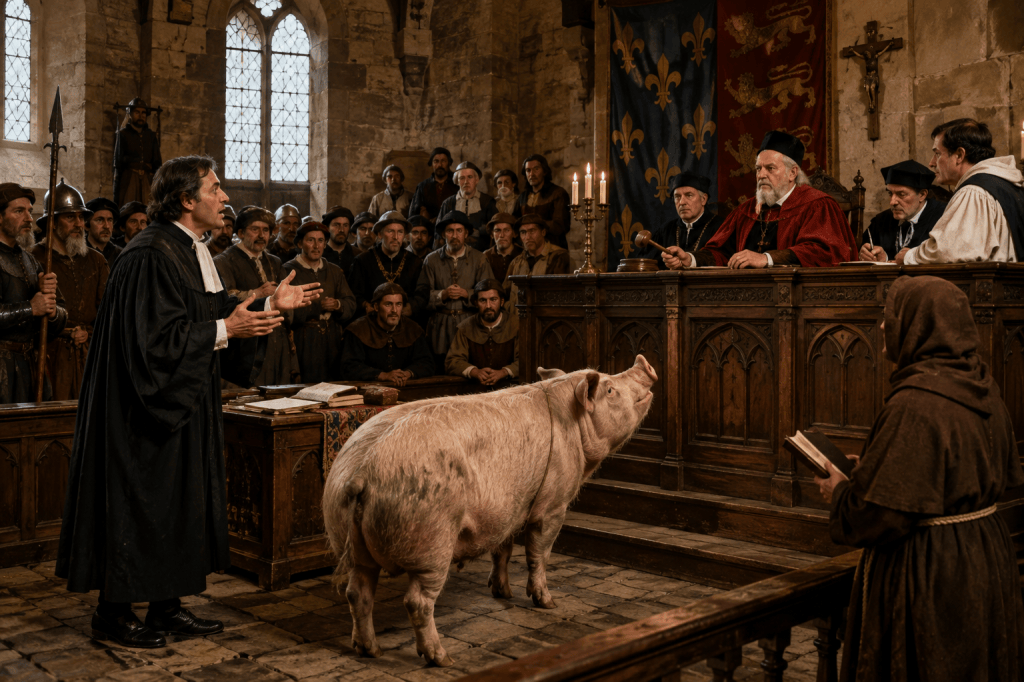
    Imagine entering a medieval courtroom expecting to witness the trial of a thief, a murderer, or perhaps someone accused of heresy, only to discover that the defendant waiting for judgment is a pig. In another town, the accused might be a colony of rats suspected of destroying crops, while elsewhere caterpillars, beetles, locusts, or other creatures could find themselves at the center of surprisingly elaborate legal proceedings. Stranger still, some of these animals were represented by lawyers who attempted to defend their interests before the court.

    Although the idea sounds like something invented for a dark comedy, animal trials were a genuine phenomenon in parts of medieval and early modern Europe. Surviving records and later historical studies describe proceedings involving pigs, cattle, dogs, rats, insects, and other creatures, sometimes ending with punishment and execution and sometimes developing into complicated arguments about responsibility, territory, legal procedure, and even whether animals had been given sufficient opportunity to obey the court.

    To modern eyes these trials appear absurd, but to the communities that organized them they could serve a serious purpose. Medieval Europeans inhabited a world in which religion, law, morality, nature, and the supernatural were not separated as clearly as they are today. When an animal killed a human being or an infestation threatened an entire harvest, people sometimes attempted to restore order using two of the most powerful institutions available to them: the law and the Church.

    Two Very Different Kinds of Animal Trials

    Not every animal was treated in the same way. Historians generally distinguish between proceedings against individual domestic animals and those directed against groups of agricultural pests.

    Domestic animals such as pigs, cattle, horses, and occasionally dogs could become the subjects of secular criminal proceedings after injuring or killing a person. Because these animals lived close to humans and often moved relatively freely through towns and villages, dangerous encounters were not uncommon, particularly in communities where livestock shared streets and public spaces with adults and children.

    Proceedings against rats, mice, caterpillars, beetles, locusts, and similar creatures were different because there was obviously no practical way to arrest thousands of animals and bring them physically before a judge. Such cases were more commonly associated with ecclesiastical authorities and could involve formal summonses, religious condemnations, anathemas, or orders demanding that the creatures leave a particular territory.

    Behind both types of proceedings was the same fundamental desire: when nature seemed to violate the order of human society, people wanted that order restored.

    The Pig of Falaise

    Among the best-known stories in the history of animal trials is the case of a pig prosecuted in Falaise, Normandy, in 1386 after reportedly attacking and killing a child.

    According to historical accounts of the case, the pig was formally tried, convicted, and condemned to death. The punishment was especially disturbing because the animal was reportedly mutilated before its execution in a manner intended to correspond to the injuries suffered by the child, after which it was publicly executed.

    The spectacle may appear grotesque today, but public punishment played an important role in medieval justice because an execution was not merely intended to remove a dangerous individual. It was also a ceremony through which authorities demonstrated that an offense against the community had been answered and that social order had been restored.

    What makes the Falaise story particularly fascinating is that the pig was apparently treated as something more than dangerous property. Instead of simply being slaughtered after the attack, it became the subject of a judicial process whose structure resembled criminal proceedings used against human offenders.

    Why Were Pigs So Often Accused?

    Pigs appear with surprising frequency in accounts of medieval animal prosecutions, but there was a practical reason for their unfortunate prominence in legal history. Medieval pigs were frequently allowed to wander through streets, courtyards, and public spaces in search of food, meaning that encounters between large animals and small children could sometimes end tragically.

    When such an attack occurred, communities living without modern concepts of animal behavior, liability, veterinary science, or public safety sometimes interpreted the incident through the legal framework they already understood. Rather than viewing the event purely as an accident caused by an uncontrolled animal, they could treat the animal itself as the perpetrator of an offense.

    The result was one of the strangest spectacles in European legal history: a creature incapable of understanding human law becoming the symbolic defendant in a human courtroom.

    The Rats That Supposedly Had a Lawyer

    One of the most celebrated stories concerning animal trials is connected with the French jurist Bartholomew Chasseneuz, also known as Chassenée, who lived during the late fifteenth and early sixteenth centuries and became associated with legal discussions concerning proceedings against animals.

    According to the traditional account, rats accused of devastating crops were summoned before an ecclesiastical court, but unsurprisingly they failed to appear. Their defense supposedly argued that the summons had not been sufficiently communicated because the accused rats were scattered across a large territory and therefore could not all have received proper notice.

    When the rats continued to ignore the court, an even more ingenious argument became associated with the story. Their journey to the hearing, the defense supposedly maintained, would expose them to mortal danger because cats were waiting along the roads. Since defendants could hardly be expected to risk their lives simply to reach the courtroom, their absence could therefore be considered reasonable.

    Historians have debated how literally every colorful detail of this famous story should be accepted, particularly because animal-trial anecdotes were frequently embellished as they were repeated. Nevertheless, Chasseneuz genuinely became associated with legal discussions surrounding proceedings against animals, and the story illustrates the extraordinary procedural questions that arose once human courts attempted to place non-human creatures inside a legal framework.

    If an animal could be summoned, did it need proper notice? If it failed to appear, could there be a legitimate reason for its absence? If a court demanded that an entire population of animals leave an area, did those creatures have somewhere else they were permitted to live? What began as an attempt to control pests could therefore develop into an unexpectedly sophisticated legal puzzle.

    When Entire Populations of Insects Faced Judgment

    Animal justice became even stranger when the defendants were not individual creatures but enormous populations of insects or agricultural pests.

    For communities whose survival depended heavily on a successful harvest, an infestation of caterpillars, beetles, locusts, or other destructive organisms could represent a genuine catastrophe. A ruined crop was not simply an economic inconvenience; it could mean hunger, poverty, displacement, or even death during the following winter.

    Without modern entomology, pesticides, ecological science, or an understanding of population cycles, communities sometimes turned toward religious and legal authorities when conventional attempts to remove the pests had failed. Ecclesiastical proceedings could then be initiated in which the creatures were formally ordered to abandon fields, vineyards, or other agricultural territory.

    The insects themselves obviously could not understand what was happening, yet the proceedings provided frightened communities with a structured response to something that otherwise seemed uncontrollable.

    The Extraordinary Case of the Moles

    One particularly curious proceeding discussed in histories of animal trials took place in the Alpine region in 1519 and concerned moles accused of damaging agricultural land.

    A legal representative was appointed to defend the animals, and the resulting arguments reveal how strange these proceedings could become once the machinery of law had been activated. According to accounts of the case, the animals were eventually required to leave the affected territory, but an extraordinary concession was reportedly made for those considered unable to comply immediately.

    Pregnant animals and their young were said to have been granted additional time before they were expected to depart.

    From a modern perspective, the idea of granting a legal extension to pregnant moles sounds almost impossible to believe, yet it illustrates the peculiar internal logic of these proceedings. Once the animals had been transformed into defendants, the court could find itself considering questions that resembled fairness, incapacity, and reasonable accommodation.

    Caterpillars Summoned Before a Court

    Another remarkable proceeding occurred in Chiavenna in 1659, when caterpillars accused of damaging vegetation became the subject of formal action. Historical discussions of the case describe the appointment of a representative for the creatures and attempts to notify them that proceedings were taking place.

    The image is extraordinary: human officials formally communicating a legal decision to insects scattered across fields and vegetation. Beneath the apparent absurdity, however, was a problem that was extremely serious for the people involved. When insects destroyed agricultural land, entire communities could face food shortages, and people naturally searched for ways to explain why such disasters occurred and how they might be stopped.

    For societies that understood the universe through a combination of Christian theology, customary law, natural philosophy, and inherited tradition, asking religious or judicial authorities to intervene was not necessarily as irrational as it appears from a twenty-first-century perspective.

    Did Animals Really Have Lawyers?

    Perhaps the most surprising aspect of these proceedings is that legal representatives could indeed be appointed in certain cases involving animals or pests. This did not necessarily mean that medieval judges believed a rat possessed human consciousness or understood its legal rights, but once authorities decided to conduct a formal proceeding, the rules and traditions of that legal system could create procedural obligations.

    A representative could question whether the accused had been properly summoned, whether a particular court possessed jurisdiction, whether an order was reasonable, or whether the creatures could realistically comply with the judgment imposed upon them.

    The resulting arguments occasionally resemble modern legal reasoning in surprisingly recognizable ways, even though the defendants themselves had no awareness that a case existed. Animal trials therefore tell us as much about human law as they do about medieval beliefs concerning animals.

    Were Animals Really Excommunicated?

    Modern retellings frequently claim that medieval courts simply “excommunicated” rats, insects, or other troublesome creatures, but the historical reality is more complicated.

    Excommunication properly refers to a religious sanction directed against a member of the Christian community, which obviously creates theological difficulties when applied literally to an animal. Nevertheless, historical sources describe religious condemnations, curses, anathemas, and ecclesiastical proceedings directed against creatures believed to be harming human communities.

    Over time, these different practices have often been grouped together under the dramatic expression “animal excommunication,” even though the terminology does not always accurately describe what occurred in each individual case.

    This distinction matters because the real history is fascinating enough without exaggeration. Medieval and early modern communities genuinely used formal religious and legal procedures against animals and pests, even if some of the most sensational details found in popular accounts developed through later retellings.

    Why Would Intelligent People Do This?

    It is tempting to laugh at people who summoned rats or caterpillars before a court, but doing so risks misunderstanding the world in which these proceedings occurred.

    Medieval Europeans were not simply incapable of recognizing that animals lacked knowledge of human law. Their societies operated within intellectual systems very different from our own, and disasters involving animals could carry religious, moral, social, and symbolic meanings in addition to their practical consequences.

    When a pig killed a child, the community had experienced something violent and deeply disturbing. When insects destroyed a harvest, the survival of families could be threatened, while rats consuming stored grain could contribute to hunger and economic hardship.

    Modern societies respond to these problems using veterinary medicine, public-health regulations, pest management, agricultural science, insurance, and scientific explanations of animal behavior. Medieval communities possessed none of these systems in their modern forms, so they sometimes turned to institutions that already carried enormous authority: the Church and the courts.

    A trial transformed chaos into a recognizable sequence of events in which there could be an accusation, a hearing, arguments, a judgment, and finally an attempt to restore the order that had been disturbed.

    What These Strange Trials Tell Us About the Medieval Mind

    Perhaps the greatest mistake would be to view animal trials merely as amusing examples of medieval superstition, because they reveal something much deeper about humanity’s relationship with nature.

    People have always attempted to impose understandable patterns upon events that frighten them. When explanations are unavailable, societies often use the intellectual systems they trust most to make sense of uncertainty.

    For medieval Europeans, law and religion provided powerful frameworks through which the unpredictable natural world could be interpreted. A destructive animal was therefore not always perceived merely as an organism behaving according to instinct; in certain circumstances, it could become part of a much larger drama involving justice, morality, divine order, and the survival of the community.

    This is what makes the history of animal trials so compelling. Behind the strange image of a pig facing execution or a lawyer defending rats lies a profoundly human desire to believe that even chaos can be brought under control.

    Somewhere centuries ago, a judge may have sat beneath the authority of a court while lawyers presented arguments concerning creatures that would never understand a single word being spoken about them. Outside, rats continued to move through fields, caterpillars continued to consume leaves, and pigs continued to behave according to instinct, completely unaware that human beings had transformed their actions into questions of law and justice.

    The animals could never understand the courts that judged them, yet the trials were never really about what the animals understood. They were about human beings attempting to make an unpredictable world obey rules, and perhaps that is why these extraordinary cases remain so fascinating centuries later.

    Sources and Further Reading

    E. P. Evans, The Criminal Prosecution and Capital Punishment of Animals (1906).

    Historical legal writings associated with Bartholomew Chasseneuz (Barthélemy de Chasseneuz) and proceedings involving animals.

    Historical and modern legal scholarship concerning animal prosecutions and ecclesiastical proceedings against agricultural pests in medieval and early modern Europe.

  • Did a Queen Really Build a Tiny Cannon to Kill Fleas? The Strange Legend of Versailles

    History is full of stories so strange that they sound like fiction. One of the most unusual claims tells of a French queen who supposedly commissioned a tiny cannon for a single purpose: to wage war against fleas inside the magnificent Palace of Versailles.
    It sounds absurd. Yet this curious tale has survived for generations.
    But is it true?
    The Palace of Luxury… and Insects
    Today, the Palace of Versailles represents elegance, wealth, and royal perfection. Glittering halls, golden decorations, crystal chandeliers, and endless gardens create the image of absolute luxury.
    The reality, however, was far less glamorous.
    During the seventeenth and eighteenth centuries, fleas, lice, bedbugs, and other insects were common throughout Europe. Even the richest palaces struggled with infestations. Hygiene standards were very different from modern expectations, and insects were considered an unavoidable part of everyday life.
    The royal family was no exception.
    The Curious Story of the Flea Cannon
    According to the legend, Marie Antoinette became so irritated by fleas that craftsmen created a miniature cannon capable of firing tiny charges to destroy insects hiding in furniture and fabrics.
    The story spread because it perfectly matched the extravagant image many people already had of the French court.
    A queen declaring war on fleas with artillery certainly sounds memorable.
    But there is a problem.
    No reliable historical document confirms that such a weapon was ever commissioned by Marie Antoinette.
    No royal inventory lists it.
    No contemporary witness clearly describes it.
    No museum possesses an authenticated example connected to the queen.
    Why Did People Believe It?
    Legends often grow around famous historical figures.
    Marie Antoinette became one of the most controversial queens in European history. During the French Revolution, countless exaggerated stories circulated to portray her as disconnected from ordinary people.
    Some were completely invented.
    Others mixed small facts with large doses of imagination.
    The flea cannon fits perfectly into this tradition.
    It reflects how people imagined the luxurious—and sometimes ridiculous—life inside Versailles rather than providing solid historical evidence.
    Were Tiny Cannons Real?
    Interestingly, miniature cannons certainly existed.
    European gunsmiths built beautiful decorative cannons for wealthy collectors and members of the nobility. Some were working models capable of firing tiny projectiles.
    These miniature weapons were often displayed in royal collections or used for entertainment.
    Because such objects genuinely existed, it became easier for later generations to believe that one might have been adapted for killing insects.
    The Truth Behind the Legend
    Whether the famous flea cannon ever existed remains uncertain.
    Modern historians generally classify the story as a legend rather than an established historical fact.
    Yet the tale reveals something even more fascinating than the cannon itself.
    It reminds us that behind the glittering image of Versailles lived real people dealing with surprisingly ordinary problems—cold rooms, unpleasant smells, insects, disease, and discomfort.
    Sometimes history becomes unforgettable not because of grand battles or political revolutions, but because of the bizarre stories that survive through the centuries.
    Perhaps no tiny cannon ever fired at a flea.
    But the legend itself has certainly survived far longer than any insect ever could.