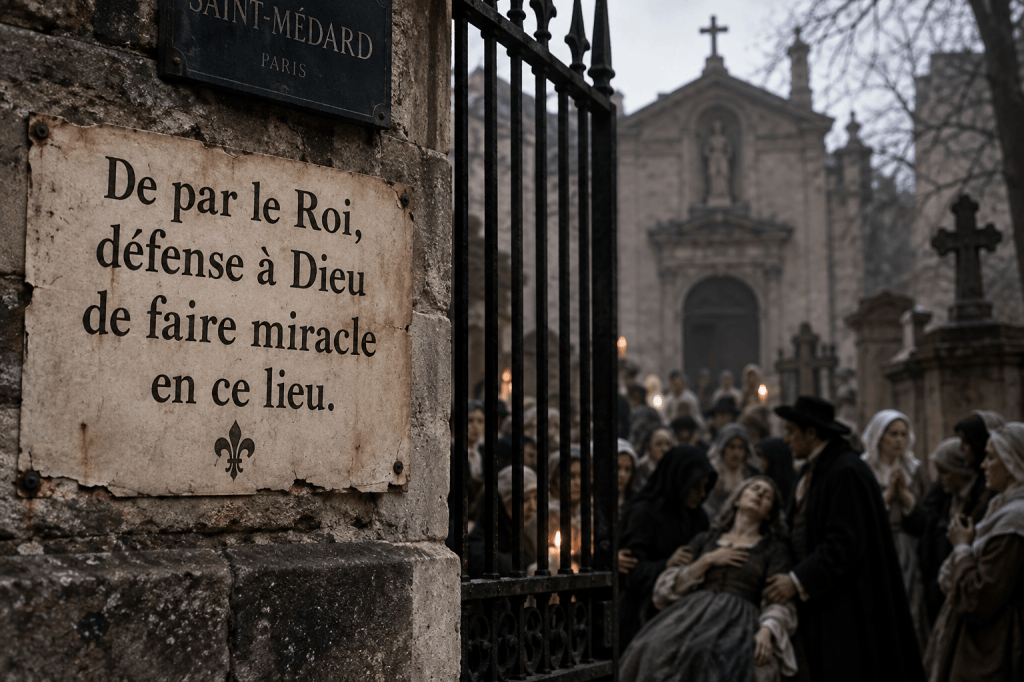
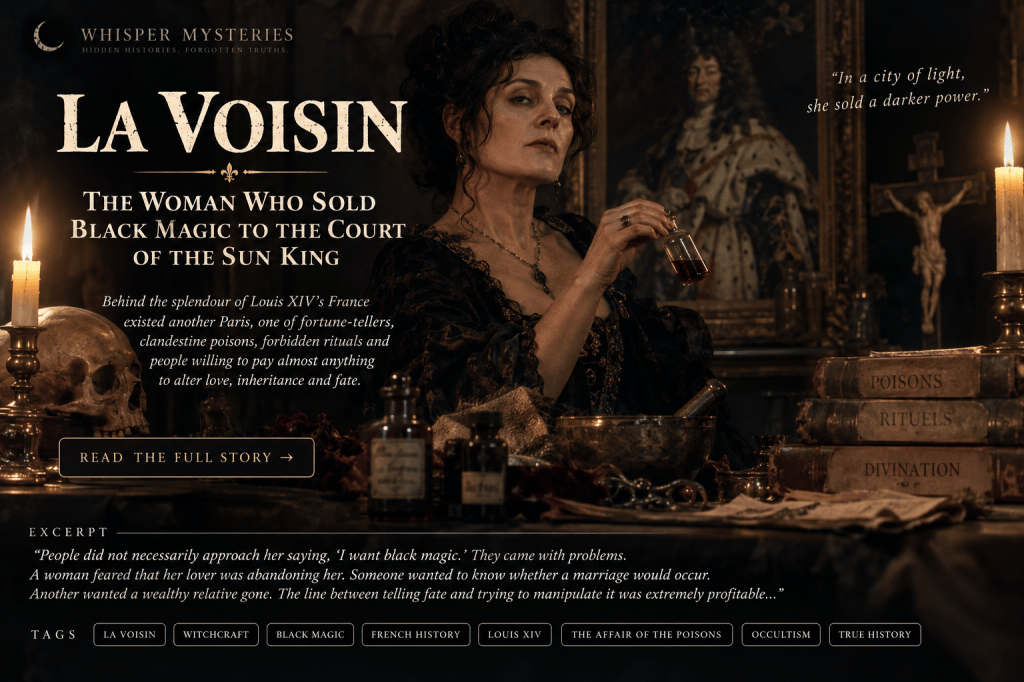
Behind the splendour of Louis XIV’s France existed another Paris, one of fortune-tellers, clandestine poisons, forbidden rituals and people willing to pay almost anything to alter love, inheritance and fate.
There is something almost indecent about the contrast. While Louis XIV was constructing the image of an absolute monarchy bathed in gold, ceremony and divine authority, while Versailles was becoming the theatre from which the Sun King intended to astonish Europe, another world was flourishing only a carriage ride away in Paris. It existed behind ordinary doors, in rented rooms and suburban houses, among astrologers, midwives, apothecaries, disgraced priests, fortune-tellers and women whom respectable society visited discreetly after nightfall. They were consulted about husbands who would not die, lovers who had lost interest, inheritances that seemed too distant, rivals who needed removing and futures that people were too impatient to leave in the hands of God.
At the centre of that world appeared a woman whose name eventually became inseparable from one of the darkest scandals of Louis XIV’s reign: Catherine Deshayes Monvoisin, remembered simply as La Voisin.
It would be convenient to describe her as a witch and leave it there, because that is how later generations transformed her into legend, but the surviving record is far stranger. La Voisin occupied an uncomfortable territory where several worlds overlapped. She practised divination and chiromancy, dealt in remedies and supposed love preparations, moved among people accused of supplying poisons, and became associated through testimony with rituals that contemporaries regarded as sorcery and sacrilege. Some accusations were supported by overlapping testimony; others emerged under interrogation and torture, and some were so extravagant that even modern historians must approach them cautiously. The French Ministry of Justice itself, in its account of the Affair of the Poisons, warns that the investigation became filled with exaggerations, inaccuracies and fabrications alongside genuine criminal activity.
That uncertainty does not make the story less disturbing. It makes it more so, because behind the fantastic language of demons and spells there was a very real underground economy built around desperation.
The Paris beneath Paris
The scandal did not begin with La Voisin.
Years before her arrest, France had already been shaken by the case of the Marquise de Brinvilliers, whose crimes helped create an atmosphere in which every unexpected death among the wealthy might conceal poison. In 1672, Jean-Baptiste Godin de Sainte-Croix died unexpectedly. Among his possessions were found bottles containing dangerous substances and letters linking him to the Marquise de Brinvilliers. She was eventually accused of poisoning members of her own family, fled France, was captured and brought back to Paris, where she was tried and executed in 1676. The case lodged itself in the imagination of the capital and gave a sinister expression to the age: poudre de succession, “inheritance powder,” poison purchased when waiting for an inheritance had become inconvenient.
(Ministère de la justice)
Soon the authorities began to suspect that Brinvilliers had not belonged to an isolated world of murderers. In September 1677, an anonymous warning concerning a supposed plot against Louis XIV and the use of a mysterious “white powder” drew further attention from the police. Nicolas de La Reynie, Louis XIV’s powerful lieutenant-general of police, began following the threads.
Those threads led into a Paris that respectable society officially despised and privately used.
Fortune-tellers were not necessarily marginal figures serving only the ignorant poor. Their clients could include people with money, influence and access to court. Astrology remained culturally powerful, charms and divination existed alongside orthodox Catholic belief, and medicines, cosmetics, aphrodisiacs, abortifacients and poisons could circulate through overlapping networks whose boundaries were not nearly as clear as a modern distinction between healer, magician and criminal might suggest. A scholarly history of the Affair describes precisely such a loose underworld of diviners, sorcerers, renegade clergy and sellers of magical remedies and poisons serving customers across Parisian society.
(Encyclopedia.com )
One of the women caught in the investigation was Marie Bosse, a fortune-teller who allegedly boasted that wealthy women came to her seeking ways to rid themselves of inconvenient husbands. The police arranged a trap, she was arrested, and under interrogation she began naming others.
Among the names was Catherine Deshayes Monvoisin.
La Voisin was arrested on 12 March 1679. What initially looked like another investigation into fortune-telling and poisoning soon expanded so violently that the monarchy created a special tribunal to contain it. On 7 April, Louis XIV established the commission that became famous as the Chambre Ardente, the Burning Chamber, which met at the Arsenal in a room described as draped in black and illuminated by torches. Between 1679 and 1682, hundreds of people would be questioned or implicated. The French Ministry of Justice records 442 people heard by the tribunal, 367 arrest orders, 218 detentions and ultimately dozens of severe sentences, including executions.
(Ministère de la justice ⚖️)
For a scandal supposedly born among obscure fortune-tellers, it was moving dangerously close to the throne.
What exactly did people buy from La Voisin?
This is where Catherine Monvoisin becomes more interesting than the caricature of a seventeenth-century witch.
People did not necessarily approach her saying, “I want black magic.” They came with problems.
A woman feared that her lover was abandoning her. Someone wanted to know whether a marriage would occur. Another wanted a wealthy relative gone. Someone wanted a pregnancy ended. Someone else needed a rival to lose favour. The client might begin by asking for a prediction, but if the prediction was unwelcome, the conversation could apparently move toward changing the predicted future.
The line between telling fate and trying to manipulate it was extremely profitable.
Accounts of the affair associate La Voisin with palmistry, physiognomy and fortune-telling, but also with love preparations, drugs and access to people capable of providing stronger substances. Contemporary investigators believed that a network existed in which magical services and poison trafficking could overlap. Whether every death attributed to these people was truly a poisoning is impossible to establish, because seventeenth-century toxicology was primitive and many accusations rested on testimony rather than forensic evidence. What is certain is that poisons were genuinely being traded and that the authorities recovered substances capable of killing.
La Voisin also became associated with abortion, an activity that placed her clientele in another clandestine world where secrecy was essential. Modern accounts repeatedly identify her as having practised or facilitated abortions, although some of the later stories about what happened to infants became intertwined with allegations of ritual murder and must be treated far more cautiously.
Then the investigation entered territory that would turn a criminal scandal into an occult legend.
Priests began appearing in the testimony.
So did forbidden masses.
And eventually, demons.
The Masses nobody was supposed to celebrate
The most famous accusations surrounding La Voisin involve what later writers called black masses, ceremonies in which the Catholic Mass was supposedly inverted, corrupted or employed for magical purposes. Several priests accused during the Affair were alleged to have conducted sacrilegious rituals for clients seeking love, power or revenge.
Among the names that emerged was Étienne Guibourg, an elderly priest whose testimony would later become central to the most sensational version of events.
Here we have to move carefully, because this is precisely where historical documentation and legend begin feeding upon one another.
There is documentary evidence that witnesses and defendants described ritualised masses involving women, priests and magical intentions. A recent Cambridge University Press history of Satanism notes testimony concerning a Mass reportedly performed in La Voisin’s home over a woman’s abdomen and observes that the episode may represent one of the earliest recorded descriptions of the motif later recognised as the Satanic or black mass using a woman as an altar. Yet the same scholarship stresses the wider context: the Affair of the Poisons was also a panic saturated with rumours about Satanism, and some confessions emerged from a judicial system that used coercion and torture.
(Cambridge Assets)
The later stories became considerably darker.
According to testimony produced in the investigation, some ceremonies allegedly called upon demonic names, while other statements accused Guibourg and associates of using infant blood or performing sacrifices. These are among the most repeated details in popular accounts of La Voisin, yet they should never be written as though a modern investigator had walked into the room and witnessed them. The French Ministry of Justice explicitly describes allegations involving murdered infants, black masses and demons while also observing that the proceedings accumulated exaggerations, imprecisions and fabrications and that tangible evidence was often lacking.
That distinction matters.
The documents prove that such accusations were made. They do not prove that every ritual described in those accusations happened exactly as reported.
Yet even after removing the embellishment, something uncomfortable remains. There really were people in Louis XIV’s Paris prepared to pay for ceremonies they believed might influence another human being, and there really were clergy accused of lending religious ritual to this underground commerce. The magical act did not have to work for the trade in magic to be real.
Its power existed first in belief.
And belief was enough to make people pay.
Then a name appeared that could destroy everything
After La Voisin was executed, the investigation should have begun to die with her.
Instead, it became more dangerous.
Her daughter, Marie-Marguerite Monvoisin, began providing information to investigators, and among the names appearing in subsequent testimony was one that could transform an embarrassing criminal affair into a catastrophe for the monarchy: Françoise-Athénaïs de Rochechouart de Mortemart, Marquise de Montespan, one of the most powerful women at Louis XIV’s court and the mother of several of his children.
Montespan was not an obscure aristocrat with a passing connection to Versailles. She had become Louis XIV’s official mistress and occupied apartments adjoining his. Versailles itself describes her circle as having become an epicentre of court life, pleasure, fortune, ambition and fear. She patronised artists including Molière and La Fontaine and stood for years extraordinarily close to the centre of royal power.
-(Château de Versailles | Site officiel)
Now witnesses were suggesting that she had consulted La Voisin.
The less sensational part is entirely plausible and is acknowledged even in the French Ministry of Justice’s account: Montespan appears to have consulted La Voisin concerning horoscopes, love preparations or magical remedies. Such practices, however improper, were not in themselves evidence that she had ordered murder.
The accusations went much further.
Marie-Marguerite and other prisoners claimed that Montespan had employed magical rituals to preserve the king’s affection. More lurid testimony connected her to black masses supposedly intended to retain Louis XIV’s love or harm rivals. Still darker allegations suggested attempts at poisoning.
Historians have argued over these accusations ever since.
The important fact is not that every allegation can be believed; it cannot. What matters is what happened when the allegations approached the king’s bedroom.
Louis XIV intervened.
According to the French Ministry of Justice, once Montespan’s name became dangerous, the king ordered that certain interrogations no longer be entered in the normal registers but recorded on separate sheets. Material concerning her was placed in a sealed container under royal control, and the Chambre Ardente was eventually prevented from pursuing cases in which her name appeared. In 1709, long after the scandal had disappeared from public life, Louis XIV personally ordered the incriminating papers held in that collection destroyed.
It is one of those moments in history that almost seems designed for conspiracy.
Documents existed.
The king intervened.
Some documents were later destroyed.
But that does not mean that the most horrifying accusations were therefore true.
A king might suppress an accusation because it was true, but he might just as readily suppress a false accusation because allowing the king’s former mistress and mother of his children to be publicly examined for sorcery, poison and sacrilege would be politically devastating regardless of the verdict.
The destruction of evidence leaves us not with proof, but with absence.
And absence is where legends thrive.
La Voisin herself remained remarkably difficult to break
One detail of Catherine Monvoisin’s final days deserves more attention than it usually receives because it complicates the popular image of the theatrical witch gleefully confessing every imaginable atrocity.
She did not provide investigators with the complete occult horror story later attached to her name.
Some of the most extreme revelations emerged only after her death.
La Voisin was interrogated repeatedly and subjected to brutal judicial pressure, yet important claims involving the alleged black masses and Montespan became clearer through other witnesses and particularly through her daughter. Even accounts sympathetic to the prosecution acknowledge the problem posed by contradictory statements, self-serving denunciations and testimony obtained under torture.
On 22 February 1680, Catherine Deshayes Monvoisin was taken to the Place de Grève in Paris and burned alive.
Public execution in seventeenth-century France was deliberately theatrical. Punishment had to be seen. Authority had to appear stronger than crime, heresy and disorder. The woman who had spent years promising clients that the future might be read or perhaps altered now reached a future she could no longer negotiate.
Yet her death solved almost nothing.
The Chambre Ardente continued its work until 1682. The investigation eventually became so politically poisonous that Louis XIV suspended it. Some defendants who might have revealed compromising information about the court were imprisoned without ordinary public trials and remained confined for years. The official French account records 34 executions, five sentences to the galleys and 23 banishments arising from the tribunal’s work.
The scandal had begun with powders and suspicious deaths.
It ended with the monarchy trying to control what could safely be known.
Was La Voisin really a witch?
Perhaps this is the wrong question.
If by witch we mean a woman possessing supernatural powers, history cannot establish that Catherine Monvoisin ever caused a death by magic, summoned a demon or altered Louis XIV’s affections through a ritual. No surviving document can demonstrate supernatural causation, and serious treatment of the case should never pretend otherwise.
If, however, we ask whether she participated in a culture in which magic was sold, purchased and believed to be capable of manipulating reality, the answer becomes much more interesting.
Her world contained divination, astrology, charms, ritual magic, suspected poisons, illicit medicine and a clientele willing to cross boundaries when ordinary solutions failed. The people approaching figures such as La Voisin did not necessarily perceive the neat categories we impose today between superstition, religion, medicine, crime and magic. A prayer could become a spell depending on intention. A remedy could become poison depending on dosage. A Mass could become magical if someone believed that the sacred words themselves possessed a power that could be redirected.
That is perhaps the darkest aspect of the Affair of the Poisons.
Not demons.
Not the extravagant stories of midnight ceremonies.
The clients.
Because behind almost every practitioner stood someone respectable enough to fear scandal and wealthy enough to purchase secrecy. The occult underground of Paris was not separated from elite society by an impenetrable wall; according to the investigation, members of that society entered it whenever love, jealousy, money or ambition became sufficiently desperate.
The splendour of Versailles and the darkness surrounding La Voisin were therefore not opposite worlds at all.
They belonged to the same century.
Perhaps even to the same people.
Louis XIV built his monarchy around light. He chose the Sun as his emblem, constructed halls filled with mirrors and surrounded himself with an elaborate ritual intended to make royal power appear almost cosmic in its order. Yet during the same reign, investigators discovered a Paris where another kind of power was being bought quietly in rooms far from the palace, power whispered over cards and palms, mixed into powders, requested through forbidden prayers and attributed to forces that respectable society publicly insisted it feared.
Whether those forces existed is a question history cannot answer.
But La Voisin existed.
Her clients existed.
The poisons existed.
The court that investigated them existed.
And somewhere among the surviving testimonies, the coerced confessions, the political manoeuvring and the papers that Louis XIV eventually ordered destroyed lies the part of the story that can no longer be recovered.
That missing part may be exactly why, more than three centuries later, La Voisin still refuses to remain merely a criminal and continues to haunt history as a witch.
Sources used for the historical reconstruction
The strongest source for the judicial chronology, arrests, Chambre Ardente, executions, Montespan allegations and destruction of the secret papers is the French Ministry of Justice’s historical dossier on the Affair of the Poisons. The Château de Versailles provides the court context and Montespan’s documented position beside Louis XIV. For the broader scholarly treatment of magical commerce and the development of the black-mass allegations, I also checked academic/encyclopedic histories of the Affair and a recent Cambridge University Press discussion of the episode.