Category: Religion & Biblical Mysteries

  • The Saint Who Raised 70 Children: The Dark Secrets of Saraktash

    The Saint Who Raised 70 Children: The Dark Secrets of Saraktash

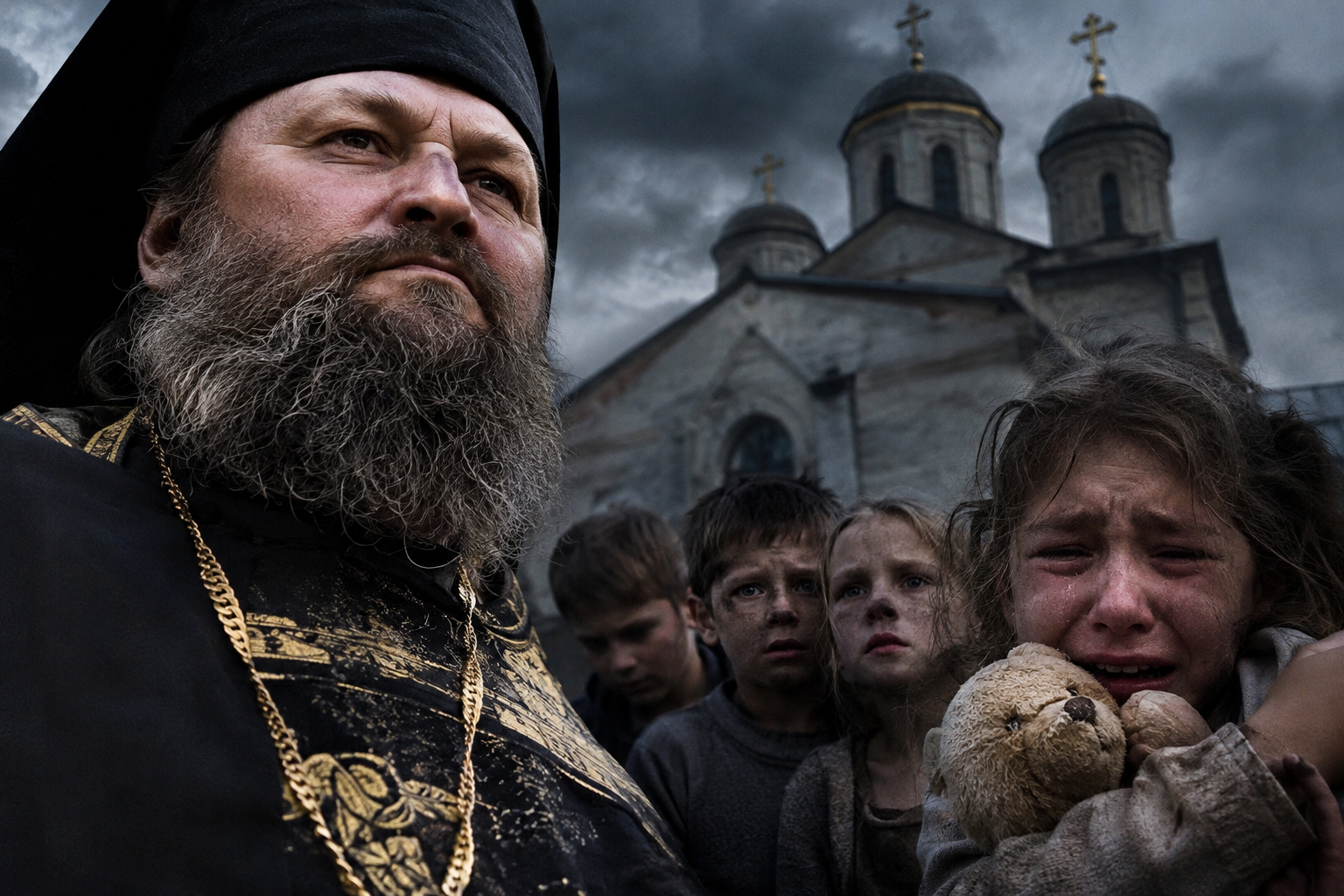
    In a remote Russian town, an Orthodox priest became a national symbol of compassion, earning prestigious honors for raising abandoned children. Behind that celebrated image, however, a criminal investigation uncovered a disturbing history of abuse. The story of Nikolai Stremsky raises a question far more unsettling than the crimes themselves: how does a society learn to trust someone so completely that it almost forgets to question him?

    There are certain stories that disturb me not simply because of the cruelty they reveal, but because of the extraordinary care with which that cruelty can remain concealed beneath an appearance of goodness. I have always found the relationship between power and public admiration fascinating, particularly when an individual becomes so closely associated with morality that questioning his behavior begins to feel almost like questioning morality itself.

    The story of Nikolai Stremsky, a Russian Orthodox priest who became famous for raising dozens of abandoned children, belongs to this troubling category of human history.

    For years, his name was associated with charity, religious devotion, and one of the largest families in Russia. Newspapers celebrated his extraordinary household, religious authorities recognized his work, and the Russian state awarded him the Order of Parental Glory, a prestigious distinction intended to honor exceptional contributions to family life.

    Yet on December 24, 2021, the Saraktash District Court in Russia’s Orenburg region sentenced this same man to 21 years in a strict-regime penal colony for serious offenses against children, including rape and other forms of sexual violence.

    When I began looking more closely at the reports surrounding this case, I found myself returning to a question that reaches far beyond Saraktash. How many times throughout history have people mistaken an impressive public reputation for evidence of private virtue?

    What makes this case especially disturbing is that Stremsky did not build his reputation through secrecy. His family was publicly celebrated, his religious institution was known to the community, and his work with children had attracted attention for decades.

    The danger was not hidden in some forgotten underground organization. It existed within an institution that many people believed represented safety, compassion, and moral authority.

    A Russian Town, a Religious Revival, and the Making of a National Hero

    Saraktash is a settlement in Russia’s Orenburg region, not far from the border with Kazakhstan. Its geographical position places it within a historically fascinating frontier, where Russian settlement, steppe traditions, Orthodox Christianity, and the cultures of Central Asia have intersected for generations.

    The broader Orenburg region developed as an important frontier territory of the Russian Empire during the eighteenth century, serving military, commercial, and administrative purposes along routes connecting European Russia with the Kazakh steppe and Central Asia.

    This historical background matters because Saraktash was not an isolated religious world detached from Russian society. Its institutions were shaped by the same political and social transformations that affected the rest of the country.

    When the Soviet Union collapsed in 1991, Russia entered a period of profound economic instability. Families struggled with poverty, unemployment, alcoholism, and the breakdown of familiar social structures. The difficulties facing children without adequate parental care became one of the most painful aspects of this transition.

    At the same time, the Russian Orthodox Church was experiencing a remarkable public revival after decades of restrictions under Soviet rule. Religious buildings were restored, monasteries reopened, and priests began recovering a social influence that had been severely limited during much of the twentieth century.

    It was within this atmosphere that Nikolai Stremsky and his wife, Galina, began taking children into their family during the early 1990s.

    Their work became associated with the Holy Trinity Simeon Monastery of Mercy in Saraktash, an Orthodox charitable complex that also developed educational and community activities.

    To the outside world, the story seemed extraordinary. A priest and his wife were providing a home for children who had experienced abandonment, institutional care, or difficult family circumstances.

    The number of children associated with their household eventually became central to Stremsky’s public identity. Reports frequently described him as the father of approximately 70 adopted or foster children, although the precise distinction between formal adoptions, guardianship arrangements, and children raised within the wider institution was not always made clear.

    That distinction is more important than it might initially appear. A large charitable household is not necessarily the same thing as a family in the legal sense, and the responsibilities of adults caring for vulnerable children depend on the arrangements under which those children have been placed.

    What interested me most was how quickly the number itself became a symbol. Seventy children represented generosity on a scale that seemed almost impossible to imagine, and the public narrative increasingly centered on the remarkable adult who had taken them in.

    But the greater the admiration directed toward the father, the easier it became for the individual experiences of the children to disappear behind his reputation.

    The Medal That Made a Reputation Almost Untouchable

    One of the less-discussed aspects of this story is the importance of public recognition in establishing Stremsky’s authority.

    In 2006, Nikolai Stremsky and his wife were photographed receiving a Golden Heart award in recognition of their work raising children. Later, Stremsky received Russia’s Order of Parental Glory, a state decoration associated with the upbringing of large families.

    The Order of Parental Glory is not simply a symbolic religious honor. It belongs to the Russian state awards system and is intended to recognize parents whose family life is presented as an example of responsible upbringing and commitment to children.

    In other words, Stremsky’s reputation was reinforced by two powerful sources of legitimacy: religion and the state.

    I find this combination particularly significant because both institutions carry forms of authority that can influence how ordinary people interpret evidence.

    A respected priest may be trusted because he represents spiritual guidance. A decorated citizen may be trusted because the state has publicly recognized his achievements. When the same individual possesses both forms of prestige, the psychological barrier to questioning him can become unusually strong.

    This does not mean that religious authority or state honors automatically create abuse. It means that public recognition can sometimes discourage the scrutiny that every institution responsible for vulnerable people requires.

    A medal may celebrate a person’s achievements, but it cannot reveal everything that happens behind closed doors.

    That is the contradiction at the heart of Saraktash. The very qualities that made Stremsky appear trustworthy also helped create an image that was extraordinarily difficult to challenge.

    September 2019: When the Public Story Began to Collapse

    In September 2019, Russian authorities arrested Nikolai Stremsky following allegations of serious crimes against children in his care.

    The investigation eventually examined offenses allegedly committed over a period extending from 1999 to 2019, a span of approximately twenty years.

    According to reporting based on statements from Russia’s Investigative Committee, the accusations included rape, sexual assault, indecent acts involving minors, cruel treatment, and failures to fulfill responsibilities toward children. Investigators also accused Stremsky of involving minors in alcohol consumption and of offenses involving specialized equipment intended for covert information gathering.

    The investigation referred to eleven minors in connection with alleged sexual offenses, while subsequent reporting identified seven children as formally recognized victims in the criminal proceedings.

    These numbers should not be confused. The number of children mentioned in an investigation, the number formally recognized as victims, and the number of specific criminal acts are different legal categories.

    I consider this distinction essential, especially in cases involving children, because exaggerating or combining figures may make a story sound more dramatic while actually weakening its credibility.

    At the time of Stremsky’s arrest, authorities removed nine children from his household, according to Russian reporting. Eight were under guardianship arrangements and one had been adopted. He subsequently lost his guardianship rights.

    For a man whose public identity had been built around caring for children, the significance of that intervention was enormous.

    The institution that had once symbolized protection had become the subject of a criminal investigation into the treatment of the very people it was supposed to protect.

    Stremsky denied the allegations, describing them as slander. His denial became part of the public controversy surrounding the case, but the subsequent judicial proceedings resulted in his conviction.

    There is something deeply unsettling about the chronology. The alleged offenses investigated by authorities stretched across two decades, during which his reputation as a devoted father continued to grow.

    It is tempting to explain this contradiction through a simple theory of institutional protection or deliberate complicity. Yet the publicly accessible reporting does not establish that every official, religious figure, or supporter knew about the abuse.

    What it does establish is that the existence of a celebrated public image did not prevent serious crimes from being committed against children.

    That fact alone deserves serious reflection.

    The Other Adults: A Detail That Changes the Story

    One of the most revealing aspects of the Saraktash case concerns the involvement of other adults connected to Stremsky’s household.

    Reports from BBC News and Radio Free Europe/Radio Liberty describe how one of his adult adopted daughters and her husband received suspended sentences for unlawfully restricting children’s freedom.

    This detail is significant because it shows that the criminal proceedings extended beyond accusations against a single priest.

    The case also raised questions about the treatment of children within the broader household and the extent to which adults responsible for their welfare respected their freedom and dignity.

    However, I believe it is important to resist turning every reported allegation into a cinematic scene. Some accounts circulating online describe underground prisons, elaborate surveillance networks, and carefully organized rituals of psychological torture.

    The verified reporting establishes serious crimes and accusations involving unlawful confinement, but it does not independently substantiate every sensational detail attached to the story.

    The distinction matters because real victims do not need invented horrors to make their experiences worthy of attention.

    The crimes established by the court are disturbing enough without embellishment.

    The Psychology of Obedience: Why Authority Can Silence Doubt

    What makes the Saraktash case relevant beyond Russia is the psychological question it raises about authority.

    In 1963, psychologist Stanley Milgram published his famous research on obedience, demonstrating how the presence of an apparently legitimate authority figure could influence people to perform actions that conflicted with their personal judgment.

    Milgram’s experiments have been debated extensively, both ethically and scientifically, and they cannot explain the behavior of every person involved in a modern criminal case. Nevertheless, they helped establish an important question within social psychology: how does perceived legitimacy affect our willingness to challenge authority?

    Later research on institutional abuse, coercive control, and the psychology of betrayal has explored how dependence on powerful individuals or organizations can complicate the recognition and disclosure of harmful experiences.

    Psychologist Jennifer Freyd’s work on betrayal trauma is especially relevant here. Her research examines how abuse involving a trusted or depended-upon person can create profound conflicts for victims, particularly when acknowledging the betrayal threatens an important relationship or source of security.

    I cannot claim to know the private psychological experiences of the children involved in Saraktash. Those experiences belong to them, and public reporting provides only a limited understanding of their lives.

    But the wider research offers a useful framework for understanding why abuse within trusted institutions can be difficult to expose.

    A child dependent on an adult for food, shelter, affection, education, and social belonging is not negotiating from a position of equality. When that adult also possesses religious or institutional authority, the imbalance becomes even more pronounced.

    The question is therefore not simply why a child might remain silent, but whether the surrounding environment provides a genuinely safe opportunity to speak and be believed.

    This is where I think the public fascination with supposedly saintly figures can become dangerous. The more completely a community identifies goodness with one individual, the more difficult it may become to recognize evidence that contradicts that belief.

    December 2021: The Judgment That Destroyed a Public Myth

    On December 24, 2021, the Saraktash District Court sentenced Nikolai Stremsky to 21 years in a strict-regime penal colony.

    The prosecution had reportedly requested a sentence of 24 years.

    The court also imposed restrictions on his freedom following imprisonment, prohibited him from working with children for twenty years, and stripped him of the Order of Parental Glory.

    The proceedings were held behind closed doors, a significant consideration in a case involving sexual crimes against minors. Public access to the complete evidentiary record was therefore limited, and detailed claims about particular testimony or forensic findings should not be presented as established unless supported by reliable documentation.

    By the time of his conviction, Stremsky had also been removed from the priesthood.

    In July 2022, the Orenburg Regional Court considered his appeal and upheld the prison sentence.

    There is a powerful historical irony in the removal of his state decoration. The same public system that had once recognized him as an exemplary parent eventually withdrew that recognition following a criminal conviction for crimes against children.

    Yet the symbolic reversal cannot undo the experiences of those harmed.

    A medal can be removed from an official record, and a sentence can establish legal responsibility, but neither action automatically restores the trust, security, or childhood that victims may have lost.

    The Most Disturbing Question Is Not About Religion

    Whenever a case like this becomes public, discussions often turn toward religion itself. Some interpret the crimes as proof of the dangers of religious institutions, while others insist that the actions of an individual should never be confused with the beliefs of an entire community.

    I think both reactions can distract from the more precise question raised by the evidence.

    The central issue is not whether faith is inherently good or bad, but what happens when moral authority becomes so concentrated in one person that ordinary safeguards begin to seem unnecessary.

    Religious institutions are not alone in facing this danger. Schools, charitable organizations, residential care facilities, political movements, and even families can develop cultures in which reputation is protected more aggressively than vulnerable individuals.

    History offers repeated examples of admired figures whose public image concealed serious wrongdoing. The lesson is not that every respected person should be regarded with suspicion, but that admiration must never replace accountability.

    The philosopher Hannah Arendt explored the relationship between authority, responsibility, and the human tendency to surrender independent judgment within powerful systems. Her work does not provide a direct explanation of Saraktash, but it offers a useful reminder that moral responsibility cannot simply be transferred to institutions or prestigious individuals.

    For me, this is one of the most important questions raised by the case. At what point does respect for an authority figure become an unwillingness to examine his actions?

    And how can institutions create conditions in which children are heard even when their testimony threatens the reputation of someone powerful?

    What Saraktash Reveals About the Stories We Want to Believe

    The longer I reflect on this case, the more I realize that its deepest mystery is not the existence of cruelty. Human history has never lacked examples of individuals capable of harming others while presenting themselves as respectable members of society.

    The more difficult mystery is our willingness to construct reassuring stories around people we admire.

    Stremsky’s public image offered a comforting narrative: an Orthodox priest rescuing abandoned children, rebuilding family life, and embodying charity during a period of social upheaval.

    It was a story people wanted to believe, partly because it seemed to demonstrate that goodness could survive even in difficult circumstances.

    And that desire was understandable.

    What troubles me is how easily a beautiful story can become a substitute for independent scrutiny. When admiration grows strong enough, uncomfortable questions may begin to look like acts of hostility rather than necessary precautions.

    The case also reminds me that the number of children in someone’s care should never become more important than the conditions in which those children live.

    Seventy children may make an impressive headline, but the true measure of an institution’s success lies in whether each child is safe, respected, listened to, and able to seek help without fear.

    The criminal proceedings in Saraktash established that the celebrated reputation of its most prominent religious figure concealed a reality profoundly different from the image presented to the public.

    That contradiction is the reason this story deserves to be remembered.

    Not because it proves that every charitable institution hides something sinister, and certainly not because the suffering of children should become entertainment, but because it reveals the consequences of confusing moral prestige with moral accountability.

    When I think about Saraktash, I do not see only the downfall of a famous priest. I see a warning about the human need to believe in heroes, the fragility of trust, and the responsibility we have to question even the most reassuring appearances.

    Perhaps the most frightening deception is not the lie that nobody believes, but the one that becomes so comforting that nobody wants to investigate it.

    And sometimes, the most important question we can ask is not whether a person appears to be good, but whether those who depend on that person are genuinely safe.


    Sources and Further Reading

    The following sources document the criminal proceedings, the history of Stremsky’s household, and the psychological concepts discussed in this article.

    BBC News — December 24, 2021
    Russian priest who adopted 70 children jailed for abuse
    https://www.bbc.com/news/world-europe-59779376

    Radio Free Europe/Radio Liberty — December 24, 2021
    Священник Стремский приговорён к 21 году колонии за насилие над детьми
    https://www.svoboda.org/a/svyaschennik-stremskiy-prigovoryon-k-21-godu-kolonii-za-nasilie-nad-detjmi/31624053.html

    RBC Russia — December 24, 2021
    Обвиненному в педофилии оренбургскому священнику дали 21 год колонии
    https://www.rbc.ru/society/24/12/2021/61c563d39a79473b315d622a

    1743.ru — September 9, 2020
    СК: Николай Стремский совершал преступления против половой неприкосновенности в течение 20 лет
    https://poleznygorod.1743.ru/news/40055

    Orenday — July 18, 2022
    21 год тюрьмы: приговор священнику Николаю Стремскому вступил в законную силу
    https://orenday.ru/news/180722094713

    Stanley Milgram — 1963
    Behavioral Study of Obedience. Journal of Abnormal and Social Psychology, 67(4), 371–378.
    DOI: 10.1037/h0040525

    Jennifer J. Freyd — 1996
    Betrayal Trauma: The Logic of Forgetting Childhood Abuse. Harvard University Press.

    Hannah Arendt — 1963
    Eichmann in Jerusalem: A Report on the Banality of Evil. Viking Press.

    Editorial note: This article distinguishes between documented court findings, allegations reported during the investigation, and the author’s interpretation of the wider social and psychological issues. Graphic details circulating online that could not be independently corroborated have been excluded.

    Whisper Mysteries — Exploring the truths hidden behind familiar stories.
  • THE SECRET OF AMEN: Solve et Coagula, Abracadabra, and the Ancient Belief That Words Can Change Reality

    THE SECRET OF AMEN: Solve et Coagula, Abracadabra, and the Ancient Belief That Words Can Change Reality

    There are certain words we repeat so often that, after a while, we stop hearing them altogether. They become part of the background of our lives, familiar sounds that pass through the mouth almost automatically, carrying traditions much older than our own understanding of them. For me, Amen had always belonged to that category, because I had heard it at the end of prayers, funerals, blessings, private pleas and ceremonial words so many times that I had unconsciously reduced it to a religious full stop, a conventional way of saying that the prayer was over.

    What changed my perception was not one dramatic discovery, but a series of details that began to accumulate once I started looking at the word more carefully. I wanted to know where it came from, why it had survived for so long almost unchanged, why it appeared in Jewish and Christian traditions with such extraordinary persistence, and why certain esoteric interpretations had turned it into something far more mysterious than a simple liturgical response. What began as a curiosity about one familiar word gradually pulled me into a much wider investigation, one that led from ancient Hebrew and Egyptian religion to the sayings attributed to Jesus, from medieval alchemy to a Roman medical charm, and finally to one of the most famous words in the history of magic: Abracadabra.

    The deeper I went, the more I found myself returning to the same unsettling question. What if ancient people did not always think of words merely as instruments for describing reality, but as actions capable of participating in reality, shaping it, confirming it, dissolving it or fixing it into form?

    The Word We Say Without Hearing It

    The first thing that intrigued me was the realization that Amen is far older than Christianity. Its accepted linguistic origin is Hebrew, from the Semitic root ʾ-M-N, a family of words associated with firmness, reliability, faithfulness, trust and truth. The same root lies behind emunah, a term commonly translated as faith or faithfulness, but whose older sense is richer than a vague inner belief because it also carries the idea of something dependable, stable and worthy of trust.

    This immediately changed the way I understood the familiar translation “so be it.” In modern usage, that expression can sound almost passive, as if the speaker were merely hoping that something might happen in the future, yet the older range of meaning attached to Amen is far stronger and more active. Depending on context, the word can function as an affirmation that what has just been spoken is accepted as true, binding or worthy of trust, almost as if the speaker were saying, “I stand behind these words; I accept their meaning; let what has been spoken be confirmed.”

    One of the passages that stayed with me appears in Numbers 5:22, where a woman responds to a solemn oath with the doubled formula “Amen, Amen.” Another appears repeatedly in Deuteronomy 27, where the assembled people answer Amen after a series of declarations. In both cases, the word is not decorative and it does not merely end the exchange. It does something socially and spiritually important, because the person saying it places himself or herself inside the statement that has just been made.

    That distinction fascinated me, because it made Amen seem less like punctuation and more like a verbal seal. I do not mean a magical seal in the later occult sense, but a deliberate act of confirmation through which spoken words become accepted, witnessed and, in a certain sense, completed.

    Rabbinic tradition gives the word even greater depth. In the Babylonian Talmud, in tractate Shabbat 119b, Rabbi Ḥanina asks what Amen signifies and interprets its Hebrew letters as an acronym for El Melekh Ne’eman, meaning “God, Faithful King.” Other rabbinic discussions treat the response Amen not as the insignificant echo of someone else’s prayer, but as a meaningful act in itself, one that binds the person answering to what has been pronounced.

    I found that reversal beautiful, because in modern religious habit we tend to assume that everything important has already happened before Amen is spoken. The prayer, the blessing, the request and the declaration seem to contain the substance, while the final word appears to be little more than closure. Yet older traditions suggest something more subtle, because sometimes the act of confirmation is precisely what gives the preceding words their final weight.

    Amun and the Egyptian Connection I Wanted to Believe

    Sooner or later, anyone who investigates the history of Amen encounters another ancient name that is almost impossible to ignore: Amun, also written Amon, one of the most important gods of ancient Egypt.

    The resemblance between Amun and Amen is immediately seductive, especially for anyone drawn to ancient mysteries. Amun rose to immense religious importance in Egypt, particularly from the Middle Kingdom onward, and later became closely associated with Ra as Amun-Ra. His cult at Karnak developed into one of the most important religious centers in the ancient world, while his name was traditionally interpreted as “the Hidden One,” a designation that fits his association with the invisible, concealed and mysterious aspects of divinity.

    When I first encountered the similarity between Amun and Amen, I wanted the connection to be real. It was the kind of idea that seems almost too perfect to resist: an Egyptian god known as “the Hidden One,” worshipped for centuries before Christianity, and a sacred word that would later become one of the most recognizable expressions in Judaism and Christianity, both surviving with remarkably similar sounds.

    It would make a magnificent secret history, but the evidence does not support a direct linguistic derivation. The Hebrew Amen belongs securely to the Semitic root ʾ-M-N, while the Egyptian name Amun arises within a different linguistic system. Similarity of sound, even when striking, is not enough to prove common origin, and this is one of those moments where I think mystery becomes more interesting when we resist the temptation to force it into certainty.

    What remains is still remarkable. Two ancient religious cultures, geographically close and historically intertwined, preserved sacred forms whose sounds resemble one another while their meanings move in different directions: one toward hiddenness and divine invisibility, the other toward truth, faithfulness and confirmation. I find the coincidence powerful enough on its own, precisely because it does not need to be turned into a false etymology.

    When Amen Moves to the Beginning

    The next stage of my investigation became even more intriguing when I noticed the way Amen appears in the sayings attributed to Jesus.

    In ordinary liturgical use, the word usually follows a statement. Someone speaks, blesses or prays, and another person answers Amen. Yet in the Gospel tradition, Jesus repeatedly places the word before what he is about to say. English Bibles usually translate this as “Truly I say to you,” but behind the word “truly” stands the Greek transliteration amēn, preserving the Semitic expression itself.

    This unusual introductory use has been discussed by scholars for a long time. In the Synoptic Gospels it appears frequently, while the Gospel of John intensifies the formula by doubling it: “Amen, amen, I say to you,” commonly translated into English as “Truly, truly, I say to you.”

    What intrigued me was the shift in function. The word is no longer being used by an audience to confirm something already spoken, but by the speaker himself to establish the certainty and authority of what is about to follow. Instead of closing a statement, Amen now stands at the threshold of one.

    That alone is unusual, but Revelation 3:14 goes even further. There, Christ is referred to as “the Amen, the faithful and true witness.” At this point, Amen is no longer simply a response or an introductory formula; it has become a title.

    I remember stopping when I first read that verse in this context, because it completely changed the scale of the word. A term I had spent years hearing as the automatic ending of prayers was suddenly being used as a name associated with faithfulness and truth. The connection with Isaiah 65:16, where the Hebrew text contains an expression that can be rendered as “the God of Amen,” “the God of faithfulness” or “the God of truth,” only deepens the background.

    At that point I began to see Amen less as the end of religious speech and more as an ancient concept of reliability transformed into language. Something spoken, affirmed and made firm.

    And that was precisely when another phrase entered my mind.

    Solve et Coagula

    Anyone who spends enough time reading about alchemy eventually encounters the expression Solve et Coagula, usually translated as “dissolve and coagulate.”

    The popular image of alchemy reduces it to eccentric men attempting to turn lead into gold, yet historical alchemy was much more complex than that. Its texts describe the dissolution, separation, purification, recombination and fixation of substances through repeated processes, and these material operations often acquired symbolic, philosophical and spiritual meanings as well.

    What interested me most was the rhythm implied in Solve et Coagula. Something must first be broken apart, released from its previous form or reduced to a more fluid state, and only afterward can it be recombined, stabilized and fixed into something new.

    While reading about this process, I began to see an unexpected symbolic parallel with Amen.

    I want to be careful here, because I found no historical evidence showing that ancient Hebrew speakers intended Amen to mean Coagula, nor did I find evidence that alchemists derived their formula from Jewish or Christian liturgical usage. The connection belongs to symbolic interpretation, not etymology.

    Even so, the correspondence is striking.

    A prayer begins in a state that is almost entirely intangible. It may start as fear, gratitude, longing, uncertainty or desire. Then it becomes thought, thought becomes breath, breath becomes sound, and sound becomes a sequence of words directed outward toward another person, a community, a divinity or even one’s own inner life.

    At the end comes Amen, the moment of confirmation.

    Seen through an alchemical metaphor, everything before that final word remains fluid, expressive and open, while Amen resembles the moment of fixation, the point at which the speaker gathers the intention, accepts it and gives it a defined boundary.

    This does not require the belief that certain syllables mechanically force the universe to obey human wishes. What interested me more was the ancient recognition that an intention changes once it acquires form.

    A vow kept silently in the mind is not the same as a vow spoken aloud. A contract imagined is not the same as a contract signed. A verdict considered privately is not the same as a verdict pronounced in court. In each case, language transforms an inner state into an event with consequences.

    Long before modern psychology or linguistics studied the social power of speech, ritual cultures had already understood that words could mark transitions, bind people, create obligations and change circumstances.

    That idea would become even more fascinating when I encountered Abracadabra.

    The Word That Was Supposed to Disappear

    I had always associated Abracadabra with stage magicians, children’s performances and cheap theatrical tricks. It was the kind of word that seemed too familiar to deserve serious attention, precisely because popular culture had turned it into a cliché.

    Its actual history is far stranger.

    The earliest surviving written appearance usually cited by scholars occurs in a Latin medical poem associated with Quintus Serenus Sammonicus, probably in the third century CE. Serenus recommended the word not as entertainment but as part of a treatment for recurring fever, generally interpreted in modern scholarship in connection with malaria.

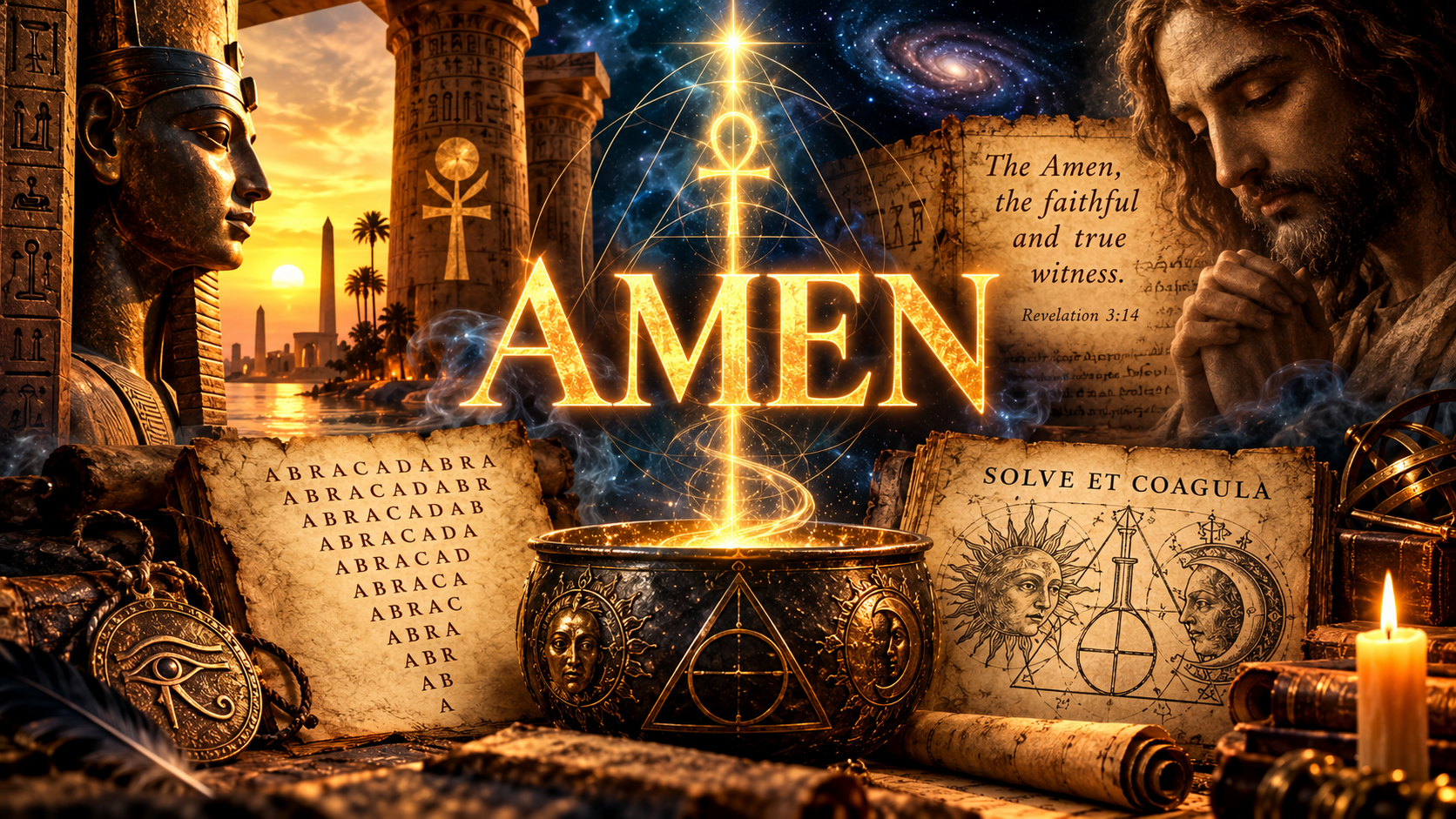
    The patient was instructed to write the word repeatedly, removing one letter from each successive line until the formula narrowed into a triangle:

    ABRACADABRA
    ABRACADABR
    ABRACADAB
    ABRACADA
    ABRACAD
    ABRACA
    ABRAC
    ABRA
    ABR
    AB
    A

    The logic is visually obvious once you see it. The word shrinks line by line, and the illness is symbolically expected to diminish with it.

    That was the moment when the relationship with Solve became impossible for me to ignore, because the written charm itself performs a kind of dissolution. The letters disappear gradually until the original form has almost completely vanished.

    In the ancient worldview behind the charm, this was not merely decorative symbolism. Medicine, religion, astrology and magic often overlapped in ways that modern categories tend to separate. A written word could function simultaneously as language, image, ritual object and supposed therapeutic instrument.

    The details of the ritual are even stranger than the word itself. According to accounts derived from Serenus, the written charm was to be tied with flax and worn around the neck, and after nine days it was to be removed and thrown backward over the shoulder into a stream flowing eastward.

    That detail stayed with me because the word alone was not considered sufficient. The body, the written object, the number of days, the direction of the flowing water and the act of disposal all became part of the same ritual structure.

    Once I understood that context, Abracadabra stopped looking like a ridiculous stage-magician formula and began to look like the fossil of a very old human conviction: that words, when written, arranged and ritualized correctly, could participate in the transformation of physical reality.

    What Does Abracadabra Actually Mean?

    This was also where I encountered one of the most attractive myths surrounding the word.

    Modern esoteric sources frequently claim that Abracadabra comes from an Aramaic phrase supposedly meaning something like “I create as I speak” or “I will create through the word.” It is an interpretation so perfectly suited to the idea of manifestation that it has been repeated almost endlessly.

    The problem is that the derivation is not securely documented.

    Scholars have proposed connections with Aramaic, Hebrew, the Gnostic name Abraxas and various magical formulas, yet no explanation has been demonstrated conclusively. The origin of Abracadabra remains uncertain.

    I found myself liking that uncertainty more than the neat explanation.

    There is something deeply unsettling about a word that has survived for nearly eighteen centuries, a word recognized today by children across much of the world, while its original meaning still escapes us. We know what people did with it before we know with confidence what it meant to the person who first recorded it.

    That, to me, is far more mysterious than forcing it into a convenient translation.

    Abracadabra as Solve, Amen as Coagula

    Once I placed Abracadabra and Amen on opposite sides of the alchemical expression Solve et Coagula, a symbolic pattern began to emerge.

    I do not mean that I had discovered a secret historical doctrine connecting ancient Judaism, Roman medical magic and medieval alchemy. There is no evidence for such a unified system, and pretending otherwise would weaken the article rather than deepen it.

    What interested me was the recurrence of the same symbolic logic.

    Abracadabra, in its ancient triangular form, is gradually dissolved.

    Amen, in its older religious use, affirms, confirms and stabilizes what has been spoken.

    The first visually resembles Solve.

    The second symbolically resembles Coagula.

    Between them lies one of humanity’s oldest obsessions: the belief that language can mediate between what exists inside us and what exists outside us.

    A thought becomes breath, breath becomes sound, sound becomes language, language becomes declaration, and declaration becomes action. Sometimes that action becomes law, ritual, commitment or history.

    We live inside this process every day, even if we no longer call it magic.

    A judge speaks a sentence and a person loses freedom. Two people pronounce words in a legal ceremony and their social status changes. A doctor names a disease and an entire family begins reorganizing its future around that diagnosis. A government signs and announces an agreement and borders, rights or obligations change. Someone says “I promise,” and suddenly there is an expectation that did not exist before.

    None of this requires supernatural forces to demonstrate that words can alter reality.

    The deeper question is why so many ancient traditions believed that the power of language extended even further.

    In the Beginning Was the Word

    At this point in my investigation, it became impossible not to think of one of the most famous openings in religious literature: “In the beginning was the Word.”

    The Gospel of John begins with the Logos, while Genesis presents creation itself as an act structured through divine speech. God speaks, and reality follows.

    I do not believe we need to claim that Genesis, John, Egyptian religion, Jewish liturgy, Roman medical charms and European alchemy all preserve fragments of one secret doctrine. That kind of claim is attractive because it creates a complete pattern, but history is usually more complicated than the patterns we want to impose on it.

    What fascinates me more is that different civilizations repeatedly return to the intuition that language possesses more than descriptive power.

    Names could invoke.

    Oaths could bind.

    Blessings could protect.

    Curses could injure.

    Sacred formulas could heal.

    Written letters could become talismans.

    A true name could grant authority.

    Even silence could become part of ritual.

    When I began placing these traditions side by side, I did not find proof that words release invisible energies capable of rearranging physical matter according to desire. What I found was something more historically defensible and, in many ways, more profound: human beings have understood for thousands of years that language shapes consciousness, consciousness shapes behavior, behavior changes circumstances, and circumstances become the world in which we live.

    Ancient ritual compressed that chain into symbol.

    Alchemy encoded it through transformation.

    Religion expressed it through sacred speech.

    Modern psychology studies parts of the same process using another vocabulary.

    Was Amen Ever a Manifestation Formula?

    This is where I think it becomes important to resist the simplest answer.

    There is no reliable historical basis for calling Amen “the oldest manifestation formula in human history,” and I found no evidence that ancient speakers believed the sound itself could mechanically force a private desire into material existence.

    That claim sounds powerful, but it risks replacing genuine mystery with a modern slogan.

    At the same time, reducing Amen to a meaningless habit would also miss the complexity of the word.

    Historically, it carries ideas of truth, trust, affirmation, reliability and confirmation. Biblically, it appears in oaths, communal responses and formal declarations. In the Gospel tradition it is placed at the beginning of authoritative sayings, while in Revelation it becomes a title associated with faithfulness and truth.

    That is already remarkable enough.

    The esoteric reading can begin after the historical evidence, without pretending to replace it.

    When I interpret Amen through the symbolism of Coagula, I am not claiming to have uncovered a hidden dictionary used by ancient alchemists. I am doing something closer to what esoteric traditions have always done, which is to observe correspondences between different systems of meaning.

    The prayer releases intention into language, while the final affirmation gathers it into certainty.

    The inner state becomes a spoken form.

    The spoken form becomes accepted.

    The volatile becomes fixed.

    That is where Solve et Coagula becomes, for me, more than an alchemical motto.

    Why Words Were Never Just Words

    The further I went into this subject, the more I found myself questioning the modern assumption that words are neutral containers.

    Why do we instinctively lower our voices when making certain promises? Why does naming a fear sometimes make it more terrifying, while at other times speaking it aloud diminishes its power? Why have people in so many cultures written sacred formulas on walls, parchment, metal, stone, amulets and even skin? Why do religions repeat particular phrases? Why do legal systems demand exact verbal declarations? Why do rituals insist that certain words be spoken in a prescribed sequence?

    We behave as though words matter because they do.

    The disagreement begins only when we ask how far that power extends.

    Ancient people may have attributed effects to sacred language that modern science does not accept, while modern culture may sometimes underestimate the psychological, social and symbolic power that carefully chosen words continue to exercise over human beings.

    Between uncritical belief and automatic dismissal lies a much more interesting territory, and that is the territory where this investigation eventually led me.

    When I now hear Amen, I no longer hear a religious full stop. I hear a word that has travelled through millennia carrying the ideas of affirmation, trust and confirmation.

    When I encounter Abracadabra, I no longer think only of a theatrical trick. I think of a person living nearly eighteen centuries ago, carrying a written triangle of diminishing letters against the body, waiting nine days before casting it into running water in the belief that illness could disappear as the word disappeared.

    When I read Solve et Coagula, I no longer imagine only furnaces, manuscripts and metals. I see a recurring human pattern in which old forms are broken apart so that new forms can emerge, after which the unstable must once again be fixed.

    These are not identical traditions, and I would never claim that they are.

    Yet they circle around the same ancient human intuition: invisible things become powerful when we give them form.

    The Real Secret of Amen

    By the time I reached the end of this investigation, I had become less interested in proving that Amen possesses some hidden supernatural frequency and more interested in understanding why a word like this could survive for so long.

    The true force of Amen may never have belonged to sound alone.

    It may lie in the moment when a person stops merely thinking and begins affirming, when uncertainty becomes commitment, when an intention receives language and when language is consciously accepted as one’s own.

    The old alchemists understood that nothing remains forever in a volatile state. At some point, something must be fixed.

    That is Coagula.

    The Roman charm reduced Abracadabra until the word almost vanished completely.

    That resembles Solve.

    Between dissolution and fixation stands the human being, doing what humans have always done: giving invisible things shape through symbols, names, ritual and speech.

    For me, this is where the deepest mystery of sacred language begins.

    Not in the simplistic idea that a word automatically commands the universe, but in the much older and more unsettling realization that a word can direct attention, shape belief, organize intention, bind communities, alter decisions, define identities, create obligations and survive long after the person who first spoke it has disappeared.

    Civilizations vanish, temples collapse, languages transform, dynasties end and gods are forgotten or renamed, yet certain words continue travelling through time.

    One of them is still spoken every day by millions of people who may never stop to ask what they are actually saying.

    And now, whenever I hear Amen, I no longer hear the end of a prayer.

    I hear the moment when the words before it are made firm.


    Sources and Further Reading

    Etymological scholarship on the uncertain origin of Abracadabra.

    British Museum, educational resources on Amun and ancient Egyptian religion.

    Metropolitan Museum of Art, Egyptian collections and material on the cult of Amun.

    Babylonian Talmud, Shabbat 119b, on Amen and El Melekh Ne’eman.

    John Strugnell, “Amen, I Say Unto You” in the sayings of Jesus and early Christian literature.

    G. K. Beale, research on the Old Testament background of Revelation 3:14.

    Princeton University Library, material on alchemy and the principle Solve et Coagula.

    Historical medical studies on Quintus Serenus Sammonicus and the Abracadabra fever amulet.

  • THE GOD WHO BECAME THE DEVIL: How Did the Bringer of Light Come to Be Called Lucifer?

    THE GOD WHO BECAME THE DEVIL: How Did the Bringer of Light Come to Be Called Lucifer?

    The story of a Greek name, a star that never changed its light, and a religious interpretation that has traveled through two millennia.

    There are things we read dozens of times without paying much attention to them, until one seemingly insignificant detail forces us to look at the entire story from a different perspective. This happened to me recently when I returned to two figures from Greek mythology, Eosphoros and Hesperos, and to a question that became more disturbing the more closely I examined it: how did a name that meant the bringer of light become associated, in the Christian imagination, with the very ruler of darkness?

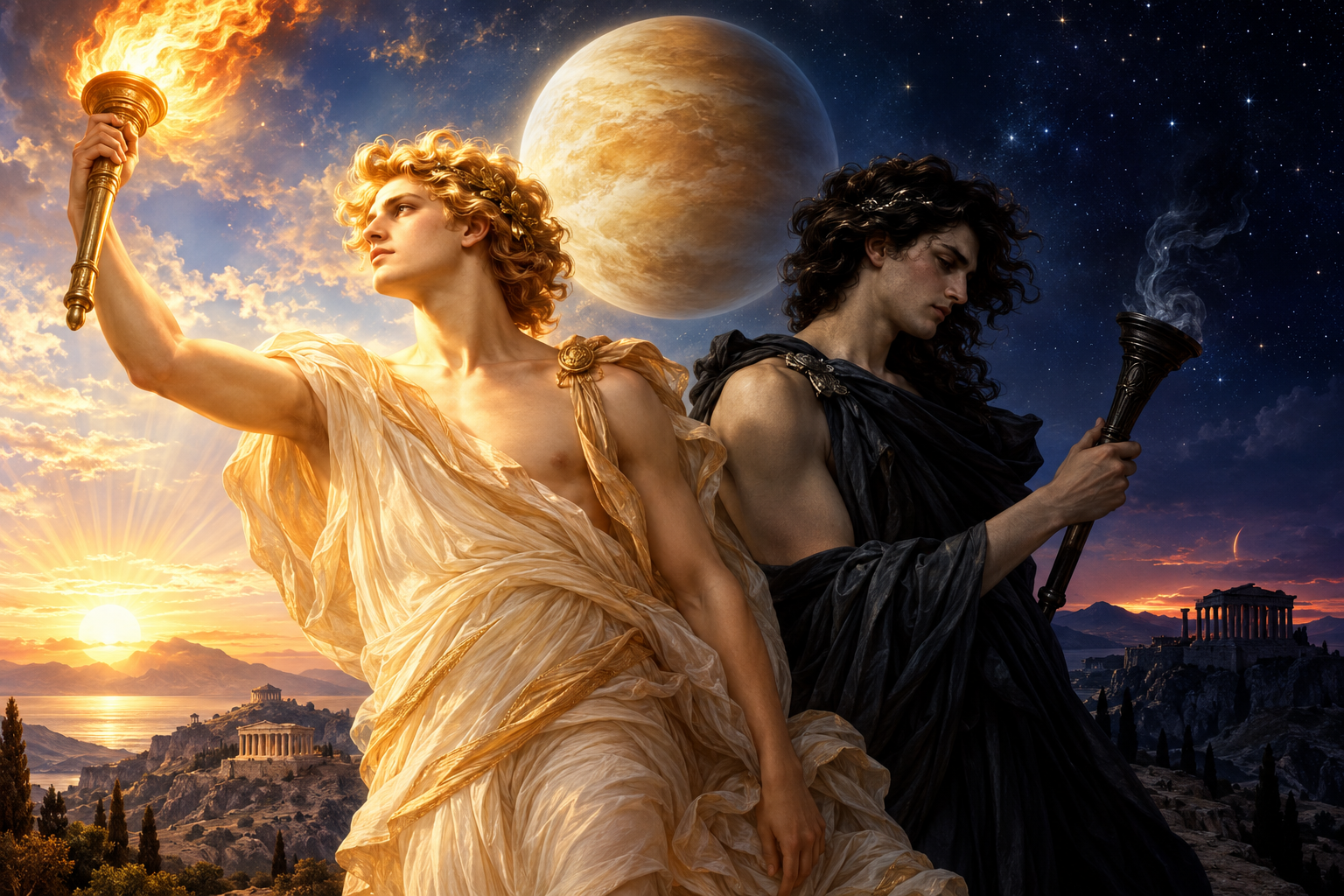
    At first, what caught my attention was a painting from 1881 by the British artist Evelyn De Morgan, entitled Phosphorus and Hesperus. Two young men, two torches, two manifestations of light, captured in a composition that seems to speak of something far more profound than the simple alternation between morning and evening.

    One of the figures carries a burning torch, while the other holds one that has been extinguished. I was drawn to this representation because, beyond its beauty, it conceals an astronomical truth known since Antiquity: the two are not, in reality, two different stars, but two appearances of the same planet.

    Venus.

    And yet, it was not astronomy that made me continue my investigation, but the history of a word.

    Eosphoros and Hesperos: Before Light Became Suspicious

    In ancient Greek, Ἑωσφόρος (Eosphoros) referred to the bringer of dawn, the celestial body that appeared before sunrise. Another name used for the Morning Star was Φωσφόρος (Phosphoros), the bearer of light, derived from phōs, meaning light, and phoros, meaning one who carries.

    Hesperos, Ἕσπερος, was the Evening Star, the brilliant celestial body that appeared after sunset.

    In Greek mythology, these celestial appearances were personified and given divine genealogies, just like many natural phenomena that the people of Antiquity attempted to understand through stories about gods.

    Hesiod, in his Theogony, mentions Eosphoros among the children of the goddess Eos, the Dawn, and the Titan Astraios. This is an important testimony because it shows us that the figure of the bringer of dawn existed in Greek tradition many centuries before the emergence of Christianity.

    Something else, however, intrigued me. The Greeks eventually came to understand that the Morning Star and the Evening Star were the same celestial body. This identification was known in ancient astronomical tradition and was associated by later writers with Pythagoras or Parmenides, although the precise attribution remains uncertain.

    Thus, the same planet could be viewed under two different names, depending on the moment of its appearance.

    It was neither good nor evil. It was neither divine nor demonic in the sense these words would later acquire in Christian theology.

    It was simply the light that announced the morning or accompanied the arrival of night.

    But what happens when an astronomical symbol enters the world of religious interpretation?

    A Verse from Isaiah and the Beginning of a Transformation

    I inevitably arrived at one of the most debated passages of the Old Testament, Isaiah 14:12.

    In the Hebrew text, we encounter the expression Helel ben Shachar, commonly translated as the shining one, son of the dawn.

    What I found particularly interesting is that, in its immediate context, the passage does not speak about Satan. Chapter 14 of Isaiah contains a song of mockery directed against the king of Babylon, portrayed as an arrogant ruler who aspires to divine heights but ultimately finds himself brought down.

    The image of the Morning Star falling from heaven is used to describe the collapse of a power that considered itself untouchable.

    When the text was translated into Greek in the Septuagint, the translators used the term heōsphoros, meaning the bringer of dawn.

    Later, in the Latin translation known as the Vulgate, produced by Jerome during the late fourth and early fifth centuries, the word lucifer appears.

    In classical Latin, lucifer was an ordinary term for the Morning Star, formed from lux, meaning light, and ferre, meaning to carry.

    It was not, in itself, the name of the Devil.

    This is the point at which the story truly began to interest me.

    Because if the Hebrew text referred to the fall of a king, and the Latin word designated a luminous celestial body, when and through what mechanism did Lucifer become the name associated with the rebellious angel?

    When Interpretation Becomes More Powerful Than the Text

    The transformation did not occur through a simple alteration of a dictionary definition, nor did it happen at a single moment in history.

    Early Christian writers frequently approached Scripture through methods of interpretation that allowed them to identify spiritual meanings beyond the immediate historical context. A character, a king, or an event could be understood as the image of a supernatural reality.

    In this way, the fall of the king of Babylon in Isaiah gradually became associated with the idea of Satan’s fall.

    Origen, a Christian theologian of the third century, contributed to the development of this interpretation, discussing the passage from Isaiah in connection with the origin and fall of the Devil. Later, other Christian writers strengthened the connection between the pride of a ruler who wished to elevate himself above others and the rebellion of a spiritual being against God.

    Other biblical passages were also brought into this interpretation, including Ezekiel 28, which refers to the king of Tyre, and Luke 10:18, where Jesus speaks of Satan falling from heaven like lightning.

    Gradually, these passages came to be read as parts of a shared history, although each originally belonged to a different context.

    I believe it is essential to observe something here: there is insufficient historical evidence to support the claim that Christian translators deliberately chose the word lucifer in order to demonize a Greek deity and distance the Greeks from their ancient religion.

    There were undoubtedly conflicts between Christianity and the traditional cults of the Greco-Roman world, and certain pagan symbols were reinterpreted or rejected. But the history of this particular word is far more complicated than the explanation of a linguistic conspiracy.

    And precisely because it is more complicated, I find it considerably more interesting.

    An Uncomfortable Detail: Christ and the Morning Star

    Here I discovered the aspect that surprised me the most.

    In Revelation 22:16, Jesus identifies himself as the bright Morning Star.

    I reread the passage because I found it extraordinary that the same astronomical symbol could be associated, within Christian tradition, with both Christ and the being regarded as his adversary.

    But the surprise does not end there.

    In the Second Epistle of Peter, chapter 1, verse 19, the Greek term phōsphoros appears, used in a spiritual image describing the rising of the Morning Star in the hearts of believers.

    The very same Greek word that, in Antiquity, designated the bearer of light.

    Furthermore, there is a remarkable example in the Latin liturgical tradition. In the Exsultet, the Easter proclamation sung during the Easter Vigil, the word lucifer appears in a context identifying Christ as the Morning Star that never sets.

    Therefore, in the Latin language of Christian tradition, lucifer was not always a demonic name.

    It could designate the light of the morning, and in certain contexts it was even used as an image of Christ.

    There was also a Christian bishop of the fourth century known as Lucifer of Cagliari, a name that did not necessarily carry the connotation it has for modern readers.

    At that moment, I found myself wondering how many people who use the name Lucifer today exclusively as a synonym for Satan actually know this history.

    And, above all, how many realize that the symbol of the Morning Star never disappeared from the Christian language of light and hope.

    Venus: The Same Light, Two Interpretations

    From an astronomical perspective, Venus does not produce its own light but reflects the light of the Sun. It is the brightest star-like object ordinarily visible in the sky after the Sun and Moon, and its apparent proximity to the Sun explains why we generally see it before sunrise or after sunset.

    I find it almost ironic that such a simple phenomenon came to carry such an extraordinarily complex symbolic meaning.

    For the ancient Greeks, its appearance could announce the coming of morning. For Roman poets, Lucifer could represent the celestial body preceding dawn. For biblical writers, the image of a fallen star could illustrate the collapse of an arrogant ruler. For certain Christian theologians, that same image became a representation of Satan’s fall.

    And for other Christian writers, the Morning Star remained a symbol of Christ.

    The planet did not change.

    What changed were the stories people told about it.

    What Does Evelyn De Morgan’s Painting Actually Tell Us?

    I then returned to the painting that had initially awakened my curiosity.

    Phosphorus and Hesperus, painted in 1881, presents the two bearers of light in a composition that evokes the transition between night and day.

    Phosphorus carries the burning torch, while Hesperus is depicted with his torch extinguished. The visual contrast may suggest the difference between the light announcing dawn and the light disappearing with the arrival of night.

    However, it would not be correct to consider the painting evidence that the artist intended to denounce the transformation of Lucifer into Satan. Such an intention would need to be demonstrated through documents, letters, or explanations provided by the artist herself.

    What we can observe is that De Morgan chose to represent two figures from classical mythology without turning them into a simplistic opposition between good and evil.

    And this is something I particularly appreciated.

    Because it reminded me how much a symbol can lose when we view it exclusively through the meaning assigned to it by a single tradition.

    Was Lucifer a Deity Whose Identity Was Stolen?

    It is a provocative question, but the answer requires caution.

    Eosphoros and Phosphoros belonged to the religious and poetic imagination of the Greeks, while Lucifer was their linguistic and astronomical equivalent in Latin. However, these names did not always designate a deity with an independent cult comparable to that of Zeus, Apollo, or Aphrodite.

    Likewise, Satan did not first appear with Christianity. The Hebrew term satan means adversary or accuser and has a history in biblical literature and Jewish traditions that predate Christianity. The figure underwent significant transformations over time, both before and after the emergence of Christianity.

    Therefore, we cannot simply say that a Greek god was renamed Satan.

    What we can say, however, is something historically documentable and, in my opinion, equally fascinating: a term that originally designated the light of the morning became, through a long process of religious interpretation, one of the most recognizable names associated with the Devil.

    This transformation deserves investigation not because it automatically proves the existence of a conspiracy, but because it demonstrates the extraordinary power of interpretation over collective memory.

    Who Decides What a Word Means?

    While researching this subject, I noticed how rarely we question the origins of words we use with such certainty.

    We inherit them together with their explanations, their images, and the emotions that entire generations have attached to them. Sometimes we forget that, before becoming religious or moral symbols, many of these words referred to simple, visible things belonging to the natural world.

    A celestial body.

    A morning.

    A light appearing on the horizon.

    What intrigues me is not only the fact that Lucifer became associated with Satan, but also the way its original astronomical meaning has become almost unknown in popular culture.

    Today, when we pronounce the name Lucifer, most people immediately think of a fallen angel, rebellion, hell, or evil.

    Very few think of Venus.

    And yet, before all these interpretations, the name designated the Morning Star.

    I do not believe history needs to be rewritten in order to become mysterious. On the contrary, authentic documents sometimes conceal contradictions far more disturbing than invented stories.

    In Lucifer’s case, the mystery does not lie in the existence of a proven secret hidden for two thousand years, but in the overlapping of traditions that assigned radically different meanings to the same image.

    A fallen king, a luminous celestial body, a rebellious angel, and an image of Christ all came together in the history of the same symbol.

    The Light Never Changed Its Name. Humanity Changed Its Story.

    When I began reading about Eosphoros and Hesperos, I expected to discover a beautiful story from Greek mythology, perhaps a few astronomical explanations, and an interesting connection with Christian tradition.

    I did not expect to arrive at such a profound question about the way human beings construct and transmit truth.

    Because ultimately, the history of Lucifer is not only about religion. It is about language, authority, interpretation, and the ability of a tradition to influence what future generations will consider self-evident.

    Not every transformation of meaning is a deliberate falsification. Some occur naturally through translation, metaphor, and cultural change. Others are influenced by religious conflicts, power, or a community’s need to define its own symbols.

    But every transformation leaves traces.

    And when we follow those traces back to their sources, we sometimes discover that things we believed to be incompatible once shared a common point of origin.

    Eosphoros announced the morning. Hesperos accompanied the evening. Lucifer was the bearer of light. And the Morning Star became, in different Christian texts, both an image of a fall and an image of hope.

    While human beings continued to debate, translate, condemn, and venerate these symbols, Venus continued to appear in the sky, just as it had in the time of Hesiod.

    And this may be the observation with which I want to conclude.

    What disturbs me is not so much that human beings changed the meaning of a name, but how easily, after enough centuries have passed, we come to believe that the name never had any other meaning.

    And the question I leave with the reader is this:

    If even the bearer of light could become, in collective memory, a name associated with darkness, how many other symbols from our history do we know today only through the interpretations of those who came after them?


    Historical Sources and Bibliography

    Henry Ansgar Kelly — Satan: A Biography (2006). Research into the development of Satan’s figure in biblical texts and Christian tradition.

    Hesiod — Theogony, lines 378–382. The genealogy of Eosphoros in Greek mythology.

    Plato — Timaeus, 38d. References to celestial bodies and the Greek astronomical tradition.

    Aristotle — De Caelo, II.12. Context for ancient Greek astronomy.

    The Hebrew Bible — Isaiah 14:4–23. The original context of the song directed against the king of Babylon.

    The Septuagint — Isaiah 14:12. The Greek translation of the Hebrew expression referring to the Morning Star.

    The Latin Vulgate — Isaiah 14:12. The use of the Latin term lucifer.

    Origen — De Principiis, I.5.5. The theological interpretation of the Devil’s fall.

    The New Testament — Luke 10:18; 2 Peter 1:19; Revelation 22:16. Images of the fall from heaven and the Morning Star.

    The Exsultet — The Easter Proclamation of the Roman liturgy. The use of the term lucifer in reference to Christ.

    Evelyn De Morgan — Phosphorus and Hesperus (1881). The artistic representation of the two personifications of the planet Venus.

    Jeffrey Burton Russell — The Devil: Perceptions of Evil from Antiquity to Primitive Christianity (1977). A study of the evolution of the concept of the Devil.

    Red YouTube button with a white play icon and the word 'YouTube' in white text.
    Promotional graphic featuring the text 'Special Discount on Payhip' with a sunset background, an ancient structure, and a red 'Buy Now' button.

  • The Mystery of Number 33: An Ancient Sacred Code, a Hidden Connection Between Religions, or Humanity’s Greatest Numerical Illusion?

    The Mystery of Number 33: An Ancient Sacred Code, a Hidden Connection Between Religions, or Humanity’s Greatest Numerical Illusion?

    From the forgotten gods of ancient India and the celestial kingdoms of Buddhism to the crucifixion of Jesus, the mysteries of Kabbalah, Freemasonry, and the scientific experiments of Isaac Newton, one number appears in places where history, religion, and human imagination seem to intersect. But what lies behind these extraordinary connections, and how much of what we believe about the number 33 can actually be demonstrated?

    There is something strangely compelling about discovering the same number in civilizations that appear to have little in common. A number that emerges from a religious manuscript written thousands of years ago, reappears in the hierarchy of a secretive fraternity, finds its way into the architecture of a medieval poem, and eventually turns up in the anatomical structure of the human body seems to invite an explanation far more extraordinary than coincidence.

    The number 33 has acquired precisely this reputation.

    For generations, it has been associated with spiritual initiation, divine perfection, hidden knowledge, the transformation of human consciousness, and, more recently, theories suggesting that religious institutions and secret societies have deliberately preserved an ancient numerical code.

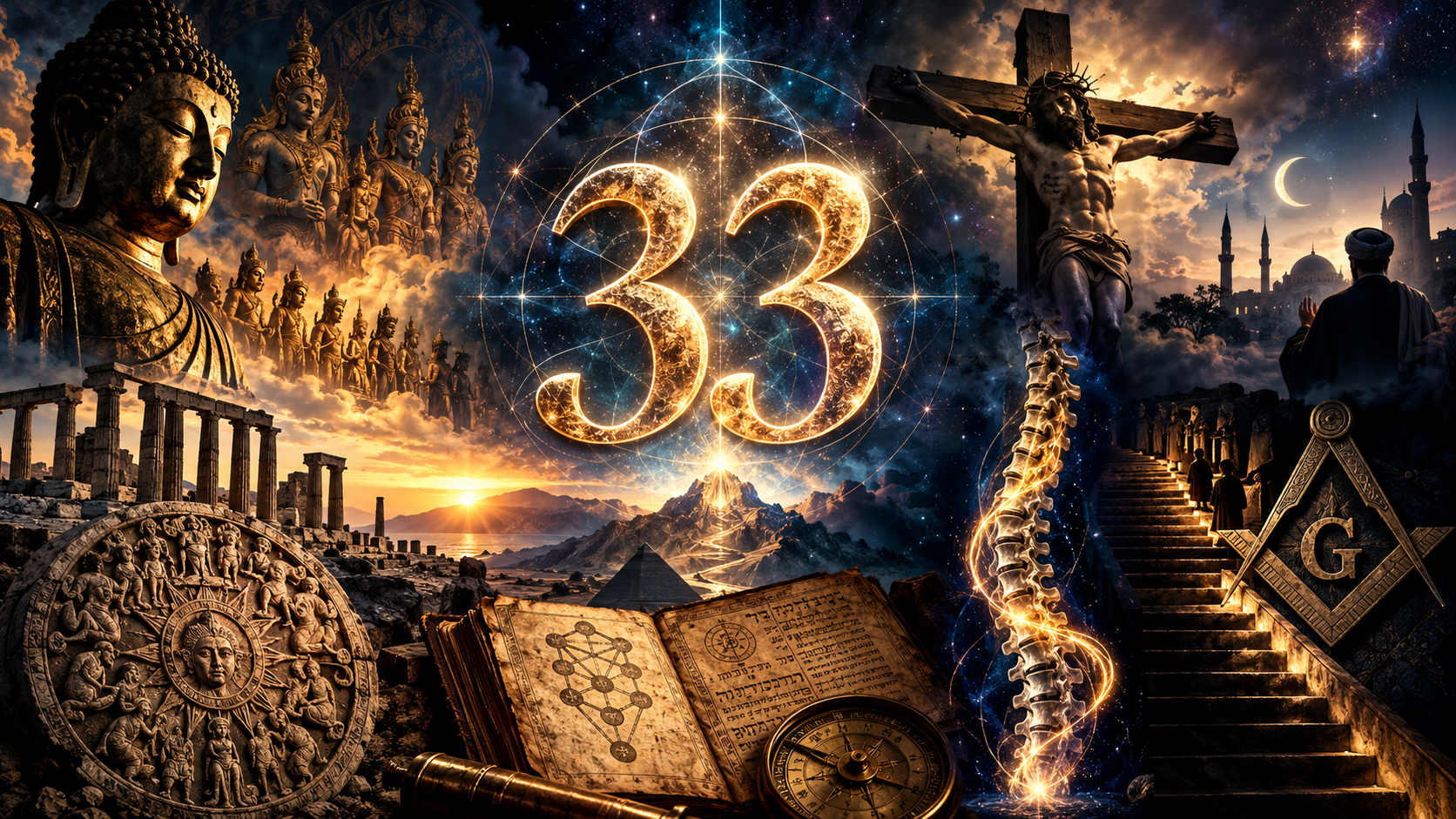
    The examples are familiar to anyone who has spent time exploring religious symbolism. Jesus is traditionally believed to have died at 33. The Scottish Rite of Freemasonry recognizes a 33rd degree. Ancient Hindu texts describe 33 deities, while Buddhist cosmology contains a celestial realm inhabited by 33 gods. Islamic traditions associate the inhabitants of Paradise with the age of 33, and Jewish religious observance includes a celebration on the 33rd day of the counting of the Omer.

    Even the human spine, with its commonly described 33 vertebrae, has been incorporated into elaborate theories about spiritual awakening and the ascent of Kundalini energy.

    When these examples are placed side by side, they create an almost irresistible impression that humanity has inherited fragments of a single forgotten system.

    Yet history has a habit of becoming considerably more interesting when we stop asking only where a symbol appears and begin investigating who first used it, what it originally meant, and how its meaning changed as civilizations encountered one another.

    The real history of 33 contains connections that can be documented, traditions that have been misunderstood, and remarkable details that rarely appear in popular discussions of sacred numbers.

    Some of these discoveries are far more revealing than the conspiracy theories built around them.

    The Ancient Indian Manuscript That Reduces Thousands of Gods to One

    One of the most extraordinary references to the number 33 appears in the Brihadaranyaka Upanishad, an ancient Indian philosophical text belonging to the Vedic tradition.

    Its importance lies not simply in mentioning 33 gods, but in the remarkable conversation through which the number is introduced.

    The philosopher Yajnavalkya is questioned by Vidagdha Shakalya about the number of gods in existence. His initial answer refers to thousands of divine manifestations, but when the question is repeated, he gives a different number.

    Thirty-three.

    The questioning continues, and the number decreases again, first to six, then three, two, one and a half, and finally one.

    At first glance, the dialogue might seem contradictory. How can the number of gods change so dramatically within the same conversation?

    The explanation lies in the philosophical purpose of the exchange. Yajnavalkya is not attempting to compile a census of supernatural beings. He is exploring the relationship between the countless manifestations of existence and the underlying reality from which they arise.

    The 33 deities are organized into eight Vasus, eleven Rudras, twelve Adityas, and two additional divine figures, Indra and Prajapati.

    What makes this classification particularly fascinating is the way the text explains these groups.

    The eight Vasus are associated with fundamental aspects of the natural world, including fire, earth, air, the sun, the moon, and the stars. The twelve Adityas are connected with the twelve months of the year, whose passage gradually consumes the duration of human life.

    The eleven Rudras receive an even more surprising explanation. In the Upanishadic dialogue, they are associated with the vital faculties of the human being and the self, whose departure at death causes those left behind to weep.

    This is an important detail that is frequently overlooked. The number 33 was not merely a collection of divine names. It belonged to a philosophical attempt to explain nature, time, human existence, and the relationship between the visible and invisible worlds.

    The same general classification also appears in the Shatapatha Brahmana, demonstrating that the tradition was not confined to a single isolated passage.

    What emerges from these ancient texts is not evidence of a secret organization controlling humanity through numerical symbolism, but something arguably more profound: an early intellectual effort to describe the unity concealed beneath the apparent multiplicity of the universe.

    And the story does not end in India.

    The Buddhist Heaven of the Thirty-Three Gods

    In Buddhist cosmology, there exists a celestial realm known as Trāyastriṃśa in Sanskrit and Tāvatiṃsa in Pali, traditionally understood as the Heaven of the Thirty-Three.

    According to the cosmological descriptions preserved in Buddhist traditions, this realm is situated on the summit of Mount Meru, the immense sacred mountain imagined as the central axis of the universe.

    Its ruler is Śakra, also known as Sakka, a figure closely connected with the ancient Indian god Indra.

    This connection deserves careful attention because it reveals something that numerical conspiracy theories often fail to recognize: two religious traditions can share symbols because they developed within overlapping cultural and intellectual environments.

    Buddhism emerged in ancient India, where Vedic ideas, religious figures, cosmological structures, and philosophical debates were already deeply established. Rather than developing in complete isolation, Buddhist thinkers inherited, challenged, and reinterpreted elements of the world around them.

    The Heaven of the Thirty-Three therefore offers an example of religious transmission that can be investigated historically.

    There is another detail that makes this celestial kingdom particularly interesting.

    Although its inhabitants enjoy extraordinary lifespans and pleasures beyond ordinary human experience, they are not necessarily liberated from suffering and rebirth. In Buddhist teaching, existence in a heavenly realm remains impermanent, and even celestial beings are subject to the conditions of the cycle of existence.

    The significance of the number is therefore embedded in a cosmological system fundamentally different from the Christian concept of eternal salvation.

    The resemblance between the Hindu and Buddhist references is real, but it becomes meaningful only when their historical relationship is examined.

    Instead of discovering an invisible code operating independently across civilizations, we encounter the documented transformation of religious ideas as they move from one tradition into another.

    Jesus Christ and the Age That the Gospels Never Explicitly Give

    Among the countless associations surrounding the number 33, none is more familiar in the Western world than the belief that Jesus Christ was crucified at that age.

    The statement is repeated so frequently that many people assume it appears directly in the Bible.

    It does not.

    The Gospel of Luke, in chapter 3, verse 23, states that Jesus was approximately thirty years old when he began his public ministry. The Gospel of John describes several Passover celebrations during that ministry, providing material from which later interpreters developed a chronology of approximately three years.

    Combining these elements produced the traditional age of 33.

    Yet the historical calculation is not as precise as popular belief suggests. Scholars continue to debate the chronology of Jesus’s birth and crucifixion, and the Gospel accounts do not provide a complete modern biographical timeline.

    The age of 33 is therefore a traditional reconstruction rather than an explicitly recorded fact.

    The frequently repeated claim that Jesus performed exactly 33 miracles raises a similar problem.

    The canonical Gospels contain numerous accounts of healings, exorcisms, extraordinary acts, and miracles involving nature, but the total depends on how the events are classified. Some episodes appear in multiple Gospels, while others are described only once, and certain passages refer collectively to miracles without identifying each individual occurrence.

    There is no universally established biblical total of precisely 33 miracles.

    This distinction matters because a number can acquire religious importance through centuries of interpretation without having been deliberately encoded in the earliest surviving texts.

    The historical question is not whether the number 33 eventually became meaningful to Christians. It is whether the original documents support the exact numerical claims later attached to it.

    In this case, the evidence is more complicated than the popular narrative.

    Islam and the Eternal Age of Paradise

    Islamic tradition provides another intriguing appearance of the number 33, although the source is often misunderstood.

    According to a report transmitted in the hadith literature, including a narration recorded by al-Tirmidhi, the inhabitants of Paradise will enter it at the age of 33.

    This description is associated with the idea of an ideal, perfected human condition, free from the physical deterioration and limitations of earthly existence.

    The distinction between the Quran and the hadith literature is essential here. The Quran describes Paradise in numerous passages, but the specific age of 33 comes from transmitted prophetic traditions rather than an explicit Quranic statement.

    The number also appears in Islamic devotional practices.

    Certain forms of dhikr, the remembrance of God, involve repeating expressions of praise and glorification 33 times. Some traditions prescribe combinations that include 34 repetitions, while others describe different arrangements.

    Prayer beads may contain 33 or 99 beads, allowing worshippers to keep count during these devotional repetitions.

    The association with the 99 beautiful names of Allah adds another numerical relationship, since 99 is three times 33.

    Yet the existence of several devotional counting traditions demonstrates that the number does not function as an unchangeable universal formula.

    The historical evidence points toward structured repetition, remembrance, and religious discipline, rather than an established mechanism of hidden spiritual control.

    The question becomes more interesting when we consider why repetition itself occupies such an important place in religious practice. Across cultures, repeated words, prayers, movements, and sounds have been used to organize attention, reinforce memory, and create a sense of spiritual concentration.

    The number of repetitions may differ, but the human practice of seeking transformation through rhythm and repetition is remarkably widespread.

    The Kabbalistic Mystery That Changes When We Read the Original Text

    Few subjects have attracted more speculative interpretations than Kabbalah, the Jewish mystical tradition concerned with creation, divine manifestation, and the relationship between the infinite and the material world.

    Modern discussions of the number 33 sometimes claim that the Kabbalistic Tree of Life contains 33 paths of wisdom.

    The explanation usually begins with ten sefirot and 22 connecting paths, then introduces an additional element to produce the desired total.

    The difficulty is that one of the foundational texts associated with Jewish cosmological mysticism gives a different number.

    Sefer Yetzirah, the Book of Formation, opens with a reference to 32 paths of wisdom.

    Its numerical structure consists of ten sefirot and the 22 letters of the Hebrew alphabet.

    Ten plus twenty-two gives thirty-two.

    The text is explicit about the number of sefirot, insisting that there are ten, rather than nine or eleven.

    Later Kabbalistic interpretations sometimes include Da’at, a concept associated with knowledge, in representations of the Tree of Life. However, Da’at is not simply an additional independent sefirah that automatically transforms the classical system into 33 paths.

    This difference exposes one of the most revealing mechanisms behind modern numerological speculation.

    Instead of discovering a number within a historical document, an interpreter may begin with a number already considered significant and reorganize the evidence until the desired result appears.

    The distinction is subtle but fundamental.

    The original Kabbalistic system is no less fascinating because it describes 32 paths instead of 33. Its attempt to connect numbers, letters, language, and the creation of reality remains one of the most intellectually distinctive features of Jewish mystical thought.

    What disappears under close examination is not the mystery of the tradition, but the unsupported claim that it must conform to the same numerical pattern as every other religion.

    The Island of Apollo and the Thirty-Three Altars That History Has Not Confirmed

    In the Aegean Sea, the island of Delos preserves the remains of one of the most important religious centers of ancient Greece.

    According to Greek mythology, Apollo and Artemis were born on this island, which became a major sanctuary attracting pilgrims and visitors from across the Mediterranean world.

    A claim circulating in discussions of the number 33 suggests that Delos once contained exactly 33 altars dedicated to Apollo, sometimes accompanied by descriptions of channels carved into sacrificial structures to carry blood.

    The image is dramatic, particularly when combined with the island’s association with prophecy, divine light, and sacred ritual.

    However, the archaeological documentation consulted does not establish the existence of exactly 33 altars dedicated to Apollo.

    The sanctuary contained multiple temples, altars, votive monuments, and religious structures, but the specific number requires evidence that the popular claim does not provide.

    The historical reality of Delos is, in fact, considerably more extraordinary.

    Over time, the island became a meeting place for religious traditions from different parts of the ancient world. Alongside the worship of Greek deities, archaeological evidence reveals sanctuaries associated with Egyptian and Syrian gods, while the island also preserves evidence of Jewish religious life.

    The UNESCO documentation of Delos reflects this remarkable cultural diversity.

    Here, within a relatively small geographical space, religious ideas crossed political, linguistic, and cultural boundaries.

    The island offers a genuine historical example of spiritual traditions encountering one another, exchanging practices, and adapting to new circumstances.

    That documented complexity is more valuable than an unsupported numerical claim, because it allows us to study the actual movement of religious ideas rather than imagine connections that have not been demonstrated.

    Freemasonry and the Thirty-Third Degree: What the Symbol Actually Means

    The 33rd degree of Freemasonry has become one of the most recognizable symbols in modern conspiracy literature.

    It is frequently portrayed as the final stage of a secret hierarchy whose members possess knowledge inaccessible to ordinary humanity.

    The historical structure is more specific.

    The Ancient and Accepted Scottish Rite includes a system of degrees extending to the 33rd, although the organization and administration of these degrees vary across jurisdictions.

    The 33rd degree is generally conferred as an honor in recognition of distinguished service rather than being a stage that every Freemason must reach.

    It is also important to distinguish the Scottish Rite from Freemasonry as a whole. Not every Masonic system uses 33 degrees, and the foundational degree of Master Mason belongs to the three degrees of symbolic or Craft Masonry.

    The presence of elaborate ceremonies, symbolic imagery, and philosophical language in Masonic traditions is well documented. Such practices reflect a much wider history of initiatory organizations that have used allegory to communicate moral and intellectual principles.

    What has not been demonstrated is that the Scottish Rite created, controlled, or secretly coordinated the ancient religious traditions in which the number 33 also appears.

    The chronological problem alone is significant.

    Indian religious texts discussing the 33 gods existed long before the development of modern Scottish Rite Freemasonry.

    To establish a genuine historical connection, researchers would need documents showing the transmission of a particular symbolic interpretation, along with evidence that the same meaning was deliberately preserved.

    A shared number, by itself, cannot provide that proof.

    A Jewish Festival Whose Name Contains a Number

    In Judaism, the festival of Lag BaOmer is observed on the 33rd day of the counting of the Omer, the seven-week period connecting Passover and Shavuot.

    The number is present in the very name of the celebration.

    In Hebrew numeration, the letters lamed and gimel represent thirty and three, giving the combined value of 33.

    The history of the festival, however, is more complex than its name suggests.

    Traditional explanations associate the day with the cessation of a plague affecting the students of Rabbi Akiva, while other traditions connect it with Rabbi Shimon bar Yochai, a figure of enormous importance in later Jewish mysticism.

    The precise development of these associations is a subject of historical discussion.

    The Jewish Encyclopedia documents the festival and the traditions surrounding it, illustrating how religious observances can acquire additional layers of meaning over centuries.

    This is a particularly important lesson for anyone studying sacred numbers.

    A numerical association may be genuine without having existed in exactly the same form throughout the entire history of a religion.

    Religious memory evolves, and communities reinterpret inherited observances in response to changing historical and spiritual circumstances.

    Sometimes the mystery lies not in the original number, but in the long process through which people came to regard it as sacred.

    The Human Spine, Kundalini, and the Symbolism of Spiritual Ascent

    One of the most intriguing modern interpretations of the number 33 connects it to the human vertebral column.

    In standard anatomical descriptions, the human spine consists of 33 vertebrae, divided into cervical, thoracic, lumbar, sacral, and coccygeal regions.

    The familiar count includes vertebrae that become fused during development, and anatomical variation means that the number is not absolutely identical in every individual.

    This anatomical fact has inspired interpretations connecting the spine to Kundalini, a concept found in certain Hindu and yogic traditions.

    Kundalini is commonly represented as a coiled serpent associated with latent spiritual potential. In traditional accounts of yogic transformation, its awakening is described through imagery of an upward movement along the body’s subtle central channel.

    The symbolism is powerful, especially when considered alongside religious images of ladders, sacred mountains, ascending souls, and journeys toward illumination.

    But the historical and scientific distinctions must remain clear.

    The subtle channels and spiritual centers described in yogic traditions are not equivalent to anatomical structures established through modern medical observation, and the existence of Kundalini as a measurable physical energy has not been scientifically demonstrated.

    There is likewise no reliable evidence that human spiritual energy is harvested through a hidden mechanism associated with the number of vertebrae.

    The more interesting historical question concerns the persistence of vertical imagery in spiritual traditions.

    Why has the movement from below to above become such a widespread metaphor for transformation?

    The answer may involve the human body’s orientation, the visible relationship between earth and sky, the experience of climbing toward elevated sacred places, and the symbolic association of height with transcendence.

    These explanations do not establish a single origin for every tradition, but they provide a serious starting point for understanding why ascent has become such a compelling religious image.

    Isaac Newton and the Thirty-Three Degrees of Boiling Water

    Among the most unexpected appearances of the number 33 is one connected with Isaac Newton.

    Long before the Celsius scale became internationally familiar, scientists experimented with different methods of measuring temperature.

    Newton proposed a thermometric scale in which the beginning of water’s boiling corresponded to approximately 33 degrees.

    The historical record preserved by the Newton Project at the University of Oxford documents this system, including distinctions made between the beginning of boiling and more vigorous boiling.

    At first glance, the coincidence seems extraordinary.

    A scientist whose work transformed our understanding of gravity, planetary motion, and the physical universe had selected the same number that appears in so many religious traditions.

    Yet the explanation lies in the history of measurement.

    Temperature scales are constructed using reference points and numerical conventions. Water boils at approximately 100 degrees on the Celsius scale and 212 degrees on the Fahrenheit scale under standard atmospheric pressure.

    The physical phenomenon remains the same even when the numerical description changes.

    Newton’s use of 33 is historically genuine, but it does not establish a mystical connection between his scientific experiments and the religious traditions of ancient India.

    It reveals something else: numbers acquire meaning within systems, and removing them from those systems can create relationships that appear far more mysterious than they actually are.

    Dante’s Divine Comedy: When Thirty-Three Was Chosen Deliberately

    There is, however, an extraordinary European example in which the number 33 genuinely belongs to the deliberate architecture of a major literary work.

    Dante Alighieri’s Divine Comedy is divided into three great sections: Inferno, Purgatorio, and Paradiso.

    The poem contains one hundred cantos in total.

    Purgatorio and Paradiso each contain 33 cantos, while Inferno contains 34, with its opening canto functioning as an introduction to the entire journey.

    The arrangement creates a structure in which three groups of 33 are accompanied by an introductory canto.

    Dante’s extensive use of numerical symbolism is closely connected with medieval Christian thought, particularly the significance of the Trinity.

    The poem is also written in terza rima, a verse form built around interlocking groups of three lines.

    Here the numerical structure is not something imposed by modern readers searching for coincidences. It belongs to the actual composition of the work.

    Dante demonstrates how numbers can become instruments of artistic and theological expression, organizing a vision of the universe through mathematical relationships.

    But this example also reveals why historical context matters.

    The fact that Dante deliberately used 33 does not mean that Newton’s thermometric scale, Buddhist cosmology, and the Masonic degree system were designed according to the same hidden plan.

    Intentional symbolism in one context cannot automatically establish intentional symbolism in another.

    Alexander the Great, Arsenic, and the Problem of Convenient Numbers

    Some numerical claims survive because they are repeated more often than they are checked.

    Alexander the Great is frequently included in lists of historical figures who died at the age of 33.

    He was born in 356 BCE and died in June 323 BCE, at the age of 32 completed years.

    The difference may seem insignificant, but it illustrates how easily a numerical narrative can be strengthened by inaccurate details.

    Arsenic provides a different example.

    The chemical element has the atomic number 33, meaning that every arsenic atom contains 33 protons in its nucleus.

    This is an established scientific fact.

    Arsenic is also associated with serious toxicity, and certain inorganic arsenic compounds are recognized as carcinogenic.

    But the number of protons does not give arsenic a spiritual identity, nor does its toxicity provide evidence of a connection with religious symbolism.

    The atomic number belongs to the modern scientific classification of matter, whereas the ancient religious traditions associated with 33 developed in entirely different historical circumstances.

    Placing these facts together may create an arresting narrative, but their proximity on a page does not establish a causal relationship.

    This is one of the central difficulties in studying numerical mysteries: an impressive collection of coincidences can be assembled without demonstrating that the coincidences share a common origin.

    The Mystery Hidden Behind Our Own Search for Patterns

    After examining ancient Indian philosophy, Buddhist cosmology, Christian chronology, Islamic traditions, Jewish mysticism, Greek archaeology, Freemasonry, medieval literature, human anatomy, and the history of science, a different picture begins to emerge.

    The number 33 does not possess one clearly documented meaning that has remained unchanged across all civilizations.

    In some traditions, its appearance reflects cultural inheritance. In others, it results from deliberate symbolic construction, religious observance, practical counting, scientific convention, or retrospective interpretation.

    Yet the fascination surrounding it remains understandable.

    Human beings are extraordinarily sensitive to patterns. This ability has allowed us to recognize seasonal cycles, understand celestial movements, develop mathematical systems, and discover relationships that would otherwise remain invisible.

    The same ability can also lead us to identify connections where no underlying causal relationship exists.

    Once a particular number captures our attention, examples of its appearance become easier to notice and remember. Cases that do not fit the pattern are less likely to be collected, repeated, or shared.

    A list containing fifteen remarkable appearances of the number 33 can seem overwhelming until we consider how many other numbers appear throughout the same religious and historical traditions.

    Seven, twelve, forty, seventy-two, and one hundred and eight also possess extensive symbolic histories, often for reasons specific to the cultures that employed them.

    Without examining the broader numerical environment, it is impossible to determine whether 33 is unusually significant or simply unusually well advertised.

    This does not make the history of sacred numbers meaningless.

    It makes the responsibility of interpreting them considerably greater.

    A symbol should be investigated through the texts, communities, and historical circumstances that gave it meaning, rather than being detached from its origins and placed into a universal theory constructed centuries later.

    What If the Real Secret Was Never the Number?

    The most revealing discovery in this investigation may be that the number 33 does not need to conceal a global conspiracy to possess an extraordinary history.

    Its appearance in the ancient Indian dialogue between Yajnavalkya and Shakalya leads us toward questions about the unity of existence. Its presence in Buddhist cosmology reveals the transmission and transformation of religious ideas. Its association with Jesus demonstrates how traditional chronology can become accepted as historical certainty, while its supposed presence in the 33 paths of Kabbalah exposes the danger of altering ancient systems to satisfy modern expectations.

    Dante shows us how a number can become part of a deliberate intellectual design, and Newton reminds us that even scientifically valid numbers may depend upon the conventions through which we describe the natural world.

    These are not fragments of a single proven secret.

    They are fragments of humanity’s much larger attempt to understand reality.

    Throughout history, people have looked toward the stars, studied the human body, constructed sacred buildings, developed religious ceremonies, and written elaborate philosophical works in the hope of discovering an order beneath the confusion of existence.

    Numbers offered something particularly attractive in this search: they appeared stable, precise, and independent of the uncertainty of human language.

    A number could cross a cultural boundary without requiring translation, even when the meaning assigned to it changed completely.

    And therein lies the deeper mystery.

    We are often so determined to discover a hidden message that we overlook the remarkable history of the people who created the symbols themselves.

    The number 33 has traveled through centuries of religious thought, scientific discovery, artistic imagination, and speculative interpretation. Some of its appearances are historically connected, others are deliberate choices, and many are coincidences whose significance has grown through repetition.

    No credible historical evidence demonstrates that a single secret organization planted this number throughout the world’s religions to control humanity.

    But the desire to believe that all these fragments belong to one concealed design tells us something important about the human mind.

    We do not merely search for patterns because we enjoy mysteries. We search for them because we want the universe to possess an underlying coherence, a structure that assures us that existence is not simply a collection of disconnected events.

    And when we encounter the same number in a sacred manuscript, a medieval poem, a religious ceremony, and a scientific experiment, we are tempted to believe that we have discovered a small part of that structure.

    The question is whether we have uncovered an ancient truth or created a new interpretation by connecting things that history never connected.

    The answer cannot be found by counting coincidences alone.

    It requires something far more demanding: the willingness to follow the evidence even when it leads away from the mystery we expected to discover.

    And that may be the most difficult initiation of all.


    Historical Sources and Further Reading

    Royal Society of Chemistry, Periodic Table: Arsenic — Atomic number and chemical properties. Royal Society of Chemistry.

    Brihadaranyaka Upanishad, Book III, Section 9 — The dialogue between Yajnavalkya and Shakalya concerning the thirty-three gods. Read the text.

    Shatapatha Brahmana, Book XI, Section 6 — Vedic classification of the thirty-three deities.

    Sefer Yetzirah, Chapter I — The thirty-two paths of wisdom, ten sefirot, and twenty-two Hebrew letters. Read the text.

    The Gospel According to Luke, 3:23, and The Gospel According to John — Biblical material relevant to the traditional chronology of Jesus’s ministry.

    Jamiʿ at-Tirmidhi, traditions concerning the inhabitants of Paradise; and Islamic hadith collections describing devotional repetition.

    Jewish Encyclopedia, entries concerning Lag BaOmer and its religious traditions.

    UNESCO World Heritage Centre, Delos — Archaeological and historical documentation of the island’s sanctuaries and religious diversity. UNESCO.

    The Newton Project, University of Oxford — Newton’s writings and historical work on thermometry. The Newton Project.

    Dante Alighieri, The Divine Comedy — The numerical and literary structure of the poem.

  • Zalmoxis and the Ancient Matrix: What If Reality Is Only a Passage?

    Zalmoxis and the Ancient Matrix: What If Reality Is Only a Passage?

    There is something unsettling about Zalmoxis even before we begin trying to understand who—or what—he was.

    He appears at the edge of recorded European history almost as if he had stepped out of a story that had already been told for centuries before anyone thought to write it down. A god to some, a man to others, perhaps a priest, perhaps a reformer, perhaps the distant memory of a real person whose identity dissolved into religion, he belonged to the world of the Getae north of the lower Danube, yet nearly everything we know about him was preserved by outsiders.

    That alone should make us cautious.

    It should also make us curious.

    The Getae left us no surviving sacred book explaining Zalmoxis in their own words. There is no Zalmoxian gospel hidden in a monastery, no authentic collection of his teachings waiting to be deciphered and no ancient manuscript that allows us to hear his voice directly. Instead, we find fragments scattered through Greek and Roman literature, each writer looking at the same strange tradition from a different angle.

    And yet, when those fragments are placed together, a remarkably persistent idea emerges.

    Human beings may be mistaken about what reality actually is.They may be mistaken even about death.That is where the story becomes far more interesting than a simple chapter of ancient religion, because behind Zalmoxis lies a question that humanity has never stopped asking.

    What if what we see is only the surface?

    The people who believed death was not an ending

    Our earliest substantial account comes from Herodotus, writing in the fifth century BC.

    While describing the Persian expansion into the lands around the Danube, Herodotus pauses to speak about the Getae. He calls them particularly courageous among the Thracian peoples, but it is their religious belief that captures his attention.

    According to him, the Getae believed that they did not truly die. A person who perished went instead to Zalmoxis—or, in the wording of the ancient account, to a divine figure Herodotus associates with Zalmoxis and also mentions under the name Gebeleizis.

    It is easy to read that sentence too quickly.

    Ancient cultures believed in afterlives everywhere, after all. Egyptians imagined the world beyond death, Greeks told stories about Hades, and later religions would place entire theological systems around the fate of the soul.

    But Herodotus describes something more concrete among the Getae.

    Once every five years, he says, they selected a messenger by lot. That man was entrusted with requests that he was supposed to carry to Zalmoxis. Then came the part that must have sounded shocking even to ancient readers: men held spears upright while the chosen messenger was thrown onto their points.

    If he died, the sacrifice was considered accepted. If he survived, the failure was blamed on the messenger and another could be selected.

    The ritual is brutal, and there is no reason to romanticize it. At the same time, its logic tells us something extraordinary about the world in which the ritual made sense.

    The messenger was not simply being killed.

    He was being sent.

    For the people performing the ritual, death was apparently a border that could be crossed, and on the other side of that border there was someone—or something—capable of receiving a message.Seen from that perspective, the sacrificed man was not merely a victim.

    He was a traveller into a reality inaccessible to the living.

    Whatever the Getae actually believed in all its complexity, Herodotus understood their religion as containing a radical conviction: the visible disappearance of a human being did not mean that the human being had ceased to exist.

    Then Herodotus tells another story, and this is where Zalmoxis becomes truly difficult to separate from mystery.

    The man who vanished underground

    Herodotus says that Greeks living around the Hellespont and the Black Sea told a different version of Zalmoxis’ origin.

    According to them, Zalmoxis had once been a mortal man associated with Pythagoras. In their story he had lived on Samos, learned from Greek thought, accumulated wealth and eventually returned to his homeland.

    There he gathered important men around him, entertained them and began teaching something astonishing: neither they, nor their descendants, nor Zalmoxis himself would truly die. Instead, they would go to another place where existence continued and where good things awaited them.

    Then he did something that sounds almost theatrical.

    He built an underground chamber.When it was ready, Zalmoxis disappeared into it.For three years, according to the story, nobody saw him. His people mourned him as dead.

    Then, in the fourth year, he emerged again.

    The man they believed had died had returned.

    And according to the Greek version preserved by Herodotus, that apparent return from death helped convince the Getae that his teaching had been true.It is precisely at this point that responsible history has to resist temptation.We cannot say that this event actually happened. We cannot even be certain that Zalmoxis was originally a historical person.

    Herodotus himself is surprisingly careful: he says that he neither completely believes nor completely rejects the tale of the underground chamber, and he doubts the chronology connecting Zalmoxis directly with Pythagoras. He even leaves open the basic question of whether Zalmoxis had been a man or a native Getic deity.

    That uncertainty does not weaken the story.In some ways it makes it more fascinating.Because whatever happened historically, somebody considered this story important enough to preserve: a teacher disappears beneath the earth, is mourned as dead, and then returns among the living.If this was an initiation drama rather than biography, what did it mean?

    If it was a myth, what truth was the myth trying to communicate?

    And if Zalmoxis was already a god before Greeks attempted to turn him into a former student of Pythagoras, why did the underground disappearance become such an important part of the story?

    We do not know.

    But we can see the structure.A man enters darkness.The world assumes he is gone.

    He returns possessing—or representing—knowledge about death that ordinary people do not possess.

    That structure has survived in religious myths, mystery traditions and philosophical stories across cultures because it touches a very old fear: perhaps human beings understand only the side of reality they happen to inhabit.

    Zalmoxis did not disappear from ancient literature

    Centuries later, Strabo tells another version.The Zalmoxis we meet in his Geography is less like a magician staging his own return from death and more like a sacred political figure, a man who acquires knowledge, becomes close to a ruler and eventually acts as an intermediary between divine authority and earthly power.

    Strabo says that Zalmoxis became a priest of the god most honoured among his people and was eventually himself treated as divine. He lived, according to the account, in an inaccessible cavernous place and met few people apart from the king and attendants. The mountain associated with this sacred retreat was called Cogaeonum in Strabo’s text.

    Again, we encounter withdrawal.

    Again, a sacred man is separated from ordinary society.Again, access to him is restricted.It is worth noticing how different this is from the modern image of a religious teacher speaking openly to crowds.

    Zalmoxis, as Strabo presents him, gains authority partly through distance. He occupies a space ordinary people cannot easily enter, and from that hidden space comes knowledge that affects the visible world outside it.Strabo even says that something of this religious-political institution continued later among the Getae. During the reign of Burebista, a comparable role was held by Decaeneus, the famous Deceneu of later Romanian historical tradition.This does not prove an unbroken secret order stretching across centuries, as modern esoteric stories sometimes suggest.

    The evidence simply does not allow that conclusion.

    Still, the repeated pattern is difficult to ignore.The ruler governs the visible world.The sacred figure interprets something beyond it.One possesses political power; the other possesses access to hidden knowledge.In a culture in which religion and political authority were deeply entangled, that distinction could have been enormously powerful.

    And then Plato enters the story.

    The strange physicians of Zalmoxis

    There is a passage in Plato’s Charmides that deserves far more attention than it usually receives when Zalmoxis is discussed.

    Socrates speaks of having learned from one of the Thracian physicians associated with Zalmoxis. The teaching attributed to them says, in essence, that you cannot properly treat the eyes without treating the head, nor the head without treating the body, and that you should not attempt to heal the body without considering the soul.

    The part cannot be healed while the whole is ignored.

    Plato presents Zalmoxis as both king and god within this story, and the medicine associated with him is explicitly holistic: body, soul and human character belong to the same reality and should not be artificially separated.

    Whether Plato is preserving an authentic Getic doctrine, reshaping an exotic tradition for philosophical purposes, or combining both is impossible to establish from the text alone.But something important has happened by this point.

    Zalmoxis is no longer merely the mysterious deity to whom the Getae send the dead.He has become associated with knowledge unavailable to ordinary perception.Death may not be what it seems.

    The body cannot be understood without the soul.The visible part cannot be fully understood without the invisible whole.That is an extraordinary collection of ideas to find around a figure standing in the mist between history and mythology.And this is where we can approach the Matrix—not by pretending that ancient Getae believed in computers, simulated universes or machines controlling humanity, but by recognising something much older beneath the modern language.

    The suspicion that reality has layers.

    Long before the red pill

    When people hear the word Matrix today, they often think immediately of a computer simulation.But the deeper philosophical idea behind the Matrix is much older than computers.

    The real shock is not discovering that machines exist.

    The real shock is discovering that your definition of reality was wrong.Neo begins inside a world that appears completely normal. Streets exist. Buildings exist. People go to work. Conversations happen. Food has taste. The world follows rules.Nothing initially appears artificial because Neo has never known anything against which to compare it.His prison works because it feels ordinary.

    That idea has an obvious philosophical ancestor in Plato’s Allegory of the Cave.

    Plato asks us to imagine human beings imprisoned underground from childhood, able to see only shadows projected before them. Since shadows constitute everything they have ever experienced, the prisoners naturally treat those shadows as reality.

    Only the person who turns around, leaves the cave and encounters another level of existence discovers how incomplete the former world was.

    Plato explicitly uses the image to distinguish the world apprehended through ordinary sight from a higher intelligible understanding.And here something curious happens.Plato gives us prisoners inside a cave, mistaking appearances for reality.The tradition about Zalmoxis gives us a sacred teacher who enters an underground chamber, disappears from ordinary human sight and returns carrying the authority of someone who supposedly knows what lies beyond death.The stories are not the same and should never be presented as though one copied the other.

    But place them beside one another and the resemblance of the questions becomes difficult to ignore.What can human senses actually tell us?How much of existence remains outside their range?If everybody around us agrees that something is real, does that agreement make it true?

    And what happens to the person who crosses the boundary between the accepted world and another understanding of it?These are not exclusively Greek, Getic or modern questions.They are human questions.

    Perhaps the real prison is certainty

    There is an uncomfortable reason why stories like these survive.Human beings need stable reality.We need to believe that the floor beneath us exists, that tomorrow will resemble today, that cause precedes effect and that the people around us inhabit roughly the same world we do.Without that agreement, ordinary life becomes almost impossible.Yet philosophy has always been dangerous to certainty.It asks whether seeing something is enough to know it.It asks whether consensus proves truth.It asks whether the limits of human perception have quietly become the limits of what we are willing to call real.Zalmoxis becomes fascinating in this context because the surviving traditions surrounding him attack the most absolute certainty of all.

    Death.

    A body falls.

    It stops breathing.It grows cold.It disappears into the earth.Every visible sign tells the observer that the person’s existence is over.And yet the Getic belief described by Herodotus says: you are interpreting what you see incorrectly.The person has gone somewhere.One does not have to accept that belief literally to understand its philosophical power.The senses provide evidence, but the doctrine tells the believer that the evidence is incomplete.That tension between appearance and hidden reality is precisely what gives both ancient initiation traditions and modern Matrix imagery their force.Not because they provide the same answer.Because they begin with the same doubt.

    What was inside the chamber?

    We will probably never know what Zalmoxis’ underground chamber looked like—if such a chamber existed at all.That missing information leaves a strange empty space at the centre of the story.

    Was it simply a hidden room in which a man lived for several years?Was it a ritual space connected with initiation?Did the story preserve a much older myth of a deity descending beneath the earth and returning?Was it a Greek attempt to rationalise a foreign god by turning him into a clever human teacher?

    Each possibility has been discussed in different forms, but the surviving evidence cannot settle the question.Modern scholarship also treats the Pythagorean connection cautiously.

    The story making Zalmoxis a former slave or follower of Pythagoras comes through Greek tradition, while Herodotus himself already doubted its chronology. Later analysis has continued to examine how legends linking Pythagoras with northern religious figures developed in Greek literature.This matters because Zalmoxis has accumulated an extraordinary amount of modern mythology.He has been called a prophet, a supreme god, a monotheistic reformer, a shaman, an initiate, a philosopher and the guardian of supposedly lost Dacian wisdom.

    Some of those interpretations may contain useful comparative ideas, while others go far beyond anything ancient sources actually tell us.The honest version is less comfortable and, I think, far more intriguing.

    We do not know exactly who he was.

    Herodotus did not know.

    Strabo inherited traditions centuries later.

    Plato knew the name and associated it with remarkable Thracian wisdom, yet he was using that tradition inside a philosophical dialogue rather than writing an ethnographic report.

    Zalmoxis stands precisely where evidence begins to thin and myth begins to breathe.

    And perhaps that is why he has never disappeared.

    The ancient Matrix was not a machine

    If we use the word Matrix here, we should use it carefully.There is no evidence that Zalmoxis taught that physical reality was false, that the world was artificially generated or that humanity was imprisoned inside anything resembling a technological simulation.The interesting parallel lies elsewhere.

    A Matrix can also be understood as a framework of reality that becomes invisible because we have lived inside it for too long.A culture tells us what life is.It tells us what death means.It teaches us which things are possible and which questions are absurd.

    Eventually we stop recognising those assumptions as assumptions. They become the walls of the world.The prisoner in Plato’s cave does not initially see a prison.Neo does not initially see a simulation.And the ordinary observer sees death and assumes that what has vanished from sight has vanished from existence.

    Zalmoxis enters this conversation not as proof that the ancients knew the secret structure of the universe, but as evidence of something more modest and perhaps more profound: thousands of years ago, human beings were already deeply uncomfortable with the possibility that visible reality might not be complete reality.That thought lies at the heart of our book Matrix as well.

    The question is not simply whether we live inside a computer program. That is only one modern version of a much older problem.The deeper question is what creates the reality in which we live.Our senses?Our society?Our language?Our memories?Our fears?Our education?The people who hold authority?Or something beyond all of them?Once that question is allowed into the mind, the Matrix changes shape.It no longer requires cables, machines or a digital sky.

    Sometimes the Matrix is simply everything we have been taught never to question.

    And perhaps this is why Zalmoxis still feels strangely modern

    More than two millennia separate us from the people Herodotus described.Their world has vanished. Their language has largely disappeared with them. Their sacred places survive mostly as archaeology, geography and conjecture, while their beliefs reach us through the imperfect filter of outsiders who were themselves trying to understand something foreign.

    Yet Zalmoxis remains.

    Not clearly enough for us to possess him, but not vaguely enough for us to forget him.A god who may have been a man.A man who may have become a god.A teacher associated with immortality who vanished beneath the earth.A sacred figure hidden in an inaccessible place.A tradition in which the soul mattered more than the body alone could explain.A people described as believing that death did not mean what everyone else assumed it meant.

    Perhaps there is no secret doctrine waiting to be recovered from these fragments.Perhaps there was never one.

    But imagine, just for a moment, the person standing outside the underground chamber after Zalmoxis had disappeared.Three years pass.Nothing.The man is dead. Everyone knows it.Then one day he walks out.What would collapse first?Belief in death?Belief in the evidence of your own eyes?Or the comforting certainty that the world works exactly as you have always been told?

    That is where Zalmoxis becomes more than an ancient mystery.

    Because every Matrix begins at exactly that point.

    Not when someone gives you the answer.But when, for the first time, you suspect that the reality you accepted without question may not be the whole story.

  • Did Jesus Survive the Crucifixion? The Templar Legend That Refuses to Die

    Did Jesus Survive the Crucifixion? The Templar Legend That Refuses to Die

    Part II – The Tomb in Kashmir, the Templar Secret and the Search for Evidence

    Did Jesus Survive the Crucifixion? The Templar Legend That Refuses to Die

    Part II – The Tomb in Kashmir, the Templar Secret and the Search for Evidence

    The first part of this investigation examined the historical evidence for the crucifixion of Jesus, the medical improbability of surviving a Roman execution, and the controversial nineteenth-century claims that Jesus may have traveled eastward during the undocumented years of his early life. Those theories become considerably more complicated, however, when the story moves beyond Tibet and into Kashmir, where an old tomb in the city of Srinagar has become the center of one of the most persistent alternative narratives in modern religious history.

    The building is known as Roza Bal, a modest shrine located in the Khanyar district of Srinagar. For generations it was associated locally with a figure known as Yuz Asaf, traditionally remembered as a holy man. During the late nineteenth and twentieth centuries, however, writers began advancing a far more extraordinary interpretation: Yuz Asaf, they claimed, was actually Jesus of Nazareth, who had survived the crucifixion, traveled east and eventually died in Kashmir at an advanced age.

    It is a remarkable proposition. It is also one for which mainstream historians find no convincing contemporary evidence.

    Understanding why the theory became so influential requires separating several layers of history that have gradually been combined into a single narrative.

    Roza Bal: The Tomb at the Center of the Mystery

    Roza Bal existed long before it became internationally associated with Jesus. The shrine contains a tomb traditionally connected with Yuz Asaf and another Muslim holy figure. Local traditions surrounding the site developed over centuries, but establishing precisely when individual elements of those traditions originated is difficult.

    The identification of Yuz Asaf with Jesus became particularly influential through the writings of Mirza Ghulam Ahmad, founder of the Ahmadiyya movement, toward the end of the nineteenth century. Ahmad argued that Jesus had survived crucifixion, traveled east in search of the Lost Tribes of Israel and eventually settled in Kashmir.

    In this interpretation, the crucifixion did occur, but it did not end Jesus’ earthly life.

    Instead, it marked the beginning of another journey.

    The theory later attracted independent authors, travelers and researchers who attempted to connect various Asian legends with the life of Jesus.

    Yet the historical problem is substantial: there is an enormous chronological gap between the first century, when Jesus lived, and the much later sources used to establish the connection between Jesus and Yuz Asaf.

    No securely dated first-century inscription at Roza Bal identifies the person buried there as Jesus of Nazareth.

    No contemporary Roman, Jewish or Indian document records Jesus arriving in Kashmir after the crucifixion.

    That absence does not logically prove that such a journey could never have occurred, but it prevents historians from treating it as established history.

    Who Was Yuz Asaf?

    The identity of Yuz Asaf is itself complicated.

    Various versions of the name appear in later Persian, Arabic and South Asian traditions. Some writers describe him as a prophet or holy man who came from the West. Others connect the tradition to stories that circulated across Asia through centuries of religious and cultural exchange.

    This has created a tempting historical puzzle.

    If Yuz Asaf was a foreign religious teacher, could his story preserve a distant memory of Jesus?

    The difficulty is that names and legends change dramatically as they move between languages and cultures. Stories can merge with other stories, historical figures can acquire characteristics belonging to entirely different people, and religious narratives can survive for centuries while changing their original meaning.

    Historians therefore require more than similarities between legends.

    They require evidence capable of connecting a specific person, place and period.

    That connection has never been conclusively established at Roza Bal.

    The Mysterious Footprints

    One of the most frequently cited pieces of evidence involves carved impressions traditionally interpreted as footprints associated with the tomb.

    Some proponents of the Jesus-in-Kashmir theory have claimed that markings on these impressions correspond to wounds caused by crucifixion nails.

    If genuine and demonstrably connected with the individual buried at Roza Bal, such evidence would certainly be intriguing.

    But several problems immediately appear.

    The age and original purpose of the footprints have not established the identity of the person buried there. Even if the markings were intended to represent wounds, symbolic representations of injured or sacred feet occur in multiple religious traditions.

    An image is not a biological identification.

    Without independently authenticated first-century material connecting those footprints specifically to Jesus, they cannot function as proof of survival from the crucifixion.

    They remain part of the tradition surrounding the shrine rather than forensic evidence.

    What About the Lost Tribes of Israel?

    Another important element of the theory attempts to explain why Jesus would have traveled to Kashmir at all.

    Supporters argue that populations descended from the Lost Tribes of Israel migrated eastward following ancient Assyrian deportations. Jesus, according to this hypothesis, traveled through Afghanistan and northern India in search of these dispersed communities.

    Certain similarities between Kashmiri and Jewish customs have occasionally been cited in support of the idea.

    Yet cultural resemblance alone is notoriously unreliable evidence for common ancestry. Trade, migration, conquest and religious exchange can produce similarities between societies without demonstrating direct descent.

    Modern historical and genetic research has not established the extraordinary chain of events required to demonstrate that Jesus traveled to Kashmir specifically to find Israelite descendants.

    Once again, an interesting possibility becomes something very different when subjected to the standards required for historical proof.

    Enter the Knights Templar

    The story becomes even more dramatic when the Knights Templar enter the narrative.

    The Templars were founded in the early twelfth century, initially to protect Christian pilgrims traveling through the Holy Land. Over the following two centuries, the order became wealthy, politically influential and surrounded by secrecy.

    Their headquarters were established on Jerusalem’s Temple Mount, an association that later generated enormous speculation.

    What did the Templars discover beneath Jerusalem?

    Did they find ancient manuscripts?

    Documents relating to Jesus?

    The Ark of the Covenant?

    The Holy Grail?

    Evidence capable of undermining the authority of medieval Christianity?

    These possibilities have become central to modern Templar mythology.

    The historical record, however, is far less dramatic.

    There is no authenticated Templar document stating that Jesus survived the crucifixion. Nor is there reliable medieval evidence demonstrating that the order possessed secret records tracing Jesus to India or Kashmir.

    The association largely belongs to much later esoteric literature and modern alternative-history theories.

    The Templars undoubtedly possessed secrets in the ordinary sense: financial information, military plans, internal ceremonies and political agreements. Secretive institutions naturally attract speculation, particularly when their destruction is as dramatic as that of the Templars.

    But secrecy itself is not evidence of a hidden gospel.

    Why Were the Templars Destroyed?

    This question is crucial because it is often used to support the theory.

    On Friday, 13 October 1307, King Philip IV of France ordered the arrest of Templars throughout his kingdom. They were accused of heresy, idolatry, obscene initiation rituals and numerous other offenses.

    Some confessed under interrogation and torture.

    The spectacular accusations eventually helped create the image of an organization guarding forbidden knowledge.

    The political and financial context provides a less mysterious explanation.

    Philip IV was heavily indebted to the Templars and had strong reasons to eliminate an organization whose wealth and independence had become politically inconvenient. Pope Clement V eventually dissolved the order in 1312.

    Nothing in the surviving evidence demonstrates that the Templars were destroyed because they possessed proof that Jesus survived the crucifixion.

    That interpretation appeared much later.

    From History to Alternative History

    The Jesus-survival theory demonstrates how powerful alternative histories are created.

    Several genuine historical mysteries exist at its foundation.

    We know remarkably little about Jesus’ life between childhood and approximately age thirty.

    Ancient trade routes genuinely connected the Mediterranean with India.

    The Templars genuinely operated from Jerusalem and developed extraordinary wealth and influence.

    Roza Bal genuinely exists.

    Yuz Asaf genuinely belongs to traditions associated with the shrine.

    These are historical elements.

    The controversial step occurs when separate facts are connected by assumptions for which evidence is missing.

    A gap in the historical record becomes a journey.

    A mysterious holy man becomes Jesus.

    A medieval military order becomes the guardian of the secret.

    Once those elements are assembled, they create a compelling story.

    But a compelling story and a demonstrated historical sequence are not the same thing.

    Could Jesus Have Survived Crucifixion?

    Returning to the original question requires confronting the strongest evidence available.

    Roman crucifixion was designed to kill.

    The canonical Gospels explicitly state that Jesus died.

    Early Christian writings are built around his death and resurrection.

    Tacitus independently confirms that Christus was executed under Pontius Pilate.

    There is no surviving first-century source stating that Jesus survived and traveled to India.

    From the standpoint of mainstream historical scholarship, therefore, the conclusion is clear: Jesus was crucified and died as a consequence of the execution.

    The survival hypothesis requires several extraordinary assumptions for which contemporary evidence is absent.

    That does not make studying the legend meaningless.

    Quite the opposite.

    Why the Legend Refuses to Die

    The continuing fascination with the theory reveals something important about the way people approach history.

    Unanswered questions are uncomfortable.

    When the historical record becomes silent, imagination naturally enters the empty space.

    The missing years of Jesus invite speculation because we want to know what happened.

    The mysterious traditions of Kashmir attract attention because they appear to offer an answer.

    The Templars fascinate us because their dramatic destruction suggests that something important disappeared with them.

    Put these mysteries together and an irresistible narrative emerges.

    Yet responsible historical investigation requires resisting the temptation to turn possibility into evidence.

    At present, there is no reliable historical proof that Jesus survived the crucifixion, traveled to Kashmir, died at Roza Bal or entrusted knowledge of his survival to the Knights Templar.

    There are traditions.

    There are disputed interpretations.

    There are remarkable coincidences.

    And there are unanswered questions.

    Those things deserve investigation, but they should not be confused with conclusions.

    Perhaps that distinction is what makes this story genuinely fascinating. The mystery is not simply whether Jesus traveled to India. The deeper mystery is how fragments of history, religion and legend separated by thousands of kilometers and many centuries became woven together into a story powerful enough to survive into the modern world.

    The tomb at Roza Bal still stands.

    The Templars are gone.

    The ancient sources remain incomplete.

    And nearly two thousand years after the crucifixion, the question continues to be asked—not because history has provided convincing evidence for an alternative ending, but because humanity has never stopped searching for what might exist beyond the parts of the story we already know.

  • The Gospel of Thomas: Was It Hidden by the Church… or Simply Never Accepted?

    The Gospel of Thomas: Was It Hidden by the Church… or Simply Never Accepted?

    Part I – The Discovery That Challenged Biblical History

    In December 1945, two Egyptian brothers searching for natural fertilizer near the cliffs of Jabal al-Tarif, close to the town of Nag Hammadi, made a discovery that would become one of the most significant archaeological finds in the history of early Christianity. Buried inside a sealed earthenware jar were thirteen leather-bound papyrus codices containing more than fifty ancient Christian and Gnostic writings. Some of these texts had never been seen by modern scholars, while others had survived only through brief quotations preserved by early Church Fathers.
    Among them was a document that would soon become one of the most debated texts in biblical scholarship: The Gospel of Thomas.
    Unlike the four canonical Gospels, this text contains no account of Jesus’ birth, no miracles, no crucifixion, no resurrection, and no narrative describing His ministry.

    Instead, it presents 114 sayings attributed to Jesus, many of which resemble passages found in Matthew, Mark, Luke, and John, while others appear entirely unfamiliar.
    Its opening sentence immediately sets the tone:
    “These are the secret sayings that the living Jesus spoke and Didymus Judas Thomas wrote down.”
    The word secret has fascinated readers for decades.
    Was this merely a literary device?
    Or did the author genuinely believe he was preserving teachings intended only for a select group of followers?
    The answer remains one of the central questions surrounding the Gospel of Thomas.


    The Discovery at Nag Hammadi
    The discovery of the Nag Hammadi Library transformed the study of early Christianity.
    Before 1945, historians knew that many alternative Christian writings had existed because influential theologians such as Irenaeus, Hippolytus, and Origen had written against them during the second and third centuries. However, most of the original documents had disappeared. Scholars knew these texts only through the criticisms of those who opposed them.
    Nag Hammadi changed everything.
    For the first time, historians could examine these writings directly instead of relying on hostile descriptions.
    The codices contained works such as the Gospel of Philip, the Apocryphon of John, the Gospel of Truth, and the Gospel of Thomas. Together, they revealed a remarkably diverse Christian landscape during the first centuries after Jesus’ death.
    Rather than representing a single unified movement, early Christianity consisted of numerous communities that sometimes held very different beliefs about Jesus, salvation, and the nature of God.
    Who Wrote the Gospel of Thomas?
    The text attributes itself to Didymus Judas Thomas.
    In Aramaic, Thomas means “twin.”
    In Greek, Didymus also means “twin.”
    Whether this title refers to the apostle traditionally known as Thomas or carries symbolic meaning remains uncertain.
    Most biblical scholars do not believe that the Apostle Thomas personally wrote the document.
    Linguistic analysis, theological vocabulary, and historical context generally suggest that the surviving text reached its present form sometime during the second century AD, although several researchers argue that some individual sayings preserved within it could be considerably older.
    This distinction is important.
    The age of the document itself is not necessarily identical to the age of every tradition it contains.
    Some sayings may preserve authentic early Christian traditions.
    Others appear to reflect theological developments that emerged generations later.
    Separating those layers remains one of the greatest challenges facing modern scholarship.


    A Gospel Unlike Any Other
    The Gospel of Thomas reads very differently from the New Testament.
    Instead of telling a story, it resembles a collection of wisdom sayings.
    Many begin with familiar phrases:
    “Jesus said…”
    Each statement stands almost independently.
    Some closely parallel verses found in the canonical Gospels.
    Others expand upon familiar teachings.
    Still others appear mysterious, symbolic, and difficult to interpret.
    Consider one of its best-known sayings:
    “The Kingdom is inside you, and it is outside you. When you know yourselves, then you will be known…”
    This emphasis on self-knowledge differs from the narrative focus of the canonical Gospels.
    Rather than describing historical events, the Gospel of Thomas repeatedly encourages readers to seek understanding through insight and interpretation.
    This characteristic has led many scholars to associate the text with traditions later described as Gnostic, although the extent of that connection remains debated.
    Was It Really Suppressed?
    Popular books and documentaries often claim that the Church deliberately hid the Gospel of Thomas because it contained dangerous truths.
    The historical evidence paints a more complex picture.
    During the first three centuries of Christianity, there was no universally accepted New Testament.
    Different Christian communities used different collections of writings.
    Some texts were widely accepted across the Roman Empire.
    Others circulated only within particular regions or theological movements.
    The process of recognizing the books that would eventually form the New Testament developed gradually over several centuries.
    When bishops and theologians evaluated Christian writings, they generally considered three principal questions.
    Could the text reasonably be connected to the apostles?
    Was it widely used in Christian worship across diverse communities?
    Did its theology agree with what churches had already received as apostolic teaching?
    The Gospel of Thomas encountered difficulties on all three points.
    Its authorship remained uncertain.
    Its circulation appears to have been limited compared with the canonical Gospels.
    Some of its teachings differed significantly from emerging orthodox theology.
    For these reasons, most historians conclude that the text was not removed from the Bible after once belonging to it.
    Instead, it was never accepted into the developing New Testament canon.


    The Most Controversial Sayings
    The fascination surrounding the Gospel of Thomas comes largely from several enigmatic sayings that have inspired centuries of interpretation.
    Some appear remarkably similar to the teachings found in Matthew and Luke.
    Others have no clear parallel anywhere else.
    One of the most famous declares:
    “Whoever discovers the interpretation of these sayings will not taste death.”
    Unlike the canonical Gospels, where salvation is closely connected to Jesus’ death and resurrection, the Gospel of Thomas repeatedly emphasizes understanding, insight, and discovering hidden meaning.
    For some readers, this reflects an ancient tradition centered on spiritual wisdom.
    For others, it represents a theology fundamentally different from mainstream Christianity.
    The debate continues.
    Why Does It Still Matter?
    The importance of the Gospel of Thomas does not depend upon whether every saying originated with Jesus.
    Its value lies elsewhere.
    It demonstrates that early Christianity was far more intellectually and spiritually diverse than many people imagine.
    Different communities preserved different memories.
    Different teachers emphasized different aspects of Jesus’ message.
    Some focused on faith.
    Others emphasized wisdom.
    Some proclaimed salvation through Christ’s death and resurrection.
    Others concentrated on inner transformation and spiritual knowledge.
    The Gospel of Thomas offers a rare window into one of those forgotten voices.
    Whether one accepts its authority or not, it remains one of the most important discoveries ever made for understanding the first centuries of Christian history.


    To Be Continued…
    Part II will examine the most controversial question of all.
    Was the Gospel of Thomas rejected because it contradicted orthodox Christianity, or because it preserved ideas that Church leaders considered dangerous? We will also explore its relationship with Gnosticism, analyze several of its most debated sayings, and examine what leading biblical scholars conclude after decades of research.
    The answers may be more surprising—and far more nuanced—than either believers or skeptics often expect.

  • Did Jesus Survive the Crucifixion? The Templar Legend That Refuses to Die

    Did Jesus Survive the Crucifixion? The Templar Legend That Refuses to Die

    Part I – The Origins of One of History’s Most Controversial Theories

    Few events in human history have shaped civilization as profoundly as the crucifixion of Jesus of Nazareth. For nearly two thousand years, Christians have regarded the crucifixion, death, and resurrection of Jesus as the foundation of their faith. The event has been examined by theologians, historians, archaeologists, physicians, and philosophers, becoming one of the most extensively studied episodes in the ancient world.
    Yet alongside the traditional account exists another story—one that refuses to disappear despite centuries of criticism and debate.
    According to this alternative tradition, Jesus did not die on the cross. Instead, he survived the crucifixion, recovered from his injuries, left Judea, and traveled east through Persia before eventually reaching India, Tibet, and, according to some versions of the legend, even southern France.
    It is an extraordinary claim.
    The question is not whether it is fascinating—it undoubtedly is.
    The real question is whether history provides any evidence to support it.
    What Do the Earliest Historical Sources Say?
    The earliest written accounts of Jesus’ death are found in the New Testament, particularly the four canonical Gospels. Although they differ in certain details, all four describe the same essential sequence of events: Jesus was arrested, tried by the Roman governor Pontius Pilate, sentenced to crucifixion, died on the cross, and was placed in a tomb by Joseph of Arimathea.
    Outside Christian writings, several ancient historians also mention Jesus.
    The Jewish historian Flavius Josephus, writing near the end of the first century, refers to Jesus and states that he was condemned under Pontius Pilate. Although parts of the passage are believed to have been modified by later Christian copyists, most historians agree that Josephus originally mentioned Jesus’ execution.
    The Roman historian Tacitus, writing in the early second century, independently recorded that Christus suffered the “extreme penalty” during the reign of Emperor Tiberius under Pontius Pilate. His account is particularly significant because Tacitus had little sympathy for Christianity and was not attempting to promote Christian beliefs.
    Taken together, these early sources strongly support the historical conclusion that Jesus was crucified.
    Whether he died during the crucifixion, however, became the focus of later debate.
    Could Someone Survive Crucifixion?
    Crucifixion was one of the most brutal methods of execution ever devised.
    Its purpose was not only to kill but to prolong suffering for as long as possible. Victims often died from a combination of blood loss, shock, dehydration, respiratory failure, and cardiac complications. Death sometimes required many hours and, in some cases, several days.
    Medical researchers who have studied Roman crucifixion generally conclude that survival would have been extremely unlikely, particularly after severe scourging and prolonged suspension on a cross.
    Nevertheless, supporters of the “survival theory” point to several details recorded in the Gospels.
    They note that Jesus appeared to die sooner than expected, prompting surprise from Pontius Pilate. They also emphasize that his legs were not broken, unlike those of the two men crucified beside him, because Roman soldiers believed he was already dead. Finally, they cite the treatment of his body with a mixture of myrrh and aloes, suggesting these substances may have possessed healing properties.
    Most historians and medical experts interpret these details differently. They argue that Roman executioners were highly experienced and that failing to ensure a prisoner’s death would have carried severe consequences. Furthermore, the spear thrust described in the Gospel of John has traditionally been understood as confirmation that death had already occurred.
    Thus, while the survival theory remains possible in the abstract, it is not supported by the consensus of historical or medical research.
    The Birth of an Extraordinary Legend
    For nearly eighteen centuries, few people suggested that Jesus had traveled to India after the crucifixion.
    The idea entered public discussion in the late nineteenth century through the writings of Nicolas Notovitch, a Russian journalist who claimed that while visiting the Hemis Monastery in Ladakh, Tibet, he had discovered ancient manuscripts describing the life of a man named Issa.
    According to Notovitch, these texts stated that Jesus had spent many of his “lost years” in India before returning to Judea—and, in some versions of the story, returned there again after surviving the crucifixion.
    His book attracted enormous attention throughout Europe.
    If genuine, the manuscripts would have transformed the study of Christian history.
    The problem was verification.
    When respected scholars later visited the monastery, they reported that the monks denied any knowledge of the manuscripts or of Notovitch’s account. Some researchers concluded that he had misunderstood local traditions; others accused him of inventing the story entirely.
    To this day, no original manuscript matching Notovitch’s description has been independently authenticated.
    Why India?
    The connection between Jesus and India did not arise entirely by chance.
    Ancient trade routes linked the Roman Empire with Persia and the Indian subcontinent. Merchants, travelers, and religious teachers moved across these routes for centuries, carrying goods as well as ideas.
    The “lost years” of Jesus—roughly the period between his childhood and the beginning of his public ministry—have long fascinated historians because the canonical Gospels say very little about them.
    This silence created space for speculation.
    Could he have traveled east?
    Could he have encountered Buddhist teachers?
    Could similarities between certain ethical teachings reflect contact between distant cultures?
    These questions continue to be debated.
    While some scholars acknowledge that cultural exchanges between the Mediterranean and South Asia certainly occurred during the first century, no reliable historical evidence demonstrates that Jesus himself ever made such a journey.
    The absence of evidence does not necessarily prove the journey impossible.
    It simply means that historians cannot presently confirm it.
    Faith, History, and the Search for Evidence
    The enduring popularity of the India theory reveals something important about human nature.
    History is rarely satisfied with unanswered questions.
    Whenever gaps appear in the historical record, alternative explanations often emerge to fill them. Some eventually become accepted after new discoveries. Others remain fascinating legends that reflect the hopes, beliefs, and imagination of later generations more than the events themselves.
    The story of Jesus in India stands precisely at that intersection.
    It combines genuine historical mysteries with disputed documents, religious traditions, and centuries of speculation.
    Separating those elements requires careful examination rather than quick conclusions.


    To Be Continued…
    In Part II, we will investigate the most controversial claims surrounding this legend: the mysterious Roza Bal tomb in Kashmir, traditions placing Jesus in Tibet after the crucifixion, the alleged connection with the Knights Templar, and what modern historians, archaeologists, and biblical scholars conclude after examining the available evidence.
    Did one of history’s greatest secrets survive for two thousand years?
    Or did an intriguing legend gradually grow into one of the world’s most enduring historical mysteries?