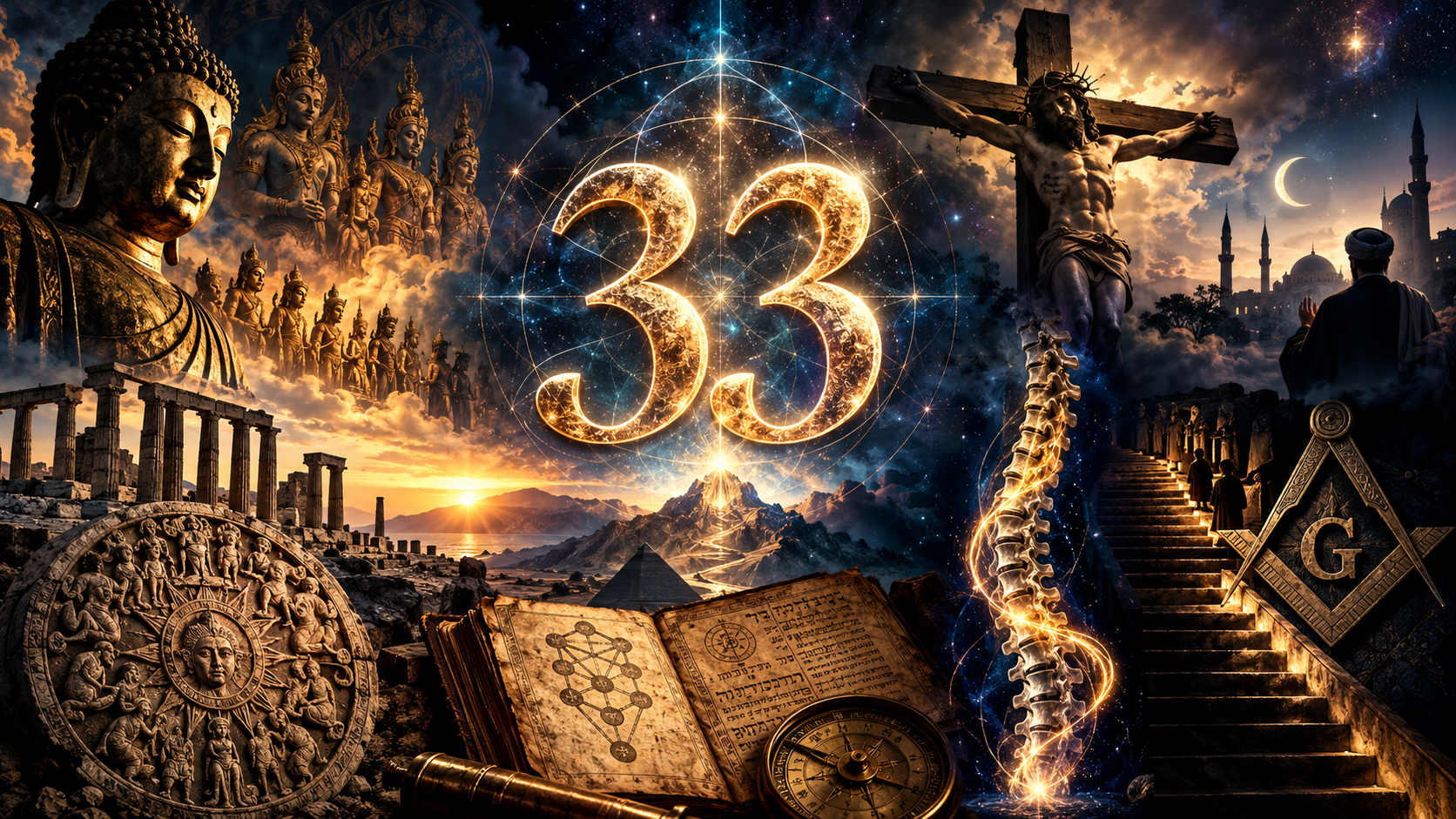
From the forgotten gods of ancient India and the celestial kingdoms of Buddhism to the crucifixion of Jesus, the mysteries of Kabbalah, Freemasonry, and the scientific experiments of Isaac Newton, one number appears in places where history, religion, and human imagination seem to intersect. But what lies behind these extraordinary connections, and how much of what we believe about the number 33 can actually be demonstrated?
There is something strangely compelling about discovering the same number in civilizations that appear to have little in common. A number that emerges from a religious manuscript written thousands of years ago, reappears in the hierarchy of a secretive fraternity, finds its way into the architecture of a medieval poem, and eventually turns up in the anatomical structure of the human body seems to invite an explanation far more extraordinary than coincidence.
The number 33 has acquired precisely this reputation.
For generations, it has been associated with spiritual initiation, divine perfection, hidden knowledge, the transformation of human consciousness, and, more recently, theories suggesting that religious institutions and secret societies have deliberately preserved an ancient numerical code.
The examples are familiar to anyone who has spent time exploring religious symbolism. Jesus is traditionally believed to have died at 33. The Scottish Rite of Freemasonry recognizes a 33rd degree. Ancient Hindu texts describe 33 deities, while Buddhist cosmology contains a celestial realm inhabited by 33 gods. Islamic traditions associate the inhabitants of Paradise with the age of 33, and Jewish religious observance includes a celebration on the 33rd day of the counting of the Omer.
Even the human spine, with its commonly described 33 vertebrae, has been incorporated into elaborate theories about spiritual awakening and the ascent of Kundalini energy.
When these examples are placed side by side, they create an almost irresistible impression that humanity has inherited fragments of a single forgotten system.
Yet history has a habit of becoming considerably more interesting when we stop asking only where a symbol appears and begin investigating who first used it, what it originally meant, and how its meaning changed as civilizations encountered one another.
The real history of 33 contains connections that can be documented, traditions that have been misunderstood, and remarkable details that rarely appear in popular discussions of sacred numbers.
Some of these discoveries are far more revealing than the conspiracy theories built around them.
The Ancient Indian Manuscript That Reduces Thousands of Gods to One
One of the most extraordinary references to the number 33 appears in the Brihadaranyaka Upanishad, an ancient Indian philosophical text belonging to the Vedic tradition.
Its importance lies not simply in mentioning 33 gods, but in the remarkable conversation through which the number is introduced.
The philosopher Yajnavalkya is questioned by Vidagdha Shakalya about the number of gods in existence. His initial answer refers to thousands of divine manifestations, but when the question is repeated, he gives a different number.
Thirty-three.
The questioning continues, and the number decreases again, first to six, then three, two, one and a half, and finally one.
At first glance, the dialogue might seem contradictory. How can the number of gods change so dramatically within the same conversation?
The explanation lies in the philosophical purpose of the exchange. Yajnavalkya is not attempting to compile a census of supernatural beings. He is exploring the relationship between the countless manifestations of existence and the underlying reality from which they arise.
The 33 deities are organized into eight Vasus, eleven Rudras, twelve Adityas, and two additional divine figures, Indra and Prajapati.
What makes this classification particularly fascinating is the way the text explains these groups.
The eight Vasus are associated with fundamental aspects of the natural world, including fire, earth, air, the sun, the moon, and the stars. The twelve Adityas are connected with the twelve months of the year, whose passage gradually consumes the duration of human life.
The eleven Rudras receive an even more surprising explanation. In the Upanishadic dialogue, they are associated with the vital faculties of the human being and the self, whose departure at death causes those left behind to weep.
This is an important detail that is frequently overlooked. The number 33 was not merely a collection of divine names. It belonged to a philosophical attempt to explain nature, time, human existence, and the relationship between the visible and invisible worlds.
The same general classification also appears in the Shatapatha Brahmana, demonstrating that the tradition was not confined to a single isolated passage.
What emerges from these ancient texts is not evidence of a secret organization controlling humanity through numerical symbolism, but something arguably more profound: an early intellectual effort to describe the unity concealed beneath the apparent multiplicity of the universe.
And the story does not end in India.
The Buddhist Heaven of the Thirty-Three Gods
In Buddhist cosmology, there exists a celestial realm known as Trāyastriṃśa in Sanskrit and Tāvatiṃsa in Pali, traditionally understood as the Heaven of the Thirty-Three.
According to the cosmological descriptions preserved in Buddhist traditions, this realm is situated on the summit of Mount Meru, the immense sacred mountain imagined as the central axis of the universe.
Its ruler is Śakra, also known as Sakka, a figure closely connected with the ancient Indian god Indra.
This connection deserves careful attention because it reveals something that numerical conspiracy theories often fail to recognize: two religious traditions can share symbols because they developed within overlapping cultural and intellectual environments.
Buddhism emerged in ancient India, where Vedic ideas, religious figures, cosmological structures, and philosophical debates were already deeply established. Rather than developing in complete isolation, Buddhist thinkers inherited, challenged, and reinterpreted elements of the world around them.
The Heaven of the Thirty-Three therefore offers an example of religious transmission that can be investigated historically.
There is another detail that makes this celestial kingdom particularly interesting.
Although its inhabitants enjoy extraordinary lifespans and pleasures beyond ordinary human experience, they are not necessarily liberated from suffering and rebirth. In Buddhist teaching, existence in a heavenly realm remains impermanent, and even celestial beings are subject to the conditions of the cycle of existence.
The significance of the number is therefore embedded in a cosmological system fundamentally different from the Christian concept of eternal salvation.
The resemblance between the Hindu and Buddhist references is real, but it becomes meaningful only when their historical relationship is examined.
Instead of discovering an invisible code operating independently across civilizations, we encounter the documented transformation of religious ideas as they move from one tradition into another.
Jesus Christ and the Age That the Gospels Never Explicitly Give
Among the countless associations surrounding the number 33, none is more familiar in the Western world than the belief that Jesus Christ was crucified at that age.
The statement is repeated so frequently that many people assume it appears directly in the Bible.
It does not.
The Gospel of Luke, in chapter 3, verse 23, states that Jesus was approximately thirty years old when he began his public ministry. The Gospel of John describes several Passover celebrations during that ministry, providing material from which later interpreters developed a chronology of approximately three years.
Combining these elements produced the traditional age of 33.
Yet the historical calculation is not as precise as popular belief suggests. Scholars continue to debate the chronology of Jesus’s birth and crucifixion, and the Gospel accounts do not provide a complete modern biographical timeline.
The age of 33 is therefore a traditional reconstruction rather than an explicitly recorded fact.
The frequently repeated claim that Jesus performed exactly 33 miracles raises a similar problem.
The canonical Gospels contain numerous accounts of healings, exorcisms, extraordinary acts, and miracles involving nature, but the total depends on how the events are classified. Some episodes appear in multiple Gospels, while others are described only once, and certain passages refer collectively to miracles without identifying each individual occurrence.
There is no universally established biblical total of precisely 33 miracles.
This distinction matters because a number can acquire religious importance through centuries of interpretation without having been deliberately encoded in the earliest surviving texts.
The historical question is not whether the number 33 eventually became meaningful to Christians. It is whether the original documents support the exact numerical claims later attached to it.
In this case, the evidence is more complicated than the popular narrative.
Islam and the Eternal Age of Paradise
Islamic tradition provides another intriguing appearance of the number 33, although the source is often misunderstood.
According to a report transmitted in the hadith literature, including a narration recorded by al-Tirmidhi, the inhabitants of Paradise will enter it at the age of 33.
This description is associated with the idea of an ideal, perfected human condition, free from the physical deterioration and limitations of earthly existence.
The distinction between the Quran and the hadith literature is essential here. The Quran describes Paradise in numerous passages, but the specific age of 33 comes from transmitted prophetic traditions rather than an explicit Quranic statement.
The number also appears in Islamic devotional practices.
Certain forms of dhikr, the remembrance of God, involve repeating expressions of praise and glorification 33 times. Some traditions prescribe combinations that include 34 repetitions, while others describe different arrangements.
Prayer beads may contain 33 or 99 beads, allowing worshippers to keep count during these devotional repetitions.
The association with the 99 beautiful names of Allah adds another numerical relationship, since 99 is three times 33.
Yet the existence of several devotional counting traditions demonstrates that the number does not function as an unchangeable universal formula.
The historical evidence points toward structured repetition, remembrance, and religious discipline, rather than an established mechanism of hidden spiritual control.
The question becomes more interesting when we consider why repetition itself occupies such an important place in religious practice. Across cultures, repeated words, prayers, movements, and sounds have been used to organize attention, reinforce memory, and create a sense of spiritual concentration.
The number of repetitions may differ, but the human practice of seeking transformation through rhythm and repetition is remarkably widespread.
The Kabbalistic Mystery That Changes When We Read the Original Text
Few subjects have attracted more speculative interpretations than Kabbalah, the Jewish mystical tradition concerned with creation, divine manifestation, and the relationship between the infinite and the material world.
Modern discussions of the number 33 sometimes claim that the Kabbalistic Tree of Life contains 33 paths of wisdom.
The explanation usually begins with ten sefirot and 22 connecting paths, then introduces an additional element to produce the desired total.
The difficulty is that one of the foundational texts associated with Jewish cosmological mysticism gives a different number.
Sefer Yetzirah, the Book of Formation, opens with a reference to 32 paths of wisdom.
Its numerical structure consists of ten sefirot and the 22 letters of the Hebrew alphabet.
Ten plus twenty-two gives thirty-two.
The text is explicit about the number of sefirot, insisting that there are ten, rather than nine or eleven.
Later Kabbalistic interpretations sometimes include Da’at, a concept associated with knowledge, in representations of the Tree of Life. However, Da’at is not simply an additional independent sefirah that automatically transforms the classical system into 33 paths.
This difference exposes one of the most revealing mechanisms behind modern numerological speculation.
Instead of discovering a number within a historical document, an interpreter may begin with a number already considered significant and reorganize the evidence until the desired result appears.
The distinction is subtle but fundamental.
The original Kabbalistic system is no less fascinating because it describes 32 paths instead of 33. Its attempt to connect numbers, letters, language, and the creation of reality remains one of the most intellectually distinctive features of Jewish mystical thought.
What disappears under close examination is not the mystery of the tradition, but the unsupported claim that it must conform to the same numerical pattern as every other religion.
The Island of Apollo and the Thirty-Three Altars That History Has Not Confirmed
In the Aegean Sea, the island of Delos preserves the remains of one of the most important religious centers of ancient Greece.
According to Greek mythology, Apollo and Artemis were born on this island, which became a major sanctuary attracting pilgrims and visitors from across the Mediterranean world.
A claim circulating in discussions of the number 33 suggests that Delos once contained exactly 33 altars dedicated to Apollo, sometimes accompanied by descriptions of channels carved into sacrificial structures to carry blood.
The image is dramatic, particularly when combined with the island’s association with prophecy, divine light, and sacred ritual.
However, the archaeological documentation consulted does not establish the existence of exactly 33 altars dedicated to Apollo.
The sanctuary contained multiple temples, altars, votive monuments, and religious structures, but the specific number requires evidence that the popular claim does not provide.
The historical reality of Delos is, in fact, considerably more extraordinary.
Over time, the island became a meeting place for religious traditions from different parts of the ancient world. Alongside the worship of Greek deities, archaeological evidence reveals sanctuaries associated with Egyptian and Syrian gods, while the island also preserves evidence of Jewish religious life.
The UNESCO documentation of Delos reflects this remarkable cultural diversity.
Here, within a relatively small geographical space, religious ideas crossed political, linguistic, and cultural boundaries.
The island offers a genuine historical example of spiritual traditions encountering one another, exchanging practices, and adapting to new circumstances.
That documented complexity is more valuable than an unsupported numerical claim, because it allows us to study the actual movement of religious ideas rather than imagine connections that have not been demonstrated.
Freemasonry and the Thirty-Third Degree: What the Symbol Actually Means
The 33rd degree of Freemasonry has become one of the most recognizable symbols in modern conspiracy literature.
It is frequently portrayed as the final stage of a secret hierarchy whose members possess knowledge inaccessible to ordinary humanity.
The historical structure is more specific.
The Ancient and Accepted Scottish Rite includes a system of degrees extending to the 33rd, although the organization and administration of these degrees vary across jurisdictions.
The 33rd degree is generally conferred as an honor in recognition of distinguished service rather than being a stage that every Freemason must reach.
It is also important to distinguish the Scottish Rite from Freemasonry as a whole. Not every Masonic system uses 33 degrees, and the foundational degree of Master Mason belongs to the three degrees of symbolic or Craft Masonry.
The presence of elaborate ceremonies, symbolic imagery, and philosophical language in Masonic traditions is well documented. Such practices reflect a much wider history of initiatory organizations that have used allegory to communicate moral and intellectual principles.
What has not been demonstrated is that the Scottish Rite created, controlled, or secretly coordinated the ancient religious traditions in which the number 33 also appears.
The chronological problem alone is significant.
Indian religious texts discussing the 33 gods existed long before the development of modern Scottish Rite Freemasonry.
To establish a genuine historical connection, researchers would need documents showing the transmission of a particular symbolic interpretation, along with evidence that the same meaning was deliberately preserved.
A shared number, by itself, cannot provide that proof.
A Jewish Festival Whose Name Contains a Number
In Judaism, the festival of Lag BaOmer is observed on the 33rd day of the counting of the Omer, the seven-week period connecting Passover and Shavuot.
The number is present in the very name of the celebration.
In Hebrew numeration, the letters lamed and gimel represent thirty and three, giving the combined value of 33.
The history of the festival, however, is more complex than its name suggests.
Traditional explanations associate the day with the cessation of a plague affecting the students of Rabbi Akiva, while other traditions connect it with Rabbi Shimon bar Yochai, a figure of enormous importance in later Jewish mysticism.
The precise development of these associations is a subject of historical discussion.
The Jewish Encyclopedia documents the festival and the traditions surrounding it, illustrating how religious observances can acquire additional layers of meaning over centuries.
This is a particularly important lesson for anyone studying sacred numbers.
A numerical association may be genuine without having existed in exactly the same form throughout the entire history of a religion.
Religious memory evolves, and communities reinterpret inherited observances in response to changing historical and spiritual circumstances.
Sometimes the mystery lies not in the original number, but in the long process through which people came to regard it as sacred.
The Human Spine, Kundalini, and the Symbolism of Spiritual Ascent
One of the most intriguing modern interpretations of the number 33 connects it to the human vertebral column.
In standard anatomical descriptions, the human spine consists of 33 vertebrae, divided into cervical, thoracic, lumbar, sacral, and coccygeal regions.
The familiar count includes vertebrae that become fused during development, and anatomical variation means that the number is not absolutely identical in every individual.
This anatomical fact has inspired interpretations connecting the spine to Kundalini, a concept found in certain Hindu and yogic traditions.
Kundalini is commonly represented as a coiled serpent associated with latent spiritual potential. In traditional accounts of yogic transformation, its awakening is described through imagery of an upward movement along the body’s subtle central channel.
The symbolism is powerful, especially when considered alongside religious images of ladders, sacred mountains, ascending souls, and journeys toward illumination.
But the historical and scientific distinctions must remain clear.
The subtle channels and spiritual centers described in yogic traditions are not equivalent to anatomical structures established through modern medical observation, and the existence of Kundalini as a measurable physical energy has not been scientifically demonstrated.
There is likewise no reliable evidence that human spiritual energy is harvested through a hidden mechanism associated with the number of vertebrae.
The more interesting historical question concerns the persistence of vertical imagery in spiritual traditions.
Why has the movement from below to above become such a widespread metaphor for transformation?
The answer may involve the human body’s orientation, the visible relationship between earth and sky, the experience of climbing toward elevated sacred places, and the symbolic association of height with transcendence.
These explanations do not establish a single origin for every tradition, but they provide a serious starting point for understanding why ascent has become such a compelling religious image.
Isaac Newton and the Thirty-Three Degrees of Boiling Water
Among the most unexpected appearances of the number 33 is one connected with Isaac Newton.
Long before the Celsius scale became internationally familiar, scientists experimented with different methods of measuring temperature.
Newton proposed a thermometric scale in which the beginning of water’s boiling corresponded to approximately 33 degrees.
The historical record preserved by the Newton Project at the University of Oxford documents this system, including distinctions made between the beginning of boiling and more vigorous boiling.
At first glance, the coincidence seems extraordinary.
A scientist whose work transformed our understanding of gravity, planetary motion, and the physical universe had selected the same number that appears in so many religious traditions.
Yet the explanation lies in the history of measurement.
Temperature scales are constructed using reference points and numerical conventions. Water boils at approximately 100 degrees on the Celsius scale and 212 degrees on the Fahrenheit scale under standard atmospheric pressure.
The physical phenomenon remains the same even when the numerical description changes.
Newton’s use of 33 is historically genuine, but it does not establish a mystical connection between his scientific experiments and the religious traditions of ancient India.
It reveals something else: numbers acquire meaning within systems, and removing them from those systems can create relationships that appear far more mysterious than they actually are.
Dante’s Divine Comedy: When Thirty-Three Was Chosen Deliberately
There is, however, an extraordinary European example in which the number 33 genuinely belongs to the deliberate architecture of a major literary work.
Dante Alighieri’s Divine Comedy is divided into three great sections: Inferno, Purgatorio, and Paradiso.
The poem contains one hundred cantos in total.
Purgatorio and Paradiso each contain 33 cantos, while Inferno contains 34, with its opening canto functioning as an introduction to the entire journey.
The arrangement creates a structure in which three groups of 33 are accompanied by an introductory canto.
Dante’s extensive use of numerical symbolism is closely connected with medieval Christian thought, particularly the significance of the Trinity.
The poem is also written in terza rima, a verse form built around interlocking groups of three lines.
Here the numerical structure is not something imposed by modern readers searching for coincidences. It belongs to the actual composition of the work.
Dante demonstrates how numbers can become instruments of artistic and theological expression, organizing a vision of the universe through mathematical relationships.
But this example also reveals why historical context matters.
The fact that Dante deliberately used 33 does not mean that Newton’s thermometric scale, Buddhist cosmology, and the Masonic degree system were designed according to the same hidden plan.
Intentional symbolism in one context cannot automatically establish intentional symbolism in another.
Alexander the Great, Arsenic, and the Problem of Convenient Numbers
Some numerical claims survive because they are repeated more often than they are checked.
Alexander the Great is frequently included in lists of historical figures who died at the age of 33.
He was born in 356 BCE and died in June 323 BCE, at the age of 32 completed years.
The difference may seem insignificant, but it illustrates how easily a numerical narrative can be strengthened by inaccurate details.
Arsenic provides a different example.
The chemical element has the atomic number 33, meaning that every arsenic atom contains 33 protons in its nucleus.
This is an established scientific fact.
Arsenic is also associated with serious toxicity, and certain inorganic arsenic compounds are recognized as carcinogenic.
But the number of protons does not give arsenic a spiritual identity, nor does its toxicity provide evidence of a connection with religious symbolism.
The atomic number belongs to the modern scientific classification of matter, whereas the ancient religious traditions associated with 33 developed in entirely different historical circumstances.
Placing these facts together may create an arresting narrative, but their proximity on a page does not establish a causal relationship.
This is one of the central difficulties in studying numerical mysteries: an impressive collection of coincidences can be assembled without demonstrating that the coincidences share a common origin.
The Mystery Hidden Behind Our Own Search for Patterns
After examining ancient Indian philosophy, Buddhist cosmology, Christian chronology, Islamic traditions, Jewish mysticism, Greek archaeology, Freemasonry, medieval literature, human anatomy, and the history of science, a different picture begins to emerge.
The number 33 does not possess one clearly documented meaning that has remained unchanged across all civilizations.
In some traditions, its appearance reflects cultural inheritance. In others, it results from deliberate symbolic construction, religious observance, practical counting, scientific convention, or retrospective interpretation.
Yet the fascination surrounding it remains understandable.
Human beings are extraordinarily sensitive to patterns. This ability has allowed us to recognize seasonal cycles, understand celestial movements, develop mathematical systems, and discover relationships that would otherwise remain invisible.
The same ability can also lead us to identify connections where no underlying causal relationship exists.
Once a particular number captures our attention, examples of its appearance become easier to notice and remember. Cases that do not fit the pattern are less likely to be collected, repeated, or shared.
A list containing fifteen remarkable appearances of the number 33 can seem overwhelming until we consider how many other numbers appear throughout the same religious and historical traditions.
Seven, twelve, forty, seventy-two, and one hundred and eight also possess extensive symbolic histories, often for reasons specific to the cultures that employed them.
Without examining the broader numerical environment, it is impossible to determine whether 33 is unusually significant or simply unusually well advertised.
This does not make the history of sacred numbers meaningless.
It makes the responsibility of interpreting them considerably greater.
A symbol should be investigated through the texts, communities, and historical circumstances that gave it meaning, rather than being detached from its origins and placed into a universal theory constructed centuries later.
What If the Real Secret Was Never the Number?
The most revealing discovery in this investigation may be that the number 33 does not need to conceal a global conspiracy to possess an extraordinary history.
Its appearance in the ancient Indian dialogue between Yajnavalkya and Shakalya leads us toward questions about the unity of existence. Its presence in Buddhist cosmology reveals the transmission and transformation of religious ideas. Its association with Jesus demonstrates how traditional chronology can become accepted as historical certainty, while its supposed presence in the 33 paths of Kabbalah exposes the danger of altering ancient systems to satisfy modern expectations.
Dante shows us how a number can become part of a deliberate intellectual design, and Newton reminds us that even scientifically valid numbers may depend upon the conventions through which we describe the natural world.
These are not fragments of a single proven secret.
They are fragments of humanity’s much larger attempt to understand reality.
Throughout history, people have looked toward the stars, studied the human body, constructed sacred buildings, developed religious ceremonies, and written elaborate philosophical works in the hope of discovering an order beneath the confusion of existence.
Numbers offered something particularly attractive in this search: they appeared stable, precise, and independent of the uncertainty of human language.
A number could cross a cultural boundary without requiring translation, even when the meaning assigned to it changed completely.
And therein lies the deeper mystery.
We are often so determined to discover a hidden message that we overlook the remarkable history of the people who created the symbols themselves.
The number 33 has traveled through centuries of religious thought, scientific discovery, artistic imagination, and speculative interpretation. Some of its appearances are historically connected, others are deliberate choices, and many are coincidences whose significance has grown through repetition.
No credible historical evidence demonstrates that a single secret organization planted this number throughout the world’s religions to control humanity.
But the desire to believe that all these fragments belong to one concealed design tells us something important about the human mind.
We do not merely search for patterns because we enjoy mysteries. We search for them because we want the universe to possess an underlying coherence, a structure that assures us that existence is not simply a collection of disconnected events.
And when we encounter the same number in a sacred manuscript, a medieval poem, a religious ceremony, and a scientific experiment, we are tempted to believe that we have discovered a small part of that structure.
The question is whether we have uncovered an ancient truth or created a new interpretation by connecting things that history never connected.
The answer cannot be found by counting coincidences alone.
It requires something far more demanding: the willingness to follow the evidence even when it leads away from the mystery we expected to discover.
And that may be the most difficult initiation of all.
Historical Sources and Further Reading
Royal Society of Chemistry, Periodic Table: Arsenic — Atomic number and chemical properties. Royal Society of Chemistry.
Brihadaranyaka Upanishad, Book III, Section 9 — The dialogue between Yajnavalkya and Shakalya concerning the thirty-three gods. Read the text.
Shatapatha Brahmana, Book XI, Section 6 — Vedic classification of the thirty-three deities.
Sefer Yetzirah, Chapter I — The thirty-two paths of wisdom, ten sefirot, and twenty-two Hebrew letters. Read the text.
The Gospel According to Luke, 3:23, and The Gospel According to John — Biblical material relevant to the traditional chronology of Jesus’s ministry.
Jamiʿ at-Tirmidhi, traditions concerning the inhabitants of Paradise; and Islamic hadith collections describing devotional repetition.
Jewish Encyclopedia, entries concerning Lag BaOmer and its religious traditions.
UNESCO World Heritage Centre, Delos — Archaeological and historical documentation of the island’s sanctuaries and religious diversity. UNESCO.
The Newton Project, University of Oxford — Newton’s writings and historical work on thermometry. The Newton Project.
Dante Alighieri, The Divine Comedy — The numerical and literary structure of the poem.

Leave a Reply