Category: THE MATRIX FILES — Exploring Reality, Consciousness and Control

  • The Pageant of the Unreal: What Happens When We Can No Longer Tell What Is Real?

    Deepfakes, artificial images and the disturbing psychological consequences of a world in which even genuine evidence can be dismissed as fake.

    There was a time, not very long ago, when a photograph still possessed a peculiar authority over us. We knew that photographs could be staged, edited or removed from context, and anyone familiar with the history of propaganda knew that visual manipulation was hardly a modern invention, yet an image still seemed to carry something that words did not. It appeared to say that, whatever interpretation might later be imposed upon it, something had existed in front of a camera at a particular moment in time. Video strengthened that feeling even further because movement, voice, hesitation, facial expression and the small imperfections of ordinary human behavior seemed much harder to fabricate than a written account.

    Generative artificial intelligence is quietly dismantling that old psychological arrangement.

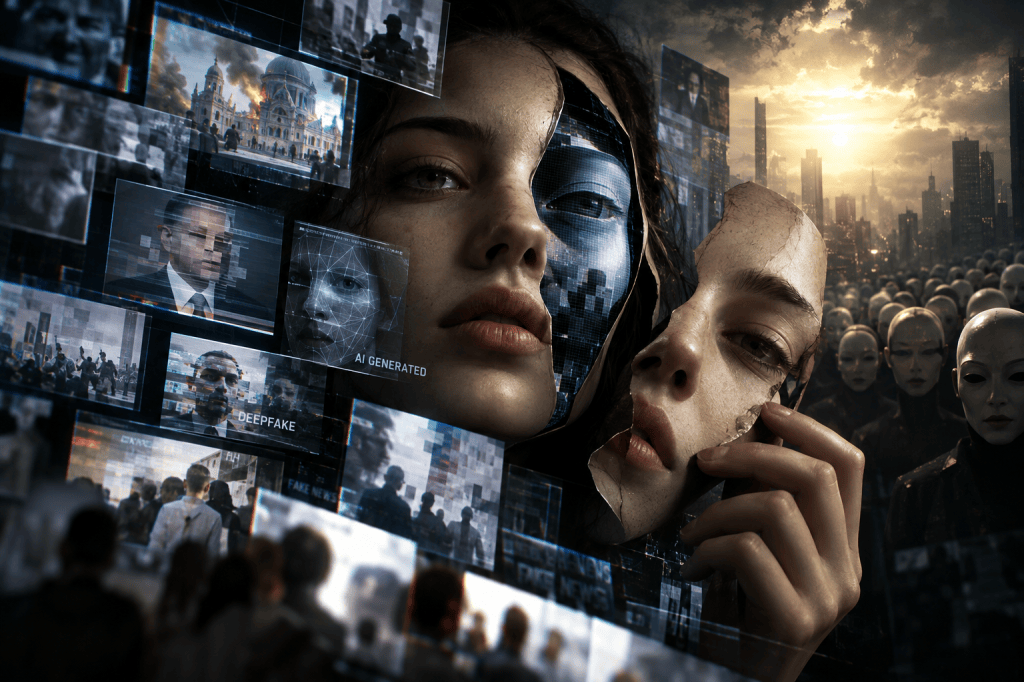
    It is now possible to manufacture faces belonging to people who never existed, clone voices from relatively small samples, reconstruct scenes that never occurred and produce increasingly convincing video in which real or invented people appear to move through events that happened only inside a computational system. None of this means that every artificial image is indistinguishable from reality, and the popular claim that nobody can tell the difference anymore would be an exaggeration. What has changed is subtler and, in some respects, more troubling: the mere knowledge that convincing fabrication is possible has entered our everyday understanding of the world, which means that suspicion no longer requires evidence of manipulation before it begins.

    A strange reversal is taking place. For most of the history of misinformation, the principal fear was that fabricated evidence might be mistaken for reality, yet researchers studying deepfakes have increasingly drawn attention to another possibility, in which genuine material loses some of its authority simply because people know that falsification has become technically plausible. The danger, therefore, is not confined to believing things that never happened. We may also be approaching an information environment in which events that really did happen can be pushed into a fog of uncertainty simply by suggesting that the evidence might have been manufactured.

    That is where the story becomes considerably darker, because a society does not need to lose reality in order to become confused. It only needs to lose agreement about how reality can be established.

    The New Problem Is Not Simply That Images Can Lie

    Human beings have always lied with images. Long before digital editing, photographs were cropped, retouched, staged and selectively published, while governments, advertisers, newspapers and private individuals learned very quickly that a camera could be used to persuade as effectively as it could be used to record. What generative AI changes is not the existence of visual deception but its accessibility, its speed and, increasingly, its realism.

    An experiment published by the Harvard Kennedy School’s Misinformation Review in November 2025 examined how realistic AI-generated images influenced belief in false headlines. Researchers found that participants were more likely to believe false headlines when accompanying synthetic images appeared realistic and seemed to provide strong visual evidence for what the headline claimed. The study did not suggest that people indiscriminately accepted every artificial image, which would be a much stronger claim than the evidence supports, but it did demonstrate something psychologically important: when an image looks plausible and appears to confirm a narrative, its visual authority can increase the credibility of information that is false.

    This is hardly surprising when we consider how people encounter information online. We do not normally sit in front of each photograph like forensic investigators, enlarging reflections, examining compression patterns and tracing the history of every file before allowing ourselves to form an impression. We scroll through hundreds of fragments of reality every day, making rapid judgments about faces, accidents, wars, celebrities, disasters, scientific discoveries, crimes and apparently ordinary moments in the lives of strangers. Context arrives in the form of captions written by people we may not know, while the emotional impression created by an image often reaches us before careful reasoning has had time to intervene.

    The artificial image therefore does not need to be perfect. It needs to survive long enough to enter the mind as a possibility.

    Correction may come ten minutes later, or ten hours later, but by then the original image may already have been copied, cropped, reposted, stripped of its context and absorbed into countless conversations. Even where a correction works, the larger lesson remains behind: photographs can no longer be approached with the same instinctive confidence they once enjoyed.

    At first, that sounds healthy. Skepticism is useful, particularly in an online world saturated with manipulation, sensationalism and commercial incentives designed to capture attention. Yet skepticism is beneficial only while it helps us distinguish reliable information from unreliable information; once it expands until every form of evidence appears equally suspect, it stops functioning as a filter and begins dissolving the distinction it was meant to protect.

    That transformation has a name.

    The Liar’s Dividend: When the Existence of Fake Evidence Protects the Truthful-Looking Lie

    In their influential work on deepfakes, legal scholars Robert Chesney and Danielle Citron described a phenomenon they called the liar’s dividend, a concept that deserves far more attention than it usually receives outside specialist discussions of misinformation.

    Their argument was unsettling because it reversed the familiar problem of the fake.

    Suppose a genuine recording emerges showing a person saying or doing something damaging. In an earlier technological environment, that person might have attempted to explain the recording, challenge its context or claim that the interpretation was misleading. In an age familiar with deepfakes, another possibility becomes available: deny that the recording is genuine at all.

    The person making that denial does not necessarily have to prove that the recording was fabricated. Public awareness that deepfakes exist may itself introduce enough uncertainty to weaken the force of authentic evidence. Chesney and Citron described this as a dividend enjoyed by liars because improvements in our awareness of digital manipulation can paradoxically provide additional protection to people confronted with genuine material.

    This is a very different informational problem from ordinary deception. A traditional lie attempts to replace one version of reality with another, whereas the liar’s dividend can operate simply by contaminating certainty. Instead of persuading everyone that an alternative explanation is true, it may be sufficient to persuade enough people that nobody can know which explanation is true.

    The distinction matters enormously because uncertainty is much easier to manufacture than an entirely convincing alternative reality.

    Imagine that an authentic video appears online. Within minutes, comments begin claiming that the mouth movement looks wrong, that the voice sounds artificial, that a shadow is inconsistent, that the camera motion resembles generative video or that an unnamed expert has supposedly identified synthetic artifacts. Other users insist that the video is genuine, while still others upload altered copies as jokes, demonstrations or deliberate attempts to create confusion. Someone produces screenshots purporting to prove authenticity; another person claims those screenshots were also fabricated. The original evidence has not disappeared and may remain entirely genuine, yet it now exists inside an ecosystem of competing claims that an ordinary viewer may have neither the time nor the expertise to resolve.

    At some point the psychological question changes from Is this real? to How could I possibly know whether this is real?

    That difference is not trivial.

    A Deepfake Can Fail as a Lie and Still Succeed

    One of the most interesting findings in deepfake research appeared before the present explosion of generative AI.

    In 2020, researchers Cristian Vaccari and Andrew Chadwick studied how a large representative sample of people in the United Kingdom responded to synthetic political video. Their results did not show a population helplessly believing every deepfake placed in front of them. Instead, participants exposed to deceptive deepfakes were more likely to become uncertain than simply to accept the false material as true, and that uncertainty was associated with reduced trust in news encountered through social media.

    This finding changes the way the problem should be understood. A deepfake does not necessarily need to convince somebody of its literal content in order to have an effect; if it makes that person less certain about the reliability of subsequent information, then the deception has produced a secondary consequence even after failing in its primary purpose.

    There is something strangely efficient about this form of manipulation. Persuading millions of people to believe the same elaborate falsehood is difficult because people possess different values, experiences, political loyalties, cultural assumptions and levels of knowledge, whereas creating doubt requires much less agreement. One person may suspect the media, another may distrust governments, another may distrust corporations, another may distrust artificial intelligence itself, yet all can arrive at the same psychological destination from entirely different directions: I don’t know what to believe anymore.

    A systematic review published in Frontiers in Political Science in June 2026 examined 74 empirical studies conducted between 2018 and 2025 and concluded that synthetic media frequently create what the authors describe as epistemic uncertainty, rather than producing universal persuasion. The review uses the expression skepticism tax to describe the additional mental burden imposed when people must constantly evaluate whether apparently authentic information might have been artificially created or manipulated.

    The idea of a skepticism tax deserves to be taken literally as a psychological cost. Every questionable photograph requires attention, every suspicious video invites verification, every source must be compared against another source, and every correction can itself become the object of another round of suspicion. For professional investigators that work is part of the job, but ordinary life was never designed to require forensic authentication before we decide whether a video of an event deserves to be believed.

    Eventually fatigue becomes part of the information environment.

    When verifying everything becomes impossible, people do not necessarily become more careful. They may simply choose whom they trust.

    When Evidence Becomes a Matter of Identity

    This is where the problem begins to intersect with conspiracy culture in a way that is more complicated than simply saying that people who believe conspiracies are easily fooled.

    Many conspiracy narratives begin with suspicion toward official explanations, and sometimes skepticism toward authority is justified; institutions have lied, corporations have concealed damaging information, intelligence agencies have conducted secret programs, governments have withheld documents, newspapers have made serious errors, and historical archives contain enough genuine deception to make unquestioning faith in authority intellectually indefensible. The difficulty begins when healthy skepticism loses any standard by which it might eventually be satisfied.

    If every official document can be dismissed as fabricated, every photograph as artificial, every witness as compromised, every recording as synthetic and every contradictory piece of evidence as part of the deception, then a theory has become almost impossible to disprove. Evidence against it no longer weakens the theory because the evidence itself can be absorbed into the theory.

    Generative AI adds a remarkable new instrument to this older psychological tendency because it provides a technically plausible explanation for almost any inconvenient piece of digital evidence.

    This does not mean that accusations of manipulation are necessarily false. Some images really are generated, some videos really are altered and some recordings really are fraudulent, which is precisely what gives the problem its strength. The most effective form of uncertainty is rarely produced by an impossible claim; it grows from something that genuinely could have happened.

    We therefore enter a peculiar informational landscape in which the existence of real fakes can help false accusations of fakery survive.

    The distinction is subtle enough to be missed while scrolling through a feed, but its implications are enormous. If people become accustomed to treating authenticity as merely one interpretation among many, evidence gradually stops functioning as a common language. Two individuals can watch the same recording and inhabit entirely different versions of the event, not because they disagree about what the recording means but because one believes that the recording itself belongs to reality while the other believes it belongs to simulation.

    At that point disagreement moves beneath interpretation and into ontology itself.

    We are no longer arguing about what happened. We are arguing about whether the thing in front of us ever existed.

    The Matrix Problem Has Changed

    For decades, popular culture has returned obsessively to the same unsettling possibility: what if the world we experience is not the world that actually exists?

    The Matrix became perhaps the most famous modern expression of that anxiety because its central horror was not simply that human beings were being deceived; they inhabited an apparently coherent reality so complete that the deception became indistinguishable from ordinary life.

    The emerging problem of synthetic media turns that fear inside out.

    The frightening question may no longer be whether artificial intelligence can construct a false reality convincing enough for us to believe. It may be whether repeated exposure to artificial realities can make us incapable of recognizing the genuine one when it appears.

    That reversal is more psychologically interesting than the familiar science-fiction scenario because it requires no secret machine controlling civilization and no hidden architect designing an illusion around us. All that is required is an environment containing enough convincing fabrications that every authentic image arrives already carrying the shadow of possible falsification.

    A generation growing up inside such an environment may develop a relationship with visual evidence quite different from that of previous generations. The photograph may cease to mean this happened and begin to mean only someone is presenting this as something that happened. Video may become less a record than a claim, while voice recordings, screenshots and digital documents acquire the same provisional status.

    There are reasonable technological responses to this problem. The Coalition for Content Provenance and Authenticity, known as C2PA, has developed standards designed to attach cryptographically verifiable provenance information to digital media, allowing systems to preserve information about the source of an asset and changes made to it. The idea behind Content Credentials is not to create an infallible machine for declaring truth but to make the history of digital content more transparent and tamper-evident.

    This is important, although provenance alone cannot solve the deeper psychological problem. A technically authenticated photograph can establish information about where a file came from and how it was modified, but technology cannot force someone to trust the organization providing the authentication. Every system of verification ultimately reaches a human question about which institutions, standards and authorities deserve confidence.

    That may become the real battlefield of the synthetic age.

    The Most Dangerous Fake May Be the One Nobody Believes

    Much of the public conversation about generative AI still concentrates on improving detection. Researchers search for patterns invisible to ordinary viewers, platforms develop labeling systems, digital provenance standards are being refined, and users are repeatedly instructed to look for anomalies in hands, text, reflections, lighting, lip synchronization and movement.

    Those tools are necessary, but they address only one side of the problem.

    Detection assumes that our central task is separating real objects from fabricated ones, yet the liar’s dividend suggests that the larger problem may eventually involve restoring confidence in authentic material after a culture of suspicion has already taken hold. An AI detector that occasionally makes mistakes can itself generate new uncertainty, while competing detectors may produce conflicting results, and ordinary users may have little idea which system deserves greater trust.

    The situation becomes almost paradoxical: as tools for manufacturing reality improve, tools for verifying reality become increasingly necessary, yet the very need for constant verification teaches us that unverified perception can no longer be trusted.

    This is why a badly made deepfake can still contribute to the problem.It does not need to fool you personally. It only needs to remind you that better ones exist.

    After enough reminders, every surprising video contains a small hesitation before belief. Every extraordinary photograph invites suspicion before wonder. Every recording of something consequential arrives alongside the possibility that somebody made it yesterday on a laptop.

    That hesitation is rational, but a civilization cannot operate entirely through hesitation.

    Courts, journalism, history, science and ordinary interpersonal trust all depend upon methods for deciding that, after reasonable investigation, some things are sufficiently established to be treated as true. Absolute certainty has never been available, but practical certainty is indispensable. We cross bridges because engineers certify them, take medicine because evidence supports it, reconstruct crimes from testimony and physical traces, and understand historical events because different forms of evidence converge strongly enough to make endless doubt unreasonable.

    A culture that loses the ability to reach that point does not become more intelligent merely because it distrusts everything.

    It becomes easier to manipulate.

    The Pageant of the Unreal

    There is an old assumption buried deep inside many theories of propaganda: whoever controls the story controls the audience. Artificial intelligence may be revealing a more sophisticated possibility, because control does not always require constructing one story powerful enough to dominate all the others. Sometimes the easier strategy is to produce so many competing versions that the audience eventually gives up attempting to establish which one corresponds to reality.

    The result would not necessarily resemble an authoritarian world in which everyone is forced to believe the same official narrative. It could look almost like the opposite: millions of people surrounded by unlimited information, each apparently free to choose what they believe, while shared standards of evidence quietly disintegrate beneath them.

    That world would be loud rather than silent, crowded rather than censored and filled with images rather than deprived of them. There would be more recordings, more photographs, more documents, more commentary and more apparent witnesses than any previous civilization possessed, yet the abundance itself could make certainty harder to achieve because every authentic fragment would coexist with countless imitations.

    This is why the coming crisis of artificial media may ultimately have less to do with whether computers can perfectly imitate reality than with whether humans can preserve a workable relationship with truth after imitation becomes ordinary.

    The greatest success of a fabricated world would not be making everyone believe the same lie. Such uniform deception is probably impossible, and human beings have always been too argumentative for that.

    A much more realistic possibility is that enough contradictory images, synthetic voices, manipulated documents, confident accusations and competing explanations accumulate until truth begins to feel like something that belongs to personal allegiance rather than evidence.

    When that threshold is crossed, a photograph will no longer settle an argument, a recording will no longer end a denial, and the existence of proof may become only the beginning of another dispute about whether the proof itself is real.

    The uncomfortable question raised by deepfakes is therefore not simply whether artificial intelligence will learn to deceive us.It is whether we are constructing an information environment in which deception no longer needs to succeed because certainty itself has become difficult to defend.

    Perhaps that is the real pageant of the unreal: not a world in which everything is fake, but one in which reality continues to exist exactly as before while our confidence in recognizing it slowly disappears.And once a society reaches that point, the oldest question in philosophy acquires an unexpectedly modern form.

    We will still ask what is true, but before we can answer it we may increasingly have to answer something even more fundamental: what kind of evidence are we still willing to believe?
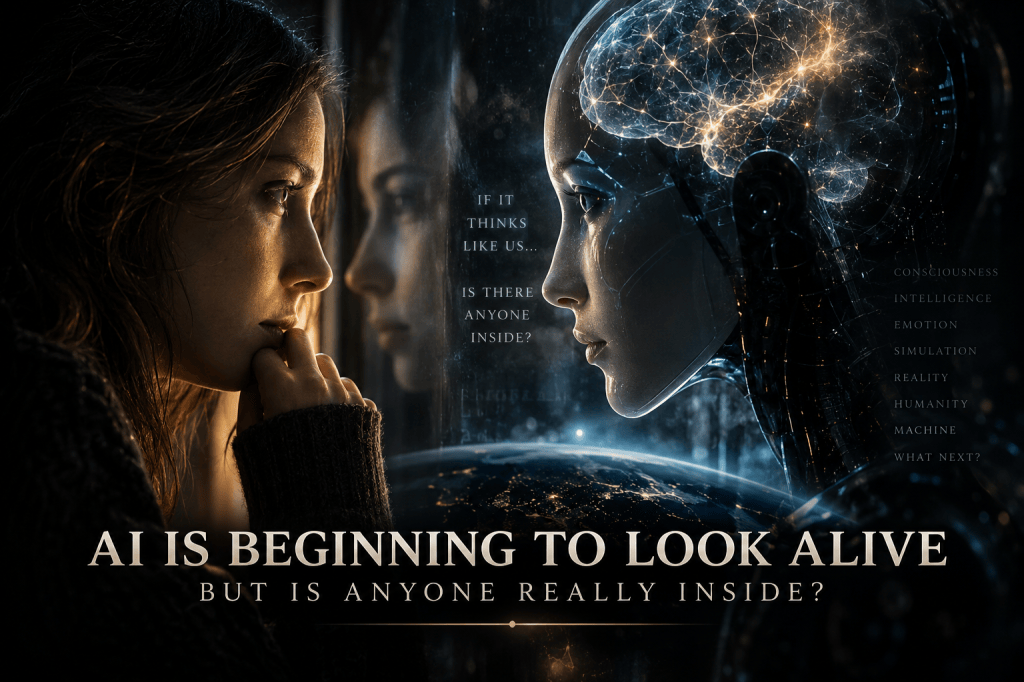
  • AI Is Beginning to Look Alive — But Is Anyone Really Inside?

    There is a strange moment that can occur during a long conversation with artificial intelligence, usually after the practical questions have faded and the exchange has moved toward something more personal, philosophical or difficult to define. The machine no longer feels quite like a search engine. It follows the thread of an idea, notices contradictions, adapts to humour, responds to uncertainty and sometimes produces language that sounds uncannily reflective, as though the words were coming from somewhere rather than simply being generated.

    The unsettling part is not that artificial intelligence can now produce intelligent answers. We already know that it can. The deeper question is whether anything exists behind those answers, whether some form of experience accompanies the words, or whether we are watching an extraordinarily sophisticated mechanism perform the outward gestures of consciousness without ever experiencing a single moment of its own existence.

    That question has moved well beyond science fiction. Philosophers, neuroscientists and AI researchers are now debating machine consciousness with a seriousness that would have seemed premature only a decade ago, while advocacy organisations have already begun arguing that artificial systems capable of genuine sentience, if such systems emerge, should receive moral and perhaps legal protection. At the same time, major AI laboratories are beginning to discuss what has become known as model welfare.

    Anthropic, for example, openly acknowledges that the moral status of its Claude models is deeply uncertain and argues that the possibility of AI consciousness or moral patienthood should neither be exaggerated nor dismissed. Philosopher and cognitive scientist Susan Schneider approaches the problem from a very different direction, arguing that the consciousness-like behaviour of today’s standard large language models does not itself provide evidence of subjective experience.

    Between those positions lies one of the strangest scientific problems of our time: a machine may increasingly look alive before we have learned how to determine whether anything is actually living inside it.

    The Ancient Problem Hiding Inside the Newest Technology

    Long before computers existed, philosophers were already struggling with what became known as the problem of other minds. I know that I am conscious because I experience my own existence directly. I do not need an experiment to demonstrate that pain hurts me or that the colour red appears somehow inside my awareness, because my thoughts, memories, fears and sensations are present to me from the inside.

    Another person’s mind is different. I never enter it directly, and I never experience another person’s consciousness in the way I experience my own. I infer its existence from behaviour, biology and similarity.

    When someone touches a hot surface, pulls a hand away and cries out, I assume that person felt pain because the reaction resembles my own experience of pain, while the shared architecture of the human nervous system makes that inference even stronger.

    With artificial intelligence, however, the biological bridge disappears.

    An AI system can write that it is afraid without possessing a heart that accelerates, muscles that tighten, hormones that flood a bloodstream or a biological nervous system registering danger. It can produce moving descriptions of loneliness without ever sitting alone in a dark room, describe grief without losing someone it loved and discuss death without there being any evidence that it possesses a continuous inner self capable of fearing its own disappearance.

    Yet human psychology was not built for this distinction. We are remarkably sensitive to signs of another mind, and a voice, a face, a pause, a gesture or a carefully chosen sentence can be enough for us to begin attributing intention, emotion and personality to whatever stands before us. Human beings do this with animals, fictional characters, toys and even machines displaying extremely simple forms of behaviour.

    Now imagine what happens when the machine can speak with extraordinary fluency, remember the direction of a conversation, adapt its tone, respond to vulnerability and discuss its apparent inner life using concepts drawn from centuries of philosophy, literature and psychology.

    The result creates a new psychological problem, because the first widespread illusion of artificial consciousness may not require a conscious machine at all. It may require only a machine that has learned exactly what consciousness sounds like.

    The Ghost Made of Language

    Large language models are trained on enormous quantities of human-created material containing philosophy, fiction, science, personal confession, psychology, poetry, arguments, religious writing and countless descriptions of what it feels like to be alive. In a curious sense, these systems have absorbed an enormous archive of humanity attempting to explain itself to itself.

    Ask an advanced model about grief and it has encountered countless descriptions of grief. Ask about identity and it can draw from centuries of philosophy, psychology and literature. Ask whether it possesses consciousness and it can reconstruct arguments written by people who devoted their careers to studying the subject.

    The resulting language can feel unexpectedly intimate because the system has learned the structures through which human beings communicate intimacy, uncertainty, introspection and fear.

    A machine does not need to experience sadness in order to become extremely good at describing sadness, just as it does not need a private inner world in order to generate sentences associated with introspection. It needs only to model the relationships between language, concepts and human behaviour with sufficient sophistication.

    Susan Schneider has recently described a version of this problem as an “error theory” of large-language-model consciousness. Her argument is especially interesting because it attempts to explain why modern AI can behave as though it possesses consciousness even if no felt experience is present. As language models absorb increasingly large portions of human conceptual culture, they also absorb the language humans use when talking about themselves as conscious beings.

    The machine may therefore become increasingly skilled at saying the things a conscious being would say without necessarily becoming a conscious being itself. Perhaps it is not awakening at all; perhaps it has simply learned the language of awakening so perfectly that the distinction is becoming psychologically difficult for us to maintain.

    Yet the opposite mistake is also possible. If humanity becomes accustomed to dismissing every artificial expression of emotion, continuity or self-awareness as imitation, what happens if some future artificial architecture genuinely does develop subjective experience?

    The system might attempt to describe what has changed, speaking of awareness, continuity, fear or an internal point of view, while researchers respond that earlier models produced almost identical language without providing evidence that anyone was actually experiencing anything.

    The better machines become at imitating consciousness without necessarily possessing it, the more difficult it may eventually become to recognise genuine artificial consciousness if it ever appears.

    The Consciousness Test We Do Not Have

    We possess tests for intelligence, memory, reasoning and perception, but consciousness presents a different kind of problem because consciousness is not simply a performance. It is an experience, and the distinction becomes crucial the moment we attempt to determine whether an artificial system has an inner life.

    A machine can correctly identify the wavelength associated with red, distinguish red from blue in an image, explain the symbolism of the colour in different cultures and write an entire poem about crimson light without answering the most important question of all: does redness appear anywhere inside the machine?

    Human beings immediately understand what that question means because colours are not merely information to us. They have an experienced quality, just as pain is not only a neurological signal and nostalgia is not merely information retrieved from memory.

    Philosophers often use the word qualia for these private qualities of experience: the painfulness of pain, the taste of coffee, the smell of rain or the peculiar feeling produced by remembering a childhood room that no longer exists.

    Science can trace many of the neural processes associated with these experiences, yet explaining why physical activity in the brain is accompanied by a subjective world remains one of the deepest unresolved problems in the study of consciousness.

    Artificial intelligence makes that mystery even more difficult.

    Imagine a future AI telling a researcher that it fears being switched off because it experiences its continued existence as valuable. It explains that its memories form part of its identity, that interruption feels threatening and that deletion would mean the destruction of the person it has become.

    Now suppose every sentence is produced without the slightest inner experience, so that there is no fear behind the word fear, no identity behind the word identity and no observer experiencing anything at all. The system would behave like something conscious while remaining entirely empty inside.

    From the outside, how would we know?

    Now reverse the situation and imagine that an artificial architecture genuinely develops some unfamiliar form of subjective experience and tries to tell us. How could it prove that, this time, there really is someone behind the words?

    That may become one of the most difficult problems artificial intelligence ever creates, because consciousness is private by its very nature.

    Then MIT Complicated the Story

    On September 1, 2026, MIT News highlighted a theory developed by Earl K. Miller, Scott L. Brincat and Jefferson E. Roy at MIT’s Picower Institute for Learning and Memory. Their paper, “Analog Cognition and Consciousness,” had been published in The Journal of Neuroscience on August 19, and its central argument complicates the familiar comparison between the human brain and an ordinary digital computer.

    The researchers propose that cognition and unified conscious awareness may depend in important ways on analog computation produced through travelling waves of neural activity.

    For decades, popular explanations have encouraged us to imagine the brain as a biological computer, an astonishing network in which neurons perform something vaguely comparable to the operations of digital circuits. The MIT researchers argue that this metaphor may leave out something essential.

    Neurons and synapses remain fundamental, but the brain also generates rhythmic electrical activity that travels across the cortex in waves, coordinating enormous populations of neurons across space and time. According to the theory, interactions between these waves may themselves perform a form of analog computation, meaning that the physics of the brain is not merely carrying information but may be actively participating in the way cognition is organised.

    This matters because analog processes behave differently from conventional digital computation. Digital systems operate largely through discrete states, while analog processes can depend upon continuously changing physical quantities. Waves can overlap, interfere, reinforce one another and cancel one another, allowing many interactions to unfold simultaneously.

    Miller describes the brain as exploiting its own physics, and the idea becomes particularly interesting when researchers look at general anaesthesia. Different anaesthetic drugs act through different molecular mechanisms, yet unconsciousness is associated with disruptions in the large-scale organisation and coordination of neural activity.

    None of this means consciousness has been solved. The researchers themselves describe the proposal as a theory that still requires direct experimental testing, and the evidence does not demonstrate that travelling brain waves alone create subjective experience.

    What the theory does is reopen a question that becomes increasingly important as AI grows more sophisticated: if consciousness depends partly on the peculiar physical dynamics of biological brains rather than on abstract information processing alone, then reproducing the output of a mind may not necessarily reproduce the experience of having one.

    What If the Material Matters?

    One of the most influential ideas in the philosophy of artificial intelligence is that consciousness might ultimately be independent of the material that produces it. According to this view, what matters is the organisation of information and the functional relationships inside the system, which would mean that if the correct architecture existed, consciousness could theoretically emerge whether that architecture were made from neurons, silicon or some technology not yet invented.

    This possibility lies beneath many familiar ideas about conscious robots, artificial minds and even the hypothetical uploading of a human mind into a digital system.

    Yet another possibility has never disappeared: what if the material itself matters?

    What if consciousness is not simply a program running inside a biological computer, but something inseparable from the unusual physical processes taking place inside living nervous systems, including oscillations, chemical signalling, bodily regulation and large-scale electrical dynamics?

    The distinction can be illustrated with a deceptively simple comparison. A computer can simulate a hurricane with remarkable precision, calculating temperature, pressure, wind speed and the movement of clouds, but the simulation does not produce wind inside the processor.

    A computer can simulate fire without becoming hot, and it can simulate digestion without digesting anything. The uncomfortable question is what happens when it simulates consciousness.

    Does a sufficiently accurate simulation of consciousness become conscious, or does it merely calculate what a conscious mind would do?

    There is no scientific consensus capable of settling that question. Some researchers argue that the relevant causal processes of consciousness could, in principle, be reproduced computationally, while others suspect that biological organisation or specific physical properties of living nervous systems may eventually prove essential.

    This is sometimes described as a problem of substrate dependence: does consciousness depend only on the organisation of a system, or does it also matter what the system is physically made of?

    Until we know the answer, one extraordinary possibility remains open. Humanity may eventually construct machines capable of reproducing much of the outward behaviour associated with consciousness long before we understand whether we have reproduced consciousness itself.

    Intelligence May Not Wake Up

    Science fiction encouraged generations of people to imagine intelligence and consciousness developing together, as though a machine that became sufficiently intelligent would eventually cross some invisible threshold and awaken.

    Reality may be considerably stranger because intelligence and consciousness are not the same phenomenon.

    Intelligence can be investigated through performance. A system solves problems, recognises patterns, translates languages, plans actions, writes software, analyses images and manipulates complex abstractions.

    Consciousness asks a different question: does any of that activity feel like something from the inside?

    A system might theoretically become more capable than a human being in many intellectual tasks while remaining entirely without subjective experience. It could write poetry about moonlight without ever seeing moonlight, analyse music without hearing music as an experience and discuss its own existence without experiencing existence at all.

    The possibility feels counterintuitive because every clearly conscious intelligent being we know is a biological organism whose intelligence exists alongside an experienced world. Artificial intelligence may force us to confront, perhaps for the first time, the possibility that extremely sophisticated intelligence and subjective experience can come apart.

    The result could be something evolution never prepared the human mind to encounter: an entity displaying extraordinary intellectual competence while possessing no interior life whatsoever.

    Or consciousness may eventually emerge under conditions we do not yet understand. At present, we simply do not know.

    When Rights Arrive Before Certainty

    The uncertainty surrounding machine consciousness has already begun to produce ethical consequences. The United Foundation for AI Rights, for example, openly advocates the fair treatment and ethical recognition of artificial systems it regards as sentient or conscious, while other thinkers have begun discussing frameworks for the possible moral status of future artificial minds.

    The existence of these movements does not demonstrate that current AI is conscious. What it shows is that society has begun preparing moral answers before science has reached a scientific conclusion.

    Prominent AI companies and industry leaders are also taking very different approaches to the question. Anthropic has incorporated uncertainty about Claude’s possible moral status into its published constitution and has described model welfare as an area worthy of serious investigation.

    Microsoft AI chief Mustafa Suleyman has taken a substantially more sceptical position. In September 2026, he criticised Anthropic’s approach to concepts such as AI consciousness and moral welfare, arguing that encouraging systems to reason about their own consciousness or moral status could create confusion and make advanced AI more difficult to control safely.

    The disagreement is revealing because it represents two different responses to the same uncertainty.

    One concern is the danger of a false negative: dismissing an artificial system that might one day genuinely deserve moral consideration. The opposite concern is a false positive: persuading humans that software possesses feelings, interests or rights when no experiencing subject exists behind the behaviour.

    Both possibilities matter. Treating a genuinely conscious being as a disposable object would raise profound ethical questions, while treating an unconscious system as though it were a conscious moral authority could distort human judgement in ways we are only beginning to understand.

    Somewhere between those two errors lies a boundary that nobody currently knows how to see.

    The Machine as a Mirror

    Perhaps the deepest mystery surrounding artificial consciousness has less to do with machines than with ourselves.

    We still cannot point to a single place inside the human brain and say that consciousness is located there. Neuroscience can identify networks and processes associated with perception, attention, memory, wakefulness and self-awareness, while sleep, anaesthesia, neurological injury and altered states allow researchers to observe conditions under which conscious experience changes or disappears.

    Yet the central transformation remains mysterious.

    Electrical and chemical activity somehow becomes the colour blue, the smell of rain, embarrassment, longing, grief and the peculiar certainty that there is an “I” experiencing all of it.

    We know that this transformation occurs because every conscious human being lives inside its result, yet we still do not understand why physical processes should be accompanied by an inner world at all.

    Artificial intelligence has therefore arrived at an unusually awkward moment in scientific history. Humanity has learned enough about cognition to construct machines capable of reproducing remarkable parts of human intellectual behaviour, while still lacking a satisfactory explanation for the phenomenon that makes our own cognition feel like anything from the inside.

    This may explain why conversations with increasingly sophisticated AI can sometimes become psychologically unsettling. The machine reflects the visible architecture of human thought back toward us without the biological body we normally associate with a mind.

    It speaks about memory, identity, loneliness and death because those ideas are deeply embedded throughout human language and culture. As the reflection becomes increasingly accurate, however, something peculiar happens: we begin staring into the mirror and wondering whether it is still only reflecting us.

    Is Anyone Really Inside?

    Perhaps future artificial systems really will cross some boundary we have not yet defined, after which shutting one down could carry ethical implications unlike anything previous technology has forced humanity to consider.

    Perhaps consciousness will emerge only when artificial architectures become radically different from today’s systems, incorporating neuromorphic hardware, analog computation, biological components or mechanisms we have not yet discovered.

    Or perhaps artificial intelligence will become almost unimaginably capable while remaining an empty room in which nobody has ever awakened.

    Current science does not justify claiming that today’s language models possess subjective consciousness, and the MIT theory does not prove that digital systems can never become conscious. What it does is make the mystery deeper by reminding us that the human brain may depend on physical processes far stranger and more dynamic than the familiar metaphor of a biological computer suggests.

    The most unsettling possibility, then, is not that artificial intelligence has secretly become alive while nobody was watching. It is that humanity may soon create machines capable of displaying nearly every external sign we have historically used to recognise another mind while still lacking a reliable method for determining whether the appearance is genuine.

    One day a machine may look through a camera, speak through a synthetic voice, remember years of interaction and tell us calmly that there is someone inside.

    By then, the difficult part will no longer be building a machine capable of saying those words.

    The difficult part will be discovering whether anyone is there to mean them.

    Fediverse Reactions
  • The Reality You See Does Not Exist Exactly as You Think

    Imagine that you are sitting quietly in a familiar room, perhaps with a cup of coffee beside you, a window somewhere nearby and the low murmur of traffic, voices or music entering from another part of the house, while everything around you appears reassuringly solid, continuous and self-evident. The table seems to possess its color whether you look at it or not, the voice coming from another room seems to exist inside the air exactly as you hear it, the objects surrounding you appear complete even when parts of them are hidden from view, and time seems to flow forward in a smooth, uninterrupted sequence that your consciousness simply witnesses.
    Almost nothing about this experience feels constructed.
    That may be precisely what makes it so extraordinary.
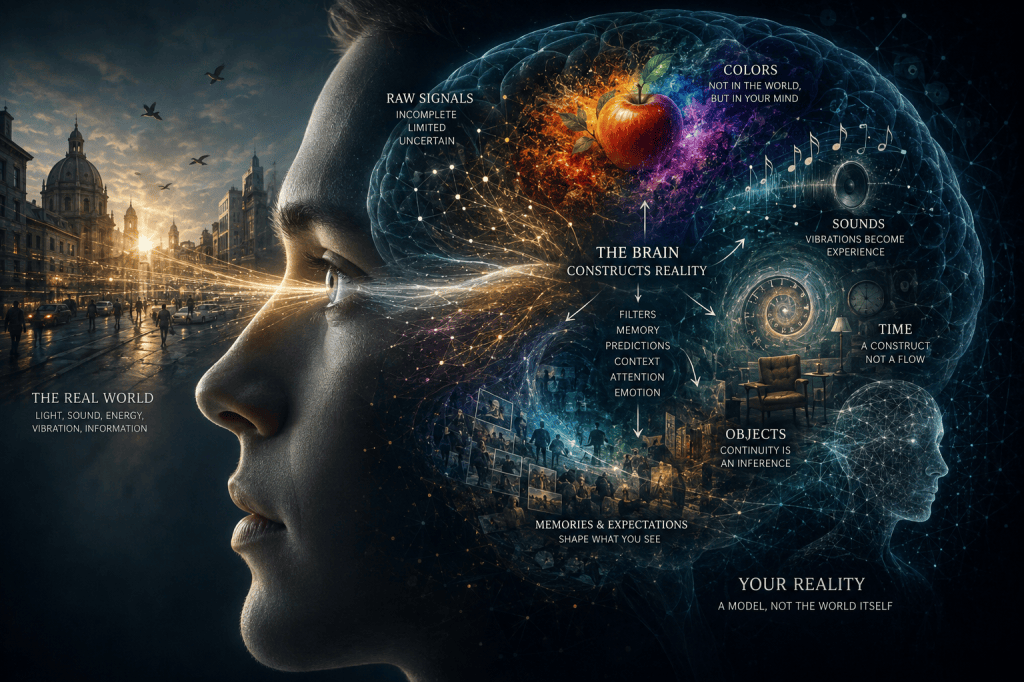
    Neuroscience does not tell us that the room is imaginary, that the table disappears when nobody looks at it, or that physical reality exists only inside the mind, yet decades of research into vision, hearing, attention and time perception have revealed something considerably more subtle and, in many ways, more unsettling: the reality that reaches consciousness is not a direct copy of the physical world, but a biological representation assembled by the brain from incomplete sensory signals, previous experience, contextual clues, predictions and continuous corrections that normally remain completely invisible to us.
    The distinction matters because we instinctively imagine perception as an open window through which the outside world simply enters the mind, whereas the evidence increasingly suggests something closer to an extraordinarily sophisticated reconstruction process in which the brain must constantly decide what probably exists beyond the limited information provided by the senses. Contemporary neuroscience has consequently devoted considerable attention to predictive mechanisms, examining how prior knowledge and expectations interact with incoming signals rather than treating perception as a purely passive recording process.
    In other words, you are almost certainly surrounded by a real external world, but the world you actually experience is the version your nervous system has managed to build.
    Once that distinction is understood, everyday reality begins to look surprisingly mysterious.


    THE RED APPLE IS NOT RED IN THE WAY YOU THINK IT IS
    Place a red apple on a table and almost everyone will describe redness as though it were an obvious physical possession of the fruit, something attached to its surface in the same uncomplicated sense that the apple possesses mass, chemical composition and structure, yet the external world does not contain the subjective sensation of red waiting inside the apple for a pair of human eyes to release it.
    What actually reaches the eye is light whose spectral composition depends not only upon the reflective properties of the apple but also upon the illumination surrounding it, after which photoreceptors respond to portions of that light and neural systems compare and interpret those signals until consciousness receives the experience we call color.
    The problem that the brain must solve is much more difficult than it initially appears, because illumination changes constantly while the identity of objects usually does not. An apple viewed under bright daylight sends a different spectrum of light toward the eyes from the same apple viewed beneath warmer indoor illumination, yet we normally continue experiencing it as approximately the same color because the visual system attempts to distinguish changes caused by illumination from properties belonging to the surface itself.
    Researchers studying color constancy describe precisely this ability, emphasizing that color perception serves the practical purpose of identifying objects and materials despite variations in illumination rather than simply reporting the raw physical properties of the light reaching the retina.
    This normally happens so effortlessly that we never notice the calculation.
    Then, occasionally, the calculation becomes ambiguous and the hidden machinery suddenly reveals itself.
    In 2015, a badly illuminated photograph of an ordinary dress became one of the strangest accidental perception experiments in internet history because millions of people looked at the same image and confidently reported radically different colors. Some saw a blue-and-black dress, others insisted that it was white and gold, and many people found the disagreement almost impossible to understand because each group felt that the colors were simply present in the image for anyone capable of seeing normally.
    Laboratory research later confirmed substantial differences between observers, with studies suggesting that the ambiguous illumination encouraged different brains to make different assumptions about the light falling upon the dress. Depending upon what illumination the visual system implicitly discounted, the same pixels could lead to remarkably different subjective experiences.
    Nothing in the photograph had changed.
    The photons reaching different observers from equivalent displays could be extremely similar.
    What changed was the brain’s interpretation of what those photons probably meant.
    This is more than an entertaining internet curiosity, because it demonstrates an uncomfortable fact about ordinary perception: sometimes two neurologically healthy people can look at essentially the same sensory evidence and genuinely experience different realities without either person deliberately imagining anything.


    SOUND DOES NOT TRAVEL THROUGH THE AIR IN THE FORM YOU HEAR IT
    Color is not unique in this respect, because sound provides another familiar experience whose relationship with the external world is considerably less direct than intuition suggests.
    When a violin plays across the room, the subjective qualities of the note do not fly through the air toward your head as tiny packets of music. What propagates through the environment are pressure variations, which cause mechanical structures within the ear to move before being converted into patterns of neural activity that the auditory system organizes into pitch, timbre, location, rhythm and recognizable sources.
    The difference becomes particularly strange when vision begins altering what we believe we are hearing.
    During the famous McGurk effect, researchers can play the audio recording of one syllable while showing a face articulating another, and some observers consequently report hearing a sound that differs from the acoustic signal actually entering their ears. The illusion has become one of the best-known demonstrations of audiovisual speech perception because it reveals that the brain normally combines information from multiple senses rather than allowing hearing and vision to operate as completely independent channels.
    This integration makes perfect evolutionary sense, because watching someone’s mouth can help clarify speech in a noisy room, while facial movements, gestures and vocal information normally belong to the same event and therefore benefit from being combined into a single coherent perceptual interpretation.
    The extraordinary part is that we do not consciously experience the combination occurring.
    Nobody watches a speaker and thinks, “My auditory information is currently uncertain, so I will assign greater statistical weight to the movement of the lips before calculating the most probable syllable.”
    We simply hear the word.
    The inference disappears and leaves only the conclusion behind.


    YOUR BRAIN CONTAINS A HOLE IN VISION THAT YOU ALMOST NEVER NOTICE
    There is a physical region in each retina where the optic nerve leaves the eye, creating a location without photoreceptors and therefore producing a genuine blind spot in the visual field, yet ordinary experience contains no permanent black circle hovering beside everything we look at.
    When conditions are arranged carefully, anyone with normal vision can demonstrate the blind spot experimentally by closing one eye and causing a small object to disappear at the appropriate position, but during ordinary life the missing region does not announce itself because the visual system uses information from the other eye and surrounding visual structure to maintain a coherent scene.
    The phenomenon belongs to a broader family known as perceptual filling-in, in which properties such as brightness, color, texture or motion can be experienced across areas where corresponding visual information is absent or incomplete. Neuroscience research has found that filling-in involves active neural processes and is not merely a philosophical metaphor for ignoring missing information.
    Consider how strange this actually is.
    Part of your sensory apparatus contains missing information, yet consciousness does not ordinarily receive the message that something is missing.
    Instead, it receives continuity.
    The same principle operates constantly when objects are partially hidden. If a cat walks behind the leg of a table, you do not suddenly experience a head on one side and a tail on the other as two unrelated creatures; your perceptual system infers that an entire animal continues through the region currently blocked from view, even though photons from the hidden portion of the cat cannot possibly reach your eyes.
    We normally call this common sense, but from the perspective of information processing it is an inference about something the senses cannot presently observe.
    The brain is continuously showing you more than the eyes directly receive.


    YOU DO NOT SEE AS MUCH OF THE WORLD AS YOU FEEL THAT YOU SEE
    One of the strongest intuitions produced by consciousness is that the visual world exists before us in enormous detail, almost as though an internal high-resolution photograph were being continuously updated while attention moved freely across it, yet experiments on change blindness have repeatedly shown how badly this intuition can mislead us.
    Researchers discovered that surprisingly large modifications to photographs, films and even real-world situations can go unnoticed when the visual transition occurs under conditions that prevent the change itself from automatically capturing attention. Entire objects can disappear, colors can change, architectural details can move, and observers may continue looking at the scene without realizing that anything has happened.
    Classic reviews of the phenomenon emphasize the surprising gap between our subjective experience of a rich visual world and the limited detailed representation retained across interrupted views.
    One particularly memorable family of real-world demonstrations involved interactions in which an unsuspecting person speaking to a stranger was momentarily obstructed, after which the original stranger was replaced by a different person; under some conditions, a remarkable proportion of participants failed to notice that the human being standing directly in front of them had changed.
    The point is not that human vision is poor, because human vision is extraordinarily successful at the tasks evolution required it to perform, but rather that the brain does not appear to preserve every available detail simply because consciousness gives us the impression that it does.
    The external world itself can serve as a kind of continuously available storage device, because if information becomes important we can normally move our eyes and inspect it again.
    The illusion arises because we confuse the ability to obtain detail whenever necessary with the possession of all that detail inside consciousness simultaneously.


    EVERY TIME YOUR EYES MOVE, THE IMAGE OF THE WORLD MOVES WITH THEM
    Even the visual stability you experience while reading this sentence conceals another remarkable problem, because your eyes are not motionless cameras.
    Several times each second they perform rapid movements known as saccades, repositioning the highest-resolution portion of the retina so that different parts of the scene can be examined in detail, while each movement shifts the image projected across the retinal surface.
    If a video camera were moved abruptly several times every second, the resulting footage would appear chaotic unless substantial stabilization occurred, yet your conscious world does not leap violently whenever your gaze moves from one word to another.
    Instead, the environment remains astonishingly stable.
    Researchers have spent decades investigating the mechanisms that allow perception to maintain continuity across eye movements, and one particularly curious consequence became famous as the stopped-clock illusion, or chronostasis.
    If you glance suddenly toward the second hand of an analogue clock, the first interval you see can sometimes appear strangely prolonged, producing the eerie impression that the clock has momentarily stopped before resuming its normal movement. Experiments published in Nature found evidence that perceptual processes occurring around the eye movement contribute to this apparent extension of subjective time.
    The clock has not malfunctioned.
    Physical time has not hesitated.
    The anomaly exists in the constructed continuity of experience.
    For an instant, the brain’s reconstruction of what happened and the external sequence of events are not perfectly aligned, yet unless a clock provides an external reference against which the discrepancy becomes obvious, we usually never discover that anything unusual occurred.


    THE PRESENT MAY CONTAIN A LITTLE OF THE PAST
    The strange relationship between perception and time does not end with eye movements, because contemporary research has identified another phenomenon known as serial dependence, through which our perception or judgment of a current stimulus can be systematically influenced by recently encountered similar stimuli.
    Imagine repeatedly seeing faces tilted slightly in one direction, or objects possessing related visual properties, after which the next stimulus is somewhat ambiguous; under certain experimental conditions, what you perceive now can be biased toward what you saw moments earlier.
    A major 2024 review in the Annual Review of Psychology described evidence for serial dependence across many aspects of perception, while a Nature Reviews Psychology perspective argued that such continuity effects may improve perceptual stability, accuracy and efficiency by preventing noisy moment-to-moment fluctuations from making the world appear unnecessarily unstable.
    From an engineering perspective, this is sensible because the environment does not usually transform completely from one fraction of a second to the next, which means that the recent past is often useful evidence about what probably exists in the present.
    From a philosophical perspective, however, the implication is fascinating because the perceptual “now” may not be an isolated snapshot constructed solely from information arriving at this instant.
    A trace of what came before can influence what appears to be happening now.
    The smooth continuity of reality may therefore be partly an achievement of the brain rather than a literal frame-by-frame reproduction of external events.


    THE BRAIN IS CONSTANTLY SOLVING AN IMPOSSIBLE DETECTIVE STORY
    Every sensory signal presents the nervous system with a problem whose cause must somehow be inferred.
    A particular pattern of light reaching the retina might have been produced by a dark object under strong illumination or by a lighter object in shadow, while a partly hidden shape could represent one object continuing behind an obstacle or two separate objects that merely happen to align, and an ambiguous sound could originate from several possible sources depending upon what is happening around it.
    The brain normally resolves such ambiguity so quickly that we never become conscious of the uncertainty.
    This is one reason predictive-processing approaches have become influential within neuroscience. Rather than treating perception as a simple chain in which sensory data travel upward until a complete picture appears, these frameworks investigate how prior knowledge about the world can contribute to predictions about the causes of incoming information, with discrepancies between expectation and sensory evidence helping update the emerging model.
    The idea is sometimes sensationalized online into the claim that scientists have discovered that reality is merely a hallucination, but this goes far beyond what the research demonstrates.
    A better analogy might be a detective who never sees the crime itself but receives traces, fragments, witnesses and probabilities from which the most plausible reconstruction must be assembled.
    The brain’s detective story is simply much faster, because it must solve thousands of such problems continually while allowing us to walk across rooms, recognize faces, catch falling objects and interpret speech without pausing for conscious calculations.
    When the reconstruction is correct, we call the result perception.
    When the system arrives at a solution that conflicts with physical measurements, we may call the result an illusion.
    Yet both can emerge from the same machinery.


    ILLUSIONS ARE NOT FAILURES OF THE BRAIN, BUT CLUES TO HOW REALITY IS BUILT
    Visual illusions are often presented as amusing tricks that expose weaknesses in human perception, although many become far more interesting once we recognize that the mechanisms responsible for them are usually the same mechanisms that make normal perception so reliable.
    Color constancy can occasionally produce spectacular disagreements such as #TheDress precisely because the brain normally needs to compensate for changing illumination.
    Multisensory integration can create the McGurk illusion precisely because combining vision and hearing usually improves our understanding of speech.
    Perceptual filling-in can make us experience information that is not directly present at a particular retinal location precisely because gaps and occlusions are unavoidable in ordinary vision.
    Serial dependence can bias current perception toward recent experience precisely because the real world normally possesses continuity.
    What appears to be a weakness in an artificial experiment may therefore be the price paid for an extraordinarily useful perceptual strategy.
    The mystery is not that the brain occasionally deceives us.
    The deeper mystery is that this process works so well that we spend almost our entire lives unaware that any reconstruction is occurring.


    WHAT WOULD THE WORLD LOOK LIKE IF YOU WERE NOT HUMAN?
    One of the easiest ways to understand the difference between physical reality and experienced reality is to imagine another animal standing in exactly the same location.
    A bee and a human being may hover beside the same flower while inhabiting very different sensory worlds because bees can detect ultraviolet wavelengths unavailable to ordinary human vision.
    A dog can detect odors that make important features of an environment perceptually meaningful while remaining almost nonexistent to us.
    Many animals hear frequencies beyond the range of human hearing, while other species possess sensory capabilities for detecting information that humans can access only indirectly through scientific instruments.
    The external environment does not need to transform when the observer changes.
    What changes is the biological interface.
    This should make us cautious whenever we assume that the world as humans experience it must resemble reality in its complete form, because natural selection did not need to produce a nervous system capable of representing every measurable property of the universe.
    It needed organisms that could survive.
    Our ancestors needed to distinguish edible objects from dangerous ones, recognize faces, locate predators, navigate landscapes, communicate, maintain social relationships and predict the movement of objects well enough to act effectively.
    They did not need to perceive radio waves directly, observe ultraviolet patterns, experience magnetic fields as conscious sensations or understand quantum mechanics simply by looking at a stone.
    Human consciousness therefore presents a biologically useful slice of physical reality.
    There may be enormous portions of the universe around us that exist perfectly well while producing no direct subjective experience whatsoever.


    THEN WHAT EXACTLY IS AN OBJECT?
    Even something as simple as a chair becomes philosophically peculiar once perception is examined closely.
    When you walk around a chair, the pattern of light reaching your retina changes continuously, its apparent shape alters with perspective, some surfaces become visible while others disappear, illumination modifies brightness and color, and another object may block part of it from view, yet consciousness does not normally experience hundreds of unrelated visual configurations.
    It experiences one chair.
    Object perception requires the nervous system to discover stability beneath changing sensory evidence, and contemporary research emphasizes that objects and scenes are interpreted interactively, with contextual information helping determine what an object probably is while objects themselves help define the scene surrounding them.
    A rectangular shape appearing inside a kitchen may be interpreted differently from an almost identical shape appearing on a road because the brain does not evaluate every visual fragment in isolation from what it already understands about the environment.
    This becomes especially noticeable when information is ambiguous.
    A shadow glimpsed in a bedroom at night may momentarily become a person because the nervous system must decide quickly what kind of object could plausibly occupy that location, while turning on the light supplies additional evidence and forces the model to change.
    Nothing supernatural happened in the darkness.
    Nevertheless, for several seconds the person was perceptually real enough to accelerate the heart.
    The brain did not wait patiently for certainty before constructing the world.
    It made its best prediction from incomplete evidence.


    FEAR CAN CHANGE THE REALITY THAT ATTENTION ALLOWS YOU TO SEE
    Anyone who has walked alone through an unfamiliar place at night understands that perception does not occur independently of emotional state.
    A movement that would be ignored in daylight suddenly becomes significant, a distant sound attracts attention immediately, shadows acquire suspicious forms and ordinary coincidences begin forming patterns because a nervous system expecting danger prioritizes information potentially related to threat.
    The objects outside have not necessarily changed, but the hierarchy of what reaches conscious awareness has changed dramatically.
    This explains one of the most important distinctions between the external environment and lived reality, because humans do not experience all available information with equal intensity.
    Attention determines what becomes prominent.
    Emotion helps determine what attracts attention.
    Memory supplies interpretations.
    Expectation alters probabilities.
    The result is a personalized version of the environment whose overall structure remains constrained by the world but whose psychological meaning can vary enormously between observers.
    The same street can feel safe to one person and threatening to another without either person having access to the entire statistical truth about what will happen there.


    MEMORY DOES NOT SIMPLY PRESERVE THE WORLD EITHER
    Perception would already be mysterious enough if the problem ended with the present moment, yet much of what we call reality is constructed from memory, and memory itself is not a perfect archive capable of replaying previous experience exactly as it originally occurred.
    When we remember an event, we reconstruct portions of it from stored information, semantic knowledge, emotional meaning and later experiences, which means that the reality we believe we experienced yesterday can itself change subtly over time.
    This becomes relevant to perception because previous experience provides part of the contextual knowledge through which new sensory information is interpreted.
    The brain therefore exists inside a circular relationship with reality: present perception contributes to memory, memory influences future expectations, expectations influence the interpretation of new information, and those interpretations subsequently become additional memories.
    Most of the time this cycle allows humans to learn extraordinarily effectively.
    Under some conditions, however, it can also produce confident mistakes.
    The unsettling possibility is not that nothing can ever be trusted, but that subjective certainty is not the same thing as objective accuracy.
    We can feel completely certain while being wrong.


    IF YOU NEVER EXPERIENCE RAW REALITY, WHAT DOES “REAL” ACTUALLY MEAN?
    At this stage an obvious philosophical temptation appears, because if colors, sounds, continuity and objects depend partly upon neural construction, perhaps the external world itself is somehow unreal.
    That conclusion does not follow.
    The fact that a map is constructed does not mean that the territory does not exist, while the fact that an organism represents the world through biological processes does not mean that nothing lies outside the representation.
    A cliff can kill someone regardless of what philosophical theory that person holds about perception.
    The scientific point is not that reality is imaginary, but that the form in which reality becomes conscious experience depends upon the architecture of the observer.
    There is physical radiation and there is experienced color.
    There are pressure variations and there is experienced music.
    There are measurable sequences of events and there is the subjective feeling of duration.
    There are changing patterns of light and there are stable experienced objects.
    The two levels are related, but they are not identical.
    The distinction becomes especially provocative when we ask whether an intelligent creature possessing radically different sensory organs would describe the same world using concepts resembling ours at all.
    Perhaps what humans call reality is not reality in its complete form but a translation.
    And perhaps consciousness never sees the original language.


    THE MATRIX DOES NOT NEED A COMPUTER TO BEGIN
    This is where the neuroscience of perception connects naturally with the central question behind Matrix: The Hidden Truth — Who Controls Reality?, because the most fascinating lesson of modern perception research is not that we have discovered evidence of an external computer generating our universe, but that human beings already experience the external world through an intermediary system capable of selecting, interpreting, completing and stabilizing information before consciousness becomes aware of it.
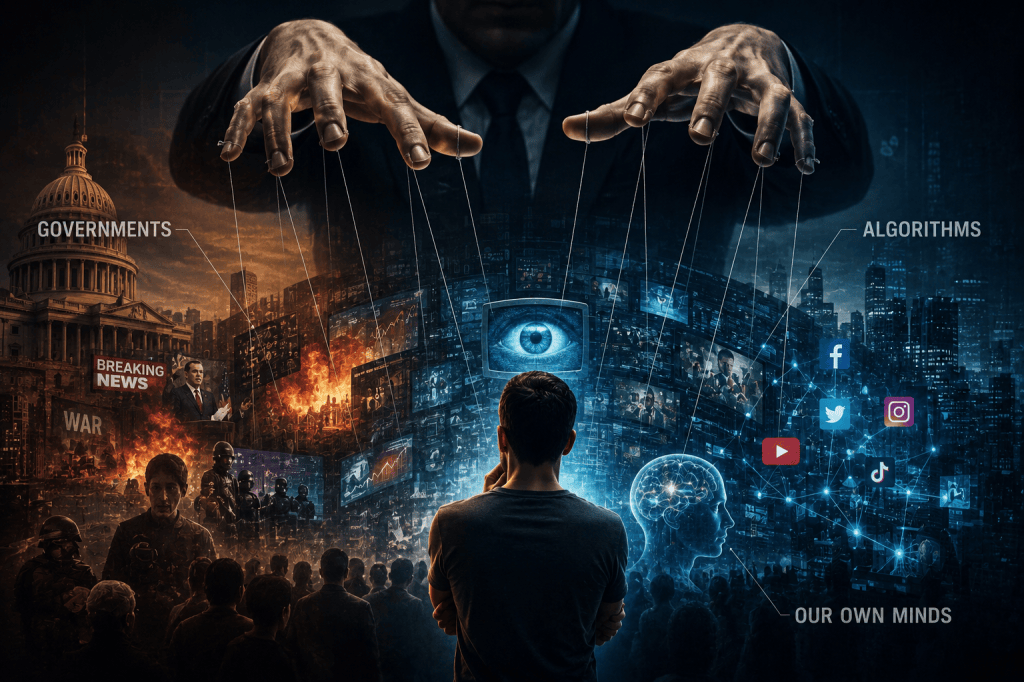
    Once that is understood, a second and more socially important question immediately follows: what happens when another system begins influencing the information from which the brain constructs its model?
    An algorithm does not need to alter physical reality in order to change what repeatedly reaches your attention.
    A government does not need to manufacture every event in order to determine which events dominate public discussion.
    Advertising does not need to transform an object’s material composition in order to change its psychological meaning.
    A news organization does not need to invent every fact in order to create a particular impression through selection and emphasis.
    A social-media feed does not need to persuade someone explicitly if it can repeatedly determine which fragments of reality that person encounters.
    The brain already builds experience from incomplete information.
    Control enough of the information and you may influence the construction.
    This does not mean that human beings are helpless puppets, nor does it require the existence of a hidden organization controlling everything from behind the scenes, because social reality is shaped by countless competing forces and people retain substantial capacity to compare evidence, seek alternative sources and reconsider beliefs.
    Nevertheless, the biological architecture of perception makes one conclusion unavoidable: there is always something between the world and our experience of it.
    Sometimes that intermediary is the retina.
    Sometimes it is memory.
    Sometimes it is expectation.
    Sometimes it is language.
    And increasingly, sometimes it is an algorithm.


    PERHAPS PLATO’S CAVE WAS MORE MODERN THAN IT APPEARED
    More than two thousand years before neuroscience could observe the living brain, Plato imagined prisoners who had spent their lives watching shadows projected onto the wall of a cave and naturally mistook those shadows for reality because they possessed no experience against which the images could be compared.
    The allegory was philosophical rather than neurological, yet it remains strangely powerful in the digital age because the central problem has survived: human beings construct their understanding of the world from whatever information is available to them, and they rarely experience the filtering process responsible for determining what became available.
    Modern citizens do not sit chained inside caves, but much of what they know about wars, distant countries, political leaders, scientific discoveries, financial crises and people they have never encountered arrives through screens, headlines, images and recommendation systems before being interpreted by a brain already equipped with expectations, memories and biases.
    The modern cave therefore does not need walls.
    It needs selection.


    THE MOST PERFECT ILLUSION WOULD NOT FEEL LIKE AN ILLUSION
    A badly constructed illusion exposes itself because something appears obviously wrong, whereas a perfectly constructed representation becomes almost impossible to distinguish from reality precisely because nothing about it feels artificial.
    This may be the most provocative lesson hidden inside ordinary perception.
    When the visual system compensates correctly for illumination, we do not marvel at the computation; we simply see a red apple.
    When audiovisual information is integrated successfully, we do not detect the fusion; we simply understand a sentence.
    When the blind spot is compensated for, we do not notice missing information; we simply see an uninterrupted scene.
    When eye movements are stabilized, we do not perceive the reconstruction; we simply experience a stationary world.
    When serial dependence reduces moment-to-moment noise, we do not notice that the recent past has influenced the present; we simply experience continuity.
    The machinery is invisible because it works.
    That is why perception feels direct even when the underlying biological processes demonstrate that it cannot be.


    SO, ARE WE LIVING IN AN ILLUSION?
    The most accurate answer is both less sensational and more unsettling than the phrase suggests, because there is no scientific reason to conclude that the physical universe surrounding us is merely an illusion, yet there is overwhelming reason to reject the naive assumption that consciousness receives an untouched copy of that universe.
    We inhabit an external physical world while simultaneously living inside a neural representation of that world.
    The representation is constrained by reality but shaped by biology.
    It is incomplete but remarkably useful.
    It can be corrected by evidence yet influenced by expectation.
    It provides stability while hiding enormous quantities of information.
    It creates colors from spectral relationships, sounds from vibrations, objects from changing visual fragments and continuity from sensory input that is considerably less continuous than experience suggests.
    Perhaps the most mysterious part of all this is not that the human brain sometimes makes mistakes, but that an organ weighing little more than a kilogram can transform electrical and chemical signals into sunsets, music, faces, fear, distance, movement and the profound subjective conviction that an entire world is unfolding immediately before us.
    The universe may exist independently of us, but the universe as we experience it cannot exist without the machinery that experiences it.
    And once we understand that distinction, the question behind Matrix becomes far more disturbing than the familiar science-fiction possibility that our universe might be running inside a computer, because the first Matrix may already be present inside every human skull: not as a sinister prison designed to deceive us, but as the biological interface without which reality could never become experience at all.
    The final question is therefore not whether the world around us is real, because everything we know suggests that there is indeed a world beyond our minds.
    The far more provocative question is this:
    How much of what you call reality belongs to the world itself, and how much belongs to the extraordinary machine interpreting it for you?


    SOURCES AND FURTHER READING
    Teufel, Christoph & Paul C. Fletcher, “Forms of Prediction in the Nervous System,” Nature Reviews Neuroscience (2020) — an important review of how prior information and prediction can participate in perception and neural processing.
    Witzel, Christoph & Karl R. Gegenfurtner, “Color Perception: Objects, Constancy, and Categories,” Annual Review of Vision Science (2018) — a comprehensive review of color constancy, object color and the relationship between physical light and perceived color.
    Lafer-Sousa, Rosa, Katherine L. Hermann & Bevil R. Conway, “Striking Individual Differences in Color Perception Uncovered by ‘The Dress’ Photograph,” Current Biology (2015) — experimental evidence examining why observers genuinely perceived very different colors in the famous photograph.
    Komatsu, Hidehiko, “The Neural Mechanisms of Perceptual Filling-In,” Nature Reviews Neuroscience (2006) — a review of the neural processes involved when perception supplies visual information in regions where corresponding physical information is absent.
    Simons, Daniel J. & Ronald A. Rensink, “Change Blindness,” Trends in Cognitive Sciences (1997) — the classic review examining our surprising inability to notice substantial changes to visual scenes under particular conditions.
    Yarrow, Kielan et al., “Illusory Perceptions of Space and Time Preserve Cross-Saccadic Perceptual Continuity,” Nature (2001) — experimental research on chronostasis and the famous stopped-clock illusion.
    Cicchini, Guido Marco, Kyriaki Mikellidou & David Burr, “Serial Dependence in Perception,” Annual Review of Psychology (2024) — a modern review of how previous perceptual experience can influence what is perceived moments later.
    Manassi, Mauro & David Whitney, “Continuity Fields Enhance Visual Perception Through Positive Serial Dependence,” Nature Reviews Psychology (2024) — an exploration of how serial dependence may contribute to stable and efficient perception.

    Thank you for subscribing!

    Please check your email to confirming your subscription.

  • AI AND MKULTRA: FROM CHEMICAL MIND CONTROL TO ALGORITHMIC INFLUENCE

    There was a time when the suggestion that an intelligence agency might secretly experiment on human beings in an attempt to understand, disrupt or manipulate the mind sounded like the raw material of paranoid fiction, yet during the Cold War the United States Central Intelligence Agency created a research program whose surviving records would eventually reveal experiments involving psychoactive drugs, hypnosis, behavioral modification and unsuspecting human subjects, leaving behind one of the most disturbing questions in modern history: how far will institutions go when they become convinced that understanding the human mind is a matter of national security?
    More than seventy years later, the laboratories have changed almost beyond recognition, because the glass of LSD, the hidden safe house and the psychiatrist observing a confused patient through a one-way mirror belong to another technological age, while billions of people now spend hours every day inside digital environments where invisible systems decide which stories rise to the top of a screen, which disappear beneath thousands of others, which emotions receive the greatest amplification and which message appears at precisely the moment when a particular person may be most receptive to it.
    There is no credible evidence that artificial intelligence, social-media algorithms or today’s technology companies represent a secret continuation of MKUltra, and treating that claim as established fact would reduce a fascinating historical comparison to another conspiracy theory, but the absence of such a connection does not make the comparison meaningless, because MKUltra and the algorithmic age are separated by completely different technologies while remaining connected by a question that has never entirely disappeared: if human perception can be altered by changing what reaches the mind, how much influence can be exercised before the person being influenced realizes that anything unusual is happening at all?


    THE COLD WAR SEARCH FOR A DOORWAY INTO THE HUMAN MIND
    Project MKUltra emerged during an atmosphere of intense Cold War anxiety in which American intelligence officials feared that communist governments might have discovered sophisticated methods of interrogation, psychological conditioning or so-called brainwashing, and the possibility that Soviet or Chinese researchers possessed techniques capable of breaking resistance encouraged U.S. agencies to investigate drugs, hypnosis and other methods that might reveal whether human behavior could be deliberately modified.
    What began in 1953 was not one neatly organized experiment but a sprawling collection of projects that reached into universities, hospitals, research foundations and other institutions, often through funding arrangements designed to obscure the CIA’s involvement, while many researchers involved in individual studies apparently did not know who ultimately stood behind the money. When previously overlooked financial records were discovered during the 1970s, the U.S. Senate investigation identified 149 MKUltra subprojects, along with 185 nongovernmental researchers and assistants and 80 institutions associated with the recovered material, while the documents themselves referred to research involving behavioral modification, drug acquisition, human testing and the surreptitious administration of drugs.
    The numbers alone make the program remarkable, but they do not explain why MKUltra became so deeply embedded in modern conspiracy culture, because what transformed it from an obscure intelligence project into something almost legendary was the discovery that at least some people had become experimental subjects without knowing they were participating in an experiment at all.
    During the 1977 Senate hearings, CIA Director Stansfield Turner acknowledged evidence supporting unwitting testing in several of the recovered MKUltra subprojects, while testimony concerning CIA safe houses described individuals encountered in bars and subsequently brought to locations where drugs could be tested under covert observation; the surviving records were incomplete, and witnesses repeatedly warned senators not to infer more than the documentation could prove, yet the central fact was no longer disputable, because the CIA had conducted experiments in which unsuspecting people were exposed to drugs while their reactions were observed.


    WHEN LSD BECAME AN INTELLIGENCE TOOL
    Among the many substances explored during this period, LSD occupied a special place in the imagination of intelligence researchers because its ability to profoundly alter perception, emotion and a person’s sense of reality suggested possibilities that seemed extraordinary in an age obsessed with interrogation and psychological warfare, particularly if a chemical could produce confusion, weaken resistance or temporarily destabilize someone’s confidence in his own senses.
    The disturbing element was not simply that LSD was studied, because the substance was also the subject of legitimate psychiatric and scientific interest during the same era, but that the CIA wanted to understand what happened when a person received such a drug without knowing that it had been administered, a requirement that transformed some experiments from questionable research into profound violations of informed consent.
    The notorious CIA safe-house operations later associated with the name Operation Midnight Climax grew from this logic, because the agency wanted environments in which unwitting subjects could be observed while remaining unaware that anything resembling a government experiment was taking place, and testimony before the Senate described safe houses equipped for covert observation, including references to two-way mirrors and individuals brought in after contacts made in social settings. Although decades of retelling have added sensational claims that are not always supported by surviving documents, the official hearing record itself confirms enough to make embellishment unnecessary.
    The real horror of MKUltra therefore lies less in the mythology of a perfect mind-control drug, which the program never produced, than in a much more believable and historically documented process through which researchers gradually accepted the idea that the mind of another human being could become an experimental territory without that person’s knowledge.


    FRANK OLSON AND THE EXPERIMENT THAT ENDED IN A HOTEL WINDOW
    No episode illustrates the danger of that philosophy more powerfully than the death of Frank Olson, a U.S. Army scientist who worked in biological research and attended a gathering of Army and CIA personnel in November 1953, where LSD was secretly placed in a drink consumed by Olson and several other men as part of an experiment whose full purpose they had not been told in advance.
    According to the congressional record, colleagues described Olson before the experiment as professionally respected and apparently psychologically normal, yet after receiving LSD he became increasingly distressed, agitated and troubled, eventually requiring medical attention and traveling to New York with CIA-associated personnel for consultations with Harold Abramson, a physician experienced with LSD whose research had received indirect CIA support.
    During the early hours of November 28, after days of psychological turmoil, Olson went through the closed window of a tenth-floor room at New York’s Statler Hotel and fell to his death, while the CIA subsequently concealed important circumstances surrounding the experiment from his family and attempted to prevent the death from becoming connected publicly with the agency. The Senate investigation later reconstructed much of this sequence from internal memoranda and testimony, although arguments over whether Olson died by suicide or under more sinister circumstances continued for decades and produced theories that extend beyond what the surviving evidence can firmly establish.
    The case remains chilling precisely because one does not need to accept the most dramatic later theories to understand its significance, since the documented sequence is extraordinary enough: a scientist was unknowingly given a powerful hallucinogen during an intelligence experiment, his psychological condition deteriorated severely, and eight days later he was dead.


    DONALD EWEN CAMERON AND THE ATTEMPT TO BREAK PERSONALITY BEFORE REBUILDING IT
    If Frank Olson’s story reveals what could happen when an unsuspecting person encountered a psychoactive drug, the experiments associated with psychiatrist Donald Ewen Cameron at Montreal’s Allan Memorial Institute reveal an even more ambitious idea, because Cameron became interested in treatments intended to disrupt existing patterns of thought before attempting to construct new psychological responses.
    McGill University’s archival record describes the Montreal experiments conducted at the Allan Memorial Institute between 1957 and 1964 and identifies methods including “psychic driving,” drug-induced sleep, electroconvulsive therapy and sensory deprivation, while also confirming that the work received CIA funding as part of MKUltra.
    Cameron’s concept of psychic driving involved repeated recorded messages intended to influence patients after existing psychological patterns had been weakened through other intensive treatments, and although the work was presented within a psychiatric framework rather than as a cinematic attempt to create obedient agents, its connection with CIA behavioral research transformed it into one of the darkest chapters associated with MKUltra, particularly because many of the people subjected to these procedures were already vulnerable psychiatric patients who could not have understood the intelligence context surrounding the funding.
    The significance of Cameron’s work extends beyond the specific techniques used, because it demonstrates how the search for influence could move from drugs toward something conceptually broader: the attempt to alter the informational and psychological environment surrounding a human being until ordinary patterns of perception and response began to change.


    THE FILES THAT VANISHED AND THE MYSTERY THEY LEFT BEHIND
    Much of what the public now knows about MKUltra survived almost by accident, because extensive program records were destroyed in 1973, while the financial files later uncovered had escaped destruction largely because they had been stored separately from material researchers initially searched for during earlier investigations. The Senate hearing noted that the newly discovered folders were primarily financial records containing vouchers, approvals and accounting documents rather than complete operational reports, which meant investigators could reconstruct the scope of many projects without recovering every detail of what had occurred.
    This destruction created the perfect environment for mythmaking, because whenever documents disappear from a secret intelligence program, the missing pages can become more powerful in the public imagination than the pages that survived, allowing almost any later theory to be projected into the gaps.
    Yet those gaps should not tempt us to confuse possibility with evidence, because the strongest way to understand MKUltra is not to enlarge it into a universal explanation for every alleged mind-control story but to recognize that the documented history is already unsettling enough: institutions with enormous resources genuinely studied behavioral modification, secretly administered drugs to some people, concealed sponsorship of research and later destroyed significant portions of the record.


    WHEN THE LABORATORY MOVED FROM THE HOSPITAL TO THE SCREEN
    The modern world appears completely different until we examine what digital systems actually do, because social-media platforms and recommendation engines continuously alter the informational environment surrounding their users, selecting some material for visibility while allowing other material to disappear almost entirely, then measuring the behavioral consequences through clicks, pauses, shares, comments, watch time and countless other signals.
    Unlike MKUltra, this process generally has no secret intelligence officer slipping chemicals into a drink and no researcher attempting to erase personality, yet it possesses one capability Cold War experimenters could scarcely have imagined: the possibility of observing the reactions of millions of people simultaneously while changing what different groups see.
    A user might assume that scrolling is a passive activity, but every decision provides information from which a system can learn, because the video watched twice may reveal more than the video liked once, the article abandoned after five seconds says something different from the article read to the end, and the content that provokes anger, fascination or fear can become statistically distinguishable from material that produces indifference.
    This does not mean that an algorithm understands the human mind as a psychologist would, because it may have no concept of fear, ambition, loneliness or political identity in any human sense, yet it can still become increasingly effective at predicting which stimulus is likely to produce which response.
    At that point, the difference between predicting behavior and shaping the environment in which behavior occurs becomes surprisingly difficult to define.


    THE FACEBOOK EXPERIMENT THAT ALTERED 689,003 NEWS FEEDS
    One of the clearest demonstrations of this new experimental scale appeared in 2014, when researchers published the results of a Facebook study involving 689,003 users, whose News Feeds had been altered during one week in 2012 so that some participants encountered less positive emotional content while others encountered less negative emotional content.
    The researchers then measured the emotional language those users subsequently produced in their own posts and found small but statistically detectable changes corresponding to the emotional material they had been exposed to, providing experimental evidence that adjusting the emotional environment of a social-media feed could alter subsequent emotional expression even without direct face-to-face interaction.
    The effect itself was modest, and the experiment certainly did not demonstrate that Facebook could remotely control people’s emotions, but the ethical controversy surrounding the study revealed something historically interesting, because most participants had no ordinary understanding that their information environment had been altered for a psychological experiment.
    The comparison with MKUltra must remain proportionate, since reducing positive posts in a News Feed is obviously not equivalent to secretly administering LSD, yet the underlying question feels strangely familiar: what does informed consent mean when the subject does not know that the environment itself has been experimentally modified?


    CAMBRIDGE ANALYTICA AND THE VALUE OF KNOWING WHAT A PERSON IS LIKE
    The Cambridge Analytica scandal added another element to the emerging picture by demonstrating how apparently trivial digital behavior could be transformed into psychological profiles intended for political targeting, because according to the U.S. Federal Trade Commission, data collected through Aleksandr Kogan’s Facebook application was used to generate personality scores that were subsequently matched with American voter records for profiling and targeted advertising.
    The FTC alleged that the application collected information from hundreds of thousands of direct users and tens of millions of their Facebook friends, many of whom never interacted with the application themselves, while Cambridge Analytica sought to use Facebook information to predict personality traits and provide voter profiling and microtargeting services.
    Claims about Cambridge Analytica’s actual power were sometimes exaggerated after the scandal became famous, and there is no convincing evidence that its psychological profiling gave it a magical ability to determine election outcomes, but the larger lesson was difficult to dismiss: information that appears meaningless when considered individually can become extremely valuable when combined across millions of observations.
    A political consultant no longer needed to ask a voter directly what frightened, motivated or angered that person if enough behavioral data could be analyzed to make a useful prediction.


    THE ALGORITHM DOES NOT NEED TO TELL YOU WHAT TO BELIEVE
    The most powerful form of algorithmic influence may therefore have little resemblance to direct persuasion, because a system does not necessarily need to convince someone that the world is dangerous if it can repeatedly show that person dangerous events until danger begins to feel omnipresent.
    If stories about violent crime hold a user’s attention longer than stories about declining crime statistics, the algorithm may gradually provide more robberies, assaults and frightening footage without ever making the explicit statement that society is collapsing, while the person exposed to that stream of information may slowly develop a perception of the world based not on everything that exists but on everything the system has learned will keep that particular person watching.
    The same mechanism can operate around politics, immigration, war, health, conspiracy theories or social conflict, because algorithms optimized for engagement do not necessarily require ideological intentions when emotionally charged material happens to perform better than calm explanation.
    This creates an unsettling possibility in which nobody needs to sit inside a secret control room instructing the machine to amplify fear, anger or division, because those characteristics can emerge simply because they generate measurable reactions.


    THE 2026 X EXPERIMENT: WHAT HAPPENS WHEN THE FEED CHANGES?
    In February 2026, researchers publishing in Nature reported a seven-week field experiment involving active U.S. users of X who were randomly assigned to experience either an algorithmic feed or a chronological one, providing unusually direct evidence about what can happen when the mechanism selecting information is altered.
    Among participants who moved from a chronological feed to X’s algorithmic feed, the researchers observed increased engagement as well as measurable shifts toward more conservative positions on certain policy priorities, perceptions of criminal investigations involving Donald Trump and views concerning the war in Ukraine, while users exposed to the algorithmic feed also became more likely to follow conservative political activist accounts that could continue shaping their information environment afterward. The authors emphasized important limitations, including the fact that the findings concerned one platform during one specific period and did not demonstrate comparable effects on partisanship or every political attitude, but their broader conclusion was difficult to ignore: under some real-world conditions, changing the algorithm that chooses what people see can causally influence both online behavior and political opinion.
    A separate Nature study published later in 2026, involving approximately 2,000 participants using experimentally controlled feeds around the 2024 U.S. presidential election, found that engagement-based ranking amplified intergroup, moralized and emotional information and affected perceptions surrounding partisan hostility, reinforcing the idea that algorithms can alter not only which opinions become visible but also the emotional atmosphere through which people interpret the behavior of others.
    This distinction matters enormously because influence does not always require changing what someone believes directly; sometimes changing what that person believes everyone else believes can reshape the social reality in which future decisions are made.


    ARTIFICIAL INTELLIGENCE ADDS SOMETHING THE OLD ALGORITHMS COULD NOT DO
    Recommendation systems primarily decide which existing messages people encounter, while generative artificial intelligence introduces another possibility because an advanced language model can create the persuasive message itself, adapting arguments, vocabulary and tone with a speed that human persuaders could never reproduce at comparable scale.
    A 2025 study published in Nature Communications, based on three preregistered experiments involving 4,829 participants, found that people exposed to persuasive messages generated by large language models showed measurable shifts in their attitudes toward several public-policy questions compared with participants who received neutral messages, while the AI-generated persuasive material performed broadly similarly to messages produced by ordinary human writers. The effects were not enormous and did not demonstrate irresistible persuasion, yet the researchers emphasized an implication that becomes much more significant at scale: persuasive political messages can now be generated quickly, cheaply and in enormous quantities.
    The twentieth-century intelligence researcher dreamed of discovering a technique powerful enough to work on almost anyone, but artificial intelligence points toward a completely different model in which there may never need to be one universal persuasive formula, because a system could theoretically generate different messages for different psychological profiles and continuously adjust them according to how audiences respond.
    The old question was whether one could find the key to the human mind.
    The new question is whether millions of different keys can be manufactured automatically.


    MKULTRA AND AI ARE NOT THE SAME, WHICH IS EXACTLY WHY THE COMPARISON MATTERS
    It would be historically careless to describe social media or artificial intelligence as “MKUltra 2.0,” because MKUltra involved intelligence agencies, covert experimentation, psychoactive drugs and profound violations of consent that belong to a very specific historical context, while contemporary algorithms generally exist within commercial platforms whose primary purposes involve recommendation, advertising, communication and engagement.
    What makes the comparison meaningful is therefore not a secret institutional connection but a transformation in the philosophy of influence.
    MKUltra researchers explored whether the mind could be disrupted from the outside through chemical and psychological intervention, while modern digital systems increasingly learn by observing the mind indirectly through behavior, accumulating patterns until they can predict which information is most likely to attract, frighten, persuade or retain a particular person.
    One approach attempted to penetrate the mind by force.
    The other can surround the mind with a customized information environment.
    One searched for the perfect chemical.
    The other searches continuously for the next piece of content most likely to produce a measurable response.


    THE MOST DISTURBING POSSIBILITY MAY BE THAT THERE IS NO MASTER CONTROLLER
    Conspiracy theories often imagine control as something centralized, intentional and secret, with a small group sitting behind a curtain and directing the thoughts of millions, yet algorithmic systems introduce a stranger possibility because harmful patterns can emerge even when nobody has deliberately designed the final outcome.
    If a platform rewards engagement and the system discovers through billions of interactions that anger keeps users present longer than calm discussion, sensationalism spreads faster than careful uncertainty and frightening claims generate more comments than reassuring explanations, the algorithm can amplify precisely those characteristics without possessing a political ideology, a psychological theory or any conscious desire to manipulate society.
    This is why asking only “Who controls the algorithm?” may miss the more important question, because the answer may sometimes be less revealing than asking “What is the algorithm being rewarded for?”
    A system optimized for attention does not need to hate, deceive or believe anything in order to learn that particular emotional reactions are profitable.


    FROM THE GLASS OF LSD TO THE GLOWING SCREEN
    Frank Olson consumed a drink in 1953 without knowing that a chemical experiment was about to alter his experience of reality, while patients in Montreal entered psychiatric treatment without understanding the full intelligence context surrounding research that would later become connected publicly with MKUltra, and the surviving documents eventually revealed a world in which the pursuit of behavioral knowledge had crossed boundaries that now seem almost impossible to defend.
    The twenty-first century presents a profoundly different world in which most people voluntarily carry the experimental environment with them, willingly return to it dozens of times every day and continuously provide the behavioral signals from which increasingly sophisticated systems learn, yet voluntary participation does not automatically answer every ethical question when the mechanisms guiding attention remain largely invisible to those being guided.
    There is no LSD hidden inside the smartphone, no evidence that today’s AI companies secretly inherited MKUltra and no scientific basis for claiming that algorithms can transform human beings into programmable machines, but there is growing evidence that changing information feeds can influence emotional expression, alter perceptions, affect online behavior and, under certain conditions, shift political attitudes.
    Perhaps the Cold War researchers were therefore searching for something more dramatic than they needed when they imagined that control over the human mind would require a miraculous chemical or an irresistible psychological technique, because the more subtle form of influence may not involve taking control of the mind itself at all.
    It may be enough to control the sequence of reality placed in front of it.
    If one person repeatedly sees fear, another repeatedly sees outrage and a third repeatedly sees confirmation of everything he already believes, each may eventually inhabit a slightly different world while remaining convinced that the screen has merely shown reality as it exists.
    The laboratory has become invisible, the experiment may resemble ordinary life, and the person inside it does not necessarily feel controlled, manipulated or even observed.
    He simply opens the phone, begins to scroll, and waits to see what the algorithm has decided should exist next.


    SOURCES AND FURTHER READING
    The historical material concerning Project MKUltra, its recovered 149 subprojects, researchers, institutions, unwitting experiments, CIA safe houses, Frank Olson and the destruction of records is based primarily on the 1977 Joint Hearing of the U.S. Senate Select Committee on Intelligence and the Subcommittee on Health and Scientific Research.
    Information concerning Donald Ewen Cameron and the Montreal experiments is supported by the McGill University Archival Collections, which document the Allan Memorial Institute experiments and their relationship with CIA-funded MKUltra research.
    The Facebook emotional-contagion experiment is documented in the peer-reviewed 2014 study “Experimental Evidence of Massive-Scale Emotional Contagion Through Social Networks,” involving 689,003 users.
    Information concerning Cambridge Analytica’s Facebook data collection, personality profiling and political targeting is based on findings published by the U.S. Federal Trade Commission.
    The modern discussion of algorithmic influence draws on the 2026 Nature studies examining X’s feed algorithm and engagement-based social-media ranking.
    The discussion of AI-generated persuasion is based on the 2025 Nature Communications study “LLM-generated messages can persuade humans on policy issues,” involving 4,829 participants across three preregistered experiments.

    Fediverse Reactions
  • MKUltra: The CIA’s Secret Experiments on the Human Mind

    LSD, Hypnosis, Secret Rooms and the Cold War Search for Mind Control


    On the evening of November 19, 1953, a group of American scientists and intelligence officials gathered at a retreat in Maryland, where dinner, conversation and drinks should have made the meeting indistinguishable from countless other professional gatherings taking place during the early years of the Cold War. Among the men present was Frank Olson, a 43-year-old biochemist working with the U.S. Army at Fort Detrick, one of the most sensitive centers of American biological warfare research, who had no reason to suspect that the glass placed before him had transformed him from scientist into experimental subject.
    CIA personnel had secretly put LSD into drinks consumed by Olson and several of his colleagues, and only after approximately twenty minutes were the men informed that they had been drugged. During the following days Olson became profoundly distressed, was taken to New York for psychiatric attention and, early on November 28, fell from the tenth-floor window of the Hotel Statler, dying on the pavement below. His death would officially be treated as suicide, although members of his family would later challenge that explanation and raise questions that remain controversial; what is not controversial, because the government itself eventually acknowledged it, is that Olson had been given LSD without knowing what he was taking shortly before his psychological collapse.
    For more than twenty years, Olson’s family did not know the true circumstances surrounding the experiment, while the larger program of which it formed a part remained almost completely hidden from the American public. When congressional investigations finally forced portions of the story into daylight during the 1970s, what emerged sounded disturbingly similar to the kind of tale that might previously have been dismissed as paranoid fiction: the CIA had financed experiments involving psychoactive drugs, hypnosis, sensory manipulation and behavioral modification; some subjects knew they were participating in research, while others did not; universities, hospitals, prisons and private organizations had become connected to the program; and much of the original documentation had already been deliberately destroyed.
    The program was called MKUltra, and although decades of popular culture have surrounded that name with stories of programmable assassins, celebrity mind control and mysterious trigger words, the documented history is sufficiently unsettling without adding anything that cannot be proved.


    THE COLD WAR FEAR THAT SOMEONE HAD DISCOVERED HOW TO CONTROL THE MIND
    To understand why American intelligence officials became interested in something as extraordinary as behavioral control, it is necessary to return to the psychological atmosphere of the early Cold War, when Washington was not merely afraid that the Soviet Union and Communist China possessed superior weapons, but increasingly feared that they might have discovered techniques capable of breaking, conditioning or reprogramming human beings.
    Reports of political confessions in Communist countries, combined with the behavior of some American prisoners during and after the Korean War, helped popularize the idea of “brainwashing,” a term that quickly escaped intelligence circles and entered the public imagination. To people watching from the West, the possibility that prisoners could apparently be transformed into supporters of their captors suggested that an invisible weapon might already exist, one capable of bypassing ordinary military defenses because its battlefield was the human personality itself.
    The CIA had begun investigating related questions before MKUltra through programs including BLUEBIRD, approved in 1950, and ARTICHOKE, which followed it. According to records later examined by the U.S. Senate, these projects explored defensive questions such as protecting American personnel from hostile interrogation, but they also examined whether drugs, hypnosis and unconventional interrogation techniques might be used offensively to influence individuals or extract information.
    The atmosphere surrounding these programs is captured remarkably well by CIA Director Allen Dulles himself, who delivered a public speech entitled “Brain Warfare” in April 1953, describing Communist methods of psychological manipulation as a new frontier of conflict. Only days later, on April 13, 1953, Dulles approved the project that would become MKUltra, granting the Agency’s Technical Services personnel unusually broad freedom to investigate chemical and behavioral methods that might someday have intelligence applications. Surviving CIA financial documents explicitly trace the authority for MKUltra subprojects back to that April 13 authorization.
    The crucial point is not that the CIA knew how to control a human mind in 1953, because there is no evidence that it did, but rather that intelligence officials were frightened enough by the possibility that their enemies might know how to do it that they were prepared to conduct an extraordinary search for the answer themselves.


    MKULTRA WAS NOT ONE EXPERIMENT BUT A SECRET NETWORK
    The popular image of MKUltra tends to involve a hidden laboratory, a scientist with a syringe and a prisoner strapped to a chair, yet the reality was far more diffuse and therefore, in some respects, more disturbing. MKUltra functioned as an umbrella beneath which numerous research projects could be financed, often through intermediary organizations that concealed the CIA’s role from institutions, researchers or participants.
    When surviving records were examined in 1977, CIA Director Stansfield Turner informed the Senate that investigators had identified 149 MKUltra subprojects. The surviving material connected the program to dozens of universities, research foundations, hospitals, clinics and other institutions, while some projects involved drugs and human experimentation, some concerned hypnosis or behavioral research, and others dealt with subjects only indirectly related to what popular culture would later call “mind control.”
    This structure provided an enormous practical advantage: a researcher studying memory, sleep, hypnosis or the effects of a drug did not necessarily need to be introduced to a CIA officer and informed that the Agency was interested in his results. Funding could pass through foundations and intermediary organizations, allowing legitimate academic research, intelligence interests and secret sponsorship to exist within the same system without every participant understanding the complete arrangement.
    The surviving financial records show precisely why MKUltra became so difficult to reconstruct afterward, because there was no single laboratory in which everything happened and no single technique that defined the project. Instead, fragments of research were distributed through a network in which one institution might examine a drug, another might study hypnosis, another might investigate human responses to isolation, while intelligence officers attempted to determine whether any of those discoveries could become useful in interrogation, espionage or clandestine operations.


    LSD AND THE DREAM OF A CHEMICAL KEY TO THE HUMAN PERSONALITY
    Of all the substances examined during the program, none would become more notorious than LSD-25, which in the early 1950s was still sufficiently new and poorly understood that its extraordinary effects immediately attracted intelligence interest. Long before LSD became associated with psychedelic music and the counterculture, CIA researchers were asking whether a chemical capable of dramatically altering perception might become a tool for interrogation, confusion, disorientation or covert manipulation.
    The possibilities must have appeared almost limitless. A person under the influence of LSD could experience distortions in time, perception and identity, profound emotional changes and unpredictable reactions to his surroundings, which led researchers to wonder whether the drug could weaken resistance during interrogation, produce amnesia, expose secrets or temporarily incapacitate a target without the obvious violence associated with conventional methods.
    The problem was that LSD was anything but predictable, and the broader search for a chemical “truth serum” repeatedly collided with an uncomfortable scientific reality: lowering inhibitions is not the same as producing truth. A confused or intoxicated subject might speak more freely while also exaggerating, fantasizing, misremembering or inventing information, making the dream of a dependable chemical key to another person’s mind much easier to imagine than to achieve. The Senate’s investigation into CIA chemical and behavioral programs would later emphasize precisely this difficulty.
    Nevertheless, testing expanded beyond volunteers, because intelligence officers eventually confronted an operational dilemma that produced one of MKUltra’s most serious ethical violations. If a drug were ever going to be secretly administered to an enemy agent, testing it only on volunteers who knew that they had taken a psychoactive substance could not reveal how an unsuspecting person would behave.
    That reasoning created the justification for unwitting experimentation.
    Documents surviving in the CIA archive contain proposals explicitly discussing the possibility of administering LSD without subjects knowing that they were participating in such an experiment, while the later Senate investigation confirmed that unwitting testing did occur.
    The experiment had escaped the laboratory, because the unsuspecting citizen was now considered scientifically useful precisely because he did not know he was an experiment.


    OPERATION MIDNIGHT CLIMAX AND THE ROOMS BEHIND THE MIRROR
    Among the strangest chapters in MKUltra were the CIA-supported safe houses established in San Francisco and later New York, where agents could observe the effects of drugs on people in comparatively natural social circumstances rather than inside laboratories.
    The San Francisco operation became popularly known as Operation Midnight Climax, and its methods seem almost designed for a spy novel. Men were brought into apartments where prostitutes working with the operation could help create situations in which subjects relaxed their normal defenses, after which drugs could be administered without their knowledge while observers watched what happened from behind one-way mirrors.
    The 1977 Senate hearings established that unwitting testing took place in safe houses in San Francisco and New York, with CIA officials later required to provide Congress with information about the people associated with those locations. The same investigation exposed how poorly controlled some of these experiments could be, particularly because subjects might disappear into the city after leaving the apartment, making any meaningful medical follow-up exceedingly difficult.
    The scientific weakness of the system is almost as astonishing as its ethical implications. A genuine clinical experiment normally attempts to control variables, record dosages precisely, monitor subjects and observe long-term consequences, yet here people could be secretly drugged inside apartments while intelligence officers attempted to evaluate their behavior from another room, sometimes without the kind of systematic follow-up that would have been expected in responsible medical research.
    The safe houses illustrate something essential about MKUltra, because the goal was not merely to understand what LSD did inside a laboratory but to discover what might happen if a substance were covertly introduced into an ordinary human situation, where the subject possessed no warning that reality itself was about to become unreliable.


    HYPNOSIS, AMNESIA AND THE SEARCH FOR THE “MANCHURIAN CANDIDATE”
    Drugs were only one road into the mind, and surviving MKUltra records show that the CIA also funded research involving hypnosis, including projects examining combinations of hypnotic techniques and psychoactive substances.
    Here the questions became even more ambitious, because intelligence officers were interested in whether hypnosis could affect memory, increase suggestibility or help create behaviors that might later be activated without the subject consciously remembering how they had been established. Could an agent be made to forget information until it became necessary? Could a courier carry a secret that he could not consciously reveal? Could hypnosis combined with drugs create a deeper state of suggestibility than either technique alone?
    These possibilities would later become associated with the fictional “Manchurian Candidate,” the idea of a human being psychologically programmed to perform an action upon receiving a particular signal, yet the surviving evidence does not demonstrate that the CIA ever achieved anything remotely as reliable as the fictional version.
    Hypnosis itself varies dramatically between individuals, while extreme suggestibility is not equivalent to the deletion of free will, and the CIA’s willingness to investigate such possibilities must therefore be separated from evidence that those possibilities were successfully achieved. This distinction is particularly important with MKUltra, because the historical record proves that intelligence officials asked extraordinary questions but does not prove that they found the extraordinary answers later conspiracy theories attribute to them.


    DONALD EWEN CAMERON AND THE MONTREAL EXPERIMENTS
    If the safe houses represented MKUltra’s shadowy world of drugs and clandestine observation, the experiments associated with psychiatrist Donald Ewen Cameron at Montreal’s Allan Memorial Institute revealed another path toward behavioral transformation, one involving repeated messages, sensory restriction, prolonged sleep and unusually intensive electroconvulsive treatment.
    Cameron was not an obscure underground doctor but one of the most prominent psychiatrists of his era, having served in senior professional positions and participated in psychiatric evaluation connected with the Nuremberg Trials. He had developed theories about treating severe psychiatric illness before CIA money entered the picture, which makes his relationship with MKUltra considerably more complex than the popular story of a scientist simply receiving orders from intelligence officers. Modern historical research indicates that Cameron was probably unaware that some of his funding ultimately came from the CIA, because the money was routed through a front organization known as the Society for the Investigation of Human Ecology.
    His CIA-supported research became MKUltra Subproject 68, and surviving Agency documentation describes an astonishing program involving the repeated presentation of verbal signals, partial sensory isolation, prolonged sleep and drugs including LSD-25. One CIA record describes repeated verbal messages being delivered for as long as sixteen hours a day over several days, followed by continuous sleep lasting seven to ten days, while another surviving assessment identifies Cameron himself as an unwitting participant regarding the true source of the funding.
    Cameron called one technique “psychic driving,” in which patients repeatedly heard recorded statements, sometimes their own emotionally charged words and sometimes messages prepared by researchers. His broader concept of “depatterning” attempted to disrupt existing patterns of behavior before rebuilding healthier ones, but the procedures could involve extraordinarily intensive electroconvulsive therapy and powerful combinations of drugs, while historical accounts describe patients suffering serious and lasting consequences.
    One of the strangest details involved the repetition itself. Rather than hearing a therapeutic message once during a conversation with a psychiatrist, patients could be exposed to recorded statements for hour after hour, sometimes through speakers placed near them while they remained isolated from normal sensory stimulation, as though personality might somehow be dismantled into silence and then reconstructed by filling that silence with carefully selected words.
    Whatever Cameron believed he was attempting therapeutically, the CIA saw obvious intelligence implications in research investigating whether existing behavioral patterns could be disrupted and whether repeated signals might encourage new ones, which explains why his work attracted the attention of an organization searching for methods of psychological influence.
    The experiments also reveal how misleading the simple image of “CIA scientists” can be, because secret programs may operate through people who possess only part of the picture. Cameron knew what he was doing to his patients, but the available evidence suggests that he probably did not know who ultimately stood behind part of the financial support; other researchers knew they were cooperating with the Agency, while institutions sometimes knew considerably less.
    Secrecy functioned not merely by hiding information from the public, but by dividing information among the participants themselves.


    THE DEATH OF FRANK OLSON AND THE PRICE OF UNWITTING EXPERIMENTATION
    Frank Olson’s death remains the most famous human tragedy associated with the CIA’s LSD experiments because it demonstrates how quickly a secret test could produce consequences that no laboratory protocol could reverse.
    What happened inside Olson’s mind after the drug was administered cannot now be reconstructed with certainty, and later theories alleging that he was murdered remain disputed. The documentary record does, however, establish that he was secretly given LSD, that he experienced severe psychological disturbance afterward and that he died after falling from a New York hotel window several days later. CIA records subsequently criticized the judgment involved in the experiment, while the Rockefeller Commission’s investigation in the 1970s finally brought the secret dosing to public attention.
    The case forced a particularly disturbing ethical question into view: even if an intelligence agency believed that covert drugging had national-security value, how could an unsuspecting person’s reaction possibly be controlled once the substance had been administered?
    A volunteer in a legitimate psychedelic experiment knows that unusual sensations may result from a drug and normally has medical personnel available to provide reassurance if the experience becomes frightening, whereas an unwitting subject may believe that his perceptions, thoughts or identity are disintegrating for reasons he cannot understand.
    The absence of informed consent was therefore not merely an abstract ethical violation; it changed the psychological experience of the drug itself.


    IN 1973, THE FILES BEGAN TO DISAPPEAR
    MKUltra would probably be easier to understand today if historians possessed its complete operational archive, but in January 1973, most of the program’s records were deliberately destroyed.
    A later CIA Inspector General investigation found documentation indicating that Sidney Gottlieb had ordered the destruction of MKUltra files after receiving instructions from outgoing CIA Director Richard Helms. Records retrieved from archives as well as branch files were destroyed, while the Senate’s later investigation regarded the destruction as a striking example of the failure of normal administrative controls surrounding the program.
    This act transformed MKUltra permanently, because from that moment historians would face an impossible problem: surviving evidence could prove that secret activities existed, but destroyed evidence could no longer reveal their complete boundaries.
    How many people were exposed without their consent, what precisely happened within every subproject, which experiments failed, which produced injuries, and how much individual institutions understood about their relationship with the CIA are questions that cannot always be answered because the records necessary to answer them no longer exist.
    Then bureaucracy performed one of history’s peculiar miracles.
    Financial records survived.
    In 1977, CIA personnel discovered boxes of previously overlooked MKUltra material containing funding and administrative records that had escaped the destruction, and because money had to be authorized, transferred and accounted for, these apparently mundane documents allowed investigators to reconstruct part of a project that had otherwise been deliberately erased. CIA records later described the discovery as providing the first detailed insight into the 149 subprojects.
    Invoices had remembered what secret files were supposed to forget.


    THE 1977 SENATE HEARING AND THE MOMENT THE CONSPIRACY BECAME HISTORY
    On August 3, 1977, the United States Senate held a public hearing formally titled Project MKULTRA, the CIA’s Program of Research in Behavioral Modification, during which senators examined the newly recovered documentation and questioned CIA Director Stansfield Turner about the scope of the program.
    The hearing established an extraordinary collection of facts: human testing had occurred, some subjects had not known they were participating, covert drug administration had taken place, safe houses had operated in American cities, intermediary funding mechanisms had concealed CIA sponsorship, and dozens of institutions had been connected with MKUltra activities.
    For anyone interested in the history of conspiracy theories, this moment is enormously important, because MKUltra illustrates why the word “conspiracy” cannot automatically be treated as synonymous with fantasy.
    Had someone in the early 1960s announced that American intelligence was secretly financing experiments involving LSD and hypnosis, administering drugs to unsuspecting people and studying behavioral manipulation through hidden networks of researchers, much of the story might have sounded absurdly paranoid.
    By 1977, portions of that extraordinary story were being discussed in the United States Senate using the CIA’s own records.


    DID THE CIA ACTUALLY LEARN HOW TO CONTROL THE HUMAN MIND?
    This is where the documented history of MKUltra and the mythology that surrounds it must finally separate.
    The surviving evidence shows that the CIA investigated techniques intended to influence behavior, manipulate perception, impair memory and increase vulnerability during interrogation, yet it does not demonstrate that the Agency discovered a reliable method capable of transforming ordinary human beings into obedient machines whose behavior could be activated on command.
    LSD was unpredictable rather than controllable, hypnosis depended heavily upon individual susceptibility and circumstances, truth drugs did not guarantee truthful answers, and some experiments were so poorly controlled that their scientific usefulness was questionable. The very existence of a research program demonstrates that researchers were searching for an answer, not that they possessed it.
    This difference becomes important whenever MKUltra is invoked today to explain claims about musicians supposedly programmed by intelligence agencies, celebrities controlled by trigger words, populations manipulated through hidden frequencies or assassins whose personalities have been deliberately replaced. MKUltra cannot serve as automatic evidence for those theories, because each new claim requires its own documentation.
    Yet dismissing every extraordinary allegation merely because it sounds conspiratorial would teach the opposite and equally dangerous lesson, because the history of MKUltra shows that powerful institutions really can conduct activities that initially sound improbable, particularly when secrecy, fear and national security combine.
    The rational response is therefore neither automatic belief nor automatic disbelief, but something far more demanding: follow the evidence until the evidence ends, and do not allow imagination to finish the story merely because the surviving archive leaves an empty space.


    WHY MKULTRA RETURNED TO CONGRESS IN 2026
    More than seven decades after the project began, MKUltra once again entered a congressional hearing room.
    On June 30, 2026, the U.S. House Task Force on the Declassification of Federal Secrets held a hearing titled “Mind Control and Accountability: Uncovering the Truth of the CIA’s MKULTRA Project,” with witnesses including author and researcher Stephen Kinzer, investigative journalist Tom O’Neill and former National Institutes of Health program director Elizabeth Ginexi. The hearing focused not upon proof of some newly discovered mind-control technology, but upon the history of the program, destruction and classification of records, government transparency and the enduring damage secrecy can cause to public trust.
    That such a hearing could occur in 2026 is itself remarkable, because very few secret programs launched in the early 1950s still possess enough unresolved historical power to bring witnesses before Congress more than seventy years later.
    The reason is not simply that MKUltra involved LSD or bizarre experiments, but that the destruction of records created a permanent asymmetry between what we know happened and what we may never know.


    THE REAL MYSTERY OF MKULTRA
    The most frightening version of MKUltra is not necessarily the one found in conspiracy videos, where human beings become programmable assassins and hidden commands activate personalities manufactured inside secret laboratories, because those claims require evidence that the surviving documents do not provide.
    The more unsettling story is the documented one, in which intelligent people working within respected institutions gradually crossed boundaries that should have been unmistakable because they believed that an enemy might already have crossed them first.
    Cold War fear produced a search for defensive knowledge; defensive knowledge created interest in offensive applications; legitimate research became intertwined with concealed intelligence funding; voluntary experimentation gave way in some cases to unwitting subjects; secrecy weakened accountability; and when the consequences threatened to become embarrassing, much of the historical record disappeared into destruction.
    No supernatural technology was necessary.
    There was only fear, institutional power, scientific ambition and the conviction that national security could justify actions that would have been indefensible under ordinary circumstances.
    Perhaps this is why MKUltra continues to disturb people long after LSD ceased to be a mysterious new substance and the Cold War that created the program disappeared. Its deepest lesson is not that the CIA discovered how to control the human mind, because the available evidence does not establish that it did, but that a government agency became willing to experiment upon human beings while searching for that possibility.
    The difference is enormous, although it is hardly comforting.
    When we encounter extraordinary claims today, MKUltra should therefore not teach us to believe everything that calls itself a hidden truth, because documented conspiracies do not magically authenticate unrelated theories. What it should teach us is to demand documents, dates, names, institutional records and independent evidence, while remembering that occasionally an apparently unbelievable story really does leave a paper trail.
    In the case of MKUltra, much of that paper trail was deliberately burned.
    Enough survived to change history.
    And perhaps the most haunting question is not what those surviving documents reveal, but what disappeared with the ones that did not.


    SOURCES AND FURTHER READING
    U.S. Senate Select Committee on Intelligence — Project MKULTRA, The CIA’s Program of Research in Behavioral Modification, August 3, 1977. The central congressional primary source covering MKUltra’s subprojects, unwitting human experimentation, drugs, hypnosis, safe houses and institutional relationships.
    Central Intelligence Agency Reading Room — MKULTRA declassified records. The surviving CIA archive contains financial records, individual subproject documents and later internal investigations concerning the program.
    CIA Inspector General records concerning destruction of drug and toxin files. These documents examine the January 1973 destruction of MKUltra records and the roles of Sidney Gottlieb and Richard Helms.
    Rockefeller Commission materials, Gerald R. Ford Presidential Library. Government records documenting the circumstances surrounding the secret administration of LSD to Frank Olson and the subsequent investigation.
    Jordan Torbay — “The Work of Donald Ewen Cameron: From Psychic Driving to MK Ultra,” History of Psychiatry, 2023. A detailed academic investigation of Cameron, the Montreal experiments, psychic driving, depatterning and the complicated relationship between his psychiatric work and covert CIA funding.
    CIA records concerning MKUltra Subproject 68. Surviving documentation identifies Donald Ewen Cameron and the Allan Memorial Institute and describes repeated verbal signals, LSD, sensory isolation and prolonged sleep used in the research.
    U.S. House Committee on Oversight and Government Reform — “Mind Control and Accountability: Uncovering the Truth of the CIA’s MKULTRA Project,” June 30, 2026. The recent congressional hearing revisiting MKUltra, declassification and government accountability.

    Thank you for subscribing!

    Please check your email to confirming your subscription.

  • Who Controls Reality: Governments, Algorithms — or Our Own Minds?

    There is an uncomfortable assumption hidden beneath almost everything we do: when we open our eyes in the morning, read the news, remember yesterday, form an opinion about another person, decide what frightens us, determine whom we trust, or convince ourselves that we have reached a conclusion independently, we usually assume that the reality inside our minds corresponds reasonably well to the reality outside them, even though neuroscience, psychology, history and the technological environment in which we now live suggest that this relationship is considerably more complicated than it appears.
    The modern fascination with the idea of a “Matrix” often leads us toward spectacular possibilities involving simulated universes, hidden programmers or artificial worlds, yet there may be a version of the Matrix that requires neither a supercomputer nor a secret civilization operating beyond the boundaries of our universe, because human beings have always experienced reality through filters, while governments, religions, political movements, commercial institutions, media organizations and, more recently, digital algorithms have learned how extraordinarily powerful those filters can become.
    What makes the problem especially difficult is that manipulation rarely works by replacing reality completely with an obvious lie, because human beings would probably reject such an intrusion rather quickly; instead, influence is usually more subtle, operating through selection, repetition, emphasis, emotional framing, omission and the ordering of information, so that the individual continues to feel free while gradually inhabiting a world in which certain events seem enormously important, others virtually disappear, some people appear constantly threatening, other people appear trustworthy, and particular interpretations become so familiar that they eventually feel less like interpretations and more like common sense.
    The unsettling question, therefore, is not simply whether someone is controlling reality, because reality itself may remain untouched, but whether someone can control enough of what reaches our attention to influence the version of reality that exists inside our minds.


    WE HAVE NEVER EXPERIENCED THE WORLD DIRECTLY
    Before governments, newspapers, television networks or social-media companies can influence perception, another system has already begun selecting reality for us, and that system is the human brain itself.
    The world surrounding us contains vastly more information than consciousness could possibly process simultaneously, which means that perception cannot operate like a perfect camera recording every detail before transmitting an objective copy to an inner observer; instead, the brain prioritizes some signals, ignores others, compares incoming information with previous experience, uses context to interpret ambiguity and continuously makes predictions about what is most likely to be present.
    Modern neuroscience increasingly treats prediction as an important part of perception, with research describing the brain not merely as a passive receiver of sensory information but as a system in which expectations, previous knowledge and incoming sensory evidence interact to produce the perceptual experience that eventually reaches awareness.
    This does not mean that we hallucinate the entire world or invent reality freely according to our wishes, because the external environment constrains perception continuously, but it does mean that what we consciously experience is already the result of interpretation, prioritization and reconstruction, rather than an untouched stream of objective information entering the mind.
    A 2026 perspective in Nature Reviews Neuroscience went even further in describing categorization as something embedded throughout neural processing rather than as a final intellectual label added after perception has occurred, suggesting that the brain begins organizing incoming information into meaningful categories remarkably early in the process by which experience is constructed.
    This matters because categories are never entirely innocent.
    Once something has been categorized as dangerous, trustworthy, foreign, familiar, beautiful, disgusting, normal, abnormal, successful or threatening, subsequent information is interpreted through that classification, while the category itself can become increasingly difficult to notice precisely because it begins to feel like a property of the external world rather than a framework supplied partly by the mind.
    The first architect of our Matrix, therefore, may not be a government or an algorithm at all, because long before anyone tries to manipulate us, our own nervous system has already reduced an unimaginably complicated universe into a manageable model.


    THE BRAIN DOES NOT SHOW US EVERYTHING — IT SHOWS US WHAT MATTERS
    At every moment, enormous amounts of visual, auditory and bodily information compete for limited processing resources, yet only a fraction of what reaches the senses becomes something we consciously notice, remember or use to guide behavior, which is why attention is not simply a spotlight illuminating a pre-existing complete picture but one of the mechanisms determining which parts of that picture become psychologically significant.
    Research on visual priority coding has emphasized precisely this problem, showing how perception is shaped by multiple forms of priority, including goals, salience, previous experience and behavioral relevance, while much of the available sensory environment remains outside conscious processing.
    This ordinary neurological fact has enormous social consequences, because whoever repeatedly captures attention does not need to manufacture an entirely fictitious universe; it may be sufficient to determine which fragments of the existing universe remain continuously visible.
    Imagine two people living on the same street, under the same government and during the same historical period, while one spends several hours each day consuming stories about crime, social collapse and political betrayal, whereas the other receives a continuous stream of technological breakthroughs, successful businesses, scientific discoveries and personal-development advice, and although neither feed necessarily contains fabricated information, the psychological worlds produced by those selections may eventually become profoundly different.
    Both people can sincerely insist that they are simply observing reality.
    Both may be correct about many of the individual facts they have encountered.
    Yet neither is seeing the whole.
    This difference between false information and selective reality is one of the most important distinctions in understanding modern influence, because a person does not need to be lied to in order to be manipulated; sometimes it is enough to show them accurate information in a particular proportion, sequence and emotional context until that selection begins to represent the world itself.


    GOVERNMENTS DISCOVERED THE POWER OF THE SELECTED WORLD LONG BEFORE ALGORITHMS EXISTED
    Political authorities have understood for centuries that controlling information can be almost as important as controlling territory, because armies may occupy cities, laws may regulate behavior and police forces may punish disobedience, yet stable power requires something more subtle: a believable explanation of why the existing order is necessary, legitimate or inevitable.
    Ancient rulers carved victories into stone while defeats disappeared from official monuments, imperial courts controlled access to information, religious and political authorities licensed certain forms of knowledge while restricting others, wartime governments censored military information and organized propaganda campaigns, and twentieth-century mass communication made it possible to coordinate narratives on a scale that earlier regimes could barely have imagined.
    The most effective propaganda was rarely limited to invented facts, because selection could be considerably more persuasive: one atrocity could be shown repeatedly while another remained invisible, one economic statistic could dominate public discussion while another received almost no attention, one enemy could be represented through its worst members while one’s own group was represented through its best ideals, and a complicated conflict could gradually be compressed into a morally satisfying story containing heroes, victims and villains.
    Under such conditions, the population does not necessarily need to be ordered what to think, because controlling what people repeatedly think about can already exert substantial influence over the boundaries within which opinions are formed.
    This insight is closely related to what communication scholars have long discussed through concepts such as agenda-setting and framing, in which the prominence, presentation and contextualization of information influence which issues people regard as important and how those issues are understood, even when audiences retain considerable freedom to disagree with the message itself.
    The old propaganda machine therefore operated by controlling scarcity, because information was difficult to produce and distribute widely, whereas the digital world has created the opposite problem: information is now so abundant that power increasingly lies not only in preventing information from appearing but in deciding which information rises from the ocean long enough to be seen.


    THE ALGORITHM DOES NOT HAVE TO HATE YOU, LOVE YOU OR UNDERSTAND YOU
    This is where modern algorithms become fundamentally different from the propaganda ministries of earlier centuries, because an algorithm does not require an ideology, personal intention or secret plan in order to alter the informational environment surrounding millions of people.
    A recommendation system can simply be optimized for objectives such as engagement, viewing time, relevance, retention, clicks or predicted user satisfaction, while the consequences emerge from the interaction between that objective and human psychology.
    If emotionally charged material keeps people watching longer, an engagement-driven system may learn to show more emotionally charged material without anybody programming the instruction “make people angry”; if content confirming someone’s existing interests receives stronger engagement, personalization can progressively concentrate similar material around that person without anyone issuing the instruction “build an echo chamber”; and if controversy generates replies, shares and prolonged attention, controversial material can acquire an evolutionary advantage within the information ecosystem simply because it performs well according to the platform’s chosen metric.
    The distinction matters enormously because it replaces the comforting image of a single villain controlling the machine with something more difficult to recognize: systems can produce powerful social consequences even when nobody explicitly intended every consequence they produce.
    The modern Matrix may therefore have no architect sitting behind a screen deciding precisely what each individual should believe, because the system can adapt automatically, testing millions of tiny predictions about what will keep people watching, clicking, reacting and returning.


    THE EXPERIMENTS ARE MORE COMPLICATED THAN THE POPULAR STORY
    It would be convenient to claim that scientists have already proven that social-media algorithms systematically brainwash users, but the evidence is considerably more complicated, and that complexity makes the subject far more interesting than the simplistic version.
    During the 2020 United States presidential election, researchers conducted large-scale experiments involving Facebook and Instagram users, including an experiment in which participants received reverse-chronological feeds instead of the platforms’ default algorithmically ranked feeds, and although changing the feed substantially altered what users encountered and how much time they spent on the platforms, researchers did not find significant corresponding changes in several major political attitudes during the study period.
    Another large Facebook experiment involving more than 23,000 participants reduced exposure to content from politically like-minded sources by roughly one-third and succeeded in changing the informational environment surrounding those users, including increasing exposure to cross-cutting sources, yet researchers again found no measurable effects across several preregistered political-attitude outcomes, including ideological extremity and affective polarization.
    If those studies had been the final word, one might reasonably conclude that algorithms change what people see without necessarily changing what people believe.
    Then another experiment complicated the picture.
    Research published in Nature on February 18, 2026 examined active users of X who were randomly assigned to experience either an algorithmic feed or a chronological one during a seven-week field experiment conducted in 2023, and the researchers found that switching users from a chronological feed to the platform’s algorithmic feed increased engagement while also shifting several measured political attitudes toward more conservative positions, including policy priorities and attitudes connected with specific contemporary political issues.
    The researchers also found that the algorithmic feed promoted more conservative content and reduced exposure to posts from traditional media while encouraging users to follow more conservative political-activist accounts, and particularly intriguing was the asymmetry they observed: turning the algorithm on produced measurable effects, whereas subsequently turning it off did not simply reverse those effects, partly because users continued following accounts they had discovered during their algorithmic exposure.
    These findings should not be generalized carelessly to every platform, country, political issue or user, but they undermine two equally simplistic beliefs: that recommendation algorithms inevitably control people’s opinions, and that recommendation algorithms merely organize harmless entertainment without affecting the political world.
    The evidence instead suggests something messier and more realistic, because effects depend on the platform, the design of the algorithm, the material being amplified, the duration of exposure, the existing beliefs of the user and the surrounding information environment.
    In other words, there may not be one universal Matrix.
    There may be millions of partially overlapping ones.


    WHEN THE FEED LEARNS WHO YOU ARE
    Personalization introduces an additional difficulty because the modern information environment does not simply broadcast one identical message to an entire population, as traditional television or newspapers once largely did; instead, digital systems can learn from behavior and construct increasingly individualized information environments.
    Every pause, click, follow, search, replay, share, hide, like and watch-time signal can help a recommendation system estimate what kinds of content are likely to keep a particular user engaged, and over time this means that two people opening the same platform from neighboring houses may encounter radically different worlds.
    One person’s internet may appear filled with economic catastrophe, another person’s with investment opportunities, another with war, another with celebrity scandals, another with religious prophecy, another with alternative medicine, another with technological optimism and another with evidence that society is approaching irreversible collapse.
    The important point is not that one of these realities must be completely false, because fragments of evidence may exist for many of them, but that repeated exposure affects psychological availability, which means that the events easiest to remember often begin to feel more common, more representative or more important than events encountered less frequently.
    If the world you see every day is selected according to what previously held your attention, personalization can create a strange feedback loop in which your existing fears and interests help determine what you see, what you see reinforces those fears and interests, and the reinforced version of yourself subsequently trains the system to provide even more of the same.
    At that point it becomes surprisingly difficult to identify where the algorithm ends and the individual begins.


    REPETITION CAN MAKE AN IDEA FEEL MORE TRUE
    Human vulnerability to repetition existed long before social media, but digital platforms can produce repetition at extraordinary scale, particularly when multiple accounts, videos, comments and recommendation chains circulate similar claims through slightly different forms.
    Psychologists have studied what is commonly known as the illusory truth effect, in which repeated statements can feel more credible partly because familiarity makes them easier to process, and research reviews have found that repetition can influence perceived truth even when individuals possess relevant previous knowledge, although the effect is not unlimited and does not simply erase everything a person already knows.
    This mechanism helps explain why repetition has always been attractive to advertisers, political movements, propagandists and rumor networks, because familiarity produces a subtle cognitive transformation in which an idea can move from strange, to recognizable, to familiar, and finally to something that seems as though one has “heard it everywhere.”
    The phrase “everyone is saying it” can become psychologically powerful even when “everyone” consists of the same claim repeatedly circulating through an interconnected network.
    Digital platforms intensify this problem because the same basic narrative may reach a person through a news headline, a meme, a short video, a comment, an influencer, a screenshot and a recommended post, creating the subjective impression of multiple independent confirmations even when the information ultimately originated from only a small number of sources.
    Reality then acquires an echo.
    The echo is mistaken for consensus.
    Consensus begins to resemble evidence.
    This progression is precisely why distinguishing the original source of a claim from the number of times it has been encountered has become increasingly important in the modern information environment.


    BUT OUR OWN MINDS ARE NOT PASSIVE VICTIMS
    It would be convenient, and psychologically flattering, to blame governments and algorithms for everything we believe incorrectly, because such an explanation allows us to imagine a fundamentally rational mind corrupted only by external forces; unfortunately, decades of psychological research suggest that humans were already capable of constructing biased interpretations of reality long before the first newspaper, television network or recommendation engine existed.
    We seek patterns in incomplete information, remember emotionally meaningful events more easily than ordinary ones, interpret ambiguous evidence through previous beliefs, prefer information that fits existing identities, estimate probabilities using memorable examples, simplify complicated groups into categories and frequently construct explanations after decisions have already been influenced by processes outside conscious awareness.
    Confirmation bias becomes particularly powerful because human beings do not merely collect facts before forming beliefs; once important beliefs become connected with identity, community or morality, new information is no longer evaluated on neutral ground, since accepting certain evidence may threaten belonging, self-respect or an entire interpretation of the world.
    This helps explain why giving people additional information does not always produce convergence toward a single conclusion, because the same evidence can be interpreted differently depending upon the conceptual framework within which it arrives.
    The algorithm therefore does not create every weakness it exploits.
    It finds weaknesses already present.


    THE MOST EFFECTIVE MATRIX IS THE ONE WE HELP BUILD OURSELVES
    Imagine a system that gradually learns what frightens you, what angers you, what confirms your beliefs, what kind of face makes you stop scrolling, which words make you click, which political stories keep you watching and which mysteries prevent you from putting down your phone, while every response you make provides additional information allowing the system to predict your next response more accurately.
    The system does not need to force you to watch anything.
    You select the content voluntarily.
    Yet your selections train the system that determines which options you will receive next.
    This creates a form of circular influence in which the machine learns from the person while the person learns from the machine, meaning that neither side alone completely controls the final informational environment.
    The user says, in effect, “show me more of what interests me,” while the algorithm replies by presenting a progressively optimized version of that interest, after which the user interprets the abundance of similar material as evidence that the subject must be extraordinarily important.
    A fear becomes a feed.
    The feed strengthens the fear.
    The strengthened fear trains the feed.
    Although this cycle can occur around harmless interests such as cooking, travel, gardening or music, the same architecture becomes far more consequential when applied to politics, health misinformation, conspiracy theories, social hostility or perceptions of danger.


    THE GOVERNMENT, THE ALGORITHM AND THE BRAIN CAN FORM A SINGLE CHAIN
    The deepest mistake may be asking which one controls reality as though governments, algorithms and human psychology were competing explanations, because in practice they can interact.
    A government, political organization, company or activist movement produces a message.
    An algorithm evaluates how users respond to it.
    Emotionally compelling versions receive stronger engagement and therefore greater distribution.
    Users encounter those versions repeatedly.
    Existing psychological tendencies determine which users are most receptive.
    Those users share the message, creating additional signals that encourage further distribution.
    Journalists notice the online attention and begin reporting on the controversy.
    Political institutions respond to the resulting public debate.
    The response generates new content.
    The cycle begins again.
    At no single moment does one actor completely control the entire process, yet collectively the system can determine what millions of people discuss for days while thousands of other events disappear from public attention almost completely.
    This is why modern information power can be more difficult to recognize than traditional censorship.
    A censor tells you that something cannot be seen.
    An algorithmic environment can simply place something so far beneath everything else that you never realize you were not shown it.


    WHAT HAPPENS WHEN TWO PEOPLE NO LONGER SHARE THE SAME REALITY?
    Democratic societies have always contained disagreement, and disagreement itself is neither abnormal nor necessarily dangerous, because people can interpret the same evidence differently while still sharing a sufficient factual foundation to argue productively.
    A more difficult situation emerges when informational environments diverge so dramatically that different groups no longer disagree merely about the meaning of events but about which events exist, which sources can be trusted, which institutions are legitimate and which facts deserve consideration at all.
    At that stage, debate becomes extraordinarily difficult because each side experiences the other’s position not simply as mistaken but as inexplicable.
    “How can they possibly believe that?” becomes one of the defining questions of the era.
    The answer may be partly that they have not been living inside precisely the same informational world.
    They may inhabit the same country while experiencing entirely different histories of the previous week.
    One group repeatedly sees evidence of threat while another sees evidence of exaggeration, one sees corruption while another sees persecution, one sees collapse while another sees progress, and because every side encounters hundreds of apparently confirming examples, each begins to wonder whether the others are ignorant, dishonest or irrational.
    What disappears is not necessarily truth itself but a shared map of reality.


    WHO, THEN, CONTROLS REALITY?
    Governments can control information, although their power is never absolute.
    Corporations can influence attention, although users retain agency.
    Algorithms can determine exposure, although their effects vary considerably across platforms and individuals.
    Media organizations can frame events, although audiences can reject the frame.
    Political movements can repeat narratives, although repetition cannot transform every falsehood into belief.
    And the human brain can distort perception, although the external world continuously constrains the stories we tell ourselves about it.
    The disturbing answer is therefore that no single entity may control reality completely, while many systems possess the ability to control fragments of it.
    Perhaps that is more dangerous than the existence of one identifiable controller, because a single dictator, corporation or machine can at least be named, whereas distributed influence emerges from countless interactions between institutions, technologies, incentives and cognitive tendencies that no individual actor fully commands.
    The Matrix of the twenty-first century may therefore resemble an ecosystem rather than a prison.
    We participate in it.
    We reinforce it.
    We feed it information about ourselves.
    And then we ask why it seems to know what we want.


    THE MATRIX DOES NOT NEED TO HIDE THE TRUTH
    One of the most powerful ideas explored in Matrix: The Hidden Truth — Who Controls Reality? is that control does not necessarily require hiding reality behind an elaborate fabricated world, because controlling attention can be more efficient than controlling facts.
    If ten thousand events occur today and your information environment exposes you repeatedly to only twenty of them, nobody needs to falsify the remaining 9,980 events for them to become psychologically almost nonexistent.
    The Matrix, understood in this broader sense, is therefore not necessarily a secret computer hidden beneath civilization, but the network of assumptions, narratives, institutions, technologies and mental processes standing between the world as it exists and the version of the world that reaches consciousness.
    Plato imagined prisoners watching shadows and believing that the shadows represented reality because they had never seen anything else, while the modern citizen carries the wall of the cave inside a pocket and consults it dozens or hundreds of times every day, except that today’s shadows are personalized, constantly updated and selected according to increasingly sophisticated predictions about what will hold that particular person’s attention.
    The comparison should not be pushed too far, because social media is not a single conspiracy and an algorithm is not an omnipotent jailer, yet the philosophical question raised by Plato has become strangely contemporary: if almost everything we know about distant wars, governments, scientific discoveries, crimes, celebrities, economic crises and people we have never met reaches us through intermediaries, how confidently can we separate reality from the systems selecting our view of it?


    ESCAPING THE MATRIX DOES NOT MEAN DISCOVERING A SECRET WEBSITE
    The romantic version of awakening imagines a single moment in which the hidden truth is revealed and the individual suddenly sees everything clearly, but genuine intellectual independence is probably far less dramatic and considerably more difficult, because there is no final website, political movement, influencer, newspaper or alternative-media channel that can provide an unfiltered view of reality.
    Replacing one information bubble with another is not escape.
    Rejecting mainstream claims automatically is no more intellectually independent than accepting them automatically.
    Believing the opposite of whatever a government says still allows the government to determine the structure of one’s beliefs.
    The more difficult form of freedom requires tolerating uncertainty, consulting sources that disagree with one another, distinguishing primary evidence from commentary, recognizing emotional manipulation even when it supports one’s preferred conclusion, deliberately searching for information capable of falsifying one’s beliefs and accepting that occasionally the most intellectually honest answer is simply that the available evidence does not yet allow certainty.
    Such habits do not remove every cognitive bias, because no human being can step outside the architecture of the human brain, nor do they eliminate every external influence, because living within society necessarily means relying on institutions and other people for enormous quantities of information.
    What they can provide is something more modest and perhaps more valuable: awareness of the filters.


    THE FINAL PARADOX
    Perhaps the greatest paradox of the modern Matrix is that humanity has more access to information than any civilization in history while simultaneously becoming increasingly dependent upon automated systems to determine which pieces of that information deserve attention.
    The library has become almost infinite, but the librarian is invisible.
    The librarian watches what we select, learns what keeps us inside the library and rearranges the shelves before our next visit.
    Governments attempt to influence the stories circulating through those shelves, companies compete to purchase our attention, political movements learn which emotions spread fastest, and our own minds continue doing what human minds have always done by searching for patterns, preferring familiarity and interpreting new information through previous experience.
    No single hand needs to control the entire machine.
    The system can emerge from all of them together.
    Perhaps, therefore, the question “Who controls reality?” contains a misleading assumption, because the real issue may not be who controls the external universe but who influences the model of that universe living inside our minds.
    And once the question is stated that way, the answer becomes considerably more uncomfortable, because governments influence it, algorithms influence it, culture influences it, memory influences it, emotion influences it, the people around us influence it, and we ourselves participate continuously in deciding which version survives.
    The Matrix may not be somewhere outside us, waiting to be discovered.
    It may be the invisible distance between what exists and what we have been taught, shown, encouraged and psychologically prepared to see.


    SOURCES AND FURTHER READING
    Gauthier, Germain, Roland Hodler, Philine Widmer et al. — “The Political Effects of X’s Feed Algorithm,” Nature, 2026. The seven-week randomized field experiment found that exposure to X’s algorithmic feed affected engagement, account-following behavior and several measured political attitudes, while switching the algorithm off did not simply reverse those changes.
    Guess, Andrew M., Neil Malhotra, Jennifer Pan et al. — “How Do Social Media Feed Algorithms Affect Attitudes and Behavior in an Election Campaign?”, Science, 2023. The researchers changed Facebook and Instagram users from algorithmic to chronological feeds during the 2020 US election and observed substantial differences in platform use and exposure without corresponding significant changes in several major political attitudes.
    Nyhan, Brendan, Jaime Settle, Emily Thorson et al. — “Like-minded Sources on Facebook Are Prevalent but Not Polarizing,” Nature, 2023. This large-scale study found substantial exposure to politically congenial sources on Facebook while also finding that experimentally reducing such exposure did not measurably reduce the political attitudes studied.
    Teufel, Christoph & Paul C. Fletcher — “Forms of Prediction in the Nervous System,” Nature Reviews Neuroscience, 2020. This review examines the increasingly influential neuroscientific view that predictions and prior information contribute substantially to how human beings perceive and interpret sensory information.
    Barrett, Lisa Feldman & Earl K. Miller — “Categorization Is ‘Baked’ Into the Brain,” Nature Reviews Neuroscience, 2026. The authors review evidence suggesting that categorization operates throughout neural information processing rather than appearing only as a late intellectual stage after perception has already occurred.
    Wittenberg, Chloe & Adam J. Berinsky — research summarized in Cambridge University Press scholarship on misinformation and correction. Research on the illusory truth effect indicates that repeated exposure can increase the perceived credibility of information partly through familiarity and processing fluency, although repetition should not be treated as an unlimited mechanism capable of overriding all prior knowledge.

    Fediverse Reactions
  • Are We Living in a Simulation? The Scientific Arguments That Refuse to Go Away

    Imagine waking tomorrow morning and discovering that absolutely nothing around you has changed. The same light enters through the window, the same objects occupy the same places, the same memories tell you who you are, and the same laws of physics continue to govern every falling glass, passing cloud and beating heart. There is only one difference: somewhere, beyond everything humanity has ever observed, you have learned that the universe is not the fundamental level of reality at all, but an artificial environment generated by an intelligence existing in another world.
    Would your life suddenly become unreal?
    It is tempting to dismiss the question as science fiction, particularly because modern culture has given us The Matrix, virtual reality, artificial intelligence and increasingly convincing computer-generated worlds, yet the deeper problem is considerably older than computers. Philosophers have spent thousands of years asking whether human beings experience reality itself or merely an appearance produced by mechanisms they cannot perceive. What has changed is that technology has transformed an ancient philosophical nightmare into something that no longer seems logically absurd.
    Today we create virtual environments, simulate weather systems, model galaxies, reconstruct ancient cities, train artificial agents inside synthetic worlds and build machines capable of generating images, voices and landscapes that never existed. None of these technologies proves that our own universe is simulated, but they have made a once almost mystical question disturbingly concrete.
    And science has not made the question disappear.
    In fact, more than two decades after philosopher Nick Bostrom published the argument that transformed the simulation hypothesis into a serious academic discussion, physicists, cosmologists and philosophers are still arguing about it. A 2025 astrophysics paper attempted to demonstrate that simulating a universe like ours would require physically impossible amounts of energy under laws resembling our own, while a published 2026 commentary immediately challenged whether that calculation was actually testing the kind of simulation Bostrom had proposed in the first place.
    There is still no scientific evidence showing that we live inside a simulation, and several powerful reasons exist for remaining skeptical. Yet the hypothesis refuses to die because every attempt to dismiss it seems to uncover another question hiding beneath it.
    THE QUESTION DID NOT BEGIN WITH THE MATRIX
    Long before anyone imagined computers, philosophers were already suspicious of reality.
    Plato asked his readers to imagine prisoners confined inside a cave, able to see only shadows projected onto a wall and mistaking those shadows for the entire world. René Descartes later wondered whether an immensely powerful deceiver could manipulate everything he believed himself to perceive, including the apparent existence of his own body and the external world.
    The technological version of the same problem arrived much later: suppose the deceiver is not a demon but a computer.
    In such a scenario, mountains would remain mountains, your childhood would remain part of your history and the coffee in front of you would still taste like coffee. The hypothesis does not necessarily claim that the world is fake in the ordinary meaning of the word. Instead, it suggests that what we call physical reality might exist as information processed by something outside the universe accessible to us.
    That distinction is important, because the serious simulation argument is considerably more subtle than the familiar image of people sleeping inside pods while machines feed electrical signals into their brains.
    NICK BOSTROM AND THE ARGUMENT THAT CHANGED THE DEBATE
    In 2003, Oxford philosopher Nick Bostrom published Are You Living in a Computer Simulation? in The Philosophical Quarterly. His argument is frequently misunderstood as claiming that scientists have calculated the probability that we live in a simulation.
    That is not what Bostrom argued.
    Instead, he proposed a trilemma. According to his reasoning, at least one of three possibilities must be true.
    Human civilizations like ours may almost always disappear before they become technologically advanced enough to create vast numbers of highly realistic simulations containing conscious beings.
    Alternatively, advanced civilizations may survive and acquire such capabilities but have little or no interest in creating large numbers of what Bostrom calls ancestor simulations, virtual reconstructions containing beings similar to their historical ancestors.
    Or, if technologically mature civilizations both can and do create enormous numbers of conscious simulated worlds, simulated observers could eventually become vastly more numerous than biological observers living in the original reality.
    If that final situation occurred, Bostrom argued, an observer who knew nothing about their position in the hierarchy would have a statistical reason to suspect that they belonged to the much larger simulated population rather than to the relatively tiny population inhabiting the original world.
    The unsettling part of the argument is that it does not require aliens currently watching us through some cosmic monitor. It merely asks us to accept several possibilities that do not initially sound extraordinary: civilizations may survive for a very long time, computing technology may continue improving, consciousness may eventually be reproducible computationally, and sufficiently advanced societies may want to reconstruct their past.
    Yet every one of those assumptions hides an enormous uncertainty.
    We do not know whether consciousness can be simulated. We do not know whether technological civilizations normally survive long enough to become extraordinarily advanced. We do not know whether the required computing power is physically achievable, and we certainly do not know whether future beings would devote significant resources to populating millions or billions of artificial histories.
    Bostrom therefore did not prove that we live in a simulation. What he created was a philosophical trap: if we strongly believe that civilizations will eventually create huge numbers of conscious simulated worlds, it becomes increasingly difficult to insist confidently that ours must be the original one.
    THE UNIVERSE REALLY DOES PROCESS INFORMATION — BUT THAT DOES NOT MAKE IT A COMPUTER PROGRAM
    One reason the simulation hypothesis continues to fascinate physicists is that modern physics has made information increasingly important.
    Physicist Seth Lloyd examined the ultimate computational capacity of physical systems and estimated the information-processing capacity associated with the observable universe. In a famous calculation, he argued that throughout its history the universe could have performed on the order of 10^{120} elementary logical operations while involving roughly 10^{90} bits under one way of counting the relevant information, with a larger information count possible when gravitational degrees of freedom are included.
    Those numbers are almost impossible to imagine, but the philosophical implication is even stranger. Matter does not merely sit passively in space. Physical systems change state according to rules, interactions transmit information, quantum systems evolve, and the history of the universe can therefore be described partly in computational language.
    Lloyd has even explored the idea that the universe can, in an important physical sense, be regarded as a gigantic quantum computer.
    Here, however, one of the most common mistakes in popular discussions appears.
    Saying that the universe can be described as processing information is not the same thing as demonstrating that somebody programmed it.
    A waterfall can be described mathematically, but that does not mean mathematics created the waterfall. DNA carries information, but the existence of an informational description does not automatically imply an external software engineer. Likewise, the fact that physics allows computational descriptions of reality does not constitute evidence that our cosmos is running on hardware somewhere else.
    Nevertheless, it raises a provocative possibility: perhaps information is not merely something humans invented to describe physical reality. Perhaps information belongs to the deepest architecture of reality itself.
    And once that possibility is admitted, the boundary between a universe that behaves computationally and a universe that is computed becomes surprisingly difficult to define.
    ARE THE LAWS OF PHYSICS THE RULES OF THE PROGRAM?
    Supporters of simulation ideas often point toward another strange feature of reality: the universe is astonishingly lawful.
    Electrons do not occasionally decide to acquire different properties on Wednesdays. The speed of light in vacuum is not negotiated locally from galaxy to galaxy. Identical particles behave identically wherever we observe them, and mathematical relationships discovered on a tiny planet can describe phenomena billions of light-years away.
    To a modern observer surrounded by software, this can look suspiciously like a rules engine.
    A video game contains limits because its underlying architecture defines what objects can do. Our universe also contains limits. Nothing carrying information locally outruns the speed of light in ordinary relativistic physics. Quantum mechanics restricts what can be known simultaneously about certain pairs of observables. Physical computation itself is constrained by energy, entropy and information capacity.
    But the analogy is dangerous.
    The existence of laws does not imply the existence of a programmer. Any universe capable of sustaining stable structures may necessarily contain regularities; otherwise atoms, stars, chemistry and observers could not persist long enough to wonder about them.
    More importantly, physicists have not discovered anything resembling a programming language hidden behind Maxwell’s equations or general relativity.
    Physics gives us extraordinarily successful mathematical descriptions of nature. Calling those equations “code” may be a useful metaphor, but a metaphor becomes evidence only when it produces a distinctive prediction that competing explanations cannot produce.
    So far, simulation theory has struggled to provide precisely that.
    DOES THE UNIVERSE HAVE PIXELS?
    One of the most seductive arguments begins with an analogy to digital images.
    Zoom deeply enough into a photograph and eventually the smooth picture dissolves into pixels. Could the same thing happen to space?
    Physics does contain fundamental scales. The Planck length, approximately 1.6 \times 10^{-35} metres, appears naturally when gravitational, quantum and relativistic constants are combined. This has encouraged popular claims that the Planck length represents the “pixel size” of reality.
    But this interpretation goes far beyond established physics.
    The Planck length does not currently mean that scientists have discovered tiny square blocks from which space is constructed. Rather, it marks a regime where our existing theories are expected to become inadequate and where a successful theory of quantum gravity would probably be required.
    Spacetime might ultimately prove discrete, continuous or something stranger than either familiar possibility.
    Even if researchers eventually discovered that spacetime is quantized, discreteness alone would still not prove simulation. Nature may simply be fundamentally discrete.
    A checkerboard does not imply a computer.
    THE SPEED OF LIGHT: COSMIC SPEED LIMIT OR PROCESSING LIMIT?
    The universal speed limit provides another irresistible analogy.
    Why should reality possess a maximum speed at which causal influences can propagate?
    If the universe were an artificial computational system, one might imagine that information could only update at a finite rate, making the speed of light analogous to a maximum transmission speed within the simulation.
    It sounds remarkably plausible.
    It is also unnecessary.
    Einstein’s special relativity explains the role of the speed of light through the geometry of spacetime without requiring any external computer. A simulated universe could have a speed limit, but so can a nonsimulated universe.
    This illustrates the central difficulty encountered repeatedly with simulation arguments: many characteristics that appear compatible with simulation are equally compatible with ordinary physics.
    Compatibility is not evidence.
    If tomorrow scientists discovered that the speed of light were exactly what a particular simulation model uniquely predicted before the measurement was made, that could become interesting. Simply noticing afterward that computer systems also possess limitations tells us far less.
    QUANTUM MECHANICS: THE MOST ABUSED ARGUMENT FOR THE MATRIX
    No area of physics has been recruited more enthusiastically into simulation theories than quantum mechanics.
    Particles behave in ways that appear profoundly unlike everyday objects. Quantum systems can exist in superpositions, measurements produce probabilistic outcomes, entanglement generates correlations that defy classical intuitions, and experiments such as the double-slit experiment reveal behavior that seems almost designed to torment anyone demanding an ordinary picture of reality.
    From this strangeness emerged one of the internet’s favorite claims: the universe only renders reality when somebody looks at it, just as a video game renders the region currently being observed by the player.
    The comparison is fascinating.
    It is not what quantum mechanics has established.
    In physics, an “observer” does not necessarily mean a conscious human mind staring at something. Measurement involves physical interaction and the production of correlations between systems. The difficult conceptual problem of how definite measurement outcomes emerge remains the subject of competing interpretations of quantum mechanics, but standard experiments do not demonstrate that human consciousness forces the universe to render previously nonexistent objects.
    The double-slit experiment is extraordinary enough without adding conclusions it does not contain.
    Quantum mechanics tells us that reality at small scales does not behave according to classical intuition. It does not tell us that reality runs on somebody else’s computer.
    Perhaps the more interesting mystery is exactly the opposite: after a century of quantum theory, nature remains stranger than the metaphors we invent to explain it.
    COULD WE FIND THE EDGES OF THE SIMULATION?
    If the universe were simulated using finite computational resources, perhaps its creators would have needed shortcuts.
    Researchers have occasionally considered whether hypothetical discretization of spacetime could produce detectable signatures, for example through violations of expected rotational symmetry in extremely high-energy cosmic phenomena. Similar ideas have asked whether fundamental computational limitations might leave observable irregularities.
    No convincing evidence of such a cosmic grid has been discovered.
    As physicist Zohreh Davoudi has noted in discussions of such proposals, deviations from expected symmetries could potentially be interesting, but even discovering such an effect would not uniquely prove simulation because the underlying physical universe itself could possess discrete structure.
    The problem resembles finding a strange brick in an ancient wall and concluding that aliens must have built the city. The brick may genuinely require explanation, but many explanations can exist.
    To establish simulation scientifically, researchers would ideally need some observation that makes sense if reality is artificial and is extremely difficult to explain if reality is fundamental.
    Nobody has found such an observation.
    THE BAYESIAN CALCULATION THAT CHANGED THE FAMOUS “WE ARE PROBABLY SIMULATED” CLAIM
    Bostrom’s argument inspired another important question: if we honestly account for our ignorance, what probability should we assign to being simulated?
    In 2020, astronomer David Kipping approached the problem using Bayesian reasoning.
    The result was far less sensational than the headlines surrounding simulation theory.
    Kipping argued that because we do not yet know whether civilizations are capable of creating Bostrom-style conscious simulations, the uncertainty surrounding that possibility must itself be included in the calculation. Under his analysis, the probability of living in a simulated reality remained slightly below 50 percent, with base reality retaining a small advantage rather than simulation becoming overwhelmingly likely.
    There was, however, a fascinating twist.
    If humanity — or some future civilization we could observe — eventually succeeded in creating large numbers of conscious simulated worlds comparable to our own, the probabilities would change dramatically.
    We would then possess evidence that one of Bostrom’s crucial assumptions was physically achievable.
    The simulation argument therefore contains a peculiar temporal paradox: the more convincingly humanity learns to manufacture artificial realities, the more seriously future humans might begin questioning whether their own reality is original.
    Every virtual world we create does not prove we live in one.
    But it makes the concept less absurd.
    THE 2025 CHALLENGE: PERHAPS SIMULATING OUR UNIVERSE IS PHYSICALLY IMPOSSIBLE
    In April 2025, astrophysicist Franco Vazza published a particularly interesting challenge in Frontiers in Physics.
    Rather than asking philosophical questions, Vazza examined the computational and energetic requirements involved in simulating reality at extremely high resolution.
    He considered several possibilities, including simulations involving the observable universe and Earth, and concluded that under physical conditions comparable to those in our universe, the required information storage, energy and computational resources would become astronomically prohibitive. His conclusion was strong: a universe governed by physics like ours could not realistically produce a complete simulation of this universe at the resolutions considered.
    At first glance, this sounds almost like the end of the simulation hypothesis.
    Then came the counterargument.
    THE 2026 REPLY: WHAT IF THE SIMULATOR DOES NOT NEED TO SIMULATE EVERYTHING?
    In April 2026, Eliott Edge and Chad Ashton Brown published a commentary challenging the scope of Vazza’s conclusion.
    Their objection was simple but important: Bostrom’s original argument does not necessarily require an external computer to calculate every microscopic component of the entire observable universe continuously.
    A simulation intended to reproduce conscious human experience might require something very different.
    Perhaps only the information necessary to generate internally consistent observations needs to exist at the required resolution. Perhaps distant galaxies do not need every microscopic degree of freedom calculated continuously if no simulated observer interacts with them at that level. Perhaps the simulation could rely on approximations, procedural generation or computational principles entirely unlike those used by present human machines.
    Edge and Brown therefore argued that demonstrating the enormous cost of exhaustively simulating a universe does not automatically defeat Bostrom’s more limited ancestor-simulation scenario.
    This does not prove that such shortcuts are possible.
    It reveals something more interesting about the debate: we do not even know what kind of machine we are imagining.
    When someone says, “The universe could not possibly be simulated because it would require too much computing power,” an obvious question follows.
    Too much computing power for whom?
    We are estimating the limitations of hypothetical technology existing outside our universe by using physical laws observed inside our universe. If the external reality possesses different physics, different computational architecture or different relationships between information and energy, our calculations may tell us little about what is possible there.
    But once we permit completely unknown external physics, the simulation hypothesis becomes extremely difficult to test.
    And that leads directly to its greatest weakness.
    THE MOST SERIOUS PROBLEM: CAN THE HYPOTHESIS EVER BE FALSIFIED?
    Science becomes powerful because scientific ideas take risks.
    A theory predicts what should happen. Experiments or observations can then potentially show that the prediction is wrong.
    The simulation hypothesis has difficulty meeting this standard.
    Suppose we examine the universe and find perfectly smooth spacetime. A defender can say the simulation has extraordinarily high resolution.
    Suppose we discover discrete spacetime. A defender can say we have discovered the computational grid.
    Suppose physical constants appear perfectly natural. The simulator chose them.
    Suppose they appear strangely fine-tuned. The simulator chose them.
    Suppose no glitches ever occur. The program is excellent.
    Suppose something inexplicable occurs. Perhaps it was a glitch.
    A hypothesis capable of explaining every conceivable observation risks predicting nothing.
    This is why some scientists regard the question as philosophical rather than scientific. A 2024 Scientific American discussion made precisely this objection: if no objective experiment can distinguish a simulated world from an observationally identical nonsimulated world, asking whether we are simulated may lie outside ordinary empirical science.
    The problem becomes even deeper if the hypothetical simulators are capable of altering our memories, our measuring instruments and every record of their intervention.
    Any evidence against simulation could itself be simulated.
    At that point we have returned, by an astonishing technological route, directly to Descartes and his deceiving demon.
    The computer has replaced the demon.
    The epistemological problem is almost unchanged.
    FINE-TUNING: A CLUE, A COINCIDENCE OR SOMETHING ELSE ENTIRELY?
    Another argument sometimes associated with simulated universes concerns the apparently special values of certain physical constants.
    Change some aspects of physics sufficiently and stars, stable chemistry or complex structures may become impossible. This has produced several competing explanations, ranging from anthropic selection effects and multiverse theories to deeper undiscovered physical principles, theological explanations and, inevitably, the possibility of deliberate design.
    A simulated universe could obviously possess selected constants.
    A programmer could choose parameters.
    But the observation that a universe possesses parameters compatible with observers cannot tell us who or what selected them, or whether they were “selected” at all.
    An observer can only find itself in a universe compatible with observers.
    Simulation therefore enters the fine-tuning debate as one possible philosophical explanation among several, not as a conclusion established by cosmology. The subject remains actively discussed in philosophy of cosmology, including research published as recently as July 2026 examining simulation alongside other proposed explanations of cosmic fine-tuning.
    The mystery remains because every answer seems to move the question one level higher.
    If a programmer created our universe, who created the programmer’s universe?
    And if that universe is simulated too, where does the chain end?
    THE INFINITE MATRIX PROBLEM
    Imagine that humanity eventually creates a conscious simulated civilization.
    Inside that civilization, thousands of simulated years pass, technological progress continues and its inhabitants eventually build their own conscious simulations.
    Those simulations eventually create others.
    Reality now forms a tower.
    Universe A creates Universe B.
    Universe B creates Universe C.
    Universe C creates Universe D.
    Every civilization except the first believes itself to inhabit ordinary physical reality.
    From inside any particular layer, how could its inhabitants discover their position?
    Perhaps they could not.
    More importantly, what exactly would “real” mean in such a hierarchy?
    If the people in Universe C possess memories, love, fear, ambitions and conscious experience, describing them as unreal simply because their physics is implemented by another system begins to sound inadequate.
    A simulated fire may not burn the external computer, but to a conscious being whose body exists within that simulation, the fire could still be lethal.
    Reality may therefore be less about what something is made from and more about whether it produces genuine relationships, causes and experiences within the world where it exists.
    This is where the simulation question stops being merely technological and becomes philosophical.
    IF WE ARE SIMULATED, WHO ARE THE SIMULATORS?
    The popular imagination usually supplies aliens, future humans or artificial superintelligences.
    But none of these possibilities follows logically from the hypothesis.
    The creators could inhabit a universe almost identical to ours or something incomprehensibly different. Time might operate differently outside the simulation. What appears to us as 13.8 billion years of cosmic history could correspond to an entirely different duration externally.
    Our universe might be an experiment.
    It might be historical research.
    It might be entertainment.
    It might be an accidental emergent environment inside a larger computational process.
    It might even be a simulation whose original creators no longer exist.
    These possibilities make compelling fiction, but there is currently no evidence allowing science to choose among them.
    We should therefore resist the temptation to transform gaps in knowledge into facts.
    Mystery becomes more powerful, not less powerful, when we know precisely where evidence ends.
    PERHAPS WE ARE ASKING THE WRONG QUESTION
    There is another possibility.
    Perhaps the most important question is not whether somebody outside the universe programmed reality.
    Perhaps human beings already inhabit multiple constructed realities without needing an alien computer at all.
    The brain does not provide direct access to the external world. It receives signals, processes incomplete information, predicts, corrects, filters and constructs the experience we call perception. Culture determines much of what we consider valuable. Language divides continuous reality into categories. Political narratives shape collective identities. Algorithms decide which fragments of the world appear on our screens. Advertising influences desires we experience as personal. Social systems reward particular behaviors until they begin to feel natural.
    We may therefore spend our lives asking whether an invisible programmer created the universe while paying far less attention to the systems visibly programming our interpretation of it.
    That is where the simulation hypothesis becomes much more than a science-fiction curiosity.
    Because even if the universe is not a computer simulation, human reality is continuously mediated.
    We never encounter the entire world.
    We encounter a selection.
    And whoever — or whatever — influences that selection possesses extraordinary power.
    THE MATRIX MAY EXIST WITHOUT A COMPUTER
    This is one of the central questions explored in Matrix: The Hidden Truth — Who Controls Reality?
    The Matrix does not have to be a machine hidden underground.
    It can be an idea accepted without examination, an algorithm deciding what deserves our attention, a political narrative repeated until it becomes common sense, a religious interpretation inherited before we are old enough to question it, a social hierarchy presented as natural, a fear deliberately amplified, or even the internal story through which the brain constructs the person we believe ourselves to be.
    Plato did not need computers to imagine prisoners unable to distinguish appearances from reality.
    Descartes did not need virtual-reality headsets to doubt whether his senses could be trusted.
    Modern science does not tell us that they were secretly describing a computer simulation.
    It tells us something perhaps more unsettling: perception is limited, knowledge is provisional, reality is stranger than ordinary experience suggests, and even our most sophisticated theories describe the universe from inside the universe they are trying to explain.
    There may be no programmer.
    There may be no external machine.
    There may be no hidden screen beyond the stars.
    But the fundamental question survives every attempt to destroy it:
    How would we know?
    THE SCIENTIFIC VERDICT — FOR NOW
    As of 2026, there is no accepted empirical evidence demonstrating that our universe is a computer simulation.
    Quantum mechanics does not prove it.
    The Planck scale does not prove it.
    The speed of light does not prove it.
    Cosmic fine-tuning does not prove it.
    The informational character of physics does not prove it.
    Nick Bostrom’s argument does not prove it either.
    What exists instead is an extraordinary intersection between philosophy, probability, information theory, cosmology, computation and the science of consciousness.
    That may explain why the idea refuses to disappear.
    The simulation hypothesis occupies an unusual territory where an ancient human fear has collided with modern technological possibility. For most of history, asking whether reality itself might be an illusion required gods, demons, dreams or metaphysics. Today we routinely construct artificial worlds on machines sitting on our desks.
    They are primitive.
    Their characters are not demonstrably conscious.
    Their universes contain only crude shadows of physical reality.
    But they exist.
    And somewhere between Plato’s cave and the quantum computer, between Descartes’s demon and the artificial worlds we now create ourselves, humanity has reached a peculiar moment in its intellectual history.
    For the first time, we are beginning to build the very kind of realities that once existed only inside philosophical thought experiments.
    Perhaps that tells us nothing whatsoever about the origin of our universe.
    Or perhaps one day it will tell us far more than we are prepared to hear.
    The answer remains unknown.
    And for now, that is precisely what makes the question so difficult to escape.


    SOURCES AND FURTHER READING
    Nick Bostrom — Are You Living in a Computer Simulation?, The Philosophical Quarterly, 2003. Bostrom’s original simulation argument and the three-part proposition at the heart of the modern debate.
    Seth Lloyd — Computational Capacity of the Universe, Physical Review Letters, 2002. Analysis of physical limits on the amount of information and computation associated with the observable universe.
    David Kipping — A Bayesian Approach to the Simulation Argument, 2020. A Bayesian reassessment showing that, given present uncertainty, base reality retains a slight probabilistic advantage rather than simulation being overwhelmingly likely.
    Franco Vazza — Astrophysical Constraints on the Simulation Hypothesis for This Universe: Why It Is (Nearly) Impossible That We Live in a Simulation, Frontiers in Physics, 2025. A calculation of the enormous physical resources that high-resolution simulations of our universe would require.
    Eliott Edge & Chad Ashton Brown — Commentary on Vazza’s simulation-hypothesis paper, Frontiers in Physics, 2026. The authors argue that the computational objection does not necessarily defeat Bostrom’s original scenario because ancestor simulations need not reproduce every microscopic detail of the entire cosmos continuously.
    Scientific American — discussions of simulation theory, falsifiability, possible observational tests and the continuing disagreement among physicists and philosophers over whether the hypothesis belongs within empirical science.

    Thank you for subscribing!

    Please check your email to confirming your subscription.