Imagine that you are sitting quietly in a familiar room, perhaps with a cup of coffee beside you, a window somewhere nearby and the low murmur of traffic, voices or music entering from another part of the house, while everything around you appears reassuringly solid, continuous and self-evident. The table seems to possess its color whether you look at it or not, the voice coming from another room seems to exist inside the air exactly as you hear it, the objects surrounding you appear complete even when parts of them are hidden from view, and time seems to flow forward in a smooth, uninterrupted sequence that your consciousness simply witnesses.
Almost nothing about this experience feels constructed.
That may be precisely what makes it so extraordinary.
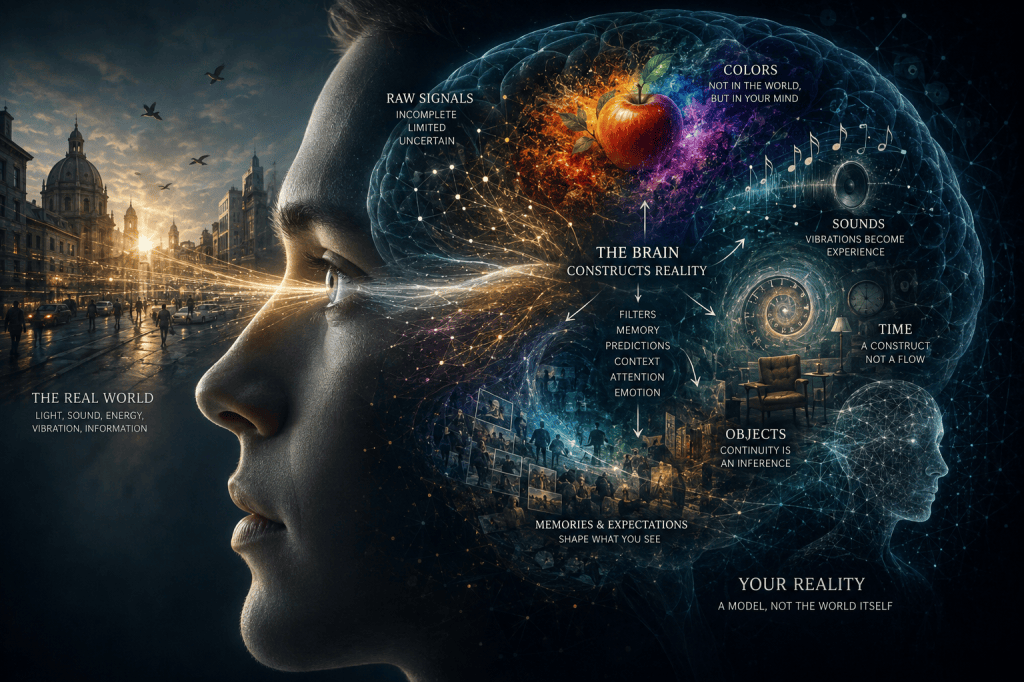
Neuroscience does not tell us that the room is imaginary, that the table disappears when nobody looks at it, or that physical reality exists only inside the mind, yet decades of research into vision, hearing, attention and time perception have revealed something considerably more subtle and, in many ways, more unsettling: the reality that reaches consciousness is not a direct copy of the physical world, but a biological representation assembled by the brain from incomplete sensory signals, previous experience, contextual clues, predictions and continuous corrections that normally remain completely invisible to us.
The distinction matters because we instinctively imagine perception as an open window through which the outside world simply enters the mind, whereas the evidence increasingly suggests something closer to an extraordinarily sophisticated reconstruction process in which the brain must constantly decide what probably exists beyond the limited information provided by the senses. Contemporary neuroscience has consequently devoted considerable attention to predictive mechanisms, examining how prior knowledge and expectations interact with incoming signals rather than treating perception as a purely passive recording process.
In other words, you are almost certainly surrounded by a real external world, but the world you actually experience is the version your nervous system has managed to build.
Once that distinction is understood, everyday reality begins to look surprisingly mysterious.
THE RED APPLE IS NOT RED IN THE WAY YOU THINK IT IS
Place a red apple on a table and almost everyone will describe redness as though it were an obvious physical possession of the fruit, something attached to its surface in the same uncomplicated sense that the apple possesses mass, chemical composition and structure, yet the external world does not contain the subjective sensation of red waiting inside the apple for a pair of human eyes to release it.
What actually reaches the eye is light whose spectral composition depends not only upon the reflective properties of the apple but also upon the illumination surrounding it, after which photoreceptors respond to portions of that light and neural systems compare and interpret those signals until consciousness receives the experience we call color.
The problem that the brain must solve is much more difficult than it initially appears, because illumination changes constantly while the identity of objects usually does not. An apple viewed under bright daylight sends a different spectrum of light toward the eyes from the same apple viewed beneath warmer indoor illumination, yet we normally continue experiencing it as approximately the same color because the visual system attempts to distinguish changes caused by illumination from properties belonging to the surface itself.
Researchers studying color constancy describe precisely this ability, emphasizing that color perception serves the practical purpose of identifying objects and materials despite variations in illumination rather than simply reporting the raw physical properties of the light reaching the retina.
This normally happens so effortlessly that we never notice the calculation.
Then, occasionally, the calculation becomes ambiguous and the hidden machinery suddenly reveals itself.
In 2015, a badly illuminated photograph of an ordinary dress became one of the strangest accidental perception experiments in internet history because millions of people looked at the same image and confidently reported radically different colors. Some saw a blue-and-black dress, others insisted that it was white and gold, and many people found the disagreement almost impossible to understand because each group felt that the colors were simply present in the image for anyone capable of seeing normally.
Laboratory research later confirmed substantial differences between observers, with studies suggesting that the ambiguous illumination encouraged different brains to make different assumptions about the light falling upon the dress. Depending upon what illumination the visual system implicitly discounted, the same pixels could lead to remarkably different subjective experiences.
Nothing in the photograph had changed.
The photons reaching different observers from equivalent displays could be extremely similar.
What changed was the brain’s interpretation of what those photons probably meant.
This is more than an entertaining internet curiosity, because it demonstrates an uncomfortable fact about ordinary perception: sometimes two neurologically healthy people can look at essentially the same sensory evidence and genuinely experience different realities without either person deliberately imagining anything.
SOUND DOES NOT TRAVEL THROUGH THE AIR IN THE FORM YOU HEAR IT
Color is not unique in this respect, because sound provides another familiar experience whose relationship with the external world is considerably less direct than intuition suggests.
When a violin plays across the room, the subjective qualities of the note do not fly through the air toward your head as tiny packets of music. What propagates through the environment are pressure variations, which cause mechanical structures within the ear to move before being converted into patterns of neural activity that the auditory system organizes into pitch, timbre, location, rhythm and recognizable sources.
The difference becomes particularly strange when vision begins altering what we believe we are hearing.
During the famous McGurk effect, researchers can play the audio recording of one syllable while showing a face articulating another, and some observers consequently report hearing a sound that differs from the acoustic signal actually entering their ears. The illusion has become one of the best-known demonstrations of audiovisual speech perception because it reveals that the brain normally combines information from multiple senses rather than allowing hearing and vision to operate as completely independent channels.
This integration makes perfect evolutionary sense, because watching someone’s mouth can help clarify speech in a noisy room, while facial movements, gestures and vocal information normally belong to the same event and therefore benefit from being combined into a single coherent perceptual interpretation.
The extraordinary part is that we do not consciously experience the combination occurring.
Nobody watches a speaker and thinks, “My auditory information is currently uncertain, so I will assign greater statistical weight to the movement of the lips before calculating the most probable syllable.”
We simply hear the word.
The inference disappears and leaves only the conclusion behind.
YOUR BRAIN CONTAINS A HOLE IN VISION THAT YOU ALMOST NEVER NOTICE
There is a physical region in each retina where the optic nerve leaves the eye, creating a location without photoreceptors and therefore producing a genuine blind spot in the visual field, yet ordinary experience contains no permanent black circle hovering beside everything we look at.
When conditions are arranged carefully, anyone with normal vision can demonstrate the blind spot experimentally by closing one eye and causing a small object to disappear at the appropriate position, but during ordinary life the missing region does not announce itself because the visual system uses information from the other eye and surrounding visual structure to maintain a coherent scene.
The phenomenon belongs to a broader family known as perceptual filling-in, in which properties such as brightness, color, texture or motion can be experienced across areas where corresponding visual information is absent or incomplete. Neuroscience research has found that filling-in involves active neural processes and is not merely a philosophical metaphor for ignoring missing information.
Consider how strange this actually is.
Part of your sensory apparatus contains missing information, yet consciousness does not ordinarily receive the message that something is missing.
Instead, it receives continuity.
The same principle operates constantly when objects are partially hidden. If a cat walks behind the leg of a table, you do not suddenly experience a head on one side and a tail on the other as two unrelated creatures; your perceptual system infers that an entire animal continues through the region currently blocked from view, even though photons from the hidden portion of the cat cannot possibly reach your eyes.
We normally call this common sense, but from the perspective of information processing it is an inference about something the senses cannot presently observe.
The brain is continuously showing you more than the eyes directly receive.
YOU DO NOT SEE AS MUCH OF THE WORLD AS YOU FEEL THAT YOU SEE
One of the strongest intuitions produced by consciousness is that the visual world exists before us in enormous detail, almost as though an internal high-resolution photograph were being continuously updated while attention moved freely across it, yet experiments on change blindness have repeatedly shown how badly this intuition can mislead us.
Researchers discovered that surprisingly large modifications to photographs, films and even real-world situations can go unnoticed when the visual transition occurs under conditions that prevent the change itself from automatically capturing attention. Entire objects can disappear, colors can change, architectural details can move, and observers may continue looking at the scene without realizing that anything has happened.
Classic reviews of the phenomenon emphasize the surprising gap between our subjective experience of a rich visual world and the limited detailed representation retained across interrupted views.
One particularly memorable family of real-world demonstrations involved interactions in which an unsuspecting person speaking to a stranger was momentarily obstructed, after which the original stranger was replaced by a different person; under some conditions, a remarkable proportion of participants failed to notice that the human being standing directly in front of them had changed.
The point is not that human vision is poor, because human vision is extraordinarily successful at the tasks evolution required it to perform, but rather that the brain does not appear to preserve every available detail simply because consciousness gives us the impression that it does.
The external world itself can serve as a kind of continuously available storage device, because if information becomes important we can normally move our eyes and inspect it again.
The illusion arises because we confuse the ability to obtain detail whenever necessary with the possession of all that detail inside consciousness simultaneously.
EVERY TIME YOUR EYES MOVE, THE IMAGE OF THE WORLD MOVES WITH THEM
Even the visual stability you experience while reading this sentence conceals another remarkable problem, because your eyes are not motionless cameras.
Several times each second they perform rapid movements known as saccades, repositioning the highest-resolution portion of the retina so that different parts of the scene can be examined in detail, while each movement shifts the image projected across the retinal surface.
If a video camera were moved abruptly several times every second, the resulting footage would appear chaotic unless substantial stabilization occurred, yet your conscious world does not leap violently whenever your gaze moves from one word to another.
Instead, the environment remains astonishingly stable.
Researchers have spent decades investigating the mechanisms that allow perception to maintain continuity across eye movements, and one particularly curious consequence became famous as the stopped-clock illusion, or chronostasis.
If you glance suddenly toward the second hand of an analogue clock, the first interval you see can sometimes appear strangely prolonged, producing the eerie impression that the clock has momentarily stopped before resuming its normal movement. Experiments published in Nature found evidence that perceptual processes occurring around the eye movement contribute to this apparent extension of subjective time.
The clock has not malfunctioned.
Physical time has not hesitated.
The anomaly exists in the constructed continuity of experience.
For an instant, the brain’s reconstruction of what happened and the external sequence of events are not perfectly aligned, yet unless a clock provides an external reference against which the discrepancy becomes obvious, we usually never discover that anything unusual occurred.
THE PRESENT MAY CONTAIN A LITTLE OF THE PAST
The strange relationship between perception and time does not end with eye movements, because contemporary research has identified another phenomenon known as serial dependence, through which our perception or judgment of a current stimulus can be systematically influenced by recently encountered similar stimuli.
Imagine repeatedly seeing faces tilted slightly in one direction, or objects possessing related visual properties, after which the next stimulus is somewhat ambiguous; under certain experimental conditions, what you perceive now can be biased toward what you saw moments earlier.
A major 2024 review in the Annual Review of Psychology described evidence for serial dependence across many aspects of perception, while a Nature Reviews Psychology perspective argued that such continuity effects may improve perceptual stability, accuracy and efficiency by preventing noisy moment-to-moment fluctuations from making the world appear unnecessarily unstable.
From an engineering perspective, this is sensible because the environment does not usually transform completely from one fraction of a second to the next, which means that the recent past is often useful evidence about what probably exists in the present.
From a philosophical perspective, however, the implication is fascinating because the perceptual “now” may not be an isolated snapshot constructed solely from information arriving at this instant.
A trace of what came before can influence what appears to be happening now.
The smooth continuity of reality may therefore be partly an achievement of the brain rather than a literal frame-by-frame reproduction of external events.
THE BRAIN IS CONSTANTLY SOLVING AN IMPOSSIBLE DETECTIVE STORY
Every sensory signal presents the nervous system with a problem whose cause must somehow be inferred.
A particular pattern of light reaching the retina might have been produced by a dark object under strong illumination or by a lighter object in shadow, while a partly hidden shape could represent one object continuing behind an obstacle or two separate objects that merely happen to align, and an ambiguous sound could originate from several possible sources depending upon what is happening around it.
The brain normally resolves such ambiguity so quickly that we never become conscious of the uncertainty.
This is one reason predictive-processing approaches have become influential within neuroscience. Rather than treating perception as a simple chain in which sensory data travel upward until a complete picture appears, these frameworks investigate how prior knowledge about the world can contribute to predictions about the causes of incoming information, with discrepancies between expectation and sensory evidence helping update the emerging model.
The idea is sometimes sensationalized online into the claim that scientists have discovered that reality is merely a hallucination, but this goes far beyond what the research demonstrates.
A better analogy might be a detective who never sees the crime itself but receives traces, fragments, witnesses and probabilities from which the most plausible reconstruction must be assembled.
The brain’s detective story is simply much faster, because it must solve thousands of such problems continually while allowing us to walk across rooms, recognize faces, catch falling objects and interpret speech without pausing for conscious calculations.
When the reconstruction is correct, we call the result perception.
When the system arrives at a solution that conflicts with physical measurements, we may call the result an illusion.
Yet both can emerge from the same machinery.
ILLUSIONS ARE NOT FAILURES OF THE BRAIN, BUT CLUES TO HOW REALITY IS BUILT
Visual illusions are often presented as amusing tricks that expose weaknesses in human perception, although many become far more interesting once we recognize that the mechanisms responsible for them are usually the same mechanisms that make normal perception so reliable.
Color constancy can occasionally produce spectacular disagreements such as #TheDress precisely because the brain normally needs to compensate for changing illumination.
Multisensory integration can create the McGurk illusion precisely because combining vision and hearing usually improves our understanding of speech.
Perceptual filling-in can make us experience information that is not directly present at a particular retinal location precisely because gaps and occlusions are unavoidable in ordinary vision.
Serial dependence can bias current perception toward recent experience precisely because the real world normally possesses continuity.
What appears to be a weakness in an artificial experiment may therefore be the price paid for an extraordinarily useful perceptual strategy.
The mystery is not that the brain occasionally deceives us.
The deeper mystery is that this process works so well that we spend almost our entire lives unaware that any reconstruction is occurring.
WHAT WOULD THE WORLD LOOK LIKE IF YOU WERE NOT HUMAN?
One of the easiest ways to understand the difference between physical reality and experienced reality is to imagine another animal standing in exactly the same location.
A bee and a human being may hover beside the same flower while inhabiting very different sensory worlds because bees can detect ultraviolet wavelengths unavailable to ordinary human vision.
A dog can detect odors that make important features of an environment perceptually meaningful while remaining almost nonexistent to us.
Many animals hear frequencies beyond the range of human hearing, while other species possess sensory capabilities for detecting information that humans can access only indirectly through scientific instruments.
The external environment does not need to transform when the observer changes.
What changes is the biological interface.
This should make us cautious whenever we assume that the world as humans experience it must resemble reality in its complete form, because natural selection did not need to produce a nervous system capable of representing every measurable property of the universe.
It needed organisms that could survive.
Our ancestors needed to distinguish edible objects from dangerous ones, recognize faces, locate predators, navigate landscapes, communicate, maintain social relationships and predict the movement of objects well enough to act effectively.
They did not need to perceive radio waves directly, observe ultraviolet patterns, experience magnetic fields as conscious sensations or understand quantum mechanics simply by looking at a stone.
Human consciousness therefore presents a biologically useful slice of physical reality.
There may be enormous portions of the universe around us that exist perfectly well while producing no direct subjective experience whatsoever.
THEN WHAT EXACTLY IS AN OBJECT?
Even something as simple as a chair becomes philosophically peculiar once perception is examined closely.
When you walk around a chair, the pattern of light reaching your retina changes continuously, its apparent shape alters with perspective, some surfaces become visible while others disappear, illumination modifies brightness and color, and another object may block part of it from view, yet consciousness does not normally experience hundreds of unrelated visual configurations.
It experiences one chair.
Object perception requires the nervous system to discover stability beneath changing sensory evidence, and contemporary research emphasizes that objects and scenes are interpreted interactively, with contextual information helping determine what an object probably is while objects themselves help define the scene surrounding them.
A rectangular shape appearing inside a kitchen may be interpreted differently from an almost identical shape appearing on a road because the brain does not evaluate every visual fragment in isolation from what it already understands about the environment.
This becomes especially noticeable when information is ambiguous.
A shadow glimpsed in a bedroom at night may momentarily become a person because the nervous system must decide quickly what kind of object could plausibly occupy that location, while turning on the light supplies additional evidence and forces the model to change.
Nothing supernatural happened in the darkness.
Nevertheless, for several seconds the person was perceptually real enough to accelerate the heart.
The brain did not wait patiently for certainty before constructing the world.
It made its best prediction from incomplete evidence.
FEAR CAN CHANGE THE REALITY THAT ATTENTION ALLOWS YOU TO SEE
Anyone who has walked alone through an unfamiliar place at night understands that perception does not occur independently of emotional state.
A movement that would be ignored in daylight suddenly becomes significant, a distant sound attracts attention immediately, shadows acquire suspicious forms and ordinary coincidences begin forming patterns because a nervous system expecting danger prioritizes information potentially related to threat.
The objects outside have not necessarily changed, but the hierarchy of what reaches conscious awareness has changed dramatically.
This explains one of the most important distinctions between the external environment and lived reality, because humans do not experience all available information with equal intensity.
Attention determines what becomes prominent.
Emotion helps determine what attracts attention.
Memory supplies interpretations.
Expectation alters probabilities.
The result is a personalized version of the environment whose overall structure remains constrained by the world but whose psychological meaning can vary enormously between observers.
The same street can feel safe to one person and threatening to another without either person having access to the entire statistical truth about what will happen there.
MEMORY DOES NOT SIMPLY PRESERVE THE WORLD EITHER
Perception would already be mysterious enough if the problem ended with the present moment, yet much of what we call reality is constructed from memory, and memory itself is not a perfect archive capable of replaying previous experience exactly as it originally occurred.
When we remember an event, we reconstruct portions of it from stored information, semantic knowledge, emotional meaning and later experiences, which means that the reality we believe we experienced yesterday can itself change subtly over time.
This becomes relevant to perception because previous experience provides part of the contextual knowledge through which new sensory information is interpreted.
The brain therefore exists inside a circular relationship with reality: present perception contributes to memory, memory influences future expectations, expectations influence the interpretation of new information, and those interpretations subsequently become additional memories.
Most of the time this cycle allows humans to learn extraordinarily effectively.
Under some conditions, however, it can also produce confident mistakes.
The unsettling possibility is not that nothing can ever be trusted, but that subjective certainty is not the same thing as objective accuracy.
We can feel completely certain while being wrong.
IF YOU NEVER EXPERIENCE RAW REALITY, WHAT DOES “REAL” ACTUALLY MEAN?
At this stage an obvious philosophical temptation appears, because if colors, sounds, continuity and objects depend partly upon neural construction, perhaps the external world itself is somehow unreal.
That conclusion does not follow.
The fact that a map is constructed does not mean that the territory does not exist, while the fact that an organism represents the world through biological processes does not mean that nothing lies outside the representation.
A cliff can kill someone regardless of what philosophical theory that person holds about perception.
The scientific point is not that reality is imaginary, but that the form in which reality becomes conscious experience depends upon the architecture of the observer.
There is physical radiation and there is experienced color.
There are pressure variations and there is experienced music.
There are measurable sequences of events and there is the subjective feeling of duration.
There are changing patterns of light and there are stable experienced objects.
The two levels are related, but they are not identical.
The distinction becomes especially provocative when we ask whether an intelligent creature possessing radically different sensory organs would describe the same world using concepts resembling ours at all.
Perhaps what humans call reality is not reality in its complete form but a translation.
And perhaps consciousness never sees the original language.
THE MATRIX DOES NOT NEED A COMPUTER TO BEGIN
This is where the neuroscience of perception connects naturally with the central question behind Matrix: The Hidden Truth — Who Controls Reality?, because the most fascinating lesson of modern perception research is not that we have discovered evidence of an external computer generating our universe, but that human beings already experience the external world through an intermediary system capable of selecting, interpreting, completing and stabilizing information before consciousness becomes aware of it.
Once that is understood, a second and more socially important question immediately follows: what happens when another system begins influencing the information from which the brain constructs its model?
An algorithm does not need to alter physical reality in order to change what repeatedly reaches your attention.
A government does not need to manufacture every event in order to determine which events dominate public discussion.
Advertising does not need to transform an object’s material composition in order to change its psychological meaning.
A news organization does not need to invent every fact in order to create a particular impression through selection and emphasis.
A social-media feed does not need to persuade someone explicitly if it can repeatedly determine which fragments of reality that person encounters.
The brain already builds experience from incomplete information.
Control enough of the information and you may influence the construction.
This does not mean that human beings are helpless puppets, nor does it require the existence of a hidden organization controlling everything from behind the scenes, because social reality is shaped by countless competing forces and people retain substantial capacity to compare evidence, seek alternative sources and reconsider beliefs.
Nevertheless, the biological architecture of perception makes one conclusion unavoidable: there is always something between the world and our experience of it.
Sometimes that intermediary is the retina.
Sometimes it is memory.
Sometimes it is expectation.
Sometimes it is language.
And increasingly, sometimes it is an algorithm.
PERHAPS PLATO’S CAVE WAS MORE MODERN THAN IT APPEARED
More than two thousand years before neuroscience could observe the living brain, Plato imagined prisoners who had spent their lives watching shadows projected onto the wall of a cave and naturally mistook those shadows for reality because they possessed no experience against which the images could be compared.
The allegory was philosophical rather than neurological, yet it remains strangely powerful in the digital age because the central problem has survived: human beings construct their understanding of the world from whatever information is available to them, and they rarely experience the filtering process responsible for determining what became available.
Modern citizens do not sit chained inside caves, but much of what they know about wars, distant countries, political leaders, scientific discoveries, financial crises and people they have never encountered arrives through screens, headlines, images and recommendation systems before being interpreted by a brain already equipped with expectations, memories and biases.
The modern cave therefore does not need walls.
It needs selection.
THE MOST PERFECT ILLUSION WOULD NOT FEEL LIKE AN ILLUSION
A badly constructed illusion exposes itself because something appears obviously wrong, whereas a perfectly constructed representation becomes almost impossible to distinguish from reality precisely because nothing about it feels artificial.
This may be the most provocative lesson hidden inside ordinary perception.
When the visual system compensates correctly for illumination, we do not marvel at the computation; we simply see a red apple.
When audiovisual information is integrated successfully, we do not detect the fusion; we simply understand a sentence.
When the blind spot is compensated for, we do not notice missing information; we simply see an uninterrupted scene.
When eye movements are stabilized, we do not perceive the reconstruction; we simply experience a stationary world.
When serial dependence reduces moment-to-moment noise, we do not notice that the recent past has influenced the present; we simply experience continuity.
The machinery is invisible because it works.
That is why perception feels direct even when the underlying biological processes demonstrate that it cannot be.
SO, ARE WE LIVING IN AN ILLUSION?
The most accurate answer is both less sensational and more unsettling than the phrase suggests, because there is no scientific reason to conclude that the physical universe surrounding us is merely an illusion, yet there is overwhelming reason to reject the naive assumption that consciousness receives an untouched copy of that universe.
We inhabit an external physical world while simultaneously living inside a neural representation of that world.
The representation is constrained by reality but shaped by biology.
It is incomplete but remarkably useful.
It can be corrected by evidence yet influenced by expectation.
It provides stability while hiding enormous quantities of information.
It creates colors from spectral relationships, sounds from vibrations, objects from changing visual fragments and continuity from sensory input that is considerably less continuous than experience suggests.
Perhaps the most mysterious part of all this is not that the human brain sometimes makes mistakes, but that an organ weighing little more than a kilogram can transform electrical and chemical signals into sunsets, music, faces, fear, distance, movement and the profound subjective conviction that an entire world is unfolding immediately before us.
The universe may exist independently of us, but the universe as we experience it cannot exist without the machinery that experiences it.
And once we understand that distinction, the question behind Matrix becomes far more disturbing than the familiar science-fiction possibility that our universe might be running inside a computer, because the first Matrix may already be present inside every human skull: not as a sinister prison designed to deceive us, but as the biological interface without which reality could never become experience at all.
The final question is therefore not whether the world around us is real, because everything we know suggests that there is indeed a world beyond our minds.
The far more provocative question is this:
How much of what you call reality belongs to the world itself, and how much belongs to the extraordinary machine interpreting it for you?
SOURCES AND FURTHER READING
Teufel, Christoph & Paul C. Fletcher, “Forms of Prediction in the Nervous System,” Nature Reviews Neuroscience (2020) — an important review of how prior information and prediction can participate in perception and neural processing.
Witzel, Christoph & Karl R. Gegenfurtner, “Color Perception: Objects, Constancy, and Categories,” Annual Review of Vision Science (2018) — a comprehensive review of color constancy, object color and the relationship between physical light and perceived color.
Lafer-Sousa, Rosa, Katherine L. Hermann & Bevil R. Conway, “Striking Individual Differences in Color Perception Uncovered by ‘The Dress’ Photograph,” Current Biology (2015) — experimental evidence examining why observers genuinely perceived very different colors in the famous photograph.
Komatsu, Hidehiko, “The Neural Mechanisms of Perceptual Filling-In,” Nature Reviews Neuroscience (2006) — a review of the neural processes involved when perception supplies visual information in regions where corresponding physical information is absent.
Simons, Daniel J. & Ronald A. Rensink, “Change Blindness,” Trends in Cognitive Sciences (1997) — the classic review examining our surprising inability to notice substantial changes to visual scenes under particular conditions.
Yarrow, Kielan et al., “Illusory Perceptions of Space and Time Preserve Cross-Saccadic Perceptual Continuity,” Nature (2001) — experimental research on chronostasis and the famous stopped-clock illusion.
Cicchini, Guido Marco, Kyriaki Mikellidou & David Burr, “Serial Dependence in Perception,” Annual Review of Psychology (2024) — a modern review of how previous perceptual experience can influence what is perceived moments later.
Manassi, Mauro & David Whitney, “Continuity Fields Enhance Visual Perception Through Positive Serial Dependence,” Nature Reviews Psychology (2024) — an exploration of how serial dependence may contribute to stable and efficient perception.


Leave a comment