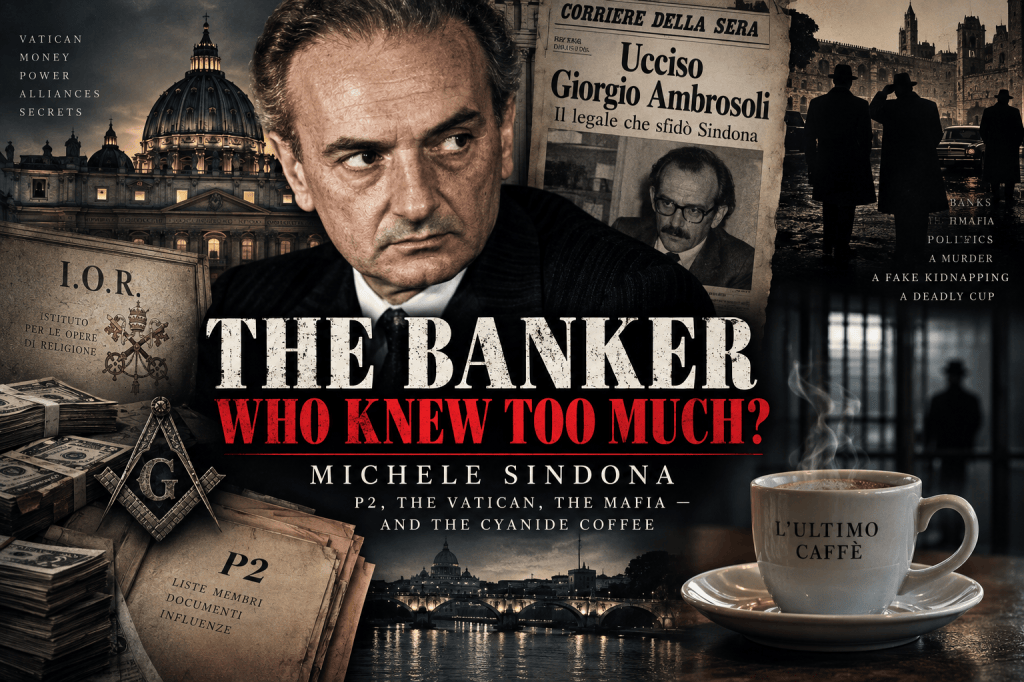
He had advised Vatican finances, controlled banks on both sides of the Atlantic, moved through the secret world surrounding P2, staged his own kidnapping with the help of men connected to organized crime, and was eventually sentenced to life for ordering the murder of the lawyer who had begun to unravel his empire. Two days after that sentence, Michele Sindona drank a cup of coffee inside a maximum-security Italian prison. The coffee contained cyanide.
On the morning of March 20, 1986, inside the high-security prison at Voghera in northern Italy, Michele Sindona was given breakfast under circumstances that should have made almost any outside interference difficult. He was watched around the clock, his meals were controlled, and only two days earlier a Milan court had sentenced him to life imprisonment for ordering the murder of lawyer Giorgio Ambrosoli, the man appointed to examine and liquidate the ruins of Sindona’s banking empire.
Then Sindona drank his coffee.
Shortly afterward he collapsed.
Tests revealed cyanide poisoning, and on March 22, after lying in an irreversible coma, the sixty-five-year-old financier died. Contemporary reports recorded the immediate question that spread through Italy: how had a prisoner under such close surveillance obtained poison, and had he taken it voluntarily or had somebody finally decided that Michele Sindona knew too much? At the time, the public prosecutor in Voghera openly stated that investigators could not yet determine whether they were dealing with suicide or murder.
It would have been an extraordinary ending to almost anyone’s life. In Sindona’s case, however, it was merely the final scene in a story that had already passed through the Vatican, Wall Street, Italian politics, Cosa Nostra, the clandestine P2 network, a murdered lawyer, a fictitious kidnapping, a false passport and a trail of financial relationships so complicated that Italian parliamentarians eventually created an entire commission of inquiry to understand what had happened.
The strange thing about Michele Sindona is that, the deeper one goes into his story, the less necessary the mythology becomes.
The documents are disturbing enough.
BEFORE CALVI, THERE WAS SINDONA
Readers of the previous episode will recognize several names that appear again here: Licio Gelli, P2, the IOR, Roberto Calvi and the shadowy borderland where banking, politics and private influence met. This is not an accidental repetition.
Parliamentary investigations later noted a remarkable continuity between the financial world of Sindona in the first half of the 1970s and that of Roberto Calvi and Banco Ambrosiano later in the decade. One parliamentary report described the connection not merely in terms of personalities, but through the continuing relationships of both financial groups with the Institute for the Works of Religion, the IOR, and Vatican circles.
Sindona had risen dramatically after the Second World War, becoming an international financier whose interests eventually reached from Milan to the United States. By the late 1960s he was also operating close to Vatican financial affairs; contemporary accounts describe him as advising Vatican interests from around 1969, while parliamentary material documents the deeper financial relationships that subsequently connected Sindona, the IOR and, eventually, Calvi.
For a time, Sindona seemed almost untouchable.
He understood currencies, tax structures, holding companies and international finance at a moment when money was becoming increasingly capable of moving across borders faster than regulators could follow it. His world was one in which ownership could disappear behind another company, which was controlled by another company, which had accounts in another country, while the men who ultimately benefited might remain several legal layers removed from the transaction.
It was sophisticated finance.
It was also an extraordinary environment in which to hide things.
And by 1974, it was beginning to collapse.
TWO BANKING EMPIRES FALL APART
Sindona had acquired control of Franklin National Bank in the United States, at the time one of America’s major banks. In 1974 Franklin failed spectacularly following huge financial problems, including disastrous foreign-exchange operations, and the collapse became, at that point, the largest failure of a federally insured American bank.
The disaster did not remain confined to America.
In Italy, Sindona’s Banca Privata Italiana was also collapsing beneath enormous losses and irregular operations. His reputation as an international financial genius was being replaced by something much less glamorous: investigations, creditors, regulators and prosecutors asking where the money had gone.
An American court eventually sentenced him in 1980 to 25 years in prison for fraud connected with the Franklin National collapse, while Italian proceedings later produced another conviction relating to the fraudulent collapse of Banca Privata Italiana.
But financial crimes were no longer Sindona’s greatest problem.
A quiet Milanese lawyer had started reading the accounts.
His name was Giorgio Ambrosoli.
THE MAN WHO READ THE PAPERS
Ambrosoli was not a spy, politician or professional anti-Mafia investigator. He was a lawyer appointed as liquidator of Sindona’s failed Italian banking operation, which sounds almost painfully ordinary until one understands what the job required.
He had to reconstruct an empire built through companies, international transactions and financial arrangements that had accumulated over years.
In other words, Ambrosoli was being paid to follow the paper trail.
As he worked, he came increasingly into conflict with Sindona and the interests surrounding him. The liquidation threatened not merely a financier’s remaining wealth but the possibility that transactions, relationships and beneficiaries which had remained obscure might eventually become visible.
On the night of July 11, 1979, Ambrosoli returned to his home in Milan.
An assassin was waiting.
He was shot dead.
Nearly seven years later, on March 18, 1986, an Italian court concluded that Michele Sindona had ordered the murder, finding him guilty of arranging payment to the American hitman responsible for the killing. Sindona received a life sentence.
That conviction changes the way the rest of his story has to be read.
We are no longer dealing merely with a reckless banker who made terrible financial decisions.
A court had concluded that when the man dismantling his financial empire became dangerous to him, Sindona arranged to have that man killed.
And yet, only weeks after Ambrosoli’s assassination in 1979, something even stranger happened.
Michele Sindona disappeared.
THE KIDNAPPING THAT NEVER HAPPENED
On August 2, 1979, Sindona vanished from New York.
Messages began to suggest that he had been kidnapped. The story was dramatic enough to fit perfectly into the violent atmosphere of Italy in the late 1970s, when political kidnappings, terrorism and organized crime had made extraordinary events almost believable by default.
Except Sindona had not been kidnapped.
He had gone underground deliberately.
A later Italian parliamentary reconstruction traced an extraordinary journey. Using a false passport in the name of Joseph Bonamico, Sindona flew from Kennedy Airport to Vienna, continued through Salzburg and Athens, entered Italy through Brindisi, traveled to Caltanissetta and then reached Palermo, where he remained secretly from August 17 until October 8.
When the performance was nearly finished, Sindona returned through Vienna and Frankfurt to New York. He remained hidden for several more days before reappearing in Manhattan, looking sufficiently battered to support the story that he had survived a kidnapping.
There was one especially theatrical detail.
While in Sicily, he had arranged to be shot in the leg so that his injuries would make the fictional abduction more convincing.
Had this appeared in a novel, an editor might have considered it excessive.
The Italian parliamentary record goes further still.
The reconstruction describes the operation as having been carried out with extensive assistance from individuals connected to Sicilian and Italian-American organized crime, and identifies several men involved in sheltering, transporting or assisting Sindona during his clandestine stay. Among the most important was physician Giuseppe Miceli Crimi, whose role would unexpectedly help expose an entirely different secret structure.
Because while Sindona was supposedly being held by kidnappers, he was actually meeting people.
And some of those meetings led back toward Licio Gelli.
THE ROAD FROM SINDONA TO P2
This is where Episode Three folds back into Episode One.
Investigators examining Sindona’s false kidnapping began following the people who had assisted him, including Miceli Crimi. Under questioning, Miceli Crimi eventually revealed contacts he had maintained with Licio Gelli on Sindona’s behalf during the clandestine Sicilian operation.
Those disclosures helped direct Milan magistrates toward Gelli.
On March 17, 1981, investigators searched Gelli’s offices at the Giole factory in Castiglion Fibocchi.
What they found transformed Italian politics.
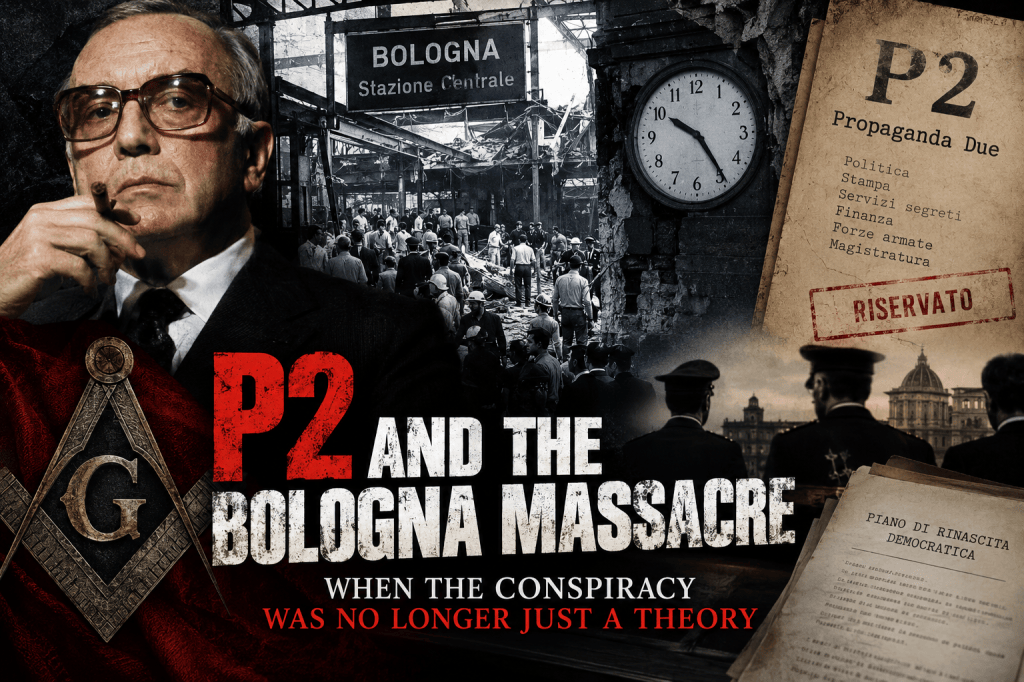
The membership lists of Propaganda Due — P2.
The discovery exposed the network containing military officers, intelligence officials, businessmen, journalists, public figures and others, producing the scandal explored in the first episode of this series. Parliamentary documentation explicitly places the Sindona investigation in the chain of events that led investigators toward Gelli and ultimately to the discovery of the P2 material.
This connection is worth lingering over because it is easily lost when the cases are treated separately.
The P2 scandal was not discovered because somebody decided one morning to investigate a mysterious Masonic lodge.
Investigators were following Michele Sindona.
A bankrupt banker pretending to have been kidnapped helped open the door to one of the largest secret-network scandals in modern Italian history.
And P2, in turn, had already been trying to help him.
GELLI’S EFFORTS TO SAVE SINDONA
Parliamentary investigations later described Licio Gelli’s persistent activity in support of Sindona after the 1974 banking collapse, noting that Gelli, Roberto Calvi and Umberto Ortolani were particularly active during efforts to find a solution for Sindona and Banca Privata Italiana.
The relationship therefore did not begin with the fake kidnapping.
By then, a network of assistance had already existed for years.
This is an important point because it reveals what makes P2 historically more interesting than the cartoon version of a secret society.
Its power did not depend upon occult ceremonies or supernatural secrets.
It depended upon relationships.
Someone knew a banker.
Someone knew a politician.
Someone knew an intelligence officer.
Someone could arrange a meeting.
Someone could make a telephone call.
Someone might know which institution could be persuaded to help rescue a failing financial structure.
Real networks of influence rarely look dramatic from the inside. Often they consist of favors, introductions, private agreements and loyalties whose importance becomes visible only after someone begins reconstructing them backward.
Sindona’s collapse did precisely that.
It forced people to follow the relationships.
THE VATICAN CONNECTION — AND WHAT IT DOES NOT PROVE
No serious account of Sindona can avoid the Vatican, but this is also the part of the story where sensationalism most easily overwhelms evidence.
Sindona had substantial financial relationships with Vatican interests and was widely described as a financial adviser to the Vatican during the period in which his influence was at its height. Parliamentary investigations into the later P2 and banking scandals repeatedly examined the continuity among Sindona, the IOR, Calvi and Banco Ambrosiano, because the same financial world appears again when Sindona falls and Calvi rises.
What this proves is that the financial relationship was real and important.
It does not prove that the Vatican ordered Ambrosoli’s murder, organized Sindona’s false kidnapping or arranged Sindona’s death.
There is no responsible way to collapse all those events into a single Vatican conspiracy.
What makes the historical situation fascinating is something subtler: Sindona occupied a position where financial institutions, powerful private figures, religious financial interests, political contacts and clandestine networks intersected, which meant that when his empire began collapsing, many different people had reasons to care about what he might reveal.
That is not the same as saying they all belonged to one conspiracy.
It may actually be more unsettling.
THE MAFIA WAS NOT JUST A RUMOR
For years, descriptions of Sindona as a banker connected to organized crime could sound like another layer added to an already overloaded conspiracy story.
Parliamentary material makes the relationship harder to dismiss.
Later investigations into the false kidnapping documented Sindona’s presence in Sicily among people identified as belonging to important organized-crime circles, while parliamentary reconstructions explicitly described Mafia participation in protecting and assisting him during his secret stay. Another parliamentary document recounting the period states that Sindona, a P2 member, disappeared from New York and traveled clandestinely to Sicily while presenting himself publicly as a kidnapping victim.
This does not mean every financial transaction Sindona ever conducted was a Mafia operation, nor does it establish that organized crime controlled every institution around him.
Again, the reality is more complicated.
It tells us instead that when Sindona desperately needed to disappear, travel secretly, obtain protection and stage an elaborate deception, he had access to people capable of helping him do exactly that.
The distinction matters.
So does the fact.
ANDREOTTI, POLITICAL PROTECTION AND THE DANGEROUS EDGE OF THE STORY
The Sindona affair also reached deeply into Italian politics, particularly through the controversy surrounding Giulio Andreotti, one of the dominant figures of postwar Italian political life.
The subject produced fierce disagreement inside Parliament itself. Later parliamentary documentation records that Milan prosecutor Guido Viola argued that political protection afforded to Sindona between 1974 and 1979 had contributed to the environment surrounding the Ambrosoli tragedy, while political opponents of Andreotti made even stronger accusations.
Those claims, however, should not be converted into a statement that Andreotti ordered Ambrosoli’s murder. The parliamentary record itself reflects substantial political dispute over precisely how far responsibility could be extended.
This is one of the places where a mysterious story becomes more credible when we resist the temptation to make it simpler than it was.
There were people who protected Sindona.
There were attempts to rescue his financial position.
There were political relationships around him.
But political protection, moral responsibility and criminal responsibility are not interchangeable concepts.
History becomes distorted when we pretend they are.
THE AMERICAN CONVICTION
By 1980, Sindona’s ability to move freely through this world had largely disappeared.
A New York court sentenced him to 25 years in prison for fraud arising from the collapse of Franklin National Bank, and after subsequent extradition proceedings he was returned to Italy, where the consequences of his Italian banking operations and the Ambrosoli murder awaited him.
In March 1985 he received a fifteen-year sentence in Italy over the fraudulent collapse of Banca Privata Italiana.
Then came the Ambrosoli trial.
On March 18, 1986, the court handed down the life sentence for ordering the lawyer’s assassination.
For a man who had once moved among financiers, church officials, political figures and international bankers, the transformation was complete.
There would be no restored empire.
No rescue of the banks.
No triumphant return to finance.
Only prison.
And perhaps testimony.
Because a man in Sindona’s position carried something that could remain valuable long after his money disappeared.
Memory.
TWO DAYS LATER, THE COFFEE ARRIVED
On Thursday morning, March 20, breakfast reached Sindona’s cell in Voghera.
According to investigators, the prison coffee was prepared in an area also serving guards and other personnel and was delivered to his cell by prison officers. His security arrangements immediately made the poisoning deeply suspicious because Sindona was not simply another inmate; he was a high-profile prisoner whose movements, food and contacts were carefully controlled.
He drank.
Soon afterward he collapsed.
The substance was identified as cyanide.
At first there was no official certainty whether Sindona had poisoned himself or had been poisoned by somebody else, and politicians immediately speculated that the financier might have been silenced before he could identify people involved in his illegal dealings.
The timing seemed almost designed to produce suspicion.
Life sentence: March 18.
Cyanide: March 20.
Death: March 22.
After everything that had happened around Sindona, few Italians were inclined to regard those dates without asking questions.
“THEY HAVE POISONED ME”
One detail gave the story an almost unbearable ambiguity.
After drinking the coffee, Sindona reportedly claimed that he had been poisoned.
If someone wanted to silence him, those words sound like the final declaration of a man who understood immediately what had happened.
But investigators eventually reached another conclusion.
In November 1986, investigating magistrate Antonio De Donno closed the criminal inquiry into Sindona’s death, ruling that the financier had committed suicide. According to the magistrate, approximately a gram of cyanide had been placed in the coffee, an enormous quantity whose smell and taste would have been difficult not to notice, and Sindona’s subsequent declaration that somebody had poisoned him was interpreted as part of a prearranged attempt to make his death appear to be murder.
That is the official conclusion.
It deserves to be stated clearly.
The Italian investigation concluded that Michele Sindona killed himself.
Yet the conclusion did not erase the mystery from public memory, partly because the circumstances surrounding his life had already made straightforward explanations difficult to accept.
The question was no longer merely how cyanide entered a prison.
It was why Sindona would stage one final deception.
ONE LAST FALSE FLAG?
There is a strange symmetry here that is almost impossible to ignore.
In 1979, Sindona had staged a kidnapping.
He had disappeared, traveled secretly across Europe, hidden in Sicily, sent messages supporting the fiction and even arranged to receive a gunshot wound so that the invented story would look real.
Seven years later, according to the magistrate who investigated his death, Sindona may have attempted another deception — this time making his own suicide look like murder.
If that conclusion is correct, the final performance was perfectly consistent with the man investigators had already encountered.
He understood the power of appearances.
He understood that people believed a story more easily when physical evidence seemed to support it.
A bullet in the leg made a kidnapping believable.
Perhaps a cup of poisoned coffee inside a guarded prison could make murder believable.
The problem, of course, is that by 1986 Sindona had also accumulated enough genuine enemies and enough genuine secrets that murder did not sound impossible.
That is why the question survives.
DID MICHELE SINDONA KNOW TOO MUCH?
This phrase appears constantly in stories about mysterious deaths, often without justification, but in Sindona’s case we can at least identify what he might have known.
He knew the internal mechanics of his own banks.
He knew the people who had tried to help rescue his empire after 1974.
He knew his contacts within P2.
He knew Licio Gelli.
He knew the history of his financial dealings with Vatican interests.
He knew the people who had helped him disappear in Sicily.
He knew enough about international finance to understand how money could be moved, concealed and reconstructed through foreign institutions.
And he had already demonstrated, during his years of crisis, that he was willing to use information and relationships as instruments of survival.
The question therefore is not whether Sindona possessed some mythical secret capable of destroying governments.
There is no evidence for that.
The more reasonable question is whether he possessed embarrassing, incriminating or politically dangerous knowledge about particular people and transactions.
Given his career, it would be surprising if he did not.
Whether any of that knowledge caused his death is another matter entirely.
The official investigation says it did not.
THE MAN WHO ACCIDENTALLY OPENED THE DOOR TO P2
There is another irony in this story that deserves more attention.
Michele Sindona spent years trying to survive scandal through connections, influence, secrecy and deception.
Yet one of his most elaborate deceptions helped expose something much larger than himself.
His false kidnapping led investigators toward Miceli Crimi.
Miceli Crimi led investigators toward Gelli.
Gelli led investigators to Castiglion Fibocchi.
And Castiglion Fibocchi yielded the P2 list.
In trying to hide his own world, Sindona helped investigators discover another one.
There is something almost literary about that sequence, except that it actually happened.
Without the investigation into the banker who pretended to disappear, one of the most consequential secret membership lists in modern European political history might have remained hidden considerably longer.
SINDONA AND CALVI: TWO BANKERS, TWO DEATHS
After reading the previous episode, the parallels are difficult to miss.
Michele Sindona had financial relationships involving the Vatican, connections to P2 and an empire that collapsed amid investigations.
Roberto Calvi had financial relationships involving the Vatican, connections to P2 and an empire that collapsed amid investigations.
Sindona died from cyanide inside an Italian prison.
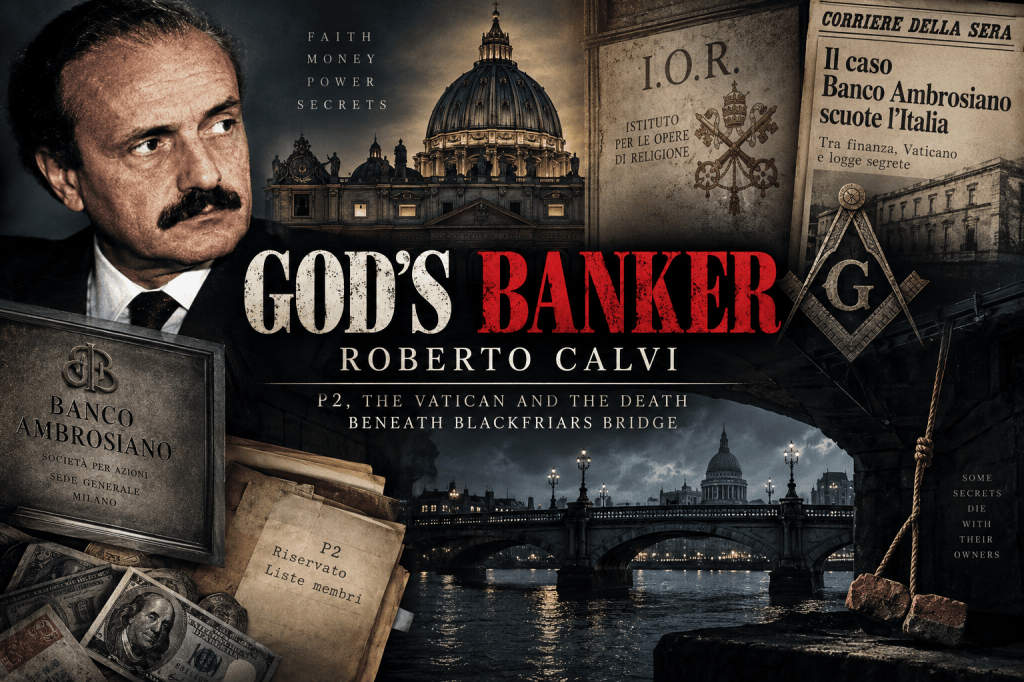
Calvi was found hanging beneath Blackfriars Bridge in London.
Neither story proves the existence of one omnipotent organization controlling finance, religion, organized crime and politics.
What they demonstrate instead is the existence of overlapping networks whose members and interests repeatedly crossed the same territory.
Italian parliamentary investigators themselves noticed the continuity, describing Sindona and Calvi as occupying successive roles in financial structures connected through relationships with the IOR and Vatican environments.
(Senato Italiano)
That is far more interesting than the simplistic claim that everyone involved belonged to the same conspiracy.
They did not need to.
Power can overlap without being centralized.
THE DOCUMENTS ARE STRANGER THAN THE LEGEND
Whenever the Sindona case is discussed today, it is tempting to add layers to it.
Secret Vatican accounts.
Masonic rituals.
Assassination squads.
International intelligence agencies.
A master plan hidden behind everything.
Some of those stories may contain fragments worth investigating, while others collapse immediately when one asks for evidence.
But removing them does not make Sindona’s story ordinary.
What remains after the mythology is stripped away?
A powerful international banker whose financial empire collapsed.
A documented relationship with Vatican financial circles.
Connections with P2.
A fabricated kidnapping.
A secret journey to Sicily.
Assistance from men linked to organized crime.
A lawyer investigating his financial empire who was assassinated.
A court finding that Sindona ordered the killing.
A twenty-five-year American prison sentence.
A later Italian life sentence.
A cup of cyanide coffee delivered inside a closely guarded prison.
And a parliamentary investigation large enough that the Italian Senate still preserves entire collections of documents devoted simply to understanding the “Sindona case.”
Nothing supernatural is required.
Nothing needs to be invented.
WHAT WE KNOW — AND WHAT WE STILL DON’T
It is established that Sindona was convicted of serious financial crimes in both the United States and Italy, and that an Italian court sentenced him to life for ordering Giorgio Ambrosoli’s murder.
It is documented that his supposed 1979 kidnapping was staged and that he secretly traveled to Sicily using a false identity, where people associated with organized crime assisted him.
(Senato Italiano)
His connections with P2 and Licio Gelli were investigated extensively by the Italian Parliament, and the Sindona investigation became one of the paths that led authorities toward the discovery of the P2 membership lists.
His financial relationship with Vatican interests and the continuity between his financial network and the later Calvi-Ambrosiano world are likewise documented in parliamentary material.
And the official investigation into his death concluded that he committed suicide by cyanide poisoning.
What the evidence does not establish is that the Vatican killed him, P2 killed him, the Mafia killed him or some unified secret alliance decided to silence him.
Those ideas remain speculation.
Yet perhaps the Sindona case does not need one final conspiracy to make it disturbing.
Perhaps its real lesson lies elsewhere.
THE BANKER WHO COULD NO LONGER BE SAVED
For years, Michele Sindona survived by moving between worlds that ordinary people rarely see from the inside: international finance, political influence, private banking, Vatican financial circles, clandestine associations and organized-crime contacts.
When one avenue closed, another seemed to appear.
When his banks began collapsing, powerful people tried to find solutions.
When legal pressure increased, he disappeared.
When he needed to look like a kidnapping victim, he created one.
When Ambrosoli’s investigation threatened him, a court later found that he answered with murder.
But eventually the network could no longer rescue him.
By March 1986, the banker who had once been able to cross borders beneath a false name was sitting inside a maximum-security prison with a life sentence ahead of him.
Then came the coffee.
Perhaps Sindona simply chose his own ending and attempted, as investigators concluded, to make his final act resemble yet another conspiracy.
Perhaps this explains everything.
And perhaps the reason people still hesitate is that too many of the conspiracies surrounding Michele Sindona turned out not to be imaginary at all.
His kidnapping really was fabricated.
His P2 connections really existed.
His Mafia-linked protection during the Sicilian disappearance was investigated and documented.
Ambrosoli really was murdered.
Sindona really was convicted of ordering it.
P2 really was discovered partly through the investigation surrounding his network.
By the time investigators told the public that the cyanide was suicide, history had already taught them an uncomfortable lesson:
sometimes the unbelievable explanation had been the correct one before.
And that is why, forty years after Michele Sindona drank his last coffee, the official answer can be clear while the story still feels unfinished.
SOURCES
Italian Parliament — Parliamentary Commission of Inquiry into the Sindona Case. The commission was formally established in 1980 to investigate the Sindona affair and possible political and administrative responsibilities connected with it; its reports and transcripts remain preserved by the Italian Senate.
Italian Parliament — P2 Commission documents. Parliamentary material reconstructs the relationship between Sindona, Gelli and P2, the false kidnapping and the investigative trail that helped lead to the March 1981 search in which the P2 lists were discovered.
Italian parliamentary documentation on Sindona, Calvi and the IOR. Later reports examined the continuity between Sindona’s financial world and that of Roberto Calvi and Banco Ambrosiano, including their respective relationships with the IOR and Vatican circles.
Contemporary judicial reporting, March 1986. Sindona was sentenced to life imprisonment for ordering the murder of Giorgio Ambrosoli and died days later from cyanide poisoning.
Investigation into Sindona’s death, November 1986. The investigating magistrate concluded that Sindona’s cyanide poisoning was suicide and closed the criminal inquiry into his death.