Liber Juratus Honorii (The Sworn Book of Honorius) is one of the best-known medieval grimoires. The manuscript Royal MS 17 A XLII, preserved at the British Library, dates from the 15th century.
Most articles about the Picatrix describe it as a medieval grimoire filled with talismans, astrology, and mysterious rituals. But the true mystery of this legendary book is not hidden in its rituals.
It is hidden between the lines.
Few people know that the author claims to have studied more than 200 books before compiling the work. In other words, the Picatrix is not an isolated creation but a remarkable collection of knowledge drawn from Greek, Egyptian, Persian, and Arabic traditions, carefully woven into a single manuscript.
But there is an even more intriguing detail.
When historians compare the text with its sources, they find that many of its ideas do not come from other grimoires at all. Instead, they trace back to an unexpected work known as The Nabataean Agriculture—a book about farming, seasonal cycles, plants, and the rhythms of nature. In the Picatrix, these observations are transformed into a broader vision in which the heavens, time, and the natural world are seen as parts of one interconnected system.
This may be the greatest secret of the Picatrix.
The book is not simply about magic. It presents a philosophy of the universe in which human beings, the stars, the earth, and the changing seasons all belong to the same cosmic order. During the Middle Ages, this was understood as a way of explaining how the universe itself functioned.
Perhaps this is why the Picatrix had such a profound influence during the Renaissance. Philosophers and scholars were fascinated not only by its mysterious reputation but also by its ambitious attempt to unite astronomy, philosophy, symbolism, and the natural world into a single vision of reality.
Today, many readers search the Picatrix hoping to discover forgotten rituals or hidden formulas. Yet its greatest lesson may be something far more enduring: the belief that nature is not a collection of separate objects but a web of relationships, patterns, and correspondences.
Whether we see this as medieval philosophy, intellectual history, or a fascinating cultural artifact, one thing remains certain.
Nearly a thousand years after it was written, the Picatrix still invites us to ask the same timeless question:
Liber Juratus Honorii (The Sworn Book of Honorius) is one of the best-known medieval grimoires. The manuscript Royal MS 17 A XLII, preserved at the British Library, dates from the 15th century.
The Forbidden Book That Was Never Meant for Everyone
Among the many medieval grimoires that have survived the centuries, few are surrounded by as much mystery as the Liber Juratus, also known as The Sworn Book of Honorius.
Unlike many famous grimoires, its greatest secret is not hidden in unusual symbols or elaborate diagrams.
It is hidden in its intended audience.
The title itself offers the first clue. The word Juratus means “sworn.” According to the introduction preserved in medieval manuscripts, the book was intended only for individuals who had taken a solemn oath to protect its contents. Whether this account reflects historical events or serves as a literary device is uncertain, but it reveals how exceptional and restricted the text was meant to appear.
This immediately sets the Liber Juratus apart from many other medieval works.
Rather than presenting knowledge as something anyone could possess, it portrays wisdom as something that required discipline, discretion, and moral responsibility.
Another fascinating aspect is that the manuscript focuses less on material gain than many later grimoires. Modern readers often expect medieval occult books to revolve around treasure, power, or supernatural control. The Liber Juratus is different.
Much of its content reflects a search for divine wisdom, contemplation, and a deeper understanding of creation. Historians generally view it as a product of medieval religious and intellectual traditions, where prayer, symbolism, and philosophy were often intertwined.
One detail that is rarely mentioned is the extraordinary effort required to produce a manuscript like this.
Every copy was written entirely by hand. Before the invention of the printing press, creating a single manuscript demanded months—sometimes years—of careful work by trained scribes. As a result, no two surviving copies are exactly alike. Differences in wording, additions, omissions, and annotations reveal that the text evolved as it was copied across generations.
In many ways, each manuscript became a historical document in its own right.
This is one reason why scholars continue to study the Liber Juratus today. They are not only interested in what the book says but also in how it changed over time, what those changes reveal about medieval Europe, and how ideas traveled across different regions and cultures.
Perhaps the greatest lesson of the Liber Juratus is not that it contains hidden secrets.
Its real value lies in showing us how knowledge was regarded nearly eight centuries ago—not as entertainment or instant information, but as something precious, demanding patience, study, and personal responsibility.
That may be why this remarkable manuscript continues to fascinate historians, collectors, and curious readers today.
Sometimes, the greatest mystery is not the book itself.
It is the world that believed such a book was worth protecting with an oath.
History is full of stories so strange that they sound like fiction. One of the most unusual claims tells of a French queen who supposedly commissioned a tiny cannon for a single purpose: to wage war against fleas inside the magnificent Palace of Versailles. It sounds absurd. Yet this curious tale has survived for generations. But is it true? The Palace of Luxury… and Insects Today, the Palace of Versailles represents elegance, wealth, and royal perfection. Glittering halls, golden decorations, crystal chandeliers, and endless gardens create the image of absolute luxury. The reality, however, was far less glamorous. During the seventeenth and eighteenth centuries, fleas, lice, bedbugs, and other insects were common throughout Europe. Even the richest palaces struggled with infestations. Hygiene standards were very different from modern expectations, and insects were considered an unavoidable part of everyday life. The royal family was no exception. The Curious Story of the Flea Cannon According to the legend, Marie Antoinette became so irritated by fleas that craftsmen created a miniature cannon capable of firing tiny charges to destroy insects hiding in furniture and fabrics. The story spread because it perfectly matched the extravagant image many people already had of the French court. A queen declaring war on fleas with artillery certainly sounds memorable. But there is a problem. No reliable historical document confirms that such a weapon was ever commissioned by Marie Antoinette. No royal inventory lists it. No contemporary witness clearly describes it. No museum possesses an authenticated example connected to the queen. Why Did People Believe It? Legends often grow around famous historical figures. Marie Antoinette became one of the most controversial queens in European history. During the French Revolution, countless exaggerated stories circulated to portray her as disconnected from ordinary people. Some were completely invented. Others mixed small facts with large doses of imagination. The flea cannon fits perfectly into this tradition. It reflects how people imagined the luxurious—and sometimes ridiculous—life inside Versailles rather than providing solid historical evidence. Were Tiny Cannons Real? Interestingly, miniature cannons certainly existed. European gunsmiths built beautiful decorative cannons for wealthy collectors and members of the nobility. Some were working models capable of firing tiny projectiles. These miniature weapons were often displayed in royal collections or used for entertainment. Because such objects genuinely existed, it became easier for later generations to believe that one might have been adapted for killing insects. The Truth Behind the Legend Whether the famous flea cannon ever existed remains uncertain. Modern historians generally classify the story as a legend rather than an established historical fact. Yet the tale reveals something even more fascinating than the cannon itself. It reminds us that behind the glittering image of Versailles lived real people dealing with surprisingly ordinary problems—cold rooms, unpleasant smells, insects, disease, and discomfort. Sometimes history becomes unforgettable not because of grand battles or political revolutions, but because of the bizarre stories that survive through the centuries. Perhaps no tiny cannon ever fired at a flea. But the legend itself has certainly survived far longer than any insect ever could.
Part I – The Discovery That Challenged Biblical History
In December 1945, two Egyptian brothers searching for natural fertilizer near the cliffs of Jabal al-Tarif, close to the town of Nag Hammadi, made a discovery that would become one of the most significant archaeological finds in the history of early Christianity. Buried inside a sealed earthenware jar were thirteen leather-bound papyrus codices containing more than fifty ancient Christian and Gnostic writings. Some of these texts had never been seen by modern scholars, while others had survived only through brief quotations preserved by early Church Fathers. Among them was a document that would soon become one of the most debated texts in biblical scholarship: The Gospel of Thomas. Unlike the four canonical Gospels, this text contains no account of Jesus’ birth, no miracles, no crucifixion, no resurrection, and no narrative describing His ministry.
Instead, it presents 114 sayings attributed to Jesus, many of which resemble passages found in Matthew, Mark, Luke, and John, while others appear entirely unfamiliar. Its opening sentence immediately sets the tone: “These are the secret sayings that the living Jesus spoke and Didymus Judas Thomas wrote down.” The word secret has fascinated readers for decades. Was this merely a literary device? Or did the author genuinely believe he was preserving teachings intended only for a select group of followers? The answer remains one of the central questions surrounding the Gospel of Thomas.
The Discovery at Nag Hammadi The discovery of the Nag Hammadi Library transformed the study of early Christianity. Before 1945, historians knew that many alternative Christian writings had existed because influential theologians such as Irenaeus, Hippolytus, and Origen had written against them during the second and third centuries. However, most of the original documents had disappeared. Scholars knew these texts only through the criticisms of those who opposed them. Nag Hammadi changed everything. For the first time, historians could examine these writings directly instead of relying on hostile descriptions. The codices contained works such as the Gospel of Philip, the Apocryphon of John, the Gospel of Truth, and the Gospel of Thomas. Together, they revealed a remarkably diverse Christian landscape during the first centuries after Jesus’ death. Rather than representing a single unified movement, early Christianity consisted of numerous communities that sometimes held very different beliefs about Jesus, salvation, and the nature of God. Who Wrote the Gospel of Thomas? The text attributes itself to Didymus Judas Thomas. In Aramaic, Thomas means “twin.” In Greek, Didymus also means “twin.” Whether this title refers to the apostle traditionally known as Thomas or carries symbolic meaning remains uncertain. Most biblical scholars do not believe that the Apostle Thomas personally wrote the document. Linguistic analysis, theological vocabulary, and historical context generally suggest that the surviving text reached its present form sometime during the second century AD, although several researchers argue that some individual sayings preserved within it could be considerably older. This distinction is important. The age of the document itself is not necessarily identical to the age of every tradition it contains. Some sayings may preserve authentic early Christian traditions. Others appear to reflect theological developments that emerged generations later. Separating those layers remains one of the greatest challenges facing modern scholarship.
A Gospel Unlike Any Other The Gospel of Thomas reads very differently from the New Testament. Instead of telling a story, it resembles a collection of wisdom sayings. Many begin with familiar phrases: “Jesus said…” Each statement stands almost independently. Some closely parallel verses found in the canonical Gospels. Others expand upon familiar teachings. Still others appear mysterious, symbolic, and difficult to interpret. Consider one of its best-known sayings: “The Kingdom is inside you, and it is outside you. When you know yourselves, then you will be known…” This emphasis on self-knowledge differs from the narrative focus of the canonical Gospels. Rather than describing historical events, the Gospel of Thomas repeatedly encourages readers to seek understanding through insight and interpretation. This characteristic has led many scholars to associate the text with traditions later described as Gnostic, although the extent of that connection remains debated. Was It Really Suppressed? Popular books and documentaries often claim that the Church deliberately hid the Gospel of Thomas because it contained dangerous truths. The historical evidence paints a more complex picture. During the first three centuries of Christianity, there was no universally accepted New Testament. Different Christian communities used different collections of writings. Some texts were widely accepted across the Roman Empire. Others circulated only within particular regions or theological movements. The process of recognizing the books that would eventually form the New Testament developed gradually over several centuries. When bishops and theologians evaluated Christian writings, they generally considered three principal questions. Could the text reasonably be connected to the apostles? Was it widely used in Christian worship across diverse communities? Did its theology agree with what churches had already received as apostolic teaching? The Gospel of Thomas encountered difficulties on all three points. Its authorship remained uncertain. Its circulation appears to have been limited compared with the canonical Gospels. Some of its teachings differed significantly from emerging orthodox theology. For these reasons, most historians conclude that the text was not removed from the Bible after once belonging to it. Instead, it was never accepted into the developing New Testament canon.
The Most Controversial Sayings The fascination surrounding the Gospel of Thomas comes largely from several enigmatic sayings that have inspired centuries of interpretation. Some appear remarkably similar to the teachings found in Matthew and Luke. Others have no clear parallel anywhere else. One of the most famous declares: “Whoever discovers the interpretation of these sayings will not taste death.” Unlike the canonical Gospels, where salvation is closely connected to Jesus’ death and resurrection, the Gospel of Thomas repeatedly emphasizes understanding, insight, and discovering hidden meaning. For some readers, this reflects an ancient tradition centered on spiritual wisdom. For others, it represents a theology fundamentally different from mainstream Christianity. The debate continues. Why Does It Still Matter? The importance of the Gospel of Thomas does not depend upon whether every saying originated with Jesus. Its value lies elsewhere. It demonstrates that early Christianity was far more intellectually and spiritually diverse than many people imagine. Different communities preserved different memories. Different teachers emphasized different aspects of Jesus’ message. Some focused on faith. Others emphasized wisdom. Some proclaimed salvation through Christ’s death and resurrection. Others concentrated on inner transformation and spiritual knowledge. The Gospel of Thomas offers a rare window into one of those forgotten voices. Whether one accepts its authority or not, it remains one of the most important discoveries ever made for understanding the first centuries of Christian history.
To Be Continued… Part II will examine the most controversial question of all. Was the Gospel of Thomas rejected because it contradicted orthodox Christianity, or because it preserved ideas that Church leaders considered dangerous? We will also explore its relationship with Gnosticism, analyze several of its most debated sayings, and examine what leading biblical scholars conclude after decades of research. The answers may be more surprising—and far more nuanced—than either believers or skeptics often expect.
Part I – The Origins of One of History’s Most Controversial Theories
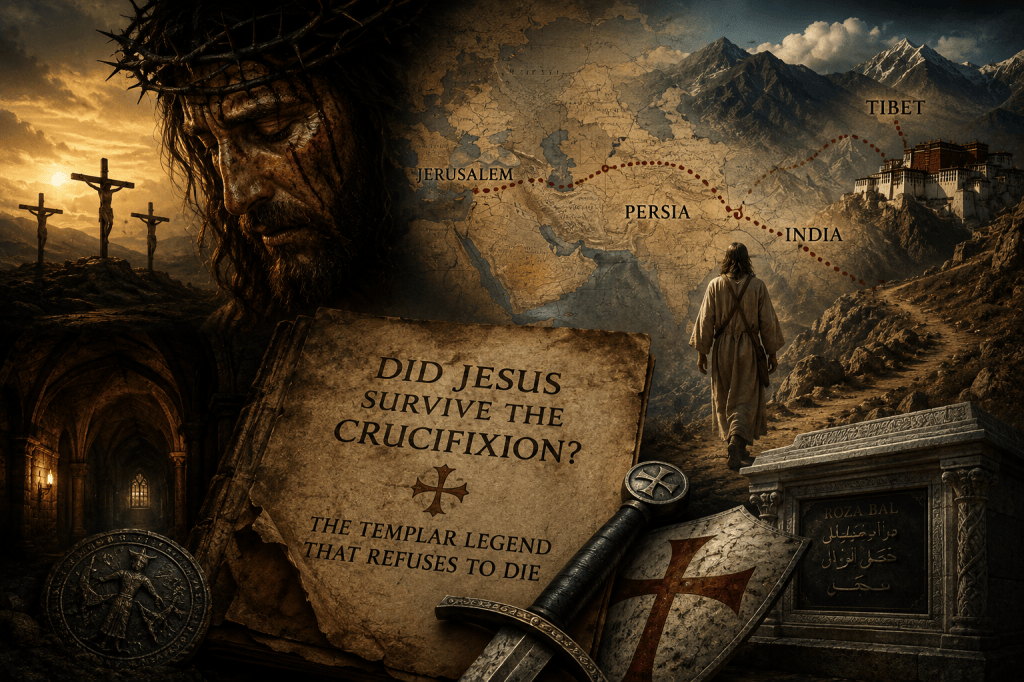
Few events in human history have shaped civilization as profoundly as the crucifixion of Jesus of Nazareth. For nearly two thousand years, Christians have regarded the crucifixion, death, and resurrection of Jesus as the foundation of their faith. The event has been examined by theologians, historians, archaeologists, physicians, and philosophers, becoming one of the most extensively studied episodes in the ancient world. Yet alongside the traditional account exists another story—one that refuses to disappear despite centuries of criticism and debate. According to this alternative tradition, Jesus did not die on the cross. Instead, he survived the crucifixion, recovered from his injuries, left Judea, and traveled east through Persia before eventually reaching India, Tibet, and, according to some versions of the legend, even southern France. It is an extraordinary claim. The question is not whether it is fascinating—it undoubtedly is. The real question is whether history provides any evidence to support it. What Do the Earliest Historical Sources Say? The earliest written accounts of Jesus’ death are found in the New Testament, particularly the four canonical Gospels. Although they differ in certain details, all four describe the same essential sequence of events: Jesus was arrested, tried by the Roman governor Pontius Pilate, sentenced to crucifixion, died on the cross, and was placed in a tomb by Joseph of Arimathea. Outside Christian writings, several ancient historians also mention Jesus. The Jewish historian Flavius Josephus, writing near the end of the first century, refers to Jesus and states that he was condemned under Pontius Pilate. Although parts of the passage are believed to have been modified by later Christian copyists, most historians agree that Josephus originally mentioned Jesus’ execution. The Roman historian Tacitus, writing in the early second century, independently recorded that Christus suffered the “extreme penalty” during the reign of Emperor Tiberius under Pontius Pilate. His account is particularly significant because Tacitus had little sympathy for Christianity and was not attempting to promote Christian beliefs. Taken together, these early sources strongly support the historical conclusion that Jesus was crucified. Whether he died during the crucifixion, however, became the focus of later debate. Could Someone Survive Crucifixion? Crucifixion was one of the most brutal methods of execution ever devised. Its purpose was not only to kill but to prolong suffering for as long as possible. Victims often died from a combination of blood loss, shock, dehydration, respiratory failure, and cardiac complications. Death sometimes required many hours and, in some cases, several days. Medical researchers who have studied Roman crucifixion generally conclude that survival would have been extremely unlikely, particularly after severe scourging and prolonged suspension on a cross. Nevertheless, supporters of the “survival theory” point to several details recorded in the Gospels. They note that Jesus appeared to die sooner than expected, prompting surprise from Pontius Pilate. They also emphasize that his legs were not broken, unlike those of the two men crucified beside him, because Roman soldiers believed he was already dead. Finally, they cite the treatment of his body with a mixture of myrrh and aloes, suggesting these substances may have possessed healing properties. Most historians and medical experts interpret these details differently. They argue that Roman executioners were highly experienced and that failing to ensure a prisoner’s death would have carried severe consequences. Furthermore, the spear thrust described in the Gospel of John has traditionally been understood as confirmation that death had already occurred. Thus, while the survival theory remains possible in the abstract, it is not supported by the consensus of historical or medical research. The Birth of an Extraordinary Legend For nearly eighteen centuries, few people suggested that Jesus had traveled to India after the crucifixion. The idea entered public discussion in the late nineteenth century through the writings of Nicolas Notovitch, a Russian journalist who claimed that while visiting the Hemis Monastery in Ladakh, Tibet, he had discovered ancient manuscripts describing the life of a man named Issa. According to Notovitch, these texts stated that Jesus had spent many of his “lost years” in India before returning to Judea—and, in some versions of the story, returned there again after surviving the crucifixion. His book attracted enormous attention throughout Europe. If genuine, the manuscripts would have transformed the study of Christian history. The problem was verification. When respected scholars later visited the monastery, they reported that the monks denied any knowledge of the manuscripts or of Notovitch’s account. Some researchers concluded that he had misunderstood local traditions; others accused him of inventing the story entirely. To this day, no original manuscript matching Notovitch’s description has been independently authenticated. Why India? The connection between Jesus and India did not arise entirely by chance. Ancient trade routes linked the Roman Empire with Persia and the Indian subcontinent. Merchants, travelers, and religious teachers moved across these routes for centuries, carrying goods as well as ideas. The “lost years” of Jesus—roughly the period between his childhood and the beginning of his public ministry—have long fascinated historians because the canonical Gospels say very little about them. This silence created space for speculation. Could he have traveled east? Could he have encountered Buddhist teachers? Could similarities between certain ethical teachings reflect contact between distant cultures? These questions continue to be debated. While some scholars acknowledge that cultural exchanges between the Mediterranean and South Asia certainly occurred during the first century, no reliable historical evidence demonstrates that Jesus himself ever made such a journey. The absence of evidence does not necessarily prove the journey impossible. It simply means that historians cannot presently confirm it. Faith, History, and the Search for Evidence The enduring popularity of the India theory reveals something important about human nature. History is rarely satisfied with unanswered questions. Whenever gaps appear in the historical record, alternative explanations often emerge to fill them. Some eventually become accepted after new discoveries. Others remain fascinating legends that reflect the hopes, beliefs, and imagination of later generations more than the events themselves. The story of Jesus in India stands precisely at that intersection. It combines genuine historical mysteries with disputed documents, religious traditions, and centuries of speculation. Separating those elements requires careful examination rather than quick conclusions.
To Be Continued… In Part II, we will investigate the most controversial claims surrounding this legend: the mysterious Roza Bal tomb in Kashmir, traditions placing Jesus in Tibet after the crucifixion, the alleged connection with the Knights Templar, and what modern historians, archaeologists, and biblical scholars conclude after examining the available evidence. Did one of history’s greatest secrets survive for two thousand years? Or did an intriguing legend gradually grow into one of the world’s most enduring historical mysteries?
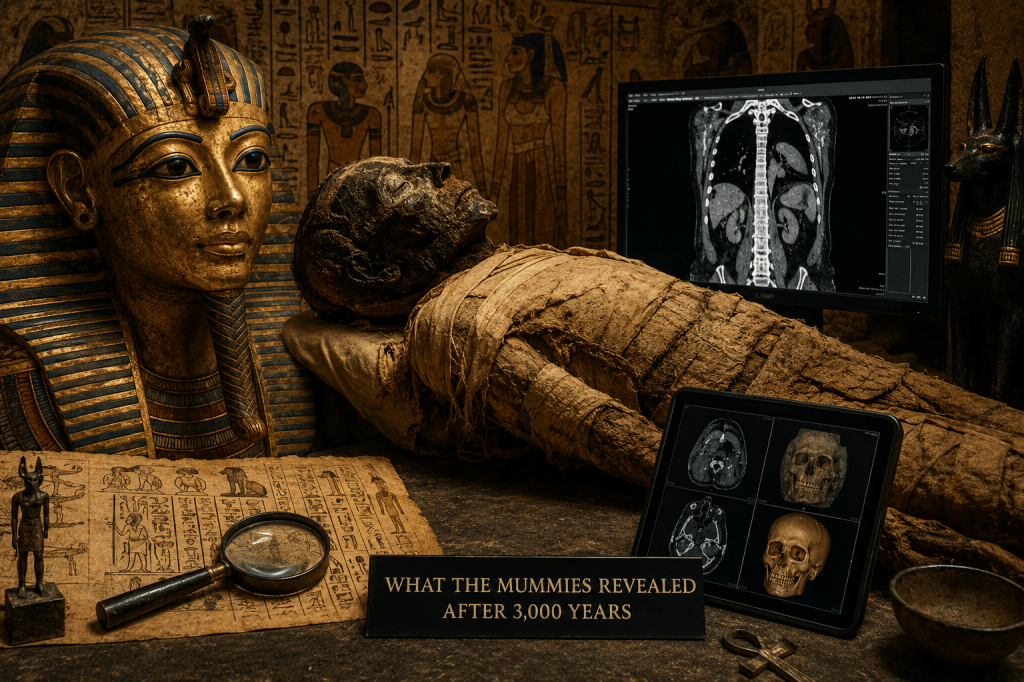
For more than three thousand years, the pharaohs of ancient Egypt were believed to have carried their secrets into eternity. Their carefully preserved bodies rested inside magnificent tombs, surrounded by gold, precious stones, sacred texts, and objects intended to accompany them into the afterlife. To the ancient Egyptians, mummification was not merely a funerary custom; it was a sacred science designed to preserve both identity and dignity beyond death. For centuries, historians viewed these royal mummies primarily as archaeological treasures. They were admired for their elaborate coffins, exquisite funerary masks, and the astonishing skill of the embalmers who had preserved them. Little attention was paid to what their bodies might reveal about their lives. That changed dramatically during the twentieth and twenty-first centuries, when advances in medicine transformed ancient mummies into some of history’s most extraordinary medical patients. Using CT scans, DNA analysis, digital reconstruction, endoscopy, and forensic pathology, researchers began examining Egyptian royalty without disturbing the delicate remains. These technologies allowed scientists to look beneath layers of linen that had remained untouched for millennia. What they discovered was remarkable. The bodies of Egypt’s most powerful rulers told stories of disease, chronic pain, genetic disorders, traumatic injuries, and medical conditions that no ancient scribe had ever recorded. The image of the pharaoh as an almost divine being began to fade. Behind the gold masks and monumental temples were men and women who suffered from many of the same illnesses that affect humanity today.
The Silent Testimony of the Mummies
Ancient Egyptian inscriptions often portrayed pharaohs as physically perfect. They were depicted defeating enemies in battle, hunting dangerous animals, and standing proudly before the gods with youthful strength regardless of their actual age. Royal propaganda left little room for weakness or illness. The mummies told a different story. Modern imaging techniques revealed worn joints, damaged teeth, spinal degeneration, healed fractures, cardiovascular disease, and congenital abnormalities. Some rulers endured years of chronic pain while continuing to govern one of history’s greatest civilizations. Perhaps the most striking realization was that the body itself had become a historical document. Bones, arteries, and even preserved soft tissue recorded details that no ancient inscription could hide.
Tutankhamun: The Boy King Reconsidered
No Egyptian ruler has attracted more fascination than Tutankhamun. Since Howard Carter uncovered his nearly intact tomb in 1922, generations have wondered about the young king whose golden mask became the symbol of ancient Egypt itself. For decades, his death remained one of archaeology’s greatest mysteries. Early theories suggested assassination. Some believed he had been struck on the head during a palace conspiracy. Others proposed a fatal accident involving a chariot. Modern forensic studies have painted a far more complex picture. High-resolution CT scans demonstrated that the apparent fracture at the back of his skull was most likely caused after death during the mummification process or by the excavation itself. The long-standing murder theory gradually lost support. DNA studies produced another important discovery. Researchers identified evidence that Tutankhamun suffered from malaria, a disease that still claims hundreds of thousands of lives each year. The analysis also suggested that he inherited several genetic conditions associated with repeated marriages between close relatives within the royal family. His left foot showed significant deformities, including evidence of clubfoot and bone disorders that would have made walking painful. More than one hundred walking sticks discovered inside his tomb, once thought to be ceremonial objects, suddenly acquired a new meaning. They may have been practical necessities rather than symbols of authority. The image of a powerful warrior racing into battle became increasingly difficult to support. Instead, modern science revealed a young ruler struggling with physical limitations while carrying the immense responsibilities of kingship.
Royal Blood and Hidden Genetic Risks
The Egyptian royal family believed that preserving divine bloodlines required marriages within the dynasty. Brothers married sisters. Half-siblings became husbands and wives. The practice strengthened claims to the throne but also increased the likelihood of inherited genetic disorders. DNA analyses have begun reconstructing these complex family relationships with unprecedented precision. While not every physical characteristic can be attributed directly to inbreeding, researchers generally agree that repeated marriages among close relatives increased the probability of congenital abnormalities appearing within the royal family. This realization has transformed the study of Egyptian history. Political decisions once interpreted purely through religion or tradition now carry biological consequences visible thousands of years later inside the royal mummies themselves.
Ramesses II: The Warrior Who Lived with Pain
If Tutankhamun represents youth, Ramesses II represents longevity. Known to history as Ramesses the Great, he ruled Egypt for approximately sixty-six years, commanded military campaigns, and oversaw one of the most ambitious building programs in the ancient world. His colossal statues continue to dominate the Egyptian landscape more than three millennia after his death. Yet the body of this legendary ruler reveals that his later years were anything but comfortable. CT imaging and physical examinations indicate that Ramesses suffered from severe arthritis, particularly affecting his spine and hips. The degeneration was so advanced that walking would almost certainly have become increasingly difficult during old age. His dental health was equally poor. Researchers found extensive tooth wear, abscesses, and advanced infections. Some experts believe that chronic dental disease may have caused persistent pain for many years. In an era before antibiotics or modern dentistry, even a seemingly ordinary tooth infection could become a serious medical condition. Despite these ailments, Ramesses continued to govern one of the ancient world’s greatest empires well into his nineties—an extraordinary lifespan by ancient standards. His mummy reminds us that greatness and suffering often coexist. The monumental temples celebrate the victorious king. The preserved body reveals the aging man behind the crown.
Ancient Medicine: Remarkably Advanced, Yet Limited
The discoveries inside Egypt’s royal mummies have also transformed our understanding of Egyptian medicine. Ancient physicians possessed surprisingly sophisticated knowledge. Medical papyri describe surgical procedures, wound treatment, fracture management, herbal remedies, and careful clinical observation. Egyptian doctors recognized numerous diseases and developed specialized branches of medicine centuries before similar practices emerged elsewhere. Yet they remained powerless against many of the conditions revealed by modern science. They could relieve pain. They could clean wounds. They could set broken bones. But malaria, inherited genetic disorders, severe arthritis, and cardiovascular disease lay far beyond the reach of ancient medicine. The pharaohs, despite being regarded as living gods, remained subject to the same biological realities as every other human being. Death, illness, and aging recognized no royal authority.
Discover the remarkable life of Alfred Nobel,the Inventor of Dynamite,whose personal tragedies inspired the creation of the world-famous Nobel Prize.
History remembers Alfred Nobel as the founder of the Nobel Prize, the world’s most prestigious award for science, literature, and peace. Yet behind this celebrated name stood a man whose life was marked by danger, personal tragedy, and relentless determination. The irony remains striking: the inventor whose discoveries revolutionized explosives ultimately chose to dedicate his fortune to honoring those who benefited humanity.”My home is where I work, and I work everywhere.” With these words, Alfred Nobel expressed his belief that science belonged to no nation, but to all mankind.Born in Stockholm on October 21, 1833, Nobel grew up under the influence of his father, Immanuel Nobel, an engineer and inventor deeply involved in the study of explosive substances. At a time when chemistry still held many dangerous mysteries, the Nobel family lived on the frontier between innovation and catastrophe. Alfred received his first formal education in St. Petersburg, where his father’s business had prospered, before being sent abroad at the age of seventeen to study mechanical engineering in New York. There he spent four formative years learning from the renowned Swedish-American engineer John Ericsson, whose military inventions had already earned international fame.The young inventor quickly demonstrated an exceptional talent for chemistry and engineering. In 1863, he patented a mixture of gunpowder and nitroglycerin, although the invention attracted little commercial interest. His truly revolutionary breakthrough came soon afterward, when he solved one of the greatest challenges surrounding nitroglycerin.Unlike conventional explosives, nitroglycerin could not simply be ignited with a burning fuse. The oily liquid burned harmlessly when exposed to flame, refusing to detonate unless subjected to a sudden and violent shock. Nobel concluded that only an instantaneous release of energy within the liquid itself could unleash its devastating power. From this insight emerged one of the most important inventions in the history of explosives: the mercury blasting cap, a device that transformed the practical use of high explosives and changed mining, engineering, and military technology forever.The significance of the invention attracted the attention of Emperor Napoleon III of France, who helped Nobel obtain financial support of 10,000 francs to establish a factory at Heleneborg, near Stockholm. There, father and sons resumed their dangerous experiments with nitroglycerin, fully aware that each day carried the possibility of disaster.Disaster arrived on September 3, 1864.A massive explosion destroyed the factory in an instant, killing several workers, including Alfred’s youngest brother, Emil Nobel. The tragedy devastated the family. Within a year, Alfred’s father died, his health broken by grief, while the Swedish authorities forbade the construction of another nitroglycerin factory on land.Many would have abandoned such perilous research. Alfred Nobel refused.Forced to continue his experiments on a floating laboratory anchored on Lake Mälaren, he worked almost as an exile, moving from shore to shore as local communities rejected the dangerous enterprise. The laboratory became a symbol of his isolation—an inventor carrying both extraordinary ambition and the weight of repeated catastrophe.It was during this period that Nobel made the discovery that would secure his place in history.He found that a soft, porous mineral known as kieselguhr, composed largely of the fossilized skeletons of microscopic algae called diatoms, possessed an extraordinary property: it could absorb several times its own weight in nitroglycerin. The resulting paste remained remarkably powerful while becoming far safer to transport and handle than liquid nitroglycerin itself.Nobel gave his invention a simple name that would soon become known throughout the world:Dynamite.The invention transformed industries. Railways crossed mountains, tunnels pierced solid rock, mines expanded deeper into the earth, and vast engineering projects became possible on a scale previously unimaginable. Yet the same invention also found military applications, creating a contradiction that would haunt Nobel for the rest of his life.Perhaps no inventor has lived with such a profound paradox. His discoveries accelerated human progress while simultaneously increasing humanity’s capacity for destruction. That inner conflict would eventually shape one of history’s greatest acts of philanthropy.When Alfred Nobel died in 1896, he shocked the world by leaving the overwhelming majority of his immense fortune to establish annual prizes honoring achievements in Physics, Chemistry, Physiology or Medicine, Literature, and Peace. It was as though the man who had spent a lifetime mastering explosive force wished his final legacy to celebrate knowledge, creativity, and reconciliation rather than conflict.Today, the Nobel Prize is remembered far more vividly than dynamite itself. Yet without the hardships, failures, personal losses, and relentless perseverance that defined Alfred Nobel’s extraordinary life, neither would ever have existed. His story remains one of history’s most compelling reminders that the greatest inventions often emerge from tragedy—and that even those associated with destruction can ultimately choose to leave behind a legacy dedicated to humanity’s highest ideals.
On 7 October 2019, Erin Valenti, a 33-year-old technology executive from Utah, boarded a flight to California.
The trip appeared routine. She was scheduled to attend a founders’ conference and a leadership seminar before returning home to her husband and her growing business.Five days later, she was found dead in the back seat of her rental car.
Officially, the case was ruled a death from natural causes associated with an acute manic episode.
Yet nearly six years later, the circumstances surrounding her final days continue to generate questions that have never been fully answered.
Who Was Erin Valenti?
Erin Valenti was the CEO of Tinker Ventures, a technology company focused on helping startups develop innovative software solutions. Colleagues described her as intelligent, energetic and ambitious. She frequently attended conferences, worked long hours and was well known within Utah’s entrepreneurial community.
According to her family and husband, she had no documented history of bipolar disorder, psychosis, psychiatric hospitalization or substance abuse.That fact would later become central to the controversy surrounding her death.
A Normal Business Trip
During the first days of her California visit, nothing appeared unusual.She attended meetings.She met former colleagues.She participated in leadership events.She spoke regularly with her parents, as she often did while traveling.Family members later recalled that she sounded optimistic and excited about returning home. One conversation with a former employer reportedly focused on new business ideas and solutions to challenges she had recently faced.Nothing suggested that within twenty-four hours she would completely disappear.
The Phone Calls
Everything changed on Monday afternoon.Erin called her parents after experiencing difficulties returning her rental vehicle. At first, the conversation appeared ordinary.Moments later she called again.This time, according to her mother, something was profoundly wrong.
Her speech became rapid and fragmented.Her thoughts appeared disconnected.
Then she made a statement that would later become the defining phrase of the entire case.”It’s all a game. It’s a thought experiment. We’re in the Matrix.”
Family members immediately realized that something was terribly wrong.Her father later described the conversation as completely unlike anything they had ever experienced.
The woman speaking no longer sounded like Erin.
The Disappearance
After those phone calls, contact stopped.Her cellphone eventually became inactive.Friends and relatives were unable to reach her.Police began searching after she was officially reported missing.Meanwhile, her rental car remained parked on a quiet residential street in San Jose.For five days.No one appears to have noticed anything unusual.
The Discovery
On 12 October 2019, a volunteer assisting in the search located the rental vehicle near 6500 Bose Lane.Erin’s body was found inside.One detail immediately attracted attention.
She was lying in the back seat, not behind the steering wheel.Investigators found no obvious evidence of violence.No indication of robbery.No signs of a struggle.The vehicle itself showed no evidence of a collision or forced entry.
The Official Conclusion
The Santa Clara County Medical Examiner ultimately concluded that Erin Valenti died from natural causes during an acute manic episode.According to medical experts, severe mania can produce profound sleep deprivation, dehydration, extreme psychological stress and dangerous physiological changes. In rare situations, these complications may contribute to sudden death.
The conclusion surprised many observers.Although first episodes of mania can occur in adulthood, they often leave relatives struggling to understand how dramatic behavioral changes could emerge so suddenly.
The Family’s Questions
Erin’s husband, Harrison Weinstein, who is trained as a psychologist, publicly questioned whether the official explanation fully accounted for the circumstances.He emphasized that Erin had never been diagnosed with a psychiatric illness.Her parents expressed similar concerns.They were not necessarily rejecting the medical findings.Instead, they questioned whether investigators had successfully reconstructed everything that happened during the missing five days.
Several questions remain unanswered.
Why did she drive aimlessly for hours before disappearing?Why was the vehicle left where it was?Why was her body found in the rear seat?What happened during the period between her final phone call and her death?Publicly available records provide only partial answers.
The “Matrix” Statement
Perhaps no element of the case has generated more speculation than Erin’s final recorded words.Within hours of news reports becoming public, online forums connected her comments to simulation theory, artificial intelligence, secret technology projects and countless conspiracy theories.There is, however, no evidence supporting these claims.Mental health specialists note that individuals experiencing acute mania or psychosis sometimes express grand philosophical ideas, unusual beliefs or references to concepts drawn from popular culture.
The word “Matrix” may therefore represent symbolism rather than hidden knowledge.Equally, no investigator has produced evidence that it meant anything beyond the state of mind Erin was experiencing during those final hours.
What Can Be Established?
Several facts are not disputed.
Erin Valenti traveled to California for business.She suddenly began speaking in a confused and highly unusual manner.She disappeared shortly afterward.Five days later she was found deceased inside her rental vehicle.The official medical conclusion identified an acute manic episode as the underlying cause of the events leading to her death.Beyond those facts, certainty becomes increasingly difficult.
An Unfinished Story
The death of Erin Valenti illustrates how modern mysteries are often shaped not by hidden evidence but by missing information.Every unexplained gap invites speculation.Every unanswered question creates another theory.Yet responsible investigation requires distinguishing between what is known, what is probable and what remains entirely unknown.Today, Erin Valenti’s case occupies an unusual place between medical science, criminal investigation and internet mythology.It reminds us that not every mystery conceals a conspiracy.
Sometimes the greatest challenge is accepting that even after years of investigation, some questions simply remain unanswered.
For decades, reports of unidentified flying objects were relegated to the margins of public discourse. Pilots who described strange encounters risked ridicule. Military personnel often chose silence over publicity, while scientists generally avoided the subject altogether, fearing that even asking the question could damage their careers. That landscape has changed dramatically.
Governments now openly acknowledge that unidentified aerial phenomena—commonly referred to as UAPs—exist.
Military videos have been officially released.
Congressional hearings have been held in the United States. Intelligence agencies have established dedicated offices to investigate reports that remain unexplained after conventional analysis. Yet despite this growing transparency, one question remains unanswered. What are these objects?
Among the scientists willing to confront that question is Dr. Garry Nolan, professor of pathology at Stanford University, inventor, entrepreneur, and one of the world’s leading researchers in immunology and biomedical technology. Unlike many public figures associated with the UFO debate, Nolan’s reputation was established long before he ever discussed unidentified phenomena. His work has been recognized internationally, and he has spent decades developing advanced medical technologies while collaborating with government agencies on highly specialized research. For this reason, when Nolan speaks about UAPs, many people pay attention—not because he claims to possess extraordinary proof, but because he approaches extraordinary questions with scientific discipline.
A Scientist’s Perspective Nolan has repeatedly stated that he believes the phenomenon deserves serious scientific investigation rather than immediate dismissal. In interviews and public conferences, he has argued that the available evidence suggests humanity is observing something genuinely unusual. Perhaps his most widely discussed statement was his personal opinion that there is a very high probability that an advanced non-human intelligence has visited—or may still be visiting—Earth. Importantly, Nolan has consistently distinguished between evidence and interpretation. He does not claim to possess definitive proof of extraterrestrial visitors. Instead, he argues that enough credible observations exist to justify rigorous scientific study. That distinction is often lost in sensational headlines.
The Theory of Planetary Guardians One of the most intriguing hypotheses associated with recent UAP discussions comes not from government agencies but from independent British researcher Patrick Jackson. After examining thousands of reports describing small luminous spheres, Jackson proposed a remarkable possibility.
What if these mysterious objects are not random visitors at all?
What if they are components of a vast planetary surveillance network? According to his hypothesis, these spheres may operate as an interconnected system, monitoring Earth’s environment while responding to unusual activity.
Jackson suggests that the apparent consistency of spherical objects reported across decades—and sometimes centuries—may indicate an organized technological network rather than isolated encounters.
The theory becomes even more provocative when it proposes that whoever created such a network may still maintain it. In this interpretation, the spheres would function less like spacecraft and more like autonomous guardians quietly observing events across the planet. It is a fascinating idea. It is also one for which no direct evidence currently exists. Why Spheres?
Curiously, spherical objects appear again and again in modern UAP reports. Military pilots have described metallic spheres moving without visible propulsion. Commercial airline crews have reported glowing orbs maintaining impossible trajectories. Radar systems have occasionally tracked small, highly maneuverable objects that appear inconsistent with known aircraft. Even historical accounts sometimes describe luminous globes crossing the sky centuries before modern aviation existed. Spheres possess certain practical advantages if they are technological devices.
They have no obvious aerodynamic orientation. They distribute structural stress evenly. They can rotate freely in any direction.
Whether these similarities are meaningful or coincidental remains unknown.
Harvard’s Hidden Intelligence Hypothesis Adding another layer to the discussion, several researchers affiliated with Harvard University published a speculative paper exploring an idea once considered almost unthinkable. Rather than asking whether intelligent non-human life exists elsewhere in the universe, they asked a different question. Could an advanced non-human intelligence already exist on Earth, remaining largely undetected? The paper explored several hypothetical possibilities, including hidden civilizations, technologically advanced unknown species, or intelligences operating beyond ordinary human perception.
The authors emphasized that these ideas were speculative thought experiments—not conclusions supported by evidence. Nevertheless, the publication demonstrated something remarkable.
Questions that were once dismissed outright are now entering serious academic discussion.
The Official Position Despite growing public interest, official investigations remain cautious.
The United States Department of Defense, through the All-domain Anomaly Resolution Office (AARO), has investigated hundreds of UAP reports. Some cases remain unresolved because of insufficient data. Others involve sensor limitations or observations that cannot presently be explained. However, official reviews have repeatedly stated that no verified evidence currently demonstrates extraterrestrial technology or confirms the existence of non-human spacecraft operating on Earth. For many observers, this conclusion is unsatisfying.
An unexplained event is not necessarily an extraordinary one. Yet an unexplained event is also not automatically explained. Science advances precisely by examining such questions rather than ignoring them.
Between Skepticism and Curiosity
Perhaps the greatest contribution of researchers like Garry Nolan is not that they provide answers. It is that they encourage better questions. Scientific history is filled with discoveries that were initially dismissed because they challenged accepted understanding. Meteorites were once considered impossible. Continental drift was ridiculed. Ball lightning remained controversial for centuries before careful documentation forced scientists to reconsider. None of these examples prove that UAPs represent non-human technology. They simply remind us that skepticism and curiosity are not opposites. They are partners. Healthy skepticism prevents us from believing every extraordinary claim. Curiosity prevents us from rejecting every extraordinary observation.
Watching the Sky
If Patrick Jackson’s planetary defense theory is correct, then humanity may already be living beneath a silent network of watchers whose purpose we have yet to understand. If the theory is incorrect, then the mysterious spheres may eventually prove to be natural phenomena, classified human technology, sensor artifacts, or explanations not yet imagined. At present, no evidence allows us to choose confidently between those possibilities.
Yet history teaches that the greatest scientific revolutions often begin with observations that refuse to fit comfortably within existing knowledge.
Perhaps the luminous spheres reported by pilots and military personnel are nothing more than misunderstood objects. Perhaps they represent technologies that will one day be fully explained. Or perhaps they are the first faint indication that humanity has never been as alone as it believed.
For now, the sky offers no definitive answers. Only questions.
And sometimes, history begins with a question that seems impossible to ask.
In January 1996, the quiet Brazilian city of Varginha became the center of one of the most controversial incidents in modern UFO history. Within days, stories spread through the streets of frightened witnesses, mysterious military convoys, strange creatures, and an operation so secretive that many believed the truth had been hidden forever.
Nearly two decades later, the mystery took an even darker turn.
In 2014, filmmaker David Vose released a documentary claiming that the creatures reported in Brazil were not extraterrestrials at all. According to the film, they were something far older, far more disturbing, and perhaps deeply connected to humanity’s oldest religious traditions.
Could the beings described by witnesses have been what ancient civilizations once called demons?
Or had imagination transformed an already extraordinary story into modern mythology?
The Day Everything Changed
On an ordinary afternoon in January 1996, several young women walking through a vacant lot in Varginha claimed they encountered a strange creature unlike anything they had ever seen.
According to their descriptions, it was approximately five feet tall, with oily brown skin, disproportionately large eyes, and an oversized head. Some witnesses also reported small horn-like protrusions on its head, giving it an appearance that frightened them so deeply that they ran home in panic.
Within hours, rumors spread across the city.
Residents reported unusual military activity.
Army trucks were allegedly seen moving through the streets.
Some claimed that soldiers had captured an unknown being alive.
Others insisted that more than one creature had been recovered.
No official confirmation ever followed.
Yet the story refused to disappear.
The Documentary That Changed the Narrative
Years later, David Vose proposed a far more controversial interpretation.
His documentary argued that the creatures described in Brazil shared remarkable similarities with ancient descriptions of demonic beings rather than visitors from another planet.
The alleged creatures were described as possessing:
dark, rough skin;
glowing red eyes;
horn-like structures;
an overwhelming sulfur-like odor;
unusual physical abilities.
To supporters of the theory, these details seemed strangely familiar.
Throughout history, many cultures have described supernatural beings with horns, glowing eyes, and terrifying appearances.
Was this merely coincidence?
Or had humanity been describing the same entities for thousands of years under different names?
Demons… or Visitors?
One of the documentary’s central arguments is both fascinating and controversial.
It suggests that ancient people interpreted mysterious encounters according to the language of their own time.
A medieval monk might have described an unknown entity as a demon.
A Roman could have called it a spirit.
An ancient Greek might have believed it was a divine messenger or a creature from the Underworld.
Today, many people would simply call it an alien.
Perhaps, the documentary suggests, the phenomenon has remained the same while human interpretations have changed.
It is an intriguing idea.
But it remains only a theory.
The Government Conspiracy
As with many famous UFO cases, allegations of a military cover-up quickly emerged.
Witnesses claimed they saw military vehicles transporting unusual containers.
Others alleged that hospitals suddenly became restricted areas.
One persistent story even claimed that a soldier involved in handling one of the creatures later died from a mysterious infection.
These accounts have fueled decades of speculation.
However, despite countless investigations by journalists, researchers, and UFO enthusiasts, no verifiable evidence has ever confirmed that non-human beings were captured.
The official explanations ranged from misunderstandings and rumors to misidentified individuals and ordinary military activity.
For believers, those explanations seem insufficient.
For skeptics, they remain the most likely answer.
Why Horns?
Perhaps the most striking feature of the story is the repeated mention of horn-like structures.
Across human history, horns have symbolized power, divinity, fertility, fear, and the supernatural.
Ancient gods wore them.
Kings placed horned crowns upon their heads.
Later religious traditions often associated horns with demons.
Yet biology offers another possibility.
If such a creature existed, small bony protrusions might simply be part of its anatomy rather than symbols of evil.
The human mind naturally interprets unfamiliar forms through familiar ideas.
Sometimes, symbolism speaks louder than reality.
Between Myth and Memory
The Varginha incident has become one of the world’s most enduring modern mysteries.
For some, it represents compelling evidence that governments conceal encounters with non-human intelligences.
For others, it is a fascinating example of how rumors, fear, media attention, and sincere eyewitness testimony can combine to create a legend.
The truth may lie somewhere between those extremes.
History is filled with stories that were dismissed for centuries before new evidence emerged.
It is equally filled with legends that grew larger every time they were retold.
The Mystery Remains
No authenticated photographs of a captured creature have ever surfaced.
No physical remains have been independently examined.
No official documents confirm that the Brazilian military recovered a non-human being.
And yet…
More than thirty years after the incident, people still travel to Varginha searching for answers.
The story refuses to disappear because it speaks to something deeper than a simple UFO report.
It asks an ancient question that humanity has never stopped asking.
If something truly unknown stood before us…
Would we recognize it for what it is?
Or would we simply give it the oldest name we know?
Perhaps an alien.
Perhaps a demon.
Or perhaps something for which human language has never possessed the right words.