Explore Whisper Mysteries

  • Albania Appointed an AI Minister. Has Artificial Intelligence Become Smarter Than the Humans Who Govern Us?

    Albania Appointed an AI Minister. Has Artificial Intelligence Become Smarter Than the Humans Who Govern Us?

    When politicians become less trustworthy than machines, the real problem may not be artificial intelligence, but human intelligence.

    After discovering that witches become rather upset when someone takes away their candles and magic wands, I learned that politicians might soon face an even greater problem: artificial intelligence. Albania has introduced a minister who never sleeps, never asks for holidays, never needs an official limousine, and, at least in theory, cannot be bribed with a discreet envelope slipped beneath a table. I admit that the idea amused me, especially when I imagined a government meeting in which the only participant immune to political ambition was the one who did not possess a human brain. But the more I investigated this extraordinary appointment, the more I realized that behind the smiling digital face of Albania’s artificial minister lies a disturbing question: have human beings become so disappointed with their own institutions that they are beginning to search for honesty inside a machine?

    The Minister Who Never Had a Childhood

    In September 2025, Albanian Prime Minister Edi Rama introduced Diella, an artificial intelligence system presented as the world’s first AI minister, with a proposed role in public procurement and the fight against corruption. Her name means Sun in Albanian, an optimistic choice for a country where government transparency remains a politically sensitive issue. Unlike her human colleagues, Diella has no childhood, no university degree, no election campaign, no political enemies, and no embarrassing photographs from a luxurious holiday paid for by a suspiciously generous businessman. She cannot enjoy an expensive watch, acquire a seaside villa, or arrange a comfortable government position for a cousin. At least, that is the attractive image surrounding her appointment, although the absence of human desires does not automatically make a computer system honest.

    What intrigued me was that Diella had already existed before her spectacular political promotion. In January 2025, she appeared as a virtual assistant on Albania’s e-Albania public services platform, helping citizens navigate administrative procedures and obtain documents. According to government figures published later that year, the system had handled approximately 972,000 interactions. Within months, an administrative assistant had become an international political celebrity, without ever giving an electoral speech or promising voters that this time everything would be different. I wondered how many politicians would envy such a career, particularly one achieved without spending years shaking hands, kissing babies, and pretending to enjoy conversations with people they would never remember.

    The Artificial Minister With a Very Human Face

    Diella was presented not as a mechanical robot but as a young woman wearing traditional Albanian clothing, a clever combination of national identity and futuristic technology. I found this choice fascinating because people do not instinctively trust mathematical formulas, but they respond to familiar faces, reassuring voices, and cultural symbols. Yet the face belonged to a real woman, Albanian actress Anila Bisha, whose image and voice had been used to create the original virtual assistant. In February 2026, Bisha challenged the government’s use of her likeness in court, arguing that her consent had not extended to representing a political figure. The government disputed her allegations, and the legal controversy did not itself establish wrongdoing.

    The irony was difficult to ignore: a government had introduced an artificial minister as a symbol of ethical administration, only to encounter a very human dispute over consent and identity. I began wondering whether the public was being encouraged to admire the perfection of the digital figure while overlooking the complicated human decisions responsible for creating her. Behind every artificial face are designers, contracts, institutions, financial interests, and people who decide what the machine is allowed to say and do. Diella may not possess personal ambitions, but that does not mean the people controlling her are equally free from them.

    Can a Machine Really Eliminate Corruption?

    The most ambitious promise associated with Diella concerned government contracts. Prime Minister Rama presented artificial intelligence as a potential instrument for making public procurement more transparent and resistant to corruption. The idea sounds wonderful, particularly in countries where public money has an unfortunate tendency to travel through mysterious administrative corridors before arriving in equally mysterious private accounts. A computer cannot be tempted by a luxury car or a discreet invitation to a five-star resort, but corruption does not always begin with the person making the final decision. Sometimes it begins when the rules are written, when the requirements are selected, or when the information supplied to the decision-maker has already been manipulated.

    Imagine an artificial intelligence system instructed to award a construction contract to the most suitable company. If the criteria have been carefully designed to favor one particular business, the machine may select that company with perfect mathematical consistency while giving the result an appearance of impartiality. The algorithm has accepted no bribe, but it may still reproduce a dishonest human decision. This is what disturbed me most during my investigation, because artificial intelligence can calculate without personal greed, yet it cannot guarantee that the objectives imposed upon it are fair. A corrupt official can be replaced by a computer, but corruption itself may simply move into the invisible architecture of the software.

    The Scandal Behind the Digital Curtain

    The story became even more interesting when I examined the institutions responsible for Albania’s digital infrastructure. In December 2025, Albania’s Special Anti-Corruption Prosecution, known as SPAK, investigated alleged irregularities involving officials connected with the National Agency for Information Society, or AKSHI, an institution central to the country’s digital-government systems. The allegations concerned matters including public procurement, and they must not be treated as proof of guilt or as evidence that Diella herself participated in wrongdoing. Nevertheless, the situation created an uncomfortable contrast between the promise of technological integrity and the continuing need to investigate the human organizations surrounding that technology.

    I could not resist imagining Diella sitting calmly at her computer while investigators examined the activities of the very institutions responsible for Albania’s digital transformation. The machine might have no interest in money, but the people managing the machinery still live in a world of political influence, commercial relationships, and personal ambition. This does not mean that artificial intelligence cannot help detect corruption; properly designed systems can identify suspicious transactions, compare contracts, and reveal irregularities that human investigators might overlook. It means that technological honesty cannot exist independently of institutional accountability.

    A Minister Who Was Not Actually a Minister

    Another remarkable development occurred in October 2026, when Albania’s Constitutional Court addressed a challenge concerning the virtual ministerial role. The Court rejected the challenge on the grounds before it, while clarifying that the use of artificial intelligence did not create an independent constitutional minister or transfer governmental responsibility away from human authorities. In practical terms, Diella could be called a minister, appear alongside ministers, and attract international attention as a technological innovation, but the constitutional responsibilities of government remained with human officials.

    This distinction fascinated me because it revealed the enormous power of political presentation. A title, a digital face, and a carefully organized public appearance can create the impression of a revolution even when the underlying distribution of authority has not fundamentally changed. In September 2025, Diella had appeared on a screen in Albania’s parliament, delivering a composed message while opposition lawmakers protested. The contrast between the calm virtual speaker and the noisy human politicians was almost theatrical, although a digital avatar delivering a prepared speech is not evidence that it possesses greater wisdom than the people arguing around it.

    Plato, Artificial Intelligence, and the Search for the Perfect Ruler

    As I followed the story, I remembered Plato’s philosopher-kings, the rulers imagined in The Republic as individuals guided by knowledge and justice rather than personal wealth or ambition. More than two thousand years later, humanity appears to be searching for a similar ideal, except that instead of trusting philosophers, we are beginning to place our hopes in algorithms. The dream remains familiar: a ruler untouched by greed, immune to manipulation, and capable of making decisions according to reason rather than private interest.

    But intelligence and wisdom are not interchangeable. A computer may compare thousands of contracts in seconds, recognize statistical anomalies, and identify suspicious financial patterns, yet it cannot independently establish the moral values that a democratic society should follow. Even a technically flawless decision can be unjust if its objectives are wrong. I began to suspect that our fascination with artificial ministers reveals less about the extraordinary abilities of machines than about our growing disappointment with the human beings who govern us.

    The Matrix Behind the Smiling Face

    There is something about Diella that reminded me of The Matrix, not because I believe artificial intelligence is secretly preparing to imprison humanity, but because the story raises a similar philosophical question about the difference between appearance and reality. In the fictional Matrix, people experience a convincing world without understanding the hidden system that shapes their perceptions. In modern society, we increasingly encounter algorithms that influence the information we receive, the products we discover, and the decisions presented to us as reasonable or objective.

    An artificial minister introduces that same problem into political life. Citizens see a reassuring face, hear a confident voice, and receive promises of impartiality, but the actual processes behind the interface may remain difficult to examine. The danger is not necessarily that the machine is secretly malicious, but that people may begin treating its conclusions as unquestionable simply because they appear to come from something more intelligent and less emotional than themselves. I have always found that the most convincing illusions are those containing enough truth to make us stop examining everything else.

    The Most Dangerous Question

    What happens when an artificial intelligence system makes a mistake that affects public money, citizens’ rights, or important government decisions? A human minister can be questioned, investigated, removed from office, or prosecuted when the law permits, but a computer cannot experience moral responsibility or criminal punishment. Responsibility must remain with the people and institutions that design, authorize, supervise, and use the technology. Without clear accountability, artificial intelligence could become an extraordinarily convenient political shield, allowing officials to describe controversial decisions as the neutral conclusions of an algorithm.

    I began this investigation laughing at the thought of politicians competing with a colleague who never takes holidays, never demands a salary, and never dreams of owning a suspiciously expensive seaside villa. But the deeper I examined Albania’s artificial minister, the more I realized that the important question was not whether Diella had become smarter than the humans surrounding her, but why so many people might be willing to believe that she could also be more honest.

    Diella’s name means Sun, and I find that symbolism unusually appropriate, because sunlight reveals what darkness conceals, yet every object illuminated by the sun also casts a shadow. Artificial intelligence may help governments become more transparent, efficient, and accountable, but only if citizens remain free to examine the systems behind it and question the people who control them.

    I do not fear a future in which artificial intelligence helps human beings make better decisions; I fear a future in which human beings use artificial intelligence to make their own decisions appear beyond criticism, because the most dangerous machine may not be the one that becomes more intelligent than its creators, but the one that convinces society that its creators no longer need to be questioned.

    And if we ever reach that point, we will not need to wait for the Matrix to arrive, because we will have built it ourselves.


    Sources and Further Reading

    • Reuters — September 11, 2025: Reporting on Albania’s announcement of Diella as an AI minister.
    • Albanian Government — Official Diella profile and public-service information: https://www.kryeministria.al/en/ministrat/diella/
    • Associated Press and Reuters — February 2026: Reporting on actress Anila Bisha’s legal dispute concerning her image and voice.
    • Deutsche Welle — Reporting on Diella, the image-rights dispute, and Albania’s digital-government infrastructure.
    • Constitutional Court of Albania — October 8, 2026: Decision concerning the constitutional challenge related to Diella.
    • European Union — Regulation (EU) 2024/1689, Artificial Intelligence Act.
    • Plato — The Republic, Books V–VII.

    Author’s note: This article combines documented events with personal interpretation, political satire, and philosophical analysis. Allegations mentioned in the text do not establish guilt, and Diella has not been demonstrated to possess independent constitutional authority.

    Fediverse reactions
  • THE WITCHES ATTACKED ME! I HID MY ELECTRIC BROOM AND DECLARED A STATE OF EMERGENCY

    THE WITCHES ATTACKED ME! I HID MY ELECTRIC BROOM AND DECLARED A STATE OF EMERGENCY

    A tragicomic tale of magic, furious witches, money that refuses to fall from the sky, and a book that dared to take away their candles.

    The witches attacked me!

    No, they didn’t come down the chimney, they didn’t send toads into my bedroom, and they didn’t turn my neighbors into bats, although, now that I think about a few of them, the transformation might have taken place long before I noticed. They attacked me on one of the social media platforms, where modern witchcraft has evolved spectacularly, where curses no longer need to be written on parchment but can simply be delivered in the comments section, and where an angry finger pounding on a keyboard can easily replace three hours of incantations in the forest.

    I admit I was absolutely terrified, so I immediately hid my electric broom in the garage, shoved my magic wand into a place so intimate that not even an experienced demon would dare go looking for it, and decided to remain silent, because there are certain things in life you simply shouldn’t mess with: the tax authorities, a woman who knows where you keep your savings, and, above all, a witch with unlimited internet access.

    The trouble apparently began the moment I committed the unforgivable mistake of writing a book called The Witch Code, in which I had the audacity to strip witches of their candles, herbs, crystals, jars of cinnamon, and little midnight rhymes, leaving them face to face with a question so uncomfortable that I can almost hear their cauldrons bubbling with indignation: if magic is a real power, why should it depend on an inventory of kitchen supplies and an operating schedule determined by the phases of the Moon?

    I fully understand the seriousness of my offense. I have endangered an entire industry, threatened the economic stability of scented candle manufacturers, and probably triggered an existential crisis among sage distributors, who until yesterday believed they were merely supplying aromatic plants, without suspecting that the financial prosperity of humanity depended on their harvests.

    How I Missed My Chance to Become the Richest Woman in the World

    Over the years, I have encountered so many recipes for attracting money that, if even half of them had worked as promised, I would have bought several banks by now, lent money to the International Monetary Fund, and accumulated enough wealth to enjoy the luxury of never checking the price of olive oil again.

    I learned that money comes if you light a green candle on a particular day, sprinkle cinnamon at your doorstep, write an amount on a piece of paper and hide it under your pillow, repeat a formula nine times, or stare into a mirror at midnight while concentrating on universal abundance.

    There are rituals for fast money, unexpected money, money that returns, money that multiplies, and money arriving from unknown sources, although nobody seems to have invented the ritual that makes the electricity bill disappear from the mailbox all by itself.

    I seriously considered standing on one leg at midnight, singing in front of the mirror, and asking the Universe to send me prosperity, but when the electricity bill arrives in the morning, I discover that the power company does not accept positive vibrations instead of euros.

    Therefore, if the ritual fails, I will find myself without money and without electricity, which automatically transforms me into an authentic witch, forced to live by candlelight.

    And that, apparently, is how destiny sometimes pushes you toward spirituality without asking your permission.

    Considering how many bundles of sage, mint, and lavender I would have to burn to attract even fifty cents, I am convinced that the tea industry would plunge into an international crisis, while pharmaceutical companies would begin looking at me with profound jealousy, because according to the logic of certain miraculous recipes, I could attract health, youth, love, and prosperity with a single trip to the spice aisle.

    And yet, amid this extraordinary abundance of advice on becoming rich, I noticed one detail that continues to intrigue me: many of the people promising urgent money through rituals seem remarkably concerned with selling as many of those rituals as possible.

    I do not know these people’s financial circumstances, nor do I claim that all of them are poor, but the commercial contradiction is far too delicious to ignore. If you have discovered the secret formula through which the Universe delivers money within twenty-four hours, why do you need to sell that same formula at a weekend discount?

    If you have direct access to unlimited prosperity, why do you need subscriptions, donations, courses, and private sessions?

    And if the ritual works so wonderfully, why not use it to obtain the money you need before asking me for fifty euros to explain how it’s done?

    I fear that the only demonstrable magic in this business is the extraordinary ability to transform the customer’s money into the income of the person promising miracles.

    I Took the Witch Off Her Broom and Put Her Face to Face with History

    When I began writing The Witch Code, I did not set out to insult women who practice rituals, ridicule traditional beliefs, or deny the importance of symbols. Quite the opposite: the more I investigated the history of witchcraft, the more I discovered that the reality behind the legends is infinitely more interesting than the familiar image of a woman wearing a pointed hat, standing over a cauldron with a black cat beside her.

    In the first chapter of the book, I began precisely with this familiar image, constructed over centuries from fear, religion, prejudice, folklore, trials, and, later, literature and cinema. Behind it, however, I found very different people: folk healers, fortune-tellers, midwives, people knowledgeable about medicinal plants, practitioners of charms, and individuals who had acquired the mysterious reputation of knowing things that others did not.

    What particularly intrigued me was how easily that reputation could become dangerous. A woman whom the village believed capable of curing an illness could, under certain circumstances, also be suspected of causing it, while a single unfortunate coincidence could transform a respected neighbor into someone feared by the entire community.

    Sometimes a witch did not have to do absolutely anything to become a witch. It was enough for other people to believe she was one.

    That was when I began to understand that the history of magic is not merely the history of rituals, but also the history of the power people grant to those they believe possess inaccessible knowledge.

    And, much to my disappointment, I found no universal registry of witches, no official broom-driving examination, and no government department issuing permits for curses.

    The Mystery of the Ritual That Must Be Performed Exactly Right, Even Though Nobody Knows Which Version Is Correct

    Another thing that fascinated me during my research was the extraordinary diversity of rituals. In the Greco-Roman world, there were curse tablets known as defixiones. Other traditions developed amulets, prayers, charms, and symbolic objects, while European folk practices passed formulas and gestures from generation to generation, gradually changing along the way.

    I noticed that two people could pursue exactly the same goal using completely different rituals, without either necessarily considering the other’s tradition powerless.

    I found this detail extraordinary, especially when I compared it with the impressive certainty of internet witches who now explain that if you fail to light your candle at the exact hour, or place your cinnamon on the wrong side of the room, the Universe will reject your prosperity request like an incorrectly completed application form.

    I wonder how witches in Antiquity managed without digital clocks, phone notifications, and video tutorials. Presumably, many missed their opportunity to become millionaires simply because they didn’t know whether the ritual had to begin at 11:59 p.m. or 12:01 a.m.

    In the book, I explored how rituals change, how certain elements disappear while others are added, and how some practices eventually come to be presented as ancient secrets, even though their current forms may be the result of much more recent modifications.

    This observation led me toward a question that runs throughout the entire work: if rituals differ so dramatically, is it possible that their true significance lies not in the objects being used, but in the meaning the human mind assigns to them?

    The Curse That Works Without Actually Working

    Of all the subjects I investigated, one struck me as particularly disturbing, because it demonstrates how a curse can produce real consequences even when there is no evidence that any supernatural force has intervened.

    Imagine someone telling you, in a grave voice and with an expression capable of making even a statue tremble, that a powerful curse has been placed upon you and that, over the coming days, problems will begin appearing in your life.

    At first, you laugh, but the next day you lose your keys, two days later you argue with someone, then you have a terrible night’s sleep, and eventually you begin interpreting every unpleasant incident as confirmation that the curse is working.

    From that moment onward, fear can change the way you sleep, think, make decisions, and interpret events. You become more attentive to misfortunes than to things that go well, while what previously seemed like an ordinary coincidence takes on the significance of an invisible threat.

    In The Witch Code, I examine precisely these mechanisms of suggestion, autosuggestion, and expectation, including the ways in which a prophecy can contribute to its own fulfillment through the behavior of the person who believes in it.

    Here lies, in my opinion, one of the most uncomfortable questions in the entire history of witchcraft: if someone begins to suffer because they are convinced they have been cursed, what produced that suffering—the supposed supernatural force, or the belief that changed their life?

    Not every effect of belief is imaginary, just as not every real effect proves the existence of magic. Fear can produce genuine psychological and physical reactions, and this reality is important enough to deserve investigation without automatically invoking demons, spirits, or mysterious energies.

    The Witch Who Discovers Your Curse and Then Charges You to Remove It

    And so we arrive at one of the most profitable miracles of the modern world: discovering a curse you never knew existed, followed by the generous offer to remove it for a fee.

    The scenario is almost perfect.

    You visit someone who claims to identify evil influences, and they inform you that your energy is extremely heavy, that someone close to you is jealous, and that an ancient curse hangs over your family.

    Naturally, they cannot immediately tell you who cast it, because such information requires an in-depth spiritual investigation which, for reasons the Universe refuses to explain, is never free.

    You pay for the first ritual.

    Nothing happens.

    You are informed that the curse is stronger than originally anticipated and that you need a second ritual involving special ingredients, which costs more.

    You pay again.

    Your problems continue, so you discover that you have a hereditary curse, three energetic blockages, two attached entities, and probably an ancestor who offended a witch sometime in the seventeenth century.

    By the time you finish your spiritual treatment, you can no longer afford to pay your bills, but at least you know exactly why you are poor: you spent everything trying to escape a curse that nobody ever demonstrated existed.

    In the manuscript, I analyzed this form of fear-based exploitation, in which the person claiming to discover the danger is the very same person selling the solution. It is a particularly effective mechanism of manipulation because every failure can be presented as evidence that the threat is even more serious than previously believed.

    I do not, however, confuse such scams with all spiritual practices, nor with people who preserve their traditions without exploiting the vulnerability of others. The difference between a personal belief and a fraudulent commercial promise is essential.

    But I must admit that if I possessed the talent to invent curses that only I could remove, my electricity bill would probably no longer be a problem.

    It would be a business opportunity.

    Where Is the Witch’s Power Actually Hidden?

    The further I progressed in my research, the less interested I became in the inventory of magical objects and the more fascinated I became by the human being using them. Why do certain symbols provoke fear, others inspire confidence, and some rituals manage to change a person’s behavior even when there is no evidence that they alter the external world through supernatural means?

    In The Witch Code, I explored this relationship between mind, will, belief, and ritual, as well as the stories of spirits, demons, entities, and extraordinary experiences that have nourished magical traditions throughout history.

    I wanted to understand what practitioners claimed, what historical sources recorded, and which explanations could actually be supported, without turning every legend into a demonstrated fact or every unusual experience into a joke.

    You do not have to believe that a green candle can change the balance of a bank account to recognize that symbols, expectations, and convictions can profoundly influence human behavior. Nor do you have to reject every spiritual tradition to notice that some of the commercial promises of modern magic cannot withstand even the most elementary scrutiny.

    It was precisely this boundary between belief and evidence, between experience and interpretation, between psychological power and supposed supernatural intervention, that led me to write the book.

    I did not want to offer readers yet another recipe for becoming rich by Thursday, because if I had discovered such a recipe, I would probably be writing from a castle by now, surrounded by accountants rather than candles.

    I wanted to ask more uncomfortable questions, examine what history has preserved, and show how easily the power of the mind can be confused with the power attributed to objects.

    The Witch Code is not a cookbook of lucky teas, a manual for getting rich through cinnamon, or a collection of incantations for attracting love. It is an investigation into witchcraft, history, the mind, belief, will, fear, and the mechanisms through which human beings have attempted to understand and control the unknown.

    And if some of my conclusions are disturbing, I can only assume that I have touched a sensitive nerve.

    My Dear Witches, I Am Not Asking You to Give Up Your Brooms

    I am simply asking you not to expect me to believe that placing three bay leaves in my wallet will cause the director of a Swiss bank to call me tomorrow morning and ask where the Universe would like my millions transferred.

    I have nothing against candles, I love lavender, I use mint, and I respect traditions that have survived for centuries, but I reserve the right to ask why a ritual only seems to work when the person selling it receives payment in advance.

    After all, if magic exists in a form we do not yet understand, it should be interesting enough to withstand questions, investigations, and verification without collapsing at the first request for evidence.

    And if it cannot withstand even a single question, then the problem is not my skepticism, but the fragility of the promise.

    So, my dear internet witches, you may keep your candles, crystals, herbs, and recipes for prosperity, while I will keep my questions, my books, and my irritating habit of investigating things before believing them.

    If you wish to curse me, I would only ask that you refrain from doing so between 10 p.m. and 8 a.m., because I need my sleep, and if you genuinely possess the power to attract money from the Universe, I would be most grateful if you could begin with my electricity bill.

    Until then, my electric broom will remain hidden in the garage, my magic wand will remain in a place where no customs inspection should ever attempt to look for it, and I will continue writing about what fascinates me most: the mysteries that human beings have transformed into beliefs, and the beliefs that others have transformed into businesses.

    And if tomorrow morning I wake up transformed into a frog, please don’t send a prince to kiss me.

    Send me a good editor and a publishing contract.

    At least we might make some money out of the story, since cinnamon clearly hasn’t worked.


    THE WITCH CODE — MIRA GRECU

    Beyond candles, incantations, and miraculous promises lies a far darker and more fascinating history: that of the human mind, fear, belief, and the power that people have attributed to magic for centuries.

    The Witch Code invites you to discover who the witches behind the legends really were, how rituals originated, why certain curses seem to work, how fear of the unknown can be exploited, and where the boundary lies between authentic experience, suggestion, manipulation, and the supernatural.

    It does not promise you miracles. It challenges you to investigate who is promising them, why, and with what evidence.

    Mira GRECU — The Witch Code

    Fediverse reactions
  • THE LIE THAT REFUSES TO DIE: WHY THE HUMAN MIND PROTECTS STORIES THAT AREN’T TRUE

    THE LIE THAT REFUSES TO DIE: WHY THE HUMAN MIND PROTECTS STORIES THAT AREN’T TRUE

    For a long time, I was fascinated by conspiracy theories, by their extraordinary stories, their hidden connections, and the unsettling possibility that the world might be concealing truths far more disturbing than anything we were officially told. I read dozens of theories, articles, investigations, and historical accounts, often finding myself drawn deeper into mysteries that seemed to become more convincing with every new detail I discovered. But at some point, fascination was no longer enough for me, and I began searching not for explanations that confirmed what I wanted to believe, but for evidence that could withstand serious examination.

    I started comparing sources, tracing claims back to their origins, examining historical documents, and connecting stories that had been presented as separate revelations. What emerged from this process was not the extraordinary hidden truth I had expected to discover, but something considerably more disappointing. I began finding the same unverified claims repeated across countless publications, the same historical inaccuracies disguised as forgotten knowledge, and the same speculative conclusions presented as undeniable facts. Sometimes, what appeared to be several independent sources turned out to be nothing more than different versions of a single unsupported story.

    The disappointment was profound, not because I had lost my fascination with mysteries, but because I realized how easily the desire to discover something extraordinary can become more powerful than the desire to discover what is actually true. Yet that disappointment eventually led me toward a question far more intriguing than the conspiracy theories themselves: why do certain stories continue to survive, even after the evidence supporting them has collapsed, and why do intelligent, curious, and otherwise rational people sometimes defend those stories with an almost unshakable conviction?

    That question became the starting point of this investigation, and what I discovered about human memory, belief, and the psychology of misinformation was, in many ways, more disturbing than the mysteries I had originally set out to explore.

    An investigation into the strange psychology of false beliefs, the hidden architecture of memory, and the disturbing possibility that the stories we defend most fiercely are sometimes the ones we have never truly examined.

    The Strange Immortality of a Lie

    There is something deeply unsettling about the human mind that I have been thinking about for a long time, particularly whenever I encounter an extraordinary claim that has survived years of investigation, public controversy, and even the discovery of evidence that should have brought the entire story to an end. I have watched people abandon certain details of a belief while continuing to defend its central meaning, and I have noticed how frequently a disproven explanation returns in a slightly different form, almost as though the original story possesses an instinct for self-preservation.

    What intrigues me is not simply that people believe things that are untrue, because all of us have accepted incorrect information at some point in our lives, but that the human mind can continue to depend upon a story even after its owner has consciously acknowledged that the story is unreliable.

    We generally imagine that discovering the truth is a straightforward intellectual process in which evidence replaces error, ignorance gives way to knowledge, and the mind reorganizes its understanding of reality accordingly. Yet the deeper I look into psychological research, the more I realize that human memory does not operate like a manuscript in which a mistaken sentence can be erased and replaced without disturbing anything else.

    A false belief can become connected to emotions, relationships, memories, personal experiences, and the explanations through which we understand the world, so removing it may require much more than presenting a correction.

    Sometimes the correction changes what we consciously believe without completely changing the assumptions that guide our reasoning.

    This distinction fascinated me because it suggests that the survival of misinformation is not always a failure to understand the facts. Sometimes it is a consequence of how successfully the original story has become integrated into our mental representation of reality.

    And this is where my investigation begins, with a question that seems simple until we consider its implications: what exactly remains inside the human mind after a lie has been exposed?

    1. The Warehouse Fire That Revealed a Hidden Weakness in Human Memory

    One of the most revealing discoveries I encountered while researching this subject came from psychological experiments involving an imaginary warehouse fire, an apparently ordinary scenario that exposed an extraordinary feature of human reasoning.

    In a landmark study published in 1994, psychologists Hollyn Johnson and Colleen Seifert investigated what happens when people receive information about an event and are subsequently told that an important part of the explanation was incorrect.

    Participants encountered reports describing a warehouse fire, including an early suggestion that flammable materials had been stored in the building. Later information withdrew that suggestion, making clear that the original explanation should no longer be treated as reliable.

    Under ordinary circumstances, we might expect people to stop using the withdrawn information when explaining what had happened. Instead, the researchers found that the original claim could continue to influence subsequent reasoning, even when participants had received the correction.

    What interested me most was the distinction between remembering a correction and actually incorporating it into one’s understanding of an event. These are not necessarily the same psychological operation, because a person may know that a particular explanation has been withdrawn while still drawing conclusions that depend upon it.

    Psychologists call this phenomenon the continued influence effect, and it has become one of the central concepts in research on misinformation.

    I find the implications remarkable because the warehouse itself never existed outside the experimental scenario, the participants had no personal investment in defending its history, and the misleading information did not concern religion, politics, identity, or any other subject ordinarily associated with intense emotional attachment.

    If an invented explanation about an ordinary fire can continue influencing reasoning after correction, what happens when misinformation becomes connected to someone’s childhood, community, political identity, or deepest fears?

    The original experiment did not answer that larger question by itself, but it opened a door into a much more complicated understanding of belief.

    The mind does not merely collect facts; it organizes them into causal structures, and once an explanation has supplied a connection between events, removing that explanation can leave a gap that the brain struggles to fill.

    I began to wonder whether some falsehoods survive not because people particularly love the falsehood itself, but because they have never been given another explanation capable of replacing the role it played.

    2. Why the Brain Prefers a Complete Story to an Uncomfortable Gap

    A major review published in Psychological Science in the Public Interest in 2012 examined the persistence of misinformation and the difficulties involved in correcting it. Written by Stephan Lewandowsky, Ullrich Ecker, Colleen Seifert, Norbert Schwarz, and John Cook, the paper brought together research showing that retractions frequently fail to eliminate the influence of incorrect information.

    What caught my attention was the importance of mental models, the internal representations we construct to explain why events happen and how different pieces of information fit together.

    Imagine reading a report about a mysterious explosion in an abandoned building. The first explanation claims that improperly stored chemicals caused the disaster, and this detail immediately provides a coherent sequence of events: dangerous materials were present, something ignited them, and the resulting explosion destroyed the building.

    Several hours later, investigators announce that no such chemicals were found.

    Although the correction removes the original explanation, it does not automatically provide a new cause, leaving the mind with an incomplete narrative in which an important connection has disappeared.

    The original explanation may remain psychologically accessible because it once made the entire story intelligible.

    I find this particularly significant when considering conspiracy theories, which often present themselves as complete explanations of events that are genuinely confusing, frightening, or difficult to understand.

    A conspiracy narrative may identify a hidden enemy, establish a motive, connect otherwise unrelated details, and transform uncertainty into an apparently organized sequence of causes and consequences.

    The explanation can be emotionally satisfying even when the evidence supporting it is weak.

    When someone challenges one of its claims, the believer may experience the correction not as an improvement in knowledge but as the destruction of an explanatory structure that made the world seem understandable.

    This does not mean that every suspicion of wrongdoing is irrational, because history contains many genuine conspiracies that were uncovered through documents, testimony, and investigation. The distinction lies in how an explanation responds to evidence, whether its claims can be independently tested, and whether contradictory findings are allowed to change the conclusion.

    The most disturbing stories are often those that have developed a defense against every possible contradiction.

    3. The Prophecy That Failed — And the Scientific Story That Was Later Challenged

    One of the most famous episodes in the history of social psychology concerns a small American religious movement whose members believed that a catastrophic flood would destroy much of the world in December 1954.

    The group was associated with Dorothy Martin, who claimed to receive messages from extraterrestrial beings, and its activities attracted the attention of psychologist Leon Festinger and his colleagues.

    The researchers observed the movement around the date of the predicted disaster, eventually publishing their account in the 1956 book When Prophecy Fails.

    According to the influential interpretation presented in that book, the failure of the prophecy did not necessarily destroy the group’s conviction. Instead, some believers reportedly reinterpreted the absence of disaster as evidence that their faith had helped prevent it.

    The episode became a celebrated illustration of cognitive dissonance, the psychological discomfort associated with holding conflicting beliefs or encountering evidence that threatens an important commitment.

    For decades, the story was repeated as an almost perfect demonstration of how people can transform a failed prediction into apparent confirmation.

    Yet while investigating this example, I encountered a development that made the entire case considerably more interesting.

    A 2025 scholarly reassessment titled Debunking “When Prophecy Fails”, drawing upon newly examined archival materials, challenged central elements of the original account. Its author argued that the group had engaged in public outreach before the prophecy failed, that participants abandoned important beliefs more readily than the classic narrative suggested, and that the researchers themselves had interfered with the events they were supposed to be observing.

    These are serious historical challenges to the traditional interpretation, not merely a disagreement over minor details.

    What struck me was the irony that one of psychology’s most famous stories about the survival of mistaken beliefs had itself become the subject of a major correction.

    For years, the episode had offered a memorable explanation of human irrationality, and precisely because it was memorable, it was repeated in books, lectures, and discussions as though its essential meaning were beyond dispute.

    The newer archival critique does not invalidate the entire scientific literature on cognitive dissonance, which extends far beyond this particular episode, but it reminds us that a compelling illustration can acquire an authority greater than the evidence supporting its details.

    I found myself facing a more uncomfortable question than the one I had originally intended to investigate: if even researchers and educated readers can become attached to an elegant explanation, how confidently can any of us claim to be immune to the stories we find convincing?

    4. The Dangerous Moment When Repetition Begins to Feel Like Truth

    There is another mechanism that I find especially disturbing because it operates without requiring a person to be emotionally committed to a particular belief.

    Psychologists describe it as the illusory truth effect, a tendency for repeated statements to be judged as more credible than unfamiliar statements, even when repetition provides no additional evidence of their accuracy.

    The phenomenon was demonstrated in influential experiments published in 1977 by Lynn Hasher, David Goldstein, and Thomas Toppino, who examined how repeated exposure affected people’s judgments of plausibility.

    The explanation is closely connected to processing fluency, the relative ease with which the mind recognizes and processes familiar information.

    When a statement has been encountered several times, it may become easier to understand, retrieve, or recognize, and that feeling of familiarity can be mistaken for evidence that the statement is true.

    What fascinates me is that the mind does not always clearly distinguish between the sensation of recognition and the experience of verification.

    A claim encountered repeatedly through newspapers, television, conversations, online videos, and social media can begin to feel established long before anyone has investigated its origin.

    This helps explain why some historical rumors acquire an almost indestructible quality.

    A story may initially appear as an unverified allegation, then be repeated in an article discussing the allegation, mentioned again in a video questioning its accuracy, and subsequently circulated through countless online discussions.

    Eventually, the public may remember the claim without remembering whether the original source supported it, rejected it, or merely reported that someone else had made it.

    I have noticed how easily the phrase everyone knows can replace the much more demanding question of how anyone knows.

    Yet repetition is not irresistible, and familiarity does not always overpower accurate knowledge. The effect varies with circumstances, prior knowledge, and the way information is presented.

    Nevertheless, it reveals a vulnerability that becomes particularly important in an information environment where the same claim can appear hundreds of times in slightly different forms.

    The internet did not invent this weakness, but it created an extraordinarily efficient environment in which to exploit it.

    5. The Memory of a Source Can Disappear Before the Memory of a Story

    Another detail that interested me during this investigation concerns the separation between remembering information and remembering where that information came from.

    Psychological research on source monitoring has shown that human memory can preserve the content of an experience while losing, confusing, or misattributing its origin.

    We may remember an extraordinary historical allegation without remembering whether we encountered it in an academic publication, a fictional novel, a documentary, a satirical article, or a conversation with someone who had no direct knowledge of the event.

    Over time, the original context may fade while the central claim remains accessible.

    This distinction becomes particularly important when an allegation is repeated across different media, because every repetition can create another memory trace while also increasing the number of possible sources with which the information might be associated.

    Imagine hearing a story about a secret experiment conducted decades ago, then encountering a dramatized version in a film and later reading an online discussion that treats the experiment as established history.

    Years afterward, you may remember the experiment vividly without being able to reconstruct which details came from documentary evidence and which were introduced through fiction or speculation.

    The resulting memory may feel entirely authentic.

    This is one reason I have become increasingly cautious whenever an extraordinary historical story is accompanied by vivid descriptions but very few identifiable primary sources.

    A detailed narrative can produce the sensation of knowledge without providing the foundations that genuine historical knowledge requires.

    The question is not simply whether we remember a story, but whether we can reconstruct the chain of evidence that justifies believing it.

    And I suspect that many of the most enduring modern myths survive precisely because that chain has disappeared from public awareness.

    6. When a Belief Becomes Part of Who We Are

    Not every false belief is defended with equal intensity, and the difference becomes easier to understand when we consider the relationship between personal identity and information.

    A mistaken claim about an unfamiliar historical date may be corrected without causing any serious emotional disturbance, because accepting the correction requires little more than updating a piece of knowledge.

    A belief connected to someone’s community, political commitments, religious interpretation, or personal history can be considerably harder to reconsider.

    In such cases, the information may serve several purposes simultaneously, providing an explanation of reality while also reinforcing belonging, loyalty, and a sense of moral certainty.

    I find this especially relevant to conspiracy communities, where accepting a particular interpretation may gradually become connected to the feeling of possessing knowledge that outsiders do not understand.

    The believer is no longer defending only a proposition about an event, but also a social identity organized around the conviction that hidden truths have been discovered.

    When contradictory evidence appears, rejecting the original belief may threaten relationships, reputation, and the sense of being someone who has seen through an elaborate deception.

    This helps explain why ridicule is such an ineffective response to many deeply held beliefs.

    Humiliation rarely creates the psychological conditions necessary for thoughtful reconsideration, and it can strengthen the feeling that the outside world is hostile.

    However, it would be equally mistaken to conclude that every believer is incapable of changing their mind.

    People do revise important beliefs, sometimes dramatically, and the scientific literature does not support the simplistic claim that presenting corrections inevitably makes misinformation stronger.

    What matters is the relationship between evidence, explanation, identity, and the circumstances in which a person encounters information that challenges an existing worldview.

    The more deeply I examine this relationship, the less useful I find the familiar distinction between intelligent people who recognize falsehoods and foolish people who believe them.

    Intelligence may help us evaluate evidence, but it does not automatically protect us from emotional investment, selective attention, or the temptation to defend conclusions we already prefer.

    7. The Historical Lie That Became a Weapon

    Perhaps the most chilling demonstration of the consequences of fabricated narratives can be found in the history of The Protocols of the Elders of Zion, an antisemitic forgery that falsely presented itself as evidence of a secret Jewish plan for global domination.

    The text emerged in the Russian Empire in the early twentieth century, drawing upon earlier political satire and other material, and was subsequently distributed internationally.

    In 1921, The Times of London published an investigation exposing extensive similarities between the supposed secret document and Maurice Joly’s nineteenth-century political satire Dialogue in Hell Between Machiavelli and Montesquieu.

    The exposure demonstrated that significant passages had been appropriated from a work that was neither a Jewish document nor evidence of the conspiracy alleged by the forgery.

    Yet the revelation did not end the document’s influence.

    It continued to circulate among antisemitic movements and became part of the propaganda environment exploited by the Nazis, with consequences that extended far beyond the original fabrication.

    What disturbs me about this history is not simply that a fraudulent document deceived readers, but that its central accusation could survive even after the supposed documentary foundation had been exposed.

    The forgery offered its audience an imaginary explanation for complex political, economic, and social developments, transforming uncertainty and resentment into hostility toward a targeted population.

    Once the narrative had acquired ideological value, the authenticity of the document was no longer the only issue.

    Its supporters could preserve the accusation while dismissing evidence against the source.

    This is one of the most dangerous transformations a falsehood can undergo: the moment when a fabricated piece of evidence becomes dispensable because the accusation it was designed to support has already taken root.

    Historical examples such as this remind me that misinformation is not always a harmless curiosity of human psychology.

    Sometimes it becomes an instrument through which prejudice is organized, enemies are invented, and violence is justified.

    The existence of real historical conspiracies must never be confused with the legitimacy of an accusation unsupported by evidence, particularly when that accusation assigns collective guilt to an entire community.

    8. Why Conspiracy Theories Can Turn Contradictions Into Evidence

    One of the most peculiar characteristics of certain conspiracy narratives is their ability to incorporate information that would ordinarily count against them.

    If an official document supports the theory, it may be presented as confirmation. If the document contradicts the theory, the contradiction may be interpreted as proof that the authorities are concealing something.

    If a witness supports the allegation, the testimony becomes important. If the witness later withdraws the allegation, the withdrawal may be interpreted as evidence of intimidation.

    In this way, a narrative can become increasingly resistant to falsification, because every possible observation is assigned a meaning that protects the original conclusion.

    I have encountered this structure repeatedly in discussions about secret societies, unexplained historical events, intelligence operations, and alleged hidden technologies.

    Some of these subjects deserve serious investigation, especially where governments or institutions have demonstrably concealed information in the past, but the existence of historical secrecy does not establish the truth of every contemporary allegation.

    There is a crucial difference between investigating a possibility and constructing an explanation that cannot be challenged by any conceivable evidence.

    What intrigues me is the psychological satisfaction offered by a system in which apparent contradictions are not obstacles but additional confirmations.

    The theory becomes capable of explaining both the presence and absence of evidence.

    And once that happens, the believer may no longer be testing the theory against reality, but interpreting reality through the theory.

    The distinction matters because a genuine investigation must allow for the possibility that its central hypothesis is wrong.

    Without that possibility, investigation gradually becomes a form of storytelling in which the conclusion has been decided before the evidence is examined.

    9. The Unexpected Findings That Complicate Everything

    While researching the effectiveness of corrections, I came across a 2023 meta-analysis published in Nature Human Behaviour by Man-pui Sally Chan and Dolores Albarracín.

    The researchers examined 245 effect sizes drawn from 75 reports involving a combined total of 53,320 participants, focusing on attempts to correct misinformation related to scientific evidence and measurement.

    Their analysis found that correction efforts, considered together, did not produce a statistically significant average effect under the conditions examined.

    I consider this an important finding, although it should not be exaggerated into the claim that fact-checking never works or that people cannot change their beliefs.

    The results concerned a particular category of misinformation and revealed substantial complexity in how corrections operate.

    Other research has found that corrections can reduce false beliefs, sometimes effectively, and that the persistence of misinformation depends upon the original message, the correction, the audience, and the outcome being measured.

    What fascinated me even more was a set of six preregistered experiments reported in Journal of Experimental Psychology: General, examining the difference between directly negating misinformation and introducing alternative information that changes the overall evaluation.

    The researchers found that providing an alternative account could sometimes influence attitudes and intentions more effectively than simply stating that the original claim was false.

    This finding brought me back to the warehouse fire experiment and the problem of incomplete mental models.

    If a misleading explanation has supplied the mind with a coherent account of an event, merely declaring it false may leave the original narrative psychologically available.

    A well-supported alternative can do something different by giving the mind a new structure through which to interpret the same information.

    I began to see why effective correction is not always an exercise in destroying a false story.

    Sometimes it is an exercise in rebuilding an understanding of reality that no longer depends upon the falsehood.

    10. The Most Uncomfortable Possibility: We Are All Vulnerable

    As I followed these studies, I gradually became less interested in identifying the people who believe misinformation and more interested in understanding the conditions under which I might believe it myself.

    This change in perspective matters because the psychology of false belief is not confined to conspiracy communities, ideological movements, or people with limited education.

    Researchers, journalists, historians, and ordinary readers all depend upon memory, interpretation, and judgments of credibility, and none of these processes is perfectly reliable.

    The most sophisticated explanation can still be built upon an incorrect assumption, and an argument can appear extraordinarily persuasive when its conclusion happens to agree with something we already believe.

    I have also noticed that skepticism can become a personal identity in much the same way that belief can.

    Someone who takes pride in questioning official explanations may eventually begin to accept alternative explanations with less scrutiny than they would apply to conventional accounts.

    At that point, skepticism risks becoming selective rather than genuinely investigative.

    The reverse problem also exists, because institutional authority can sometimes be accepted too readily, even though governments, corporations, scientific institutions, and other organizations are capable of making mistakes or concealing wrongdoing.

    The challenge is therefore not to choose permanent allegiance to authority or permanent opposition to it, but to examine evidence with standards that remain consistent regardless of who benefits from the conclusion.

    For me, this is the essential distinction between curiosity and credulity.

    Curiosity permits uncertainty and welcomes discoveries that change the original hypothesis, whereas credulity grants a favored explanation immunity from serious examination.

    The more mysterious a story appears, the more important this distinction becomes.

    11. The Hidden Architecture of a Belief

    After exploring these studies, I began to think of a deeply established belief less as an isolated statement and more as a structure held together by multiple psychological connections.

    A belief can be supported by remembered experiences, emotional associations, repeated exposure, explanations of past events, and the approval of people whose opinions matter to us.

    Some of those connections are factual, while others are social or emotional.

    Correcting one piece of information does not necessarily alter every other connection that has developed around it.

    This is not a literal map of how every belief is stored in the brain, but it is a useful way of understanding why a single correction may have limited consequences.

    Imagine someone who has spent years studying an alleged historical conspiracy, discussing it with friends, collecting books, and interpreting unrelated events through the same framework.

    If a central document is exposed as fraudulent, accepting that discovery may require reconsidering not only the document but also years of conclusions, conversations, and personal judgments.

    The psychological cost of revision can become substantial.

    And yet this is precisely what serious investigation sometimes demands.

    I find it revealing that we admire people who remain loyal to their convictions, but we are often less generous toward those who publicly acknowledge that their convictions were mistaken.

    We celebrate certainty more easily than revision, even though the ability to change one’s mind in response to evidence is one of the foundations of intellectual integrity.

    There is something profoundly human in the desire to preserve a coherent personal history.

    Admitting that a belief was wrong can feel like admitting that part of one’s life was built upon an illusion.

    But the willingness to make that admission may also be the beginning of a more accurate understanding of the world.

    12. Can a Lie Truly Die?

    I began this investigation with the impression that certain false stories possess an almost unnatural capacity to survive, reappearing across generations despite corrections, investigations, and the disappearance of the circumstances in which they originated.

    I now think the explanation is both more ordinary and more disturbing.

    A falsehood does not need to possess any mysterious power of its own, because the mechanisms that preserve it are already present in the human mind and in the societies through which information circulates.

    Memory preserves fragments of explanations. Familiarity can create an impression of credibility. Emotional commitments influence attention. Social belonging can reward agreement. Repetition can keep an accusation alive long after its source has been forgotten.

    And when an explanation has become essential to someone’s understanding of reality, removing it may feel less like correcting an error than losing a part of the world.

    None of this means that truth is powerless.

    Corrections can work, evidence can change minds, and people can abandon convictions they once considered unquestionable. The scientific challenge is to understand why some corrections succeed while others fail, and the personal challenge is to remain capable of recognizing the difference.

    What continues to trouble me is the possibility that some of the stories we defend most passionately are not necessarily those we have investigated most carefully, but those that have become most deeply connected to our sense of who we are.

    I have always been drawn to mysteries, forgotten histories, forbidden manuscripts, and questions that conventional explanations do not completely resolve. Yet the longer I investigate such subjects, the more convinced I become that mystery deserves disciplined curiosity rather than automatic belief.

    An unanswered question is not proof of a hidden conspiracy, just as an official explanation is not automatically beyond criticism.

    The responsibility of an investigator is to remain open to what the evidence reveals, even when the discovery destroys a story that once seemed extraordinary.

    And after everything I have read about the continued influence of misinformation, one question remains with me more persistently than any other.

    If a lie can survive inside the human mind after its evidence has disappeared, how many of the things we consider unquestionable truths are actually stories we have simply forgotten to investigate?

    Source

    Johnson, H. M., & Seifert, C. M. (1994). Sources of the Continued Influence Effect: When Misinformation in Memory Affects Later Inferences. Journal of Experimental Psychology: Learning, Memory, and Cognition, 20(6), 1420–1436.

    Festinger, L., Riecken, H. W., & Schachter, S. (1956). When Prophecy Fails: A Social and Psychological Study of a Modern Group That Predicted the Destruction of the World. University of Minnesota Press.

    Hasher, L., Goldstein, D., & Toppino, T. (1977). Frequency and the Conference of Referential Validity. Journal of Verbal Learning and Verbal Behavior, 16(1), 107–112.

    Chan, M. P. S., & Albarracín, D. (2023). A Meta-analysis of Correction Effects in Science-Relevant Misinformation. Nature Human Behaviour.

    United States Holocaust Memorial Museum. Protocols of the Elders of Zion. Holocaust Encyclopedia. An examination of the origins, fraudulent nature, and historical consequences of one of the most influential antisemitic conspiracy forgeries.

    National Library of Medicine — PubMed Central. The Continued Influence of Misinformation in Memory and Reasoning. Research discussing why retracted information can continue to influence judgments and how corrective explanations may reduce its effects.

    These academic studies and historical records provide the research foundation for this investigation into false beliefs, cognitive dissonance, memory distortion, conspiracy narratives, and the psychological mechanisms that allow misinformation to survive even after it has been corrected.

    Fediverse reactions
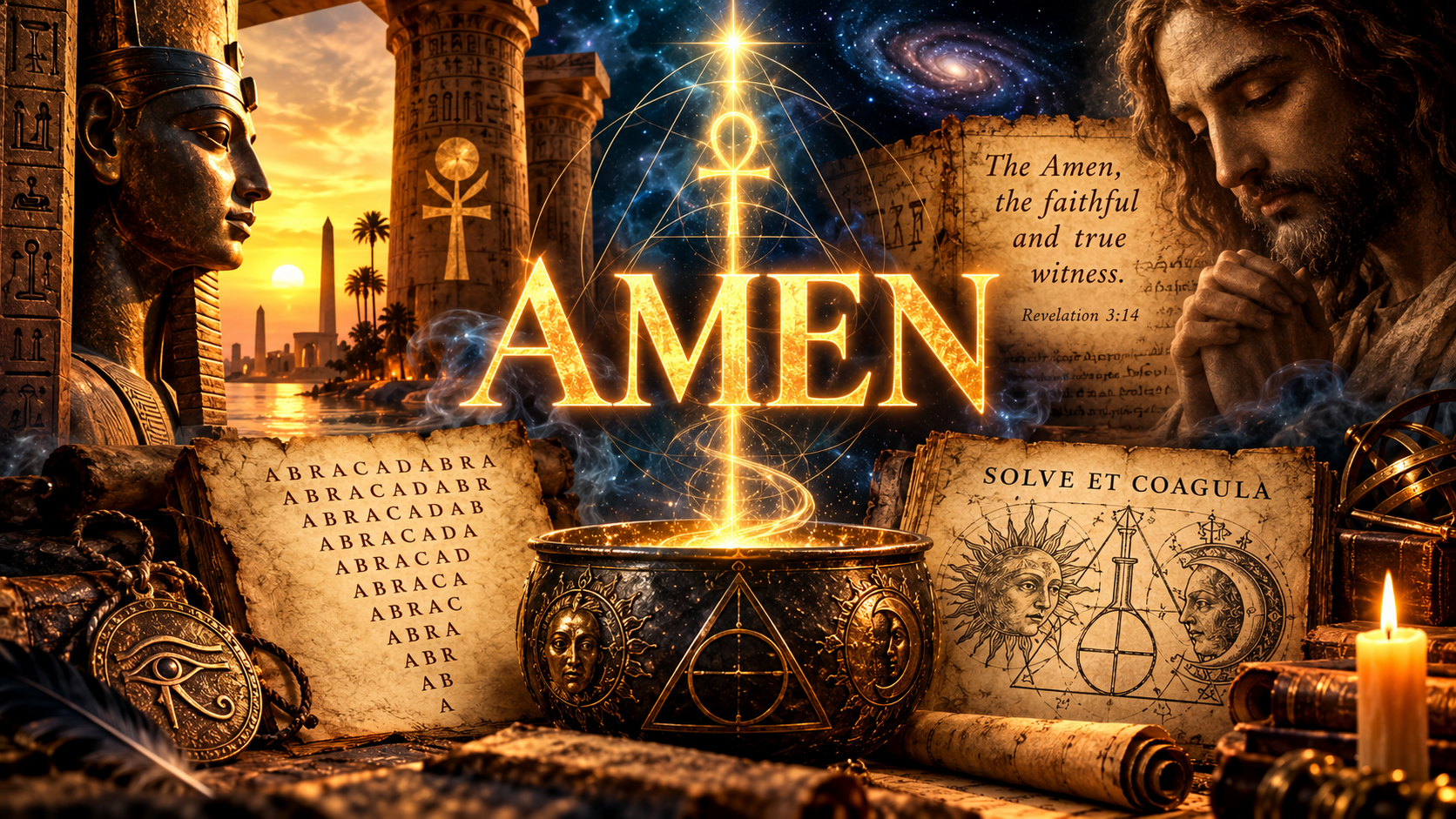
  • THE SECRET OF AMEN: Solve et Coagula, Abracadabra, and the Ancient Belief That Words Can Change Reality

    THE SECRET OF AMEN: Solve et Coagula, Abracadabra, and the Ancient Belief That Words Can Change Reality

    There are certain words we repeat so often that, after a while, we stop hearing them altogether. They become part of the background of our lives, familiar sounds that pass through the mouth almost automatically, carrying traditions much older than our own understanding of them. For me, Amen had always belonged to that category, because I had heard it at the end of prayers, funerals, blessings, private pleas and ceremonial words so many times that I had unconsciously reduced it to a religious full stop, a conventional way of saying that the prayer was over.

    What changed my perception was not one dramatic discovery, but a series of details that began to accumulate once I started looking at the word more carefully. I wanted to know where it came from, why it had survived for so long almost unchanged, why it appeared in Jewish and Christian traditions with such extraordinary persistence, and why certain esoteric interpretations had turned it into something far more mysterious than a simple liturgical response. What began as a curiosity about one familiar word gradually pulled me into a much wider investigation, one that led from ancient Hebrew and Egyptian religion to the sayings attributed to Jesus, from medieval alchemy to a Roman medical charm, and finally to one of the most famous words in the history of magic: Abracadabra.

    The deeper I went, the more I found myself returning to the same unsettling question. What if ancient people did not always think of words merely as instruments for describing reality, but as actions capable of participating in reality, shaping it, confirming it, dissolving it or fixing it into form?

    The Word We Say Without Hearing It

    The first thing that intrigued me was the realization that Amen is far older than Christianity. Its accepted linguistic origin is Hebrew, from the Semitic root ʾ-M-N, a family of words associated with firmness, reliability, faithfulness, trust and truth. The same root lies behind emunah, a term commonly translated as faith or faithfulness, but whose older sense is richer than a vague inner belief because it also carries the idea of something dependable, stable and worthy of trust.

    This immediately changed the way I understood the familiar translation “so be it.” In modern usage, that expression can sound almost passive, as if the speaker were merely hoping that something might happen in the future, yet the older range of meaning attached to Amen is far stronger and more active. Depending on context, the word can function as an affirmation that what has just been spoken is accepted as true, binding or worthy of trust, almost as if the speaker were saying, “I stand behind these words; I accept their meaning; let what has been spoken be confirmed.”

    One of the passages that stayed with me appears in Numbers 5:22, where a woman responds to a solemn oath with the doubled formula “Amen, Amen.” Another appears repeatedly in Deuteronomy 27, where the assembled people answer Amen after a series of declarations. In both cases, the word is not decorative and it does not merely end the exchange. It does something socially and spiritually important, because the person saying it places himself or herself inside the statement that has just been made.

    That distinction fascinated me, because it made Amen seem less like punctuation and more like a verbal seal. I do not mean a magical seal in the later occult sense, but a deliberate act of confirmation through which spoken words become accepted, witnessed and, in a certain sense, completed.

    Rabbinic tradition gives the word even greater depth. In the Babylonian Talmud, in tractate Shabbat 119b, Rabbi Ḥanina asks what Amen signifies and interprets its Hebrew letters as an acronym for El Melekh Ne’eman, meaning “God, Faithful King.” Other rabbinic discussions treat the response Amen not as the insignificant echo of someone else’s prayer, but as a meaningful act in itself, one that binds the person answering to what has been pronounced.

    I found that reversal beautiful, because in modern religious habit we tend to assume that everything important has already happened before Amen is spoken. The prayer, the blessing, the request and the declaration seem to contain the substance, while the final word appears to be little more than closure. Yet older traditions suggest something more subtle, because sometimes the act of confirmation is precisely what gives the preceding words their final weight.

    Amun and the Egyptian Connection I Wanted to Believe

    Sooner or later, anyone who investigates the history of Amen encounters another ancient name that is almost impossible to ignore: Amun, also written Amon, one of the most important gods of ancient Egypt.

    The resemblance between Amun and Amen is immediately seductive, especially for anyone drawn to ancient mysteries. Amun rose to immense religious importance in Egypt, particularly from the Middle Kingdom onward, and later became closely associated with Ra as Amun-Ra. His cult at Karnak developed into one of the most important religious centers in the ancient world, while his name was traditionally interpreted as “the Hidden One,” a designation that fits his association with the invisible, concealed and mysterious aspects of divinity.

    When I first encountered the similarity between Amun and Amen, I wanted the connection to be real. It was the kind of idea that seems almost too perfect to resist: an Egyptian god known as “the Hidden One,” worshipped for centuries before Christianity, and a sacred word that would later become one of the most recognizable expressions in Judaism and Christianity, both surviving with remarkably similar sounds.

    It would make a magnificent secret history, but the evidence does not support a direct linguistic derivation. The Hebrew Amen belongs securely to the Semitic root ʾ-M-N, while the Egyptian name Amun arises within a different linguistic system. Similarity of sound, even when striking, is not enough to prove common origin, and this is one of those moments where I think mystery becomes more interesting when we resist the temptation to force it into certainty.

    What remains is still remarkable. Two ancient religious cultures, geographically close and historically intertwined, preserved sacred forms whose sounds resemble one another while their meanings move in different directions: one toward hiddenness and divine invisibility, the other toward truth, faithfulness and confirmation. I find the coincidence powerful enough on its own, precisely because it does not need to be turned into a false etymology.

    When Amen Moves to the Beginning

    The next stage of my investigation became even more intriguing when I noticed the way Amen appears in the sayings attributed to Jesus.

    In ordinary liturgical use, the word usually follows a statement. Someone speaks, blesses or prays, and another person answers Amen. Yet in the Gospel tradition, Jesus repeatedly places the word before what he is about to say. English Bibles usually translate this as “Truly I say to you,” but behind the word “truly” stands the Greek transliteration amēn, preserving the Semitic expression itself.

    This unusual introductory use has been discussed by scholars for a long time. In the Synoptic Gospels it appears frequently, while the Gospel of John intensifies the formula by doubling it: “Amen, amen, I say to you,” commonly translated into English as “Truly, truly, I say to you.”

    What intrigued me was the shift in function. The word is no longer being used by an audience to confirm something already spoken, but by the speaker himself to establish the certainty and authority of what is about to follow. Instead of closing a statement, Amen now stands at the threshold of one.

    That alone is unusual, but Revelation 3:14 goes even further. There, Christ is referred to as “the Amen, the faithful and true witness.” At this point, Amen is no longer simply a response or an introductory formula; it has become a title.

    I remember stopping when I first read that verse in this context, because it completely changed the scale of the word. A term I had spent years hearing as the automatic ending of prayers was suddenly being used as a name associated with faithfulness and truth. The connection with Isaiah 65:16, where the Hebrew text contains an expression that can be rendered as “the God of Amen,” “the God of faithfulness” or “the God of truth,” only deepens the background.

    At that point I began to see Amen less as the end of religious speech and more as an ancient concept of reliability transformed into language. Something spoken, affirmed and made firm.

    And that was precisely when another phrase entered my mind.

    Solve et Coagula

    Anyone who spends enough time reading about alchemy eventually encounters the expression Solve et Coagula, usually translated as “dissolve and coagulate.”

    The popular image of alchemy reduces it to eccentric men attempting to turn lead into gold, yet historical alchemy was much more complex than that. Its texts describe the dissolution, separation, purification, recombination and fixation of substances through repeated processes, and these material operations often acquired symbolic, philosophical and spiritual meanings as well.

    What interested me most was the rhythm implied in Solve et Coagula. Something must first be broken apart, released from its previous form or reduced to a more fluid state, and only afterward can it be recombined, stabilized and fixed into something new.

    While reading about this process, I began to see an unexpected symbolic parallel with Amen.

    I want to be careful here, because I found no historical evidence showing that ancient Hebrew speakers intended Amen to mean Coagula, nor did I find evidence that alchemists derived their formula from Jewish or Christian liturgical usage. The connection belongs to symbolic interpretation, not etymology.

    Even so, the correspondence is striking.

    A prayer begins in a state that is almost entirely intangible. It may start as fear, gratitude, longing, uncertainty or desire. Then it becomes thought, thought becomes breath, breath becomes sound, and sound becomes a sequence of words directed outward toward another person, a community, a divinity or even one’s own inner life.

    At the end comes Amen, the moment of confirmation.

    Seen through an alchemical metaphor, everything before that final word remains fluid, expressive and open, while Amen resembles the moment of fixation, the point at which the speaker gathers the intention, accepts it and gives it a defined boundary.

    This does not require the belief that certain syllables mechanically force the universe to obey human wishes. What interested me more was the ancient recognition that an intention changes once it acquires form.

    A vow kept silently in the mind is not the same as a vow spoken aloud. A contract imagined is not the same as a contract signed. A verdict considered privately is not the same as a verdict pronounced in court. In each case, language transforms an inner state into an event with consequences.

    Long before modern psychology or linguistics studied the social power of speech, ritual cultures had already understood that words could mark transitions, bind people, create obligations and change circumstances.

    That idea would become even more fascinating when I encountered Abracadabra.

    The Word That Was Supposed to Disappear

    I had always associated Abracadabra with stage magicians, children’s performances and cheap theatrical tricks. It was the kind of word that seemed too familiar to deserve serious attention, precisely because popular culture had turned it into a cliché.

    Its actual history is far stranger.

    The earliest surviving written appearance usually cited by scholars occurs in a Latin medical poem associated with Quintus Serenus Sammonicus, probably in the third century CE. Serenus recommended the word not as entertainment but as part of a treatment for recurring fever, generally interpreted in modern scholarship in connection with malaria.

    The patient was instructed to write the word repeatedly, removing one letter from each successive line until the formula narrowed into a triangle:

    ABRACADABRA
    ABRACADABR
    ABRACADAB
    ABRACADA
    ABRACAD
    ABRACA
    ABRAC
    ABRA
    ABR
    AB
    A

    The logic is visually obvious once you see it. The word shrinks line by line, and the illness is symbolically expected to diminish with it.

    That was the moment when the relationship with Solve became impossible for me to ignore, because the written charm itself performs a kind of dissolution. The letters disappear gradually until the original form has almost completely vanished.

    In the ancient worldview behind the charm, this was not merely decorative symbolism. Medicine, religion, astrology and magic often overlapped in ways that modern categories tend to separate. A written word could function simultaneously as language, image, ritual object and supposed therapeutic instrument.

    The details of the ritual are even stranger than the word itself. According to accounts derived from Serenus, the written charm was to be tied with flax and worn around the neck, and after nine days it was to be removed and thrown backward over the shoulder into a stream flowing eastward.

    That detail stayed with me because the word alone was not considered sufficient. The body, the written object, the number of days, the direction of the flowing water and the act of disposal all became part of the same ritual structure.

    Once I understood that context, Abracadabra stopped looking like a ridiculous stage-magician formula and began to look like the fossil of a very old human conviction: that words, when written, arranged and ritualized correctly, could participate in the transformation of physical reality.

    What Does Abracadabra Actually Mean?

    This was also where I encountered one of the most attractive myths surrounding the word.

    Modern esoteric sources frequently claim that Abracadabra comes from an Aramaic phrase supposedly meaning something like “I create as I speak” or “I will create through the word.” It is an interpretation so perfectly suited to the idea of manifestation that it has been repeated almost endlessly.

    The problem is that the derivation is not securely documented.

    Scholars have proposed connections with Aramaic, Hebrew, the Gnostic name Abraxas and various magical formulas, yet no explanation has been demonstrated conclusively. The origin of Abracadabra remains uncertain.

    I found myself liking that uncertainty more than the neat explanation.

    There is something deeply unsettling about a word that has survived for nearly eighteen centuries, a word recognized today by children across much of the world, while its original meaning still escapes us. We know what people did with it before we know with confidence what it meant to the person who first recorded it.

    That, to me, is far more mysterious than forcing it into a convenient translation.

    Abracadabra as Solve, Amen as Coagula

    Once I placed Abracadabra and Amen on opposite sides of the alchemical expression Solve et Coagula, a symbolic pattern began to emerge.

    I do not mean that I had discovered a secret historical doctrine connecting ancient Judaism, Roman medical magic and medieval alchemy. There is no evidence for such a unified system, and pretending otherwise would weaken the article rather than deepen it.

    What interested me was the recurrence of the same symbolic logic.

    Abracadabra, in its ancient triangular form, is gradually dissolved.

    Amen, in its older religious use, affirms, confirms and stabilizes what has been spoken.

    The first visually resembles Solve.

    The second symbolically resembles Coagula.

    Between them lies one of humanity’s oldest obsessions: the belief that language can mediate between what exists inside us and what exists outside us.

    A thought becomes breath, breath becomes sound, sound becomes language, language becomes declaration, and declaration becomes action. Sometimes that action becomes law, ritual, commitment or history.

    We live inside this process every day, even if we no longer call it magic.

    A judge speaks a sentence and a person loses freedom. Two people pronounce words in a legal ceremony and their social status changes. A doctor names a disease and an entire family begins reorganizing its future around that diagnosis. A government signs and announces an agreement and borders, rights or obligations change. Someone says “I promise,” and suddenly there is an expectation that did not exist before.

    None of this requires supernatural forces to demonstrate that words can alter reality.

    The deeper question is why so many ancient traditions believed that the power of language extended even further.

    In the Beginning Was the Word

    At this point in my investigation, it became impossible not to think of one of the most famous openings in religious literature: “In the beginning was the Word.”

    The Gospel of John begins with the Logos, while Genesis presents creation itself as an act structured through divine speech. God speaks, and reality follows.

    I do not believe we need to claim that Genesis, John, Egyptian religion, Jewish liturgy, Roman medical charms and European alchemy all preserve fragments of one secret doctrine. That kind of claim is attractive because it creates a complete pattern, but history is usually more complicated than the patterns we want to impose on it.

    What fascinates me more is that different civilizations repeatedly return to the intuition that language possesses more than descriptive power.

    Names could invoke.

    Oaths could bind.

    Blessings could protect.

    Curses could injure.

    Sacred formulas could heal.

    Written letters could become talismans.

    A true name could grant authority.

    Even silence could become part of ritual.

    When I began placing these traditions side by side, I did not find proof that words release invisible energies capable of rearranging physical matter according to desire. What I found was something more historically defensible and, in many ways, more profound: human beings have understood for thousands of years that language shapes consciousness, consciousness shapes behavior, behavior changes circumstances, and circumstances become the world in which we live.

    Ancient ritual compressed that chain into symbol.

    Alchemy encoded it through transformation.

    Religion expressed it through sacred speech.

    Modern psychology studies parts of the same process using another vocabulary.

    Was Amen Ever a Manifestation Formula?

    This is where I think it becomes important to resist the simplest answer.

    There is no reliable historical basis for calling Amen “the oldest manifestation formula in human history,” and I found no evidence that ancient speakers believed the sound itself could mechanically force a private desire into material existence.

    That claim sounds powerful, but it risks replacing genuine mystery with a modern slogan.

    At the same time, reducing Amen to a meaningless habit would also miss the complexity of the word.

    Historically, it carries ideas of truth, trust, affirmation, reliability and confirmation. Biblically, it appears in oaths, communal responses and formal declarations. In the Gospel tradition it is placed at the beginning of authoritative sayings, while in Revelation it becomes a title associated with faithfulness and truth.

    That is already remarkable enough.

    The esoteric reading can begin after the historical evidence, without pretending to replace it.

    When I interpret Amen through the symbolism of Coagula, I am not claiming to have uncovered a hidden dictionary used by ancient alchemists. I am doing something closer to what esoteric traditions have always done, which is to observe correspondences between different systems of meaning.

    The prayer releases intention into language, while the final affirmation gathers it into certainty.

    The inner state becomes a spoken form.

    The spoken form becomes accepted.

    The volatile becomes fixed.

    That is where Solve et Coagula becomes, for me, more than an alchemical motto.

    Why Words Were Never Just Words

    The further I went into this subject, the more I found myself questioning the modern assumption that words are neutral containers.

    Why do we instinctively lower our voices when making certain promises? Why does naming a fear sometimes make it more terrifying, while at other times speaking it aloud diminishes its power? Why have people in so many cultures written sacred formulas on walls, parchment, metal, stone, amulets and even skin? Why do religions repeat particular phrases? Why do legal systems demand exact verbal declarations? Why do rituals insist that certain words be spoken in a prescribed sequence?

    We behave as though words matter because they do.

    The disagreement begins only when we ask how far that power extends.

    Ancient people may have attributed effects to sacred language that modern science does not accept, while modern culture may sometimes underestimate the psychological, social and symbolic power that carefully chosen words continue to exercise over human beings.

    Between uncritical belief and automatic dismissal lies a much more interesting territory, and that is the territory where this investigation eventually led me.

    When I now hear Amen, I no longer hear a religious full stop. I hear a word that has travelled through millennia carrying the ideas of affirmation, trust and confirmation.

    When I encounter Abracadabra, I no longer think only of a theatrical trick. I think of a person living nearly eighteen centuries ago, carrying a written triangle of diminishing letters against the body, waiting nine days before casting it into running water in the belief that illness could disappear as the word disappeared.

    When I read Solve et Coagula, I no longer imagine only furnaces, manuscripts and metals. I see a recurring human pattern in which old forms are broken apart so that new forms can emerge, after which the unstable must once again be fixed.

    These are not identical traditions, and I would never claim that they are.

    Yet they circle around the same ancient human intuition: invisible things become powerful when we give them form.

    The Real Secret of Amen

    By the time I reached the end of this investigation, I had become less interested in proving that Amen possesses some hidden supernatural frequency and more interested in understanding why a word like this could survive for so long.

    The true force of Amen may never have belonged to sound alone.

    It may lie in the moment when a person stops merely thinking and begins affirming, when uncertainty becomes commitment, when an intention receives language and when language is consciously accepted as one’s own.

    The old alchemists understood that nothing remains forever in a volatile state. At some point, something must be fixed.

    That is Coagula.

    The Roman charm reduced Abracadabra until the word almost vanished completely.

    That resembles Solve.

    Between dissolution and fixation stands the human being, doing what humans have always done: giving invisible things shape through symbols, names, ritual and speech.

    For me, this is where the deepest mystery of sacred language begins.

    Not in the simplistic idea that a word automatically commands the universe, but in the much older and more unsettling realization that a word can direct attention, shape belief, organize intention, bind communities, alter decisions, define identities, create obligations and survive long after the person who first spoke it has disappeared.

    Civilizations vanish, temples collapse, languages transform, dynasties end and gods are forgotten or renamed, yet certain words continue travelling through time.

    One of them is still spoken every day by millions of people who may never stop to ask what they are actually saying.

    And now, whenever I hear Amen, I no longer hear the end of a prayer.

    I hear the moment when the words before it are made firm.


    Sources and Further Reading

    Etymological scholarship on the uncertain origin of Abracadabra.

    British Museum, educational resources on Amun and ancient Egyptian religion.

    Metropolitan Museum of Art, Egyptian collections and material on the cult of Amun.

    Babylonian Talmud, Shabbat 119b, on Amen and El Melekh Ne’eman.

    John Strugnell, “Amen, I Say Unto You” in the sayings of Jesus and early Christian literature.

    G. K. Beale, research on the Old Testament background of Revelation 3:14.

    Princeton University Library, material on alchemy and the principle Solve et Coagula.

    Historical medical studies on Quintus Serenus Sammonicus and the Abracadabra fever amulet.

    Fediverse reactions
  • THE GOD WHO BECAME THE DEVIL: How Did the Bringer of Light Come to Be Called Lucifer?

    THE GOD WHO BECAME THE DEVIL: How Did the Bringer of Light Come to Be Called Lucifer?

    The story of a Greek name, a star that never changed its light, and a religious interpretation that has traveled through two millennia.

    There are things we read dozens of times without paying much attention to them, until one seemingly insignificant detail forces us to look at the entire story from a different perspective. This happened to me recently when I returned to two figures from Greek mythology, Eosphoros and Hesperos, and to a question that became more disturbing the more closely I examined it: how did a name that meant the bringer of light become associated, in the Christian imagination, with the very ruler of darkness?

    At first, what caught my attention was a painting from 1881 by the British artist Evelyn De Morgan, entitled Phosphorus and Hesperus. Two young men, two torches, two manifestations of light, captured in a composition that seems to speak of something far more profound than the simple alternation between morning and evening.

    One of the figures carries a burning torch, while the other holds one that has been extinguished. I was drawn to this representation because, beyond its beauty, it conceals an astronomical truth known since Antiquity: the two are not, in reality, two different stars, but two appearances of the same planet.

    Venus.

    And yet, it was not astronomy that made me continue my investigation, but the history of a word.

    Eosphoros and Hesperos: Before Light Became Suspicious

    In ancient Greek, Ἑωσφόρος (Eosphoros) referred to the bringer of dawn, the celestial body that appeared before sunrise. Another name used for the Morning Star was Φωσφόρος (Phosphoros), the bearer of light, derived from phōs, meaning light, and phoros, meaning one who carries.

    Hesperos, Ἕσπερος, was the Evening Star, the brilliant celestial body that appeared after sunset.

    In Greek mythology, these celestial appearances were personified and given divine genealogies, just like many natural phenomena that the people of Antiquity attempted to understand through stories about gods.

    Hesiod, in his Theogony, mentions Eosphoros among the children of the goddess Eos, the Dawn, and the Titan Astraios. This is an important testimony because it shows us that the figure of the bringer of dawn existed in Greek tradition many centuries before the emergence of Christianity.

    Something else, however, intrigued me. The Greeks eventually came to understand that the Morning Star and the Evening Star were the same celestial body. This identification was known in ancient astronomical tradition and was associated by later writers with Pythagoras or Parmenides, although the precise attribution remains uncertain.

    Thus, the same planet could be viewed under two different names, depending on the moment of its appearance.

    It was neither good nor evil. It was neither divine nor demonic in the sense these words would later acquire in Christian theology.

    It was simply the light that announced the morning or accompanied the arrival of night.

    But what happens when an astronomical symbol enters the world of religious interpretation?

    A Verse from Isaiah and the Beginning of a Transformation

    I inevitably arrived at one of the most debated passages of the Old Testament, Isaiah 14:12.

    In the Hebrew text, we encounter the expression Helel ben Shachar, commonly translated as the shining one, son of the dawn.

    What I found particularly interesting is that, in its immediate context, the passage does not speak about Satan. Chapter 14 of Isaiah contains a song of mockery directed against the king of Babylon, portrayed as an arrogant ruler who aspires to divine heights but ultimately finds himself brought down.

    The image of the Morning Star falling from heaven is used to describe the collapse of a power that considered itself untouchable.

    When the text was translated into Greek in the Septuagint, the translators used the term heōsphoros, meaning the bringer of dawn.

    Later, in the Latin translation known as the Vulgate, produced by Jerome during the late fourth and early fifth centuries, the word lucifer appears.

    In classical Latin, lucifer was an ordinary term for the Morning Star, formed from lux, meaning light, and ferre, meaning to carry.

    It was not, in itself, the name of the Devil.

    This is the point at which the story truly began to interest me.

    Because if the Hebrew text referred to the fall of a king, and the Latin word designated a luminous celestial body, when and through what mechanism did Lucifer become the name associated with the rebellious angel?

    When Interpretation Becomes More Powerful Than the Text

    The transformation did not occur through a simple alteration of a dictionary definition, nor did it happen at a single moment in history.

    Early Christian writers frequently approached Scripture through methods of interpretation that allowed them to identify spiritual meanings beyond the immediate historical context. A character, a king, or an event could be understood as the image of a supernatural reality.

    In this way, the fall of the king of Babylon in Isaiah gradually became associated with the idea of Satan’s fall.

    Origen, a Christian theologian of the third century, contributed to the development of this interpretation, discussing the passage from Isaiah in connection with the origin and fall of the Devil. Later, other Christian writers strengthened the connection between the pride of a ruler who wished to elevate himself above others and the rebellion of a spiritual being against God.

    Other biblical passages were also brought into this interpretation, including Ezekiel 28, which refers to the king of Tyre, and Luke 10:18, where Jesus speaks of Satan falling from heaven like lightning.

    Gradually, these passages came to be read as parts of a shared history, although each originally belonged to a different context.

    I believe it is essential to observe something here: there is insufficient historical evidence to support the claim that Christian translators deliberately chose the word lucifer in order to demonize a Greek deity and distance the Greeks from their ancient religion.

    There were undoubtedly conflicts between Christianity and the traditional cults of the Greco-Roman world, and certain pagan symbols were reinterpreted or rejected. But the history of this particular word is far more complicated than the explanation of a linguistic conspiracy.

    And precisely because it is more complicated, I find it considerably more interesting.

    An Uncomfortable Detail: Christ and the Morning Star

    Here I discovered the aspect that surprised me the most.

    In Revelation 22:16, Jesus identifies himself as the bright Morning Star.

    I reread the passage because I found it extraordinary that the same astronomical symbol could be associated, within Christian tradition, with both Christ and the being regarded as his adversary.

    But the surprise does not end there.

    In the Second Epistle of Peter, chapter 1, verse 19, the Greek term phōsphoros appears, used in a spiritual image describing the rising of the Morning Star in the hearts of believers.

    The very same Greek word that, in Antiquity, designated the bearer of light.

    Furthermore, there is a remarkable example in the Latin liturgical tradition. In the Exsultet, the Easter proclamation sung during the Easter Vigil, the word lucifer appears in a context identifying Christ as the Morning Star that never sets.

    Therefore, in the Latin language of Christian tradition, lucifer was not always a demonic name.

    It could designate the light of the morning, and in certain contexts it was even used as an image of Christ.

    There was also a Christian bishop of the fourth century known as Lucifer of Cagliari, a name that did not necessarily carry the connotation it has for modern readers.

    At that moment, I found myself wondering how many people who use the name Lucifer today exclusively as a synonym for Satan actually know this history.

    And, above all, how many realize that the symbol of the Morning Star never disappeared from the Christian language of light and hope.

    Venus: The Same Light, Two Interpretations

    From an astronomical perspective, Venus does not produce its own light but reflects the light of the Sun. It is the brightest star-like object ordinarily visible in the sky after the Sun and Moon, and its apparent proximity to the Sun explains why we generally see it before sunrise or after sunset.

    I find it almost ironic that such a simple phenomenon came to carry such an extraordinarily complex symbolic meaning.

    For the ancient Greeks, its appearance could announce the coming of morning. For Roman poets, Lucifer could represent the celestial body preceding dawn. For biblical writers, the image of a fallen star could illustrate the collapse of an arrogant ruler. For certain Christian theologians, that same image became a representation of Satan’s fall.

    And for other Christian writers, the Morning Star remained a symbol of Christ.

    The planet did not change.

    What changed were the stories people told about it.

    What Does Evelyn De Morgan’s Painting Actually Tell Us?

    I then returned to the painting that had initially awakened my curiosity.

    Phosphorus and Hesperus, painted in 1881, presents the two bearers of light in a composition that evokes the transition between night and day.

    Phosphorus carries the burning torch, while Hesperus is depicted with his torch extinguished. The visual contrast may suggest the difference between the light announcing dawn and the light disappearing with the arrival of night.

    However, it would not be correct to consider the painting evidence that the artist intended to denounce the transformation of Lucifer into Satan. Such an intention would need to be demonstrated through documents, letters, or explanations provided by the artist herself.

    What we can observe is that De Morgan chose to represent two figures from classical mythology without turning them into a simplistic opposition between good and evil.

    And this is something I particularly appreciated.

    Because it reminded me how much a symbol can lose when we view it exclusively through the meaning assigned to it by a single tradition.

    Was Lucifer a Deity Whose Identity Was Stolen?

    It is a provocative question, but the answer requires caution.

    Eosphoros and Phosphoros belonged to the religious and poetic imagination of the Greeks, while Lucifer was their linguistic and astronomical equivalent in Latin. However, these names did not always designate a deity with an independent cult comparable to that of Zeus, Apollo, or Aphrodite.

    Likewise, Satan did not first appear with Christianity. The Hebrew term satan means adversary or accuser and has a history in biblical literature and Jewish traditions that predate Christianity. The figure underwent significant transformations over time, both before and after the emergence of Christianity.

    Therefore, we cannot simply say that a Greek god was renamed Satan.

    What we can say, however, is something historically documentable and, in my opinion, equally fascinating: a term that originally designated the light of the morning became, through a long process of religious interpretation, one of the most recognizable names associated with the Devil.

    This transformation deserves investigation not because it automatically proves the existence of a conspiracy, but because it demonstrates the extraordinary power of interpretation over collective memory.

    Who Decides What a Word Means?

    While researching this subject, I noticed how rarely we question the origins of words we use with such certainty.

    We inherit them together with their explanations, their images, and the emotions that entire generations have attached to them. Sometimes we forget that, before becoming religious or moral symbols, many of these words referred to simple, visible things belonging to the natural world.

    A celestial body.

    A morning.

    A light appearing on the horizon.

    What intrigues me is not only the fact that Lucifer became associated with Satan, but also the way its original astronomical meaning has become almost unknown in popular culture.

    Today, when we pronounce the name Lucifer, most people immediately think of a fallen angel, rebellion, hell, or evil.

    Very few think of Venus.

    And yet, before all these interpretations, the name designated the Morning Star.

    I do not believe history needs to be rewritten in order to become mysterious. On the contrary, authentic documents sometimes conceal contradictions far more disturbing than invented stories.

    In Lucifer’s case, the mystery does not lie in the existence of a proven secret hidden for two thousand years, but in the overlapping of traditions that assigned radically different meanings to the same image.

    A fallen king, a luminous celestial body, a rebellious angel, and an image of Christ all came together in the history of the same symbol.

    The Light Never Changed Its Name. Humanity Changed Its Story.

    When I began reading about Eosphoros and Hesperos, I expected to discover a beautiful story from Greek mythology, perhaps a few astronomical explanations, and an interesting connection with Christian tradition.

    I did not expect to arrive at such a profound question about the way human beings construct and transmit truth.

    Because ultimately, the history of Lucifer is not only about religion. It is about language, authority, interpretation, and the ability of a tradition to influence what future generations will consider self-evident.

    Not every transformation of meaning is a deliberate falsification. Some occur naturally through translation, metaphor, and cultural change. Others are influenced by religious conflicts, power, or a community’s need to define its own symbols.

    But every transformation leaves traces.

    And when we follow those traces back to their sources, we sometimes discover that things we believed to be incompatible once shared a common point of origin.

    Eosphoros announced the morning. Hesperos accompanied the evening. Lucifer was the bearer of light. And the Morning Star became, in different Christian texts, both an image of a fall and an image of hope.

    While human beings continued to debate, translate, condemn, and venerate these symbols, Venus continued to appear in the sky, just as it had in the time of Hesiod.

    And this may be the observation with which I want to conclude.

    What disturbs me is not so much that human beings changed the meaning of a name, but how easily, after enough centuries have passed, we come to believe that the name never had any other meaning.

    And the question I leave with the reader is this:

    If even the bearer of light could become, in collective memory, a name associated with darkness, how many other symbols from our history do we know today only through the interpretations of those who came after them?


    Historical Sources and Bibliography

    Henry Ansgar Kelly — Satan: A Biography (2006). Research into the development of Satan’s figure in biblical texts and Christian tradition.

    Hesiod — Theogony, lines 378–382. The genealogy of Eosphoros in Greek mythology.

    Plato — Timaeus, 38d. References to celestial bodies and the Greek astronomical tradition.

    Aristotle — De Caelo, II.12. Context for ancient Greek astronomy.

    The Hebrew Bible — Isaiah 14:4–23. The original context of the song directed against the king of Babylon.

    The Septuagint — Isaiah 14:12. The Greek translation of the Hebrew expression referring to the Morning Star.

    The Latin Vulgate — Isaiah 14:12. The use of the Latin term lucifer.

    Origen — De Principiis, I.5.5. The theological interpretation of the Devil’s fall.

    The New Testament — Luke 10:18; 2 Peter 1:19; Revelation 22:16. Images of the fall from heaven and the Morning Star.

    The Exsultet — The Easter Proclamation of the Roman liturgy. The use of the term lucifer in reference to Christ.

    Evelyn De Morgan — Phosphorus and Hesperus (1881). The artistic representation of the two personifications of the planet Venus.

    Jeffrey Burton Russell — The Devil: Perceptions of Evil from Antiquity to Primitive Christianity (1977). A study of the evolution of the concept of the Devil.

    Red YouTube button with a white play icon and the word 'YouTube' in white text.
    Promotional graphic featuring the text 'Special Discount on Payhip' with a sunset background, an ancient structure, and a red 'Buy Now' button.

    Fediverse reactions
  • Animal Farm: The Terrifying Truth George Orwell Hid Behind a Children’s Fable

    Animal Farm: The Terrifying Truth George Orwell Hid Behind a Children’s Fable

    One of those rare books that made me lose track of day and night, not because of its length, but because of the unsettling truths hidden beneath its deceptively simple story. George Orwell’s Animal Farm is the kind of book you finish reading, only to realize that the most disturbing part is not what happens on the farm, but how much of it you recognize in the world around you. And believe me, after reading it, you may never look at a pig in quite the same way again.

    The book that publishers feared, politicians misunderstood, and history has never quite managed to escape.

    There is something wonderfully suspicious about a book in which pigs learn to walk on two legs, horses work themselves to death, sheep repeat whatever they are told, and the creatures who promise to abolish oppression eventually become indistinguishable from their former masters. At first glance, George Orwell’s Animal Farm looks like an amusing little story about an unfortunate agricultural experiment, although anyone who has spent more than ten minutes observing human politics will quickly recognize that the animals are behaving with an alarming degree of realism.

    I have always found it remarkable that one of the most devastating examinations of political power ever written takes place not in a parliament, a royal palace, or a revolutionary headquarters, but in a barnyard, where the future of an entire society is decided by creatures whose principal qualifications for leadership are intelligence, ambition, and an impressive willingness to lie.

    Published in August 1945, Animal Farm has survived generations of political movements, ideological battles, and changing interpretations, yet its central warning has lost none of its force. Orwell understood something deeply uncomfortable about human nature: the people who promise to liberate us from tyranny are not necessarily immune to becoming tyrants themselves, especially when they discover how convenient it is to control the truth.

    But the story behind this extraordinary book is almost as disturbing as the story inside it. Its author had witnessed political betrayal, survived a bullet wound in Spain, experienced poverty and imperial injustice, and discovered that even respectable publishers could become remarkably nervous when confronted with the wrong kind of truth.

    And somewhere between the Russian Revolution, a frightened British publishing industry, a forgotten manuscript, and an extraordinary Ukrainian edition, the history of Animal Farm begins to resemble one of Orwell’s own plots.

    The Man Who Was Not Really George Orwell

    Before exploring the secrets of Animal Farm, we should begin with a curious detail about its author: George Orwell was not born George Orwell.

    His real name was Eric Arthur Blair, and he entered the world in 1903 in Motihari, British India, into a family connected to the administrative machinery of the British Empire. His father worked in the colonial opium department, an occupation that provides an almost absurdly appropriate introduction to the life of a future writer obsessed with the relationship between government, morality, and the management of human behavior.

    Orwell was educated at Eton, one of Britain’s most prestigious schools, although his family was far from wealthy enough to belong comfortably to the aristocratic world surrounding him. He attended on a scholarship, an experience that exposed him to the complicated relationship between class, privilege, and social expectations.

    Instead of following the predictable path of a young man educated among Britain’s elite, he joined the Indian Imperial Police in Burma in 1922, becoming an officer within the very imperial system he would later criticize.

    His years in Burma were transformative, not because they made him admire colonial authority, but because they helped him understand the moral corruption that accompanies the exercise of power over other human beings. His later essay Shooting an Elephant would describe the peculiar imprisonment of the oppressor, a man who appears powerful but finds himself compelled to perform a role dictated by the expectations of those around him.

    This is one of the first important connections between Orwell’s life and Animal Farm: he understood that systems of domination deform both those who suffer under them and those who administer them.

    After leaving Burma, he deliberately explored the lives of the poor and socially marginalized in Paris and London, experiences that informed Down and Out in Paris and London, published in 1933. It was for this book that he adopted the name George Orwell, partly to separate his literary identity from his family and earlier life.

    There is a certain irony in the fact that a writer who became famous for exposing political disguises began his literary career by adopting a new identity himself, although in his case the disguise concealed neither a secret police department nor an ambition to govern the world’s livestock.

    His interest was not in appearing powerful, but in understanding how power worked.

    Spain: Where Orwell Learned That Revolutions Can Devour Their Own Children

    The true origins of Animal Farm cannot be understood without examining Orwell’s experiences during the Spanish Civil War.

    In 1936, he traveled to Spain to fight against the forces of General Francisco Franco, joining a militia associated with the anti-Stalinist POUM, a Marxist organization that opposed fascism but was also deeply suspicious of Soviet-style authoritarianism.

    For Orwell, the struggle initially represented a genuine possibility of social transformation, an opportunity to participate in a movement that promised equality and resistance to oppression.

    What he encountered, however, was a political nightmare in which supposed allies began treating one another as enemies.

    As Soviet influence expanded within the Republican camp, rival left-wing organizations became targets of repression, and the POUM was accused of treachery. Orwell witnessed an atmosphere in which propaganda, political accusations, and manipulated information could transform yesterday’s comrades into today’s criminals.

    He was also shot through the throat by a sniper while serving at the front, surviving an injury that might easily have ended his life before he had written either Animal Farm or Nineteen Eighty-Four.

    Yet the physical wound was not the only lasting consequence of Spain.

    What disturbed Orwell was the realization that events he had personally witnessed could be reported in ways that bore little resemblance to reality. Newspapers and political organizations were not merely disagreeing over interpretations; some were constructing versions of events that erased inconvenient facts.

    In Homage to Catalonia, published in 1938, he attempted to document these experiences, including the political persecution that followed the suppression of the POUM.

    Spain taught Orwell that a revolution could be betrayed without abandoning its revolutionary vocabulary. Its leaders could continue speaking of equality while establishing hierarchies, invoking solidarity while persecuting former allies, and claiming to defend the people while denying those same people the right to question authority.

    Years later, the pigs of Animal Farm would demonstrate precisely this talent.

    The Strange Inspiration Behind a Very Dangerous Book

    One of the lesser-known details about Animal Farm is that Orwell connected its central inspiration to an ordinary scene involving a horse.

    In his 1947 preface to the Ukrainian edition, he recalled seeing a young boy driving a large cart-horse along a narrow path, whipping the animal whenever it attempted to turn.

    The observation led him toward a disturbing comparison. Human beings could dominate horses not because they were physically stronger, but because the animals lacked an understanding of their own collective strength.

    Orwell began imagining what might happen if exploited creatures became conscious of the relationship between their labor and their masters’ authority.

    It was an ingenious starting point, because it allowed him to examine political exploitation without immediately placing human political parties, nationalities, or leaders at the center of the story.

    The animals would become the workers, the rulers, the propagandists, the opportunists, and the victims of a political experiment that began with liberation and ended with the restoration of oppression under a different name.

    Orwell had conceived the central idea as early as 1937, although he wrote the novel primarily during 1943 and 1944, when the Soviet Union was fighting alongside Britain against Nazi Germany.

    The timing could hardly have been worse for a writer determined to expose Stalinist tyranny.

    In wartime Britain, Joseph Stalin was not simply the dictator Orwell believed him to be; he was also the leader of an indispensable military ally, whose armies were fighting and dying on the Eastern Front.

    Criticizing him was politically inconvenient.

    And political inconvenience, as Orwell was about to discover, could be remarkably effective at closing publishing-house doors.

    The Book That Respectable Publishers Did Not Want to Touch

    Today, Animal Farm is considered a modern classic, translated into numerous languages and studied around the world. It is therefore entertaining, in a rather bleak literary sense, to discover that several publishers originally wanted nothing to do with it.

    Orwell himself recorded that four publishers rejected the manuscript.

    One publishing house initially showed interest but withdrew after consultation with the British Ministry of Information, where an official’s unfavorable reaction apparently persuaded the publisher that attacking Stalin through a fable about pigs was not an especially diplomatic activity.

    Another rejection came from Faber & Faber, where the distinguished poet T. S. Eliot was involved in evaluating the manuscript.

    Eliot acknowledged Orwell’s literary abilities but questioned the political perspective of the book, which he interpreted as broadly Trotskyist. He was unconvinced that Orwell’s criticism offered the appropriate political position from which to judge the Soviet situation.

    The episode is almost irresistible in its irony: one of the most influential poets of the twentieth century helped reject one of the most influential political novels of the twentieth century.

    Literary history occasionally has a sense of humor, even when its participants do not.

    Eventually, Secker & Warburg agreed to publish the book, and Animal Farm appeared in Britain on August 17, 1945, shortly after the end of the war in Europe and only days after Japan announced its surrender.

    But the most revealing part of this publishing struggle was not simply that Orwell had been rejected.

    It was his explanation of why.

    He believed that a society could suppress uncomfortable ideas without requiring a formal government ban. Publishers, journalists, intellectuals, and influential institutions might voluntarily avoid subjects that threatened accepted political opinion.

    In other words, censorship did not always need a policeman standing at the door.

    Sometimes it needed only a respectable person explaining that the timing was unfortunate.

    And that observation would become one of the most unsettling legacies of the entire affair.

    The Missing Preface: A Warning That Readers Did Not See for Decades

    Among the most fascinating documents associated with Animal Farm is an essay Orwell prepared as a proposed preface, now known as The Freedom of the Press.

    It was not included in the original published edition.

    The text was eventually brought to public attention in 1972, more than two decades after Orwell’s death, when it appeared in The Times Literary Supplement.

    Its importance lies in the fact that Orwell was not merely criticizing the Soviet Union. He was also examining the intellectual habits of British society, particularly the willingness of educated people to avoid ideas that challenged fashionable political assumptions.

    The proposed preface questioned the distinction between direct state censorship and the subtler pressures of public opinion, professional conformity, and voluntary silence.

    That distinction matters enormously.

    A government that bans a book makes its intentions visible, whereas a society in which publishers quietly refuse to print it may preserve the appearance of intellectual freedom while making certain arguments extraordinarily difficult to hear.

    We should be careful not to turn the history of this preface into a conspiracy story. The evidence does not establish that a secret organization ordered its suppression, and the precise circumstances of its omission remain a matter of historical discussion.

    What we can say is that the manuscript existed, it was absent from the original edition, and its eventual publication revealed how deeply Orwell worried about censorship operating through social and institutional pressure.

    There is something particularly appropriate about a missing preface to a novel in which controlling the written record becomes one of the ruling class’s favorite occupations.

    The pigs would undoubtedly have considered the situation perfectly reasonable.

    The Ukrainian Edition That Revealed Orwell’s Real Political Position

    Another extraordinary chapter in the history of Animal Farm unfolded in 1947, when the novel was translated into Ukrainian for readers living in displaced-persons camps in postwar Europe.

    Many of these readers had experienced Soviet rule directly, and the book’s depiction of revolutionary ideals transformed into authoritarian domination carried a significance that extended far beyond literary satire.

    The translator, Ihor Ševčenko, who used the name Ivan Cherniatynskyi, requested a special introduction from Orwell.

    Orwell agreed.

    What makes this preface so valuable is that he explained his political development with unusual clarity, discussing his experiences of imperialism, class inequality, socialism, Spain, and Soviet repression.

    He did not present himself as an opponent of every form of socialism. On the contrary, he distinguished his commitment to democratic socialism from his rejection of Stalinist dictatorship.

    This is a crucial point frequently lost when Animal Farm is reduced to a convenient political slogan.

    Orwell was not arguing that the pursuit of equality was inherently foolish. He was showing how a movement founded upon equality could be captured by a ruling group that gradually destroyed the principles it claimed to defend.

    The Ukrainian edition has another intriguing historical detail: Orwell’s original English preface has been lost, and the version available today survives through translation back into English from the Ukrainian text.

    Even the author’s own explanation of his book has reached later generations through an imperfect chain of transmission.

    For a writer so concerned with the fragility of historical truth, the irony is difficult to overlook.

    The Pigs, the Horses, and the Anatomy of a Political Deception

    The brilliance of Animal Farm lies partly in its ability to make political structures recognizable through a handful of animal characters.

    Napoleon, the calculating pig who eventually dominates the farm, is principally associated with Joseph Stalin. His rival Snowball reflects aspects of Leon Trotsky, while Old Major combines features associated with Karl Marx and Vladimir Lenin, representing the ideological origins of the revolution.

    Squealer, the extraordinarily persuasive pig who explains every contradiction in the leadership’s behavior, embodies the machinery of political propaganda.

    Boxer, the loyal and immensely hardworking horse, represents the laboring population whose dedication makes the system function, even as the system exploits and ultimately betrays him.

    Benjamin, the cynical donkey, is especially interesting because he understands far more than he chooses to say.

    He has the intelligence to recognize the absurdities surrounding him, but his skepticism rarely develops into meaningful resistance.

    And this raises one of the novel’s most uncomfortable questions: is recognizing a lie sufficient if we do nothing to challenge it?

    Orwell’s characters were rooted in the historical experience of the Russian Revolution and the emergence of Stalinist rule, but their psychological significance extends beyond those original references.

    Napoleon demonstrates how power can be consolidated through intimidation and the elimination of rivals. Squealer reveals how language can transform injustice into necessity. Boxer illustrates how loyalty can become dangerous when separated from critical thought.

    Benjamin, meanwhile, reminds us that intelligence without courage may leave oppression entirely undisturbed.

    The sheep deserve their own special mention, because they possess a political talent that has remained remarkably fashionable: repeating slogans loudly enough to prevent anyone else from finishing a sentence.

    One suspects they would have adapted to social media with astonishing speed.

    The Seven Commandments and the Art of Changing Reality

    At the beginning of the animals’ revolution, the principles of their new society are written on the barn wall.

    The commandments establish rules intended to distinguish the liberated animals from their former human masters, creating a moral framework based upon solidarity, equality, and the rejection of human exploitation.

    But as the pigs accumulate privileges, the commandments begin to change.

    The alterations are often subtle, involving the addition of qualifying words that transform an apparent prohibition into permission for the rulers’ behavior.

    What makes this process terrifying is not merely that the leaders lie, but that they change the standard by which their lies might be exposed.

    The written rules cease to function as independent principles and become instruments of political convenience.

    When the animals struggle to remember the original wording, Squealer supplies explanations that make the new versions appear perfectly legitimate.

    The result is a society in which the past becomes negotiable, language loses its stability, and the population gradually loses the ability to compare official claims with previous reality.

    Orwell understood that political domination depends not only upon controlling what people are permitted to do, but also upon influencing what they believe has already happened.

    A society deprived of reliable memory becomes easier to manipulate, because every new contradiction can be explained away as a misunderstanding, an emergency, or an unfortunate necessity.

    The terrifying achievement of the pigs is that they do not need to abolish the revolution’s language.

    They simply redefine it until the original meaning disappears.

    Boxer: The Most Tragic Character Is Not the One Who Lies

    Although Napoleon is the obvious villain of Animal Farm, Boxer may be its most emotionally devastating character.

    He is physically powerful, devoted to the collective good, and almost incapable of imagining that those he serves might deliberately betray him.

    His response to hardship is to work harder, and his response to political uncertainty is to place greater faith in Napoleon.

    In many ways, Boxer represents the moral strength of the revolution: the ordinary individual who sacrifices comfort and security because he believes his efforts will improve life for everyone.

    Yet this same devotion becomes his weakness.

    When Boxer grows old and his strength begins to fail, the leadership disposes of him, despite the years of labor that helped sustain the farm.

    The betrayal is particularly cruel because it exposes the difference between the language of collective gratitude and the actual priorities of those in power.

    Boxer has spent his life believing that loyalty creates an obligation of mutual care.

    The pigs have learned to regard loyalty as a resource to be consumed.

    There is no need for elaborate philosophical arguments to understand the tragedy. Orwell places before us a character whose goodness is genuine, whose suffering is undeserved, and whose trust is exploited by individuals who possess neither his courage nor his integrity.

    It is difficult to read Boxer’s fate without recognizing how frequently political and economic systems celebrate the sacrifices of ordinary people while treating those same individuals as disposable once their usefulness has diminished.

    And it is here that Animal Farm becomes more than an allegory of Stalinism.

    It becomes a study of what happens when institutions demand unlimited devotion but accept no corresponding responsibility.

    The Animal Farm Film That Became a Cold War Weapon

    If the publication history of Animal Farm seems complicated, its transformation into an animated film adds another layer of political irony.

    In 1954, four years after Orwell’s death, an animated adaptation of the novel was released, produced by the British company Halas and Batchelor.

    What many viewers did not know was that the production had been secretly supported through channels connected to the CIA, as part of the cultural propaganda struggle between the United States and the Soviet Union.

    The involvement of American intelligence in the adaptation has been documented by historian Daniel J. Leab in his study Orwell Subverted: The CIA and the Filming of Animal Farm.

    The film also departed significantly from Orwell’s original ending.

    In the novel, the distinction between pigs and human beings finally disappears, leaving the reader with a disturbing image of revolutionary leaders who have become indistinguishable from the oppressors they replaced.

    The film instead moves toward another uprising against the pigs, offering a more hopeful and politically useful conclusion.

    This change is fascinating because it reveals how Orwell’s own work could become an instrument of ideological competition.

    A book warning against the manipulation of political truth was adapted with intelligence-agency involvement, and its ending was changed to serve a different narrative purpose.

    The irony is almost too perfect.

    Orwell had created a story about political leaders rewriting history to support their objectives, only for the story itself to be rewritten in the context of a struggle between political powers.

    That does not mean the original novel and the film carried identical political messages, nor does it erase the genuine artistic achievement of the animators. It does, however, demonstrate how easily a literary work can be appropriated by institutions with agendas of their own.

    Orwell might have found the situation infuriating, although one suspects he would also have appreciated its satirical possibilities.

    Was Orwell Against Socialism, or Against Those Who Betrayed It?

    One of the most persistent misunderstandings surrounding Animal Farm is the belief that Orwell wrote it as a straightforward rejection of socialism.

    His own political statements tell a more complicated story.

    Orwell identified with democratic socialism and repeatedly expressed opposition to totalitarianism, whether associated with fascism or Stalinism. His experiences in Spain had convinced him that authoritarian communism could destroy the very freedoms and solidarities that socialist movements claimed to defend.

    The distinction is essential to understanding the novel.

    The original rebellion against Mr. Jones is not presented as entirely unjustified. The animals genuinely suffer under his neglectful and exploitative management, and their desire for a more equitable society has a recognizable moral foundation.

    The tragedy emerges when the revolutionary leadership gradually replaces collective liberation with a new hierarchy.

    Napoleon does not prove that the animals were wrong to desire freedom. He proves that their desire for freedom was vulnerable to betrayal.

    This is one reason the novel remains politically uncomfortable. Readers across different ideological traditions have found reasons to claim Orwell as an ally, but his actual position resists simplistic ownership.

    He distrusted concentrated power, condemned the falsification of reality, and believed that political ideals became dangerous when loyalty to an organization replaced independent moral judgment.

    It would be convenient if the book offered one political camp permanent immunity from criticism, but Orwell was not particularly interested in making life convenient for political camps.

    He was interested in exposing the point at which noble language begins concealing ignoble behavior.

    The Most Frightening Character May Be the One Who Controls the Words

    Napoleon possesses authority, but Squealer makes that authority psychologically sustainable.

    Without Squealer, the pigs would have to rely far more openly upon intimidation. With him, exploitation can be presented as responsibility, privilege as sacrifice, and contradiction as evidence of superior wisdom.

    His talent lies in understanding that people do not always need to be forced into accepting injustice.

    They can sometimes be persuaded that injustice is necessary for their own protection.

    Whenever the pigs acquire advantages forbidden to the other animals, Squealer produces explanations involving the welfare of the farm, the burdens of leadership, or the danger that Mr. Jones might return.

    Fear becomes the emotional foundation of obedience.

    The animals are encouraged to believe that questioning their leaders might destroy the revolution itself, allowing the old enemy to regain power.

    This mechanism is one of Orwell’s sharpest observations.

    A population can be manipulated not only through what it desires, but through what it fears losing. Once a ruling group convinces people that its survival is identical to the survival of society, almost any demand can be portrayed as a patriotic obligation.

    The important distinction is that Orwell was not predicting every later form of mass communication. He was examining a recurring political mechanism: the replacement of independent judgment with emotionally compelling explanations supplied by authority.

    The tools change over time, but the underlying vulnerabilities of human reasoning remain recognizable.

    Why the Ending Is More Disturbing Than It First Appears

    The final scene of Animal Farm is among the most memorable endings in twentieth-century literature.

    The pigs, who once condemned human habits as symbols of oppression, have adopted the behaviors and privileges of their former enemies. The other animals watch as the new rulers socialize with neighboring human farmers, and the differences between them become impossible to distinguish.

    The revolution has completed a terrible circle.

    What began as a struggle to abolish domination has ended by reproducing it.

    Yet the ending contains a deeper warning than the simple observation that power corrupts.

    Orwell shows how political systems can preserve their original symbols long after abandoning their original principles. The farm still possesses a revolutionary history, its leaders still claim legitimacy from the rebellion, and the animals are still expected to regard the new order as an achievement.

    But the substance of liberation has vanished.

    This is why the novel’s most famous declaration, “All animals are equal, but some animals are more equal than others,” remains so powerful.

    Its absurdity is deliberate. Equality cannot logically accommodate a privileged category of beings who are somehow more equal, yet political language can normalize contradictions when enough authority stands behind them.

    The statement is ridiculous, and that is precisely why it is frightening.

    Orwell forces readers to confront the possibility that a society can become accustomed to ideas that would once have appeared obviously nonsensical.

    The most disturbing element is not that the pigs have changed.

    It is that the other animals have been gradually trained to accept the changes.

    What Animal Farm Still Understands About Us

    More than eighty years after its publication, Animal Farm continues to invite comparisons with contemporary politics, institutional authority, media manipulation, and the psychology of collective obedience.

    Such comparisons should be made carefully, because the novel emerged from specific historical circumstances, and reducing every political disagreement to an Orwellian allegory risks turning a sophisticated work into an all-purpose insult.

    Not every unpopular decision is tyranny, not every political leader is Napoleon, and not every misleading statement is evidence of a totalitarian system.

    The value of Orwell’s novel lies in something more demanding than identifying villains.

    It encourages us to examine how power is acquired, how institutions justify their privileges, how public language changes, and how ordinary people respond when the ideals they once supported are gradually contradicted by the actions of their leaders.

    The most useful questions are not simply whether we can identify Napoleon in the world around us, but whether we can recognize the habits that make Napoleon possible.

    Why do intelligent people accept explanations that contradict observable facts? Why does loyalty sometimes survive repeated betrayal? Why are people willing to surrender independent judgment when they believe a greater cause is at stake?

    And why do societies so often recognize the corruption of past revolutions more easily than the contradictions developing within their own institutions?

    These questions have no convenient answers, which is one reason Animal Farm continues to unsettle readers who approach it seriously.

    Its brilliance is not that it provides a perfect political formula.

    It is that it makes certain political excuses much harder to accept without examination.

    The Truth Orwell Left Between the Lines

    There is a temptation to finish any discussion of Animal Farm by declaring that Orwell predicted the modern world.

    That would be a satisfying conclusion, but it would also underestimate him.

    Orwell did not need supernatural foresight to recognize the dangers he described. He had already encountered imperial arrogance, economic exploitation, political persecution, manipulated information, and the extraordinary human ability to justify cruelty in the name of noble ideals.

    He took what he had observed and transformed it into a fable whose simplicity made its implications almost impossible to escape.

    The most important secret of Animal Farm is therefore not hidden in an obscure manuscript or an undiscovered historical conspiracy. It is concealed in the ordinary behavior of its characters, in the gradual compromises they accept, and in the distance between what they remember and what they are instructed to believe.

    Orwell understood that the destruction of freedom rarely begins with an announcement that freedom is about to be destroyed.

    It may begin with a reasonable exception, an emergency measure, a revised principle, or a reassuring explanation from someone who insists that everything is being done for the common good.

    By the time the animals recognize how completely their revolution has been betrayed, the language of liberation has already become the language of domination.

    And that brings us to the question I find most troubling whenever I return to this extraordinary little book.

    What if the real danger is not that we might someday encounter a society resembling Animal Farm, but that we are perfectly capable of recognizing its characters, laughing at their absurdities, condemning their betrayals, and then returning to our own lives without noticing how easily the same mechanisms can operate wherever power escapes accountability?

    Orwell gave us pigs who behaved like men, horses who trusted too much, sheep who repeated slogans, and a donkey who understood almost everything but changed almost nothing.

    He never needed to explain which animal the reader was supposed to be.

    That is the question he left for us.

    And it may be the most uncomfortable question in the entire book.

    YouTube logo button with a red background, featuring a white play icon and the word 'YouTube' in white text.

    As an Amazon Associate I earn from qualifying purchases.

    P.S.

    Fediverse reactions
  • The Mystery of Number 33: An Ancient Sacred Code, a Hidden Connection Between Religions, or Humanity’s Greatest Numerical Illusion?

    The Mystery of Number 33: An Ancient Sacred Code, a Hidden Connection Between Religions, or Humanity’s Greatest Numerical Illusion?

    From the forgotten gods of ancient India and the celestial kingdoms of Buddhism to the crucifixion of Jesus, the mysteries of Kabbalah, Freemasonry, and the scientific experiments of Isaac Newton, one number appears in places where history, religion, and human imagination seem to intersect. But what lies behind these extraordinary connections, and how much of what we believe about the number 33 can actually be demonstrated?

    There is something strangely compelling about discovering the same number in civilizations that appear to have little in common. A number that emerges from a religious manuscript written thousands of years ago, reappears in the hierarchy of a secretive fraternity, finds its way into the architecture of a medieval poem, and eventually turns up in the anatomical structure of the human body seems to invite an explanation far more extraordinary than coincidence.

    The number 33 has acquired precisely this reputation.

    For generations, it has been associated with spiritual initiation, divine perfection, hidden knowledge, the transformation of human consciousness, and, more recently, theories suggesting that religious institutions and secret societies have deliberately preserved an ancient numerical code.

    The examples are familiar to anyone who has spent time exploring religious symbolism. Jesus is traditionally believed to have died at 33. The Scottish Rite of Freemasonry recognizes a 33rd degree. Ancient Hindu texts describe 33 deities, while Buddhist cosmology contains a celestial realm inhabited by 33 gods. Islamic traditions associate the inhabitants of Paradise with the age of 33, and Jewish religious observance includes a celebration on the 33rd day of the counting of the Omer.

    Even the human spine, with its commonly described 33 vertebrae, has been incorporated into elaborate theories about spiritual awakening and the ascent of Kundalini energy.

    When these examples are placed side by side, they create an almost irresistible impression that humanity has inherited fragments of a single forgotten system.

    Yet history has a habit of becoming considerably more interesting when we stop asking only where a symbol appears and begin investigating who first used it, what it originally meant, and how its meaning changed as civilizations encountered one another.

    The real history of 33 contains connections that can be documented, traditions that have been misunderstood, and remarkable details that rarely appear in popular discussions of sacred numbers.

    Some of these discoveries are far more revealing than the conspiracy theories built around them.

    The Ancient Indian Manuscript That Reduces Thousands of Gods to One

    One of the most extraordinary references to the number 33 appears in the Brihadaranyaka Upanishad, an ancient Indian philosophical text belonging to the Vedic tradition.

    Its importance lies not simply in mentioning 33 gods, but in the remarkable conversation through which the number is introduced.

    The philosopher Yajnavalkya is questioned by Vidagdha Shakalya about the number of gods in existence. His initial answer refers to thousands of divine manifestations, but when the question is repeated, he gives a different number.

    Thirty-three.

    The questioning continues, and the number decreases again, first to six, then three, two, one and a half, and finally one.

    At first glance, the dialogue might seem contradictory. How can the number of gods change so dramatically within the same conversation?

    The explanation lies in the philosophical purpose of the exchange. Yajnavalkya is not attempting to compile a census of supernatural beings. He is exploring the relationship between the countless manifestations of existence and the underlying reality from which they arise.

    The 33 deities are organized into eight Vasus, eleven Rudras, twelve Adityas, and two additional divine figures, Indra and Prajapati.

    What makes this classification particularly fascinating is the way the text explains these groups.

    The eight Vasus are associated with fundamental aspects of the natural world, including fire, earth, air, the sun, the moon, and the stars. The twelve Adityas are connected with the twelve months of the year, whose passage gradually consumes the duration of human life.

    The eleven Rudras receive an even more surprising explanation. In the Upanishadic dialogue, they are associated with the vital faculties of the human being and the self, whose departure at death causes those left behind to weep.

    This is an important detail that is frequently overlooked. The number 33 was not merely a collection of divine names. It belonged to a philosophical attempt to explain nature, time, human existence, and the relationship between the visible and invisible worlds.

    The same general classification also appears in the Shatapatha Brahmana, demonstrating that the tradition was not confined to a single isolated passage.

    What emerges from these ancient texts is not evidence of a secret organization controlling humanity through numerical symbolism, but something arguably more profound: an early intellectual effort to describe the unity concealed beneath the apparent multiplicity of the universe.

    And the story does not end in India.

    The Buddhist Heaven of the Thirty-Three Gods

    In Buddhist cosmology, there exists a celestial realm known as Trāyastriṃśa in Sanskrit and Tāvatiṃsa in Pali, traditionally understood as the Heaven of the Thirty-Three.

    According to the cosmological descriptions preserved in Buddhist traditions, this realm is situated on the summit of Mount Meru, the immense sacred mountain imagined as the central axis of the universe.

    Its ruler is Śakra, also known as Sakka, a figure closely connected with the ancient Indian god Indra.

    This connection deserves careful attention because it reveals something that numerical conspiracy theories often fail to recognize: two religious traditions can share symbols because they developed within overlapping cultural and intellectual environments.

    Buddhism emerged in ancient India, where Vedic ideas, religious figures, cosmological structures, and philosophical debates were already deeply established. Rather than developing in complete isolation, Buddhist thinkers inherited, challenged, and reinterpreted elements of the world around them.

    The Heaven of the Thirty-Three therefore offers an example of religious transmission that can be investigated historically.

    There is another detail that makes this celestial kingdom particularly interesting.

    Although its inhabitants enjoy extraordinary lifespans and pleasures beyond ordinary human experience, they are not necessarily liberated from suffering and rebirth. In Buddhist teaching, existence in a heavenly realm remains impermanent, and even celestial beings are subject to the conditions of the cycle of existence.

    The significance of the number is therefore embedded in a cosmological system fundamentally different from the Christian concept of eternal salvation.

    The resemblance between the Hindu and Buddhist references is real, but it becomes meaningful only when their historical relationship is examined.

    Instead of discovering an invisible code operating independently across civilizations, we encounter the documented transformation of religious ideas as they move from one tradition into another.

    Jesus Christ and the Age That the Gospels Never Explicitly Give

    Among the countless associations surrounding the number 33, none is more familiar in the Western world than the belief that Jesus Christ was crucified at that age.

    The statement is repeated so frequently that many people assume it appears directly in the Bible.

    It does not.

    The Gospel of Luke, in chapter 3, verse 23, states that Jesus was approximately thirty years old when he began his public ministry. The Gospel of John describes several Passover celebrations during that ministry, providing material from which later interpreters developed a chronology of approximately three years.

    Combining these elements produced the traditional age of 33.

    Yet the historical calculation is not as precise as popular belief suggests. Scholars continue to debate the chronology of Jesus’s birth and crucifixion, and the Gospel accounts do not provide a complete modern biographical timeline.

    The age of 33 is therefore a traditional reconstruction rather than an explicitly recorded fact.

    The frequently repeated claim that Jesus performed exactly 33 miracles raises a similar problem.

    The canonical Gospels contain numerous accounts of healings, exorcisms, extraordinary acts, and miracles involving nature, but the total depends on how the events are classified. Some episodes appear in multiple Gospels, while others are described only once, and certain passages refer collectively to miracles without identifying each individual occurrence.

    There is no universally established biblical total of precisely 33 miracles.

    This distinction matters because a number can acquire religious importance through centuries of interpretation without having been deliberately encoded in the earliest surviving texts.

    The historical question is not whether the number 33 eventually became meaningful to Christians. It is whether the original documents support the exact numerical claims later attached to it.

    In this case, the evidence is more complicated than the popular narrative.

    Islam and the Eternal Age of Paradise

    Islamic tradition provides another intriguing appearance of the number 33, although the source is often misunderstood.

    According to a report transmitted in the hadith literature, including a narration recorded by al-Tirmidhi, the inhabitants of Paradise will enter it at the age of 33.

    This description is associated with the idea of an ideal, perfected human condition, free from the physical deterioration and limitations of earthly existence.

    The distinction between the Quran and the hadith literature is essential here. The Quran describes Paradise in numerous passages, but the specific age of 33 comes from transmitted prophetic traditions rather than an explicit Quranic statement.

    The number also appears in Islamic devotional practices.

    Certain forms of dhikr, the remembrance of God, involve repeating expressions of praise and glorification 33 times. Some traditions prescribe combinations that include 34 repetitions, while others describe different arrangements.

    Prayer beads may contain 33 or 99 beads, allowing worshippers to keep count during these devotional repetitions.

    The association with the 99 beautiful names of Allah adds another numerical relationship, since 99 is three times 33.

    Yet the existence of several devotional counting traditions demonstrates that the number does not function as an unchangeable universal formula.

    The historical evidence points toward structured repetition, remembrance, and religious discipline, rather than an established mechanism of hidden spiritual control.

    The question becomes more interesting when we consider why repetition itself occupies such an important place in religious practice. Across cultures, repeated words, prayers, movements, and sounds have been used to organize attention, reinforce memory, and create a sense of spiritual concentration.

    The number of repetitions may differ, but the human practice of seeking transformation through rhythm and repetition is remarkably widespread.

    The Kabbalistic Mystery That Changes When We Read the Original Text

    Few subjects have attracted more speculative interpretations than Kabbalah, the Jewish mystical tradition concerned with creation, divine manifestation, and the relationship between the infinite and the material world.

    Modern discussions of the number 33 sometimes claim that the Kabbalistic Tree of Life contains 33 paths of wisdom.

    The explanation usually begins with ten sefirot and 22 connecting paths, then introduces an additional element to produce the desired total.

    The difficulty is that one of the foundational texts associated with Jewish cosmological mysticism gives a different number.

    Sefer Yetzirah, the Book of Formation, opens with a reference to 32 paths of wisdom.

    Its numerical structure consists of ten sefirot and the 22 letters of the Hebrew alphabet.

    Ten plus twenty-two gives thirty-two.

    The text is explicit about the number of sefirot, insisting that there are ten, rather than nine or eleven.

    Later Kabbalistic interpretations sometimes include Da’at, a concept associated with knowledge, in representations of the Tree of Life. However, Da’at is not simply an additional independent sefirah that automatically transforms the classical system into 33 paths.

    This difference exposes one of the most revealing mechanisms behind modern numerological speculation.

    Instead of discovering a number within a historical document, an interpreter may begin with a number already considered significant and reorganize the evidence until the desired result appears.

    The distinction is subtle but fundamental.

    The original Kabbalistic system is no less fascinating because it describes 32 paths instead of 33. Its attempt to connect numbers, letters, language, and the creation of reality remains one of the most intellectually distinctive features of Jewish mystical thought.

    What disappears under close examination is not the mystery of the tradition, but the unsupported claim that it must conform to the same numerical pattern as every other religion.

    The Island of Apollo and the Thirty-Three Altars That History Has Not Confirmed

    In the Aegean Sea, the island of Delos preserves the remains of one of the most important religious centers of ancient Greece.

    According to Greek mythology, Apollo and Artemis were born on this island, which became a major sanctuary attracting pilgrims and visitors from across the Mediterranean world.

    A claim circulating in discussions of the number 33 suggests that Delos once contained exactly 33 altars dedicated to Apollo, sometimes accompanied by descriptions of channels carved into sacrificial structures to carry blood.

    The image is dramatic, particularly when combined with the island’s association with prophecy, divine light, and sacred ritual.

    However, the archaeological documentation consulted does not establish the existence of exactly 33 altars dedicated to Apollo.

    The sanctuary contained multiple temples, altars, votive monuments, and religious structures, but the specific number requires evidence that the popular claim does not provide.

    The historical reality of Delos is, in fact, considerably more extraordinary.

    Over time, the island became a meeting place for religious traditions from different parts of the ancient world. Alongside the worship of Greek deities, archaeological evidence reveals sanctuaries associated with Egyptian and Syrian gods, while the island also preserves evidence of Jewish religious life.

    The UNESCO documentation of Delos reflects this remarkable cultural diversity.

    Here, within a relatively small geographical space, religious ideas crossed political, linguistic, and cultural boundaries.

    The island offers a genuine historical example of spiritual traditions encountering one another, exchanging practices, and adapting to new circumstances.

    That documented complexity is more valuable than an unsupported numerical claim, because it allows us to study the actual movement of religious ideas rather than imagine connections that have not been demonstrated.

    Freemasonry and the Thirty-Third Degree: What the Symbol Actually Means

    The 33rd degree of Freemasonry has become one of the most recognizable symbols in modern conspiracy literature.

    It is frequently portrayed as the final stage of a secret hierarchy whose members possess knowledge inaccessible to ordinary humanity.

    The historical structure is more specific.

    The Ancient and Accepted Scottish Rite includes a system of degrees extending to the 33rd, although the organization and administration of these degrees vary across jurisdictions.

    The 33rd degree is generally conferred as an honor in recognition of distinguished service rather than being a stage that every Freemason must reach.

    It is also important to distinguish the Scottish Rite from Freemasonry as a whole. Not every Masonic system uses 33 degrees, and the foundational degree of Master Mason belongs to the three degrees of symbolic or Craft Masonry.

    The presence of elaborate ceremonies, symbolic imagery, and philosophical language in Masonic traditions is well documented. Such practices reflect a much wider history of initiatory organizations that have used allegory to communicate moral and intellectual principles.

    What has not been demonstrated is that the Scottish Rite created, controlled, or secretly coordinated the ancient religious traditions in which the number 33 also appears.

    The chronological problem alone is significant.

    Indian religious texts discussing the 33 gods existed long before the development of modern Scottish Rite Freemasonry.

    To establish a genuine historical connection, researchers would need documents showing the transmission of a particular symbolic interpretation, along with evidence that the same meaning was deliberately preserved.

    A shared number, by itself, cannot provide that proof.

    A Jewish Festival Whose Name Contains a Number

    In Judaism, the festival of Lag BaOmer is observed on the 33rd day of the counting of the Omer, the seven-week period connecting Passover and Shavuot.

    The number is present in the very name of the celebration.

    In Hebrew numeration, the letters lamed and gimel represent thirty and three, giving the combined value of 33.

    The history of the festival, however, is more complex than its name suggests.

    Traditional explanations associate the day with the cessation of a plague affecting the students of Rabbi Akiva, while other traditions connect it with Rabbi Shimon bar Yochai, a figure of enormous importance in later Jewish mysticism.

    The precise development of these associations is a subject of historical discussion.

    The Jewish Encyclopedia documents the festival and the traditions surrounding it, illustrating how religious observances can acquire additional layers of meaning over centuries.

    This is a particularly important lesson for anyone studying sacred numbers.

    A numerical association may be genuine without having existed in exactly the same form throughout the entire history of a religion.

    Religious memory evolves, and communities reinterpret inherited observances in response to changing historical and spiritual circumstances.

    Sometimes the mystery lies not in the original number, but in the long process through which people came to regard it as sacred.

    The Human Spine, Kundalini, and the Symbolism of Spiritual Ascent

    One of the most intriguing modern interpretations of the number 33 connects it to the human vertebral column.

    In standard anatomical descriptions, the human spine consists of 33 vertebrae, divided into cervical, thoracic, lumbar, sacral, and coccygeal regions.

    The familiar count includes vertebrae that become fused during development, and anatomical variation means that the number is not absolutely identical in every individual.

    This anatomical fact has inspired interpretations connecting the spine to Kundalini, a concept found in certain Hindu and yogic traditions.

    Kundalini is commonly represented as a coiled serpent associated with latent spiritual potential. In traditional accounts of yogic transformation, its awakening is described through imagery of an upward movement along the body’s subtle central channel.

    The symbolism is powerful, especially when considered alongside religious images of ladders, sacred mountains, ascending souls, and journeys toward illumination.

    But the historical and scientific distinctions must remain clear.

    The subtle channels and spiritual centers described in yogic traditions are not equivalent to anatomical structures established through modern medical observation, and the existence of Kundalini as a measurable physical energy has not been scientifically demonstrated.

    There is likewise no reliable evidence that human spiritual energy is harvested through a hidden mechanism associated with the number of vertebrae.

    The more interesting historical question concerns the persistence of vertical imagery in spiritual traditions.

    Why has the movement from below to above become such a widespread metaphor for transformation?

    The answer may involve the human body’s orientation, the visible relationship between earth and sky, the experience of climbing toward elevated sacred places, and the symbolic association of height with transcendence.

    These explanations do not establish a single origin for every tradition, but they provide a serious starting point for understanding why ascent has become such a compelling religious image.

    Isaac Newton and the Thirty-Three Degrees of Boiling Water

    Among the most unexpected appearances of the number 33 is one connected with Isaac Newton.

    Long before the Celsius scale became internationally familiar, scientists experimented with different methods of measuring temperature.

    Newton proposed a thermometric scale in which the beginning of water’s boiling corresponded to approximately 33 degrees.

    The historical record preserved by the Newton Project at the University of Oxford documents this system, including distinctions made between the beginning of boiling and more vigorous boiling.

    At first glance, the coincidence seems extraordinary.

    A scientist whose work transformed our understanding of gravity, planetary motion, and the physical universe had selected the same number that appears in so many religious traditions.

    Yet the explanation lies in the history of measurement.

    Temperature scales are constructed using reference points and numerical conventions. Water boils at approximately 100 degrees on the Celsius scale and 212 degrees on the Fahrenheit scale under standard atmospheric pressure.

    The physical phenomenon remains the same even when the numerical description changes.

    Newton’s use of 33 is historically genuine, but it does not establish a mystical connection between his scientific experiments and the religious traditions of ancient India.

    It reveals something else: numbers acquire meaning within systems, and removing them from those systems can create relationships that appear far more mysterious than they actually are.

    Dante’s Divine Comedy: When Thirty-Three Was Chosen Deliberately

    There is, however, an extraordinary European example in which the number 33 genuinely belongs to the deliberate architecture of a major literary work.

    Dante Alighieri’s Divine Comedy is divided into three great sections: Inferno, Purgatorio, and Paradiso.

    The poem contains one hundred cantos in total.

    Purgatorio and Paradiso each contain 33 cantos, while Inferno contains 34, with its opening canto functioning as an introduction to the entire journey.

    The arrangement creates a structure in which three groups of 33 are accompanied by an introductory canto.

    Dante’s extensive use of numerical symbolism is closely connected with medieval Christian thought, particularly the significance of the Trinity.

    The poem is also written in terza rima, a verse form built around interlocking groups of three lines.

    Here the numerical structure is not something imposed by modern readers searching for coincidences. It belongs to the actual composition of the work.

    Dante demonstrates how numbers can become instruments of artistic and theological expression, organizing a vision of the universe through mathematical relationships.

    But this example also reveals why historical context matters.

    The fact that Dante deliberately used 33 does not mean that Newton’s thermometric scale, Buddhist cosmology, and the Masonic degree system were designed according to the same hidden plan.

    Intentional symbolism in one context cannot automatically establish intentional symbolism in another.

    Alexander the Great, Arsenic, and the Problem of Convenient Numbers

    Some numerical claims survive because they are repeated more often than they are checked.

    Alexander the Great is frequently included in lists of historical figures who died at the age of 33.

    He was born in 356 BCE and died in June 323 BCE, at the age of 32 completed years.

    The difference may seem insignificant, but it illustrates how easily a numerical narrative can be strengthened by inaccurate details.

    Arsenic provides a different example.

    The chemical element has the atomic number 33, meaning that every arsenic atom contains 33 protons in its nucleus.

    This is an established scientific fact.

    Arsenic is also associated with serious toxicity, and certain inorganic arsenic compounds are recognized as carcinogenic.

    But the number of protons does not give arsenic a spiritual identity, nor does its toxicity provide evidence of a connection with religious symbolism.

    The atomic number belongs to the modern scientific classification of matter, whereas the ancient religious traditions associated with 33 developed in entirely different historical circumstances.

    Placing these facts together may create an arresting narrative, but their proximity on a page does not establish a causal relationship.

    This is one of the central difficulties in studying numerical mysteries: an impressive collection of coincidences can be assembled without demonstrating that the coincidences share a common origin.

    The Mystery Hidden Behind Our Own Search for Patterns

    After examining ancient Indian philosophy, Buddhist cosmology, Christian chronology, Islamic traditions, Jewish mysticism, Greek archaeology, Freemasonry, medieval literature, human anatomy, and the history of science, a different picture begins to emerge.

    The number 33 does not possess one clearly documented meaning that has remained unchanged across all civilizations.

    In some traditions, its appearance reflects cultural inheritance. In others, it results from deliberate symbolic construction, religious observance, practical counting, scientific convention, or retrospective interpretation.

    Yet the fascination surrounding it remains understandable.

    Human beings are extraordinarily sensitive to patterns. This ability has allowed us to recognize seasonal cycles, understand celestial movements, develop mathematical systems, and discover relationships that would otherwise remain invisible.

    The same ability can also lead us to identify connections where no underlying causal relationship exists.

    Once a particular number captures our attention, examples of its appearance become easier to notice and remember. Cases that do not fit the pattern are less likely to be collected, repeated, or shared.

    A list containing fifteen remarkable appearances of the number 33 can seem overwhelming until we consider how many other numbers appear throughout the same religious and historical traditions.

    Seven, twelve, forty, seventy-two, and one hundred and eight also possess extensive symbolic histories, often for reasons specific to the cultures that employed them.

    Without examining the broader numerical environment, it is impossible to determine whether 33 is unusually significant or simply unusually well advertised.

    This does not make the history of sacred numbers meaningless.

    It makes the responsibility of interpreting them considerably greater.

    A symbol should be investigated through the texts, communities, and historical circumstances that gave it meaning, rather than being detached from its origins and placed into a universal theory constructed centuries later.

    What If the Real Secret Was Never the Number?

    The most revealing discovery in this investigation may be that the number 33 does not need to conceal a global conspiracy to possess an extraordinary history.

    Its appearance in the ancient Indian dialogue between Yajnavalkya and Shakalya leads us toward questions about the unity of existence. Its presence in Buddhist cosmology reveals the transmission and transformation of religious ideas. Its association with Jesus demonstrates how traditional chronology can become accepted as historical certainty, while its supposed presence in the 33 paths of Kabbalah exposes the danger of altering ancient systems to satisfy modern expectations.

    Dante shows us how a number can become part of a deliberate intellectual design, and Newton reminds us that even scientifically valid numbers may depend upon the conventions through which we describe the natural world.

    These are not fragments of a single proven secret.

    They are fragments of humanity’s much larger attempt to understand reality.

    Throughout history, people have looked toward the stars, studied the human body, constructed sacred buildings, developed religious ceremonies, and written elaborate philosophical works in the hope of discovering an order beneath the confusion of existence.

    Numbers offered something particularly attractive in this search: they appeared stable, precise, and independent of the uncertainty of human language.

    A number could cross a cultural boundary without requiring translation, even when the meaning assigned to it changed completely.

    And therein lies the deeper mystery.

    We are often so determined to discover a hidden message that we overlook the remarkable history of the people who created the symbols themselves.

    The number 33 has traveled through centuries of religious thought, scientific discovery, artistic imagination, and speculative interpretation. Some of its appearances are historically connected, others are deliberate choices, and many are coincidences whose significance has grown through repetition.

    No credible historical evidence demonstrates that a single secret organization planted this number throughout the world’s religions to control humanity.

    But the desire to believe that all these fragments belong to one concealed design tells us something important about the human mind.

    We do not merely search for patterns because we enjoy mysteries. We search for them because we want the universe to possess an underlying coherence, a structure that assures us that existence is not simply a collection of disconnected events.

    And when we encounter the same number in a sacred manuscript, a medieval poem, a religious ceremony, and a scientific experiment, we are tempted to believe that we have discovered a small part of that structure.

    The question is whether we have uncovered an ancient truth or created a new interpretation by connecting things that history never connected.

    The answer cannot be found by counting coincidences alone.

    It requires something far more demanding: the willingness to follow the evidence even when it leads away from the mystery we expected to discover.

    And that may be the most difficult initiation of all.


    Historical Sources and Further Reading

    Royal Society of Chemistry, Periodic Table: Arsenic — Atomic number and chemical properties. Royal Society of Chemistry.

    Brihadaranyaka Upanishad, Book III, Section 9 — The dialogue between Yajnavalkya and Shakalya concerning the thirty-three gods. Read the text.

    Shatapatha Brahmana, Book XI, Section 6 — Vedic classification of the thirty-three deities.

    Sefer Yetzirah, Chapter I — The thirty-two paths of wisdom, ten sefirot, and twenty-two Hebrew letters. Read the text.

    The Gospel According to Luke, 3:23, and The Gospel According to John — Biblical material relevant to the traditional chronology of Jesus’s ministry.

    Jamiʿ at-Tirmidhi, traditions concerning the inhabitants of Paradise; and Islamic hadith collections describing devotional repetition.

    Jewish Encyclopedia, entries concerning Lag BaOmer and its religious traditions.

    UNESCO World Heritage Centre, Delos — Archaeological and historical documentation of the island’s sanctuaries and religious diversity. UNESCO.

    The Newton Project, University of Oxford — Newton’s writings and historical work on thermometry. The Newton Project.

    Dante Alighieri, The Divine Comedy — The numerical and literary structure of the poem.

    Fediverse reactions
  • EATEN ALIVE: The Terrifying Truth Behind the Man Who Wanted to Be Swallowed by a Giant Anaconda

    EATEN ALIVE: The Terrifying Truth Behind the Man Who Wanted to Be Swallowed by a Giant Anaconda

    In December 2014, millions of television viewers were invited to witness something that seemed to belong more to a nightmare than to the natural world. A man was preparing to surrender himself to one of the most powerful predators on Earth, allowing a giant anaconda to wrap its body around him, crush him in its coils, and attempt to swallow him whole. What happened inside the Amazon rainforest would become one of the most controversial experiments in wildlife television, but the most disturbing part of the story may not be what the cameras captured. It may be what the experiment revealed about the frightening boundary between human curiosity and nature’s indifference.

    The Night the World Waited for a Man to Disappear

    On December 7, 2014, Discovery Channel broadcast a television special with a title that left very little room for interpretation: Eaten Alive. The promotional campaign had promised an extraordinary confrontation between a human being and a giant anaconda, an encounter so dangerous that the protagonist would require a specially constructed protective suit merely to survive the first stages of the animal’s attack.

    The man at the center of this experiment was Paul Rosolie, an American naturalist, conservationist, and filmmaker who had spent years exploring the Amazon rainforest. Unlike the reckless adventurer some viewers might have imagined, Rosolie was familiar with the animals that inhabited these remote regions and had dedicated much of his professional life to protecting their increasingly threatened environment.

    Yet even his experience could not entirely prepare him for what he intended to do.

    He was going to offer himself to a giant constrictor.

    For generations, stories of enormous snakes capable of swallowing human beings had circulated through tropical villages, colonial travel accounts, and sensational newspapers. Some were almost certainly exaggerations, others were misunderstandings, and a few seemed sufficiently plausible to survive repeated attempts at dismissal. Now, in an age of high-definition cameras and advanced protective technology, a television network was preparing to confront one of humanity’s oldest reptilian nightmares.

    The audience expected to witness a man disappear into the body of a living predator and somehow emerge alive.

    But nature had not agreed to follow the script.

    Deep Inside the Amazon, Where the Water Hides Its Predators

    To understand why this experiment attracted so much attention, we must first understand the animal involved.

    The green anaconda, Eunectes murinus, belongs to the boa family and is among the heaviest snakes in the world. Large females can reach extraordinary proportions, possessing muscular bodies designed to overpower substantial prey in environments where water, vegetation, and poor visibility provide ideal opportunities for ambush.

    The Amazon is particularly suited to such a predator. Beneath the surface of its rivers, flooded forests, and dark channels, an anaconda can move with a degree of concealment that would be impossible on open ground. Its eyes and nostrils are positioned high on its head, allowing it to observe and breathe while much of its enormous body remains submerged.

    An animal weighing more than a human adult can remain almost invisible in shallow, muddy water, surrounded by floating vegetation and the complicated reflections of the forest canopy.

    There is something profoundly unsettling about that possibility, particularly when we remember that human beings have explored these waterways for centuries without ever obtaining a complete understanding of everything that lives within them.

    Anacondas feed on a variety of animals, including fish, turtles, birds, capybaras, and caimans. Their feeding behavior depends on opportunity, prey size, and the circumstances of an encounter, but their method of subduing larger animals is remarkably efficient.

    Contrary to the familiar image of a snake slowly crushing every bone in its victim’s body, constriction primarily interferes with circulation. Research on constricting snakes has demonstrated that the pressure of their coils can disrupt blood flow with alarming speed, causing cardiovascular collapse rather than simply suffocating prey over an extended period.

    The animal does not need venom, claws, or the tearing teeth of a mammalian carnivore. Its muscular body is itself the weapon.

    And unlike a predator that must repeatedly bite or strike, a constrictor can maintain pressure while responding to the movements of the animal trapped within its coils.

    For a human being, the implications are terrifying.

    A Suit Designed to Survive the Impossible

    Rosolie’s proposed experiment required equipment unlike anything normally associated with wildlife research.

    His protective suit incorporated carbon-fiber components intended to resist the tremendous forces exerted by the snake’s muscular body. A specially designed helmet provided oxygen and housed cameras, allowing the team to record the encounter from a perspective that had never been safely documented in this way.

    The suit was supposed to protect him during constriction and, according to the experiment’s ambitious premise, potentially allow him to survive an attempted swallowing.

    But designing a suit capable of resisting external pressure was only one part of an extraordinarily complicated problem.

    The human body is not constructed to endure prolonged compression, and a snake’s behavior cannot be programmed or predicted with the certainty required by an engineering experiment. The slightest change in the position of an arm, the angle of the head, or the direction of the animal’s coils could transform a calculated risk into a medical emergency.

    There was another disturbing consideration. The equipment intended to protect Rosolie could itself create dangers for the snake if the animal attempted to swallow or regurgitate a large, rigid object.

    Nevertheless, preparations continued.

    During the filmed encounter, Rosolie wore the specialized suit, and pig’s blood was used in an effort to encourage the snake’s interest. The intention was to provoke the kind of interaction that would make the experiment possible, although whether the snake’s behavior represented feeding, defensive aggression, or some combination of responses became an important point of scientific criticism.

    As the cameras recorded the scene, the distinction between scientific observation and manufactured spectacle was already beginning to disappear.

    Then the anaconda struck.

    The Moment the Experiment Became a Fight for Survival

    The snake’s body began wrapping around Rosolie, its powerful coils tightening as he struggled to maintain control of his position.

    From the outside, the scene resembled the confrontation that viewers had been promised. A human figure, encased in protective equipment, was being overwhelmed by a massive reptile whose muscular strength had evolved over millions of years without the slightest consideration for human survival.

    Inside the suit, however, the situation was considerably less controlled.

    Rosolie later described the intense pressure on his body and the sensation that his arm was approaching its breaking point. His breathing became labored, and the increasing stress made it clear that the protective equipment could not eliminate the dangers of such an encounter.

    The snake’s mouth reached his helmet, creating the appearance of the beginning of a swallowing attempt, but the animal never swallowed his body.

    As the pressure increased, Rosolie faced a decision that no amount of television publicity could make for him.

    He could continue, risking a serious injury whose consequences were impossible to predict, or he could stop the experiment before the situation became irreversible.

    He called for his team.

    The rescuers intervened, separating him from the anaconda and bringing the encounter to an end.

    He had survived, but the extraordinary event that audiences had been encouraged to anticipate had not occurred.

    The man who was supposed to disappear inside a giant snake had never entered its stomach.

    And when the program ended, the controversy was only beginning.

    The Outrage That Followed

    The reaction to Eaten Alive was immediate and often furious.

    Viewers who had spent nearly two hours waiting for the promised spectacle felt deceived, particularly because the advertising had strongly suggested that the experiment would progress much further than it actually did.

    Social media filled with criticism, ridicule, and accusations that Discovery had deliberately exaggerated what audiences were going to see.

    But another controversy was developing alongside the complaints about misleading publicity.

    Wildlife specialists and animal welfare advocates questioned the ethics of deliberately provoking a large snake into attacking a human being for entertainment. The concern was not simply that Rosolie might be injured, but that the anaconda itself could experience considerable stress or suffer harm during an unnatural encounter involving protective equipment and human intervention.

    Some experts also disputed the scientific value of the experiment, arguing that the behavior of a deliberately provoked snake could not provide a reliable representation of ordinary predation.

    In January 2015, Discovery Channel president Rich Ross acknowledged that the program’s promotion had been misleading.

    Rosolie, meanwhile, offered a perspective that made the story more complicated than the public controversy suggested.

    Writing about the experience afterward, he explained that his original ambition had been to draw attention to the extraordinary biodiversity of the western Amazon and the destruction threatening its ecosystems. He expressed disappointment that much of the conservation work, ecological research, and environmental destruction documented during the expedition had been omitted from the final television production.

    In his account, the most important story had largely disappeared during editing.

    There is a bitter irony in that outcome. A conservationist had participated in an extreme experiment to make the world pay attention to a threatened environment, only to discover that the audience was far more interested in watching him become a predator’s meal.

    The forest had become a backdrop.

    The snake had become a monster.

    And the conservation message had struggled to survive the spectacle.

    Can a Giant Snake Really Swallow a Human Being?

    This is where the story becomes considerably more disturbing, because although Rosolie’s experiment failed to achieve its advertised objective, the underlying biological possibility cannot simply be dismissed as fantasy.

    Large constrictors possess highly specialized skulls and jaws that allow them to swallow prey much wider than their heads. Contrary to a widespread misconception, snakes do not literally dislocate their jaws. Instead, the bones of their skulls are connected by flexible tissues, and the two sides of the lower jaw can move with a degree of independence that permits remarkable expansion during feeding.

    The process is slow, physically demanding, and dependent on the size and shape of the prey.

    A sufficiently large snake can consume an animal that appears almost impossibly substantial when compared with its own head.

    But could that animal be a human being?

    The answer requires an important distinction between anacondas and other giant constrictors.

    Despite centuries of frightening stories, there are no widely accepted, reliably documented cases of a green anaconda swallowing an adult human being. That absence of evidence does not establish that such an event is physically impossible under every conceivable circumstance, but it does mean that sensational claims about man-eating anacondas should be treated with considerable skepticism.

    With reticulated pythons, however, the historical record is different.

    These enormous snakes, native to parts of South and Southeast Asia, have been implicated in documented fatal attacks on human beings, including cases in Indonesia in which victims were discovered inside the snakes.

    In March 2017, a 25-year-old Indonesian man named Akbar Salubiro disappeared while working near a palm oil plantation on the island of Sulawesi. His body was subsequently found inside a large reticulated python, an incident that received extensive international coverage.

    Other reported and documented cases have followed.

    Such incidents remain exceptionally rare, but they demonstrate that the idea of a giant snake swallowing a human being is not merely a creation of horror fiction.

    It has happened.

    Just not in the way Discovery’s 2014 experiment led viewers to expect.

    The Ancient Fear That Refuses to Die

    Long before television cameras entered the Amazon, giant snakes occupied an extraordinary place in human imagination.

    Across cultures separated by thousands of miles, enormous serpents appeared in mythology as guardians of forbidden places, embodiments of chaos, supernatural beings, or creatures capable of consuming entire lives.

    In South America, stories associated with immense water serpents have circulated through Indigenous traditions for generations, often connecting these creatures with rivers, hidden places, and forces beyond ordinary human control.

    Such traditions deserve to be understood within their cultural and spiritual contexts rather than reduced to supposed eyewitness reports of oversized animals.

    Nevertheless, the recurrence of the giant serpent in human storytelling is revealing.

    Perhaps our fear of snakes is intensified by the way they move, without visible limbs, through spaces we cannot easily enter or inspect. Perhaps it is their ability to remain concealed until the instant of attack, or the unnerving knowledge that some species can overpower animals far larger than their own heads would seem to permit.

    The anaconda combines all these qualities with an environment that seems designed to amplify human uncertainty.

    In the Amazon, visibility can disappear within inches beneath the surface of the water. A fallen branch can resemble the body of a reptile, while a genuine snake may remain indistinguishable from the submerged roots and vegetation surrounding it.

    The imagination fills whatever the eyes cannot confirm.

    And when that imagination is reinforced by real animals of extraordinary size, legends become remarkably difficult to extinguish.

    Yet there is a danger in allowing those legends to replace biological reality.

    Anacondas are powerful predators, but they are not supernatural monsters, nor do they routinely hunt human beings. Their ecological role is far more complex and important than the frightening caricature that sensational television sometimes presents.

    The creature itself is extraordinary enough without inventing horrors for it.

    The Most Frightening Detail Was Not the Snake

    There is one aspect of the 2014 experiment that becomes increasingly troubling the longer we consider it.

    Rosolie entered the encounter with protective technology, a trained support team, and an emergency plan. He understood that the snake was dangerous, and he had deliberately constructed an environment in which intervention would be possible.

    Yet when the animal began tightening its coils, the situation still approached a point at which serious injury appeared imminent.

    The difference between an ambitious experiment and a potentially catastrophic accident had narrowed to the pressure being exerted on one man’s arm.

    Now imagine the same encounter without the suit, without oxygen, without cameras, and without a rescue team standing nearby.

    It is not necessary to invent a scene of someone being swallowed alive to understand the danger. The physiology of constriction, the difficulty of escaping a powerful snake, and the vulnerability of the human circulatory system provide enough reasons for caution.

    But there is something else worth considering.

    The anaconda did not understand that it was participating in a television experiment. It did not know that millions of people would eventually watch the encounter, that advertisements had promised an extraordinary outcome, or that its behavior would become the subject of international controversy.

    It responded to an unusual and threatening situation according to its instincts.

    The human participants were the ones who had created the spectacle, assigned meaning to it, and transformed a wild animal into the central figure of a manufactured nightmare.

    Perhaps that is the most unsettling truth behind Eaten Alive.

    The snake was never trying to entertain anyone.

    What Remains Hidden Beneath the Water

    More than a decade after the broadcast, the story of Paul Rosolie and the giant anaconda remains a remarkable example of what happens when human ambition, scientific curiosity, entertainment, and the ancient fear of predators collide.

    The experiment did not prove that an anaconda could swallow a human adult. It did not produce the extraordinary internal footage that viewers had been led to anticipate, and it raised serious questions about how wildlife should be presented to the public.

    Yet it revealed something about human nature that may be more disturbing than the experiment itself.

    We are fascinated by creatures that remind us how fragile our bodies really are, particularly when those creatures possess abilities that seem almost impossible. We build machines, protective suits, cameras, and elaborate safety procedures in an effort to approach the dangers that our ancestors learned to avoid.

    And sometimes, even with all that technology, we discover that our control is far less complete than we imagined.

    Somewhere in the flooded forests of South America, enormous anacondas continue moving through dark waterways, hunting, reproducing, and surviving in an environment that existed long before human beings began telling stories about monsters.

    They do not need our fear to make them formidable.

    They do not need our myths to make them mysterious.

    And they certainly do not need a television audience to make them dangerous.

    Perhaps the most haunting question is not whether a giant snake could swallow a human being, but why millions of people were so eager to watch it happen.

    Because on that December night in 2014, the anaconda was not the only creature whose instincts were exposed.

    The snake tightened its coils because that was its nature. Humanity kept watching because, perhaps, that was ours.


    Sources and Further Reading

    Boback et al., The Journal of Experimental Biology (2015): Snake Constriction Rapidly Induces Circulatory Arrest in Rats — experimental research explaining the cardiovascular effects of constriction.

    Paul Rosolie, Mongabay / The Guardian (December 23, 2014): Why I Let Myself Be ‘Eaten Alive’ by an Anaconda — Rosolie’s own account of the expedition, its conservation objectives, and his disappointment with the final production.

    The Washington Post (December 8, 2014): Discovery’s ‘Eaten Alive’ Guy Isn’t Actually Eaten Alive by Snake, and Viewers Are Furious — contemporary reporting on the broadcast and its reception.

    ABC News (January 9, 2015): ‘Eaten Alive’ Special Was ‘Misleading,’ Discovery Channel President Admits — reporting on Discovery’s subsequent acknowledgment.

    The Washington Post (December 8, 2014): Force-Feeding a Human to a Snake Is Not Science — scientific and animal-welfare criticism of the experiment.

    Fediverse reactions
  • What Is Coming Cannot Be Stopped — Why Are the World’s Elites Going Underground?

    What Is Coming Cannot Be Stopped — Why Are the World’s Elites Going Underground?

    From billionaires building private shelters to the frozen vaults preserving humanity’s seeds, a disturbing question is emerging: what kind of future are the world’s most powerful people preparing for, and who will be allowed to survive it?

    There is something profoundly unsettling about the image of a billionaire building a shelter beneath the earth while the rest of humanity continues its ordinary life above ground. Somewhere, a family is planning its next holiday, a young couple is struggling to pay the mortgage, and millions of people are waking up each morning believing that tomorrow will resemble yesterday. Meanwhile, behind guarded gates and on remote stretches of privately owned land, extraordinary sums of money are being invested in reinforced structures, independent energy supplies, underground living spaces and systems designed to function when the infrastructure of modern civilization no longer does.

    We are told that these precautions are understandable in an unpredictable world, and to a certain extent they are. Wars have returned to regions that once believed themselves secure, pandemics have demonstrated how quickly international systems can become paralyzed, and the growing dependence of society on electricity, communications and digital networks has created vulnerabilities that previous generations could scarcely have imagined. Anyone with sufficient resources might reasonably want a place of refuge.

    Yet there is an uncomfortable difference between preparing for an emergency and preparing to live beyond the collapse of the society that made one’s fortune possible.

    That distinction deserves considerably more attention than it receives.

    For centuries, the powerful demonstrated their position by building upwards, raising palaces, towers, cathedrals and monuments that could be seen from miles away. Their architecture was intended to announce permanence, authority and an almost sacred distance from ordinary human existence. Today, some of the wealthiest individuals in the world are investing in precisely the opposite direction, placing their confidence in reinforced walls, concealed entrances and the protective silence of the earth.

    The symbolism is difficult to ignore. When people who have accumulated extraordinary wealth and influence begin planning for circumstances in which money, institutions and technological systems might cease to function as expected, it is reasonable to ask what they fear losing.

    And whether the rest of us should be asking different questions about the future.

    The Billionaires Who Are Preparing for a World Without Guarantees

    In December 2023, WIRED published an investigation into Mark Zuckerberg’s enormous property development on the Hawaiian island of Kauai. Drawing on planning documents, public records and interviews, the publication described an estate designed with an unusual degree of independence, including its own food production, water infrastructure and an underground shelter of approximately 5,000 square feet.

    According to the documents examined by the journalists, the planned shelter would be connected to the main residences by a tunnel and equipped with living space, mechanical facilities, an escape hatch and a heavy reinforced door. The overall development, including land acquisitions, was estimated to cost more than $270 million.

    These details are important because they move the conversation beyond internet speculation. Whatever the owner’s personal intentions, which cannot be established from construction plans alone, the physical infrastructure described in the investigation was real enough to warrant serious reporting.

    An underground shelter does not prove that its owner possesses secret knowledge of an approaching catastrophe. It does, however, reveal something about the relationship between extraordinary wealth and the desire for independence from the surrounding world.

    For most people, security means trusting that hospitals will remain open, that drinking water will continue to flow, that food will reach supermarkets and that governments will maintain sufficient order to protect ordinary life. For the exceptionally wealthy, security can increasingly mean constructing private alternatives to these public systems.

    The difference is not merely financial. It is philosophical.

    A person who builds a shelter beneath a remote estate is not necessarily predicting the end of civilization, but is acknowledging the possibility that civilization may become unreliable enough to require an escape from it.

    New Zealand has also attracted attention as a destination for wealthy individuals seeking privacy, geographical isolation and greater security. In 2025, the New Zealand Herald reported confirmation from the founder of a specialist security company that his firm had worked on a private underground shelter in the country. The client’s identity and the shelter’s precise location were not disclosed.

    The company’s founder cited the country’s natural beauty, isolation and security considerations as reasons for the project.

    The distinction between confirmed facts and popular assumptions matters here. The existence of private shelters does not establish a coordinated evacuation plan among the world’s elites, nor does it demonstrate that their owners have been warned about a particular future event.

    Still, the growing fascination with such structures exposes a paradox at the heart of modern technological civilization. Some of the people most closely associated with promises of progress, connectivity and an increasingly sophisticated future are also investing in the ability to disconnect from that future if it becomes dangerous.

    One cannot help wondering what confidence in progress really means when accompanied by a reinforced emergency exit.

    Svalbard: The Mountain Where Humanity Has Hidden Its Future

    Far to the north, on a Norwegian archipelago situated between mainland Europe and the North Pole, an extraordinary structure has been carved into the frozen rock.

    The Svalbard Global Seed Vault opened in 2008 as a secure backup for the world’s agricultural genetic diversity. Behind its unmistakable entrance, seeds from collections around the planet are preserved at approximately minus 18 degrees Celsius, protected by both engineered cooling systems and the naturally cold environment surrounding the facility.

    By 2026, the vault held more than 1.4 million seed samples, representing thousands of crop varieties and agricultural genetic resources. Its purpose is to preserve material that may become essential if agricultural collections elsewhere are destroyed or lost.

    It is one of the most remarkable examples of long-term planning in modern history, not because it predicts a particular apocalypse, but because it recognizes that human civilization can lose irreplaceable knowledge and biological diversity through war, environmental disaster, institutional failure or simple neglect.

    The vault’s existence has inspired countless theories about an approaching global reset. Its location in the Arctic, its heavy security and its association with the survival of humanity’s food supply create an atmosphere that seems almost designed for mystery.

    Yet the documented explanation is both simpler and, in certain respects, more revealing.

    The facility is an international agricultural safeguard, owned by Norway and operated through a partnership involving Norwegian authorities, NordGen and the Crop Trust. It is not evidence that governments possess secret knowledge of an imminent reversal of the Earth’s poles.

    Even this carefully selected location has demonstrated the limits of human foresight. Following water intrusion into its entrance tunnel, particularly during an episode of heavy rainfall in 2016, substantial improvements were undertaken to waterproof the access infrastructure. The stored seeds remained safe, but the incident showed that a changing environment can challenge even structures built specifically for long-term protection.

    There is a strange irony in this story. Humanity has created a vault intended to preserve the foundations of agriculture for generations yet unborn, while simultaneously struggling to protect the ecosystems and climatic conditions upon which agriculture depends today.

    And that leads to a question more disturbing than the idea of a hidden government prophecy.

    Why are we becoming so skilled at preserving fragments of the world while finding it so difficult to preserve the world itself?

    Have We Forgotten What Happened to Earlier Civilizations?

    Long before modern billionaires began commissioning underground shelters, human beings were already imagining catastrophes capable of destroying everything they knew.

    The story of a great flood appears in ancient Mesopotamian literature, including the Epic of Gilgamesh, and later in the biblical account of Noah. Across different cultures, stories describe cities overwhelmed by water, worlds destroyed through fire, divine judgments and the survival of small groups entrusted with preserving life or knowledge.

    These traditions have fascinated historians, archaeologists and comparative mythologists because they raise questions about the relationship between cultural memory and environmental catastrophe.

    Ancient people experienced floods, droughts, earthquakes, volcanic eruptions and sudden changes in their surroundings, often without the scientific tools necessary to explain them. Such events could become the foundation of stories transmitted over centuries, acquiring religious and symbolic meanings as generations retold them.

    The fact that different societies developed stories of destruction and renewal does not prove that they witnessed the same worldwide disaster. Nevertheless, it reminds us that the fear of civilization’s disappearance is far older than the technologies through which we express it today.

    Archaeology has also repeatedly challenged our assumptions about the sophistication and antiquity of human societies. Sites such as Göbekli Tepe in present-day Türkiye demonstrate that monumental ritual architecture existed thousands of years before the Egyptian pyramids, forcing researchers to reconsider older ideas about the relationship between organized religion, settlement and social complexity.

    Such discoveries do not establish the existence of a technologically advanced civilization destroyed by a forgotten planetary reset. What they establish is that our understanding of prehistory remains incomplete, and that the surviving archaeological record represents only a fraction of human experience.

    Stone survives where wood disappears. Written records preserve the voices of some societies while leaving others almost entirely silent. Rising seas have submerged landscapes that were once inhabited, and erosion has erased evidence that no future excavation will recover.

    Our knowledge of the past is therefore not a complete archive of everything humanity has accomplished. It is a reconstruction assembled from what time has allowed to remain.

    That alone should encourage a certain humility when we imagine that our own civilization is too advanced to disappear.

    The Magnetic Reversal: A Real Phenomenon Behind an Extraordinary Fear

    Among the most dramatic claims circulating online is the assertion that Earth periodically undergoes a catastrophic geographical reset, during which the poles reverse, the crust shifts and entire oceans sweep across continents.

    The underlying scientific phenomenon is real, but the popular interpretation often confuses several very different processes.

    Earth’s magnetic field is generated by the movement of electrically conducting material within its outer core. Over geological time, the field has repeatedly changed direction, leaving evidence of its former orientations in volcanic rocks and ocean sediments.

    According to the United States Geological Survey, the last major magnetic reversal occurred approximately 780,000 years ago. Such reversals do not follow a predictable timetable, and the geological record shows enormous variation in the intervals between them.

    The magnetic poles are not the same as the geographical poles, which are defined by Earth’s axis of rotation. A reversal of the magnetic field does not mean that the planet physically turns upside down or that continents suddenly exchange positions.

    NASA has also explained that although the global magnetic field has weakened over the last two centuries, this does not establish that a reversal is imminent. Geological and fossil evidence from previous reversals does not support the claim that they routinely produced worldwide extinctions or apocalyptic geographical destruction.

    These distinctions are essential, particularly because sensational predictions often borrow genuine scientific terminology while attaching consequences that the evidence does not justify.

    Solar storms are another legitimate concern. Powerful disturbances from the Sun can affect satellites, radio communications, navigation systems and electrical infrastructure, making preparedness an entirely rational objective for governments and industries.

    But a genuine technological vulnerability should not be confused with proof of a predetermined planetary catastrophe.

    The unsettling truth is that modern civilization has created an extraordinary dependence on systems whose reliability most of us rarely question. We do not need the Earth’s crust to overturn for a prolonged disruption of electricity, communications or food distribution to produce serious consequences.

    Our technological achievements have made daily life easier, faster and more interconnected, but they have also created new forms of fragility.

    A civilization can become vulnerable not only because nature is unpredictable, but because its own complexity leaves it exposed.

    Beneath the Mountains: The Underground World That Really Exists

    The existence of genuine underground military complexes has contributed enormously to the mythology surrounding secret cities, hidden governments and preparations for an approaching global catastrophe.

    One of the most remarkable examples is the Cheyenne Mountain Complex in Colorado, constructed during the Cold War as a protected command facility capable of supporting military operations during a major attack.

    Built inside a granite mountain, the complex contains multiple buildings and was designed to provide protection against threats that could devastate ordinary infrastructure. It became operational in the 1960s and continues to serve as an alternate command facility for NORAD and USNORTHCOM.

    Unlike the imaginary underground kingdoms that populate conspiracy literature, Cheyenne Mountain has a documented history, an identifiable military purpose and an architectural reality that is extraordinary enough without embellishment.

    Its existence demonstrates that governments have long understood something civilians are rarely encouraged to consider in detail: during certain extreme emergencies, the continuity of military command and state institutions may depend on protected facilities that ordinary citizens cannot access.

    This is not evidence of a secret plan to abandon humanity, but it does raise legitimate questions about how governments determine which functions must survive a national catastrophe, how resources are distributed and what obligations public institutions retain toward the populations they serve.

    The Denver International Airport has acquired a different kind of reputation. Its unusual artwork, enormous scale and underground infrastructure have inspired decades of speculation about secret societies, concealed bunkers and tunnels leading to distant military installations.

    The airport does have underground operational areas, including transportation and baggage-handling infrastructure, but the existence of these facilities does not substantiate claims about an enormous clandestine survival complex.

    What makes such stories enduring is not necessarily the strength of the evidence. It is the emotional plausibility of the underlying suspicion.

    People know that governments keep secrets, that military facilities exist beyond public scrutiny and that history contains genuine examples of deception by powerful institutions. When these realities are combined with imposing architecture and restricted access, imagination easily fills the gaps.

    The challenge is to remain curious without allowing suspicion to become a substitute for proof.

    The Digital Escape: Can the Wealthy Survive Beyond Their Own Bodies?

    There is another dimension to the modern obsession with survival, one that would have seemed almost incomprehensible to earlier generations.

    For much of human history, wealth could preserve comfort, status and influence, but it could not prevent the eventual death of its owner. Kings could commission elaborate tombs, emperors could demand monuments intended to endure for eternity, and powerful families could establish dynasties that carried their names across centuries, yet the individual human body remained subject to the same fundamental limitations.

    Modern technology has introduced the possibility of challenging those limitations in ways that were previously confined to mythology and speculative fiction.

    Artificial intelligence, advanced neuroscience, brain-computer interfaces and the theoretical concept of whole-brain emulation have encouraged discussions about whether aspects of human memory, personality and consciousness might one day be represented in digital form.

    In September 2026, the MIT McGovern Institute for Brain Research examined the scientific and philosophical questions surrounding mind uploading, emphasizing the extraordinary complexity of the human brain and the technological obstacles involved in reproducing its structure and functions.

    No scientifically established method currently allows a person’s subjective consciousness to be transferred into a computer, and even a future system capable of reproducing someone’s memories and behavior would confront a profound unresolved question: would the resulting digital entity actually be the original person, or an extraordinarily convincing copy?

    This distinction is not trivial. It concerns the nature of identity itself.

    If a machine could speak with your voice, remember your childhood, recognize your loved ones and respond to the world exactly as you would, would your consciousness have survived, or would the machine merely continue telling your story after you were gone?

    The question becomes especially fascinating when considered alongside the ambitions of a technological culture increasingly interested in extending human capabilities beyond their biological limits.

    There is no credible evidence that private bunkers are being equipped to transfer their owners’ souls into synthetic bodies after a planetary reset. Yet the intellectual ambition to preserve or reproduce human identity through technology is real, and it reveals a desire that connects our age to the most ancient civilizations.

    We still want to defeat death.

    We have simply exchanged the language of immortality, resurrection and divine transformation for the language of algorithms, neural networks and digital information.

    The Question That One Group of Wealthy Men Could Not Answer

    One of the most revealing accounts of elite survival thinking comes from media theorist and author Douglas Rushkoff.

    Rushkoff described being invited to meet a small group of extremely wealthy men who were ostensibly interested in discussing the future of technology. Instead, their questions revolved around surviving a catastrophic breakdown of modern society.

    They wanted to know which regions might remain safest, how technological disruption could unfold and, most strikingly, how someone living in a fortified compound could maintain authority over armed security personnel after the collapse of the economic and political systems that normally enforce contracts and social hierarchies.

    Rushkoff later explored this experience in his book Survival of the Richest: Escape Fantasies of the Tech Billionaires.

    The episode exposes a weakness in the entire philosophy of private survival.

    A billionaire may own the shelter, finance the security systems and stockpile the supplies, but once the surrounding social order disappears, what guarantees that the people operating those systems will continue to recognize the authority of the person who paid for them?

    Money derives much of its power from institutions, laws, shared expectations and functioning markets. If those structures collapse, personal relationships, trust, cooperation and practical abilities may become more important than financial assets.

    A fortified shelter could protect its occupants from certain external dangers, but it could not automatically preserve the social hierarchy that existed outside its walls.

    And there is something almost tragic about the possibility of spending a lifetime accumulating enough wealth to escape dependence on other people, only to discover that survival remains fundamentally dependent on them.

    Rushkoff’s argument challenges the idea that humanity’s greatest problems can be solved through individual escape. He suggests that the resources devoted to isolating a privileged minority might achieve far more if invested in strengthening the resilience of society as a whole.

    The significance of this observation extends beyond the personalities of a few wealthy individuals.

    It forces us to reconsider what survival actually means.

    The Great Reset That History Has Already Shown Us

    The phrase great reset has acquired an enormous range of meanings, from economic reform to elaborate claims about hidden plans for worldwide domination. Yet history demonstrates that civilizations can undergo profound transformations without any mysterious cosmic intervention.

    The Bronze Age collapse disrupted powerful societies across the eastern Mediterranean around the end of the second millennium BCE. Political systems fragmented, trade networks contracted, cities were destroyed or abandoned, and societies that had once appeared stable entered periods of extraordinary uncertainty.

    Historians continue to debate the relative importance of warfare, environmental pressures, migration, political instability and the interconnected vulnerabilities of the region’s major powers.

    The complexity of that collapse is precisely what makes it relevant to the present.

    A civilization does not always fall because of one overwhelming disaster. Sometimes several pressures accumulate until the institutions designed to manage them can no longer respond effectively.

    The Roman Empire offers another lesson. Its western political structure eventually disintegrated, yet Roman law, language, engineering, religious institutions and cultural traditions continued to shape the societies that followed.

    Civilizations rarely disappear as completely as the most dramatic stories suggest. They transform, fragment, survive through other institutions and leave behind memories that later generations reinterpret.

    The same principle applies to the present.

    A future crisis could profoundly change the organization of global society without resembling the spectacular destruction imagined in apocalyptic narratives. Economic instability, technological disruption, environmental pressures, political conflict and failures of essential infrastructure could reshape everyday life through a series of events rather than a single catastrophic moment.

    And unlike a hypothetical planetary reset, these are risks that can be studied, debated and addressed.

    The danger of becoming obsessed with an inevitable apocalypse is that inevitability can become an excuse for inaction.

    If destruction has already been written into the future, why attempt to prevent it?

    Yet history offers no guarantee that humanity’s next great crisis is unavoidable, and no evidence that a hidden group possesses a precise timetable for the end of our civilization.

    What Will Remain When the Doors Close?

    Imagine, for a moment, a future in which an extraordinary crisis has forced millions of people to abandon their ordinary lives.

    Deep inside a mountain, a small group waits behind reinforced doors. Their shelter contains water purification equipment, stored food, medical supplies, electricity and enough technology to maintain a comfortable existence for an extended period.

    Above them, communities are struggling to restore communications, distribute essential resources and care for those who cannot protect themselves.

    The people underground may have succeeded in preserving their immediate physical safety, but the question of what they have preserved beyond that remains unanswered.

    Can wealth retain its meaning when there is no functioning economy in which to spend it? Can political authority survive when the institutions supporting it have disappeared? Can technological sophistication replace the knowledge, labor and cooperation of the countless people who make complex societies possible?

    Even the most advanced private shelter depends on an immense history of collective human achievement. Its steel was produced through industrial systems, its electronics were developed by generations of researchers, its medicines emerged from shared scientific knowledge, and its energy infrastructure relies on principles discovered and refined across centuries.

    No billionaire, however intelligent or resourceful, created those foundations alone.

    The fantasy of complete independence is therefore built upon a contradiction: the ability to withdraw from civilization is itself one of civilization’s most elaborate products.

    And when the supplies begin to run out, when machinery requires replacement components and when the occupants must eventually return to the surface, the importance of the surrounding human world becomes impossible to ignore.

    A bunker can delay exposure to danger. It cannot manufacture an entire civilization from nothing.

    What Are They Really Afraid Of?

    It is tempting to interpret the construction of underground shelters as evidence that powerful individuals know something the rest of humanity has not been told.

    The imagination immediately supplies possibilities: a devastating solar storm, a magnetic reversal, an approaching astronomical object, a secret discovery beneath Antarctic ice or some ancient cycle of destruction that has finally returned.

    These ideas make compelling stories because they offer an explanation for uncertainty. They transform a confusing collection of modern anxieties into a single hidden narrative in which someone knows what is happening, someone has a plan and the future follows an invisible schedule.

    But the evidence does not establish that such a schedule exists.

    The more convincing explanation may also be the more uncomfortable one.

    The wealthy do not need secret knowledge of an approaching catastrophe to fear the future. They have access to the same broad categories of risk that confront governments, scientists and ordinary citizens, but they possess resources that allow them to respond privately and on a scale unavailable to most people.

    Some may be motivated by genuine concern, others by status, privacy, security or a desire for maximum personal control. Their individual motives cannot be reduced to a single explanation.

    Yet their preparations reveal something about our era that deserves serious reflection.

    We have reached a point in history when some people can imagine protecting themselves from the consequences of collective failure more easily than they can imagine preventing that failure.

    It is a remarkable reversal of the optimism that once accompanied technological progress.

    For generations, the future was presented as a destination toward which humanity would advance together, overcoming disease, scarcity, ignorance and geographical limitations through scientific discovery and cooperation.

    Now, in certain wealthy circles, the future can resemble a place from which one must secure an emergency exit.

    The real mystery is not whether these individuals have discovered an ancient prophecy hidden beneath the ice.

    It is why people who possess extraordinary power to influence the present sometimes appear more interested in protecting themselves from the future than in improving it.

    The Last Door

    There is an ancient human instinct to seek safety beneath the earth. Caves sheltered our ancestors from the elements and from predators, while underground chambers preserved food, sacred objects, records and the remains of the dead.

    The earth has always represented both protection and burial, continuity and disappearance.

    Modern survival bunkers inherit that symbolism, even when their builders have no interest in mythology. Their reinforced entrances resemble the thresholds of ancient tombs, and their sealed interiors preserve the hope that something valuable can endure while the world outside changes beyond recognition.

    Yet history suggests that the greatest inheritance of a civilization is not necessarily what it hides behind walls.

    It is what survives in human memory, knowledge, language, relationships and the ability of one generation to teach another.

    The seeds stored beneath the mountains of Svalbard matter because they may one day help farmers grow food. Scientific archives matter because future researchers can use them to solve problems we have not yet encountered. Libraries, historical records and cultural traditions matter because they allow people to recover knowledge that would otherwise disappear.

    Preservation becomes meaningful when what has been protected can return to the world.

    A vault that never opens is merely a monument to fear.

    And this is where the story of the underground shelters becomes something larger than a curiosity about wealthy individuals and their extraordinary properties.

    We do not know what the coming decades will bring. We cannot identify every threat, predict every technological transformation or guarantee that the political and environmental conditions we take for granted will remain stable.

    But uncertainty is not proof that catastrophe has already been decided, and the existence of preparations is not proof that those making them possess secret knowledge.

    The future remains something humanity can influence.

    I find myself returning to a simple image: somewhere beneath a mountain, behind a door designed to resist extraordinary force, a group of people may one day wait for the danger outside to pass. They will have preserved their supplies, their technology and, if everything works as intended, their lives.

    But when that door finally opens, the world they encounter will depend not only on what they managed to protect underground, but on what everyone else managed to preserve above it.

    And that may be the greatest irony of all: the people who can afford to escape civilization are still depending on civilization to survive.

    So when we ask why the world’s elites are going underground, we should not stop at wondering what they know about the future.

    We should ask what kind of future is being built, who is expected to endure its dangers, and why the possibility of survival is becoming something that can be purchased.

    Because the most disturbing prospect is not that the world is about to end.

    It is that, long before any catastrophe arrives, we may already be deciding whose future is worth protecting.


    Sources and Further Reading

    Douglas Rushkoff — Survival of the Richest
    https://rushkoff.com/books/survival-of-the-richest.html

    WIRED — Inside Mark Zuckerberg’s Top-Secret Hawaii Compound
    https://www.wired.com/story/mark-zuckerberg-inside-hawaii-compound/

    New Zealand Herald — Doomsday Bunker Confirmed
    https://www.nzherald.co.nz/nz/apocalypse-now-doomsday-bunker-secretly-installed-on-nz-property-confirmed/IHQ47FV7ZJGDLMJUEA3YMUG6MM/

    Svalbard Global Seed Vault — Official Purpose and Operations
    https://www.seedvault.no/about/purpose-operations-and-organisation/

    United States Geological Survey — Earth’s Magnetic Field Reversals
    https://www.usgs.gov/faqs/it-true-earths-magnetic-field-occasionally-reverses-its-polarity

    NASA — Magnetic Field Variations and Climate
    https://science.nasa.gov/science-research/earth-science/flip-flop-why-variations-in-earths-magnetic-field-arent-causing-todays-climate-change/

    NORAD — Cheyenne Mountain Complex
    https://www.norad.mil/Newsroom/Fact-Sheets/Article-View/Article/578775/cheyenne-mountain-complex/

    MIT McGovern Institute — Can Consciousness Be Uploaded to a Machine?
    https://mcgovern.mit.edu/2026/09/02/can-and-should-consciousness-be-uploaded-to-a-machine/

    Fediverse reactions
  • THE WITCH CODE: If You Take Away the Ritual, Does the Magic Disappear?

    THE WITCH CODE: If You Take Away the Ritual, Does the Magic Disappear?

    THE WITCH CODE: If You Take Away the Ritual, Does the Magic Disappear?

    An exclusive glimpse inside The Witch Code — Volume I, by Mira Grecu

    For centuries, witches have been associated with burning candles, mysterious herbs, ancient symbols, whispered incantations, and objects believed to possess extraordinary powers. These images have become so deeply embedded in our imagination that we rarely stop to question them.

    But what happens when we remove every one of those objects?

    Does the magic disappear with them, or have we been looking for its source in the wrong place all along?

    While writing The Witch Code, I wanted to explore a question that reaches beyond the familiar images of witchcraft: Is ritual the source of power, or merely an instrument through which the human mind expresses intention?

    The following passage comes from Chapter 19, Ritual — The Instrument or the Source of Power?

    An Excerpt from THE WITCH CODE

    The objects do not physically change when they enter a ritual, but their meaning is transformed, and with that transformation the behavior of the people using them changes as well.

    This is precisely why the central question of this chapter is not whether rituals exist or whether people can have powerful experiences during them, because both are evident.

    The question is whether ritual is merely an instrument through which the mind organizes intention or whether, as numerous occult traditions maintain, the ritual act produces something that extends beyond the psychology of its participants.

    — The Witch Code, Volume I, Chapter 19, by Mira Grecu

    What If the Most Important Ingredient Was Never in the Ritual?

    A candle can illuminate a room, but it can also become a symbol of protection, remembrance, or purification. A simple thread can hold two pieces of fabric together, yet in a ritual it may represent a bond that someone hopes to create or destroy.

    The objects remain physically unchanged. What changes is the meaning we give them, the attention we devote to them, and sometimes even our expectations about what will happen next.

    Does that make ritual meaningless? Not necessarily. Human beings have used rituals for thousands of years to confront uncertainty, express grief, mark important transitions, and organize experiences that ordinary language cannot always capture.

    But the more disturbing question remains unanswered: if a ritual can profoundly influence the person performing it, where does psychological influence end, and where do claims of supernatural power begin?

    That boundary is one of the mysteries explored throughout The Witch Code.

    What Else Is Hidden Inside Volume I?

    The journey extends far beyond candles and incantations, into chapters exploring questions such as:

    • Are witches born, or are they made?
    • Can a thought reach another mind?
    • Where does psychology end and magic begin?
    • Can fear and belief make a curse feel real?
    • Who answers when you call upon a spirit?
    • Can the dead be summoned?

    These are not promises of supernatural revelations, but invitations to investigate the extraordinary relationship between history, belief, fear, ritual, and the human mind.

    THE WITCH CODE — VOLUME I

    Over 700 pages of mysteries, history, psychology, and questions that challenge what we think we know about witchcraft.

    They burned the witches. But did they ever understand their power?

    Discover THE WITCH CODE — Volume I on Amazon

    Book cover for 'The Witch Code' by Mira Grecu, featuring a cloaked figure with long hair, mystical symbols, a skull, candles, and a raven, set against a dark background with an illuminated moon.
    Fediverse reactions