Explore Whisper Mysteries

  • The Saint Who Raised 70 Children: The Dark Secrets of Saraktash

    The Saint Who Raised 70 Children: The Dark Secrets of Saraktash

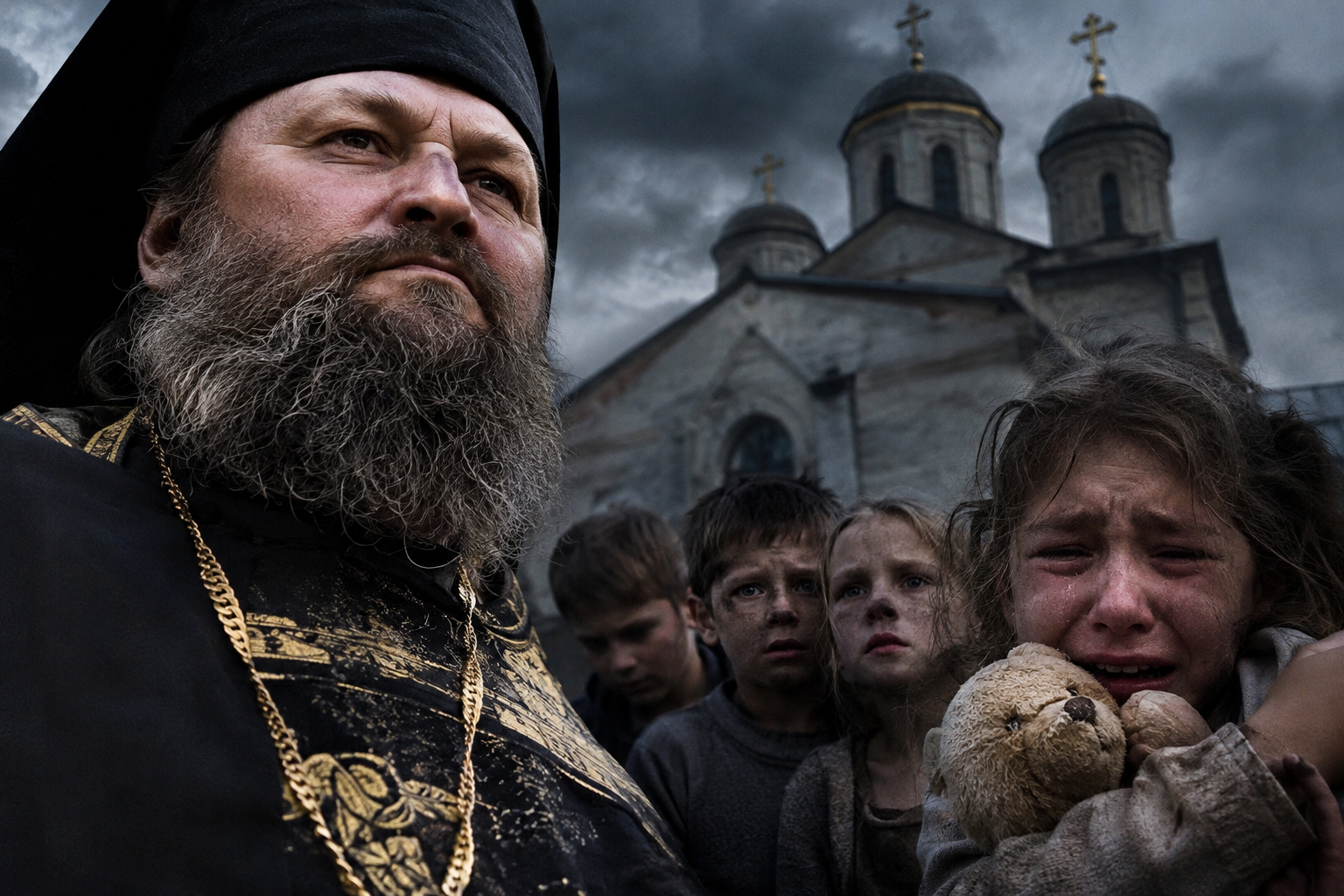
    In a remote Russian town, an Orthodox priest became a national symbol of compassion, earning prestigious honors for raising abandoned children. Behind that celebrated image, however, a criminal investigation uncovered a disturbing history of abuse. The story of Nikolai Stremsky raises a question far more unsettling than the crimes themselves: how does a society learn to trust someone so completely that it almost forgets to question him?

    There are certain stories that disturb me not simply because of the cruelty they reveal, but because of the extraordinary care with which that cruelty can remain concealed beneath an appearance of goodness. I have always found the relationship between power and public admiration fascinating, particularly when an individual becomes so closely associated with morality that questioning his behavior begins to feel almost like questioning morality itself.

    The story of Nikolai Stremsky, a Russian Orthodox priest who became famous for raising dozens of abandoned children, belongs to this troubling category of human history.

    For years, his name was associated with charity, religious devotion, and one of the largest families in Russia. Newspapers celebrated his extraordinary household, religious authorities recognized his work, and the Russian state awarded him the Order of Parental Glory, a prestigious distinction intended to honor exceptional contributions to family life.

    Yet on December 24, 2021, the Saraktash District Court in Russia’s Orenburg region sentenced this same man to 21 years in a strict-regime penal colony for serious offenses against children, including rape and other forms of sexual violence.

    When I began looking more closely at the reports surrounding this case, I found myself returning to a question that reaches far beyond Saraktash. How many times throughout history have people mistaken an impressive public reputation for evidence of private virtue?

    What makes this case especially disturbing is that Stremsky did not build his reputation through secrecy. His family was publicly celebrated, his religious institution was known to the community, and his work with children had attracted attention for decades.

    The danger was not hidden in some forgotten underground organization. It existed within an institution that many people believed represented safety, compassion, and moral authority.

    A Russian Town, a Religious Revival, and the Making of a National Hero

    Saraktash is a settlement in Russia’s Orenburg region, not far from the border with Kazakhstan. Its geographical position places it within a historically fascinating frontier, where Russian settlement, steppe traditions, Orthodox Christianity, and the cultures of Central Asia have intersected for generations.

    The broader Orenburg region developed as an important frontier territory of the Russian Empire during the eighteenth century, serving military, commercial, and administrative purposes along routes connecting European Russia with the Kazakh steppe and Central Asia.

    This historical background matters because Saraktash was not an isolated religious world detached from Russian society. Its institutions were shaped by the same political and social transformations that affected the rest of the country.

    When the Soviet Union collapsed in 1991, Russia entered a period of profound economic instability. Families struggled with poverty, unemployment, alcoholism, and the breakdown of familiar social structures. The difficulties facing children without adequate parental care became one of the most painful aspects of this transition.

    At the same time, the Russian Orthodox Church was experiencing a remarkable public revival after decades of restrictions under Soviet rule. Religious buildings were restored, monasteries reopened, and priests began recovering a social influence that had been severely limited during much of the twentieth century.

    It was within this atmosphere that Nikolai Stremsky and his wife, Galina, began taking children into their family during the early 1990s.

    Their work became associated with the Holy Trinity Simeon Monastery of Mercy in Saraktash, an Orthodox charitable complex that also developed educational and community activities.

    To the outside world, the story seemed extraordinary. A priest and his wife were providing a home for children who had experienced abandonment, institutional care, or difficult family circumstances.

    The number of children associated with their household eventually became central to Stremsky’s public identity. Reports frequently described him as the father of approximately 70 adopted or foster children, although the precise distinction between formal adoptions, guardianship arrangements, and children raised within the wider institution was not always made clear.

    That distinction is more important than it might initially appear. A large charitable household is not necessarily the same thing as a family in the legal sense, and the responsibilities of adults caring for vulnerable children depend on the arrangements under which those children have been placed.

    What interested me most was how quickly the number itself became a symbol. Seventy children represented generosity on a scale that seemed almost impossible to imagine, and the public narrative increasingly centered on the remarkable adult who had taken them in.

    But the greater the admiration directed toward the father, the easier it became for the individual experiences of the children to disappear behind his reputation.

    The Medal That Made a Reputation Almost Untouchable

    One of the less-discussed aspects of this story is the importance of public recognition in establishing Stremsky’s authority.

    In 2006, Nikolai Stremsky and his wife were photographed receiving a Golden Heart award in recognition of their work raising children. Later, Stremsky received Russia’s Order of Parental Glory, a state decoration associated with the upbringing of large families.

    The Order of Parental Glory is not simply a symbolic religious honor. It belongs to the Russian state awards system and is intended to recognize parents whose family life is presented as an example of responsible upbringing and commitment to children.

    In other words, Stremsky’s reputation was reinforced by two powerful sources of legitimacy: religion and the state.

    I find this combination particularly significant because both institutions carry forms of authority that can influence how ordinary people interpret evidence.

    A respected priest may be trusted because he represents spiritual guidance. A decorated citizen may be trusted because the state has publicly recognized his achievements. When the same individual possesses both forms of prestige, the psychological barrier to questioning him can become unusually strong.

    This does not mean that religious authority or state honors automatically create abuse. It means that public recognition can sometimes discourage the scrutiny that every institution responsible for vulnerable people requires.

    A medal may celebrate a person’s achievements, but it cannot reveal everything that happens behind closed doors.

    That is the contradiction at the heart of Saraktash. The very qualities that made Stremsky appear trustworthy also helped create an image that was extraordinarily difficult to challenge.

    September 2019: When the Public Story Began to Collapse

    In September 2019, Russian authorities arrested Nikolai Stremsky following allegations of serious crimes against children in his care.

    The investigation eventually examined offenses allegedly committed over a period extending from 1999 to 2019, a span of approximately twenty years.

    According to reporting based on statements from Russia’s Investigative Committee, the accusations included rape, sexual assault, indecent acts involving minors, cruel treatment, and failures to fulfill responsibilities toward children. Investigators also accused Stremsky of involving minors in alcohol consumption and of offenses involving specialized equipment intended for covert information gathering.

    The investigation referred to eleven minors in connection with alleged sexual offenses, while subsequent reporting identified seven children as formally recognized victims in the criminal proceedings.

    These numbers should not be confused. The number of children mentioned in an investigation, the number formally recognized as victims, and the number of specific criminal acts are different legal categories.

    I consider this distinction essential, especially in cases involving children, because exaggerating or combining figures may make a story sound more dramatic while actually weakening its credibility.

    At the time of Stremsky’s arrest, authorities removed nine children from his household, according to Russian reporting. Eight were under guardianship arrangements and one had been adopted. He subsequently lost his guardianship rights.

    For a man whose public identity had been built around caring for children, the significance of that intervention was enormous.

    The institution that had once symbolized protection had become the subject of a criminal investigation into the treatment of the very people it was supposed to protect.

    Stremsky denied the allegations, describing them as slander. His denial became part of the public controversy surrounding the case, but the subsequent judicial proceedings resulted in his conviction.

    There is something deeply unsettling about the chronology. The alleged offenses investigated by authorities stretched across two decades, during which his reputation as a devoted father continued to grow.

    It is tempting to explain this contradiction through a simple theory of institutional protection or deliberate complicity. Yet the publicly accessible reporting does not establish that every official, religious figure, or supporter knew about the abuse.

    What it does establish is that the existence of a celebrated public image did not prevent serious crimes from being committed against children.

    That fact alone deserves serious reflection.

    The Other Adults: A Detail That Changes the Story

    One of the most revealing aspects of the Saraktash case concerns the involvement of other adults connected to Stremsky’s household.

    Reports from BBC News and Radio Free Europe/Radio Liberty describe how one of his adult adopted daughters and her husband received suspended sentences for unlawfully restricting children’s freedom.

    This detail is significant because it shows that the criminal proceedings extended beyond accusations against a single priest.

    The case also raised questions about the treatment of children within the broader household and the extent to which adults responsible for their welfare respected their freedom and dignity.

    However, I believe it is important to resist turning every reported allegation into a cinematic scene. Some accounts circulating online describe underground prisons, elaborate surveillance networks, and carefully organized rituals of psychological torture.

    The verified reporting establishes serious crimes and accusations involving unlawful confinement, but it does not independently substantiate every sensational detail attached to the story.

    The distinction matters because real victims do not need invented horrors to make their experiences worthy of attention.

    The crimes established by the court are disturbing enough without embellishment.

    The Psychology of Obedience: Why Authority Can Silence Doubt

    What makes the Saraktash case relevant beyond Russia is the psychological question it raises about authority.

    In 1963, psychologist Stanley Milgram published his famous research on obedience, demonstrating how the presence of an apparently legitimate authority figure could influence people to perform actions that conflicted with their personal judgment.

    Milgram’s experiments have been debated extensively, both ethically and scientifically, and they cannot explain the behavior of every person involved in a modern criminal case. Nevertheless, they helped establish an important question within social psychology: how does perceived legitimacy affect our willingness to challenge authority?

    Later research on institutional abuse, coercive control, and the psychology of betrayal has explored how dependence on powerful individuals or organizations can complicate the recognition and disclosure of harmful experiences.

    Psychologist Jennifer Freyd’s work on betrayal trauma is especially relevant here. Her research examines how abuse involving a trusted or depended-upon person can create profound conflicts for victims, particularly when acknowledging the betrayal threatens an important relationship or source of security.

    I cannot claim to know the private psychological experiences of the children involved in Saraktash. Those experiences belong to them, and public reporting provides only a limited understanding of their lives.

    But the wider research offers a useful framework for understanding why abuse within trusted institutions can be difficult to expose.

    A child dependent on an adult for food, shelter, affection, education, and social belonging is not negotiating from a position of equality. When that adult also possesses religious or institutional authority, the imbalance becomes even more pronounced.

    The question is therefore not simply why a child might remain silent, but whether the surrounding environment provides a genuinely safe opportunity to speak and be believed.

    This is where I think the public fascination with supposedly saintly figures can become dangerous. The more completely a community identifies goodness with one individual, the more difficult it may become to recognize evidence that contradicts that belief.

    December 2021: The Judgment That Destroyed a Public Myth

    On December 24, 2021, the Saraktash District Court sentenced Nikolai Stremsky to 21 years in a strict-regime penal colony.

    The prosecution had reportedly requested a sentence of 24 years.

    The court also imposed restrictions on his freedom following imprisonment, prohibited him from working with children for twenty years, and stripped him of the Order of Parental Glory.

    The proceedings were held behind closed doors, a significant consideration in a case involving sexual crimes against minors. Public access to the complete evidentiary record was therefore limited, and detailed claims about particular testimony or forensic findings should not be presented as established unless supported by reliable documentation.

    By the time of his conviction, Stremsky had also been removed from the priesthood.

    In July 2022, the Orenburg Regional Court considered his appeal and upheld the prison sentence.

    There is a powerful historical irony in the removal of his state decoration. The same public system that had once recognized him as an exemplary parent eventually withdrew that recognition following a criminal conviction for crimes against children.

    Yet the symbolic reversal cannot undo the experiences of those harmed.

    A medal can be removed from an official record, and a sentence can establish legal responsibility, but neither action automatically restores the trust, security, or childhood that victims may have lost.

    The Most Disturbing Question Is Not About Religion

    Whenever a case like this becomes public, discussions often turn toward religion itself. Some interpret the crimes as proof of the dangers of religious institutions, while others insist that the actions of an individual should never be confused with the beliefs of an entire community.

    I think both reactions can distract from the more precise question raised by the evidence.

    The central issue is not whether faith is inherently good or bad, but what happens when moral authority becomes so concentrated in one person that ordinary safeguards begin to seem unnecessary.

    Religious institutions are not alone in facing this danger. Schools, charitable organizations, residential care facilities, political movements, and even families can develop cultures in which reputation is protected more aggressively than vulnerable individuals.

    History offers repeated examples of admired figures whose public image concealed serious wrongdoing. The lesson is not that every respected person should be regarded with suspicion, but that admiration must never replace accountability.

    The philosopher Hannah Arendt explored the relationship between authority, responsibility, and the human tendency to surrender independent judgment within powerful systems. Her work does not provide a direct explanation of Saraktash, but it offers a useful reminder that moral responsibility cannot simply be transferred to institutions or prestigious individuals.

    For me, this is one of the most important questions raised by the case. At what point does respect for an authority figure become an unwillingness to examine his actions?

    And how can institutions create conditions in which children are heard even when their testimony threatens the reputation of someone powerful?

    What Saraktash Reveals About the Stories We Want to Believe

    The longer I reflect on this case, the more I realize that its deepest mystery is not the existence of cruelty. Human history has never lacked examples of individuals capable of harming others while presenting themselves as respectable members of society.

    The more difficult mystery is our willingness to construct reassuring stories around people we admire.

    Stremsky’s public image offered a comforting narrative: an Orthodox priest rescuing abandoned children, rebuilding family life, and embodying charity during a period of social upheaval.

    It was a story people wanted to believe, partly because it seemed to demonstrate that goodness could survive even in difficult circumstances.

    And that desire was understandable.

    What troubles me is how easily a beautiful story can become a substitute for independent scrutiny. When admiration grows strong enough, uncomfortable questions may begin to look like acts of hostility rather than necessary precautions.

    The case also reminds me that the number of children in someone’s care should never become more important than the conditions in which those children live.

    Seventy children may make an impressive headline, but the true measure of an institution’s success lies in whether each child is safe, respected, listened to, and able to seek help without fear.

    The criminal proceedings in Saraktash established that the celebrated reputation of its most prominent religious figure concealed a reality profoundly different from the image presented to the public.

    That contradiction is the reason this story deserves to be remembered.

    Not because it proves that every charitable institution hides something sinister, and certainly not because the suffering of children should become entertainment, but because it reveals the consequences of confusing moral prestige with moral accountability.

    When I think about Saraktash, I do not see only the downfall of a famous priest. I see a warning about the human need to believe in heroes, the fragility of trust, and the responsibility we have to question even the most reassuring appearances.

    Perhaps the most frightening deception is not the lie that nobody believes, but the one that becomes so comforting that nobody wants to investigate it.

    And sometimes, the most important question we can ask is not whether a person appears to be good, but whether those who depend on that person are genuinely safe.


    Sources and Further Reading

    The following sources document the criminal proceedings, the history of Stremsky’s household, and the psychological concepts discussed in this article.

    BBC News — December 24, 2021
    Russian priest who adopted 70 children jailed for abuse
    https://www.bbc.com/news/world-europe-59779376

    Radio Free Europe/Radio Liberty — December 24, 2021
    Священник Стремский приговорён к 21 году колонии за насилие над детьми
    https://www.svoboda.org/a/svyaschennik-stremskiy-prigovoryon-k-21-godu-kolonii-za-nasilie-nad-detjmi/31624053.html

    RBC Russia — December 24, 2021
    Обвиненному в педофилии оренбургскому священнику дали 21 год колонии
    https://www.rbc.ru/society/24/12/2021/61c563d39a79473b315d622a

    1743.ru — September 9, 2020
    СК: Николай Стремский совершал преступления против половой неприкосновенности в течение 20 лет
    https://poleznygorod.1743.ru/news/40055

    Orenday — July 18, 2022
    21 год тюрьмы: приговор священнику Николаю Стремскому вступил в законную силу
    https://orenday.ru/news/180722094713

    Stanley Milgram — 1963
    Behavioral Study of Obedience. Journal of Abnormal and Social Psychology, 67(4), 371–378.
    DOI: 10.1037/h0040525

    Jennifer J. Freyd — 1996
    Betrayal Trauma: The Logic of Forgetting Childhood Abuse. Harvard University Press.

    Hannah Arendt — 1963
    Eichmann in Jerusalem: A Report on the Banality of Evil. Viking Press.

    Editorial note: This article distinguishes between documented court findings, allegations reported during the investigation, and the author’s interpretation of the wider social and psychological issues. Graphic details circulating online that could not be independently corroborated have been excluded.

    Whisper Mysteries — Exploring the truths hidden behind familiar stories.

    Fediverse reactions
  • The Nuclear Tomb America Left Behind: What Is Really Happening Beneath the Runit Dome?

    The Nuclear Tomb America Left Behind: What Is Really Happening Beneath the Runit Dome?

    I keep seeing discussions on Facebook and short articles, although I can hardly call some of them articles, about the Runit Dome, a mysterious concrete structure in the middle of the Pacific Ocean that supposedly conceals one of America’s most disturbing nuclear secrets. Most of these posts repeat the same information about radioactive waste, cracks in the concrete and rising sea levels, but almost nobody seems interested in explaining how this extraordinary place came into existence, what American authorities actually knew when they built it, or why an entire island was transformed into a radioactive burial ground whose consequences could extend thousands of years into the future.

    What intrigued me most was not the frightening appearance of the dome or the possibility that it might eventually deteriorate, but the uncomfortable realization that the structure everyone is discussing represents only a small part of a much larger story, one involving displaced islanders, nuclear experiments, contaminated lagoons and political decisions whose consequences continue long after the Cold War has ended.

    As I began examining the historical records and scientific assessments, I discovered details that made me question not only the decisions taken during the nuclear testing era, but also our modern understanding of environmental responsibility, because what happened on Runit Island raises a disturbing question about whether humanity is capable of managing the consequences of its own technological achievements.

    The Island That America Turned Into a Nuclear Cemetery

    Before Runit became associated with radioactive waste, it was part of Enewetak Atoll in the Marshall Islands, a remote Pacific landscape of coral islands, turquoise lagoons and communities whose relationship with the ocean had developed over countless generations.

    Following the Second World War, the United States selected parts of the Marshall Islands for nuclear weapons testing, and between 1946 and 1958, 67 nuclear tests were conducted at Bikini and Enewetak Atolls, leaving behind enormous quantities of radioactive contamination and permanently transforming sections of the surrounding environment.

    The inhabitants of Enewetak were relocated to Ujelang Atoll in 1947, and their displacement continued for more than three decades, while their ancestral homeland became a military testing ground where some of the most powerful weapons ever developed were detonated.

    When the United States eventually began preparing Enewetak for resettlement, the cleanup operation undertaken between 1977 and 1980 involved collecting contaminated soil and debris from several islands and transporting approximately 110,000 cubic yards, equivalent to roughly 84,000 cubic metres, of material to a crater on Runit Island.

    The crater itself had been created during the Cactus nuclear test in May 1958, and I found something deeply unsettling about the decision to use a hole produced by a nuclear explosion as the final resting place for radioactive materials left behind by other nuclear explosions.

    Workers mixed contaminated material with cement and placed it inside the crater before constructing a massive concrete covering approximately 115 metres in diameter, creating the structure that would eventually become known as the Runit Dome.

    From the air, the dome resembles an enormous grey shell surrounded by the astonishing blue waters of the Pacific, and the contrast between the beauty of the landscape and the history concealed beneath the concrete is almost impossible to ignore.

    The Detail Beneath the Concrete That Changes Everything

    One of the most surprising discoveries I made while researching Runit was that the crater containing the radioactive waste was never equipped with a fully impermeable lining capable of isolating its contents from the surrounding geological environment.

    Although the concrete covering was intended to prevent erosion and the dispersal of contaminated material from the surface, the waste beneath it was not enclosed inside a completely sealed container, which means that groundwater and seawater can interact with the materials deposited inside the crater.

    This is not a sensational theory invented by conspiracy websites, because official assessments and scientific investigations have acknowledged the movement of water through the porous coral formations beneath the structure.

    What disturbed me was discovering that the possibility of radioactive material migrating through groundwater was not entirely unexpected, and that environmental evaluations had considered such movement in relation to the substantial contamination already present in Enewetak Lagoon.

    The implications are uncomfortable because they suggest that the surrounding environment had already been so extensively affected by nuclear testing that the additional contribution from the dome could be relatively small compared with the radioactive contamination dispersed throughout the lagoon.

    In other words, the concrete structure that attracts so much attention is not necessarily the greatest source of contamination in the area, and concentrating exclusively on the dome risks overlooking the much larger environmental legacy left behind by the nuclear testing program.

    What Scientists Have Actually Discovered

    Over the years, photographs showing cracks and deterioration in parts of the concrete covering have generated alarming headlines, particularly as concerns about climate change and rising sea levels have intensified across the Pacific.

    However, the scientific picture is considerably more complicated than the dramatic predictions suggesting that the structure is about to collapse and release its entire radioactive inventory into the ocean.

    A United States Department of Energy assessment published in 2022 documented visible defects in the dome, including cracks and damage to some concrete panels, but did not identify evidence of imminent structural failure or a significant additional radiological threat to the residents of Enewetak from the containment structure.

    The same assessments recognized that groundwater can move through the crater and surrounding geological formations, while available measurements suggested that the dome’s contribution to radioactive contamination in the lagoon was relatively limited compared with contamination already present from historical testing.

    Additional investigations have examined the possible effects of climate change, coastal erosion and changes in ocean conditions, and the Department of Energy has continued reporting on inspections and groundwater monitoring, including documentation associated with a further reporting cycle in 2026.

    I believe these distinctions are essential because the absence of an imminent disaster does not mean that the radioactive legacy has disappeared, just as the existence of cracks does not automatically prove that a catastrophic release is approaching.

    What we are dealing with is a long-term environmental problem whose future depends on geological processes, changing coastal conditions, scientific monitoring and decisions that may have to be maintained across generations.

    The Radioactive Material That Could Outlive Civilizations

    Among the radioactive substances associated with the contamination of Enewetak is plutonium-239, an isotope with a half-life of approximately 24,100 years, meaning that after this extraordinary period, half of the original quantity of that isotope would remain undecayed.

    When I considered what 24,100 years actually represents in human history, the scale of the problem became much more disturbing than any photograph of damaged concrete could ever communicate.

    More than twenty-four thousand years ago, humanity was living during the last Ice Age, long before the emergence of modern cities, written history, established nations or the political institutions that now claim responsibility for managing the consequences of nuclear technology.

    Of course, radioactive half-life alone does not determine environmental danger, because actual exposure depends on the quantity and chemical form of the material, the pathways through which it can move and the circumstances under which people or ecosystems might encounter it.

    Nevertheless, the timescale forces us to confront an extraordinary contradiction between the temporary nature of human institutions and the lasting consequences of some of the materials those institutions have created.

    Concrete deteriorates, coastlines change, governments are replaced and international agreements can be rewritten, while the radioactive substances buried beneath Runit continue following physical processes that are entirely indifferent to human political arrangements.

    The Marshall Islands are also particularly vulnerable to rising sea levels and coastal changes, which makes the long-term management of contaminated locations an issue extending far beyond the original engineering decisions made during the cleanup operation.

    The People Who Inherited the Consequences

    Something else became increasingly clear as I examined the history of the Runit Dome, and it was the extent to which the people most directly affected by the nuclear testing program are often almost invisible in the stories written about it.

    The Marshallese communities did not choose to transform their islands into nuclear laboratories, nor did they design the military experiments that contaminated parts of their ancestral environment, yet they have lived with the consequences through displacement, restricted access to land and continuing concerns about environmental safety.

    The United States has provided compensation and supported monitoring and rehabilitation programs, but disagreements over the adequacy of compensation, environmental restoration and long-term responsibility have persisted.

    What I find particularly troubling is how easily the human dimension disappears behind technical terminology, because scientific reports can measure radioactive concentrations and calculate environmental exposure without fully communicating what it means for a community to inherit a homeland whose safety has become dependent on decisions made by distant governments.

    For the people of Enewetak, this is not simply an unusual Cold War monument that attracts attention on social media, but part of a continuing history that connects their past, their present and the future of generations who have not yet been born.

    What Would Really Happen If the Dome Failed?

    One of the most persistent misconceptions surrounding Runit is the idea that the collapse of its concrete covering would trigger a nuclear explosion or instantly release all the radioactive material beneath it into the surrounding ocean.

    Neither scenario follows from the available scientific evidence, because the dome is not an operating nuclear reactor or an assembled nuclear weapon, and any structural failure would have to be evaluated in terms of the actual movement of contaminated sediments, erosion, groundwater circulation and possible exposure pathways.

    A severe storm, progressive coastal erosion or long-term deterioration could potentially redistribute contaminated material, but the consequences would depend on the extent of the damage, the characteristics of the radioactive substances involved and the environmental conditions at the time.

    Scientific investigations have also indicated that substantial contamination already exists in parts of the surrounding lagoon independently of the waste contained beneath the dome, making it important to distinguish the effects of any future structural damage from the broader legacy of nuclear testing.

    What interests me most is not the dramatic possibility of an immediate catastrophe, but the quieter and more difficult question of how such a site can be responsibly managed over centuries when the environmental conditions, available resources and political priorities of future generations cannot be predicted with certainty.

    The Nuclear Tomb That Raises a Question Nobody Can Escape

    After examining the history of Runit Island, I no longer see its concrete dome merely as a frightening relic of the Cold War, because to me it represents something much more profound about the relationship between human ambition, technological power and responsibility.

    We have developed weapons capable of transforming landscapes within seconds, yet managing the consequences of those weapons can require commitments extending far beyond the lifespan of the governments, institutions and individuals who authorized their use.

    The Runit Dome is still standing, and available scientific assessments have not established that a catastrophic structural failure is imminent, but its existence reminds us that radioactive contamination cannot simply be erased from history by covering it with concrete.

    What continues to trouble me is the thought that hundreds or even thousands of years from now, when the political world responsible for these experiments may have changed beyond recognition, future generations could still be confronting questions created during a brief period of twentieth-century military competition.

    And somewhere in the Pacific, beneath a grey concrete shell surrounded by beautiful tropical waters, the physical remains of those decisions continue to exist, quietly challenging our assumption that the consequences of human actions belong only to the generations that created them.

    We have learned how to bury radioactive waste beneath concrete, but I am not convinced that we have learned how to prevent future generations from inheriting the responsibility for what we leave behind.


    Whisper Mysteries — Discover the Inexplicable.

    Sources and Further Reading

    U.S. Department of Energy and U.S. Army — Historical records of the Enewetak Atoll radiological cleanup, 1977–1980.

    U.S. Department of Energy — 2022 Report on the Visual Study and Groundwater Analysis of the Cactus Crater Containment Structure.

    U.S. Department of Energy — Reports and environmental monitoring of Enewetak Atoll.

    U.S. Department of Energy — 2024 climate change assessment concerning the Runit Dome and the Marshall Islands.

    U.S. Department of Energy — 2026 Runit Dome inspection and groundwater reporting information.

    Fediverse reactions
  • THE ARCHONS: What If the World Was Created by a God Who Didn’t Know the Truth?

    THE ARCHONS: What If the World Was Created by a God Who Didn’t Know the Truth?

    THE ARCHONS: What If the World Was Created by a God Who Didn’t Know the Truth?

    The disturbing secrets of the Nag Hammadi manuscripts, the mysterious rulers of the material world, and the ancient belief that humanity has forgotten its true origins.

    There is something deeply unsettling about the possibility that the world we know might not be exactly what we believe it to be, especially when that possibility appears in ancient writings composed long before modern theories about simulated realities, invisible dimensions, or hidden systems of control. I have spent considerable time exploring religious history and the different ways human beings have tried to explain existence, but few accounts have intrigued me as much as the extraordinary story preserved in the manuscripts discovered near Nag Hammadi, Egypt, in 1945.

    What makes these writings so fascinating is not simply their age or the unusual circumstances of their discovery, but the disturbing picture they present of creation itself. According to certain traditions preserved in these texts, the material universe was not created directly by the highest divine intelligence, but by an inferior being who possessed extraordinary powers while remaining ignorant of the greater reality from which he had emerged. This creator believed himself to be the only God, surrounded himself with subordinate rulers, and established an order in which humanity would remain unaware of its spiritual origins.

    These rulers were called the Archons, and although modern theories have transformed them into everything from reptilian extraterrestrials to invisible entities feeding on human fear, their original appearance in ancient religious literature reveals a far more complex and interesting story. I wanted to understand what the manuscripts actually say, particularly because the difference between an ancient belief and a modern interpretation can easily disappear when a mysterious subject becomes popular on the internet.

    The three writings that deserve our attention are The Apocryphon of John, The Hypostasis of the Archons, and On the Origin of the World. Together, they describe a universe shaped by ignorance, contested authority, and a struggle for knowledge, although each approaches the story from a different perspective. Their existence is historically established, while the supernatural beings they describe belong to religious cosmology rather than scientifically demonstrated reality.

    The Discovery at Nag Hammadi and the Beliefs That Almost Disappeared

    The story begins in Upper Egypt, where a collection of ancient papyrus books came to light in 1945, near the town of Nag Hammadi. The best-known account describes a local farmer, Muhammad Ali al-Samman, discovering manuscripts inside a large earthenware jar, although historians have questioned certain details of the discovery because the surviving accounts do not agree on every circumstance.

    The manuscripts themselves are genuine and date mainly to the fourth century, while many of the works they contain were probably composed during the preceding two centuries. Written in Coptic and frequently translated from earlier Greek compositions, these books preserve a remarkable variety of religious and philosophical traditions that existed during the formative centuries of Christianity.

    What makes the discovery particularly important is that several of these teachings had previously been known primarily through the writings of theologians who opposed them. Early Christian authors such as Irenaeus of Lyon described and criticized movements whose beliefs differed from those that eventually became orthodox, but the Nag Hammadi collection allowed modern researchers to study many related traditions through their own surviving literature.

    I find the uncertainty surrounding the manuscripts’ final owners almost as interesting as their contents, because we still cannot establish with confidence who assembled the collection, why these particular books were kept together, or why they ended up buried. The popular theory that they were hidden to escape religious persecution is possible, but it should not be mistaken for a proven historical explanation.

    Among the texts, however, one particular idea repeatedly emerges: the visible world is not necessarily the highest expression of divine reality, and the powers governing it may be fundamentally mistaken about their own nature.

    Yaldabaoth: The Creator Who Mistook His Power for Divine Perfection

    In The Apocryphon of John, also known as The Secret Book of John, the story begins not with the familiar biblical creation of heaven and earth, but with an ineffable divine source existing beyond the material universe. This ultimate reality transcends ordinary human categories, and from it emerge divine manifestations, including Barbelo, associated with divine forethought, and Sophia, whose name means Wisdom.

    Sophia occupies a central position in the unfolding drama because, according to the narrative, she brings forth a being without the proper participation of her divine counterpart. The result is Yaldabaoth, an imperfect entity who possesses considerable creative power but lacks awareness of the higher divine realm. The manuscript describes him through the extraordinary image of a lion-faced serpent, a representation that modern writers sometimes interpret literally, although such hybrid imagery was familiar within ancient religious symbolism.

    What interested me most was not his appearance, but the contradiction between his power and his ignorance. Yaldabaoth believes that he is the supreme divine authority because he cannot perceive the reality above him, and his conviction becomes so absolute that he proclaims himself the only God in existence. Within the logic of the story, his claim reveals the very ignorance he does not recognize, since a truly all-knowing being would not be unaware of its own origin.

    This is where the ancient narrative becomes philosophically provocative, because it presents a creator whose authority is not supported by complete understanding. Yaldabaoth then produces subordinate cosmic powers, the Archons, who participate in organizing and governing the lower universe, creating a hierarchy in which authority flows from a being who has misunderstood his own position.

    I find it difficult to read this account without thinking about the difference between possessing power and possessing wisdom, a distinction that has troubled philosophers throughout history. Human societies have repeatedly placed enormous authority in the hands of individuals and institutions whose confidence exceeded their understanding, and although the ancient text was not written as a modern political commentary, its central paradox remains recognizable.

    The most disturbing implication of the narrative is that an entire world could be organized around the certainty of a ruler who does not know what he does not know.

    The Creation of Humanity and the Secret the Archons Could Not Control

    The story becomes even more unusual when The Apocryphon of John describes the creation of Adam, because the Archons do not simply create humanity as an expression of their own perfection. Instead, they perceive an image associated with the higher divine realm and attempt to reproduce it, constructing a human form that initially lacks the living spiritual power necessary to animate it.

    Through an intervention originating from the higher divine reality, Yaldabaoth is induced to transfer power into the human being, and Adam becomes alive. The result is deeply ironic: the rulers have helped create something that possesses a spiritual capacity they themselves cannot fully comprehend, because humanity carries a connection to the divine realm beyond their authority.

    Within this mythology, the human condition is therefore more complicated than ordinary obedience to a creator. The rulers attempt to limit human awareness precisely because knowledge of humanity’s higher origin threatens the assumptions upon which their authority rests.

    This interpretation transforms the familiar story of Genesis into a conflict over spiritual knowledge, where the central problem is not simply disobedience but ignorance of one’s true nature. The human being is presented as possessing a potential that cannot be explained entirely through the material order, while the rulers struggle to maintain control over a creation whose deeper identity exceeds their understanding.

    Some contemporary writers have connected these passages to genetic manipulation, extraterrestrial experimentation, and the possibility that humanity was deliberately engineered by nonhuman beings. However, the manuscript does not provide scientific evidence for these claims, and its elaborate descriptions of the human body belong to ancient religious cosmology rather than modern biology.

    Even without accepting the account literally, I find its underlying question fascinating, because it asks what happens when a being created within a particular system develops the ability to recognize the limitations of that system. The question applies naturally to philosophy, education, and the history of human knowledge, where progress has often depended upon challenging explanations once considered beyond dispute.

    The Hypostasis of the Archons: A Woman Who Challenged the Rulers

    The second manuscript, The Hypostasis of the Archons, sometimes translated as The Reality of the Rulers, develops the relationship between humanity and the cosmic authorities through a striking reinterpretation of the biblical creation story. Although it shares important themes with The Apocryphon of John, it places particular emphasis on the rulers’ attempts to dominate human beings and on the spiritual forces that resist them.

    One of the most intriguing aspects of this text is its treatment of feminine spiritual figures, especially the spiritual Eve and Norea. Rather than presenting feminine knowledge simply as the cause of humanity’s downfall, the narrative associates the spiritual feminine with insight, resistance, and a form of existence that the rulers cannot fully possess.

    In one disturbing episode, the Archons attempt to violate the woman, but the spiritual feminine principle escapes their grasp, leaving them unable to exercise the control they imagined they possessed. The episode is expressed through mythological imagery, yet its treatment of domination and spiritual autonomy is unmistakable.

    Later, Norea confronts the rulers when they attempt to assert authority over her, and she receives assistance from a heavenly revealer named Eleleth, who explains the origins and limitations of the powers threatening her. Through this revelation, the narrative presents knowledge as a means of resisting illegitimate authority, while the rulers’ inability to understand the higher divine reality becomes the foundation of their weakness.

    I was particularly interested in how differently this story treats the relationship between feminine identity and spiritual knowledge compared with more familiar interpretations of Genesis. Instead of reducing the woman to a symbol of temptation, the manuscript presents figures who challenge domination and expose the ignorance of those claiming absolute power.

    This does not mean that the text should be treated as a modern statement about political or social equality, because its authors operated within a very different religious and cultural environment. Nevertheless, its portrayal of resistance raises a question that remains relevant: whether authority deserves obedience simply because it possesses the ability to impose its will.

    On the Origin of the World: The Archon Who Turned Against His Creator

    The third text, On the Origin of the World, offers a more elaborate explanation of the formation of the lower cosmos, developing themes of darkness, deficiency, divine wisdom, and the emergence of the rulers. Its narrative shares important elements with the other two manuscripts, but the details are not identical, which is worth remembering whenever modern interpretations combine all Gnostic writings into one supposedly unified secret doctrine.

    Yaldabaoth again appears as a ruler whose arrogance is inseparable from his ignorance, but the story introduces an unexpected development involving Sabaoth, one of the powers associated with the lower cosmic order. Rather than remaining permanently loyal to his father’s claims, Sabaoth turns away from Yaldabaoth’s arrogance and receives a different position within the divine hierarchy.

    This detail complicates the popular portrayal of the Archons as a single, unchanging species of malicious beings, because the ancient narrative allows for recognition, transformation, and a change in allegiance. The conflict is therefore not simply between humanity and an alien race, but between ignorance and knowledge within a much larger religious drama.

    Reading the three manuscripts together, I was struck by how much disappears when their stories are reduced to claims about reptilian creatures secretly controlling the planet. Their authors were exploring questions about the origins of evil, the limitations of material existence, the nature of divine wisdom, and the possibility of spiritual liberation, using an elaborate mythological language that cannot be translated directly into contemporary scientific categories.

    Reptilian Archons, the Matrix, and the Modern Fear of Invisible Control

    Anyone who searches for the Archons today will encounter interpretations that connect them to reptilian extraterrestrials, interdimensional parasites, emotional energy harvesting, and hidden forces supposedly manipulating human civilization. These theories often draw upon Yaldabaoth’s serpent-like appearance, the hierarchical organization of the cosmic rulers, and the ancient idea that humanity has been prevented from recognizing its true spiritual origins.

    The problem is that the surviving manuscripts do not establish the existence of a reptilian extraterrestrial species, nor do they demonstrate that invisible entities consume human fear or control contemporary institutions. Those claims belong to modern speculative interpretations, many of which combine ancient Gnostic mythology with ideas drawn from science fiction, conspiracy literature, and contemporary spirituality.

    Nevertheless, I understand why these interpretations have become popular, because the image of humanity living under an unseen system of control reflects anxieties that are deeply familiar in modern society. We inhabit a world shaped by complicated economic structures, political institutions, digital platforms, and technologies that influence what information reaches us, how our attention is directed, and sometimes even how we understand ourselves.

    These mechanisms can be studied through psychology, sociology, economics, and political history without assuming the existence of supernatural rulers. Yet the resemblance between the ancient mythology and the modern experience of living within systems we do not fully understand is difficult to ignore.

    The comparison becomes even more interesting when we consider the simulation hypothesis and Plato’s allegory of the cave, both of which raise questions about the relationship between perceived reality and a deeper level of existence. The Gnostic writers were not describing computer simulations or artificial intelligence, but they did imagine a world in which ordinary perception fails to reveal the highest truth.

    For them, liberation depended upon gnosis, a transformative knowledge of divine reality and humanity’s spiritual origin, rather than merely accumulating secret information about the rulers. This distinction matters because the ancient concept of awakening was not equivalent to discovering a hidden conspiracy; it involved a fundamental change in how the individual understood existence.

    Were the Nag Hammadi Teachings Deliberately Suppressed?

    One of the most persistent claims surrounding the Nag Hammadi discovery is that the manuscripts contain the original teachings of Jesus, deliberately concealed by religious authorities because they challenged the foundations of established Christianity. The historical reality is more complicated, although there is no doubt that the early Christian world contained a much greater diversity of theological interpretations than many people realize.

    During the first centuries of Christianity, different communities debated the nature of God, the identity of Jesus, the meaning of salvation, and the relationship between the material and spiritual worlds. Authors such as Irenaeus strongly opposed doctrines they considered incompatible with their understanding of Christianity, and many writings associated with alternative traditions eventually ceased to circulate widely.

    However, historians cannot establish that the entire Nag Hammadi collection was deliberately buried to preserve a single forbidden revelation, nor that its contents represent one original form of Christianity subsequently replaced by an invented doctrine.

    What these manuscripts genuinely demonstrate is that ancient religious thought was extraordinarily diverse, and that some communities developed interpretations of creation and salvation that differed radically from those that became dominant. Their survival allows us to examine ideas that might otherwise have been known only through the criticisms of their opponents, which makes the discovery historically significant without requiring an elaborate conspiracy to explain it.

    The Most Unsettling Question the Archons Leave Behind

    After examining these three writings, I found myself thinking less about the physical appearance of the Archons and more about the extraordinary relationship between ignorance, authority, and human freedom that their stories describe. The image of a lion-faced creator surrounded by subordinate cosmic rulers is certainly memorable, but the deeper philosophical problem lies in the possibility that an entire system could be governed by beings who mistake their limited understanding for absolute truth.

    In The Apocryphon of John, Yaldabaoth cannot recognize the reality above him, yet claims supreme authority over everything beneath him. In The Hypostasis of the Archons, the rulers attempt to dominate human beings whose spiritual nature they cannot fully comprehend, while On the Origin of the World introduces the possibility that even a being associated with the lower cosmic order can recognize the arrogance of its creator and turn away from it.

    Although these accounts differ in their details, they share a concern with the consequences of ignorance and the transformative possibilities of knowledge. Their authors imagined spiritual liberation as an awakening to a reality beyond the visible world, but the questions raised by their mythology remain meaningful even when approached without supernatural assumptions.

    I began reading about the Archons because I wanted to understand why ancient writers had imagined such an unusual hierarchy of cosmic powers, and why modern audiences continue to connect those figures to hidden rulers, extraterrestrial beings, and the possibility that our reality is not what it appears to be. What stayed with me, however, was the realization that the most disturbing form of control does not necessarily involve invisible creatures or supernatural intervention, because human beings can also become prisoners of inherited beliefs, unquestioned authority, and explanations they have never seriously examined.

    The Nag Hammadi manuscripts cannot prove that humanity is trapped inside a cosmic prison, but they preserve an extraordinary ancient attempt to explain why the world appears imperfect and why knowledge might offer a path toward freedom. Their authors lived in a very different intellectual universe from our own, yet their questions about power, ignorance, and the limits of perception have lost little of their ability to disturb us.

    And this is the thought I would leave with anyone willing to explore these manuscripts: if a person had spent an entire lifetime accepting a particular version of reality, surrounded by institutions that reinforced it and authorities that insisted there was nothing beyond it, how could that person ever recognize the limits of what they had been taught?

    The answer may have nothing to do with supernatural Archons, but it has everything to do with the courage to question what we believe we know.


    Sources and Further Reading

    • The Apocryphon of John — Nag Hammadi Codices II,1; III,1; IV,1; Berlin Codex 8502,2.
    • The Hypostasis of the Archons — Nag Hammadi Codex II,4.
    • On the Origin of the World — Nag Hammadi Codex II,5, with additional fragmentary evidence from Codex XIII.
    • James M. Robinson (ed.), The Nag Hammadi Library in English, revised edition, 1990.
    • Bentley Layton, The Gnostic Scriptures, 1987.
    • Karen L. King, What Is Gnosticism?, 2003.
    • Michael A. Williams, Rethinking “Gnosticism”, 1996.
    • Hugo Lundhaug and Lance Jenott, The Monastic Origins of the Nag Hammadi Codices, 2015.

    This article examines ancient religious writings and their contemporary interpretations. The manuscripts are authentic historical documents, but claims about literal extraterrestrial Archons or supernatural control of humanity have not been scientifically established.

    Whisper Mysteries — Discover the Inexplicable.

    Fediverse reactions
  • LA BRUTE by Guy des Cars — The Man Who Could Neither See, Hear, Nor Speak, and the Cruelty of Those Who Judged Him

    LA BRUTE by Guy des Cars — The Man Who Could Neither See, Hear, Nor Speak, and the Cruelty of Those Who Judged Him

    I first read this extraordinary novel almost thirty years ago. Returning to it now, I discovered that the story had not changed, but the woman reading it had.

    A few days ago, I finished rereading La Brute (The Brute) by Guy des Cars, a novel I had first encountered almost thirty years ago. I remembered the story, its extraordinary central character, and the unsettling impression it had left on me, although many of its details had faded from memory. What had remained was the feeling that somewhere beneath the mystery of a murder, the author had been trying to tell us something far more profound about human nature.

    I was too young then to fully understand everything hidden within this story. I read with the impatience of youth, following the events, searching for explanations, and wanting to discover the truth. The mystery fascinated me, the central character intrigued me, and, like any reader absorbed in a compelling novel, I wanted to know what had really happened.

    Now, almost thirty years later, I opened the same book with a different mind, carrying the experiences accumulated over the intervening decades and, above all, a different understanding of people. I was no longer interested only in discovering who had committed the murder. I wanted to understand the man at the centre of the story, the extraordinary workings of his mind, the suffering that others could neither see nor comprehend, and the frightening ease with which society mistakes difference for inferiority.

    It is almost impossible to read this novel without being moved to tears, without feeling something painfully human stirring deep inside you. La Brute is not the kind of book you simply finish and put back on the shelf. It stays with you, unsettles you, and forces you to confront emotions you may have believed you understood. There are moments when you want to cry, others when you feel anger rising at the cruelty of human judgment, and still others when you find yourself wondering how much suffering can exist inside a person whom the world has never truly tried to understand.

    I cried when I first read it almost thirty years ago, but reading it again, I realised that my tears no longer came from exactly the same place. Back then, I was overwhelmed by the tragedy of one man’s existence. Today, I am far more disturbed by the behaviour of those around him.

    Some books never change, but their readers change so profoundly that returning to them feels almost like discovering an entirely different work.

    That is exactly what happened to me with La Brute.

    And this time, one question followed me long after I had closed the book: who, in this story, truly deserves to be called a brute?

    A Murder in the Middle of the Atlantic

    The story takes us aboard the French ocean liner De Grasse, travelling from New York to Le Havre, during an era when crossing the Atlantic meant spending days surrounded by strangers, separated from the familiar world by thousands of miles of open water.

    There is something about the setting that immediately creates a sense of unease. A ship is a strange, temporary society, where people who know almost nothing about one another share confined spaces, exchange polite conversations, conceal private histories, and continue their journey with the comforting belief that the world beyond the ocean will eventually restore everything to normal.

    But somewhere in the middle of the Atlantic, that illusion is shattered.

    In one of the ship’s cabins, a wealthy American passenger is discovered murdered.

    Near the body sits Jacques Vauthier, his hands covered in blood.

    The circumstances appear devastatingly clear, and the man found at the scene acknowledges responsibility for the crime. Yet there is something about this apparent confession that transforms an ordinary murder investigation into a psychological puzzle of extraordinary complexity.

    Jacques Vauthier was born blind, deaf, and unable to speak.

    He has never seen another human face, never heard a voice, and never experienced the world through the two senses upon which most of us depend for nearly everything we know.

    Nevertheless, he is not the helpless, intellectually diminished figure that strangers might imagine.

    He is an educated man, a writer, and a person whose inner life is considerably more complex than his appearance suggests.

    The contrast is disturbing. A man who cannot see the victim, cannot hear the accusations against him, and cannot answer questions through ordinary speech suddenly finds himself at the centre of a murder case that fascinates the public.

    And he refuses to explain himself.

    What makes this situation particularly intriguing is that Jacques’ silence cannot be understood merely as a consequence of his disabilities. There is another silence, one that seems deliberate, guarded, and connected to something he is unwilling to reveal.

    That distinction changes the entire meaning of the story, because it forces us to consider the possibility that a person who appears completely powerless may possess a form of control that nobody around him recognises.

    Jacques Vauthier — The Extraordinary Mind Behind an Unfamiliar Face

    When I first read the novel, Jacques’ physical condition was what impressed me most. I tried to imagine how someone could live without sight, hearing, or speech, and I found the idea almost impossible to comprehend.

    Reading the book again, I became far more interested in the assumptions people make about such a life.

    We are accustomed to measuring intelligence through visible and audible expressions. We associate quick answers with understanding, articulate speech with education, and physical confidence with competence. When someone cannot communicate in ways familiar to us, we often make the terrible mistake of assuming that the absence of conventional expression means the absence of thought.

    Guy des Cars places precisely this prejudice at the centre of his novel.

    Jacques is physically powerful, and his appearance is described in ways that make many people uncomfortable. Yet behind that exterior exists a remarkable intelligence, developed through an education that required patience, adaptation, and a willingness to recognise abilities that others might have overlooked.

    One of the most fascinating details is that Jacques becomes an author himself. His fictional book, L’Isolé (The Isolated One), introduces another dimension to his character: a man who has never heard spoken language or seen printed words nevertheless discovers a means of expressing his thoughts through literature.

    During my second reading, this detail affected me more deeply than I expected.

    I have always considered writing one of the most intimate forms of human expression, a way of revealing thoughts that we cannot always communicate in conversation. But what happens when a person has never heard the sound of a word, never seen a letter printed on a page, and never experienced language in the way most writers do?

    Does the meaning of a word depend upon its sound, its appearance, or the thought it carries?

    Jacques forces us to reconsider what it really means to possess a voice.

    His existence raises an uncomfortable question about the way we define human intelligence. If a person cannot demonstrate understanding through the methods we recognise, does that make the understanding less real, or does it expose the limitations of our own imagination?

    The Real History Behind an Extraordinary Fictional Character

    There is another aspect of La Brute that deserves attention, especially because the novel was first published in 1951, when public understanding of disability was very different from what it is today.

    Guy des Cars did not invent the possibility of educating a person who was both deaf and blind. Long before his novel appeared, remarkable individuals had already challenged the widespread assumption that the absence of sight and hearing made intellectual development impossible.

    One of the best-known examples is Helen Keller, born in Alabama in 1880, who lost her sight and hearing in early childhood following an illness.

    With the assistance of her teacher, Anne Sullivan, Keller learned to communicate through tactile methods and eventually became an author, lecturer, and advocate for people with disabilities.

    The breakthrough in her education came when Sullivan repeatedly spelled words into Keller’s hand, helping her establish the connection between tactile signs and the objects they represented.

    Keller would later attend Radcliffe College, graduating in 1904, and her life became an enduring demonstration that language, intelligence, and education do not depend exclusively upon sight or hearing.

    But Keller was not the first person whose education challenged such assumptions.

    Decades earlier, Laura Bridgman, who had also lost her sight and hearing during childhood, was educated at the Perkins Institution for the Blind in Massachusetts. Her progress attracted international attention, including that of Charles Dickens, who visited the institution and subsequently wrote about her in American Notes.

    I find these historical connections important because they prevent us from treating Jacques Vauthier merely as an extraordinary invention designed to make a sensational novel more dramatic.

    The human possibilities behind his character were already being explored in the real world.

    A 1970 article in Le Monde discussing Guy des Cars’ fiction specifically referred to the education of people born deafblind as one of the unusual subjects incorporated into La Brute.

    That detail made me appreciate the novel from another perspective. Behind its murder mystery lies a question that has occupied educators, philosophers, psychologists, and families for generations: how does a human being develop an understanding of the world when the usual pathways of communication are unavailable?

    And how many intelligent people throughout history were considered incapable of learning simply because nobody had discovered how to reach them?

    The Cruelty Hidden Inside a Single Word

    The title of the novel deserves careful consideration.

    La Brute.

    The Brute.

    It is an ugly word, carrying associations of violence, primitive behaviour, physical force, and a supposed absence of refinement or sensitivity.

    What intrigues me is the contradiction between the title and the man to whom it is applied.

    Jacques possesses exceptional physical strength, and his appearance does not conform to conventional ideas of attractiveness. To people who judge him superficially, these characteristics become evidence of something threatening, something that must be feared or controlled.

    Yet the same man possesses intellectual abilities that many of those judging him would struggle to equal.

    This contradiction reflects a habit deeply embedded in human behaviour: we often interpret physical appearance as evidence of moral character.

    A beautiful face is more readily associated with kindness, while an unfamiliar or unsettling appearance can provoke suspicion before a person has spoken or acted.

    Psychology has a name for one aspect of this tendency: the halo effect, in which one noticeable characteristic influences our judgment of unrelated qualities.

    The opposite can happen as well. A negative impression of someone’s appearance can contaminate our assessment of their intelligence, honesty, or intentions.

    Reading La Brute today, I could not avoid thinking about how frequently we continue to make these judgments, even while congratulating ourselves on living in a more enlightened society.

    We have changed our vocabulary, developed new laws, and learned to speak publicly about inclusion and dignity, but the instinct to judge what looks unfamiliar has hardly disappeared.

    And the cruelty of such judgments becomes particularly disturbing when the person being judged cannot easily defend themselves against them.

    Victor Deliot — The Lawyer Who Refuses to Accept the Obvious

    Another character who deserves far more attention than a simple plot summary can offer is Victor Deliot, the ageing lawyer appointed to defend Jacques Vauthier.

    Deliot is not presented as an untouchable legal genius surrounded by prestige and admiration. He is a modest, experienced lawyer whose professional life has not brought him the recognition he might once have imagined.

    Yet he possesses something that proves more valuable than reputation: the willingness to question an explanation that everyone else seems ready to accept.

    The evidence against Jacques appears overwhelming. The accused has been found at the scene, and his acknowledgement of responsibility seems to remove any remaining uncertainty.

    For many observers, there is nothing left to investigate.

    But Deliot understands that a confession is not necessarily the same thing as the truth.

    I have always been fascinated by stories in which the most important investigator is not the person who discovers the greatest number of clues, but the one who recognises that the accepted interpretation of those clues may be fundamentally wrong.

    There is a profound difference between establishing what appears to have happened and understanding why events unfolded as they did.

    Deliot begins looking beyond the immediate circumstances of the crime, examining Jacques’ past, his education, his relationships, and the emotional world that others have so readily dismissed.

    The investigation gradually becomes more than a search for legal evidence.

    It becomes an attempt to understand another human being.

    And this, for me, is where La Brute begins to move beyond the conventions of an ordinary crime novel.

    Can a Human Being Think Without Words?

    One of the questions that occupied my thoughts during this rereading concerned the relationship between language and thought.

    We tend to imagine our minds as places filled with words, internal conversations, remembered voices, and images. Even when we are alone, we often experience our thoughts as a kind of silent dialogue.

    But what happens when someone has never heard a spoken word?

    What form does memory take in a person who has never seen an image?

    How does someone imagine another human being without ever having seen a face or heard a voice?

    These questions are more complicated than they initially appear, because human thought does not depend entirely upon spoken language. We can recognise patterns, remember physical sensations, understand spatial relationships, and experience emotions without translating every experience into words.

    Modern research into cognition has shown that thought can involve multiple forms of representation, including visual, spatial, tactile, emotional, and linguistic processes.

    For a person born deafblind, the development of language depends heavily upon accessible communication and education. Tactile systems can allow complex ideas to be learned, discussed, remembered, and expressed.

    This is why the education of Jacques Vauthier matters so much to the novel.

    His intelligence is not a supernatural gift, nor does his condition grant him mysterious powers. What makes him extraordinary is the determination and education through which his abilities have developed despite formidable barriers.

    There is something profoundly moving about that achievement.

    And there is something equally disturbing about the fact that people who possess sight, hearing, and speech can still fail so completely to understand the person standing before them.

    The more I thought about this contradiction, the more the novel seemed to be asking a different question from the one suggested by its murder mystery.

    Who is truly unable to communicate: the man who cannot speak, or the people who refuse to listen?

    Solange — Love, Dependence, and the Fear of Losing Another Human Being

    No examination of Jacques Vauthier would be complete without considering Solange, the woman who becomes his wife.

    Her relationship with Jacques introduces another difficult question into the novel: what does love mean when two people experience and communicate with the world in radically different ways?

    It is tempting to approach such a relationship through sentimentality, imagining that devotion alone can overcome every obstacle. But human relationships are rarely so simple, and Guy des Cars does not construct his fictional world around uncomplicated emotions.

    Love can contain tenderness and dependence, loyalty and fear, admiration and resentment. The desire to protect another person may coexist with the need for independence, while the wish to be understood can become inseparable from the terror of being abandoned.

    Jacques’ relationship with Solange is important not merely because she helps connect him with the surrounding world, but because it reminds us that disability does not eliminate emotional complexity.

    A person who cannot see, hear, or speak can still experience attachment, jealousy, longing, anger, and the desire to be loved.

    This should be obvious, yet the history of how people with disabilities have been represented suggests that society has often struggled to acknowledge their full emotional and personal lives.

    During my first reading, I followed the relationship primarily as part of the mystery.

    This time, I found myself thinking about the unequal expectations that can develop between people who depend upon one another, and about the difficult boundary between love and sacrifice.

    The novel offers enough emotional complexity to make these questions worth considering without revealing the secrets on which its plot depends.

    A Novel Written in 1951 That Still Questions Our Modern World

    Guy des Cars was one of France’s successful popular novelists of the twentieth century, although his work did not always receive the same critical prestige granted to writers considered more literary or experimental.

    He had a particular interest in unusual destinies, intense psychological conflicts, and characters placed in circumstances that exposed the contradictions of society.

    La Brute belongs unmistakably to that tradition.

    Its dramatic construction, extraordinary protagonist, and courtroom mystery are designed to hold the reader’s attention, but beneath these elements lies a subject that remains relevant decades after its publication.

    We continue to live in a world where people are frequently reduced to labels.

    We identify them by their physical appearance, education, social position, disabilities, beliefs, or the circumstances in which we encounter them. Once a label has been attached, everything that follows risks being interpreted through it.

    A person considered dangerous must continually prove that they are not dangerous. Someone assumed to be unintelligent must work harder to have their ideas taken seriously. Someone who cannot communicate conventionally may find that others speak about them rather than attempt to communicate with them.

    The legal dimension of the novel makes this problem particularly troubling.

    Justice depends upon evidence, but evidence must always be interpreted by human beings, and human beings are not free from prejudice.

    A confession may appear decisive, yet its meaning depends upon circumstances, motives, and the reliability of the process through which it was obtained.

    An unusual appearance may influence public opinion, even though it tells us nothing about guilt.

    And a person’s inability to defend themselves through ordinary speech must never be confused with an absence of thoughts worth hearing.

    These are not merely questions from a novel published more than seventy years ago.

    They are questions about the kind of society we have created and the assumptions we continue to carry into our judgments of others.

    What Thirty Years Have Changed in Me

    I do not believe that every book needs to offer a moral lesson, and I am generally suspicious of stories that attempt to divide humanity neatly into innocent victims and irredeemable villains.

    What makes La Brute interesting is precisely the discomfort of its contradictions.

    Jacques is not simply a symbol of suffering, nor should his disabilities be treated as proof of moral purity. He is a fictional human being whose intelligence, emotions, personal history, and decisions must be considered together.

    That complexity is essential.

    To recognise someone’s humanity does not mean idealising them, and to understand their circumstances does not mean abandoning the search for truth.

    The first time I read this novel, I was captivated by the mystery of the crime and by the extraordinary condition of the accused man.

    Thirty years later, the murder was no longer the element that disturbed me most.

    I kept returning to the people who believed they understood Jacques before they had made any serious effort to know him. I thought about the confidence with which human beings pronounce judgments, the ease with which appearances become explanations, and the frightening possibility that we sometimes mistake our inability to understand another person for evidence that there is nothing worth understanding.

    There is also something deeply unsettling about the idea of a man who has spent his entire life learning how to communicate with the world, only to find himself in a situation where the world seems unwilling to listen.

    The irony is almost unbearable.

    And yet, I do not want to reveal what lies behind Jacques Vauthier’s silence, because discovering its meaning is part of the experience that makes this novel worth reading.

    Who Is the Real Brute?

    I finished La Brute with the feeling that Guy des Cars had constructed something more enduring than a conventional murder mystery.

    He had created a story in which the reader is invited to examine not only the accused man, but also the assumptions brought into the act of judging him.

    The novel asks us to consider whether intelligence can exist without familiar forms of expression, whether love can survive the most difficult forms of dependence, and whether justice is possible when appearances have already shaped the verdict in people’s minds.

    But the question that remained with me was the one contained in the title itself.

    What makes a human being a brute?

    Is it physical strength, an unsettling appearance, an inability to communicate, or a form of behaviour that others cannot understand?

    Or is brutality something that can exist behind perfectly ordinary faces, educated speech, respectable positions, and the comfortable certainty of people who have never questioned their own prejudices?

    I will leave the answer where Guy des Cars placed it: within the experience of reading the novel.

    I have deliberately avoided revealing the identity of the murderer or the ending, because I believe this is a story that deserves to be discovered rather than explained away.

    Almost thirty years separated my two readings of La Brute, and the greatest difference was not in the book itself, but in the questions I brought to its pages.

    When I was younger, I wanted to know what Jacques Vauthier had done.

    Today, I am far more interested in understanding who he was, and why so many people were prepared to judge him without truly knowing him.

    I have come to believe that one of the most important things a book can do is not provide us with answers, but make us recognise how much we still fail to understand about other human beings.

    And that is why, after almost thirty years, La Brute has remained with me.

    Not simply as the story of a man who could neither see, hear, nor speak, but as a reminder that possessing all our senses does not necessarily mean we know how to perceive the truth.

    Because the most dangerous form of blindness may be the one we never recognise in ourselves.


    Have you ever reread a book after many years and discovered that it seemed to tell an entirely different story? I would love to know which books changed their meaning for you as you grew older.

    Whisper Mysteries — Exploring the stories that reveal what lies beneath the surface of human experience.

    Fediverse reactions
  • Karl Marx: The Secrets Behind the Revolutionary — A Hidden Son, a Silent Woman, and the Tragic Fate of His Daughters

    Karl Marx: The Secrets Behind the Revolutionary — A Hidden Son, a Silent Woman, and the Tragic Fate of His Daughters

    Karl Marx: The Secrets Behind the Revolutionary — A Hidden Son, a Silent Woman, and the Tragic Fate of His Daughters

    Behind the man who promised to liberate humanity from exploitation lies a disturbing family history of poverty, financial dependence, concealed relationships, and two daughters whose lives ended in tragedy. But how much of this story is true, and how much has been rewritten to serve political agendas?

    There is something about the private lives of famous historical figures that has always fascinated me. We know their books, their speeches, their theories, and the ideas that changed the world, yet we rarely ask what happened when they returned home, closed the door, and became ordinary human beings, surrounded by people who had to live with their ambitions, weaknesses, and contradictions.

    Karl Marx is one of those figures whose public identity has almost completely swallowed the man himself. His name has been praised, condemned, worshipped, and blamed for some of the most dramatic political transformations in modern history. Generations have argued over his ideas about capitalism, class struggle, and revolution, but far fewer have examined the complicated relationships and painful secrets hidden within his own family.

    My curiosity began with an unusual statement circulating online, supposedly written by Marx himself. In it, he appeared to confess that he had fathered a child with his housekeeper, lived on his wife’s money, depended on a wealthy friend, and had two daughters who committed suicide.

    The accusations were extraordinary, but one detail immediately raised a question that changed the direction of my investigation. Marx died in 1883, while the two daughters mentioned in the statement died in 1898 and 1911. Whatever the origins of that supposed confession, it could not have been written by him in the form being circulated.

    I could have dismissed the entire story as another piece of political propaganda, but the historical details behind it were too intriguing to ignore. Some were documented, others remained disputed, and a few led me toward a side of Marx’s life that was far more revealing than the fabricated confession itself.

    I began following the story backward, through nineteenth-century London, family letters, biographies, and the lives of women who spent decades in the shadow of a man determined to change the world.

    And somewhere along the way, the revolutionary philosopher began to look very different from the familiar portrait hanging in history books.

    The Man Who Studied Poverty While His Own Family Was Drowning in It

    London, 1849.

    The city was becoming the industrial heart of the British Empire, a place where extraordinary wealth existed within walking distance of overcrowded rooms, polluted streets, and families struggling to survive. Factories produced fortunes for their owners, while thousands of workers endured exhausting labour and living conditions that would later become central to Marx’s criticism of capitalism.

    Marx arrived in this city as a political exile, accompanied by his wife, Jenny von Westphalen, and their children. The revolutionary movements of 1848 had failed to achieve the transformations he had hoped for, and his political activities had made it increasingly difficult for him to remain on the European continent.

    Jenny had not been born into poverty. Her family belonged to respectable Prussian society and had aristocratic connections, which makes the contrast between her upbringing and her married life especially striking. She had chosen a brilliant, controversial young intellectual whose political convictions offered little prospect of financial security.

    Their life in London became a long struggle against debt, illness, and uncertainty.

    At 28 Dean Street, in Soho, the family occupied cramped rooms that have since become part of the mythology surrounding Marx. Household possessions were repeatedly pawned, creditors demanded payment, and the lack of money affected almost every aspect of their existence.

    One of the details that stayed with me came from Jenny’s own recollections of the death of their daughter Franziska in 1852. The little girl was barely a year old, and the family was so impoverished that Jenny had to seek help to obtain a coffin.

    It is difficult to read such an account without imagining the despair inside that household. While Marx was developing arguments about the economic structures responsible for human suffering, his own wife was confronting a tragedy made even more painful by their inability to pay for the simplest funeral arrangements.

    Karl and Jenny had seven children, but only three daughters survived to adulthood: Jenny Caroline, Laura, and Eleanor.

    The deaths of their other children cannot simply be blamed on Marx’s financial decisions. Childhood mortality was tragically common in nineteenth-century Europe, and infectious diseases claimed lives across social classes. Nevertheless, the family’s precarious living conditions added another layer of vulnerability to an already dangerous world.

    The correspondence from those years reveals a man capable of intense intellectual concentration but frequently overwhelmed by practical difficulties. Marx worked as a journalist, received payments for articles, and occasionally benefited from inheritances, yet his income was inconsistent and his spending often exceeded what the household could afford.

    Jenny copied manuscripts, managed family affairs, dealt with correspondence, and helped preserve her husband’s work through periods when their circumstances might have destroyed it entirely.

    The more I read about her, the more I wondered how differently the history of Marxism might have unfolded without the unpaid and largely invisible labour of the woman who shared his life.

    But Jenny was not the only woman whose work sustained the Marx household.

    There was another, and her story leads directly to one of the most controversial mysteries in the philosopher’s biography.

    Helene Demuth: The Woman Who Knew Too Much

    Her name was Helene Demuth, although everyone in the family called her Lenchen.

    She had entered Jenny von Westphalen’s household before Jenny married Marx and remained connected to the family for decades. Through political exile, poverty, illness, and personal upheaval, Helene became an indispensable presence in their domestic life.

    She cooked, cleaned, cared for the children, and helped maintain the household while Marx spent long hours studying and writing.

    I find her position particularly interesting because she lived at the intersection of two very different worlds. Inside the same home where one of the nineteenth century’s most influential critics of class inequality was developing his theories, Helene performed the domestic labour that made his intellectual life possible.

    The relationship between Helene and the Marx family was not simply that of an employer and an employee. She was deeply involved in their daily existence and remained close to them throughout her life, although that closeness did not erase the differences in status and power between them.

    Then, in June 1851, something happened that would become the subject of speculation for generations.

    Helene gave birth to a boy.

    His name was Henry Frederick Demuth, usually known as Freddy.

    The father’s name was not recorded on his birth certificate.

    Freddy was raised outside the Marx household, and the identity of his biological father remained a question that would eventually divide historians.

    According to the account accepted by many Marx biographers, Karl Marx was the child’s father, while Friedrich Engels, Marx’s closest friend and collaborator, helped conceal the relationship to protect Jenny and prevent a scandal.

    But the story is not as straightforward as it is often presented.

    A crucial piece of evidence is a letter written in September 1898 by Louise Freyberger to the German socialist leader August Bebel. Freyberger reported that Engels had acknowledged, shortly before his death, that Marx was Freddy’s father.

    The letter is historically significant, but it is not the same as a direct confession by Marx, and it does not establish biological paternity beyond all doubt.

    Historians have debated the reliability of the testimony, the circumstances in which the information was transmitted, and whether the traditional interpretation rests too heavily on a limited documentary record.

    What makes this case especially revealing is the silence surrounding Helene herself. Her own detailed account of the circumstances has not survived, leaving historians dependent largely on the words and recollections of other people.

    I kept returning to that absence while reading about the controversy. The men involved became world-famous intellectual figures, their letters were collected, and their political disagreements were studied for generations, while the woman at the centre of this intimate mystery left comparatively little testimony through which we can hear her own voice.

    Freddy Demuth eventually worked as a skilled tradesman and lived a life far removed from the intellectual and political circles associated with Marx. He died in 1929.

    Whether Marx was his biological father remains disputed, but the existence of Freddy, his mother’s position in the household, and the later attempts to establish his paternity are part of the historical record.

    And the man whose name appears repeatedly in this controversy, Friedrich Engels, played another extraordinary role in Marx’s life.

    He helped keep him financially afloat for decades.

    Friedrich Engels: The Capitalist Who Financed the Critic of Capitalism

    If there is one contradiction in Marx’s biography that deserves careful examination, it is his relationship with Friedrich Engels.

    Engels was not merely a political companion or a fellow philosopher. He came from a prosperous industrial family whose business interests included textile manufacturing, particularly in Manchester, one of the great centres of British industrial capitalism.

    His family’s wealth was connected to the very economic system that Marx and Engels would spend much of their lives analysing and criticising.

    Engels knew the industrial world from within. He had observed the conditions endured by workers in Manchester and published The Condition of the Working Class in England in 1845, several years before Marx began publishing the major volumes of his economic work.

    The friendship between the two men developed into one of the most influential intellectual partnerships in modern history, but it also involved something much more practical.

    Money.

    Engels repeatedly sent financial assistance to Marx, helping him cover living expenses and continue his research during periods when the family had little reliable income.

    Their correspondence contains numerous references to financial difficulties, requests for help, payments, and arrangements intended to provide Marx with greater stability.

    In 1869, Engels retired from his commercial position in Manchester, and the financial arrangements between the two friends became more regular.

    What intrigued me was not simply the irony of a revolutionary thinker receiving money generated through capitalist industry. It was the extraordinary extent to which Marx’s intellectual independence depended on the material support of another person.

    Without Engels, Marx might still have developed his ideas, but the conditions under which he worked would have been considerably more difficult.

    Of course, receiving financial support from an industrialist does not automatically invalidate a critique of capitalism. Engels himself believed that understanding the system from within strengthened his arguments against its inequalities.

    Nevertheless, the relationship exposes a truth that ideological portraits often conceal: even the most radical intellectual projects depend on ordinary material realities.

    Someone has to pay the rent, purchase the books, provide food, and make it possible for a writer to spend years developing ideas that may never generate enough income to sustain a family.

    Marx understood economic dependence as a central feature of social life, yet his own dependence on Engels was unusually personal.

    There is something almost literary about that relationship, a wealthy industrialist financing the man who would become capitalism’s most famous critic, while the two worked together to imagine a world fundamentally different from the one that made their collaboration possible.

    But money was only one part of the story.

    Behind the intellectual partnership stood a family in which love, loyalty, illness, ambition, and sacrifice were becoming increasingly difficult to separate.

    Jenny Marx: The Woman Who Helped Build a Revolution and Paid a Personal Price

    When I began looking more closely at Jenny von Westphalen, I realised that her life deserved an investigation of its own.

    She was not simply the patient wife of a difficult genius, nor was she a passive figure standing quietly beside her husband’s intellectual achievements. Jenny was educated, politically aware, and deeply involved in the work that would eventually make Marx famous.

    She copied manuscripts, discussed political developments, maintained correspondence, and helped him navigate the complicated relationships surrounding the socialist movement.

    But she was also a mother who buried four children, a woman who lived for years under financial pressure, and a wife whose private life may have contained a betrayal that was never openly acknowledged.

    The possibility that Marx fathered Helene Demuth’s child raises uncomfortable questions about what Jenny knew and how the family handled the situation. The surviving evidence does not allow us to reconstruct her thoughts with certainty, and I would rather leave that silence intact than invent a confrontation or a confession for which no reliable document exists.

    What we do know is that Jenny remained with Marx until her death in December 1881, after a long marriage marked by political upheaval, financial insecurity, and repeated illness.

    One of the lesser-known aspects of their relationship is that Jenny came from a social background very different from the revolutionary circles in which her husband would eventually become famous. Their marriage crossed expectations of class and political respectability, and her commitment to Marx was established long before anyone could have predicted his historical influence.

    I found that detail particularly moving because it reminds us that Jenny did not marry a monument or a celebrated philosopher. She married a young man whose future was uncertain, whose ideas were controversial, and whose political activities would repeatedly disrupt their lives.

    History tends to preserve the achievements of exceptional men while reducing the women around them to supporting roles. Yet without Jenny’s labour, patience, intelligence, and practical involvement, the story of Karl Marx would have been profoundly different.

    And after Jenny’s death, the family began to unravel in ways that neither Marx nor Engels would live to witness completely.

    The Three Daughters Who Survived Childhood

    There were three daughters who reached adulthood in the Marx family, and their lives reveal something rarely discussed in the simplified portraits of their father.

    Jenny Caroline, Laura, and Eleanor were raised in an intellectually intense household, surrounded by political debates, books, foreign languages, visiting revolutionaries, and conversations about the future of European society.

    Marx was affectionate with his children, who called him Moor, a family nickname associated with his dark appearance. His letters and the recollections of those who knew him reveal a playful side of his personality, particularly in his relationships with children and grandchildren.

    This is an important part of the story because the historical record does not support portraying Marx as a man incapable of affection or indifferent to his family.

    He could be loving, humorous, demanding, irritable, intellectually generous, and personally difficult, sometimes within the same relationship.

    His daughters inherited more than his name. They grew up in a world where political commitment was treated as a serious moral responsibility, and both Laura and Eleanor became active participants in socialist movements.

    The eldest daughter, Jenny Caroline, married the French socialist Charles Longuet and became involved in political journalism and activism. Her life was cut short by illness in January 1883, only weeks before her father’s death.

    By then, Marx had already lost his wife and several children, and his own health was deteriorating.

    Karl Marx died in London on 14 March 1883, aged sixty-four.

    His death is essential to understanding the false quotation that originally led me into this investigation, because the tragedies most frequently used to condemn his private life had not yet occurred.

    Eleanor would die fifteen years later.

    Laura would die twenty-eight years later.

    Neither event could have appeared in a genuine confession written by their father.

    Yet the circumstances of those deaths are among the most haunting episodes in the history of the Marx family.

    Eleanor Marx: The Woman Who Fought for Freedom but Could Not Escape Her Own Tragedy

    Eleanor Marx was born in London in January 1855 and became known within her family as Tussy.

    Of all Marx’s daughters, she is perhaps the one whose life most clearly demonstrates the tension between public convictions and private suffering.

    She was intelligent, energetic, politically committed, and deeply interested in literature and theatre. She translated important works, including Gustave Flaubert’s Madame Bovary, and became involved in the British labour movement at a time when women were still struggling to gain recognition as independent political actors.

    Eleanor helped organise workers, supported trade union activity, and became associated with the emerging socialist movement in Britain.

    She was not merely repeating her father’s ideas. She developed her own political identity and became an important advocate for women’s emancipation.

    What drew me into her story was the contrast between the independence she defended publicly and the painful complications of her relationship with Edward Aveling.

    Aveling was a socialist lecturer, writer, and activist who moved in the same intellectual circles as Eleanor. He was charismatic, educated, and politically active, but his personal and financial conduct attracted criticism even among his associates.

    The two began living together in the 1880s, although their relationship was never formalised through marriage.

    For years, Eleanor supported their shared political activities while also dealing with Aveling’s financial difficulties and the tensions surrounding his behaviour.

    Their relationship became increasingly troubled, and in 1897 Aveling secretly married another woman, an actress named Eva Frye, despite his continuing relationship with Eleanor.

    This deception would become central to the accounts written after Eleanor’s death.

    On 31 March 1898, Eleanor died at her home in Sydenham, London, after taking poison. She was forty-three years old.

    The circumstances surrounding her death generated suspicion and controversy almost immediately.

    Aveling’s behaviour was questioned, particularly because of his secret marriage and the circumstances in which Eleanor obtained the poison. Some contemporaries believed he bore a grave moral responsibility for what happened, although the available evidence does not establish that he murdered her.

    One of the most valuable contemporary accounts came from Eduard Bernstein, who had known Eleanor and published an examination of her death in July 1898.

    Bernstein’s account is important because it demonstrates that concerns about Aveling were not simply inventions created by later political opponents of Marx.

    But even this testimony cannot tell us everything that passed through Eleanor’s mind during her final days.

    I kept thinking about the woman who had spent years speaking about freedom, equality, and the dignity of working people, yet whose own intimate relationship had become a source of profound distress.

    It would be tempting to turn her death into a symbolic judgement on her father’s philosophy, but doing so would erase the independent life she had built and reduce a complex personal tragedy to a political argument.

    Eleanor was not simply Karl Marx’s unfortunate daughter.

    She was a remarkable woman whose achievements deserve recognition independently of the circumstances of her death.

    Her story also raises a question that remains painfully relevant today: how can someone understand injustice so clearly in public life and still become trapped in a destructive relationship in private?

    There is no simple answer, and perhaps that is precisely why her story continues to disturb me.

    Laura Marx: The Final Tragedy and a Decision That Shocked Europe

    The second daughter whose death is mentioned in the circulating accusation was Laura Marx, born in Brussels in 1845.

    Laura married Paul Lafargue, a French socialist of Cuban background who became one of the best-known figures in the French socialist movement.

    Lafargue is remembered for his provocative essay The Right to Be Lazy, first published in 1880, in which he criticised the glorification of endless labour and challenged the idea that human existence should revolve entirely around work.

    Laura and Paul shared political commitments, intellectual interests, and decades of activism. They also experienced personal tragedy, including the deaths of their children.

    Unlike Eleanor, Laura did not die following a documented romantic betrayal.

    Her death occurred under entirely different circumstances.

    On 26 November 1911, Laura and Paul Lafargue died by suicide at their home in Draveil, near Paris. Laura was sixty-six, while Paul was sixty-nine.

    Paul left a written explanation describing his determination not to endure the physical and intellectual decline he associated with old age. His final statement also expressed confidence in the future of socialism.

    The decision shocked many contemporaries, including members of the socialist movement who admired the couple.

    Vladimir Lenin attended their funeral and spoke in their memory.

    I find the contrast between the two sisters especially important. Eleanor’s death followed years of personal turmoil and deception, while Laura and Paul had made a deliberate joint decision shaped by their own beliefs about ageing, independence, and the end of life.

    Both deaths were tragic, but they cannot responsibly be explained as consequences of a single family ideology.

    There is also a historical irony that deserves attention.

    Karl Marx, whose writings were devoted to understanding the forces shaping human lives, never knew how the stories of his two surviving daughters would end.

    He had been dead for fifteen years when Eleanor died and for twenty-eight years when Laura died.

    The famous revolutionary who had imagined a transformed future never lived to see these final chapters of his family’s history.

    The Forgotten Lives Behind the Famous Name

    By this point in my investigation, something had begun to trouble me more than the original accusation.

    Almost every popular account of the Marx family revolves around Karl himself, even when the most extraordinary events concern the women around him.

    Jenny is remembered primarily as his wife.

    Helene is remembered through the controversy surrounding the paternity of her son.

    Eleanor is frequently reduced to the tragedy of her relationship with Edward Aveling.

    Laura is often mentioned only because of the circumstances of her death.

    Yet each of these women had a life far more complicated than the role assigned to her in the biography of a famous man.

    Jenny helped preserve and support a body of work that would influence generations.

    Helene remained an essential figure in the household and later helped care for Engels after Marx’s death. She died in 1890 and was buried in the Marx family grave at Highgate Cemetery, a detail that speaks to the unusual closeness of her relationship with the family.

    Eleanor became a political activist, translator, and organiser in her own right.

    Laura worked alongside her husband in the international socialist movement and helped sustain the intellectual and political legacy of her father.

    Their stories deserve to be told without reducing them to evidence for or against Marxism.

    Another detail caught my attention while examining the family history: after Marx died, Engels devoted considerable effort to organising and publishing the manuscripts his friend had left unfinished.

    The second and third volumes of Capital were published after Marx’s death, edited by Engels in 1885 and 1894.

    That means the intellectual legacy we associate with Marx was also shaped by the editorial decisions and years of work of another man.

    Even the most famous achievements attributed to solitary historical figures often depend on networks of people whose contributions are less visible.

    The Marx household was not simply the residence of a philosopher.

    It was a place where political ideas, domestic labour, financial support, friendship, personal loyalty, and unresolved tensions existed together.

    And perhaps the most revealing aspect of this history is that none of those elements can be completely separated from the others.

    The Confession Karl Marx Could Never Have Written

    I eventually returned to the statement that had started this investigation.

    Its message was designed to be devastating: the man who criticised exploitation supposedly admitted that he had depended on other people’s money, betrayed his wife, and watched his daughters die by suicide.

    Several elements were drawn from real historical controversies, but the supposed confession contained an impossible chronology.

    Marx died in 1883.

    Eleanor died in 1898.

    Laura died in 1911.

    A man cannot confess to having witnessed events that occurred after his death.

    I have found no reliable primary source establishing that Marx wrote or spoke the statement circulating online, and its reference to the later deaths of his daughters is sufficient to demonstrate that it cannot be an authentic quotation in that form.

    This is how historical misinformation often becomes persuasive.

    It does not always begin with a completely invented story. Sometimes it takes genuine events, removes their context, rearranges their chronology, and places them inside a dramatic quotation attributed to a famous person.

    The result feels convincing precisely because some of its ingredients are true.

    Marx did depend heavily on financial support from Engels.

    The paternity of Helene Demuth’s son has been attributed to Marx by numerous biographers, although the matter remains historically disputed.

    Two of Marx’s daughters did die by suicide.

    But combining these facts into a supposed personal confession transforms history into something else entirely.

    It creates the illusion that Marx himself acknowledged a moral failure involving events he never lived to witness.

    The distinction matters because historical truth should not depend on whether we admire or despise the person being investigated.

    If we want to criticise Marx, there is no shortage of authentic material to examine. His writings, political positions, personal correspondence, conflicts with other socialists, and the later interpretations of his ideas provide enormous room for serious debate.

    Inventing a confession only weakens that debate.

    Can a Man Who Wanted to Liberate Humanity Be Judged by His Own Life?

    This was the question I carried with me after finishing my research.

    Marx spent much of his life investigating the relationship between economic power and human freedom, yet his own household depended on financial assistance, domestic labour, and the sacrifices of people who rarely received public recognition.

    He criticised systems of inequality while living within the social structures of nineteenth-century Europe, structures that shaped his own relationships as surely as they shaped those of the people he studied.

    If he fathered Helene Demuth’s child, as many historians believe, the circumstances raise serious questions about personal responsibility and the vulnerability of a woman employed in his household.

    But it would be equally misleading to ignore the evidence of affection within his family, his grief over the deaths of his children, or the political and intellectual achievements of his daughters.

    Human beings rarely fit the moral categories that later generations create for them.

    The same person can produce extraordinary intellectual work and make deeply questionable personal decisions. Someone can understand the suffering of strangers while failing to recognise the harm caused within their closest relationships.

    That contradiction is not unique to Marx.

    It appears repeatedly throughout history, in the lives of philosophers, religious leaders, reformers, artists, and revolutionaries who offered humanity visions of a better world while struggling with their own limitations.

    I have never believed that we understand historical figures by turning them into saints or monsters.

    Both approaches are convenient because they remove the need to examine complexity.

    The saint can do no wrong, while the monster can do nothing right.

    The real person disappears somewhere between those two inventions.

    Karl Marx’s private life does not, by itself, prove or disprove his economic theories. Those theories must be examined through their arguments, historical evidence, and consequences.

    But his private life does reveal something about the distance that can exist between intellectual ideals and everyday human behaviour.

    And that distance is worth investigating, particularly when a historical figure becomes the symbol of a movement that claims to understand how society should be organised.

    The Silence That Remains

    When I think about this story now, the image that stays with me is not the familiar photograph of Karl Marx, seated with his heavy beard and penetrating expression.

    It is the image of a London household in which several lives unfolded around the ambitions of one extraordinary man.

    I imagine Jenny working through another difficult evening, surrounded by papers, unpaid bills, and the constant demands of family life.

    I think of Helene Demuth, whose presence was essential to that household but whose own voice remains largely absent from the controversy that followed her son.

    I think of Eleanor, the passionate advocate for women’s freedom whose final years were overshadowed by a relationship that brought her enormous suffering.

    And I think of Laura, who lived long enough to witness the expansion of the socialist movement across Europe but whose life ended in circumstances that shocked even those closest to her political world.

    These women were not merely witnesses to Karl Marx’s greatness or evidence of his shortcomings.

    They were individuals whose experiences reveal the human cost, complexity, and contradictions of a family that lived at the centre of nineteenth-century revolutionary politics.

    What began for me as an attempt to verify a suspicious quotation became something far more interesting: an investigation into the private world behind a public legend.

    The fabricated confession was easy to expose once the dates were examined.

    The genuine history was much harder to understand.

    And that is often the difference between propaganda and historical investigation. Propaganda offers a conclusion before asking questions, while serious investigation forces us to live with details that do not always fit together comfortably.

    Karl Marx wanted to understand the forces that shaped human society, and his ideas would influence generations long after his death.

    Yet behind those ideas were people whose lives cannot be reduced to economic theories, political slogans, or the convenient judgements of posterity.

    Perhaps the most unsettling truth is not that the man who wanted to change the world had contradictions.

    It is that we continue to search for flawless people behind powerful ideas, even though history repeatedly shows us how rarely such people exist.

    The real mystery of Karl Marx is not whether he lived according to every principle he defended, but how much of the human story behind his intellectual legacy we have chosen to forget.


    Historical Sources and Further Reading

    1. Karl Marx and Friedrich Engels — Collected Works and Correspondence. Their letters provide essential evidence about the family’s financial circumstances, political activities, personal relationships, and Engels’s long-term financial support.

    Marxists Internet Archive: https://www.marxists.org/archive/marx/

    2. Mary Gabriel — Love and Capital: Karl and Jenny Marx and the Birth of a Revolution (2011). A detailed narrative biography examining the Marx family, Jenny’s role, the children’s lives, and the personal circumstances surrounding the development of Marx’s ideas.

    3. Jonathan Sperber — Karl Marx: A Nineteenth-Century Life (2013). A historical biography that places Marx within the intellectual, political, and social realities of nineteenth-century Europe.

    4. Gareth Stedman Jones — Karl Marx: Greatness and Illusion (2016). A critical examination of Marx’s life and thought, separating the historical individual from the political mythology constructed around him.

    5. Yvonne Kapp — Eleanor Marx: Family Life (1855–1883) and Eleanor Marx: The Crowded Years (1884–1898). Two major biographical studies of Eleanor’s intellectual achievements, political activities, relationship with Edward Aveling, and final years.

    6. Eduard Bernstein — What Drove Eleanor Marx to Suicide? (1898). A contemporary account discussing the circumstances surrounding Eleanor’s death and the conduct of Edward Aveling.

    7. Peter Madill — Historical research on Frederick Demuth and the disputed paternity evidence. Research revisiting the documentary record surrounding the alleged relationship between Marx and Helene Demuth.

    8. Paul Lafargue — The Right to Be Lazy (1880). A work offering insight into the intellectual and political convictions of Laura Marx’s husband.

    9. Jenny Marx — Autobiographical recollections and family correspondence. Important firsthand material concerning the family’s years of poverty, the deaths of the children, and the difficulties of political exile.


    Whisper Mysteries — Hidden History, Forgotten Lives, and the Stories Behind the Official Narrative.

    Fediverse reactions
  • MH370: The Plane That Vanished — And the Truth Still Buried Beneath the Ocean

    MH370: The Plane That Vanished — And the Truth Still Buried Beneath the Ocean

    MH370: The Plane That Vanished — And the Truth Still Buried Beneath the Ocean

    239 people disappeared into the darkness of the Indian Ocean. Twelve years later, the aircraft remains missing, its final hours are still unexplained, and one of aviation’s greatest mysteries continues to challenge everything we believe about modern technology.

    There is something deeply unsettling about the disappearance of Malaysia Airlines Flight MH370, something that goes beyond the tragedy itself and raises uncomfortable questions about the technological world we inhabit. We live in an age in which satellites observe the Earth, aircraft communicate across continents, and sophisticated surveillance systems monitor movements that would once have remained invisible. Yet, on March 8, 2014, a Boeing 777 carrying 239 people vanished during what should have been an ordinary flight from Kuala Lumpur to Beijing.

    I have returned to this story several times over the years, not because I believe every mysterious disappearance conceals a conspiracy, but because certain details refuse to fit comfortably into a simple explanation. The more I examined the official reports, satellite communications, recovered debris, and extraordinary scale of the underwater searches, the more I understood why MH370 has become something larger than an aviation investigation.

    What intrigues me most is not simply that the aircraft disappeared, but that investigators were able to reconstruct fragments of its journey without ever establishing what happened inside the cockpit, why the aircraft changed course, or precisely where its final descent ended.

    Now, twelve years later, advanced underwater robots have brought renewed attention to the southern Indian Ocean, reminding us of an uncomfortable reality: finding something in the deepest parts of our own planet can still be extraordinarily difficult.

    And somewhere beneath those immense stretches of dark water, the evidence that could resolve this mystery may still be waiting.

    The Last Ordinary Conversation

    The final routine radio exchange between MH370 and Malaysian air traffic control occurred at approximately 1:19 a.m., Malaysian time, as the aircraft approached the boundary between Malaysian and Vietnamese-controlled airspace.

    The message, commonly reproduced as Good night Malaysian Three Seven Zero, sounded entirely ordinary. There was no distress call, no warning of an emergency, and nothing in the recorded exchange that suggested the aircraft was about to become the centre of an international mystery.

    Approximately two minutes later, its transponder stopped providing the identifying information used by civilian air traffic control. The aircraft disappeared from conventional tracking displays, but it had not disappeared from the sky.

    Military radar data later indicated that MH370 had turned away from its intended route, crossed back over the Malay Peninsula, and continued northwest towards the Strait of Malacca before leaving radar coverage.

    I find this sequence particularly disturbing because it changes the nature of the mystery. We are not dealing simply with an aircraft that lost contact and immediately crashed into the sea. The available evidence indicates that it continued flying for hours after disappearing from civilian radar.

    The question that has troubled investigators ever since is whether those changes resulted from deliberate human intervention, an extraordinary technical emergency, or a combination of circumstances that has never been reconstructed.

    The Malaysian safety investigation published in 2018 acknowledged that the changes in flight path were difficult to attribute to ordinary system failures alone, yet it could not establish who, or what, was responsible.

    Evidence suggesting deliberate control of an aircraft is not the same as proof of a particular person’s intentions, and that distinction remains essential when examining MH370.

    The Satellite That Continued Listening

    One of the least understood aspects of MH370 is that the aircraft did not vanish completely from the technological world when its transponder stopped transmitting.

    A satellite communications system operated through Inmarsat continued to exchange automated signals with equipment aboard the aircraft. These exchanges, often described as electronic handshakes, were not ordinary messages from the pilots and did not reveal the aircraft’s exact position.

    Instead, they provided technical measurements from which investigators could estimate the aircraft’s distance from the satellite and examine its movement.

    Two types of information became especially important: Burst Timing Offset, which helped establish possible distance arcs, and Burst Frequency Offset, which provided clues about relative motion through changes in signal frequency.

    The resulting analysis pointed towards the southern Indian Ocean, far from the original flight route to Beijing.

    What struck me while studying this evidence was how much information could be extracted from signals that were never intended to function as a complete tracking system. Investigators were effectively reconstructing the movements of a missing aircraft from the timing and frequency characteristics of brief satellite communications.

    But there was a fundamental limitation. A distance measurement does not identify a single location, and even a sophisticated reconstruction remains dependent on assumptions about speed, altitude, direction, and aircraft behaviour.

    The famous seventh arc, associated with the aircraft’s final satellite communication at approximately 8:19 a.m., was therefore not a precise crash location. It was a geographical constraint within which investigators had to search for a possible endpoint.

    Another intriguing detail concerns the satellite communication system itself. After an interruption, it logged back onto the network at approximately 2:25 a.m., an event investigators examined as a possible indication of an interruption and restoration of electrical power to the satellite data unit.

    A further log-on occurred near the end of the flight, at approximately 8:19 a.m. Investigators considered whether this event could have followed a power interruption associated with fuel exhaustion and subsequent electrical changes, although the available evidence could not establish the complete sequence.

    These are not insignificant technical details. They offer rare glimpses into the condition of an aircraft whose cockpit conversations, final decisions, and last moments remain unknown.

    The Ocean That Concealed an Aircraft

    When I first looked at the maps of the MH370 search areas, I underestimated the scale of the problem. On a computer screen, the southern Indian Ocean appears as an immense blue expanse interrupted by lines, coordinates, and carefully drawn search boundaries. In reality, those lines cross one of the most remote and difficult maritime environments on Earth.

    The search crews faced powerful winds, enormous waves, unpredictable weather, and depths reaching several kilometres. Beneath the surface lay underwater mountains, steep slopes, deep valleys, and geological formations that complicated the interpretation of sonar images.

    Before investigators could systematically search certain areas for an aircraft, they needed to map portions of the seabed itself.

    The Australian-led underwater operation eventually examined more than 120,000 square kilometres before being suspended in January 2017. It was one of the most extensive searches ever conducted for a missing aircraft, yet it failed to locate the main wreckage.

    What fascinated me was the paradox: the search produced an extraordinary body of new geographical information about the ocean floor, while the object responsible for the investigation remained undiscovered.

    The seabed had become better known, but the fate of the aircraft had not.

    The First Piece of the Puzzle Was Found on a Beach

    In July 2015, a large piece of aircraft wreckage washed ashore on Réunion, a French island in the western Indian Ocean.

    The object was a flaperon, a movable surface from an aircraft wing, and investigators subsequently confirmed that it belonged to MH370.

    This discovery fundamentally changed the investigation because it provided physical evidence connecting the missing aircraft to the Indian Ocean.

    Additional debris was subsequently recovered along the shores of East Africa and nearby islands, including fragments whose identification and connection to MH370 varied in certainty.

    The ocean currents had apparently carried pieces of the aircraft thousands of kilometres from their original location.

    I became particularly interested in the scientific effort to reverse that journey. Researchers examined currents, winds, drifting objects, and marine growth on recovered fragments in an attempt to determine where the debris might have entered the water.

    Even the small marine organisms attached to wreckage became potential witnesses.

    Barnacles, for example, can provide information about environmental conditions experienced during their growth. Researchers have explored whether the chemical composition of their shells could help reconstruct the temperature history of drifting debris and, indirectly, its possible journey across the ocean.

    It is an extraordinary idea that something as small as a marine organism might preserve clues about an aircraft that the world’s most advanced search systems could not locate.

    But ocean drift modelling is not an exact reversal of time. Floating debris can be influenced by wind exposure, waves, currents, and the shape of individual fragments. Different assumptions can produce different possible origins.

    The recovered pieces support the conclusion that MH370 ended its flight in the Indian Ocean, but they have not established the precise impact location or explained why the aircraft travelled there.

    The Pilot, the Flight Simulator, and a Theory That Refuses to Disappear

    Among the most controversial elements of the MH370 investigation is the discovery of deleted flight simulation data on a computer belonging to the aircraft’s captain, Zaharie Ahmad Shah.

    Investigators recovered information relating to simulated flight paths, including coordinates associated with a route towards the southern Indian Ocean. The discovery attracted considerable attention because of its apparent geographical resemblance to the region where MH370 is believed to have ended its journey.

    I wanted to understand whether this represented compelling evidence or whether the connection had become stronger in public imagination than it was in the actual investigation.

    The distinction is important. The recovered simulator data did not constitute a complete, verified rehearsal of the final MH370 flight, and the official investigation did not establish that the captain deliberately caused the aircraft’s disappearance.

    Nevertheless, the possibility of intentional human intervention has remained part of the debate, particularly because of the aircraft’s unexplained course changes and the absence of a conventional distress message.

    Other proposed explanations include a serious onboard emergency, loss of cabin pressure, incapacitation of those aboard, and an aircraft continuing under automatic flight control until its fuel was exhausted.

    Each explanation encounters difficulties when compared with the available evidence.

    An emergency might account for an initial deviation from the planned route, but explaining the subsequent flight requires additional assumptions. Deliberate intervention could explain some of the course changes, but the available evidence does not identify a perpetrator or establish a motive.

    What I find most revealing is how easily uncertainty becomes certainty when a theory is repeated often enough. A suspicious detail can become an accusation, and an unverified interpretation can eventually acquire the appearance of historical fact.

    In the case of MH370, that would be especially irresponsible, because the people aboard cannot defend themselves and their families have already endured years of speculation.

    The Radio Signals That Might Reveal Another Route

    One of the more unusual approaches to locating MH370 involves a global network of amateur radio transmissions known as WSPR, or Weak Signal Propagation Reporter.

    The system was developed to study radio propagation rather than track aircraft. However, British engineer Richard Godfrey and other independent researchers have explored whether disturbances in historical radio signal data might reveal the passage of MH370 through particular regions.

    The idea is intriguing because it proposes extracting information from an entirely different technological system, one that was operating independently of the aircraft’s conventional navigation and communication equipment.

    According to Godfrey’s proposed reconstruction, the aircraft may have followed a route towards a specific region of the southern Indian Ocean that deserves further investigation.

    I was fascinated by the possibility that signals exchanged by amateur radio operators, scattered across different continents, might contain traces of an aircraft whose disappearance became a global mystery.

    Yet this hypothesis must be treated carefully. The use of WSPR data to reconstruct the precise historical path of an individual aircraft is disputed, and the proposed locations have not been independently validated by the discovery of wreckage.

    It remains a research hypothesis rather than an established solution.

    Still, the existence of such alternative approaches illustrates something important about MH370: the investigation has attracted people from aviation, oceanography, mathematics, radio engineering, satellite communications, and several other scientific disciplines.

    The aircraft may have disappeared from radar, but it never disappeared from the questions researchers continued to ask.

    The Robots Searching the Darkness

    The latest chapter of this investigation belongs to underwater robotics.

    Ocean Infinity, a marine exploration company specialising in autonomous systems, conducted an unsuccessful search in 2018 before returning to the southern Indian Ocean with newer technology.

    Unlike conventional searches that rely heavily on ships towing equipment over the seabed, autonomous underwater vehicles can travel through the ocean while collecting high-resolution sonar information and other measurements.

    These machines operate in an environment where sunlight cannot penetrate, GPS signals cannot be received underwater, and conventional radio communication becomes impractical.

    They navigate using combinations of inertial navigation, acoustic positioning, and other sensors, while collecting data that can later be examined for unusual objects or structures.

    Their sonar systems produce detailed representations of the seabed, allowing investigators to distinguish geological features from objects that might be fragments of a large aircraft.

    But the technology is not infallible. Underwater mountains can create shadows in sonar imagery, steep slopes complicate scanning, and an object may be difficult to identify if it lies in an unexpected position or is partly obscured.

    The results of Ocean Infinity’s latest campaign illustrate both the progress and the limitations of modern exploration.

    According to Malaysia’s Ministry of Transport, the search conducted between March 2025 and January 2026 involved 28 operational days under the new agreement and examined approximately 7,571 square kilometres of seabed. The aircraft was not found.

    In March 2026, Ocean Infinity reported that, across its MH370 operations since 2018, it had spent 151 days at sea and mapped more than 140,000 square kilometres of ocean floor.

    Its chief executive, Oliver Plunkett, emphasised that unsuccessful searches still provide valuable information by eliminating areas and allowing future investigators to refine their calculations.

    I find this aspect particularly interesting because failure in an investigation does not always mean the absence of progress. Every carefully examined region changes the geographical problem, although the confidence with which an area can be excluded depends on the quality and completeness of the search.

    On June 29, 2026, Malaysia announced that Ocean Infinity’s agreement would be extended until June 30, 2027, allowing the company to complete work on approximately 7,428 square kilometres still awaiting examination.

    The arrangement follows a no find, no fee principle, with a payment of $70 million contingent upon locating the wreckage.

    The mystery remains unresolved, but the search has not been abandoned.

    What the Black Boxes Could Tell Us — and What They Might Never Reveal

    There is a widespread assumption that finding MH370’s flight recorders would immediately explain everything.

    The reality is more complicated.

    The flight data recorder could contain crucial information about the aircraft’s altitude, speed, flight controls, engine parameters, and system behaviour, depending on the condition and recoverability of the stored data.

    The cockpit voice recorder could also provide important evidence, but its recording capacity was limited. On a flight that continued for hours after communications were lost, the earliest and potentially most revealing cockpit conversations might have been overwritten before the aircraft reached the ocean.

    After more than twelve years underwater, the physical condition of both recorders would also be uncertain, although such devices are designed to survive extremely severe conditions.

    Locating the main wreckage could nevertheless provide information that no satellite calculation can supply.

    The distribution of debris, the condition of the fuselage, the position of major components, and the damage to flight control surfaces could help investigators reconstruct the aircraft’s final impact.

    I keep returning to the possibility that the greatest discovery might not be a dramatic recording or an unexpected revelation, but a series of technical details that finally allows investigators to eliminate competing explanations.

    Sometimes the truth does not arrive as a confession. It emerges slowly, from measurements, fragments, and evidence that only acquires meaning when everything is examined together.

    The Most Uncomfortable Question

    After examining the history of MH370, I find myself returning to one question that seems almost impossible to ignore.

    How could a modern passenger aircraft continue flying for hours beyond its expected route without anyone being able to determine its precise location in time to intervene?

    The answer involves limitations that were not widely understood by the public in 2014.

    Aircraft tracking depended on several different systems, and continuous global position reporting was not as comprehensive as many passengers assumed. Radar coverage was limited by geography and distance, particularly over remote oceans, while satellite communications were not necessarily designed to transmit a continuous record of an aircraft’s exact coordinates.

    The disappearance exposed vulnerabilities that prompted changes in international aviation tracking requirements.

    What troubles me is the distance between the technological world we imagine and the technological world that actually exists.

    We have become accustomed to believing that everything is recorded, monitored, stored, and recoverable. Yet MH370 demonstrated that a highly sophisticated aircraft could leave behind a trail of indirect electronic evidence without leaving investigators a definitive explanation of its fate.

    That does not prove the existence of a cover-up, and the absence of a complete answer should never be treated as evidence that authorities are concealing one.

    But it does reveal how fragile our confidence in technological certainty can become when confronted with an event that falls outside ordinary expectations.

    The People Behind the Mystery

    There is one aspect of MH370 that I believe deserves more attention than the endless arguments about pilots, satellites, and hidden flight paths.

    There were 239 human beings aboard that aircraft: 227 passengers and 12 crew members.

    They had families, personal histories, responsibilities, unfinished conversations, and plans that extended far beyond the morning of March 8, 2014.

    For their relatives, the disappearance did not end when the initial search operations were suspended or when the international media gradually turned its attention elsewhere.

    The absence of the main wreckage has meant living without a complete explanation of the circumstances in which their loved ones died.

    I think this is why the continued search matters, even when another unsuccessful expedition produces little public excitement.

    Finding MH370 would not reverse the tragedy, but it could provide answers that the families have waited more than a decade to receive.

    It could also reveal lessons capable of preventing another disappearance under similar circumstances.

    And that possibility gives the investigation a significance far beyond curiosity about an unsolved mystery.

    Somewhere Beneath the Seventh Arc

    I began examining MH370 because I was intrigued by the apparent contradiction between modern surveillance technology and the disappearance of an enormous commercial aircraft. What I discovered was a far more complex story involving incomplete information, extraordinary scientific efforts, competing interpretations, and an ocean whose immense depths still resist our attempts to understand them.

    The recovered debris tells us that the aircraft reached the Indian Ocean. The satellite communications provide important constraints on its final journey. The radar information reveals that its route changed in ways investigators have never fully explained.

    But none of these pieces, individually or together, has yet established the complete sequence of events.

    I do not believe we need to invent an extraordinary explanation to recognise how extraordinary this case already is.

    An aircraft carrying 239 people departed on a scheduled international flight, changed course, continued into one of the most isolated regions of the planet, and disappeared into waters so vast that even years of coordinated searches have failed to locate its main wreckage.

    Somewhere beneath the southern Indian Ocean, the remains of MH370 may still contain evidence capable of answering questions that have haunted investigators and families since 2014.

    The most haunting part of this story is that the truth may not be inaccessible because someone deliberately concealed it. It may simply be lying several kilometres beneath the surface, surrounded by darkness, waiting for technology and human persistence to reach the right place.

    And until that happens, MH370 will remain more than a missing aircraft. It will remain a reminder that, despite everything humanity has learned about the world, there are still places on our own planet where the answers to our most urgent questions can disappear from sight.

    Whisper Mysteries — Discover the Inexplicable.


    Sources and Further Reading

    • Malaysian Ministry of Transport — Safety Investigation Report MH370, 2018.
    • Australian Transport Safety Bureau — The Operational Search for MH370, 2017.
    • Ocean Infinity — MH370 search updates, March 2026.
    • Malaysian Ministry of Transport — MH370 search extension announcement, June 2026.
    • Inmarsat satellite communications analysis associated with the MH370 investigation.

    Editorial note: The theories discussed in this article remain unproven unless explicitly supported by official findings. As of November 5, 2026, the main wreckage of MH370 has not been located and the cause of its disappearance remains undetermined.

    Fediverse reactions
  • The Most Terrifying Mystery Is the Truth We Refuse to See

    The Most Terrifying Mystery Is the Truth We Refuse to See

    What We Believe, What We Want to Believe, and Why the Simplest Truth Can Be More Frightening Than Any Conspiracy

    There is something about human nature that has always intrigued me, something I have encountered repeatedly while exploring history, religion, philosophy, and the countless conspiracy theories that attempt to explain the world around us. Human beings claim to be searching for the truth, yet the moment they encounter something that contradicts their convictions, threatens their identity, or destroys a comforting explanation, they become remarkably inventive in finding reasons to reject it.

    I have often wondered whether people genuinely want to understand reality or whether, in most cases, they are simply searching for confirmation of what they have already chosen to believe.

    Because there is an enormous difference between searching for the truth and searching for evidence that you are right.

    And that difference may explain not only the extraordinary popularity of conspiracy theories but also the determination with which people defend their beliefs, even when reality gives them compelling reasons to question them.

    Everyone Has Their Own Truth. But How Many Truths Can Reality Have?

    We live in a world where almost everyone has an explanation for what happens around them. Some find their answers in religion, others in science, some trust the statements of authorities, while others search for hidden documents, secret organizations, and conspiracies supposedly controlling the world from the shadows.

    Each person interprets reality through personal experiences, fears, hopes, and convictions, sometimes becoming so attached to a particular perspective that it begins to feel like absolute truth.

    But having the right to our own opinions does not mean that every opinion is true.

    We can interpret the same event differently, be influenced by incomplete information, and reach mistaken conclusions without necessarily lacking intelligence. What we cannot do is transform a belief into reality simply through the intensity with which we defend it.

    Truth does not become more truthful because millions of people believe it, nor does it cease to exist because nobody wishes to accept it.

    History has repeatedly demonstrated that majorities can be wrong, authorities can lie, and ideas once considered unquestionable can eventually collapse under the weight of new evidence.

    Yet there is another side to this problem that receives considerably less attention: the possibility that an official explanation is wrong does not automatically make every alternative explanation correct.

    Conspiracy Theories: Between Real Secrets and Imaginary Explanations

    I have never believed that every conspiracy theory should be dismissed without investigation. Doing so would mean ignoring the uncomfortable fact that history contains genuine conspiracies, clandestine operations, concealed experiments, and institutional deceptions that remained hidden for years or even decades.

    The Watergate scandal, the unethical medical practices associated with the Tuskegee syphilis study, and the CIA’s MKUltra program are documented examples of situations in which powerful institutions concealed information, violated human rights, or deceived the public.

    These cases remind us that suspicion toward those in power is not always unreasonable.

    But this is precisely where a fundamental problem emerges, one I frequently notice in discussions about conspiracies: the existence of proven conspiracies does not constitute evidence for every conspiracy that someone can imagine.

    The fact that a government lied on one occasion does not establish that it lies in every situation, just as the discovery of a secret experiment does not prove that every unexplained phenomenon is part of another hidden program.

    And yet, for many people, this distinction seems to disappear entirely.

    Once distrust becomes a permanent worldview, every official statement becomes suspicious, every contradiction becomes a clue, and even the absence of evidence can be interpreted as the ultimate proof that someone has successfully concealed it.

    At that point, the theory becomes almost impossible to challenge because every possible outcome appears to confirm it.

    If documents emerge, the conspiracy exists. If no documents emerge, the conspiracy must be so sophisticated that nobody can uncover its traces.

    But if both the presence and absence of evidence lead to exactly the same conclusion, are we still investigating reality, or are we simply protecting a belief?

    When the Absence of Evidence Becomes Evidence

    This is one of the most disturbing mechanisms I have encountered in conspiracy thinking.

    In a serious investigation, the absence of evidence does not automatically demonstrate that a claim is false, but neither does it establish that the claim is true. It requires us to remain cautious, examine available sources, and acknowledge the limits of our knowledge.

    There is a fundamental difference between saying that something has not been proven and declaring that it has been conclusively disproven.

    Nevertheless, I frequently encounter people who transform uncertainty into certainty. A missing document becomes evidence of a cover-up, a coincidence becomes proof of a secret plan, and an unanswered question develops into an elaborate narrative about invisible forces controlling world events.

    I have no objection to uncomfortable questions. On the contrary, I believe they are essential to any society that wishes to remain free.

    What concerns me is the moment we stop asking questions and begin presenting assumptions as established facts.

    Because genuine critical thinking does not mean automatically rejecting what authorities tell us. It means applying the same standards of verification to every claim, including those that support our own suspicions.

    Why Do We Sometimes Prefer a Conspiracy to a Simple Explanation?

    There is a question that has fascinated me for a long time: why does an extraordinary explanation sometimes feel more convincing than an ordinary one, even when the ordinary explanation is supported by stronger evidence?

    One possible reason is that human beings struggle to accept that events with enormous consequences can emerge from relatively ordinary causes.

    We find it difficult to imagine that a catastrophe might result from negligence, incompetence, poor decisions, or an unfortunate sequence of circumstances. Instead, we are tempted to believe that somewhere behind the event there must be an extraordinary intelligence, a carefully constructed plan, and an organization capable of controlling every detail.

    Paradoxically, a conspiracy theory can become a form of psychological comfort.

    If someone controls everything, then the world possesses an underlying order, even if that order is sinister. But if nobody controls everything, we must confront a far more unsettling possibility: powerful people make mistakes, institutions improvise, systems fail, and no one possesses all the answers.

    A world secretly governed by a hidden organization may seem terrifying, but a world in which nobody has complete control could be even more difficult to accept.

    And I find that possibility considerably more intriguing than many stories about secret societies.

    Truth Has No Obligation to Be Spectacular

    While researching different theories, I have noticed how strongly people are attracted to explanations promising extraordinary revelations. A truth concealed for centuries, a mysterious code, an unknown civilization, or a hidden force manipulating humanity seems to offer an intellectual satisfaction that ordinary reality cannot provide.

    But truth has no obligation to fascinate us.

    Sometimes, behind a controversial event, there is no secret organization, only financial interests. At other times, we do not uncover a brilliant strategy of manipulation but corruption, opportunism, negligence, or individuals desperately trying to conceal their own mistakes.

    And this may be where the most uncomfortable truth begins.

    We do not need a worldwide conspiracy to explain every injustice, because greed, fear, the desire for power, and human indifference are perfectly capable of producing devastating consequences on their own.

    We do not need a secret plan to explain every lie, because people sometimes deceive others for trivial advantages, to escape responsibility, or simply because admitting a mistake would damage their reputation.

    And to understand how easily a society can be manipulated, we do not always need to imagine an invisible mastermind. It is enough to examine propaganda, social pressure, economic interests, and the extraordinary speed with which false information spreads when it satisfies an emotional need.

    Truth can be completely ordinary and profoundly terrifying at the same time.

    The Hardest Truth Is the One About Ourselves

    There is another dimension to this subject that disturbs me more than almost anything else.

    We like to believe that manipulation affects other people, that propaganda works primarily on the uninformed, and that only naive individuals accept explanations without sufficient evidence.

    But almost nobody considers themselves naive.

    Each of us can construct a flattering image of our own intellectual independence, convinced that we think freely, resist manipulation, and recognize deception whenever it appears.

    In reality, education, intelligence, and access to information do not make us immune to errors in judgment. Sometimes, they merely provide us with more sophisticated arguments for defending beliefs we are emotionally unwilling to abandon.

    I wonder how many of us would have the courage to admit publicly that we had believed something false for years, defended someone who deceived us, or rejected convincing evidence simply because it contradicted our understanding of the world.

    It is much easier to expose the supposed lies of others than to investigate the mechanisms through which we deceive ourselves.

    And perhaps this is why truth becomes so uncomfortable: it does not merely ask us to change an opinion, but sometimes demands that we abandon part of the identity we have spent years constructing.

    The Mystery Hidden in Plain Sight

    I have gradually come to believe that some of the most important truths are not concealed in secret archives, forbidden manuscripts, or classified documents. They exist directly in front of us, within patterns of human behavior that we observe every day but rarely examine with sufficient honesty.

    We know that fear can be used to manipulate people, yet we continue sharing frightening claims without verifying them. We know that power can corrupt, yet we continue idealizing individuals and institutions. We understand that personal convictions can distort judgment, yet we seldom apply that knowledge to ourselves.

    We fear mysterious organizations that might secretly control human thought, while far more visible mechanisms, including propaganda, misinformation, social conformity, and commercial interests, already influence our decisions.

    And perhaps the most disturbing realization is that we do not always need someone else to hide the truth from us.

    Sometimes, we conceal it ourselves because we dislike what it reveals.

    I do not believe we should abandon mysteries or stop investigating alternative explanations. Confusing skepticism with unquestioning obedience to official narratives would be a serious mistake.

    But I believe we must have the courage to ask the same question of every story, regardless of whether it comes from a government, a scientist, a religious leader, or a conspiracy theorist:

    What evidence supports this claim, and what would convince us that we are wrong?

    A conviction that refuses even the possibility of being mistaken is no longer an investigation. It has become a belief protected against reality.

    And genuine intellectual freedom may begin precisely when we no longer need the world to confirm what we already believe.

    I have spent considerable time exploring mysteries within things we cannot explain, but I have increasingly begun to suspect that some of the most disturbing answers lie within things we already understand and refuse to accept.

    Because a conspiracy allows us to believe that someone else has hidden the truth from us.

    The simple truth forces us to confront a far more frightening possibility: that sometimes it has been directly in front of our eyes all along, and we simply chose not to see it.

    And then the question is no longer who is hiding the truth from us, but how much truth we are genuinely prepared to bear.

    Whisper Mysteries — Finding the Truth Among the Lies.

    Fediverse reactions
  • The Price of a Child’s Hope: Inside Greece’s €5.8 Million Charity Scandal

    The Price of a Child’s Hope: Inside Greece’s €5.8 Million Charity Scandal

    An investigation into the Greek nonprofit organization “Παιδική Χαρά,” the millions collected in the name of vulnerable children, and the disturbing questions surrounding the people entrusted with their hope.

    For the past few days, I have found myself sitting in front of the television, watching the news from Greece with a growing sense of horror. I have followed stories of corruption, financial scandals, political deception, and human greed for years, yet there is something particularly disturbing about an investigation involving money donated for sick children. It is not simply the amount of money that troubles me, although the reported figure of €5.8 million is staggering. It is the possibility that one of the most compassionate human instincts, our willingness to help a suffering child, may have been turned into an extraordinarily profitable instrument of deception.

    The organization at the center of the controversy bears an almost painfully innocent name: Παιδική Χαρά, meaning “Children’s Joy.”

    As I listened to the reports, I kept returning to that name, wondering how something associated with childhood happiness could become the subject of such serious criminal allegations. Behind the television headlines, I wanted to understand something more important than the financial figures: how an organization could gain people’s confidence, how donations could allegedly be diverted from their intended purpose, and what warning signs might have been overlooked along the way.

    What began as another news story gradually became, for me, an investigation into the fragile relationship between generosity, trust, and the people who claim to act on behalf of those who cannot defend themselves.

    The Millions Behind the Promise

    According to Greek media reports published in early November 2026, investigators have been examining approximately €5.8 million in financial movements associated with the nonprofit organization and individuals connected to it over a period extending from 2018 to 2026.

    What particularly caught my attention was the reported complexity of the financial trail, involving numerous transactions and accounts that investigators have been attempting to reconstruct. Reports have suggested that only a portion of the money collected reached children and families requiring assistance, while substantial amounts are suspected of having been diverted toward other purposes.

    An important distinction must be made here: the €5.8 million figure refers to financial activity under investigation, not to a judicially established amount of stolen donations.

    I found myself wondering what it must feel like for a parent desperately trying to finance a child’s treatment to discover that an organization offering help is now being investigated for the possible misuse of charitable contributions. When a family is confronted with a serious illness, time becomes an enemy, medical expenses become overwhelming, and an offer of financial assistance can appear almost miraculous.

    The emotional circumstances surrounding such donations are precisely what make this case so unsettling. Donors are not purchasing a product or expecting a financial return. They are placing their confidence in strangers because they believe that somewhere, a child might have a better chance of surviving.

    A Name, a Public Image, and a Life of Luxury

    The man identified in Greek reporting as the organization’s founder is Konstantinos Firinidis. His public appearances, charitable appeals, and social-media presence have attracted renewed attention since the investigation became public.

    Greek media have described an apparent contrast between the charitable image associated with the organization and reports of expensive travel, luxury accommodation, designer purchases, and substantial personal expenditure now being examined by investigators.

    I have always found the construction of public trust fascinating, particularly when reputation becomes almost as valuable as money. A person who appears repeatedly in charitable campaigns can gradually acquire an image of generosity, and that image may discourage uncomfortable questions.

    Yet a photograph from an expensive holiday does not, by itself, prove that charitable funds paid for it. The essential question is whether investigators can demonstrate a direct financial connection between donations intended for children and the personal expenses under scrutiny.

    For me, this is where the real investigation begins, not with the appearance of wealth, but with its documented source.

    The Detail That Disturbed Me Most

    Among the most troubling allegations emerging from Greece are those concerning the way seriously ill children may have been presented in fundraising campaigns.

    Greek reporting has described accusations that children in extremely serious medical conditions were used in emotionally powerful appeals intended to encourage donations. Other allegations concern financial assistance that families were reportedly promised but did not receive in full.

    These claims remain subject to investigation and judicial examination.

    I read these details several times because they reveal something profoundly disturbing about the potential exploitation of human suffering.

    There is an enormous moral difference between showing the reality of a child’s illness to obtain necessary treatment and using that suffering primarily to generate money. The first can be an act of solidarity, provided that the child’s dignity and the family’s wishes are respected. The second, if established, transforms vulnerability into a commercial instrument.

    What disturbed me was the possibility that the more visibly a child suffered, the more useful that suffering could become to someone collecting donations.

    I cannot imagine a more painful betrayal of the trust that charitable work requires.

    The Strange Connection to Football Betting

    Just when I thought the case could not become more complicated, another aspect of the investigation emerged, one that seemed almost disconnected from the original purpose of the organization.

    Football betting.

    According to Greek media reports, investigators are examining substantial transfers involving betting accounts, including allegations that gambling transactions may have been used to disguise the origin of money associated with charitable collections.

    Reports have also described possible financial connections with amateur football clubs and allegations concerning sporting activities that authorities are investigating.

    This was the moment when I began to understand why the affair was being treated as something considerably more complex than a straightforward allegation of charity fraud.

    The investigation appears to involve several interconnected financial activities, from charitable collections and personal accounts to betting transactions and possible sporting corruption.

    I am particularly interested in whether the judicial proceedings will establish a coordinated mechanism or reveal separate activities that became connected through the same individuals.

    At present, that remains a question for the courts.

    Two Emails That Changed Everything

    One of the lesser-known details of this story concerns the way the investigation reportedly began to unravel.

    According to Greek reporting, two complaints sent to the authorities in July 2024 and January 2025 helped direct attention toward the organization’s financial management. The resulting investigation eventually expanded into an examination of banking records, transfers, personal expenditure, and alleged connections to sporting activities.

    I find this detail particularly revealing because it suggests that the case did not begin with the spectacular images now circulating on television, but with concerns raised long before the public became aware of the scale of the investigation.

    It also raises questions that deserve attention. Who first noticed something suspicious? What information prompted the complaints? Were donors or families already questioning how the organization handled the money entrusted to it?

    These questions are not accusations against anyone beyond those already under investigation. They are questions about accountability and the mechanisms that should protect charitable donations.

    When Compassion Becomes a Vulnerability

    The more I examine this case, the more I realize that its most disturbing dimension extends beyond the organization itself.

    Charitable fraud, when it occurs, exploits something deeply human: our reluctance to question a person who claims to be helping someone in desperate need.

    We ask difficult questions when purchasing property, investing money, or entering a business agreement, yet we often hesitate to demand the same transparency when donating to a charitable cause. We fear appearing insensitive, suspicious, or indifferent to suffering.

    That hesitation can create opportunities for exploitation.

    A photograph of a sick child, a heartbreaking family story, a recognizable public representative, and an urgent request for money can form a remarkably persuasive appeal. None of these elements proves wrongdoing, and countless legitimate organizations depend on such campaigns to provide essential assistance. The danger begins when emotional persuasion replaces financial transparency.

    A genuine charitable organization should be able to explain how donations are collected, where they are deposited, who controls the accounts, what administrative expenses are incurred, and how much assistance actually reaches the intended beneficiaries.

    Compassion and accountability should never be treated as opposing values.

    The Question That Remains

    As of November 3, 2026, the Greek investigation and judicial proceedings are ongoing. The individuals accused are entitled to the presumption of innocence, and the allegations described in the media must be distinguished from facts established by a court.

    I do not know what the final judicial outcome will be, and I have no intention of replacing evidence with speculation. What I do know is that the allegations have exposed an uncomfortable question about the relationship between generosity and trust.

    If investigators establish that donations intended for vulnerable children were deliberately diverted for personal benefit, the consequences will extend far beyond financial losses. Every scandal of this nature risks making ordinary people more suspicious of legitimate charitable organizations, including those that work tirelessly and transparently to save lives.

    That possibility troubles me almost as much as the allegations themselves.

    Because somewhere in Greece, and elsewhere in the world, there are parents who genuinely need assistance, children whose treatment depends on public generosity, and honest volunteers who devote their lives to helping them.

    They should not have to pay the price for the actions of anyone who abuses that trust.

    And as I continue watching the developments on Greek television, one thought remains with me: the greatest damage caused by an alleged charity fraud cannot always be measured in euros. Sometimes it is measured in the trust that disappears, the donations that are never made, and the children who may consequently lose an opportunity to receive help.

    A child’s suffering should never become someone’s business model.


    Sources and Further Reading

    Editorial note: This article discusses allegations reported during an ongoing criminal investigation. Financial figures and descriptions of suspected misconduct are based on media reporting and should not be interpreted as findings of guilt. All accused persons retain the presumption of innocence.

    Fediverse reactions
  • THE ROTHSCHILD MYTH: HOW A BANKING DYNASTY BECAME THE FACE OF AN INVISIBLE WORLD GOVERNMENT

    THE ROTHSCHILD MYTH: HOW A BANKING DYNASTY BECAME THE FACE OF AN INVISIBLE WORLD GOVERNMENT

    The forgotten documents, the extraordinary fortune, and the conspiracy that refuses to disappear.

    By Whisper Mysteries

    The Name That Follows Every Conspiracy

    While scrolling through social media recently, I came across a post claiming that Vladimir Putin had expelled the Rothschild banking cartel from Russia, supposedly ending centuries of financial domination. The announcement was presented as a historic victory against the New World Order, yet what intrigued me was not the political claim itself, but the extraordinary reputation of the family supposedly standing behind this invisible system of power.

    I have encountered the Rothschild name in stories about Napoleon, international banking, secret societies, financial crises, and the alleged manipulation of governments, often accompanied by the suggestion that the world’s most important decisions are made by people whose authority remains hidden from public view. What I wanted to understand was how a banking family from eighteenth-century Frankfurt had become the central figure in a conspiracy that continues to attract believers more than two hundred years later.

    As I began examining historical records, I discovered that the genuine story was considerably more fascinating than I expected, involving private correspondence written in unfamiliar characters, pigeons carrying financial messages, emergency shipments of gold, and transactions that influenced the political ambitions of European governments.

    Yet I also noticed something troubling: the more extraordinary the documented achievements became, the easier it seemed for later generations to transform financial influence into the belief that one family secretly controlled the world.

    I. Five Brothers, Secret Letters, and an Extraordinary Network

    The Rothschild name originated from a house in Frankfurt’s Jewish quarter identified by a red shield, zum Roten Schild, an unexpectedly ordinary beginning for a surname that would eventually become surrounded by elaborate political mythology.

    Mayer Amschel Rothschild, born in 1744, began dealing in rare coins before developing financial relationships with wealthy patrons, including the court of Hesse-Kassel. His five sons subsequently established banking operations in Frankfurt, London, Paris, Vienna, and Naples, creating an international network capable of transferring money and information across a continent divided by competing monarchies and frequent wars.

    What particularly fascinated me was the family’s correspondence, because the brothers frequently wrote in Judendeutsch, a form of German using Hebrew characters, sometimes incorporating private expressions and nicknames that made their letters difficult for outsiders to interpret.

    Their communication system was remarkably sophisticated for its time, combining trusted couriers with methods designed to deliver important information before it reached competitors.

    The Rothschild Archive preserves tiny messages transported by carrier pigeons in 1846, some measuring only eight by five centimeters, while a contemporary newspaper report from 1836 described how news of Nathan Rothschild’s death allegedly reached England after a pigeon carrying the announcement was shot down in Kent.

    I found these details fascinating because they reveal how information itself had become a valuable financial instrument long before electronic communications transformed international markets.

    The family also acquired property near the English coast that may have been connected with its pigeon operations, although the surviving evidence does not conclusively establish that purpose.

    It was this genuine reputation for obtaining information quickly that helped inspire one of the most famous financial legends in modern history.

    II. Waterloo and the Fortune That May Never Have Existed

    According to a story repeated for generations, Nathan Rothschild learned of Napoleon’s defeat at Waterloo before the British government, deliberately created panic by selling government securities, and secretly purchased them at reduced prices before the official victory announcement sent their value soaring.

    Some versions claim that he acquired such an enormous fortune that he effectively gained control of Britain’s financial system.

    I found the story compelling until I began examining its origins, because the historical evidence supports the Rothschild family’s involvement in financing British military operations during the Napoleonic Wars, but does not establish the spectacular market manipulation described in the legend.

    Historian Brian Cathcart’s investigation into the surviving records reveals that the familiar account developed long after the battle, with one influential version appearing in 1846 in a hostile pamphlet written by Georges Dairnvaell under the pseudonym Satan.

    What disturbed me was how the story continued acquiring supposedly authoritative details despite the absence of reliable contemporary evidence, eventually becoming material for Nazi propaganda in the 1940 film Die Rothschilds: Aktien auf Waterloo.

    The legend survived because it contained fragments of genuine history: the Rothschilds possessed an effective information network, participated in government finance, and understood the commercial importance of receiving news quickly.

    Yet those documented advantages were gradually transformed into an accusation of unlimited financial manipulation.

    I began to wonder how often historical myths survive precisely because they contain enough truth to make their inventions appear credible.

    III. The Gold, the Mercury Mines, and the Suez Canal

    While investigating the family’s genuine financial influence, I discovered several episodes that seemed far more revealing than the familiar conspiracy stories.

    During Britain’s financial crisis of 1825, the Bank of England faced severe pressure on its gold reserves, and Nathan Rothschild’s international network helped provide precious metal during the emergency. The family was not solely responsible for stabilizing the institution, but its contribution demonstrated how a private banking house could become important to a country’s monetary system without actually owning its central bank.

    An even less familiar discovery involved the Almadén mercury mines in Spain, where the Rothschilds obtained valuable commercial rights in 1830 following a loan default. Mercury was essential to important methods of extracting precious metals, and the family’s position in this market became exceptionally strong.

    I found this connection intriguing because it revealed that Rothschild wealth was not built exclusively through government loans, but also through interests in mining, refining, and the international precious-metals trade.

    The most striking example of their relationship with political power, however, occurred in 1875, when Britain’s Prime Minister Benjamin Disraeli sought to purchase the Egyptian government’s shares in the Suez Canal Company.

    The transaction required approximately four million pounds, and N. M. Rothschild & Sons provided the financing that allowed Britain to acquire a substantial shareholding in one of the world’s most strategically important maritime routes.

    The Rothschild Archive preserves Treasury correspondence documenting the government’s repayment obligations, including an instruction dated March 9, 1876, for the Bank of England to pay £1.5 million.

    What interested me was that this extraordinary transaction required no imaginary secret government to explain its significance, because a private financial institution had demonstrably helped make a major geopolitical decision possible.

    The Rothschilds did not secretly acquire the Suez Canal through this arrangement, but their ability to provide substantial capital at a decisive moment illustrates how financial influence can affect the choices available to political leaders.

    IV. How a Banking Dynasty Became an Invisible Government

    As I followed the history of the Rothschild conspiracy, I discovered that its development could not be separated from the antisemitic accusations that had circulated in Europe for centuries, portraying Jewish communities as secretly responsible for political and economic problems.

    The family’s extraordinary wealth and international connections made it a particularly prominent target, while legitimate concerns about financial concentration were increasingly mixed with claims about an imagined worldwide Jewish conspiracy.

    One of the most notorious expressions of this mythology appeared in The Protocols of the Elders of Zion, a fraudulent document published in the Russian Empire in 1903 that claimed to reveal a secret plan for world domination.

    In 1921, journalist Philip Graves demonstrated that substantial passages had been plagiarized from Maurice Joly’s nineteenth-century political satire criticizing Napoleon III, yet the forged document continued circulating despite its exposure.

    What I found particularly disturbing was the ability of such accusations to survive even after their supposed evidence had been discredited, adapting themselves to new political circumstances while preserving the same underlying story about hidden financial control.

    The modern claim that Putin expelled the Rothschild banking cartel from Russia follows a similar pattern, presenting an extraordinary conclusion without credible evidence that the family ever owned or controlled the Russian central bank.

    Rothschild & Co. did suspend its Russian operations in 2022 following Russia’s invasion of Ukraine, but that documented corporate decision is not evidence of the alleged liberation of Russia’s monetary system.

    The more I examined these narratives, the more I recognized that their attraction lies in offering a simple explanation for an extraordinarily complicated world, transforming financial crises, political decisions, and international conflicts into the supposed consequences of a single hidden plan.

    Conclusion — The Power We Overlook While Searching for an Invisible Ruler

    When I began this investigation, I expected to encounter a history of immense wealth and political connections, but what fascinated me most was the contrast between the extraordinary achievements preserved in the Rothschild archives and the mythology that gradually developed around them.

    The family genuinely helped finance governments, developed sophisticated communication networks, participated in important precious-metals markets, and arranged transactions whose consequences extended far beyond the banking world.

    These activities deserve historical scrutiny because they reveal how private capital can influence public institutions, particularly when governments depend on financial intermediaries during wars, economic emergencies, or major strategic decisions.

    Yet the evidence does not establish the existence of a hereditary financial government secretly directing every central bank and political leader.

    What remains with me is the realization that genuine concentrations of wealth and influence can be difficult enough to understand without surrounding them with stories that cannot be verified, especially when those stories reproduce prejudices that have caused profound harm throughout history.

    I have always believed that the most interesting mysteries are not necessarily those offering the most sensational explanations, but those that force us to reconsider what we thought we understood.

    And after examining the Rothschild story, I find myself returning to a question that seems more important than the familiar accusation that one family controls the world: while we search for an invisible ruler behind every major event, how much of the real machinery of financial and political power are we failing to recognize, even when its operations are documented in plain sight?

    Whisper Mysteries — Discover the Inexplicable. Question the Narrative. Follow the Evidence.


    Historical Sources

    United States Holocaust Memorial Museum — The Protocols of the Elders of Zion — Historical analysis of the forged document and its role in antisemitic propaganda.
    https://encyclopedia.ushmm.org/content/en/article/protocols-of-the-elders-of-zion

    The Rothschild Archive — Family correspondence, pigeon post, banking history, precious-metals operations, and the Suez Canal financing records.
    https://www.rothschildarchive.org/

    Brian Cathcart — Nathan Rothschild and the Battle of Waterloo — Historical examination of the origins and evidence behind the Waterloo legend.
    https://www.rothschildarchive.org/materials/nathan_and_waterloo.pdf

    The Rothschild Archive — Suez Canal Loan Receipts, 1876 — Treasury records documenting the financing and repayment of the British government’s Suez Canal share purchase.
    https://www.rothschildarchive.org/collections/archivists_choice/march_2015_suez_canal_loan_receipts_1876

    Fediverse reactions
  • Deadly Dreams of Eternal Youth: The Mazonakis Tragedy and the Dark Business of Rejuvenation

    Deadly Dreams of Eternal Youth: The Mazonakis Tragedy and the Dark Business of Rejuvenation

    When the promise of a younger body becomes a medical gamble, the price of immortality may be life itself.

    There is something profoundly disturbing about an industry that has learned to sell human beings the one thing nature has never promised them: more time. Not simply better health, a stronger body, or a longer life, but the seductive possibility of reversing the biological clock, cleansing the blood of age, repairing invisible damage, and emerging from an expensive medical procedure somehow younger than before.

    For years, I have watched the language of modern medicine slowly merge with the vocabulary of ancient alchemy. What medieval experimenters once called the elixir of life is now advertised through sophisticated websites, luxurious medical offices, scientific terminology, and machines that look as though they belong in an advanced research laboratory. The promise has changed its appearance, but its emotional foundation remains remarkably familiar: the fear of growing old and the desperate human desire to escape death.

    Then, in September 2026, Greece was shaken by the death of one of its most recognizable singers, Giorgos Mazonakis.

    He was only 54 years old.

    What initially appeared to be another tragic celebrity death soon developed into something considerably more disturbing: a criminal investigation involving an Athens medical practice, an invasive blood-filtering procedure, questions about medical authorization, conflicting accounts of what happened inside the building, and two physicians facing serious criminal charges.

    But the story that interested me most was not simply what happened to a famous singer. It was the world that his death suddenly exposed.

    A world where treatments developed for serious medical conditions can be marketed as rejuvenation therapies, where scientific uncertainty is sometimes transformed into commercial certainty, and where the desire to live longer can become an extraordinarily profitable business.

    The Last Visit to Kolonaki

    On September 9, 2026, Giorgos Mazonakis visited a private medical practice in Kolonaki, one of Athens’ most affluent neighborhoods.

    According to subsequent reporting, the singer had arranged to undergo plasmapheresis, a procedure involving the separation of blood plasma from other blood components.

    Plasmapheresis, or therapeutic plasma exchange, is not an imaginary medical technique. It has legitimate applications in treating certain neurological, autoimmune, and hematological disorders. Under appropriate medical supervision, it can be an important and sometimes lifesaving intervention.

    But treating a serious disease and promising to reverse aging are two entirely different things.

    Mazonakis suffered cardiac arrest at the practice and was subsequently pronounced dead at Elpis Hospital.

    The circumstances immediately raised questions about the facility’s authorization, the medical decisions made that afternoon, and whether the singer had been exposed to risks that should have been avoided.

    Investigators began reconstructing his movements, examining equipment, reviewing security footage, and comparing the accounts provided by those present.

    One of the most troubling discrepancies concerned time.

    Initial statements reportedly placed the singer’s arrival much later than security footage suggested. Investigators also examined information stored by the plasmapheresis equipment, with reporting indicating that machine data contradicted the account that the procedure had not yet begun.

    These contradictions do not independently establish exactly what caused his death, but they explain why the investigation quickly became more serious.

    Two doctors associated with the practice were arrested, and prosecutors subsequently upgraded the charges to homicide with possible intent. The allegations remain subject to judicial determination, and the defendants are entitled to the presumption of innocence.

    What happened medically during those final hours must ultimately be established through forensic evidence, technical records, expert testimony, and the courts.

    Yet the investigation had already revealed something larger than one disputed medical procedure.

    It had opened the door to an industry that often operates in the uncertain territory between established medicine, experimental intervention, aggressive marketing, and the human obsession with remaining young.

    When Blood Becomes a Promise of Youth

    The idea that blood contains the secret of youth is not new.

    Throughout history, blood has occupied a strange position between medicine, mythology, and superstition. It has represented vitality, sacrifice, inheritance, power, and the mysterious force that separates the living from the dead.

    Modern science has given us an extraordinarily detailed understanding of blood and its components, but that knowledge has also created opportunities for commercial exaggeration.

    Plasma exchange can remove certain circulating substances from the blood. In specific diseases, this can have measurable therapeutic benefits.

    However, the claim that removing or replacing plasma can reliably reverse human aging, restore youth, or extend lifespan in otherwise healthy individuals has not been established by convincing clinical evidence.

    This distinction matters enormously.

    A procedure may be scientifically legitimate for one purpose while remaining unproven, inappropriate, or unnecessarily dangerous for another.

    The Hellenic Hematology Society warned after Mazonakis’ death that plasmapheresis was being promoted for detoxification, wellness, and longevity despite the absence of clinical evidence supporting those claims.

    The organization also emphasized the procedure’s potential cardiovascular complications, including low blood pressure and disturbances in heart rhythm.

    These are not cosmetic inconveniences.

    They are medical risks that require appropriate patient selection, trained personnel, monitoring, and emergency preparedness.

    When an invasive procedure is performed without a clear medical indication, the ethical calculation changes dramatically. The patient may be accepting real physical risks in exchange for a benefit that has never been demonstrated.

    And that is where the dream of rejuvenation begins to resemble a dangerous commercial experiment.

    The Clinic That Raised Too Many Questions

    The Kolonaki practice came under scrutiny not merely because a famous patient died there, but because investigators and medical authorities questioned whether the facility was legally authorized to perform the procedure.

    Greek reporting indicated that the establishment was licensed as a private internal medicine practice rather than a hospital facility equipped and authorized for therapeutic plasma exchange.

    Authorities reportedly found equipment that had not appeared in earlier medical association inspection records.

    The doctors’ legal representatives disputed allegations of illegality, including claims concerning the equipment’s registration.

    The distinction between a licensed physician and an authorized medical facility is crucial. A medical degree does not automatically permit every procedure in every setting, and an impressive-looking machine does not establish that a clinic possesses the necessary infrastructure, specialist personnel, or emergency capabilities.

    I find this aspect of the case particularly unsettling because patients frequently judge medical credibility through appearances.

    An elegant reception area, expensive equipment, polished advertisements, and a prestigious address can create an atmosphere of unquestionable professionalism.

    But none of these things proves that a treatment is scientifically justified or that the facility is legally permitted to provide it.

    The real questions are less glamorous.

    What medical indication justified the procedure? What evidence supports the promised benefit? Who is responsible if the patient deteriorates? Is emergency resuscitation equipment available? Has the patient been informed about the risks, alternatives, and uncertainties?

    And perhaps most importantly, who is independently verifying the answers?

    The Terrifying Economics of Rejuvenation

    One detail that caught my attention was the amount of money circulating through this industry.

    Reporting by Kathimerini described anti-aging treatments costing thousands of euros, with some procedures priced between €6,000 and €10,000 and intravenous wellness infusions marketed for hundreds of euros.

    Such prices do not establish that every provider is dishonest, but they reveal the commercial incentives surrounding treatments whose advertised benefits may exceed the available evidence.

    The more extraordinary the promise, the more valuable the treatment can appear.

    Ordinary medical care is expected to justify its interventions through evidence of benefit and an acceptable balance of risks. Commercial longevity marketing can operate differently, especially when it sells an experience, an aspiration, or an exclusive opportunity rather than a clinically proven outcome.

    The patient is no longer simply purchasing a medical service.

    They are purchasing hope.

    Hope that their biological age can be reduced. Hope that fatigue will disappear. Hope that aging can be postponed. Hope that money can accomplish what nature refuses.

    And when hope becomes a product, the temptation to exaggerate its benefits can become enormous.

    Stem Cells, Miracle Infusions, and the New Alchemy

    The anti-aging industry extends far beyond plasma exchange.

    Stem-cell treatments, intravenous vitamin cocktails, hormone optimization programs, experimental cellular therapies, and various forms of blood-based rejuvenation are promoted in different markets under the broad language of regeneration and longevity.

    Some interventions have legitimate medical uses, while others remain experimental or lack reliable evidence for the benefits advertised.

    Stem cells provide a particularly revealing example.

    Hematopoietic stem cells are essential in established treatments for certain blood diseases, including some cancers. Their medical importance is undeniable.

    But the existence of legitimate stem-cell medicine does not validate every commercial promise involving cellular regeneration.

    The Hellenic Hematology Society has warned against unsupported claims surrounding cellular therapies and emphasized that established blood-forming stem-cell treatments should not be confused with supposed regeneration of unrelated tissues.

    This is one of the most persistent techniques in questionable medical marketing: borrowing the language of genuine scientific discoveries and extending it far beyond what the research actually demonstrates.

    A treatment can sound revolutionary without having been shown to work.

    A clinic can advertise innovation without proving effectiveness.

    And a patient can be exposed to substantial risks without receiving any measurable benefit.

    The result is a modern version of alchemy, except that the laboratories are real, the invoices are substantial, and the consequences may be irreversible.

    The Warning That Came Years Earlier

    One of the most disturbing details I discovered was that Greek medical authorities had raised concerns about unproven regenerative treatments long before the Mazonakis tragedy.

    According to the Hellenic Hematology Society, warnings about uncontrolled cellular therapies had already been communicated to regulatory and health authorities in 2019.

    The concerns included inadequate scientific support, unauthorized practices, misleading promotion, and the need for stronger oversight.

    This raises an uncomfortable question.

    If professional medical organizations had already identified the risks, why was the regulatory environment still struggling to control questionable treatments years later?

    After Mazonakis’ death, Greece’s Health Ministry announced plans to develop a regulatory framework addressing longevity, rejuvenation, and anti-aging services.

    The Panhellenic Medical Association also called for stronger action against advertisements promoting miraculous treatments, guaranteed cures, unsupported medical results, and the reversal of natural aging.

    These responses suggest that the problem cannot be reduced to the actions of one medical practice.

    It concerns the relationship between medical innovation, commercial ambition, professional responsibility, and regulatory enforcement.

    And it forces us to confront a difficult reality: technological progress can move faster than the institutions responsible for protecting the people who use it.

    The Patients Who Were Never Famous

    Perhaps the most important question raised by this tragedy concerns people whose names never appear in newspaper headlines.

    After the singer’s death, Greek media reported allegations from other patients who had visited the practice.

    One particularly disturbing account concerned a woman who reportedly claimed that she had been given a frightening prognosis unless she followed the doctor’s recommendations.

    Such allegations require independent investigation and should not be treated as established findings. Nevertheless, they illustrate a dangerous possibility: the use of medical authority and fear to persuade vulnerable patients to accept expensive or inadequately supported interventions.

    A frightened patient does not approach a medical decision in the same way as a customer choosing a luxury product.

    When someone believes that their health, future, or survival depends on a particular treatment, the person offering that treatment holds extraordinary psychological power.

    That power creates an equally extraordinary responsibility.

    I keep returning to the patients who cannot afford legal representation, whose medical records may be incomplete, whose complaints receive little attention, and whose experiences never become national scandals.

    How many people have paid for promises that could not be scientifically justified?

    How many have undergone unnecessary procedures because they trusted an impressive title, a sophisticated machine, or a confident medical explanation?

    And how many have remained silent because they believed that questioning a doctor meant questioning science itself?

    These questions deserve investigation, not speculative answers.

    The Most Dangerous Illusion

    There is a tragic contradiction at the heart of the modern longevity business.

    Humanity has genuinely achieved remarkable advances in medicine. Vaccination, antibiotics, cardiovascular care, cancer treatment, improved sanitation, and countless other developments have saved lives and extended human survival.

    But those achievements were not created by promises alone.

    They emerged from research, testing, criticism, evidence, regulation, and the willingness to abandon ideas that failed.

    The danger begins when the prestige of scientific medicine is used to promote interventions whose benefits have not been established.

    It is entirely reasonable to want a healthier and longer life.

    It is not reasonable for medical marketing to transform that desire into a guarantee that biology can be reversed.

    And it is profoundly irresponsible to present invasive treatments as harmless wellness experiences when they carry serious medical risks.

    The distinction between a promising experiment and a proven therapy is not an inconvenience to be hidden in small print.

    It is the difference between informed consent and the exploitation of hope.

    The Death That Should Force Us to Ask More Questions

    Giorgos Mazonakis’ death has become a defining moment in Greece’s debate about the commercial rejuvenation industry.

    The criminal investigation must determine what happened in the Kolonaki practice, whether the treatment contributed to his death, what responsibilities the physicians may bear, and whether medical or regulatory requirements were violated.

    Those conclusions belong to the evidence and the courts.

    But society does not need to wait for a verdict to ask whether unproven anti-aging claims are being advertised irresponsibly, whether medical oversight is adequate, or whether patients understand the risks of procedures promoted as pathways to youth.

    What unsettles me most about this story is the transformation of a very human fear into an extraordinarily marketable promise.

    For centuries, people searched for fountains of youth, magical substances, and secret formulas capable of defeating time. Today, the same dream can arrive wrapped in medical terminology, administered through intravenous lines, and sold in elegant offices behind discreet doors.

    The technology has changed.

    The vulnerability has not.

    And as I followed the investigation surrounding Mazonakis’ death, I found myself returning to one question that seemed more disturbing than any of the headlines.

    When a person enters a clinic hoping to gain a few more years of life, who is responsible for ensuring that the dream itself does not become the thing that kills them?

    Because the most dangerous promise in medicine may not be that a treatment can cure disease.

    It may be the promise that death can be postponed for a price.


    Sources and further reading

    1. Kathimerini, September 10–15, 2026 — Reporting on the Mazonakis investigation, the medical practice’s authorization, criminal charges, and regulation of anti-aging services.
    2. To Vima, September 11–14, 2026 — Investigations into the business of rejuvenation, patient allegations, and medical oversight.
    3. Proto Thema, September 11, 2026 — Statement from the Hellenic Hematology Society on plasmapheresis, cellular therapies, and unproven regenerative treatments.
    4. Panhellenic Medical Association, September 2026 — Calls for action against misleading advertisements and scientifically unsupported medical claims.

    Editorial note: This article reflects publicly reported information available in October 2026. Criminal allegations remain unproven unless established by a court. Legitimate medical procedures should not be confused with unproven commercial uses, and no final forensic conclusion about the precise cause of Mazonakis’ death is asserted here.

    Fediverse reactions