The Green Children of Woolpit: The Medieval Mystery That Has Never Been Fully Explained
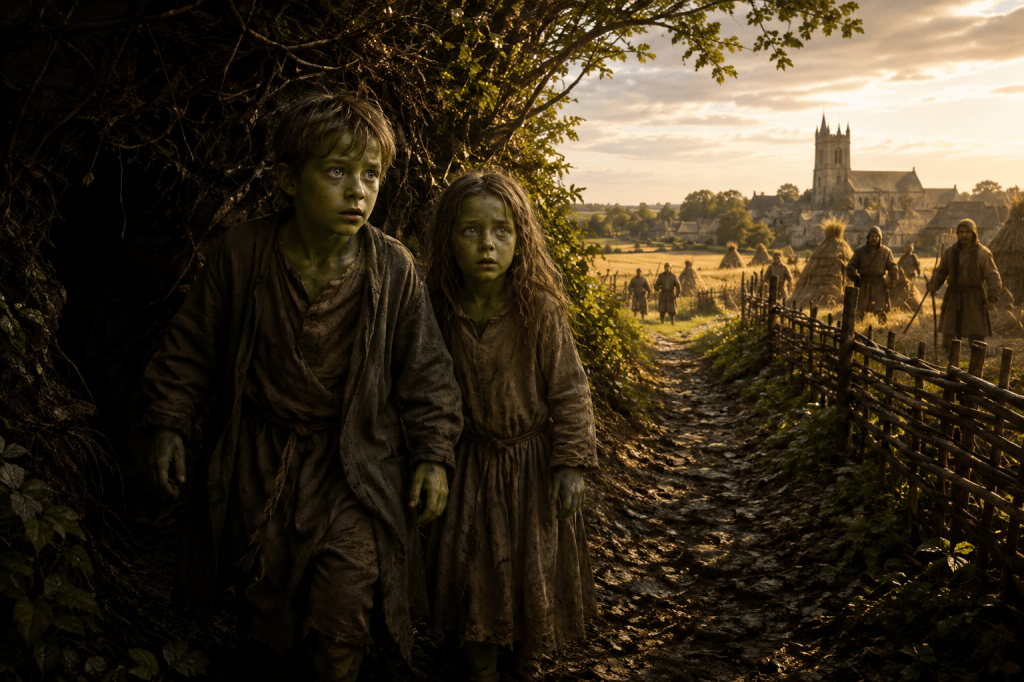
Sometime during the twelfth century, while workers were gathering the harvest near the small English village of Woolpit in Suffolk, two children appeared in the countryside under circumstances so unusual that their story would survive for more than eight hundred years.
They were a boy and a girl, apparently brother and sister, and according to the medieval chroniclers who recorded the event, there was immediately something extraordinary about them. Their clothes were made from material the local people did not recognize, the language they spoke could not be understood by anyone around them, and, most remarkably of all, their skin appeared to have a distinctly green coloration.
The children seemed frightened and disoriented, and they were unable to explain where they had come from because nobody could understand their speech. They were eventually taken into the household of a local landowner, where another strange detail soon emerged: although food was placed before them, they refused almost everything they were offered.
Then they saw beans.
According to the medieval accounts, the children immediately became excited and searched desperately for the beans inside their stalks, apparently unfamiliar with the way the plants were presented to them. Once the beans themselves were produced, they ate eagerly.
For some time, beans were reportedly almost the only food they would accept.
Eventually their diet changed, their green coloration gradually disappeared, and the surviving child learned enough English to tell the people around her where she believed she had come from.
Her explanation transformed an already unusual story into one of medieval England’s most enduring mysteries.
She said that she and her brother had come from a place known as St Martin’s Land, a country where the sun did not shine as it did in England and where the world remained beneath a strange twilight.
According to her account, everyone there was green.
The Village Where the Children Appeared
Woolpit is a real village in Suffolk, situated not far from Bury St Edmunds, and its unusual name has traditionally been connected with pits used for trapping wolves. The medieval form of the name is generally understood as deriving from something resembling “wolf pit,” which provided later storytellers with an appropriately mysterious landscape for the children’s appearance.
One version of the story describes the children emerging near one of these pits during harvest time, where workers discovered them wandering in confusion.
The event would probably have disappeared completely into local folklore had it not attracted the attention of two medieval chroniclers.
The first was William of Newburgh, an Augustinian canon born around 1136 who wrote his Historia rerum Anglicarum, or History of English Affairs, toward the end of the twelfth century.
William was not merely collecting fairy tales. His work was intended as a history of England beginning with the Norman Conquest, although, like many medieval historians, he also included accounts of wonders, supernatural events and phenomena that he considered sufficiently remarkable to record.
When introducing the strange children, William himself acknowledged how difficult the story was to believe, yet indicated that the number and quality of the witnesses convinced him that something unusual had occurred.
The second account comes from Ralph of Coggeshall, a monk and later abbot of Coggeshall Abbey in Essex, whose Chronicon Anglicanum also contains the story.
Ralph’s account is particularly interesting because he claimed to have obtained information from Richard de Calne, the man whose household had reportedly taken in the children. If that statement is accurate, Ralph’s version brings us considerably closer to people associated with the original event than many legends of medieval Europe allow.
The two chronicles differ in some details, but their central elements are remarkably similar: two strangely dressed children appeared near Woolpit, their skin had a green coloration, their language was unfamiliar, and initially they would eat little except beans.
The Children Who Would Eat Only Beans
Once the children had been brought into local care, attempts were made to feed them, but the food offered to them appeared unfamiliar or unacceptable.
Then green beans were brought into their presence.
The children reportedly reacted with intense interest, although one version of the story contains an intriguing detail: they initially searched the stalks rather than opening the pods, as though they recognized the food but did not understand where the beans were located on the plant before them.
After someone showed them the pods, they ate eagerly.
For a period afterward, beans remained their preferred food, although they gradually began eating other foods as they adapted to their new surroundings.
At the same time, another transformation supposedly occurred.
Their green skin began to fade.
The boy, however, did not recover as successfully as his sister. Medieval accounts describe him as becoming increasingly weak or depressed, and he eventually died.
The girl survived.
She was baptized, remained in England and gradually learned the local language.
Only then could anyone ask the question that must have occupied the villagers from the moment the children appeared.
Where had they come from?
The Land Where the Sun Never Fully Rose
The girl’s answer was extraordinary.
She reportedly said that she and her brother came from a place called St Martin’s Land, where the inhabitants were Christian and where churches existed, but the quality of daylight was completely different from that of England.
The sun, she explained, did not shine brightly over their homeland.
Instead, the country existed beneath something resembling perpetual twilight.
In one version of the account, she described another luminous land visible beyond a considerable river, suggesting that her own country was separated from a brighter region by water.
When asked how she and her brother had reached Woolpit, her explanation became even stranger.
According to the story preserved by the chroniclers, the children had been tending their father’s animals when they entered or followed them into some kind of underground passage or cavern. Inside the darkness they heard the sound of bells, and after wandering through the passage for what seemed like a long time, they suddenly emerged into brilliant daylight.
The intensity of the sunlight supposedly overwhelmed them because they had never experienced anything like it.
Before they could find their way back, the harvest workers discovered them.
The children had apparently crossed from one world into another without understanding how they had done it.
At least, that was how medieval listeners could interpret the story.
Was St Martin’s Land Somewhere on Earth?
The obvious question is whether the girl’s mysterious homeland might have been a perfectly ordinary location whose description became distorted through language, fear and retelling.
One modern hypothesis proposes that the children may have belonged to a Flemish community living in eastern England.
Flemish settlers and textile workers were present in medieval England, and political conflict during the twelfth century created periods of hostility and violence involving Flemish communities and mercenaries.
In 1173, during the rebellion against Henry II, fighting occurred at Fornham, not far from Bury St Edmunds. A later theory proposed by Paul Harris suggested that the children might have been displaced Flemish youngsters associated with Fornham St Martin, providing a possible explanation for the girl’s reference to “St Martin’s Land.”
If the children spoke a Flemish dialect, their language could easily have sounded completely incomprehensible to rural English villagers.
Their unfamiliar clothing might similarly have reflected cultural differences rather than anything supernatural.
The theory is attractive because it potentially explains several pieces of the puzzle at once, but it remains a reconstruction rather than a demonstrated solution. Geographic and chronological difficulties remain, and historians do not possess independent evidence identifying the children as Flemish refugees.
Why Were Their Faces Green?
The most famous element of the story may also have one of the least supernatural explanations.
Historical writers have suggested that the children’s appearance could have resulted from severe malnutrition or anemia. A condition historically called chlorosis was associated with a pale or greenish complexion, although applying a later medical diagnosis to two children known only through medieval chronicles is necessarily speculative.
If the children had spent a prolonged period lost, displaced or surviving on an inadequate diet, their unusual complexion might have appeared even more striking to people encountering them for the first time.
The fact that the girl’s green coloration reportedly disappeared after she began eating a more varied diet is one reason this explanation has remained attractive. Woolpit’s own historical account mentions severe nutritional deficiency as one possible explanation for the reported appearance.
Yet this explanation creates another interesting question.
If malnutrition explains the green color, what explains the strange language, unfamiliar clothing and story of the twilight homeland?
Each mystery can perhaps be explained individually, but combining all of them into one convincing reconstruction becomes considerably more difficult.
Or Was This a Medieval Story About Another World?
There is another possibility that does not require the children to have existed exactly as described.
Medieval chronicles were not written according to modern standards of historical reporting, and their authors frequently recorded miracles, omens, monsters, visions and other extraordinary events alongside political history.
The boundary between history, theology, oral tradition and folklore was considerably more fluid than it is for modern historians.
The Green Children may therefore belong partly to the enormous European tradition of stories about encounters with an Otherworld, a hidden realm existing alongside the ordinary human world.
Several elements fit surprisingly well.
The children emerge from an underground passage.
Their homeland exists beneath unusual light.
Their appearance is different from ordinary humans.
They eat unusual food.
They cannot initially communicate with the people who discover them.
One of them eventually remains permanently in the human world.
Green itself acquired powerful associations with nature, fairies, spirits and otherworldly beings in later European folklore, although we must be careful not to project later traditions automatically onto a twelfth-century account.
The story could therefore represent a real event that accumulated folkloric details, an older folktale attached to a real village, or some combination of both.
That uncertainty is precisely what makes Woolpit so fascinating.
What Happened to the Surviving Girl?
After learning English and adapting to local life, the girl reportedly remained in England.
William of Newburgh wrote that she eventually lost the green coloration of her skin and lived for many years, while Ralph of Coggeshall associated her with the household of Richard de Calne.
Later tradition sometimes gives the girl the name Agnes and claims that she married a man connected with King’s Lynn, but these details are considerably less secure than the central medieval accounts and should not be presented as established fact.
What matters is that, according to the chroniclers, the surviving child did not disappear mysteriously back into St Martin’s Land.
She stayed.
This small detail makes the story unusually tantalizing because, if there really was a surviving girl who grew into adulthood in medieval England, she potentially represented a living connection to whatever event originally inspired the legend.
Yet no surviving document has conclusively identified her.
Her trail disappears into history.
Two Chroniclers, One Extraordinary Story
The existence of two medieval accounts is often presented online as though it proves that the Green Children must have existed exactly as described.
It does not.
The chroniclers were not eyewitnesses to the children’s appearance, and both recorded the story after the supposed event. Medieval information traveled through oral networks, monasteries, travelers and shared stories, which means that two written accounts do not necessarily represent two completely independent eyewitness traditions.
Nevertheless, their existence matters.
The Green Children were not invented by a nineteenth-century spiritualist, a twentieth-century UFO writer or a modern internet storyteller.
Something resembling this extraordinary narrative was already circulating in medieval England strongly enough for two serious chroniclers to preserve it.
That leaves us with several possibilities, none of which can now be proven.
Perhaps two displaced foreign children really did wander into Woolpit, malnourished, frightened and unable to communicate, while bewildered villagers gradually transformed their tragedy into a supernatural story.
Perhaps the narrative began as folklore and acquired real names and locations as it circulated.
Perhaps an unusual historical incident and an older tradition of the Otherworld merged until separating fact from legend became impossible.
Or perhaps something happened near Woolpit that does not fit comfortably into any explanation that has survived.
More than eight centuries later, the village remains where it always was, the medieval chroniclers remain available to be read, and the children themselves have disappeared completely.
We know what William of Newburgh and Ralph of Coggeshall wrote.
We know what later generations believed.
What we do not know is what two frightened children actually saw before they stepped into the sunlight near Woolpit.
And somewhere between those three things — chronicle, legend and lost experience — the Green Children are still waiting.
Sources & Further Reading
William of Newburgh — Historia rerum Anglicarum (History of English Affairs)
One of the two principal medieval accounts of the Green Children.
Ralph of Coggeshall — Chronicon Anglicanum
The second major medieval source; Ralph claimed information connected with Richard de Calne, whose household was associated with the children.
Woolpit Village — Local History
The village’s historical account preserves the local tradition and discusses possible explanations for the children’s appearance.
Brian Haughton — “The Green Children of Woolpit”
A useful overview comparing the medieval sources with later historical, medical and folkloric explanations.


Leave a comment