
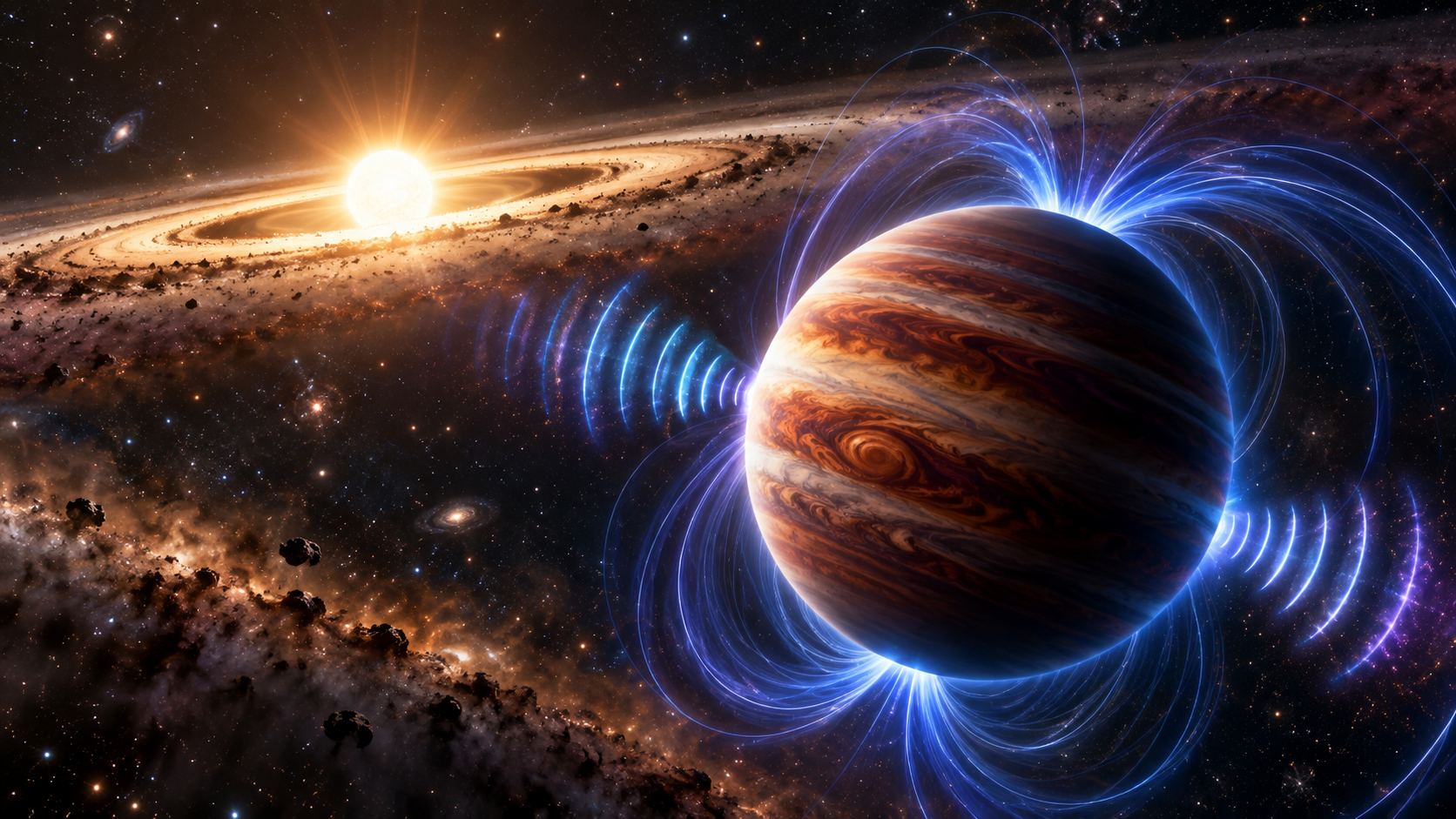
For the first time, astronomers have traced radio emission directly to a planet beyond our Solar System. It is not an alien message. In some ways, what it may be telling us is even more interesting.
For most of human history, the planets beyond our own Solar System existed only as possibilities.
Astronomers suspected they must be there. Philosophers imagined them. Science-fiction writers populated them with civilizations long before telescopes were capable of proving that such worlds actually existed. Then, during the final years of the twentieth century, the situation changed dramatically. Exoplanets moved from speculation into observation, and thousands of worlds were gradually added to our maps of the galaxy.
We learned to detect their shadows as they crossed distant stars. We measured the tiny gravitational movements they imposed upon their suns. In a few extraordinary cases, we even managed to photograph them directly.
But listening to one was another matter.
In September 2026, a team led by Kevin N. Ortiz Ceballos, with Edo Berger and Yvette Cendes, reported something that astronomy had been waiting for: radio emission that could be localized directly to an exoplanet rather than merely to the stellar system surrounding it. The source was Beta Pictoris b, a giant world orbiting a young star roughly 63 light-years from Earth. Their paper, submitted to arXiv on September 15, describes rapid and recurring radio bursts, together with persistent emission, detected between approximately 0.85 and 3.5 GHz.
This does not mean that someone 63 light-years away has switched on a transmitter.
There is no evidence of an artificial message, no encoded sequence, no recognizable technological signature and no reason, on the present evidence, to invoke an extraterrestrial civilization.
And yet something remarkable has happened.
For perhaps the first time, we have begun to hear the magnetic environment of another planet.
The strange young world of Beta Pictoris
Beta Pictoris has fascinated astronomers for decades because the system resembles, in certain respects, a planetary system caught during its youth.
The star lies in the southern constellation Pictor and is surrounded by an enormous disc of dust and debris. Long before its planets were directly observed, distortions within that disc suggested that unseen bodies might be gravitationally disturbing it.
Beta Pictoris b was eventually announced in 2008 and became one of the best-known directly imaged exoplanets. It is a gas giant, probably around ten times the mass of Jupiter, orbiting its star at roughly the distance at which Saturn travels around our Sun. Unlike the ancient Solar System, however, the Beta Pictoris system is only around twenty to twenty-five million years old, making it extraordinarily young on cosmic timescales.
It is therefore not simply another distant planet. It offers astronomers something closer to a laboratory in which planetary evolution can be observed at an early stage.
Beta Pictoris b is also rotating very quickly. Earlier observations indicated a planetary day measured in only several hours, and the new radio research notes that this rapid rotation could be involved in powering its magnetospheric activity. Digi24, summarizing the new study, reports a rotation period of approximately eight to nine hours.
That rapid rotation becomes important when we begin to understand what the radio telescope actually detected.
MeerKAT was not listening for words
The observations were made with MeerKAT, the powerful radio telescope array in South Africa.
During several observing sessions in 2025 and 2026, the researchers detected radio emission from the Beta Pictoris system that behaved in an unusual but physically recognizable way. There were brief, repeating bursts, and the radiation was strongly circularly polarized.
Circular polarization matters because it can reveal the physical mechanism responsible for generating radio waves. In this case, the characteristics of the emission pointed toward a process known as electron cyclotron maser instability, usually abbreviated ECMI.
The name sounds exotic, but nature is already performing versions of the same phenomenon in our own cosmic neighborhood.
Charged particles moving through a planet’s magnetic environment can interact with magnetic field lines and produce intense radio waves. Similar processes are associated with auroral activity in the Solar System, particularly around magnetically active planets such as Jupiter.
The important question, therefore, was not simply whether radio waves were coming from the direction of Beta Pictoris.
The real question was: where exactly were they coming from?
That distinction is crucial.
Stars themselves can produce radio emission. Previous observations of planetary systems had therefore left astronomers with an uncomfortable ambiguity. A signal might appear to come from a system containing an exoplanet while actually originating from the host star.
This time the researchers attempted to resolve that ambiguity through precise astrometry.
Using extremely distant quasars as reference points, they compared the measured radio position with the known positions of the star and its planets. Their analysis placed the radio source at Beta Pictoris b and found it inconsistent with the position of the host star. The researchers therefore argue that the emission is genuinely planetary.
That is the part of the discovery that changes the story.
Astronomers were no longer merely detecting radio noise somewhere inside a distant planetary system.
They had apparently isolated the voice of the planet itself.
A magnetic field we cannot see — but can hear
A planet’s magnetic field is invisible, yet its importance can be enormous.
On Earth, the magnetic field interacts with charged particles carried by the solar wind. Some of those particles are guided toward the polar regions, contributing to the aurora borealis and aurora australis. Our magnetosphere also influences how the planet interacts with its surrounding space environment.
On distant worlds, magnetic fields may provide clues about planetary interiors, rotation, atmospheric loss and the processes taking place deep beneath surfaces we cannot possibly observe directly.
Until now, however, obtaining a direct measurement of an exoplanet’s magnetic field has been extremely difficult.
This is where the frequency of the Beta Pictoris b emission becomes particularly valuable.
In ECMI radiation, the maximum frequency is connected to the strength of the magnetic field in the region where the radiation originates. Because the researchers detected emission extending to 3.5 GHz, they infer a magnetic field of at least approximately 1.25 kilogauss at the emission source.
There is an important nuance here.
The figure does not necessarily describe a simple, uniform magnetic field covering the entire planet. It is a lower limit associated with the region producing the detected emission, based upon the researchers’ interpretation of the radiation mechanism.
Nevertheless, if their interpretation is confirmed, it represents something extraordinary: the first direct measurement of magnetic-field strength associated with an exoplanet.
Until very recently, we were struggling merely to prove that planets existed around distant stars.
Now we may be beginning to investigate their magnetospheres.
Why this matters far beyond Beta Pictoris b
There is another reason astronomers are interested in planetary magnetic fields, and it goes far beyond one enormous young gas giant.
Magnetic environments may affect the evolution of planetary atmospheres. They influence the interaction between planets and stellar winds, and they can potentially tell us something about processes occurring inside planets themselves. That makes radio astronomy a possible new tool for characterizing worlds too distant to study by conventional methods.
Imagine what this means for the future of exoplanet science.
We have spent decades learning how to discover distant planets. The next stage is learning what those planets are actually like.
Their atmospheres can sometimes be studied through spectroscopy. Their masses can be estimated through gravitational effects. Their temperatures can occasionally be inferred. Their orbits can be mapped.
Radio astronomy may now add another layer: the ability to probe their magnetic personalities.
The authors of the Beta Pictoris study believe that future radio observatories with substantially greater sensitivity could extend this technique to other giant exoplanets. Seven additional giant planets in five nearby systems are mentioned as promising targets for similar investigation, while next-generation instruments may provide sensitivity improvements of roughly five to seven times.
In other words, Beta Pictoris b may not remain unique for very long.
It could simply be the first planet loud enough for our present instruments to hear clearly.
And then comes the unavoidable question
Whenever the words radio signal and distant planet appear together, one question inevitably follows.
What would an artificial signal look like?
The emission detected from Beta Pictoris b gives scientists no reason to suspect technology. Its polarization, frequency and behavior fit a natural magnetospheric explanation, and the researchers identify ECMI as the likely mechanism.
But the philosophical importance of the discovery lies elsewhere.
For decades, the search for extraterrestrial intelligence has depended partly upon the assumption that sufficiently advanced technology might produce detectable electromagnetic signals. The problem has never been simply finding radio waves. The universe is filled with radio emission.
Stars produce it.
Pulsars produce it.
Magnetospheres produce it.
Lightning can produce it.
Gas clouds, active galactic nuclei and countless violent astrophysical processes generate electromagnetic radiation across an enormous range of frequencies.
The difficult task is learning to distinguish nature from technology.
And every natural phenomenon that we understand makes that distinction slightly easier.
Beta Pictoris b therefore represents an interesting paradox. The signal does not provide evidence of extraterrestrial intelligence, yet learning exactly how an alien planet naturally produces radio signals may eventually help astronomers recognize something that nature cannot easily explain.
Before we can identify an artificial whisper, we must first understand the countless natural voices of the universe.
Sixty-three years through the darkness
There is another detail worth considering.
Beta Pictoris lies approximately 63 light-years away, which means the radiation detected on Earth did not begin its journey yesterday, or even during the last decade.
It travelled through interstellar space for more than six decades before reaching our instruments.
When those radio waves left the Beta Pictoris system, Earth was a different place. The people who eventually designed the instruments capable of detecting them could not yet know that those particular photons and radio waves were already travelling toward us.
Nothing about this requires mystery in the supernatural sense. Physics explains how radiation crosses space.
But the scale itself remains difficult to absorb.
A planet that no human being will visit anytime soon is revealing something about its magnetic field across more than sixty light-years of darkness.
We cannot touch it.
We cannot send a probe there and wait for results.
We cannot see its auroras with human eyes.
Yet the behavior of charged particles around that distant world has left a signature strong enough for instruments on Earth to recognize.
That is remarkable without adding anything fictional to the story.
We have entered the age of listening to planets
There is one final reason to remain cautious.
As of early October 2026, the research is a preprint submitted to arXiv and has not yet completed peer review. Independent observations will be important. Extraordinary new techniques become scientifically powerful not because one team observes something once, but because the result survives scrutiny and can eventually be reproduced.
The discovery should therefore be treated as extremely promising rather than as the final word.
But if the result holds, astronomy has crossed another quiet boundary.
For centuries we looked at the planets.
Then we learned to photograph worlds around other stars.
We began examining their atmospheres and measuring their movement.
And now, for the first time, we may have directly heard radio emission produced by the magnetic environment of one of them.
Beta Pictoris b has not sent us a message.
Perhaps the more interesting truth is that it did not need to.
Its magnetic field, its rapid rotation and the charged particles moving through its enormous magnetosphere have already carried information across sixty-three light-years.
The universe has probably been broadcasting this kind of information for billions of years.
Only now are we learning how to listen.
Sources: Kevin N. Ortiz Ceballos, Edo Berger & Yvette Cendes, Discovery of radio emission from the exoplanet β Pictoris b, submitted to arXiv September 15, 2026; NASA Exoplanet Archive/Science; European Southern Observatory; and reporting on the discovery by Digi24.