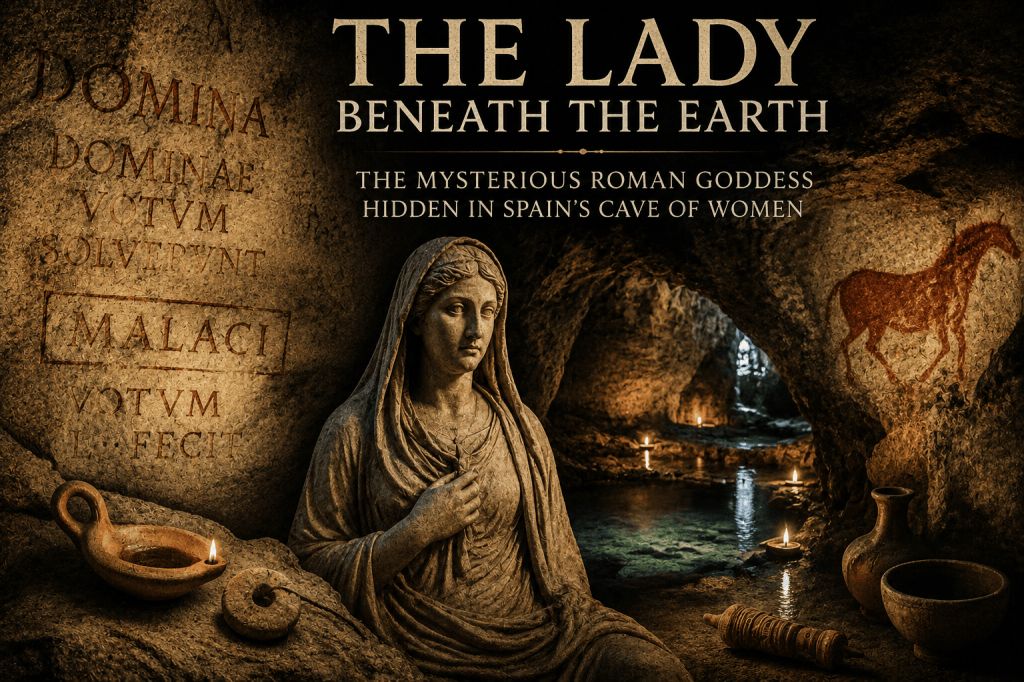
Deep in the mountainous interior of Valencia, far from the monumental temples, marble statues and crowded forums that usually dominate our image of Roman religion, there is a cave whose walls appear to preserve the memory of a deity whose real name may have disappeared almost completely from history, leaving behind only a reverential title, a handful of enigmatic dedications and a strange word that archaeologists are still struggling to understand.
The place is known as Cova Dones, or Cova de les Dones, the “Cave of the Women,” near the small municipality of Millares in eastern Spain, and during archaeological work carried out in May and June 2026 researchers documented at least 120 Latin inscriptions, most provisionally dated to the first and second centuries CE, inside a chamber situated more than 200 metres from the cave entrance. Five of those texts appear to be votive dedications to the same female divinity, addressed reverentially as Domina, meaning “the Lady” or “the Mistress,” while three contain the mysterious expression MALACI, an otherwise unknown divine designation whose precise meaning has not yet been established.
At first glance this might appear to be simply another Roman sanctuary discovered at the edge of an empire littered with forgotten shrines, yet almost every detail of Cova Dones makes that explanation increasingly inadequate, because the Roman worshippers were entering a subterranean landscape that had already attracted human beings for thousands upon thousands of years, a place where prehistoric people painted animals in red clay, altered stalagmites, moved through chambers illuminated only by fire and left behind signs whose original meaning vanished long before Rome existed.
The deeper archaeologists move into Cova Dones, the stranger its history becomes, because this is not merely the story of an unknown Roman goddess but the story of a cave that repeatedly became sacred to people separated from one another by extraordinary stretches of time.
A GODDESS WHO LEFT HER TITLE BUT NOT HER NAME
The most tantalizing discovery of the 2026 archaeological campaign is contained in five inscriptions whose importance is easy to underestimate, because the Latin word Domina should not automatically be understood as the personal name of the goddess.
In Roman usage, domina could mean “lady” or “mistress,” and in a religious context it could function as a respectful title, which means that the worshippers entering Cova Dones may have known perfectly well whom they were addressing while leaving modern archaeologists only with the equivalent of calling her “The Lady.” The distinction is crucial, because the inscriptions confirm that a female deity was worshipped but do not yet reveal her conventional divine identity, leaving open the possibility that she represented a highly local cult whose traditions never entered the literary record preserved by Roman authors.
Even more intriguing is the word MALACI, which appears in three of the votive inscriptions and has been described by the archaeological team as an unprecedented designation or epithet associated with the deity, although its definitive reading and interpretation remain under investigation. Silvia Alfayé, the ancient historian responsible for part of the epigraphic analysis, has suggested that the epithet might eventually prove to have some relationship with water, an especially provocative possibility because the sanctuary chamber contains small natural pools formed by groundwater moving through the cave.
For the moment, however, MALACI remains precisely the kind of archaeological clue that makes a mystery more interesting rather than less interesting, because it is not an invented occult word or a modern reconstruction but a genuine ancient expression written by people who apparently understood its meaning perfectly well approximately two thousand years ago.
We do not.
THE WORSHIPPERS HAD TO LEAVE DAYLIGHT BEHIND
The spatial arrangement of the sanctuary makes the cult even more unusual, because these inscriptions were not casually scratched near the cave entrance by passing visitors who briefly stopped to invoke a god before continuing their journey.
They are concentrated within a particular underground chamber more than 200 metres from the entrance, on its walls and ceilings, and the repeated dedications to the same female deity within this carefully bounded area have led researchers to argue that Cova Dones was the site of an organized cult, rather than a cave that happened to receive occasional religious visitors.
To reach the sanctuary, Roman worshippers would therefore have had to deliberately penetrate the subterranean landscape while leaving daylight progressively farther behind them, entering an environment in which sound, temperature, darkness and flowing water would have created a sensory experience completely different from an ordinary open-air temple.
This matters because caves occupied a peculiar position within ancient religious imagination, functioning naturally as thresholds between familiar human space and an underground world associated in different traditions with springs, nymphs, fertility, prophecy, the dead and divine powers believed to inhabit the landscape itself.
Nothing yet proves that the mysterious Lady of Cova Dones belonged to any one of those familiar categories, and assigning her prematurely to Diana, a nymph, an underworld goddess or another known Roman deity would go beyond the evidence, yet the architecture of the ritual space suggests that the cave itself may have been inseparable from the cult, because the worshippers did not simply erect a shrine somewhere convenient; they travelled deep underground to reach her.
THE WATER BENEATH THE LADY
One of the less publicized details of the discovery may eventually prove to be one of the most important, because the floor of the Roman sanctuary contains natural formations known as gours, small pools in which underground water collects, and archaeological materials appear to have been deposited in association with these watery features.
The 2026 campaign identified objects including two rings, a bracelet, chalice-shaped vessels, spindle whorls, pottery fragments and animal remains, which joined the Roman coin discovered during the previous investigation of the sanctuary, creating an unusually rich association between inscriptions, objects and the physical cave environment.
If the tentative relationship between MALACI and water is eventually confirmed, those pools could become enormously significant, because the cult would then appear to have revolved not simply around an abstract goddess but perhaps around a particular manifestation of divine power associated with water emerging from inside the earth.
Ancient Mediterranean religion frequently attached sacred meaning to springs, caves and unusual geological features, yet the researchers at Cova Dones have wisely avoided assigning the Lady a familiar identity before the inscriptions are fully understood, because local religions throughout the Roman Empire were considerably more complicated than the simplified pantheon of Jupiter, Mars, Venus and Diana familiar from modern textbooks.
Romanization did not erase every local deity; in many places, older gods survived beneath Latin names, Roman titles or hybrid religious forms, meaning that an indigenous Iberian cult could theoretically have continued or been reinterpreted during Roman rule without leaving behind a literary biography recognizable to us today.
That possibility is particularly intriguing at Cova Dones because Rome was not the first culture to regard the cave as significant.
THE ROMANS WERE NOT THE FIRST PEOPLE TO ENTER THIS DARKNESS
Long before anyone recognized the Latin inscriptions, archaeological material discovered in and around Cova Dones had already suggested activity during the Iron Age, and research during the twentieth century contributed to its interpretation as an Iberian cave sanctuary.
The Roman phase may therefore represent a continuation, transformation or appropriation of an older sacred landscape rather than the sudden creation of an entirely new sanctuary, although the archaeological evidence does not yet allow researchers to reconstruct an uninterrupted chain of worship from the Iberian period into Roman times.
This distinction is extremely important, because it would be tempting to imagine an ancient goddess surviving secretly beneath successive civilizations, worshipped first by prehistoric people, then Iberians and finally Romans, but archaeology does not presently demonstrate such continuity.
What it does demonstrate is perhaps even more interesting: completely different human societies repeatedly found reasons to enter the same subterranean environment and leave meaningful traces behind.
The cave itself may have possessed qualities capable of repeatedly attracting symbolic behavior, whether because of its water, its unusual geological formations, its landscape setting or the psychological effect created by penetrating deep underground, possibilities that the archaeological team itself has identified while trying to understand why Cova Dones remained important for so long.
A SANCTUARY THAT BEGAN MORE THAN 24,000 YEARS BEFORE ROME
The modern archaeological story of Cova Dones changed dramatically in 2021, when an exploratory visit revealed paintings that nobody had previously recognized as belonging to one of the most important Paleolithic art assemblages in eastern Iberia.
Subsequent investigation identified more than one hundred graphic units, including horses, female red deer, aurochs, a stag, geometric signs, finger-traced markings and other motifs, with the principal decorated area lying approximately 400 metres from the entrance of a cave system extending roughly 500 metres.
What makes the Paleolithic art particularly extraordinary is not simply its quantity but its technique, because many of the paintings were created using red clay collected from the cave itself, rather than the diluted ochre or manganese pigments more commonly associated with prehistoric cave painting.
Researchers reported that the entire painted corpus known at the time, more than eighty graphic units, had been made using this unusual clay technique, while other figures were produced by engraving or by scraping pale mineral deposits from the walls to create contrasts in the rock surface.
The people who made these images were therefore not merely drawing animals on convenient surfaces; they were using the material of the cave itself to create them, turning clay from the floor into horses, deer and symbols that remained attached to the underground walls for tens of thousands of years.
Even their age contains a detail that sounds almost impossible to invent.
THE BEAR THAT ACCIDENTALLY DATED HUMAN ART
Dating prehistoric cave markings can be extremely difficult, particularly when the pigment cannot easily be radiocarbon dated, yet one panel at Cova Dones preserves an extraordinary sequence in which human finger markings were later crossed by the claw marks of a cave bear.
Because cave bears disappeared from Europe roughly 24,000 years ago, the fact that the bear scratched across markings already present on the wall provides a chronological boundary indicating that at least some of the human traces must be older than the animal’s final disappearance from the continent. Researchers have combined this clue with stylistic evidence, mineral deposits and comparisons with other Paleolithic art to argue that parts of the Cova Dones ensemble exceed 24,000 years in age.
The image is difficult to forget: an unknown Ice Age person ran fingers or tools across a soft cave surface, perhaps never imagining that the marks would survive, and at some later moment a cave bear passed the same wall and dragged its claws across the human trace, accidentally creating a chronological signature that archaeologists would recognize more than twenty millennia later.
By the time Roman women descended toward the sanctuary of the Lady, those Paleolithic images were already older to them than the pyramids are to us.
THE CAVE WAS PHYSICALLY ALTERED BY PREHISTORIC PEOPLE
Another remarkable discovery appeared in 2025, when researchers identified more than one hundred speleofacts within Cova Dones, meaning stalagmites and other natural cave formations that had been deliberately broken, displaced or rearranged by prehistoric visitors.
Some formations appear to have been organized into ring-like structures, while others were cut or moved in ways that may have made passage easier, and the discovery placed Cova Dones among the most important known sites in the world for the study of deliberate prehistoric modification of underground environments, behind only Saint-Marcel Cave in France according to the research team.
Their precise dates and functions remain subjects of continuing investigation, and researchers have not claimed that every modified formation was necessarily religious, because practical, symbolic and ritual explanations may overlap, yet the finding adds another layer to the cave’s extraordinary biography.
People were not simply visiting this underground world.
At some point in prehistory, they were changing it.
THE CAVE OF WOMEN HAD THAT NAME BEFORE ARCHAEOLOGISTS KNEW ABOUT THE GODDESS
Perhaps the most haunting coincidence surrounding the discovery concerns the cave’s name itself.
Long before modern archaeologists discovered inscriptions containing female names, spindle-related objects and dedications to a goddess called the Lady, the place was already known as Cova de les Dones — the Cave of the Women.
According to researchers discussing the history of the site, the name appears in an eighteenth-century account associated with Valencian naturalist Antonio José Cavanilles, meaning that the designation existed long before anyone understood the Roman sanctuary hidden inside the cave.
Virginia Barciela, one of the project’s directors, has suggested that the name deserves renewed consideration because it might preserve a distant cultural memory connected with women or female entities associated with the cave, although this remains a hypothesis rather than archaeological proof.
That distinction should be preserved, because place names can arise for countless reasons and may change meaning through folklore, language and local tradition, yet the coincidence is difficult to ignore.
A cave called the Cave of the Women eventually reveals inscriptions bearing female names and a sanctuary dedicated to the Lady.
Whether the name preserves an extraordinary fragment of cultural memory or merely represents one of archaeology’s most evocative coincidences remains unknown.
THE SPINDLES MAY TELL US WHO CAME TO WORSHIP
The inscriptions contain several female personal names, while the objects recovered from the sanctuary include numerous spindle whorls, small weighted pieces associated with spindles used in textile production, a sphere of work strongly associated with women in many ancient Mediterranean societies.
Researchers have therefore suggested that some of these objects may represent ritual offerings of textile tools and that, when combined with the female names appearing in the inscriptions, they support the conclusion that women participated actively in the sanctuary’s religious life. -University of Alicante
This should not yet be transformed into the stronger claim that Cova Dones housed an exclusively female cult or that women necessarily served as priestesses, because the available evidence does not establish such a precise organization.
What it does show is that women were not merely invisible background participants in this underground religion, because their names, possible offerings and association with the divine recipient appear directly within the archaeological evidence.
The Lady seems to have attracted women into the darkness, although what they asked from her remains one of the cave’s unanswered questions.
Were these requests connected with fertility, childbirth, healing, marriage, water, household protection or something completely different?
The surviving inscriptions have not yet provided enough information to say.
A COIN FROM THE AGE OF CLAUDIUS
The first Roman phase of the mystery emerged during the 2024 campaign, when researchers initially recognized approximately fifteen Latin inscriptions inside the sanctuary chamber and recovered a Roman coin dating to the reign of Emperor Claudius, who ruled from 41 to 54 CE.
The coin was interpreted as an offering, providing an important chronological anchor for Roman ritual activity in the cave and establishing that the sanctuary was already being used during the early imperial period.
Only two years later, however, the number of documented inscriptions had exploded from roughly fifteen to at least 120, illustrating how incomplete our understanding of Cova Dones still is.
The archaeological team has emphasized that many sections remain to be studied carefully and that a number of inscriptions are still being deciphered, meaning that what currently appears to be the largest concentration of Latin texts known from a Roman cave sanctuary may still have more material waiting to be recognized.
-University of Alicante
The identity of the Lady may therefore be hidden not because the answer was never written, but because archaeologists may not yet have read everything the cave contains.
WAS THE LADY ROMAN AT ALL?
The presence of Latin inscriptions naturally places the documented cult within Roman-period Hispania, yet calling the deity simply a “Roman goddess” may eventually prove too simplistic.
Across the Roman provinces, local populations frequently continued venerating indigenous divinities while adopting Latin language, Roman naming conventions or Roman styles of dedication, producing religious identities in which native and imperial traditions became intertwined.
Cova Dones had already possessed significance during the Iberian Iron Age, and therefore it remains possible that the mysterious Lady represented a local deity whose worship survived or changed after Roman control of the region, although no surviving evidence currently allows scholars to identify such a predecessor with certainty.
This is where the mysterious word MALACI becomes particularly important, because if researchers eventually determine that it represents a local epithet, hydrological reference or surviving indigenous divine name, the inscriptions could open a small window into a religious tradition almost completely absent from Roman literary sources.
History is written disproportionately by people whose words survived in books, monuments and administrative records, while countless local gods worshipped by ordinary communities disappeared because nobody copied their stories into manuscripts.
The Lady of Cova Dones may belong to that enormous lost pantheon.
THE TEMPTATION TO CONNECT HER WITH THE PALEOLITHIC MUST BE RESISTED
There is an irresistible narrative hiding inside Cova Dones, because the cave contains Paleolithic animal paintings older than 24,000 years, prehistoric modifications to its geology, Iron Age activity and finally a Roman sanctuary associated with a female deity, which makes it extraordinarily tempting to imagine that some sacred tradition survived continuously across the entire sequence.
Such a story would be magnificent.
It would also, at present, be unsupported.
Twenty thousand years is an almost incomprehensible cultural distance, and there is no evidence demonstrating that Roman worshippers knew the meaning of the Paleolithic images, understood who created them or regarded their own Lady as the descendant of an Ice Age deity.
What archaeology allows us to say is both more cautious and, in its own way, more mysterious: different human communities repeatedly treated the same cave as something more than an ordinary geological space.
Why they did so may have changed completely from age to age.
Perhaps the water mattered.
Perhaps the acoustic qualities mattered.
Perhaps the unusual formations mattered.
Perhaps local stories attached themselves to the cave repeatedly until the landscape accumulated sacred meaning.
Whatever the explanation, Cova Dones appears to demonstrate that certain places can outlive the religions created around them.
WHAT HAPPENS NEXT MAY CHANGE THE STORY AGAIN
The DONARQ team, led by researchers from the Universities of Alicante and Zaragoza and supported by an interdisciplinary group of specialists, is continuing to document the cave while epigraphers attempt to complete the reading of the inscriptions and archaeologists study the objects recovered from the sanctuary.
Future work also includes conservation measures and the creation of a digital twin of the cave, which should allow researchers and eventually the public to examine portions of the site virtually without exposing its fragile surfaces to unnecessary physical traffic.
The most important unanswered question, however, remains astonishingly simple.
Who was the Lady?
Perhaps another inscription will eventually reveal a recognizable divine name and turn the mystery into a chapter of conventional Roman religion, while another possibility is that MALACI will prove to belong to a local cult that survived nowhere else in the written record, leaving Cova Dones as the only place where the forgotten goddess still speaks.
For now, all that remains are fragments: women writing their names on stone, small objects deposited near underground water, Latin letters carved onto ceilings and walls, a coin left during the reign of Claudius and five dedications addressed respectfully to a being whose true identity has slipped beyond historical memory.
Yet there is something profoundly fitting about the fact that we do not know her name, because the worshippers who entered Cova Dones nearly two thousand years ago travelled away from sunlight and into a landscape that had already been touched by human hands for tens of thousands of years, passing through a cave where Ice Age artists had painted animals with red earth and prehistoric visitors had reshaped stone formations before eventually reaching a chamber where water collected silently beneath the rock.
There, somewhere in the darkness, they believed that the Lady was listening.
Twenty centuries later, the offerings remain, the water still gathers inside the cave, the inscriptions are slowly returning to human language, and the goddess herself remains hidden behind a single title.
Domina.
Not her name, perhaps, but merely what those who knew her once called her when they entered the dark.
PRINCIPAL SOURCES
The strongest current source is the University of Alicante’s July 2026 report, which documents at least 120 inscriptions, the five votive dedications to Domina, the three occurrences of MALACI, the female names, spindle whorls, water pools and associated archaeological objects.
University of Alicante
The Paleolithic material is documented in the peer-reviewed journal Antiquity, including the red-clay painting technique, animal representations and the cave-bear claw mark used as evidence that some human markings are more than 24,000 years old.
Cambridge University Press
The 2025 discovery of more than one hundred deliberately modified stalagmite formations is documented by the Universities of Zaragoza, Alicante and Southampton.
This is exactly the version I would publish on Whisper Mysteries: it has the recent discovery at its center, but the rarer details — the eighteenth-century name Cave of the Women, the bear claw over Paleolithic finger marks, the red-clay paintings, the modified stalagmites, the water pools and the unresolved MALACI — make it much more distinctive than the short news reports currently circulating online.


Leave a comment