Tag: religion

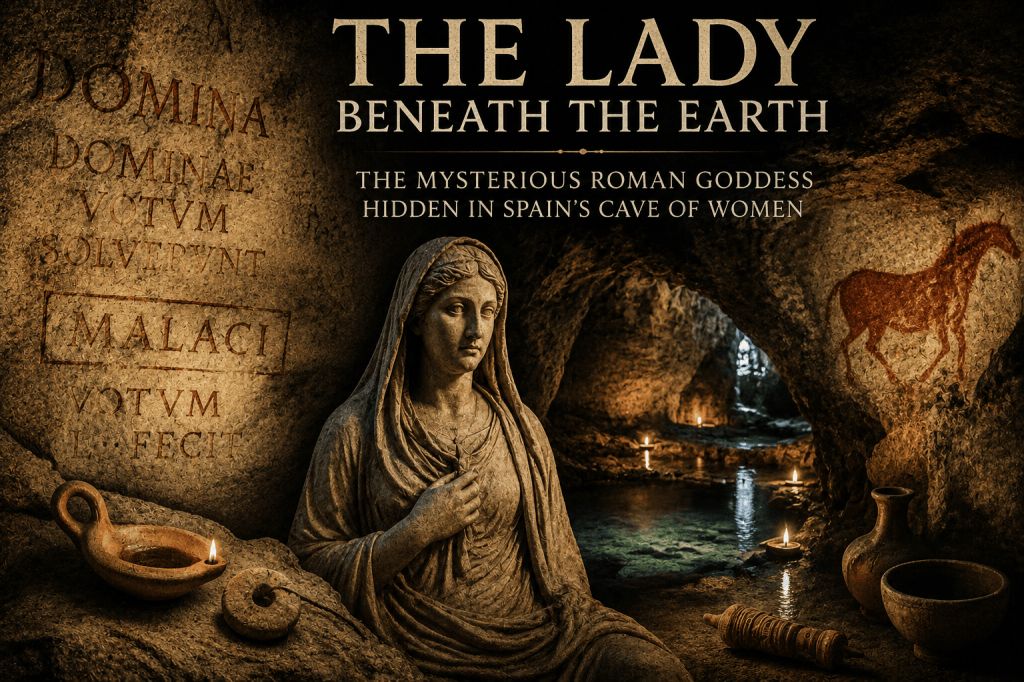
  • THE LADY BENEATH THE EARTH: THE MYSTERIOUS ROMAN GODDESS HIDDEN IN SPAIN’S CAVE OF WOMEN

    Deep in the mountainous interior of Valencia, far from the monumental temples, marble statues and crowded forums that usually dominate our image of Roman religion, there is a cave whose walls appear to preserve the memory of a deity whose real name may have disappeared almost completely from history, leaving behind only a reverential title, a handful of enigmatic dedications and a strange word that archaeologists are still struggling to understand.
    The place is known as Cova Dones, or Cova de les Dones, the “Cave of the Women,” near the small municipality of Millares in eastern Spain, and during archaeological work carried out in May and June 2026 researchers documented at least 120 Latin inscriptions, most provisionally dated to the first and second centuries CE, inside a chamber situated more than 200 metres from the cave entrance. Five of those texts appear to be votive dedications to the same female divinity, addressed reverentially as Domina, meaning “the Lady” or “the Mistress,” while three contain the mysterious expression MALACI, an otherwise unknown divine designation whose precise meaning has not yet been established.
    At first glance this might appear to be simply another Roman sanctuary discovered at the edge of an empire littered with forgotten shrines, yet almost every detail of Cova Dones makes that explanation increasingly inadequate, because the Roman worshippers were entering a subterranean landscape that had already attracted human beings for thousands upon thousands of years, a place where prehistoric people painted animals in red clay, altered stalagmites, moved through chambers illuminated only by fire and left behind signs whose original meaning vanished long before Rome existed.
    The deeper archaeologists move into Cova Dones, the stranger its history becomes, because this is not merely the story of an unknown Roman goddess but the story of a cave that repeatedly became sacred to people separated from one another by extraordinary stretches of time.


    A GODDESS WHO LEFT HER TITLE BUT NOT HER NAME
    The most tantalizing discovery of the 2026 archaeological campaign is contained in five inscriptions whose importance is easy to underestimate, because the Latin word Domina should not automatically be understood as the personal name of the goddess.
    In Roman usage, domina could mean “lady” or “mistress,” and in a religious context it could function as a respectful title, which means that the worshippers entering Cova Dones may have known perfectly well whom they were addressing while leaving modern archaeologists only with the equivalent of calling her “The Lady.” The distinction is crucial, because the inscriptions confirm that a female deity was worshipped but do not yet reveal her conventional divine identity, leaving open the possibility that she represented a highly local cult whose traditions never entered the literary record preserved by Roman authors.
    Even more intriguing is the word MALACI, which appears in three of the votive inscriptions and has been described by the archaeological team as an unprecedented designation or epithet associated with the deity, although its definitive reading and interpretation remain under investigation. Silvia Alfayé, the ancient historian responsible for part of the epigraphic analysis, has suggested that the epithet might eventually prove to have some relationship with water, an especially provocative possibility because the sanctuary chamber contains small natural pools formed by groundwater moving through the cave.
    For the moment, however, MALACI remains precisely the kind of archaeological clue that makes a mystery more interesting rather than less interesting, because it is not an invented occult word or a modern reconstruction but a genuine ancient expression written by people who apparently understood its meaning perfectly well approximately two thousand years ago.
    We do not.


    THE WORSHIPPERS HAD TO LEAVE DAYLIGHT BEHIND
    The spatial arrangement of the sanctuary makes the cult even more unusual, because these inscriptions were not casually scratched near the cave entrance by passing visitors who briefly stopped to invoke a god before continuing their journey.
    They are concentrated within a particular underground chamber more than 200 metres from the entrance, on its walls and ceilings, and the repeated dedications to the same female deity within this carefully bounded area have led researchers to argue that Cova Dones was the site of an organized cult, rather than a cave that happened to receive occasional religious visitors.
    To reach the sanctuary, Roman worshippers would therefore have had to deliberately penetrate the subterranean landscape while leaving daylight progressively farther behind them, entering an environment in which sound, temperature, darkness and flowing water would have created a sensory experience completely different from an ordinary open-air temple.
    This matters because caves occupied a peculiar position within ancient religious imagination, functioning naturally as thresholds between familiar human space and an underground world associated in different traditions with springs, nymphs, fertility, prophecy, the dead and divine powers believed to inhabit the landscape itself.
    Nothing yet proves that the mysterious Lady of Cova Dones belonged to any one of those familiar categories, and assigning her prematurely to Diana, a nymph, an underworld goddess or another known Roman deity would go beyond the evidence, yet the architecture of the ritual space suggests that the cave itself may have been inseparable from the cult, because the worshippers did not simply erect a shrine somewhere convenient; they travelled deep underground to reach her.


    THE WATER BENEATH THE LADY
    One of the less publicized details of the discovery may eventually prove to be one of the most important, because the floor of the Roman sanctuary contains natural formations known as gours, small pools in which underground water collects, and archaeological materials appear to have been deposited in association with these watery features.
    The 2026 campaign identified objects including two rings, a bracelet, chalice-shaped vessels, spindle whorls, pottery fragments and animal remains, which joined the Roman coin discovered during the previous investigation of the sanctuary, creating an unusually rich association between inscriptions, objects and the physical cave environment.
    If the tentative relationship between MALACI and water is eventually confirmed, those pools could become enormously significant, because the cult would then appear to have revolved not simply around an abstract goddess but perhaps around a particular manifestation of divine power associated with water emerging from inside the earth.
    Ancient Mediterranean religion frequently attached sacred meaning to springs, caves and unusual geological features, yet the researchers at Cova Dones have wisely avoided assigning the Lady a familiar identity before the inscriptions are fully understood, because local religions throughout the Roman Empire were considerably more complicated than the simplified pantheon of Jupiter, Mars, Venus and Diana familiar from modern textbooks.
    Romanization did not erase every local deity; in many places, older gods survived beneath Latin names, Roman titles or hybrid religious forms, meaning that an indigenous Iberian cult could theoretically have continued or been reinterpreted during Roman rule without leaving behind a literary biography recognizable to us today.
    That possibility is particularly intriguing at Cova Dones because Rome was not the first culture to regard the cave as significant.


    THE ROMANS WERE NOT THE FIRST PEOPLE TO ENTER THIS DARKNESS
    Long before anyone recognized the Latin inscriptions, archaeological material discovered in and around Cova Dones had already suggested activity during the Iron Age, and research during the twentieth century contributed to its interpretation as an Iberian cave sanctuary.
    The Roman phase may therefore represent a continuation, transformation or appropriation of an older sacred landscape rather than the sudden creation of an entirely new sanctuary, although the archaeological evidence does not yet allow researchers to reconstruct an uninterrupted chain of worship from the Iberian period into Roman times.
    This distinction is extremely important, because it would be tempting to imagine an ancient goddess surviving secretly beneath successive civilizations, worshipped first by prehistoric people, then Iberians and finally Romans, but archaeology does not presently demonstrate such continuity.
    What it does demonstrate is perhaps even more interesting: completely different human societies repeatedly found reasons to enter the same subterranean environment and leave meaningful traces behind.
    The cave itself may have possessed qualities capable of repeatedly attracting symbolic behavior, whether because of its water, its unusual geological formations, its landscape setting or the psychological effect created by penetrating deep underground, possibilities that the archaeological team itself has identified while trying to understand why Cova Dones remained important for so long.


    A SANCTUARY THAT BEGAN MORE THAN 24,000 YEARS BEFORE ROME
    The modern archaeological story of Cova Dones changed dramatically in 2021, when an exploratory visit revealed paintings that nobody had previously recognized as belonging to one of the most important Paleolithic art assemblages in eastern Iberia.
    Subsequent investigation identified more than one hundred graphic units, including horses, female red deer, aurochs, a stag, geometric signs, finger-traced markings and other motifs, with the principal decorated area lying approximately 400 metres from the entrance of a cave system extending roughly 500 metres.
    What makes the Paleolithic art particularly extraordinary is not simply its quantity but its technique, because many of the paintings were created using red clay collected from the cave itself, rather than the diluted ochre or manganese pigments more commonly associated with prehistoric cave painting.
    Researchers reported that the entire painted corpus known at the time, more than eighty graphic units, had been made using this unusual clay technique, while other figures were produced by engraving or by scraping pale mineral deposits from the walls to create contrasts in the rock surface.
    The people who made these images were therefore not merely drawing animals on convenient surfaces; they were using the material of the cave itself to create them, turning clay from the floor into horses, deer and symbols that remained attached to the underground walls for tens of thousands of years.
    Even their age contains a detail that sounds almost impossible to invent.


    THE BEAR THAT ACCIDENTALLY DATED HUMAN ART
    Dating prehistoric cave markings can be extremely difficult, particularly when the pigment cannot easily be radiocarbon dated, yet one panel at Cova Dones preserves an extraordinary sequence in which human finger markings were later crossed by the claw marks of a cave bear.
    Because cave bears disappeared from Europe roughly 24,000 years ago, the fact that the bear scratched across markings already present on the wall provides a chronological boundary indicating that at least some of the human traces must be older than the animal’s final disappearance from the continent. Researchers have combined this clue with stylistic evidence, mineral deposits and comparisons with other Paleolithic art to argue that parts of the Cova Dones ensemble exceed 24,000 years in age.
    The image is difficult to forget: an unknown Ice Age person ran fingers or tools across a soft cave surface, perhaps never imagining that the marks would survive, and at some later moment a cave bear passed the same wall and dragged its claws across the human trace, accidentally creating a chronological signature that archaeologists would recognize more than twenty millennia later.
    By the time Roman women descended toward the sanctuary of the Lady, those Paleolithic images were already older to them than the pyramids are to us.


    THE CAVE WAS PHYSICALLY ALTERED BY PREHISTORIC PEOPLE
    Another remarkable discovery appeared in 2025, when researchers identified more than one hundred speleofacts within Cova Dones, meaning stalagmites and other natural cave formations that had been deliberately broken, displaced or rearranged by prehistoric visitors.
    Some formations appear to have been organized into ring-like structures, while others were cut or moved in ways that may have made passage easier, and the discovery placed Cova Dones among the most important known sites in the world for the study of deliberate prehistoric modification of underground environments, behind only Saint-Marcel Cave in France according to the research team.
    Their precise dates and functions remain subjects of continuing investigation, and researchers have not claimed that every modified formation was necessarily religious, because practical, symbolic and ritual explanations may overlap, yet the finding adds another layer to the cave’s extraordinary biography.
    People were not simply visiting this underground world.
    At some point in prehistory, they were changing it.


    THE CAVE OF WOMEN HAD THAT NAME BEFORE ARCHAEOLOGISTS KNEW ABOUT THE GODDESS
    Perhaps the most haunting coincidence surrounding the discovery concerns the cave’s name itself.
    Long before modern archaeologists discovered inscriptions containing female names, spindle-related objects and dedications to a goddess called the Lady, the place was already known as Cova de les Dones — the Cave of the Women.
    According to researchers discussing the history of the site, the name appears in an eighteenth-century account associated with Valencian naturalist Antonio José Cavanilles, meaning that the designation existed long before anyone understood the Roman sanctuary hidden inside the cave.
    Virginia Barciela, one of the project’s directors, has suggested that the name deserves renewed consideration because it might preserve a distant cultural memory connected with women or female entities associated with the cave, although this remains a hypothesis rather than archaeological proof.


    That distinction should be preserved, because place names can arise for countless reasons and may change meaning through folklore, language and local tradition, yet the coincidence is difficult to ignore.
    A cave called the Cave of the Women eventually reveals inscriptions bearing female names and a sanctuary dedicated to the Lady.
    Whether the name preserves an extraordinary fragment of cultural memory or merely represents one of archaeology’s most evocative coincidences remains unknown.


    THE SPINDLES MAY TELL US WHO CAME TO WORSHIP
    The inscriptions contain several female personal names, while the objects recovered from the sanctuary include numerous spindle whorls, small weighted pieces associated with spindles used in textile production, a sphere of work strongly associated with women in many ancient Mediterranean societies.
    Researchers have therefore suggested that some of these objects may represent ritual offerings of textile tools and that, when combined with the female names appearing in the inscriptions, they support the conclusion that women participated actively in the sanctuary’s religious life. -University of Alicante
    This should not yet be transformed into the stronger claim that Cova Dones housed an exclusively female cult or that women necessarily served as priestesses, because the available evidence does not establish such a precise organization.
    What it does show is that women were not merely invisible background participants in this underground religion, because their names, possible offerings and association with the divine recipient appear directly within the archaeological evidence.
    The Lady seems to have attracted women into the darkness, although what they asked from her remains one of the cave’s unanswered questions.
    Were these requests connected with fertility, childbirth, healing, marriage, water, household protection or something completely different?
    The surviving inscriptions have not yet provided enough information to say.


    A COIN FROM THE AGE OF CLAUDIUS
    The first Roman phase of the mystery emerged during the 2024 campaign, when researchers initially recognized approximately fifteen Latin inscriptions inside the sanctuary chamber and recovered a Roman coin dating to the reign of Emperor Claudius, who ruled from 41 to 54 CE.
    The coin was interpreted as an offering, providing an important chronological anchor for Roman ritual activity in the cave and establishing that the sanctuary was already being used during the early imperial period.
    Only two years later, however, the number of documented inscriptions had exploded from roughly fifteen to at least 120, illustrating how incomplete our understanding of Cova Dones still is.
    The archaeological team has emphasized that many sections remain to be studied carefully and that a number of inscriptions are still being deciphered, meaning that what currently appears to be the largest concentration of Latin texts known from a Roman cave sanctuary may still have more material waiting to be recognized.
    -University of Alicante
    The identity of the Lady may therefore be hidden not because the answer was never written, but because archaeologists may not yet have read everything the cave contains.


    WAS THE LADY ROMAN AT ALL?
    The presence of Latin inscriptions naturally places the documented cult within Roman-period Hispania, yet calling the deity simply a “Roman goddess” may eventually prove too simplistic.
    Across the Roman provinces, local populations frequently continued venerating indigenous divinities while adopting Latin language, Roman naming conventions or Roman styles of dedication, producing religious identities in which native and imperial traditions became intertwined.
    Cova Dones had already possessed significance during the Iberian Iron Age, and therefore it remains possible that the mysterious Lady represented a local deity whose worship survived or changed after Roman control of the region, although no surviving evidence currently allows scholars to identify such a predecessor with certainty.
    This is where the mysterious word MALACI becomes particularly important, because if researchers eventually determine that it represents a local epithet, hydrological reference or surviving indigenous divine name, the inscriptions could open a small window into a religious tradition almost completely absent from Roman literary sources.
    History is written disproportionately by people whose words survived in books, monuments and administrative records, while countless local gods worshipped by ordinary communities disappeared because nobody copied their stories into manuscripts.
    The Lady of Cova Dones may belong to that enormous lost pantheon.


    THE TEMPTATION TO CONNECT HER WITH THE PALEOLITHIC MUST BE RESISTED
    There is an irresistible narrative hiding inside Cova Dones, because the cave contains Paleolithic animal paintings older than 24,000 years, prehistoric modifications to its geology, Iron Age activity and finally a Roman sanctuary associated with a female deity, which makes it extraordinarily tempting to imagine that some sacred tradition survived continuously across the entire sequence.
    Such a story would be magnificent.
    It would also, at present, be unsupported.
    Twenty thousand years is an almost incomprehensible cultural distance, and there is no evidence demonstrating that Roman worshippers knew the meaning of the Paleolithic images, understood who created them or regarded their own Lady as the descendant of an Ice Age deity.
    What archaeology allows us to say is both more cautious and, in its own way, more mysterious: different human communities repeatedly treated the same cave as something more than an ordinary geological space.
    Why they did so may have changed completely from age to age.
    Perhaps the water mattered.
    Perhaps the acoustic qualities mattered.
    Perhaps the unusual formations mattered.
    Perhaps local stories attached themselves to the cave repeatedly until the landscape accumulated sacred meaning.
    Whatever the explanation, Cova Dones appears to demonstrate that certain places can outlive the religions created around them.


    WHAT HAPPENS NEXT MAY CHANGE THE STORY AGAIN
    The DONARQ team, led by researchers from the Universities of Alicante and Zaragoza and supported by an interdisciplinary group of specialists, is continuing to document the cave while epigraphers attempt to complete the reading of the inscriptions and archaeologists study the objects recovered from the sanctuary.
    Future work also includes conservation measures and the creation of a digital twin of the cave, which should allow researchers and eventually the public to examine portions of the site virtually without exposing its fragile surfaces to unnecessary physical traffic.
    The most important unanswered question, however, remains astonishingly simple.
    Who was the Lady?
    Perhaps another inscription will eventually reveal a recognizable divine name and turn the mystery into a chapter of conventional Roman religion, while another possibility is that MALACI will prove to belong to a local cult that survived nowhere else in the written record, leaving Cova Dones as the only place where the forgotten goddess still speaks.
    For now, all that remains are fragments: women writing their names on stone, small objects deposited near underground water, Latin letters carved onto ceilings and walls, a coin left during the reign of Claudius and five dedications addressed respectfully to a being whose true identity has slipped beyond historical memory.
    Yet there is something profoundly fitting about the fact that we do not know her name, because the worshippers who entered Cova Dones nearly two thousand years ago travelled away from sunlight and into a landscape that had already been touched by human hands for tens of thousands of years, passing through a cave where Ice Age artists had painted animals with red earth and prehistoric visitors had reshaped stone formations before eventually reaching a chamber where water collected silently beneath the rock.
    There, somewhere in the darkness, they believed that the Lady was listening.
    Twenty centuries later, the offerings remain, the water still gathers inside the cave, the inscriptions are slowly returning to human language, and the goddess herself remains hidden behind a single title.
    Domina.
    Not her name, perhaps, but merely what those who knew her once called her when they entered the dark.

    PRINCIPAL SOURCES
    The strongest current source is the University of Alicante’s July 2026 report, which documents at least 120 inscriptions, the five votive dedications to Domina, the three occurrences of MALACI, the female names, spindle whorls, water pools and associated archaeological objects.
    University of Alicante
    The Paleolithic material is documented in the peer-reviewed journal Antiquity, including the red-clay painting technique, animal representations and the cave-bear claw mark used as evidence that some human markings are more than 24,000 years old.
    Cambridge University Press
    The 2025 discovery of more than one hundred deliberately modified stalagmite formations is documented by the Universities of Zaragoza, Alicante and Southampton.
    This is exactly the version I would publish on Whisper Mysteries: it has the recent discovery at its center, but the rarer details — the eighteenth-century name Cave of the Women, the bear claw over Paleolithic finger marks, the red-clay paintings, the modified stalagmites, the water pools and the unresolved MALACI — make it much more distinctive than the short news reports currently circulating online.
    Fediverse Reactions
  • THE SECRET MEANING OF BIRTHMARKS: ANCIENT BELIEFS, REINCARNATION CASES AND THE OCCULT MAP OF THE SKIN

    Are Birthmarks Merely Biological Accidents — or Could the Body Remember Something the Mind Has Forgotten?

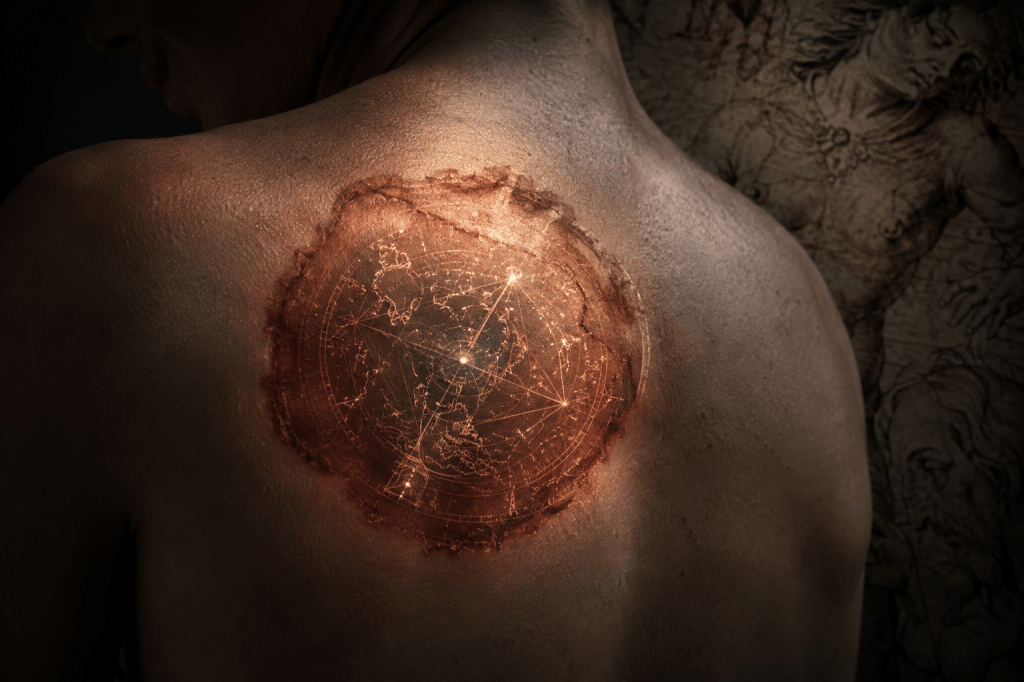
    Most of us enter the world carrying no visible evidence of where we have come from, yet some arrive already marked, bearing upon the skin an oval patch, a red stain, an irregular constellation of pigment, a shape resembling a leaf, a flame, a wing, a flower or, in the strangest cases, something disturbingly similar to an old wound.

    Modern medicine has names for these marks, and those names matter, because birthmarks are real biological structures rather than supernatural objects floating outside the laws of the body. Dermatology generally distinguishes between vascular birthmarks, involving blood vessels, and pigmented birthmarks, involving pigment-producing cells, while congenital melanocytic nevi, port-wine stains, hemangiomas and dermal melanocytosis all have their own biological characteristics, appearances and clinical significance. For many birthmarks, medicine can describe remarkably well what the tissue is doing, even though the precise cause of every type is not always known.

    Yet throughout history another question has persisted beside the medical one, quieter and considerably more unsettling.

    Why there?

    Why that particular shape?

    Why does one person arrive bearing a mark over the heart, another along the spine, another upon the hand, the throat, the thigh or the face, while most human beings emerge without anything comparable at all?

    Science can examine the mechanism by which pigment cells or blood vessels form a mark, but the occult imagination asks a different kind of question, not necessarily because science has failed, but because human beings have always searched for meaning in patterns that biology merely describes. From ancient Greek divination to Renaissance medicine, from folk traditions surrounding maternal impressions to twentieth-century investigations of alleged past-life memories, the birthmark has repeatedly occupied a strange borderland where flesh, symbolism, destiny and memory seem to touch.

    Perhaps that is why the skin has never been merely skin in the esoteric imagination.

    It is the frontier where the hidden becomes visible.

    And if the old occultists were right about even a fraction of what they suspected, some birthmarks may be more than imperfections in the parchment.

    They may be writing.


    THE SKIN AS THE FIRST SACRED TEXT

    Long before human beings carved prayers into stone, painted symbols upon temple walls or bound sacred words between covers, the body itself was interpreted as a text, because the face, hands, eyes, scars, moles and peculiarities of the flesh appeared to ancient observers as signs through which the invisible order of existence might occasionally reveal itself.

    This idea does not belong to one culture alone, nor does it require us to assume that every bodily feature possesses a supernatural meaning, because its real historical importance lies in something deeper: human beings repeatedly imagined the body as a microcosm, a miniature world in which celestial, moral and spiritual realities could somehow leave traces.

    The Hermetic principle traditionally summarized as “as above, so below” encouraged precisely this kind of correspondence, because if the human being reflected the larger cosmos, then the body could theoretically become a map upon which greater forces expressed themselves. Medieval and Renaissance physiognomy extended such reasoning into elaborate systems, while astrology associated portions of the body with planets and zodiacal influences, alchemy turned bodily transformation into a metaphor for spiritual transmutation, and magical traditions regarded certain unusual physical features as signs of destiny, protection, danger or inherited power.

    The concept of birthmarks as an occult alphabet therefore did not emerge from nowhere, although the elaborate interpretations found in modern esoteric literature should not automatically be projected backwards and called ancient Hermetic doctrine.

    What history actually gives us is more interesting.

    It gives us fragments.

    And fragments are often where mysteries begin.


    AN ANCIENT GREEK MAP OF THE MARKED BODY

    Among the surviving works associated with the legendary Greek seer Melampus is a brief text known as Peri Elaion tou Somatos, usually translated as On the Moles of the Body or interpreted more broadly as a treatise concerning bodily marks. The work survives within an ancient tradition of divination in which the location of a mark could be read as an omen, and a sixteenth-century English edition preserved the text as “a little treatise” concerning the significance of moles attributed to the Greek Melampus. Modern cataloguing by the Folger Shakespeare Library confirms that this tradition circulated in early modern Europe alongside works on physiognomy.

    The surviving material is strange because it treats the human body almost as though geography itself possessed meaning, connecting particular locations with particular outcomes and sometimes distinguishing between the left and right sides of the body. Historians do not regard this as scientific anatomy, of course, but its existence tells us something important: the idea that a bodily mark might carry meaning according to its exact position is not a recent invention created by social media mysticism.

    People were asking this question more than two thousand years ago.

    The Greek text does not give us the elaborate chakra-like map sometimes presented online today, nor should we pretend that it does, but it reveals an enduring occult instinct: position matters, because a mark on the mouth seems symbolically different from a mark upon the foot, just as a scar across the heart carries a different psychological meaning from one upon the hand.

    Whether the universe actually intended such distinctions remains impossible to establish.

    The fact that human beings have perceived them for centuries is indisputable.


    PARACELSUS AND THE MYSTERIOUS “IMPRESSIONS”

    The story becomes considerably stranger when we reach Paracelsus, the sixteenth-century physician, alchemist and medical revolutionary whose writings exist in the uncomfortable territory between observation, medicine, theology, astrology and occult philosophy.

    Paracelsus lived in a world in which imagination was not regarded merely as private fantasy. Within his cosmology, imagination could function almost like a force, capable of influencing matter under particular conditions, and when discussing pregnancy he described unusual marks upon the unborn child as “impressions,” comparing the process to a seal being pressed into something capable of receiving its form.

    In an English translation of his writings, he describes influences becoming impressed upon the fetus “as though one should impress a seal or stamp a piece of money,” after which the resulting birthmarks were called “impressions.” Elsewhere in the same body of writings, he discusses what were once called maternal or uterine marks and connects outward bodily signs with an “art of signature,” according to which visible forms were thought capable of revealing invisible qualities.

    His biological explanation does not survive modern scientific scrutiny, and there is no good evidence that an unsatisfied craving or a powerful maternal image literally stamps a corresponding symbol onto the fetus, yet the metaphor he chose remains remarkable.

    A seal.

    An impression.

    Something invisible pressing itself into visible matter.

    If we temporarily remove Paracelsus’s obsolete embryology and retain only the symbolic architecture of his thought, we arrive at one of the most evocative occult ideas surrounding congenital marks: perhaps the body does not simply grow, but receives impressions while it grows.

    The question then becomes infinitely more dangerous.

    Impressions from what?


    THE ASTRAL BODY AND THE MOMENT OF DESCENT

    In a modern esoteric synthesis drawing upon Hermeticism, Neoplatonism, alchemy, astrology and later occult traditions, we can imagine the formation of a human being as something more complicated than a soul suddenly dropped into a finished biological machine.

    Instead, consciousness would gradually descend through levels of increasing density until it became attached to physical existence, passing symbolically from the invisible toward the visible, from possibility toward form, from what the alchemists might have called subtle substance into the heavy kingdom of matter.

    We might call the hypothetical pattern carried through that descent the Morphe Astralis, not as an authenticated ancient Hermetic term, but as a useful modern name for the occult idea that consciousness possesses a subtle architecture before its physical expression becomes complete.

    Within this symbolic system, a birthmark could be imagined as Stigmata Hermetica, a “Hermetic impression” where something belonging to the subtle history of the person has coincided with the construction of the physical body.

    Such a model cannot presently be demonstrated scientifically, and it should not be confused with embryology, but occult philosophy has never restricted itself to asking only how matter behaves. It also asks whether meaning can precede matter, whether consciousness can leave physical traces, whether memory can exist outside ordinary neurological recall and whether the body may occasionally preserve information that the waking mind cannot access.

    These questions move us directly toward one of the most controversial researchers of the twentieth century.


    IAN STEVENSON AND THE CHILDREN WHO WERE BORN WITH WOUNDS

    Ian Stevenson was not an occultist writing by candlelight in a forgotten monastery, but a psychiatrist associated with the University of Virginia who spent decades investigating young children who spontaneously reported what appeared to be memories of previous lives.

    The University of Virginia’s Division of Perceptual Studies reports that its researchers have collected more than 2,500 cases of the “reincarnation type,” and approximately 30 percent of those cases involve a birthmark and/or birth defect.

    That figure is often distorted online into the claim that Stevenson “proved reincarnation through thousands of birthmarks,” which he did not, and the actual material is considerably more interesting when presented accurately.

    In a published summary concerning 895 children said to remember previous lives, Stevenson reported that 309 cases, approximately 35 percent, included a birthmark or birth defect attributed by the families to the previous personality. He subsequently investigated hundreds of such cases more closely, attempting, when circumstances permitted, to compare the child’s physical anomaly with information about injuries suffered by the deceased person.

    For some cases his research involved autopsy reports, medical records, police documentation or eyewitness accounts, rather than relying exclusively upon family stories, and his later two-volume work Reincarnation and Biology assembled an enormous collection of these reports.

    Among the cases described in the literature were children born with abnormalities allegedly corresponding to amputations, surgical wounds or fatal injuries associated with the deceased individuals whose lives they claimed to remember, although every individual case presents methodological difficulties and alternative explanations must remain part of any serious evaluation.

    This is precisely where the mystery should be allowed to remain a mystery.

    Stevenson’s cases do not establish that a bullet wound suffered by one person magically reappears as a birthmark upon another body, and mainstream biology has no accepted mechanism through which such a transfer could occur.

    But if even a small number of carefully documented correspondences resist ordinary explanations, an uncomfortable possibility appears at the edge of the discussion.

    What if memory is not always confined to the brain?

    And what, exactly, would a body remember if consciousness had existed before it?


    THE OCCULT GEOMETRY OF BIRTHMARKS

    Once we enter the symbolic territory rather than the medical one, the shape of a birthmark becomes as significant as its location, although we should immediately resist the temptation to create an absolute dictionary in which every circle means one thing and every triangular mark inevitably predicts another.

    Occult symbolism is strongest when understood as a language of correspondences rather than a mechanical code, because the same symbol may transform its meaning according to location, colour, orientation, personal history and even the associations spontaneously produced in the person who carries it.

    An oval or egg-shaped mark, for example, naturally evokes one of humanity’s oldest symbols of latent creation, because the egg contains an entire living form that has not yet revealed itself. In an alchemical reading, such a mark may therefore symbolize concentrated potential, an ability, memory or unfinished transformation that has remained enclosed rather than manifested, especially when the person repeatedly experiences the sensation that some important capacity exists within them without ever having been fully expressed.

    A circle traditionally evokes wholeness, enclosure, eternity and recurrence, because it possesses neither obvious beginning nor end, while alchemical imagery frequently uses circular forms to represent cycles of dissolution and regeneration. A circular birthmark could consequently be contemplated as the image of a cycle that has closed, or perhaps one that continues to repeat until its internal pattern is understood.

    A mark resembling a star, radiant point or small explosion belongs naturally to the symbolism of fire and illumination, particularly if its shape suggests energy moving outward from a centre. Within an occult reading, this could represent initiation, revelation, knowledge struggling toward expression or an old experience of visibility so powerful that the person in this life simultaneously seeks and fears being seen.

    A crescent, tear or drop-shaped mark invites lunar and aquatic associations, connecting it symbolically with memory, receptivity, intuition, mourning and the hidden movements of emotional life, while an organic mark resembling a flower or unopened bud might represent spiritual development that is incomplete rather than absent, something that has already begun beneath the surface but has not yet opened completely into the world.

    A leaf, branch or tree-like formation naturally belongs to the symbolism of ancestry, continuity and the Earth, because trees join what lies beneath the ground with what reaches toward the sky, making them among the oldest possible symbols of mediation between worlds.

    A mark resembling a bird, feather or wing, meanwhile, lends itself to the symbolism of separation, transcendence and freedom, perhaps becoming especially meaningful for someone whose life repeatedly revolves around departure, exile, escape, confinement or an almost irrational refusal to remain where others expect them to stay.

    None of these interpretations can tell you objectively what a birthmark “means.”

    What they can do is provide a symbolic mirror.

    Sometimes mirrors reveal things that dictionaries cannot.


    THE OCCULT MAP OF THE BODY

    If shape tells us something about the quality of the symbol, location tells us where its story may be unfolding, and this is the principle underlying almost every historical system that interprets bodily signs.

    THE HEAD, FACE AND THROAT — IDENTITY, PERCEPTION AND THE WORD

    A mark upon the forehead, particularly near the space between the eyes, has naturally acquired associations with perception, judgment and hidden sight because this region occupies the symbolic frontier between ordinary vision and what later mystical traditions described as interior vision.

    An occult interpretation would not mean that someone with such a birthmark automatically possesses clairvoyance, because that would reduce symbolism to superstition, but it might suggest a life organized around seeing what others overlook, questioning appearances or becoming painfully conscious of contradictions other people find easier to ignore.

    A mark around the mouth or lips belongs to another powerful territory because the mouth receives food, gives kisses, utters promises, tells lies, reveals secrets and transforms thought into sound. Such a mark could symbolically be explored through questions concerning speech, forbidden expression, broken vows, persuasion, desire or words that were never spoken when they should have been.

    The throat intensifies this symbolism because it is both a passageway and a vulnerable constriction between head and body, making it an obvious occult location for themes involving suppressed truth, testimony, command, silence or the terrifying consequences that can follow from saying the wrong thing at the wrong moment.

    THE SHOULDERS, ARMS AND HANDS — WILL MADE VISIBLE

    The arms are where intention becomes action, because thought may conceive a thing but the hands must eventually build it, touch it, write it, destroy it, heal it or release it.

    A mark upon the shoulder or upper arm may therefore be contemplated in relation to burden, responsibility and strength, particularly in people who repeatedly find themselves carrying obligations that technically belong to others.

    The forearm occupies an especially intriguing symbolic position because it is the bridge between the body’s central strength and the precision of the hand, making it suitable for what we might call the Seal of Craft, an association with learned skill, healing, writing, construction, artistic work or any ability through which invisible intention becomes physical result.

    A mark upon the wrist or palm naturally evokes older traditions surrounding the magical hand, because hands bless, swear oaths, exchange money, perform ritual gestures, feel the sick, wield weapons and leave fingerprints, which are themselves unique biological signatures.

    The occultist might therefore ask not “Does this mark prove that I was a healer or magician?” but rather, “What do my hands repeatedly attempt to do in this life, and why does this particular part of my body feel symbolically charged?”

    That question is considerably more useful.

    And considerably harder to answer.


    THE CHEST AND HEART — LOVE, SACRIFICE AND THE UNFINISHED VOW

    Few locations invite stronger interpretation than a congenital mark close to the heart, because the chest is simultaneously anatomical protection and emotional symbol, shielding the organs that keep us alive while becoming, across cultures, the imagined home of courage, grief, love, loyalty and betrayal.

    An occult reading of a birthmark here might therefore concern an unresolved bond, a sacrifice, a devotion that outlived its circumstances or a recurring pattern in which love becomes inseparable from suffering.

    In the darker language of esoteric symbolism, it might be called the Seal of the Vow, not because every mark on the chest records some literal oath from a former incarnation, but because the person carrying it may discover that promises, loyalty and emotional debts dominate their life with unusual intensity.

    If reincarnation were ever demonstrated to involve the transfer of more than personality, the heart would be exactly the kind of place in which human imagination expects an old story to survive.

    Whether nature shares our symbolism is another matter entirely.


    THE ABDOMEN AND SOLAR PLEXUS — INSTINCT, FEAR AND THE BODY THAT KNOWS FIRST

    Human beings often say that they “feel something in the gut” long before they can explain what is wrong, an expression that has physiological dimensions as well as symbolic ones because the nervous system, stress response and gastrointestinal system are deeply interconnected.

    Occult traditions transformed this visceral territory into something even larger, interpreting the abdomen as a region of instinctive power, appetite, fear, courage and emotional digestion.

    A birthmark upon the abdomen can therefore be contemplated as a symbol of experiences that must be digested rather than merely understood intellectually, particularly when the person repeatedly encounters circumstances that produce strong instinctive reactions before conscious reasoning catches up.

    In symbolic terms, this is the territory where life is swallowed.

    And where life sometimes refuses to be digested.


    THE BACK AND SPINE — WHAT WE CARRY WITHOUT SEEING

    The back is perhaps the most psychologically suggestive territory of all because it exists largely outside our ordinary field of vision, allowing us to carry wounds, scars and marks that other people may observe more easily than we can.

    A congenital mark between the shoulder blades can therefore be read as an emblem of inherited burdens, obligations or stories that seem to have been placed upon a person without their conscious choice, making this area particularly suited to reflection upon family patterns and transgenerational identity.

    The lower back and sacral region belong to another symbolic world involving support, survival, sexuality, ancestry and the physical capacity to remain upright beneath pressure.

    Later esoteric systems influenced by Indian traditions might associate this region with kundalini and foundational life energy, although it would be historically inaccurate to describe kundalini doctrine itself as ancient Hermetic teaching.

    The more interesting possibility is that multiple spiritual traditions independently recognized the lower trunk and spine as profound symbols of incarnation because this is literally where the human body balances itself against gravity.

    A mark there may therefore invite the question: What keeps me rooted in this world, and what repeatedly threatens to uproot me?


    THE THIGHS, KNEES, LEGS AND FEET — THE MEMORY OF THE ROAD

    If the hands represent what we do, the legs represent where we go, which is why marks upon the lower body naturally lend themselves to interpretations involving endurance, movement, exile, pilgrimage and the direction of one’s life.

    The thighs, massive engines of movement and support, suggest resilience and stored power, particularly when life repeatedly requires a person to rise after experiences that should have left them unable to continue.

    The knees introduce a different symbolism because bending the knee can signify humility, defeat, reverence or strategic flexibility, making a congenital mark there suitable for contemplation of pride, submission and the ability to yield without surrendering one’s identity.

    The calves and lower legs belong to forward motion and persistence, while marks upon the ankles or feet inevitably evoke paths, journeys and contact with the Earth itself.

    In an occult reading, a marked foot might be called the Seal of the Road, particularly for someone whose existence has been shaped by migration, repeated relocation, an inability to remain in one place or the persistent intuition that there is somewhere they are still supposed to go.

    Perhaps some people inherit houses.

    Perhaps others inherit journeys.


    RIGHT AND LEFT — THE ANCIENT MYSTERY OF POLARITY

    The distinction between the right and left sides of the body appears in numerous historical symbolic systems, including traditions of divination, and the old Greek material associated with bodily marks sometimes distinguishes between sides rather than treating the body as perfectly symmetrical in meaning.

    A modern occult synthesis can develop this further through the language of polarity, provided we understand that we are constructing symbolism rather than recovering a single ancient doctrine.

    The right side can be treated as the solar, active or outward-facing current, connected with action, projection, decision, creation and the forces we impose upon the world, while the left side can be treated as lunar, receptive and inward-facing, connected with memory, intuition, inheritance and the forces the world impresses upon us.

    Thus, a mark upon the right hand might invite reflection on what a person is meant to accomplish, while a similar mark upon the left could invite questions concerning what they have received, inherited or carried.

    The symbolism becomes even more interesting when the person’s actual temperament seems reversed, because a strongly passive individual bearing an unusual mark on the traditionally active side might contemplate whether the mark symbolizes precisely the quality that remains undeveloped.

    An occult symbol does not always describe what you are.

    Sometimes it describes what you have not yet become.


    THE WOUND THAT DID NOT DISAPPEAR

    Alchemy rarely treats wounds as meaningless because the entire Great Work depends upon transformation, and transformation begins with something imperfect, divided, impure or incomplete.

    The alchemist does not begin with gold.

    He begins with matter that must pass through darkness, separation, dissolution and recombination before another state becomes possible.

    For that reason, the most profound occult interpretation of a birthmark is not that it proves a violent death in another lifetime, nor that it condemns the person to repeat an ancient tragedy, but that it may be used symbolically as the location where an unfinished story has become visible.

    This is where the old alchemical metaphor of lead becoming gold becomes useful.

    The “lead” is not the mark itself.

    It is whatever fear, attachment, inherited pattern, unexpressed ability or repeated conflict the mark comes to represent within the person’s interior life.

    The “gold” appears when the symbol ceases to be a sentence pronounced upon the individual and becomes instead an instrument of self-knowledge.

    A mark over the heart does not mean you are destined to suffer for love.

    A mark upon the throat does not mean someone once killed you for speaking.

    A mark upon the hand does not prove that you possessed magical abilities.

    Those are stories, and stories become dangerous when possibility hardens into certainty.

    But if a particular symbol repeatedly opens the same psychological door, if contemplating it produces memories, dreams, fears or associations that are strangely consistent across years, then the occultist does not necessarily dismiss the experience.

    The occultist watches.


    HOW TO READ YOUR OWN BIRTHMARK WITHOUT INVENTING A DESTINY

    The worst way to interpret a birthmark is to search for a rigid online dictionary that tells you that a mark three centimetres above the left knee means you were a priestess in Atlantis or murdered by a jealous lover in 1742.

    The deeper method begins without an answer.

    Study the shape without deciding what it resembles, because human perception is exceptionally skilled at finding familiar forms in ambiguous patterns, a phenomenon that can transform an irregular patch of pigment into a bird, a sword, a continent, a face or almost anything else once expectation has taken control.

    Then ask what you saw before anyone else suggested an interpretation.

    Consider its location and your relationship with that part of the body, while paying attention to recurring dreams, inexplicable emotional reactions, lifelong fears, unusual abilities and patterns that seem to gather around the same symbolic territory.

    You may place a hand gently over the mark, close your eyes and ask three questions, not as an attempt to summon an objective supernatural answer, but as a contemplative exercise capable of revealing associations hidden beneath ordinary thought:

    What force does this part of my body represent in my life?

    Does the shape seem to speak of containment, expansion, movement, protection, injury, growth or transformation?

    If this mark were not a defect but a message written in a symbolic language, what part of myself would I suspect I had forgotten?

    Then resist answering too quickly.

    The first answer often comes from expectation.

    The more interesting one sometimes arrives later.


    THE MOST DANGEROUS POSSIBILITY

    It would be easy to end this investigation by declaring either that birthmarks are purely biological accidents and therefore meaningless, or that they are indisputable seals from former incarnations and therefore proof that the soul survives death.

    Neither conclusion is justified by the evidence we possess.

    Medicine demonstrates that birthmarks have physical structures and developmental mechanisms, and unusual or changing marks should always be evaluated medically when appropriate, because symbolic interpretation must never replace dermatological care. MedlinePlus notes that most birthmarks are harmless while some types require observation, particularly if they change, bleed, itch or develop other concerning features.

    History, however, demonstrates something equally undeniable: people have contemplated bodily marks as meaningful signs for centuries, from Greek mole divination to Renaissance theories of signatures and Paracelsian “impressions.”

    And the investigations associated with Ian Stevenson leave us with a third category, neither accepted proof nor easily disposable mythology, consisting of cases in which children reportedly displayed both unusual physical marks and detailed claims concerning deceased individuals, sometimes allowing comparisons against records that existed independently of the child’s body.

    Perhaps all such cases will eventually receive conventional explanations.

    Perhaps memory is stranger than we currently understand.

    Perhaps the human impulse to interpret birthmarks is simply an extraordinary example of our species’ refusal to accept randomness.

    Or perhaps the mistake lies in assuming that biology and meaning must cancel one another out.

    A page is made of paper, ink and chemical compounds, yet none of those facts tells you what the words written upon it mean.

    Could the same principle ever apply to the body?

    We do not know.

    That uncertainty is the real mystery.

    Because before you were old enough to write your name, before you learned your family’s stories, before anyone taught you what a soul was supposed to be, your body had already written something upon itself.

    Maybe it was nothing more than biology following an ancient molecular choreography.

    Maybe it was an accident of pigment and blood vessels.

    Maybe it was an echo carried through some mechanism we have not discovered.

    Or perhaps, as the occultists might whisper, the body is not merely the vessel into which consciousness arrives.

    Perhaps it is the final page of a book that began somewhere else.

    And perhaps a birthmark is one sentence that was never completely erased.

    Your skin may be the first sacred manuscript you were ever given, and the marks with which you entered this world may be letters from an alphabet that the body knew before the mind learned how to read.


    SOURCES AND FURTHER READING

    Ian Stevenson, Reincarnation and Biology: A Contribution to the Etiology of Birthmarks and Birth Defects, Praeger, 1997.

    University of Virginia, Division of Perceptual Studies, research archive on children who report memories of previous lives. The division reports more than 2,500 investigated cases and notes that roughly 30 percent contain a birthmark and/or birth defect.

    Ian Stevenson, “Birthmarks and Birth Defects Corresponding to Wounds on Deceased Persons,” Journal of Scientific Exploration, 1993.

    Paracelsus, The Hermetic and Alchemical Writings of Paracelsus, translated and edited by Arthur Edward Waite, including passages concerning congenital “impressions,” maternal marks and the art of signature.

    Pseudo-Melampus, Peri Elaion tou Somatos (On the Moles/Marks of the Body), preserved within the ancient and later European tradition of bodily divination; the work is catalogued in the Folger Shakespeare Library within Thomas Hill’s 1571 The Contemplation of Mankinde.

    MedlinePlus, U.S. National Library of Medicine, medical information concerning vascular and pigmented birthmarks, congenital nevi and related conditions.

    Thank you for subscribing!

    Please check your email to confirming your subscription.

    Fediverse Reactions