
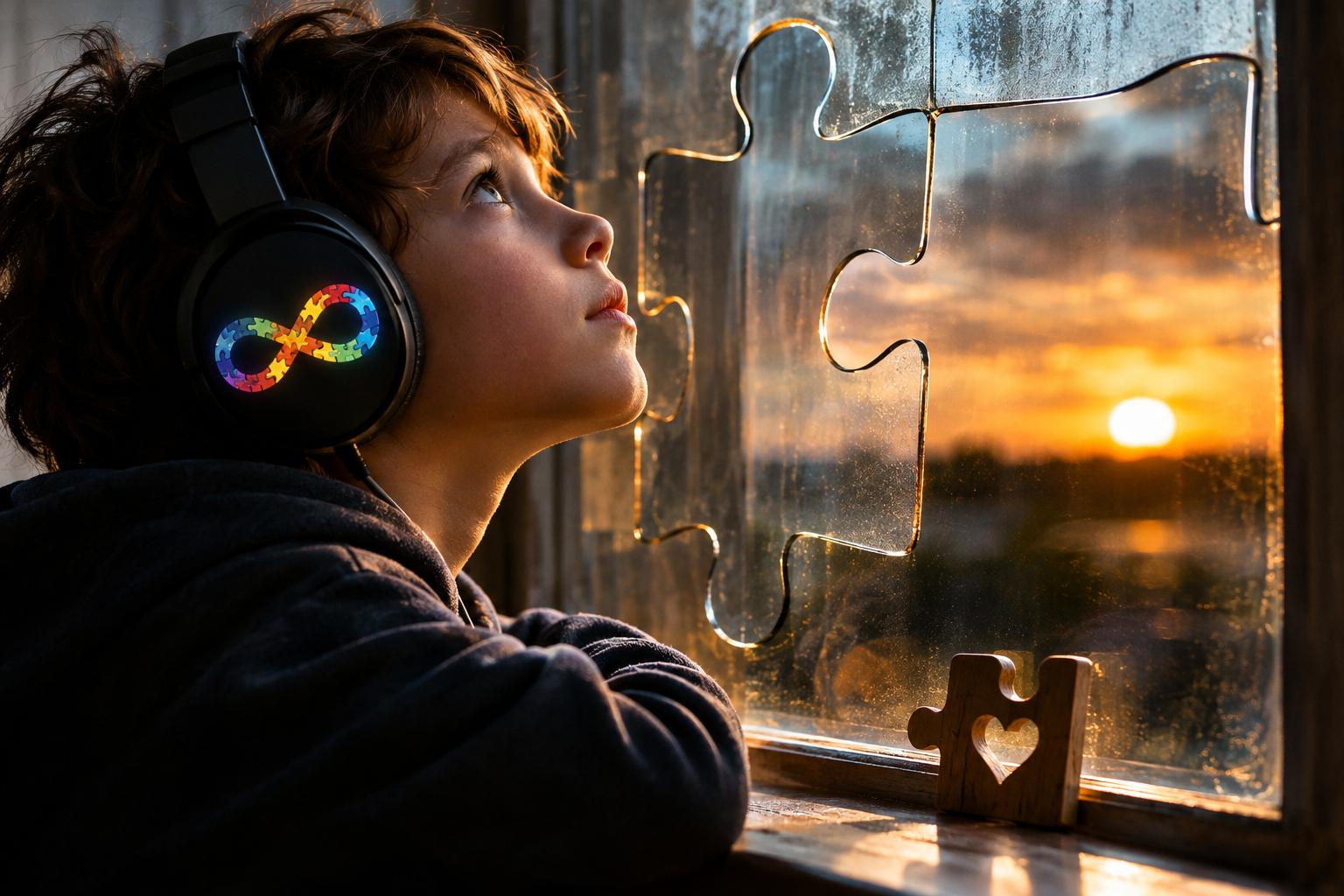
Autism and the hypocrisy of a society that encourages us to be ourselves, but only as long as we resemble everyone else.
I have a friend who has an autistic son. I met her when the boy was six years old, and today he is a wonderful 22-year-old young man studying law. Yes, you read that correctly, he is studying law. Nothing particularly remarkable about that, although some people seem to find it surprising.
When she found out that I wanted to write an article on this subject, she immediately jumped down my throat, telling me that she did not want me to portray her as a victim for something she had done out of love. No, neither she nor her son is a victim, but it took her a little longer to understand what I intended to write.
During our conversation, she said to me:
“Imagine walking into a room where everyone is playing a game whose rules have never been explained to you. Everyone else knows when to speak, when to laugh, how long to maintain eye contact, and even when to pretend to be interested in a conversation they have absolutely no interest in. You have to figure all these things out by observing them, while they judge you for every mistake you make.”
Right, I understood where she wanted to throw me. To the wolves! Very well-mannered wolves, of course, who know all the rules of etiquette.
For many autistic people, this is an everyday experience.
I recently read an article by Lia Altor, Why People Feel Uncomfortable Around Autistic People, published in Invisible Illness on Medium. Diagnosed with autism in 2004, she discusses how, despite scientific advances, society’s attitude towards autistic people has not changed nearly as much as we would like to believe.
Tragic, considering how proud we are of our evolution as a species.
The article caught my attention because of an unusual association between autism and a psychological phenomenon known as the Uncanny Valley, something new to me.
Why Are We Uncomfortable Around People Who Behave Differently?
In 1970, Japanese engineer Masahiro Mori described an interesting phenomenon: when a robot closely resembles a human being, but its expressions and movements do not match our expectations, we may experience a sense of discomfort without immediately understanding why.
Lia Altor suggests that a similar mechanism might contribute to the social rejection of autistic people. This is not about comparing autistic people to robots, but about our reaction to behaviour that differs from what we are accustomed to.
Sometimes we avoid people who are different as though they might infect us with some invisible virus. Fortunately for us, autism is not contagious. Unfortunately for them, prejudice seems to be.
Although the Uncanny Valley hypothesis has not been scientifically established in relation to autism, a study published in 2017 by Noah J. Sasson and his colleagues in Scientific Reports shows that non-autistic participants formed less favourable impressions of autistic people within just a few seconds.
Instant, like instant coffee. What a rush! Apparently, they had no time left to discover the human being in front of them.
Interestingly, these differences disappeared when participants simply read the transcripts of the conversations, without seeing or hearing the people involved.
This experiment says a great deal about us, the non-autistic people, not just about them. The problem was not necessarily what autistic people were saying, but the way they communicated.
How many friendships, relationships and professional opportunities have been lost because of such first impressions?
The School of Normality
I do not remember there being a school subject called “How to Appear Normal in Society,” although, judging by the importance we attach to such things, there probably should have been one, complete with a final examination and a diploma certifying that we are officially normal.
Most people learn social conventions through observation and imitation until these become almost automatic. For some autistic people, however, a simple telephone conversation may require mentally rehearsing what they are going to say, while attending a social gathering may involve consciously controlling their gestures, facial expressions and eye contact.
A child who does not follow these conventions may become a target of ridicule, gradually learning that, in order to be accepted, certain aspects of their personality must remain hidden.
In psychology, this phenomenon is known as masking, or social camouflaging.
A study conducted in 2017 by Laura Hull and her colleagues, based on the experiences of 92 autistic adults, highlighted the consequences of this adaptation, including mental exhaustion and difficulties with their sense of identity.
Imagine an actor forced to play a character every single day, without a complete script, without knowing when the performance will end, and without receiving even a round of applause. Their only reward is the possibility of not being rejected.
When Competence Is Not Enough
In the workplace, things become even more complicated. It is not always enough to fulfil your responsibilities; you must also appear happy to do so, smile and give the impression that nothing bothers you.
Now that’s theatre, and we don’t even get paid separately for the performance!
An employment contract specifies working hours, salary and responsibilities, but says absolutely nothing about smiles, how many are required per day or during which hours. Nevertheless, they seem to be part of the unwritten criteria by which employees are evaluated.
For an autistic person who is sensitive to noise, bright lights or crowded environments, an ordinary working day can become extremely demanding. If that stress shows on their face, it may be interpreted as arrogance, indifference or a lack of professionalism.
When we judge an employee who does their job properly, who is thoroughly fed up with the daily routine, simply because they do not appear enthusiastic enough, what exactly are we evaluating: professional competence or acting talent?
And, between you and me, how many of us wake up in the morning with an almost romantic longing to go to work?
Who Doesn’t Understand Whom?
In 2012, researcher Damian Milton introduced the concept of the Double Empathy Problem, suggesting that communication difficulties between autistic and non-autistic people can be reciprocal.
Well, now we have something interesting, something that might slightly damage our perception of our own social superiority.
In 2020, a study led by Catherine Crompton showed that autistic people could communicate information effectively among themselves, with difficulties becoming more apparent in mixed groups.
Now, for the thousand-point question: when an autistic person does not understand the behaviour of a neurotypical person, meaning a “normal” person, we talk about their communication difficulties. But when a neurotypical person does not understand the behaviour of an autistic person, why don’t we also talk about their difficulties?
It seems that the majority enjoys a very convenient privilege: whenever it fails to understand the minority, the problem still belongs to the minority.
Why does the responsibility for adapting almost always fall on those who are in the minority?
The Hypocrisy of Normality
We live in a society that encourages us to be authentic, to have the courage to be different and to never allow anyone to change our personalities. The personal development industry makes money teaching us how to be ourselves, while society gives us reasons not to be, free of charge, and the latter seem to be considerably more numerous.
The message appears to contain an additional condition, written in very small print: be yourself, but not so much that you make other people uncomfortable.
Oops! We forgot to read the terms and conditions of authenticity.
Nor do I want to romanticise autism by portraying all autistic people as misunderstood geniuses. Autism is a complex spectrum, and some individuals require considerable support throughout their lives. However, nobody should have to prove that they are a genius to deserve respect, nor should they have to be productive to earn the right to belong to society.
The young man I told you about at the beginning of this article does not deserve respect because he is studying law, but because he is a human being. He would have deserved exactly the same respect if he had been unable to read even a single page of a book.
I believe we spend far too much time discussing how autistic people should learn to live among us and far too little discussing how we should learn to live alongside them.
If a person has to hide their suffering, control every reaction and sacrifice their authenticity so that we can feel comfortable in their presence, I am not entirely convinced that they are the ones who have the most to learn about human relationships.
As for that diploma certifying our normality, I think we should postpone the graduation ceremony for a little while longer. It seems we still have a few examinations to pass.
Sources and References:
Lia Altor (2026) – Why People Feel Uncomfortable Around Autistic People: Autism and the Uncanny Valley Effect, Invisible Illness, Medium.
World Health Organization – Autism.
Noah J. Sasson et al. (2017) – Neurotypical Peers Are Less Willing to Interact with Those with Autism Based on Thin Slice Judgments, Scientific Reports.
Laura Hull et al. (2017) – Putting on My Best Normal: Social Camouflaging in Adults with Autism Spectrum Conditions, Journal of Autism and Developmental Disorders.
Damian Milton (2012) – On the Ontological Status of Autism: The Double Empathy Problem.
Catherine Crompton et al. (2020) – Autistic Peer-to-Peer Information Transfer Is Highly Effective, Autism.
Masahiro Mori (1970) – The Uncanny Valley.

Leave a Reply