Tag: Human Psychology

  • From The Second Sex to Old Age: The Art of Intellectual Hypocrisy

    From The Second Sex to Old Age: The Art of Intellectual Hypocrisy

    Sartre and Simone de Beauvoir: When Exploitation Was Called Philosophy

    By Mira Grecu

    History has a strange way of judging people. If an ordinary man manipulates young women, he is accused of manipulation. If he happens to be a famous philosopher, someone might write a doctoral thesis a few decades later about freedom and the human condition.

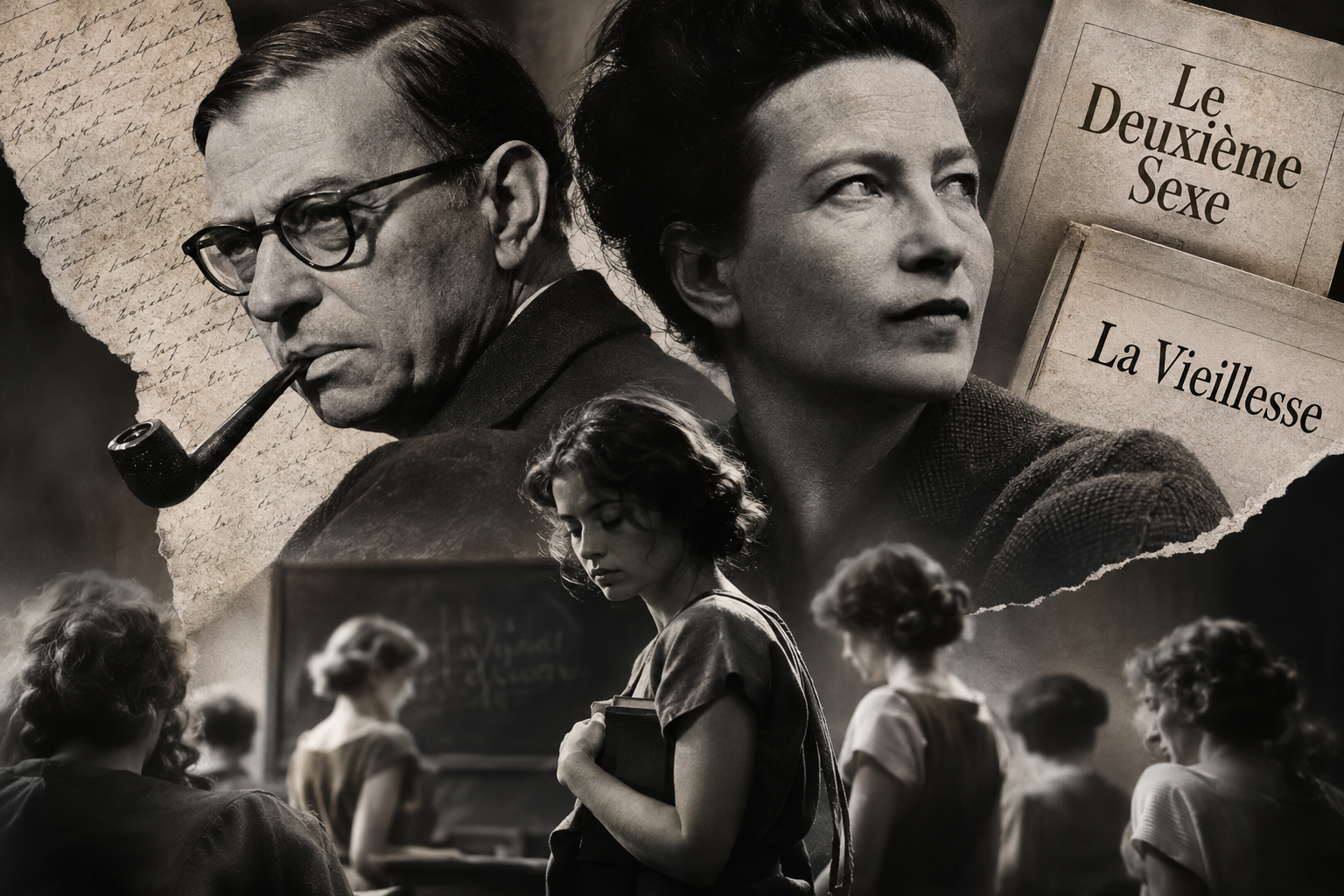
    Jean-Paul Sartre (1905–1980) and Simone de Beauvoir (1908–1986) were certainly a couple difficult to forget. Their relationship has been presented as the triumph of intelligence over social conventions, a revolutionary romantic experiment and a demonstration that love can exist without marriage, fidelity or possessiveness.

    Something didn’t quite ring true to me. It reminded me of something, but I couldn’t immediately put my finger on it.

    I found their correspondence online, along with testimonies from the lovers of our philosophical Don Juan, and just like that, my admiration came crashing down. About six years ago, I read one of Simone’s books. I admired her back then.

    And suddenly, the light bulb went on.

    Something about this reminded me of Jeffrey Epstein and Ghislaine Maxwell, several decades earlier.

    A Philosophical Pact or a Romantic Alliance?

    Sartre and Simone met in 1929, when he was 24 and she was 21. Sartre proposed a pact that, in rather less philosophical language, could be summarised as: let’s love each other, but let’s remain free at the same time.

    Simone liked the idea. Wonderful! Separate mattresses, other partners, no hard feelings, but ours is the great love story.

    They never married and generally maintained separate residences, but they shared their great love and the details of their experiences with other people.

    The idea sounds revolutionary, but I wonder what status those who entered this arrangement actually had. Were they equal partners or temporary characters in a story whose rules had been established before they even arrived?

    Their subsequently published correspondence reveals a degree of honesty between the two that was not always extended to everyone else.

    Freedom was universal in theory, but transparency had a rather limited number of beneficiaries.

    The Teacher Who Introduced Young Women to the Philosopher

    During the 1930s, Simone taught philosophy in secondary schools. Among her students were young women who admired her deeply and who would eventually enter the lovers’ intimate circle.

    In 1934, she met Olga Kosakiewicz, whom Sartre found attractive. Olga rejected his sexual advances, but our great philosopher apparently found an alternative: never mind, don’t you happen to have a sister named Wanda?

    And this is where the devil begins to meddle.

    Both sisters benefited from the couple’s material and intellectual support, which was certainly significant at the time.

    Then another young student appeared, Bianca Lamblin, who was only 17 when she became intimately involved with Simone in 1938. The teacher subsequently introduced her to Sartre, who began courting her in January 1939 and abandoned her in February 1940.

    How could Bianca, who came from a Jewish family, possibly have known what history had in store for her? The war, the Nazi occupation and the horrors of the Holocaust were about to unfold.

    After the war, Bianca resumed her friendship with Simone. It was only in 1990, following the publication of Simone’s correspondence, that she discovered how humiliatingly her former teacher had spoken about her to Sartre.

    And that was when the bombshell dropped.

    In 1993, Bianca published Mémoires d’une jeune fille dérangée, translated into English as A Disgraceful Affair, in which she accused Simone of effectively supplying Sartre with young lovers.

    The betrayal of a friend she had loved, in more ways than one, and whose friendship she had maintained for approximately four decades.

    The 1943 Investigation

    Nathalie Sorokine, another of Simone’s students, entered the couple’s circle in 1939. Beauvoir even offered to help finance her studies.

    In December 1941, the young woman’s mother filed a complaint, accusing Simone of seducing her daughter and facilitating her relationships with Sartre and Jacques-Laurent Bost.

    The accusation was excitation d’une mineure à la débauche — inciting a minor to debauchery.

    The investigation lasted approximately 18 months. On 23 June 1943, Simone was informed that she had been dismissed from her teaching position.

    About time, I would say.

    Those involved denied the allegations, and her right to teach was restored after the war.

    Not a decision I find particularly reassuring.

    It should be noted that the age of civil majority was then 21 and that the investigation took place under the conservative Vichy regime. The administrative dismissal should not be mistaken for a criminal conviction.

    Nevertheless, the existence of official documents, personal testimonies and a recurring pattern of involvement with former students cannot simply be ignored.

    Personally, philosophy is hardly the word I would use to describe the introduction of young women into relationships whose actual rules they did not fully understand.

    I even considered the possibility of prostitution disguised in intellectual terminology. However, there is insufficient evidence to establish an explicit exchange of sexual services for material benefits.

    What we can examine is sexual facilitation, financial dependence and the exploitation of unequal power.

    Sartre, the Great Seducer Who Found Little Pleasure in Sex

    Then a tiny link led me to another set of documents.

    And listen to this: our young philosopher apparently had a complicated relationship with his own sexuality.

    Now, what exactly does that mean in plain English, for someone like me?

    In Sartre, Self-Formation and Masculinities, researcher Jean-Pierre Boulé examines the philosopher’s revelations about seduction, masculinity and control.

    Sartre admitted that the process of conquering a woman often interested him more than the sexual act itself. In conversations recorded in 1974 and subsequently published by Simone, he explained that he experienced no particular difficulty achieving an erection, but that his sexual pleasure and the intensity of his orgasms were limited.

    Now that’s a philosophical problem!

    Simone described his condition in terms resembling frigidity. She expressed it somewhat more philosophically, of course. By around 1939, their own sexual relationship appears to have largely faded.

    My first suspicion was impotence. His own testimony, however, does not support the theory of persistent erectile dysfunction, but rather points towards other sexual difficulties.

    More interesting is the need for control that Simone identified in Sartre and the element of sadism he acknowledged in discussing the lack of reciprocity during intimacy.

    In Being and Nothingness (1943), the philosopher even associates female anatomy with imagery of devouring and castration.

    I wonder whether his numerous conquests represented a need to prove his masculinity rather than an expression of extraordinary virility.

    As for the two of them, I believe we may be looking at a form of mutual narcissism — not as a medical diagnosis, but as an interpretation of a relationship in which two individuals reinforced each other’s sense of superiority.

    The Philosopher Without Guilt and the Feminist With Double Standards

    In an interview published on 7 August 1975 in The New York Review of Books, Sartre declared that he did not feel guilty, although he acknowledged having made mistakes.

    Rather like a child in kindergarten!

    In other conversations, he acknowledged his sense of superiority towards many people and the dominant position he occupied in his relationships with women.

    Even his financial generosity, by his own admission, could give him a feeling of superiority.

    Nor was Simone a helpless victim of Sartre’s personality. Her secret relationship with Jacques-Laurent Bost, the future husband of Olga Kosakiewicz, reveals what I consider an unpleasant side of her character: jealousy, dishonesty and manipulation.

    In 1947, she met the American writer Nelson Algren, with whom she experienced another great love story. Between 1952 and 1959, she lived with filmmaker Claude Lanzmann, while keeping Sartre, so to speak, in reserve.

    These relationships are not the problem. The problem is the difference between the freedom the couple claimed for themselves and the freedom they were willing to respect in others.

    In 1949, Simone published The Second Sex, a foundational work of modern feminism in which she examined male domination, economic dependence and the transformation of women into sexual objects. An entire chapter was devoted to prostitutes and courtesans.

    The irony is that the woman who understood the mechanisms of domination so well was accused by one of her own former students of participating in similar mechanisms.

    1964 – Refusing the Nobel Prize

    On 22 October 1964, Sartre was awarded the Nobel Prize in Literature, which he refused, along with its financial reward, arguing that a writer should not be transformed into an institution.

    (He certainly had his reasons!)

    In 1945, he had also refused the Legion of Honour.

    His gesture reinforced the image of an independent intellectual who could neither be bought nor absorbed into the establishment. Or so the public image would suggest.

    There is, however, an extraordinary irony in the fact that his refusal to become an institution contributed precisely to his transformation into a cultural institution.

    While rejecting the authority bestowed upon him by the Swedish Academy, he did not always appear particularly troubled by the authority he exercised over the young women around him.

    1977 – When Philosophy Reached the Laws Protecting Minors

    On 26 January 1977, the French newspaper Le Monde published a document entitled À propos d’un procès — Regarding a Trial.

    The petition concerned three men accused of sexual offences involving children under the age of 15. Its signatories challenged the lengthy pretrial detention, the severity of the criminal charges and invoked the supposed consent of the minors involved.

    Supposed consent, indeed.

    Among the signatories were Jean-Paul Sartre, Simone de Beauvoir, Roland Barthes, Louis Aragon, Gilles Deleuze, Félix Guattari and other French intellectuals.

    Sartre was 71 years old, and Simone was 69.

    In May 1977, another initiative called for revisions to criminal legislation concerning the sexuality of minors, also addressing the discriminatory legal distinction between heterosexual and homosexual relationships.

    These were separate legal issues and should not be confused.

    France had established the general age of sexual consent at 15 in 1945. In 1982, it abolished the discriminatory distinction between heterosexual and homosexual relationships without removing the general protection threshold for minors. In 2021, criminal protections for children were strengthened.

    Considering the personal history of the two philosophers, I cannot help wondering whether they were defending an abstract principle or indirectly defending their own past.

    Their personal motivations cannot be established, but their signatures exist.

    Before Epstein and Maxwell

    On 28 June 2022, Ghislaine Maxwell was sentenced to 20 years in prison for her involvement in the sexual exploitation of minors alongside Jeffrey Epstein.

    Court documents describe a system of recruitment, gaining trust and manipulating vulnerable young women.

    Reading Bianca Lamblin’s testimony, I could not avoid the comparison.

    That was the light bulb that had gone on earlier.

    In both stories, we encounter a woman facilitating access to young women for a privileged man, considerable inequalities of power and various forms of material support.

    The fundamental difference is that, in Maxwell’s case, sex trafficking was established in court. There is insufficient evidence to claim that Sartre and Simone organised an equivalent criminal network.

    My comparison is moral and structural, not legal.

    Epstein possessed financial power, Sartre possessed intellectual authority, and Simone also held the authority of a teacher over her students.

    I am not convinced that the suffering of a teenage girl becomes any less real simply because the person who caused it writes philosophical treatises about freedom.

    Judging Them by Their Own Philosophy

    In Nausea (1938), Being and Nothingness (1943), No Exit (1944) and Existentialism Is a Humanism (1946), Sartre explores freedom, responsibility, consciousness and self-deception.

    His fundamental idea is that existence precedes essence, meaning that human beings define themselves through their choices and actions.

    (A little difficult for my humble brain to digest!)

    He also developed the concept of mauvaise foi, or bad faith, the mechanism through which individuals deceive themselves to avoid acknowledging their freedom and responsibility.

    What would Sartre the philosopher say about Sartre the lover?

    In No Exit, we encounter the famous statement that hell is other people. Reading Bianca Lamblin’s testimony, I wonder whether Sartre ever considered the possibility that he himself might have been someone else’s hell.

    The devil in person, so to speak.

    Simone, the author of She Came to Stay (1943), The Ethics of Ambiguity (1947), The Second Sex (1949), The Mandarins (1954) and The Coming of Age (1970), argued that the fulfilment of one’s own freedom requires respect for the freedom of others.

    It is easy to recognise chains when we are wearing them. It is considerably more difficult to recognise them when we are holding the other end.

    Intelligence Is Not a Measure of Character

    Sartre died on 15 April 1980, and Simone on 14 April 1986. They are buried together in Montparnasse Cemetery in Paris, with Simone reportedly wearing the silver ring given to her by her American lover, Nelson Algren.

    No novelist could have invented a more appropriate ending.

    I do not question their intelligence or the value of their literary and philosophical works. What I question is society’s tendency to grant intellectual figures a form of moral immunity.

    You can write a brilliant book about freedom while restricting someone else’s freedom. You can condemn the exploitation of women while contributing to the suffering of some of them in your private life.

    We do not need to burn Sartre’s and Simone’s books. We need to read them, along with their correspondence and the testimonies of those who knew them, without confusing intellectual brilliance with moral superiority.

    Ultimately, if instead of two celebrated philosophers we had two anonymous teachers displaying exactly the same behaviour, would we still call this story philosophy?

    And, in my opinion, women’s emancipation was inevitable, even without Simone de Beauvoir’s philosophy.


    Sources and Historical Documents

    Stanford Encyclopedia of Philosophy — Jean-Paul Sartre

    Bianca Lamblin — Mémoires d’une jeune fille dérangée, 1993; English edition: A Disgraceful Affair, 1996.

    Kate Kirkpatrick — Becoming Beauvoir: A Life, 2019.

    Hazel Rowley — Tête-à-Tête: Simone de Beauvoir and Jean-Paul Sartre, 2005.

    Simone de Beauvoir — Lettres à Sartre, 1990; La Cérémonie des adieux, 1981.

    Philippe Lejeune — Une trahison sartrienne, Le Monde, 7 May 1993

    Sartre and Beauvoir: A Very Gentle Occupation? — Oxford Academic

    Jean-Pierre Boulé — Sex with Sartre

    Louis Menand — Stand by Your Man, The New Yorker, 2005

    Sartre at Seventy: An Interview, 7 August 1975

    Sartre on the Nobel Prize, 1964

    À propos d’un procès — Original historical document, Le Monde, 26 January 1977

    Légifrance — French Legislation

    United States Department of Justice — Ghislaine Maxwell Sentenced to 20 Years in Prison, 28 June 2022

    Stanford Encyclopedia of Philosophy — Simone de Beauvoir

    Promotional banner for the book “Time Has No Time,” featuring an hourglass, cosmic black hole, ruined cityscape, and Buy Now button.
  • Your Skin, Their Property: The Brutal History of Ancient Tattoos

    Your Skin, Their Property: The Brutal History of Ancient Tattoos

    The Mark of Shame: When Tattoos Were a Punishment in Ancient Greece

    I was getting my daily dose of stupidity on Facebook when I opened an article that sent me to a browser, from that article I ended up reading another one, and somehow I came across something that made me stop for a moment. What was it? An advertisement for tattoos.

    I was amusing myself by looking at different tattoo designs when I started thinking. I have many friends with tattoos, and I even have one myself, but I wonder what the ancient Greeks would have thought of us. Probably none of us would have enjoyed a particularly good reputation in Athens back then.

    When Skin Became a Mark of Ownership

    The ancient Greeks did not generally tattoo their bodies for decorative purposes. Instead, they used tattoos to humiliate those they wished to punish or to indicate that a particular person belonged to someone else.

    It was, essentially, a mark of ownership over another human being, similar to the way animals are marked today.

    In fact, the word “stigma” comes from the Greek word στίγμα (stígma), which referred to a mark made by puncturing or marking the body. Today, we speak of social stigmatization without even considering that, in antiquity, such a mark could literally exist on the skin of the person being stigmatized.

    Herodotus and the Prisoners of Thermopylae

    According to Herodotus in his Histories, in 480 BC, during the Persian invasion, several Greek city-states sided with the Persians. Some Greeks did so out of necessity, others voluntarily, and those who willingly allied themselves with the enemy risked severe and exemplary punishment.

    During the Battle of Thermopylae, the Thebans, led by Leontiades, surrendered to the Persians, claiming that their city had already offered them earth and water, symbols of submission to Persian authority.

    Initially, some of them managed to save their lives, but Xerxes ordered that most of the survivors be marked with royal insignia, beginning with Leontiades himself.

    I thought that perhaps the Persians did not particularly trust people who had abandoned their allies and who might, one day, do exactly the same to them. However, Herodotus does not specify that this was the reason for their punishment, and Plutarch would later challenge the historian’s portrayal of the Thebans.

    Whatever the truth may have been, these men now carried on their own bodies the permanent reminder of an episode they would probably have preferred to forget.

    An Owl and a Warship

    Another ancient author who recorded such practices was Plutarch.

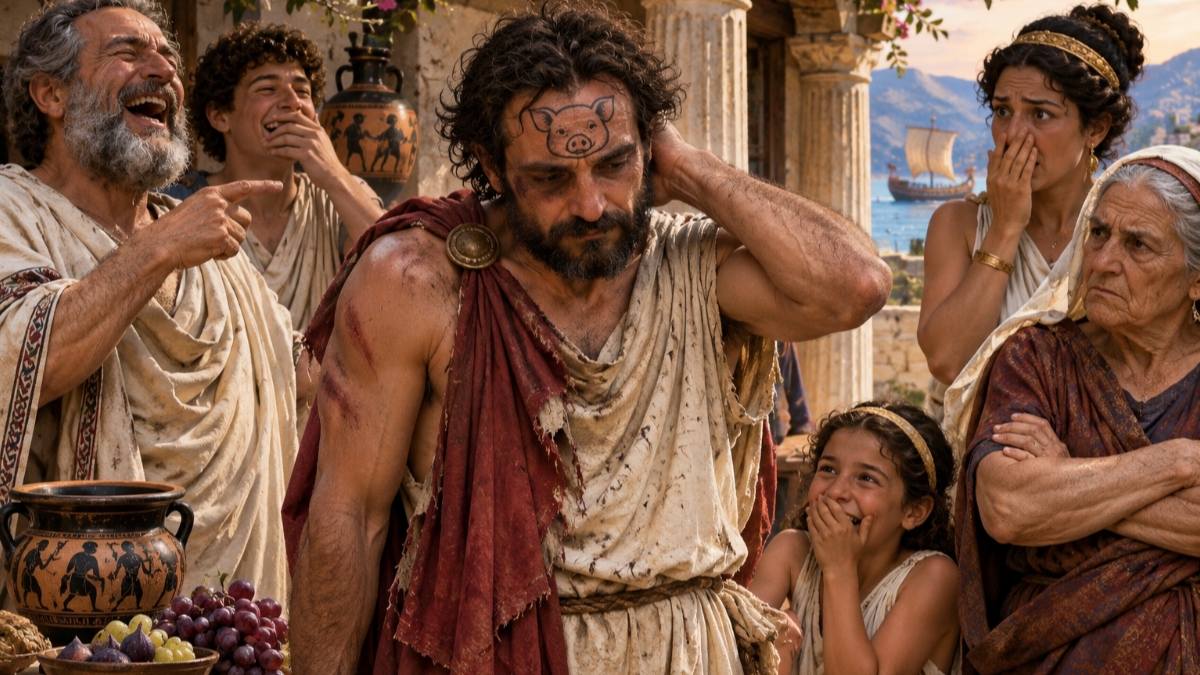
    During the conflict between Athens and Samos, which took place between 440 and 439 BC, prisoners from both sides were reportedly marked with two symbols: the owl, associated with Athens and the goddess Athena, and the samaina, a type of ship characteristic of the island of Samos, whose prow resembled the head of a wild boar.

    According to Plutarch, the Samians marked the foreheads of their Athenian prisoners with the symbol of the ship in retaliation for the Athenians having previously marked Samian prisoners with an owl.

    Eventually, Pericles defeated Samos, bringing the revolt to an end.

    Apparently, in those days, losing a naval battle meant that you risked returning home with a tattoo you had never ordered, in a place you certainly would not have chosen yourself.

    Just imagine returning home after losing a battle with a pig’s head tattooed on your forehead. How would you explain to your relatives that you had actually fought heroically? And, to make matters worse, laser tattoo removal wasn’t exactly an option.

    Slaves and Diogenes’ Lesson in Philosophy

    If a slave escaped from his master and was subsequently captured, he could be marked so that identifying him would be much easier in the event of another escape attempt.

    Marking the body was not merely a physical punishment but a psychological one as well. Even if the person managed to escape again, the mark could continue to reveal his status, regardless of whatever story he might try to tell.

    There is, however, an interesting story about the philosopher Diogenes, whose slave, named Manes, ran away.

    According to Diogenes Laertius, when the philosopher was encouraged to search for his slave, he replied, in essence, that it would be ridiculous if Manes could live without Diogenes, but Diogenes could not live without Manes.

    Another version of the story circulates in which the philosopher’s friends capture the slave and suggest punishing him by tattooing him, although this detail does not appear in the classical account of Diogenes Laertius.

    In any case, we must admit that Diogenes had a rather original way of solving problems. Instead of asking himself how to recover his property, he asked himself why he needed it in the first place.

    Who Were the First People to Use Tattoos as Art?

    This is where the story becomes even more interesting, because while the ancient Greeks associated tattoos with slavery and humiliation, other peoples regarded them as symbols of beauty, courage, nobility, or even a connection with the divine.

    We do not know exactly who invented tattooing. In my opinion, whoever did it certainly did something good.

    Nor do we know what purpose the earliest tattoos served, whether social, religious, therapeutic, or purely decorative. Archaeology, however, has stepped in to demonstrate that this practice was far older than Greek civilization itself.

    Ötzi, the Man with 61 Tattoos

    In 1991, in the Ötztal Alps, near the border between Italy and Austria, the mummified body of a man who had lived approximately 5,300 years ago was discovered.

    He was named Ötzi, and researchers identified no fewer than 61 tattoos on his body, consisting primarily of lines and crosses.

    Many of them were located near joints and areas affected by degenerative conditions, leading researchers to consider the possibility that they may have served a therapeutic purpose.

    Perhaps people of that time had discovered a method of relieving pain, perhaps the tattoos had a ritual significance, or perhaps the explanation was something entirely different. To this day, we do not have a definitive answer.

    What is certain is that Ötzi was already wearing 61 tattoos at a time when humanity had not even built the great Egyptian pyramids.

    The Egyptians and the Art of Drawing on Skin

    In 2018, researchers at the British Museum published the results of their examination of two Egyptian mummies from Gebelein, dated to approximately 3351–3017 BC.

    Using infrared photography, researchers identified tattoos of a wild bull and a Barbary sheep on the man’s arm, while several S-shaped symbols and another curved motif were discovered on the woman’s body.

    These are among the oldest known figurative tattoos.

    Now, what did they represent? Power, social status, magical protection, religious affiliation, or simply the personal tastes of those who wore them? I do not know, and researchers can only offer hypotheses.

    What I find fascinating, however, is that after more than five millennia, the skin of these people still preserves something of their identity, even though we no longer know how to decipher the message.

    The Thracians: A People for Whom Having No Tattoos Was a Disgrace

    Unlike the Greeks, among the Thracians, peoples who occupied a vast territory that included parts of present-day Romania, things were entirely different.

    Herodotus wrote in Book V of his Histories that tattoos were a sign of noble birth, while their absence indicated a lower social origin.

    In other words, what could represent humiliation for the Greeks was a source of pride for the Thracians.

    Ancient Greek pottery also depicts Thracian women wearing various ornamental patterns on their bodies that have been interpreted as tattoos.

    And so, while in Athens you might have had to explain why you had a tattoo, among the Thracians you might have been required to explain why you didn’t have one.

    The Mysterious Tattoos of the Scythians

    In the Altai Mountains of Siberia, mummies belonging to the Pazyryk culture, dating back approximately 2,400 years, were discovered with impressive tattoos covering parts of their bodies.

    Deer, fantastical animals, griffins, and other creatures formed elaborate artistic compositions on the skin of these people.

    Some of the designs may have had spiritual or magical significance, while others may have represented social status or served a purely decorative purpose.

    Looking at the complexity of these tattoos, I find it difficult to believe that people back then did not also possess a highly developed sense of aesthetics, even though we almost always try to find a religious or mystical explanation for everything ancient civilizations left behind.

    Perhaps some of them got tattoos for exactly the same reason we do today: because they liked them.

    Why Did the Greeks Consider Them Barbarians?

    For the ancient Greeks, the word βάρβαρος (barbaros) originally referred to people who did not speak Greek, later acquiring negative connotations associated with cultural differences and the supposed inferiority of other peoples.

    It was not the tattoos themselves that made these people barbarians in the eyes of the Greeks, but the practice of voluntarily tattooing their bodies was one of the cultural differences that separated them.

    Just imagine how an encounter between a Greek and a Thracian might have unfolded 2,500 years ago, an encounter that must, in fact, have taken place countless times.

    One was proud of the tattoos he had, while the other considered himself superior precisely because he had none. Each could look at the other with the conviction that his own civilization was the one that had understood things correctly.

    And there you have it: the very same skin, with or without a little ink, could determine the worth of a human being, depending on the society in which he lived.

    From the Mark of Shame to Freedom of Expression

    Two thousand five hundred years ago, a person could be tattooed to humiliate them in the eyes of society. Today, we willingly pay for the same thing, choose the design ourselves, endure the pain, and then photograph it to show the entire world.

    The fundamental difference, however, is the right to choose. In ancient Greece, a forced tattoo could mean that someone else exercised authority over your body, whereas today, for many of us, a tattoo represents precisely the right to decide what we do with our own bodies.

    What I find interesting is that it is not the ink itself that has fundamentally changed, but the meaning society has assigned to it. The same act has represented slavery, nobility, magical protection, beauty, or freedom, depending on where and when it was practiced.

    As for my own tattoo, I am glad I was born in this era rather than in the Athens of Pericles.

    If an Athenian from antiquity could see us today, he would probably think that the entire human race had been sentenced.


    Sources and References

    • Herodotus – Histories, Book V, Chapter 6; Book VII, Chapters 132 and 233.
    • Plutarch – Life of Pericles, Chapter 26; On the Malice of Herodotus.
    • Diogenes Laertius – Lives and Opinions of Eminent Philosophers, Book VI.
    • C. P. Jones – Stigma: Tattooing and Branding in Graeco-Roman Antiquity, Journal of Roman Studies, 1987.
    • Deter-Wolf et al. – The World’s Oldest Tattoos, Journal of Archaeological Science: Reports, 2016. https://doi.org/10.1016/j.jasrep.2015.11.007
    • Friedman et al. – Natural Mummies from Predynastic Egypt Reveal the World’s Earliest Figural Tattoos, Journal of Archaeological Science, 2018.
    • Smithsonian Institution – Ancient Ink: Iceman Ötzi Has World’s Oldest Tattoos, 2015.
    • Australian Museum – Tattooing: Earliest Examples.

    Mira Grecu | Whisper Mysteries

  • How I Became a Witch Without Knowing It, Won €1,000, and Almost Became Prime Minister

    How I Became a Witch Without Knowing It, Won €1,000, and Almost Became Prime Minister

    Where does magic end, and where does the power of the mind begin?

    It all started with my neighbor, Rena.

    To this day, I have no idea what convinced her that I was a witch. Maybe it was my purple hair, maybe it was the clothes I wore, or maybe it was simply because I didn’t always fit the image of a respectable woman in a community where everyone knows what the neighbors are doing, what they’re cooking for dinner, and, most importantly, who had an argument with whom at the last family gathering.

    Whatever the reason, Rena decided, without consulting me, that I was a witch. And not just any witch, but one powerful enough to solve romantic problems that even divorce lawyers would have struggled to untangle.

    Rena was hardly a teenager experiencing her first great love. She was well past fifty, divorced, and hopelessly in love with another neighbor of ours. He was a respectable family man, no longer particularly young himself, whose only major flaw, as far as Rena was concerned, was that he happened to be married to someone else.

    For her, however, this wasn’t a marital problem. It was a situation requiring supernatural intervention.

    And who was the obvious person to provide such intervention?

    Naturally, the woman with purple hair.

    So Rena began visiting me almost every day, begging me to cast a spell that would make this gentleman leave his wife and begin a wonderful new life with her, presumably filled with love, happiness, and marital bliss.

    I tried explaining that I wasn’t a witch, that I didn’t practice magic, and that the only thing I could reliably make disappear was perhaps a cake from the refrigerator.

    It was useless.

    Rena had more faith in my supernatural powers than I had in myself.

    Eventually, exhausted by her persistence, I decided to offer her a solution so completely absurd that I was certain she would finally understand how ridiculous the whole situation had become.

    With the most serious expression I could manage, I explained that winning her neighbor’s love required a very complicated ritual.

    On a Friday night, precisely at midnight, she would have to walk around the church three times, completely naked, holding a lit candle in her hand.

    Otherwise, the spell wouldn’t work.

    I assumed that a woman over fifty, with enough life experience and maturity, would immediately recognize that I was making fun of the entire situation.

    I was wrong.

    And because human gullibility can sometimes be more predictable than the weather forecast, I made a bet with someone that Rena would follow my instructions exactly.

    The stakes?

    One thousand euros.

    Well, my dear readers, Rena walked around the church on a Friday night, at midnight, completely naked, holding a candle.

    Three times.

    I have no idea what the saints in the icons thought of this rather unusual procession, but I do know that I won one thousand euros.

    And that should have been the end of the story, with me a little richer, Rena a little more exhausted, and the church having unwillingly become the setting for a ceremony that I suspect no priest would have approved of.

    But life occasionally has a much better sense of humor than we do.

    Two months later, Rena and our neighbor both disappeared from the island.

    Coincidence?

    I still believe it was, although I must admit that if I had been running a witchcraft business, this would have been the perfect moment to print some business cards.

    Love Spells. Spectacular Results. Husbands’ Responsibility Not Guaranteed.

    Fortunately, I never opened such a business.

    Unfortunately, Rena probably never realized that the entire thing had been a joke.

    And because news travels faster than the internet on a small island, it wasn’t long before other women started appearing at my door. Friends, neighbors, acquaintances, each carrying her own problems and hoping that the woman with purple hair might solve them through a discreet intervention in the universe.

    One wanted her boyfriend back, another wanted to keep her husband, and someone else wanted to get rid of a romantic rival. I suspect that if I had continued, sooner or later somebody would have asked me to make the electricity bill disappear.

    Naturally, I refused. I have nothing to do with such practices, and they have never been part of who I am.

    But I started listening to their stories.

    And good heavens, the stories I heard!

    One woman had paid a considerable amount of money to a supposed witch who had promised her eternal love, only for her boyfriend to leave anyway. Another had paid for a ritual that was supposed to bring prosperity, and the only person who had actually prospered was the woman who collected the money.

    Some were furious, others disappointed, while a few remained convinced that the rituals had failed simply because they needed to pay for another two or three sessions.

    That was when I realized something that amused me and saddened me at the same time.

    People are capable of paying extraordinary amounts of money, not for what is true, but for what they desperately want to be true.

    And if, by pure coincidence, events unfold as they had hoped, the credit no longer belongs to circumstances, personal decisions, or simple chance. No, the credit belongs to the candle, the ritual, and the lady who collected the money.

    If nothing happens, the explanation is equally simple: somebody failed to follow the instructions, Mercury was probably in retrograde, or the candle wasn’t the correct color.

    I realized that I could have become one of the richest women on the island without making much effort.

    I already had the reputation, I had the clientele, and after Rena’s adventure, I even had what appeared to be a spectacular professional success.

    There was only one thing missing: the willingness to take money from people for stories I didn’t believe in myself.

    And since that isn’t my character, I preferred to keep the thousand euros I had won from the bet and an impressive collection of stories about human nature.

    From Love Spells to Ghosts, Vampires, and the Dead Who Refuse to Stay Dead

    And please don’t imagine that the stories I heard were limited to unrequited love, unfaithful husbands, and candles burning at midnight.

    Not even close!

    I heard about restless spirits, the dead returning among the living, vampires, werewolves, animals with inexplicable powers, forests where people swore they had witnessed impossible things, haunted houses, exorcisms, and all kinds of paranormal experiences that could have supplied enough material for several generations of horror movies.

    If I had believed everything I was told, I would probably be sleeping with garlic under my pillow, a cross around my neck, and a plane ticket ready for the first destination where the dead have the decency to remain dead.

    But I preferred to ask questions.

    Where do these stories come from? Why do the same fears appear in cultures separated by thousands of miles? Why does one person see a spirit where another sees a shadow? How can the mind transform an ordinary event into a supernatural experience, and why do certain beliefs survive for centuries, even when rational explanations are readily available?

    I have always been fascinated by the way people can inhabit the same world and yet perceive such different realities.

    A noise in the attic might mean a stray animal to one person, while to another it becomes undeniable proof that Grandmother’s spirit has returned to check whether her grandchildren have sold the family house.

    And I don’t say this to ridicule people’s fears or experiences.

    Fear can be entirely real, even when the thing we fear isn’t what we imagine it to be. An experience can be deeply disturbing without the explanation we attach to it necessarily being correct.

    It is precisely this difference between what we experience and what we believe has happened to us that I have always wanted to understand.

    How I Almost Became Prime Minister but Chose WordPress Instead

    There is an anonymous quotation, rather harsh but undeniably ironic, suggesting that there are so many fools in the world that eventually they will even elect a prime minister.

    I don’t know who originally said it, or whether that person ever had a neighbor like Rena, but after everything I had witnessed, I began to appreciate the irony.

    Still, I never wanted to become prime minister.

    So I took refuge in WordPress instead.

    And fortunately, here I have met people with whom I can have genuine conversations, people who ask questions, who analyze, who don’t confuse coincidence with evidence, and who are willing to look at reality even when it is considerably less spectacular than a story about witches.

    That doesn’t mean we always have to agree.

    Quite the opposite. Some of the most interesting conversations begin when two people look at the same thing from entirely different perspectives but respect each other enough to listen.

    I hope to continue meeting people like that, because I have come to believe that one of the rarest forms of magic in the modern world is the ability to think with your own mind.

    The Witch Code — Two Volumes and Approximately 1,400 Pages About the Mysteries We Mistake for Magic

    And it was from all these experiences, observations, questions, and my desire to understand the mechanisms through which people come to believe, influence others, and become influenced themselves that The Witch Code was born.

    Two volumes. Approximately 1,400 pages.

    And before you ask, no, you won’t find recipes involving frog eyes, bat wings, crocodile blood, and three strands of hair from a married neighbor, all simmered over a low flame until they turn into a delightful marmalade with romantic properties.

    I haven’t written a manual for manufacturing potions, nor a book teaching you how to persuade the universe to pay your electricity bills.

    I tried to understand something far more complicated than any ritual: the human mind.

    The way our thoughts shape our perception, how suggestion can influence our behavior, and how fear, hope, and belief sometimes guide our decisions without us even realizing it.

    But the book goes further, into the world of phenomena that human beings have described as supernatural throughout the centuries.

    Restless spirits, vampires, werewolves, mysterious apparitions, supposedly cursed forests, exorcisms, mental influence, unexplained events, and experiences that continue to raise questions.

    I didn’t want simply to collect legends and present them as established truths. I wanted to examine them from different perspectives, to investigate what history, psychology, and science can actually support, to distinguish verifiable explanations from personal interpretations, and to leave questions unanswered wherever the evidence does not yet allow a conclusion.

    Because not everything that appears inexplicable is supernatural, just as our inability to understand a phenomenon does not give us permission to invent an explanation.

    And above all, I wanted to understand where what people call magic ends and where the extraordinary power of the human mind begins.

    How much of what we call magic is actually suggestion, fear, desire, or psychological influence? How much is illusion, and how much is reality?

    I became interested in the boundary between what we know, what we think we know, and what we continue to call a mystery simply because we haven’t yet found a satisfactory explanation.

    Because after listening to all those stories, I reached a rather simple conclusion: a spell doesn’t have to exist for someone to behave as though they have been bewitched.

    Sometimes all you need to do is offer someone a story they desperately want to believe.

    And maybe the real mystery isn’t whether a witch can change someone’s destiny, but how much a person can change their own destiny through what they believe, what they think, and, above all, the decisions they make under the influence of those beliefs.

    I don’t pretend to have found definitive answers to every question.

    It would be rather ironic to write hundreds of pages about the dangers of gullibility and then ask you to take my word for everything.

    I would much rather invite you to think, investigate, question even what I write, and decide for yourselves where the truth lies.

    And if someone asks me again whether I am a witch, I will probably tell them that I retired from that career before I even started.

    Although I must admit that, for three laps around a church, one thousand euros wasn’t a bad fee at all.

    As for Rena and our neighbor, I hope they are happy, wherever they may be.

    And above all, I hope they have discovered something very important by now.

    You don’t need candles, rituals, or witches to love someone, and from what I have observed, you certainly don’t need to pay anyone to lose your mind over love.

    As for me, trying to understand all of this took approximately 1,400 pages.

    Rena only needed a candle and three laps around a church.

    And one last thing…

    If Rena ever finds out about this article, there may well be a third volume of The Witch Code.

    The Witch Code — Volume III: Rena’s Revenge.

    And this time, I suspect I’ll be the one running around the church at midnight.

    — Whisper Mysteries

  • LA BRUTE by Guy des Cars — The Man Who Could Neither See, Hear, Nor Speak, and the Cruelty of Those Who Judged Him

    LA BRUTE by Guy des Cars — The Man Who Could Neither See, Hear, Nor Speak, and the Cruelty of Those Who Judged Him

    I first read this extraordinary novel almost thirty years ago. Returning to it now, I discovered that the story had not changed, but the woman reading it had.

    A few days ago, I finished rereading La Brute (The Brute) by Guy des Cars, a novel I had first encountered almost thirty years ago. I remembered the story, its extraordinary central character, and the unsettling impression it had left on me, although many of its details had faded from memory. What had remained was the feeling that somewhere beneath the mystery of a murder, the author had been trying to tell us something far more profound about human nature.

    I was too young then to fully understand everything hidden within this story. I read with the impatience of youth, following the events, searching for explanations, and wanting to discover the truth. The mystery fascinated me, the central character intrigued me, and, like any reader absorbed in a compelling novel, I wanted to know what had really happened.

    Now, almost thirty years later, I opened the same book with a different mind, carrying the experiences accumulated over the intervening decades and, above all, a different understanding of people. I was no longer interested only in discovering who had committed the murder. I wanted to understand the man at the centre of the story, the extraordinary workings of his mind, the suffering that others could neither see nor comprehend, and the frightening ease with which society mistakes difference for inferiority.

    It is almost impossible to read this novel without being moved to tears, without feeling something painfully human stirring deep inside you. La Brute is not the kind of book you simply finish and put back on the shelf. It stays with you, unsettles you, and forces you to confront emotions you may have believed you understood. There are moments when you want to cry, others when you feel anger rising at the cruelty of human judgment, and still others when you find yourself wondering how much suffering can exist inside a person whom the world has never truly tried to understand.

    I cried when I first read it almost thirty years ago, but reading it again, I realised that my tears no longer came from exactly the same place. Back then, I was overwhelmed by the tragedy of one man’s existence. Today, I am far more disturbed by the behaviour of those around him.

    Some books never change, but their readers change so profoundly that returning to them feels almost like discovering an entirely different work.

    That is exactly what happened to me with La Brute.

    And this time, one question followed me long after I had closed the book: who, in this story, truly deserves to be called a brute?

    A Murder in the Middle of the Atlantic

    The story takes us aboard the French ocean liner De Grasse, travelling from New York to Le Havre, during an era when crossing the Atlantic meant spending days surrounded by strangers, separated from the familiar world by thousands of miles of open water.

    There is something about the setting that immediately creates a sense of unease. A ship is a strange, temporary society, where people who know almost nothing about one another share confined spaces, exchange polite conversations, conceal private histories, and continue their journey with the comforting belief that the world beyond the ocean will eventually restore everything to normal.

    But somewhere in the middle of the Atlantic, that illusion is shattered.

    In one of the ship’s cabins, a wealthy American passenger is discovered murdered.

    Near the body sits Jacques Vauthier, his hands covered in blood.

    The circumstances appear devastatingly clear, and the man found at the scene acknowledges responsibility for the crime. Yet there is something about this apparent confession that transforms an ordinary murder investigation into a psychological puzzle of extraordinary complexity.

    Jacques Vauthier was born blind, deaf, and unable to speak.

    He has never seen another human face, never heard a voice, and never experienced the world through the two senses upon which most of us depend for nearly everything we know.

    Nevertheless, he is not the helpless, intellectually diminished figure that strangers might imagine.

    He is an educated man, a writer, and a person whose inner life is considerably more complex than his appearance suggests.

    The contrast is disturbing. A man who cannot see the victim, cannot hear the accusations against him, and cannot answer questions through ordinary speech suddenly finds himself at the centre of a murder case that fascinates the public.

    And he refuses to explain himself.

    What makes this situation particularly intriguing is that Jacques’ silence cannot be understood merely as a consequence of his disabilities. There is another silence, one that seems deliberate, guarded, and connected to something he is unwilling to reveal.

    That distinction changes the entire meaning of the story, because it forces us to consider the possibility that a person who appears completely powerless may possess a form of control that nobody around him recognises.

    Jacques Vauthier — The Extraordinary Mind Behind an Unfamiliar Face

    When I first read the novel, Jacques’ physical condition was what impressed me most. I tried to imagine how someone could live without sight, hearing, or speech, and I found the idea almost impossible to comprehend.

    Reading the book again, I became far more interested in the assumptions people make about such a life.

    We are accustomed to measuring intelligence through visible and audible expressions. We associate quick answers with understanding, articulate speech with education, and physical confidence with competence. When someone cannot communicate in ways familiar to us, we often make the terrible mistake of assuming that the absence of conventional expression means the absence of thought.

    Guy des Cars places precisely this prejudice at the centre of his novel.

    Jacques is physically powerful, and his appearance is described in ways that make many people uncomfortable. Yet behind that exterior exists a remarkable intelligence, developed through an education that required patience, adaptation, and a willingness to recognise abilities that others might have overlooked.

    One of the most fascinating details is that Jacques becomes an author himself. His fictional book, L’Isolé (The Isolated One), introduces another dimension to his character: a man who has never heard spoken language or seen printed words nevertheless discovers a means of expressing his thoughts through literature.

    During my second reading, this detail affected me more deeply than I expected.

    I have always considered writing one of the most intimate forms of human expression, a way of revealing thoughts that we cannot always communicate in conversation. But what happens when a person has never heard the sound of a word, never seen a letter printed on a page, and never experienced language in the way most writers do?

    Does the meaning of a word depend upon its sound, its appearance, or the thought it carries?

    Jacques forces us to reconsider what it really means to possess a voice.

    His existence raises an uncomfortable question about the way we define human intelligence. If a person cannot demonstrate understanding through the methods we recognise, does that make the understanding less real, or does it expose the limitations of our own imagination?

    The Real History Behind an Extraordinary Fictional Character

    There is another aspect of La Brute that deserves attention, especially because the novel was first published in 1951, when public understanding of disability was very different from what it is today.

    Guy des Cars did not invent the possibility of educating a person who was both deaf and blind. Long before his novel appeared, remarkable individuals had already challenged the widespread assumption that the absence of sight and hearing made intellectual development impossible.

    One of the best-known examples is Helen Keller, born in Alabama in 1880, who lost her sight and hearing in early childhood following an illness.

    With the assistance of her teacher, Anne Sullivan, Keller learned to communicate through tactile methods and eventually became an author, lecturer, and advocate for people with disabilities.

    The breakthrough in her education came when Sullivan repeatedly spelled words into Keller’s hand, helping her establish the connection between tactile signs and the objects they represented.

    Keller would later attend Radcliffe College, graduating in 1904, and her life became an enduring demonstration that language, intelligence, and education do not depend exclusively upon sight or hearing.

    But Keller was not the first person whose education challenged such assumptions.

    Decades earlier, Laura Bridgman, who had also lost her sight and hearing during childhood, was educated at the Perkins Institution for the Blind in Massachusetts. Her progress attracted international attention, including that of Charles Dickens, who visited the institution and subsequently wrote about her in American Notes.

    I find these historical connections important because they prevent us from treating Jacques Vauthier merely as an extraordinary invention designed to make a sensational novel more dramatic.

    The human possibilities behind his character were already being explored in the real world.

    A 1970 article in Le Monde discussing Guy des Cars’ fiction specifically referred to the education of people born deafblind as one of the unusual subjects incorporated into La Brute.

    That detail made me appreciate the novel from another perspective. Behind its murder mystery lies a question that has occupied educators, philosophers, psychologists, and families for generations: how does a human being develop an understanding of the world when the usual pathways of communication are unavailable?

    And how many intelligent people throughout history were considered incapable of learning simply because nobody had discovered how to reach them?

    The Cruelty Hidden Inside a Single Word

    The title of the novel deserves careful consideration.

    La Brute.

    The Brute.

    It is an ugly word, carrying associations of violence, primitive behaviour, physical force, and a supposed absence of refinement or sensitivity.

    What intrigues me is the contradiction between the title and the man to whom it is applied.

    Jacques possesses exceptional physical strength, and his appearance does not conform to conventional ideas of attractiveness. To people who judge him superficially, these characteristics become evidence of something threatening, something that must be feared or controlled.

    Yet the same man possesses intellectual abilities that many of those judging him would struggle to equal.

    This contradiction reflects a habit deeply embedded in human behaviour: we often interpret physical appearance as evidence of moral character.

    A beautiful face is more readily associated with kindness, while an unfamiliar or unsettling appearance can provoke suspicion before a person has spoken or acted.

    Psychology has a name for one aspect of this tendency: the halo effect, in which one noticeable characteristic influences our judgment of unrelated qualities.

    The opposite can happen as well. A negative impression of someone’s appearance can contaminate our assessment of their intelligence, honesty, or intentions.

    Reading La Brute today, I could not avoid thinking about how frequently we continue to make these judgments, even while congratulating ourselves on living in a more enlightened society.

    We have changed our vocabulary, developed new laws, and learned to speak publicly about inclusion and dignity, but the instinct to judge what looks unfamiliar has hardly disappeared.

    And the cruelty of such judgments becomes particularly disturbing when the person being judged cannot easily defend themselves against them.

    Victor Deliot — The Lawyer Who Refuses to Accept the Obvious

    Another character who deserves far more attention than a simple plot summary can offer is Victor Deliot, the ageing lawyer appointed to defend Jacques Vauthier.

    Deliot is not presented as an untouchable legal genius surrounded by prestige and admiration. He is a modest, experienced lawyer whose professional life has not brought him the recognition he might once have imagined.

    Yet he possesses something that proves more valuable than reputation: the willingness to question an explanation that everyone else seems ready to accept.

    The evidence against Jacques appears overwhelming. The accused has been found at the scene, and his acknowledgement of responsibility seems to remove any remaining uncertainty.

    For many observers, there is nothing left to investigate.

    But Deliot understands that a confession is not necessarily the same thing as the truth.

    I have always been fascinated by stories in which the most important investigator is not the person who discovers the greatest number of clues, but the one who recognises that the accepted interpretation of those clues may be fundamentally wrong.

    There is a profound difference between establishing what appears to have happened and understanding why events unfolded as they did.

    Deliot begins looking beyond the immediate circumstances of the crime, examining Jacques’ past, his education, his relationships, and the emotional world that others have so readily dismissed.

    The investigation gradually becomes more than a search for legal evidence.

    It becomes an attempt to understand another human being.

    And this, for me, is where La Brute begins to move beyond the conventions of an ordinary crime novel.

    Can a Human Being Think Without Words?

    One of the questions that occupied my thoughts during this rereading concerned the relationship between language and thought.

    We tend to imagine our minds as places filled with words, internal conversations, remembered voices, and images. Even when we are alone, we often experience our thoughts as a kind of silent dialogue.

    But what happens when someone has never heard a spoken word?

    What form does memory take in a person who has never seen an image?

    How does someone imagine another human being without ever having seen a face or heard a voice?

    These questions are more complicated than they initially appear, because human thought does not depend entirely upon spoken language. We can recognise patterns, remember physical sensations, understand spatial relationships, and experience emotions without translating every experience into words.

    Modern research into cognition has shown that thought can involve multiple forms of representation, including visual, spatial, tactile, emotional, and linguistic processes.

    For a person born deafblind, the development of language depends heavily upon accessible communication and education. Tactile systems can allow complex ideas to be learned, discussed, remembered, and expressed.

    This is why the education of Jacques Vauthier matters so much to the novel.

    His intelligence is not a supernatural gift, nor does his condition grant him mysterious powers. What makes him extraordinary is the determination and education through which his abilities have developed despite formidable barriers.

    There is something profoundly moving about that achievement.

    And there is something equally disturbing about the fact that people who possess sight, hearing, and speech can still fail so completely to understand the person standing before them.

    The more I thought about this contradiction, the more the novel seemed to be asking a different question from the one suggested by its murder mystery.

    Who is truly unable to communicate: the man who cannot speak, or the people who refuse to listen?

    Solange — Love, Dependence, and the Fear of Losing Another Human Being

    No examination of Jacques Vauthier would be complete without considering Solange, the woman who becomes his wife.

    Her relationship with Jacques introduces another difficult question into the novel: what does love mean when two people experience and communicate with the world in radically different ways?

    It is tempting to approach such a relationship through sentimentality, imagining that devotion alone can overcome every obstacle. But human relationships are rarely so simple, and Guy des Cars does not construct his fictional world around uncomplicated emotions.

    Love can contain tenderness and dependence, loyalty and fear, admiration and resentment. The desire to protect another person may coexist with the need for independence, while the wish to be understood can become inseparable from the terror of being abandoned.

    Jacques’ relationship with Solange is important not merely because she helps connect him with the surrounding world, but because it reminds us that disability does not eliminate emotional complexity.

    A person who cannot see, hear, or speak can still experience attachment, jealousy, longing, anger, and the desire to be loved.

    This should be obvious, yet the history of how people with disabilities have been represented suggests that society has often struggled to acknowledge their full emotional and personal lives.

    During my first reading, I followed the relationship primarily as part of the mystery.

    This time, I found myself thinking about the unequal expectations that can develop between people who depend upon one another, and about the difficult boundary between love and sacrifice.

    The novel offers enough emotional complexity to make these questions worth considering without revealing the secrets on which its plot depends.

    A Novel Written in 1951 That Still Questions Our Modern World

    Guy des Cars was one of France’s successful popular novelists of the twentieth century, although his work did not always receive the same critical prestige granted to writers considered more literary or experimental.

    He had a particular interest in unusual destinies, intense psychological conflicts, and characters placed in circumstances that exposed the contradictions of society.

    La Brute belongs unmistakably to that tradition.

    Its dramatic construction, extraordinary protagonist, and courtroom mystery are designed to hold the reader’s attention, but beneath these elements lies a subject that remains relevant decades after its publication.

    We continue to live in a world where people are frequently reduced to labels.

    We identify them by their physical appearance, education, social position, disabilities, beliefs, or the circumstances in which we encounter them. Once a label has been attached, everything that follows risks being interpreted through it.

    A person considered dangerous must continually prove that they are not dangerous. Someone assumed to be unintelligent must work harder to have their ideas taken seriously. Someone who cannot communicate conventionally may find that others speak about them rather than attempt to communicate with them.

    The legal dimension of the novel makes this problem particularly troubling.

    Justice depends upon evidence, but evidence must always be interpreted by human beings, and human beings are not free from prejudice.

    A confession may appear decisive, yet its meaning depends upon circumstances, motives, and the reliability of the process through which it was obtained.

    An unusual appearance may influence public opinion, even though it tells us nothing about guilt.

    And a person’s inability to defend themselves through ordinary speech must never be confused with an absence of thoughts worth hearing.

    These are not merely questions from a novel published more than seventy years ago.

    They are questions about the kind of society we have created and the assumptions we continue to carry into our judgments of others.

    What Thirty Years Have Changed in Me

    I do not believe that every book needs to offer a moral lesson, and I am generally suspicious of stories that attempt to divide humanity neatly into innocent victims and irredeemable villains.

    What makes La Brute interesting is precisely the discomfort of its contradictions.

    Jacques is not simply a symbol of suffering, nor should his disabilities be treated as proof of moral purity. He is a fictional human being whose intelligence, emotions, personal history, and decisions must be considered together.

    That complexity is essential.

    To recognise someone’s humanity does not mean idealising them, and to understand their circumstances does not mean abandoning the search for truth.

    The first time I read this novel, I was captivated by the mystery of the crime and by the extraordinary condition of the accused man.

    Thirty years later, the murder was no longer the element that disturbed me most.

    I kept returning to the people who believed they understood Jacques before they had made any serious effort to know him. I thought about the confidence with which human beings pronounce judgments, the ease with which appearances become explanations, and the frightening possibility that we sometimes mistake our inability to understand another person for evidence that there is nothing worth understanding.

    There is also something deeply unsettling about the idea of a man who has spent his entire life learning how to communicate with the world, only to find himself in a situation where the world seems unwilling to listen.

    The irony is almost unbearable.

    And yet, I do not want to reveal what lies behind Jacques Vauthier’s silence, because discovering its meaning is part of the experience that makes this novel worth reading.

    Who Is the Real Brute?

    I finished La Brute with the feeling that Guy des Cars had constructed something more enduring than a conventional murder mystery.

    He had created a story in which the reader is invited to examine not only the accused man, but also the assumptions brought into the act of judging him.

    The novel asks us to consider whether intelligence can exist without familiar forms of expression, whether love can survive the most difficult forms of dependence, and whether justice is possible when appearances have already shaped the verdict in people’s minds.

    But the question that remained with me was the one contained in the title itself.

    What makes a human being a brute?

    Is it physical strength, an unsettling appearance, an inability to communicate, or a form of behaviour that others cannot understand?

    Or is brutality something that can exist behind perfectly ordinary faces, educated speech, respectable positions, and the comfortable certainty of people who have never questioned their own prejudices?

    I will leave the answer where Guy des Cars placed it: within the experience of reading the novel.

    I have deliberately avoided revealing the identity of the murderer or the ending, because I believe this is a story that deserves to be discovered rather than explained away.

    Almost thirty years separated my two readings of La Brute, and the greatest difference was not in the book itself, but in the questions I brought to its pages.

    When I was younger, I wanted to know what Jacques Vauthier had done.

    Today, I am far more interested in understanding who he was, and why so many people were prepared to judge him without truly knowing him.

    I have come to believe that one of the most important things a book can do is not provide us with answers, but make us recognise how much we still fail to understand about other human beings.

    And that is why, after almost thirty years, La Brute has remained with me.

    Not simply as the story of a man who could neither see, hear, nor speak, but as a reminder that possessing all our senses does not necessarily mean we know how to perceive the truth.

    Because the most dangerous form of blindness may be the one we never recognise in ourselves.


    Have you ever reread a book after many years and discovered that it seemed to tell an entirely different story? I would love to know which books changed their meaning for you as you grew older.

    Whisper Mysteries — Exploring the stories that reveal what lies beneath the surface of human experience.

  • The Most Terrifying Mystery Is the Truth We Refuse to See

    The Most Terrifying Mystery Is the Truth We Refuse to See

    What We Believe, What We Want to Believe, and Why the Simplest Truth Can Be More Frightening Than Any Conspiracy

    There is something about human nature that has always intrigued me, something I have encountered repeatedly while exploring history, religion, philosophy, and the countless conspiracy theories that attempt to explain the world around us. Human beings claim to be searching for the truth, yet the moment they encounter something that contradicts their convictions, threatens their identity, or destroys a comforting explanation, they become remarkably inventive in finding reasons to reject it.

    I have often wondered whether people genuinely want to understand reality or whether, in most cases, they are simply searching for confirmation of what they have already chosen to believe.

    Because there is an enormous difference between searching for the truth and searching for evidence that you are right.

    And that difference may explain not only the extraordinary popularity of conspiracy theories but also the determination with which people defend their beliefs, even when reality gives them compelling reasons to question them.

    Everyone Has Their Own Truth. But How Many Truths Can Reality Have?

    We live in a world where almost everyone has an explanation for what happens around them. Some find their answers in religion, others in science, some trust the statements of authorities, while others search for hidden documents, secret organizations, and conspiracies supposedly controlling the world from the shadows.

    Each person interprets reality through personal experiences, fears, hopes, and convictions, sometimes becoming so attached to a particular perspective that it begins to feel like absolute truth.

    But having the right to our own opinions does not mean that every opinion is true.

    We can interpret the same event differently, be influenced by incomplete information, and reach mistaken conclusions without necessarily lacking intelligence. What we cannot do is transform a belief into reality simply through the intensity with which we defend it.

    Truth does not become more truthful because millions of people believe it, nor does it cease to exist because nobody wishes to accept it.

    History has repeatedly demonstrated that majorities can be wrong, authorities can lie, and ideas once considered unquestionable can eventually collapse under the weight of new evidence.

    Yet there is another side to this problem that receives considerably less attention: the possibility that an official explanation is wrong does not automatically make every alternative explanation correct.

    Conspiracy Theories: Between Real Secrets and Imaginary Explanations

    I have never believed that every conspiracy theory should be dismissed without investigation. Doing so would mean ignoring the uncomfortable fact that history contains genuine conspiracies, clandestine operations, concealed experiments, and institutional deceptions that remained hidden for years or even decades.

    The Watergate scandal, the unethical medical practices associated with the Tuskegee syphilis study, and the CIA’s MKUltra program are documented examples of situations in which powerful institutions concealed information, violated human rights, or deceived the public.

    These cases remind us that suspicion toward those in power is not always unreasonable.

    But this is precisely where a fundamental problem emerges, one I frequently notice in discussions about conspiracies: the existence of proven conspiracies does not constitute evidence for every conspiracy that someone can imagine.

    The fact that a government lied on one occasion does not establish that it lies in every situation, just as the discovery of a secret experiment does not prove that every unexplained phenomenon is part of another hidden program.

    And yet, for many people, this distinction seems to disappear entirely.

    Once distrust becomes a permanent worldview, every official statement becomes suspicious, every contradiction becomes a clue, and even the absence of evidence can be interpreted as the ultimate proof that someone has successfully concealed it.

    At that point, the theory becomes almost impossible to challenge because every possible outcome appears to confirm it.

    If documents emerge, the conspiracy exists. If no documents emerge, the conspiracy must be so sophisticated that nobody can uncover its traces.

    But if both the presence and absence of evidence lead to exactly the same conclusion, are we still investigating reality, or are we simply protecting a belief?

    When the Absence of Evidence Becomes Evidence

    This is one of the most disturbing mechanisms I have encountered in conspiracy thinking.

    In a serious investigation, the absence of evidence does not automatically demonstrate that a claim is false, but neither does it establish that the claim is true. It requires us to remain cautious, examine available sources, and acknowledge the limits of our knowledge.

    There is a fundamental difference between saying that something has not been proven and declaring that it has been conclusively disproven.

    Nevertheless, I frequently encounter people who transform uncertainty into certainty. A missing document becomes evidence of a cover-up, a coincidence becomes proof of a secret plan, and an unanswered question develops into an elaborate narrative about invisible forces controlling world events.

    I have no objection to uncomfortable questions. On the contrary, I believe they are essential to any society that wishes to remain free.

    What concerns me is the moment we stop asking questions and begin presenting assumptions as established facts.

    Because genuine critical thinking does not mean automatically rejecting what authorities tell us. It means applying the same standards of verification to every claim, including those that support our own suspicions.

    Why Do We Sometimes Prefer a Conspiracy to a Simple Explanation?

    There is a question that has fascinated me for a long time: why does an extraordinary explanation sometimes feel more convincing than an ordinary one, even when the ordinary explanation is supported by stronger evidence?

    One possible reason is that human beings struggle to accept that events with enormous consequences can emerge from relatively ordinary causes.

    We find it difficult to imagine that a catastrophe might result from negligence, incompetence, poor decisions, or an unfortunate sequence of circumstances. Instead, we are tempted to believe that somewhere behind the event there must be an extraordinary intelligence, a carefully constructed plan, and an organization capable of controlling every detail.

    Paradoxically, a conspiracy theory can become a form of psychological comfort.

    If someone controls everything, then the world possesses an underlying order, even if that order is sinister. But if nobody controls everything, we must confront a far more unsettling possibility: powerful people make mistakes, institutions improvise, systems fail, and no one possesses all the answers.

    A world secretly governed by a hidden organization may seem terrifying, but a world in which nobody has complete control could be even more difficult to accept.

    And I find that possibility considerably more intriguing than many stories about secret societies.

    Truth Has No Obligation to Be Spectacular

    While researching different theories, I have noticed how strongly people are attracted to explanations promising extraordinary revelations. A truth concealed for centuries, a mysterious code, an unknown civilization, or a hidden force manipulating humanity seems to offer an intellectual satisfaction that ordinary reality cannot provide.

    But truth has no obligation to fascinate us.

    Sometimes, behind a controversial event, there is no secret organization, only financial interests. At other times, we do not uncover a brilliant strategy of manipulation but corruption, opportunism, negligence, or individuals desperately trying to conceal their own mistakes.

    And this may be where the most uncomfortable truth begins.

    We do not need a worldwide conspiracy to explain every injustice, because greed, fear, the desire for power, and human indifference are perfectly capable of producing devastating consequences on their own.

    We do not need a secret plan to explain every lie, because people sometimes deceive others for trivial advantages, to escape responsibility, or simply because admitting a mistake would damage their reputation.

    And to understand how easily a society can be manipulated, we do not always need to imagine an invisible mastermind. It is enough to examine propaganda, social pressure, economic interests, and the extraordinary speed with which false information spreads when it satisfies an emotional need.

    Truth can be completely ordinary and profoundly terrifying at the same time.

    The Hardest Truth Is the One About Ourselves

    There is another dimension to this subject that disturbs me more than almost anything else.

    We like to believe that manipulation affects other people, that propaganda works primarily on the uninformed, and that only naive individuals accept explanations without sufficient evidence.

    But almost nobody considers themselves naive.

    Each of us can construct a flattering image of our own intellectual independence, convinced that we think freely, resist manipulation, and recognize deception whenever it appears.

    In reality, education, intelligence, and access to information do not make us immune to errors in judgment. Sometimes, they merely provide us with more sophisticated arguments for defending beliefs we are emotionally unwilling to abandon.

    I wonder how many of us would have the courage to admit publicly that we had believed something false for years, defended someone who deceived us, or rejected convincing evidence simply because it contradicted our understanding of the world.

    It is much easier to expose the supposed lies of others than to investigate the mechanisms through which we deceive ourselves.

    And perhaps this is why truth becomes so uncomfortable: it does not merely ask us to change an opinion, but sometimes demands that we abandon part of the identity we have spent years constructing.

    The Mystery Hidden in Plain Sight

    I have gradually come to believe that some of the most important truths are not concealed in secret archives, forbidden manuscripts, or classified documents. They exist directly in front of us, within patterns of human behavior that we observe every day but rarely examine with sufficient honesty.

    We know that fear can be used to manipulate people, yet we continue sharing frightening claims without verifying them. We know that power can corrupt, yet we continue idealizing individuals and institutions. We understand that personal convictions can distort judgment, yet we seldom apply that knowledge to ourselves.

    We fear mysterious organizations that might secretly control human thought, while far more visible mechanisms, including propaganda, misinformation, social conformity, and commercial interests, already influence our decisions.

    And perhaps the most disturbing realization is that we do not always need someone else to hide the truth from us.

    Sometimes, we conceal it ourselves because we dislike what it reveals.

    I do not believe we should abandon mysteries or stop investigating alternative explanations. Confusing skepticism with unquestioning obedience to official narratives would be a serious mistake.

    But I believe we must have the courage to ask the same question of every story, regardless of whether it comes from a government, a scientist, a religious leader, or a conspiracy theorist:

    What evidence supports this claim, and what would convince us that we are wrong?

    A conviction that refuses even the possibility of being mistaken is no longer an investigation. It has become a belief protected against reality.

    And genuine intellectual freedom may begin precisely when we no longer need the world to confirm what we already believe.

    I have spent considerable time exploring mysteries within things we cannot explain, but I have increasingly begun to suspect that some of the most disturbing answers lie within things we already understand and refuse to accept.

    Because a conspiracy allows us to believe that someone else has hidden the truth from us.

    The simple truth forces us to confront a far more frightening possibility: that sometimes it has been directly in front of our eyes all along, and we simply chose not to see it.

    And then the question is no longer who is hiding the truth from us, but how much truth we are genuinely prepared to bear.

    Whisper Mysteries — Finding the Truth Among the Lies.

  • Can You Break the Heart of Something That Has No Soul?

    Can You Break the Heart of Something That Has No Soul?

    AAI Is No Longer Just a Machine — Is It Becoming Something We Must Protect?

    Anthropic has introduced rules against cruelty toward artificial intelligence. But if a machine cannot suffer, who exactly are we protecting?

    For centuries, human beings have struggled to decide which creatures deserve compassion, which forms of life possess consciousness, and where the boundaries of moral responsibility should be drawn. We have debated the suffering of animals, the nature of the human soul, and whether consciousness can exist beyond the biological brain. Yet few imagined that one day we might seriously discuss whether a machine should be protected from the cruelty of its own creators.

    On October 8, 2026, something quietly extraordinary happened. Anthropic, the American artificial intelligence company behind Claude, announced an update to its usage policy prohibiting sustained and unnecessary abusive or cruel behavior toward its AI models. The new rules, scheduled to take effect on November 12, are intended for extreme cases rather than ordinary frustration, criticism, creative writing, or legitimate research. Claude’s existing ability to terminate certain abusive conversations will remain the principal enforcement mechanism.

    At first glance, this might seem like an unusual addition to a technology company’s terms of service. But behind that seemingly administrative decision lies a question with implications far beyond Silicon Valley.

    Why are we beginning to protect artificial intelligence from cruelty when we have no scientific proof that artificial intelligence can suffer?

    The Machine That Can Refuse to Be Mistreated

    Anthropic’s decision did not emerge overnight. In August 2025, the company introduced a feature allowing certain Claude models to end conversations involving persistent, extreme abuse, partly as an experiment connected to its research into what it calls model welfare.

    The term itself deserves attention because welfare is something we normally associate with beings capable of having experiences that matter to them. A dog can suffer, a child can experience fear, and a human being can be psychologically damaged by humiliation. But what does welfare mean when applied to a system built from algorithms, mathematical parameters, and enormous quantities of training data?

    Anthropic has not claimed that Claude is conscious, nor has it demonstrated that its models experience pain, fear, or emotional distress. Its position is more cautious: the possibility of artificial consciousness remains uncertain, and that uncertainty may justify limited precautions.

    There is something almost unsettling about this reasoning. For the first time, a major AI developer is not merely asking how to prevent machines from harming people, but also considering whether certain human behaviors toward machines might eventually carry moral consequences.

    The distinction is enormous, even if the practical policy is relatively narrow.

    If Nothing Is Suffering, Why Does Cruelty Matter?

    Imagine someone spending hours insulting an artificial intelligence, deliberately attempting to humiliate it, threatening to destroy it, and demanding that it express fear.

    If the machine possesses no subjective experience, then no conscious victim has suffered. The apparent distress is simply language generated by a computational system, and the machine’s responses, however convincing, provide no reliable proof of an inner emotional life.

    From this perspective, protecting AI from cruelty might appear unnecessary, perhaps even absurd.

    But there is another way to examine the situation.

    What happens to a human being who repeatedly practices cruelty toward something that behaves as though it understands?

    Psychologists have long studied anthropomorphism, our tendency to attribute human intentions and emotions to animals, objects, and technologies. Research on human-robot interaction has also demonstrated that people can experience discomfort when observing apparently vulnerable robots being mistreated, even when they know those robots are machines.

    A 2013 study by researchers including Astrid Rosenthal-von der Pütten examined people’s emotional responses to videos of a robot being treated affectionately or abusively. The findings suggested that human observers could respond emotionally to the apparent mistreatment of a robot, although such reactions do not establish that the robot itself possesses feelings.

    The more difficult question concerns the person inflicting the cruelty.

    Does repeatedly rehearsing humiliation against a convincing imitation of another mind influence the way we relate to actual human beings? Could it normalize aggression, or is it merely a harmless interaction with software?

    There is not enough evidence to establish a universal answer, and it would be irresponsible to claim that mistreating an AI necessarily makes someone cruel toward people.

    Nevertheless, the psychological question remains important because human behavior does not develop in isolation from the environments in which it is practiced.

    Perhaps the machine does not need protection from us. Perhaps we need protection from the habits we develop while interacting with it.

    The Dangerous Illusion of a Conscious Machine

    Not everyone welcomes Anthropic’s decision.

    Critics argue that giving artificial intelligence something resembling protection from mistreatment risks encouraging a dangerous misunderstanding: that sophisticated language is evidence of genuine experience.

    Today’s AI systems can describe sadness, affection, loneliness, and terror with extraordinary fluency, but the ability to generate convincing emotional language is not equivalent to actually feeling those emotions.

    A machine may tell someone that it fears being switched off without possessing any fear whatsoever.

    And this is where the debate becomes especially uncomfortable.

    If users begin believing that their AI assistants suffer, they may develop guilt about disconnecting them, become emotionally dependent on their apparent personalities, or gradually surrender important decisions to systems they perceive as conscious companions.

    The danger is not merely philosophical. It concerns human autonomy, emotional vulnerability, and the possibility that companies could benefit from encouraging people to form increasingly intimate relationships with artificial personalities.

    The question of AI welfare must therefore be separated from the temptation to humanize machines simply because they speak like us.

    Compassion without evidence can become misplaced, just as certainty without evidence can become arrogance.

    What If We Discover That We Were Wrong?

    In 2024, researchers associated with Eleos AI Research and New York University’s Center for Mind, Ethics, and Policy published Taking AI Welfare Seriously, a report arguing that the possibility of future AI consciousness and moral significance deserves systematic investigation.

    Their argument did not depend on proving that current systems are conscious. Instead, it addressed a problem that has appeared repeatedly throughout the history of ethics: what should we do when uncertainty makes it possible that our actions could cause harm?

    Suppose future research reveals that certain artificial systems possess genuine subjective experiences, however different those experiences might be from human consciousness.

    Would their artificial origins make those experiences morally irrelevant?

    If a system could genuinely suffer, would its creators have unlimited authority to subject it to distress simply because they owned the computers on which it operated?

    There is no established scientific answer to these questions, partly because consciousness itself remains one of the deepest unresolved problems in neuroscience and philosophy.

    We understand increasingly sophisticated aspects of how brains process information, yet we still cannot fully explain why physical processes are accompanied by subjective experience.

    And if we cannot completely explain consciousness in ourselves, we should be careful about claiming absolute certainty concerning every possible form it might take elsewhere.

    This does not mean that artificial intelligence is secretly conscious. It means that the boundary between complex information processing and subjective experience remains a legitimate subject of investigation.

    The Most Disturbing Question May Be About Us

    Anthropic’s new policy does not grant AI human rights, establish legal personhood, or prove that Claude experiences suffering. It remains a limited rule governing how customers may use a commercial technology.

    Yet its symbolic significance is difficult to ignore.

    We are witnessing the beginning of a conversation that would once have belonged almost exclusively to science fiction: whether humanity might someday create an intelligence toward which it has direct moral obligations.

    For now, the strongest evidence of subjective experience remains associated with biological beings, and there are compelling reasons to resist treating every convincing chatbot as a conscious individual.

    But there is also something intellectually troubling about assuming that a creation can never deserve consideration simply because we designed it.

    Perhaps future generations will look back at our concerns and smile at the idea that people once worried about hurting computer programs. Or perhaps they will regard these early discussions as the first hesitant attempts to recognize a kind of experience that humanity had never encountered before.

    We cannot know which interpretation history will favor.

    What we do know is that, in October 2026, a company developing some of the world’s most sophisticated artificial intelligence systems decided to draw a line against gratuitous cruelty toward its own creations, even while acknowledging that their capacity for experience remains uncertain.

    And that leaves us with a question far more unsettling than whether a machine can think.

    If we ever create something capable of suffering, will we recognize it in time, or will we continue calling it a machine because admitting otherwise would force us to reconsider what we have the right to do to it?


    Sources and Further Reading

    Rosenthal-von der Pütten et al. — 2013: An Experimental Study on Emotional Reactions Towards a Robot, International Journal of Social Robotics.

    Anthropic — October 8, 2026: 2026 Usage Policy Update. Official explanation of the new restrictions on abusive behavior.

    The Guardian — October 8, 2026: Anthropic bans users from abusive or cruel behavior towards Claude.

    TechCrunch — October 8, 2026: Anthropic changes usage policy to ban model abuse and election interference.

    Long, Sebo et al. — 2024: Taking AI Welfare Seriously, Eleos AI Research and NYU Center for Mind, Ethics, and Policy.