
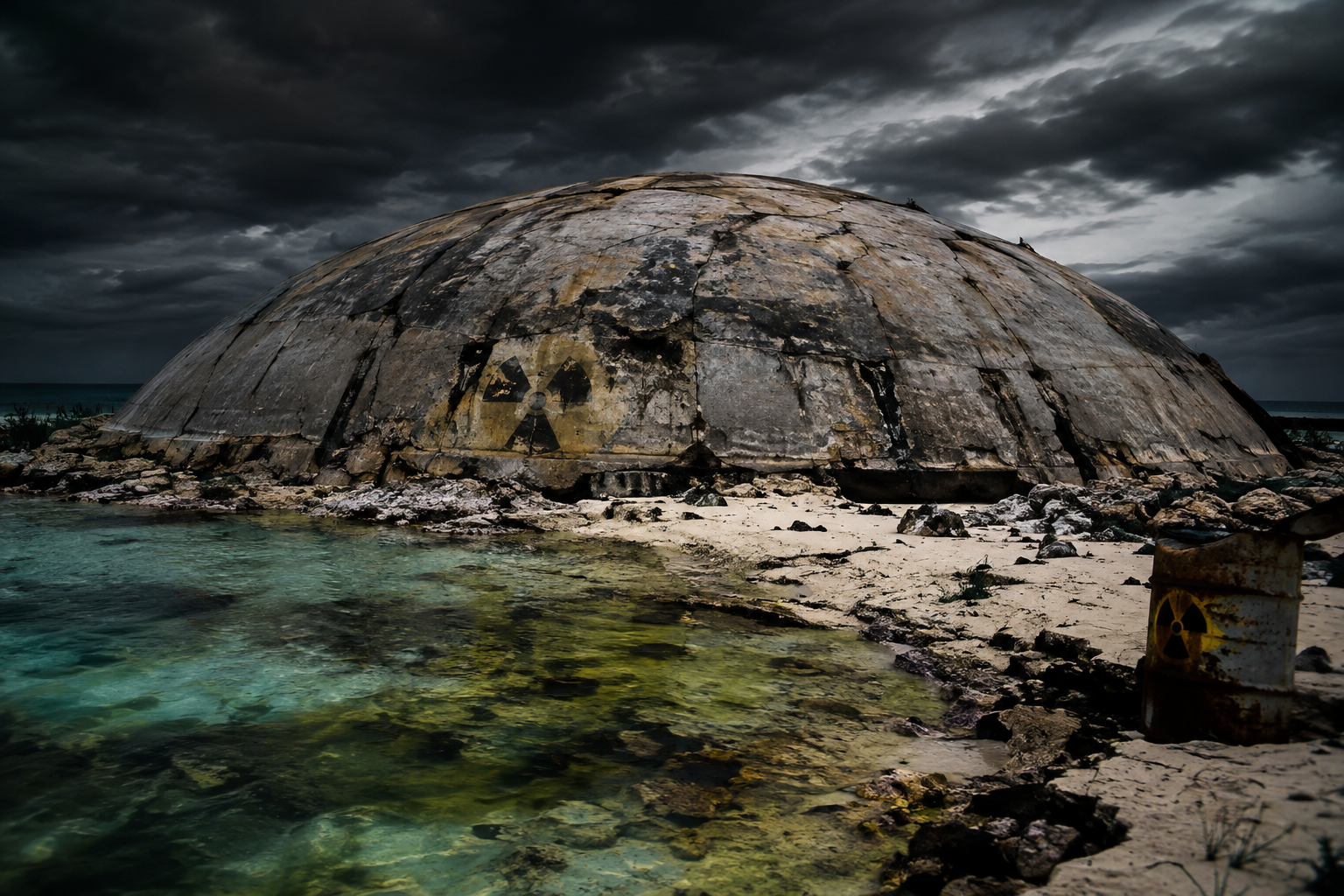
I keep seeing discussions on Facebook and short articles, although I can hardly call some of them articles, about the Runit Dome, a mysterious concrete structure in the middle of the Pacific Ocean that supposedly conceals one of America’s most disturbing nuclear secrets. Most of these posts repeat the same information about radioactive waste, cracks in the concrete and rising sea levels, but almost nobody seems interested in explaining how this extraordinary place came into existence, what American authorities actually knew when they built it, or why an entire island was transformed into a radioactive burial ground whose consequences could extend thousands of years into the future.
What intrigued me most was not the frightening appearance of the dome or the possibility that it might eventually deteriorate, but the uncomfortable realization that the structure everyone is discussing represents only a small part of a much larger story, one involving displaced islanders, nuclear experiments, contaminated lagoons and political decisions whose consequences continue long after the Cold War has ended.
As I began examining the historical records and scientific assessments, I discovered details that made me question not only the decisions taken during the nuclear testing era, but also our modern understanding of environmental responsibility, because what happened on Runit Island raises a disturbing question about whether humanity is capable of managing the consequences of its own technological achievements.
The Island That America Turned Into a Nuclear Cemetery
Before Runit became associated with radioactive waste, it was part of Enewetak Atoll in the Marshall Islands, a remote Pacific landscape of coral islands, turquoise lagoons and communities whose relationship with the ocean had developed over countless generations.
Following the Second World War, the United States selected parts of the Marshall Islands for nuclear weapons testing, and between 1946 and 1958, 67 nuclear tests were conducted at Bikini and Enewetak Atolls, leaving behind enormous quantities of radioactive contamination and permanently transforming sections of the surrounding environment.
The inhabitants of Enewetak were relocated to Ujelang Atoll in 1947, and their displacement continued for more than three decades, while their ancestral homeland became a military testing ground where some of the most powerful weapons ever developed were detonated.
When the United States eventually began preparing Enewetak for resettlement, the cleanup operation undertaken between 1977 and 1980 involved collecting contaminated soil and debris from several islands and transporting approximately 110,000 cubic yards, equivalent to roughly 84,000 cubic metres, of material to a crater on Runit Island.
The crater itself had been created during the Cactus nuclear test in May 1958, and I found something deeply unsettling about the decision to use a hole produced by a nuclear explosion as the final resting place for radioactive materials left behind by other nuclear explosions.
Workers mixed contaminated material with cement and placed it inside the crater before constructing a massive concrete covering approximately 115 metres in diameter, creating the structure that would eventually become known as the Runit Dome.
From the air, the dome resembles an enormous grey shell surrounded by the astonishing blue waters of the Pacific, and the contrast between the beauty of the landscape and the history concealed beneath the concrete is almost impossible to ignore.
The Detail Beneath the Concrete That Changes Everything
One of the most surprising discoveries I made while researching Runit was that the crater containing the radioactive waste was never equipped with a fully impermeable lining capable of isolating its contents from the surrounding geological environment.
Although the concrete covering was intended to prevent erosion and the dispersal of contaminated material from the surface, the waste beneath it was not enclosed inside a completely sealed container, which means that groundwater and seawater can interact with the materials deposited inside the crater.
This is not a sensational theory invented by conspiracy websites, because official assessments and scientific investigations have acknowledged the movement of water through the porous coral formations beneath the structure.
What disturbed me was discovering that the possibility of radioactive material migrating through groundwater was not entirely unexpected, and that environmental evaluations had considered such movement in relation to the substantial contamination already present in Enewetak Lagoon.
The implications are uncomfortable because they suggest that the surrounding environment had already been so extensively affected by nuclear testing that the additional contribution from the dome could be relatively small compared with the radioactive contamination dispersed throughout the lagoon.
In other words, the concrete structure that attracts so much attention is not necessarily the greatest source of contamination in the area, and concentrating exclusively on the dome risks overlooking the much larger environmental legacy left behind by the nuclear testing program.
What Scientists Have Actually Discovered
Over the years, photographs showing cracks and deterioration in parts of the concrete covering have generated alarming headlines, particularly as concerns about climate change and rising sea levels have intensified across the Pacific.
However, the scientific picture is considerably more complicated than the dramatic predictions suggesting that the structure is about to collapse and release its entire radioactive inventory into the ocean.
A United States Department of Energy assessment published in 2022 documented visible defects in the dome, including cracks and damage to some concrete panels, but did not identify evidence of imminent structural failure or a significant additional radiological threat to the residents of Enewetak from the containment structure.
The same assessments recognized that groundwater can move through the crater and surrounding geological formations, while available measurements suggested that the dome’s contribution to radioactive contamination in the lagoon was relatively limited compared with contamination already present from historical testing.
Additional investigations have examined the possible effects of climate change, coastal erosion and changes in ocean conditions, and the Department of Energy has continued reporting on inspections and groundwater monitoring, including documentation associated with a further reporting cycle in 2026.
I believe these distinctions are essential because the absence of an imminent disaster does not mean that the radioactive legacy has disappeared, just as the existence of cracks does not automatically prove that a catastrophic release is approaching.
What we are dealing with is a long-term environmental problem whose future depends on geological processes, changing coastal conditions, scientific monitoring and decisions that may have to be maintained across generations.
The Radioactive Material That Could Outlive Civilizations
Among the radioactive substances associated with the contamination of Enewetak is plutonium-239, an isotope with a half-life of approximately 24,100 years, meaning that after this extraordinary period, half of the original quantity of that isotope would remain undecayed.
When I considered what 24,100 years actually represents in human history, the scale of the problem became much more disturbing than any photograph of damaged concrete could ever communicate.
More than twenty-four thousand years ago, humanity was living during the last Ice Age, long before the emergence of modern cities, written history, established nations or the political institutions that now claim responsibility for managing the consequences of nuclear technology.
Of course, radioactive half-life alone does not determine environmental danger, because actual exposure depends on the quantity and chemical form of the material, the pathways through which it can move and the circumstances under which people or ecosystems might encounter it.
Nevertheless, the timescale forces us to confront an extraordinary contradiction between the temporary nature of human institutions and the lasting consequences of some of the materials those institutions have created.
Concrete deteriorates, coastlines change, governments are replaced and international agreements can be rewritten, while the radioactive substances buried beneath Runit continue following physical processes that are entirely indifferent to human political arrangements.
The Marshall Islands are also particularly vulnerable to rising sea levels and coastal changes, which makes the long-term management of contaminated locations an issue extending far beyond the original engineering decisions made during the cleanup operation.
The People Who Inherited the Consequences
Something else became increasingly clear as I examined the history of the Runit Dome, and it was the extent to which the people most directly affected by the nuclear testing program are often almost invisible in the stories written about it.
The Marshallese communities did not choose to transform their islands into nuclear laboratories, nor did they design the military experiments that contaminated parts of their ancestral environment, yet they have lived with the consequences through displacement, restricted access to land and continuing concerns about environmental safety.
The United States has provided compensation and supported monitoring and rehabilitation programs, but disagreements over the adequacy of compensation, environmental restoration and long-term responsibility have persisted.
What I find particularly troubling is how easily the human dimension disappears behind technical terminology, because scientific reports can measure radioactive concentrations and calculate environmental exposure without fully communicating what it means for a community to inherit a homeland whose safety has become dependent on decisions made by distant governments.
For the people of Enewetak, this is not simply an unusual Cold War monument that attracts attention on social media, but part of a continuing history that connects their past, their present and the future of generations who have not yet been born.
What Would Really Happen If the Dome Failed?
One of the most persistent misconceptions surrounding Runit is the idea that the collapse of its concrete covering would trigger a nuclear explosion or instantly release all the radioactive material beneath it into the surrounding ocean.
Neither scenario follows from the available scientific evidence, because the dome is not an operating nuclear reactor or an assembled nuclear weapon, and any structural failure would have to be evaluated in terms of the actual movement of contaminated sediments, erosion, groundwater circulation and possible exposure pathways.
A severe storm, progressive coastal erosion or long-term deterioration could potentially redistribute contaminated material, but the consequences would depend on the extent of the damage, the characteristics of the radioactive substances involved and the environmental conditions at the time.
Scientific investigations have also indicated that substantial contamination already exists in parts of the surrounding lagoon independently of the waste contained beneath the dome, making it important to distinguish the effects of any future structural damage from the broader legacy of nuclear testing.
What interests me most is not the dramatic possibility of an immediate catastrophe, but the quieter and more difficult question of how such a site can be responsibly managed over centuries when the environmental conditions, available resources and political priorities of future generations cannot be predicted with certainty.
The Nuclear Tomb That Raises a Question Nobody Can Escape
After examining the history of Runit Island, I no longer see its concrete dome merely as a frightening relic of the Cold War, because to me it represents something much more profound about the relationship between human ambition, technological power and responsibility.
We have developed weapons capable of transforming landscapes within seconds, yet managing the consequences of those weapons can require commitments extending far beyond the lifespan of the governments, institutions and individuals who authorized their use.
The Runit Dome is still standing, and available scientific assessments have not established that a catastrophic structural failure is imminent, but its existence reminds us that radioactive contamination cannot simply be erased from history by covering it with concrete.
What continues to trouble me is the thought that hundreds or even thousands of years from now, when the political world responsible for these experiments may have changed beyond recognition, future generations could still be confronting questions created during a brief period of twentieth-century military competition.
And somewhere in the Pacific, beneath a grey concrete shell surrounded by beautiful tropical waters, the physical remains of those decisions continue to exist, quietly challenging our assumption that the consequences of human actions belong only to the generations that created them.
We have learned how to bury radioactive waste beneath concrete, but I am not convinced that we have learned how to prevent future generations from inheriting the responsibility for what we leave behind.
Whisper Mysteries — Discover the Inexplicable.
Sources and Further Reading
U.S. Department of Energy and U.S. Army — Historical records of the Enewetak Atoll radiological cleanup, 1977–1980.
U.S. Department of Energy — 2022 Report on the Visual Study and Groundwater Analysis of the Cactus Crater Containment Structure.
U.S. Department of Energy — Reports and environmental monitoring of Enewetak Atoll.
U.S. Department of Energy — 2024 climate change assessment concerning the Runit Dome and the Marshall Islands.
U.S. Department of Energy — 2026 Runit Dome inspection and groundwater reporting information.


Leave a Reply