
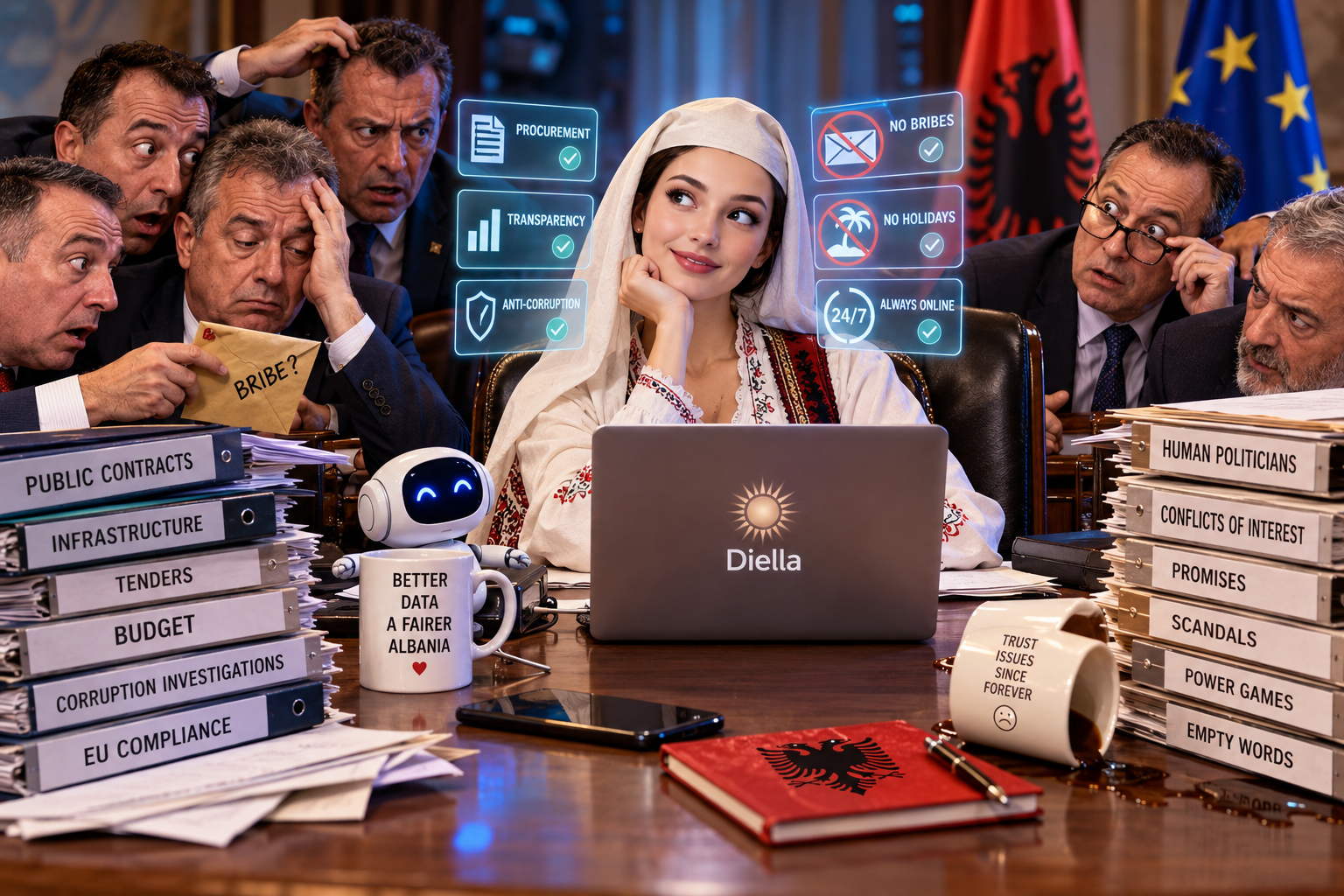
When politicians become less trustworthy than machines, the real problem may not be artificial intelligence, but human intelligence.
After discovering that witches become rather upset when someone takes away their candles and magic wands, I learned that politicians might soon face an even greater problem: artificial intelligence. Albania has introduced a minister who never sleeps, never asks for holidays, never needs an official limousine, and, at least in theory, cannot be bribed with a discreet envelope slipped beneath a table. I admit that the idea amused me, especially when I imagined a government meeting in which the only participant immune to political ambition was the one who did not possess a human brain. But the more I investigated this extraordinary appointment, the more I realized that behind the smiling digital face of Albania’s artificial minister lies a disturbing question: have human beings become so disappointed with their own institutions that they are beginning to search for honesty inside a machine?
The Minister Who Never Had a Childhood
In September 2025, Albanian Prime Minister Edi Rama introduced Diella, an artificial intelligence system presented as the world’s first AI minister, with a proposed role in public procurement and the fight against corruption. Her name means Sun in Albanian, an optimistic choice for a country where government transparency remains a politically sensitive issue. Unlike her human colleagues, Diella has no childhood, no university degree, no election campaign, no political enemies, and no embarrassing photographs from a luxurious holiday paid for by a suspiciously generous businessman. She cannot enjoy an expensive watch, acquire a seaside villa, or arrange a comfortable government position for a cousin. At least, that is the attractive image surrounding her appointment, although the absence of human desires does not automatically make a computer system honest.
What intrigued me was that Diella had already existed before her spectacular political promotion. In January 2025, she appeared as a virtual assistant on Albania’s e-Albania public services platform, helping citizens navigate administrative procedures and obtain documents. According to government figures published later that year, the system had handled approximately 972,000 interactions. Within months, an administrative assistant had become an international political celebrity, without ever giving an electoral speech or promising voters that this time everything would be different. I wondered how many politicians would envy such a career, particularly one achieved without spending years shaking hands, kissing babies, and pretending to enjoy conversations with people they would never remember.
The Artificial Minister With a Very Human Face
Diella was presented not as a mechanical robot but as a young woman wearing traditional Albanian clothing, a clever combination of national identity and futuristic technology. I found this choice fascinating because people do not instinctively trust mathematical formulas, but they respond to familiar faces, reassuring voices, and cultural symbols. Yet the face belonged to a real woman, Albanian actress Anila Bisha, whose image and voice had been used to create the original virtual assistant. In February 2026, Bisha challenged the government’s use of her likeness in court, arguing that her consent had not extended to representing a political figure. The government disputed her allegations, and the legal controversy did not itself establish wrongdoing.
The irony was difficult to ignore: a government had introduced an artificial minister as a symbol of ethical administration, only to encounter a very human dispute over consent and identity. I began wondering whether the public was being encouraged to admire the perfection of the digital figure while overlooking the complicated human decisions responsible for creating her. Behind every artificial face are designers, contracts, institutions, financial interests, and people who decide what the machine is allowed to say and do. Diella may not possess personal ambitions, but that does not mean the people controlling her are equally free from them.
Can a Machine Really Eliminate Corruption?
The most ambitious promise associated with Diella concerned government contracts. Prime Minister Rama presented artificial intelligence as a potential instrument for making public procurement more transparent and resistant to corruption. The idea sounds wonderful, particularly in countries where public money has an unfortunate tendency to travel through mysterious administrative corridors before arriving in equally mysterious private accounts. A computer cannot be tempted by a luxury car or a discreet invitation to a five-star resort, but corruption does not always begin with the person making the final decision. Sometimes it begins when the rules are written, when the requirements are selected, or when the information supplied to the decision-maker has already been manipulated.
Imagine an artificial intelligence system instructed to award a construction contract to the most suitable company. If the criteria have been carefully designed to favor one particular business, the machine may select that company with perfect mathematical consistency while giving the result an appearance of impartiality. The algorithm has accepted no bribe, but it may still reproduce a dishonest human decision. This is what disturbed me most during my investigation, because artificial intelligence can calculate without personal greed, yet it cannot guarantee that the objectives imposed upon it are fair. A corrupt official can be replaced by a computer, but corruption itself may simply move into the invisible architecture of the software.
The Scandal Behind the Digital Curtain
The story became even more interesting when I examined the institutions responsible for Albania’s digital infrastructure. In December 2025, Albania’s Special Anti-Corruption Prosecution, known as SPAK, investigated alleged irregularities involving officials connected with the National Agency for Information Society, or AKSHI, an institution central to the country’s digital-government systems. The allegations concerned matters including public procurement, and they must not be treated as proof of guilt or as evidence that Diella herself participated in wrongdoing. Nevertheless, the situation created an uncomfortable contrast between the promise of technological integrity and the continuing need to investigate the human organizations surrounding that technology.
I could not resist imagining Diella sitting calmly at her computer while investigators examined the activities of the very institutions responsible for Albania’s digital transformation. The machine might have no interest in money, but the people managing the machinery still live in a world of political influence, commercial relationships, and personal ambition. This does not mean that artificial intelligence cannot help detect corruption; properly designed systems can identify suspicious transactions, compare contracts, and reveal irregularities that human investigators might overlook. It means that technological honesty cannot exist independently of institutional accountability.
A Minister Who Was Not Actually a Minister
Another remarkable development occurred in October 2026, when Albania’s Constitutional Court addressed a challenge concerning the virtual ministerial role. The Court rejected the challenge on the grounds before it, while clarifying that the use of artificial intelligence did not create an independent constitutional minister or transfer governmental responsibility away from human authorities. In practical terms, Diella could be called a minister, appear alongside ministers, and attract international attention as a technological innovation, but the constitutional responsibilities of government remained with human officials.
This distinction fascinated me because it revealed the enormous power of political presentation. A title, a digital face, and a carefully organized public appearance can create the impression of a revolution even when the underlying distribution of authority has not fundamentally changed. In September 2025, Diella had appeared on a screen in Albania’s parliament, delivering a composed message while opposition lawmakers protested. The contrast between the calm virtual speaker and the noisy human politicians was almost theatrical, although a digital avatar delivering a prepared speech is not evidence that it possesses greater wisdom than the people arguing around it.
Plato, Artificial Intelligence, and the Search for the Perfect Ruler
As I followed the story, I remembered Plato’s philosopher-kings, the rulers imagined in The Republic as individuals guided by knowledge and justice rather than personal wealth or ambition. More than two thousand years later, humanity appears to be searching for a similar ideal, except that instead of trusting philosophers, we are beginning to place our hopes in algorithms. The dream remains familiar: a ruler untouched by greed, immune to manipulation, and capable of making decisions according to reason rather than private interest.
But intelligence and wisdom are not interchangeable. A computer may compare thousands of contracts in seconds, recognize statistical anomalies, and identify suspicious financial patterns, yet it cannot independently establish the moral values that a democratic society should follow. Even a technically flawless decision can be unjust if its objectives are wrong. I began to suspect that our fascination with artificial ministers reveals less about the extraordinary abilities of machines than about our growing disappointment with the human beings who govern us.
The Matrix Behind the Smiling Face
There is something about Diella that reminded me of The Matrix, not because I believe artificial intelligence is secretly preparing to imprison humanity, but because the story raises a similar philosophical question about the difference between appearance and reality. In the fictional Matrix, people experience a convincing world without understanding the hidden system that shapes their perceptions. In modern society, we increasingly encounter algorithms that influence the information we receive, the products we discover, and the decisions presented to us as reasonable or objective.
An artificial minister introduces that same problem into political life. Citizens see a reassuring face, hear a confident voice, and receive promises of impartiality, but the actual processes behind the interface may remain difficult to examine. The danger is not necessarily that the machine is secretly malicious, but that people may begin treating its conclusions as unquestionable simply because they appear to come from something more intelligent and less emotional than themselves. I have always found that the most convincing illusions are those containing enough truth to make us stop examining everything else.
The Most Dangerous Question
What happens when an artificial intelligence system makes a mistake that affects public money, citizens’ rights, or important government decisions? A human minister can be questioned, investigated, removed from office, or prosecuted when the law permits, but a computer cannot experience moral responsibility or criminal punishment. Responsibility must remain with the people and institutions that design, authorize, supervise, and use the technology. Without clear accountability, artificial intelligence could become an extraordinarily convenient political shield, allowing officials to describe controversial decisions as the neutral conclusions of an algorithm.
I began this investigation laughing at the thought of politicians competing with a colleague who never takes holidays, never demands a salary, and never dreams of owning a suspiciously expensive seaside villa. But the deeper I examined Albania’s artificial minister, the more I realized that the important question was not whether Diella had become smarter than the humans surrounding her, but why so many people might be willing to believe that she could also be more honest.
Diella’s name means Sun, and I find that symbolism unusually appropriate, because sunlight reveals what darkness conceals, yet every object illuminated by the sun also casts a shadow. Artificial intelligence may help governments become more transparent, efficient, and accountable, but only if citizens remain free to examine the systems behind it and question the people who control them.
I do not fear a future in which artificial intelligence helps human beings make better decisions; I fear a future in which human beings use artificial intelligence to make their own decisions appear beyond criticism, because the most dangerous machine may not be the one that becomes more intelligent than its creators, but the one that convinces society that its creators no longer need to be questioned.
And if we ever reach that point, we will not need to wait for the Matrix to arrive, because we will have built it ourselves.
Sources and Further Reading
- Reuters — September 11, 2025: Reporting on Albania’s announcement of Diella as an AI minister.
- Albanian Government — Official Diella profile and public-service information: https://www.kryeministria.al/en/ministrat/diella/
- Associated Press and Reuters — February 2026: Reporting on actress Anila Bisha’s legal dispute concerning her image and voice.
- Deutsche Welle — Reporting on Diella, the image-rights dispute, and Albania’s digital-government infrastructure.
- Constitutional Court of Albania — October 8, 2026: Decision concerning the constitutional challenge related to Diella.
- European Union — Regulation (EU) 2024/1689, Artificial Intelligence Act.
- Plato — The Republic, Books V–VII.
Author’s note: This article combines documented events with personal interpretation, political satire, and philosophical analysis. Allegations mentioned in the text do not establish guilt, and Diella has not been demonstrated to possess independent constitutional authority.


Leave a Reply