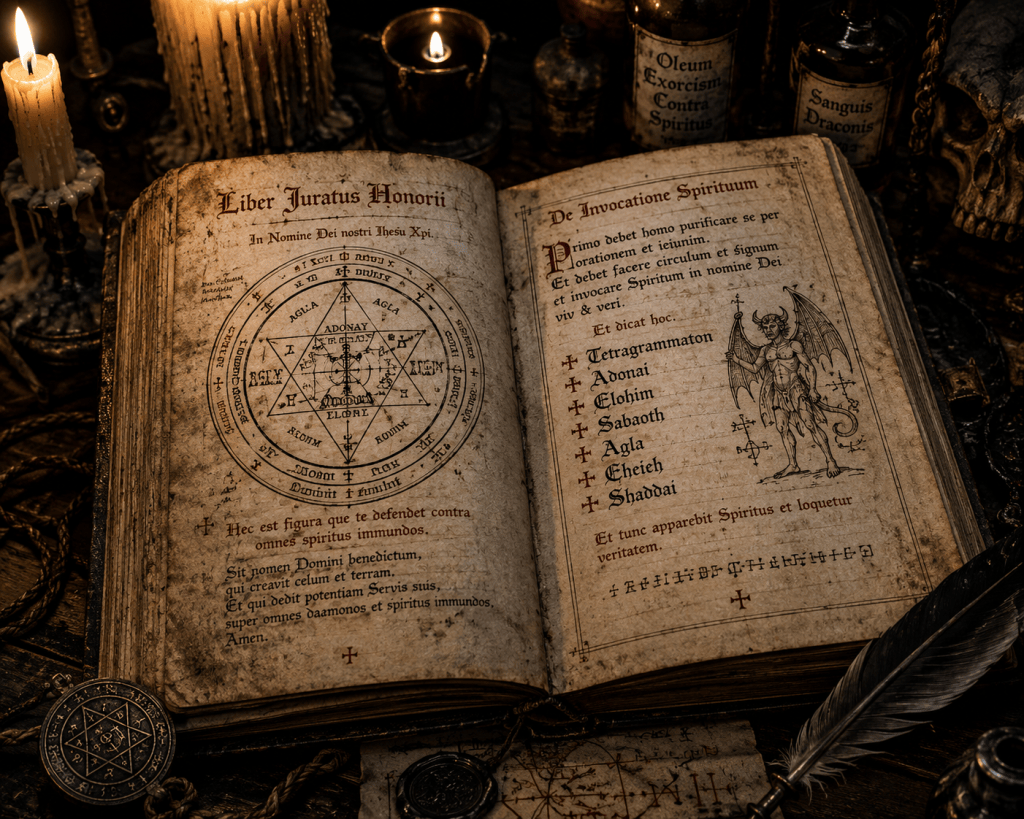
Liber Juratus Honorii (The Sworn Book of Honorius) is one of the best-known medieval grimoires. The manuscript Royal MS 17 A XLII, preserved at the British Library, dates from the 15th century.
Most articles about the Picatrix describe it as a medieval grimoire filled with talismans, astrology, and mysterious rituals. But the true mystery of this legendary book is not hidden in its rituals.
It is hidden between the lines.
Few people know that the author claims to have studied more than 200 books before compiling the work. In other words, the Picatrix is not an isolated creation but a remarkable collection of knowledge drawn from Greek, Egyptian, Persian, and Arabic traditions, carefully woven into a single manuscript.
But there is an even more intriguing detail.
When historians compare the text with its sources, they find that many of its ideas do not come from other grimoires at all. Instead, they trace back to an unexpected work known as The Nabataean Agriculture—a book about farming, seasonal cycles, plants, and the rhythms of nature. In the Picatrix, these observations are transformed into a broader vision in which the heavens, time, and the natural world are seen as parts of one interconnected system.
This may be the greatest secret of the Picatrix.
The book is not simply about magic. It presents a philosophy of the universe in which human beings, the stars, the earth, and the changing seasons all belong to the same cosmic order. During the Middle Ages, this was understood as a way of explaining how the universe itself functioned.
Perhaps this is why the Picatrix had such a profound influence during the Renaissance. Philosophers and scholars were fascinated not only by its mysterious reputation but also by its ambitious attempt to unite astronomy, philosophy, symbolism, and the natural world into a single vision of reality.
Today, many readers search the Picatrix hoping to discover forgotten rituals or hidden formulas. Yet its greatest lesson may be something far more enduring: the belief that nature is not a collection of separate objects but a web of relationships, patterns, and correspondences.
Whether we see this as medieval philosophy, intellectual history, or a fascinating cultural artifact, one thing remains certain.
Nearly a thousand years after it was written, the Picatrix still invites us to ask the same timeless question:
How much of the universe do we truly understand?


Leave a comment