Part I – The Discovery That Challenged Biblical History
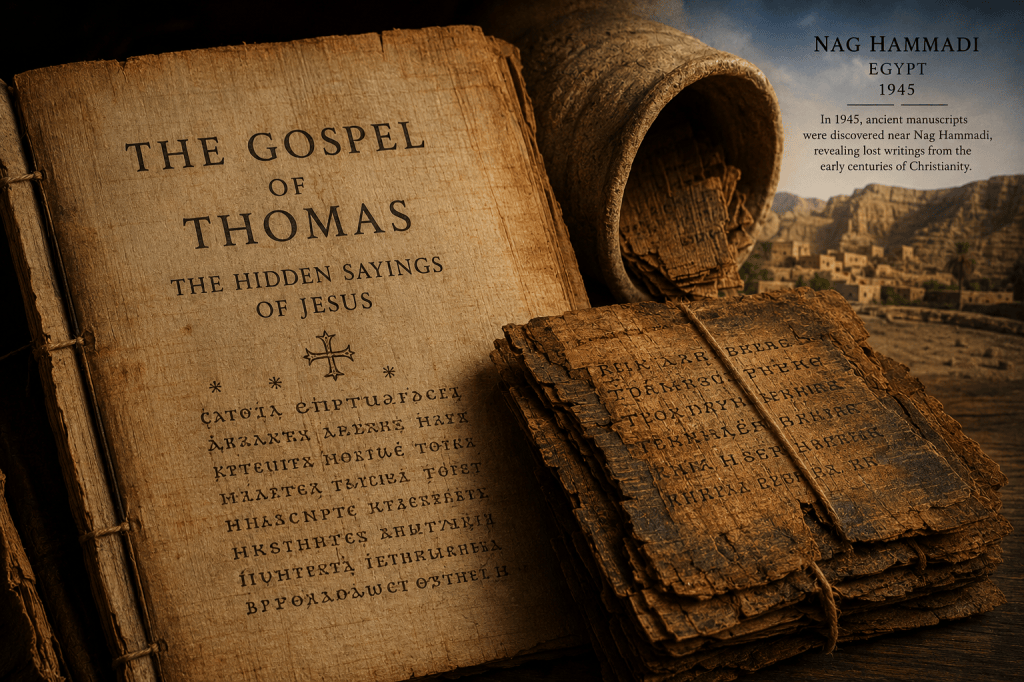
In December 1945, two Egyptian brothers searching for natural fertilizer near the cliffs of Jabal al-Tarif, close to the town of Nag Hammadi, made a discovery that would become one of the most significant archaeological finds in the history of early Christianity. Buried inside a sealed earthenware jar were thirteen leather-bound papyrus codices containing more than fifty ancient Christian and Gnostic writings. Some of these texts had never been seen by modern scholars, while others had survived only through brief quotations preserved by early Church Fathers.
Among them was a document that would soon become one of the most debated texts in biblical scholarship: The Gospel of Thomas.
Unlike the four canonical Gospels, this text contains no account of Jesus’ birth, no miracles, no crucifixion, no resurrection, and no narrative describing His ministry.
Instead, it presents 114 sayings attributed to Jesus, many of which resemble passages found in Matthew, Mark, Luke, and John, while others appear entirely unfamiliar.
Its opening sentence immediately sets the tone:
“These are the secret sayings that the living Jesus spoke and Didymus Judas Thomas wrote down.”
The word secret has fascinated readers for decades.
Was this merely a literary device?
Or did the author genuinely believe he was preserving teachings intended only for a select group of followers?
The answer remains one of the central questions surrounding the Gospel of Thomas.
The Discovery at Nag Hammadi
The discovery of the Nag Hammadi Library transformed the study of early Christianity.
Before 1945, historians knew that many alternative Christian writings had existed because influential theologians such as Irenaeus, Hippolytus, and Origen had written against them during the second and third centuries. However, most of the original documents had disappeared. Scholars knew these texts only through the criticisms of those who opposed them.
Nag Hammadi changed everything.
For the first time, historians could examine these writings directly instead of relying on hostile descriptions.
The codices contained works such as the Gospel of Philip, the Apocryphon of John, the Gospel of Truth, and the Gospel of Thomas. Together, they revealed a remarkably diverse Christian landscape during the first centuries after Jesus’ death.
Rather than representing a single unified movement, early Christianity consisted of numerous communities that sometimes held very different beliefs about Jesus, salvation, and the nature of God.
Who Wrote the Gospel of Thomas?
The text attributes itself to Didymus Judas Thomas.
In Aramaic, Thomas means “twin.”
In Greek, Didymus also means “twin.”
Whether this title refers to the apostle traditionally known as Thomas or carries symbolic meaning remains uncertain.
Most biblical scholars do not believe that the Apostle Thomas personally wrote the document.
Linguistic analysis, theological vocabulary, and historical context generally suggest that the surviving text reached its present form sometime during the second century AD, although several researchers argue that some individual sayings preserved within it could be considerably older.
This distinction is important.
The age of the document itself is not necessarily identical to the age of every tradition it contains.
Some sayings may preserve authentic early Christian traditions.
Others appear to reflect theological developments that emerged generations later.
Separating those layers remains one of the greatest challenges facing modern scholarship.
A Gospel Unlike Any Other
The Gospel of Thomas reads very differently from the New Testament.
Instead of telling a story, it resembles a collection of wisdom sayings.
Many begin with familiar phrases:
“Jesus said…”
Each statement stands almost independently.
Some closely parallel verses found in the canonical Gospels.
Others expand upon familiar teachings.
Still others appear mysterious, symbolic, and difficult to interpret.
Consider one of its best-known sayings:
“The Kingdom is inside you, and it is outside you. When you know yourselves, then you will be known…”
This emphasis on self-knowledge differs from the narrative focus of the canonical Gospels.
Rather than describing historical events, the Gospel of Thomas repeatedly encourages readers to seek understanding through insight and interpretation.
This characteristic has led many scholars to associate the text with traditions later described as Gnostic, although the extent of that connection remains debated.
Was It Really Suppressed?
Popular books and documentaries often claim that the Church deliberately hid the Gospel of Thomas because it contained dangerous truths.
The historical evidence paints a more complex picture.
During the first three centuries of Christianity, there was no universally accepted New Testament.
Different Christian communities used different collections of writings.
Some texts were widely accepted across the Roman Empire.
Others circulated only within particular regions or theological movements.
The process of recognizing the books that would eventually form the New Testament developed gradually over several centuries.
When bishops and theologians evaluated Christian writings, they generally considered three principal questions.
Could the text reasonably be connected to the apostles?
Was it widely used in Christian worship across diverse communities?
Did its theology agree with what churches had already received as apostolic teaching?
The Gospel of Thomas encountered difficulties on all three points.
Its authorship remained uncertain.
Its circulation appears to have been limited compared with the canonical Gospels.
Some of its teachings differed significantly from emerging orthodox theology.
For these reasons, most historians conclude that the text was not removed from the Bible after once belonging to it.
Instead, it was never accepted into the developing New Testament canon.
The Most Controversial Sayings
The fascination surrounding the Gospel of Thomas comes largely from several enigmatic sayings that have inspired centuries of interpretation.
Some appear remarkably similar to the teachings found in Matthew and Luke.
Others have no clear parallel anywhere else.
One of the most famous declares:
“Whoever discovers the interpretation of these sayings will not taste death.”
Unlike the canonical Gospels, where salvation is closely connected to Jesus’ death and resurrection, the Gospel of Thomas repeatedly emphasizes understanding, insight, and discovering hidden meaning.
For some readers, this reflects an ancient tradition centered on spiritual wisdom.
For others, it represents a theology fundamentally different from mainstream Christianity.
The debate continues.
Why Does It Still Matter?
The importance of the Gospel of Thomas does not depend upon whether every saying originated with Jesus.
Its value lies elsewhere.
It demonstrates that early Christianity was far more intellectually and spiritually diverse than many people imagine.
Different communities preserved different memories.
Different teachers emphasized different aspects of Jesus’ message.
Some focused on faith.
Others emphasized wisdom.
Some proclaimed salvation through Christ’s death and resurrection.
Others concentrated on inner transformation and spiritual knowledge.
The Gospel of Thomas offers a rare window into one of those forgotten voices.
Whether one accepts its authority or not, it remains one of the most important discoveries ever made for understanding the first centuries of Christian history.
To Be Continued…
Part II will examine the most controversial question of all.
Was the Gospel of Thomas rejected because it contradicted orthodox Christianity, or because it preserved ideas that Church leaders considered dangerous? We will also explore its relationship with Gnosticism, analyze several of its most debated sayings, and examine what leading biblical scholars conclude after decades of research.
The answers may be more surprising—and far more nuanced—than either believers or skeptics often expect.


Leave a comment