Part I – The Origins of One of History’s Most Controversial Theories
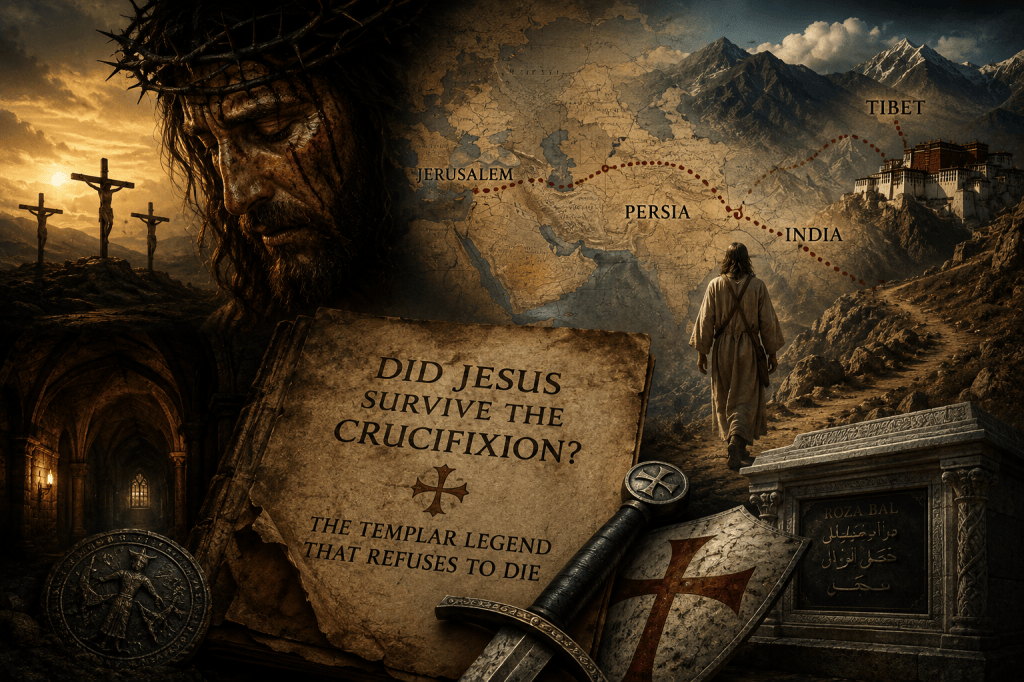
Few events in human history have shaped civilization as profoundly as the crucifixion of Jesus of Nazareth. For nearly two thousand years, Christians have regarded the crucifixion, death, and resurrection of Jesus as the foundation of their faith. The event has been examined by theologians, historians, archaeologists, physicians, and philosophers, becoming one of the most extensively studied episodes in the ancient world.
Yet alongside the traditional account exists another story—one that refuses to disappear despite centuries of criticism and debate.
According to this alternative tradition, Jesus did not die on the cross. Instead, he survived the crucifixion, recovered from his injuries, left Judea, and traveled east through Persia before eventually reaching India, Tibet, and, according to some versions of the legend, even southern France.
It is an extraordinary claim.
The question is not whether it is fascinating—it undoubtedly is.
The real question is whether history provides any evidence to support it.
What Do the Earliest Historical Sources Say?
The earliest written accounts of Jesus’ death are found in the New Testament, particularly the four canonical Gospels. Although they differ in certain details, all four describe the same essential sequence of events: Jesus was arrested, tried by the Roman governor Pontius Pilate, sentenced to crucifixion, died on the cross, and was placed in a tomb by Joseph of Arimathea.
Outside Christian writings, several ancient historians also mention Jesus.
The Jewish historian Flavius Josephus, writing near the end of the first century, refers to Jesus and states that he was condemned under Pontius Pilate. Although parts of the passage are believed to have been modified by later Christian copyists, most historians agree that Josephus originally mentioned Jesus’ execution.
The Roman historian Tacitus, writing in the early second century, independently recorded that Christus suffered the “extreme penalty” during the reign of Emperor Tiberius under Pontius Pilate. His account is particularly significant because Tacitus had little sympathy for Christianity and was not attempting to promote Christian beliefs.
Taken together, these early sources strongly support the historical conclusion that Jesus was crucified.
Whether he died during the crucifixion, however, became the focus of later debate.
Could Someone Survive Crucifixion?
Crucifixion was one of the most brutal methods of execution ever devised.
Its purpose was not only to kill but to prolong suffering for as long as possible. Victims often died from a combination of blood loss, shock, dehydration, respiratory failure, and cardiac complications. Death sometimes required many hours and, in some cases, several days.
Medical researchers who have studied Roman crucifixion generally conclude that survival would have been extremely unlikely, particularly after severe scourging and prolonged suspension on a cross.
Nevertheless, supporters of the “survival theory” point to several details recorded in the Gospels.
They note that Jesus appeared to die sooner than expected, prompting surprise from Pontius Pilate. They also emphasize that his legs were not broken, unlike those of the two men crucified beside him, because Roman soldiers believed he was already dead. Finally, they cite the treatment of his body with a mixture of myrrh and aloes, suggesting these substances may have possessed healing properties.
Most historians and medical experts interpret these details differently. They argue that Roman executioners were highly experienced and that failing to ensure a prisoner’s death would have carried severe consequences. Furthermore, the spear thrust described in the Gospel of John has traditionally been understood as confirmation that death had already occurred.
Thus, while the survival theory remains possible in the abstract, it is not supported by the consensus of historical or medical research.
The Birth of an Extraordinary Legend
For nearly eighteen centuries, few people suggested that Jesus had traveled to India after the crucifixion.
The idea entered public discussion in the late nineteenth century through the writings of Nicolas Notovitch, a Russian journalist who claimed that while visiting the Hemis Monastery in Ladakh, Tibet, he had discovered ancient manuscripts describing the life of a man named Issa.
According to Notovitch, these texts stated that Jesus had spent many of his “lost years” in India before returning to Judea—and, in some versions of the story, returned there again after surviving the crucifixion.
His book attracted enormous attention throughout Europe.
If genuine, the manuscripts would have transformed the study of Christian history.
The problem was verification.
When respected scholars later visited the monastery, they reported that the monks denied any knowledge of the manuscripts or of Notovitch’s account. Some researchers concluded that he had misunderstood local traditions; others accused him of inventing the story entirely.
To this day, no original manuscript matching Notovitch’s description has been independently authenticated.
Why India?
The connection between Jesus and India did not arise entirely by chance.
Ancient trade routes linked the Roman Empire with Persia and the Indian subcontinent. Merchants, travelers, and religious teachers moved across these routes for centuries, carrying goods as well as ideas.
The “lost years” of Jesus—roughly the period between his childhood and the beginning of his public ministry—have long fascinated historians because the canonical Gospels say very little about them.
This silence created space for speculation.
Could he have traveled east?
Could he have encountered Buddhist teachers?
Could similarities between certain ethical teachings reflect contact between distant cultures?
These questions continue to be debated.
While some scholars acknowledge that cultural exchanges between the Mediterranean and South Asia certainly occurred during the first century, no reliable historical evidence demonstrates that Jesus himself ever made such a journey.
The absence of evidence does not necessarily prove the journey impossible.
It simply means that historians cannot presently confirm it.
Faith, History, and the Search for Evidence
The enduring popularity of the India theory reveals something important about human nature.
History is rarely satisfied with unanswered questions.
Whenever gaps appear in the historical record, alternative explanations often emerge to fill them. Some eventually become accepted after new discoveries. Others remain fascinating legends that reflect the hopes, beliefs, and imagination of later generations more than the events themselves.
The story of Jesus in India stands precisely at that intersection.
It combines genuine historical mysteries with disputed documents, religious traditions, and centuries of speculation.
Separating those elements requires careful examination rather than quick conclusions.
To Be Continued…
In Part II, we will investigate the most controversial claims surrounding this legend: the mysterious Roza Bal tomb in Kashmir, traditions placing Jesus in Tibet after the crucifixion, the alleged connection with the Knights Templar, and what modern historians, archaeologists, and biblical scholars conclude after examining the available evidence.
Did one of history’s greatest secrets survive for two thousand years?
Or did an intriguing legend gradually grow into one of the world’s most enduring historical mysteries?


Leave a comment