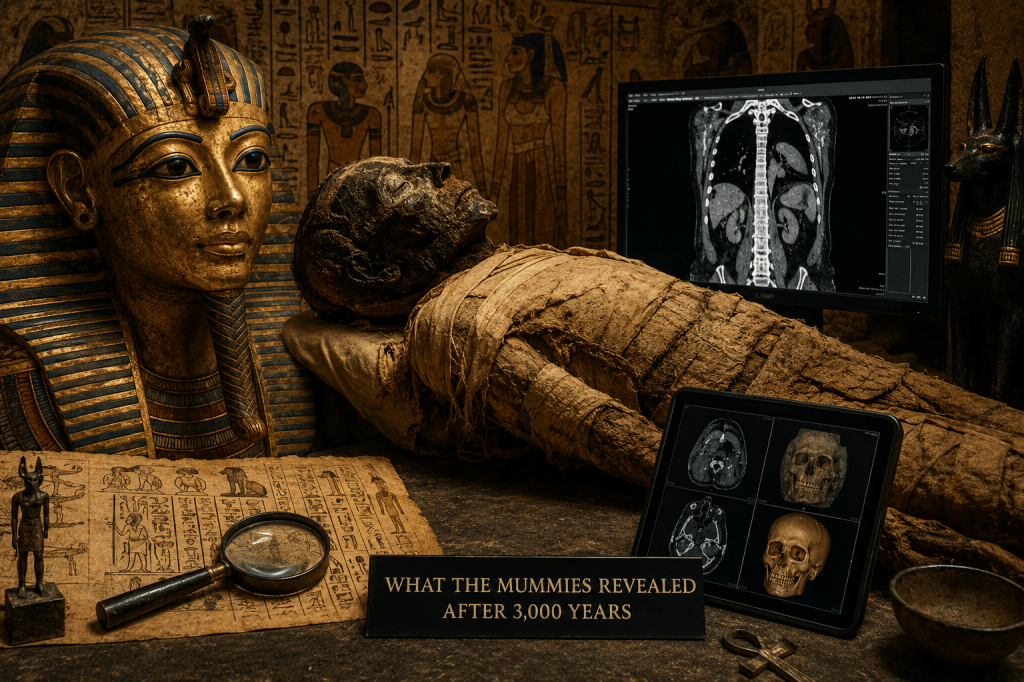
Part I – When Modern Medicine Entered the Tombs
For more than three thousand years, the pharaohs of ancient Egypt were believed to have carried their secrets into eternity. Their carefully preserved bodies rested inside magnificent tombs, surrounded by gold, precious stones, sacred texts, and objects intended to accompany them into the afterlife. To the ancient Egyptians, mummification was not merely a funerary custom; it was a sacred science designed to preserve both identity and dignity beyond death.
For centuries, historians viewed these royal mummies primarily as archaeological treasures. They were admired for their elaborate coffins, exquisite funerary masks, and the astonishing skill of the embalmers who had preserved them. Little attention was paid to what their bodies might reveal about their lives. That changed dramatically during the twentieth and twenty-first centuries, when advances in medicine transformed ancient mummies into some of history’s most extraordinary medical patients.
Using CT scans, DNA analysis, digital reconstruction, endoscopy, and forensic pathology, researchers began examining Egyptian royalty without disturbing the delicate remains. These technologies allowed scientists to look beneath layers of linen that had remained untouched for millennia. What they discovered was remarkable. The bodies of Egypt’s most powerful rulers told stories of disease, chronic pain, genetic disorders, traumatic injuries, and medical conditions that no ancient scribe had ever recorded.
The image of the pharaoh as an almost divine being began to fade. Behind the gold masks and monumental temples were men and women who suffered from many of the same illnesses that affect humanity today.
The Silent Testimony of the Mummies
Ancient Egyptian inscriptions often portrayed pharaohs as physically perfect. They were depicted defeating enemies in battle, hunting dangerous animals, and standing proudly before the gods with youthful strength regardless of their actual age. Royal propaganda left little room for weakness or illness.
The mummies told a different story.
Modern imaging techniques revealed worn joints, damaged teeth, spinal degeneration, healed fractures, cardiovascular disease, and congenital abnormalities. Some rulers endured years of chronic pain while continuing to govern one of history’s greatest civilizations.
Perhaps the most striking realization was that the body itself had become a historical document. Bones, arteries, and even preserved soft tissue recorded details that no ancient inscription could hide.
Tutankhamun: The Boy King Reconsidered
No Egyptian ruler has attracted more fascination than Tutankhamun. Since Howard Carter uncovered his nearly intact tomb in 1922, generations have wondered about the young king whose golden mask became the symbol of ancient Egypt itself.
For decades, his death remained one of archaeology’s greatest mysteries.
Early theories suggested assassination. Some believed he had been struck on the head during a palace conspiracy. Others proposed a fatal accident involving a chariot.
Modern forensic studies have painted a far more complex picture.
High-resolution CT scans demonstrated that the apparent fracture at the back of his skull was most likely caused after death during the mummification process or by the excavation itself. The long-standing murder theory gradually lost support.
DNA studies produced another important discovery.
Researchers identified evidence that Tutankhamun suffered from malaria, a disease that still claims hundreds of thousands of lives each year. The analysis also suggested that he inherited several genetic conditions associated with repeated marriages between close relatives within the royal family.
His left foot showed significant deformities, including evidence of clubfoot and bone disorders that would have made walking painful. More than one hundred walking sticks discovered inside his tomb, once thought to be ceremonial objects, suddenly acquired a new meaning. They may have been practical necessities rather than symbols of authority.
The image of a powerful warrior racing into battle became increasingly difficult to support.
Instead, modern science revealed a young ruler struggling with physical limitations while carrying the immense responsibilities of kingship.
Royal Blood and Hidden Genetic Risks
The Egyptian royal family believed that preserving divine bloodlines required marriages within the dynasty. Brothers married sisters. Half-siblings became husbands and wives. The practice strengthened claims to the throne but also increased the likelihood of inherited genetic disorders.
DNA analyses have begun reconstructing these complex family relationships with unprecedented precision.
While not every physical characteristic can be attributed directly to inbreeding, researchers generally agree that repeated marriages among close relatives increased the probability of congenital abnormalities appearing within the royal family.
This realization has transformed the study of Egyptian history.
Political decisions once interpreted purely through religion or tradition now carry biological consequences visible thousands of years later inside the royal mummies themselves.
Ramesses II: The Warrior Who Lived with Pain
If Tutankhamun represents youth, Ramesses II represents longevity.
Known to history as Ramesses the Great, he ruled Egypt for approximately sixty-six years, commanded military campaigns, and oversaw one of the most ambitious building programs in the ancient world. His colossal statues continue to dominate the Egyptian landscape more than three millennia after his death.
Yet the body of this legendary ruler reveals that his later years were anything but comfortable.
CT imaging and physical examinations indicate that Ramesses suffered from severe arthritis, particularly affecting his spine and hips. The degeneration was so advanced that walking would almost certainly have become increasingly difficult during old age.
His dental health was equally poor.
Researchers found extensive tooth wear, abscesses, and advanced infections. Some experts believe that chronic dental disease may have caused persistent pain for many years. In an era before antibiotics or modern dentistry, even a seemingly ordinary tooth infection could become a serious medical condition.
Despite these ailments, Ramesses continued to govern one of the ancient world’s greatest empires well into his nineties—an extraordinary lifespan by ancient standards.
His mummy reminds us that greatness and suffering often coexist.
The monumental temples celebrate the victorious king.
The preserved body reveals the aging man behind the crown.
Ancient Medicine: Remarkably Advanced, Yet Limited
The discoveries inside Egypt’s royal mummies have also transformed our understanding of Egyptian medicine.
Ancient physicians possessed surprisingly sophisticated knowledge. Medical papyri describe surgical procedures, wound treatment, fracture management, herbal remedies, and careful clinical observation. Egyptian doctors recognized numerous diseases and developed specialized branches of medicine centuries before similar practices emerged elsewhere.
Yet they remained powerless against many of the conditions revealed by modern science.
They could relieve pain.
They could clean wounds.
They could set broken bones.
But malaria, inherited genetic disorders, severe arthritis, and cardiovascular disease lay far beyond the reach of ancient medicine.
The pharaohs, despite being regarded as living gods, remained subject to the same biological realities as every other human being.
Death, illness, and aging recognized no royal authority.


Leave a comment