When Animals Were Put on Trial: The Strange Medieval Courts That Judged Pigs, Rats, and Insects
When Animals Were Put on Trial: The Strange Medieval Courts That Judged Pigs, Rats, and Insects
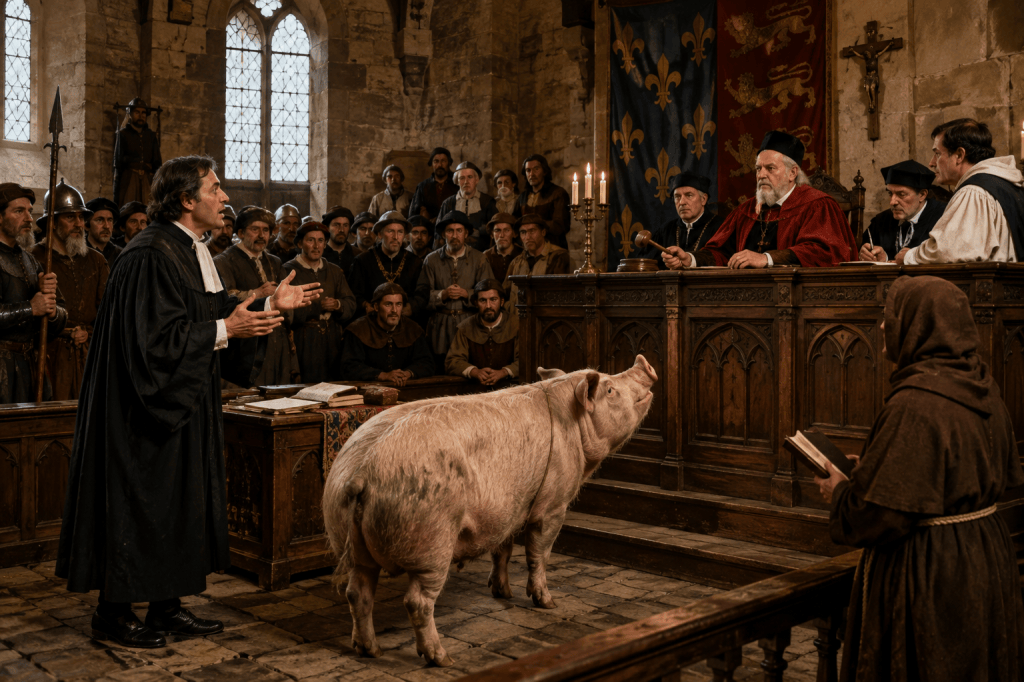
Imagine entering a medieval courtroom expecting to witness the trial of a thief, a murderer, or perhaps someone accused of heresy, only to discover that the defendant waiting for judgment is a pig. In another town, the accused might be a colony of rats suspected of destroying crops, while elsewhere caterpillars, beetles, locusts, or other creatures could find themselves at the center of surprisingly elaborate legal proceedings. Stranger still, some of these animals were represented by lawyers who attempted to defend their interests before the court.
Although the idea sounds like something invented for a dark comedy, animal trials were a genuine phenomenon in parts of medieval and early modern Europe. Surviving records and later historical studies describe proceedings involving pigs, cattle, dogs, rats, insects, and other creatures, sometimes ending with punishment and execution and sometimes developing into complicated arguments about responsibility, territory, legal procedure, and even whether animals had been given sufficient opportunity to obey the court.
To modern eyes these trials appear absurd, but to the communities that organized them they could serve a serious purpose. Medieval Europeans inhabited a world in which religion, law, morality, nature, and the supernatural were not separated as clearly as they are today. When an animal killed a human being or an infestation threatened an entire harvest, people sometimes attempted to restore order using two of the most powerful institutions available to them: the law and the Church.
Two Very Different Kinds of Animal Trials
Not every animal was treated in the same way. Historians generally distinguish between proceedings against individual domestic animals and those directed against groups of agricultural pests.
Domestic animals such as pigs, cattle, horses, and occasionally dogs could become the subjects of secular criminal proceedings after injuring or killing a person. Because these animals lived close to humans and often moved relatively freely through towns and villages, dangerous encounters were not uncommon, particularly in communities where livestock shared streets and public spaces with adults and children.
Proceedings against rats, mice, caterpillars, beetles, locusts, and similar creatures were different because there was obviously no practical way to arrest thousands of animals and bring them physically before a judge. Such cases were more commonly associated with ecclesiastical authorities and could involve formal summonses, religious condemnations, anathemas, or orders demanding that the creatures leave a particular territory.
Behind both types of proceedings was the same fundamental desire: when nature seemed to violate the order of human society, people wanted that order restored.
The Pig of Falaise
Among the best-known stories in the history of animal trials is the case of a pig prosecuted in Falaise, Normandy, in 1386 after reportedly attacking and killing a child.
According to historical accounts of the case, the pig was formally tried, convicted, and condemned to death. The punishment was especially disturbing because the animal was reportedly mutilated before its execution in a manner intended to correspond to the injuries suffered by the child, after which it was publicly executed.
The spectacle may appear grotesque today, but public punishment played an important role in medieval justice because an execution was not merely intended to remove a dangerous individual. It was also a ceremony through which authorities demonstrated that an offense against the community had been answered and that social order had been restored.
What makes the Falaise story particularly fascinating is that the pig was apparently treated as something more than dangerous property. Instead of simply being slaughtered after the attack, it became the subject of a judicial process whose structure resembled criminal proceedings used against human offenders.
Why Were Pigs So Often Accused?
Pigs appear with surprising frequency in accounts of medieval animal prosecutions, but there was a practical reason for their unfortunate prominence in legal history. Medieval pigs were frequently allowed to wander through streets, courtyards, and public spaces in search of food, meaning that encounters between large animals and small children could sometimes end tragically.
When such an attack occurred, communities living without modern concepts of animal behavior, liability, veterinary science, or public safety sometimes interpreted the incident through the legal framework they already understood. Rather than viewing the event purely as an accident caused by an uncontrolled animal, they could treat the animal itself as the perpetrator of an offense.
The result was one of the strangest spectacles in European legal history: a creature incapable of understanding human law becoming the symbolic defendant in a human courtroom.
The Rats That Supposedly Had a Lawyer
One of the most celebrated stories concerning animal trials is connected with the French jurist Bartholomew Chasseneuz, also known as Chassenée, who lived during the late fifteenth and early sixteenth centuries and became associated with legal discussions concerning proceedings against animals.
According to the traditional account, rats accused of devastating crops were summoned before an ecclesiastical court, but unsurprisingly they failed to appear. Their defense supposedly argued that the summons had not been sufficiently communicated because the accused rats were scattered across a large territory and therefore could not all have received proper notice.
When the rats continued to ignore the court, an even more ingenious argument became associated with the story. Their journey to the hearing, the defense supposedly maintained, would expose them to mortal danger because cats were waiting along the roads. Since defendants could hardly be expected to risk their lives simply to reach the courtroom, their absence could therefore be considered reasonable.
Historians have debated how literally every colorful detail of this famous story should be accepted, particularly because animal-trial anecdotes were frequently embellished as they were repeated. Nevertheless, Chasseneuz genuinely became associated with legal discussions surrounding proceedings against animals, and the story illustrates the extraordinary procedural questions that arose once human courts attempted to place non-human creatures inside a legal framework.
If an animal could be summoned, did it need proper notice? If it failed to appear, could there be a legitimate reason for its absence? If a court demanded that an entire population of animals leave an area, did those creatures have somewhere else they were permitted to live? What began as an attempt to control pests could therefore develop into an unexpectedly sophisticated legal puzzle.
When Entire Populations of Insects Faced Judgment
Animal justice became even stranger when the defendants were not individual creatures but enormous populations of insects or agricultural pests.
For communities whose survival depended heavily on a successful harvest, an infestation of caterpillars, beetles, locusts, or other destructive organisms could represent a genuine catastrophe. A ruined crop was not simply an economic inconvenience; it could mean hunger, poverty, displacement, or even death during the following winter.
Without modern entomology, pesticides, ecological science, or an understanding of population cycles, communities sometimes turned toward religious and legal authorities when conventional attempts to remove the pests had failed. Ecclesiastical proceedings could then be initiated in which the creatures were formally ordered to abandon fields, vineyards, or other agricultural territory.
The insects themselves obviously could not understand what was happening, yet the proceedings provided frightened communities with a structured response to something that otherwise seemed uncontrollable.
The Extraordinary Case of the Moles
One particularly curious proceeding discussed in histories of animal trials took place in the Alpine region in 1519 and concerned moles accused of damaging agricultural land.
A legal representative was appointed to defend the animals, and the resulting arguments reveal how strange these proceedings could become once the machinery of law had been activated. According to accounts of the case, the animals were eventually required to leave the affected territory, but an extraordinary concession was reportedly made for those considered unable to comply immediately.
Pregnant animals and their young were said to have been granted additional time before they were expected to depart.
From a modern perspective, the idea of granting a legal extension to pregnant moles sounds almost impossible to believe, yet it illustrates the peculiar internal logic of these proceedings. Once the animals had been transformed into defendants, the court could find itself considering questions that resembled fairness, incapacity, and reasonable accommodation.
Caterpillars Summoned Before a Court
Another remarkable proceeding occurred in Chiavenna in 1659, when caterpillars accused of damaging vegetation became the subject of formal action. Historical discussions of the case describe the appointment of a representative for the creatures and attempts to notify them that proceedings were taking place.
The image is extraordinary: human officials formally communicating a legal decision to insects scattered across fields and vegetation. Beneath the apparent absurdity, however, was a problem that was extremely serious for the people involved. When insects destroyed agricultural land, entire communities could face food shortages, and people naturally searched for ways to explain why such disasters occurred and how they might be stopped.
For societies that understood the universe through a combination of Christian theology, customary law, natural philosophy, and inherited tradition, asking religious or judicial authorities to intervene was not necessarily as irrational as it appears from a twenty-first-century perspective.
Did Animals Really Have Lawyers?
Perhaps the most surprising aspect of these proceedings is that legal representatives could indeed be appointed in certain cases involving animals or pests. This did not necessarily mean that medieval judges believed a rat possessed human consciousness or understood its legal rights, but once authorities decided to conduct a formal proceeding, the rules and traditions of that legal system could create procedural obligations.
A representative could question whether the accused had been properly summoned, whether a particular court possessed jurisdiction, whether an order was reasonable, or whether the creatures could realistically comply with the judgment imposed upon them.
The resulting arguments occasionally resemble modern legal reasoning in surprisingly recognizable ways, even though the defendants themselves had no awareness that a case existed. Animal trials therefore tell us as much about human law as they do about medieval beliefs concerning animals.
Were Animals Really Excommunicated?
Modern retellings frequently claim that medieval courts simply “excommunicated” rats, insects, or other troublesome creatures, but the historical reality is more complicated.
Excommunication properly refers to a religious sanction directed against a member of the Christian community, which obviously creates theological difficulties when applied literally to an animal. Nevertheless, historical sources describe religious condemnations, curses, anathemas, and ecclesiastical proceedings directed against creatures believed to be harming human communities.
Over time, these different practices have often been grouped together under the dramatic expression “animal excommunication,” even though the terminology does not always accurately describe what occurred in each individual case.
This distinction matters because the real history is fascinating enough without exaggeration. Medieval and early modern communities genuinely used formal religious and legal procedures against animals and pests, even if some of the most sensational details found in popular accounts developed through later retellings.
Why Would Intelligent People Do This?
It is tempting to laugh at people who summoned rats or caterpillars before a court, but doing so risks misunderstanding the world in which these proceedings occurred.
Medieval Europeans were not simply incapable of recognizing that animals lacked knowledge of human law. Their societies operated within intellectual systems very different from our own, and disasters involving animals could carry religious, moral, social, and symbolic meanings in addition to their practical consequences.
When a pig killed a child, the community had experienced something violent and deeply disturbing. When insects destroyed a harvest, the survival of families could be threatened, while rats consuming stored grain could contribute to hunger and economic hardship.
Modern societies respond to these problems using veterinary medicine, public-health regulations, pest management, agricultural science, insurance, and scientific explanations of animal behavior. Medieval communities possessed none of these systems in their modern forms, so they sometimes turned to institutions that already carried enormous authority: the Church and the courts.
A trial transformed chaos into a recognizable sequence of events in which there could be an accusation, a hearing, arguments, a judgment, and finally an attempt to restore the order that had been disturbed.
What These Strange Trials Tell Us About the Medieval Mind
Perhaps the greatest mistake would be to view animal trials merely as amusing examples of medieval superstition, because they reveal something much deeper about humanity’s relationship with nature.
People have always attempted to impose understandable patterns upon events that frighten them. When explanations are unavailable, societies often use the intellectual systems they trust most to make sense of uncertainty.
For medieval Europeans, law and religion provided powerful frameworks through which the unpredictable natural world could be interpreted. A destructive animal was therefore not always perceived merely as an organism behaving according to instinct; in certain circumstances, it could become part of a much larger drama involving justice, morality, divine order, and the survival of the community.
This is what makes the history of animal trials so compelling. Behind the strange image of a pig facing execution or a lawyer defending rats lies a profoundly human desire to believe that even chaos can be brought under control.
Somewhere centuries ago, a judge may have sat beneath the authority of a court while lawyers presented arguments concerning creatures that would never understand a single word being spoken about them. Outside, rats continued to move through fields, caterpillars continued to consume leaves, and pigs continued to behave according to instinct, completely unaware that human beings had transformed their actions into questions of law and justice.
The animals could never understand the courts that judged them, yet the trials were never really about what the animals understood. They were about human beings attempting to make an unpredictable world obey rules, and perhaps that is why these extraordinary cases remain so fascinating centuries later.
Sources and Further Reading
E. P. Evans, The Criminal Prosecution and Capital Punishment of Animals (1906).
Historical legal writings associated with Bartholomew Chasseneuz (Barthélemy de Chasseneuz) and proceedings involving animals.
Historical and modern legal scholarship concerning animal prosecutions and ecclesiastical proceedings against agricultural pests in medieval and early modern Europe.


Leave a comment