Some mysteries begin with a whisper.
Others begin with a scream.
In January 1996, the quiet Brazilian city of Varginha became the center of one of the most controversial incidents in modern UFO history. Within days, stories spread through the streets of frightened witnesses, mysterious military convoys, strange creatures, and an operation so secretive that many believed the truth had been hidden forever.
Nearly two decades later, the mystery took an even darker turn.
In 2014, filmmaker David Vose released a documentary claiming that the creatures reported in Brazil were not extraterrestrials at all. According to the film, they were something far older, far more disturbing, and perhaps deeply connected to humanity’s oldest religious traditions.
Could the beings described by witnesses have been what ancient civilizations once called demons?
Or had imagination transformed an already extraordinary story into modern mythology?
The Day Everything Changed
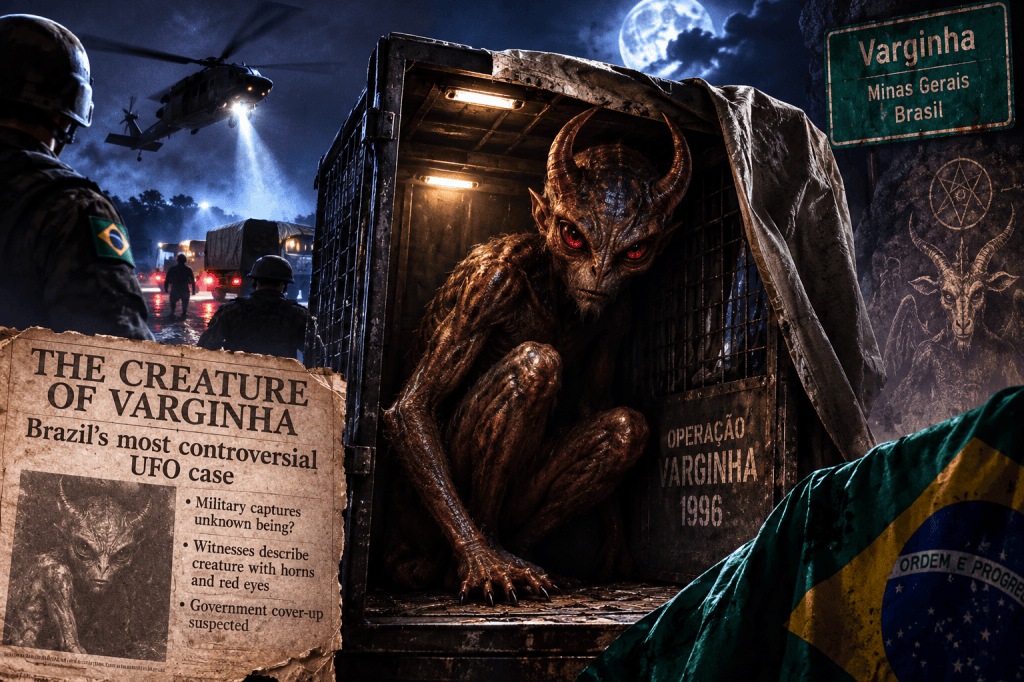
On an ordinary afternoon in January 1996, several young women walking through a vacant lot in Varginha claimed they encountered a strange creature unlike anything they had ever seen.
According to their descriptions, it was approximately five feet tall, with oily brown skin, disproportionately large eyes, and an oversized head. Some witnesses also reported small horn-like protrusions on its head, giving it an appearance that frightened them so deeply that they ran home in panic.
Within hours, rumors spread across the city.
Residents reported unusual military activity.
Army trucks were allegedly seen moving through the streets.
Some claimed that soldiers had captured an unknown being alive.
Others insisted that more than one creature had been recovered.
No official confirmation ever followed.
Yet the story refused to disappear.
The Documentary That Changed the Narrative
Years later, David Vose proposed a far more controversial interpretation.
His documentary argued that the creatures described in Brazil shared remarkable similarities with ancient descriptions of demonic beings rather than visitors from another planet.
The alleged creatures were described as possessing:
- dark, rough skin;
- glowing red eyes;
- horn-like structures;
- an overwhelming sulfur-like odor;
- unusual physical abilities.
To supporters of the theory, these details seemed strangely familiar.
Throughout history, many cultures have described supernatural beings with horns, glowing eyes, and terrifying appearances.
Was this merely coincidence?
Or had humanity been describing the same entities for thousands of years under different names?
Demons… or Visitors?
One of the documentary’s central arguments is both fascinating and controversial.
It suggests that ancient people interpreted mysterious encounters according to the language of their own time.
A medieval monk might have described an unknown entity as a demon.
A Roman could have called it a spirit.
An ancient Greek might have believed it was a divine messenger or a creature from the Underworld.
Today, many people would simply call it an alien.
Perhaps, the documentary suggests, the phenomenon has remained the same while human interpretations have changed.
It is an intriguing idea.
But it remains only a theory.
The Government Conspiracy
As with many famous UFO cases, allegations of a military cover-up quickly emerged.
Witnesses claimed they saw military vehicles transporting unusual containers.
Others alleged that hospitals suddenly became restricted areas.
One persistent story even claimed that a soldier involved in handling one of the creatures later died from a mysterious infection.
These accounts have fueled decades of speculation.
However, despite countless investigations by journalists, researchers, and UFO enthusiasts, no verifiable evidence has ever confirmed that non-human beings were captured.
The official explanations ranged from misunderstandings and rumors to misidentified individuals and ordinary military activity.
For believers, those explanations seem insufficient.
For skeptics, they remain the most likely answer.
Why Horns?
Perhaps the most striking feature of the story is the repeated mention of horn-like structures.
Across human history, horns have symbolized power, divinity, fertility, fear, and the supernatural.
Ancient gods wore them.
Kings placed horned crowns upon their heads.
Later religious traditions often associated horns with demons.
Yet biology offers another possibility.
If such a creature existed, small bony protrusions might simply be part of its anatomy rather than symbols of evil.
The human mind naturally interprets unfamiliar forms through familiar ideas.
Sometimes, symbolism speaks louder than reality.
Between Myth and Memory
The Varginha incident has become one of the world’s most enduring modern mysteries.
For some, it represents compelling evidence that governments conceal encounters with non-human intelligences.
For others, it is a fascinating example of how rumors, fear, media attention, and sincere eyewitness testimony can combine to create a legend.
The truth may lie somewhere between those extremes.
History is filled with stories that were dismissed for centuries before new evidence emerged.
It is equally filled with legends that grew larger every time they were retold.
The Mystery Remains
No authenticated photographs of a captured creature have ever surfaced.
No physical remains have been independently examined.
No official documents confirm that the Brazilian military recovered a non-human being.
And yet…
More than thirty years after the incident, people still travel to Varginha searching for answers.
The story refuses to disappear because it speaks to something deeper than a simple UFO report.
It asks an ancient question that humanity has never stopped asking.
If something truly unknown stood before us…
Would we recognize it for what it is?
Or would we simply give it the oldest name we know?
Perhaps an alien.
Perhaps a demon.
Or perhaps something for which human language has never possessed the right words.


Leave a comment