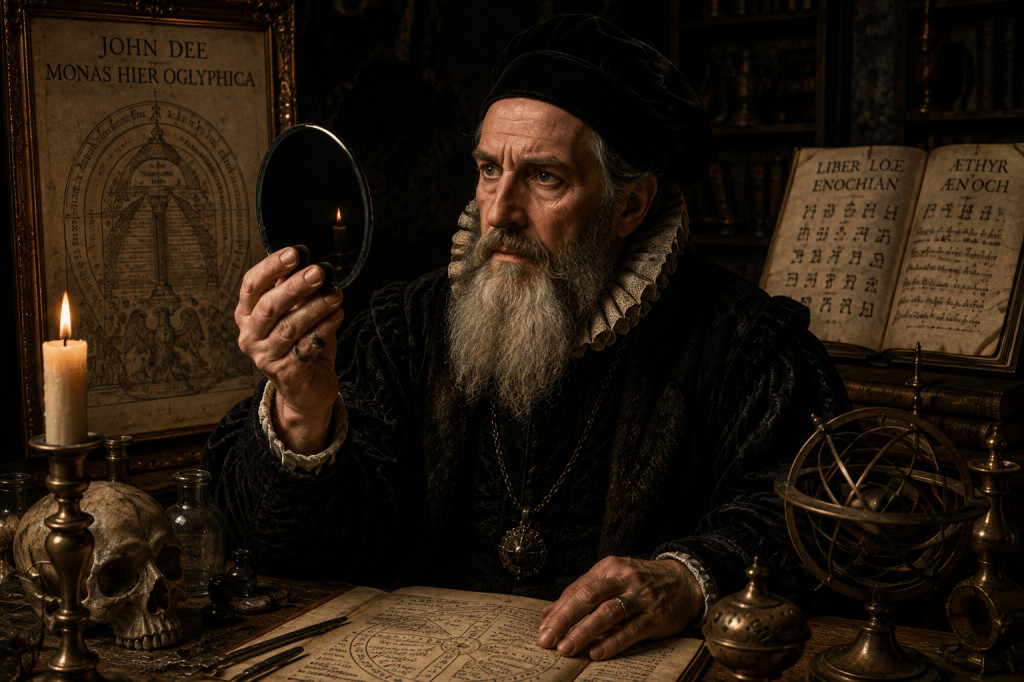
Few objects in the history of the occult have inspired as much fascination as the black mirror of John Dee. Unlike the ornate crystal balls and elaborate magical instruments often portrayed in popular culture, Dee’s mirror was astonishingly simple. It was a polished disk of deep black obsidian, smooth enough to reflect a face, yet dark enough to conceal far more than it revealed. To some, it was merely a carefully crafted artifact from ancient Mexico. To others, it was a doorway through which one of the greatest minds of the Renaissance believed he could communicate with beings beyond the visible world.
John Dee was no ordinary mystic. He served as mathematician, astronomer, navigator, philosopher, and trusted advisor to Queen Elizabeth I. His knowledge of astronomy helped shape England’s ambitions at sea, while his immense personal library became one of the greatest collections of scientific and philosophical works in Europe. Yet despite his remarkable achievements, Dee believed that human knowledge had reached a limit. Beyond mathematics, beyond philosophy, and beyond theology, he became convinced that another source of wisdom existed—one that could only be reached through direct contact with higher intelligences.
It was during this relentless search that the black mirror became central to his work. Unlike many occult practitioners of his age, Dee insisted that he did not seek power, wealth, or domination over hidden forces. He believed that before humanity’s fall from grace, divine knowledge had once been freely accessible. The ancient patriarchs, he argued, had understood truths that later generations had forgotten. His goal was not to invent new magic, but to recover a sacred language that had been lost with time.
The mirror itself had a remarkable history long before it reached Dee’s hands. Modern scholars believe it was fashioned from volcanic obsidian by Aztec craftsmen centuries before the Spanish conquest of the Americas. In Aztec tradition, polished obsidian mirrors were associated with the powerful deity Tezcatlipoca, whose name is often translated as “Smoking Mirror.” Priests are believed to have used such mirrors in rituals of divination, believing they could glimpse hidden realities or receive messages from the divine. Whether by coincidence or fate, an object once revered in one civilization eventually found its way into the study of an English scholar searching for heavenly knowledge.
Dee rarely worked alone. His most famous collaborator was Edward Kelley, a controversial figure who claimed to possess an extraordinary ability known as “scrying”—the practice of perceiving visions within reflective surfaces. While Dee prayed, recorded observations, and carefully documented every detail, Kelley would gaze into the black mirror, describing luminous cities, strange symbols, radiant beings, and voices that claimed to be angels. These sessions were recorded with remarkable precision, filling thousands of pages with conversations written in a mysterious language that Dee believed was the original tongue spoken by Adam before the Fall.
This language, now known as Enochian, remains one of the greatest mysteries in Western esotericism. Some linguists argue that it was an elaborate invention created by Kelley. Others maintain that its unusual grammatical structure and internal consistency make it difficult to dismiss as simple fabrication. Whatever its true origin, the language continues to be studied and used within certain esoteric traditions more than four centuries after Dee first encountered it.
Not everyone who visited Dee’s house viewed these experiments with admiration. Rumors spread quickly through London that the scholar who advised the Queen was secretly practicing forbidden arts. Some believed he conversed with angels; others whispered that no angel would speak through a black mirror once used in pagan ceremonies. The line between divine revelation and dangerous sorcery was perilously thin during the sixteenth century, and Dee increasingly found himself viewed with suspicion. Although he spent much of his life pursuing knowledge, history often remembered him more as a magician than as one of England’s greatest intellectuals.
Centuries later, the black mirror survives. It is no longer hidden inside a private chamber lit by candlelight but preserved behind glass in the collections of the British Museum. Visitors stand before it expecting something extraordinary, only to find a polished disk of black volcanic stone. Yet many describe an unsettling sensation as they look into its surface. Unlike an ordinary mirror, obsidian absorbs light instead of reflecting it brightly. Faces seem to emerge from darkness rather than from light, giving the illusion that the glass possesses an unusual depth.
Psychologists explain this phenomenon as a natural consequence of prolonged observation in dim light. The human brain begins to reinterpret subtle reflections, occasionally producing vivid visual distortions. Historians see the mirror as a priceless cultural artifact connecting Renaissance Europe with pre-Columbian America. Occultists, however, continue to believe that certain objects preserve more than their physical form. They argue that centuries of ritual use may leave behind an intangible presence, impossible to measure yet impossible to ignore.
Whether one accepts these ideas or rejects them entirely, the black mirror of John Dee remains an extraordinary symbol of humanity’s endless search for hidden knowledge. It stands at the crossroads of science, religion, philosophy, and the occult, reminding us that some of history’s greatest thinkers were never satisfied with the answers available in their own age. They continued searching beyond the horizon of accepted knowledge, convinced that the greatest mysteries were not those buried beneath the earth, but those waiting silently beyond the limits of human perception.
Even today, no one can say with certainty what Edward Kelley truly saw reflected in that dark obsidian surface. Perhaps it revealed nothing more than the imagination of a gifted visionary. Perhaps it became a canvas upon which the human mind projected its deepest hopes and fears. Or perhaps, on certain forgotten nights, when the candles burned low and silence filled the room, the mirror reflected something that no ordinary eye was ever meant to see.Dacă vrei, putem transforma acest articol într-o serie intitulată “Forbidden Objects of the Occult”, continuând cu The Book of Soyga, The Hand of Glory, The Emerald Tablet, The Bell Witch Cave, The Skull of Yorick?, The Baphomet Idol și alte relicve misterioase. Acest tip de serie poate deveni o semnătură a blogului tău.


Leave a comment