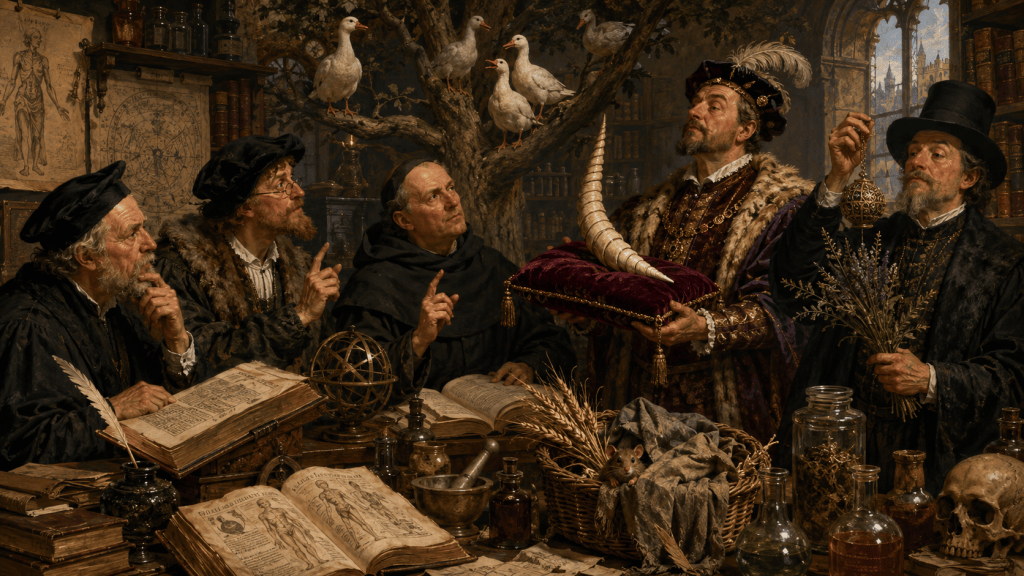
There is something deeply comforting about looking back at history and laughing at our ancestors, because from the safety of the twenty-first century it is remarkably easy to wonder how intelligent people could possibly have believed that mice could be manufactured from dirty laundry, that certain birds grew on trees, that the smell of a rose might stand between a person and the plague, or that the horn of an animal no one had ever reliably seen could detect poison at the dinner table. Yet there is also something slightly dangerous about laughing too loudly, because many of these ideas were not whispered in taverns by the ignorant or preserved only in village superstition; they appeared in serious books, were discussed by physicians, natural philosophers and scholars, circulated through universities and royal courts, and sometimes survived for centuries precisely because respectable people had already decided that they were true.
The history of science is therefore not merely a triumphant procession from darkness toward knowledge, with one brilliant discovery politely replacing another. It is also a museum of magnificent mistakes, some amusing, some deadly, and some so wonderfully strange that, had they appeared in a fantasy novel, an editor might have asked the author to make them a little more believable.
And perhaps the most uncomfortable lesson is this: the people who believed them were not necessarily less intelligent than we are.
WHEN MICE COULD BE MADE FROM WHEAT AND A DIRTY SHIRT
For centuries, one of the most persistent ideas in natural philosophy was spontaneous generation, the belief that living creatures could arise directly from non-living or decaying matter. Maggots seemed to appear from rotting meat, insects appeared in mud, and small animals could seemingly materialize wherever food and filth had been left undisturbed, so the conclusion did not initially appear as absurd as it does today.
The seventeenth-century physician and chemist Jan Baptista van Helmont, an important figure in early chemistry, provided one of the most memorable recipes associated with the theory. According to his writings, if wheat was placed in a vessel together with a dirty shirt, after approximately twenty-one days the combination could produce mice.
Not attract mice.
Produce them.
The sweat from the shirt was supposed to act upon the wheat and somehow transform the material into living animals. One can only imagine the satisfaction of a seventeenth-century experimenter discovering mice in his grain after three weeks and triumphantly announcing that nature had obeyed him, while the mice themselves, having discovered an unattended container full of wheat, were probably equally pleased with the experiment.
Van Helmont also described a supposed method of generating scorpions involving basil and bricks, which suggests that seventeenth-century kitchens could theoretically have doubled as zoological laboratories if one possessed sufficient patience and a reckless attitude toward household pests.
The idea was not destroyed simply because someone laughed at it. It had to be challenged experimentally. In 1668, the Italian physician Francesco Redi placed meat in different containers, leaving some open and covering others so that flies could not reach the meat. Maggots appeared where flies had access, while the protected meat did not spontaneously manufacture them. Redi demonstrated that the seemingly miraculous appearance of worms had a considerably less mystical explanation: flies laid eggs.
Even then, spontaneous generation did not disappear overnight. Versions of the idea survived until the nineteenth century, when experiments by scientists including Louis Pasteur helped demonstrate that microorganisms appearing in supposedly lifeless material came from contamination rather than material suddenly deciding to become alive.
For a theory that seems ridiculous today, spontaneous generation had an extraordinarily long career.
WHEN BIRDS GREW ON TREES
If mice could emerge from wheat, perhaps birds growing from trees did not seem quite so unreasonable.
Medieval and early modern Europeans faced a peculiar mystery involving the barnacle goose, a bird that appeared seasonally in parts of Britain and Ireland but whose nesting grounds were far to the north, beyond the everyday experience of European observers. People saw the birds arrive, but they did not see them breed locally, build nests or hatch from eggs.
Nature seemed to have misplaced an important part of the story.
Meanwhile, sailors and coastal inhabitants encountered strange stalked barnacles attached to floating wood. Their shapes, particularly when interpreted through imagination rather than modern zoology, could be made to resemble developing birds. From this coincidence developed one of history’s most delightful pieces of natural history: the belief that barnacle geese did not hatch from eggs at all.
Some accounts described them developing from barnacles hanging from wood; others imagined strange trees producing structures from which the young birds eventually emerged. Medieval illustrations even depicted trees carrying what looked like embryonic geese, waiting for gravity and destiny to complete the process. Gerald of Wales wrote about the phenomenon in the Middle Ages, and the story remained culturally recognizable centuries later.
It is tempting to imagine an English traveler standing beneath an ordinary oak tree, staring upward with great concentration and wondering why the local geese crop was disappointing that year.
Yet the story reveals something more interesting than simple gullibility. The observers possessed incomplete information and tried to construct an explanation from what they could actually see. The birds arrived mysteriously; barnacles appeared mysteriously; the two objects looked vaguely connected; therefore, a theory was born.
It was wrong, but it had something many successful false theories possess: it explained the missing evidence.
WHEN A BAD SMELL COULD KILL YOU
Few historical theories demonstrate the strange mixture of error and accidental usefulness better than the miasma theory of disease.
For centuries, disease was frequently associated with foul air arising from rotting organic matter, sewage, corpses and filthy streets. Epidemics seemed to flourish in places where the smell was terrible, so physicians and authorities concluded that the smell itself, or some poisonous corruption carried within the air, was responsible.
In other words, if a street smelled as though something had died there, medical wisdom suggested that the smell might soon arrange for something else to die there as well.
During outbreaks of plague, people attempted to protect themselves with strong aromas, vinegar, herbs, spices and smoke. During the Great Plague of London in 1665, advice included carrying aromatic substances and using smoke to defend against dangerous air. The underlying theory was wrong: unpleasant odor itself was not the infectious agent. Yet filthy conditions often did accompany environments where disease spread, meaning that people had noticed a genuine association while misunderstanding its cause.
This distinction matters, because history rarely divides itself neatly into sensible people and fools. Sometimes people observed the right pattern and reached the wrong explanation.
Miasma theory could even encourage sanitation reforms, because removing sewage, rubbish and rotting waste improved public health even though the reformers did not yet understand microorganisms in the modern sense. A mistaken theory could therefore lead occasionally to useful behavior, which is perhaps one reason mistaken theories can be so difficult to kill.
If an incorrect idea appears to work, it acquires friends very quickly.
WHEN KINGS BOUGHT HORNS FROM AN ANIMAL THAT DID NOT EXIST
Medieval and Renaissance Europe possessed another remarkable item of prestigious scientific and medical technology: the unicorn horn.
These objects were not cheap ornaments sold to gullible tourists. Supposed unicorn horns could be extraordinarily valuable, belonged to royal collections and were credited with extraordinary medicinal abilities, particularly the power to detect or neutralize poison.
For a ruler living in a world where poisoning was feared, the attraction is obvious. Imagine sitting down to dinner knowing that political rivals might prefer you dead, while a trusted courtier assures you that the mysterious spiral horn beside your plate will reveal whether someone has interfered with the soup. One might reasonably decide that the horn was worth a considerable amount of money.
Unfortunately for European monarchs and fortunately for Arctic marine biology, many celebrated “unicorn horns” were actually narwhal tusks.
The narwhal’s extraordinary spiral tusk entered European trade from northern regions and was interpreted within a culture that already accepted descriptions of unicorns. According to the Smithsonian, narwhal tusks were sold as unicorn horn and credited with medical properties ranging from treating diseases to detecting poison, and the most prized examples could command astonishing prices.
The deception worked partly because almost nobody buying a unicorn horn was in a position to compare it with an actual unicorn.
This is an excellent commercial advantage when selling imaginary animals.
What makes the story especially fascinating is that the objects themselves were entirely real. A magnificent spiral tusk could be placed on a table, measured, touched and displayed to ambassadors. The mistake concerned not the evidence but its interpretation.
The horn existed.
The unicorn was the problem.
WHEN THE CURE FOR DROWNING INVOLVED TOBACCO SMOKE AND A VERY UNEXPECTED ROUTE
Historical medicine becomes particularly dangerous when one assumes that every strange treatment is an exaggeration invented later for amusement.
Consider the tobacco-smoke enema.
After tobacco reached Europe, it acquired a reputation as a medicinal substance and was recommended for various conditions. By the Georgian period in Britain, physicians and rescuers sometimes attempted to revive drowning victims by introducing warm tobacco smoke into the rectum, believing that the warmth and stimulating properties of tobacco might restore the apparently lifeless person.
This was sufficiently respectable that equipment for administering tobacco-smoke enemas was provided along the River Thames in connection with efforts to resuscitate drowning victims.
There are historical medical procedures that invite careful scholarly interpretation.
This one also invites the observation that waking after nearly drowning and discovering several earnest gentlemen standing behind you with bellows must have produced an unusually strong desire to return immediately to full consciousness.
The practice nevertheless followed a recognizable medical logic of its period. Tobacco was considered stimulating, drowning victims were cold and unresponsive, and warm smoke appeared capable of providing both heat and stimulation. Without modern knowledge of respiratory physiology, the reasoning was not random, merely spectacularly misdirected.
Eventually, more effective methods of resuscitation replaced it, and the bellows were allowed to return to occupations less alarming to patients.
WHEN POISON WAS MEDICINE
Medicine provides some of the most disturbing examples of intelligent people operating with imperfect knowledge, because a physician cannot simply wait several centuries for microbiology to improve while a patient is suffering in front of him.
For hundreds of years, mercury compounds were among the treatments used against syphilis. Mercury could be administered in different forms, despite its toxicity, because physicians had few effective alternatives and sometimes interpreted the body’s violent reactions to treatment as evidence that the medicine was doing something useful.
And technically, it certainly was doing something.
Unfortunately, some of what it was doing was poisoning the patient.
The Science History Institute notes that historical syphilis treatments involving toxic mercury compounds could produce symptoms severe enough to rival those of the illness itself. Later, the arsenic-derived drug Salvarsan, introduced in the early twentieth century, became an important treatment before penicillin transformed syphilis therapy.
Here the story becomes more sobering than amusing, because it reminds us that past physicians were often forced to choose between dangerous treatment and an even more dangerous disease. Their mistakes were sometimes produced not by stupidity but by desperation, limited evidence and the absence of better options.
That distinction is important when judging the past.
It is also slightly terrifying.
THE MOST DANGEROUS PHRASE IN SCIENCE MAY BE “EVERYONE KNOWS”
What connects mice created from dirty shirts, geese growing from trees, poisonous air, medicinal unicorn horns and tobacco smoke administered through improbable anatomy is not simply ignorance.
It is authority.
Once an idea entered respected books, once distinguished scholars repeated it, once physicians taught it to students and students eventually became the next generation of physicians, the theory gained something stronger than evidence: familiarity.
People stopped asking whether it was true and began asking how it worked.
That is a remarkably important transition.
If everyone agrees that barnacle geese grow from unusual marine structures, the scholarly question becomes the precise stage at which feathers develop. If unicorn horn neutralizes poison, researchers debate how best to prepare the powder. If bad air produces disease, officials argue over which smells are most dangerous.
A false premise can therefore generate an enormous amount of perfectly logical reasoning.
The reasoning may be excellent.
The premise is still false.
History repeatedly demonstrates that intelligence is not an automatic vaccine against error. In fact, an intelligent person can sometimes defend a bad idea more effectively than an unintelligent person, because intelligence supplies a much larger collection of arguments with which to protect it.
WHY DID THEY NOT SIMPLY CHECK?
This is perhaps the question modern readers ask most frequently, and it deserves an answer.
Sometimes they did check.
Redi checked the maggots. Pasteur checked microorganisms. Anatomists dissected bodies. Naturalists traveled. Physicians compared cases. Sailors brought specimens home. Each challenge slowly weakened beliefs that had previously seemed obvious.
But checking reality was historically more difficult than it sounds. A medieval scholar in England could not book an inexpensive flight to Greenland to inspect a barnacle goose nesting site. A physician could not examine bacteria without instruments that had yet to be invented. A European naturalist confronted with a narwhal tusk might never see a living narwhal during his entire lifetime.
Books therefore carried enormous authority, particularly when an ancient and respected author had made the original claim.
Knowledge was inherited much as property was inherited, and people were understandably reluctant to throw away an intellectual estate merely because one room looked suspicious.
Eventually, however, observation began winning more arguments.
Not always quickly.
Not always peacefully.
But increasingly, the question changed from “Who said this?” to “How can we test it?”
That change may be one of the most important events in the history of human thought.
AND NOW FOR THE UNCOMFORTABLE QUESTION
It would be pleasant to finish here, congratulate ourselves and conclude that humanity has finally escaped the age of ridiculous ideas.
Unfortunately, history does not offer us that luxury.
The medieval scholar who believed that birds grew from trees did not wake each morning thinking, Today I shall believe something absurd. He believed he possessed a reasonable explanation supported by respected authorities and apparently consistent with the evidence available to him.
The physician carrying aromatic herbs against epidemic disease did not consider himself superstitious. The courtier guarding a king’s supposed unicorn horn did not necessarily imagine himself participating in mythology. Van Helmont did not think that his theories would one day become material for jokes about dirty shirts and entrepreneurial mice.
They lived inside the accepted knowledge of their own time.
So do we.
Science today possesses tools, methods and safeguards unimaginable to earlier generations, from controlled trials and statistical analysis to genetics, electron microscopy and global scientific collaboration. That does not mean every current theory is wrong, nor does it mean modern science is merely another collection of medieval beliefs. Quite the opposite: the strength of science lies precisely in its ability to test, challenge and eventually abandon ideas when evidence contradicts them.
But it does mean that some things we currently regard as obvious will almost certainly be revised, qualified or discarded.
Perhaps a person living in the year 2400 will open a history book, encounter one of our most confident assumptions and stare at the page with exactly the expression we wear when reading instructions for manufacturing mice from wheat and underwear.
They may laugh.
We should probably forgive them.
After all, somewhere in seventeenth-century Europe, a very serious man once looked into a container containing wheat, discovered several mice and believed he had witnessed the creation of life.
The mice, meanwhile, had probably reached a simpler and much more accurate scientific conclusion:
free dinner.
Sources & Further Reading
Bob Fenster, Duh! The Stupid History of the Human Race
Additional historical and scientific sources were consulted to verify the events and beliefs discussed in this article.


Leave a comment