Part II – The Tomb in Kashmir, the Templar Secret and the Search for Evidence
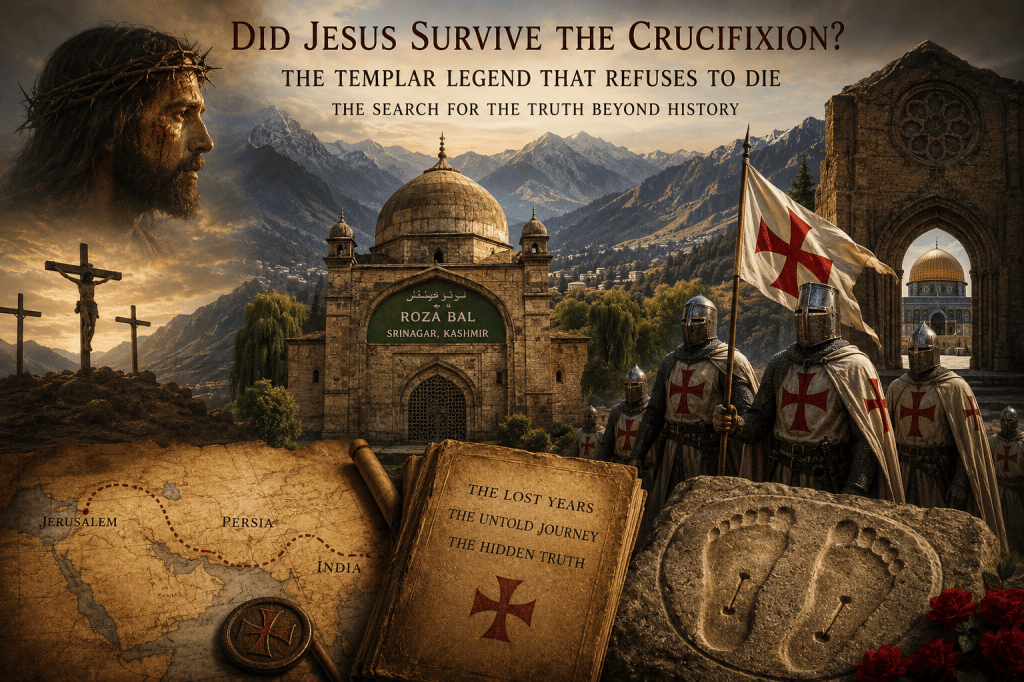
Did Jesus Survive the Crucifixion? The Templar Legend That Refuses to Die
Part II – The Tomb in Kashmir, the Templar Secret and the Search for Evidence
The first part of this investigation examined the historical evidence for the crucifixion of Jesus, the medical improbability of surviving a Roman execution, and the controversial nineteenth-century claims that Jesus may have traveled eastward during the undocumented years of his early life. Those theories become considerably more complicated, however, when the story moves beyond Tibet and into Kashmir, where an old tomb in the city of Srinagar has become the center of one of the most persistent alternative narratives in modern religious history.
The building is known as Roza Bal, a modest shrine located in the Khanyar district of Srinagar. For generations it was associated locally with a figure known as Yuz Asaf, traditionally remembered as a holy man. During the late nineteenth and twentieth centuries, however, writers began advancing a far more extraordinary interpretation: Yuz Asaf, they claimed, was actually Jesus of Nazareth, who had survived the crucifixion, traveled east and eventually died in Kashmir at an advanced age.
It is a remarkable proposition. It is also one for which mainstream historians find no convincing contemporary evidence.
Understanding why the theory became so influential requires separating several layers of history that have gradually been combined into a single narrative.
Roza Bal: The Tomb at the Center of the Mystery
Roza Bal existed long before it became internationally associated with Jesus. The shrine contains a tomb traditionally connected with Yuz Asaf and another Muslim holy figure. Local traditions surrounding the site developed over centuries, but establishing precisely when individual elements of those traditions originated is difficult.
The identification of Yuz Asaf with Jesus became particularly influential through the writings of Mirza Ghulam Ahmad, founder of the Ahmadiyya movement, toward the end of the nineteenth century. Ahmad argued that Jesus had survived crucifixion, traveled east in search of the Lost Tribes of Israel and eventually settled in Kashmir.
In this interpretation, the crucifixion did occur, but it did not end Jesus’ earthly life.
Instead, it marked the beginning of another journey.
The theory later attracted independent authors, travelers and researchers who attempted to connect various Asian legends with the life of Jesus.
Yet the historical problem is substantial: there is an enormous chronological gap between the first century, when Jesus lived, and the much later sources used to establish the connection between Jesus and Yuz Asaf.
No securely dated first-century inscription at Roza Bal identifies the person buried there as Jesus of Nazareth.
No contemporary Roman, Jewish or Indian document records Jesus arriving in Kashmir after the crucifixion.
That absence does not logically prove that such a journey could never have occurred, but it prevents historians from treating it as established history.
Who Was Yuz Asaf?
The identity of Yuz Asaf is itself complicated.
Various versions of the name appear in later Persian, Arabic and South Asian traditions. Some writers describe him as a prophet or holy man who came from the West. Others connect the tradition to stories that circulated across Asia through centuries of religious and cultural exchange.
This has created a tempting historical puzzle.
If Yuz Asaf was a foreign religious teacher, could his story preserve a distant memory of Jesus?
The difficulty is that names and legends change dramatically as they move between languages and cultures. Stories can merge with other stories, historical figures can acquire characteristics belonging to entirely different people, and religious narratives can survive for centuries while changing their original meaning.
Historians therefore require more than similarities between legends.
They require evidence capable of connecting a specific person, place and period.
That connection has never been conclusively established at Roza Bal.
The Mysterious Footprints
One of the most frequently cited pieces of evidence involves carved impressions traditionally interpreted as footprints associated with the tomb.
Some proponents of the Jesus-in-Kashmir theory have claimed that markings on these impressions correspond to wounds caused by crucifixion nails.
If genuine and demonstrably connected with the individual buried at Roza Bal, such evidence would certainly be intriguing.
But several problems immediately appear.
The age and original purpose of the footprints have not established the identity of the person buried there. Even if the markings were intended to represent wounds, symbolic representations of injured or sacred feet occur in multiple religious traditions.
An image is not a biological identification.
Without independently authenticated first-century material connecting those footprints specifically to Jesus, they cannot function as proof of survival from the crucifixion.
They remain part of the tradition surrounding the shrine rather than forensic evidence.
What About the Lost Tribes of Israel?
Another important element of the theory attempts to explain why Jesus would have traveled to Kashmir at all.
Supporters argue that populations descended from the Lost Tribes of Israel migrated eastward following ancient Assyrian deportations. Jesus, according to this hypothesis, traveled through Afghanistan and northern India in search of these dispersed communities.
Certain similarities between Kashmiri and Jewish customs have occasionally been cited in support of the idea.
Yet cultural resemblance alone is notoriously unreliable evidence for common ancestry. Trade, migration, conquest and religious exchange can produce similarities between societies without demonstrating direct descent.
Modern historical and genetic research has not established the extraordinary chain of events required to demonstrate that Jesus traveled to Kashmir specifically to find Israelite descendants.
Once again, an interesting possibility becomes something very different when subjected to the standards required for historical proof.
Enter the Knights Templar
The story becomes even more dramatic when the Knights Templar enter the narrative.
The Templars were founded in the early twelfth century, initially to protect Christian pilgrims traveling through the Holy Land. Over the following two centuries, the order became wealthy, politically influential and surrounded by secrecy.
Their headquarters were established on Jerusalem’s Temple Mount, an association that later generated enormous speculation.
What did the Templars discover beneath Jerusalem?
Did they find ancient manuscripts?
Documents relating to Jesus?
The Ark of the Covenant?
The Holy Grail?
Evidence capable of undermining the authority of medieval Christianity?
These possibilities have become central to modern Templar mythology.
The historical record, however, is far less dramatic.
There is no authenticated Templar document stating that Jesus survived the crucifixion. Nor is there reliable medieval evidence demonstrating that the order possessed secret records tracing Jesus to India or Kashmir.
The association largely belongs to much later esoteric literature and modern alternative-history theories.
The Templars undoubtedly possessed secrets in the ordinary sense: financial information, military plans, internal ceremonies and political agreements. Secretive institutions naturally attract speculation, particularly when their destruction is as dramatic as that of the Templars.
But secrecy itself is not evidence of a hidden gospel.
Why Were the Templars Destroyed?
This question is crucial because it is often used to support the theory.
On Friday, 13 October 1307, King Philip IV of France ordered the arrest of Templars throughout his kingdom. They were accused of heresy, idolatry, obscene initiation rituals and numerous other offenses.
Some confessed under interrogation and torture.
The spectacular accusations eventually helped create the image of an organization guarding forbidden knowledge.
The political and financial context provides a less mysterious explanation.
Philip IV was heavily indebted to the Templars and had strong reasons to eliminate an organization whose wealth and independence had become politically inconvenient. Pope Clement V eventually dissolved the order in 1312.
Nothing in the surviving evidence demonstrates that the Templars were destroyed because they possessed proof that Jesus survived the crucifixion.
That interpretation appeared much later.
From History to Alternative History
The Jesus-survival theory demonstrates how powerful alternative histories are created.
Several genuine historical mysteries exist at its foundation.
We know remarkably little about Jesus’ life between childhood and approximately age thirty.
Ancient trade routes genuinely connected the Mediterranean with India.
The Templars genuinely operated from Jerusalem and developed extraordinary wealth and influence.
Roza Bal genuinely exists.
Yuz Asaf genuinely belongs to traditions associated with the shrine.
These are historical elements.
The controversial step occurs when separate facts are connected by assumptions for which evidence is missing.
A gap in the historical record becomes a journey.
A mysterious holy man becomes Jesus.
A medieval military order becomes the guardian of the secret.
Once those elements are assembled, they create a compelling story.
But a compelling story and a demonstrated historical sequence are not the same thing.
Could Jesus Have Survived Crucifixion?
Returning to the original question requires confronting the strongest evidence available.
Roman crucifixion was designed to kill.
The canonical Gospels explicitly state that Jesus died.
Early Christian writings are built around his death and resurrection.
Tacitus independently confirms that Christus was executed under Pontius Pilate.
There is no surviving first-century source stating that Jesus survived and traveled to India.
From the standpoint of mainstream historical scholarship, therefore, the conclusion is clear: Jesus was crucified and died as a consequence of the execution.
The survival hypothesis requires several extraordinary assumptions for which contemporary evidence is absent.
That does not make studying the legend meaningless.
Quite the opposite.
Why the Legend Refuses to Die
The continuing fascination with the theory reveals something important about the way people approach history.
Unanswered questions are uncomfortable.
When the historical record becomes silent, imagination naturally enters the empty space.
The missing years of Jesus invite speculation because we want to know what happened.
The mysterious traditions of Kashmir attract attention because they appear to offer an answer.
The Templars fascinate us because their dramatic destruction suggests that something important disappeared with them.
Put these mysteries together and an irresistible narrative emerges.
Yet responsible historical investigation requires resisting the temptation to turn possibility into evidence.
At present, there is no reliable historical proof that Jesus survived the crucifixion, traveled to Kashmir, died at Roza Bal or entrusted knowledge of his survival to the Knights Templar.
There are traditions.
There are disputed interpretations.
There are remarkable coincidences.
And there are unanswered questions.
Those things deserve investigation, but they should not be confused with conclusions.
Perhaps that distinction is what makes this story genuinely fascinating. The mystery is not simply whether Jesus traveled to India. The deeper mystery is how fragments of history, religion and legend separated by thousands of kilometers and many centuries became woven together into a story powerful enough to survive into the modern world.
The tomb at Roza Bal still stands.
The Templars are gone.
The ancient sources remain incomplete.
And nearly two thousand years after the crucifixion, the question continues to be asked—not because history has provided convincing evidence for an alternative ending, but because humanity has never stopped searching for what might exist beyond the parts of the story we already know.


Leave a comment