LSD, Hypnosis, Secret Rooms and the Cold War Search for Mind Control
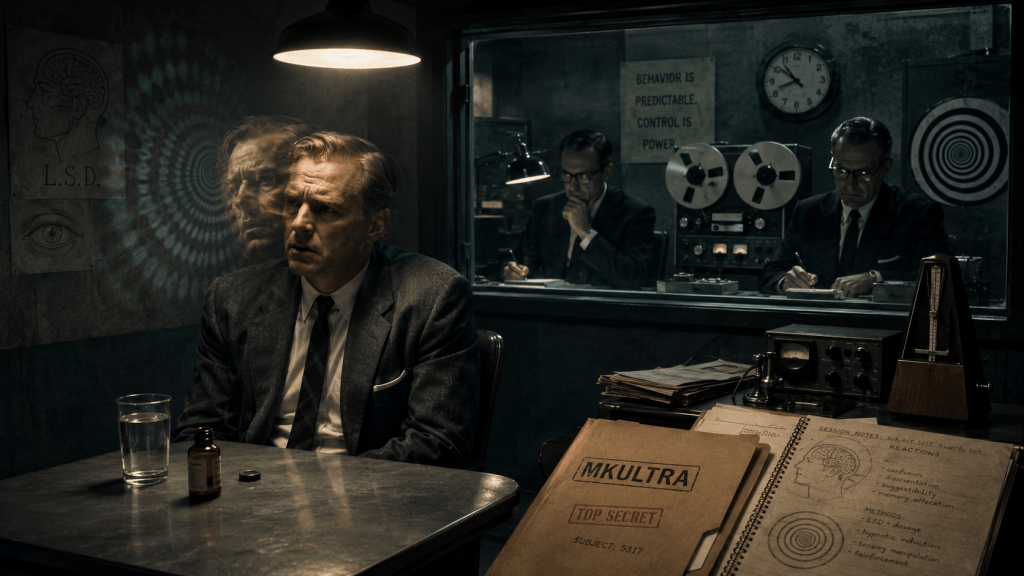
On the evening of November 19, 1953, a group of American scientists and intelligence officials gathered at a retreat in Maryland, where dinner, conversation and drinks should have made the meeting indistinguishable from countless other professional gatherings taking place during the early years of the Cold War. Among the men present was Frank Olson, a 43-year-old biochemist working with the U.S. Army at Fort Detrick, one of the most sensitive centers of American biological warfare research, who had no reason to suspect that the glass placed before him had transformed him from scientist into experimental subject.
CIA personnel had secretly put LSD into drinks consumed by Olson and several of his colleagues, and only after approximately twenty minutes were the men informed that they had been drugged. During the following days Olson became profoundly distressed, was taken to New York for psychiatric attention and, early on November 28, fell from the tenth-floor window of the Hotel Statler, dying on the pavement below. His death would officially be treated as suicide, although members of his family would later challenge that explanation and raise questions that remain controversial; what is not controversial, because the government itself eventually acknowledged it, is that Olson had been given LSD without knowing what he was taking shortly before his psychological collapse.
For more than twenty years, Olson’s family did not know the true circumstances surrounding the experiment, while the larger program of which it formed a part remained almost completely hidden from the American public. When congressional investigations finally forced portions of the story into daylight during the 1970s, what emerged sounded disturbingly similar to the kind of tale that might previously have been dismissed as paranoid fiction: the CIA had financed experiments involving psychoactive drugs, hypnosis, sensory manipulation and behavioral modification; some subjects knew they were participating in research, while others did not; universities, hospitals, prisons and private organizations had become connected to the program; and much of the original documentation had already been deliberately destroyed.
The program was called MKUltra, and although decades of popular culture have surrounded that name with stories of programmable assassins, celebrity mind control and mysterious trigger words, the documented history is sufficiently unsettling without adding anything that cannot be proved.
THE COLD WAR FEAR THAT SOMEONE HAD DISCOVERED HOW TO CONTROL THE MIND
To understand why American intelligence officials became interested in something as extraordinary as behavioral control, it is necessary to return to the psychological atmosphere of the early Cold War, when Washington was not merely afraid that the Soviet Union and Communist China possessed superior weapons, but increasingly feared that they might have discovered techniques capable of breaking, conditioning or reprogramming human beings.
Reports of political confessions in Communist countries, combined with the behavior of some American prisoners during and after the Korean War, helped popularize the idea of “brainwashing,” a term that quickly escaped intelligence circles and entered the public imagination. To people watching from the West, the possibility that prisoners could apparently be transformed into supporters of their captors suggested that an invisible weapon might already exist, one capable of bypassing ordinary military defenses because its battlefield was the human personality itself.
The CIA had begun investigating related questions before MKUltra through programs including BLUEBIRD, approved in 1950, and ARTICHOKE, which followed it. According to records later examined by the U.S. Senate, these projects explored defensive questions such as protecting American personnel from hostile interrogation, but they also examined whether drugs, hypnosis and unconventional interrogation techniques might be used offensively to influence individuals or extract information.
The atmosphere surrounding these programs is captured remarkably well by CIA Director Allen Dulles himself, who delivered a public speech entitled “Brain Warfare” in April 1953, describing Communist methods of psychological manipulation as a new frontier of conflict. Only days later, on April 13, 1953, Dulles approved the project that would become MKUltra, granting the Agency’s Technical Services personnel unusually broad freedom to investigate chemical and behavioral methods that might someday have intelligence applications. Surviving CIA financial documents explicitly trace the authority for MKUltra subprojects back to that April 13 authorization.
The crucial point is not that the CIA knew how to control a human mind in 1953, because there is no evidence that it did, but rather that intelligence officials were frightened enough by the possibility that their enemies might know how to do it that they were prepared to conduct an extraordinary search for the answer themselves.
MKULTRA WAS NOT ONE EXPERIMENT BUT A SECRET NETWORK
The popular image of MKUltra tends to involve a hidden laboratory, a scientist with a syringe and a prisoner strapped to a chair, yet the reality was far more diffuse and therefore, in some respects, more disturbing. MKUltra functioned as an umbrella beneath which numerous research projects could be financed, often through intermediary organizations that concealed the CIA’s role from institutions, researchers or participants.
When surviving records were examined in 1977, CIA Director Stansfield Turner informed the Senate that investigators had identified 149 MKUltra subprojects. The surviving material connected the program to dozens of universities, research foundations, hospitals, clinics and other institutions, while some projects involved drugs and human experimentation, some concerned hypnosis or behavioral research, and others dealt with subjects only indirectly related to what popular culture would later call “mind control.”
This structure provided an enormous practical advantage: a researcher studying memory, sleep, hypnosis or the effects of a drug did not necessarily need to be introduced to a CIA officer and informed that the Agency was interested in his results. Funding could pass through foundations and intermediary organizations, allowing legitimate academic research, intelligence interests and secret sponsorship to exist within the same system without every participant understanding the complete arrangement.
The surviving financial records show precisely why MKUltra became so difficult to reconstruct afterward, because there was no single laboratory in which everything happened and no single technique that defined the project. Instead, fragments of research were distributed through a network in which one institution might examine a drug, another might study hypnosis, another might investigate human responses to isolation, while intelligence officers attempted to determine whether any of those discoveries could become useful in interrogation, espionage or clandestine operations.
LSD AND THE DREAM OF A CHEMICAL KEY TO THE HUMAN PERSONALITY
Of all the substances examined during the program, none would become more notorious than LSD-25, which in the early 1950s was still sufficiently new and poorly understood that its extraordinary effects immediately attracted intelligence interest. Long before LSD became associated with psychedelic music and the counterculture, CIA researchers were asking whether a chemical capable of dramatically altering perception might become a tool for interrogation, confusion, disorientation or covert manipulation.
The possibilities must have appeared almost limitless. A person under the influence of LSD could experience distortions in time, perception and identity, profound emotional changes and unpredictable reactions to his surroundings, which led researchers to wonder whether the drug could weaken resistance during interrogation, produce amnesia, expose secrets or temporarily incapacitate a target without the obvious violence associated with conventional methods.
The problem was that LSD was anything but predictable, and the broader search for a chemical “truth serum” repeatedly collided with an uncomfortable scientific reality: lowering inhibitions is not the same as producing truth. A confused or intoxicated subject might speak more freely while also exaggerating, fantasizing, misremembering or inventing information, making the dream of a dependable chemical key to another person’s mind much easier to imagine than to achieve. The Senate’s investigation into CIA chemical and behavioral programs would later emphasize precisely this difficulty.
Nevertheless, testing expanded beyond volunteers, because intelligence officers eventually confronted an operational dilemma that produced one of MKUltra’s most serious ethical violations. If a drug were ever going to be secretly administered to an enemy agent, testing it only on volunteers who knew that they had taken a psychoactive substance could not reveal how an unsuspecting person would behave.
That reasoning created the justification for unwitting experimentation.
Documents surviving in the CIA archive contain proposals explicitly discussing the possibility of administering LSD without subjects knowing that they were participating in such an experiment, while the later Senate investigation confirmed that unwitting testing did occur.
The experiment had escaped the laboratory, because the unsuspecting citizen was now considered scientifically useful precisely because he did not know he was an experiment.
OPERATION MIDNIGHT CLIMAX AND THE ROOMS BEHIND THE MIRROR
Among the strangest chapters in MKUltra were the CIA-supported safe houses established in San Francisco and later New York, where agents could observe the effects of drugs on people in comparatively natural social circumstances rather than inside laboratories.
The San Francisco operation became popularly known as Operation Midnight Climax, and its methods seem almost designed for a spy novel. Men were brought into apartments where prostitutes working with the operation could help create situations in which subjects relaxed their normal defenses, after which drugs could be administered without their knowledge while observers watched what happened from behind one-way mirrors.
The 1977 Senate hearings established that unwitting testing took place in safe houses in San Francisco and New York, with CIA officials later required to provide Congress with information about the people associated with those locations. The same investigation exposed how poorly controlled some of these experiments could be, particularly because subjects might disappear into the city after leaving the apartment, making any meaningful medical follow-up exceedingly difficult.
The scientific weakness of the system is almost as astonishing as its ethical implications. A genuine clinical experiment normally attempts to control variables, record dosages precisely, monitor subjects and observe long-term consequences, yet here people could be secretly drugged inside apartments while intelligence officers attempted to evaluate their behavior from another room, sometimes without the kind of systematic follow-up that would have been expected in responsible medical research.
The safe houses illustrate something essential about MKUltra, because the goal was not merely to understand what LSD did inside a laboratory but to discover what might happen if a substance were covertly introduced into an ordinary human situation, where the subject possessed no warning that reality itself was about to become unreliable.
HYPNOSIS, AMNESIA AND THE SEARCH FOR THE “MANCHURIAN CANDIDATE”
Drugs were only one road into the mind, and surviving MKUltra records show that the CIA also funded research involving hypnosis, including projects examining combinations of hypnotic techniques and psychoactive substances.
Here the questions became even more ambitious, because intelligence officers were interested in whether hypnosis could affect memory, increase suggestibility or help create behaviors that might later be activated without the subject consciously remembering how they had been established. Could an agent be made to forget information until it became necessary? Could a courier carry a secret that he could not consciously reveal? Could hypnosis combined with drugs create a deeper state of suggestibility than either technique alone?
These possibilities would later become associated with the fictional “Manchurian Candidate,” the idea of a human being psychologically programmed to perform an action upon receiving a particular signal, yet the surviving evidence does not demonstrate that the CIA ever achieved anything remotely as reliable as the fictional version.
Hypnosis itself varies dramatically between individuals, while extreme suggestibility is not equivalent to the deletion of free will, and the CIA’s willingness to investigate such possibilities must therefore be separated from evidence that those possibilities were successfully achieved. This distinction is particularly important with MKUltra, because the historical record proves that intelligence officials asked extraordinary questions but does not prove that they found the extraordinary answers later conspiracy theories attribute to them.
DONALD EWEN CAMERON AND THE MONTREAL EXPERIMENTS
If the safe houses represented MKUltra’s shadowy world of drugs and clandestine observation, the experiments associated with psychiatrist Donald Ewen Cameron at Montreal’s Allan Memorial Institute revealed another path toward behavioral transformation, one involving repeated messages, sensory restriction, prolonged sleep and unusually intensive electroconvulsive treatment.
Cameron was not an obscure underground doctor but one of the most prominent psychiatrists of his era, having served in senior professional positions and participated in psychiatric evaluation connected with the Nuremberg Trials. He had developed theories about treating severe psychiatric illness before CIA money entered the picture, which makes his relationship with MKUltra considerably more complex than the popular story of a scientist simply receiving orders from intelligence officers. Modern historical research indicates that Cameron was probably unaware that some of his funding ultimately came from the CIA, because the money was routed through a front organization known as the Society for the Investigation of Human Ecology.
His CIA-supported research became MKUltra Subproject 68, and surviving Agency documentation describes an astonishing program involving the repeated presentation of verbal signals, partial sensory isolation, prolonged sleep and drugs including LSD-25. One CIA record describes repeated verbal messages being delivered for as long as sixteen hours a day over several days, followed by continuous sleep lasting seven to ten days, while another surviving assessment identifies Cameron himself as an unwitting participant regarding the true source of the funding.
Cameron called one technique “psychic driving,” in which patients repeatedly heard recorded statements, sometimes their own emotionally charged words and sometimes messages prepared by researchers. His broader concept of “depatterning” attempted to disrupt existing patterns of behavior before rebuilding healthier ones, but the procedures could involve extraordinarily intensive electroconvulsive therapy and powerful combinations of drugs, while historical accounts describe patients suffering serious and lasting consequences.
One of the strangest details involved the repetition itself. Rather than hearing a therapeutic message once during a conversation with a psychiatrist, patients could be exposed to recorded statements for hour after hour, sometimes through speakers placed near them while they remained isolated from normal sensory stimulation, as though personality might somehow be dismantled into silence and then reconstructed by filling that silence with carefully selected words.
Whatever Cameron believed he was attempting therapeutically, the CIA saw obvious intelligence implications in research investigating whether existing behavioral patterns could be disrupted and whether repeated signals might encourage new ones, which explains why his work attracted the attention of an organization searching for methods of psychological influence.
The experiments also reveal how misleading the simple image of “CIA scientists” can be, because secret programs may operate through people who possess only part of the picture. Cameron knew what he was doing to his patients, but the available evidence suggests that he probably did not know who ultimately stood behind part of the financial support; other researchers knew they were cooperating with the Agency, while institutions sometimes knew considerably less.
Secrecy functioned not merely by hiding information from the public, but by dividing information among the participants themselves.
THE DEATH OF FRANK OLSON AND THE PRICE OF UNWITTING EXPERIMENTATION
Frank Olson’s death remains the most famous human tragedy associated with the CIA’s LSD experiments because it demonstrates how quickly a secret test could produce consequences that no laboratory protocol could reverse.
What happened inside Olson’s mind after the drug was administered cannot now be reconstructed with certainty, and later theories alleging that he was murdered remain disputed. The documentary record does, however, establish that he was secretly given LSD, that he experienced severe psychological disturbance afterward and that he died after falling from a New York hotel window several days later. CIA records subsequently criticized the judgment involved in the experiment, while the Rockefeller Commission’s investigation in the 1970s finally brought the secret dosing to public attention.
The case forced a particularly disturbing ethical question into view: even if an intelligence agency believed that covert drugging had national-security value, how could an unsuspecting person’s reaction possibly be controlled once the substance had been administered?
A volunteer in a legitimate psychedelic experiment knows that unusual sensations may result from a drug and normally has medical personnel available to provide reassurance if the experience becomes frightening, whereas an unwitting subject may believe that his perceptions, thoughts or identity are disintegrating for reasons he cannot understand.
The absence of informed consent was therefore not merely an abstract ethical violation; it changed the psychological experience of the drug itself.
IN 1973, THE FILES BEGAN TO DISAPPEAR
MKUltra would probably be easier to understand today if historians possessed its complete operational archive, but in January 1973, most of the program’s records were deliberately destroyed.
A later CIA Inspector General investigation found documentation indicating that Sidney Gottlieb had ordered the destruction of MKUltra files after receiving instructions from outgoing CIA Director Richard Helms. Records retrieved from archives as well as branch files were destroyed, while the Senate’s later investigation regarded the destruction as a striking example of the failure of normal administrative controls surrounding the program.
This act transformed MKUltra permanently, because from that moment historians would face an impossible problem: surviving evidence could prove that secret activities existed, but destroyed evidence could no longer reveal their complete boundaries.
How many people were exposed without their consent, what precisely happened within every subproject, which experiments failed, which produced injuries, and how much individual institutions understood about their relationship with the CIA are questions that cannot always be answered because the records necessary to answer them no longer exist.
Then bureaucracy performed one of history’s peculiar miracles.
Financial records survived.
In 1977, CIA personnel discovered boxes of previously overlooked MKUltra material containing funding and administrative records that had escaped the destruction, and because money had to be authorized, transferred and accounted for, these apparently mundane documents allowed investigators to reconstruct part of a project that had otherwise been deliberately erased. CIA records later described the discovery as providing the first detailed insight into the 149 subprojects.
Invoices had remembered what secret files were supposed to forget.
THE 1977 SENATE HEARING AND THE MOMENT THE CONSPIRACY BECAME HISTORY
On August 3, 1977, the United States Senate held a public hearing formally titled Project MKULTRA, the CIA’s Program of Research in Behavioral Modification, during which senators examined the newly recovered documentation and questioned CIA Director Stansfield Turner about the scope of the program.
The hearing established an extraordinary collection of facts: human testing had occurred, some subjects had not known they were participating, covert drug administration had taken place, safe houses had operated in American cities, intermediary funding mechanisms had concealed CIA sponsorship, and dozens of institutions had been connected with MKUltra activities.
For anyone interested in the history of conspiracy theories, this moment is enormously important, because MKUltra illustrates why the word “conspiracy” cannot automatically be treated as synonymous with fantasy.
Had someone in the early 1960s announced that American intelligence was secretly financing experiments involving LSD and hypnosis, administering drugs to unsuspecting people and studying behavioral manipulation through hidden networks of researchers, much of the story might have sounded absurdly paranoid.
By 1977, portions of that extraordinary story were being discussed in the United States Senate using the CIA’s own records.
DID THE CIA ACTUALLY LEARN HOW TO CONTROL THE HUMAN MIND?
This is where the documented history of MKUltra and the mythology that surrounds it must finally separate.
The surviving evidence shows that the CIA investigated techniques intended to influence behavior, manipulate perception, impair memory and increase vulnerability during interrogation, yet it does not demonstrate that the Agency discovered a reliable method capable of transforming ordinary human beings into obedient machines whose behavior could be activated on command.
LSD was unpredictable rather than controllable, hypnosis depended heavily upon individual susceptibility and circumstances, truth drugs did not guarantee truthful answers, and some experiments were so poorly controlled that their scientific usefulness was questionable. The very existence of a research program demonstrates that researchers were searching for an answer, not that they possessed it.
This difference becomes important whenever MKUltra is invoked today to explain claims about musicians supposedly programmed by intelligence agencies, celebrities controlled by trigger words, populations manipulated through hidden frequencies or assassins whose personalities have been deliberately replaced. MKUltra cannot serve as automatic evidence for those theories, because each new claim requires its own documentation.
Yet dismissing every extraordinary allegation merely because it sounds conspiratorial would teach the opposite and equally dangerous lesson, because the history of MKUltra shows that powerful institutions really can conduct activities that initially sound improbable, particularly when secrecy, fear and national security combine.
The rational response is therefore neither automatic belief nor automatic disbelief, but something far more demanding: follow the evidence until the evidence ends, and do not allow imagination to finish the story merely because the surviving archive leaves an empty space.
WHY MKULTRA RETURNED TO CONGRESS IN 2026
More than seven decades after the project began, MKUltra once again entered a congressional hearing room.
On June 30, 2026, the U.S. House Task Force on the Declassification of Federal Secrets held a hearing titled “Mind Control and Accountability: Uncovering the Truth of the CIA’s MKULTRA Project,” with witnesses including author and researcher Stephen Kinzer, investigative journalist Tom O’Neill and former National Institutes of Health program director Elizabeth Ginexi. The hearing focused not upon proof of some newly discovered mind-control technology, but upon the history of the program, destruction and classification of records, government transparency and the enduring damage secrecy can cause to public trust.
That such a hearing could occur in 2026 is itself remarkable, because very few secret programs launched in the early 1950s still possess enough unresolved historical power to bring witnesses before Congress more than seventy years later.
The reason is not simply that MKUltra involved LSD or bizarre experiments, but that the destruction of records created a permanent asymmetry between what we know happened and what we may never know.
THE REAL MYSTERY OF MKULTRA
The most frightening version of MKUltra is not necessarily the one found in conspiracy videos, where human beings become programmable assassins and hidden commands activate personalities manufactured inside secret laboratories, because those claims require evidence that the surviving documents do not provide.
The more unsettling story is the documented one, in which intelligent people working within respected institutions gradually crossed boundaries that should have been unmistakable because they believed that an enemy might already have crossed them first.
Cold War fear produced a search for defensive knowledge; defensive knowledge created interest in offensive applications; legitimate research became intertwined with concealed intelligence funding; voluntary experimentation gave way in some cases to unwitting subjects; secrecy weakened accountability; and when the consequences threatened to become embarrassing, much of the historical record disappeared into destruction.
No supernatural technology was necessary.
There was only fear, institutional power, scientific ambition and the conviction that national security could justify actions that would have been indefensible under ordinary circumstances.
Perhaps this is why MKUltra continues to disturb people long after LSD ceased to be a mysterious new substance and the Cold War that created the program disappeared. Its deepest lesson is not that the CIA discovered how to control the human mind, because the available evidence does not establish that it did, but that a government agency became willing to experiment upon human beings while searching for that possibility.
The difference is enormous, although it is hardly comforting.
When we encounter extraordinary claims today, MKUltra should therefore not teach us to believe everything that calls itself a hidden truth, because documented conspiracies do not magically authenticate unrelated theories. What it should teach us is to demand documents, dates, names, institutional records and independent evidence, while remembering that occasionally an apparently unbelievable story really does leave a paper trail.
In the case of MKUltra, much of that paper trail was deliberately burned.
Enough survived to change history.
And perhaps the most haunting question is not what those surviving documents reveal, but what disappeared with the ones that did not.
SOURCES AND FURTHER READING
U.S. Senate Select Committee on Intelligence — Project MKULTRA, The CIA’s Program of Research in Behavioral Modification, August 3, 1977. The central congressional primary source covering MKUltra’s subprojects, unwitting human experimentation, drugs, hypnosis, safe houses and institutional relationships.
Central Intelligence Agency Reading Room — MKULTRA declassified records. The surviving CIA archive contains financial records, individual subproject documents and later internal investigations concerning the program.
CIA Inspector General records concerning destruction of drug and toxin files. These documents examine the January 1973 destruction of MKUltra records and the roles of Sidney Gottlieb and Richard Helms.
Rockefeller Commission materials, Gerald R. Ford Presidential Library. Government records documenting the circumstances surrounding the secret administration of LSD to Frank Olson and the subsequent investigation.
Jordan Torbay — “The Work of Donald Ewen Cameron: From Psychic Driving to MK Ultra,” History of Psychiatry, 2023. A detailed academic investigation of Cameron, the Montreal experiments, psychic driving, depatterning and the complicated relationship between his psychiatric work and covert CIA funding.
CIA records concerning MKUltra Subproject 68. Surviving documentation identifies Donald Ewen Cameron and the Allan Memorial Institute and describes repeated verbal signals, LSD, sensory isolation and prolonged sleep used in the research.
U.S. House Committee on Oversight and Government Reform — “Mind Control and Accountability: Uncovering the Truth of the CIA’s MKULTRA Project,” June 30, 2026. The recent congressional hearing revisiting MKUltra, declassification and government accountability.


Leave a comment