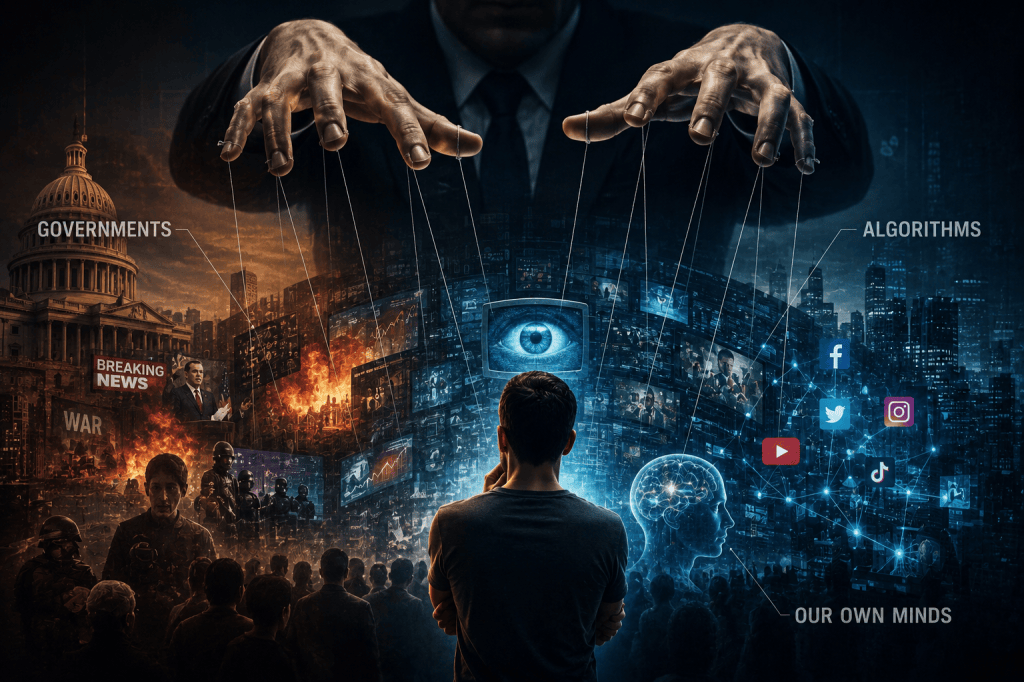
There is an uncomfortable assumption hidden beneath almost everything we do: when we open our eyes in the morning, read the news, remember yesterday, form an opinion about another person, decide what frightens us, determine whom we trust, or convince ourselves that we have reached a conclusion independently, we usually assume that the reality inside our minds corresponds reasonably well to the reality outside them, even though neuroscience, psychology, history and the technological environment in which we now live suggest that this relationship is considerably more complicated than it appears.
The modern fascination with the idea of a “Matrix” often leads us toward spectacular possibilities involving simulated universes, hidden programmers or artificial worlds, yet there may be a version of the Matrix that requires neither a supercomputer nor a secret civilization operating beyond the boundaries of our universe, because human beings have always experienced reality through filters, while governments, religions, political movements, commercial institutions, media organizations and, more recently, digital algorithms have learned how extraordinarily powerful those filters can become.
What makes the problem especially difficult is that manipulation rarely works by replacing reality completely with an obvious lie, because human beings would probably reject such an intrusion rather quickly; instead, influence is usually more subtle, operating through selection, repetition, emphasis, emotional framing, omission and the ordering of information, so that the individual continues to feel free while gradually inhabiting a world in which certain events seem enormously important, others virtually disappear, some people appear constantly threatening, other people appear trustworthy, and particular interpretations become so familiar that they eventually feel less like interpretations and more like common sense.
The unsettling question, therefore, is not simply whether someone is controlling reality, because reality itself may remain untouched, but whether someone can control enough of what reaches our attention to influence the version of reality that exists inside our minds.
WE HAVE NEVER EXPERIENCED THE WORLD DIRECTLY
Before governments, newspapers, television networks or social-media companies can influence perception, another system has already begun selecting reality for us, and that system is the human brain itself.
The world surrounding us contains vastly more information than consciousness could possibly process simultaneously, which means that perception cannot operate like a perfect camera recording every detail before transmitting an objective copy to an inner observer; instead, the brain prioritizes some signals, ignores others, compares incoming information with previous experience, uses context to interpret ambiguity and continuously makes predictions about what is most likely to be present.
Modern neuroscience increasingly treats prediction as an important part of perception, with research describing the brain not merely as a passive receiver of sensory information but as a system in which expectations, previous knowledge and incoming sensory evidence interact to produce the perceptual experience that eventually reaches awareness.
This does not mean that we hallucinate the entire world or invent reality freely according to our wishes, because the external environment constrains perception continuously, but it does mean that what we consciously experience is already the result of interpretation, prioritization and reconstruction, rather than an untouched stream of objective information entering the mind.
A 2026 perspective in Nature Reviews Neuroscience went even further in describing categorization as something embedded throughout neural processing rather than as a final intellectual label added after perception has occurred, suggesting that the brain begins organizing incoming information into meaningful categories remarkably early in the process by which experience is constructed.
This matters because categories are never entirely innocent.
Once something has been categorized as dangerous, trustworthy, foreign, familiar, beautiful, disgusting, normal, abnormal, successful or threatening, subsequent information is interpreted through that classification, while the category itself can become increasingly difficult to notice precisely because it begins to feel like a property of the external world rather than a framework supplied partly by the mind.
The first architect of our Matrix, therefore, may not be a government or an algorithm at all, because long before anyone tries to manipulate us, our own nervous system has already reduced an unimaginably complicated universe into a manageable model.
THE BRAIN DOES NOT SHOW US EVERYTHING — IT SHOWS US WHAT MATTERS
At every moment, enormous amounts of visual, auditory and bodily information compete for limited processing resources, yet only a fraction of what reaches the senses becomes something we consciously notice, remember or use to guide behavior, which is why attention is not simply a spotlight illuminating a pre-existing complete picture but one of the mechanisms determining which parts of that picture become psychologically significant.
Research on visual priority coding has emphasized precisely this problem, showing how perception is shaped by multiple forms of priority, including goals, salience, previous experience and behavioral relevance, while much of the available sensory environment remains outside conscious processing.
This ordinary neurological fact has enormous social consequences, because whoever repeatedly captures attention does not need to manufacture an entirely fictitious universe; it may be sufficient to determine which fragments of the existing universe remain continuously visible.
Imagine two people living on the same street, under the same government and during the same historical period, while one spends several hours each day consuming stories about crime, social collapse and political betrayal, whereas the other receives a continuous stream of technological breakthroughs, successful businesses, scientific discoveries and personal-development advice, and although neither feed necessarily contains fabricated information, the psychological worlds produced by those selections may eventually become profoundly different.
Both people can sincerely insist that they are simply observing reality.
Both may be correct about many of the individual facts they have encountered.
Yet neither is seeing the whole.
This difference between false information and selective reality is one of the most important distinctions in understanding modern influence, because a person does not need to be lied to in order to be manipulated; sometimes it is enough to show them accurate information in a particular proportion, sequence and emotional context until that selection begins to represent the world itself.
GOVERNMENTS DISCOVERED THE POWER OF THE SELECTED WORLD LONG BEFORE ALGORITHMS EXISTED
Political authorities have understood for centuries that controlling information can be almost as important as controlling territory, because armies may occupy cities, laws may regulate behavior and police forces may punish disobedience, yet stable power requires something more subtle: a believable explanation of why the existing order is necessary, legitimate or inevitable.
Ancient rulers carved victories into stone while defeats disappeared from official monuments, imperial courts controlled access to information, religious and political authorities licensed certain forms of knowledge while restricting others, wartime governments censored military information and organized propaganda campaigns, and twentieth-century mass communication made it possible to coordinate narratives on a scale that earlier regimes could barely have imagined.
The most effective propaganda was rarely limited to invented facts, because selection could be considerably more persuasive: one atrocity could be shown repeatedly while another remained invisible, one economic statistic could dominate public discussion while another received almost no attention, one enemy could be represented through its worst members while one’s own group was represented through its best ideals, and a complicated conflict could gradually be compressed into a morally satisfying story containing heroes, victims and villains.
Under such conditions, the population does not necessarily need to be ordered what to think, because controlling what people repeatedly think about can already exert substantial influence over the boundaries within which opinions are formed.
This insight is closely related to what communication scholars have long discussed through concepts such as agenda-setting and framing, in which the prominence, presentation and contextualization of information influence which issues people regard as important and how those issues are understood, even when audiences retain considerable freedom to disagree with the message itself.
The old propaganda machine therefore operated by controlling scarcity, because information was difficult to produce and distribute widely, whereas the digital world has created the opposite problem: information is now so abundant that power increasingly lies not only in preventing information from appearing but in deciding which information rises from the ocean long enough to be seen.
THE ALGORITHM DOES NOT HAVE TO HATE YOU, LOVE YOU OR UNDERSTAND YOU
This is where modern algorithms become fundamentally different from the propaganda ministries of earlier centuries, because an algorithm does not require an ideology, personal intention or secret plan in order to alter the informational environment surrounding millions of people.
A recommendation system can simply be optimized for objectives such as engagement, viewing time, relevance, retention, clicks or predicted user satisfaction, while the consequences emerge from the interaction between that objective and human psychology.
If emotionally charged material keeps people watching longer, an engagement-driven system may learn to show more emotionally charged material without anybody programming the instruction “make people angry”; if content confirming someone’s existing interests receives stronger engagement, personalization can progressively concentrate similar material around that person without anyone issuing the instruction “build an echo chamber”; and if controversy generates replies, shares and prolonged attention, controversial material can acquire an evolutionary advantage within the information ecosystem simply because it performs well according to the platform’s chosen metric.
The distinction matters enormously because it replaces the comforting image of a single villain controlling the machine with something more difficult to recognize: systems can produce powerful social consequences even when nobody explicitly intended every consequence they produce.
The modern Matrix may therefore have no architect sitting behind a screen deciding precisely what each individual should believe, because the system can adapt automatically, testing millions of tiny predictions about what will keep people watching, clicking, reacting and returning.
THE EXPERIMENTS ARE MORE COMPLICATED THAN THE POPULAR STORY
It would be convenient to claim that scientists have already proven that social-media algorithms systematically brainwash users, but the evidence is considerably more complicated, and that complexity makes the subject far more interesting than the simplistic version.
During the 2020 United States presidential election, researchers conducted large-scale experiments involving Facebook and Instagram users, including an experiment in which participants received reverse-chronological feeds instead of the platforms’ default algorithmically ranked feeds, and although changing the feed substantially altered what users encountered and how much time they spent on the platforms, researchers did not find significant corresponding changes in several major political attitudes during the study period.
Another large Facebook experiment involving more than 23,000 participants reduced exposure to content from politically like-minded sources by roughly one-third and succeeded in changing the informational environment surrounding those users, including increasing exposure to cross-cutting sources, yet researchers again found no measurable effects across several preregistered political-attitude outcomes, including ideological extremity and affective polarization.
If those studies had been the final word, one might reasonably conclude that algorithms change what people see without necessarily changing what people believe.
Then another experiment complicated the picture.
Research published in Nature on February 18, 2026 examined active users of X who were randomly assigned to experience either an algorithmic feed or a chronological one during a seven-week field experiment conducted in 2023, and the researchers found that switching users from a chronological feed to the platform’s algorithmic feed increased engagement while also shifting several measured political attitudes toward more conservative positions, including policy priorities and attitudes connected with specific contemporary political issues.
The researchers also found that the algorithmic feed promoted more conservative content and reduced exposure to posts from traditional media while encouraging users to follow more conservative political-activist accounts, and particularly intriguing was the asymmetry they observed: turning the algorithm on produced measurable effects, whereas subsequently turning it off did not simply reverse those effects, partly because users continued following accounts they had discovered during their algorithmic exposure.
These findings should not be generalized carelessly to every platform, country, political issue or user, but they undermine two equally simplistic beliefs: that recommendation algorithms inevitably control people’s opinions, and that recommendation algorithms merely organize harmless entertainment without affecting the political world.
The evidence instead suggests something messier and more realistic, because effects depend on the platform, the design of the algorithm, the material being amplified, the duration of exposure, the existing beliefs of the user and the surrounding information environment.
In other words, there may not be one universal Matrix.
There may be millions of partially overlapping ones.
WHEN THE FEED LEARNS WHO YOU ARE
Personalization introduces an additional difficulty because the modern information environment does not simply broadcast one identical message to an entire population, as traditional television or newspapers once largely did; instead, digital systems can learn from behavior and construct increasingly individualized information environments.
Every pause, click, follow, search, replay, share, hide, like and watch-time signal can help a recommendation system estimate what kinds of content are likely to keep a particular user engaged, and over time this means that two people opening the same platform from neighboring houses may encounter radically different worlds.
One person’s internet may appear filled with economic catastrophe, another person’s with investment opportunities, another with war, another with celebrity scandals, another with religious prophecy, another with alternative medicine, another with technological optimism and another with evidence that society is approaching irreversible collapse.
The important point is not that one of these realities must be completely false, because fragments of evidence may exist for many of them, but that repeated exposure affects psychological availability, which means that the events easiest to remember often begin to feel more common, more representative or more important than events encountered less frequently.
If the world you see every day is selected according to what previously held your attention, personalization can create a strange feedback loop in which your existing fears and interests help determine what you see, what you see reinforces those fears and interests, and the reinforced version of yourself subsequently trains the system to provide even more of the same.
At that point it becomes surprisingly difficult to identify where the algorithm ends and the individual begins.
REPETITION CAN MAKE AN IDEA FEEL MORE TRUE
Human vulnerability to repetition existed long before social media, but digital platforms can produce repetition at extraordinary scale, particularly when multiple accounts, videos, comments and recommendation chains circulate similar claims through slightly different forms.
Psychologists have studied what is commonly known as the illusory truth effect, in which repeated statements can feel more credible partly because familiarity makes them easier to process, and research reviews have found that repetition can influence perceived truth even when individuals possess relevant previous knowledge, although the effect is not unlimited and does not simply erase everything a person already knows.
This mechanism helps explain why repetition has always been attractive to advertisers, political movements, propagandists and rumor networks, because familiarity produces a subtle cognitive transformation in which an idea can move from strange, to recognizable, to familiar, and finally to something that seems as though one has “heard it everywhere.”
The phrase “everyone is saying it” can become psychologically powerful even when “everyone” consists of the same claim repeatedly circulating through an interconnected network.
Digital platforms intensify this problem because the same basic narrative may reach a person through a news headline, a meme, a short video, a comment, an influencer, a screenshot and a recommended post, creating the subjective impression of multiple independent confirmations even when the information ultimately originated from only a small number of sources.
Reality then acquires an echo.
The echo is mistaken for consensus.
Consensus begins to resemble evidence.
This progression is precisely why distinguishing the original source of a claim from the number of times it has been encountered has become increasingly important in the modern information environment.
BUT OUR OWN MINDS ARE NOT PASSIVE VICTIMS
It would be convenient, and psychologically flattering, to blame governments and algorithms for everything we believe incorrectly, because such an explanation allows us to imagine a fundamentally rational mind corrupted only by external forces; unfortunately, decades of psychological research suggest that humans were already capable of constructing biased interpretations of reality long before the first newspaper, television network or recommendation engine existed.
We seek patterns in incomplete information, remember emotionally meaningful events more easily than ordinary ones, interpret ambiguous evidence through previous beliefs, prefer information that fits existing identities, estimate probabilities using memorable examples, simplify complicated groups into categories and frequently construct explanations after decisions have already been influenced by processes outside conscious awareness.
Confirmation bias becomes particularly powerful because human beings do not merely collect facts before forming beliefs; once important beliefs become connected with identity, community or morality, new information is no longer evaluated on neutral ground, since accepting certain evidence may threaten belonging, self-respect or an entire interpretation of the world.
This helps explain why giving people additional information does not always produce convergence toward a single conclusion, because the same evidence can be interpreted differently depending upon the conceptual framework within which it arrives.
The algorithm therefore does not create every weakness it exploits.
It finds weaknesses already present.
THE MOST EFFECTIVE MATRIX IS THE ONE WE HELP BUILD OURSELVES
Imagine a system that gradually learns what frightens you, what angers you, what confirms your beliefs, what kind of face makes you stop scrolling, which words make you click, which political stories keep you watching and which mysteries prevent you from putting down your phone, while every response you make provides additional information allowing the system to predict your next response more accurately.
The system does not need to force you to watch anything.
You select the content voluntarily.
Yet your selections train the system that determines which options you will receive next.
This creates a form of circular influence in which the machine learns from the person while the person learns from the machine, meaning that neither side alone completely controls the final informational environment.
The user says, in effect, “show me more of what interests me,” while the algorithm replies by presenting a progressively optimized version of that interest, after which the user interprets the abundance of similar material as evidence that the subject must be extraordinarily important.
A fear becomes a feed.
The feed strengthens the fear.
The strengthened fear trains the feed.
Although this cycle can occur around harmless interests such as cooking, travel, gardening or music, the same architecture becomes far more consequential when applied to politics, health misinformation, conspiracy theories, social hostility or perceptions of danger.
THE GOVERNMENT, THE ALGORITHM AND THE BRAIN CAN FORM A SINGLE CHAIN
The deepest mistake may be asking which one controls reality as though governments, algorithms and human psychology were competing explanations, because in practice they can interact.
A government, political organization, company or activist movement produces a message.
An algorithm evaluates how users respond to it.
Emotionally compelling versions receive stronger engagement and therefore greater distribution.
Users encounter those versions repeatedly.
Existing psychological tendencies determine which users are most receptive.
Those users share the message, creating additional signals that encourage further distribution.
Journalists notice the online attention and begin reporting on the controversy.
Political institutions respond to the resulting public debate.
The response generates new content.
The cycle begins again.
At no single moment does one actor completely control the entire process, yet collectively the system can determine what millions of people discuss for days while thousands of other events disappear from public attention almost completely.
This is why modern information power can be more difficult to recognize than traditional censorship.
A censor tells you that something cannot be seen.
An algorithmic environment can simply place something so far beneath everything else that you never realize you were not shown it.
WHAT HAPPENS WHEN TWO PEOPLE NO LONGER SHARE THE SAME REALITY?
Democratic societies have always contained disagreement, and disagreement itself is neither abnormal nor necessarily dangerous, because people can interpret the same evidence differently while still sharing a sufficient factual foundation to argue productively.
A more difficult situation emerges when informational environments diverge so dramatically that different groups no longer disagree merely about the meaning of events but about which events exist, which sources can be trusted, which institutions are legitimate and which facts deserve consideration at all.
At that stage, debate becomes extraordinarily difficult because each side experiences the other’s position not simply as mistaken but as inexplicable.
“How can they possibly believe that?” becomes one of the defining questions of the era.
The answer may be partly that they have not been living inside precisely the same informational world.
They may inhabit the same country while experiencing entirely different histories of the previous week.
One group repeatedly sees evidence of threat while another sees evidence of exaggeration, one sees corruption while another sees persecution, one sees collapse while another sees progress, and because every side encounters hundreds of apparently confirming examples, each begins to wonder whether the others are ignorant, dishonest or irrational.
What disappears is not necessarily truth itself but a shared map of reality.
WHO, THEN, CONTROLS REALITY?
Governments can control information, although their power is never absolute.
Corporations can influence attention, although users retain agency.
Algorithms can determine exposure, although their effects vary considerably across platforms and individuals.
Media organizations can frame events, although audiences can reject the frame.
Political movements can repeat narratives, although repetition cannot transform every falsehood into belief.
And the human brain can distort perception, although the external world continuously constrains the stories we tell ourselves about it.
The disturbing answer is therefore that no single entity may control reality completely, while many systems possess the ability to control fragments of it.
Perhaps that is more dangerous than the existence of one identifiable controller, because a single dictator, corporation or machine can at least be named, whereas distributed influence emerges from countless interactions between institutions, technologies, incentives and cognitive tendencies that no individual actor fully commands.
The Matrix of the twenty-first century may therefore resemble an ecosystem rather than a prison.
We participate in it.
We reinforce it.
We feed it information about ourselves.
And then we ask why it seems to know what we want.
THE MATRIX DOES NOT NEED TO HIDE THE TRUTH
One of the most powerful ideas explored in Matrix: The Hidden Truth — Who Controls Reality? is that control does not necessarily require hiding reality behind an elaborate fabricated world, because controlling attention can be more efficient than controlling facts.
If ten thousand events occur today and your information environment exposes you repeatedly to only twenty of them, nobody needs to falsify the remaining 9,980 events for them to become psychologically almost nonexistent.
The Matrix, understood in this broader sense, is therefore not necessarily a secret computer hidden beneath civilization, but the network of assumptions, narratives, institutions, technologies and mental processes standing between the world as it exists and the version of the world that reaches consciousness.
Plato imagined prisoners watching shadows and believing that the shadows represented reality because they had never seen anything else, while the modern citizen carries the wall of the cave inside a pocket and consults it dozens or hundreds of times every day, except that today’s shadows are personalized, constantly updated and selected according to increasingly sophisticated predictions about what will hold that particular person’s attention.
The comparison should not be pushed too far, because social media is not a single conspiracy and an algorithm is not an omnipotent jailer, yet the philosophical question raised by Plato has become strangely contemporary: if almost everything we know about distant wars, governments, scientific discoveries, crimes, celebrities, economic crises and people we have never met reaches us through intermediaries, how confidently can we separate reality from the systems selecting our view of it?
ESCAPING THE MATRIX DOES NOT MEAN DISCOVERING A SECRET WEBSITE
The romantic version of awakening imagines a single moment in which the hidden truth is revealed and the individual suddenly sees everything clearly, but genuine intellectual independence is probably far less dramatic and considerably more difficult, because there is no final website, political movement, influencer, newspaper or alternative-media channel that can provide an unfiltered view of reality.
Replacing one information bubble with another is not escape.
Rejecting mainstream claims automatically is no more intellectually independent than accepting them automatically.
Believing the opposite of whatever a government says still allows the government to determine the structure of one’s beliefs.
The more difficult form of freedom requires tolerating uncertainty, consulting sources that disagree with one another, distinguishing primary evidence from commentary, recognizing emotional manipulation even when it supports one’s preferred conclusion, deliberately searching for information capable of falsifying one’s beliefs and accepting that occasionally the most intellectually honest answer is simply that the available evidence does not yet allow certainty.
Such habits do not remove every cognitive bias, because no human being can step outside the architecture of the human brain, nor do they eliminate every external influence, because living within society necessarily means relying on institutions and other people for enormous quantities of information.
What they can provide is something more modest and perhaps more valuable: awareness of the filters.
THE FINAL PARADOX
Perhaps the greatest paradox of the modern Matrix is that humanity has more access to information than any civilization in history while simultaneously becoming increasingly dependent upon automated systems to determine which pieces of that information deserve attention.
The library has become almost infinite, but the librarian is invisible.
The librarian watches what we select, learns what keeps us inside the library and rearranges the shelves before our next visit.
Governments attempt to influence the stories circulating through those shelves, companies compete to purchase our attention, political movements learn which emotions spread fastest, and our own minds continue doing what human minds have always done by searching for patterns, preferring familiarity and interpreting new information through previous experience.
No single hand needs to control the entire machine.
The system can emerge from all of them together.
Perhaps, therefore, the question “Who controls reality?” contains a misleading assumption, because the real issue may not be who controls the external universe but who influences the model of that universe living inside our minds.
And once the question is stated that way, the answer becomes considerably more uncomfortable, because governments influence it, algorithms influence it, culture influences it, memory influences it, emotion influences it, the people around us influence it, and we ourselves participate continuously in deciding which version survives.
The Matrix may not be somewhere outside us, waiting to be discovered.
It may be the invisible distance between what exists and what we have been taught, shown, encouraged and psychologically prepared to see.
SOURCES AND FURTHER READING
Gauthier, Germain, Roland Hodler, Philine Widmer et al. — “The Political Effects of X’s Feed Algorithm,” Nature, 2026. The seven-week randomized field experiment found that exposure to X’s algorithmic feed affected engagement, account-following behavior and several measured political attitudes, while switching the algorithm off did not simply reverse those changes.
Guess, Andrew M., Neil Malhotra, Jennifer Pan et al. — “How Do Social Media Feed Algorithms Affect Attitudes and Behavior in an Election Campaign?”, Science, 2023. The researchers changed Facebook and Instagram users from algorithmic to chronological feeds during the 2020 US election and observed substantial differences in platform use and exposure without corresponding significant changes in several major political attitudes.
Nyhan, Brendan, Jaime Settle, Emily Thorson et al. — “Like-minded Sources on Facebook Are Prevalent but Not Polarizing,” Nature, 2023. This large-scale study found substantial exposure to politically congenial sources on Facebook while also finding that experimentally reducing such exposure did not measurably reduce the political attitudes studied.
Teufel, Christoph & Paul C. Fletcher — “Forms of Prediction in the Nervous System,” Nature Reviews Neuroscience, 2020. This review examines the increasingly influential neuroscientific view that predictions and prior information contribute substantially to how human beings perceive and interpret sensory information.
Barrett, Lisa Feldman & Earl K. Miller — “Categorization Is ‘Baked’ Into the Brain,” Nature Reviews Neuroscience, 2026. The authors review evidence suggesting that categorization operates throughout neural information processing rather than appearing only as a late intellectual stage after perception has already occurred.
Wittenberg, Chloe & Adam J. Berinsky — research summarized in Cambridge University Press scholarship on misinformation and correction. Research on the illusory truth effect indicates that repeated exposure can increase the perceived credibility of information partly through familiarity and processing fluency, although repetition should not be treated as an unlimited mechanism capable of overriding all prior knowledge.


Leave a comment