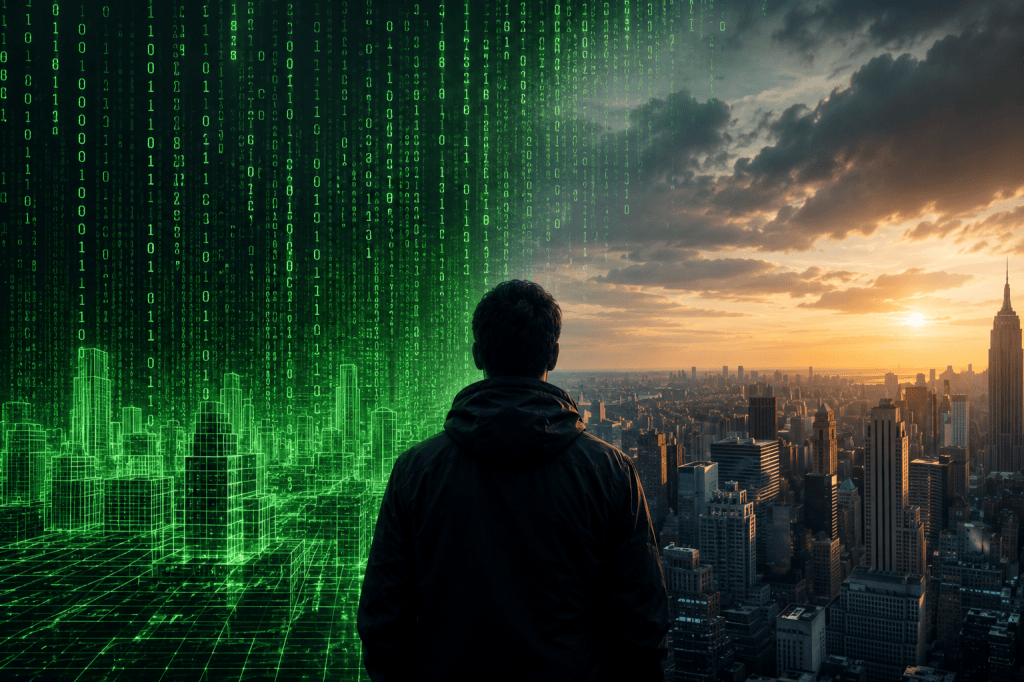
Imagine waking tomorrow morning and discovering that absolutely nothing around you has changed. The same light enters through the window, the same objects occupy the same places, the same memories tell you who you are, and the same laws of physics continue to govern every falling glass, passing cloud and beating heart. There is only one difference: somewhere, beyond everything humanity has ever observed, you have learned that the universe is not the fundamental level of reality at all, but an artificial environment generated by an intelligence existing in another world.
Would your life suddenly become unreal?
It is tempting to dismiss the question as science fiction, particularly because modern culture has given us The Matrix, virtual reality, artificial intelligence and increasingly convincing computer-generated worlds, yet the deeper problem is considerably older than computers. Philosophers have spent thousands of years asking whether human beings experience reality itself or merely an appearance produced by mechanisms they cannot perceive. What has changed is that technology has transformed an ancient philosophical nightmare into something that no longer seems logically absurd.
Today we create virtual environments, simulate weather systems, model galaxies, reconstruct ancient cities, train artificial agents inside synthetic worlds and build machines capable of generating images, voices and landscapes that never existed. None of these technologies proves that our own universe is simulated, but they have made a once almost mystical question disturbingly concrete.
And science has not made the question disappear.
In fact, more than two decades after philosopher Nick Bostrom published the argument that transformed the simulation hypothesis into a serious academic discussion, physicists, cosmologists and philosophers are still arguing about it. A 2025 astrophysics paper attempted to demonstrate that simulating a universe like ours would require physically impossible amounts of energy under laws resembling our own, while a published 2026 commentary immediately challenged whether that calculation was actually testing the kind of simulation Bostrom had proposed in the first place.
There is still no scientific evidence showing that we live inside a simulation, and several powerful reasons exist for remaining skeptical. Yet the hypothesis refuses to die because every attempt to dismiss it seems to uncover another question hiding beneath it.
THE QUESTION DID NOT BEGIN WITH THE MATRIX
Long before anyone imagined computers, philosophers were already suspicious of reality.
Plato asked his readers to imagine prisoners confined inside a cave, able to see only shadows projected onto a wall and mistaking those shadows for the entire world. René Descartes later wondered whether an immensely powerful deceiver could manipulate everything he believed himself to perceive, including the apparent existence of his own body and the external world.
The technological version of the same problem arrived much later: suppose the deceiver is not a demon but a computer.
In such a scenario, mountains would remain mountains, your childhood would remain part of your history and the coffee in front of you would still taste like coffee. The hypothesis does not necessarily claim that the world is fake in the ordinary meaning of the word. Instead, it suggests that what we call physical reality might exist as information processed by something outside the universe accessible to us.
That distinction is important, because the serious simulation argument is considerably more subtle than the familiar image of people sleeping inside pods while machines feed electrical signals into their brains.
NICK BOSTROM AND THE ARGUMENT THAT CHANGED THE DEBATE
In 2003, Oxford philosopher Nick Bostrom published Are You Living in a Computer Simulation? in The Philosophical Quarterly. His argument is frequently misunderstood as claiming that scientists have calculated the probability that we live in a simulation.
That is not what Bostrom argued.
Instead, he proposed a trilemma. According to his reasoning, at least one of three possibilities must be true.
Human civilizations like ours may almost always disappear before they become technologically advanced enough to create vast numbers of highly realistic simulations containing conscious beings.
Alternatively, advanced civilizations may survive and acquire such capabilities but have little or no interest in creating large numbers of what Bostrom calls ancestor simulations, virtual reconstructions containing beings similar to their historical ancestors.
Or, if technologically mature civilizations both can and do create enormous numbers of conscious simulated worlds, simulated observers could eventually become vastly more numerous than biological observers living in the original reality.
If that final situation occurred, Bostrom argued, an observer who knew nothing about their position in the hierarchy would have a statistical reason to suspect that they belonged to the much larger simulated population rather than to the relatively tiny population inhabiting the original world.
The unsettling part of the argument is that it does not require aliens currently watching us through some cosmic monitor. It merely asks us to accept several possibilities that do not initially sound extraordinary: civilizations may survive for a very long time, computing technology may continue improving, consciousness may eventually be reproducible computationally, and sufficiently advanced societies may want to reconstruct their past.
Yet every one of those assumptions hides an enormous uncertainty.
We do not know whether consciousness can be simulated. We do not know whether technological civilizations normally survive long enough to become extraordinarily advanced. We do not know whether the required computing power is physically achievable, and we certainly do not know whether future beings would devote significant resources to populating millions or billions of artificial histories.
Bostrom therefore did not prove that we live in a simulation. What he created was a philosophical trap: if we strongly believe that civilizations will eventually create huge numbers of conscious simulated worlds, it becomes increasingly difficult to insist confidently that ours must be the original one.
THE UNIVERSE REALLY DOES PROCESS INFORMATION — BUT THAT DOES NOT MAKE IT A COMPUTER PROGRAM
One reason the simulation hypothesis continues to fascinate physicists is that modern physics has made information increasingly important.
Physicist Seth Lloyd examined the ultimate computational capacity of physical systems and estimated the information-processing capacity associated with the observable universe. In a famous calculation, he argued that throughout its history the universe could have performed on the order of 10^{120} elementary logical operations while involving roughly 10^{90} bits under one way of counting the relevant information, with a larger information count possible when gravitational degrees of freedom are included.
Those numbers are almost impossible to imagine, but the philosophical implication is even stranger. Matter does not merely sit passively in space. Physical systems change state according to rules, interactions transmit information, quantum systems evolve, and the history of the universe can therefore be described partly in computational language.
Lloyd has even explored the idea that the universe can, in an important physical sense, be regarded as a gigantic quantum computer.
Here, however, one of the most common mistakes in popular discussions appears.
Saying that the universe can be described as processing information is not the same thing as demonstrating that somebody programmed it.
A waterfall can be described mathematically, but that does not mean mathematics created the waterfall. DNA carries information, but the existence of an informational description does not automatically imply an external software engineer. Likewise, the fact that physics allows computational descriptions of reality does not constitute evidence that our cosmos is running on hardware somewhere else.
Nevertheless, it raises a provocative possibility: perhaps information is not merely something humans invented to describe physical reality. Perhaps information belongs to the deepest architecture of reality itself.
And once that possibility is admitted, the boundary between a universe that behaves computationally and a universe that is computed becomes surprisingly difficult to define.
ARE THE LAWS OF PHYSICS THE RULES OF THE PROGRAM?
Supporters of simulation ideas often point toward another strange feature of reality: the universe is astonishingly lawful.
Electrons do not occasionally decide to acquire different properties on Wednesdays. The speed of light in vacuum is not negotiated locally from galaxy to galaxy. Identical particles behave identically wherever we observe them, and mathematical relationships discovered on a tiny planet can describe phenomena billions of light-years away.
To a modern observer surrounded by software, this can look suspiciously like a rules engine.
A video game contains limits because its underlying architecture defines what objects can do. Our universe also contains limits. Nothing carrying information locally outruns the speed of light in ordinary relativistic physics. Quantum mechanics restricts what can be known simultaneously about certain pairs of observables. Physical computation itself is constrained by energy, entropy and information capacity.
But the analogy is dangerous.
The existence of laws does not imply the existence of a programmer. Any universe capable of sustaining stable structures may necessarily contain regularities; otherwise atoms, stars, chemistry and observers could not persist long enough to wonder about them.
More importantly, physicists have not discovered anything resembling a programming language hidden behind Maxwell’s equations or general relativity.
Physics gives us extraordinarily successful mathematical descriptions of nature. Calling those equations “code” may be a useful metaphor, but a metaphor becomes evidence only when it produces a distinctive prediction that competing explanations cannot produce.
So far, simulation theory has struggled to provide precisely that.
DOES THE UNIVERSE HAVE PIXELS?
One of the most seductive arguments begins with an analogy to digital images.
Zoom deeply enough into a photograph and eventually the smooth picture dissolves into pixels. Could the same thing happen to space?
Physics does contain fundamental scales. The Planck length, approximately 1.6 \times 10^{-35} metres, appears naturally when gravitational, quantum and relativistic constants are combined. This has encouraged popular claims that the Planck length represents the “pixel size” of reality.
But this interpretation goes far beyond established physics.
The Planck length does not currently mean that scientists have discovered tiny square blocks from which space is constructed. Rather, it marks a regime where our existing theories are expected to become inadequate and where a successful theory of quantum gravity would probably be required.
Spacetime might ultimately prove discrete, continuous or something stranger than either familiar possibility.
Even if researchers eventually discovered that spacetime is quantized, discreteness alone would still not prove simulation. Nature may simply be fundamentally discrete.
A checkerboard does not imply a computer.
THE SPEED OF LIGHT: COSMIC SPEED LIMIT OR PROCESSING LIMIT?
The universal speed limit provides another irresistible analogy.
Why should reality possess a maximum speed at which causal influences can propagate?
If the universe were an artificial computational system, one might imagine that information could only update at a finite rate, making the speed of light analogous to a maximum transmission speed within the simulation.
It sounds remarkably plausible.
It is also unnecessary.
Einstein’s special relativity explains the role of the speed of light through the geometry of spacetime without requiring any external computer. A simulated universe could have a speed limit, but so can a nonsimulated universe.
This illustrates the central difficulty encountered repeatedly with simulation arguments: many characteristics that appear compatible with simulation are equally compatible with ordinary physics.
Compatibility is not evidence.
If tomorrow scientists discovered that the speed of light were exactly what a particular simulation model uniquely predicted before the measurement was made, that could become interesting. Simply noticing afterward that computer systems also possess limitations tells us far less.
QUANTUM MECHANICS: THE MOST ABUSED ARGUMENT FOR THE MATRIX
No area of physics has been recruited more enthusiastically into simulation theories than quantum mechanics.
Particles behave in ways that appear profoundly unlike everyday objects. Quantum systems can exist in superpositions, measurements produce probabilistic outcomes, entanglement generates correlations that defy classical intuitions, and experiments such as the double-slit experiment reveal behavior that seems almost designed to torment anyone demanding an ordinary picture of reality.
From this strangeness emerged one of the internet’s favorite claims: the universe only renders reality when somebody looks at it, just as a video game renders the region currently being observed by the player.
The comparison is fascinating.
It is not what quantum mechanics has established.
In physics, an “observer” does not necessarily mean a conscious human mind staring at something. Measurement involves physical interaction and the production of correlations between systems. The difficult conceptual problem of how definite measurement outcomes emerge remains the subject of competing interpretations of quantum mechanics, but standard experiments do not demonstrate that human consciousness forces the universe to render previously nonexistent objects.
The double-slit experiment is extraordinary enough without adding conclusions it does not contain.
Quantum mechanics tells us that reality at small scales does not behave according to classical intuition. It does not tell us that reality runs on somebody else’s computer.
Perhaps the more interesting mystery is exactly the opposite: after a century of quantum theory, nature remains stranger than the metaphors we invent to explain it.
COULD WE FIND THE EDGES OF THE SIMULATION?
If the universe were simulated using finite computational resources, perhaps its creators would have needed shortcuts.
Researchers have occasionally considered whether hypothetical discretization of spacetime could produce detectable signatures, for example through violations of expected rotational symmetry in extremely high-energy cosmic phenomena. Similar ideas have asked whether fundamental computational limitations might leave observable irregularities.
No convincing evidence of such a cosmic grid has been discovered.
As physicist Zohreh Davoudi has noted in discussions of such proposals, deviations from expected symmetries could potentially be interesting, but even discovering such an effect would not uniquely prove simulation because the underlying physical universe itself could possess discrete structure.
The problem resembles finding a strange brick in an ancient wall and concluding that aliens must have built the city. The brick may genuinely require explanation, but many explanations can exist.
To establish simulation scientifically, researchers would ideally need some observation that makes sense if reality is artificial and is extremely difficult to explain if reality is fundamental.
Nobody has found such an observation.
THE BAYESIAN CALCULATION THAT CHANGED THE FAMOUS “WE ARE PROBABLY SIMULATED” CLAIM
Bostrom’s argument inspired another important question: if we honestly account for our ignorance, what probability should we assign to being simulated?
In 2020, astronomer David Kipping approached the problem using Bayesian reasoning.
The result was far less sensational than the headlines surrounding simulation theory.
Kipping argued that because we do not yet know whether civilizations are capable of creating Bostrom-style conscious simulations, the uncertainty surrounding that possibility must itself be included in the calculation. Under his analysis, the probability of living in a simulated reality remained slightly below 50 percent, with base reality retaining a small advantage rather than simulation becoming overwhelmingly likely.
There was, however, a fascinating twist.
If humanity — or some future civilization we could observe — eventually succeeded in creating large numbers of conscious simulated worlds comparable to our own, the probabilities would change dramatically.
We would then possess evidence that one of Bostrom’s crucial assumptions was physically achievable.
The simulation argument therefore contains a peculiar temporal paradox: the more convincingly humanity learns to manufacture artificial realities, the more seriously future humans might begin questioning whether their own reality is original.
Every virtual world we create does not prove we live in one.
But it makes the concept less absurd.
THE 2025 CHALLENGE: PERHAPS SIMULATING OUR UNIVERSE IS PHYSICALLY IMPOSSIBLE
In April 2025, astrophysicist Franco Vazza published a particularly interesting challenge in Frontiers in Physics.
Rather than asking philosophical questions, Vazza examined the computational and energetic requirements involved in simulating reality at extremely high resolution.
He considered several possibilities, including simulations involving the observable universe and Earth, and concluded that under physical conditions comparable to those in our universe, the required information storage, energy and computational resources would become astronomically prohibitive. His conclusion was strong: a universe governed by physics like ours could not realistically produce a complete simulation of this universe at the resolutions considered.
At first glance, this sounds almost like the end of the simulation hypothesis.
Then came the counterargument.
THE 2026 REPLY: WHAT IF THE SIMULATOR DOES NOT NEED TO SIMULATE EVERYTHING?
In April 2026, Eliott Edge and Chad Ashton Brown published a commentary challenging the scope of Vazza’s conclusion.
Their objection was simple but important: Bostrom’s original argument does not necessarily require an external computer to calculate every microscopic component of the entire observable universe continuously.
A simulation intended to reproduce conscious human experience might require something very different.
Perhaps only the information necessary to generate internally consistent observations needs to exist at the required resolution. Perhaps distant galaxies do not need every microscopic degree of freedom calculated continuously if no simulated observer interacts with them at that level. Perhaps the simulation could rely on approximations, procedural generation or computational principles entirely unlike those used by present human machines.
Edge and Brown therefore argued that demonstrating the enormous cost of exhaustively simulating a universe does not automatically defeat Bostrom’s more limited ancestor-simulation scenario.
This does not prove that such shortcuts are possible.
It reveals something more interesting about the debate: we do not even know what kind of machine we are imagining.
When someone says, “The universe could not possibly be simulated because it would require too much computing power,” an obvious question follows.
Too much computing power for whom?
We are estimating the limitations of hypothetical technology existing outside our universe by using physical laws observed inside our universe. If the external reality possesses different physics, different computational architecture or different relationships between information and energy, our calculations may tell us little about what is possible there.
But once we permit completely unknown external physics, the simulation hypothesis becomes extremely difficult to test.
And that leads directly to its greatest weakness.
THE MOST SERIOUS PROBLEM: CAN THE HYPOTHESIS EVER BE FALSIFIED?
Science becomes powerful because scientific ideas take risks.
A theory predicts what should happen. Experiments or observations can then potentially show that the prediction is wrong.
The simulation hypothesis has difficulty meeting this standard.
Suppose we examine the universe and find perfectly smooth spacetime. A defender can say the simulation has extraordinarily high resolution.
Suppose we discover discrete spacetime. A defender can say we have discovered the computational grid.
Suppose physical constants appear perfectly natural. The simulator chose them.
Suppose they appear strangely fine-tuned. The simulator chose them.
Suppose no glitches ever occur. The program is excellent.
Suppose something inexplicable occurs. Perhaps it was a glitch.
A hypothesis capable of explaining every conceivable observation risks predicting nothing.
This is why some scientists regard the question as philosophical rather than scientific. A 2024 Scientific American discussion made precisely this objection: if no objective experiment can distinguish a simulated world from an observationally identical nonsimulated world, asking whether we are simulated may lie outside ordinary empirical science.
The problem becomes even deeper if the hypothetical simulators are capable of altering our memories, our measuring instruments and every record of their intervention.
Any evidence against simulation could itself be simulated.
At that point we have returned, by an astonishing technological route, directly to Descartes and his deceiving demon.
The computer has replaced the demon.
The epistemological problem is almost unchanged.
FINE-TUNING: A CLUE, A COINCIDENCE OR SOMETHING ELSE ENTIRELY?
Another argument sometimes associated with simulated universes concerns the apparently special values of certain physical constants.
Change some aspects of physics sufficiently and stars, stable chemistry or complex structures may become impossible. This has produced several competing explanations, ranging from anthropic selection effects and multiverse theories to deeper undiscovered physical principles, theological explanations and, inevitably, the possibility of deliberate design.
A simulated universe could obviously possess selected constants.
A programmer could choose parameters.
But the observation that a universe possesses parameters compatible with observers cannot tell us who or what selected them, or whether they were “selected” at all.
An observer can only find itself in a universe compatible with observers.
Simulation therefore enters the fine-tuning debate as one possible philosophical explanation among several, not as a conclusion established by cosmology. The subject remains actively discussed in philosophy of cosmology, including research published as recently as July 2026 examining simulation alongside other proposed explanations of cosmic fine-tuning.
The mystery remains because every answer seems to move the question one level higher.
If a programmer created our universe, who created the programmer’s universe?
And if that universe is simulated too, where does the chain end?
THE INFINITE MATRIX PROBLEM
Imagine that humanity eventually creates a conscious simulated civilization.
Inside that civilization, thousands of simulated years pass, technological progress continues and its inhabitants eventually build their own conscious simulations.
Those simulations eventually create others.
Reality now forms a tower.
Universe A creates Universe B.
Universe B creates Universe C.
Universe C creates Universe D.
Every civilization except the first believes itself to inhabit ordinary physical reality.
From inside any particular layer, how could its inhabitants discover their position?
Perhaps they could not.
More importantly, what exactly would “real” mean in such a hierarchy?
If the people in Universe C possess memories, love, fear, ambitions and conscious experience, describing them as unreal simply because their physics is implemented by another system begins to sound inadequate.
A simulated fire may not burn the external computer, but to a conscious being whose body exists within that simulation, the fire could still be lethal.
Reality may therefore be less about what something is made from and more about whether it produces genuine relationships, causes and experiences within the world where it exists.
This is where the simulation question stops being merely technological and becomes philosophical.
IF WE ARE SIMULATED, WHO ARE THE SIMULATORS?
The popular imagination usually supplies aliens, future humans or artificial superintelligences.
But none of these possibilities follows logically from the hypothesis.
The creators could inhabit a universe almost identical to ours or something incomprehensibly different. Time might operate differently outside the simulation. What appears to us as 13.8 billion years of cosmic history could correspond to an entirely different duration externally.
Our universe might be an experiment.
It might be historical research.
It might be entertainment.
It might be an accidental emergent environment inside a larger computational process.
It might even be a simulation whose original creators no longer exist.
These possibilities make compelling fiction, but there is currently no evidence allowing science to choose among them.
We should therefore resist the temptation to transform gaps in knowledge into facts.
Mystery becomes more powerful, not less powerful, when we know precisely where evidence ends.
PERHAPS WE ARE ASKING THE WRONG QUESTION
There is another possibility.
Perhaps the most important question is not whether somebody outside the universe programmed reality.
Perhaps human beings already inhabit multiple constructed realities without needing an alien computer at all.
The brain does not provide direct access to the external world. It receives signals, processes incomplete information, predicts, corrects, filters and constructs the experience we call perception. Culture determines much of what we consider valuable. Language divides continuous reality into categories. Political narratives shape collective identities. Algorithms decide which fragments of the world appear on our screens. Advertising influences desires we experience as personal. Social systems reward particular behaviors until they begin to feel natural.
We may therefore spend our lives asking whether an invisible programmer created the universe while paying far less attention to the systems visibly programming our interpretation of it.
That is where the simulation hypothesis becomes much more than a science-fiction curiosity.
Because even if the universe is not a computer simulation, human reality is continuously mediated.
We never encounter the entire world.
We encounter a selection.
And whoever — or whatever — influences that selection possesses extraordinary power.
THE MATRIX MAY EXIST WITHOUT A COMPUTER
This is one of the central questions explored in Matrix: The Hidden Truth — Who Controls Reality?
The Matrix does not have to be a machine hidden underground.
It can be an idea accepted without examination, an algorithm deciding what deserves our attention, a political narrative repeated until it becomes common sense, a religious interpretation inherited before we are old enough to question it, a social hierarchy presented as natural, a fear deliberately amplified, or even the internal story through which the brain constructs the person we believe ourselves to be.
Plato did not need computers to imagine prisoners unable to distinguish appearances from reality.
Descartes did not need virtual-reality headsets to doubt whether his senses could be trusted.
Modern science does not tell us that they were secretly describing a computer simulation.
It tells us something perhaps more unsettling: perception is limited, knowledge is provisional, reality is stranger than ordinary experience suggests, and even our most sophisticated theories describe the universe from inside the universe they are trying to explain.
There may be no programmer.
There may be no external machine.
There may be no hidden screen beyond the stars.
But the fundamental question survives every attempt to destroy it:
How would we know?
THE SCIENTIFIC VERDICT — FOR NOW
As of 2026, there is no accepted empirical evidence demonstrating that our universe is a computer simulation.
Quantum mechanics does not prove it.
The Planck scale does not prove it.
The speed of light does not prove it.
Cosmic fine-tuning does not prove it.
The informational character of physics does not prove it.
Nick Bostrom’s argument does not prove it either.
What exists instead is an extraordinary intersection between philosophy, probability, information theory, cosmology, computation and the science of consciousness.
That may explain why the idea refuses to disappear.
The simulation hypothesis occupies an unusual territory where an ancient human fear has collided with modern technological possibility. For most of history, asking whether reality itself might be an illusion required gods, demons, dreams or metaphysics. Today we routinely construct artificial worlds on machines sitting on our desks.
They are primitive.
Their characters are not demonstrably conscious.
Their universes contain only crude shadows of physical reality.
But they exist.
And somewhere between Plato’s cave and the quantum computer, between Descartes’s demon and the artificial worlds we now create ourselves, humanity has reached a peculiar moment in its intellectual history.
For the first time, we are beginning to build the very kind of realities that once existed only inside philosophical thought experiments.
Perhaps that tells us nothing whatsoever about the origin of our universe.
Or perhaps one day it will tell us far more than we are prepared to hear.
The answer remains unknown.
And for now, that is precisely what makes the question so difficult to escape.
SOURCES AND FURTHER READING
Nick Bostrom — Are You Living in a Computer Simulation?, The Philosophical Quarterly, 2003. Bostrom’s original simulation argument and the three-part proposition at the heart of the modern debate.
Seth Lloyd — Computational Capacity of the Universe, Physical Review Letters, 2002. Analysis of physical limits on the amount of information and computation associated with the observable universe.
David Kipping — A Bayesian Approach to the Simulation Argument, 2020. A Bayesian reassessment showing that, given present uncertainty, base reality retains a slight probabilistic advantage rather than simulation being overwhelmingly likely.
Franco Vazza — Astrophysical Constraints on the Simulation Hypothesis for This Universe: Why It Is (Nearly) Impossible That We Live in a Simulation, Frontiers in Physics, 2025. A calculation of the enormous physical resources that high-resolution simulations of our universe would require.
Eliott Edge & Chad Ashton Brown — Commentary on Vazza’s simulation-hypothesis paper, Frontiers in Physics, 2026. The authors argue that the computational objection does not necessarily defeat Bostrom’s original scenario because ancestor simulations need not reproduce every microscopic detail of the entire cosmos continuously.
Scientific American — discussions of simulation theory, falsifiability, possible observational tests and the continuing disagreement among physicists and philosophers over whether the hypothesis belongs within empirical science.


Leave a comment