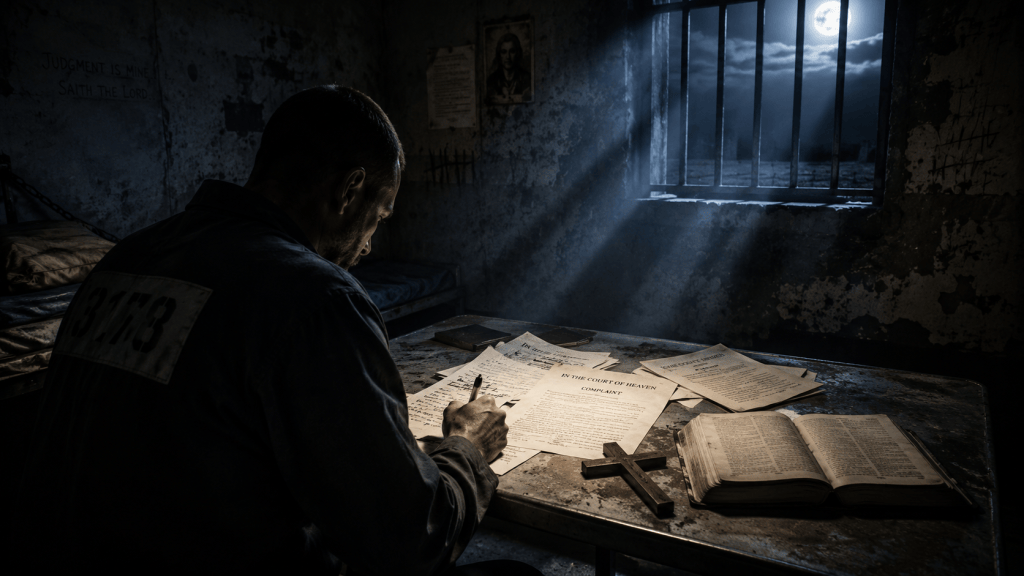
A convicted murderer, a baptism treated as a contract, a defendant whose address was listed as Heaven — and a legal complaint that eventually reached newspapers around the world.
Somewhere behind the walls of Timișoara Penitentiary, in western Romania, a prisoner arrived at an extraordinary conclusion.
The justice system had already decided who was responsible for the murder that had brought him there.
He disagreed.
Or, at least, he believed there was another party who should also be held accountable.
That party was God.
In October 2005, Pavel Mircea, a Romanian prisoner serving a 20-year sentence for murder, submitted a criminal complaint naming God as the accused. Contemporary Romanian reports described him as a man from Reșița imprisoned in Timișoara. The complaint was not a metaphor, a theological essay or merely an angry letter.
It entered Romania’s legal machinery.
And Mircea had an argument.
He believed he had a contract.
A Contract Signed at Baptism
The foundation of Mircea’s case reached all the way back to his baptism.
According to contemporary Romanian reporting, he argued that through his baptism in the Orthodox Church he had effectively entered into an agreement with God. Under his interpretation of that agreement, God had undertaken to keep the Devil away from him and protect him from misfortune and evil.
But Mircea was now sitting in prison for murder.
Therefore, he reasoned, something had gone terribly wrong with the agreement.
He maintained that God had failed to protect him from Satan and that the Devil had consequently been able to influence him toward the crime for which he had been convicted. Romanian newspaper Adevărul later summarized his argument in striking terms: the divine party to the baptismal “contract” had failed to keep its word.
The logic was bizarre from a legal perspective.
Yet internally, it followed an almost unsettling sequence:
There was a promise.
The promise involved protection from evil.
Evil prevailed.
Therefore the promise had been broken.
And Mircea wanted someone held responsible.
The Defendant’s Address: Heaven
Even the wording of the complaint seemed designed for a story that no novelist would dare make too obvious.
Mircea sought criminal proceedings against:
God, domiciled in Heaven.
He identified the Romanian Orthodox Church as God’s representative in Romania and, locally, the Orthodox metropolitan authority in Timișoara.
Once the supernatural defendant had been identified, Mircea proceeded as though he were accusing an ordinary earthly suspect.
Contemporary reporting listed allegations corresponding to offences such as fraud, concealment, abuse of office, receiving undue benefits and influence peddling.
And there was money involved.
One 2005 Romanian report said Mircea demanded €2 million in damages.
Later reporting stated that he also wanted back money he had spent on candles and religious services that, in his view, had failed to produce the promised protection.
Suddenly the argument became stranger still.
Prayer had become consideration.
Baptism had become contract.
Religious offerings had become payments.
And divine protection had become a service which, according to the prisoner, had not been delivered.
The Prosecutors Had a Problem
It would have been easy simply to throw the papers away.
But a criminal complaint submitted to authorities could not necessarily be treated as though it had never existed.
In October 2005, Florin Munteanu, then chief prosecutor attached to the Timișoara District Court, told Romanian media that the complaint would be registered and ultimately closed. He said prosecutors still had to provide the prisoner with an answer. Police representatives likewise described the complaint as impossible for state institutions to resolve.
For almost two years, the story remained an extraordinary curiosity of the Romanian justice system.
Then, in July 2007, it returned to the news.
The file had finally been closed.
According to Adevărul, prosecutors attached to the Timișoara District Court decided not to begin a criminal prosecution, giving a reason that would propel the case into headlines far beyond Romania:
God was not a real person in the legal sense and had no domicile.
The problem was brutally mundane.
To prosecute someone, the legal system needs a legally recognizable defendant.
And Heaven was not an address at which Romanian authorities could serve papers.
When the Story Escaped Romania.
This was the moment the case became international.
News agencies picked it up, and soon one of Romania’s strangest criminal complaints appeared on websites thousands of kilometres away.
ABC News in Australia published the story under the headline “God escapes day in court.” Its AFP report described a Romanian murderer who had accused God of fraud and betrayal of trust after his prayers apparently failed to protect him from evil.
South Africa’s Mail & Guardian carried essentially the same international agency report, describing the defendant as God, resident in Heaven and represented in Romania by the Orthodox Church.
There was, however, an important difference between some international accounts and the Romanian reporting.
The foreign stories often said that a court had dismissed a lawsuit against God. Romanian contemporary sources describe the procedure more precisely as a criminal complaint handled by prosecutors, ending with a decision not to begin criminal prosecution.
That distinction hardly made the headline less remarkable.
A Romanian prosecutor’s office had still been placed in the surreal position of having to determine what to do with a criminal accusation against the Creator of the universe.
But Pavel Mircea Was Not the First
What happened in Timișoara feels unique until one begins searching through legal history.
Then something unexpected appears.
Human beings have tried, more than once, to drag supernatural beings into earthly courts.
And each case reveals something peculiar about what happens when metaphysical claims collide with procedural law.
United States v. Satan — 1971
More than three decades before the Romanian complaint, another prisoner had selected an even less accessible defendant.
Satan.
In 1971, Gerald Mayo brought a case in the United States District Court for the Western District of Pennsylvania under the unforgettable title:
United States ex rel. Gerald Mayo v. Satan and His Staff
This case is not an urban legend. The federal court decision survives.
Mayo alleged that Satan had caused him misery and threats, deliberately placed obstacles in his path and caused his downfall. He argued that these actions had deprived him of constitutional rights.
Judge Gerald J. Weber found several problems.
There were questions about whether the court had personal jurisdiction over Satan. Mayo had not alleged that Satan resided within the Western District of Pennsylvania.
There were also problems with Mayo’s attempt to make the proceeding a class action.
And then there was the question that would echo eerily through later supernatural lawsuits:
How exactly was Satan supposed to be served with legal papers?
The court noted that Mayo had failed to provide the U.S. Marshal with instructions for service of process. His request to proceed without paying court costs was denied.
The judicial opinion even contained a piece of remarkable legal humor. Judge Weber referred to an “unofficial” account in which the same defendant had once appeared as a plaintiff in New Hampshire — an unmistakable allusion to the fictional tale The Devil and Daniel Webster.
The law had met the Devil.
And paperwork won.
Then a Senator Sued God
Two years after Pavel Mircea’s complaint became international news, another case involving God attracted enormous attention in the United States.
The plaintiff this time was not a prisoner.
He was Nebraska state senator Ernie Chambers.
On September 14, 2007, Chambers filed a petition in the District Court of Douglas County, Nebraska, asking for a permanent injunction against God. The surviving complaint literally identifies the parties as:
State Senator Ernie Chambers, Plaintiff
v.
God, Defendant.
Center for Agricultural Law and Taxation
Chambers accused the defendant of causing catastrophic events and sought an order stopping harmful activities and terroristic threats. His filing attempted to solve the jurisdiction problem with wonderfully circular theological logic: because God was omnipresent, God was necessarily present in Douglas County, Nebraska — therefore the court had jurisdiction.
The suit was not primarily an expression of religious grievance like Mircea’s. Chambers used the case to make a point about access to the courts and the ability of citizens to file lawsuits. Contemporary accounts characterized the filing as a demonstration of how broadly the courthouse doors were supposed to remain open.
But once again, theology encountered procedure.
The fundamental difficulty remained familiar:
How do you legally notify God that God has been sued?
The Strange Pattern Behind These Cases
Look at the three cases side by side and something fascinating emerges.
Gerald Mayo blamed Satan for his downfall.
Pavel Mircea blamed God for failing to prevent his.
Ernie Chambers sued God partly to test a principle of human law.
Different decades. Different countries. Different motives.
Yet all three eventually collided with roughly the same wall:
A court may entertain almost any allegation on paper, but a legal system operates through jurisdiction, legal personality, evidence and service of process.
The supernatural is remarkably difficult to summon with a subpoena.
And that is where these stories stop being merely funny.
Who Is Responsible for Evil?
Strip away the absurdity of Mircea’s complaint and underneath it sits one of humanity’s oldest philosophical problems.
If an all-powerful and benevolent God exists, why is evil permitted?
Philosophers and theologians have debated variations of that question for centuries.
Pavel Mircea did something different.
He tried to turn the question into a criminal file.
Rather than asking:
“Why did God allow evil?”
his complaint effectively asked:
“If God promised to protect me from evil and failed, can God be held responsible?”
The transformation is extraordinary because it attempts to force a theological dilemma into the language of earthly accountability.
Contract.
Obligation.
Failure.
Damage.
Compensation.
But there is an uncomfortable element to the story as well.
Mircea had been convicted of murder. His theory transferred responsibility for his actions away from himself and toward supernatural forces: God had failed him; Satan had influenced him.
The criminal law could not accept that chain of reasoning merely because the prisoner believed it.
Human courts judge human conduct.
And so the cosmic question returned to Earth.
The One Defendant Who Could Not Be Summoned
There was no courtroom confrontation in Timișoara.
No lawyer stood up for Heaven.
No representative of the Romanian Orthodox Church was required to defend the Creator against accusations of fraud.
No witness was asked whether prayers constitute payment.
No judge had to determine whether baptism creates an enforceable contract.
The case ended before any such spectacle could occur. Romanian prosecutors closed the matter rather than beginning a criminal prosecution.
Yet the complaint survived.
It survived because it was strange enough to be reported in Romania in 2005.
It survived because the decision resurfaced in 2007.
It survived because international news agencies carried it across continents.
And nearly two decades later, it remains one of those rare stories in which bureaucracy, religion, crime and philosophy briefly occupy the same page.
Perhaps the most remarkable part is not that a prisoner tried to put God on trial.
Humans have been putting God on trial in poetry, philosophy and private despair for thousands of years.
Pavel Mircea simply attempted to obtain a case number for it.
And somewhere inside the Romanian justice system, for a brief and astonishing moment, someone had to decide what to write in the file when the accused had only one known address:
Heaven.
Sources & Further Reading
ABC News Australia / AFP — “God escapes day in court”, July 12, 2007. Relates the international version of Pavel Mircea’s complaint against God and the decision to dismiss the case.
ABC News
Mail & Guardian / AFP — “Case against God dismissed in Romanian court”, July 11, 2007. Reports that Mircea was serving a 20-year sentence for murder and had named God, “who lives in the heavens,” as defendant.
Mail & Guardian
University of Georgia School of Law — United States ex rel. Gerald Mayo v. Satan and His Staff, 54 F.R.D. 282 (W.D. Pa. 1971). Original federal court decision concerning Gerald Mayo’s lawsuit against Satan.
University of Georgia School of Law
Texas Bar — Discussion of Mayo v. Satan and His Staff and the unusual procedural issues raised by attempting to sue a supernatural defendant.
Texas Bar
Ernie Chambers v. God, District Court of Douglas County, Nebraska, 2007 — court filing in which Nebraska State Senator Ernie Chambers named God as defendant and argued that an omnipresent deity was necessarily within the court’s jurisdiction.


Leave a comment