Discover the remarkable life of Alfred Nobel,the Inventor of Dynamite,whose personal tragedies inspired the creation of the world-famous Nobel Prize.
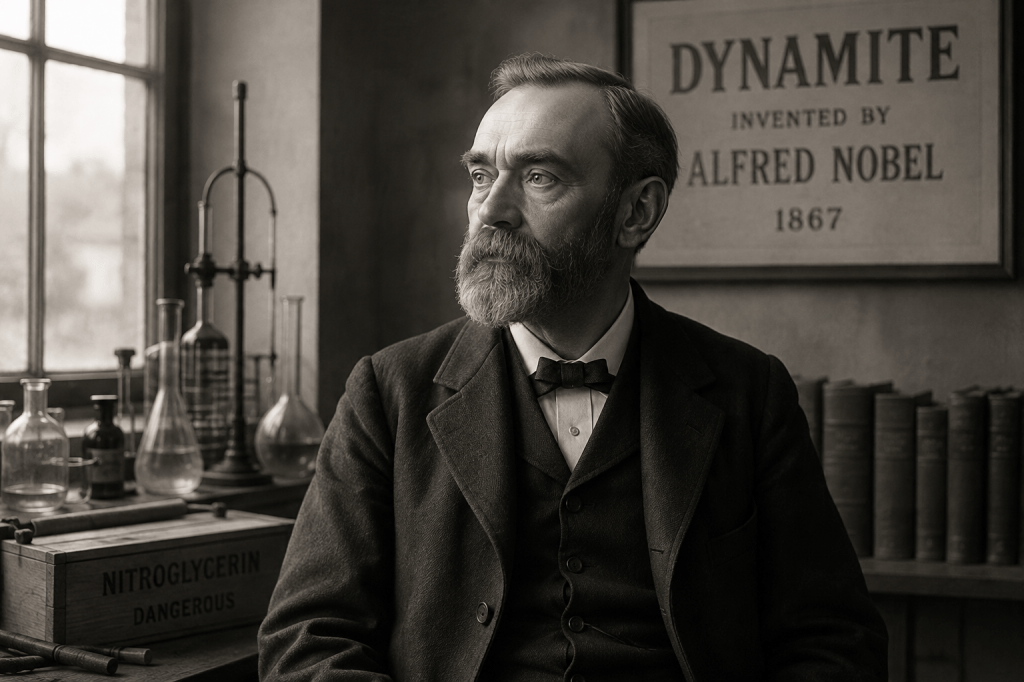
History remembers Alfred Nobel as the founder of the Nobel Prize, the world’s most prestigious award for science, literature, and peace. Yet behind this celebrated name stood a man whose life was marked by danger, personal tragedy, and relentless determination. The irony remains striking: the inventor whose discoveries revolutionized explosives ultimately chose to dedicate his fortune to honoring those who benefited humanity.”My home is where I work, and I work everywhere.” With these words, Alfred Nobel expressed his belief that science belonged to no nation, but to all mankind.Born in Stockholm on October 21, 1833, Nobel grew up under the influence of his father, Immanuel Nobel, an engineer and inventor deeply involved in the study of explosive substances. At a time when chemistry still held many dangerous mysteries, the Nobel family lived on the frontier between innovation and catastrophe. Alfred received his first formal education in St. Petersburg, where his father’s business had prospered, before being sent abroad at the age of seventeen to study mechanical engineering in New York. There he spent four formative years learning from the renowned Swedish-American engineer John Ericsson, whose military inventions had already earned international fame.The young inventor quickly demonstrated an exceptional talent for chemistry and engineering. In 1863, he patented a mixture of gunpowder and nitroglycerin, although the invention attracted little commercial interest. His truly revolutionary breakthrough came soon afterward, when he solved one of the greatest challenges surrounding nitroglycerin.Unlike conventional explosives, nitroglycerin could not simply be ignited with a burning fuse. The oily liquid burned harmlessly when exposed to flame, refusing to detonate unless subjected to a sudden and violent shock. Nobel concluded that only an instantaneous release of energy within the liquid itself could unleash its devastating power. From this insight emerged one of the most important inventions in the history of explosives: the mercury blasting cap, a device that transformed the practical use of high explosives and changed mining, engineering, and military technology forever.The significance of the invention attracted the attention of Emperor Napoleon III of France, who helped Nobel obtain financial support of 10,000 francs to establish a factory at Heleneborg, near Stockholm. There, father and sons resumed their dangerous experiments with nitroglycerin, fully aware that each day carried the possibility of disaster.Disaster arrived on September 3, 1864.A massive explosion destroyed the factory in an instant, killing several workers, including Alfred’s youngest brother, Emil Nobel. The tragedy devastated the family. Within a year, Alfred’s father died, his health broken by grief, while the Swedish authorities forbade the construction of another nitroglycerin factory on land.Many would have abandoned such perilous research. Alfred Nobel refused.Forced to continue his experiments on a floating laboratory anchored on Lake Mälaren, he worked almost as an exile, moving from shore to shore as local communities rejected the dangerous enterprise. The laboratory became a symbol of his isolation—an inventor carrying both extraordinary ambition and the weight of repeated catastrophe.It was during this period that Nobel made the discovery that would secure his place in history.He found that a soft, porous mineral known as kieselguhr, composed largely of the fossilized skeletons of microscopic algae called diatoms, possessed an extraordinary property: it could absorb several times its own weight in nitroglycerin. The resulting paste remained remarkably powerful while becoming far safer to transport and handle than liquid nitroglycerin itself.Nobel gave his invention a simple name that would soon become known throughout the world:Dynamite.The invention transformed industries. Railways crossed mountains, tunnels pierced solid rock, mines expanded deeper into the earth, and vast engineering projects became possible on a scale previously unimaginable. Yet the same invention also found military applications, creating a contradiction that would haunt Nobel for the rest of his life.Perhaps no inventor has lived with such a profound paradox. His discoveries accelerated human progress while simultaneously increasing humanity’s capacity for destruction. That inner conflict would eventually shape one of history’s greatest acts of philanthropy.When Alfred Nobel died in 1896, he shocked the world by leaving the overwhelming majority of his immense fortune to establish annual prizes honoring achievements in Physics, Chemistry, Physiology or Medicine, Literature, and Peace. It was as though the man who had spent a lifetime mastering explosive force wished his final legacy to celebrate knowledge, creativity, and reconciliation rather than conflict.Today, the Nobel Prize is remembered far more vividly than dynamite itself. Yet without the hardships, failures, personal losses, and relentless perseverance that defined Alfred Nobel’s extraordinary life, neither would ever have existed. His story remains one of history’s most compelling reminders that the greatest inventions often emerge from tragedy—and that even those associated with destruction can ultimately choose to leave behind a legacy dedicated to humanity’s highest ideals.


Leave a comment