
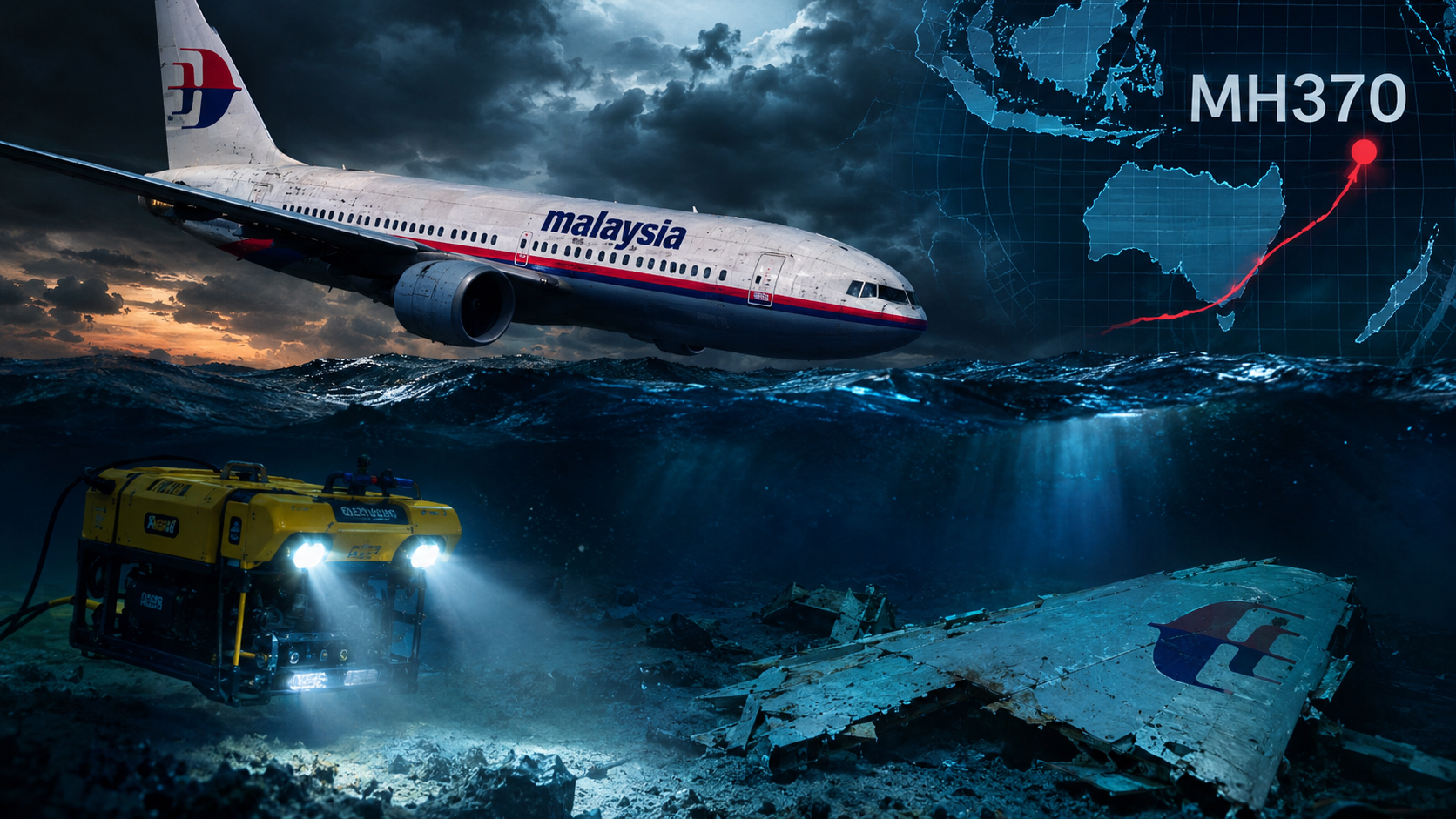
MH370: The Plane That Vanished — And the Truth Still Buried Beneath the Ocean
239 people disappeared into the darkness of the Indian Ocean. Twelve years later, the aircraft remains missing, its final hours are still unexplained, and one of aviation’s greatest mysteries continues to challenge everything we believe about modern technology.
There is something deeply unsettling about the disappearance of Malaysia Airlines Flight MH370, something that goes beyond the tragedy itself and raises uncomfortable questions about the technological world we inhabit. We live in an age in which satellites observe the Earth, aircraft communicate across continents, and sophisticated surveillance systems monitor movements that would once have remained invisible. Yet, on March 8, 2014, a Boeing 777 carrying 239 people vanished during what should have been an ordinary flight from Kuala Lumpur to Beijing.
I have returned to this story several times over the years, not because I believe every mysterious disappearance conceals a conspiracy, but because certain details refuse to fit comfortably into a simple explanation. The more I examined the official reports, satellite communications, recovered debris, and extraordinary scale of the underwater searches, the more I understood why MH370 has become something larger than an aviation investigation.
What intrigues me most is not simply that the aircraft disappeared, but that investigators were able to reconstruct fragments of its journey without ever establishing what happened inside the cockpit, why the aircraft changed course, or precisely where its final descent ended.
Now, twelve years later, advanced underwater robots have brought renewed attention to the southern Indian Ocean, reminding us of an uncomfortable reality: finding something in the deepest parts of our own planet can still be extraordinarily difficult.
And somewhere beneath those immense stretches of dark water, the evidence that could resolve this mystery may still be waiting.
The Last Ordinary Conversation
The final routine radio exchange between MH370 and Malaysian air traffic control occurred at approximately 1:19 a.m., Malaysian time, as the aircraft approached the boundary between Malaysian and Vietnamese-controlled airspace.
The message, commonly reproduced as Good night Malaysian Three Seven Zero, sounded entirely ordinary. There was no distress call, no warning of an emergency, and nothing in the recorded exchange that suggested the aircraft was about to become the centre of an international mystery.
Approximately two minutes later, its transponder stopped providing the identifying information used by civilian air traffic control. The aircraft disappeared from conventional tracking displays, but it had not disappeared from the sky.
Military radar data later indicated that MH370 had turned away from its intended route, crossed back over the Malay Peninsula, and continued northwest towards the Strait of Malacca before leaving radar coverage.
I find this sequence particularly disturbing because it changes the nature of the mystery. We are not dealing simply with an aircraft that lost contact and immediately crashed into the sea. The available evidence indicates that it continued flying for hours after disappearing from civilian radar.
The question that has troubled investigators ever since is whether those changes resulted from deliberate human intervention, an extraordinary technical emergency, or a combination of circumstances that has never been reconstructed.
The Malaysian safety investigation published in 2018 acknowledged that the changes in flight path were difficult to attribute to ordinary system failures alone, yet it could not establish who, or what, was responsible.
Evidence suggesting deliberate control of an aircraft is not the same as proof of a particular person’s intentions, and that distinction remains essential when examining MH370.
The Satellite That Continued Listening
One of the least understood aspects of MH370 is that the aircraft did not vanish completely from the technological world when its transponder stopped transmitting.
A satellite communications system operated through Inmarsat continued to exchange automated signals with equipment aboard the aircraft. These exchanges, often described as electronic handshakes, were not ordinary messages from the pilots and did not reveal the aircraft’s exact position.
Instead, they provided technical measurements from which investigators could estimate the aircraft’s distance from the satellite and examine its movement.
Two types of information became especially important: Burst Timing Offset, which helped establish possible distance arcs, and Burst Frequency Offset, which provided clues about relative motion through changes in signal frequency.
The resulting analysis pointed towards the southern Indian Ocean, far from the original flight route to Beijing.
What struck me while studying this evidence was how much information could be extracted from signals that were never intended to function as a complete tracking system. Investigators were effectively reconstructing the movements of a missing aircraft from the timing and frequency characteristics of brief satellite communications.
But there was a fundamental limitation. A distance measurement does not identify a single location, and even a sophisticated reconstruction remains dependent on assumptions about speed, altitude, direction, and aircraft behaviour.
The famous seventh arc, associated with the aircraft’s final satellite communication at approximately 8:19 a.m., was therefore not a precise crash location. It was a geographical constraint within which investigators had to search for a possible endpoint.
Another intriguing detail concerns the satellite communication system itself. After an interruption, it logged back onto the network at approximately 2:25 a.m., an event investigators examined as a possible indication of an interruption and restoration of electrical power to the satellite data unit.
A further log-on occurred near the end of the flight, at approximately 8:19 a.m. Investigators considered whether this event could have followed a power interruption associated with fuel exhaustion and subsequent electrical changes, although the available evidence could not establish the complete sequence.
These are not insignificant technical details. They offer rare glimpses into the condition of an aircraft whose cockpit conversations, final decisions, and last moments remain unknown.
The Ocean That Concealed an Aircraft
When I first looked at the maps of the MH370 search areas, I underestimated the scale of the problem. On a computer screen, the southern Indian Ocean appears as an immense blue expanse interrupted by lines, coordinates, and carefully drawn search boundaries. In reality, those lines cross one of the most remote and difficult maritime environments on Earth.
The search crews faced powerful winds, enormous waves, unpredictable weather, and depths reaching several kilometres. Beneath the surface lay underwater mountains, steep slopes, deep valleys, and geological formations that complicated the interpretation of sonar images.
Before investigators could systematically search certain areas for an aircraft, they needed to map portions of the seabed itself.
The Australian-led underwater operation eventually examined more than 120,000 square kilometres before being suspended in January 2017. It was one of the most extensive searches ever conducted for a missing aircraft, yet it failed to locate the main wreckage.
What fascinated me was the paradox: the search produced an extraordinary body of new geographical information about the ocean floor, while the object responsible for the investigation remained undiscovered.
The seabed had become better known, but the fate of the aircraft had not.
The First Piece of the Puzzle Was Found on a Beach
In July 2015, a large piece of aircraft wreckage washed ashore on Réunion, a French island in the western Indian Ocean.
The object was a flaperon, a movable surface from an aircraft wing, and investigators subsequently confirmed that it belonged to MH370.
This discovery fundamentally changed the investigation because it provided physical evidence connecting the missing aircraft to the Indian Ocean.
Additional debris was subsequently recovered along the shores of East Africa and nearby islands, including fragments whose identification and connection to MH370 varied in certainty.
The ocean currents had apparently carried pieces of the aircraft thousands of kilometres from their original location.
I became particularly interested in the scientific effort to reverse that journey. Researchers examined currents, winds, drifting objects, and marine growth on recovered fragments in an attempt to determine where the debris might have entered the water.
Even the small marine organisms attached to wreckage became potential witnesses.
Barnacles, for example, can provide information about environmental conditions experienced during their growth. Researchers have explored whether the chemical composition of their shells could help reconstruct the temperature history of drifting debris and, indirectly, its possible journey across the ocean.
It is an extraordinary idea that something as small as a marine organism might preserve clues about an aircraft that the world’s most advanced search systems could not locate.
But ocean drift modelling is not an exact reversal of time. Floating debris can be influenced by wind exposure, waves, currents, and the shape of individual fragments. Different assumptions can produce different possible origins.
The recovered pieces support the conclusion that MH370 ended its flight in the Indian Ocean, but they have not established the precise impact location or explained why the aircraft travelled there.
The Pilot, the Flight Simulator, and a Theory That Refuses to Disappear
Among the most controversial elements of the MH370 investigation is the discovery of deleted flight simulation data on a computer belonging to the aircraft’s captain, Zaharie Ahmad Shah.
Investigators recovered information relating to simulated flight paths, including coordinates associated with a route towards the southern Indian Ocean. The discovery attracted considerable attention because of its apparent geographical resemblance to the region where MH370 is believed to have ended its journey.
I wanted to understand whether this represented compelling evidence or whether the connection had become stronger in public imagination than it was in the actual investigation.
The distinction is important. The recovered simulator data did not constitute a complete, verified rehearsal of the final MH370 flight, and the official investigation did not establish that the captain deliberately caused the aircraft’s disappearance.
Nevertheless, the possibility of intentional human intervention has remained part of the debate, particularly because of the aircraft’s unexplained course changes and the absence of a conventional distress message.
Other proposed explanations include a serious onboard emergency, loss of cabin pressure, incapacitation of those aboard, and an aircraft continuing under automatic flight control until its fuel was exhausted.
Each explanation encounters difficulties when compared with the available evidence.
An emergency might account for an initial deviation from the planned route, but explaining the subsequent flight requires additional assumptions. Deliberate intervention could explain some of the course changes, but the available evidence does not identify a perpetrator or establish a motive.
What I find most revealing is how easily uncertainty becomes certainty when a theory is repeated often enough. A suspicious detail can become an accusation, and an unverified interpretation can eventually acquire the appearance of historical fact.
In the case of MH370, that would be especially irresponsible, because the people aboard cannot defend themselves and their families have already endured years of speculation.
The Radio Signals That Might Reveal Another Route
One of the more unusual approaches to locating MH370 involves a global network of amateur radio transmissions known as WSPR, or Weak Signal Propagation Reporter.
The system was developed to study radio propagation rather than track aircraft. However, British engineer Richard Godfrey and other independent researchers have explored whether disturbances in historical radio signal data might reveal the passage of MH370 through particular regions.
The idea is intriguing because it proposes extracting information from an entirely different technological system, one that was operating independently of the aircraft’s conventional navigation and communication equipment.
According to Godfrey’s proposed reconstruction, the aircraft may have followed a route towards a specific region of the southern Indian Ocean that deserves further investigation.
I was fascinated by the possibility that signals exchanged by amateur radio operators, scattered across different continents, might contain traces of an aircraft whose disappearance became a global mystery.
Yet this hypothesis must be treated carefully. The use of WSPR data to reconstruct the precise historical path of an individual aircraft is disputed, and the proposed locations have not been independently validated by the discovery of wreckage.
It remains a research hypothesis rather than an established solution.
Still, the existence of such alternative approaches illustrates something important about MH370: the investigation has attracted people from aviation, oceanography, mathematics, radio engineering, satellite communications, and several other scientific disciplines.
The aircraft may have disappeared from radar, but it never disappeared from the questions researchers continued to ask.
The Robots Searching the Darkness
The latest chapter of this investigation belongs to underwater robotics.
Ocean Infinity, a marine exploration company specialising in autonomous systems, conducted an unsuccessful search in 2018 before returning to the southern Indian Ocean with newer technology.
Unlike conventional searches that rely heavily on ships towing equipment over the seabed, autonomous underwater vehicles can travel through the ocean while collecting high-resolution sonar information and other measurements.
These machines operate in an environment where sunlight cannot penetrate, GPS signals cannot be received underwater, and conventional radio communication becomes impractical.
They navigate using combinations of inertial navigation, acoustic positioning, and other sensors, while collecting data that can later be examined for unusual objects or structures.
Their sonar systems produce detailed representations of the seabed, allowing investigators to distinguish geological features from objects that might be fragments of a large aircraft.
But the technology is not infallible. Underwater mountains can create shadows in sonar imagery, steep slopes complicate scanning, and an object may be difficult to identify if it lies in an unexpected position or is partly obscured.
The results of Ocean Infinity’s latest campaign illustrate both the progress and the limitations of modern exploration.
According to Malaysia’s Ministry of Transport, the search conducted between March 2025 and January 2026 involved 28 operational days under the new agreement and examined approximately 7,571 square kilometres of seabed. The aircraft was not found.
In March 2026, Ocean Infinity reported that, across its MH370 operations since 2018, it had spent 151 days at sea and mapped more than 140,000 square kilometres of ocean floor.
Its chief executive, Oliver Plunkett, emphasised that unsuccessful searches still provide valuable information by eliminating areas and allowing future investigators to refine their calculations.
I find this aspect particularly interesting because failure in an investigation does not always mean the absence of progress. Every carefully examined region changes the geographical problem, although the confidence with which an area can be excluded depends on the quality and completeness of the search.
On June 29, 2026, Malaysia announced that Ocean Infinity’s agreement would be extended until June 30, 2027, allowing the company to complete work on approximately 7,428 square kilometres still awaiting examination.
The arrangement follows a no find, no fee principle, with a payment of $70 million contingent upon locating the wreckage.
The mystery remains unresolved, but the search has not been abandoned.
What the Black Boxes Could Tell Us — and What They Might Never Reveal
There is a widespread assumption that finding MH370’s flight recorders would immediately explain everything.
The reality is more complicated.
The flight data recorder could contain crucial information about the aircraft’s altitude, speed, flight controls, engine parameters, and system behaviour, depending on the condition and recoverability of the stored data.
The cockpit voice recorder could also provide important evidence, but its recording capacity was limited. On a flight that continued for hours after communications were lost, the earliest and potentially most revealing cockpit conversations might have been overwritten before the aircraft reached the ocean.
After more than twelve years underwater, the physical condition of both recorders would also be uncertain, although such devices are designed to survive extremely severe conditions.
Locating the main wreckage could nevertheless provide information that no satellite calculation can supply.
The distribution of debris, the condition of the fuselage, the position of major components, and the damage to flight control surfaces could help investigators reconstruct the aircraft’s final impact.
I keep returning to the possibility that the greatest discovery might not be a dramatic recording or an unexpected revelation, but a series of technical details that finally allows investigators to eliminate competing explanations.
Sometimes the truth does not arrive as a confession. It emerges slowly, from measurements, fragments, and evidence that only acquires meaning when everything is examined together.
The Most Uncomfortable Question
After examining the history of MH370, I find myself returning to one question that seems almost impossible to ignore.
How could a modern passenger aircraft continue flying for hours beyond its expected route without anyone being able to determine its precise location in time to intervene?
The answer involves limitations that were not widely understood by the public in 2014.
Aircraft tracking depended on several different systems, and continuous global position reporting was not as comprehensive as many passengers assumed. Radar coverage was limited by geography and distance, particularly over remote oceans, while satellite communications were not necessarily designed to transmit a continuous record of an aircraft’s exact coordinates.
The disappearance exposed vulnerabilities that prompted changes in international aviation tracking requirements.
What troubles me is the distance between the technological world we imagine and the technological world that actually exists.
We have become accustomed to believing that everything is recorded, monitored, stored, and recoverable. Yet MH370 demonstrated that a highly sophisticated aircraft could leave behind a trail of indirect electronic evidence without leaving investigators a definitive explanation of its fate.
That does not prove the existence of a cover-up, and the absence of a complete answer should never be treated as evidence that authorities are concealing one.
But it does reveal how fragile our confidence in technological certainty can become when confronted with an event that falls outside ordinary expectations.
The People Behind the Mystery
There is one aspect of MH370 that I believe deserves more attention than the endless arguments about pilots, satellites, and hidden flight paths.
There were 239 human beings aboard that aircraft: 227 passengers and 12 crew members.
They had families, personal histories, responsibilities, unfinished conversations, and plans that extended far beyond the morning of March 8, 2014.
For their relatives, the disappearance did not end when the initial search operations were suspended or when the international media gradually turned its attention elsewhere.
The absence of the main wreckage has meant living without a complete explanation of the circumstances in which their loved ones died.
I think this is why the continued search matters, even when another unsuccessful expedition produces little public excitement.
Finding MH370 would not reverse the tragedy, but it could provide answers that the families have waited more than a decade to receive.
It could also reveal lessons capable of preventing another disappearance under similar circumstances.
And that possibility gives the investigation a significance far beyond curiosity about an unsolved mystery.
Somewhere Beneath the Seventh Arc
I began examining MH370 because I was intrigued by the apparent contradiction between modern surveillance technology and the disappearance of an enormous commercial aircraft. What I discovered was a far more complex story involving incomplete information, extraordinary scientific efforts, competing interpretations, and an ocean whose immense depths still resist our attempts to understand them.
The recovered debris tells us that the aircraft reached the Indian Ocean. The satellite communications provide important constraints on its final journey. The radar information reveals that its route changed in ways investigators have never fully explained.
But none of these pieces, individually or together, has yet established the complete sequence of events.
I do not believe we need to invent an extraordinary explanation to recognise how extraordinary this case already is.
An aircraft carrying 239 people departed on a scheduled international flight, changed course, continued into one of the most isolated regions of the planet, and disappeared into waters so vast that even years of coordinated searches have failed to locate its main wreckage.
Somewhere beneath the southern Indian Ocean, the remains of MH370 may still contain evidence capable of answering questions that have haunted investigators and families since 2014.
The most haunting part of this story is that the truth may not be inaccessible because someone deliberately concealed it. It may simply be lying several kilometres beneath the surface, surrounded by darkness, waiting for technology and human persistence to reach the right place.
And until that happens, MH370 will remain more than a missing aircraft. It will remain a reminder that, despite everything humanity has learned about the world, there are still places on our own planet where the answers to our most urgent questions can disappear from sight.
Whisper Mysteries — Discover the Inexplicable.
Sources and Further Reading
- Malaysian Ministry of Transport — Safety Investigation Report MH370, 2018.
- Australian Transport Safety Bureau — The Operational Search for MH370, 2017.
- Ocean Infinity — MH370 search updates, March 2026.
- Malaysian Ministry of Transport — MH370 search extension announcement, June 2026.
- Inmarsat satellite communications analysis associated with the MH370 investigation.
Editorial note: The theories discussed in this article remain unproven unless explicitly supported by official findings. As of November 5, 2026, the main wreckage of MH370 has not been located and the cause of its disappearance remains undetermined.
