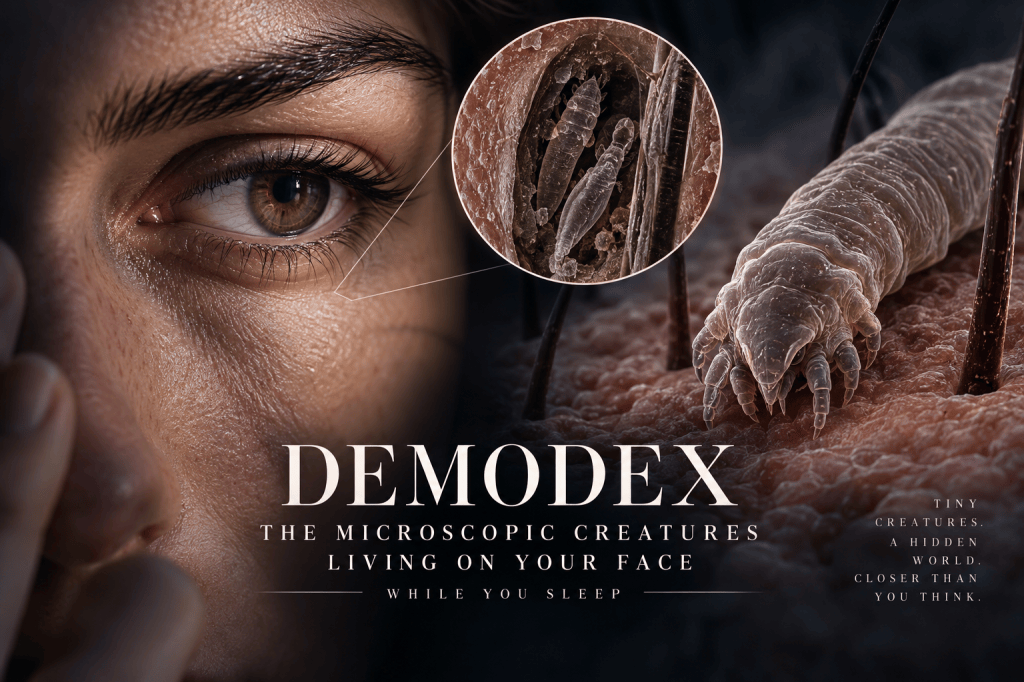
Demodex: The Microscopic Creatures Living on Your Face While You Sleep
There is something quietly unsettling about looking into a mirror and realizing that the face staring back at you is not inhabited by you alone.
Inside the tiny follicles around the nose, forehead, cheeks, eyebrows and eyelashes, microscopic creatures may be living out their entire existence almost completely unnoticed. They feed, move, reproduce and die within a landscape measured not in miles but in fractions of a millimeter, and although most of us will never feel them or see them, they are remarkably common companions of adult human beings.
They are called Demodex mites, and unlike many of the creatures that populate stories about parasites, these are not rare tropical organisms or invaders picked up during some unfortunate encounter. They belong to a much stranger category because, for many people, Demodex is simply part of life on human skin.
Under a microscope the creature looks almost unreal: a long, translucent body, a cluster of eight short legs near its head and a shape that seems better suited to a science-fiction illustration than to the pores of an ordinary human face. Yet Demodex has been known to medicine since the nineteenth century, and modern research has revealed a surprisingly intimate relationship between these mites and their human hosts.
The disturbing part is not that they exist.
It is how close they have always been.
A creature hidden inside the human face
Two species are primarily associated with humans: Demodex folliculorum and Demodex brevis.
Demodex folliculorum is the larger of the two, generally measuring around 0.3 to 0.4 millimeters, and tends to live in hair follicles, often gathering near facial hairs and eyelashes. Demodex brevis is shorter and prefers a deeper existence, inhabiting sebaceous glands and the meibomian glands located along the eyelids.
Their favorite territory is therefore exactly where human skin tends to be richest in oil: around the nose, cheeks, forehead, chin, eyebrows and eyelids.
To us, a pore is almost nothing, a tiny opening visible only when we examine the skin closely. To an organism the size of Demodex, however, the same structure is an entire habitat, providing darkness, protection and a steady supply of material from the skin and sebaceous glands.
Their elongated bodies are remarkably well suited to this environment. Instead of the rounded appearance we usually associate with mites, Demodex resembles a microscopic translucent worm with legs concentrated toward the front of its body, allowing it to fit into the narrow architecture of a follicle.
It is an arachnid, belonging to the same broad class as spiders and ticks, although its existence could hardly be more different.
Most of the time, it remains invisible not only to our eyes but also to our awareness.
What happens after the lights go out
This is where the biology of Demodex becomes considerably stranger.
The mites show nocturnal activity. During periods of darkness they can leave the deeper parts of the follicle and move across the surface of the skin, while bright light encourages them to retreat again. Laboratory and microscopic observations have estimated their movement at only a few millimeters per hour, which sounds insignificant until one remembers the scale of the creature itself.
For Demodex, crossing a small portion of the face can represent a substantial journey.
Research into the mite’s biology has suggested that darkness is closely connected with its activity and reproductive behavior. Adults can move toward follicular openings, encounter other mites and mate before returning to the protected environment of follicles and glands, where eggs develop and a new generation begins.
Their lives are remarkably short, generally lasting only a matter of weeks.
From egg to larva, through immature stages and eventually to adulthood, the entire cycle unfolds on the human host. There is no hidden nest beneath the bed, no colony waiting somewhere in the bathroom and no mysterious external phase of the animal’s existence. For a human-associated Demodex mite, our skin is essentially its world.
This nocturnal behavior also helps explain an observation reported in some people suffering from Demodex-related eyelid disease: itching and irritation may become particularly noticeable during the night or shortly after waking.
For most people, however, nothing happens that they can feel at all.
Does everyone have Demodex?
Not literally everyone, and claims that every single human being carries thousands of mites should be treated cautiously, but Demodex becomes extremely common with increasing age.
Children tend to have far fewer mites, while colonization becomes progressively more frequent in adults. Differences between studies are substantial because results depend on age, population and the technique used to detect the mites, but the overall pattern is clear: Demodex is a very ordinary inhabitant of adult human skin.
That distinction matters because finding a Demodex mite does not mean someone has a disease.
Human skin was never intended to be sterile. It supports complicated communities of bacteria, fungi, viruses and microscopic organisms whose presence may be harmless, beneficial, problematic or some combination of all three depending upon circumstances.
Demodex occupies an especially ambiguous position within this hidden ecosystem.
When present in small numbers, the mites may coexist with us without producing any recognizable symptom. When their population becomes unusually dense, however, the relationship can change.
And this is where medicine becomes interested.
When a harmless resident becomes a problem
An excessive proliferation of Demodex can be associated with a condition known as demodicosis, which may produce facial redness, roughness, scaling, burning, itching, follicular irritation and small inflammatory eruptions.
The difficulty is that these symptoms can resemble other dermatological disorders.
Someone may believe they have acne, sensitive skin, an allergic reaction or rosacea when the underlying picture is more complicated. Conversely, discovering Demodex does not automatically prove that the mites caused the inflammation because they can also be found on perfectly healthy skin.
The important factor appears to be not merely their presence but their density, their location, the condition of the skin barrier and the way the immune system responds to them.
This has led to one of the most intriguing debates surrounding Demodex: when large numbers of mites are found on diseased skin, are they helping to create the disease, or has the altered skin environment simply created perfect conditions for the mites to multiply?
The answer is still developing.
The strange connection with rosacea
Few aspects of Demodex research have generated as much interest as its connection with rosacea, the chronic inflammatory disorder that can produce facial flushing, persistent redness, visible blood vessels, papules and pustules.
Study after study has found greater densities of Demodex on the skin of many patients with rosacea than on unaffected controls. One systematic review discussing the skin microbiome reported research in which levels of Demodex folliculorum were several times higher in people with rosacea than in controls.
That association is real.
Its meaning is more complicated.
Rosacea is not simply a Demodex infestation. The disorder involves interactions among blood vessels, immune responses, the skin barrier, environmental triggers, genetics and the cutaneous microbiome. The mites appear to be one possible participant in this inflammatory network rather than a complete explanation for the disease.
Researchers have proposed several mechanisms by which high mite densities might contribute to inflammation. Their physical presence can affect follicles, components associated with the mites may stimulate the immune system, and microorganisms carried within or around them may potentially add another layer to the reaction.
Other researchers have pointed out the reverse possibility: rosacea may alter the skin environment in ways that allow Demodex populations to flourish.
There is therefore a peculiar biological circle that science is still trying to untangle.
Perhaps inflammation encourages the mites.
Perhaps the mites encourage inflammation.
Perhaps both processes occur at the same time.
They also live among your eyelashes
If the thought of microscopic mites in facial follicles is uncomfortable, their preferred location around the eyes may be even harder to ignore.
Demodex folliculorum is frequently found around eyelash follicles, while Demodex brevis can inhabit sebaceous and meibomian glands associated with the eyelids.
In excessive numbers they have been linked to Demodex blepharitis, an inflammatory condition affecting the eyelid margins. People may experience itching, burning, dryness, redness, watering, a foreign-body sensation or irritation that is particularly noticeable around the eyelashes.
One of the characteristic signs doctors look for is the presence of cylindrical material, often described as collarettes, around the bases of the lashes. These deposits can contain keratinized material and debris associated with mite activity.
This is not simply an obscure medical curiosity. Modern ophthalmology increasingly recognizes Demodex as an important factor in some cases of persistent blepharitis, particularly when symptoms continue despite conventional eyelid care.
Once again, however, context matters. A mite found in an eyelash follicle is not automatically a disease diagnosis because asymptomatic people can carry them too.
The difference between coexistence and illness often lies in numbers and inflammation.
What do they actually eat?
For years, descriptions of Demodex were sometimes simplified into the claim that the mites merely consume dead skin.
Their feeding behavior appears to be more complex.
They inhabit environments rich in sebum and cellular material and possess mouthparts adapted to obtaining substances available inside follicles and sebaceous structures. Studies describe their diet in relation to sebum, epithelial material and substances associated with the follicular environment.
This makes the human face remarkably suitable habitat because the areas surrounding the nose, forehead, eyebrows and eyelids contain abundant sebaceous structures.
In evolutionary terms, Demodex has become so closely adapted to this environment that its biology makes little sense without its mammalian host.
The mite is not simply visiting us.
It has evolved to live here.
The famous Demodex myth that refuses to die
Anyone who has explored Demodex on social media has probably encountered a particularly memorable claim: the mites supposedly have no anus, accumulate waste throughout their lives and then burst open after death, releasing everything into the human pore.
It is an excellent horror story.
It is also misleading.
Modern anatomical and genomic work has challenged the claim that Demodex lacks a functional way of eliminating waste, and researchers studying its biology have specifically pointed out that the popular story of accumulated feces exploding into the follicle after death is incorrect.
The persistence of this myth illustrates something interesting about our relationship with microscopic life. Once people discover that an eight-legged creature lives inside human pores, reality already sounds strange enough that almost any additional detail becomes believable.
Demodex does not need fictional embellishment.
Its genuine biology is peculiar enough.
Can you feel them walking across your face?
Normally, no.
A single mite is far too small and moves far too slowly for someone simply to feel it crawling across the skin. Sensations such as itching or irritation associated with Demodex-related disorders are connected with inflammation and the interaction between the mites, follicles and immune system rather than with a person consciously detecting individual footsteps.
The same applies when looking into a mirror.
Although an adult Demodex folliculorum approaches the lower limits at which an object might theoretically become detectable under ideal conditions, ordinary observation of the skin will not reveal mites walking around the face. Proper identification generally requires magnification and clinical examination techniques.
Dermatologists may use skin-surface sampling, microscopy and other methods when demodicosis is suspected, while eye-care professionals can examine the eyelashes and lid margins when Demodex blepharitis is considered.
For people without symptoms, there is generally no reason to go hunting for them.
Should we try to kill them?
Probably the most important thing to understand about Demodex is that discovering these mites should not lead to an attempt to sterilize the face.
Aggressive cleansing, excessive exfoliation or unproven chemicals can damage the skin barrier and create problems far more significant than the mites themselves.
When Demodex is genuinely involved in a diagnosed skin or eyelid disorder, targeted medical treatments are available, and management depends on whether the problem involves the facial skin, rosacea, demodicosis or the eyelids. Dermatologists and eye-care professionals can distinguish these conditions more reliably than photographs or home experiments.
The goal is not necessarily to create a completely mite-free human being.
The goal is to restore a healthy balance.
That concept feels strangely modern, yet it reflects something biology has been telling us for a long time: health is not always the absence of other organisms. Sometimes it is the ability of many organisms to occupy the same environment without allowing one part of the system to overwhelm the rest.
The face in the mirror is an ecosystem
Perhaps Demodex fascinates us because it challenges one of the simplest assumptions we make about our own bodies.
We instinctively think of the boundary of the skin as the place where the self ends and the outside world begins, yet biology has never respected that boundary as neatly as we do. The human body is inhabited by enormous communities of microscopic life, and the line separating us from that living environment is far more complicated than it appears.
Demodex occupies one of the most intimate territories imaginable, inside structures belonging to our skin, sometimes only fractions of a millimeter from the surface we touch when we wash our faces in the morning.
While we sleep, some of these mites become active. They move through a landscape formed by our follicles, reproduce within it and disappear again into spaces too small for us to see.
By morning the mirror looks exactly the same.
Perhaps that is what makes Demodex more fascinating than frightening. The discovery does not reveal that something suddenly invaded the human body; it reveals that an entire miniature world was already there, carrying on with its existence while we remained completely unaware of it.
And once you know that, it becomes difficult to look at an ordinary human face in quite the same way again.
Sources & Further Reading
University of Reading — The Secret Lives of Mites in the Skin of Our Faces. Explanation of the genomic study and the unusual biology of Demodex folliculorum.
https://www.reading.ac.uk/news/2022/Research-News/Secret-lives-of-skin-mites-in-our-faces
Significance of Demodex folliculorum and Demodex brevis in Pathogenesis of Dermatological Diseases — Current State of Knowledge. A recent scientific review covering Demodex biology, demodicosis, rosacea, blepharitis, diagnosis and treatment.
https://pmc.ncbi.nlm.nih.gov/articles/PMC12028426/
Beyond the Surface: Understanding Demodex and Its Link to Blepharitis and Facial Dermatoses. Review of the relationship between Demodex mites, facial skin disorders, ocular rosacea and eyelid inflammation.
https://pmc.ncbi.nlm.nih.gov/articles/PMC11213710/
Demodex Blepharitis: A Comprehensive Review of the Disease, Current Management, and Emerging Therapies. Detailed review of Demodex infestation around the eyelashes, collarettes, inflammation and ocular symptoms.
https://pmc.ncbi.nlm.nih.gov/articles/PMC10351901/
Demodex and the Eye — A Review. Overview of ocular Demodex, blepharitis, rosacea and the still-debated relationship between mite proliferation and disease.
https://pmc.ncbi.nlm.nih.gov/articles/PMC11831939/
Human Follicular Mites: Ectoparasites Becoming Symbionts. Molecular Biology and Evolution, 2022. Genomic research into Demodex folliculorum, its extraordinary adaptation to human follicles, nocturnal behavior and reduced genome.
https://doi.org/10.1093/molbev/msac125


Leave a comment