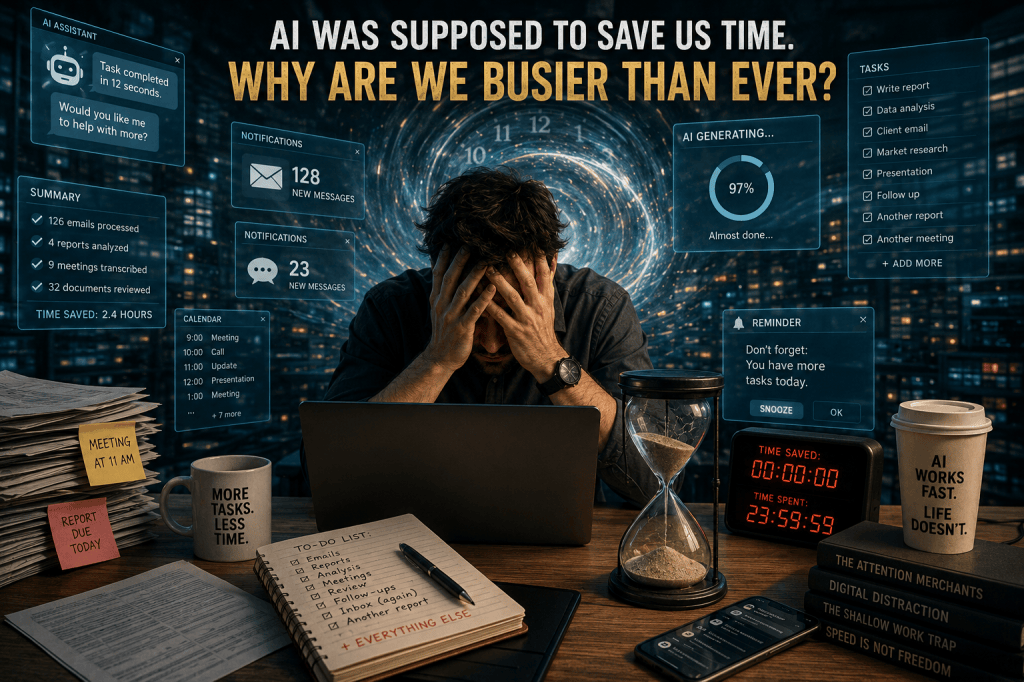
Artificial intelligence entered everyday life carrying one of technology’s oldest promises: the promise of time. We were told that machines capable of writing, summarizing, translating, researching, organizing, calculating, designing and answering questions almost instantaneously would remove hours of repetitive labor from our days, leaving human beings with more space for creativity, relationships, reflection and the kinds of work that require genuine judgment rather than mechanical repetition. The logic appeared almost impossible to dispute, because if a report that once required three hours could be produced in thirty minutes, if twenty pages could be summarized in seconds, and if an administrative task could be delegated almost entirely to software, then somewhere inside this extraordinary increase in efficiency there should have been an equally extraordinary increase in free time.
Yet that is not how the AI revolution feels to many people living through it.
Instead, we appear to have entered a peculiar period in which everything is becoming faster while almost nobody feels that life is becoming slower. Emails are produced more quickly, documents are generated more rapidly, research that once required hours can sometimes be compressed into minutes, and enormous quantities of information can be processed almost instantly, yet our calendars remain full, our notifications multiply, our expectations rise, and the sensation of being permanently behind seems to have become one of the defining psychological conditions of digital life.
The contradiction deserves closer examination because it suggests that the real question surrounding artificial intelligence may not be whether AI can save time. There is already substantial evidence that, for particular tasks, it can. The more uncomfortable question is what human societies do with the time after technology saves it.
AI Really Does Make Some Work Faster
Before examining the paradox, it is important to separate evidence from technological pessimism. Generative AI is not merely creating the illusion of greater efficiency; carefully designed studies have demonstrated substantial productivity gains in certain kinds of work.
In a widely discussed experiment published in Science in 2023, economists Shakked Noy and Whitney Zhang recruited 453 college-educated professionals and asked them to complete realistic professional writing assignments. Participants given access to ChatGPT completed their work approximately 40 percent faster, while independent evaluators rated the quality of their output approximately 18 percent higher. The results were particularly interesting because the technology did not simply accelerate production; it also reduced differences in performance between stronger and weaker participants.
Another major investigation by Erik Brynjolfsson, Danielle Li and Lindsey Raymond examined thousands of customer-support workers using a generative AI assistant. The researchers found a substantial improvement in productivity, with especially pronounced gains among less experienced and lower-skilled employees. AI appeared to function partly as a mechanism for distributing expertise, allowing inexperienced workers to benefit from patterns and techniques previously associated with more accomplished colleagues.
These studies demonstrate something important: the basic promise is not imaginary. AI can reduce the time required for specific cognitive tasks, sometimes dramatically.
The mystery begins when we ask what happens next.
Suppose an employee once required an entire morning to prepare a report, respond to clients and summarize the previous day’s meetings. With AI assistance, the same employee can now complete those activities before ten o’clock. From the perspective of pure arithmetic, several hours have been liberated. From the perspective of organizational life, however, those hours rarely become leisure. They become available capacity, and available capacity is remarkably difficult for modern institutions to leave unused.
The worker receives another report to prepare, another meeting to summarize, another customer to answer and another project that previously would have been considered impossible to complete within the working day.
The technology has saved time, but the system has absorbed it.
The Strange Economics of Saved Time
There is an old economic idea that provides a surprisingly useful way of understanding what may be happening. In the nineteenth century, British economist William Stanley Jevons observed that improvements in the efficiency with which coal was used did not necessarily cause society to consume less coal. Greater efficiency made coal-powered technologies cheaper and more attractive, which encouraged their expansion and could ultimately increase total consumption.
This became known as the Jevons paradox.
Human attention is obviously not coal, and applying Jevons’ observation directly to knowledge work would be an analogy rather than an economic law. Nevertheless, the pattern is remarkably suggestive because digital technology repeatedly demonstrates something similar: when the cost of performing an activity falls, we frequently respond by performing far more of that activity.
Email is perhaps the clearest example.
Electronic mail was one of the greatest time-saving technologies ever introduced into office life. A letter that previously had to be written, printed, placed in an envelope, transported across a city or country and physically delivered could suddenly arrive on another person’s screen almost instantaneously. If humanity had maintained the same volume of correspondence after adopting email, enormous amounts of time would unquestionably have been saved.
We did not maintain the same volume.
We began sending vastly more messages.
Because sending an email was easy, people copied additional colleagues into conversations, organizations created mailing lists, companies developed automated communications, newsletters multiplied, marketing messages exploded and expectations surrounding response times gradually changed. The technology reduced the cost of each individual communication so dramatically that the total quantity of communication expanded.
AI may now be doing something similar to cognitive production itself.
When writing becomes cheaper, we can produce more writing. When analysis becomes faster, we can request more analysis. When presentations can be created rapidly, organizations can expect more presentations. When software can summarize every meeting, every meeting can generate a summary, which can generate action items, which can generate emails, which can generate another meeting.
The individual task becomes more efficient while the surrounding ecosystem becomes larger.
A Report That Once Took a Day Can Now Create Three More Reports
Consider a fairly ordinary workplace example. Before generative AI, a manager receives a thirty-page market report and must prepare a briefing for senior leadership. Reading the document carefully, extracting the important findings, checking several figures and producing a concise presentation might consume most of the afternoon.
An AI assistant can now summarize the document, identify major themes and generate a preliminary presentation structure in minutes. Even after the manager verifies the output and corrects mistakes, the task might require only an hour.
This appears to represent an enormous productivity victory, and at the level of the individual task it certainly is.
But the organization now realizes that such analysis is inexpensive.
Instead of requesting one market briefing each month, leadership may request one every week. Instead of analyzing one competitor, the manager can now analyze five. Because presentations are easier to produce, meetings may demand more detailed documentation. Because data can be summarized rapidly, executives may expect answers to questions that previously would have been postponed until the following week.
Nothing malicious needs to occur for this transformation to happen. Nobody has to deliberately decide to make employees miserable. Expectations simply adjust to technological capability.
Yesterday’s extraordinary productivity gradually becomes tomorrow’s minimum standard.
What Recent Research Is Beginning to Show
This distinction between task-level efficiency and actual reductions in work is becoming increasingly important in empirical research.
A 2026 review by the International Labour Organization examined emerging evidence from experiments, firms, digital platforms and worker surveys across several countries. Its conclusion was considerably more nuanced than either the utopian or catastrophic versions of the AI story. Productivity improvements are real but uneven, while worker-reported time savings representing a few percent of total working hours have not yet translated consistently into correspondingly higher measured output, earnings or employment effects.
The OECD has similarly emphasized that impressive results from controlled experiments often concern carefully defined tasks that are particularly suitable for generative AI, while real occupations consist of complicated mixtures of activities, only some of which can be accelerated effectively. Survey evidence cited by the OECD suggests that average savings across total working hours can be much smaller than the spectacular gains observed in individual experiments.
This distinction helps explain why someone can genuinely experience AI as extraordinarily useful and still wonder at the end of the week where all the promised free time went.
Saving forty percent of the time required for one writing task does not mean reducing the working week by forty percent, because the working week contains meetings, decisions, interruptions, verification, interpersonal communication, administration and dozens of activities that have not disappeared.
More importantly, the tasks that become faster may simply multiply.
We Have Seen This Movie Before
AI is not the first technology expected to liberate humanity from work.
The washing machine reduced the physical labor required to wash clothing, yet historical research into household labor has shown that labor-saving appliances did not automatically eliminate domestic work because standards of cleanliness, frequency and household expectations changed alongside the technology.
Computers transformed office administration but did not eliminate paperwork; in many environments they dramatically increased the quantity of documents that could be produced.
Smartphones promised freedom from fixed locations while simultaneously making employees reachable almost everywhere.
Search engines eliminated countless hours previously spent locating information, yet they also helped create a culture in which people are expected to find answers almost immediately.
Navigation applications save us from studying maps while allowing schedules to be planned with increasingly precise expectations about arrival times.
Every generation of technology removes a constraint, and society reorganizes itself around the absence of that constraint.
The mistake is assuming that saved time naturally becomes free time.
It does not.
Saved time becomes available time, and what happens to available time is determined by economics, culture, institutions and personal behavior.
The Death of Waiting
One of the least discussed consequences of digital technology is the gradual disappearance of waiting from everyday life.
Waiting was once built into almost every form of communication and intellectual work. A letter required days to arrive, a photograph needed to be developed, a library had opening hours, an encyclopedia had to be consulted physically, a colleague who had left the office could not necessarily be contacted, and a question sometimes remained unanswered until the following morning simply because no mechanism existed for obtaining an immediate response.
Many of these delays were inconvenient, and there is little reason to romanticize them. Nevertheless, they created boundaries that technology has systematically removed.
Artificial intelligence removes another layer of waiting because it dramatically reduces the distance between intention and output. We can ask for a summary and receive it immediately, request ten ideas instead of spending an afternoon developing three, generate a first draft before our thoughts have completely formed, translate a document without waiting for another person, and transform a vague concept into images, text, tables or code within moments.
This changes more than productivity.
It changes expectation.
Once instant response becomes technologically possible, delay begins to appear unnecessary. When one employee can answer immediately, another employee who waits until tomorrow may appear slow. When one company produces personalized content at enormous scale, competitors feel pressure to do the same. When one creator publishes every day with AI assistance, another creator who publishes once a week risks becoming invisible.
The machine changes the speed of production, and the new speed gradually becomes a social norm.
The White Rabbit Effect
This creates what might be called the White Rabbit Effect, borrowing the image of the perpetually hurried White Rabbit from Alice’s Adventures in Wonderland. The modern digital worker is increasingly surrounded by signals suggesting that something requires immediate attention: another notification, another message, another update, another piece of content, another opportunity, another deadline, another task that can now be completed because technology has made it possible to squeeze it into the day.
The important point is not simply that people are busy. Humans have always worked hard. The difference lies in the psychological structure of contemporary busyness, because the modern individual can spend an entire day completing tasks while simultaneously experiencing the persistent sensation of falling behind.
The inbox is never truly finished because new messages can arrive indefinitely. Social media has no final page. News has no closing edition. Streaming platforms contain more entertainment than anyone could consume in a lifetime. Online stores contain effectively unlimited products, and generative AI introduces another infinity: an inexhaustible supply of answers, drafts, ideas, variations, images and possibilities.
For the first time in history, many people inhabit information environments with almost no natural endpoint.
The human brain, however, still searches for completion.
That mismatch can create a strange form of cognitive dissatisfaction in which productivity rises while the subjective experience of accomplishment declines.
AI Can Complete Tasks, but It Can Also Generate Them
Another paradox receives far less attention: generative AI is extremely good not only at completing work but also at inventing additional work.
Ask an AI system to analyze a business problem and it may identify ten opportunities requiring further investigation. Ask it to improve a website and it may produce twenty recommendations. Ask it to develop a marketing strategy and it can generate campaigns for multiple platforms, each requiring images, copy, analytics, testing and follow-up.
Before AI, a small business owner might have concluded that publishing one article and promoting it on two platforms was enough because creating more material would require too much time.
With AI, the same person can theoretically maintain a blog, newsletter, YouTube channel, TikTok account, Pinterest profile, X account, Threads account, Facebook page and several other channels simultaneously.
The technology has increased capability enormously.
It has also expanded the universe of things the person could reasonably believe they ought to be doing.
This distinction between can and should may become one of the central psychological problems of the AI age.
The Verification Tax
AI-generated work also creates another category of labor that is easy to overlook: verification.
A human who delegates research to an AI system cannot responsibly assume that every source, quotation, statistic or interpretation is correct. A programmer using generated code must test it. A lawyer must verify citations. A journalist must check claims. A physician using an AI assistant must retain professional judgment. A company deploying generated customer communications must monitor accuracy, privacy and tone.
The first draft may arrive in thirty seconds, but responsibility does not disappear with it.
In some situations, AI therefore changes the nature of work rather than simply eliminating it. Humans move from producing everything themselves to supervising, selecting, correcting and validating machine output.
This can still represent a major productivity improvement, but it complicates the popular image of automation as a simple subtraction of tasks.
Sometimes AI removes labor.
Sometimes it relocates labor.
Sometimes it creates an entirely new layer of labor around the automated system.
Why the Human Brain Cannot Accelerate Indefinitely
The deepest limitation in this process may not be technological at all.
Computers can become faster. Networks can transmit more information. AI systems can generate more output. Storage can expand and software can operate continuously without requiring sleep.
Human attention cannot scale in the same way.
A person still possesses a finite number of waking hours, a limited working memory and a nervous system that evolved in an environment radically different from the digital ecosystem now surrounding it.
This is why context switching matters so much.
Imagine someone preparing an important document. During the process, an email notification appears, followed by a message from a colleague, an AI-generated summary requiring approval, a calendar reminder and an invitation to review another document. Each interruption may require only a minute, yet the cost is not measured solely by the minute consumed. The person must repeatedly reconstruct the mental context of the original task.
The result is a workplace in which information moves with machine speed while attention continues to operate at human speed.
AI may make each fragment of work easier while increasing the number of fragments competing for consciousness.
Social Acceleration and the Problem of Never Arriving
German sociologist Hartmut Rosa developed the concept of social acceleration to describe a characteristic tension of modern societies: technological acceleration should theoretically produce more free time, yet people often experience increasing time pressure because the number of activities, possibilities and expectations expands alongside technological capability.
The concept becomes particularly relevant in the age of generative AI.
If a technology allows us to accomplish twice as much in an hour, society has at least two choices. We can maintain the previous level of output and reclaim part of the hour, or we can double the expected output.
Modern competitive systems have a powerful tendency toward the second option.
Businesses that can answer customers faster gain an advantage, so competitors must respond faster. Creators who can publish more content occupy more attention, encouraging others to increase output. Researchers who can analyze larger datasets can attempt more ambitious projects. Students who can access information instantly may be expected to produce more sophisticated assignments.
Acceleration becomes self-reinforcing because nobody wants to be the person or institution moving at yesterday’s speed.
The destination keeps moving precisely because everyone is moving faster.
The Matrix We Built Ourselves
This is where the discussion begins to resemble the philosophical territory of The Matrix, although no simulation theory or hidden conspiracy is necessary.
The most interesting Matrix may simply be a system created collectively by human incentives and then experienced individually as something beyond our control.
Nobody decided that every email should receive a rapid response, yet many people feel anxious when they do not respond.
Nobody decreed that creators must maintain accounts on numerous platforms, yet visibility increasingly rewards constant production.
Nobody ordered workers to fill every minute saved by technology with another task, yet organizational incentives make unused capacity appear inefficient.
Nobody needs to control the system from a secret room because the system can reproduce itself through competition, expectations and habits.
We built tools to save time, then constructed social structures that interpret unused time as wasted potential.
That may be a far more interesting Matrix than the fictional one because we do not need to ask whether it exists.
We participate in it every day.
Productivity and Freedom Are Not the Same Thing
One of the most important distinctions in the AI debate is the difference between productivity and freedom.
Suppose an employee can accomplish an eight-hour workload in five hours using artificial intelligence. Technologically, three hours have been saved.
Nothing about the technology itself determines what happens to them.
The employee might receive three hours of leisure. The company might assign additional work. The working day might remain eight hours while output increases. Staffing levels might fall. The employee might use the extra time for more creative tasks, training or strategic thinking.
AI determines what becomes possible, but institutions determine how the productivity dividend is distributed.
This is why predictions that automation will inevitably create a society of abundant leisure have repeatedly disappointed. A machine can reduce the labor necessary to produce something, but it cannot decide whether the resulting efficiency becomes higher profits, lower prices, greater output, fewer workers, shorter working hours or more free time.
Those are human choices.
Perhaps Attention, Not Intelligence, Is Becoming the Scarce Resource
Generative AI is making certain forms of intellectual production astonishingly inexpensive. Text, images, summaries, ideas and analyses that once required substantial human effort can now be generated in enormous quantities.
When something becomes abundant, however, another resource usually becomes scarce.
In the AI economy, that resource may be human attention.
If everyone can produce ten articles, the difficult problem becomes deciding which article deserves to be read. If every company can generate hundreds of advertisements, the scarce commodity is not advertising but the customer’s willingness to notice one. If an AI can propose fifty business ideas, the valuable human skill becomes determining which idea is worth pursuing.
This may create an unexpected reversal.
For decades we associated productivity with producing more.
The next stage may require learning to deliberately produce less.
The most valuable worker may not be the person who generates the greatest quantity of AI-assisted material but the person capable of deciding what does not need to exist.
The most effective manager may not be the one who fills every saved hour but the one who protects employees from unnecessary tasks.
The most intelligent use of AI may not be asking it how to accomplish twenty things faster, but asking which fifteen should never have been done in the first place.
The Question AI Cannot Answer for Us
There is an irony at the heart of artificial intelligence.
We have created machines increasingly capable of helping us optimize almost everything except the reason we are optimizing it.
AI can organize a calendar but cannot determine whether the calendar deserves to be full. It can write an email but cannot decide whether the email needs to be sent. It can generate content but cannot tell society how much content is enough. It can suggest ways to become more productive without resolving the deeper question of what productivity is ultimately for.
Technology can accelerate means extraordinarily well.
Purpose remains a human problem.
If AI genuinely saves humanity billions of hours of labor in the coming decades, those hours will represent an enormous social resource. They could become more production, more consumption and more competition, or they could become time for families, education, creativity, community, sleep, reflection and experiences that cannot easily be measured in productivity statistics.
Nothing about artificial intelligence guarantees either outcome.
Maybe the Revolution Is Not Doing More
The conventional question surrounding AI is almost always some variation of: How much more can we accomplish?
Perhaps we should begin asking a different one.
What can we finally stop doing?
If artificial intelligence eliminates thirty minutes of repetitive administration but we immediately replace those thirty minutes with another administrative obligation, the machine has improved efficiency without improving life. If it allows a writer to produce five times more content but forces that writer to live permanently inside a production schedule, we may have optimized the wrong variable. If employees become dramatically more productive while remaining equally exhausted, productivity statistics will tell only part of the story.
The genuine test of AI may therefore have little to do with how rapidly it generates words, images or code.
It may be whether humans can resist the impulse to fill every space the technology creates.
For generations, we imagined that the great technological challenge was inventing machines capable of giving us more time.
We may finally be approaching that capability.
The harder challenge is discovering whether we know what to do with the time once we receive it.
Artificial intelligence can accelerate work, compress tasks and remove friction from countless activities, but it cannot protect an empty hour unless human beings decide that an empty hour has value. It cannot prevent organizations from converting every efficiency gain into another target, and it cannot stop individuals from turning every new capability into another obligation.
The paradox is therefore not that AI failed to save us time.
The paradox is that it may be succeeding.
We simply keep spending everything it saves.
And that leaves us with a question far more unsettling than whether machines will eventually become more intelligent than human beings:
If AI gives us back our time, but our society immediately converts that time into more work, more content, more messages and more obligations, have we actually become freer—or have we merely built a faster version of the same cage?


Leave a comment