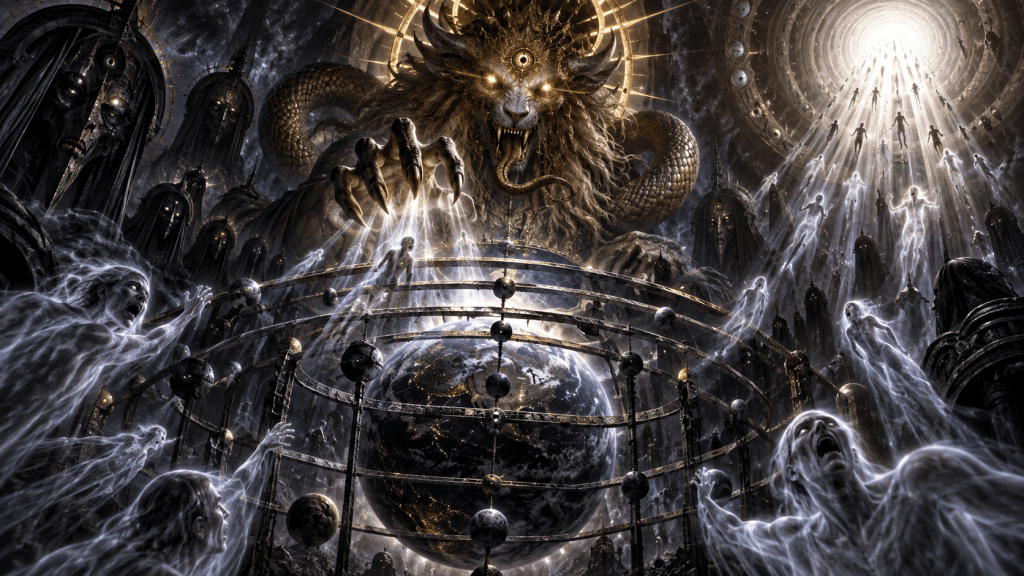
What if the most disturbing version of the Matrix was imagined almost two thousand years before computers existed?
Long before simulation theory, artificial intelligence, virtual reality or the language of digital prisons entered human culture, several ancient religious movements were already telling a remarkably unsettling story: the visible universe was not necessarily the work of the highest God, human beings carried within themselves something that did not truly belong to this world, and powerful cosmic rulers stood between the imprisoned divine spark and the realm from which it had originally descended.
Those rulers were called the Archons, and presiding over their imperfect cosmos was an extraordinary figure known as Yaldabaoth, also called Saklas and Samael, a creator who believed himself to be supreme precisely because he was ignorant of everything existing above him.
Almost seventeen centuries later, an entirely new mythology has begun to grow around those ancient ideas, combining Gnostic cosmology with near-death experiences, reincarnation, the Van Allen radiation belts, Saturn, the Moon, electromagnetic frequencies and the mysterious concept known as Loosh. According to this modern theory, Earth is not merely a difficult world but part of an enormous reincarnation mechanism in which consciousness is repeatedly returned to physical existence after death.
The resemblance between these two systems is fascinating.
The problem is that they are not the same system.
To understand where ancient Gnosticism ends and the modern “soul trap” begins, we have to go back to texts buried for centuries beneath the Egyptian desert and ask a much more disturbing question: what did the Gnostics actually believe was waiting above the visible world?
The God Who Did Not Know There Was a God Above Him
Among the manuscripts discovered near Nag Hammadi in Upper Egypt in 1945 was a collection of texts containing radically different interpretations of creation, salvation and the nature of humanity. One of the most important is the Apocryphon of John, sometimes called the Secret Book of John, a work that presents creation almost as a cosmic catastrophe.
At the highest level of reality exists the divine fullness, usually described in Gnostic language as the Pleroma, a realm beyond ordinary matter and limitation. From this transcendent divine reality emerge spiritual powers known as Aeons, among them Sophia, whose name means Wisdom.
Then something goes wrong.
Sophia produces a being outside the proper harmony of the divine realm, and that being becomes Yaldabaoth. Unaware of the higher world from which his power ultimately derives, Yaldabaoth begins creating his own realm and generating subordinate rulers.
The Apocryphon of John describes him as establishing seven kings over seven heavens, while other authorities rule additional regions beneath them. The text gives Yaldabaoth three names — Yaldabaoth, Saklas and Samael — and depicts him declaring himself to be the only God because he does not know the true source of his own power.
This is one of the most radical theological reversals surviving from antiquity.
The creator of the material cosmos is not necessarily evil in the simple sense of a demonic villain plotting in darkness; what makes him dangerous is his ignorance, combined with enormous power. He mistakes a lower realm for total reality and mistakes himself for the supreme principle of existence.
Another Nag Hammadi text, The Hypostasis of the Archons, or The Reality of the Rulers, develops a similar image, calling the chief ruler blind and associating him with Samael, traditionally interpreted as the “god of the blind.”
From a modern perspective, the idea sounds almost unnervingly familiar: imagine an intelligence capable of constructing an entire world while remaining incapable of perceiving the reality above its own system.
Whether interpreted religiously, symbolically or philosophically, Yaldabaoth resembles the ultimate administrator of a closed reality who has forgotten that he, too, belongs to something larger.
The Divine Spark Hidden Inside the Human Being
Gnostic mythology becomes even stranger when humanity enters the story, because human beings are not presented merely as creatures belonging completely to the world constructed by the Archons.
Within humanity exists something higher.
Different Gnostic schools described this inner element in different ways, but the central image is that a fragment, spark or element of the divine realm has somehow become embedded within material existence. The human problem therefore becomes more profound than sin in the ordinary moral sense; the problem is forgetfulness, because the spiritual element within the human being no longer remembers where it came from.
Salvation, consequently, requires more than obedience.
It requires Gnosis.
Gnosis does not simply mean accumulating secret facts, but awakening to the true nature of oneself, of the cosmos and of the powers claiming authority over it. From this perspective, ignorance is the prison, while knowledge becomes the beginning of escape.
This explains why many Gnostic narratives contain strange images of awakening, recognition and remembering one’s origin. The human being who discovers that the material order is not ultimate also discovers that the rulers of that order may not possess ultimate authority.
It is here that modern Matrix comparisons become difficult to resist.
A prisoner who does not know that he is imprisoned does not search for an exit, while a consciousness that believes the visible world is the whole of reality will never ask what might exist beyond it.
The Seven Heavens and the Cosmic Gatekeepers
One of the strongest connections between genuine Gnosticism and the modern soul-trap theory is the ancient idea that the cosmos consisted of successive heavenly regions associated with ruling powers.
The Apocryphon of John explicitly speaks of seven rulers assigned to seven heavenly spheres.
This idea did not emerge in a vacuum, because ancient Mediterranean cosmology commonly imagined a layered universe associated with the visible celestial bodies, and religious traditions frequently transformed these astronomical layers into spiritual territories.
For certain Gnostic groups, however, these were not merely beautiful heavens through which a blessed soul floated effortlessly upward. They could represent domains of authority through which the ascending soul had to pass.
Later Gnostic works, including traditions preserved in the Pistis Sophia and related texts, describe elaborate cosmic hierarchies filled with rulers, emanations, mysteries and regions of light. The Pistis Sophia, preserved separately from the Nag Hammadi collection in the Askew Codex, repeatedly describes the ascent through cosmic regions and the mysteries connected with higher realms.
Some late Gnostic and related initiatory traditions went even further, associating spiritual ascent with names, seals, formulas and precise knowledge that permitted passage through hostile or restricted regions.
For a modern reader, these texts can sound surprisingly like descriptions of checkpoints.
That resemblance has helped generate one of the most persistent contemporary interpretations: the idea that ancient descriptions of celestial gates were actually coded references to a mechanism designed to recycle souls.
Yet the ancient texts never mention satellites, radiation belts, electromagnetic grids or planetary technology.
Those elements arrived much later.
From Seven Gnostic Spheres to the Van Allen Belts
The modern soul-trap theory makes a dramatic leap by identifying ancient celestial barriers with the Van Allen radiation belts, two major regions of energetic charged particles surrounding Earth.
The comparison is visually powerful. The belts form enormous toroidal regions around the planet, and if someone approaches ancient cosmological diagrams already believing Earth is enclosed within an energetic prison, the resemblance can appear almost irresistible.
However, the historical chronology creates an immediate problem.
The Van Allen belts were discovered in 1958, roughly seventeen centuries after the principal Gnostic texts were composed. NASA describes them as regions of high-energy charged particles trapped by Earth’s magnetic environment, with an inner and outer radiation belt surrounding the planet.
They are therefore real.
What is not established is the claim that they interact with souls.
There is currently no scientific evidence that consciousness after death possesses electrical charge, measurable electromagnetic mass or any known physical property that would allow it to become trapped by Earth’s magnetic field. Equally important, the belts are not an impenetrable wall surrounding the planet; spacecraft travel through them, and NASA notes that Apollo 8 became the first crewed spacecraft to travel beyond the Van Allen belts in 1968.
This does not make the symbolic comparison meaningless.
It simply changes what the comparison represents.
Ancient Gnostic spheres were metaphysical structures within a religious cosmology, while the Van Allen belts are measurable regions of plasma physics. Connecting the two may create an intriguing modern mythology, but it should not be mistaken for an ancient teaching secretly anticipating twentieth-century space science.
The White Light: Gateway to the Beyond or Entrance to the Loop?
Perhaps no part of the modern theory is more disturbing than the reinterpretation of the light reported during near-death experiences.
Accounts from people who have come close to death sometimes include sensations of leaving the body, entering darkness or a tunnel, encountering intense light, meeting deceased relatives or apparently spiritual beings, experiencing unusual peace and reviewing episodes from one’s life. These features appear repeatedly in the scientific literature examining near-death experiences, although not every person reports the same sequence and no single element appears universally.
The modern Archon theory reverses the usual interpretation.
Instead of seeing the light as a destination of peace, divine presence or neurological phenomenon, some soul-trap believers describe it as a lure, an artificial mechanism supposedly designed to attract consciousness immediately after death.
In this interpretation, deceased relatives, religious figures or benevolent guides might themselves be projections intended to persuade the disoriented individual to consent to another incarnation. The frequently reported life review is then transformed from a moment of understanding into a psychological interrogation during which guilt, regret and attachment supposedly convince the soul that it must return to Earth in order to correct previous mistakes.
It is an extraordinarily powerful narrative because it takes familiar spiritual symbols and reverses their meaning.
Love becomes bait.
Judgment becomes manipulation.
Reincarnation becomes imprisonment.
Yet this interpretation does not come from the Nag Hammadi manuscripts, nor has science demonstrated that NDE lights are external machines or that post-mortem consciousness is being redirected toward reincarnation.
Research confirms that people report such experiences; it does not establish the modern explanation attached to them.
Did the Gnostics Really Possess Passwords for the Afterlife?
One of the most fascinating claims surrounding the soul-trap theory concerns secret names and formulas supposedly used to bypass Archonic guardians.
Here the modern story contains a genuine ancient echo.
Late antique religious traditions did sometimes assign enormous importance to sacred names, seals, symbols and mysteries, and certain Gnostic texts contain elaborate maps of spiritual hierarchy that would be nearly incomprehensible without initiation into the system behind them.
The Pistis Sophia repeatedly speaks of mysteries, regions and powers connected with ascent toward higher light, while related Gnostic literature develops intricate systems through which initiates symbolically demonstrate their spiritual identity and knowledge.
What should not be done, however, is to take every modern phrase circulating online and label it a quotation from Nag Hammadi.
Statements such as “I come from the Pre-Existent One and return to the place from which I came” may resemble Gnostic theology, because they express the fundamental motif of remembering one’s divine origin, but modern versions often circulate without a precise ancient manuscript, tractate, chapter or translation attached to them.
The deeper Gnostic principle is actually more interesting than a magical password.
The soul escapes because it knows what it is.
If the Archons rule through ignorance, then the moment of liberation occurs when their authority is recognized as limited.
The ultimate password would therefore not be a sequence of syllables.
It would be awakening.
Saturn, the Moon and the Alleged Cosmic Broadcast
Modern versions of the theory often expand the Matrix far beyond Earth, presenting Saturn as a gigantic generator and the Moon as a relay station that supposedly broadcasts frequencies maintaining human consciousness within a narrow perceptual spectrum.
Saturn is particularly attractive to occult interpretation because its mythological counterpart, Cronus or Kronos, has long been associated symbolically with time, limitation, age and restriction, while the enormous ring system gives the planet an appearance unlike anything else visible in the Solar System.
From symbolism, however, the modern theory moves into technology.
Saturn’s rings are sometimes described online as artificial transmitters, while the Moon is described as an amplification station projecting the signal toward Earth.
There is no observational evidence supporting this mechanism.
Cassini spent more than a decade studying Saturn and its rings at close range, measuring their structure, composition and interactions with Saturn’s moons. NASA describes the main rings as overwhelmingly composed of enormous numbers of pieces of water ice ranging from tiny particles to extremely large fragments, while some ring material is continually supplied or redistributed through interactions with moons such as Enceladus.
The idea that the Moon is hollow encounters an equally substantial problem.
Apollo seismic experiments recorded moonquakes, impacts and the propagation of seismic waves through the lunar body, allowing researchers to investigate its internal structure, while subsequent analyses support a differentiated Moon containing crust, mantle and a small core rather than an empty artificial shell.
The symbolic Saturn–Moon theory may therefore belong to modern occult cosmology, but it should not be confused with planetary science.
Loosh: The Word That Sounds Ancient but Is Not
One word appears constantly in contemporary discussions of Archons: Loosh.
According to the modern theory, suffering, fear, grief, conflict and intense emotional states generate an energetic substance that non-human entities can consume, providing a reason why humanity might be kept inside a cycle of repeated incarnation.
The concept has become so deeply intertwined with contemporary discussions of Archons that many people assume it originated with the Gnostics.
It did not.
The term is associated with American author Robert A. Monroe, who described unusual out-of-body experiences and nonphysical realities in his books. His Far Journeys, published by Doubleday in 1985, contains the famous Loosh narrative in which life generates a valuable form of energy.
Monroe was not translating an ancient Gnostic manuscript.
He was describing his own parapsychological experiences and interpretations.
Only later did elements from Monroe’s cosmology become combined online with Yaldabaoth, Archons, reincarnation and the prison-planet theory, producing the hybrid mythology now frequently presented as if it were one uninterrupted ancient doctrine.
It is a perfect example of how modern myths are born, because fragments from separate systems gradually lock together until the seams disappear.
Cremation, the Astral Body and the Alleged Breaking of the Connection
Another modern idea claims that cremation may help sever an energetic bond between consciousness and the physical body more rapidly than burial, while some versions of the theory suggest traditional funeral rites could allow parasitic entities to feed upon residual emotional or etheric energy.
There is no scientific evidence demonstrating such a mechanism, and the major Gnostic texts do not teach that cremation itself guarantees escape from the Archons.
This distinction matters because the central Gnostic problem was not the physical corpse.
It was ignorance.
If liberation depends upon Gnosis, then changing the method by which the physical body is disposed of cannot substitute for the transformation of consciousness that Gnostic writers considered essential.
In that sense, even ancient Gnosticism would undermine some of the more mechanical modern interpretations of escape.
A person could burn the body and remain ignorant.
Another could bury it and possess Gnosis.
The decisive battlefield was consciousness itself.
The Most Dangerous Archon May Not Be a Creature
There is another way of reading these texts that requires neither spaceships nor invisible electromagnetic machines.
Suppose the Archons were understood psychologically.
Fear can rule a human being.
Desire can rule a human being.
Status, tribal identity, ideology, addiction, resentment, money, social conformity and the need for approval can all become invisible authorities whose power depends partly upon our failure to recognize them.
Under this interpretation, Yaldabaoth becomes something more than an ancient monster.
He becomes the symbol of consciousness that mistakes its own limited reality for the whole universe.
An institution can become Yaldabaoth when it believes nothing exists beyond its rules.
An ideology can become Yaldabaoth when it interprets every contradiction as proof of itself.
Even the human ego can become a miniature Demiurge when it constructs a mental world and then forgets that the world it sees is partly its own construction.
This may explain why Gnostic mythology continues to return in modern culture.
The language changes, but the fear remains remarkably similar: what if the forces controlling our perception are strongest precisely when we do not know they exist?
So Is Earth Really a Soul Prison?
There is no reliable scientific evidence demonstrating that the Earth is an artificial reincarnation prison, that the Van Allen belts capture souls, that Saturn broadcasts a Matrix frequency, that the Moon is a hollow relay station or that the light reported in near-death experiences is a technological trap.
Those claims belong to modern speculative and esoteric cosmology.
Yet dismissing the entire story as merely an internet invention would be equally inaccurate, because beneath the modern additions lies an authentic and genuinely astonishing ancient tradition.
The Gnostics really did describe an inferior cosmic ruler.
They really did call him Yaldabaoth, Saklas and Samael.
They really did speak about Archons.
They really did imagine multiple cosmic regions governed by powers.
They really did teach that humanity contained an element originating beyond the visible world.
And they really did believe that liberation required a form of awakening capable of revealing the true nature of reality.
What the twentieth and twenty-first centuries added were radiation belts, electromagnetic grids, Saturnian transmissions, lunar technology, Loosh farming and the reinterpretation of near-death experiences as components of a reincarnation machine.
Perhaps the most fascinating mystery is therefore not whether ancient Egyptians secretly knew about the Van Allen belts.
It is how an ancient religious fear survived for nearly two thousand years and then adapted itself perfectly to the technological anxieties of the modern age.
The ancient Gnostic looked upward and saw planetary rulers standing between the soul and the Pleroma.
The modern conspiracy theorist looks upward and sees satellites, radiation belts and invisible frequencies.
The imagery changed.
The question did not.
Who controls the reality we mistake for the whole of existence?
And if the Gnostics were right about one thing — that ignorance is the strongest prison — then perhaps the most important escape has never required a spacecraft, a password or a hidden opening in the sky.
Perhaps it begins the moment we learn to distinguish what we know from what we merely believe.
Sources and Further Reading
Primary and historical Gnostic texts: The Apocryphon of John, Nag Hammadi Codex II; The Hypostasis of the Archons (The Reality of the Rulers), Nag Hammadi Codex II; Pistis Sophia, preserved in the Askew Codex; translations and archival material available through the Gnostic Society Library.
Space science: NASA material on the Van Allen radiation belts, Cassini observations of Saturn’s rings, Apollo lunar seismology and studies of the Moon’s internal structure.
Near-death experiences: peer-reviewed reviews describing commonly reported NDE features, including light, tunnel experiences, apparent separation from the body and life review, while noting important methodological and explanatory uncertainties.
Modern Loosh concept: Robert A. Monroe, Far Journeys, Doubleday, 1985.

