April 2026The Witches Who Still Speak With the Dead: Inside a Real Witchcraft Retreat in Ireland
There is something strangely unsettling about witchcraft in the twenty-first century, not because it has survived in forgotten villages or in the private rituals of people who refuse to abandon old beliefs, but because it has returned openly, confidently, and without any apparent need to hide.
The modern witch does not necessarily live at the edge of a forest, surrounded by herbs and candles in a house avoided by the neighbours. She may have an Instagram account, a normal profession, a smartphone beside her tarot cards, and a plane ticket to Ireland in her bag.
And yet, beneath these thoroughly modern details, some of the oldest questions have not changed.
Can the dead hear us?
Can something that no longer has a physical body still answer?
Can an object held between our fingers move because another consciousness is attempting to communicate with us?
Or are we listening to something much closer, and perhaps equally mysterious: the hidden part of our own minds?
In April 2026, fifteen women gathered inside an old Irish estate for a witchcraft retreat known as Green Veil. They had travelled there for rituals, divination, healing practices and something that human beings have attempted for thousands of years: communication with the invisible.
The gathering was not reconstructed from rumours or from a story circulating through occult forums. Journalist Lauren Abunassar attended the retreat and later described it for The Guardian, documenting the women, their practices and what happened inside that house.
What she witnessed was neither a medieval witches’ sabbath nor the theatrical version of witchcraft created by cinema.
It was, in many ways, far stranger precisely because it was so ordinary.
An old house, fifteen women and a room full of questions
The retreat took place at Lisnavagh House in County Carlow, an old Irish estate surrounded by countryside and woodland. Retreat organisers continue to use the property for witchcraft gatherings, and future events advertised by the venue combine folklore, ritual, somatic practices and seasonal traditions.
Inside the house during the April gathering were fifteen women who identified with various forms of witchcraft or alternative spirituality. More than half had travelled from the United States.
They did not all look like the witches of popular imagination. Some wore clothing that might have belonged in an occult photograph, while others arrived dressed much like anyone spending a weekend in the countryside. That contrast is important because it removes the comfortable distance between the observer and the subject.
These were not fictional characters.
They were women with ordinary histories, families, jobs, grief, religious backgrounds and personal losses, sitting together because they believed — or at least hoped — that reality contained something more than what could be measured.
Their guide was Isabella Ferrari, better known within her community as Penny the Witch.
Ferrari describes herself as a modern witch, author, spiritual mentor and practitioner whose work combines witchcraft with Buddhist philosophy and somatic healing. According to her own biography, she lived and studied for several years in a Buddhist monastery before eventually incorporating paganism and witchcraft into her spiritual practice. She later created an online community that now reaches well over a hundred thousand followers.
This mixture tells us something important about modern witchcraft.
It is rarely a simple continuation of one ancient religion. Instead, it often brings together folklore, pagan traditions, meditation, psychology, ritual, herbalism, divination and ideas drawn from several spiritual systems. For its practitioners, however, this does not necessarily make the experience less serious.
For some of the women in Ireland, it had become a new spiritual language after older religious structures had ceased to make sense to them.
And on that particular day, the language they chose involved a pendulum.
The pendulum begins to move
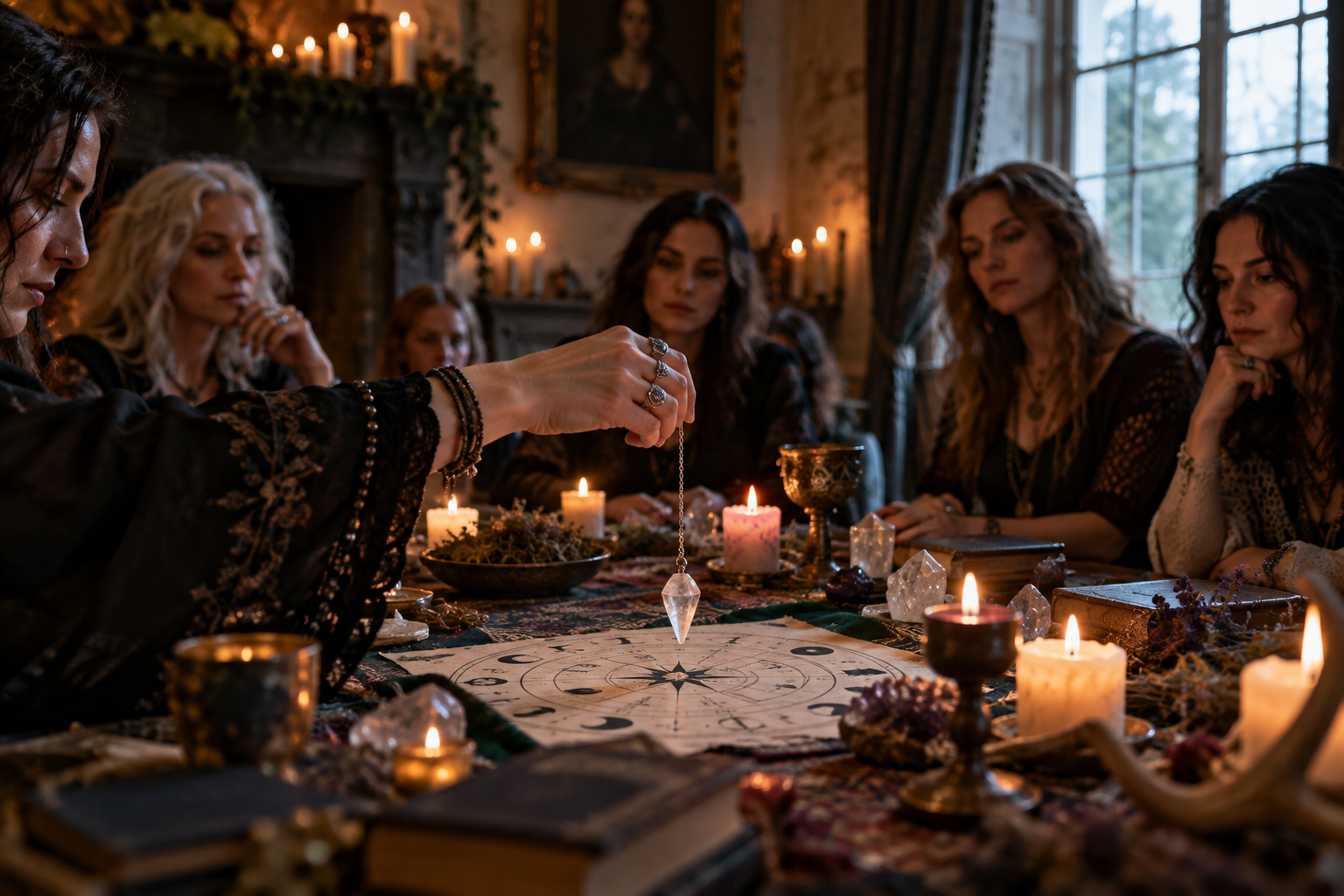
The women sat together and created what were described as divination maps. On the paper were possible responses, including simple answers such as yes and no.
A crystal pendulum was suspended above the map.
The principle was ancient in spirit even if the materials were modern: ask a question, hold the pendulum as steadily as possible, and watch.
For believers in divination, the resulting movement may reveal an answer from intuition, spiritual forces, ancestors or other forms of consciousness. For a psychologist, the same motion may have a very different explanation.
But before reaching the science, something happened inside that room.
One participant, Tara Monte, watched her pendulum begin to rotate with such intensity that she called out to Ferrari, uncertain whether she should stop.
To Monte, the movement did not feel random.
She later interpreted what happened as contact involving the Archangel Michael and a message connected with her deceased parents. What she believed she had received was reassurance: that they were proud of her and still loved her.
It is easy to dismiss an incident like this when reading about it from a distance.
A hand moves. A crystal swings. A grieving person interprets the result.
Nothing supernatural has been demonstrated.
But inside that room, surrounded by other people engaged in the same ritual and carrying their own memories of the dead, the experience was evidently powerful enough to be remembered as something far more significant than the movement of an object.
That difference between what an observer sees and what a participant experiences lies at the heart of nearly every serious discussion about the paranormal.
A camera can record the pendulum.
It cannot record what the woman holding it believes she is encountering.
Who are modern witches actually trying to contact?
Not everyone at the retreat was necessarily looking for the stereotypical ghost of a dead human being.
The women spoke of ancestors, deceased loved ones, spiritual beings, figures from folklore and the witches who had lived before them. This makes contemporary witchcraft difficult to define through the familiar categories of traditional religion.
The invisible world described by its practitioners can include the dead, nature spirits, deities, archetypal beings, angels, faeries and sometimes something considerably less defined — a presence, an intuition or the sense that an answer has arrived from somewhere outside ordinary thought.
Ferrari’s retreats themselves demonstrate how broad that world has become. Her programmes advertise forest rituals, folklore, candle work, ceremonies, somatic healing and practices connected with the seasons. An Ireland retreat scheduled for December 2026, for example, specifically includes Yule traditions and Irish faerie lore concerning the Aos Sí, hawthorn trees and ancient burial mounds.
The old supernatural landscape has therefore not disappeared.
It has simply entered the modern wellness age.
There are booking pages now.
There are payment plans.
There are WhatsApp groups and online communities.
A person may spend the afternoon discussing spirits and the evening checking notifications on a phone.
That apparent contradiction is perhaps one of the most interesting aspects of the entire phenomenon. Technology has not eliminated magical thinking. In some ways, it appears to have helped communities built around it find one another.
But why does the pendulum really move?
Here the story becomes more complicated, because science does have an explanation for an apparently self-moving pendulum.
It is called the ideomotor effect.
The principle has been studied for more than a century and refers to movements generated without the person experiencing a clear conscious intention to make them. Tiny muscular actions can pass from the fingers into the pendulum and gradually become amplified, creating a visible swinging motion even though the person holding it may sincerely feel that she is keeping her hand still.
Research published in Neuroscience of Consciousness describes exactly this phenomenon. Thoughts and expectations concerning movement can generate extremely small muscular actions, which are then magnified by the pendulum. The person does not necessarily experience those actions as deliberate.
The same mechanism has long been invoked to explain dowsing rods and Ouija boards. A medical review of the history of ideomotor signalling likewise notes that subtle movements can occur without conscious awareness and become amplified by the device being held.
At first glance, that seems to solve the mystery.
The spirit did not move the pendulum.
The hand did.
But the answer is not quite as simple as it sounds.
Saying that a muscle moved does not necessarily tell us why the brain produced that particular movement at that particular moment, nor does it fully explain the extraordinary subjective sensation of watching one’s own body apparently act independently of conscious intention.
Researchers have even experimented with Ouija-type responses to study unconscious knowledge. One study found that participants sometimes performed differently when answering through ideomotor movements than when consciously guessing, suggesting that such methods may reveal aspects of information processing occurring outside immediate conscious awareness. Later pendulum experiments have produced more cautious results, so the idea remains scientifically interesting without providing evidence for communication with spirits.
And this is where the story becomes genuinely fascinating.
Perhaps the pendulum is not a telephone to the dead.
But it may sometimes behave like a doorway into processes inside the living mind that the conscious self does not fully perceive.
For someone sitting in an old Irish house and asking a dead parent a question, the distinction may not feel as large as it sounds.
The ancient desire behind a very modern retreat
Human beings have been trying to communicate with the dead for far longer than the word “witchcraft” has carried its modern meaning.
The methods have changed repeatedly.
Ancient cultures consulted oracles and practiced forms of necromancy. Later European traditions developed elaborate systems involving spirits, dreams, signs and divination. In the nineteenth century, Spiritualism brought séances and table-turning into respectable drawing rooms, where educated men and women sat in darkness waiting for the furniture to move.
The Ouija board eventually turned spirit communication into something that could be bought in a box.
Now there are witchcraft retreats.
Seen from that perspective, the women gathered in Ireland were participating in something much older than contemporary social media spirituality. They were repeating an ancient human act: asking those who have disappeared whether disappearance is truly the end.
Modern science can explain many of the physical events associated with these rituals, but it has never removed the emotional reason people perform them.
Grief does not disappear because a mechanism has been identified.
Neither does curiosity.
And perhaps most importantly, neither does the uncomfortable awareness that consciousness itself remains one of the great unresolved problems of human knowledge.
We understand enormously more about the brain than our ancestors did, yet we still cannot completely explain why electrical and biochemical activity produces the intimate experience of being a person — of remembering a mother, missing a father, fearing death or feeling that someone who is gone is somehow close.
Into that unanswered territory, spiritual traditions inevitably enter.
Witchcraft without hiding
There is another reason the Irish retreat deserves attention.
For centuries, being publicly identified as a witch could destroy a person’s life.
In parts of Europe, accusations of witchcraft resulted in imprisonment, torture and execution. The historical record is filled with women and men who did not choose the label placed upon them.
The modern practitioners at Green Veil do something radically different.
They claim it voluntarily.
Ferrari does not conceal the word witch. She places it at the centre of her identity and her work. Her retreats are openly advertised, priced and booked, and demand has been strong enough for additional events to be organised. Her official retreat pages list programmes in Ireland, Italy and Scotland, with accommodation and structured ritual activities presented much as any other specialist retreat would be.
Whatever one thinks of the supernatural claims sometimes associated with witchcraft, the transformation of the word itself is remarkable.
The figure once whispered about in courtrooms is now running workshops.
The secret coven has become an international retreat.
The forbidden ritual has a booking form.
Yet the central mystery has survived untouched.
When the room becomes quiet, when a question is asked and a pendulum begins to move, everyone still has to decide what they believe caused it.
So what happened in that room in Ireland?
We know that fifteen women gathered there.
We know that they performed divination rituals.
We know that pendulums moved.
We know that Tara Monte experienced one of those movements as meaningful and interpreted it as communication associated with the Archangel Michael and her deceased parents.
Those are the parts of the story that can be documented.
What cannot be documented is a spirit standing beside her.
There is no scientific evidence from the retreat demonstrating that a deceased person, an angel or another supernatural intelligence moved the pendulum.
There is, however, strong scientific evidence that pendulums can move through unconscious muscular activity without the holder feeling that she deliberately caused the motion.
For a sceptic, that may be the end of the story.
For a practitioner of witchcraft, it may only explain the mechanism through which something else communicates.
And for someone who remains somewhere between those two positions, perhaps the most interesting possibility is that the pendulum reveals neither ghosts nor fraud, but something hidden inside the architecture of the human mind.
That possibility is less spectacular than a spirit entering the room, but it is not necessarily less mysterious.
We like to imagine that we know when we are moving our own hands, why a thought enters our minds, where an intuition comes from and how much of ourselves is under conscious control.
Experiments in psychology repeatedly suggest that the boundary is far less certain.
So perhaps the most disturbing question raised by the witches of Ireland is not whether the dead can speak.
It is whether something can speak through us without our conscious mind knowing where the message began.
The fifteen women eventually left the old estate and returned to ordinary life. The candles were extinguished, the pendulums packed away, the rooms emptied.
Nothing captured there proves that another world opened its doors.
But somewhere inside that house, for a few moments, a small crystal hanging from a woman’s fingers began to turn while she insisted that she was not consciously making it move.
Science has a name for that movement.
The woman had another.
And between those two explanations lies the narrow, uncomfortable territory where the most enduring mysteries have always lived.
Sources
The Guardian — report on the 2026 witchcraft retreat in Ireland, including Isabella Ferrari and the women attending the Green Veil gathering.
Lisnavagh House — official information about the witchcraft retreats held at the Irish estate.
Neuroscience of Consciousness — research on the ideomotor effect and unconscious pendulum movement.
PubMed — research on ideomotor signaling, including pendulums, dowsing, and Ouija-style responses.