There is an extraordinarily simple question that almost nobody thinks to ask because the answer seems to have been learned before we were old enough to question it: What color is the Sun?
Ask a child to draw it and the crayon will almost certainly be yellow, perhaps orange if the scene represents sunset, while schoolbooks, religious paintings, cartoons, flags, advertisements and thousands of years of artistic symbolism have reinforced the same image until the association between the Sun and the color yellow feels almost instinctive. We do not normally regard this as an assumption because it seems to be confirmed every time we raise our eyes toward a bright afternoon sky, yet the moment we leave Earth’s atmosphere, the certainty begins to dissolve, and a surprisingly deep mystery of physics, biology and perception appears in its place.
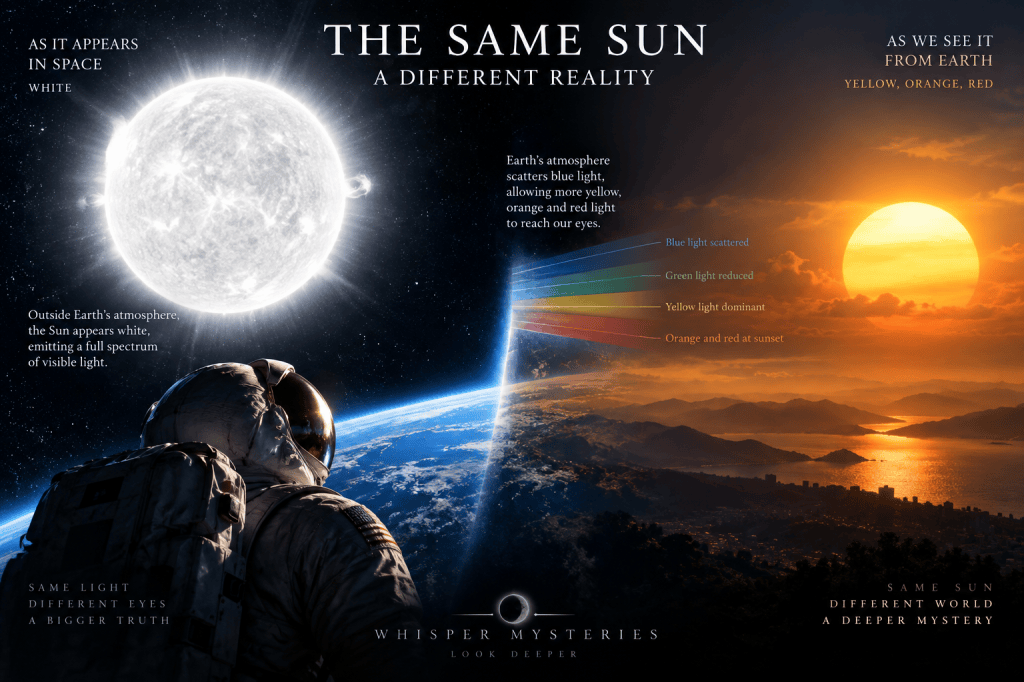
The Sun, viewed from space under appropriate protection, does not look like the golden disk most of us imagine.
It appears essentially white.
NASA solar physicists have addressed this seemingly trivial question directly, explaining that an observer above Earth’s atmosphere, viewing the Sun through proper protective equipment, would perceive it as white because it emits strongly throughout the visible spectrum rather than producing only the wavelengths we associate with yellow.
The disturbing part is not that generations of children have chosen the wrong crayon.
The disturbing part is that the object responsible for nearly every naturally illuminated thing we have ever seen has been standing in front of us throughout our entire lives, while Earth’s atmosphere and our own visual system have quietly altered the experience before consciousness receives it.
And the Sun is only the beginning.
The White Star We Learned to Paint Yellow
Sunlight appears deceptively simple because the human eye experiences it as a unified brightness, yet when sunlight passes through a prism it separates into the familiar sequence of violet, blue, green, yellow, orange and red, revealing that what we call white sunlight is actually a combination of many visible wavelengths.
NASA describes visible sunlight as extending approximately from 400 to 700 nanometers, although the Sun itself produces radiation far beyond the limits of human sight, including infrared, ultraviolet, X-rays and other regions of the electromagnetic spectrum that surround us without ever becoming part of our conscious visual world.
This immediately creates a fascinating problem with the question What color is the Sun?, because color is not simply a substance carried by an object in the way that mass or electrical charge is a physical property. Light arrives with particular wavelengths and intensities, photoreceptors in the retina respond to portions of that radiation, neural circuits compare those responses, and the brain eventually constructs the experience that we call red, blue, green, yellow or white.
In other words, somewhere between the surface of the Sun and the experience occurring inside your consciousness, physics becomes perception.
The Sun’s photosphere has an effective temperature of roughly 5,800 kelvin and radiates energy across a broad spectrum, with substantial emission throughout the wavelengths detectable by the human eye. Astronomers classify the Sun as a G2V main-sequence star, sometimes popularly described as a yellow dwarf or yellow-white star, but this astronomical classification should not be confused with saying that a human observer in space would see a distinctly yellow sphere.
That distinction is small enough to sound technical, yet large enough to overturn one of the most familiar images in human culture.
But Doesn’t the Sun Emit Most Strongly in Green?
Here the story becomes even stranger, because an often repeated explanation says that the Sun’s spectrum peaks somewhere around the green portion of visible light, which naturally raises another question: if the Sun is not yellow, should it actually be green?
The answer is also no, and the reason reveals how misleading it can be to reduce a complicated spectrum to a single color.
When scientists plot solar radiation according to energy per unit wavelength, the distribution reaches a maximum around the visible region near green wavelengths, but the curve is extremely broad, meaning that large amounts of red, orange, yellow and blue light are being emitted at the same time. The three principal classes of cone photoreceptors involved in normal human color vision therefore receive strong stimulation together, and the combined percept is close to white rather than saturated green. NASA specifically notes that although solar emission is strong in the green region, it remains strong across the visible spectrum, allowing the brain to integrate the signals into white.
There is another subtle complication that makes the story even more interesting: the apparent location and shape of a spectral peak depend partly upon what is being plotted, whether energy per wavelength interval, energy per frequency interval or the number of photons arriving at different wavelengths. NASA notes that when the solar spectrum is considered in terms of photon flux rather than energy alone, the visible distribution becomes flatter and the perceptual interpretation changes somewhat.
So even the seemingly innocent statement that the Sun peaks at one particular color can become misleading unless we first ask exactly what measurement is being used.
Nature rarely owes us the simplicity of our diagrams.
Earth’s Atmosphere Is Editing the Sun Before You See It
If the Sun’s visible light is essentially white, why has humanity so consistently experienced it as yellow, orange or red?
Part of the answer floats invisibly between us and space.
Earth’s atmosphere is not a perfectly transparent window through which an untouched universe reaches our eyes, because molecules and particles scatter different wavelengths of incoming sunlight with different efficiencies. Shorter visible wavelengths, particularly blue and violet, are scattered far more strongly by atmospheric molecules than longer wavelengths, a process commonly associated with Rayleigh scattering.
This is one reason the sky appears blue.
NOAA explains that blue light is scattered throughout the atmosphere more strongly than the longer wavelengths, while much of the remaining sunlight continues more directly toward the observer.
The paradox is beautiful: the blue sky and the warmer-looking Sun are parts of the same optical story.
Some of the shorter-wavelength light is removed from the direct solar beam and scattered across the sky, which can give direct sunlight viewed from Earth’s surface a warmer tint than it would have outside the atmosphere. When the Sun approaches the horizon, the effect becomes much stronger because its light must travel through a considerably longer path within the atmosphere before reaching the observer, allowing still more of the shorter wavelengths to be scattered away while red and orange wavelengths become increasingly dominant in the direct beam.
That enormous blood-red Sun sinking into the sea is therefore not evidence that the star itself has suddenly changed color.
It is evidence that the medium between the star and the observer has changed the light that finally arrives.
And this has a profound implication that extends well beyond astronomy: what you perceive depends not only upon the object being observed, but also upon everything standing between that object and you.
Sunrise and Sunset Are Natural Optical Illusions
Imagine two people observing exactly the same Sun at approximately the same moment, one from Earth’s surface during a deep orange sunset and another from orbit above much of the atmosphere.
Their descriptions of its color could be very different even though the Sun itself has not undergone any corresponding transformation.
The observer on Earth is looking through a long corridor of atmospheric gases, aerosols, dust and sometimes water droplets, while the orbital observer encounters a very different optical path. NOAA notes that at sunrise and sunset the increased distance traveled through the atmosphere allows scattering processes to become far more pronounced, particularly when aerosols or other particles are present.
This means that some of the most dramatic colors we associate with the Sun actually tell us as much about Earth as they do about the star.
A volcanic eruption, desert dust, smoke, pollution or unusual atmospheric conditions can alter the spectral composition reaching an observer and produce sunsets of astonishing intensity, while the nuclear furnace approximately 150 million kilometers away continues producing its radiation without caring whether a human standing on a beach describes it as golden, crimson or white.
The sunset is real, but its color is relational rather than absolute.
That distinction matters.
The Hidden Barcodes Inside Sunlight
There is another secret inside white sunlight that the naked eye normally cannot see, and it is one of the most beautiful chapters in the history of astronomy.
When solar light is dispersed with sufficient precision, the resulting rainbow is not perfectly continuous. Thousands of darker features cross the spectrum at particular wavelengths, creating what appear almost like thin scars or barcodes embedded inside the light.
These are spectral absorption lines, historically associated with the work of Joseph von Fraunhofer, and their patterns provide information about the chemical elements interacting with radiation in the Sun’s atmosphere.
Suddenly, sunlight is no longer simply illumination.
It becomes a message.
Different atoms interact with specific wavelengths according to their atomic structure, meaning that astronomers can use spectral lines to identify substances in objects that no human being could ever physically reach. Long before spacecraft existed, scientists learned to read the chemistry of the heavens from patterns hidden inside beams of light.
Perhaps the most extraordinary example involves helium.
During the solar eclipse of 1868, observations of the Sun’s spectrum revealed a spectral feature that could not initially be matched to a known terrestrial element, contributing to the identification of a previously unknown element that became known as helium, its name derived from Helios, the Greek Sun. ESA notes that helium was detected through the solar spectrum before it was later identified on Earth.
Consider what that means.
Human beings discovered a chemical element in the Sun before recognizing it on their own planet.
A distant star had revealed part of the periodic table through light.
The Sun in NASA Photographs Is Often Not the Color You Think
There is another layer of confusion created by modern imagery, because many of the spectacular pictures of the Sun circulating online show an enormous orange, crimson, blue, violet or electric green sphere filled with looping arcs and violent eruptions.
Those images are real scientific observations, but their colors do not necessarily represent what the human eye would see.
NASA’s Solar Dynamics Observatory examines the Sun at multiple wavelengths, including forms of ultraviolet radiation invisible to human vision, and scientists assign visible colors to those datasets so that different wavelengths, temperatures and structures can be distinguished by the eye. NASA explicitly explains that these color assignments allow information our eyes cannot naturally perceive to become visually interpretable.
A red solar image may therefore represent one wavelength range, while a green or blue image represents another, and the strange landscape revealed by ultraviolet instruments contains structures that could remain completely invisible to an unaided human observer.
This produces one of the great paradoxes of modern astronomy: sometimes scientists must create an artificial visible color in order to reveal something physically real.
The color may be translated.
The phenomenon is not.
The Universe Contains More Light Than Your Eyes Will Ever See
Human vision occupies only a narrow window within the electromagnetic spectrum, which means that the universe surrounding us contains enormous amounts of radiation to which our eyes are completely blind.
The Sun emits infrared radiation beyond the red limit of human vision and ultraviolet radiation beyond violet, while its energetic atmosphere also produces radiation at wavelengths such as extreme ultraviolet and X-rays, allowing specialized instruments to reveal magnetic structures and temperatures that ordinary visible-light observation cannot expose.
If human beings had evolved different photoreceptors, our subjective universe could have looked dramatically different.
Flowers might display patterns invisible to us today, the sky might possess unfamiliar contrasts, thermal radiation could conceivably become part of visual experience, and the Sun might occupy a very different perceptual category.
The cosmos would not have changed.
The observer would have changed.
This distinction leads directly toward one of the deepest questions in neuroscience and philosophy: when we say that something has a color, are we describing the external world itself, or the way a biological nervous system translates information from that world?
Your Eyes Do Not Simply Record Color
It is tempting to imagine the eye as a biological camera transmitting a miniature photograph to the brain, yet vision does not operate so simply.
Color perception depends upon specialized cone photoreceptors in the retina and subsequent neural processing, with the human visual system comparing signals rather than merely assigning a fixed color to each incoming wavelength. Neuroscience research describes three cone classes as the basis of normal trichromatic vision and shows that later retinal and cortical processing contributes to opponent color mechanisms, local contrast and the construction of color appearance.
Even more remarkable is the phenomenon known as color constancy.
A white object can remain subjectively white whether it is illuminated by relatively bluish daylight or warmer artificial illumination, even though the exact wavelengths entering the eye may have changed substantially. Researchers studying color constancy describe perception as a process in which the visual system uses contextual information to maintain relatively stable object colors despite changing illumination.
Your brain is therefore not passively receiving color.
It is interpreting circumstances.
It estimates illumination, compares surrounding surfaces, evaluates relationships between signals and produces a stable perceptual world that is useful for survival.
That world feels immediate because the computation happens before you become consciously aware of it.
The Color You See Exists Somewhere Between the Sun and Your Mind
This does not mean that reality is imaginary, nor does it mean that physical objects exist only because we observe them, which would be an unjustified leap from neuroscience into metaphysics.
What it means is more subtle and, in some ways, more unsettling.
There is an external physical world in which electromagnetic radiation possesses measurable wavelengths and energy, but the subjective experience called yellow does not simply travel through space as a tiny parcel of yellowness waiting to enter the eye. Instead, light interacts with matter, photoreceptors respond according to their biological properties, neural systems compare those responses, and consciousness experiences the result as color.
Recent research continues to emphasize that color is produced by the visual system from the light reflected or emitted by objects and from the context in which that light appears.
The yellow Sun of childhood therefore exists in a curious territory between astronomy, atmosphere, biology, culture and memory.
It is not entirely false.
But neither is it simply the intrinsic color of the star.
Why Did Humanity Make the Sun Yellow?
Once the physical explanation is understood, another mystery remains, although this one belongs partly to psychology and culture rather than astrophysics.
Why do children across many cultures so naturally draw the Sun as yellow?
One possible explanation is straightforward: viewed from Earth’s surface, particularly when it is lower in the sky or softened by haze and clouds, the Sun frequently does acquire a yellowish or orange appearance, while the surrounding sky provides a powerful blue contrast that makes yellow an intuitive artistic choice.
Another influence may come from the way pigments and screens represent brightness. A truly white circle on white paper disappears, whereas yellow immediately distinguishes the Sun from its background. Over generations, representation becomes convention, convention becomes expectation, and expectation eventually feels like observation.
We begin by painting what we think we see.
Later, we may begin seeing what we have learned to paint.
Even the Name “Yellow Dwarf” Can Mislead Us
Anyone researching the subject will quickly encounter another apparent contradiction because the Sun is routinely called a yellow dwarf.
Does that not prove that it is yellow after all?
Not quite.
Astronomical color terminology emerged partly from spectral classification, temperature and comparative stellar appearance, rather than from the simplistic palette used in children’s drawings. NASA describes the Sun as a G2V star and elsewhere refers to this spectral category as yellow-white, while NASA’s SOHO material directly answers the color question by describing the Sun as white.
Both statements can coexist because they belong to different descriptive contexts.
Scientific language often becomes misleading when technical classifications are removed from the systems in which they were created.
The phrase yellow dwarf sounds simple.
The physics behind it is not.
Perhaps We Have Never Seen Anything “Exactly as It Is”
The mystery of the Sun’s color eventually leads to a much larger question, because precisely the same principle applies, in different ways, to almost everything we see.
Every face, tree, building, ocean and star enters conscious experience only after light has interacted with matter, traveled through an environment, passed through the optics of the eye, stimulated photoreceptors and undergone extensive neural processing.
What arrives in consciousness is therefore not an untouched copy of the external world.
It is a biological reconstruction constrained by the external world.
This distinction is important because saying that perception is constructed does not mean that anything can be true or that reality is arbitrary. The wavelengths can be measured, the atmospheric scattering can be calculated, solar spectra can be recorded by independent instruments, and predictions derived from these measurements repeatedly work.
Yet our experience of those measurements belongs to another layer.
Physics describes radiation.
Neuroscience describes processing.
Consciousness experiences color.
And somewhere among those three levels lies the world each of us believes we simply “see.”
Research into individual differences in color vision adds another intriguing layer, because genetic and neural variations mean that human observers do not necessarily experience every color in precisely identical ways, even when looking at the same physical stimulus.
We share a world.
We do not necessarily share an identical perceptual rendering of it.
The Star Hidden in Plain Sight
Perhaps this is why the question of the Sun’s color is more profound than it first appears.
For thousands of years, humanity has watched the same star rise above temples, battlefields, oceans, deserts and cities, while civilizations worshipped it, measured time by it, painted it, feared eclipses of it and eventually sent machines into space to study it.
Yet even after all that familiarity, a childlike question can still reveal something unexpected.
The Sun is not simply the yellow circle we inherited from drawings, nor is it accurately represented by every red and orange astronomical image appearing on our screens. Its visible radiation is broadly distributed across the colors our eyes can detect, the combination is perceived as essentially white outside Earth’s atmosphere, atmospheric scattering modifies what reaches observers on the ground, and the nervous system performs another transformation before the final experience emerges in consciousness.
Perhaps the strangest discovery is therefore not that we misunderstood the color of the Sun.
It is that seeing was never as simple as we assumed.
The universe sends radiation toward us, the atmosphere filters it, our eyes sample only a tiny portion of it, and our brain silently constructs a coherent visual world from incomplete information, while consciousness receives the finished result and calls it reality.
The yellow Sun may therefore serve as a small crack in an enormous wall.
Once you notice that crack, a far more unsettling question appears behind it:
If something as familiar as the Sun is not experienced exactly as it physically exists, how much of the world around us have we mistaken for reality itself when we are actually experiencing reality translated through the limits of the human mind?
A Note on Observing the Sun
The ideas discussed here should never be tested by staring directly at the Sun. Except during the brief total phase of a total solar eclipse, direct observation requires appropriate solar-viewing protection, and ordinary sunglasses are not sufficient; telescopes, binoculars and cameras also require properly designed solar filters. NASA warns that unprotected direct viewing can cause severe eye injury.
Sources and Further Reading
NASA Goddard Space Flight Center — What Color Is the Sun?
NASA Science / SOHO — Solar color, spectral classification and solar observations.
NASA Scientific Visualization Studio — Why Does NASA Observe the Sun in Different Colors?
NASA Space Place / NOAA — Atmospheric scattering and the blue sky.
NOAA Global Monitoring Laboratory — Rayleigh scattering, aerosols and red sunsets.
European Space Agency — Solar spectroscopy and the discovery of helium.
National Library of Medicine / PubMed — Research on color perception, retinal processing and color constancy.
Annual Review of Vision Science — Research on color perception, objects and perceptual constancy.
If even the Sun is not exactly as we perceive it, what else about reality have we misunderstood? Discover a deeper exploration in Matrix — The Hidden Truth: Who Controls Reality?

