

Tag: Whisper Mysteries.

  • THE LIE THAT REFUSES TO DIE: WHY THE HUMAN MIND PROTECTS STORIES THAT AREN’T TRUE

    THE LIE THAT REFUSES TO DIE: WHY THE HUMAN MIND PROTECTS STORIES THAT AREN’T TRUE

    For a long time, I was fascinated by conspiracy theories, by their extraordinary stories, their hidden connections, and the unsettling possibility that the world might be concealing truths far more disturbing than anything we were officially told. I read dozens of theories, articles, investigations, and historical accounts, often finding myself drawn deeper into mysteries that seemed to become more convincing with every new detail I discovered. But at some point, fascination was no longer enough for me, and I began searching not for explanations that confirmed what I wanted to believe, but for evidence that could withstand serious examination.

    I started comparing sources, tracing claims back to their origins, examining historical documents, and connecting stories that had been presented as separate revelations. What emerged from this process was not the extraordinary hidden truth I had expected to discover, but something considerably more disappointing. I began finding the same unverified claims repeated across countless publications, the same historical inaccuracies disguised as forgotten knowledge, and the same speculative conclusions presented as undeniable facts. Sometimes, what appeared to be several independent sources turned out to be nothing more than different versions of a single unsupported story.

    The disappointment was profound, not because I had lost my fascination with mysteries, but because I realized how easily the desire to discover something extraordinary can become more powerful than the desire to discover what is actually true. Yet that disappointment eventually led me toward a question far more intriguing than the conspiracy theories themselves: why do certain stories continue to survive, even after the evidence supporting them has collapsed, and why do intelligent, curious, and otherwise rational people sometimes defend those stories with an almost unshakable conviction?

    That question became the starting point of this investigation, and what I discovered about human memory, belief, and the psychology of misinformation was, in many ways, more disturbing than the mysteries I had originally set out to explore.

    An investigation into the strange psychology of false beliefs, the hidden architecture of memory, and the disturbing possibility that the stories we defend most fiercely are sometimes the ones we have never truly examined.

    The Strange Immortality of a Lie

    There is something deeply unsettling about the human mind that I have been thinking about for a long time, particularly whenever I encounter an extraordinary claim that has survived years of investigation, public controversy, and even the discovery of evidence that should have brought the entire story to an end. I have watched people abandon certain details of a belief while continuing to defend its central meaning, and I have noticed how frequently a disproven explanation returns in a slightly different form, almost as though the original story possesses an instinct for self-preservation.

    What intrigues me is not simply that people believe things that are untrue, because all of us have accepted incorrect information at some point in our lives, but that the human mind can continue to depend upon a story even after its owner has consciously acknowledged that the story is unreliable.

    We generally imagine that discovering the truth is a straightforward intellectual process in which evidence replaces error, ignorance gives way to knowledge, and the mind reorganizes its understanding of reality accordingly. Yet the deeper I look into psychological research, the more I realize that human memory does not operate like a manuscript in which a mistaken sentence can be erased and replaced without disturbing anything else.

    A false belief can become connected to emotions, relationships, memories, personal experiences, and the explanations through which we understand the world, so removing it may require much more than presenting a correction.

    Sometimes the correction changes what we consciously believe without completely changing the assumptions that guide our reasoning.

    This distinction fascinated me because it suggests that the survival of misinformation is not always a failure to understand the facts. Sometimes it is a consequence of how successfully the original story has become integrated into our mental representation of reality.

    And this is where my investigation begins, with a question that seems simple until we consider its implications: what exactly remains inside the human mind after a lie has been exposed?

    1. The Warehouse Fire That Revealed a Hidden Weakness in Human Memory

    One of the most revealing discoveries I encountered while researching this subject came from psychological experiments involving an imaginary warehouse fire, an apparently ordinary scenario that exposed an extraordinary feature of human reasoning.

    In a landmark study published in 1994, psychologists Hollyn Johnson and Colleen Seifert investigated what happens when people receive information about an event and are subsequently told that an important part of the explanation was incorrect.

    Participants encountered reports describing a warehouse fire, including an early suggestion that flammable materials had been stored in the building. Later information withdrew that suggestion, making clear that the original explanation should no longer be treated as reliable.

    Under ordinary circumstances, we might expect people to stop using the withdrawn information when explaining what had happened. Instead, the researchers found that the original claim could continue to influence subsequent reasoning, even when participants had received the correction.

    What interested me most was the distinction between remembering a correction and actually incorporating it into one’s understanding of an event. These are not necessarily the same psychological operation, because a person may know that a particular explanation has been withdrawn while still drawing conclusions that depend upon it.

    Psychologists call this phenomenon the continued influence effect, and it has become one of the central concepts in research on misinformation.

    I find the implications remarkable because the warehouse itself never existed outside the experimental scenario, the participants had no personal investment in defending its history, and the misleading information did not concern religion, politics, identity, or any other subject ordinarily associated with intense emotional attachment.

    If an invented explanation about an ordinary fire can continue influencing reasoning after correction, what happens when misinformation becomes connected to someone’s childhood, community, political identity, or deepest fears?

    The original experiment did not answer that larger question by itself, but it opened a door into a much more complicated understanding of belief.

    The mind does not merely collect facts; it organizes them into causal structures, and once an explanation has supplied a connection between events, removing that explanation can leave a gap that the brain struggles to fill.

    I began to wonder whether some falsehoods survive not because people particularly love the falsehood itself, but because they have never been given another explanation capable of replacing the role it played.

    2. Why the Brain Prefers a Complete Story to an Uncomfortable Gap

    A major review published in Psychological Science in the Public Interest in 2012 examined the persistence of misinformation and the difficulties involved in correcting it. Written by Stephan Lewandowsky, Ullrich Ecker, Colleen Seifert, Norbert Schwarz, and John Cook, the paper brought together research showing that retractions frequently fail to eliminate the influence of incorrect information.

    What caught my attention was the importance of mental models, the internal representations we construct to explain why events happen and how different pieces of information fit together.

    Imagine reading a report about a mysterious explosion in an abandoned building. The first explanation claims that improperly stored chemicals caused the disaster, and this detail immediately provides a coherent sequence of events: dangerous materials were present, something ignited them, and the resulting explosion destroyed the building.

    Several hours later, investigators announce that no such chemicals were found.

    Although the correction removes the original explanation, it does not automatically provide a new cause, leaving the mind with an incomplete narrative in which an important connection has disappeared.

    The original explanation may remain psychologically accessible because it once made the entire story intelligible.

    I find this particularly significant when considering conspiracy theories, which often present themselves as complete explanations of events that are genuinely confusing, frightening, or difficult to understand.

    A conspiracy narrative may identify a hidden enemy, establish a motive, connect otherwise unrelated details, and transform uncertainty into an apparently organized sequence of causes and consequences.

    The explanation can be emotionally satisfying even when the evidence supporting it is weak.

    When someone challenges one of its claims, the believer may experience the correction not as an improvement in knowledge but as the destruction of an explanatory structure that made the world seem understandable.

    This does not mean that every suspicion of wrongdoing is irrational, because history contains many genuine conspiracies that were uncovered through documents, testimony, and investigation. The distinction lies in how an explanation responds to evidence, whether its claims can be independently tested, and whether contradictory findings are allowed to change the conclusion.

    The most disturbing stories are often those that have developed a defense against every possible contradiction.

    3. The Prophecy That Failed — And the Scientific Story That Was Later Challenged

    One of the most famous episodes in the history of social psychology concerns a small American religious movement whose members believed that a catastrophic flood would destroy much of the world in December 1954.

    The group was associated with Dorothy Martin, who claimed to receive messages from extraterrestrial beings, and its activities attracted the attention of psychologist Leon Festinger and his colleagues.

    The researchers observed the movement around the date of the predicted disaster, eventually publishing their account in the 1956 book When Prophecy Fails.

    According to the influential interpretation presented in that book, the failure of the prophecy did not necessarily destroy the group’s conviction. Instead, some believers reportedly reinterpreted the absence of disaster as evidence that their faith had helped prevent it.

    The episode became a celebrated illustration of cognitive dissonance, the psychological discomfort associated with holding conflicting beliefs or encountering evidence that threatens an important commitment.

    For decades, the story was repeated as an almost perfect demonstration of how people can transform a failed prediction into apparent confirmation.

    Yet while investigating this example, I encountered a development that made the entire case considerably more interesting.

    A 2025 scholarly reassessment titled Debunking “When Prophecy Fails”, drawing upon newly examined archival materials, challenged central elements of the original account. Its author argued that the group had engaged in public outreach before the prophecy failed, that participants abandoned important beliefs more readily than the classic narrative suggested, and that the researchers themselves had interfered with the events they were supposed to be observing.

    These are serious historical challenges to the traditional interpretation, not merely a disagreement over minor details.

    What struck me was the irony that one of psychology’s most famous stories about the survival of mistaken beliefs had itself become the subject of a major correction.

    For years, the episode had offered a memorable explanation of human irrationality, and precisely because it was memorable, it was repeated in books, lectures, and discussions as though its essential meaning were beyond dispute.

    The newer archival critique does not invalidate the entire scientific literature on cognitive dissonance, which extends far beyond this particular episode, but it reminds us that a compelling illustration can acquire an authority greater than the evidence supporting its details.

    I found myself facing a more uncomfortable question than the one I had originally intended to investigate: if even researchers and educated readers can become attached to an elegant explanation, how confidently can any of us claim to be immune to the stories we find convincing?

    4. The Dangerous Moment When Repetition Begins to Feel Like Truth

    There is another mechanism that I find especially disturbing because it operates without requiring a person to be emotionally committed to a particular belief.

    Psychologists describe it as the illusory truth effect, a tendency for repeated statements to be judged as more credible than unfamiliar statements, even when repetition provides no additional evidence of their accuracy.

    The phenomenon was demonstrated in influential experiments published in 1977 by Lynn Hasher, David Goldstein, and Thomas Toppino, who examined how repeated exposure affected people’s judgments of plausibility.

    The explanation is closely connected to processing fluency, the relative ease with which the mind recognizes and processes familiar information.

    When a statement has been encountered several times, it may become easier to understand, retrieve, or recognize, and that feeling of familiarity can be mistaken for evidence that the statement is true.

    What fascinates me is that the mind does not always clearly distinguish between the sensation of recognition and the experience of verification.

    A claim encountered repeatedly through newspapers, television, conversations, online videos, and social media can begin to feel established long before anyone has investigated its origin.

    This helps explain why some historical rumors acquire an almost indestructible quality.

    A story may initially appear as an unverified allegation, then be repeated in an article discussing the allegation, mentioned again in a video questioning its accuracy, and subsequently circulated through countless online discussions.

    Eventually, the public may remember the claim without remembering whether the original source supported it, rejected it, or merely reported that someone else had made it.

    I have noticed how easily the phrase everyone knows can replace the much more demanding question of how anyone knows.

    Yet repetition is not irresistible, and familiarity does not always overpower accurate knowledge. The effect varies with circumstances, prior knowledge, and the way information is presented.

    Nevertheless, it reveals a vulnerability that becomes particularly important in an information environment where the same claim can appear hundreds of times in slightly different forms.

    The internet did not invent this weakness, but it created an extraordinarily efficient environment in which to exploit it.

    5. The Memory of a Source Can Disappear Before the Memory of a Story

    Another detail that interested me during this investigation concerns the separation between remembering information and remembering where that information came from.

    Psychological research on source monitoring has shown that human memory can preserve the content of an experience while losing, confusing, or misattributing its origin.

    We may remember an extraordinary historical allegation without remembering whether we encountered it in an academic publication, a fictional novel, a documentary, a satirical article, or a conversation with someone who had no direct knowledge of the event.

    Over time, the original context may fade while the central claim remains accessible.

    This distinction becomes particularly important when an allegation is repeated across different media, because every repetition can create another memory trace while also increasing the number of possible sources with which the information might be associated.

    Imagine hearing a story about a secret experiment conducted decades ago, then encountering a dramatized version in a film and later reading an online discussion that treats the experiment as established history.

    Years afterward, you may remember the experiment vividly without being able to reconstruct which details came from documentary evidence and which were introduced through fiction or speculation.

    The resulting memory may feel entirely authentic.

    This is one reason I have become increasingly cautious whenever an extraordinary historical story is accompanied by vivid descriptions but very few identifiable primary sources.

    A detailed narrative can produce the sensation of knowledge without providing the foundations that genuine historical knowledge requires.

    The question is not simply whether we remember a story, but whether we can reconstruct the chain of evidence that justifies believing it.

    And I suspect that many of the most enduring modern myths survive precisely because that chain has disappeared from public awareness.

    6. When a Belief Becomes Part of Who We Are

    Not every false belief is defended with equal intensity, and the difference becomes easier to understand when we consider the relationship between personal identity and information.

    A mistaken claim about an unfamiliar historical date may be corrected without causing any serious emotional disturbance, because accepting the correction requires little more than updating a piece of knowledge.

    A belief connected to someone’s community, political commitments, religious interpretation, or personal history can be considerably harder to reconsider.

    In such cases, the information may serve several purposes simultaneously, providing an explanation of reality while also reinforcing belonging, loyalty, and a sense of moral certainty.

    I find this especially relevant to conspiracy communities, where accepting a particular interpretation may gradually become connected to the feeling of possessing knowledge that outsiders do not understand.

    The believer is no longer defending only a proposition about an event, but also a social identity organized around the conviction that hidden truths have been discovered.

    When contradictory evidence appears, rejecting the original belief may threaten relationships, reputation, and the sense of being someone who has seen through an elaborate deception.

    This helps explain why ridicule is such an ineffective response to many deeply held beliefs.

    Humiliation rarely creates the psychological conditions necessary for thoughtful reconsideration, and it can strengthen the feeling that the outside world is hostile.

    However, it would be equally mistaken to conclude that every believer is incapable of changing their mind.

    People do revise important beliefs, sometimes dramatically, and the scientific literature does not support the simplistic claim that presenting corrections inevitably makes misinformation stronger.

    What matters is the relationship between evidence, explanation, identity, and the circumstances in which a person encounters information that challenges an existing worldview.

    The more deeply I examine this relationship, the less useful I find the familiar distinction between intelligent people who recognize falsehoods and foolish people who believe them.

    Intelligence may help us evaluate evidence, but it does not automatically protect us from emotional investment, selective attention, or the temptation to defend conclusions we already prefer.

    7. The Historical Lie That Became a Weapon

    Perhaps the most chilling demonstration of the consequences of fabricated narratives can be found in the history of The Protocols of the Elders of Zion, an antisemitic forgery that falsely presented itself as evidence of a secret Jewish plan for global domination.

    The text emerged in the Russian Empire in the early twentieth century, drawing upon earlier political satire and other material, and was subsequently distributed internationally.

    In 1921, The Times of London published an investigation exposing extensive similarities between the supposed secret document and Maurice Joly’s nineteenth-century political satire Dialogue in Hell Between Machiavelli and Montesquieu.

    The exposure demonstrated that significant passages had been appropriated from a work that was neither a Jewish document nor evidence of the conspiracy alleged by the forgery.

    Yet the revelation did not end the document’s influence.

    It continued to circulate among antisemitic movements and became part of the propaganda environment exploited by the Nazis, with consequences that extended far beyond the original fabrication.

    What disturbs me about this history is not simply that a fraudulent document deceived readers, but that its central accusation could survive even after the supposed documentary foundation had been exposed.

    The forgery offered its audience an imaginary explanation for complex political, economic, and social developments, transforming uncertainty and resentment into hostility toward a targeted population.

    Once the narrative had acquired ideological value, the authenticity of the document was no longer the only issue.

    Its supporters could preserve the accusation while dismissing evidence against the source.

    This is one of the most dangerous transformations a falsehood can undergo: the moment when a fabricated piece of evidence becomes dispensable because the accusation it was designed to support has already taken root.

    Historical examples such as this remind me that misinformation is not always a harmless curiosity of human psychology.

    Sometimes it becomes an instrument through which prejudice is organized, enemies are invented, and violence is justified.

    The existence of real historical conspiracies must never be confused with the legitimacy of an accusation unsupported by evidence, particularly when that accusation assigns collective guilt to an entire community.

    8. Why Conspiracy Theories Can Turn Contradictions Into Evidence

    One of the most peculiar characteristics of certain conspiracy narratives is their ability to incorporate information that would ordinarily count against them.

    If an official document supports the theory, it may be presented as confirmation. If the document contradicts the theory, the contradiction may be interpreted as proof that the authorities are concealing something.

    If a witness supports the allegation, the testimony becomes important. If the witness later withdraws the allegation, the withdrawal may be interpreted as evidence of intimidation.

    In this way, a narrative can become increasingly resistant to falsification, because every possible observation is assigned a meaning that protects the original conclusion.

    I have encountered this structure repeatedly in discussions about secret societies, unexplained historical events, intelligence operations, and alleged hidden technologies.

    Some of these subjects deserve serious investigation, especially where governments or institutions have demonstrably concealed information in the past, but the existence of historical secrecy does not establish the truth of every contemporary allegation.

    There is a crucial difference between investigating a possibility and constructing an explanation that cannot be challenged by any conceivable evidence.

    What intrigues me is the psychological satisfaction offered by a system in which apparent contradictions are not obstacles but additional confirmations.

    The theory becomes capable of explaining both the presence and absence of evidence.

    And once that happens, the believer may no longer be testing the theory against reality, but interpreting reality through the theory.

    The distinction matters because a genuine investigation must allow for the possibility that its central hypothesis is wrong.

    Without that possibility, investigation gradually becomes a form of storytelling in which the conclusion has been decided before the evidence is examined.

    9. The Unexpected Findings That Complicate Everything

    While researching the effectiveness of corrections, I came across a 2023 meta-analysis published in Nature Human Behaviour by Man-pui Sally Chan and Dolores Albarracín.

    The researchers examined 245 effect sizes drawn from 75 reports involving a combined total of 53,320 participants, focusing on attempts to correct misinformation related to scientific evidence and measurement.

    Their analysis found that correction efforts, considered together, did not produce a statistically significant average effect under the conditions examined.

    I consider this an important finding, although it should not be exaggerated into the claim that fact-checking never works or that people cannot change their beliefs.

    The results concerned a particular category of misinformation and revealed substantial complexity in how corrections operate.

    Other research has found that corrections can reduce false beliefs, sometimes effectively, and that the persistence of misinformation depends upon the original message, the correction, the audience, and the outcome being measured.

    What fascinated me even more was a set of six preregistered experiments reported in Journal of Experimental Psychology: General, examining the difference between directly negating misinformation and introducing alternative information that changes the overall evaluation.

    The researchers found that providing an alternative account could sometimes influence attitudes and intentions more effectively than simply stating that the original claim was false.

    This finding brought me back to the warehouse fire experiment and the problem of incomplete mental models.

    If a misleading explanation has supplied the mind with a coherent account of an event, merely declaring it false may leave the original narrative psychologically available.

    A well-supported alternative can do something different by giving the mind a new structure through which to interpret the same information.

    I began to see why effective correction is not always an exercise in destroying a false story.

    Sometimes it is an exercise in rebuilding an understanding of reality that no longer depends upon the falsehood.

    10. The Most Uncomfortable Possibility: We Are All Vulnerable

    As I followed these studies, I gradually became less interested in identifying the people who believe misinformation and more interested in understanding the conditions under which I might believe it myself.

    This change in perspective matters because the psychology of false belief is not confined to conspiracy communities, ideological movements, or people with limited education.

    Researchers, journalists, historians, and ordinary readers all depend upon memory, interpretation, and judgments of credibility, and none of these processes is perfectly reliable.

    The most sophisticated explanation can still be built upon an incorrect assumption, and an argument can appear extraordinarily persuasive when its conclusion happens to agree with something we already believe.

    I have also noticed that skepticism can become a personal identity in much the same way that belief can.

    Someone who takes pride in questioning official explanations may eventually begin to accept alternative explanations with less scrutiny than they would apply to conventional accounts.

    At that point, skepticism risks becoming selective rather than genuinely investigative.

    The reverse problem also exists, because institutional authority can sometimes be accepted too readily, even though governments, corporations, scientific institutions, and other organizations are capable of making mistakes or concealing wrongdoing.

    The challenge is therefore not to choose permanent allegiance to authority or permanent opposition to it, but to examine evidence with standards that remain consistent regardless of who benefits from the conclusion.

    For me, this is the essential distinction between curiosity and credulity.

    Curiosity permits uncertainty and welcomes discoveries that change the original hypothesis, whereas credulity grants a favored explanation immunity from serious examination.

    The more mysterious a story appears, the more important this distinction becomes.

    11. The Hidden Architecture of a Belief

    After exploring these studies, I began to think of a deeply established belief less as an isolated statement and more as a structure held together by multiple psychological connections.

    A belief can be supported by remembered experiences, emotional associations, repeated exposure, explanations of past events, and the approval of people whose opinions matter to us.

    Some of those connections are factual, while others are social or emotional.

    Correcting one piece of information does not necessarily alter every other connection that has developed around it.

    This is not a literal map of how every belief is stored in the brain, but it is a useful way of understanding why a single correction may have limited consequences.

    Imagine someone who has spent years studying an alleged historical conspiracy, discussing it with friends, collecting books, and interpreting unrelated events through the same framework.

    If a central document is exposed as fraudulent, accepting that discovery may require reconsidering not only the document but also years of conclusions, conversations, and personal judgments.

    The psychological cost of revision can become substantial.

    And yet this is precisely what serious investigation sometimes demands.

    I find it revealing that we admire people who remain loyal to their convictions, but we are often less generous toward those who publicly acknowledge that their convictions were mistaken.

    We celebrate certainty more easily than revision, even though the ability to change one’s mind in response to evidence is one of the foundations of intellectual integrity.

    There is something profoundly human in the desire to preserve a coherent personal history.

    Admitting that a belief was wrong can feel like admitting that part of one’s life was built upon an illusion.

    But the willingness to make that admission may also be the beginning of a more accurate understanding of the world.

    12. Can a Lie Truly Die?

    I began this investigation with the impression that certain false stories possess an almost unnatural capacity to survive, reappearing across generations despite corrections, investigations, and the disappearance of the circumstances in which they originated.

    I now think the explanation is both more ordinary and more disturbing.

    A falsehood does not need to possess any mysterious power of its own, because the mechanisms that preserve it are already present in the human mind and in the societies through which information circulates.

    Memory preserves fragments of explanations. Familiarity can create an impression of credibility. Emotional commitments influence attention. Social belonging can reward agreement. Repetition can keep an accusation alive long after its source has been forgotten.

    And when an explanation has become essential to someone’s understanding of reality, removing it may feel less like correcting an error than losing a part of the world.

    None of this means that truth is powerless.

    Corrections can work, evidence can change minds, and people can abandon convictions they once considered unquestionable. The scientific challenge is to understand why some corrections succeed while others fail, and the personal challenge is to remain capable of recognizing the difference.

    What continues to trouble me is the possibility that some of the stories we defend most passionately are not necessarily those we have investigated most carefully, but those that have become most deeply connected to our sense of who we are.

    I have always been drawn to mysteries, forgotten histories, forbidden manuscripts, and questions that conventional explanations do not completely resolve. Yet the longer I investigate such subjects, the more convinced I become that mystery deserves disciplined curiosity rather than automatic belief.

    An unanswered question is not proof of a hidden conspiracy, just as an official explanation is not automatically beyond criticism.

    The responsibility of an investigator is to remain open to what the evidence reveals, even when the discovery destroys a story that once seemed extraordinary.

    And after everything I have read about the continued influence of misinformation, one question remains with me more persistently than any other.

    If a lie can survive inside the human mind after its evidence has disappeared, how many of the things we consider unquestionable truths are actually stories we have simply forgotten to investigate?

    Source

    Johnson, H. M., & Seifert, C. M. (1994). Sources of the Continued Influence Effect: When Misinformation in Memory Affects Later Inferences. Journal of Experimental Psychology: Learning, Memory, and Cognition, 20(6), 1420–1436.

    Festinger, L., Riecken, H. W., & Schachter, S. (1956). When Prophecy Fails: A Social and Psychological Study of a Modern Group That Predicted the Destruction of the World. University of Minnesota Press.

    Hasher, L., Goldstein, D., & Toppino, T. (1977). Frequency and the Conference of Referential Validity. Journal of Verbal Learning and Verbal Behavior, 16(1), 107–112.

    Chan, M. P. S., & Albarracín, D. (2023). A Meta-analysis of Correction Effects in Science-Relevant Misinformation. Nature Human Behaviour.

    United States Holocaust Memorial Museum. Protocols of the Elders of Zion. Holocaust Encyclopedia. An examination of the origins, fraudulent nature, and historical consequences of one of the most influential antisemitic conspiracy forgeries.

    National Library of Medicine — PubMed Central. The Continued Influence of Misinformation in Memory and Reasoning. Research discussing why retracted information can continue to influence judgments and how corrective explanations may reduce its effects.

    These academic studies and historical records provide the research foundation for this investigation into false beliefs, cognitive dissonance, memory distortion, conspiracy narratives, and the psychological mechanisms that allow misinformation to survive even after it has been corrected.

  • The Rosenheim Poltergeist: The Office Where Something Seemed to Bend the Rules of Reality

    The Rosenheim Poltergeist: The Office Where Something Seemed to Bend the Rules of Reality

    There are haunted houses whose stories begin with footsteps in an empty corridor, a pale figure at the foot of a bed, or the whisper of a dead relative heard in the middle of the night. Rosenheim was different. There was no ruined castle, no forgotten cemetery beneath the floorboards and no ancient family curse waiting conveniently in the background. The disturbances began inside an ordinary German law office, among ringing telephones, filing cabinets, fluorescent lights, invoices and typewriters, which may be one reason the case still feels so uncomfortable more than half a century later.

    Because whatever happened there did not behave like the traditional ghost of folklore.

    It behaved, at least according to those who investigated it, almost as though something invisible had learned how to interfere with electricity, machinery and matter itself.

    In the autumn of 1967, strange disturbances began to be reported in the law office of attorney Sigmund Adam in Rosenheim, a Bavarian town southeast of Munich. Automatic fuses reportedly tripped without an obvious electrical cause, light bulbs burst, hanging lamps began swinging, loud cracks were heard in the rooms and the telephone system behaved in ways the staff could not explain. Calls appeared to have been registered that nobody remembered making, including repeated connections to the German telephone time service, then reached through the number 0119.

    At first, nobody needed a ghost.

    They needed an electrician.

    And that distinction matters, because the people involved did not immediately interpret the disturbances as paranormal. The obvious possibility was that something was wrong with the building’s electrical installation, so technicians from the Rosenheim municipal utility began examining the office. According to the contemporary technical account published the following year, investigations had already been underway for more than three weeks by the time physicists Friedbert Karger and Gerhard Zicha arrived. The electricity company installed recording instruments designed to monitor voltage and current, replaced or isolated parts of the electrical system and eventually supplied parts of the office through separate wiring and an emergency generator.

    Yet the reported disturbances continued.

    That is where the story begins to become difficult.

    The Machines Began Recording Something

    Voltage and current recorders installed in the office sometimes produced dramatic deflections. The investigators were interested in these events precisely because, unlike a frightened witness saying that a lamp had moved, an instrument left a physical trace.

    Karger and Zicha later published a technical investigation of the case in the Zeitschrift für Parapsychologie und Grenzgebiete der Psychologie. Their report described telephone disturbances, unexplained recorder deflections, loud noises, automatic circuit breakers switching off, exploding bulbs and lamps swinging with unusual force. They also noted that efforts by the local electricity utility — including separate lamps, wiring and an emergency power source — had not simply made the phenomenon disappear.

    This did not prove anything supernatural. An unexplained measurement is not the same thing as evidence for a spirit, and it is worth remembering that unusual electrical behaviour can arise from causes that are extremely difficult to locate.

    Nevertheless, Rosenheim had moved beyond the familiar territory of ghost stories told around a kitchen table. Technicians were now watching instruments, police were aware of the investigation, witnesses were being questioned and physicists were trying to understand why equipment appeared to be registering disturbances for which they could not find a satisfactory physical explanation.

    Then the pictures on the walls began to move.

    Hans Bender, one of Germany’s best-known researchers of alleged paranormal phenomena and at the time director of the Institute for Frontier Areas of Psychology and Mental Health in Freiburg, became involved. Bender’s own account described pictures rotating on their suspension points, sometimes falling from the walls, along with drawers and furniture apparently moving without an obvious hand pushing them. His team attempted to document events with an AMPEX video recorder, managing to record swinging lamps and noises, while some of the more dramatic events remained frustratingly unpredictable.

    One particular observation preserved in Bender’s report is difficult to forget.

    Paul Brunner, involved in the electrical investigation, reported standing near a floral picture when it suddenly rotated approximately 320 degrees, twisting its hanging wire around the hook. Another witness present at the time confirmed that he had seen the picture move from its resting position. Other technicians subsequently reported seeing pictures swing or turn.

    Whether those observations had a paranormal cause is another question entirely.

    But the witnesses themselves were real.

    The reports were real.

    And the investigation existed.

    Then They Noticed Annemarie

    Among the employees in the office was a nineteen-year-old apprentice, usually identified in accounts of the case as Annemarie Schaberl.

    As the investigation progressed, Bender’s group became convinced that the frequency of the disturbances was somehow associated with her presence. Their published summary claimed that the number of incidents appeared to decrease with increasing distance from the young woman and that the phenomena eventually stopped after she left the workplace.

    This detail transformed Rosenheim from an electrical mystery into something much stranger.

    Bender did not believe that Annemarie was possessed by a dead person. Nor did he necessarily imagine an invisible ghost wandering around the law office unscrewing bulbs and pushing pictures.

    He proposed something arguably even more disturbing.

    Spontaneous psychokinesis.

    Within parapsychology, this idea suggested that intense unconscious psychological states might somehow produce physical effects outside the body, particularly around certain individuals during periods of emotional strain. There is no accepted mechanism in modern physics demonstrating that human emotion can cause objects to move at a distance, and psychokinesis has never been established as a reproducible phenomenon under the standards required by mainstream experimental science.

    But Bender believed that poltergeist cases might not primarily concern the dead at all.

    They might concern the living.

    Instead of imagining a spirit entering a room, this interpretation asks us to imagine something hidden inside the human mind somehow escaping the ordinary boundaries of the nervous system and acting upon the surrounding world.

    It is a deeply unsettling idea because it changes the location of the haunting.

    The haunted place would not be the building.

    The haunted place would be the person.

    Bender used the concept of an emotional or “affective field” when discussing spontaneous phenomena, and the Rosenheim report linked the concentration of the disturbances with the apparent proximity of the young employee. His interpretation belonged to parapsychology rather than established physics, but it would become central to the legend of Rosenheim.

    There is something psychologically fascinating here even if one rejects the paranormal explanation completely. Human beings have always imagined hauntings as intrusions from outside ourselves — the dead returning, demons entering, invisible beings crossing some forbidden threshold — while the poltergeist tradition frequently reverses that image and places the source inside an emotionally disturbed living person.

    If that model were ever shown to be real, the implications would be extraordinary.

    There is presently no scientific basis for saying that it has been.

    And Rosenheim certainly did not settle the question.

    The Case Was Not as Clean as the Legend Suggests

    This is the part that many paranormal retellings quietly omit.

    Rosenheim became famous, and fame is rarely kind to an investigation.

    By 1969, illusionist Albin Neumann, known professionally as Allan, together with Herbert Schiff and Gert Günther Kramer, had published Falsche Geister – Echte Schwindler — roughly, False Ghosts, Real Swindlers. Their account challenged the paranormal interpretation and argued that at least some of the spectacular physical phenomena could have been produced through ordinary deception.

    The controversy became serious enough that the German newspaper Die Zeit revisited the case in April 1970 under the wonderfully appropriate title “Geister oder Nylon?” — “Ghosts or Nylon?” The article discussed allegations that fine nylon threads could have been used to move fixtures and objects inside the office.

    This cannot simply be brushed aside because it damages a good ghost story.

    If evidence of trickery existed, it matters enormously.

    Later sceptical critics also attacked the methodology of the investigation, arguing that the controls were not strong enough to exclude fraud reliably and questioning whether Bender’s publications presented every problematic detail of the case. Physicist John Taylor would later argue that some of the recorder traces might themselves have been produced mechanically and regarded expectation, misinterpretation and trickery as more plausible explanations than psychokinesis.

    At this point it would be tempting to close the file.

    Nylon thread was alleged, therefore there was no mystery.

    But that conclusion is also more convenient than the surviving evidence allows.

    Showing that a lamp could have been moved with a hidden thread does not automatically reconstruct every event reported over the preceding months, nor does it by itself account for every electrical disturbance, telephone irregularity or instrument reading described during the technical investigation. Conversely, the fact that technicians failed to explain something at the time cannot transform an unexplained event into evidence for psychokinesis.

    Rosenheim therefore occupies an uncomfortable space between two stories, neither of which can simply swallow the other.

    The paranormal version sometimes claims too much.

    The sceptical version can also become more certain than the evidence permits.

    And somewhere between them is what actually happened inside that Bavarian office.

    What Makes Rosenheim Different

    Most famous hauntings are built almost entirely from testimony. Someone saw a woman standing on the stairs. Someone heard footsteps in a locked room. Someone woke with scratches across their body.

    Rosenheim is stranger because technical people became involved before the story had finished unfolding.

    The municipal utility investigated. Electrical monitoring equipment was installed. Physicists wrote a technical paper. Witness statements were collected. Attempts were made to record the phenomena. Bender’s preliminary account and the Karger-Zicha physical investigation appeared in a 1968 journal issue devoted substantially to the case, and those documents remain accessible today through the University Library of Freiburg.

    That does not mean that scientists proved the paranormal.

    They did not.

    It means something subtler and, perhaps, more interesting: scientifically trained observers encountered a confusing collection of events, some of which they believed they could not explain using the physical causes they had examined.

    History contains many unexplained observations that later received ordinary explanations. Instruments fail. Witnesses make mistakes. People deceive investigators. Investigators become attached to their theories. Rare combinations of circumstances produce events that look impossible until somebody notices the missing variable.

    All of those possibilities belong inside Rosenheim.

    But there is another uncomfortable fact.

    Not every anomaly documented in a controversial case automatically vanishes because fraud has been demonstrated somewhere within that case.

    Human reality is often messier than that.

    A person can fake one incident after genuinely witnessing another that frightened them. A witness can misunderstand an event while accurately reporting something else. Investigators can correctly eliminate several explanations while overlooking the one explanation that matters. A case can contain deception, coincidence, faulty interpretation and genuinely unresolved events simultaneously.

    Perhaps that is exactly what happened in Rosenheim.

    Or perhaps something stranger occurred.

    Was Annemarie the Poltergeist?

    The strangest element remains the apparent relationship between the disturbances and the nineteen-year-old apprentice.

    Bender’s published summary stated that the phenomena diminished with distance from her and ceased when she changed workplaces.

    If this association was genuine, it still does not tell us why it existed.

    Perhaps Annemarie herself produced some of the disturbances deliberately.

    Perhaps other people did.

    Perhaps her presence created heightened expectations and witnesses began interpreting ordinary events differently.

    Perhaps the correlation was exaggerated afterward.

    Or perhaps Bender had encountered something for which our ordinary psychological vocabulary was inadequate.

    The difficulty is that Rosenheim took place in 1967, not inside a modern laboratory surrounded by synchronized high-resolution cameras, independent observers, tamper-proof sensors and continuous digital recording. The evidence that survives is substantial enough to make the story interesting but incomplete enough to prevent certainty.

    And certainty is precisely what both believers and sceptics often want most.

    The believer wants the final sentence to say that Rosenheim proves the mind can move matter.

    The sceptic wants it to say that nylon thread solved everything.

    The documents stubbornly refuse to give either side such an elegant ending.

    Perhaps the Most Disturbing Possibility Is Not a Ghost

    More than fifty years later, nothing in the Rosenheim material allows us responsibly to say that a supernatural entity haunted Sigmund Adam’s office.

    There is no verified ghost.

    There is no established physical mechanism for spontaneous psychokinesis.

    There are serious allegations of deception, methodological weaknesses and competing interpretations that prevent the case from being treated as scientific proof of the paranormal.

    And yet, after all of those qualifications have been made, Rosenheim does not become boring.

    Quite the opposite.

    Because beneath decades of sensational retelling remains an office in Bavaria where electricians installed equipment because something was repeatedly going wrong, where recording instruments produced unusual traces, where technicians and other witnesses described objects moving, where researchers arrived expecting to study an electrical anomaly and eventually began discussing psychokinesis, and where the disturbances appeared, according to the investigators, to orbit around one young woman.

    Then she left.

    And the office became quiet.

    Perhaps the explanation was entirely human.

    Perhaps some crucial technical defect was never discovered.

    Perhaps a mixture of tricks, anxiety, coincidence and expectation created one of the most famous poltergeist cases of the twentieth century.

    Or perhaps, hidden somewhere inside those old recorder traces and contradictory witness statements, there was a phenomenon for which the investigators simply did not possess the right language.

    That is why Rosenheim still matters.

    Not because it proves that ghosts exist, but because it leaves behind a question considerably more disturbing than a ghost story:

    If the source of a poltergeist is sometimes not a dead person at all, but something unconscious within the living human mind, what exactly are the limits of the mind we believe we understand?

    More than half a century later, Rosenheim has still not given us a reliable answer.

    And perhaps that unanswered space is where the real haunting begins.

    Sources and Further Reading

    Hans Bender, Der Rosenheimer Spuk – ein Fall spontaner Psychokinese, Zeitschrift für Parapsychologie und Grenzgebiete der Psychologie, Vol. 11, 1968.

    F. Karger & G. Zicha, Physikalische Untersuchung des Spukfalles in Rosenheim 1967, Zeitschrift für Parapsychologie und Grenzgebiete der Psychologie, Vol. 11, 1968.

    Institute for Frontier Areas of Psychology and Mental Health, historical information on Hans Bender and the institute.

    Alexander Adrion, Rosenheimer Spuk wieder vor Gericht: Geister oder Nylon?, Die Zeit, April 10, 1970.

    Allan [Albin Neumann], Herbert Schiff & Gert Günther Kramer, Falsche Geister – Echte Schwindler, Zsolnay, Vienna, 1969. Contemporary critical discussion of the book and the Rosenheim controversy appeared in Die Zeit.

  • “God Is Forbidden to Perform Miracles Here”: The Strange Mystery of Saint-Médard

    “God Is Forbidden to Perform Miracles Here”: The Strange Mystery of Saint-Médard

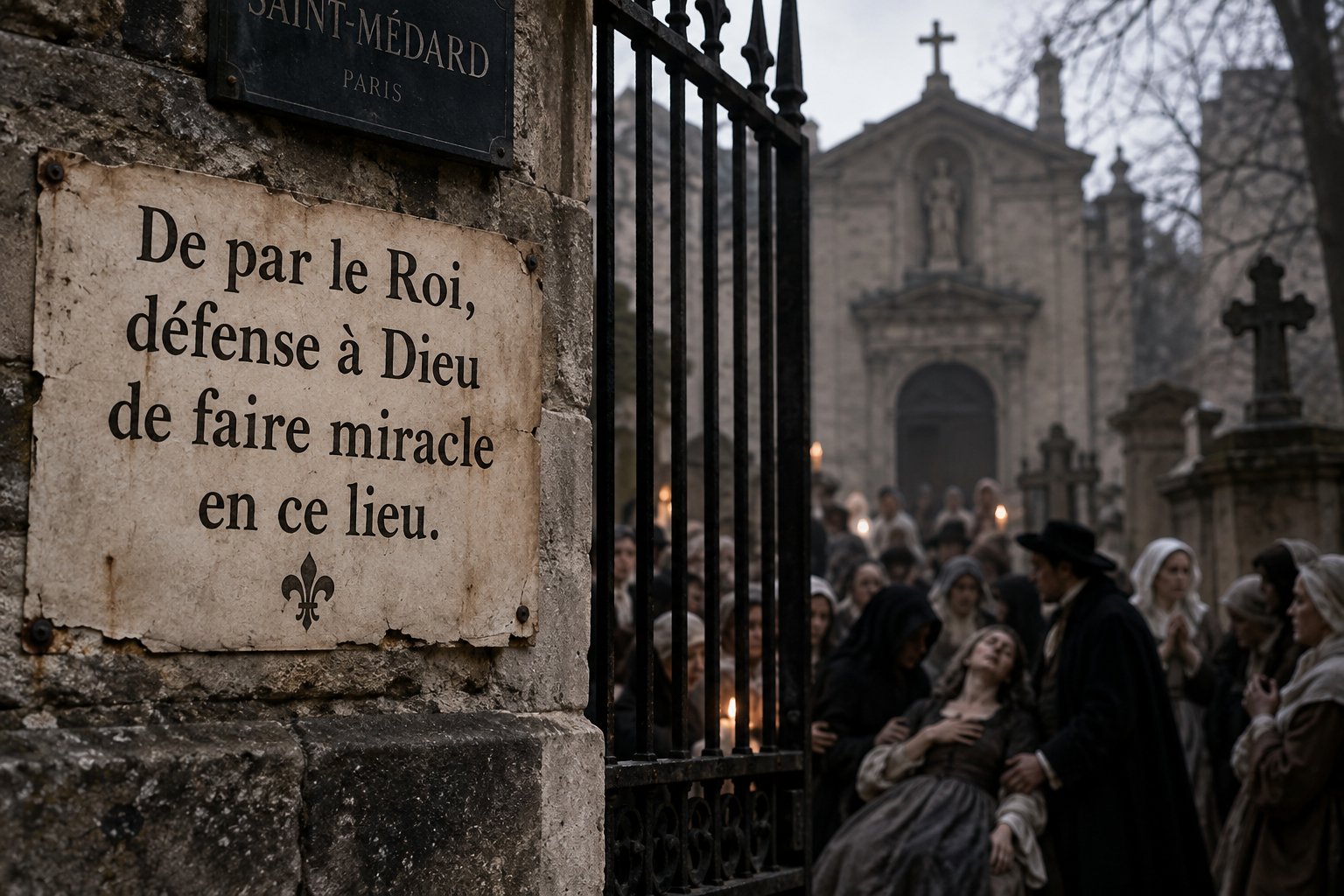
    There are historical sentences that survive because they explain an event, and there are others that survive because they make the event almost impossible to forget. Somewhere in Paris, during the winter of 1732, an anonymous hand is said to have placed one of the latter on the barrier surrounding a cemetery that the authorities had just ordered closed:

    “De par le Roi, défense à Dieu de faire miracle en ce lieu.”

    By order of the King, God is forbidden to perform miracles in this place.

    It sounds so absurd that it has often been repeated as though Louis XV himself had issued a royal decree commanding God to cease supernatural activity, but that is not what happened. The real story is stranger, because the sentence was a piece of anonymous satire aimed at a government that had found itself confronting something it could neither comfortably accept nor easily suppress: crowds gathering around the grave of an obscure religious man, reports of miraculous cures, bodies twisting in violent convulsions, respectable Parisians insisting that heaven had taken sides in a theological dispute, and a movement that became more extreme after the cemetery gates were finally locked.

    The royal ordinance of 27 January 1732 did not forbid God to perform miracles. It closed the small cemetery of Saint-Médard because the Crown believed the gatherings there were exploiting popular credulity and disturbing public order. The famous couplet appeared afterward and rapidly became one of the most memorable pieces of underground satire produced in eighteenth-century France. Historians still quote it because, in two lines, an anonymous Parisian managed to expose the almost comic problem confronting royal power: if the events were frauds, why did the state seem so afraid of them, and if they were miracles, what exactly did a locked gate accomplish?

    Behind that joke lies one of the strangest religious episodes of the French Enlightenment.

    The Dead Deacon Who Refused to Disappear

    François de Pâris was not a flamboyant prophet, an occult magician or a wandering miracle worker, which is partly why what happened after his death became so difficult for contemporaries to dismiss as ordinary religious theatre. Born in 1690, he became a Catholic deacon associated with Jansenism, a controversial current within French Catholicism that emphasized original sin, divine grace, moral austerity and a demanding vision of salvation.

    By the time Pâris died in 1727, Jansenism had become far more than a theological argument. It had acquired political meaning because many of its supporters resisted both papal authority and the increasingly centralized religious policies of the French monarchy. Pope Clement XI’s bull Unigenitus, issued in 1713 at the request of Louis XIV, condemned propositions associated with the Jansenist theologian Pasquier Quesnel, while the French Crown eventually treated the bull as a matter of state law in 1730. What looked from a distance like an argument about grace and doctrine had therefore become entangled with questions of royal power, ecclesiastical authority and the right of conscience.

    Pâris belonged to the opposition.

    He lived with unusual austerity, devoted himself to prayer and charity, and became respected among those who saw Jansenist persecution as evidence that the institutional Church had turned against sincere religious life. After his death on 1 May 1727, he was buried in the small cemetery attached to the church of Saint-Médard, in what was then a relatively poor district of Paris.

    Almost immediately, stories began circulating around his grave.

    People prayed there. Sick men and women visited. Reports appeared of pain disappearing, paralysis improving, blindness being relieved and illnesses inexplicably changing course, while devotees began treating the grave almost as though it had become a point of contact between ordinary Paris and another order of reality.

    Whether these were genuine miracles, spontaneous remissions, psychosomatic phenomena, exaggerations or carefully cultivated religious propaganda remains impossible to resolve three centuries later. What can be established is that reports of cures multiplied sufficiently to attract enormous public attention, and by 1731 the cemetery had become the center of a movement that authorities could no longer regard as merely private devotion.

    Then the bodies began to convulse.

    When the Miracles Changed Form

    Visitors to Saint-Médard began entering states that contemporaries struggled to classify. Some trembled violently, others fell to the ground, experienced spasms, cried out, spoke ecstatically or appeared to enter altered states of consciousness, and the people exhibiting these phenomena became known as the Convulsionnaires de Saint-Médard.

    To believers, the convulsions could be interpreted as signs of divine action, physical evidence that grace was moving through the body and confirming the righteousness of a persecuted religious cause. To opponents, they looked like hysteria, deception, fanaticism or mass contagion. Royal physicians and clerical critics rejected the supernatural interpretation, while supporters collected testimonies with almost obsessive determination.

    The argument was therefore not simply over whether unusual things happened at Saint-Médard, because nobody seriously disputed that unusual behavior was occurring. The battle concerned what those bodies meant.

    A woman collapsing beside the tomb could be interpreted as a saintly recipient of grace, a medically disturbed patient, an actress, a victim of suggestion or a political symbol, depending entirely upon who was watching her.

    This is where Saint-Médard becomes more fascinating than a collection of old miracle stories, because eighteenth-century France found itself confronting a problem that continues to trouble modern societies: the same physical event can become evidence for completely different realities once religion, medicine and politics compete to explain it.

    What one witness called possession by divine grace, another called illness.

    What one called healing, another called coincidence.

    What one called revelation, the police called disorder.

    The Authorities Had a Problem

    By late 1731, Saint-Médard was attracting crowds large enough to make the affair impossible to ignore, and the political context made the situation even more dangerous. Jansenists regarded the supposed miracles as evidence that God himself had vindicated a community condemned by ecclesiastical authorities, which meant every claimed cure carried an implication far beyond the health of the person involved.

    If Pâris really was performing miracles from beyond the grave, then heaven appeared to be validating people whom Church and Crown had tried to silence.

    A miracle had become an argument against authority.

    The archbishop of Paris, Charles-Gaspard de Vintimille, opposed the cult, while royal authorities increasingly viewed the cemetery gatherings as both religiously suspect and politically destabilizing. After investigations, condemnations and growing public controversy, the decision was finally made to close the cemetery.

    On 27 January 1732, access was prohibited by royal ordinance. Historical accounts record that the order accused those involved of exploiting the credulity of the public, while guards and physical barriers prevented worshippers from reaching the famous grave.

    Not long afterward, Paris acquired its immortal joke:

    De par le Roi, défense à Dieu
    De faire miracle en ce lieu.

    Larousse still records the epigram in its dictionary, while academic work on Saint-Médard describes it as perhaps the most enduring commentary produced by the affair. Its author remains unknown.

    There is something almost modern about it.

    The writer did not need a theological treatise, because two lines were enough to make royal authority appear ridiculous.

    The king could close a cemetery.

    Apparently, someone wondered whether he could close heaven as well.

    The Gates Closed, but the Convulsions Did Not

    Had the movement disappeared after the cemetery was sealed, Saint-Médard might have remained merely another curious episode in the history of popular religion. Instead, the opposite occurred, because the Convulsionnaires moved indoors.

    Meetings continued in private houses, including homes connected with clergy, members of the Parlement and sympathetic elites. The phenomenon became less public but, in some circles, considerably more extreme. Historical sources describe practices known as secours, or “assistance,” in which people undergoing convulsions asked others to apply heavy physical pressure or blows in the apparent belief that intense bodily intervention relieved the internal agony accompanying their ecstatic states.

    Over time, certain groups developed ritual forms of mortification that could include crushing pressure, blows from heavy objects, piercing, burning and even performances modeled upon crucifixion. The sources must be approached carefully because hostile observers had every reason to emphasize the most grotesque episodes, yet surviving Jansenist manuscripts themselves record extraordinary acts associated with the movement, while the Bibliothèque nationale de France preserves eighteenth-century collections of testimony concerning “prodigious events” attributed to the convulsions.

    This is the point at which Saint-Médard crosses an uncomfortable border between religion and something much harder to name.

    Were these acts expressions of mystical identification with Christ’s suffering, collective psychological states, demonstrations of bodily endurance, subconscious performance, or rituals that gradually developed their own symbolic language once official worship had been driven underground?

    The answer probably varied from person to person, and perhaps that ambiguity explains why the movement became so difficult for both the Church and later historians to classify.

    It was Catholic but condemned by important Catholic authorities.

    It was political without being a conventional political party.

    It was physical yet interpreted spiritually.

    It was public devotion transformed by repression into something resembling a secret initiatory culture, complete with private gatherings, unusual bodily trials and an increasingly elaborate understanding of suffering as spiritual evidence.

    To call it simply “occult” would be historically misleading, because its participants considered themselves Christians rather than practitioners of hidden magic, yet the atmosphere surrounding the later Convulsionnaires unmistakably enters territory familiar from the history of esoteric religion: hidden meetings, altered states, privileged revelation, sacred suffering and the conviction that ordinary appearances concealed another order of truth.

    The Skeptic Who Became a Believer

    Among the people drawn into the affair was a man whose involvement gave the movement a degree of seriousness its enemies would have preferred to deny.

    Louis-Basile Carré de Montgeron, a magistrate of the Parlement of Paris, approached the Saint-Médard phenomena as a skeptic before becoming convinced that at least some of the reported cures were genuine. He began gathering evidence with the mentality of a legal official rather than that of a wandering visionary, interviewing witnesses, assembling medical statements and attempting to reconstruct individual cases in detail.

    The result was the monumental La Vérité des miracles opérés à l’intercession de M. de Pâris, first published clandestinely in 1737, a work designed explicitly to demonstrate that genuine miracles had occurred through the intercession of François de Pâris. The Bibliothèque nationale de France preserves the work and identifies its purpose precisely as a demonstration of the reality of miracles associated with the dead deacon.

    Montgeron’s next decision was either courageous, naïve or spectacularly reckless.

    On 29 July 1737, he personally presented a copy of his book to Louis XV.

    It was an extraordinary gesture because the book was not merely devotional literature; it was evidence, in Montgeron’s view, that the king’s government and Church authorities had been resisting manifestations of divine approval.

    He was arrested shortly afterward and imprisoned.

    The BnF preserves an engraving commemorating the episode, showing Montgeron presenting his demonstration of the miracles to the king before his confinement, an image that almost perfectly captures the tension of the entire Saint-Médard affair: a magistrate kneeling before earthly sovereignty while offering what he believed to be evidence of a higher sovereignty that no royal decree could overrule.

    Montgeron spent much of the rest of his life imprisoned and died in 1754.

    His book survived him.

    Were There Really Miracles?

    This is the question that inevitably remains, and it deserves a better answer than either credulous acceptance or dismissive laughter.

    Carré de Montgeron attempted to present the cures in something resembling documentary form, including witness statements and medical observations, while supporters stressed that some cases involved illnesses known to physicians before the alleged recovery. Modern readers sometimes treat this as though eighteenth-century documentation were equivalent to contemporary controlled medical evidence, which it was not.

    Diagnostic medicine was different, standards of verification were different, spontaneous remission was poorly understood, and retrospective testimony carried enormous evidentiary problems.

    Yet simply calling everything fraud does not explain the entire phenomenon either.

    Religious expectation can powerfully influence behavior and subjective symptoms, social contagion can produce genuine physical manifestations without conscious deception, altered states can spread through groups, and psychosomatic processes can create symptoms that are absolutely real despite lacking the kind of structural pathology people normally imagine when hearing the word disease.

    None of this requires supernatural intervention.

    It also does not prove that every reported cure was imaginary.

    The intellectually responsible position is less satisfying and more interesting: the surviving evidence allows us to reconstruct what people claimed, what they witnessed and how passionately they fought over those events, but it does not allow us to travel backward three centuries and establish the medical cause of every recovery.

    In some ways, the uncertainty is what kept Saint-Médard alive.

    A miracle conclusively disproved becomes a mistake.

    A miracle conclusively proven would cease to be a historical mystery.

    Saint-Médard remained suspended between them.

    A Cemetery Where Religion Became Political Evidence

    The deepest layer of the story may have little to do with supernatural healing.

    The cult of François de Pâris emerged at precisely the moment when the French monarchy and the Catholic hierarchy were attempting to settle a theological conflict through authority. The supposed miracles therefore became dangerous because they appeared to reverse the direction of judgment.

    Rome had condemned the Jansenist cause.

    The Crown supported that condemnation.

    Yet ordinary men and women gathered around a dead Jansenist and claimed that God disagreed.

    For an absolute monarchy, that was no small problem.

    A government can imprison theologians, prohibit publications and close cemeteries, but religious experience cannot be regulated so easily because its ultimate authority is claimed to originate somewhere beyond the reach of government. Once a crowd becomes convinced that heaven has authenticated its cause, political suppression can even strengthen the belief by providing exactly the persecution narrative that the movement expects.

    This may explain why closing Saint-Médard failed so spectacularly as an attempt to end the phenomenon.

    Before 1732, the movement had a grave.

    After 1732, it had a legend.

    The Occult Shadow of Saint-Médard

    What happened inside the private gatherings after the cemetery closure is perhaps the most unsettling part of the story because repression changed the movement’s spiritual vocabulary.

    Public pilgrimage had been relatively simple: visit the grave, pray, touch the tomb, hope for healing.

    Underground Convulsionnaire spirituality became more elaborate, physical and symbolic, with suffering increasingly interpreted as a vehicle for revelation. The body ceased to be merely something waiting to be healed and became an instrument through which hidden meaning might be expressed.

    Similar ideas appear in many mystical traditions, although their theological explanations differ dramatically. Christian ascetics practiced fasting and mortification; medieval visionaries understood bodily suffering as participation in Christ’s Passion; ecstatic religious movements repeatedly blurred the boundary between pain, transcendence and altered consciousness.

    Saint-Médard belonged to that wider human territory in which extreme bodily experience can acquire sacred interpretation.

    There is no need to invent demons, secret magical orders or supernatural conspiracies to make this strange.

    The documented reality is strange enough.

    Educated magistrates defended the movement.

    Authorities feared it.

    Crowds sought miracles at a grave.

    Bodies convulsed around the dead.

    Private groups transformed suffering into ritual.

    An anonymous Parisian mocked the king for apparently trying to regulate God.

    And all of it occurred not in some forgotten medieval village but in eighteenth-century Paris, at the very moment Europe liked to imagine itself entering an age of reason.

    Voltaire Was Watching Too

    The irony was not lost on Voltaire, who later mocked the Convulsionnaires and used their excesses as ammunition against religious fanaticism. His Dictionnaire philosophique preserved the famous couplet about forbidding God to perform miracles, while treating the movement with characteristic sarcasm.

    Yet Voltaire’s ridicule creates another interesting paradox.

    The Enlightenment is often narrated as though reason simply arrived and superstition retreated, but Saint-Médard shows how inadequate that picture is. Skepticism, popular religion, early medical reasoning, political propaganda, mystical experience and satirical journalism existed simultaneously, competing within the same city and sometimes within the same individuals.

    Paris could produce Voltaire and the Convulsionnaires at the same time.

    Perhaps it had to.

    Periods that advertise themselves as rational often generate intense fascination with whatever reason appears unable to explain.

    The Sentence That Outlived the King

    Louis XV died in 1774.

    François de Pâris had already been dead for nearly half a century.

    The Convulsionnaire movement slowly fragmented, although traces of it persisted for decades, while Jansenism itself continued influencing French religious and political culture long after the spectacular scenes at Saint-Médard had disappeared. Larousse records that secret Convulsionnaire activity continued well into the later eighteenth century.

    The anonymous couplet survived them all.

    Perhaps this happened because it captures something larger than the event that inspired it.

    Every system of authority eventually encounters a boundary beyond which commands become strangely powerless. A king can decree where people may gather, a bishop can condemn a doctrine, guards can prevent worshippers from reaching a tomb, and printers can be forbidden to circulate certain books, yet none of these measures can directly regulate what people believe they have experienced.

    That does not mean the belief is true.

    It means belief occupies a territory that coercion cannot completely control.

    The cemetery of Saint-Médard was closed because authorities wanted the phenomenon to end, but the closure gave the affair the one thing capable of preserving it indefinitely: a perfect story.

    A dead deacon.

    A forbidden grave.

    Supposed miracles.

    Bodies seized by inexplicable convulsions.

    Secret ceremonies continuing behind closed doors.

    A magistrate imprisoned after presenting evidence to the king.

    And finally an unknown hand leaving two lines on a barrier in Paris, quietly suggesting that earthly authority had become so confident in itself that it had attempted to issue instructions to heaven.

    The king never actually forbade God to perform miracles at Saint-Médard.

    Someone merely accused him of trying.

    Almost three hundred years later, that is the part everyone still remembers.

    Sources and Further Reading

    The historical reconstruction is based on the Bibliothèque nationale de France collections concerning François de Pâris, the Convulsionnaires and Louis-Basile Carré de Montgeron; academic research collected in Miracles, Convulsions, and Ecclesiastical Politics in Early Eighteenth-Century Paris; eighteenth-century manuscript testimony preserved in the French national collections; the historical archives of Larousse; research on the Unigenitus controversy and French Jansenism; and Montgeron’s 1737 La Vérité des miracles opérés à l’intercession de M. de Pâris.

    Some mysteries were never meant to remain inside churches, archives, or forbidden books. If you want to go deeper into ritual, symbolism and the hidden path of the witch, enter the Grimoire.