
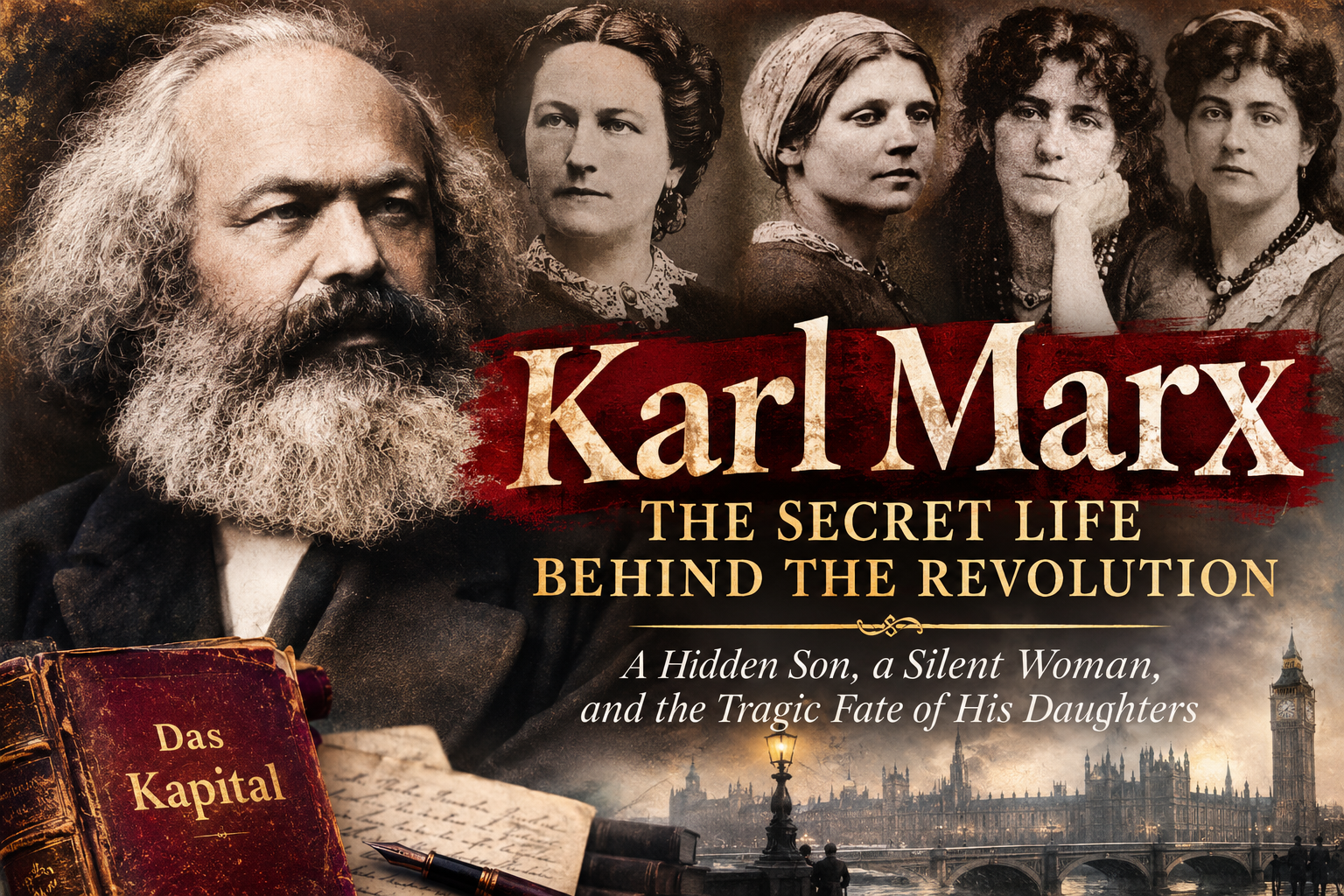
Karl Marx: The Secrets Behind the Revolutionary — A Hidden Son, a Silent Woman, and the Tragic Fate of His Daughters
Behind the man who promised to liberate humanity from exploitation lies a disturbing family history of poverty, financial dependence, concealed relationships, and two daughters whose lives ended in tragedy. But how much of this story is true, and how much has been rewritten to serve political agendas?
There is something about the private lives of famous historical figures that has always fascinated me. We know their books, their speeches, their theories, and the ideas that changed the world, yet we rarely ask what happened when they returned home, closed the door, and became ordinary human beings, surrounded by people who had to live with their ambitions, weaknesses, and contradictions.
Karl Marx is one of those figures whose public identity has almost completely swallowed the man himself. His name has been praised, condemned, worshipped, and blamed for some of the most dramatic political transformations in modern history. Generations have argued over his ideas about capitalism, class struggle, and revolution, but far fewer have examined the complicated relationships and painful secrets hidden within his own family.
My curiosity began with an unusual statement circulating online, supposedly written by Marx himself. In it, he appeared to confess that he had fathered a child with his housekeeper, lived on his wife’s money, depended on a wealthy friend, and had two daughters who committed suicide.
The accusations were extraordinary, but one detail immediately raised a question that changed the direction of my investigation. Marx died in 1883, while the two daughters mentioned in the statement died in 1898 and 1911. Whatever the origins of that supposed confession, it could not have been written by him in the form being circulated.
I could have dismissed the entire story as another piece of political propaganda, but the historical details behind it were too intriguing to ignore. Some were documented, others remained disputed, and a few led me toward a side of Marx’s life that was far more revealing than the fabricated confession itself.
I began following the story backward, through nineteenth-century London, family letters, biographies, and the lives of women who spent decades in the shadow of a man determined to change the world.
And somewhere along the way, the revolutionary philosopher began to look very different from the familiar portrait hanging in history books.
The Man Who Studied Poverty While His Own Family Was Drowning in It
London, 1849.
The city was becoming the industrial heart of the British Empire, a place where extraordinary wealth existed within walking distance of overcrowded rooms, polluted streets, and families struggling to survive. Factories produced fortunes for their owners, while thousands of workers endured exhausting labour and living conditions that would later become central to Marx’s criticism of capitalism.
Marx arrived in this city as a political exile, accompanied by his wife, Jenny von Westphalen, and their children. The revolutionary movements of 1848 had failed to achieve the transformations he had hoped for, and his political activities had made it increasingly difficult for him to remain on the European continent.
Jenny had not been born into poverty. Her family belonged to respectable Prussian society and had aristocratic connections, which makes the contrast between her upbringing and her married life especially striking. She had chosen a brilliant, controversial young intellectual whose political convictions offered little prospect of financial security.
Their life in London became a long struggle against debt, illness, and uncertainty.
At 28 Dean Street, in Soho, the family occupied cramped rooms that have since become part of the mythology surrounding Marx. Household possessions were repeatedly pawned, creditors demanded payment, and the lack of money affected almost every aspect of their existence.
One of the details that stayed with me came from Jenny’s own recollections of the death of their daughter Franziska in 1852. The little girl was barely a year old, and the family was so impoverished that Jenny had to seek help to obtain a coffin.
It is difficult to read such an account without imagining the despair inside that household. While Marx was developing arguments about the economic structures responsible for human suffering, his own wife was confronting a tragedy made even more painful by their inability to pay for the simplest funeral arrangements.
Karl and Jenny had seven children, but only three daughters survived to adulthood: Jenny Caroline, Laura, and Eleanor.
The deaths of their other children cannot simply be blamed on Marx’s financial decisions. Childhood mortality was tragically common in nineteenth-century Europe, and infectious diseases claimed lives across social classes. Nevertheless, the family’s precarious living conditions added another layer of vulnerability to an already dangerous world.
The correspondence from those years reveals a man capable of intense intellectual concentration but frequently overwhelmed by practical difficulties. Marx worked as a journalist, received payments for articles, and occasionally benefited from inheritances, yet his income was inconsistent and his spending often exceeded what the household could afford.
Jenny copied manuscripts, managed family affairs, dealt with correspondence, and helped preserve her husband’s work through periods when their circumstances might have destroyed it entirely.
The more I read about her, the more I wondered how differently the history of Marxism might have unfolded without the unpaid and largely invisible labour of the woman who shared his life.
But Jenny was not the only woman whose work sustained the Marx household.
There was another, and her story leads directly to one of the most controversial mysteries in the philosopher’s biography.
Helene Demuth: The Woman Who Knew Too Much
Her name was Helene Demuth, although everyone in the family called her Lenchen.
She had entered Jenny von Westphalen’s household before Jenny married Marx and remained connected to the family for decades. Through political exile, poverty, illness, and personal upheaval, Helene became an indispensable presence in their domestic life.
She cooked, cleaned, cared for the children, and helped maintain the household while Marx spent long hours studying and writing.
I find her position particularly interesting because she lived at the intersection of two very different worlds. Inside the same home where one of the nineteenth century’s most influential critics of class inequality was developing his theories, Helene performed the domestic labour that made his intellectual life possible.
The relationship between Helene and the Marx family was not simply that of an employer and an employee. She was deeply involved in their daily existence and remained close to them throughout her life, although that closeness did not erase the differences in status and power between them.
Then, in June 1851, something happened that would become the subject of speculation for generations.
Helene gave birth to a boy.
His name was Henry Frederick Demuth, usually known as Freddy.
The father’s name was not recorded on his birth certificate.
Freddy was raised outside the Marx household, and the identity of his biological father remained a question that would eventually divide historians.
According to the account accepted by many Marx biographers, Karl Marx was the child’s father, while Friedrich Engels, Marx’s closest friend and collaborator, helped conceal the relationship to protect Jenny and prevent a scandal.
But the story is not as straightforward as it is often presented.
A crucial piece of evidence is a letter written in September 1898 by Louise Freyberger to the German socialist leader August Bebel. Freyberger reported that Engels had acknowledged, shortly before his death, that Marx was Freddy’s father.
The letter is historically significant, but it is not the same as a direct confession by Marx, and it does not establish biological paternity beyond all doubt.
Historians have debated the reliability of the testimony, the circumstances in which the information was transmitted, and whether the traditional interpretation rests too heavily on a limited documentary record.
What makes this case especially revealing is the silence surrounding Helene herself. Her own detailed account of the circumstances has not survived, leaving historians dependent largely on the words and recollections of other people.
I kept returning to that absence while reading about the controversy. The men involved became world-famous intellectual figures, their letters were collected, and their political disagreements were studied for generations, while the woman at the centre of this intimate mystery left comparatively little testimony through which we can hear her own voice.
Freddy Demuth eventually worked as a skilled tradesman and lived a life far removed from the intellectual and political circles associated with Marx. He died in 1929.
Whether Marx was his biological father remains disputed, but the existence of Freddy, his mother’s position in the household, and the later attempts to establish his paternity are part of the historical record.
And the man whose name appears repeatedly in this controversy, Friedrich Engels, played another extraordinary role in Marx’s life.
He helped keep him financially afloat for decades.
Friedrich Engels: The Capitalist Who Financed the Critic of Capitalism
If there is one contradiction in Marx’s biography that deserves careful examination, it is his relationship with Friedrich Engels.
Engels was not merely a political companion or a fellow philosopher. He came from a prosperous industrial family whose business interests included textile manufacturing, particularly in Manchester, one of the great centres of British industrial capitalism.
His family’s wealth was connected to the very economic system that Marx and Engels would spend much of their lives analysing and criticising.
Engels knew the industrial world from within. He had observed the conditions endured by workers in Manchester and published The Condition of the Working Class in England in 1845, several years before Marx began publishing the major volumes of his economic work.
The friendship between the two men developed into one of the most influential intellectual partnerships in modern history, but it also involved something much more practical.
Money.
Engels repeatedly sent financial assistance to Marx, helping him cover living expenses and continue his research during periods when the family had little reliable income.
Their correspondence contains numerous references to financial difficulties, requests for help, payments, and arrangements intended to provide Marx with greater stability.
In 1869, Engels retired from his commercial position in Manchester, and the financial arrangements between the two friends became more regular.
What intrigued me was not simply the irony of a revolutionary thinker receiving money generated through capitalist industry. It was the extraordinary extent to which Marx’s intellectual independence depended on the material support of another person.
Without Engels, Marx might still have developed his ideas, but the conditions under which he worked would have been considerably more difficult.
Of course, receiving financial support from an industrialist does not automatically invalidate a critique of capitalism. Engels himself believed that understanding the system from within strengthened his arguments against its inequalities.
Nevertheless, the relationship exposes a truth that ideological portraits often conceal: even the most radical intellectual projects depend on ordinary material realities.
Someone has to pay the rent, purchase the books, provide food, and make it possible for a writer to spend years developing ideas that may never generate enough income to sustain a family.
Marx understood economic dependence as a central feature of social life, yet his own dependence on Engels was unusually personal.
There is something almost literary about that relationship, a wealthy industrialist financing the man who would become capitalism’s most famous critic, while the two worked together to imagine a world fundamentally different from the one that made their collaboration possible.
But money was only one part of the story.
Behind the intellectual partnership stood a family in which love, loyalty, illness, ambition, and sacrifice were becoming increasingly difficult to separate.
Jenny Marx: The Woman Who Helped Build a Revolution and Paid a Personal Price
When I began looking more closely at Jenny von Westphalen, I realised that her life deserved an investigation of its own.
She was not simply the patient wife of a difficult genius, nor was she a passive figure standing quietly beside her husband’s intellectual achievements. Jenny was educated, politically aware, and deeply involved in the work that would eventually make Marx famous.
She copied manuscripts, discussed political developments, maintained correspondence, and helped him navigate the complicated relationships surrounding the socialist movement.
But she was also a mother who buried four children, a woman who lived for years under financial pressure, and a wife whose private life may have contained a betrayal that was never openly acknowledged.
The possibility that Marx fathered Helene Demuth’s child raises uncomfortable questions about what Jenny knew and how the family handled the situation. The surviving evidence does not allow us to reconstruct her thoughts with certainty, and I would rather leave that silence intact than invent a confrontation or a confession for which no reliable document exists.
What we do know is that Jenny remained with Marx until her death in December 1881, after a long marriage marked by political upheaval, financial insecurity, and repeated illness.
One of the lesser-known aspects of their relationship is that Jenny came from a social background very different from the revolutionary circles in which her husband would eventually become famous. Their marriage crossed expectations of class and political respectability, and her commitment to Marx was established long before anyone could have predicted his historical influence.
I found that detail particularly moving because it reminds us that Jenny did not marry a monument or a celebrated philosopher. She married a young man whose future was uncertain, whose ideas were controversial, and whose political activities would repeatedly disrupt their lives.
History tends to preserve the achievements of exceptional men while reducing the women around them to supporting roles. Yet without Jenny’s labour, patience, intelligence, and practical involvement, the story of Karl Marx would have been profoundly different.
And after Jenny’s death, the family began to unravel in ways that neither Marx nor Engels would live to witness completely.
The Three Daughters Who Survived Childhood
There were three daughters who reached adulthood in the Marx family, and their lives reveal something rarely discussed in the simplified portraits of their father.
Jenny Caroline, Laura, and Eleanor were raised in an intellectually intense household, surrounded by political debates, books, foreign languages, visiting revolutionaries, and conversations about the future of European society.
Marx was affectionate with his children, who called him Moor, a family nickname associated with his dark appearance. His letters and the recollections of those who knew him reveal a playful side of his personality, particularly in his relationships with children and grandchildren.
This is an important part of the story because the historical record does not support portraying Marx as a man incapable of affection or indifferent to his family.
He could be loving, humorous, demanding, irritable, intellectually generous, and personally difficult, sometimes within the same relationship.
His daughters inherited more than his name. They grew up in a world where political commitment was treated as a serious moral responsibility, and both Laura and Eleanor became active participants in socialist movements.
The eldest daughter, Jenny Caroline, married the French socialist Charles Longuet and became involved in political journalism and activism. Her life was cut short by illness in January 1883, only weeks before her father’s death.
By then, Marx had already lost his wife and several children, and his own health was deteriorating.
Karl Marx died in London on 14 March 1883, aged sixty-four.
His death is essential to understanding the false quotation that originally led me into this investigation, because the tragedies most frequently used to condemn his private life had not yet occurred.
Eleanor would die fifteen years later.
Laura would die twenty-eight years later.
Neither event could have appeared in a genuine confession written by their father.
Yet the circumstances of those deaths are among the most haunting episodes in the history of the Marx family.
Eleanor Marx: The Woman Who Fought for Freedom but Could Not Escape Her Own Tragedy
Eleanor Marx was born in London in January 1855 and became known within her family as Tussy.
Of all Marx’s daughters, she is perhaps the one whose life most clearly demonstrates the tension between public convictions and private suffering.
She was intelligent, energetic, politically committed, and deeply interested in literature and theatre. She translated important works, including Gustave Flaubert’s Madame Bovary, and became involved in the British labour movement at a time when women were still struggling to gain recognition as independent political actors.
Eleanor helped organise workers, supported trade union activity, and became associated with the emerging socialist movement in Britain.
She was not merely repeating her father’s ideas. She developed her own political identity and became an important advocate for women’s emancipation.
What drew me into her story was the contrast between the independence she defended publicly and the painful complications of her relationship with Edward Aveling.
Aveling was a socialist lecturer, writer, and activist who moved in the same intellectual circles as Eleanor. He was charismatic, educated, and politically active, but his personal and financial conduct attracted criticism even among his associates.
The two began living together in the 1880s, although their relationship was never formalised through marriage.
For years, Eleanor supported their shared political activities while also dealing with Aveling’s financial difficulties and the tensions surrounding his behaviour.
Their relationship became increasingly troubled, and in 1897 Aveling secretly married another woman, an actress named Eva Frye, despite his continuing relationship with Eleanor.
This deception would become central to the accounts written after Eleanor’s death.
On 31 March 1898, Eleanor died at her home in Sydenham, London, after taking poison. She was forty-three years old.
The circumstances surrounding her death generated suspicion and controversy almost immediately.
Aveling’s behaviour was questioned, particularly because of his secret marriage and the circumstances in which Eleanor obtained the poison. Some contemporaries believed he bore a grave moral responsibility for what happened, although the available evidence does not establish that he murdered her.
One of the most valuable contemporary accounts came from Eduard Bernstein, who had known Eleanor and published an examination of her death in July 1898.
Bernstein’s account is important because it demonstrates that concerns about Aveling were not simply inventions created by later political opponents of Marx.
But even this testimony cannot tell us everything that passed through Eleanor’s mind during her final days.
I kept thinking about the woman who had spent years speaking about freedom, equality, and the dignity of working people, yet whose own intimate relationship had become a source of profound distress.
It would be tempting to turn her death into a symbolic judgement on her father’s philosophy, but doing so would erase the independent life she had built and reduce a complex personal tragedy to a political argument.
Eleanor was not simply Karl Marx’s unfortunate daughter.
She was a remarkable woman whose achievements deserve recognition independently of the circumstances of her death.
Her story also raises a question that remains painfully relevant today: how can someone understand injustice so clearly in public life and still become trapped in a destructive relationship in private?
There is no simple answer, and perhaps that is precisely why her story continues to disturb me.
Laura Marx: The Final Tragedy and a Decision That Shocked Europe
The second daughter whose death is mentioned in the circulating accusation was Laura Marx, born in Brussels in 1845.
Laura married Paul Lafargue, a French socialist of Cuban background who became one of the best-known figures in the French socialist movement.
Lafargue is remembered for his provocative essay The Right to Be Lazy, first published in 1880, in which he criticised the glorification of endless labour and challenged the idea that human existence should revolve entirely around work.
Laura and Paul shared political commitments, intellectual interests, and decades of activism. They also experienced personal tragedy, including the deaths of their children.
Unlike Eleanor, Laura did not die following a documented romantic betrayal.
Her death occurred under entirely different circumstances.
On 26 November 1911, Laura and Paul Lafargue died by suicide at their home in Draveil, near Paris. Laura was sixty-six, while Paul was sixty-nine.
Paul left a written explanation describing his determination not to endure the physical and intellectual decline he associated with old age. His final statement also expressed confidence in the future of socialism.
The decision shocked many contemporaries, including members of the socialist movement who admired the couple.
Vladimir Lenin attended their funeral and spoke in their memory.
I find the contrast between the two sisters especially important. Eleanor’s death followed years of personal turmoil and deception, while Laura and Paul had made a deliberate joint decision shaped by their own beliefs about ageing, independence, and the end of life.
Both deaths were tragic, but they cannot responsibly be explained as consequences of a single family ideology.
There is also a historical irony that deserves attention.
Karl Marx, whose writings were devoted to understanding the forces shaping human lives, never knew how the stories of his two surviving daughters would end.
He had been dead for fifteen years when Eleanor died and for twenty-eight years when Laura died.
The famous revolutionary who had imagined a transformed future never lived to see these final chapters of his family’s history.
The Forgotten Lives Behind the Famous Name
By this point in my investigation, something had begun to trouble me more than the original accusation.
Almost every popular account of the Marx family revolves around Karl himself, even when the most extraordinary events concern the women around him.
Jenny is remembered primarily as his wife.
Helene is remembered through the controversy surrounding the paternity of her son.
Eleanor is frequently reduced to the tragedy of her relationship with Edward Aveling.
Laura is often mentioned only because of the circumstances of her death.
Yet each of these women had a life far more complicated than the role assigned to her in the biography of a famous man.
Jenny helped preserve and support a body of work that would influence generations.
Helene remained an essential figure in the household and later helped care for Engels after Marx’s death. She died in 1890 and was buried in the Marx family grave at Highgate Cemetery, a detail that speaks to the unusual closeness of her relationship with the family.
Eleanor became a political activist, translator, and organiser in her own right.
Laura worked alongside her husband in the international socialist movement and helped sustain the intellectual and political legacy of her father.
Their stories deserve to be told without reducing them to evidence for or against Marxism.
Another detail caught my attention while examining the family history: after Marx died, Engels devoted considerable effort to organising and publishing the manuscripts his friend had left unfinished.
The second and third volumes of Capital were published after Marx’s death, edited by Engels in 1885 and 1894.
That means the intellectual legacy we associate with Marx was also shaped by the editorial decisions and years of work of another man.
Even the most famous achievements attributed to solitary historical figures often depend on networks of people whose contributions are less visible.
The Marx household was not simply the residence of a philosopher.
It was a place where political ideas, domestic labour, financial support, friendship, personal loyalty, and unresolved tensions existed together.
And perhaps the most revealing aspect of this history is that none of those elements can be completely separated from the others.
The Confession Karl Marx Could Never Have Written
I eventually returned to the statement that had started this investigation.
Its message was designed to be devastating: the man who criticised exploitation supposedly admitted that he had depended on other people’s money, betrayed his wife, and watched his daughters die by suicide.
Several elements were drawn from real historical controversies, but the supposed confession contained an impossible chronology.
Marx died in 1883.
Eleanor died in 1898.
Laura died in 1911.
A man cannot confess to having witnessed events that occurred after his death.
I have found no reliable primary source establishing that Marx wrote or spoke the statement circulating online, and its reference to the later deaths of his daughters is sufficient to demonstrate that it cannot be an authentic quotation in that form.
This is how historical misinformation often becomes persuasive.
It does not always begin with a completely invented story. Sometimes it takes genuine events, removes their context, rearranges their chronology, and places them inside a dramatic quotation attributed to a famous person.
The result feels convincing precisely because some of its ingredients are true.
Marx did depend heavily on financial support from Engels.
The paternity of Helene Demuth’s son has been attributed to Marx by numerous biographers, although the matter remains historically disputed.
Two of Marx’s daughters did die by suicide.
But combining these facts into a supposed personal confession transforms history into something else entirely.
It creates the illusion that Marx himself acknowledged a moral failure involving events he never lived to witness.
The distinction matters because historical truth should not depend on whether we admire or despise the person being investigated.
If we want to criticise Marx, there is no shortage of authentic material to examine. His writings, political positions, personal correspondence, conflicts with other socialists, and the later interpretations of his ideas provide enormous room for serious debate.
Inventing a confession only weakens that debate.
Can a Man Who Wanted to Liberate Humanity Be Judged by His Own Life?
This was the question I carried with me after finishing my research.
Marx spent much of his life investigating the relationship between economic power and human freedom, yet his own household depended on financial assistance, domestic labour, and the sacrifices of people who rarely received public recognition.
He criticised systems of inequality while living within the social structures of nineteenth-century Europe, structures that shaped his own relationships as surely as they shaped those of the people he studied.
If he fathered Helene Demuth’s child, as many historians believe, the circumstances raise serious questions about personal responsibility and the vulnerability of a woman employed in his household.
But it would be equally misleading to ignore the evidence of affection within his family, his grief over the deaths of his children, or the political and intellectual achievements of his daughters.
Human beings rarely fit the moral categories that later generations create for them.
The same person can produce extraordinary intellectual work and make deeply questionable personal decisions. Someone can understand the suffering of strangers while failing to recognise the harm caused within their closest relationships.
That contradiction is not unique to Marx.
It appears repeatedly throughout history, in the lives of philosophers, religious leaders, reformers, artists, and revolutionaries who offered humanity visions of a better world while struggling with their own limitations.
I have never believed that we understand historical figures by turning them into saints or monsters.
Both approaches are convenient because they remove the need to examine complexity.
The saint can do no wrong, while the monster can do nothing right.
The real person disappears somewhere between those two inventions.
Karl Marx’s private life does not, by itself, prove or disprove his economic theories. Those theories must be examined through their arguments, historical evidence, and consequences.
But his private life does reveal something about the distance that can exist between intellectual ideals and everyday human behaviour.
And that distance is worth investigating, particularly when a historical figure becomes the symbol of a movement that claims to understand how society should be organised.
The Silence That Remains
When I think about this story now, the image that stays with me is not the familiar photograph of Karl Marx, seated with his heavy beard and penetrating expression.
It is the image of a London household in which several lives unfolded around the ambitions of one extraordinary man.
I imagine Jenny working through another difficult evening, surrounded by papers, unpaid bills, and the constant demands of family life.
I think of Helene Demuth, whose presence was essential to that household but whose own voice remains largely absent from the controversy that followed her son.
I think of Eleanor, the passionate advocate for women’s freedom whose final years were overshadowed by a relationship that brought her enormous suffering.
And I think of Laura, who lived long enough to witness the expansion of the socialist movement across Europe but whose life ended in circumstances that shocked even those closest to her political world.
These women were not merely witnesses to Karl Marx’s greatness or evidence of his shortcomings.
They were individuals whose experiences reveal the human cost, complexity, and contradictions of a family that lived at the centre of nineteenth-century revolutionary politics.
What began for me as an attempt to verify a suspicious quotation became something far more interesting: an investigation into the private world behind a public legend.
The fabricated confession was easy to expose once the dates were examined.
The genuine history was much harder to understand.
And that is often the difference between propaganda and historical investigation. Propaganda offers a conclusion before asking questions, while serious investigation forces us to live with details that do not always fit together comfortably.
Karl Marx wanted to understand the forces that shaped human society, and his ideas would influence generations long after his death.
Yet behind those ideas were people whose lives cannot be reduced to economic theories, political slogans, or the convenient judgements of posterity.
Perhaps the most unsettling truth is not that the man who wanted to change the world had contradictions.
It is that we continue to search for flawless people behind powerful ideas, even though history repeatedly shows us how rarely such people exist.
The real mystery of Karl Marx is not whether he lived according to every principle he defended, but how much of the human story behind his intellectual legacy we have chosen to forget.
Historical Sources and Further Reading
1. Karl Marx and Friedrich Engels — Collected Works and Correspondence. Their letters provide essential evidence about the family’s financial circumstances, political activities, personal relationships, and Engels’s long-term financial support.
Marxists Internet Archive: https://www.marxists.org/archive/marx/
2. Mary Gabriel — Love and Capital: Karl and Jenny Marx and the Birth of a Revolution (2011). A detailed narrative biography examining the Marx family, Jenny’s role, the children’s lives, and the personal circumstances surrounding the development of Marx’s ideas.
3. Jonathan Sperber — Karl Marx: A Nineteenth-Century Life (2013). A historical biography that places Marx within the intellectual, political, and social realities of nineteenth-century Europe.
4. Gareth Stedman Jones — Karl Marx: Greatness and Illusion (2016). A critical examination of Marx’s life and thought, separating the historical individual from the political mythology constructed around him.
5. Yvonne Kapp — Eleanor Marx: Family Life (1855–1883) and Eleanor Marx: The Crowded Years (1884–1898). Two major biographical studies of Eleanor’s intellectual achievements, political activities, relationship with Edward Aveling, and final years.
6. Eduard Bernstein — What Drove Eleanor Marx to Suicide? (1898). A contemporary account discussing the circumstances surrounding Eleanor’s death and the conduct of Edward Aveling.
7. Peter Madill — Historical research on Frederick Demuth and the disputed paternity evidence. Research revisiting the documentary record surrounding the alleged relationship between Marx and Helene Demuth.
8. Paul Lafargue — The Right to Be Lazy (1880). A work offering insight into the intellectual and political convictions of Laura Marx’s husband.
9. Jenny Marx — Autobiographical recollections and family correspondence. Important firsthand material concerning the family’s years of poverty, the deaths of the children, and the difficulties of political exile.
Whisper Mysteries — Hidden History, Forgotten Lives, and the Stories Behind the Official Narrative.